This study examines psychosocial safety climate, innovation capacity and attitudes towards change in predicting organisational readiness for Industry 5.0, which integrates human-centric elements with advanced technologies. While Industry 4.0 emphasised automation and digitalisation, Industry 5.0 aims to create more collaborative human–machine relationships, necessitating a deeper understanding of organisational social systems.
Applying sociotechnical systems theory, we investigate relationships between psychosocial safety climate (PSC), organisational innovation capacity and attitudes towards change in Industry 5.0 readiness. Data from 192 decision-makers in Australian organisations were analysed using structural equation modelling.
Results indicate innovation capacity and attitude towards organisational change significantly predict Industry 5.0 readiness, with PSC indirectly influencing readiness through attitudes towards change. The model explains a substantial portion of variance in Industry 5.0 readiness, with both attitude towards change and innovation capacity mediating the PSC-readiness relationship. These findings demonstrate that fostering psychologically safe environments enhances innovation, attitudes and overall readiness for Industry 5.0.
Organisations focusing on developing strong PSC and innovation capacity, while fostering positive attitudes towards change, will be better positioned to successfully transition to Industry 5.0. The findings highlight the need for a holistic approach, considering both technological and human factors, for successful implementation of Industry 5.0 principles.
This study is among the first to examine the psychosocial aspects of Industry 5.0 readiness, moving beyond the technological focus of Industry 4.0 research. By applying sociotechnical systems theory to Industry 5.0, we provide a novel framework for understanding the integration of human and technological elements in advanced manufacturing environments.
1. Introduction
Many industries worldwide are navigating the transition from Industry 4.0 to Industry 5.0, a shift that represents a significant evolution in industrial paradigms. Industry 4.0 emphasised technological advancement but often overlooked human-centric considerations. This created challenges for workforce well-being, adaptability, and creativity (Adel, 2022; Valette et al., 2023; Zizic et al., 2022). In contrast, Industry 5.0 aims to address these challenges by emphasising a stronger integration of human factors alongside technological innovation. This approach seeks to create more collaborative relationships between humans and machines, ensuring that technological innovation aligns with human-centric work environments (Nahavandi, 2019; Valette et al., 2023). The transition to Industry 5.0 presents significant challenges as it requires organisations to not only upgrade technology but also fundamentally reassess how they incorporate social and psychological aspects into their operations (Huang et al., 2022; Xu and Gao, 2024).
Addressing social and psychological dynamics is critical, as organisations that fail to consider the human dimension risk suboptimal adaptation to Industry 5.0, potentially stunting innovation, employee engagement, and overall performance (Longo et al., 2020; Xu et al., 2021). Moreover, inadequate integration of human-centric elements may result in broader societal consequences, such as diminished workforce resilience and reduced capacity to harness technological advancements for societal benefit (Nahavandi, 2019; Oztemel and Gursev, 2020). Thus, this study seeks to elucidate the interplay between social system factors and organisational readiness for Industry 5.0, offering insights into how organisations can successfully balance technological advancement with human-centred practices. By advancing our understanding of how Psychosocial Safety Climate (PSC), innovation capacity, and attitudes towards organisational change collectively influence an organisation's readiness for Industry 5.0, this study tests a conceptual model examining the role of these factors in fostering workplaces that are both technologically advanced and human-centred (Erro-Garcés and Aramendia-Muneta, 2023; Golovianko et al., 2023).
Despite the growing interest in Industry 5.0, a significant research gap exists in understanding how social system factors collectively influence organisational readiness for this new paradigm. While technological aspects of Industry 4.0 have been extensively examined, there is limited research on how psychosocial factors; particularly PSC, innovation capacity, and attitudes towards change, interact to facilitate an organisation's successful transition to Industry 5.0. Previous studies have examined these social system factors in isolation or in different contexts, but their combined influence remains unexplored. Additionally, the application of STS theory to the specific challenges of Industry 5.0 requires further development, especially regarding the integration of PSC theory with STS principles in rapidly evolving technological environments.
This study aims to investigate the influence of social system factors, particularly Psychosocial Safety Climate (PSC), innovation capacity, and attitudes towards organisational change, on an organisation's readiness for Industry 5.0. By examining these relationships, this research intends to develop and test a conceptual model that explains how these psychosocial factors collectively contribute to creating workplaces that successfully integrate advanced technologies with human-centred approaches, which is the cornerstone of Industry 5.0 (Erro-Garcés and Aramendia-Muneta, 2023; Golovianko et al., 2023).
The selection of these specific variables is grounded in both theoretical considerations and empirical evidence. PSC, innovation capacity, and attitudes towards organisational change represent critical elements of the social subsystem within the Sociotechnical Systems (STS) framework, making them particularly relevant in the context of Industry 5.0's human-centred approach. PSC directly addresses the psychological health and safety concerns that emerge during technological transitions (Dollard and Karasek, 2010; Dollard and Bakker, 2010), a central tenet of Industry 5.0. Innovation capacity reflects an organisation's ability to adapt and generate novel solutions, essential in evolving technological landscapes (Cropley and Cropley, 2021). Attitudes towards organisational change play an established role in determining successful technological adoption (Gupta and Goyal, 2021). Together, these variables align with Industry 5.0's core principles of balancing technological advancement with human wellbeing (Breque et al., 2021) and offer potential for providing actionable insights to organisations navigating this transition.
Using Sociotechnical Systems (STS) theory as a framework, we examine how the described social system elements interact with and influence the readiness of organisations for Industry 5.0 (Appelbaum, 1997; Sony and Naik, 2020; Trist, 1981). STS theory serves as a critical approach to addressing the core challenges posed by the shift to Industry 5.0, providing insights into how organisations can successfully navigate the transition by aligning technological development with strategies that improve employee well-being and innovation potential (Erro-Garcés and Aramendia-Muneta, 2023; Golovianko et al., 2023).
1.1 From Industry 4.0 to Industry 5.0: a paradigm shift
Industry 4.0, known as the “Fourth Industrial Revolution,” initiated a transformative journey towards widespread automation and digitalisation across diverse sectors. It introduced cutting-edge technologies such as the Internet of Things (IoT), big data analytics, and artificial intelligence (AI) into traditional manufacturing and operational processes. The revolution went beyond simply improving efficiency, fundamentally reshaping how businesses operate, innovate, and create value across their entire operations (Dalenogare et al., 2018; Erro-Garcés and Aramendia-Muneta, 2023; Hecklau et al., 2016; Jedynak et al., 2021). The pervasive impact of Industry 4.0 principles extended beyond manufacturing, revolutionising services, healthcare, agriculture, and numerous other sectors, creating interconnected, intelligent systems that blur traditional industry boundaries (Ali Mohamad et al., 2023; Ullrich et al., 2023).
As organisations grappled with the rapid technological advancements of Industry 4.0, critical limitations became apparent. Evidence suggests that the intense focus on technological innovation often came at the expense of human factors, leading to issues such as increased worker stress, skills obsolescence, and ethical concerns surrounding AI and automation (Kadir and Broberg, 2020; Oztemel and Gursev, 2020). For instance, a study by Tortorella et al. (2020) found that while Industry 4.0 technologies improved operational performance, another study indicated that they often negatively impacted employee well-being and job satisfaction (Kamble et al., 2018; Tortorella et al., 2020). Recognising these shortcomings, a new approach emerged: Industry 5.0. This concept evolved from the need for a more balanced, human-centric approach to industrial development. Industry 5.0 builds upon the digital foundations of its predecessor while emphasising sustainable and human-centred practices (Erro-Garcés and Aramendia-Muneta, 2023; Golovianko et al., 2023). This approach represents a fundamental paradigm shift from the technology-centric focus of Industry 4.0. As emphasised by Breque et al. (2021) in their seminal European Commission report, Industry 5.0 is defined by three core pillars: human-centricity, sustainability, and resilience. Unlike previous industrial revolutions that primarily sought efficiency gains, Industry 5.0 explicitly recognises human workers as the central value creators whose capabilities are complemented rather than replaced by technology. This human-centric perspective aligns closely with the aim to create a technological ecosystem grounded in ethical principles, inclusivity, and environmental responsibility (Huang et al., 2022; Nair et al., 2021; Xu et al., 2021).
In contrast to Industry 4.0's focus on automation, Industry 5.0 recognises human skills and creativity as essential complements to smart technology, not elements to be replaced. The transition underscores the complexity organisations face in adapting both technologically and culturally. The focus is no longer solely on implementing new technologies but on ensuring that these advancements enhance rather than diminish human well-being and environmental sustainability (Golovianko et al., 2023). By examining the role of Psychosocial Safety Climate (PSC) and other social system factors in this transition, this study addresses a crucial gap in understanding how organisations can successfully prepare for and thrive in the era of Industry 5.0.
1.2 Sociotechnical Systems theory and Industry 5.0
Sociotechnical Systems (STS) theory provides a comprehensive framework for examining the complex interplay between human and technological elements within organisations (Trist, 1981). As industries transition to Industry 5.0, STS theory offers valuable insights into how organisations can effectively integrate advanced technologies while prioritising human factors. Originally developed in the 1950s, STS theory has evolved to address contemporary digital challenges (Govers and van Amelsvoort, 2023; Leonardi, 2012). However, the rapid technological advancements characteristic of Industry 5.0 necessitate a further refinement of STS principles to fully capture the changing dynamics of human-machine interactions in the workplace.
Recent literature has explored the integration of human-centred approaches within STS, emphasising ethical principles and inclusivity (Ali and Johl, 2024; Herrmann and Pfeiffer, 2023). These studies highlight the importance of creating work environments that harmonise technological advancements with employee well-being (Battistoni et al., 2023). Factors such as stress management, job satisfaction, and mental health are increasingly recognised as crucial considerations when implementing new technologies in the context of Industry 5.0 (Bentley et al., 2016; Okolo et al., 2019). The principles of human-centric approaches in Industry 5.0 align closely with Psychosocial Safety Climate (PSC) theory, which prioritises worker well-being within the organisational framework (Dollard and Bakker, 2010). This alignment is particularly important in light of Breque et al.'s (2021) framework for Industry 5.0, which emphasises that organisations must develop technologies that adapt to workers rather than forcing workers to adapt to technological imperatives. Their vision of Industry 5.0 calls for prioritising worker well-being, addressing demographic challenges, and upskilling the workforce to complement technological advancements, aspects that correspond directly with the human-centric social system factors we examine in this study. The integration of STS and PSC theories offers a promising avenue for understanding how organisations can foster a culture of innovation and resilience while maintaining a strong focus on human-centric values in the Industry 5.0 era.
Despite these advancements in theoretical understanding, there remains a gap in the literature regarding how organisations can effectively align technological advancements with their workforce's capacity for change and well-being in the specific context of Industry 5.0. This study aims to address this gap by examining how STS principles, in conjunction with PSC considerations, can be applied and extended to enhance organisational readiness for Industry 5.0. By investigating these relationships, this research contributes to understanding how organisations can implement Industry 5.0 principles, offering insights into strategies that support technological integration while prioritising employee well-being.
1.3 Psychosocial safety climate and Innovation in Industry 5.0
Psychosocial Safety Climate (PSC) is defined as the shared perception of policies, practices, and procedures for the protection of worker psychological health and safety (Dollard and Bakker, 2010). In the context of Industry 5.0, PSC emerges as a critical factor in facilitating the integration of advanced technologies with human-centric practices as it encapsulates an organisation's commitment to integrating technological advancements in a manner that consciously prioritises the psychological well-being of its workforce. As organisations transition to Industry 5.0, characterised by the increasing adoption of sophisticated technologies such as artificial intelligence and automation, PSC plays an essential role in ensuring that these innovations are implemented in ways that support, rather than undermine, employee mental health. By fostering a work environment where employees perceive their psychological safety as a priority, organisations can mitigate the risks of stress, burnout, and resistance to change that often accompany rapid technological shifts (Bailey et al., 2015; Erro-Garcés and Aramendia-Muneta, 2023; Golovianko et al., 2023).
Managing workplace health and safety, both physical and psychological, remains a significant challenge in Industry 5.0 (Bécue et al., 2021; Turner et al., 2020). The accelerated pace of technological integration is creating new forms of psychosocial stress for workers (Badri et al., 2018). These stressors include increased cognitive demands due to complex human-machine interactions, heightened pressure for continuous skill adaptation, and anxieties related to job security in the face of automation (Derdowski and Mathisen, 2023; Mościcka-Teske et al., 2019). The integration of collaborative robots (cobots) in workplaces, while enhancing productivity, also introduces new challenges in human-machine communication and collaboration, potentially leading to stress and strain (Chesalina, 2023). Moreover, the blurring of boundaries between work and personal life, exacerbated by digital technologies, contributes to work intensification and potential burnout (Bécue et al., 2021; Turner et al., 2020). These psychosocial risks are emerging because the rapid technological advancements often outpace organisational and individual capacities to adapt, creating a misalignment between technological capabilities and human psychological readiness.
Furthermore, there's a growing recognition that successful implementation of advanced technologies requires a workforce that is not only skilled but also psychologically ready for change. Resilience, adaptability, and a proactive attitude towards embracing new technologies and work processes all become a part of this psychological readiness (Xing et al., 2021). Recent trends indicate a decline in Australia's PSC scores as industries undergo digital transformation (Crispin et al., 2023), highlighting the urgency of addressing these issues. The decline suggests that organisations are struggling to maintain a focus on employee psychological health and safety while navigating the complexities of technological integration, potentially hindering their ability to fully leverage the benefits of Industry 5.0 advancements.
PSC theory offers a potential solution to these challenges. By fostering a strong PSC, organisations can create an environment that supports both technological advancement and employee well-being (Dollard and McTernan, 2011; Juutinen et al., 2023). A high PSC can mitigate the psychological risks associated with technological change, reduce resistance to new technologies, and promote a culture of adaptability and innovation. When employees feel that their psychological health is prioritised, they are more likely to engage positively with new technologies and contribute to their successful integration (Idris et al., 2014; Lee and Idris, 2017). Moreover, PSC theory suggests that organisations with a strong psychosocial safety climate are better equipped to handle the complexities of Industry 5.0. Such organisations are more likely to implement human-centric designs in their technological systems, ensure effective communication during change processes, and maintain employee engagement throughout digital transformations (Battistoni et al., 2023; Weidinger et al., 2023). This approach aligns closely with the ethos of Industry 5.0, which seeks to place human workers at the centre of the production process, complemented by advanced technologies (Huang et al., 2022; Xu et al., 2021).
Given these considerations, we hypothesise:
A high PSC will enable organisations to be better equipped and have better preparedness for Industry 5.0.
1.4 Innovation capacity and Industry 5.0
Innovation capacity has emerged as a critical factor in organisational success, particularly in the context of Industry 4.0 and the transition to Industry 5.0. As organisations navigate increasingly complex technological landscapes, their ability to innovate becomes paramount to survival and growth (Cropley and Cropley, 2021; Morrar et al., 2017). In Industry 4.0, innovation capacity primarily focused on technological advancements and digital transformation. However, the shift towards Industry 5.0 necessitates a more holistic approach to innovation that integrates technological progress with human-centric values and sustainability (Huang et al., 2022; Xu et al., 2021).
The STS perspective shows why innovation capacity matters for Industry 5.0. It reveals how organiations can balance technology with human factors to create innovations that are both technically advanced and socially responsible (Battistoni et al., 2023; Trist, 1981). This research may reveal how organisations can create environments that support technological innovation, employee well-being, and broader societal impact, aligning with the core principles of Industry 5.0 (Erro-Garcés and Aramendia-Muneta, 2023). Moreover, as organisations face challenges such as technological lags, low social acceptance, and limited interdisciplinary knowledge in their transition to Industry 5.0 (Lee et al., 2018; Lookman et al., 2023), understanding the role of innovation capacity becomes even more critical. It may provide insights into how organisations can overcome these barriers and successfully integrate the human-centric approach of Industry 5.0 with the technological focus of Industry 4.0. Based on this understanding, we propose:
A higher innovation capacity will lead to organisations being better prepared for Industry 5.0.
The relationship between Psychosocial Safety Climate (PSC) and innovation capacity is an area of growing interest in organisational research (Hsu and Chen, 2017; Idris et al., 2015; Yulita et al., 2016). PSC, with its focus on employee psychological health and safety, creates an environment where employees feel secure to take risks, share ideas, and engage in innovative behaviours (Dollard and Bakker, 2010). This aligns closely with the requirements for fostering innovation, particularly in the context of Industry 5.0 where human factors are central.
Theoretically, PSC and innovation capacity coincide in several ways. A strong PSC fosters psychological safety, which has been linked to increased creativity and innovation in organisations (Kwan et al., 2020). Furthermore, the emphasis of PSC on open communication and employee well-being aligns with the conditions necessary for collaborative innovation, a key aspect of Industry 5.0 (Cropley et al., 2013). Studying this relationship is crucial to our core research question, as it may reveal how organisations can create psychologically safe environments that protect employee well-being while driving innovation in the complex landscape of Industry 5.0. Therefore, we hypothesise:
A high PSC will enable organisations to have higher innovative capacity.
Research has shown that a positive organisational climate, such as that created by high PSC, significantly enhances innovation capacity (Ren and Zhang, 2015). Moreover, innovation capacity has been identified as a key factor in organisational readiness for technological change and digital transformation (Lokuge et al., 2019). These findings suggest a clear pathway from PSC to Industry 5.0 readiness, mediated by innovation capacity. Innovation capacity, bolstered by a strong PSC, facilitates the integration of new technologies with human-centric approaches, a key requirement of Industry 5.0 (Xu et al., 2021). It enables organisations to adapt more readily to rapid changes, bridging the gap between technological advancements and workforce capabilities (Hanelt et al., 2021). The mediation effect explains how PSC can significantly impact an organisation's preparedness for Industry 5.0 through its influence on innovation capacity. Thus, we propose:
Innovation Capacity will mediate the relationship between PSC and Readiness for Industry 5.0.
1.5 Attitudes towards organisational change and Industry 5.0
In the rapidly evolving landscape of Industry 5.0, an organisation's ability to adapt and embrace change has become essential to its survival and success (Gupta and Goyal, 2021). As we transition from Industry 4.0's focus on automation and data exchange to Industry 5.0's emphasis on human-machine collaboration, organisations face the challenge of not only implementing new technologies but also fundamentally reimagining work processes and human roles within these advanced systems. This shift brings attitudes towards organisational change to the forefront as a critical factor in an organisation's journey towards Industry 5.0 readiness (Bordeleau and Felden, 2019). From a Sociotechnical Systems (STS) perspective, these attitudes represent the interface between the social and technical subsystems of an organisation (Trist, 1981). They reflect how well the workforce is prepared to adapt to and leverage the technological advancements characteristic of Industry 5.0, making them a crucial area of study in understanding organisational readiness for this new era. The relationship between attitudes towards change and innovation capacity is particularly noteworthy. A culture that embraces change is more likely to foster innovation, enabling organisations to seize the opportunities presented by Industry 5.0 (Cropley and Cropley, 2015; Hamada, 2019; Simpson, 2017). This symbiotic relationship leads us to propose:
A positive Attitude towards Organisational Change will lead to a higher capacity to innovate.
However, the path to successful adoption of Industry 5.0 principles is fraught with challenges. Organisations must view change not as a series of discrete events but as an ongoing process to avoid change fatigue and failed initiatives (Beaudan, 2006; Hall and Hord, 2006). This perspective is crucial in an era where technological advancements are continuous and rapid. Organisations that cultivate positive attitudes towards change are better positioned to navigate these challenges, leading to our next hypothesis:
Organisations with a more positive attitude towards change will exhibit higher levels of readiness for Industry 5.0.
The role of organisational culture in shaping these attitudes cannot be overstated. Within this cultural context, Psychosocial Safety Climate (PSC) emerges as a key element. By prioritising employee psychological health and safety, PSC creates an environment where change is not perceived as a threat but as an opportunity for growth and improvement (Derdowski and Mathisen, 2023; Taylor et al., 2019). This supportive environment is likely to foster more positive attitudes towards change, as reflected in our seventh hypothesis:
High levels of PSC will be conducive to having more positive attitudes towards change.
Building on this, we posit that attitudes towards change may serve as a crucial link between PSC and an organisation's readiness for Industry 5.0. While PSC creates a supportive foundation, it is the positive attitudes towards change that actively drive an organisation's ability to adapt to the new paradigms of Industry 5.0. This leads to our final hypothesis:
Attitude towards Organisational Change will mediate the relationship between PSC and Readiness for Industry 5.0.
By examining these relationships, our research addresses a critical gap in understanding how organisations can align technological advancements with their workforce's capacity for change and well-being. This alignment is not merely about technological adaptation; it's about fostering a culture of resilience, innovation, and human-centric values that is essential for thriving in the era of Industry 5.0 (Hanelt et al., 2021; Mohelska and Sokolova, 2018; Sony and Naik, 2019).
1.6 Integrated model
Following recent guidelines for SEM hypothesis development in organisational research (Zyphur et al., 2023), we establish our complex mediation model through systematic theoretical justification. Contemporary approaches to mediation hypothesis derivation require demonstrating strong theoretical links between: (1) the independent variable and each mediator, and (2) each mediator and the dependent variable (Wu et al., 2024; Yáñez-Araque et al., 2017). Our model structure follows these established patterns showing that climate variables typically influence technological outcomes through intermediate psychological and capability mechanisms rather than direct pathways (Dollard and Bakker, 2010; Parker et al., 2025; Sony and Naik, 2020).
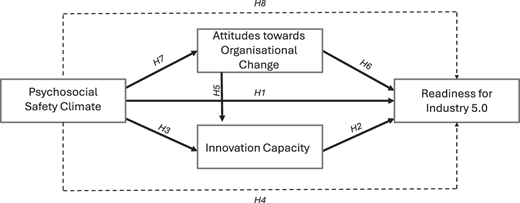
Based on the theoretical relationships discussed above, we propose an integrated model (Figure 1) that captures the complex interplay between PSC, Innovation Capacity, Attitudes towards Organisational Change, and Industry 5.0 readiness. Therefore, we propose an overarching hypothesis that allows us to test the suggested factors as an integrated system:
Based on hypotheses H1-H8, we propose that PSC influences Industry 5.0 readiness through an integrated mediational mechanism. According to H3 and H7, PSC creates organisational conditions that foster both innovation capacity and positive attitudes toward change. According to H2 and H6, these enhanced capabilities and attitudes then directly enable greater readiness for Industry 5.0 implementation. This theoretical chain suggests that PSC operates primarily through these indirect pathways rather than through direct effects, consistent with STS theory's emphasis on the interconnectedness of social and technical systems.
Based on STS theory and following established approaches to complex SEM hypothesis development (Wu et al., 2024; Yáñez-Araque et al., 2017; Zyphur et al., 2023), we propose that PSC influences Industry 5.0 readiness through a theoretically grounded indirect pathway. Specifically, high PSC creates organisational conditions that simultaneously foster positive attitudes toward change and enhance innovation capacity, which then jointly enable greater readiness for Industry 5.0 implementation. This indirect mechanism reflects the established theoretical principle that organisational climate variables achieve their effects on technological outcomes through intermediate psychological and capability-building processes.
H0: Psychosocial Safety Climate influences an organisation's readiness for Industry 5.0 through a complex mediational pathway involving both Innovation Capacity and Attitudes towards Organisational Change, with these mediators also influencing each other.
2. Method
2.1 Ontology and epistemology
This research adopts a contextual realist ontology, recognising the tangible realities brought by digital transformations in both Industry 4.0 and 5.0, and exploring their impact on organisational structures and employee welfare. While acknowledging the objective facts of technological advancements, this perspective also appreciates the evolving human-centric focus of Industry 5.0, which considers the subjective experiences of employees as they adapt to new organisational dynamics (Fleetwood, 2005). This ontological stance allows for an analysis that reflects the technological redefinition of operational processes and organisational culture, while emphasising the critical importance of integrating these with a strong consideration of human factors, as posited by Sociotechnical Systems (STS) theory (Appelbaum, 1997; Sony and Naik, 2020; Trist, 1981).
Epistemologically, this study leans on a pragmatic approach, blending empiricism with the interpretive understanding necessary to grasp the complexities of human-centred changes in Industry 5.0. The research utilises empirical data collection and analysis through quantitative methodologies, employing surveys to examine variables and their interrelationships (Mertens et al., 2016). This empirical approach is enhanced by a theoretical lens provided by STS, which facilitates a deeper understanding of how technological and social systems interplay to impact organisational readiness and adaptation. By integrating empirical findings with theoretical insights, the study aims to uncover patterns that reflect not only the objective realities of technological advancement but also the subjective experiences of employees adapting to these changes. This approach underscores the study's commitment to a comprehensive analysis that respects both the data-driven aspects of scientific inquiry and the nuanced understandings of sociotechnical dynamics.
2.2 Participants
Participants were recruited via Qualtrics academic services, using bulk email invitations to a pre-screened panel of business decision-makers. A screening question (“Have you made business decisions about your organisation in the last 12 months?”) was used to ensure participants had appropriate authority and organisational knowledge. Prior to completing the Industry 4.0 readiness section, participants were provided with a standardised definition of Industry 4.0 to ensure consistent understanding of the concept. A total of 192 participants, who were self-identified decision-makers within their organisations and had a comprehensive understanding of their business processes, completed a 91-item survey following successful screening. The study focused exclusively on individuals employed by publicly listed Australian organisations, excluding non-decision makers, those under eighteen, and avoiding the collection of personal demographic information to maintain participant anonymity.
2.3 Measures
The current study used four self-report scales to measure: (a) Psychosocial Safety Climate, (b) Attitude towards Organisational Change, (c) Innovation Capacity, and (d) Readiness for Industry 5.0:
Psychosocial Safety Climate was evaluated using the PSC-12 scale (Hall et al., 2010), comprising four subscales with 12 items in total. Respondents rated their agreement with statements on a 5-point Likert scale, addressing dimensions such as management commitment (e.g. “In our organisation, senior management acts quickly to correct problems that affect employees’ psychological health”), management priority, organisational communication, and participation. This scale is instrumental in highlighting how an organisation's prioritisation of psychological safety can facilitate the adaptability required in the digital era. The reported validity and reliability of the scale are high (Hall et al., 2010). The Cronbach's α for the current study was 0.86, indicating a good level of internal consistency.
Attitude towards Organisational Change was measured using the Organisational Change Questionnaire-Change, Processes and Readiness (OCQ-C, P, R) (Bouckenooghe et al., 2009) focusing on six subscales from 20 questions that examined participatory management, involvement, top management attitudes, and readiness for change. The scale included items that probe the extent of participatory management in change processes (e.g. “Employees in my organisation are regularly informed on how the change is going”). This measure sheds light on how receptive organisational cultures are to change drive. The OCQ- C, P, R is rated on a 5-point Likert scale and has high reliability (Bouckenooghe et al., 2009). Cronbach's α for the current study was 0.80, indicating a good level of internal consistency.
Innovation Capacity was measured using the Innovation Phase Assessment Instrument (IPAI) (Cropley et al., 2013), selecting 30 items from three subscales to measure the environment, attitudes, and processes for innovation (e.g. “Employees in this organisation are encouraged to look everywhere for ideas”). This choice underscores the necessity of a supportive and dynamic environment for nurturing innovation—a cornerstone of Industry 5.0 readiness. Responses were captured using a 5-point Likert scale, compared to ideal answers to calculate an Innovation Capacity score. The IPAI has been administered to several organisations and is a highly reliable measure (Cropley et al., 2013). Cronbach's α was 0.80, indicating a good level of internal consistency.
Readiness for Industry 5.0 was assessed using a custom questionnaire informed by Xing et al. (2021), focusing on elements like business and skills readiness essential for navigating the technological advancements of Industry 4.0. This measure was designed to capture the organisational capabilities and preparedness within the framework of Industry 4.0, including aspects such as digital transformation alignment, strategy integration, and skill development (e.g. Our organisation's vision aligns with the potential offered by digital transformation). While the measure is rooted in the fourth industrial revolution context, the principles and findings are equally pertinent to the human-centric focus of Industry 5.0, as discussed throughout the paper. This study utilised “Business” and “skills” subscales (28 items) to provide a comprehensive view of an organisation's preparedness, excluding innovation readiness to avoid overlap with IPAI. The implications of these findings are extended to Industry 5.0 in the discussion section, highlighting their relevance in the evolving industry context. Cronbach's α for the current study was 0.78, indicating an acceptable level of internal consistency.
2.4 Procedure
This study employed a quantitative cross-sectional correlational design via an online self-report questionnaire distributed through Qualtrics. Participants were informed about their rights and the study's objectives through an information sheet before giving their consent. The survey, taking an average of 11 min to complete, was aimed at decision-makers in publicly listed Australian organisations. It excluded non-decision makers, individuals not meeting the criteria, and those under eighteen to ensure anonymity. The Human Research Ethics Committee of the University of South Australia granted approval for this research.
2.5 Statistical analysis
Data analysis employed SPSS and AMOS for descriptive analyses of Innovation Capacity, Attitude towards Organisational Change, PSC, and Readiness for Industry 5.0. Following this, assessments for normality, linearity, outliers, and multicollinearity were performed to ensure the data met the assumptions required for further analysis. Pearson correlation coefficients were also calculated to explore the relationships among variables.
To test hypotheses H1 through H8, as well as our overarching hypothesis (H0) about the integrated mediation model, Pathway Analysis with Structural Equation Modelling (SEM) was used in AMOS to investigate the mediating effects of Innovation Capacity and Attitude towards Organisational Change on the relationship between PSC and Readiness for Industry 5.0. SEM was selected for its capacity to estimate multiple interrelated dependencies. The analysis involved assessing models for complete, partial, and no mediation effects, applying maximum likelihood estimation and bootstrapping methods. The models were compared using the Chi-Square Difference test to determine the best fit for the hypothesised relationships.
The optimal model featured Psychosocial Safety Climate as an exogenous variable and Innovation Capacity, Attitude towards Organisational Change, and Readiness for Industry 5.0 as endogenous variables. Model fit was evaluated using various indices: Goodness of Fit Index (GFI), Comparative Fit Index (CFI), Root Mean Square Error of Approximation (RMSEA), and chi-square (χ2). A good fit was indicated by a non-significant χ2 (p > 0.05), GFI >0.95, CFI >0.95, and RMSEA <0.08 with a non-significant PCLOSE (Browne and Cudeck, 1992; Byrne, 2016).
3. Results
3.1 Normality and preliminary analysis
Tests for normality, linearity, outliers, and multicollinearity were conducted, revealing moderate positive skewness in Innovation Capacity and Readiness for Industry 5.0, which was adjusted for using bootstrapping. Harman's single-factor test indicated a low risk of common method bias, with only 23.33% of variance accounted for by a single factor (Kock et al., 2021).
To assess construct validity for Industry 5.0 readiness, a confirmatory factor analysis (CFA) was performed. The initial single-factor model showed poor fit indices: χ2(32) = 148.29, p < 0.05; CFI = 0.65; TLI = 0.60; RMSEA = 0.14; SRMR = 0.10. A four-factor model, aligned with theoretical expectations, yielded much better fit: χ2(83) = 218.659, p < 0.001; CFI = 0.909; TLI = 0.885; RMSEA = 0.092; SRMR = 0.087. The significant improvement (Δχ2(6) = 161.78, p < 0.001) supported the constructs' discriminant validity and confirmed the theoretical framework.
Descriptive statistics and Pearson's correlation highlighted positive, significant associations among Psychosocial Safety Climate, Attitude towards Organisational Change, Innovation Capacity and Readiness for Industry 5.0 (see Table 1).
3.2 Path analysis
Structural Equation Modelling (SEM) in AMOS v26 was used to test the hypotheses involving mediation effects (H4 and H8) and direct effects (H1, H2, H3, H5, H6, and H7), as well as our overarching hypothesis (H0) regarding the integrated influence of PSC on Industry 5.0 readiness through mediating factors. This analysis examined how Innovation Capacity and Attitude towards Organisational Change mediate the relationship between Psychosocial Safety Climate (PSC) and Readiness for Industry 5.0. In the analysis, PSC was treated as an exogenous variable, while Innovation Capacity, Attitude towards Organisational Change, and Readiness for Industry 5.0 were endogenous variables.
Due to non-normal distribution (Critical Ratio >5), bootstrapping with 2,000 iterations and 95% confidence intervals was used to address this issue, along with Bollen-Stine bootstrap for model fit (Akins et al., 2005; Cifuentes-Faura and Faura-Martínez, 2023). Maximum likelihood estimation with bootstrapping was employed to test full mediation, partial mediation, and direct effect models.
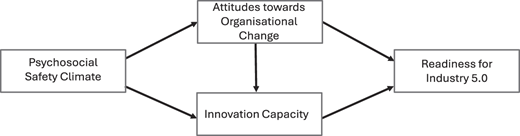
Model 1 proposed full mediation without a direct PSC-Readiness path (see Figure 2), Model 2 (modified for partial mediation) removed the direct effect of Attitude on Innovation Capacity, and Model 3 explored direct associations. Comparative analysis showed Model 1, with full mediation, as the best fit, confirmed by fit indices (non-significant χ2 (1) = 1.78, p = 0.18, GFI and CFI >0.95, RMSEA = 0.06 with PCLOSE >0.05) (see Table 2).
Model comparisons using the chi-square difference test highlighted Model 1's superiority, fitting the data significantly better than Models 2 and 3, validating the hypothesised mediating roles (H4 and H8) and affirming Model 1 as the most representative of the empirical evidence. This result also supports our overarching hypothesis (H0) that PSC influences Industry 5.0 readiness through an integrated pathway involving both Innovation Capacity and Attitudes towards Organisational Change.
3.3 Direct and Indirect effects
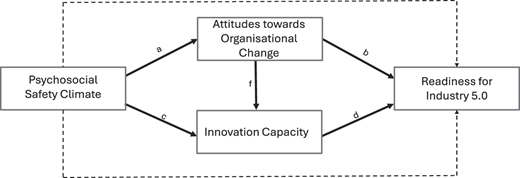
Model 1, which proposed that Attitude towards Organisational Change and Innovation Capacity mediate the relationship between Psychosocial Safety Climate (PSC) and Readiness for Industry 5.0, was found to best fit the data, explaining 58.9% of the variance in Industry 5.0 readiness (see Figure 3 and Table 3).
The analysis of Model 1 supported Hypotheses 2, 5, 6, and 7. Higher innovation capacity was significantly associated with better organisational preparedness for Industry 5.0 (H2). A positive attitude towards organisational change was significantly correlated with a higher capacity for innovation (H5). Organisations with positive attitudes towards change were more ready for Industry 5.0 (H6), and high levels of PSC were associated with more positive attitudes towards change (H7).
However, the direct effect in H1, suggesting that high PSC directly leads to better Industry 5.0 preparedness, was not supported. This implies a potentially indirect role for PSC. H8 was supported, confirming that Attitude towards Organisational Change mediates the relationship between PSC and Industry 5.0 readiness. Although H3 was not directly supported, partial support for H4 suggested that Innovation Capacity might mediate the path from PSC to Industry 5.0 readiness. Taken together, these findings provide substantial support for our overarching hypothesis (H0) that PSC influences Industry 5.0 readiness through a complex mediational pathway involving both mediating variables, though the specific pathways differ somewhat from our initial predictions.
4. Discussion
This study explains the complex interplay of social system factors in shaping organisational readiness for Industry 5.0. Our findings indicate that readiness for Industry 5.0 involves more than technological adoption; it requires integrating strategies that enhance employee wellbeing, creativity and engagement within technological advancements. This approach signifies a paradigm shift towards a more holistic readiness model that equally values technical progress and human-centric innovation strategies, aligning with the core principles of Sociotechnical Systems (STS) theory (Hamada, 2019; Paschek et al., 2022; Yilmaz et al., 2021). The confirmation of our overarching hypothesis (H0) provides strong support for the importance of examining social system factors as an integrated network of influences rather than isolated variables. The complex mediational pathways identified demonstrate how PSC creates the foundation for positive attitudes toward change and enhanced innovation capacity, which together contribute to greater readiness for Industry 5.0.
The research highlights the mediating roles of Innovation Capacity and Attitudes Towards Organisational Change in linking Psychosocial Safety Climate (PSC) with Industry 5.0 readiness. It statistically substantiates that robust levels of PSC, combined with a positive attitude towards change and enhanced innovation capacity, significantly elevate an organisation's readiness for the challenges of Industry 5.0. These findings resonate with those of Lee and Idris (2017), which found that proactive managerial approaches to employee well-being substantially contribute to creating a supportive climate that enhances safety, value, and readiness for future work challenges that involve humans and machines working together.
An intriguing aspect of the study was that eliminating PSC's direct link to Industry 5.0 Readiness enhanced the mediating role of Attitude towards Organisational Change and Innovation Capacity. Such enhancement underscores the assertion that a focus on employee well-being boosts productivity and innovation and is essential for navigating the transition to Industry 5.0. A strong PSC ensures that employees feel safe and supported as they navigate the complexities of adapting to AI and cobot technologies. When employees feel that their psychological health is a priority, they are more likely to engage positively with new technologies, experiment without fear of failure, and provide valuable feedback that can lead to improvements in how these technologies are integrated. For example, in settings where cobots are introduced to assist with manual tasks, a supportive PSC can facilitate better teamwork between humans and machines, leading to innovative ways of managing workflows that optimise both human and robotic contributions. Our study suggests that organisations poised for success in the digital era are those that nurture a strong PSC, cultivate positive attitudes towards change, and foster a culture of innovation. These elements collectively form a readiness nexus, preparing organisations for the significant shifts brought about by Industry 4.0 and sets a foundation for the further evolution into Industry 5.0, where their relevance is intensified (Huang et al., 2022).
A comparative analysis identified Innovation Capacity as the most significant predictor of readiness for Industry 5.0, pointing to adaptability and change management skills as crucial elements beyond mere technological resources (Golovianko et al., 2023; Pizoń and Gola, 2023). The finding emphasises the need for a robust framework that integrates both technological and human elements—a core principle of Sociotechnical Systems (STS) theory. By highlighting Innovation Capacity as a critical factor, this research underscores the importance of fostering an environment where technological and human resources are aligned. Such alignment enhances the organisation's agility and responsiveness to technological changes, making it better equipped to capitalise on the opportunities presented by Industry 5.0 (Hasan and Sony, 2023; Potočan et al., 2020). For instance, the implementation of AI in production processes can optimise operations and predict maintenance needs, thereby reducing downtime and increasing productivity. However, to fully leverage these benefits, employees must be able to work synergistically with these systems. This requires a change in mindset from traditional methods to a more integrated and adaptive approach. Here, Innovation Capacity is crucial as it empowers employees to understand and innovate on new technological processes, ensuring that the workforce is not only compliant but also proactive in leveraging AI capabilities.
The results from this research have provided a granular understanding of how these social systems factors interact to influence readiness for Industry 5.0. The significant proportion of variance in readiness accounted for by the model indicates the strength of these associations and suggests that focusing on social system factors is essential for organisations preparing for Industry 5.0. This research invites further exploration into how organisational culture and leadership practices can cultivate positive attitudes, potentially leading to higher innovation outputs and greater overall organisational readiness for future technological challenges (Kopp et al., 2019; Lundgren et al., 2023).
4.1 Theoretical Implications
This study ventures into relatively uncharted territory by exploring the nuances of organisational readiness for Industry 5.0. By incorporating the social dynamics of digital transformation preparedness into the analysis, it challenges the traditionally tech-centric view of industrial evolution, aligning more closely with the tenets of Sociotechnical Systems (STS) theory (Prodi et al., 2021; Sony and Naik, 2020; Trist, 1981).
Our findings refine STS theory by demonstrating that integrating psychosocial safety and innovation capacity significantly enhances an organisation's readiness for Industry 5.0. This aligns with our proposed extended STS framework, which emphasises the need for dynamic socio-technical alignment in rapidly changing technological environments. Traditional STS models, while valuable, often overlook the critical role of human-centric factors such as creativity and well-being in driving technological integration (Ávila-Gutiérrez et al., 2022; Grosse et al., 2023). Moreover, our research extends Psychosocial Safety Climate (PSC) theory by elaborating on how it influences the context and human capacity for new technology introduction. For instance, our findings suggest that organisations with a high PSC are better positioned to implement advanced technologies, such as AI and cobots, with minimal disruption to employee workflows. Integrating psychosocial support with technological advancements fosters a more resilient workforce and enhances innovation capacity and adaptability in the face of Industry 5.0 challenges. By demonstrating the role of PSC in facilitating technological readiness, our study expands PSC theory beyond its traditional focus on worker well-being to include its impact on organisational adaptability and innovation in rapidly changing technological environments. Thus, future applications of both STS and PSC theories should consider these deep interconnections to fully realise the potential of Industry 5.0 and to better understand the role of psychosocial factors in technological adaptation.
This study underscores the importance of addressing the psychological and social aspects of organisational change, which are vital for thriving in the rapidly evolving digital landscape. Extending traditional STS applications by incorporating broader socio-psychological dynamics, this study provides a more comprehensive framework that reflects the complexities of modern industrial systems. Our findings support the need for STS theory to evolve to remain relevant in understanding Industry 5.0, particularly in recognising the blurring boundaries between human and machine capabilities (Oztemel and Gursev, 2020; Pizoń and Gola, 2023).
The integration of PSC into our extended STS framework contributes to a more nuanced understanding of how organisations can create environments that support both technological advancement and employee well-being. This addresses a key challenge in the transition to Industry 5.0 and responds to the call for STS theory to better account for the human factors in highly digitalised and automated environments (Bednar and Welch, 2020).
This broader theoretical contribution enriches the academic discussion around Industry 5.0 and provides a nuanced perspective that could influence future research and practice. By highlighting the interconnectedness of social and technological aspects, the study paves the way for more integrated and human-centred approaches to industrial readiness, aligning with the emerging focus on sustainability and employee well-being in the context of global digital transformation.
4.2 Practical Implications
In the context of rapid industrial evolution and heightened competition, businesses are increasingly seeking to leverage technological advancements to bolster their productivity (Hamada, 2019). This research offers practical insights, urging practitioners to extend their focus beyond mere technical readiness for Industry 4.0 and beyond. The findings advocate for managerial strategies that enable a conducive environment for innovation and organisational change, with a significant emphasis on enhancing Psychosocial Safety Climate (PSC) levels.
Key recommendations informed by this study include:
Prioritising Psychosocial Safety Climate: Implement strategies that enhance PSC within the organisation. Develop policies and practices that protect employee psychological health and safety, fostering a culture where employees feel valued, safe, and supported.
Promoting Innovation Capacity: Encourage a culture of innovation by providing opportunities for employee development and engagement in innovative practices is essential. Consider innovation workshops, cross-departmental collaboration, and incentivising creative problem-solving.
Cultivating Positive Attitudes Towards Change: Utilise training programs that prepare employees for organisational change, emphasising the benefits of adaptability and flexibility is key. Ensure clear communication about the importance of the human worker in Industry 5.0 and the crucial role they play in this transition.
Developing “Best Practice” Guidelines: Based on the findings, create guidelines that outline effective strategies for improving PSC, innovation capacity, and attitudes towards change. These guidelines can serve as a roadmap for organisations aiming to achieve a seamless transition into Industry 5.0.
By integrating these recommendations, organisations can enhance their technological readiness while ensuring they are socially and organisationally prepared to thrive in the Fifth Industrial Revolution. These insights provide a foundational framework for developing interventions aimed at bolstering the social systems aspects of businesses, facilitating a smoother adaptation to the challenges and opportunities presented by increased digitalisation and a broader digital transformation.
4.3 Strengths, limitations and future directions
This study's examination of social system factors in preparing organisations for Industry 5.0 offers valuable insights into the socio-technical dynamics underpinning this industrial shift. The study's strength lies in its focus on diverse organisational representation among participants. The methodological approach, involving one representative per organisation, captured a broad view of Industry 4.0 and subsequently Industry 5.0 readiness across various entities. While this strategy succeeded in ensuring diversity, it may have constrained the depth of understanding achievable through a more concentrated, multi-respondent approach within organisations.
Relying on cross-sectional, self-reported data presents challenges, particularly in establishing causality and addressing social desirability bias. The focus on decision-makers' views may not fully reflect broader organisational perspectives, potentially leading to overestimations of positive attributes like safety culture. Leaders often tend to overestimate the positivity of organisational attributes, which underlines the importance of gathering diverse internal viewpoints for a more comprehensive understanding (Huang et al., 2022; Loh et al., 2019, 2021; Loh et al., 2021). Additionally, the absence of detailed demographic data on participating organisations, such as size, industry sector, and technological maturity, limits our ability to examine how these characteristics might moderate the relationships observed. A key limitation is the study's exclusive focus on Australian organisations, which may limit the generalisability of findings to other national contexts. Australia's specific economic structure, regulatory environment, and pace of technological adoption may influence how organisations approach Industry 5.0 readiness.
To address these limitations, future research could adopt longitudinal and mixed-methods designs for a richer understanding of how social system factors impact Industry 5.0 readiness. Incorporating both qualitative and quantitative data from different organisational levels would offer a more nuanced view of changing social dynamics. Moreover, expanding the scope to include personnel diversity, social equity, and technological advancements could provide a more holistic perspective on thriving in an Industry 5.0 era.
In summary, while this study contributes to the existing body of knowledge, the identified limitations and suggested future directions underscore the need for ongoing research. A deeper investigation into the interplay between social system factors and Industry 5.0 readiness-specifically from a Socio-technical Systems lens, incorporating a wider range of perspectives and methodological rigour, will be crucial in guiding organisations through the complexities of Industry 5.0 and future of work.
5. Conclusion
This research provides a detailed examination of organisational readiness for Industry 5.0, viewed through a Socio-technical Systems lens. It underscores the critical interplay between technological advancements and social system elements, establishing their combined importance in meeting the unique demands of Industry 5.0. The study reveals that effective adaptation to Industry 5.0 requires more than just technological upgrades; it necessitates a profound integration of strategies that enhance employee well-being and engagement. These strategies foster organisational cultures that are supportive, adaptive and finely attuned to the rapid technological shifts characteristic of this era. By accounting for approximately 60% of the variance in readiness, the findings highlight the significant impact of prioritising psychosocial factors alongside technological innovations. A central finding is the role of employee well-being in promoting a culture receptive to change and innovation, thus facilitating smoother and more effective integration of advanced technologies typical of Industry 5.0.
The insights provided here deepen the understanding of the socio-technical dynamics of Industry 5.0 readiness and pave the way for further research. This study invites future investigations to expand on the social systems perspective, exploring its impact on organisational performance and technological adaptation. Furthermore, the findings offer practical guidance for designing interventions that enhance the social dimensions of businesses. These interventions are crucial as they ensure organisations are prepared both technologically and socially to excel in the continually evolving industrial landscape, making them well-suited to thrive in the future of work. Future research should explore longitudinal impacts and diverse industry applications of the expanded STS framework, examining how these elements can be effectively integrated to enhance organisational resilience and innovation in the face of Industry 5.0 challenges.
The authors would like to thank the editors and peer reviewers for their constructive feedback on this manuscript. The authors also extend their appreciation to Dr May Young Loh and Dr Mikaela Sian Owen for their assistance in double-checking the statistical analyses.