


To achieve organisational pro-environmental goals, it is critical that employees engage in pro-environmental behaviours. This study aims to understand how individual and organisational biospheric values, self-efficacy and collective outcome efficacy are related to in-role pro-environmental behaviours (i.e. designing pro-environmental products or services) and environmental advocacy at work (i.e. encouraging environmental action among others).
We conducted a questionnaire study among 304 Dutch employees.
As expected, stronger individual and perceived organisational biospheric values were related to higher self-efficacy and collective outcome efficacy, which in turn promoted in-role pro-environmental behaviours and environmental advocacy. Further, particularly self-efficacy mediated the relationship between both types of values and in-role pro-environmental behaviour and advocacy. Interestingly, the pattern of results was similar for both behaviours. We discuss how organisations can leverage these insights to foster pro-environmental action at work.
We discuss how organisations can leverage these insights to foster pro-environmental action at work.
We extend previous work by examining both individual and organisational level factors related to pro-environmental behaviour at work. Specifically, we examine to what extent individual and perceived organisational biospheric values explain employees’ in-role pro-environmental behaviour and environmental advocacy, and how self-efficacy and collective outcome efficacy are associated with these relationships. Our findings indicate that both individual and organisational level factors are important to understand employees’ pro-environmental behaviour. We rely on a high-quality sample from an organisation in a sector with high climate impact to test our reasoning.
The world is facing major global challenges, including climate change and its severe negative impacts (IPCC, 2022, 2023), with more than six of the nine planetary boundaries being breached (Richardson et al., 2023). Addressing these problems requires actions by all actors, including the adoption of environmentally friendly behaviours in both private and workplace settings (IPCC, 2023; Steg, 2023). Organisations can play a key role in mitigating environmental problems such as climate change. Many organisations recognise their role and have embraced Corporate Environmental Responsibility (CER; Manika et al., 2015), explicitly aiming to reduce their environmental impact. Such organisational environmental goals will only be achieved when employees engage in pro-environmental behaviour at work (also referred to as organisational citizenship behaviours for the environment or employee green behaviours; Boiral and Paillé, 2012; Organ, 1988, 1997; Unsworth et al., 2021; Zacher et al., 2023; Zhang et al., 2024). Pro-environmental behaviour refers to actions that reduce negative environmental impacts (Steg and Vlek, 2009). Prior research has largely focused on the domestic domain (Carrus et al., 2021; Geiger et al., 2019; Nielsen et al., 2024; Van Valkengoed et al., 2022a, b), with pro-environmental actions at the workplace receiving comparatively less attention. It is critical to understand to what extent employees engage in pro-environmental behaviour at work and what factors underpin such behaviour, as interventions will be more effective when they target key antecedents of behaviours (Katz et al., 2022; Van Valkengoed et al., 2022a, b).
Pro-environmental behaviour at work
Employees may engage in various types of pro-environmental behaviours within the workplace (Boiral and Paillé, 2012; Unsworth et al., 2021; Zacher et al., 2023; Zhang et al., 2024). Many studies focus on extra-role workplace behaviours that are not part of employees’ task description, such as commuting by public transport, recycling, switching off lights or computers, or avoiding unnecessary material use (Bamberg and Möser, 2007; Francoeur et al., 2021; Geiger et al., 2019; Katz et al., 2022; Ruepert et al., 2017; Zacher et al., 2023). Meanwhile, in-role pro-environmental behaviours at work reflect behaviours that are part of one’s task description and formally rewarded. Examples are adoption of environmentally friendly work practices, participation in sustainability initiatives or helping to develop procedures and policies aimed at reducing emissions and resource use (Boiral, 2009; Boiral and Paillé, 2012).
In addition, employees may also indirectly contribute to reducing their organisation’s environmental impact by promoting pro-environmental behaviour among others, such as colleagues, clients or management (cf. Homburg and Stolberg, 2006; Kim et al., 2017; Ones et al., 2018; Smith and O’Sullivan, 2012; Zacher et al., 2023). Such behaviours are sometimes referred to as indirect pro-environmental behaviour at work, as they influence the environmental actions of others rather than one’s own behaviour (Zacher et al., 2023). In line with the environmental psychology literature, we refer to these behaviours as environmental advocacy at work. Such environmental advocacy includes informing others about how to reduce their environmental impact, encouraging leadership or external stakeholders to adopt greener strategies, role modelling pro-environmental behaviour and giving feedback by complimenting or criticising others’ actions (Francoeur et al., 2021; Kim et al., 2017; Van Valkengoed et al., 2025). While environmental advocacy may have a relatively large environmental impact when it changes the behaviours of many people and can promote organisational-level change, it has not received much empirical attention. Moreover, it is not clear to what extent similar or different factors are related to in-role pro-environmental behaviour and environmental advocacy. This study extends previous work by examining which factors affect both types of workplace pro-environmental behaviours. We use the term employees’ pro-environmental behaviour as an overarching label for both.
Factors influencing in-role pro-environmental behaviours and environmental advocacy at work
Employees’ pro-environmental behaviour is likely not only related to individual-level factors, but also to organisational-level factors, as the behaviour takes place in the organisational context. Yet, individual and organisational-level factors have hardly been considered together in one study. We aim to address this gap by considering both individual and organisational level factors, focusing on the role of values and efficacy beliefs. Specifically, we aim to study to what extent both individual and perceived organisational biospheric values relate to pro-environmental behaviour at work, including in-role pro-environmental behaviour and environmental advocacy. Further, we investigate the psychological mechanisms underlying these relationships by examining two types of efficacy beliefs that reflect different forms of agency in organisations: self-efficacy and collective outcome efficacy.
Values reflect guiding principles in people’s lives that influence to what extent people consider different consequences when making choices, and thereby affect a wide range of actions across contexts (Schwartz, 1992; Schwartz and Bilsky, 1987). Particularly biospheric values, which reflect the extent to which people care about nature and the environment, affect pro-environmental behaviour: stronger biospheric values promote pro-environmental behaviour in the private sphere (De Groot and Steg, 2008; Steg, 2016; Steg and de Groot, 2012), and at work (Andersson et al., 2005; Dumont et al., 2017; Norton et al., 2015a; Ruepert et al., 2017), including in-role pro-environmental behaviours (Wagner et al., 2025). We reason that stronger biospheric values also encourage employees to motivate others to act pro-environmentally, as such environmental advocacy can help to reduce the environmental impact of their organisation. Therefore, we expect that stronger biospheric values are associated with more in-role pro-environmental behaviours (H1), and environmental advocacy (H2).
Stronger biospheric values are associated with more in-role pro-environmental behaviours.
Stronger biospheric values are associated with more environmental advocacy.
Next, perceived organisational biospheric values likely affect pro-environmental actions at work. Many organisations aim to reduce their environmental impact (e.g. by adopting Corporate Environmental Responsibility; Ruepert, 2016; Ruepert et al., 2017), and may thus be perceived as endorsing biospheric values (Andersson et al., 2005; Wagner et al., 2025). People are generally likely to act in line with the values of the groups they belong to, such as their organisation (Bouman and Steg, 2022; Jans et al., 2018; Mildenberger and Tingley, 2019; Steg, 2023; Wang et al., 2021). Thus, we reason that when employees believe their organisation strongly endorses biospheric values, they are more likely to act in ways that align with these values. There is some initial evidence to suggest that the more employees perceive that their organisation values nature and the environment, the more likely they are to act pro-environmentally at work (Norton et al., 2014, 2015b; Ruepert et al., 2017; Sharpe et al., 2022), including in-role pro-environmental behaviours (Wagner et al., 2025). Employees who more strongly view their organisation as endorsing biospheric values likely also engage more in environmental advocacy, as such actions would serve the pro-environmental goals of the organisation. Thus, we posit that the more strongly employees believe that their organisation endorses biospheric values, the more likely they are to engage in in-role pro-environmental behaviour (H3) and environmental advocacy (H4).
The more strongly employees believe that their organisation endorses biospheric values, the more likely they are to engage in in-role pro-environmental behaviour.
The more strongly employees believe that their organisation endorses biospheric values, the more likely they are to engage in environmental advocacy.
Values represent broad life goals that guide people’s choices, but they tend to shape behaviour indirectly by influencing behaviour-specific beliefs (De Groot and Steg, 2009; Steg, 2016; Steg and Nordlund, 2018; Steg and de Groot, 2010), such as efficacy beliefs that reflect perceived agency to help reduce the environmental impact of the organisation. Here, we examine the role of self-efficacy at the individual level and collective outcome efficacy at the organisational level (cf. Hamann et al., 2024).
Biospheric values and self-efficacy
Self-efficacy refers to one’s perceived capability to engage in pro-environmental behaviour (Bandura, 1997). Stronger self-efficacy is generally associated with a higher likelihood of engaging in behaviour (Schutte and Bhullar, 2017). Adopting pro-environmental behaviour at work oftentimes is somewhat effortful or inconvenient. Employees with strong biospheric values may be more motivated to engage in pro-environmental behaviours because this aligns with what they find important. Further, they may be more willing to incur some costs to adopt this behaviour, and therefore perceive such costs as less burdensome, which can reduce perceived barriers to action. Consequently, they may feel more capable of overcoming these costs (i.e. higher self-efficacy; Ruepert et al., 2015; Steg et al., 2014a, b). Further, employees who perceive that their organisation values environmental protection may feel more capable of engaging in pro-environmental behaviour at work, as they may perceive their pro-environmental actions are supported and encouraged by the organisation (Wagner et al., 2025). Initial evidence indeed suggests that both individual and perceived organisational biospheric values are associated with higher self-efficacy at work (Wagner et al., 2025). Thus, we hypothesise that stronger individual biospheric values are associated with higher self-efficacy, which in turn is associated with more in-role pro-environmental behaviour at work (H5). Similarly, we hypothesise that stronger perceived organisational biospheric values are associated with higher self-efficacy, which is associated with more in-role pro-environmental behaviour at work (H6). We also explore the relationship between individual and organisational biospheric values, self-efficacy and environmental advocacy, but do not formally hypothesise these relationships.
Stronger individual biospheric values are associated with higher self-efficacy, which in turn is associated with more in-role pro-environmental behaviour at work.
Stronger perceived organisational biospheric values are associated with higher self-efficacy, which is associated with more in-role pro-environmental behaviour at work.
Biospheric values and collective outcome efficacy
Collective outcome efficacy refers to employees’ beliefs that joint efforts at work can reduce their organisation’s environmental impact (cf. Doherty and Webler, 2016; Riggs and Knight, 1994; Steg and de Groot, 2019, 2010). Collective outcome efficacy is likely higher when employees more strongly believe their organisation endorses biospheric values, since this signals that environmental improvement is a shared goal. As a result, employees may judge it more likely that others at work will engage in pro-environmental behaviour, which strengthens the belief that joint efforts can reduce the organisation’s environmental impact. Stronger individual biospheric values may also enhance collective outcome efficacy, as people may be more likely to look for and recognise opportunities to reduce the environmental impact of their organisation, but we expect this relationship to be weaker (Steg and de Groot, 2010).
Higher collective outcome efficacy is likely related to more pro-environmental behaviour at work, because personal efforts seem more worthwhile when one thinks collective actions will have an impact in the first place (Bandura, 2000; Fritsche and Masson, 2021). Indeed, stronger collective outcome efficacy increases the likelihood that people engage in pro-environmental behaviour (Chen et al., 2015; Choi and Hart, 2021; Hamann and Reese, 2020) and encourage others to do so, i.e. environmental advocacy (Bamberg et al., 2015; Doherty and Webler, 2016; Guenthner et al., 2025; van Zomeren et al., 2010). Thus, we hypothesise that stronger perceived organisational biospheric values are associated with higher collective outcome efficacy, which is associated with more in-role pro-environmental behaviours (H7) and more environmental advocacy (H8). We also explore the relationship between individual biospheric values, collective outcome efficacy, in-role pro-environmental behaviours and environmental advocacy, but do not formally hypothesise this relationship (see Figure 1).
Stronger perceived organisational biospheric values are associated with higher collective outcome efficacy, which is associated with more in-role pro-environmental behaviours.
Stronger perceived organisational biospheric values are associated with higher collective outcome efficacy, which is associated with more environmental advocacy.
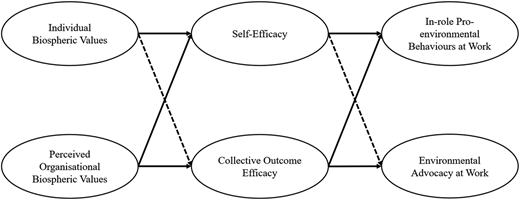
Conceptual model showing hypothesised relationships between biospheric values and efficacy beliefs on the individual and organisational level, and in-role pro-environmental behaviour and environmental advocacy. Note. Solid lines represent the hypothesised relationships. Dotted lines represent additional tested relationships between constructs. Direct relationships between both biospheric values and both behavioural outcomes were also tested in the analyses, but are omitted from the figure for clarity
Conceptual model showing hypothesised relationships between biospheric values and efficacy beliefs on the individual and organisational level, and in-role pro-environmental behaviour and environmental advocacy. Note. Solid lines represent the hypothesised relationships. Dotted lines represent additional tested relationships between constructs. Direct relationships between both biospheric values and both behavioural outcomes were also tested in the analyses, but are omitted from the figure for clarity
Methods
Sample and procedure
This study was reviewed and approved by the Ethics Committee at the Faculty of Behavioural and Social Sciences (EC-BSS) at the University of Groningen (PSY-2324-S-0141).
We conducted a questionnaire study among employees working at a multinational financial organisation [1] in the Netherlands in February 2025. To be eligible for this study, employees had to be at least 18 years old; participation was voluntary and not compensated. The Head of Sustainability of the organisation sent an invitation email to approximately 3,000 employees based in the Netherlands [2]. Respondents accessed the questionnaire through a link provided in the email. After providing informed consent, respondents completed questions on personal and perceived organisational values, in-role pro-environmental behaviours and environmental advocacy, self-efficacy and collective outcome efficacy, and sociodemographic information including age, gender, average weekly working hours, tenure at the organisation and whether they supervise others (in this order). The questionnaire included additional variables, namely perceived CER and credibility, identification with the work team and the organisation, outcome efficacy and social and personal norms. We do not report these as they are not relevant to the purpose of this study. A total of 281 [3] employees fully completed the questionnaire and passed both attention checks, prompting respondents to select a specific response option. The response rate was modest (9.4%) but consistent with typical participation rates for voluntary, single-invite questionnaires without incentives in organisational studies (Baruch and Holtom, 2008). Appendix A provides an overview of the demographic characteristics of the final sample.
Measures [4]
Individual biospheric values
Employees’ individual values were assessed using a validated scale designed to capture egoistic, altruistic and biospheric values (De Groot and Steg, 2008). Participants rated the importance of 13 values on a nine-point scale, ranging from −1 (opposed), 0 (not important) to 7 (extremely important) [5]. Four items reflected biospheric values: Protecting the environment: preserving nature; Respecting the earth: harmony with other species; Unity with nature: fitting into nature; Preventing pollution: protecting natural resources. The biospheric values scale showed high internal consistency (α = 0.89; ω = 0.89; M = 4.90; SD = 1.40), suggesting that respondents generally considered biospheric values to be an important guiding principle in their lives.
Perceived organisational biospheric values
To assess perceived organisational values, we used the same items and scale [6] as for individual values, but this time participants rated how important they think each value is as a guiding principle for their organisation. This scale also showed high internal consistency (α = 0.92; ω = 0.92; M = 3.50; SD = 1.60). On average, respondents perceived their organisation to value nature and the environment, although to a lesser degree than they do personally.
Self-efficacy
Self-efficacy in performing pro-environmental behaviours in the workplace was measured using three items: I am able to change the way I work to reduce my negative impact on the environment at work; I am able to adapt my work to reduce my negative impact on the environment at work; I am able to make changes in my work to reduce my negative impact on the environment (based on Breaugh, 1985; Chen et al., 2015). Responses were recorded on a 7-point scale from 1 (strongly disagree) to 7 (strongly agree). The items formed a reliable scale (α = 0.91; ω = 0.91; M = 3.72, SD = 1.49); employees felt moderately able to engage in pro-environmental action at work.
Collective outcome efficacy
Collective outcome efficacy was measured using three items: Together, we, [organisation] employees, can contribute to reducing [organisation’s] negative impact on the environment by acting environmentally friendly at work; Together we, [organisation] employees, can reduce [organisation’s] negative impact on the environment; Together, we, [organisation] employees, can contribute to reducing [organisation’s] negative impact on the environment by choosing environmentally friendly ways of working (adapted from the European Social Survey, 2016). Responses were given on a 7-point scale ranging from 1 (strongly disagree) to 7 (strongly agree). The items formed a reliable scale (α = 0.94; ω = 0.94; M = 4.85, SD = 1.32); respondents perceived that the organisation’s negative environmental impact can be reduced by collectively engaging in pro-environmental action.
In-role pro-environmental behaviours at work
Three items were included to assess in-role pro-environmental behaviours: I contribute to projects and events that help reduce [organisation’s] negative impact on the environment; I help establish procedures and policies to reduce [organisation’s] negative impact on the environment; I help to design products and services for colleagues and/or customers to reduce [organisation’s] negative impact on the environment (adapted from Boiral and Paillé, 2012; Wagner et al., 2025; Zhang et al., 2024). To contextualise the items, reference to the organisation was made. Responses were provided on a seven-point scale ranging from 1 (never) to 7 (always). The scale showed good internal consistency (α = 0.83; ω = 0.83; M = 2.49; SD = 1.42); employees occasionally engage in these behaviours.
Environmental advocacy at work
We assessed employees’ environmental advocacy using the following items: At [organisation], I advise colleagues and/or customers on how to reduce their negative environmental impact; At [organisation], I advise colleagues and/or customers on how to prevent the negative impacts of climate change on themselves; At [organisation], I motivate colleagues and/or customers to opt for pro-environmental options and products; I talk with my colleagues at [organisation] about how we can reduce our negative impact on the environment at work; I draw management’s attention to potentially environmentally unfriendly activities or policies of [organisation]; I collaborate with colleagues and/or customers of [organisation] to find the most sustainable and financially viable options; I put forward ideas to reduce [organisation’s] negative impact on the environment (adapted from Francoeur et al., 2021; Kim et al., 2017; Smith and O’Sullivan, 2012; Van Valkengoed et al., 2025). Responses were collected on a 7-point scale ranging from 1 (never) to 7 (always). The scale showed good internal consistency (α = 0.89; ω = 0.90; M = 2.78, SD = 1.28); employees occasionally engage in these behaviours.
Analytical approach
Hypotheses 1 to 4 were tested using bivariate correlations, which provide a direct test of the strength and direction of these relationships. To test hypotheses 5–8, we conducted simple mediation analyses, testing the mediation paths separately using bootstrapped indirect effects with the MedMod module in Jamovi (The jamovi project, 2023) [7].
Results
Table 1 shows that all variables are significantly positively correlated (see Table 1). Stronger biospheric values, both individual and organisational, were associated with more in-role pro-environmental behaviour and environmental advocacy, supporting H1-4. Stronger individual and organisational biospheric values were related to higher self-efficacy and collective outcome efficacy as well. Stronger self-efficacy and higher collective outcome efficacy were related to more in-role pro-environmental behaviours and environmental advocacy, to a similar extent. Next, stronger individual biospheric values were related to stronger perceived organisational biospheric values, and stronger self-efficacy was related to stronger collective outcome efficacy. Furthermore, the more employees engage in in-role pro-environmental behaviours, the more likely they are to engage in environmental advocacy as well [8].
Correlations between the model variables
| Variable | 1 | 2 | 3 | 4 | 5 | 6 |
|---|---|---|---|---|---|---|
| 1. Individual biospheric values | – | |||||
| 2. Organisational biospheric values | 0.28* | – | ||||
| 3. Self-efficacy | 0.24* | 0.33* | – | |||
| 4. Collective outcome efficacy | 0.27* | 0.25* | 0.51* | – | ||
| 5. In-role pro-environmental behaviours | 0.23* | 0.30* | 0.45* | 0.36* | – | |
| 6. Environmental advocacy | 0.31* | 0.30* | 0.49* | 0.38* | 0.79* | – |
Note(s): To assess the robustness of the results, we additionally estimated non-parametric tests; we find similar results (see Appendix D), N = 304, *p < 0.001
Mediation analyses
Table 2 shows the results of a series of simple mediation analyses examining whether self-efficacy and collective outcome efficacy explained the associations between individual and perceived organisational biospheric values and in-role pro-environmental behaviour and environmental advocacy. As expected, stronger individual and organisational biospheric values, respectively, were each associated with higher self-efficacy, which in turn related to more frequent in-role pro-environmental behaviour (supporting H5 and H6) as well as environmental advocacy. Direct effects of individual and organisational biospheric values on both behaviours remained significant, indicating partial mediation.
Results of the simple mediation analyses
| Hypothesis | Predictor | Mediator | Outcome | Indirect Effect (B, 95% CI) | Direct Effect (B, 95% CI) | Total Effect (B, 95% CI) | % Mediated |
|---|---|---|---|---|---|---|---|
| H5 | Individual Biospheric Values | Self-efficacy | In-role PEB | 0.104*** [0.053, 0.163] | 0.107 [−0.002, 0.216] | 0.211*** [0.089, 0.328] | 49.4 |
| H6 | Organisational Biospheric Values | Self-efficacy | In-role PEB | 0.118*** [0.066, 0.178] | 0.139* [0.033, 0.252] | 0.257*** [0.151, 0.375] | 45.8 |
| H7 | Organisational Biospheric Values | Collective Outcome Efficacy | In-role PEB | 0.069*** [0.034, 0.112] | 0.188*** [0.079, 0.295] | 0.257*** [0.151, 0.364] | 26.8 |
| H8 | Organisational Biospheric Values | Collective Outcome Efficacy | Environmental Advocacy | 0.067*** [0.035, 0.105] | 0.162** [0.067, 0.259] | 0.229*** [0.130, 0.327] | 29.3 |
| Explorative Analysis | |||||||
| Not hypothesised | Individual Biospheric Values | Self-efficacy | Environmental Advocacy | 0.098*** [0.049, 0.155] | 0.170*** [0.079, 0.264] | 0.268*** [0.165, 0.371] | 36.6 |
| Not hypothesised | Organisational Biospheric Values | Self-efficacy | Environmental Advocacy | 0.118*** [0.070, 0.174] | 0.111* [0.018, 0.205] | 0.229*** [0.130, 0.330] | 51.4 |
| Not hypothesised | Individual Biospheric Values | Collective Outcome Efficacy | In-role PEB | 0.089*** [0.047, 0.141] | 0.122* [0.009, 0.234] | 0.211*** [0.094, 0.331] | 42.3 |
| Not hypothesised | Individual Biospheric Values | Collective Outcome Efficacy | Environmental Advocacy | 0.080*** [0.038, 0.121] | 0.189*** [0.092, 0.285] | 0.268*** [0.170, 0.366] | 29.7 |
Note(s): Indirect effects reflect the estimated effect of the predictor on the outcome through the mediator. Direct effects reflect the effect of the predictor on the outcome while accounting for the mediator. The total effect refers to the combined direct and indirect effects. The percentage mediated indicates the proportion of the total effect that operates through the mediator. *p < 0.05, **p < 0.01, ***p < 0.001
As expected (H7 and H8), stronger organisational biospheric values were related to higher collective outcome efficacy, which in turn related to more in-role pro-environmental behaviours and environmental advocacy. Interestingly, all other mediation models are also significant, indicating that stronger individual values also relate to more collective outcome efficacy, which is in turn related to more in-role pro-environmental behaviour and environmental advocacy.
Discussion
This study examined which factors explain two types of workplace pro-environmental behaviours that have been understudied: in-role pro-environmental behaviours and environmental advocacy. Specifically, we studied to what extent individual and perceived organisational biospheric values are associated with both types of pro-environmental behaviours at work, and to what extent these relationships are associated with self-efficacy and collective outcome efficacy.
Main findings and theoretical implications
As expected, stronger individual biospheric values as well as stronger perceived organisational biospheric values are related to more in-role pro-environmental behaviour as well as environmental advocacy, supporting hypotheses 1–4. These findings align with value theory, which proposes that values serve as overarching goals that promote value-congruent behaviour across a variety of contexts (Dietz, 2017; Dietz et al., 2005; Steg et al., 2014a, b), as well as social identity theory, proposing that people are likely to act in line with the values of the groups they belong to, such as their organisation (Bouman and Steg, 2022; Fielding and Hornsey, 2016; Fritsche et al., 2018; Jans et al., 2018). Our findings are further in line with earlier studies showing that the more employees believe their organisation has the goal to reduce its environmental impact, the more likely they are to act pro-environmentally at work (Sharpe et al., 2022; Van der Werff et al., 2021). We extend previous studies by showing that individual and perceived organisational values are both associated with in-role pro-environmental behaviours and environmental advocacy.
It may be that employees with strong biospheric values self-select into organisations with strong environmental goals (cf. Cable and Edwards, 2004; Kristof-Brown et al., 2005), which would imply that individual and perceived organisational biospheric values are strongly correlated. Yet, we found that both types of values are not strongly related, suggesting that such self-selection processes are unlikely to fully explain the observed relationships. In addition, both values were uniquely related to both types of pro-environmental behaviour, further indicating that self-selection alone is unlikely to account for our findings.
Further, stronger individual and organisational biospheric values were related to higher self-efficacy, reflecting employees’ belief in their personal ability to change the way they work to reduce their environmental impact, which in turn was not only related to more in-role pro-environmental behaviour (supporting H5 and H6), but also to more environmental advocacy. These results support our reasoning that employees with stronger biospheric values may be more willing to bear some of the costs associated with pro-environmental behaviours, thereby perceiving fewer barriers to pro-environmental behaviour and feeling more capable of acting accordingly, which in turn is associated with more pro-environmental behaviours at work. The findings also support our reasoning that stronger perceived organisational biospheric values may enhance self-efficacy and thereby pro-environmental behaviour because employees may feel more supported and empowered to act pro-environmentally at work, the more strongly they believe their organisation cares about nature and the environment. Interestingly, we find that both types of values also affect environmental advocacy via self-efficacy. An explanation of this finding may be that employees who feel more capable of acting pro-environmentally themselves may also think others are more able to do so, making it more likely that they will try to motivate others to act pro-environmentally.
As expected, stronger perceived organisational biospheric values were related to higher collective outcome efficacy (reflecting employees’ belief that collective efforts within the organisation can reduce environmental impact), which in turn was related to more in-role pro-environmental behaviour and more environmental advocacy (supporting H7 and H8). Further, we found that collective outcome efficacy was associated with the relationship between individual biospheric values and both types of pro-environmental behaviour as well. These findings suggest that individual and perceived organisational values affect both types of pro-environmental behaviour in a similar way, and that similar processes explain why and how both values relate to in-role behaviour as well as environmental advocacy. These results support our reasoning that stronger perceived organisational biospheric values strengthen collective outcome efficacy, as employees are more likely to believe that others can and will act pro-environmentally and therefore reduce the organisation’s environmental impact, which is likely supported when organisations more strongly care about nature and the environment. In turn, believing that joint efforts can make a difference may increase the likelihood that employees encourage others to act as well. We find that collective outcome efficacy is also related to more in-role pro-environmental behaviours, suggesting that more strongly perceiving that employees can collectively reduce the organisation’s environmental impact increases the likelihood that employees act themselves, probably because this makes one’s own efforts seem more worthwhile. Interestingly, we also find that stronger individual biospheric values are related to more in-role pro-environmental behaviours at work by strengthening collective outcome efficacy. This may be because employees with stronger personal biospheric values are more attuned to the urgency and importance of environmental action and therefore more likely to reflect on and identify ways to reduce the environmental impact of their organisation. As such, they may also be more likely to believe that efforts can be effective, thereby strengthening their sense of collective outcome efficacy (cf. Steg and de Groot, 2010).
Overall, our findings indicate that both individual and organisational level factors are important to understand employees’ pro-environmental behaviour at work. Further, our findings add to the literature indicating that individual and perceived organisational biospheric values and self-efficacy and collective outcome efficacy beliefs relate not only to private-sphere behaviours but also to work-related actions, in particular in-role pro-environmental behaviours and environmental advocacy.
Limitations and future research
Our study draws on a high-quality sample of employees from an organisation with offices in the Netherlands. Unlike much psychological research that relies on student samples, we recruited employees whose demographic profile reflects the organisation’s broader workforce in terms of gender, age, educational background, tenure and managerial position. Further, we focused on a workplace context in the financial sector in which in-role pro-environmental behaviours and environmental advocacy are highly relevant but often under-studied, despite their potential high environmental impact. Yet, future studies in other organisations, cultures or countries are needed to test the generalisability of our findings. Importantly, our findings are in line with previous research among a broader sample of Dutch office workers, showing that both individual and perceived organisational biospheric values relate to pro-environmental behaviours at work via self-efficacy (Wagner et al., 2025). We extend these findings by showing that collective outcome efficacy is also associated with in-role pro-environmental behaviour and environmental advocacy.
Although we followed a theory-driven approach, meaning that the relationships we tested are based on theory (e.g. value theory, VBN theory and social identity theory; Steg et al., 2014a, b; Stern et al., 1999), our cross-sectional design does not allow us to draw causal conclusions (Antonakis et al., 2010; Maxwell and Cole, 2007). Notably, we based our study on theories that outline a causal ordering of variables where individual and organisational values influence behaviour-specific beliefs (in our case self-efficacy and collective outcome efficacy), which in turn affect pro-environmental behaviours at work. Such theory-driven analyses provide an acceptable rationale for examining mediation in cross-sectional data (Georgeson et al., 2025). Yet, our findings should not be read as establishing causality de novo, but rather as testing whether the proposed theoretical model holds in our context. However, future experimental or longitudinal studies are needed to test causal relationships between our model variables.
We found that in-role pro-environmental behaviour and environmental advocacy were strongly positively related, probably because both are related to similar factors. In-role pro-environmental behaviour may increase the likelihood of engaging in environmental advocacy, as from a self-concept consistency perspective (Swann and Pelham, 2002), employees are more likely to advocate for environmental protection if they act accordingly themselves to avoid experiencing cognitive dissonance (Harmon-Jones and Harmon-Jones, 2007) or social impression management concerns (Leary and Kowalski, 1990). Future studies could examine whether, when, and why in-role pro-environmental behaviours and environmental advocacy are related. Yet, importantly, our confirmatory factor analysis indicates both behaviours can be distinguished empirically as well; therefore, we retained them as separate constructs in our analyses, enabling us to explore whether both are related to values and efficacy beliefs in similar or different ways.
We focused on the role of self-efficacy and collective outcome efficacy in explaining the relationships between individual and perceived organisational values and employees’ pro-environmental behaviour. Future research could examine a wider range of factors, including other types of efficacy beliefs (cf. Hamann et al., 2024). Notably, future research could examine to what extent perceived organisational biospheric values may also affect collective efficacy, that is the extent to which employees think other employees are capable of acting pro-environmentally at work. Collective efficacy may be higher the more strongly employees believe their organisation cares about nature and the environment, as this may make them feel that protecting the environment is a shared goal and that employees in general likely feel more supported, empowered and encouraged to act pro-environmentally at work, thereby promoting their pro-environmental behaviours at work. Further, future work can examine whether stronger individual biospheric values promote pro-environmental behaviour at work by strengthening outcome efficacy, as an employee who strongly values environmental protection is more likely to reflect on and recognise the extent to which their actions can meaningfully contribute to reducing environmental problems (Steg and de Groot, 2010; van der Werff and Steg, 2016).
Practical implications
Our study found that both in-role pro-environmental behaviours and environmental advocacy are currently performed only occasionally, suggesting potential to reduce the organisation’s environmental impact by promoting these behaviours. Our findings highlight how organisations can achieve this by enabling employees to act on both their own and the organisation’s biospheric values, which is likely to enhance their sense of self-efficacy and collective outcome efficacy. Doing so will likely not only promote in-role pro-environmental behaviours, but also increase the likelihood that employees encourage others, such as colleagues, customers or leadership, to make more environmentally responsible choices (environmental advocacy). Importantly, our results show that both individual and perceived organisational biospheric values are uniquely and similarly related to pro-environmental actions at work. This underscores the importance of clearly and consistently communicating the organisation’s commitment to environmental protection, as doing so is likely to strengthen employees’ pro-environmental behaviour. Further, organisations can strengthen employees’ self-efficacy by providing training and resources that support pro-environmental action, offering clear guidance on how to implement sustainable practices in daily work tasks, and highlighting successful examples of such behaviours within the organisation (Bandura, 1997). Such measures can reduce perceived barriers and increase employees’ confidence in their ability to act pro-environmentally.
Collective outcome efficacy, that is, their belief that the combined efforts of people within the organisation can meaningfully reduce its environmental impact, can be enhanced by fostering a shared belief in the power of collective action and making employees aware of the pro-environmental actions of others and the environmental impact of these actions. To support this, organisations could communicate not only their environmental goals but also how coordinated action among employees contributes to achieving those goals. Highlighting successful team-based initiatives, celebrating department-wide environmental achievements and providing feedback on the cumulative impact of pro-environmental actions can reinforce the sense that “what we do together matters”. When employees believe that their joint efforts can bring about real change, our findings suggest that they are more likely to engage in in-role pro-environmental behaviour and environmental advocacy.
Communicating environmental values consistently and recognising efforts throughout the organisation helps make pro-environmental action a regular part of workplace life. This includes recruiting and promoting employees who already value environmental protection, offering training in environmental knowledge and skills, and implementing green performance evaluation and reward systems (Fawehinmi et al., 2022; Kühner et al., 2025; Pham et al., 2020; Renwick et al., 2013). These practices may help strengthen employees’ perceived self-efficacy and collective outcome efficacy by signalling that pro-environmental action is valued, supported and achievable within the organisation. Organisations may also include in-role pro-environmental behaviours and environmental advocacy in job descriptions and performance reviews to emphasise that environmental responsibility is part of every role. By providing clear expectations and formal recognition, these practices may help employees feel more confident in their ability to act and more motivated to sustain their engagement (Norton et al., 2015a; Zacher et al., 2023). By embedding pro-environmental values, expectations and support mechanisms into everyday work structures and practices, organisations can ensure that environmental action becomes a visible and consistent element of organisational life.
Notes
The name of the organisation is omitted to protect the anonymity of respondents.
Data analysts working at the organisation sampled a representative sample of 3,000 employees of the organisation, who received the invitation. Of this sample, 650 employees responded or commenced the questionnaire.
The final sample included 304 employees. However, due to missing responses, descriptive statistics are reported for 281 participants. All model analyses were based on cases with complete data on the relevant variables.
A confirmatory factor analyses (CFA) confirms the convergent and discriminant validity of the measures (see Appendix B).
Responses on the four biospheric values items (−1 to 7) showed that Items 1 and 2 ranged from 0 to 7, whereas Items 3 and 4 covered the full range from −1 to 7.
For the organisational biospheric values items, responses for Items 1, 3 and 4 ranged from 0 to 7, and Item 2 covered the full −1 to 7 range.
As an additional robustness check, we estimated structural equation models corresponding to the conceptual model depicted in Figure 1 using the Interactive SEM module in Jamovi (Gallucci and Jentschke, 2021; Rosseel, 2012) with maximum likelihood estimation and 2,000 bootstrap samples. Model fit was evaluated using χ2/df, RMSEA, TLI and CFI. The results were consistent with the main analyses and are reported in Appendix E.
Given the strong correlations between both types of pro-environmental behaviour at work, we also tested a parsimonious model with a combined measure of in-role and advocacy behaviours (see Appendix C). The results remained consistent.
The supplementary material for this article can be found online.

