Introduction
The EU has long used public procurement law to foster an internal market through competition. Competition in well-functioning markets can yield important societal benefits (Bek Aagaard and Gregers Linaa, 2024), particularly when bidding costs are proportionate and when manipulative bidding is prevented (Bek Aagaard and Gregers Linaa, 2024; Carril et al., 2022). Moreover, competitive procedures reduce risks of favoritism and corruption (Titl, 2025).
Yet active pursuit of competition is not self-evident in the public sector. Compared to private buyers, public buyers often have a more limited understanding of their markets, underuse collaboration and find public value harder to measure than cost savings. They also aim to avoid budget overruns, but cost savings are not valued (Tukiainen et al., 2023). Against this backdrop, several signs suggest that competition for public contracts is under pressure. The number of bids per tender is declining, single bidding is more frequent (ECA, 2023), and although public buyers avoid very low competition, they also value additional bids at a rapidly diminishing rate (Tukiainen et al., 2023).
These signs have raised concern (European Commission, 2017; Jääskeläinen and Tukiainen, 2019) and led to calls for more research. For instance, the European Court of Auditors (ECA) has called for better data, clearer objectives and a study of causes and measures to improve competition (ECA, 2023). This opinion paper focuses on the latter two: what drives low competition in public procurement and how can it be addressed? I aim to take a more overarching perspective than earlier studies, seeking to explore the broader dynamics at play.
The article first shows that the role of public procurement is growing while competition is declining. Next, I analyze key causes. Finally, I explore the need for a broader cultural shift in public procurement and I present short- and long-term measures to make tenders more attractive.
Growing public procurement
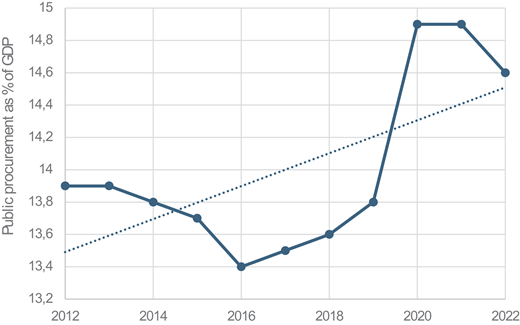
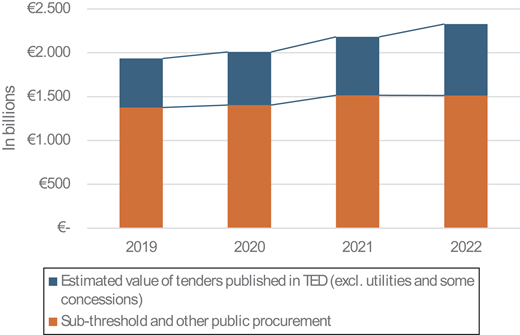
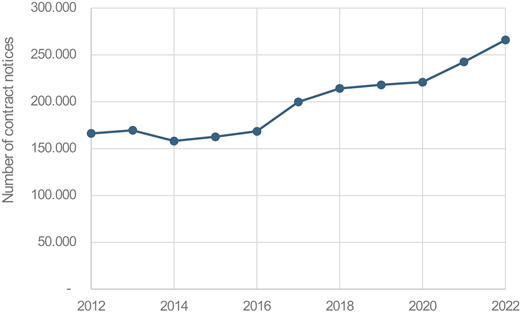
Public procurement plays an increasingly important role in the European economy. In 2012, it accounted for just under 14% of GDP, rising to nearly 15% in 2020–2022 (Figure 1). Since EU GDP also grew in real terms by about 20% (Eurostat, 2025), the volume of public procurement expanded even more (Figure 2). The share regulated by EU directives also rose, from 29% in 2019–35% in 2022. Meanwhile, the number of tenders published on tenders electronic daily (TED) increased substantially as well (Figure 3).
Declining competition
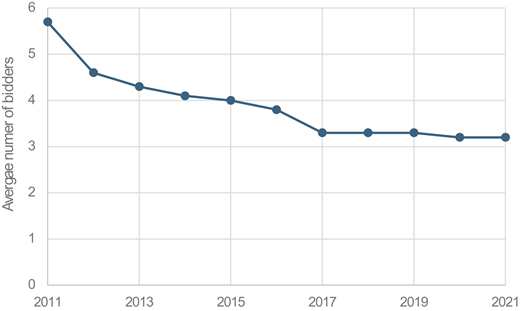
Despite the increasing size of public procurement, competition appears to be declining. This is evident both in the perceptions of public buyers and in available data. A recent survey in The Netherlands shows that public buyers express more concern than private buyers about declining levels of perceived competition (Nevi and Schotanus, 2024). Based on tender data, the ECA (2023) also reports a decline in the average number of bidders per tender from nearly six in 2011 to just over three in 2021 (Figure 4). While a mean of six bidders per tender may be too high, implying many firms prepare bids, three seems low. There is no ideal number though, as this depends on markets, contracting authority and tender design.
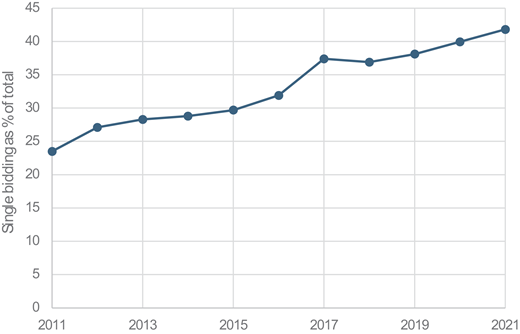
Despite data limitations, both ECA and Public Procurement Data Space (PPDS) data show a similar problem: frequent single bidding (Figure 5). While this issue mainly occurs in procurements for supplies and services, especially in healthcare (PPDS, 2025), the percentage can be considered high. It is also concerning that in restricted procedures, which are supposed to be used primarily in markets with many bidders, the single bid rate is also around 30% in 2024 (PPDS, 2025) . This may indicate poor market knowledge or overly restrictive tender designs. Single bidding is not always problematic, for example, when genuine competition occurred during the procedure but only one firm submitted a bid. However, it becomes a problem when suppliers come to expect that they will face little competition. They are not incentivized to bid competitively. In addition, there is an increased risk of collusion in concentrated markets (Asch and Seneca, 1975) and the likelihood of failed negotiations increases.
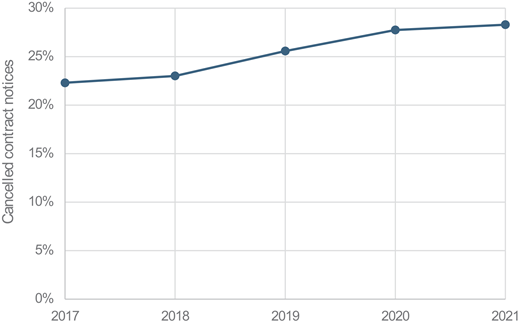
This latter problem, tender cancellations, is also tracked, though no reliable EU-wide data appears to be available. Data from Denmark and The Netherlands, however, show that too little bids is a key reason for cancellations (Casady et al., 2023; Schotanus, 2023). For Denmark, cancelation rates rose by about 27% over the past four years (Figure 6).
These trends precede recent geopolitical developments and shifts in EU industrial policy, which may further reduce the pool of suppliers (Alcidi et al., 2023). While this creates opportunities for EU firms, especially in combination with the new Foreign Subsidies Regulation, it also risks shrinking the pool of suppliers.
Competition-limiting factors
There has been extensive research on competition and public procurement (Tátrai et al., 2024), identifying a wide range of competition-limiting factors (Table 1). However, not all factors explain the observed decline in competition. Some conditions have actually improved over the past decade. For instance, tenders have become more accessible (e.g. Borowiec, 2017) and national procurement platforms have improved (Titl and Schotanus, 2025). In addition, there is, as far as I know, no strong evidence that collusion has increased in recent years. Still, for several other factors, there are indications of decline. On the market side, there are signs that supplier capacity is declining (Nevi and Schotanus, 2024). On the buyer side, risk allocation appears to be becoming a greater issue (Du Saar, 2024), potentially exacerbated by the growing complexity of some public contracts. Legally, several new layers of sector-specific EU legislation have been introduced in recent years (Janssen, 2023).
A large and important part of these factors can be influenced by public organizations. However, I believe that public procurement has increasingly become a compliance-driven, risk-averse and template-based “paper” profession shaped by legal formalism. It has become more focused on avoiding mistakes than on creating optimal value (Jääskeläinen and Tukiainen, 2019). This is visible in the average tender, which often fails to express a genuine intention to engage constructively with suppliers. If competition and pubic value creation through procurement is to be strengthened, change is essential.
Short term: making tenders more attractive
The key question now is: how to become a more attractive public customer (Fridner, 2025), not only to attract more bids, but perhaps even more importantly, to improve their diversity and quality? The goal, then, is not merely to increase competition, but to pursue better competition (Manunza, 2023). Several promising examples already exist, which could be implemented as of tomorrow.
Making it easier to submit bids
Procurement documents could be more accessible (Jääskeläinen and Tukiainen, 2019) and goal-oriented. This means using shorter and less complex tender documents, written in plain language, with a greater focus on functional requirements and compact and transparent supplier selection models. Additionally, submission periods could be extended, especially during holiday seasons (Pliatsidis, 2022; Schotanus, 2025) and administrative burdens reduced, for example by requiring certain documents only once instead of for every tender (European Commission, 2016a). For complex tenders, public buyers could also consider offering partial reimbursement of bidding costs.
Engaging more in dialogue
Many contracting authorities appear to increasingly rely on “paper-based” tenders. However, suppliers tend to value dialogue (Jääskeläinen and Tukiainen, 2019) and interaction improves the alignment between demand and supply (Volker and Schotanus, 2023). There are several ways to improve this. Market consultations remain an underused instrument for, among other things, asking how a tender could be made more attractive and for proactively notifying firms of an upcoming tender. During tenders, individual oral sessions can be added following a written round of questions. This can help clarify suppliers’ reasoning and expectations. Furthermore, parts of a bid may be further explained in presentation format, also allowing for dialogue. That said, dialogue also carries risks, for example, if it ends up benefiting a familiar supplier. However, paper-based tenders are not risk-free either. In both cases, safeguards such as involving an independent facilitator may be necessary. Avoiding dialogue altogether is not the solution. In fact, the cost of not engaging in meaningful interaction may well exceed the risks it is meant to avoid, both in terms of missed value and reduced competition.
Fairer risk allocation and pricing models
There are several ways to allocate risks and set prices more appropriately. One example is using two-phase procurement procedures, where the final price is determined only after a joint design and engineering stage, by which point the risks are better understood. Improved indexation clauses (Klimavičiūtė et al., 2024) as well as collaborative contract forms such as open-book contracts and construction teams or development teams, in which the buyer and supplier work together, can also contribute to more balanced risk sharing.
Extending and bundling consecutive contracts
Longer contract durations that encourage collaboration can make tenders more attractive (Tátrai et al., 2024). Such contracts reduce the relative cost of bidding and enable better capacity planning. They also provide greater stability and continuity (Caldwell et al., 2005). When sequential projects are bundled into a contract, a practice often referred to as programmatic or serial procurement, they can also improve efficiency. Such contracts do not exclude SMEs, provided that the selection criteria are tailored to the initial project requirements, rather than to all projects. However, longer contracts may create incumbency advantages that weaken competition in subsequent tenders. Contract management will therefore have to make more efforts to prevent this.
Avoiding excessively large or complex contracts
While high contract values can make tenders more attractive, they may also increase complexity and deter bidders. Breaking such contracts into smaller, more manageable lots can help to make them more accessible.
Long term: changing procurement culture
In the long term, the first question is whether competition should remain the default, or whether deviations that allow for more collaboration should be permitted more frequently. However, as long as competition remains the norm, fundamental challenges arise in making it work better. Ultimately, the role of public buyers must then evolve beyond ensuring compliance: the buyer as referee. Instead, we should move toward seeing the buyer as someone who, operating within the rules, enables others create value and innovate, facilitates interaction between technical staff and suppliers, and is supported by top management: the buyer as coach.
Such a cultural shift will be complex and slow, and it cannot be enforced through legislation alone. However, in a profession deeply shaped by compliance, rule-following can also be leveraged constructively. Below, I outline three categories of long-term measures that address several competition-limiting factors.
Legal: promoting attractive tenders
The Czech Republic and Finland have introduced legislation preventing automatic award of contracts when only one bid is received (Titl, 2025). This could compel buyers to make tenders more appealing (Titl, 2025), lower entry barriers and reach out to new suppliers (Amwayi, 2004). Another measure that could push buyers to better explore markets is requiring minimum and maximum prices in tenders (Carril et al., 2022; Lopomo et al., 2023). A minimum reduces the risk of awarding contracts to abnormally low and underperforming bidders (Carril et al., 2022), while price ranges can improve bid quality and quantity (Pasman and Telgen, 2023; Telgen and Schotanus, 2010).
Legal: stimulating more dialogue
The current legal framework could be more explicit about what forms of dialogue are permitted, to remove uncertainty and encourage uptake, stimulating better competition. For example, verbal question rounds could be explicitly allowed. Furthermore, the negotiated procedure with competition could be added to every buyer’s standard toolkit, also as negotiated procedures may result in more bids (Tátrai et al., 2024). Moreover, market consultations for high-value tenders could become mandatory (Sorokina, 2022) to ensure institutionally that this step is not skipped due to competing time pressures.
Institutional: shifting accountability toward outcomes
Public buyers are often assessed on procedural “referee” indicators, such as the rate of rule-compliant tenders. Yet the core question remains largely unmeasured: does procurement create, as a “coach”, public value? Such evaluations could also support effective competition.
Supporting measures
Changing legislation or norms alone will not be sufficient. As the profession moves toward more attractive tenders and dialogue, not all buyers may have the mindset to lead such interactions. Training and certification can help, for example, in conducting a dialogue or a negotiation and in developing a better understanding of how firms operate, as can the sharing of best practices discussed earlier. However, it may also be valuable to bring in more people with backgrounds in marketing, communications or private-sector procurement. In addition, the current fragmentation of public procurement must be addressed. With over 250,000 contracting authorities across the EU, each increasingly expected to professionalize, more central coordination seems unavoidable. Finally, good procurement is not only the responsibility of buyers, but also of the organization surrounding them. Restrictive requirements or risk-averseness often originate not with the buyer, but with support departments or top management. Changing procurement, therefore, requires a collective effort.
Conclusion
In the EU, competition for public contracts is declining, while the growing importance of public spending and geopolitical developments are increasing the urgency of making procurement more attractive and strategic. Action is needed. In the short term, through measures that can be applied in the very next tender. In the long term, a cultural shift is required: from a strictly process-driven, compliance-oriented, paper-based and risk-averse profession to a value-driven discipline; one that embraces fair and open dialogue, is willing to take calculated risks and treats compliance not as an end in itself. Legislative reforms and supportive measures can contribute to this transition by enabling more attractive, dialogue-based procurement and by shifting the accountability culture away from mere compliance toward creating public value. This not only results in better competition, but also makes procurement more accessible for SMEs and facilitates more strategic procurement.
The author gratefully acknowledges the valuable input and thoughtful comments provided by Vitezslav Titl (Utrecht University) and Sharon Chömpff (Dutch Ministry of Economic Affairs).
The author declares that partial funding was received to conduct public procurement research from the Dutch Ministry of the Interior and Kingdom Relations/DGOO, Tax and Customs Administration, National Police, Central government purchasing cooperation (RIS), Public employment services organization in The Netherlands (UWV) and the Dutch association for purchasing management (Nevi). The funders were not involved in the study design, analysis, the writing of this article or the decision to submit it for publication.