Purpose
The purpose of this paper is to examine peer-to-peer sharing platform business models, their sources of competitive advantage, and the roles, motivations and behaviors of key actors in their ecosystems.
Design/methodology/approach
This paper uses a conceptual approach that is rooted in the service, tourism and hospitality, and strategy literature.
Findings
First, this paper defines key types of platform business models in the sharing economy anddescribes their characteristics. In particular, the authors propose the differentiation between sharing platforms of capacity-constrained vs capacity-unconstrained assets and advance five core properties of the former. Second, the authors contrast platform business models with their pipeline business model counterparts to understand the fundamental differences between them. One important conclusion is that platforms cater to vastly more heterogeneous assets and consumer needs and, therefore, require liquidity and analytics for high-quality matching. Third, the authors examine the competitive position of platforms and conclude that their widely taken “winner takes it all” assumption is not valid. Primary network effects are less important once a critical level of liquidity has been reached and may even turn negative if increased listings raise friction in the form of search costs. Once a critical level of liquidity has been reached, a platform’s competitive position depends on stakeholder trust and service provider and user loyalty. Fourth, the authors integrate and synthesize the literature on key platform stakeholders of platform businesses (i.e. users, service providers, and regulators) and their roles and motivations. Finally, directions for further research are advanced.
Practical implications
This paper helps platform owners, service providers and users understand better the implications of sharing platform business models and how to position themselves in such ecosystems.
Originality/value
This paper integrates the extant literature on sharing platforms, takes a novel approach in delineating their key properties and dimensions, and provides insights into the evolving and dynamic forms of sharing platforms including converging business models.
Introduction
The growth of platform businesses has been fueled by the internet and mobile technologies, and rapid advances in analytics, artificial intelligence (AI) and Big Data together with changing consumer preferences and consumption patterns. Platform business models in general, and the sharing economy in particular, have produced disintermediated industries. Often, sharing economy business models facilitate people to transact directly with one another by connecting individuals in unprecedented ways (Caldieraro et al., 2018). These developments have resulted in an explosive growth of the peer-to-peer economy.
Platform businesses emerged as a viable alternative to fulfilling a range of customer needs, including transportation, accommodation, meals, and even investments and personal loans. They include Airbnb, HomeAway, XiaoZhu and onefinestay that are embraced by travelers ranging from budget-conscious students and families to luxury consumers and even business travelers. Uber, Lyft, Didi, BlaBlacCar, Grab and Ola are fast growing ride-sharing platforms that have disrupted often sleepy, sloppy and expensive taxi markets around the world. EatWith and MealSharing delight foodies with the opportunity for experiencing delicious homemade food with local hosts. RentMyWardrobe and DesignerShare facilitate sharing your wardrobe with fashion enthusiasts near you. These services were previously provided primarily by established firms in traditional industries such as hotels, taxi companies, restaurants and wardrobe rental businesses, which we refer to as pipeline businesses. Other platform services created completely new markets, such as BorrowMyDoggy which connects dog lovers who share the care for their canines. Evidence is gathering that the sharing economy and platform business models are significantly changing ecosystems, markets and consumption patterns (Caldieraro et al., 2018; Lamberton and Rose, 2012; Zervas et al., 2017).
Sharing platform business models are celebrated not only by consumers but also by investors who are optimistic about their profit potential, resulting in valuations that often match or even exceed their much larger and more established incumbent competitors. For example, by early 2019, Uber had a higher valuation (US$72bn; based on the most recent private equity fund raising) than the market capitalization of America’s largest car companies (e.g. US$56bn for General Motors) and Airbnb (US$31bn; based on the most recent private equity fund raising) was valued almost as much as the world’s largest hotel chain Marriot (US$44bn). These high valuations show that investors believe that platform players will be able to capture large markets, become highly profitable and remain so for a prolonged period of time. Furthermore, the high valuations imply that financial markets assume these platform players have significant competitive advantages that block new entrants and incumbents alike to enter and drive price competition. If these assumptions are correct, platforms can potentially generate astronomical returns on assets once they reach scale as they tend to be asset-light. This paper examines what makes platform business models potentially so valuable (i.e. what protects their competitive edge), and where perhaps financial markets may be overly optimistic.
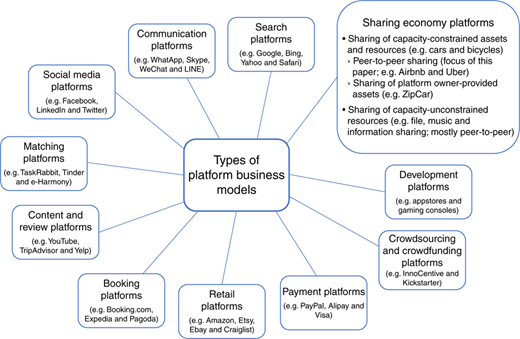
There are many types of platform business models, including search, communication, social media, matching, content and review, booking aggregator, retail, payment, crowdsourcing and crowdfunding, and development platforms in addition to those that exist in the sharing economy (see Figure 1 for examples of these different types of platform business models). Of course, these “pure” platform types can be combined. For example, a social media platform can integrate communications, contents, retail and payment functions.
In this paper, we focus on peer-to-peer sharing economy platform business models that match capacity-constrained assets and resources with consumer demand for the following reasons. First, sharing platforms for capacity-constrained and unconstrained assets (see Figure 1) have fundamentally different management challenges (e.g. the former involve physical assets with all their related operations and supply-demand matching issues). Second, peer-to-peer platforms differ significantly from platforms that own the provided assets as they do not need to manage two-sided markets with issues such as signing up, rewarding and managing service providers, or deal with their typically highly heterogeneous assets (e.g. Airbnb postings differ widely on key attributes). Third, there is keen interest in understanding better peer-to-peer asset-sharing platforms as they are often portrayed as being ecological given that the same assets can be used by many people. This can democratize services by bringing down prices, allowing lower-income consumers to enter the market, and offering income opportunities all at the same time. Finally, we concentrate on business models with a for-profit motive to sharpen our focus and allow us to better contrast them with their traditional pipeline business model counterparts.
This paper makes five important contributions: First, we define key types of platform business models in the sharing economy and describe their characteristics and properties. In particular, we propose the differentiation between sharing platforms of capacity-constrained vs capacity-unconstrained assets and advance five core properties of the former. Second, we contrast peer-to-peer sharing platform business models with their pipeline business model counterparts to understand the fundamental differences between them. One important conclusion is that platforms cater to vastly more heterogeneous assets and consumer needs, and therefore require liquidity and analytics for high-quality matching and resultant value creation. Third, we examine the competitive position of platforms and their widely assumed “winner takes it all” characteristic and reject it. Primary network effects are less important once a critical level of liquidity has been reached and may even turn negative if increased listings raise friction in the form of search costs through information and choice overload for both customers and service providers. Once a critical level of liquidity has been reached, a platform’s competitive position depends on stakeholder trust, and service provider and user loyalty. Fourth, we integrate and synthesize the literature on key platform stakeholders of platform business models (i.e. consumers, service providers and regulators), and their roles and motivations. Finally, directions for further research are drawn from each of these sections.
Defining and characterizing sharing platform businesses models
The academic literature and popular press use various terms, often interchangeably, for platform business models in the sharing economy. This paper aims to clarify the confusion surrounding this nomenclature and characterizes platforms in the sharing economy. Before discussing the definitions, we delineate the important dimensions of capacity-constrained vs capacity-unconstrained assets to be shared, access provision vs transfer of ownership, peer-to-peer vs platform-provided assets, and direct and indirect network effects.
Capacity-constrained vs unconstrained assets
The term sharing economy implies an increased utilization of assets with spare capacity (e.g. Benoit et al., 2017; Frenken and Schor, 2017; Hamari et al., 2016) and related reduced use of resources and ecological impact (e.g. Guttentag et al., 2018; Tussyadiah and Pesonen, 2018). This means, the sharing economy implicitly refers to the sharing of capacity-constrained physical assets (e.g. cars, rooms, and bicycles) and the provision of performances and experiences that rely on shared assets and labor (e.g. a cooking or dining experience). To a lesser extent, it can also refer to intangible assets (e.g. capital for loans).
The sharing of capacity-unconstrained resources (e.g. sharing files, music and information) is fundamentally different from the sharing of capacity-constrained assets. Unlike capacity-constrained assets, music files and information can be simultaneously consumed by many people without capacity management implications. In contrast, sharing platforms of capacity-constrained assets and resources are particularly efficient in matching capacity and demand, asset features and user needs, and time and geography requirements, thereby enhancing value for all actors in the ecosystem. In short, the focus of the sharing economy literature is concerned predominantly with access-based sharing platforms that match capacity-constrained assets and resources with consumer demand (Cusumano, 2015; Hall and Pennington, 2016).
Access provision vs transfer of asset ownership
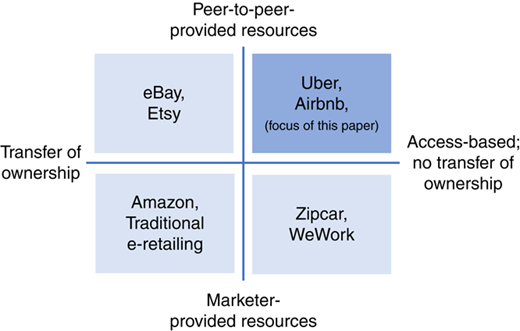
In our conceptualization, we consider the following two separate dimensions to be critical in delineating what constitutes the sharing economy platforms: first, whether temporary access or ownership transfer is at the core of the transaction, and, second, whether an asset or resource is provided by peers or by a platform (see Figure 2). Different types of platforms emerge based on these distinctions.
Peer-to-peer platforms that operate on transferring the ownership of products such as eBay and Etsy (e.g. top left quadrant in Figure 2; note that peer-to-peer can also include micro businesses) or Amazon and traditional e-retailing (e.g. bottom left quadrant in Figure 2) are generally not considered sharing economy platforms as assets are being sold instead of being shared. We therefore consider sharing economy platforms as only those that provide access to assets, resources and services without the transfer of ownership, which is consistent with much of the sharing economy literature (e.g. Benoit et al., 2017; Hamari et al., 2016; Kumar et al., 2018; Schaefers et al., 2016; Zervas et al., 2017).
Peer-to-peer vs platform-provided assets
The literature frequently focuses on and equates the sharing economy with peer-to-peer provided assets (e.g. Benoit et al., 2017; Cusumano, 2015; Zervas et al., 2017; again, peers can be self-employed or operate micro businesses). However, there are also access-based platforms that rely predominantly on marketer-provided assets and resources such as Zipcar and bicycle sharing platforms (i.e. not peer-to-peer; bottom right quadrant in Figure 2). Unlike peer-to-peer sharing platforms, marketer-provided sharing platforms have their own inventory of assets. That is, these platforms players operate similarly to their traditional incumbents (e.g. Zipcar and Hertz both control a fleet of cars). A key difference is that marketer-provided asset platforms have, compared to incumbents, vastly improved technology with app interfaces that make locating assets and resources, reserving and using them, and making payment convenient and seamless. This, combined with location-specific analytics, allows by-the-minute access to assets and resources (e.g. cars or bicycles) and enables customers to pick up and drop these assets where and when convenient. They also require a higher degree of co-creation with users (e.g. filling petrol of cars and keeping them clean), which reduces the “turn-around” time of assets for the next user. As such, these business models allow the enhanced utilization of assets through improved sharing. For example, Zipcar automobiles are likely to be used more than Hertz cars as the latter are mostly rented by the day or longer and tend to have considerable idle time even when rented out. Given the intensified and flexible form of sharing, platforms with marketer-provided assets and resources, broadly speaking, should also be considered as part of the sharing economy.
Direct and indirect network effects
There are two types of network effects: direct network effects (also called same-side effects) and indirect network effects (also called cross-side effects). Direct network effects mean that the utility a user receives from a particular service increases as the number of other users increases (Duch-Brown, 2017). These effects are particularly pronounced for social media and communication platforms where the value to users tends to increase as family, friends and acquaintances join a network. That is, network size and resultant direct network effects can become an effective competitive barrier for competing smaller platforms (Duch-Brown, 2017; Johnson, 2018).
For capacity-constrained assets, however, direct network effects are less relevant and offer benefits only up to a threshold level at which the overall network size is sufficiently attractive for users or providers to join the platform. Beyond that, there is little benefit to a user or provider if more same-side actors join. The reason is that service providers have limited inventory to offer, that is, only a certain number of people can access a platform’s available capacity at a given time (Moazed, 2017). For example, only so many people can take a specific ride using Uber or rent out a specific Airbnb apartment at a given time. Once sufficient listings are available to make a platform attractive, further listings only add competition to existing service providers. The same logic applies to users who also have to compete for available service capacity (e.g. a particular room or ride).
In contrast, indirect network effects are critical for multi-sided platforms. Indirect network effects mean that the value of a service increases for one user group when a new user of a different user group joins (Johnson, 2018). For example, a new host joining Airbnb adds value to guests seeking accommodation since it provides them with more options to choose from. This attracts more guests to the platform, which, in turn, attracts more hosts. In other words, indirect rather than direct network effects serve as an effective means to scale the business.
Types of sharing economy platforms in the extant literature
Three main terms are used in the platform literature almost interchangeably depending on the focus of a particular study. They are access-based services, peer-to-peer sharing economy and sharing economy. As the following discussion shows, the literature has not converged to a common nomenclature (cf. Chen et al., 2018; Kumar et al., 2018); there are substantial commonalities yet important differences between these three related categories for which we propose differentiation and definitions.
The access-based services literature highlights the nature of the transaction not being centered on ownership transfer, but on providing temporary, short-term access to an asset, and thus includes examples of car and bicycle sharing. Specifically, access-based services “grant customers limited access to goods without any transfer of ownership” (Hazée et al., 2017, p. 441) and facilitate transactions in which “multiple consumers successively gain temporary, short-term access to a good, while legal ownership remains with the service provider” (Schaefers et al., 2016, p. 3). Access-based services are commercial sharing systems where marketer-managed systems “provide customers with the opportunity to enjoy product benefits without ownership” (Lamberton and Rose, 2012, p. 109). Implicit in these definitions is that access-based services relate to physical, capacity-constrained assets. That is, access-based services are concerned with both peer-to-peer and platform-provided capacity-constrained assets.
In contrast, the peer-to-peer sharing economy literature, sometimes also referred to as collaborative economy and collaborative consumption literature (e.g. Benoit et al., 2017), focuses on the transaction entities (i.e. consumers and peer service providers) and community-based online services. These platforms orchestrate “peer-to-peer-based activity of obtaining, giving, or sharing the access to goods and services, coordinated through community-based online services” (Hamari et al., 2016, p. 2047) and link a consumer who “aims to temporarily utilize assets with a peer service provider who grants access to these assets and with this delivers the core service” (Benoit et al., 2017, p. 220). They enable people to “collaboratively make use of underutilized inventory through fee-based sharing” (Zervas et al., 2017, p. 687). Integrating these definitions, we advance that peer-to-peer sharing business models adopted in the literature are a subset of access-based platforms, and that peer-to-peer sharing business models are exclusively peer-to-peer and exclude platforms with marketer- or platform-provided assets (the latter are included in the wider access-based service platforms).
Interestingly, both access-based service platforms and peer-to-peer sharing economy are loosely referred to as the sharing economy. Current definitions of the sharing economy in the literature mostly refer to peer-to-peer sharing as the following examples illustrate: “Consumers granting each other temporary access to underutilized physical assets (“idle capacity”), possibly for money” (Frenken and Schor, 2017, pp. 4-5). The sharing economy activity is “centered around online platforms, based on sharing of underused assets or services between peers for free or for a fee” (Hall and Pennington, 2016), and is “a socioeconomic system that allows for shared creation, production, distribution, and consumption of goods and other resources among individuals” (Tussyadiah and Pesonen, 2016, p. 1022).
However, we suggest that the term sharing economy also includes platforms that provide access to company- and platform-owned assets, resources and services. For example, ZipCar and bike sharing business models both allow highly effective sharing of assets (e.g. Hazée et al., 2017) even though assets and resources are provided by platform owners. In sum, we define sharing economy as online-enabled sharing economy platforms offering short-term access to goods, services and other resources that are provided by peers or platform owners.
Definition and core properties of peer-to-peer sharing economy platforms
For the reasons outlined in the introduction (including the management challenges related to matching physical assets and managing two-sided markets), this paper focuses on online-enabled platform business models that share capacity-constraint assets and resources and are both access- and peer-to-peer-based (top right quadrant in Figure 2). The platforms explored in this paper thus include examples such as Uber and Airbnb which give peer customers access to unused or underutilized assets and resources, but do not cover platforms with marketer- or platform-provided assets (e.g. Zipcar and WeWork).
Synthesizing the preceding discussion, we define peer-to-peer sharing economy platforms, which are the focus of this paper, as two- or more-sided peer-to-peer online platforms through which people collaboratively provide and use capacity-constrained assets and resources. This definition and the discussion in the previous section allow us to derive the following core properties of these platforms: no transfer of ownership (i.e. access-based consumption); peer-to-peer exchange mediated through a digital platform; sharing relates to capacity-constrained tangible assets (e.g. cars, clothing and accommodation) that are sometimes enhanced by other resources (e.g. labor); indirect network effects and transaction volume (i.e. liquidity) enhance the matching quality of heterogeneous assets and resources of peer providers with the heterogeneous needs of users; and direct network effects are of less relevance once a threshold level has been reached, which allows high-quality matching (Table I).
The following section builds on these properties and contrasts peer-to-peer sharing economy platforms with pipeline businesses. As highlighted by Van Alstyne et al. (2016), “to understand how the rise of platforms is transforming competition, we need to examine how platforms differ from the conventional “pipeline” businesses that have dominated industry for decades” (p. 56).
Contrasting sharing platform with pipeline business models
We reviewed the literature to identify the characteristics that make peer-to-peer sharing platforms unique and contribute to their success vis-à-vis pipeline business models. The interrelationships between these characteristics alluded to three themes along which sharing platform and pipeline business models can be contrasted: market-level characteristics, market economics and firm-level characteristics. We drew characteristics of peer-to-peer sharing platforms and pipeline business models from the literature and derived key differences as synthesized in Table II.
Market-level characteristics
Traditional pipeline businesses emphasize a centralized exchange of value, focus on transactions with consumers, create value by controlling a linear series of activities from input to output, known as the value chain, and aim to leak minimum value to other members in the value chain (Porter, 1985). The roles of actors in the value chain tend to be stable. In contrast, sharing economy platforms mediate exchanges between providers and consumers using the key assets of liquidity (i.e. transaction volume or market thickness), data and analytics. Liquidity ensures transaction execution, and data and analytics (including peer-review systems) create value by decreasing information asymmetries between the peer groups and reducing search costs (cf. Chen et al., 2018).
Physical platforms have existed for centuries (e.g. the local farmer’s market); however, recent advances in information technology have enabled dramatically improved matching of capacity and demand and thus access to shared assets and resources that previously had to be owned or rented. These platforms thrive on circular, iterative and feedback-driven processes of value creation that emphasize the exchange of value produced by a decentralized network of individuals scattered across an ecosystem. As opposed to the one-sided revenue generation of pipeline businesses (i.e. selling to the customer), sharing platforms typically focus on extracting a share of transaction value on the platform through multi-sided revenue models (e.g. Airbnb charges hosts a 3 percent service fee and guests a service fee that ranges from 0 to 20 percent for facilitating the transaction). Moreover, in the platform ecosystem, consumers can also be providers (e.g. an Airbnb guest who goes on to become an Airbnb host in another situation), making them “prosumers.”
Platforms are “visualized as resource integrators, involving consumers and business partners in a process of co-creation of value” (Muzellec et al., 2015, p. 139). Value co-creation among the platform, providers, consumers and complementors is fundamental to the platform’s value creation process (Andreassen et al., 2018).
Market economics
Cost structure represents an important differentiator between platform and pipeline business models whereby a platform’s fixed and marginal costs are typically lower compared to their pipeline business model counterparts (Zervas et al., 2017). The latter tend to have high fixed costs as significant investments in production assets and stock are usually required. A lack of readily available resources like land, finance (low-cost debt), human resources and equipment, among others, can cause production bottlenecks, which, in turn, increase variable costs of production. In contrast, platform businesses have significantly lower fixed costs, mainly those pertaining to platform maintenance, and a near-zero marginal cost of production with the cost of serving one additional customer typically being close to zero. Moreover, platforms take such advantage one step further, whereby they extend zero marginal costs to the supply side of the business whereby the cost of adding one additional supplier is also close to zero (Johnson, 2017).
Compared to pipeline businesses that manage supply through the modulation of production capacity based on demand (e.g. a car rental company adjusts its fleet size based on predicted demand), sharing platforms can use highly sophisticated and dynamic supply- and demand-side pricing to equilibrate peer supply and demand, and thus manage capacity constraints more effectively than pipeline businesses. For example, Uber’s surge pricing allows it to attract a higher supply of drivers onto the platform to meet increased demand in a particular geography at a particular time and at the same time allocate spare capacity to users with the highest utility (Hall et al., 2015). This also means that capacity can be scaled rapidly, especially during periods of high and less price-sensitive demand (Zervas et al., 2017). Furthermore, capacity constraints are often also malleable, as evidenced in Uber Pool, which allows the same vehicle to carry multiple passengers along a particular route and thus increases vehicle capacity and supply. Platform businesses therefore seem more flexible and can respond to changes on both the supply- and demand-side faster than pipeline businesses.
In comparison to pipeline businesses that offer largely standardized products and services to homogenous groups of customer segments, platforms have both highly heterogeneous peer-provided assets and user needs (Akbar and Tracogna, 2018; Dolnicar, 2018). For example, Airbnb hosts offer and guests seek a variety of accommodation options ranging from couches, rooms, and apartments to boats and treehouses. While heterogeneity can prove to be a challenge, platforms have demonstrated the ability to develop and use highly sophisticated algorithms and analytics that can mitigate the effects of capacity constraints caused by heterogeneity much more effectively than pipeline businesses (Duch-Brown, 2017). For example, Airbnb’s large investment in data systems, AI and machine learning, has enabled genuine micro-segmentation, allowing guests to find the “perfect match” accommodation from thousands of unique options (Dolnicar, 2018). In traditional pipeline businesses, in contrast, guests are treated as the average member of an artificially created market segment that typifies the brand creation and differentiation efforts (Dolnicar, 2018).
Finally, indirect network effects are critical for multi-sided platforms but have little relevance for pipeline businesses. Platform businesses need to grow both asset supply and user demand to offer sufficient liquidity (i.e. transaction volume). Higher liquidity allows a platform to better match heterogeneous assets with heterogeneous user needs (i.e. improve match quality) and thereby increase value for both providers (through a better price) and users (through a better meeting of needs). That is, the required liquidity is higher on platforms with more heterogeneous assets and user needs to achieve high-quality matching.
Firm-level characteristics
The role and strategic focus of leadership provide another important point of differentiation between platform and pipeline business models. Consistent with pipeline businesses’ orientation to value creation, leadership in such models involves achieving competitive advantage by maintaining control over scarce and inimitable resources that provide supply-side economies of scale and cost leadership, or those that enable differentiation in the marketplace (Porter, 1985). In contrast, platform business models typically require “curator” leadership practices that emphasize: resource integration whereby leaders design a platform architecture that facilitates building a strong network of service providers who bring their capacity-constrained assets to the platform; resource orchestration, which is based on efficient exchange mechanisms that match supply and demand, and thus improve a network’s liquidity (Gawer and Cusumano, 2014); and platform vibrancy whereby asset providers and users co-create value, frequently enhanced by complementors (Hagiu and Wright, 2015). Leadership focuses on building a platform’s ecosystem that includes liquidity and quality matching, and the integration and orchestration of service providers, users and complementors which are all critical for value creation.
Regarding innovation orientation, pipeline businesses are inclined to adopt internalized systems of innovation, whereby innovation is controlled by the firm and stems mainly from within the firm. In contrast, platform businesses tend to focus on rapid innovation on their platforms but, importantly, also have an external innovation focus. That is, in addition to the internalized system of innovation adopted by pipeline businesses, platforms leverage external innovation by players in a platform’s ecosystem which often include complementors. In particular, attracting and integrating complementors to a sharing platform can increase the stickiness for all actors, make it harder to copy and therefore build competitive advantage and enhance value appropriation power. For example, Nielsen and Lund (2015) highlight how platform business models can have collaboration as a central focus through leveraging the concept of open innovation. Here, the role of the platform is to create an ecosystem that enables it to benefit from the investments of others in the platform (Chesbrough, 2012).
Furthermore, working and innovating with complementors can help platforms to find new markets (e.g. Airbnb’s partnership with refugee relief organizations and medical non-profits to offer free temporary housing to people who lost their home due to disasters, conflict or illness as part of its Open Homes program), enable brand extensions (e.g. Niido by Airbnb which offers a range of services to travelers) and overcome supply constraints (e.g. Uber’s partnerships with Hertz, GetAround and Fair).
Value appropriation power of peer-to-peer sharing platforms
Financial markets celebrate peer-to-peer sharing platform business models under the assumption that they can capture value over a prolonged period of time. In fact, some feel that many of these markets will be dominated by one or two platforms in a “winner takes all or most” manner (Akbar and Tracogna, 2018; Johnson, 2017). However, recent developments suggest that rivalry among existing competitors in sharing economy platforms can be high. Typically, once a novel sharing platform gains traction, similar platforms tend to emerge quickly. For example, following Uber’s initial success in New York City, numerous similar rideshare platforms were launched (e.g. Lyft, Gett, Juno, Curb and Via), which all compete for both drivers and riders. To better understand competition in sharing economy platform markets we examine potential sources of competitive advantage, starting with network effects and liquidity in the next section.
Network effects and liquidity
Peer-to-peer platforms that share capacity-constrained assets and resources face two-sided markets. One implication of this is that service providers (e.g. Airbnb hosts) place importance on asset and resource utilization (i.e. occupancy rates), whereas users are concerned with capacity availability. An added challenge to balancing capacity and demand on peer-to-peer platforms is that assets and resources tend to be heterogeneous (e.g. almost every listing on Airbnb is unique), and user needs can also differ widely, and are time- and location-specific. These characteristics require a minimum level of liquidity to allow quality matching. This minimum viable platform size is determined by the nature of the network effects linking the platform’s two or more-sided markets, the heterogeneity of assets and “tastes” of the actors (Akbar and Tracogna, 2018; Evans and Schmalensee, 2010), and equilibrium dynamics between service providers and users that allow stakeholder utilities to be maximized at a given price (Evans and Schmalensee, 2010).
These requirements make liquidity an important value-creation mechanism for platforms. An increasing transaction volume on a platform adds value as long as it translates into better quality matching of available assets, resources and their attributes at a specific time and location with the heterogeneous needs of users. As such, a highly liquid platform will deliver both higher service provider earnings and higher user utility than a platform that operates below a level of liquidity required for optimum quality matching.
Evans and Schmalensee (2010) cite the critical mass constraint that prevents many platform businesses from succeeding. This is also described as a chicken-and-egg problem whereby “to attain a critical mass of buyers, you need a critical mass of suppliers – but to attract suppliers, you need a lot of buyers” (Hagiu and Rothman, 2016, p. 66). The critical mass constraint combined with value addition by complementors (who are also attracted to liquid platforms) means that liquidity, once achieved, can offer a platform some protection from smaller competitors and can be a source of competitive advantage as liquidity is hard to copy (cf. Wirtz and Ehret, 2019).
However, unlike for social media and communications platforms that thrive on direct network effects, there is a declining rate of incremental value of adding liquidity to capacity-constrained sharing platforms once a certain level offers sufficient matching quality. After all, the service provider and customer just need a single match for a particular transaction. This also means that with sufficient initial promotional investment (e.g. incentives for providers to join and for users to try and make bookings), liquidity can be built if the challenger has access to sufficient funding. As such, the power of network effects is less for sharing platforms than for those that thrive on direct network effects, rendering the competitive advantage of sharing economy platforms less powerful than generally assumed.
Furthermore, the threat of new entrants and other alternative players seems high. The typically low fixed and marginal costs mean that sharing platforms have relatively low barriers to entry within an industry, and access to service providers tends to be easy (Van Alstyne et al., 2016). While new platform concepts then to be differentiated initially (e.g. Onefinestay focused on luxury homes and was at first not in direct competition with Airbnb), over time, concept-copying commoditizes offerings. Furthermore, cross-listing of assets increases similarity across platforms and create direct competition (e.g. the same accommodation can be booked on two or more platforms). New entrants also frequently create price competition within the industry (e.g. Lyft launched with attractive promotions and generally lower prices than Uber). Thus, low barriers to entry can result in intense competition between sharing platforms.
Competitive responses of pipeline players
Traditional pipeline business models were disrupted by sharing platforms offering customers attractive and low-cost alternatives (Parker et al., 2016; Evans and Schmalensee, 2016; Piscicelli et al., 2018; Van Alstyne et al., 2016). Incumbent players have responded in various ways to these challenges. Responses range from modifying their business models to focus on segments platforms cannot serve well (e.g. business travelers who need a range of value-add services) and adopting features of platforms (e.g. launching a booking app), to launching competing platforms (often one-sided platforms), and acquiring and integrating peer-to-peer platforms (e.g. Accor Hotel’s acquisition of onefinestay).
Examples of competitive responses include MetroCab Boston’s mobile app launch. Its app is, from the user perspectives, not significantly different from Uber’s and Lyft’s (An, 2018). The rider experience in Singapore is largely identical between sharing platforms and the incumbent taxi company’s app-based service, except that the taxi company offers a more reliable service with virtually no cancellations, more predictable arrival times and trained drivers at marginally higher prices. Given the pipeline businesses’ superior reliability and consistent qualities, it can be challenging for sharing platforms to convince consumers that the economic benefits outweigh the risks they are taking, while still making a profit (Wallenstein and Shelat, 2017).
Furthermore, some pipeline business models have also started listing peer providers on their own platforms. For example, BMW is taking on Uber and Lyft directly by launching a ride-sharing service named ReachNow. In the hotel industry, following the purchase and development of onefinestay, Accor added peer-provided rooms to their traditional distribution channels. While initially taken by surprise, traditional pipeline players have started responding by embracing platform technologies and innovation that leverage and strengthen their existing competencies and assets, which increasingly will intensify competition with peer-to-peer platforms.
In conclusion, the analysis of competitive intensity of peer-to-peer sharing platform markets shows that beyond an initial potential liquidity advantage, peer-to-peer sharing platforms can face intense competition from direct competitors, new entrants and even traditional pipeline players who are becoming more effective in their competitive responses. The question arises as to what else platform players can do to reduce competitive intensity. In this context, we discuss next platform governance and trust, and building service provider and customer loyalty.
Platform governance and trust
The platform specifies the “rules of engagement,” including the information to be provided on listings, pricing schedules, search criteria and ratings for uses to search, interact and transact (Chen et al., 2018), and stakeholder privacy protection and data security (cf. Lwin et al., 2016; Wirtz and Lwin, 2009). Effective platform governance that cultivates stakeholder trust which, in turn, is important for reducing transaction costs (Ndubisi et al., 2016; Wirtz and Ehret, 2019) and enables safe exchanges between strangers is seen as critical to a platform’s success (Hagiu and Rothman, 2016). Furthermore, unethical behavior in peer-to-peer transactions is a risk in particular in one-off encounters between strangers (Hassan and Tovey, 2012). Here, risk and uncertainty are mitigated through instilling and managing trust via institutional and legal governance mechanisms (Akbar and Tracogna, 2018; Perren and Kozinets, 2018).
Effective platform governance fosters trust through “sociality management,” and institutional and legal arrangements that enable exchange mediation (Perren and Kozinets, 2018). Governance mechanisms on sharing platforms include (Akbar and Tracogna, 2018): pre-selection of assets, other resources and complementors that can be accessed through the platform: the owner of the platform may decide to limit access to only specific assets and resources that meet predefined quality standards (e.g. accommodations offered on onefinestay); rating systems that enable feedback and build trust (e.g. Airbnb’s guest and host ratings; Etzioni, 2017); establishment and administration of platform contracts among peers, including the management of payments (e.g. Airbnb’s secure payment platform that protects hosts and guests); the formulation of rules and standards regarding service levels (e.g. Airbnb’s “hosting standards” and “Airbnb Plus”); and legally-mandated or voluntary provision of insurance and guarantees to protect assets, resources and actors (e.g. Uber’s $1m in third-party liability coverage for rideshare driver-partners).
Hartl et al. (2016) found that the majority of participants in sharing networks support a governance system and that good governance increases cooperation among members by reducing distrust. In a study of consumers on Chinese platforms, Chen et al. (2009) found that two types of trust are essential for building platform loyalty: mutual trust among members and members’ trust in the platform itself (a number of further studies validated these findings; Abrate and Viglia, 2019; Ert et al., 2016). Embedding trust in a platform and its brand takes time, which makes it harder for competitors to copy and reduces competitive intensity. For example, Teubner et al. (2017) demonstrated that trust-building mechanisms on Airbnb translated into tangible economic value by attracting more demand and enabling higher prices. Thus, we suggest that stakeholders’ perceptions of effective governance and resulting trust in a platform can, in addition to liquidity, be an important source of competitive advantage.
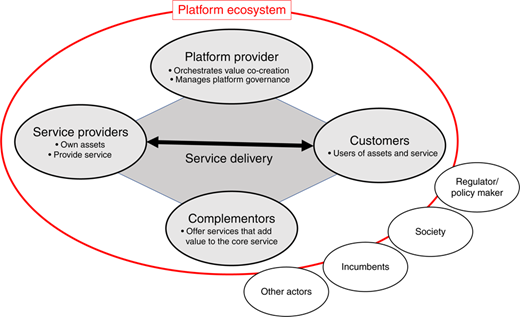
Having examined the literature on platform governance and trust, the next three sections focus on key actors who orchestrate and co-create value in a platform ecosystem (Figure 3). Specifically, we explore the perceptions, motivations and behaviors of three key actors: users, service providers and policy makers, and, where appropriate, link this section back to the discussion on building a competitive edge for platform providers.
Customer behavior in the context of sharing platforms
A significant body of literature has examined various aspects of sharing platform-related consumer behaviors. We synthesize, integrate and structure this literature using the three-stage model of service consumption as organizing framework whereby we deconstruct the customer journey into the pre-purchase, service encounter (i.e. consumption) and post-encounter stages (Wirtz and Lovelock, 2016, p. 53; Tsiotsou and Wirtz, 2015). See also Benoit et al. (2017) for an excellent review for consumer motives and behaviors related to collaborative consumption, which includes peer-to-peer sharing.
Pre-purchase stage
Need awareness
While conventional wisdom in consumer behavior suggests that consumer journeys start with need arousal, for customers on sharing platforms such needs are often driven by unfulfilled needs for traditional offerings (e.g. a hotel room or taxi ride). Especially when the supply of traditional providers seems limited, unavailable, expensive and/or of poor quality, consumers extend their consideration set to include sharing platforms. Furthermore, instead of buying and owning things, consumers also increasingly prefer access and temporary use (i.e. experiences over possessions; Bardhi and Eckhardt, 2012). Need arousal can also be triggered by social influence, wanting to be part of the peer-to-peer sharing economy and trend affinity (Tussyadiah and Pesonen, 2016), and an experience “worth trying” (Yang and Ahn, 2016). For repeat customers, such need arousal is likely to be a habitual process.
Information search
Consumers tend to rely heavily on information provided by peers (e.g. online reviews and peer ratings) as it is viewed as credible and independent. Sharing platforms are relatively new and consumers who are not familiar with a particular platform may perceive increased levels of risk and incur added search costs (Mao and Lyu, 2017; Tussyadiah and Pesonen, 2016) as they need to deal with independent providers who are essentially “strangers” (Frenken and Schor, 2017). In addition, information search tends to be more elaborate compared to buying from traditional pipeline providers as offerings in the sharing economy can be highly heterogeneous and are provided by independent and equally heterogeneous service providers (i.e. peers). Furthermore, as services are provided by many independent providers, information search and need clarification involves more direct communication with peers rather than the platform.
Relatedly, as network liquidity increases beyond what is required for high-quality matching, provider and user search costs increase which can reduce the quality and number of transactions per provider. For example, Li and Netessine (2018) empirically demonstrated that as a platform’s number of hosts and travelers doubled, search costs (i.e. search friction) increased through an increase of 18.3 percent of inquiries sent to hosts and 19.6 percent to travelers. As a result, traveler confirmation rates dropped by 15.4 percent and host occupancy by 15.9 percent, and the platform lost 5.6 percent of potential transactions due to the increased search friction. Because of the larger number of hosts and users, both hosts and users need to spend time and effort to evaluate more options and both parties could communicate simultaneously with multiple potential matches and make comparisons. Being faced with too many options reduces decision making, and even when they are ready to make a reservation, their favorite option may no longer be available (Li and Netessine, 2018).
To assist in the search process, platforms should therefore alleviate the uncertainty and higher search costs that result from heterogeneity and invest in systems that reduce search friction and enable high-quality matching. These can include decision aids based on analytics and AI that filter, sort, compare and rank options, and to create customizable search tools and recommendation systems that cater better to individuals’ preferences (Li and Netessine, 2018), and also to design better feedback and rating systems to reduce friction caused by information asymmetry (Tadelis, 2016). Additional approaches include making the matching process more instantaneous (e.g. Airbnb’s instant booking function), limiting the number of options presented to travelers through a more refined search (Li and Netessine, 2018), and reducing risk perceptions by allowing users to challenge payment due to unsatisfactory service (Chen et al., 2018).
Evaluation of alternatives
Platforms businesses often offer a lower price than pipeline businesses which constitutes a powerful decision factor for many consumers (Poon and Huang, 2017; So et al., 2018; Tussyadiah and Pesonen, 2018; Yang and Ahn, 2016). Furthermore, platform businesses tend to be more innovative and have offerings that are perceived as new, interesting, attractive and novel (Guttentag et al., 2018; Johnson and Neuhofer, 2017; Mao and Lyu, 2017; So et al., 2018), and thereby create unique experience expectations (Mao and Lyu, 2017).
Some consumers are attracted to collaborative consumption due to sharing economy ethos which include consumers’ belief that platforms provide income for locals and support a community’s well-being, and that the offerings are more authentic (e.g. the benefits of a local home for Airbnb; Guttentag et al., 2018; Johnson and Neuhofer, 2017; So et al., 2018). Furthermore, many consumers believe that sharing assets and resources is environmentally friendly (Guttentag et al., 2018) and supports sustainability (Hamari et al., 2016; Yang and Ahn, 2016). However, these assumptions have been challenged as the sharing economy can increase overall load on the environment through higher consumption, such as added flights due to lower cost accommodation and more traffic due to convenient and lower cost ride sharing (e.g. Font Vivanco et al., 2015; Frenken and Schor, 2017).
On the negative side, perceived risk can be increased due to the “new to the market” nature of many platforms (Mao and Lyu, 2017; Tussyadiah and Pesonen, 2016), using assets and resources of others in an unsupervised manner (Poon and Huang, 2017), and privacy concerns and insecurity caused by interacting with peers who are effectively strangers (So et al., 2018; Yang and Ahn, 2016). These risks lead to a lower level of trust in platforms compared to pipeline providers (So et al., 2018).
Making a booking decision
When making their first booking, consumers may encounter barriers, including learning and set-up costs, and have self-efficacy concerns as they need to learn how to navigate the platform regarding what is occurring, why, how, who and when (Zhu et al., 2017). In contrast, repeat bookings are often seamless as the account, once set up, results in reduced transaction costs, increased convenience, and reduced risk. As such, the first transaction plays an important role as risk perceptions and nonmonetary costs are expected to diminish after the first trial. However, repeat users still may have difficulty making a booking decision if presented with too many options due to information overload and choice fatigue (Li and Netessine, 2018; cf. Kuksow and Villas-Boas, 2010).
Consumption stage
Core benefits consumers may derive from participating in peer-to-peer sharing platforms include functional, experiential and hedonic, and social value.
Functional value
One of the benefits users gain from participating in sharing platforms is perceived functional (and economic) value (Razli et al., 2017; Zhu et al., 2017; Eckhardt and Bardhi, 2015). The availability of a wide range of options combined with effective matching mechanisms frequently result in high matching quality with the heterogeneous needs of customers (Lalicic and Weismayer, 2017; Priporas et al., 2017), which, in turn, leads to superior functional value (Razli et al., 2017; Zhu et al., 2017) at an attractive price.
Experiential and hedonic value
Novelty and experience heterogeneity can produce high levels of enjoyment (So et al., 2018; Tussyadiah and Pesonen, 2018; Yang and Ahn, 2016). Platform businesses can also create experiencescapes that offer added dimensions such as entertainment, education, escapism, aesthetics, serendipity and personalization (Mody et al., 2017).
Social value
Social interactions between actors can form an important part of the consumption experience and offer value (Mody et al., 2017; So et al., 2018; Zhu et al., 2017), including authenticity (Guttentag et al., 2018; Poon and Huang, 2017) and local cultural aspects (Poon and Huang, 2017). Here, Airbnb’s idiosyncratic offerings that reflect each host’s lifestyle, personality and culture provide a wider range of options to match user tastes and differentiate their travel experience (Liu and Mattila, 2017).
Increasingly, however, the consumer and the service provider may not need to meet in person. For example, a consumer can be given a code to enter an Airbnb apartment or to open a keylock box, rendering in-person service interactions unnecessary. This tends to be particularly the case for professional Airbnb hosts who have multiple listings as opposed to the more casual Airbnb hosts who deliver authentic experiences. While in the latter case social and authentic experiences may be diminished, accessibility and convenience are increased.
Post-consumption stage
Satisfaction
Customer satisfaction tends to be higher when a platform offers attractive pricing, and perceived ease of use and usefulness of the platform are high (Min et al., 2018). The evaluation of the consumption experience also depends heavily on the quality of service provided by the service provider and perceived platform governance, based on which consumers ascribe attribution of responsibility for the outcome of service experiences. Furthermore (dis)satisfaction with the service provider performance may also carry over to customer (dis)satisfaction with the platform itself (Lalicic and Weismayer, 2017). Finally, customer experiential outcomes can include memorability and extraordinary experiential outcomes and well-being (Mody et al., 2017).
Ratings and word-of-mouth (WOM)
At the post-consumption stage, users are frequently prompted to provide ratings of the peer provider and post online reviews which exert an important influence on other users’ booking behaviors. Furthermore, users generate online and offline WOM that has a powerful influence on the adoption behaviors of others (Liang, Schuckert and Law, 2017; Mao and Lyu, 2017).
Repurchase intentions and loyalty
After the initial use and set up, repurchase tends to be easy because it is a simple click repurchase with low learning and search costs. Repurchase intentions are formed in the initial transactions (Johnson and Neuhofer, 2017; Mao and Lyu, 2017; So et al., 2018).
Consumers’ post-consumption attitudes toward the platform depend on their personal consumption experiences, peer behaviors and platform governance (Mao and Lyu, 2017; So et al., 2018). Furthermore, customers tend to develop commitment to a platform (e.g. Airbnb) rather than service providers (e.g. a host; Lalicic and Weismayer, 2017; Mody and Hanks, 2019; Yang et al., 2017). That is, customers form post-consumption attitudes toward the platform (Mao and Lyu, 2017; So et al., 2018), including platform brand perceptions and brand personality (Lee and Kim, 2018), brand loyalty (Lalicic and Weismayer, 2017; Mody and Hanks, 2019; Yang et al., 2017) and willingness to pay a price premium (Zhang et al., 2019). Moreover, rich and authentic experiences associated with a platform were found to contribute to creating brand love and loyalty (e.g. for Airbnb; Mody and Hanks, 2019).
If a platform can cover most customer needs at a competitive price, enabled by a large network and variety in offerings, switching becomes less likely. However, if price performance (e.g. surge pricing and temporary promotions) and matching quality (e.g. availability of a suitable family home) are perceived to vary, providers and users may sign up on several platforms (called multi-homing) and switch on a transaction-by-transaction basis. Once multi-homing is set up, the close to zero switching costs can make competition between platforms direct and intense. For example, both drivers and users can sign up with several platforms and switch on a case-by-case basis, depending on a platform’s surge pricing strategies, the availability of temporary promotions, and quality matches (Chen et al., 2018). As such, it can be difficult for platforms to lock in customers, which makes competition intense if two or more providers have sufficient liquidity to serve the product feature-, location- and time-specific user needs.
In addition, when peers repeatedly make transactions with one another (e.g. a traveler needs a daily ride to the office), they may choose to substitute the platform through user disintermediation (e.g. Hagiu and Rothman, 2016). After an initial successful transaction facilitated by the platform, the buyer and seller may agree to conduct subsequent transactions outside the platform to save fees. Platforms try to police such behaviors, for example, through temporarily suspending accounts if algorithms detect attempts to take transactions off a platform and prevent offline transactions such as Airbnb blocking the exchange of phone numbers or emails until a booking is confirmed. However, if incentives are sufficiently high, actors will find ways to circumvent a platform which reduces a platform’s pricing power (Upbin, 2010).
As such, low switching costs, multi-homing and disintermediation can pose challenges to platforms. Potential responses are tools to build loyalty include evangelizing, milestoning, badging and documenting (Perren and Kozinets, 2018), and incentive systems for service providers to increase their activity on the platform (Chen et al., 2018). For example, Airbnb’s Superhost program rewards hosts for providing outstanding hospitality, as measured by guest reviews, for at least ten trips over a year; the badge enables hosts to charge higher prices for their listing (Liang, Schuckert, Law and Chen, 2017). Incentive systems can be developed to encourage increased transactions on a platform; both Uber and Lyft offer bonuses if drivers exceed a certain number of rides in a specified period of time, and Uber launched a rider loyalty program. Such strategies increase switching costs and provide incentives for providers and users to become more loyal to a platform (Chen et al., 2018).
In sum, sharing platforms present their own unique characteristics, challenges and opportunities at each stage of the consumer journey in impacting consumers’ perceptions, motivations, and behaviors. With constantly evolving ecosystems, markets and consumption patterns (e.g. Caldieraro et al., 2018; Lamberton and Rose, 2012), sharing platforms need to understand the factors that draw and keep consumers with the platform. Building platform brand equity and loyalty can be effective in developing a competitive advantage.
Service provider motivations and behaviors
Much academic research has focused on demand-side consumer motivation, but relatively fewer studies investigated the motivations of peer service providers (Karlsson and Dolnicar, 2016; Hall and Krueger, 2018). We consider service providers’ main motivations and decision-making processes next.
Financial benefits and entrepreneurial freedom
One of the main draws of platform business models for providers is that platforms tend to offer flexibility to providers with low barriers to entry. This flexibility allows service providers to gain income for assets and resources they already own and are underutilized, and let them use these underutilized assets and resources when and how they wish rather than being restricted by traditional job positions (Benoit et al., 2017). For example, Uber drivers can enter destinations for trips that are aligned with trips already intended (e.g. to/from work). Approximately two-thirds of Uber drivers use the platform as an additional income source over regular employment; Uber is the only source of personal income only for one-fifth of drivers (Hall and Krueger, 2018). Uber also provides a bridge for workers who are seeking another position in the labor market and offers higher earnings per hour than the traditional taxi businesses (Hall and Krueger, 2018). Overall, service providers participate in the sharing economy platforms for financial gain – driven either by the needs to cover basic necessities or to create additional income to afford the things that are normally unaffordable to them (Karlsson and Dolnicar, 2016).
Reduced set-up, distribution and transaction costs
Platform liquidity-enabled matching and process efficiencies reduce transaction costs. Platforms effectively enable providers to “distribute” highly unique services (e.g. a trip from near a service provider’s home to near his work place). Furthermore, a convenient and effective technology interface with the platform lowers the barrier to entry for service providers and reduces their listing and distribution costs. That is, it is relatively easier and costs less to advertise one’s assets and services on a platform compared to listing on websites or running one’s own website, which tends to be expensive and ineffective as these channels typically lack in transaction liquidity (Bakos, 1997; Zervas et al., 2017). In sum, platform models allow providers to bring their excess capacity to market at low cost and therefore significantly expand supply, even for short peak demand periods.
Social interaction and sharing
In addition to economic benefits, service providers in the sharing economy can be motivated by social needs (e.g. “cultural interaction”) and genuine passion and excitement for meeting people (e.g. “meeting fun and interesting people”), and being welcoming and hospitable (e.g. in the context of Airbnb; Karlsson and Dolnicar, 2016; Liu and Mattila, 2017).
Relatedly, provider participation can be motivated by a perceived obligation to do good for others and for the environment (e.g. helping others, sharing and participating in sustainable behavior; Prothero et al., 2011; Sacks, 2011), and by mutual respect, compassion, sympathy for others, and the feelings of fun and joy from sharing (Hellwig et al., 2015).
Policy makers and society in the peer-to-peer sharing economy
The significant growth of the sharing economy has resulted in a new array of issues for regulators and policy makers. Sharing platforms can result in immediate tax revenue losses as demand is shifted away from traditional, tax paying, and regulated businesses, and taxing peer-to-peer platforms has proven to be a challenge (Zervas et al., 2017). Competition may be distorted if regulation applies to traditional businesses such as hotels and taxi companies, which follow taxation codes, labor laws and safety regulations, but may be circumvented by platforms players and their service providers. Furthermore, it has been suggested that home sharing platforms harm neighborhoods, distort the housing market and reduce the stock of affordable housing for residents. For these reasons, restrictive regulation on sharing platforms has been advocated by incumbent firms, workers for incumbent firms, and wary “neighbors” of sharing economy users (Rauch and Schleicher, 2015).
Advocates of the sharing economy highlight various benefits of sharing platforms, including increased tourist arrivals and spending (Boros et al., 2018), extra incomes for local service providers, higher traveler well-being, and better asset and resource allocation and utilization for society at large. For example, Airbnb makes inexpensive accommodation available that can increase travel and tourism receipts overall through, for example, higher spending with restaurants, retailers, and tourist attractions. Furthermore, indirect revenues through the higher spending power of service providers (e.g. hosts) are also likely to boost the local economy. Together, these effects could lead to a net increase in economic activity and employment, and even an overall increase in tax revenue.
To embrace the benefits of the sharing economy while mitigating potential negative effects, policy makers need to address these challenges, for example, through effective laws, regulation, and norms to encourage actors to engage in positive behaviors, and, at the same time, discourage negative interactions (Tiwana, 2013). These may include effective systems of taxation and penalties (An, 2018) and maintaining overall a level playing field for competition (Gyódi, 2017).
Platform players themselves can also work on easing regulatory issues. For example, to overcome the stigma of home sharing among non-host property stakeholders, Airbnb started its Friendly Buildings Program to incentivize landlords, property managers and homeowner associations to let people in their buildings host on Airbnb by sharing information and revenue with these stakeholders. This program also underlies Airbnb’s new Niido brand in which Airbnb is partnering with real estate developers to make entire buildings Airbnb-ready (Studach, 2017; Ting, 2018).
Finally, although celebrated by some as ecologically friendly, potential negative environmental outcomes of sharing platforms have been highlighted. For example, Font Vivanco et al. (2015) estimate that car-sharing services contribute to increasing emission rather than reducing it as lower prices can increase the miles traveled in cars and switch commuters from more environmental-friendly public transport. Tussyadiah and Pesonen (2016) also note that sharing platforms increase the overall travel frequency and length of stay, which likely leads to a negative environmental impact (e.g. through additional air travel).
Summary, conclusions and further research
Summary and conclusions
We suggest that the key differences between pipeline and platform business models lie in what they use to create value – one-sided transactions based on internally produced products vs multi-sided exchanges that leverage the assets and resources of network actors; how they create value – linear optimization of internal processes vs lowering transaction costs and enhancing value through high-quality matching, managing heterogeneity of supply and demand, fostering trust and ecosystem governance; intra-organizational dynamics that enable value creation – reliance on capacity-constrained assets vs lower capacity constraints due to lower costs of production and dynamic demand-based pricing; and in how they leverage ecosystem innovation – innovation from within the firm vs innovation from within the firm plus ecosystem-wide innovation. Integrating and channeling assets and resources, as opposed to accumulating and owning them, is the key to platform success.
Our competitive analysis suggests that peer-to-peer sharing platforms’ competitive advantage is less powerful than widely assumed. Beyond a critical level of transaction liquidity, platforms have to look at other aspects of their business model to support value appropriation. These include the service provider experience (including user onboarding and interface design), developing an ecosystem of complementors, and platform governance to build trust of stakeholders and brand equity of the platform.
Directions for further research
Table III lists research questions that emerged throughout this paper. A few topics we are particularly excited about are elaborated next.
Success factors for different platform types
Our focus was on access-based, peer-to-peer sharing platforms that match capacity-constrained assets and resources. Future research should examine access-based platforms that rely on marketer-provided assets (not peer-to-peer) such as Zipcar, which owns and controls a fleet of cars (bottom right quadrant in Figure 2), and compare them to the peer-to-peer sharing platforms and traditional pipeline business models.
The sharing of the capacity-constrained assets and resources (e.g. cars, rooms and labor) examined in this paper is also fundamentally different from the sharing of capacity-unconstrained assets (e.g. files, music, information and ratings), which can be simultaneously consumed by many people without capacity restrictions. These include social media, communication, and content platforms (see Figure 1). Given their access to millions of user profiles, such platforms’ revenue models rely largely on targeted advertising (Aguirre et al., 2015). Contrasting core properties underlying the different platforms based on capacity-constrained vs unconstrained assets and resources, and their impact on sources of competitive advantage (e.g. direct vs indirect network effects) warrant further research.
Converging business models
Businesses know that the characteristics associated with their primary business model – pipeline or platform – need to be dynamic and malleable to remain competitive. Thus, while sharing platform businesses have flourished due to their ability to scale and indirect network effects, ignoring the potential benefits associated with pipeline business models would be limiting a platform’s future growth trajectory. Uber is considering owning autonomous vehicles and Airbnb works on owning and controlling room inventory, effectively moving closer to sharing platform-provided assets and resources, and to their pipeline counterparts such as Hertz and Marriot, respectively.
Similarly, pipeline businesses have recognized that to starve off the threats to their positions as dominant incumbents, they can leverage the characteristics of platform business models (Hagiu, 2018). For example, Marriott International partnered with London-based home rental management company Hostmaker to offer homes via a new brand Tribute Portfolio Homes. Marriott’s move is reflective of its platform-type ambitions, transitioning away from hotel ownership and operations towards a branded marketplace platform (Richard and Cleveland, 2016).
Value co-creation and sharing in the new economy have been fundamentally altered by the convergence of business models, which refers to the simultaneous integration of pipeline-like characteristics into platform business models (Akbar and Tracogna, 2018) or the hybridization of the platform business model characteristics into pipeline business models (Van Alstyne and Parker, 2017; Zhu and Furr, 2016). Value creation is not simply about a choice of the platform or pipeline business model, but rather a continuum (Andreassen et al., 2018). Future research is needed to explore the nature, dynamics and optimal configurations of convergence business models, their impact on the nature of competition, and the wider consumer, societal and economic impacts.
In addition, new technologies such as blockchains may provide opportunities for peer-to-peer transactions taking place without middlemen or mediating organizations, which could provide a disruption to existing platform and pipeline businesses alike. Thus, how platforms and pipeline businesses embrace these new technologies in the process of convergence will have significant impact on their value propositions and competitive position (Andreassen et al., 2018), may offer additional avenues to achieve cost-effective service excellence (cf. Wirtz and Zeithaml, 2018) and represent exciting avenues for future research.
Consumer behavior related to sharing platforms
There are vast open areas for consumer research related to sharing platforms (see Table III) and a noticeable gap relates to branding. There is little research that provides theoretical or practical insight into how to brand platforms and their service providers (Baumeister et al., 2015), and whether and how branding principles and considerations differ for the sharing economy from those of the traditional pipeline-based products (Van Alstyne et al., 2016). The differences are particularly relevant, given that the role of a brand is potentially altered in the context of platform business models (Dussart, 2001).
Specifically, in pipeline businesses, brands are mostly end-user facing, promote differentiation from competition, manage customer expectations, build consumer trust in the offering, and require significant investments over long periods of time (Van Alstyne et al., 2016). A key difference in the platform context is that the brand, in addition to fulfilling its customer-facing function, primarily serves as an enabler of stakeholder and ecosystem engagement. This may impact the nature and dynamics of brand creation and development and is an interesting area of future research. Relatedly, the branding of convergence business models, with its pipeline and platform components, also presents exciting avenues for future exploration.
Finally, Big Data and related analytics are expected to provide added leverage to platform business models. For example, Martin-Fuentes et al. (2018) used a Big Data technique called support vector machine classification to create a hotel-like grading scheme for Airbnb accommodation. They highlight how their grading system can be used to generate trust within the platform by alleviating information asymmetry and preventing opportunistic host behaviors, and by solving the problem of information overload for potential guests who may be overwhelmed by the many reviews associated with numerous heterogeneous options.
In a similar vein, Ma et al. (2018) suggest that a form of machine learning technique called “deep learning” can be used to understand information value of online consumer posts. For example, convolutional neural networks can detect features in texts and images to encode meaning and emotional expressions (Chevalier and Mayzlin, 2006; He et al., 2016). Research is required on how these technologies can be developed to prove useful for platforms, service providers, and users alike.
In conclusion, we hope this paper helps to integrate and synthesize our understanding of peer-to-peer sharing platforms and that it will encourage further research in this fascinating and rapidly developing field.
This study was partially funded by a grant from the Ministry of Education, Singapore; Project: Service Productivity and Innovation Research, MOE2016-SSRTG-059. All authors contributed equally to this paper. The authors like to acknowledge the following individuals for their valuable feedback to earlier drafts of this paper (in alphabetical order): Russel W. Belk, Alexander Capri, Arne De Keyser, Tarik Dogru, Michael Ehret, Julia Hagel, Maren Purrmann, Christopher S. Tang, Terry Taylor, Giampaolo Viglia, Luorong (Laurie) Wu, Nancy Wünderlich and Thijs Zwienenberg.