Skip to Main Content
Skip Nav Destination
Purpose

Digital servitization (DS) is transforming value creation and appropriation for manufacturing firms. However, existing research predominantly focuses on dyadic relationships, overlooking possible dynamic, multi-actor interactions that shape servitization outcomes. This paper introduces the concept of DS value-in-context (DS-ViC) as a theory-driven explanation of how value aggregates and evolves across actors, governance structures and technological settings in digital servitization.

Design/methodology/approach

Building on a structured synthesis of prior research across digital servitization and multi-actor platform contexts, we develop a conceptual framework for understanding how value is created and appropriated through digital servitization in terms of DS-ViC.

Findings

DS value is not static but dynamically shaped by two spatio-temporal mechanisms: contextual value aggregation (spatial expansion across multiple actor settings at a specific point in time) and contextual value evolution (longer-term transformation of governance structures, actor roles and business models). The DS-ViC taxonomy comprises four forms of value contextualization: (1) lateral, (2) horizontal, (3) vertical and (4) intermediary contextualization. Each is shaped by distinct dynamic configurations of governance structures, platform control and data-driven learning mechanisms.

Originality/value

This study extends servitization research by offering a dynamic, multi-actor perspective on value creation and appropriation in DS. We introduce the concept of DS-ViC, which illustrates how digital servitized offerings aggregate value and reshape value across contexts and actors over time and space. By integrating service-dominant logic with platform governance theory, we develop a fourfold taxonomy of value contextualization and provide real-world examples of is manifestation. Managerial implications address issues such as pricing strategies, data-driven learning and role transitions in servitized settings associated with DS-ViC.

For manufacturers and their industrial customers, value increasingly emerges through digital servitized offerings, shaped by multi-actor interactions rather than traditional dyadic supplier–buyer relationships (Barile et al., 2016; Beverungen et al., 2021; Hunke et al., 2024). Servitization refers to the (gradual) transition of manufacturers from offering solely tangible products to combining them with an ever more comprehensive range of services, and ultimately hybrid product-service solutions (Oliva and Kallenberg, 2003; Tuli et al., 2007; Ulaga and Reinartz, 2011). Innovative technologies such as digital twins, artificial intelligence (AI), Internet of Things (IoT), smart sensors and cloud-based platforms enable manufacturers to offer advanced interconnected services, transforming how firms create and appropriate value (Kohtamäki et al., 2019; Kowalkowski et al., 2024; Opazo-Basáez et al., 2022; Rabetino et al., 2024). These technologies enable, for example, real-time asset monitoring, predictive maintenance and remote optimization, allowing firms to deliver smart solutions, remote advisory services and training using virtual and augmented reality (Kohtamäki et al., 2022; Faramarzi et al., 2024). However, the value of digital servitized offerings may transcend single business relationships: For instance, digitally-enabled predictive maintenance in manufacturing may initially create value by reducing downtime of the installed base for an individual customer. Such value potentially can be enhanced by operational data being shared, enabling industry-wide performance improvements, thereby facilitating new revenue models for manufacturers, platform providers and analytics firms (Hunke et al., 2024). Similarly, telematics providers and software platforms in fleet management may initially deliver efficiency gains to logistics firms through servitized offerings. As data aggregates across different applications, new value emerges through generating cross-industry insights, regulatory compliance services and route optimization enhanced by AI capabilities for multiple customers. These examples illustrate our point of departure, namely that value in digital servitization (DS) is often not fixed within single business relationship applications, but rather emerges dynamically, as servitized offerings provide opportunity for aggregating insights and thus value that evolves across multi-actor networks and across specific applications.

Consequently, DS often requires multi-actor considerations, where platform orchestrators, third-party technology providers or data intermediaries may play a central role in value creation and appropriation (Beverungen et al., 2021; Rabetino et al., 2024). Rather than static bundles of products, services and software, digital servitized offerings evolve as they integrate across contexts and applications, by leveraging real-time data, platforms increasingly incorporate AI-enhanced learning to refine service offerings, and thus enable cross-industry utilization by creating new value configurations (Sampson and Chase, 2020; Hendricks et al., 2025; Wieczerzycki et al., 2025). To explain such complex developments, a still limited but growing body of literature conceptualizes value co-creation and contextualization in platforms and service networks to understand how value is realized through DS (cf, Gawer and Cusumano, 2014; Kapoor et al., 2022; Kohtamäki et al., 2019; Wieczerzycki et al., 2025). While recent studies adopt ecosystem or platform perspectives, many still conceptualize value creation and appropriation within firm-centric or dyadic frames (e.g. manufacturer-customer relationship). For example, studies may consider DS networks (Reim et al., 2019; Sklyar et al., 2019) but often treat intermediaries as peripheral or enabling agents, rather than active co-creators that shape evolving governance structures and value flows. Thus, the role of intermediaries, orchestrators and network-level configurations in general remains undertheorized in terms of how they influence value evolution over time. Furthermore, while platform and network research highlights interaction facilitation and network effects, it focuses on value as being a function of platform efficiency rather than evolving through governance shifts, changing actor roles or coordinated business model innovations between partner firms (Beverungen et al., 2021; Kapoor et al., 2022). Furthermore, most research conceptualizes value in the context of DS as a fixed outcome tied to a specific point in time rather than a dynamic process that evolves as digital servitized offerings aggregate across multiple contexts and applications (Barile et al., 2016; Andreassen et al., 2018).

Given these gaps in the literature, and the practical importance of the phenomenon, our research objective relates to the development of a context- and application-sensitive value concept of DS that takes multi-actor networks into account. To develop a novel understanding of how value aggregates and evolves across DS settings, we derive different conceptualizations – lateral, horizontal, vertical and intermediary – to capture how value is shaped across dynamic actor interactions and applications. The resulting taxonomy is based on a structured synthesis of the relevant literature, offering a novel integrative conceptualization of value evolution and aggregation in DS. We anchor our conceptual development in two theoretical perspectives: service-dominant logic (Vargo and Lusch, 2004, 2011), which helps us explain mechanisms of value co-creation and contextual aggregation, and platform governance theory (Gawer and Cusumano, 2014), which helps us to provide insights into orchestrating value creation and appropriation as well as control mechanisms in digital multi-actor settings. We derive the novel DS value-in-context (DS-ViC) concept, which explains how value aggregates and evolves across contexts and applications by recognizing multi-actor interactions, governance structures and dynamic cross-context adaptations. Contextual value aggregation reflects the spatial expansion of servitized offerings across actor settings, while contextual value evolution captures temporal shifts in governance, actor roles and business models. We identify evolving interdependencies, such as governance structures, platform control and data-driven learning, as key determinants of value creation and appropriation over time. To exemplify the distinct forms of DS-ViC, we illustrate their applicability through real-world manifestations, thereby demonstrating the relevance for academic research and managerial decision-making.

Our arguments make several contributions. First, by introducing the novel concept of DS-ViC, this study advances servitization research by introducing a context-sensitive, multi-actor and dynamic perspective on value creation and appropriation. It thereby shifts the traditional focus beyond the manufacturer–customer dyad to explain how value may emerge across complex service networks. Second, we introduce a novel taxonomy of contextual value creation in DS – lateral, horizontal, vertical and intermediary value contextualization – therefore providing a flexible yet theoretically grounded lens for examining how digital servitized offerings scale and adapt across actor networks, contexts and use cases. While informed by existing literature, the taxonomy represents an original conceptual contribution, advancing the theorization of value-in-context in platform-based service ecosystems. Third, we conceptualize contextual value aggregation (spatial expansion) and contextual value evolution (temporal transformation) as distinct but interconnected processes. In this context, our study shows how digital infrastructures, AI-enabled and data-driven learning, and multi-actor coordination shape value creation and appropriation.

Together, these contributions advance a multi-actor, spatio-temporal understanding of value creation and appropriation in digital servitization. Section 2 presents baseline findings from our literature analysis, Section 3 develops the DS-ViC concept and Section 4 outlines implications and future research.

To ground our conceptual development, we draw on a structured synthesis of prior research across two related domains: (1) value creation and appropriation in DS and (2) multi-actor dynamics in digital contexts. Following PRISMA principles for systematic literature reviews (SLR) (Marić et al., 2024), we analyzed over 200 high-quality articles, focusing on mechanisms, actor roles and theoretical gaps. The purpose was to identify conceptual tensions, underexplored constructs and concept-integration opportunities. Thematic analysis was used to synthesize recurring mechanisms, constructs and theoretical gaps. This enabled the identification of undertheorized dynamics, such as contextual value aggregation and evolution, across diverse DS settings. These baseline findings from existing literature informed the development of our conceptual framework.

Drawing on our literature analysis, DS is argued to significantly reshape how value is created and appropriated, particularly through shifts from traditional dyadic to complex multi-actor settings. We identify core mechanisms for this reshaping across different actor roles, including manufacturers (providers), customers and platform intermediaries (see Table 1 and Online Appendix A.1 and A.2). In dyadic relationships, value is primarily exchanged transactionally, through service-level agreements and performance-based contracts, with manufacturers and customers as the focal participants. In contrast, multi-actor settings introduce intermediaries such as platform providers that enable scalable, data-driven service orchestration. While this expansion enhances service standardization, process optimization and knowledge transfer, it also introduces governance complexities, power asymmetries and regulatory uncertainties.

2.1.1 Value creation mechanisms

Providers (manufacturers themselves or (third party) service providers operating for the manufacturer) can create value in DS by leveraging, for example, predictive maintenance, extended warranties and performance-based contracts, thereby enabling a shift from traditional product sales to service-driven revenue models (Oliva and Kallenberg, 2003; Baines and Lightfoot, 2014; Frank et al., 2019; Kohtamäki et al., 2022). By embedding technologies like sensors, AI-enabled diagnostics, digital twins and remote monitoring capabilities within their offerings, manufacturers enhance asset reliability, operational efficiencies and extend product lifecycles for the customer (Davies et al., 2023; Moerchel et al., 2023; Rantala et al., 2023; Ritala et al., 2024). Customers benefit from increased asset utilization, reduced operational downtime and lower total cost of ownership (CapEx to OpEx transfer) (Ulaga and Reinartz, 2011; Ricci et al., 2021). Through predictive analytics, AI-enhanced decision-making and real-time performance monitoring, customers optimize operational efficiency while mitigating risks associated with equipment failures and maintenance disruptions (Häckel et al., 2022; Bustinza et al., 2024). Service agreements further ensure cost predictability and access to expert support. Customers actively co-create value by sharing operational data, engaging in collaborative service design and contributing to data-driven service enhancements (Chen et al., 2021; Sjödin et al., 2022).

Intermediaries, such as platform providers, facilitate multi-actor collaboration by enabling process optimization through digital infrastructure, modularity, standardization and service orchestration (Hakanen et al., 2017; Johnson et al., 2021; Marcon et al., 2022). They integrate actors across industries, ensuring interoperability and seamless knowledge exchange (Weking et al., 2020; Hendricks et al., 2025). Value creation mechanisms based on AI-powered analytics and cloud-based infrastructures allow platform providers to aggregate operational insights, optimize resource allocation and drive efficiency gains within and across industries. This is especially relevant for digital service mature firms as it shapes their ability to engage with broader servitization ecosystems (Kolagar et al., 2022). Beyond individual actor contributions, multi-actor collaboration enables service providers, intermediaries and platform orchestrators to co-create value within shared infrastructures (e.g. Cenamor et al., 2017). Knowledge sharing in multi-actor settings facilitates iterative learning, risk management and service innovation (Parida and Jovanovic, 2022). Digital platforms extend value creation potential by fostering cross-sector interoperability, enhancing scalability on a multi-actor level and promoting knowledge exchange across diverse industry participants. The shared technical and organizational infrastructure creates a shared value space, where iterative improvements and data-based learning is co-created (Sjödin et al., 2022). This aligns with the service ecosystem perspective, which suggests that organizing for DS requires network-level coordination, not just firm-level capabilities (Sklyar et al., 2019).

2.1.2 Value appropriation mechanisms

In dyadic configurations, value appropriation often remains transaction-based, relying primarily on fixed-fee or usage-based pricing models. However, in multi-actor environments, more dynamic value-capturing mechanisms emerge, including revenue-sharing agreements, bundled services and freemium models. Platform providers in particular have substantial influence on pricing strategies and value redistribution (Kowalkowski and Ulaga, 2024; Yang et al., 2024; Hendricks et al., 2025).

Providers (manufacturers or service providers) appropriate value through long-term service contracts, warranties and specialized expertise embedded within their servitized offerings. By embedding digitally enabled capabilities such as remote monitoring, predictive maintenance and autonomous functions within their offerings, manufacturers strengthen customer dependencies, create recurring revenue streams based on subscriptions and differentiate their service portfolios (Kowalkowski and Ulaga, 2024). Customers appropriate value through cost savings, operational efficiencies and risk mitigation (including risk of asset ownership). Predictive analytics, data-driven process optimizations and predictive maintenance reduce operating costs, enhance asset utilization and improve production planning. Customers also mitigate operational risks by shifting responsibility for service performance to providers, ensuring uptime and reliability.

Intermediaries, such as platform providers, on the other hand, monetize value through subscription models, data analytics, advisory services and system integration services. Their role in tailoring servitized offerings, ensuring interoperability and facilitating digital service transformation allows them to appropriate value through additional service fees, project-based pricing and recurring service contracts. Platform providers leverage subscription models, data monetization, or performance-based pricing to appropriate value. By aggregating and analyzing cross-industry data, platforms create new interdependencies, shaping pricing structures and redistributing value flows across multi-actor settings (Kohtamäki et al., 2019, 2021; Smania et al., 2024b).

2.1.3 Risks and challenges

Despite its advantages, DS introduces structural and strategic risks that vary across actor constellations. As part of the SLR, we identify key risks and challenges that shape DS in both dyadic and multi-actor settings. As firms transition from transactional models to DS multi-actor settings, several structural and strategic challenges emerge, influencing value creation, appropriation and governance dynamics. A primary risk is vendor lock-in and provider dominance, where customers risk dependency on proprietary systems, limiting their flexibility and reducing bargaining power. As manufacturers and platform providers expand their service outreach, switching costs increase, making it difficult for customers to migrate to alternative offerings without significant costs (Rabetino et al., 2017). Without standardized interoperability frameworks, servitized offerings remain siloed, hindering efficiency gains and multi-actor coordination (Kohtamäki et al., 2021).

Value distribution asymmetries represent another critical challenge (Zolkiewski et al., 2023), particularly in platform-driven environments where smaller service providers and intermediaries struggle to secure equitable revenue shares (Borgström et al., 2021). Platform orchestrators that control access to customer data and service infrastructure often capture a disproportionate share of financial returns, thereby reinforcing power imbalances (Smania et al., 2024a). Data governance and monopolization risks arise as platform orchestrators gain control over critical data flows, pricing mechanisms and customer insights (Mosch et al., 2021; Marcon et al., 2022). Additionally, regulatory uncertainties surrounding data ownership and security, and interoperability create compliance challenges while also increasing transaction costs and legal exposure. Addressing these governance concerns is crucial for ensuring sustainable, fair and scalable DS models.

The gaps across the three dimensions converge on a central insight: servitization outcomes depend on how architectures, capabilities and actor roles are continuously configured and adapted. Specifically, the identified gaps concern (see Table 2): (1) how value creation shifts dynamically across interoperable offerings as AI-enabled learning and customer co-learning unfold and (2) how value appropriation mechanisms (e.g. revenue sharing, freemium models or IP control) are governed as customers and partners transition from passive users to co-orchestrators and (3) how to design contractual, technical and regulatory safeguards that ensure fair value distribution while maintaining stable, scalable multi-actor settings.

2.2.1 Value creation gaps: the need for understanding dynamic, scalable and AI-enabled value co-creation

While DS increasingly incorporates technologies such as AI, we view these as enablers of service innovation and do not use technologies as a “theoretical lens” of the present study. As our SLR outlined, the prevailing focus in contemporary servitization research is characterized by a firm- or dyad-centric, static conceptualization of value creation, which fails to acknowledge the intricate, dynamic and multifaceted nature of value evolution within digital multi-actor settings. While there has been an increasing integration of AI-enabled learning mechanisms and interoperable service offerings within firms, the extant literature has yet to critically engage with the way these advancements reshape value mechanisms across interdependent actors in the context of DS (Smania et al., 2024b; Eloranta et al., 2021). The absence of a theoretical lens including such temporal dynamics hinders servitization research's capacity to comprehend how firms can strategically design AI-enabled value co-creation mechanisms that adapt to evolving actor interactions. In the absence of such insights, the literature often remains overly dyadic and static, failing to account for the fluidity of multi-actor value exchanges.

A fundamental reason for this lacuna is the prevalence of firm-centric servitization models that treat customers as passive recipients rather than active co-creators. However, AI-enhanced DS enables real-time adaptation and service responsiveness, scalability and co-learning, allowing customers to refine their service interactions while manufacturers and providers continuously enhance offerings based on data-driven insights. This co-learning process, in which users iteratively shape their service experiences and providers leverage feedback for service innovation, remains under-theorized (Niu et al., 2021; Tronvoll et al., 2020). Addressing this limitation requires a shift toward a more contextualized, multi-actor perspective. In such a perspective, servitization value may be recognized as an emergent and co-evolving construct rather than a predefined transactional outcome.

To address this gap in the literature, recent research suggests the importance of understanding how digitally enabled co-creation mechanisms emerge from specific combinations of technological capabilities, customer roles and governance structures. Rather than assuming AI-enhanced interactions to automatically generate value, it becomes critical to investigate how value is co-created across dynamic actor constellations, where customers are active participants and providers configure real-time adaptive processes (Vargo and Lusch, 2016). Using the lens of service-dominant logic, value can be understood as not being embedded in offerings per se but emerging through use, interaction and context (Vargo and Lusch, 2004, 2011). Moreover, platform governance theory (Gawer and Cusumano, 2014) helps illuminate how orchestrating control over data, participation rights and service evolution enables scalable value realization across actors (Tiwana, 2014; Hein et al., 2020). Beyond these studies, recent work on digital business ecosystems and blockchain-based ventures also examines multi-actor value creation and appropriation in digital settings (Bohnsack et al., 2024; Rezazadeh and Bohnsack, 2025). Combining these perspectives allows to move beyond static models of value creation and instead explore how contextual, co-evolving interactions shape value trajectories in DS ecosystems.

2.2.2 Value appropriation gaps: governance, control and new revenue models

Another gap in the extant literature concerns value appropriation within DS multi-actor settings. While traditional models emphasize linear value capture – such as service contracts, subscriptions or performance-based pricing – emerging digital business models introduce complex revenue interdependencies, such as freemium models, revenue-sharing agreements and data monetization, which necessitate alignment across global service network actors with diverse institutional logics and capabilities (Romero and Molina, 2011; Vargo and Lusch, 2011; Reim et al., 2019; Kowalkowski and Ulaga, 2024). Despite their growing prominence, these mechanisms remain under-researched, impeding our understanding of how firms govern and capture value in evolving digital environments. A primary reason for this oversight may be the prevailing emphasis on firm-led value capture, which overlooks the governance challenges posed by decentralized, multi-actor interactions. As customers transition from passive buyers to co-orchestrators, firms must develop governance mechanisms that regulate control, decision-making and value capture. However, the extant literature offers limited insights into the dynamics of these processes (Buenechea-Elberdin et al., 2024; Sjödin et al., 2022). The absence of effective governance structures may result in relinquishing control over critical assets, including data, platforms and proprietary knowledge, thereby compromising a customer firm's competitive position.

While platform governance theory (Gawer and Cusumano, 2014) already offers a foundational framework for understanding control and coordination in servitization, it can be further extended to explain how orchestrators strategically manage data access, participation rights and service evolution. Rather than focusing on structural network positions, it may be crucial to explore how control mechanisms, such as algorithmic governance, interface design and user dependencies, shape competitive advantage and value appropriation evolution within DS ecosystems. Firms that occupy central network positions, such as platform orchestrators, often possess a strategic advantage in terms of value capture, while those positioned on the periphery frequently encounter challenges in terms of value appropriation. Research in this area could prioritize the investigation of network structures, such as centrality, brokerage and tie strength, and their influence on value capture and revenue dependencies within servitization settings. A more nuanced understanding of these dynamics may furnish firms with actionable strategies for structuring servitization models that ensure both competitive advantage and equitable value distribution.

2.2.3 Risks and challenges gaps: cybersecurity, fair value distribution and regulatory barriers

The increasing reliance on data-driven interactions and AI-enabled platforms introduces significant risks in the context of DS, yet research on governance mechanisms for mitigating these risks remains sparse. For example, there exist conflicting interests and coordination trade-offs in multi-actor settings (Smania et al., 2024a), and paradoxical tensions that arise from the governance structures of DS platforms (Tóth et al., 2022). Thus, one of the most pressing concerns is ensuring fair value distribution in digital multi-actor settings. The absence of regulatory oversight arguably enables dominant firms to monopolize data control, thereby marginalizing smaller actors and restricting the potential for value creation within servitized networks (Lusch and Nambisan, 2015; Kohtamäki et al., 2019). This power imbalance runs counter to the fundamental tenets of servitization, which prioritize collaborative value creation as opposed to the extraction of value by dominant actors.

In addition, significant challenges persist in the exploration of cybersecurity vulnerabilities and data privacy risks (Green et al., 2017; Wirths et al., 2024). Moreover, inter-firm collaboration in servitization ecosystems relies on diverse exchange mechanisms that create new tensions around data access and role clarity (Dalenogare et al., 2023). As firms increasingly adopt cloud-based platforms and AI-enabled analytics, they become susceptible to cyber threats and compliance challenges, particularly in the context of cross-border DS. The regulatory frameworks that govern these interactions have proven ineffective in keeping pace with the evolving nature of servitization, leading to legal ambiguities concerning data governance, service responsibility and compliance within multi-actor settings (Marcon et al., 2022). Addressing these concerns is imperative to ensure the stability and reliability of multi-actor servitization settings.

While traditional perspectives on regulatory adaptation highlight macro-level institutional forces, platform governance theory is proposed to offer more granular insights into how platforms embed compliance and trust into their architectures. This perspective enables research to examine how DS ecosystems develop embedded governance mechanisms, such as standardization protocols, secure APIs and AI-enabled data controls, to mitigate risks, ensure fair value distribution and enhance trust among participating firms. Service-dominant logic further supports this view by framing trust and governance as co-created outcomes within ongoing actor interactions rather than exogenously imposed structures. Empirical research could examine how firms engage with policymakers, cybersecurity coalitions and platform governance bodies to co-develop regulatory standards that mitigate cybersecurity threats and ensure fair value distribution.

These discrete challenges – cybersecurity vulnerabilities, data governance asymmetries, regulatory uncertainty and concerns about fair value distribution – represent persistent structural tensions in multi-actor DS settings. These tensions shape how actors coordinate, exchange data and manage interdependencies over time, thereby conditioning value creation and value appropriation. They are not episodic risks but enduring governance pressures that influence platform dominance positions, power asymmetries and the long-term stability of DS multi-actor settings.

2.2.4 Toward a spatio-temporal understanding of value creation and appropriation in digital servitization

Existing research has focused on predefined value mechanisms rather than on the evolving nature of value. However, value in servitization is not static; it continuously evolves as actors engage in new applications of servitized offerings. For example, manufacturers such as John Deere, which initially leverage data insights for operational efficiency, may later monetize these insights, shifting their role from service providers to data aggregators, and thereby altering competitive dynamics (Deere, 2023; Schumacher, 2025). This transition, in which firms repurpose servitization capabilities to redefine their market positioning, remains largely unexamined in the extant literature (see Table 2 for an overview of the literature gaps).

Another oversight concerns the role of intermediaries and platform orchestrators in shaping value creation. Contextual alignment between servitization processes and the transformation trajectory of service ecosystems remains a key challenge (Makkonen et al., 2022). Existing studies recognize their facilitative role but fail to capture the extent to which they actively influence value aggregation across multiple interconnected contexts. Intermediaries do not merely enable transactions; they strategically shape how value materializes, scales and flows across multi-actor settings.

A more nuanced theoretical framework, building primarily on service-dominant logic and platform governance theory, could provide a detailed understanding of how platform orchestrators and intermediaries influence the evolution and aggregation of value across interconnected contexts. Service-dominant logic helps conceptualize value as dynamically emergent through actor interactions and contextual adaptation, while platform governance theory explains how orchestrators manage interfaces, data access and modular architectures to facilitate multi-actor scalability and control value flows. Addressing these gaps in the existing literature on DS can facilitate a shift from static, firm-centric models to a more dynamic, network-driven understanding, taking into account the spatio-temporal characteristics of the practices of DS. These dynamics reflect how ecosystem-level co-creation in digital business models reshapes both value outcomes and strategic positions over time (Chen et al., 2021, 2024). Such a theoretical shift would not only enhance the existing body of knowledge but also provide firms with actionable insights to navigate the complexities of AI-enabled mechanisms in DS, governance challenges, and evolving value co-creation mechanisms in multi-actor digital environments.

To bridge the identified gaps related to multi-actor, spatio-temporal value creation and appropriation in DS, we propose a concept and derived taxonomy that explains how value in DS unfolds across space, time and actors. Rather than being an output of thematic coding alone, this taxonomy results from an abductive integration of literature insights and theoretical reasoning (Braun and Clarke, 2006). Accordingly, our conceptual development specifically targets the spatio-temporal dynamics of value creation and value appropriation in digital servitization, while acknowledging risk-related issues as part of the broader governance environment within which these dynamics unfold. While recent studies on digital business ecosystems and blockchain-based ventures illustrate multi-actor value creation and appropriation in digital settings (Bohnsack et al., 2024; Rezazadeh and Bohnsack, 2025), they do not offer a spatio-temporal, DS-specific framework that explains how value unfolds across contexts and actor configurations over time and space.

Building on the baseline findings in Section 2, we adopt a context and application-sensitive perspective of value in DS that extends existing conceptualizations. Emphasizing that value creation and appropriation in multi-actor settings are inherently dynamic, with evolving actor roles and configurations, we introduce the concept of DS-ViC. We define DS-ViC as the value created and appropriated through the application of digital servitized offerings in dyadic and multi-actor settings, where providers, customers and intermediaries interact across contexts to shape value outcomes. In DS-ViC value unfolds through contextualization, encompassing both (1) spatial expansion, where value aggregates as servitized offerings extend and integrate across contexts at a specific point in time and (2) temporal evolution, which captures the temporal reconfigurations that arise as actor roles, governance structures, digital infrastructure and business models adapt over time.

DS-ViC unfolds through two contextual mechanisms: (1) Contextual value aggregation addresses spatial expansion and refers to how DS-ViC emerges as servitized offerings interact across different contexts and applications at a specific point in time, leading to the accumulation and transfer of data-driven efficiencies, operational improvements and cross-context scalability. Rather than emerging within isolated settings, value aggregates when servitized offerings become interoperable and coordinated across contexts through technological, organizational and contractual mechanisms. For example, cross-context learning could improve system performance, reliability and scalability when actors integrate predictive maintenance practices across industries. However, a lack of interoperability and dependencies on control of data infrastructure and platforms can increase governance complexity, transaction costs and lock-in risks.

(2) Contextual value evolution addresses temporal dynamics and refers to how DS-ViC evolves over time through ongoing data integration, iterative learningand adaptive co-creation in dyadic and multi-actor settings. This temporal evolution aspect captures the long-term shifts in actor roles and configurations, such as customers transitioning from passive service recipients to value co-orchestrators, and the emergence of new revenue models, reconfiguration of governance structures and interdependencies as servitization settings mature. For example, manufacturers may transition to more dynamic, context-based service models as AI-enabled service platforms learn from usage data and adapt to varying operational contexts. In turn, customers may take a more active role by contributing contextual insights and shaping service configurations through feedback and data sharing. At the same time, contextual value evolution may include the emergence of power asymmetries as actors consolidate control over data and platforms, influencing value distribution and strategic flexibility.

Finally, risk-related aspects such as cybersecurity, data privacy, regulatory demands and fair value distribution as part of the environment shape how value aggregation and evolution unfold. Accordingly, we conceptualize them as boundary conditions of DS-ViC rather than defining elements of the concept itself.

The concept of DS-ViC builds on as well as extends and differentiates existing frameworks of co-created value, value-in-use, co-created value-in-context and platform-based value by emphasizing how value creation and appropriation unfold across different actor settings in DS over time. As summarized in Table 3, prior research provides strong foundations for understanding contextualized and platform-mediated value. However, DS-ViC introduces a contextual, cross-actor and dynamic perspective, considering how servitized offerings aggregate and evolve across contexts through interoperability, learning and governance shifts over time. The following subsections position DS-ViC relative to these frameworks.

Service-dominant logic (Vargo and Lusch, 2004, 2011) represents a fundamental shift from a goods-dominant view of value creation to a service-centered perspective, where value is not embedded in products as a value proposition but co-created through using capabilities and knowledge in service exchanges. Economic and social actors, including firms, customers and other stakeholders, are considered resource integrators who jointly contribute to value creation. Value is always co-created, not delivered and it is realized “in use” rather than in exchange. Unlike traditional dyadic perspectives that separate producers from consumers, service-dominant logic emphasizes actor-to-actor interactions (Vargo and Lusch, 2011). While service-dominant logic recognizes the role of institutions and networks for value co-creation, it does not explicitly theorize how interoperability and learning processes influence value evolution, particularly from a cross-actor perspective in DS. In contrast, DS-ViC highlights how value emerges beyond dyads, emphasizing how value unfolds dynamically across multi-actor settings through distinct cross-context and application learning, interoperability and governance shifts over time.

The value-in-use concept, as defined by Macdonald et al. (2011, 2016), captures the benefits customers realize through solution usage, shaped by both provider-supplied and customer-integrated resources. It evolves with improving solution quality in relation to customers' goals, considering not just provider performance but also the joint processes integration of the involved actors. While value-in-use acknowledges a dynamic component, it does not fully account for governance shifts, interoperability and cross-actor learning in DS. In contrast, DS-ViC extends this concept by emphasizing how servitized offerings continuously reconfigure value creation and appropriation across multiple actors and contexts, integrating cross-context learning, adaptive governance and data feedback mechanisms.

The co-created value-in-context perspective (Chandler and Vargo, 2011; Wieczerzycki et al., 2025) views value as emerging from service-for-service exchanges, shaped by the specific contexts in which actors integrate resources. Rather than being intrinsic to a product or the exchange, value is determined by its application within a specific setting. This perspective acknowledges that value co-creation occurs across different context levels, from dyads to triads and complex networks. However, while it captures the interdependencies between these levels, it does not fully capture how value dynamically evolves as actors and contexts shift over time. In contrast, DS-ViC extends this perspective by integrating spatial and temporal dimensions through cross-context learning, governance reconfigurations and the fluid adaptation of servitized offerings, showing how value aggregation (spatial expansion) and value evolution (long-term transformation) unfold as servitized offerings move across multi-actor settings.

Platform governance theory (Gawer and Cusumano, 2014; Kapoor et al., 2022) emphasizes transaction facilitation, enabling interactions between providers and users within scalable digital platforms. These frameworks focus on platforms enabling exchanges, standardization and network effects. However, they often treat value as a function of platform efficiency rather than dynamically evolving with changing actor roles and governance mechanisms. In line with this research stream, recent work on control points in emerging digital business ecosystems shows how value creation and appropriation can be organized in multi-actor settings (Bohnsack et al., 2024). DS-ViC extends beyond transaction facilitation, arguing that platforms are not just intermediaries but enablers of continuous value evolution, where actors reposition, co-orchestrate offerings and leverage cross-context learning to redefine value creation and appropriation.

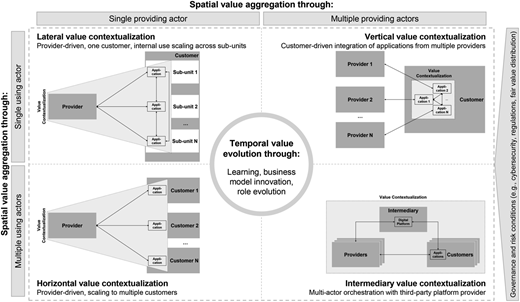
We identify four distinct manifestations of value contextualization within DS-ViC: lateral, horizontal, vertical and intermediary. The resulting forms differ by their initiating actor and the mechanisms through which servitized offerings create and appropriate value. Together, they capture how DS-ViC unfolds across different actor constellations and application settings. Across these forms, value is continuously shaped by scalability, learning effects and cross-context collaboration; furthermore, governance and risk conditions differentially amplify or constrain value aggregation and evolution.

Lateral and horizontal contextualization are typically provider-driven, as manufacturers scale servitized offerings across internal operations, multiple customers or industries to enhance knowledge transfer and operational efficiency. Vertical contextualization, by contrast, is often customer-driven, as firms integrate complementary applications from multiple providers to improve interoperability and system-level performance. Intermediary contextualization presents a more complex dynamic, as value emerges through third-party platforms coordinating multiple providers and customers. While some intermediary models are orchestrator-driven, with a dominant platform provider shaping interactions, others reflect collective contextualization, where multiple actors actively co-create value through shared governance, data integration and modular service configurations. This diversity in initiation influences the balance of power, governance complexity and long-term value distribution within the multi-actor setting.

The DS-ViC framework (see Figure 1) illustrates how these four forms of contextualization span along two spatial dimensions: DS value aggregation by either a single providing actor or multiple providing actors, and by either a single using actor or multiple using actors. In addition, the framework highlights the temporal dimension of DS value evolution, capturing how value creation mechanisms change over time through learning, role evolution and business model innovation. Risk-related issues such as cybersecurity, data privacy, regulatory demands and fair value distribution are represented in Figure 1 by a dashed outer boundary labeled “Governance and risk conditions (e.g. cybersecurity, regulations, fair value distribution)”, indicating that they operate as boundary conditions that shape value aggregation and evolution across all four manifestations over time. Together, these dimensions offer a lens to understand how contextualized value emerges in contemporary DS settings.

3.3.1 Lateral value contextualization

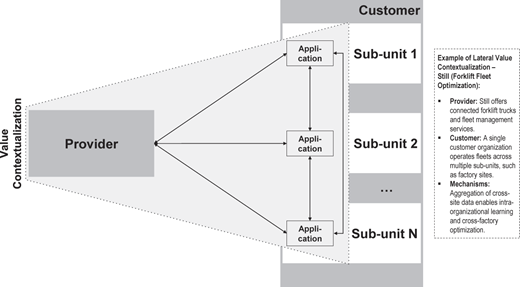
Lateral value contextualization occurs within a single customer organization, where servitized offerings are implemented across multiple applications, such as sites or factories (see Figure 2). This model facilitates intra-organizational learning, operational consistency and efficiency gains by allowing a single customer to benchmark and optimize performance across multiple sub-units, such as factory sites. Customers benefit from data-driven process improvements, standardization and streamlined service adoption. However, this model can introduce scaling rigidity, as solutions are tailored for internal alignment, they may become less adaptable within other contexts. Further, interdependencies between sub-units mean that failures in one sub-unit's operations can have (deleterious) cascading effects.

Real-world example: Still, a global provider of forklift trucks and warehouse technology, provides connected trucks that enable data-driven fleet optimization. Its fleet management solutions, utilizing a digital platform, offer customers control over their fleets, integrating accident monitoring, maintenance management and AI-supported analytics to identify cost savings and optimization opportunities in energy consumption and operational efficiency (Still, 2025). In real-world manifestations of lateral value contextualization, operational data from forklift fleets across multiple factory sites of one customer can be aggregated, allowing for cross-site optimization. The rise of smart manufacturing and intelligent warehouses has further driven demand for forklifts, emphasizing the growing importance of data-driven fleet management to meet increasing logistics complexities (Interact Analysis, 2025). Beyond fleet monitoring, AI-powered digital twins could further enhance the efficiency of automated warehouses by improving coordination between human workers, autonomous forklifts and fully automated systems, ensuring adaptability in response to fluctuating inventory and demand (Kion, 2025). In maintenance operations, generative AI tools already support classification and analysis of documented issues, streamlining problem diagnosis and resolution across customer applications (Kion, 2024). By leveraging such cross-site learning, predictive analytics and AI-enabled process enhancements, customers can unlock cost efficiencies through reduced downtime, optimized fleet performance and lower energy costs, as well as increase health and safety standards across sites. Meanwhile, the provider aggregates value over time by continuously refining predictive model specificity, enhancing service offerings and strengthening its role in the market.

3.3.2 Horizontal value contextualization

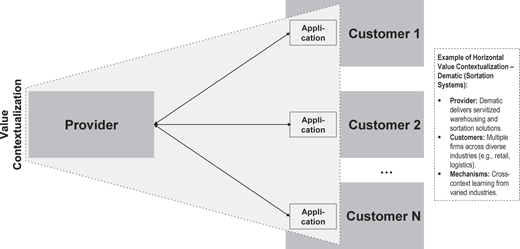
Horizontal value contextualization occurs when a provider implements similar servitized offerings across multiple customers, industries or use cases (see Figure 3). This approach enables scalability, standardization and efficiency, as best practices and insights from one customer or industry inform improvements across different applications. Providers benefit from scale effects, reduced customization costs and faster innovation cycles by refining digital services through cross-context experiences. However, the push-driven nature of this model can create misalignment with customer needs, as overly standardized solutions may lack the flexibility and specificity required for distinct industries or applications.

Real-world example: Dematic, a global leader in automated warehousing, produces robotics and provides servitized offerings (e.g. flexible and scalable automated sortation solutions) to a wide array of customers across different industries including retail, e-commerce, food and beverage, parcel and postal and apparel, creating excellent customer value (Dematic UK, 2025; Dematic US, 2025). Instead of just selling equipment such as pouch sorters, tilt-tray sorters, cross-belt sorters and diverters, Dematic's “Sortation Systems” retain responsibility for operational effectiveness and excellence, ensuring uptime, efficiency and precision (Dematic US, 2025). Horizontal value contextualization works in such a situation by Dematic learning from customers in the parcel and postal industry, for example, regarding efficiently deploying high-rate sortation systems to manage massive package volumes. Then the fine-tuned sorter configurations (e.g. gapping and spacing control between items or divert timing adjustments), which help avoid jams and maintain smooth flow under extreme demand, can be adapted to other industries, such as fast-fashion retailers, to manage high stock-keeping unit turnover and rapid order fulfilment. In other words, the high-speed sorting practices from the parcel and postal industry can be adapted to the apparel industry's pouch sorters. Even though the former industry aims at parcel delivery at scale, the latter industry can benefit from similar efficiency gains for smaller items, especially during peak fashion periods. Such cross-industry application also benefits Dematic as the provider with scale effects and reduced customization costs.

3.3.3 Vertical value contextualization

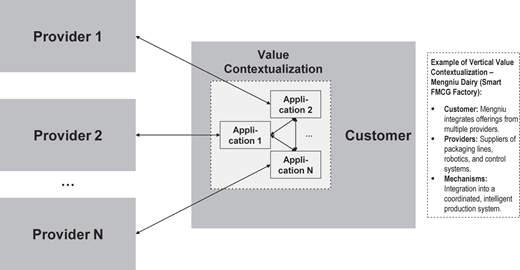
Vertical value contextualization occurs when multiple providers offer complementary servitized offerings that integrate as part of a single customer's transformation process (e.g. a production line) (see Figure 4). This model enhances system interoperability and efficiency, enabling a pull-driven service model in which the customer dictates requirements. Unlike horizontal contextualization, which scales solutions across customers, vertical contextualization enhances functionality within a single customer's setting. This customer-driven model ensures solutions align closely with operational needs, minimizing inefficiencies and promoting seamless integration. However, vertical contextualization increases provider interdependencies, requiring strong governance structures to manage data sharing, service-level agreements and compatibility issues. If interoperability standards are not well-defined, integration costs can escalate, limiting the long-term viability of this approach. Additionally, lock-in risks emerge as customers become reliant on specific providers for integrated servitized offerings.

Real-world example: Mengniu Dairy, a leading multinational FMCG company, demonstrates vertical value contextualization as part of integrating the complementary servitized offerings from different providers into a seamless production system. In their world-first fully intelligent dairy factory (Mengniu, 2023), the packaging provider tailors technology onsite including 24 filling lines to ensure fastest packaging procedure, while Mengniu manages and monitors all operations in real time (Qureshi, 2024); the programmable logic controllers (PLCs) provider regulates fluid temperature and pressure during pre-processing, and this servitized offering not only helps control the conveyor belt but it transmits signals to robot palletizers to ensure manufacturing efficiency (Desmet, 2017); the providers who produce robotic arms that palletize and handle finished dairy products can leverage the IoT data for predictive maintenance which can help Mengniu minimize downtime and maximize equipment efficiency (COFCO, 2023). Mengniu showcases how different servitized applications provided by various providers (including but not limited to smart aseptic testing workstations, automatic raw milk sampling and transporting systems, top-conducting valve clusters, ultra-high-speed filling machines, ultra-high-speed DreamCap package buffering accumulators and 5G IoT transporting systems) are integrated and operated by a single solution via Mengniu's proprietary “Intelligent Digitalized System” (COFCO, 2023). As a result, this vertical value contextualization demonstrates how the customer optimizes production plans, equipment efficiency and energy use, maintaining a competitive position in the industry.

3.3.4 Intermediary value contextualization

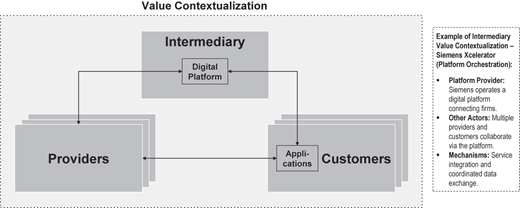
Intermediary value contextualization emerges when a third-party platform provider facilitates interactions between multiple providers and customers as part of DS-ViC (see Figure 5). Unlike vertical contextualization, where providers integrate different servitized offerings from different providers into a single system, intermediaries orchestrate cross-firm service integration, for example, by optimizing industry-wide collaboration through shared data infrastructures and service exchanges. Intermediary value contextualization might manifest itself in diverse environments, influenced, for example, by the openness of the multi-actor setting or the dominance of the platform provider. Some intermediary settings may allow competing manufacturers to operate within the same platform, while others might be closed multi-actor settings. These distinctions affect how value is created, appropriated and governed within the platform structure. Intermediary value contextualization enhances interoperability, scalability and innovation by enabling modular service integration and cross-company data sharing. Open platforms accelerate co-creation and resource optimization and improve operational efficiency. However, firms face high investment costs, vendor lock-in and power asymmetries, particularly when dominant platform providers control data access and governance. Competing manufacturers within shared platforms must navigate data privacy, IP protection and regulatory challenges, while evolving cybersecurity and compliance requirements add further complexities.

Real-world example: Siemens Xcelerator serves as a digital business platform that connects providers (manufacturers, software or service providers) and customers, facilitating cross-company collaboration, service integration and AI-enabled optimization (Siemens, 2025). Through open APIs (Application Programming Interfaces) and modular architectures, companies can integrate servitized offerings, enhance interoperability and foster digital innovations. Customers gain access to customizable solutions, while Siemens coordinates data exchange, accelerating innovation and industrial digitalization across multiple sectors. Following an initial digital twin simulation that assessed energy reduction strategies at a single brewery, the digital platform now aggregates operational data across multiple locations, enabling enterprise-wide optimization – an example of value contextualization within one industry. Similar applications extend to automotive manufacturing, where digital twins facilitate architectural changes and the integration of electrified systems (Swallow, 2024), demonstrating cross-industry value aggregation. These cases illustrate how platform-driven servitization enables scalable learning, operational efficiency and cross-sector innovation.

This study introduces the novel theoretical concept of DS-ViC by outlining how value creation and value appropriation unfold dynamically across multi-actor settings through two interlinked mechanisms: contextual value aggregation and contextual value evolution. These two mechanisms specify how value co-creation unfolds and scales over time and across contexts in multi-actor digital servitization settings. By integrating service-dominant logic with platform governance theory, DS-ViC moves beyond static and dyadic framings and offers a spatio-temporal explanation of how value scales, transforms and is governed in digital servitization. Building on this foundation, we articulate four distinct theoretical contributions.

4.1.1 Advancing servitization research toward multi-actor perspectives

Servitization research has traditionally emphasized firm-centric as well as dyadic perspectives (Oliva and Kallenberg, 2003; Ulaga and Reinartz, 2011). However, this understanding, while foundational, does not capture the increasing relevance of networked collaboration, platforms and intermediaries in DS settings (Edvardsson et al., 2018; Kohtamäki et al., 2022; As'ad et al., 2024). DS-ViC addresses this gap and advances the literature by reconceptualizing value as co-created through multi-actor interactions embedded in specific application contexts. The framework contributes to the DS literature by showing how value is not confined to bilateral exchanges but emerges as actors dynamically integrate resources, share data and coordinate activities across applications, sites or organizational boundaries. The four forms of contextualization introduced in this study – vertical, horizontal, lateral and intermediary – help clarify how different patterns of actor interaction influence DS value evolution.

4.1.2 Governance, control and value appropriation in digital platforms

While value creation has received considerable attention in the servitization literature, value appropriation in multi-actor digital environments remains somewhat under-theorized (Kohtamäki et al., 2019; Sjödin et al., 2022). As servitization progresses onto multi-actor digital platforms and AI-enabled service dynamics, traditional governance structures become inadequate (Nansubuga and Kowalkowski, 2024; Kowalkowski et al., 2024). DS-ViC addresses this gap by incorporating insights from platform governance theory to explain how evolving governance structures influence the distribution of control and value. In particular, the intermediary form of value contextualization highlights how platform providers and data intermediaries shape participation rules, access to digital infrastructure and pricing mechanisms. In this regard, our study provides novel insights into the evolution of governance structures to address a) power asymmetries between manufacturers, platform providers and service intermediaries (Wirtz and Ehret, 2017), b) revenue-sharing models that surpass conventional performance-based contracts, incorporating data monetization, subscription-based access and outcome-driven pricing strategies (Baines et al., 2017; Kowalkowski and Ulaga, 2024; Nansubuga and Kowalkowski, 2024) and c) control mechanisms ensuring fair access to servitized infrastructures, and mitigating risks of vendor lock-in and monopolistic control over service networks (Marcon et al., 2022). Overall, building on platform governance theory, DS-ViC clarifies how governance and control in DS adapt over time as actor constellations expand and as platform providers and intermediaries shape participation rules, data access and pricing.

In addition, the DS-ViC framework highlights that value creation and value appropriation in digital servitization are always embedded within boundary conditions of cybersecurity exposure, data control, regulatory fragmentation and distributive tensions. These governance-related constraints shape power asymmetries, platform dominance, and actors' strategic degrees of freedom, thereby influencing how value aggregation and value evolution unfold in multi-actor settings. Our conceptualization thus complements recent ecosystem-based analyses of control points and multi-actor value appropriation in digital and blockchain-based business models (Bohnsack et al., 2024; Rezazadeh and Bohnsack, 2025).

4.1.3 Contextualizing value through spatio-temporal dynamics

The third theoretical contribution of this study is the reconceptualization of value as a dynamic, contextual construct that unfolds through contextual value aggregation and contextual value evolution (i.e. the two core mechanisms through which DS-ViC develops dynamically over time and across contexts). Traditional servitization models have largely treated value as a predefined transactional gain, failing to account for how value continuously evolves as servitized offerings adapt across contexts (Tronvoll et al., 2020; As'ad et al., 2024). DS-ViC addresses this limitation as part of its spatio-temporal perspective and conceptualizes value along two interrelated dimensions: contextual value aggregation and contextual value evolution. Contextual value aggregation captures the spatial expansion of value as servitized offerings are extended and integrated across applications, users or industry settings. It reflects value dynamics through cross-context learning, reapplication and network effects. In contrast, contextual value evolution emphasizes the temporal transformation of value creation mechanisms as actor roles, governance models and digital infrastructures adapt over time.

The spatio-temporal reconceptualization of value connects to service ecosystems theory by highlighting the emergent and relational nature of value co-creation across actor networks (Lusch and Nambisan, 2015), but it adds specificity by distinguishing how value scales and transforms across space and time. At the same time, it complements configurational approaches to servitization (Forkmann et al., 2017; Heirati et al., 2024, 2025) by emphasizing that the success of servitized offerings depends not on isolated factors, but on evolving configurations of digital capabilities, actor interactions and governance mechanisms. While configurational approaches focus on identifying successful static patterns, DS-ViC emphasizes how these configurations shift dynamically.

4.1.4 AI and dynamics of value in digital servitization

Finally, this study contributes to the DS literature by integrating AI-enabled mechanisms into the conceptualization of platform-based service models. While AI and predictive analytics are increasingly integrated into servitized offerings, there is a lack of conceptual clarity on how these technologies reshape value co-creation dynamics (Niu et al., 2021; Kowalkowski et al., 2024). DS-ViC addresses this gap by offering three interrelated aspects.

It emphasizes how AI can support contextual value creation by enabling more adaptive and responsive service delivery. For example, the use of real-time data analytics and automated decision support can enhance service performance and foster cross-context learning (Vial and Grange, 2024). Furthermore, the framework conceptualizes how AI-enabled learning loops may facilitate deeper co-creation between providers and customers over time, contributing to iterative service improvement and enhanced customization. These mechanisms, while still emerging, represent potential extensions of traditional DS models, where static value propositions give way to more fluid, learning-oriented value dynamics. Finally, DS-ViC draws attention to governance-related risks associated with the integration of AI in digital platforms. Specifically, the concentration of AI capabilities among platform orchestrators can raise concerns about control over data, transparency of decision processes and equitable access to insights. By identifying these risks within the intermediary contextualization of value, the framework offers a foundation for future research on algorithmic governance, digital trust and data-enabled orchestration in multi-actor DS settings. In doing so, DS-ViC maintains its core focus on contextualized value while acknowledging AI as one of several technological enablers within DS.

As DS expands into dynamic multi-actor settings, firms must respond to a shifting value creation and appropriation logic. Based on the DS-ViC concept, we identify three managerial priorities to support value realization and strategic alignment in DS contexts.

4.2.1 Emphasize value-oriented approaches and ensure interoperability

Manufacturers, service providers and platform providers should move beyond product-centric strategies and adopt value-oriented approaches that reflect the multi-actor nature of DS. Instead of relying on one-time and static service transactions, value creation should be structured as a continuous process of optimization, supported by predictive analytics, performance-based contracts and customer-driven adaptations. Firms should align technology choices with a customer-centric lens and tailor specifics to distinct customer needs to enhance adoption and value realization (Wünderlich et al., 2025).

These dynamic elements must be combined with modular standardization and open technical architectures to ensure scalability and seamless integration across offerings (Hunke et al., 2024). To mitigate technological dependencies and lock-in effects, firms should prioritize interoperability through standardized APIs, open platforms and participation in industry consortia. Interoperability enhances scalability, facilitates seamless service adoption and enables multi-actor collaboration (Kowalkowski et al., 2024). In doing so, organizations can reduce risks related to vendor dominance, enhance cross-platform collaboration and better address cybersecurity and data governance concerns.

4.2.2 Optimize monetization strategies and ensure secure, data-enabled value co-creation

DS demands pricing schemes that balance cost recovery, revenue scalability and value distribution across actors. Manufacturers and service providers must move beyond fixed-fee and cost-plus pricing, adopting subscription models, performance-based pricing and hybrid monetization structures (i.e., combinations of different pricing schemes and revenue generation mechanisms used to create more flexible and scalable business models in DS) (Nansubuga and Kowalkowski, 2024). The choice of pricing scheme depends on the practical context, with some providers leveraging fixed subscription fees, while others link fees to usage or performance outcomes. For instance, a fleet management service may employ a subscription scheme, where customers prepay for a fixed number of service appointments per month, ensuring predictable costs while allowing flexibility for additional usage​. Similarly, in industrial maintenance, a provider may charge a recurring fee based on equipment uptime guarantees, aligning pricing with delivered value (Kowalkowski and Ulaga, 2024)​. These examples highlight the importance of aligning incentives among providers, intermediaries and customers. Data-enabled insights can enhance monetization, but pricing transparency, responsible data usage, customer trust and customer willingness to pay appear to be critical to adoption and long-term viability.

In parallel, data-enabled insights and predictive analytics increasingly support value creation and service adaptation. When applied responsibly, these technologies can improve pricing precision, service performance and customer engagement. At the same time, firms must ensure that all data flows and analytics processes are secure, particularly when sensitive operational or customer information is involved. Cybersecurity measures, such as encrypted data exchange, access controls and AI auditability, should be embedded in service design. Effective AI implementation requires co-learning mechanisms in which customers, providers and intermediaries collaboratively refine service models, improving accuracy and reliability over time (Vial and Grange, 2024). Firms should develop adaptive AI and data frameworks that support continuous learning, foster trust and enable shared development, thereby strengthening both monetization and co-creation in DS settings.

4.2.3 Manage role transitions and business model evolution in digital servitization settings

Firms should proactively anticipate and manage role transitions as they evolve, e.g. from traditional manufacturers to service orchestrators or data-driven platform providers. This shift requires clear governance structures, adaptable capabilities and a long-term monetization strategy. To build strategic flexibility, firms should invest in adaptive digital infrastructure, foster cross-functional collaboration and enable modular service innovation that can scale across applications. Developing internal mechanisms for sensing and responding to changes, such as shifting actor roles, emerging intermediaries or regulatory developments, will help firms remain resilient and competitive. Based on the DS-ViC framework, firms should explicitly assess how value aggregation and value evolution occur in their specific contextual settings and use these insights to guide role positioning and capability development. Mapping the spatial and temporal pathways of possible value dynamics can support more informed decisions about scaling offerings, reconfiguring partnerships or transitioning toward orchestration roles. Hybrid strategies may be particularly effective, allowing organizations to operate simultaneously across product, service and data layers, while incrementally repositioning themselves in response to contextual shifts in DS settings.

This study introduces the DS-ViC concept to explain how value creation and appropriation in DS are shaped by multi-actor interactions, governance mechanisms and contextual adaptations over time (Edvardsson et al., 2018; Kohtamäki et al., 2022). While our findings highlight the spatial aggregation and temporal evolution of value in multi-actor DS settings, they also reveal avenues for further research. As DS continues to evolve in B2B settings, questions emerge regarding the co-creation, governance and technological mechanisms that drive value contextualization, as well as the empirical validation of our proposed DS-ViC concept.

First, research should examine the micro-foundations of how multiple actors interact, negotiate, co-create value and align their roles in dynamic servitization settings. Tying in with Vial and Grange (2024), shifting from dyadic provider-customer relationships to multi-actor servitization settings has the potential to redefine how firms coordinate, negotiate and appropriate value (Vial and Grange, 2024). However, research has yet to explore the relational, cognitive and structural mechanisms that underpin such complex settings. While previous studies have addressed inter-organizational collaboration in servitization (Forkmann et al., 2017), limited attention has been given to how multiple actors align value expectations, resolve conflicts and reconfigure governance structures when servitized offerings span across contexts, especially within digital platform environments. As the roles of value orchestrators, complementors and subordinate service providers remain conceptually underdeveloped, future research may focus on trust-building, role coordination and power dependencies that shape long-term value creation in multi-actor DS settings. Empirical studies employing longitudinal designs, social network analysis and configurational analysis (e.g. fsQCA) can provide insights into the complementary, necessary and sufficient factors that facilitate navigating these complexities over time and under varying spatial conditions.

Second, DS increasingly relies on digital platforms, with governance models shifting and platform orchestrators gaining significant control over value distribution, data governance and access to customer networks. Accordingly, governance challenges and power asymmetries demand deeper scrutiny, particularly regarding platform orchestrators' control over value capture and distribution (Kohtamäki et al., 2019; Nansubuga and Kowalkowski, 2024). While platforms create network effects that enable scalability, they also introduce power asymmetries, reinforcing value capture by dominant actors. Existing research does not sufficiently examine how governance structures evolve when multiple stakeholders interact within platform-based servitization settings. Future research should investigate how open versus closed platform models shape power relationships and service innovation. We encourage researchers to augment our framework by incorporating rationale from diverse theoretical lenses. For example, governance theory (Gawer and Cusumano, 2014) can provide insights into how firms manage regulatory interventions, data control and governance shifts in platform-based servitization. Furthermore, institutional theory (Scott, 2014) can inform research on regulatory pressures and industry norms that shape governance in DS, while social network theory (Granovetter, 1973; Borgatti and Halgin, 2011; Scott, 2017) can provide a lens to understand emerging power structures.

Third, a persistent barrier to the scalability and modularity of DS offerings is the lack of interoperability and standardization across technologies, platforms and organizational boundaries. As Kowalkowski et al. (2024) highlight, the absence of standardization and interoperability frameworks across industries hampers scalability and limits the cross-context adaptation of digital services. This fragmentation creates challenges in integrating offerings across multi-actor or cross-industry environments, where organizations must align disparate systems and data architectures to ensure seamless integration. In platform-based servitization settings, firms face a tension between adopting open standards that foster compatibility and scalability and protecting competitive advantage through proprietary systems. This tension is particularly salient in the context of DS-ViC, where value co-creation depends on technological coordination and data exchange among heterogeneous actors. Further research should investigate how regulatory frameworks, platform governance and industry consortia influence standard-setting processes and interoperability.

Fourth, while this study introduces DS-ViC as a conceptual model, the theoretical contribution will advance as its generalizations become more structured, its applicability across contexts more universal and explanatory power broader (Weick, 1989). Testing DS-ViC, for example, the four different forms of value contextualization, requires a methodologically robust comparative approach that captures how value aggregation and evolution unfold in diverse DS configurations. Future studies could integrate interviews with managers and boundary spanners, longitudinal organizational studies and temporal configurational analysis to investigate how value aggregation and evolution unfold. By capturing these dynamics, researchers can systematically analyze how actors engage in cross-context learning, how governance structures evolve and how multi-actor dependencies impact business models.

Concluding, our DS-ViC framework provides a foundation for advancing the understanding of value in DS. Researchers might examine how the four forms of contextualization manifest across industries and how value aggregation trajectories shape firm performance and ecosystem resilience. Further work should also examine how cybersecurity and data privacy risks, international regulatory differences and concerns about fairness influence the long-term stability of value appropriation, learning dynamics and orchestration roles in DS multi-actor settings. Longitudinal and comparative studies across regulatory regimes could improve our understanding of how governance pressures shape platform control, inter-firm trust and the evolution of value creation and appropriation over time.

We thank the Cambridge Service Alliance, University of Cambridge, for conducting the forum “Shaping the Future of Service Management”. This article has benefited from valuable feedback received during the forum. We are especially grateful to Mohamed Zaki, Ruusa Ligthart and Lars Witell for hosting and facilitating the event. Additionally, we would like to thank the two reviewers for their constructive feedback, which was important for refining this work.

The supplementary material for this article can be found online.
Andreassen
,
T.W.
,
Lervik-Olsen
,
L.
,
Snyder
,
H.
,
Van Riel
,
A.C.
,
Sweeney
,
J.C.
and
Van Vaerenbergh
,
Y.
(
2018
), “
Business model innovation and value-creation: the triadic way
”,
Journal of Service Management
, Vol. 
29
No. 
5
, pp. 
883
-
906
, doi: .
As’ad
,
N.
,
Patrício
,
L.
,
Koskela-Huotari
,
K.
and
Edvardsson
,
B.
(
2024
), “
Understanding service ecosystem dynamics: a typology
”,
Journal of Service Management
, Vol. 
35
No. 
6
, pp. 
159
-
184
, doi: .
Baden-Fuller
,
C.
and
Haefliger
,
S.
(
2013
), “
Business models and technological innovation
”,
Long Range Planning
, Vol. 
46
No. 
6
, pp.
419
-
426
, doi: .
Baines
,
T.
and
Lightfoot
,
H.W.
(
2014
), “
Servitization of the manufacturing firm
”,
International Journal of Operations and Production Management
, Vol. 
34
No. 
1
, pp. 
2
-
35
.
Baines
,
T.
,
Ziaee Bigdeli
,
A.
,
Bustinza
,
O.F.
,
Shi
,
V.G.
,
Baldwin
,
J.
and
Ridgway
,
K.
(
2017
), “
Servitization: revisiting the state-of-the-art and research priorities
”,
International Journal of Operations and Production Management
, Vol. 
37
No. 
2
, pp. 
256
-
278
, doi: .
Barile
,
S.
,
Lusch
,
R.
,
Reynoso
,
J.
,
Saviano
,
M.
and
Spohrer
,
J.
(
2016
), “
Systems, networks, and ecosystems in service research
”,
Journal of Service Management
, Vol. 
27
No. 
4
, pp. 
652
-
674
, doi: .
Beverungen
,
D.
,
Kundisch
,
D.
and
Wünderlich
,
N.V.
(
2021
), “
Transforming into a platform provider: strategic options for industrial smart Service providers
”,
Journal of Service Management
, Vol. 
32
No. 
4
, pp. 
507
-
532
, doi: .
Bohnsack
,
R.
,
Rennings
,
M.
,
Block
,
C.
and
Bröring
,
S.
(
2024
), “
Profiting from innovation when digital business ecosystems emerge: a control point perspective
”,
Research Policy
, Vol. 
53
No. 
3
, pp. 
1
-
20
, doi: .
Borgatti
,
S.P.
and
Halgin
,
D.S.
(
2011
), “
On network theory
”,
Organization Science
, Vol. 
22
No. 
5
, pp. 
1168
-
1181
, doi: .
Borgström
,
B.
,
Hertz
,
S.
and
Jensen
,
L.-M.
(
2021
), “
Strategic development of third-party logistics providers (TPLs): ‘Going under the floor’ or ‘raising the roof’
”,
Industrial Marketing Management
, Vol. 
97
, pp. 
183
-
192
, doi: .
Boucher
,
X.
,
Coba
,
C.M.
and
Lamy
,
D.
(
2024
), “
Smart PSS modelling language for value offer prototyping: a design case study in the field of heating appliance offers
”,
Computers in Industry
, Vol. 
155
, doi: .
Braun
,
V.
and
Clarke
,
V.
(
2006
), “
Using thematic analysis in psychology
”,
Qualitative Research in Psychology
, Vol. 
3
No. 
2
, pp. 
77
-
101
, doi: .
Buenechea-Elberdin
,
M.
,
Sáenz
,
J.
and
Kianto
,
A.
(
2024
), “
Intellectual capital-driven innovation: the influence of servitization degree
”,
R&D Management
, Vol. 
54
No. 
4
, pp. 
818
-
832
, doi: .
Bustinza
,
O.F.
,
Molina
,
L.M.
,
Vendrell-Herrero
,
F.
and
Opazo-Basáez
,
M.
(
2024
), “
AI-enabled smart manufacturing boosts ecosystem value capture: the importance of servitization pathways within digital-intensive industries
”,
International Journal of Production Economics
, Vol. 
277
, pp. 
1
-
14
, doi: .
Cavalieri
,
S.
and
Pezzotta
,
G.
(
2012
), “
Product–service systems engineering: state of the art and research challenges
”,
Computers in Industry
, Vol. 
63
No. 
4
, pp.
278
-
288
, doi: .
Cenamor
,
J.
,
Sjödin
,
D.R.
and
Parida
,
V.
(
2017
), “
Adopting a platform approach in servitization: leveraging the value of digitalization
”,
International Journal of Production Economics
, Vol. 
192
, pp. 
54
-
65
, doi: .
Chakkol
,
M.
,
Karatzas
,
A.
,
Johnson
,
M.
and
Godsell
,
J.
(
2018
), “
Building bridges: boundary spanners in servitized supply chains
”,
International Journal of Operations & Production Management
, Vol. 
38
No. 
2
, pp.
579
-
604
, doi: .
Chandler
,
J.D.
and
Vargo
,
S.L.
(
2011
), “
Contextualization and value-in-context: how context frames exchange
”,
Marketing Theory
, Vol. 
11
No. 
1
, pp. 
35
-
49
, doi: .
Chen
,
Y.
,
Visnjic
,
I.
,
Parida
,
V.
and
Zhang
,
Z.
(
2021
), “
On the road to digital servitization – the (dis)continuous interplay between business model and digital technology
”,
International Journal of Operations and Production Management
, Vol. 
41
No. 
5
, pp. 
694
-
722
, doi: .
Chen
,
L.
,
Peng
,
Y.
and
Luo
,
J.
(
2024
), “
Benefit distribution and stability analysis of enterprise digital servitization ecosystems from the perspective of value cocreation
”,
Journal of Business and Industrial Marketing
, Vol. 
39
No. 
9
, pp. 
2003
-
2020
, doi: .
Chesbrough
,
H.W.
(
2011
), “
Bringing open innovation to services
”,
MIT Sloan Management Review
, Vol. 
52
No. 
2
.
Chester Goduscheit
,
R.
and
Faullant
,
R.
(
2018
), “
Paths toward radical service innovation in manufacturing companies: a service-dominant logic perspective
”,
Journal of Product Innovation Management
, Vol. 
35
, pp.
701
-
719
.
COFCO
(
2023
), “
Digital transformation - Mengniu dairy fully intelligent factory
”,
available at:
 https://www.youtube.com/watch?v=F2rd7cJBzIY (
accessed
 5 March 2025).
Culot
,
G.
,
Orzes
,
G.
,
Sartor
,
M.
and
Nassimbeni
,
G.
(
2024
), “
The data sharing conundrum: revisiting established theory in the age of digital transformation
”,
Supply Chain Management: An International Journal
, Vol. 
29
No. 
7
, pp.
1
-
27
, doi: .
Dalenogare
,
L.S.
,
Le Dain
,
M.A.
,
Ayala
,
N.F.
,
Pezzotta
,
G.
and
Frank
,
A.G.
(
2023
), “
Building digital servitization ecosystems: an analysis of inter-firm collaboration types and social exchange mechanisms among actors
”,
Technovation
, Vol. 
124
, 102756, doi: .
Davies
,
P.
,
Liu
,
Y.
,
Cooper
,
M.
and
Xing
,
Y.
(
2023
), “
Supply chains and ecosystems for servitization: a systematic review and future research agenda
”,
International Marketing Review
, Vol. 
40
No. 
4
, pp. 
667
-
692
, doi: .
Deere
,
J.
(
2023
), “
John Deere delivers smart technology for all production systems
”,
available at:
 https://www.deere.co.uk/en-gb/our-company/news/john-deere-delivers-smart-technology-for-all-production-systems--210800 (
accessed
 19 February 2025).
Dematic
 
UK
(
2025
), “
About dematic
”,
available at:
 https://www.dematic.com/en-gb/about/ (
accessed
 6 March 2025).
Dematic US
(
2025
), “
Sortation systems
”,
available at:
 https://www.dematic.com/en-us/products/sortation-systems/ (
accessed
 6 March 2025).
Desmet
,
E.
(
2017
), “
Dairy industry 4.0 – manufacturing transformation for the China Mengniu dairy company
”,
available at:
 https://blogs.sw.siemens.com/opcenter/dairy-industry-4-0-manufacturing-transformation-for-the-china-mengniu-dairy-company/ (
accessed
 6 March 2025).
Edvardsson
,
B.
,
Frow
,
P.
,
Jaakkola
,
E.
,
Keiningham
,
T.L.
,
Tronvoll
,
B.
,
McColl-Kennedy
,
J.R.
and
Tombs
,
A.
(
2018
), “
Examining how context change fosters service innovation
”,
Journal of Service Management
, Vol. 
29
No. 
5
, pp. 
932
-
955
, doi: .
Eggert
,
A.
,
Hogreve
,
J.
,
Ulaga
,
W.
and
Muenkhoff
,
E.
(
2014
), “
Revenue and profit implications of industrial service strategies
”,
Journal of Service Research
, Vol. 
17
No. 
1
, pp.
23
-
39
, doi: .
Eloranta
,
V.
,
Ardolino
,
M.
and
Saccani
,
N.
(
2021
), “
A complexity management approach to servitization: the role of digital platforms
”,
International Journal of Operations and Production Management
, Vol. 
41
No. 
5
, pp. 
622
-
644
, doi: .
Eloranta
,
V.
and
Turunen
,
T.
(
2016
), “
Platforms in service-driven manufacturing: leveraging complexity by connecting, sharing, and integrating
”,
Industrial Marketing Management
, Vol. 
55
, pp.
178
-
186
, doi: .
Faramarzi
,
A.
,
Worm
,
S.
and
Ulaga
,
W.
(
2024
), “
Service strategy's effect on firm performance: a meta-analysis of the servitization literature
”,
Journal of the Academy of Marketing Science
, Vol. 
52
No. 
4
, pp. 
1018
-
1044
, doi: .
Ferreira
,
F.N.H.
,
Cova
,
B.
,
Spencer
,
R.
and
Proença
,
J.F.
(
2016
), “
A dynamics-based approach to solutions typology: a case from the aerospace industry
”,
Industrial Marketing Management
, Vol. 
58
, pp.
114
-
122
, doi: .
Forkmann
,
S.
,
Henneberg
,
S.C.
,
Witell
,
L.
and
Kindström
,
D.
(
2017
), “
Driver configurations for successful service infusion
”,
Journal of Service Research
, Vol. 
20
No. 
3
, pp. 
275
-
291
, doi: .
Frank
,
A.G.
,
Mendes
,
G.H.S.
,
Ayala
,
N.F.
and
Ghezzi
,
A.
(
2019
), “
Servitization and Industry 4.0 convergence in the digital transformation of product firms: a business model innovation perspective
”,
Technological Forecasting and Social Change
, Vol. 
141
, pp. 
341
-
351
, doi: .
Gawer
,
A.
and
Cusumano
,
M.A.
(
2014
), “
Industry platforms and ecosystem innovation
”,
Journal of Product Innovation Management
, Vol. 
31
No. 
3
, pp. 
417
-
433
, doi: .
Gebauer
,
H.
,
Gustafsson
,
A.
and
Witell
,
L.
(
2011
), “
Competitive advantage through service differentiation by manufacturing companies
”,
Journal of Business Research
, Vol. 
64
No. 
12
, pp.
1270
-
1280
, doi: .
Gölgeci
,
I.
,
Gligor
,
D.M.
,
Lacka
,
E.
and
Raja
,
J.Z.
(
2021
), “
Understanding the influence of servitization on global value chains: a conceptual framework
”,
International Journal of Operations & Production Management
, Vol. 
41
No. 
5
, pp.
645
-
667
, doi: .
Granovetter
,
M.S.
(
1973
), “
The strength of weak ties
”,
American Journal of Sociology
, Vol. 
78
No. 
6
, pp. 
1360
-
1380
, doi: .
Green
,
M.H.
,
Davies
,
P.
and
Ng
,
I.C.L.
(
2017
), “
Two strands of servitization: a thematic analysis of traditional and customer co-created servitization and future research directions
”,
International Journal of Production Economics
, Vol. 
192
, pp. 
40
-
53
, doi: .
Guillon
,
D.
,
Ayachi
,
R.
,
Vareilles
,
E.
,
Aldanondo
,
M.
,
Villeneuve
,
E.
and
Merlo
,
C.
(
2021
), “
Product⋎service system configuration: a generic knowledge-based model for commercial offers
”,
International Journal of Production Research
, Vol. 
59
No. 
4
, pp.
1021
-
1040
, doi: .
Häckel
,
B.
,
Karnebogen
,
P.
and
Ritter
,
C.
(
2022
), “
AI-based industrial full-service offerings: a model for payment structure selection considering predictive power
”,
Decision Support Systems
, Vol. 
152
, pp. 
1
-
13
, doi: .
Hakanen
,
T.
,
Helander
,
N.
and
Valkokari
,
K.
(
2017
), “
Servitization in global business-to-business distribution: the central activities of manufacturers
”,
Industrial Marketing Management
, Vol. 
63
, pp. 
167
-
178
, doi: .
Hein
,
A.
,
Schreieck
,
M.
,
Riasanow
,
T.
,
Soto Setzke
,
D.
,
Wiesche
,
M.
,
Böhm
,
M.
and
Krcmar
,
H.
(
2020
), “
Digital platform ecosystems
”,
Electron Markets
, Vol. 
30
No. 
1
, pp. 
87
-
98
, doi: .
Heirati
,
N.
,
Leischnig
,
A.
and
Henneberg
,
S.C.
(
2024
), “
Organization architecture configurations for successful servitization
”,
Journal of Service Research
, Vol. 
27
No. 
3
, pp. 
307
-
326
, doi: .
Heirati
,
N.
,
Thornton
,
S.C.
,
Leischnig
,
A.
and
Henneberg
,
S.C.
(
2025
), “
Capability configurations for successful advanced servitization
”,
International Journal of Operations and Production Management
, Vol. 
45
No. 
2
, pp. 
329
-
354
, doi: .
Hendricks
,
L.
,
Matthyssens
,
P.
and
Kowalkowski
,
C.
(
2025
), “
The Co-evolution of actor engagement and value Co-creation on digital platforms
”,
International Journal of Production Economics
, Vol. 
279
, pp. 
1
-
17
, doi: .
Hunke
,
F.
,
Satzger
,
G.
and
Tuunanen
,
T.
(
2024
), “
Reuse of service concept elements for modular service design
”,
Journal of Service Management
, Vol. 
35
No. 
6
, pp. 
216
-
241
, doi: .
Iansiti
,
M.
and
Lakhani
,
K.R.
(
2014
), “
Digital ubiquity: how connections, sensors, and data are revolutionizing business
”,
Harvard Business Review
, Vol. 
92
No. 
11
.
Interact Analysis
(
2025
),
Forklift Orders Stagnate in 2024 but Reasons for Optimism Remain
,
available at:
 https://interactanalysis.com/forklift-orders-stagnate-in-2024-but-reasons-for-optimism-remain (
accessed
 18 March 2025).
Johnson
,
M.
,
Roehrich
,
J.K.
,
Chakkol
,
M.
and
Davies
,
A.
(
2021
), “
Reconciling and reconceptualising servitization research: drawing on modularity, platforms, ecosystems, risk and governance to develop mid-range theory
”,
International Journal of Operations and Production Management
, Vol. 
41
No. 
5
, pp. 
465
-
493
, doi: .
Jovanovic
,
M.
,
Sjödin
,
D.
and
Parida
,
V.
(
2022
), “
Co-evolution of platform architecture, platform services, and platform governance: expanding the platform value of industrial digital platforms
”,
Technovation
, Vol. 
118
, doi: .
Kapoor
,
K.
,
Bigdeli
,
A.Z.
,
Schroeder
,
A.
and
Baines
,
T.
(
2022
), “
A platform ecosystem view of servitization in manufacturing
”,
Technovation
, Vol. 
118
, pp. 
1
-
12
, doi: .
Karatzas
,
A.
,
Johnson
,
M.
and
Bastl
,
M.
(
2017
), “
Manufacturer-supplier relationships and service performance in service triads
”,
International Journal of Operations & Production Management
, Vol. 
37
No. 
7
, pp.
950
-
969
, doi: .
Khan
,
H.
,
Arslan
,
A.
,
Haapanen
,
L.
,
Rodgers
,
P.
and
Tarba
,
S.Y.
(
2023
), “
Hybrid market offering in the medical technology sector and the role of network configuration: an exploratory assessment in both developed and emerging markets
”,
International Marketing Review
, Vol. 
40
No. 
4
, pp.
612
-
635
, doi: .
Kion
(
2024
), “
Artificial intelligence is revolutionizing the maintenance process of industrial trucks
”,
available at:
 https://www.kiongroup.com/en/News-Stories/Stories/Digitalization/Artificial-intelligence-is-revolutionizing-the-maintenance-process-of-industrial-trucks.html (
accessed
 18 March 2025).
Kion
(
2025
), “
KION teams with NVIDIA and accenture to optimize supply chains with AI-powered robots and digital twins
”,
available at:
 https://www.kiongroup.com/en/News-Stories/Stories/Digitalization/KION-Teams-with-NVIDIA-and-Accenture-to-Optimize-Supply-Chains-with-AI-Powered-Robots-and-Digital-Twins.html?storyid=55296 (
accessed
 18 March 2025).
Kohtamäki
,
M.
,
Parida
,
V.
,
Oghazi
,
P.
,
Gebauer
,
H.
and
Baines
,
T.
(
2019
), “
Digital servitization business models in ecosystems: a theory of the firm
”,
Journal of Business Research
, Vol. 
104
, pp. 
380
-
392
, doi: .
Kohtamäki
,
M.
,
Rabetino
,
R.
,
Einola
,
S.
,
Parida
,
V.
and
Patel
,
P.
(
2021
), “
Unfolding the digital servitization path from products to product-service-software systems: practicing change through intentional narratives
”,
Journal of Business Research
, Vol. 
137
, pp. 
379
-
392
, doi: .
Kohtamäki
,
M.
,
Rabetino
,
R.
,
Parida
,
V.
,
Sjödin
,
D.
and
Henneberg
,
S.
(
2022
), “
Managing digital servitization toward smart solutions: framing the connections between technologies, business models, and ecosystems
”,
Industrial Marketing Management
, Vol. 
104
, pp. 
277
-
291
.
Kolagar
,
M.
,
Reim
,
W.
,
Parida
,
V.
and
Sjödin
,
D.
(
2022
), “
Digital servitization strategies for SME internationalization: the interplay between digital service maturity and ecosystem involvement
”,
Journal of Service Management
, Vol. 
33
No. 
1
, pp. 
143
-
162
, doi: .
Kowalkowski
,
C.
and
Ulaga
,
W.
(
2024
), “
Subscription offers in business-to-business markets: conceptualization, taxonomy, and framework for growth
”,
Industrial Marketing Management
, Vol. 
117
, pp. 
440
-
456
, doi: .
Kowalkowski
,
C.
,
Wirtz
,
J.
and
Ehret
,
M.
(
2024
), “
Digital service innovation in B2B markets
”,
Journal of Service Management
, Vol. 
35
No. 
2
, pp. 
280
-
305
, doi: .
Lusch
,
R.F.
and
Nambisan
,
S.
(
2015
), “
Service innovation: a service-dominant logic perspective
”,
MIS Quarterly
, Vol. 
39
No. 
1
, pp. 
155
-
175
, doi: .
Macdonald
,
E.K.
,
Wilson
,
H.
,
Martinez
,
V.
and
Toossi
,
A.
(
2011
), “
Assessing value-in-use: a conceptual framework and exploratory study
”,
Industrial Marketing Management
, Vol. 
40
No. 
5
, pp. 
671
-
682
, doi: .
Lusch
,
R.F.
,
Vargo
,
S.L.
and
Tanniru
,
M.
(
2010
), “
Service, value networks and learning
”,
Journal of the Academy of Marketing Science
, Vol. 
38
, pp.
19
-
31
, doi: .
Macdonald
,
E.K.
,
Kleinaltenkamp
,
M.
and
Wilson
,
H.N.
(
2016
), “
How business customers judge solutions: solution quality and value in use
”,
Journal of Marketing
, Vol. 
80
No. 
3
, pp. 
96
-
120
, doi: .
Makkonen
,
H.
,
Nordberg-Davies
,
S.
,
Saarni
,
J.
and
Huikkola
,
T.
(
2022
), “
A contextual account of digital servitization through autonomous solutions: aligning a digital servitization process and a maritime service ecosystem transformation to autonomous shipping
”,
Industrial Marketing Management
, Vol. 
102
, pp. 
546
-
563
, doi: .
Marcon
,
É.
,
Marcon
,
A.
,
Ayala
,
N.F.
,
Frank
,
A.G.
,
Story
,
V.
,
Burton
,
J.
,
Raddats
,
C.
and
Zolkiewski
,
J.
(
2022
), “
Capabilities supporting digital servitization: a multi-actor perspective
”,
Industrial Marketing Management
, Vol. 
98
, pp. 
225
-
239
.
Marić
,
J.
,
Pejić Bach
,
M.
and
Gupta
,
S.
(
2024
), “
The origins of digital service innovation (DSI): systematic review of ontology and future research agenda
”,
Journal of Service Management
, Vol. 
35
No. 
2
, pp. 
141
-
175
, doi: .
Mengniu
(
2023
), “
Sustainability report 2022
”,
available at:
 https://api.aconnect.com.hk/Attachment/103573 (
accessed
 25 March 2024).
Moerchel
,
A.
,
Tietze
,
F.
and
Urmetzer
,
F.
(
2023
), “
Visualising dynamics in innovation ecosystems: a new method and demonstration in the commercial aircraft MRO ecosystem
”,
Technovation
, Vol. 
128
, pp. 
1
-
16
, doi: .
Mosch
,
P.
,
Schweikl
,
S.
and
Obermaier
,
R.
(
2021
), “
Trapped in the supply chain? Digital servitization strategies and power relations in the case of an industrial technology supplier
”,
International Journal of Production Economics
, Vol. 
236
, pp. 
1
-
14
, doi: .
Nansubuga
,
B.
and
Kowalkowski
,
C.
(
2024
), “
Moving to subscriptions: service growth through business model innovation in consumer and business markets
”,
Journal of Service Management
, Vol. 
35
No. 
1
, pp. 
49
-
75
, doi: .
Niu
,
Y.
,
Jiang
,
Z.
,
Geng
,
N.
and
Jiang
,
S.
(
2021
), “
Disclosing the formation and value creation of servitization through influential factors: a systematic review and future research agenda
”,
International Journal of Production Research
, Vol. 
59
No. 
23
, pp. 
7057
-
7089
, doi: .
Oliva
,
R.
and
Kallenberg
,
R.
(
2003
), “
Managing the transition from products to services
”,
International Journal of Service Industry Management
, Vol. 
14
No. 
2
, pp. 
160
-
172
, doi: .
Opazo-Basáez
,
M.
,
Vendrell-Herrero
,
F.
and
Bustinza
,
O.F.
(
2022
), “
Digital service innovation: a paradigm shift in technological innovation
”,
Journal of Service Management
, Vol. 
33
No. 
1
, pp. 
97
-
120
, doi: .
Parida
,
V.
and
Jovanovic
,
M.
(
2022
), “
Servitization in global markets: role alignment in global service networks for advanced service provision
”,
R&D Management
, Vol. 
52
No. 
3
, pp. 
577
-
592
, doi: .
Qureshi
,
W.
(
2024
), “
Tetra Pak technology enables Chinese dairy giant World Economic Forum accolade
”,
available at:
 https://www.packagingnews.co.uk/news/markets/drinks/268060-07-11-2024 (
accessed
 5 March 2025).
Rabetino
,
R.
,
Kohtamäki
,
M.
and
Gebauer
,
H.
(
2017
), “
Strategy map of servitization
”,
International Journal of Production Economics
, Vol. 
192
, pp. 
144
-
156
, doi: .
Rabetino
,
R.
,
Kohtamäki
,
M.
and
Huikkola
,
T.
(
2024
), “
Digital service innovation (DSI): a multidisciplinary (re)view of its origins and progress using bibliometric and text mining methods
”,
Journal of Service Management
, Vol. 
35
No. 
2
, pp. 
176
-
201
, doi: .
Rantala
,
T.
,
Ukko
,
J.
,
Nasiri
,
M.
and
Saunila
,
M.
(
2023
), “
Shifting focus of value creation through industrial digital twins—from internal application to ecosystem-level utilization
”,
Technovation
, Vol. 
125
, pp. 
1
-
16
, doi: .
Reim
,
W.
,
Sjödin
,
D.R.
and
Parida
,
V.
(
2019
), “
Servitization of global service network actors–A contingency framework for matching challenges and strategies in service transition
”,
Journal of Business Research
, Vol. 
104
, pp. 
461
-
471
, doi: .
Rezazadeh
,
A.
and
Bohnsack
,
R.
(
2025
), “
Value creation and value capture in NFT business models: insights from blockchain-based ventures
”,
Technological Forecasting and Social Change
, Vol. 
219
, pp. 
1
-
18
, doi: .
Ricci
,
R.
,
Battaglia
,
D.
and
Neirotti
,
P.
(
2021
), “
External knowledge search, opportunity recognition and industry 4.0 adoption in SMEs
”,
International Journal of Production Economics
, Vol. 
240
, pp. 
1
-
18
, doi: .
Ritala
,
P.
,
Keränen
,
J.
,
Fishburn
,
J.
and
Ruokonen
,
M.
(
2024
), “
Selling and monetizing data in B2B markets: four data-driven value propositions
”,
Technovation
, Vol. 
130
, pp. 
1
-
14
, doi: .
Romero
,
D.
and
Molina
,
A.
(
2011
), “
Collaborative networked organisations and customer communities: value co-creation and co-innovation in the networking era
”,
Production Planning and Control
, Vol. 
22
Nos
5-6
, pp. 
447
-
472
, doi: .
Rondi
,
E.
,
De Massis
,
A.
and
Kraus
,
S.
(
2021
), “
Servitization through open service innovation in family firms: exploring the ability-willingness paradox
”,
Journal of Business Research
, Vol. 
135
, pp.
436
-
444
, doi: .
Sampson
,
S.E.
and
Chase
,
R.B.
(
2020
), “
Customer contact in a digital world
”,
Journal of Service Management
, Vol. 
31
No. 
6
, pp. 
1061
-
1069
, doi: .
Schumacher
,
S.
(
2025
), “
John Deere operations center your FAQs answered
”,
available at:
 https://www.rdoequipment.com/resources/blogs/john-deere-operations-center-faqs (
accessed
 19 February 2025).
Scott
,
W.R.
(
2014
),
Institutions and Organizations: Ideas, Interests, and Identities
, (4th ed.) ,
SAGE Publications
,
Thousand Oaks, CA
.
Scott
,
J.
(
2017
),
Social Network Analysis
, (4th ed.) ,
SAGE Publications
,
London
.
Siemens
(
2025
), “
Siemens xcelerator - software for industry
”,
available at:
 https://www.sw.siemens.com/en-US/digital-transformation/ (
accessed
 4 March 2025).
Sjödin
,
D.R.
,
Parida
,
V.
and
Visnjic
,
I.
(
2022
), “
How can large manufacturers digitalize their business models? A framework for orchestrating industrial ecosystems
”,
California Management Review
, Vol. 
64
No. 
3
, pp. 
49
-
77
, doi: .
Sklyar
,
A.
,
Kowalkowski
,
C.
,
Tronvoll
,
B.
and
Sörhammar
,
D.
(
2019
), “
Organizing for digital servitization: a service ecosystem perspective
”,
Journal of Business Research
, Vol. 
104
, pp. 
450
-
460
, doi: .
Smania
,
G.S.
,
Osiro
,
L.
,
Ayala
,
N.F.
,
Coreynen
,
W.
and
Mendes
,
G.H.S.
(
2024a
), “
Unraveling paradoxical tensions in digital servitization ecosystems: an analysis of their interrelationships from the technology provider's perspective
”,
Technovation
, Vol. 
131
, pp. 
1
-
17
, doi: .
Smania
,
G.S.
,
Ayala
,
N.F.
,
Coreynen
,
W.
and
Mendes
,
G.H.S.
(
2024b
), “
Data-related tensions in digital servitization ecosystems: a systematic literature review
”,
Industrial Marketing Management
, Vol. 
123
, pp. 
31
-
48
, doi: .
Spring
,
M.
and
Araujo
,
L.
(
2013
), “
Beyond the service factory: service innovation in manufacturing supply networks
”,
Industrial Marketing Management
, Vol. 
42
No. 
1
, pp.
59
-
70
, doi: .
Still
(
2025
), “
STILL Smart Portal – your all-in-one fleet management
”,
available at:
 https://www.still.de/en-DE/intralogistics-systems/fleetmanagement.html (
accessed
 18 March 2025).
Struyf
,
B.
,
Galvani
,
S.
,
Matthyssens
,
P.
and
Bocconcelli
,
R.
(
2021
), “
Toward a multilevel perspective on digital servitization
”,
International Journal of Operations & Production Management
, Vol. 
41
No. 
5
, pp.
668
-
693
, doi: .
Swallow
,
T.
(
2024
), “
Siemens xcelerator reduces energy consumption with insights
”,
available at:
 https://sustainabilitymag.com/renewable-energy/siemens-xcelerator-reduces-energy-consumption-with-insights (
accessed
 18 March 2025).
Tian
,
J.
,
Coreynen
,
W.
,
Matthyssens
,
P.
and
Shen
,
L.
(
2022
), “
Platform-based servitization and business model adaptation by established manufacturers
”,
Technovation
, Vol. 
118
, doi: .
Tiwana
,
A.
(
2014
),
Platform Ecosystems: Aligning Architecture, Governance, and Strategy
,
Elsevier
,
Waltham, MA
.
Tóth
,
Z.
,
Sklyar
,
A.
,
Kowalkowski
,
C.
,
Sörhammar
,
D.
,
Tronvoll
,
B.
and
Wirths
,
O.
(
2022
), “
Tensions in digital servitization through a paradox lens
”,
Industrial Marketing Management
, Vol. 
102
, pp. 
438
-
450
, doi: .
Tronvoll
,
B.
,
Sklyar
,
A.
,
Sörhammar
,
D.
and
Kowalkowski
,
C.
(
2020
), “
Transformational shifts through digital servitization
”,
Industrial Marketing Management
, Vol. 
89
, pp. 
293
-
305
, doi: .
Tuli
,
K.R.
,
Kohli
,
A.K.
and
Bharadwaj
,
S.G.
(
2007
), “
Rethinking customer solutions: from product bundles to relational processes
”,
Journal of Marketing
, Vol. 
71
No. 
3
, pp. 
1
-
17
, doi: .
Ulaga
,
W.
and
Reinartz
,
W.J.
(
2011
), “
Hybrid offerings: how manufacturing firms combine goods and services successfully
”,
Journal of Marketing
, Vol. 
75
No. 
6
, pp. 
5
-
23
, doi: .
Vargo
,
S.L.
and
Lusch
,
R.F.
(
2004
), “
Evolving to a new dominant logic for marketing
”,
Journal of Marketing
, Vol. 
68
, pp. 
1
-
17
, doi: .
Vargo
,
S.L.
and
Lusch
,
R.F.
(
2011
), “
It's all B2B…and beyond: toward a systems perspective of the market
”,
Industrial Marketing Management
, Vol. 
40
No. 
2
, pp. 
181
-
187
, doi: .
Vargo
,
S.L.
and
Lusch
,
R.F.
(
2016
), “
Institutions and axioms: an extension and update of service-dominant logic
”,
Journal of the Academy of Marketing Science
, Vol. 
44
No. 
1
, pp. 
5
-
23
, doi: .
Vial
,
G.
and
Grange
,
C.
(
2024
), “
Conceptualizing digital service: coconstitutive relationships between digital technologies and service ecosystems
”,
Journal of Service Management
, Vol. 
35
No. 
3
, pp. 
408
-
437
, doi: .
Weick
,
K.E.
(
1989
), “
Theory construction as disciplined imagination
”,
Academy of Management Review
, Vol. 
14
No. 
4
, pp. 
516
-
531
, doi: .
Weigel
,
S.
and
Hadwich
,
K.
(
2018
), “
Success factors of service networks in the context of servitization: development and verification of an impact model
”,
Industrial Marketing Management
, Vol. 
74
, pp.
254
-
275
, doi: .
Weking
,
J.
,
Stöcker
,
M.
,
Kowalkiewicz
,
M.
,
Böhm
,
M.
and
Krcmar
,
H.
(
2020
), “
Leveraging industry 4.0 – a business model pattern framework
”,
International Journal of Production Economics
, Vol. 
225
, pp. 
1
-
17
, doi: .
Wieczerzycki
,
M.
,
Ratajczak-Mrozek
,
M.
,
Hauke-Lopes
,
A.
and
Colurcio
,
M.
(
2025
), “
Value-in-context: co-creation across different context levels in the service ecosystem
”,
Journal of Business and Industrial Marketing
, Vol. 
40
No. 
1
, pp. 
53
-
68
, doi: .
Wirths
,
O.
,
Tóth
,
Z.
and
Diaz Ruiz
,
C.A.
(
2024
), “
Adversarial service networks: a study of service firms’ response to manufacturer-led servitization in aviation
”,
Industrial Marketing Management
, Vol. 
113
, pp. 
1
-
15
, doi: .
Wirtz
,
J.
and
Ehret
,
M.
(
2017
), “
Capturing value in the service economy
”,
SMR - Journal of Service Management Research
, Vol. 
1
No. 
1
, pp. 
22
-
38
, doi: .
Wünderlich
,
N.V.
,
Blut
,
M.
,
Brock
,
C.
,
Heirati
,
N.
,
Jensen
,
M.
,
Paluch
,
S.
,
Rötzmeier-Keuper
,
J.
and
Tóth
,
Z.
(
2025
), “
How to use emerging service technologies to enhance customer centricity in business-to-business contexts: a conceptual framework and research agenda
”,
Journal of Business Research
, Vol. 
192
, pp. 
1
-
14
, doi: .
Yang
,
Z.
,
Zhang
,
Y.
and
Zhang
,
T.
(
2024
), “
Leveraging digitalization and servitization to improve financial performance
”,
Production Planning and Control
, Vol. 
35
No. 
15
, pp. 
2007
-
2020
, doi: .
Zolkiewski
,
J.
,
Story
,
V.M.
,
Burton
,
J.
,
Raddats
,
C.
,
Baines
,
T.
and
Medway
,
D.
(
2023
), “
Tensions in value spaces: the organizational buying center and advanced services
”,
Industrial Marketing Management
, Vol. 
114
, pp. 
196
-
210
, doi: .
Published by Emerald Publishing Limited. This article is published under the Creative Commons Attribution (CC BY 4.0) licence. Anyone may reproduce, distribute, translate and create derivative works of this article (for both commercial and non-commercial purposes), subject to full attribution to the original publication and authors. The full terms of this licence may be seen at Link to the terms of the CC BY 4.0 licence.

Supplementary data

Data & Figures

Figure 1
A diagram shows spatial and temporal value aggregation across single and multiple actors and providers.The layout is divided into four quadrants under the heading “Spatial value aggregation through:” with top labels “Single providing actor” and “Multiple providing actors” and a left vertical label “Spatial value aggregation through:” split into “Single using actor” and “Multiple using actors”. The top-left quadrant titled “Lateral value contextualization” includes a provider block on the left connected by arrows to multiple “Application” boxes within a “Customer” area containing “Sub-unit 1”, “Sub-unit 2”, an ellipsis, and “Sub-unit N”, indicating internal scaling across sub-units. The top-right quadrant titled “Vertical value contextualization” shows multiple provider blocks labeled “Provider 1”, “Provider 2”, an ellipsis, and “Provider N” connected to a central “Value Contextualization” box containing “Application 1”, “Application 2”, an ellipsis, and “Application N”, which then connects to a “Customer” block, representing integration from multiple providers. The bottom-left quadrant titled “Horizontal value contextualization” depicts a single provider connected to separate “Application” boxes aligned with “Customer 1”, “Customer 2”, an ellipsis, and “Customer N”, indicating scaling to multiple customers. The bottom-right quadrant titled “Intermediary value contextualization” shows an “Intermediary” block with a “Digital Platform” linking grouped “Providers” on the left to grouped “Customers” with “Applications” on the right, representing orchestration via a third-party platform. At the center, a circular element reads “Temporal value evolution through: Learning, business model innovation, role evolution”. A vertical label on the far right reads “Governance and risk conditions (e. g. cybersecurity, regulations, fair value distribution)”.

Framework of DS-ViC taxonomy: Four forms of value contextualization through spatial value aggregation and temporal value evolution

Figure 1
A diagram shows spatial and temporal value aggregation across single and multiple actors and providers.The layout is divided into four quadrants under the heading “Spatial value aggregation through:” with top labels “Single providing actor” and “Multiple providing actors” and a left vertical label “Spatial value aggregation through:” split into “Single using actor” and “Multiple using actors”. The top-left quadrant titled “Lateral value contextualization” includes a provider block on the left connected by arrows to multiple “Application” boxes within a “Customer” area containing “Sub-unit 1”, “Sub-unit 2”, an ellipsis, and “Sub-unit N”, indicating internal scaling across sub-units. The top-right quadrant titled “Vertical value contextualization” shows multiple provider blocks labeled “Provider 1”, “Provider 2”, an ellipsis, and “Provider N” connected to a central “Value Contextualization” box containing “Application 1”, “Application 2”, an ellipsis, and “Application N”, which then connects to a “Customer” block, representing integration from multiple providers. The bottom-left quadrant titled “Horizontal value contextualization” depicts a single provider connected to separate “Application” boxes aligned with “Customer 1”, “Customer 2”, an ellipsis, and “Customer N”, indicating scaling to multiple customers. The bottom-right quadrant titled “Intermediary value contextualization” shows an “Intermediary” block with a “Digital Platform” linking grouped “Providers” on the left to grouped “Customers” with “Applications” on the right, representing orchestration via a third-party platform. At the center, a circular element reads “Temporal value evolution through: Learning, business model innovation, role evolution”. A vertical label on the far right reads “Governance and risk conditions (e. g. cybersecurity, regulations, fair value distribution)”.

Framework of DS-ViC taxonomy: Four forms of value contextualization through spatial value aggregation and temporal value evolution

Close modal
Figure 2
A diagram shows lateral value contextualization between a provider and customer sub-units via applications.On the left, a large block labeled “Provider” appears within a dotted boundary labeled “Value Contextualization”, with three arrows extending from the provider to three vertically aligned boxes labeled “Application”. These application boxes are positioned inside a larger “Customer” block on the right, which is divided into sections labeled “Sub-unit 1”, “Sub-unit 2”, and “Sub-unit N” with an ellipsis between them. Vertical arrows connect the application boxes, indicating interaction between subunits. The arrows from the provider point toward each application. A dotted triangular region visually links the provider side to the customer side. On the far right, a dashed box titled “Example of Lateral Value Contextualization – Still (Forklift Fleet Optimization):” contains bullet points describing “Provider: Still offers connected forklift trucks and fleet management services”, “Customer: A single customer organization operates fleets across multiple sub-units, such as factory sites”, and “Mechanisms: Aggregation of cross-site data enables intra-organizational learning and cross-factory optimization”.

Lateral value contextualization

Figure 2
A diagram shows lateral value contextualization between a provider and customer sub-units via applications.On the left, a large block labeled “Provider” appears within a dotted boundary labeled “Value Contextualization”, with three arrows extending from the provider to three vertically aligned boxes labeled “Application”. These application boxes are positioned inside a larger “Customer” block on the right, which is divided into sections labeled “Sub-unit 1”, “Sub-unit 2”, and “Sub-unit N” with an ellipsis between them. Vertical arrows connect the application boxes, indicating interaction between subunits. The arrows from the provider point toward each application. A dotted triangular region visually links the provider side to the customer side. On the far right, a dashed box titled “Example of Lateral Value Contextualization – Still (Forklift Fleet Optimization):” contains bullet points describing “Provider: Still offers connected forklift trucks and fleet management services”, “Customer: A single customer organization operates fleets across multiple sub-units, such as factory sites”, and “Mechanisms: Aggregation of cross-site data enables intra-organizational learning and cross-factory optimization”.

Lateral value contextualization

Close modal
Figure 3
A diagram shows horizontal value contextualization from one provider to multiple customers via applications.On the left, a large block labeled “Provider” appears within a dotted boundary labeled “Value Contextualization”, with three arrows extending outward to three separate boxes labeled “Application”. These application boxes align with three distinct blocks on the right labeled “Customer 1”, “Customer 2”, and “Customer N”, with an ellipsis indicating additional customers. The top and bottom arrows point from the provider toward the respective applications, while the middle connection is shown as a bidirectional arrow between the provider and the central application. A dotted triangular region visually expands from the provider toward the multiple customer side. On the far right, a dashed box titled “Example of Horizontal Value Contextualization – Dematic (Sortation Systems):” includes bullet points stating “Provider: Dematic delivers servitized warehousing and sortation solutions”, “Customers: Multiple firms across diverse industries (e. g., retail, logistics)”, and “Mechanisms: Cross-context learning from varied industries”.

Horizontal value contextualization

Figure 3
A diagram shows horizontal value contextualization from one provider to multiple customers via applications.On the left, a large block labeled “Provider” appears within a dotted boundary labeled “Value Contextualization”, with three arrows extending outward to three separate boxes labeled “Application”. These application boxes align with three distinct blocks on the right labeled “Customer 1”, “Customer 2”, and “Customer N”, with an ellipsis indicating additional customers. The top and bottom arrows point from the provider toward the respective applications, while the middle connection is shown as a bidirectional arrow between the provider and the central application. A dotted triangular region visually expands from the provider toward the multiple customer side. On the far right, a dashed box titled “Example of Horizontal Value Contextualization – Dematic (Sortation Systems):” includes bullet points stating “Provider: Dematic delivers servitized warehousing and sortation solutions”, “Customers: Multiple firms across diverse industries (e. g., retail, logistics)”, and “Mechanisms: Cross-context learning from varied industries”.

Horizontal value contextualization

Close modal
Figure 4
A diagram shows vertical value contextualization integrating multiple providers into customer applications.Multiple blocks labeled “Provider 1”, “Provider 2”, and “Provider N” are arranged vertically on the left, each connected by arrows toward a large central area labeled “Value Contextualization” inside a “Customer” block. Within this central area, a dotted rectangle contains three boxes labeled “Application 1”, “Application 2”, and “Application N” with arrows indicating interactions between the applications, including bidirectional links among them. Arrows from the providers point into different applications, while one connection between “Provider 2” and “Application 1” is shown as bidirectional. On the right side, a dashed box titled “Example of Vertical Value Contextualization – Mengniu Dairy (Smart F M C G Factory):” includes bullet points stating “Customer: Mengniu integrates offerings from multiple providers”, “Providers: Suppliers of packaging lines, robotics, and control systems”, and “Mechanisms: Integration into a coordinated, intelligent production system”.

Vertical value contextualization

Figure 4
A diagram shows vertical value contextualization integrating multiple providers into customer applications.Multiple blocks labeled “Provider 1”, “Provider 2”, and “Provider N” are arranged vertically on the left, each connected by arrows toward a large central area labeled “Value Contextualization” inside a “Customer” block. Within this central area, a dotted rectangle contains three boxes labeled “Application 1”, “Application 2”, and “Application N” with arrows indicating interactions between the applications, including bidirectional links among them. Arrows from the providers point into different applications, while one connection between “Provider 2” and “Application 1” is shown as bidirectional. On the right side, a dashed box titled “Example of Vertical Value Contextualization – Mengniu Dairy (Smart F M C G Factory):” includes bullet points stating “Customer: Mengniu integrates offerings from multiple providers”, “Providers: Suppliers of packaging lines, robotics, and control systems”, and “Mechanisms: Integration into a coordinated, intelligent production system”.

Vertical value contextualization

Close modal
Figure 5
A diagram shows intermediary value contextualization connecting providers and customers via a digital platform.The large dotted boundary labeled “Value Contextualization” encloses the diagram, with a central block labeled “Intermediary” containing a smaller box labeled “Digital Platform”. Arrows extend from the digital platform downward to grouped blocks labeled “Providers” on the left and “Customers” on the right, indicating connections through the platform. Between the providers and customers, a box labeled “Applications” is positioned closer to the customer side, with a bidirectional arrow linking “Providers” and “Applications”, and another connection from the digital platform to the applications. The providers and customers are shown as stacked blocks, indicating multiple entities on each side. On the far right, a dashed box titled “Example of Intermediary Value Contextualization – Siemens Xcelerator (Platform Orchestration):” includes bullet points stating “Platform Provider: Siemens operates a digital platform connecting firms”, “Other Actors: Multiple providers and customers collaborate via the platform”, and “Mechanisms: Service integration and coordinated data exchange”.

Intermediary value contextualization

Figure 5
A diagram shows intermediary value contextualization connecting providers and customers via a digital platform.The large dotted boundary labeled “Value Contextualization” encloses the diagram, with a central block labeled “Intermediary” containing a smaller box labeled “Digital Platform”. Arrows extend from the digital platform downward to grouped blocks labeled “Providers” on the left and “Customers” on the right, indicating connections through the platform. Between the providers and customers, a box labeled “Applications” is positioned closer to the customer side, with a bidirectional arrow linking “Providers” and “Applications”, and another connection from the digital platform to the applications. The providers and customers are shown as stacked blocks, indicating multiple entities on each side. On the far right, a dashed box titled “Example of Intermediary Value Contextualization – Siemens Xcelerator (Platform Orchestration):” includes bullet points stating “Platform Provider: Siemens operates a digital platform connecting firms”, “Other Actors: Multiple providers and customers collaborate via the platform”, and “Mechanisms: Service integration and coordinated data exchange”.

Intermediary value contextualization

Close modal
Table 1

Analytical results of the dual SLR: how DS reshapes value across actor settings

DimensionsRelationship-related perspective: Focus on single actors or dyadsMulti-actor perspective: Focus on triads or networks
Value creation Actors
  • Providers (manufacturers or service providers): Create value through product-service transitions (e.g. predictive maintenance, extended warranties, and performance-based contract)

  • Customers: Benefit from improved asset utilization, cost savings, reduced downtime and operational reliability

Mechanisms
  • Value is generated within the context of contractual agreements (e.g. SLAs, pay-per-use, performance-based models)

 
Actors
  • Providers (manufacturers or service providers): Optimize cost efficiency and knowledge transfer by leveraging synergies, scaling value creation through service modularization, data-driven optimization and AI-powered diagnostics

  • Customers: Co-create value by sharing operational data, engaging in collaborative service design and driving efficiencies across actor boundaries

  • Intermediaries (e.g. platform providers): Enable multi-actor collaboration and data-driven process optimization through digital infrastructure, standardization, and orchestrating service exchanges

Mechanisms
  • Multi-actor co-creation drives scalability and interoperability, leveraging data analytics, AI and predictive service management

  • Platforms facilitate seamless service orchestration, integrating actors across industries for knowledge sharing and process optimization

 
Value appropriation Actors
  • Providers (manufacturers or service providers): Capture value through cost-plus pricing, long-term service contracts and recurring revenues from warranties and usage-based agreements

  • Customers: Appropriate value via total cost of ownership reduction and risk mitigation

Mechanisms
  • Transactional revenue models (fixed-fee, usage-based, or pay-per-performance structures)

 
Actors
  • Providers (manufacturers or service providers): Capture value and secure competitive advantage through specialized expertise and long-term contractual service delivery

  • Customers: Appropriate value through reduced total cost of ownership and risk mitigation while benefiting from aggregated insights, performance-based contracting and improved service customization

  • Intermediaries (e.g. platform providers): Monetize value through subscriptions, advisory and integration, analytics and AI-driven services

Mechanisms
  • Emerging revenue mechanisms include revenue-sharing agreements, freemium models, and bundled services

 
Risks and challenges 
  • Vendor lock-in: Customers risk becoming dependent on proprietary systems with high switching costs

  • Provider dominance: Manufacturers control service models, restricting customer bargaining power

  • Scalability challenges: Firm-centric servitization lacks interoperability

  • Uncertain ROI for manufacturers: Transitioning to service-based revenue risks profit margin erosion due to high service costs

 
  • Asymmetries in value distribution: Smaller providers and service integrators struggle to negotiate fair revenue shares in platform-driven settings

  • Data governance and monopolization risks: Platform orchestrators control data flows and customer insights, service bundling and pricing mechanisms

  • Regulatory concerns: Absence of unified standards for data ownership, security and interoperability creates uncertainty for actors in multi-actor networks

 
DimensionsRelationship-related perspective: Focus on single actors or dyadsMulti-actor perspective: Focus on triads or networks
Value creation Actors
  • Providers (manufacturers or service providers): Create value through product-service transitions (e.g. predictive maintenance, extended warranties, and performance-based contract)

  • Customers: Benefit from improved asset utilization, cost savings, reduced downtime and operational reliability

Mechanisms
  • Value is generated within the context of contractual agreements (e.g. SLAs, pay-per-use, performance-based models)

 
Actors
  • Providers (manufacturers or service providers): Optimize cost efficiency and knowledge transfer by leveraging synergies, scaling value creation through service modularization, data-driven optimization and AI-powered diagnostics

  • Customers: Co-create value by sharing operational data, engaging in collaborative service design and driving efficiencies across actor boundaries

  • Intermediaries (e.g. platform providers): Enable multi-actor collaboration and data-driven process optimization through digital infrastructure, standardization, and orchestrating service exchanges

Mechanisms
  • Multi-actor co-creation drives scalability and interoperability, leveraging data analytics, AI and predictive service management

  • Platforms facilitate seamless service orchestration, integrating actors across industries for knowledge sharing and process optimization

 
Value appropriation Actors
  • Providers (manufacturers or service providers): Capture value through cost-plus pricing, long-term service contracts and recurring revenues from warranties and usage-based agreements

  • Customers: Appropriate value via total cost of ownership reduction and risk mitigation

Mechanisms
  • Transactional revenue models (fixed-fee, usage-based, or pay-per-performance structures)

 
Actors
  • Providers (manufacturers or service providers): Capture value and secure competitive advantage through specialized expertise and long-term contractual service delivery

  • Customers: Appropriate value through reduced total cost of ownership and risk mitigation while benefiting from aggregated insights, performance-based contracting and improved service customization

  • Intermediaries (e.g. platform providers): Monetize value through subscriptions, advisory and integration, analytics and AI-driven services

Mechanisms
  • Emerging revenue mechanisms include revenue-sharing agreements, freemium models, and bundled services

 
Risks and challenges 
  • Vendor lock-in: Customers risk becoming dependent on proprietary systems with high switching costs

  • Provider dominance: Manufacturers control service models, restricting customer bargaining power

  • Scalability challenges: Firm-centric servitization lacks interoperability

  • Uncertain ROI for manufacturers: Transitioning to service-based revenue risks profit margin erosion due to high service costs

 
  • Asymmetries in value distribution: Smaller providers and service integrators struggle to negotiate fair revenue shares in platform-driven settings

  • Data governance and monopolization risks: Platform orchestrators control data flows and customer insights, service bundling and pricing mechanisms

  • Regulatory concerns: Absence of unified standards for data ownership, security and interoperability creates uncertainty for actors in multi-actor networks

 
Table 2

Overview of the gaps derived from the dual SLR

DimensionsIdentified gaps in the DUAL SLRList of articles related to these gaps
Value Creation Limited understanding of how value dynamically shifts across interdependent servitized offerings. Need to explore how interoperability and AI-driven learning processes enhance multi-actor value realization Smania et al. (2024a, b), Niu et al. (2021), Tronvoll et al. (2020), Eloranta et al. (2021)  
Limited research on real-time adaptation, scalability and customer co-learning in digital servitization 
Value Appropriation Limited research on how actors reposition within evolving multi-actor settings (e.g. when customers transition from passive buyers to “co-orchestrators”). New revenue interdependencies (e.g. revenue-sharing, freemium models) require further exploration Buenechea-Elberdin et al. (2024), Boucher et al. (2024), Sjödin et al. (2022), Hendricks et al. (2025), Romero and Molina (2011), Guillon et al. (2021), Gawer and Cusumano (2014), Eggert et al. (2014), Dalenogare et al. (2023), Culot et al. (2024), Khan et al. (2023), Eloranta et al. (2021), Tian et al. (2022), Weigel and Hadwich (2018), Lusch et al. (2010), Jovanovic et al. (2022), Smania et al. (2024a, b), Rantala et al. (2023), Rondi et al. (2021), Vargo and Lusch (2011), Struyf et al. (2021), Spring and Araujo (2013)  
Lack of research on governance, control mechanisms and IP protection in digital value capture 
Risks and Challenges Need for mechanisms ensuring fair value distribution. Limited understanding on contractual dependencies to prevent monopolization while maintaining stability of the multi-actor settings Kohtamäki et al. (2019), Buenechea-Elberdin et al. (2024), Lusch and Nambisan (2015), Baines et al. (2017), Mosch et al. (2021), Gölgeci et al. (2021), Chakkol et al. (2018), Wirths et al. (2024), Karatzas et al. (2017), Chesbrough (2011), Gawer and Cusumano (2014), Green et al. (2017), Baden-Fuller and Haefliger (2013), Boucher et al. (2024), Marcon et al. (2022), Iansiti and Lakhani (2014), Cavalieri and Pezzotta (2012), Chester Goduscheit and Faullant (2018), Spring and Araujo (2013), Gebauer et al. (2011), Ferreira et al. (2016), Eloranta and Turunen (2016), Davies et al. (2023), Weigel and Hadwich (2018), Guillon et al. (2021), Dalenogare et al. (2023), Ritala et al. (2024), Weking et al. (2020), Romero and Molina (2011)  
Limited focus on cybersecurity, data privacy and regulatory challenges in servitization 
DimensionsIdentified gaps in the DUAL SLRList of articles related to these gaps
Value Creation Limited understanding of how value dynamically shifts across interdependent servitized offerings. Need to explore how interoperability and AI-driven learning processes enhance multi-actor value realization Smania et al. (2024a, b), Niu et al. (2021), Tronvoll et al. (2020), Eloranta et al. (2021)  
Limited research on real-time adaptation, scalability and customer co-learning in digital servitization 
Value Appropriation Limited research on how actors reposition within evolving multi-actor settings (e.g. when customers transition from passive buyers to “co-orchestrators”). New revenue interdependencies (e.g. revenue-sharing, freemium models) require further exploration Buenechea-Elberdin et al. (2024), Boucher et al. (2024), Sjödin et al. (2022), Hendricks et al. (2025), Romero and Molina (2011), Guillon et al. (2021), Gawer and Cusumano (2014), Eggert et al. (2014), Dalenogare et al. (2023), Culot et al. (2024), Khan et al. (2023), Eloranta et al. (2021), Tian et al. (2022), Weigel and Hadwich (2018), Lusch et al. (2010), Jovanovic et al. (2022), Smania et al. (2024a, b), Rantala et al. (2023), Rondi et al. (2021), Vargo and Lusch (2011), Struyf et al. (2021), Spring and Araujo (2013)  
Lack of research on governance, control mechanisms and IP protection in digital value capture 
Risks and Challenges Need for mechanisms ensuring fair value distribution. Limited understanding on contractual dependencies to prevent monopolization while maintaining stability of the multi-actor settings Kohtamäki et al. (2019), Buenechea-Elberdin et al. (2024), Lusch and Nambisan (2015), Baines et al. (2017), Mosch et al. (2021), Gölgeci et al. (2021), Chakkol et al. (2018), Wirths et al. (2024), Karatzas et al. (2017), Chesbrough (2011), Gawer and Cusumano (2014), Green et al. (2017), Baden-Fuller and Haefliger (2013), Boucher et al. (2024), Marcon et al. (2022), Iansiti and Lakhani (2014), Cavalieri and Pezzotta (2012), Chester Goduscheit and Faullant (2018), Spring and Araujo (2013), Gebauer et al. (2011), Ferreira et al. (2016), Eloranta and Turunen (2016), Davies et al. (2023), Weigel and Hadwich (2018), Guillon et al. (2021), Dalenogare et al. (2023), Ritala et al. (2024), Weking et al. (2020), Romero and Molina (2011)  
Limited focus on cybersecurity, data privacy and regulatory challenges in servitization 
Table 3

Positioning DS-ViC vis-a-vis existing frameworks

FrameworkValue creation and appropriationLimitations for digital servitizationExtension by DS-ViC
Value Co-creation (Vargo and Lusch, 2004, 2011Value is co-created through resource integration and realized in use, with a primary emphasis on dyadic provider-customer interactions while being compatible with broader actor constellations Provides a strong foundation for relational value creation but offers limited guidance on interoperability challenges, governance shifts, or cross-actor learning in evolving servitization settings Builds on these foundations by specifying how multi-actor settings, governance mechanisms, and iterative learning shape value creation and appropriation across contexts and over time in DS 
Value-in-use (Macdonald et al., 2011, 2016Value is generated through solution usage and is shaped by resource and process integration, typically assessed at customer level Offers important insights into usage-based value assessments but pays less explicit attention to broader governance, interoperability and multi-actor interactions in DS Extends the lens by clarifying how cross-actor adaptation, governance shifts, and data-driven learning shape value creation and appropriation across contexts and over time in DS 
Value-in-context (Chandler and Vargo, 2011; Wieczerzycki et al., 2025Value is co-created through service-for-service exchanges, defined by context and resource integration across potentially multiple actors Acknowledges contextualized value but provides limited conceptual detail on how value aggregates across contexts and evolves over time as actor roles, governance arrangements and applications reconfigure in DS Introduces explicitly spatial and temporal dimensions, illustrating how value aggregation and evolution unfold through cross-context learning, changing governance and shifting actor roles in DS 
Platform governance value (Gawer and Cusumano, 2014; Kapoor et al., 2022Value is created through platform-mediated interactions and network effects, facilitating exchanges among platform owners, complementors and users Mainly focuses on platform exchange facilitation emphasizing efficiency rather than the potential evolution of actor roles and cross-actor learning over time in DS Reframes platform-enabled value in DS by explaining how actors orchestrate offerings, reposition within multi-actor settings and enable cross-context learning 
FrameworkValue creation and appropriationLimitations for digital servitizationExtension by DS-ViC
Value Co-creation (Vargo and Lusch, 2004, 2011Value is co-created through resource integration and realized in use, with a primary emphasis on dyadic provider-customer interactions while being compatible with broader actor constellations Provides a strong foundation for relational value creation but offers limited guidance on interoperability challenges, governance shifts, or cross-actor learning in evolving servitization settings Builds on these foundations by specifying how multi-actor settings, governance mechanisms, and iterative learning shape value creation and appropriation across contexts and over time in DS 
Value-in-use (Macdonald et al., 2011, 2016Value is generated through solution usage and is shaped by resource and process integration, typically assessed at customer level Offers important insights into usage-based value assessments but pays less explicit attention to broader governance, interoperability and multi-actor interactions in DS Extends the lens by clarifying how cross-actor adaptation, governance shifts, and data-driven learning shape value creation and appropriation across contexts and over time in DS 
Value-in-context (Chandler and Vargo, 2011; Wieczerzycki et al., 2025Value is co-created through service-for-service exchanges, defined by context and resource integration across potentially multiple actors Acknowledges contextualized value but provides limited conceptual detail on how value aggregates across contexts and evolves over time as actor roles, governance arrangements and applications reconfigure in DS Introduces explicitly spatial and temporal dimensions, illustrating how value aggregation and evolution unfold through cross-context learning, changing governance and shifting actor roles in DS 
Platform governance value (Gawer and Cusumano, 2014; Kapoor et al., 2022Value is created through platform-mediated interactions and network effects, facilitating exchanges among platform owners, complementors and users Mainly focuses on platform exchange facilitation emphasizing efficiency rather than the potential evolution of actor roles and cross-actor learning over time in DS Reframes platform-enabled value in DS by explaining how actors orchestrate offerings, reposition within multi-actor settings and enable cross-context learning 

Supplements

Supplementary data

References

Andreassen
,
T.W.
,
Lervik-Olsen
,
L.
,
Snyder
,
H.
,
Van Riel
,
A.C.
,
Sweeney
,
J.C.
and
Van Vaerenbergh
,
Y.
(
2018
), “
Business model innovation and value-creation: the triadic way
”,
Journal of Service Management
, Vol. 
29
No. 
5
, pp. 
883
-
906
, doi: .
As’ad
,
N.
,
Patrício
,
L.
,
Koskela-Huotari
,
K.
and
Edvardsson
,
B.
(
2024
), “
Understanding service ecosystem dynamics: a typology
”,
Journal of Service Management
, Vol. 
35
No. 
6
, pp. 
159
-
184
, doi: .
Baden-Fuller
,
C.
and
Haefliger
,
S.
(
2013
), “
Business models and technological innovation
”,
Long Range Planning
, Vol. 
46
No. 
6
, pp.
419
-
426
, doi: .
Baines
,
T.
and
Lightfoot
,
H.W.
(
2014
), “
Servitization of the manufacturing firm
”,
International Journal of Operations and Production Management
, Vol. 
34
No. 
1
, pp. 
2
-
35
.
Baines
,
T.
,
Ziaee Bigdeli
,
A.
,
Bustinza
,
O.F.
,
Shi
,
V.G.
,
Baldwin
,
J.
and
Ridgway
,
K.
(
2017
), “
Servitization: revisiting the state-of-the-art and research priorities
”,
International Journal of Operations and Production Management
, Vol. 
37
No. 
2
, pp. 
256
-
278
, doi: .
Barile
,
S.
,
Lusch
,
R.
,
Reynoso
,
J.
,
Saviano
,
M.
and
Spohrer
,
J.
(
2016
), “
Systems, networks, and ecosystems in service research
”,
Journal of Service Management
, Vol. 
27
No. 
4
, pp. 
652
-
674
, doi: .
Beverungen
,
D.
,
Kundisch
,
D.
and
Wünderlich
,
N.V.
(
2021
), “
Transforming into a platform provider: strategic options for industrial smart Service providers
”,
Journal of Service Management
, Vol. 
32
No. 
4
, pp. 
507
-
532
, doi: .
Bohnsack
,
R.
,
Rennings
,
M.
,
Block
,
C.
and
Bröring
,
S.
(
2024
), “
Profiting from innovation when digital business ecosystems emerge: a control point perspective
”,
Research Policy
, Vol. 
53
No. 
3
, pp. 
1
-
20
, doi: .
Borgatti
,
S.P.
and
Halgin
,
D.S.
(
2011
), “
On network theory
”,
Organization Science
, Vol. 
22
No. 
5
, pp. 
1168
-
1181
, doi: .
Borgström
,
B.
,
Hertz
,
S.
and
Jensen
,
L.-M.
(
2021
), “
Strategic development of third-party logistics providers (TPLs): ‘Going under the floor’ or ‘raising the roof’
”,
Industrial Marketing Management
, Vol. 
97
, pp. 
183
-
192
, doi: .
Boucher
,
X.
,
Coba
,
C.M.
and
Lamy
,
D.
(
2024
), “
Smart PSS modelling language for value offer prototyping: a design case study in the field of heating appliance offers
”,
Computers in Industry
, Vol. 
155
, doi: .
Braun
,
V.
and
Clarke
,
V.
(
2006
), “
Using thematic analysis in psychology
”,
Qualitative Research in Psychology
, Vol. 
3
No. 
2
, pp. 
77
-
101
, doi: .
Buenechea-Elberdin
,
M.
,
Sáenz
,
J.
and
Kianto
,
A.
(
2024
), “
Intellectual capital-driven innovation: the influence of servitization degree
”,
R&D Management
, Vol. 
54
No. 
4
, pp. 
818
-
832
, doi: .
Bustinza
,
O.F.
,
Molina
,
L.M.
,
Vendrell-Herrero
,
F.
and
Opazo-Basáez
,
M.
(
2024
), “
AI-enabled smart manufacturing boosts ecosystem value capture: the importance of servitization pathways within digital-intensive industries
”,
International Journal of Production Economics
, Vol. 
277
, pp. 
1
-
14
, doi: .
Cavalieri
,
S.
and
Pezzotta
,
G.
(
2012
), “
Product–service systems engineering: state of the art and research challenges
”,
Computers in Industry
, Vol. 
63
No. 
4
, pp.
278
-
288
, doi: .
Cenamor
,
J.
,
Sjödin
,
D.R.
and
Parida
,
V.
(
2017
), “
Adopting a platform approach in servitization: leveraging the value of digitalization
”,
International Journal of Production Economics
, Vol. 
192
, pp. 
54
-
65
, doi: .
Chakkol
,
M.
,
Karatzas
,
A.
,
Johnson
,
M.
and
Godsell
,
J.
(
2018
), “
Building bridges: boundary spanners in servitized supply chains
”,
International Journal of Operations & Production Management
, Vol. 
38
No. 
2
, pp.
579
-
604
, doi: .
Chandler
,
J.D.
and
Vargo
,
S.L.
(
2011
), “
Contextualization and value-in-context: how context frames exchange
”,
Marketing Theory
, Vol. 
11
No. 
1
, pp. 
35
-
49
, doi: .
Chen
,
Y.
,
Visnjic
,
I.
,
Parida
,
V.
and
Zhang
,
Z.
(
2021
), “
On the road to digital servitization – the (dis)continuous interplay between business model and digital technology
”,
International Journal of Operations and Production Management
, Vol. 
41
No. 
5
, pp. 
694
-
722
, doi: .
Chen
,
L.
,
Peng
,
Y.
and
Luo
,
J.
(
2024
), “
Benefit distribution and stability analysis of enterprise digital servitization ecosystems from the perspective of value cocreation
”,
Journal of Business and Industrial Marketing
, Vol. 
39
No. 
9
, pp. 
2003
-
2020
, doi: .
Chesbrough
,
H.W.
(
2011
), “
Bringing open innovation to services
”,
MIT Sloan Management Review
, Vol. 
52
No. 
2
.
Chester Goduscheit
,
R.
and
Faullant
,
R.
(
2018
), “
Paths toward radical service innovation in manufacturing companies: a service-dominant logic perspective
”,
Journal of Product Innovation Management
, Vol. 
35
, pp.
701
-
719
.
COFCO
(
2023
), “
Digital transformation - Mengniu dairy fully intelligent factory
”,
available at:
 https://www.youtube.com/watch?v=F2rd7cJBzIY (
accessed
 5 March 2025).
Culot
,
G.
,
Orzes
,
G.
,
Sartor
,
M.
and
Nassimbeni
,
G.
(
2024
), “
The data sharing conundrum: revisiting established theory in the age of digital transformation
”,
Supply Chain Management: An International Journal
, Vol. 
29
No. 
7
, pp.
1
-
27
, doi: .
Dalenogare
,
L.S.
,
Le Dain
,
M.A.
,
Ayala
,
N.F.
,
Pezzotta
,
G.
and
Frank
,
A.G.
(
2023
), “
Building digital servitization ecosystems: an analysis of inter-firm collaboration types and social exchange mechanisms among actors
”,
Technovation
, Vol. 
124
, 102756, doi: .
Davies
,
P.
,
Liu
,
Y.
,
Cooper
,
M.
and
Xing
,
Y.
(
2023
), “
Supply chains and ecosystems for servitization: a systematic review and future research agenda
”,
International Marketing Review
, Vol. 
40
No. 
4
, pp. 
667
-
692
, doi: .
Deere
,
J.
(
2023
), “
John Deere delivers smart technology for all production systems
”,
available at:
 https://www.deere.co.uk/en-gb/our-company/news/john-deere-delivers-smart-technology-for-all-production-systems--210800 (
accessed
 19 February 2025).
Dematic
 
UK
(
2025
), “
About dematic
”,
available at:
 https://www.dematic.com/en-gb/about/ (
accessed
 6 March 2025).
Dematic US
(
2025
), “
Sortation systems
”,
available at:
 https://www.dematic.com/en-us/products/sortation-systems/ (
accessed
 6 March 2025).
Desmet
,
E.
(
2017
), “
Dairy industry 4.0 – manufacturing transformation for the China Mengniu dairy company
”,
available at:
 https://blogs.sw.siemens.com/opcenter/dairy-industry-4-0-manufacturing-transformation-for-the-china-mengniu-dairy-company/ (
accessed
 6 March 2025).
Edvardsson
,
B.
,
Frow
,
P.
,
Jaakkola
,
E.
,
Keiningham
,
T.L.
,
Tronvoll
,
B.
,
McColl-Kennedy
,
J.R.
and
Tombs
,
A.
(
2018
), “
Examining how context change fosters service innovation
”,
Journal of Service Management
, Vol. 
29
No. 
5
, pp. 
932
-
955
, doi: .
Eggert
,
A.
,
Hogreve
,
J.
,
Ulaga
,
W.
and
Muenkhoff
,
E.
(
2014
), “
Revenue and profit implications of industrial service strategies
”,
Journal of Service Research
, Vol. 
17
No. 
1
, pp.
23
-
39
, doi: .
Eloranta
,
V.
,
Ardolino
,
M.
and
Saccani
,
N.
(
2021
), “
A complexity management approach to servitization: the role of digital platforms
”,
International Journal of Operations and Production Management
, Vol. 
41
No. 
5
, pp. 
622
-
644
, doi: .
Eloranta
,
V.
and
Turunen
,
T.
(
2016
), “
Platforms in service-driven manufacturing: leveraging complexity by connecting, sharing, and integrating
”,
Industrial Marketing Management
, Vol. 
55
, pp.
178
-
186
, doi: .
Faramarzi
,
A.
,
Worm
,
S.
and
Ulaga
,
W.
(
2024
), “
Service strategy's effect on firm performance: a meta-analysis of the servitization literature
”,
Journal of the Academy of Marketing Science
, Vol. 
52
No. 
4
, pp. 
1018
-
1044
, doi: .
Ferreira
,
F.N.H.
,
Cova
,
B.
,
Spencer
,
R.
and
Proença
,
J.F.
(
2016
), “
A dynamics-based approach to solutions typology: a case from the aerospace industry
”,
Industrial Marketing Management
, Vol. 
58
, pp.
114
-
122
, doi: .
Forkmann
,
S.
,
Henneberg
,
S.C.
,
Witell
,
L.
and
Kindström
,
D.
(
2017
), “
Driver configurations for successful service infusion
”,
Journal of Service Research
, Vol. 
20
No. 
3
, pp. 
275
-
291
, doi: .
Frank
,
A.G.
,
Mendes
,
G.H.S.
,
Ayala
,
N.F.
and
Ghezzi
,
A.
(
2019
), “
Servitization and Industry 4.0 convergence in the digital transformation of product firms: a business model innovation perspective
”,
Technological Forecasting and Social Change
, Vol. 
141
, pp. 
341
-
351
, doi: .
Gawer
,
A.
and
Cusumano
,
M.A.
(
2014
), “
Industry platforms and ecosystem innovation
”,
Journal of Product Innovation Management
, Vol. 
31
No. 
3
, pp. 
417
-
433
, doi: .
Gebauer
,
H.
,
Gustafsson
,
A.
and
Witell
,
L.
(
2011
), “
Competitive advantage through service differentiation by manufacturing companies
”,
Journal of Business Research
, Vol. 
64
No. 
12
, pp.
1270
-
1280
, doi: .
Gölgeci
,
I.
,
Gligor
,
D.M.
,
Lacka
,
E.
and
Raja
,
J.Z.
(
2021
), “
Understanding the influence of servitization on global value chains: a conceptual framework
”,
International Journal of Operations & Production Management
, Vol. 
41
No. 
5
, pp.
645
-
667
, doi: .
Granovetter
,
M.S.
(
1973
), “
The strength of weak ties
”,
American Journal of Sociology
, Vol. 
78
No. 
6
, pp. 
1360
-
1380
, doi: .
Green
,
M.H.
,
Davies
,
P.
and
Ng
,
I.C.L.
(
2017
), “
Two strands of servitization: a thematic analysis of traditional and customer co-created servitization and future research directions
”,
International Journal of Production Economics
, Vol. 
192
, pp. 
40
-
53
, doi: .
Guillon
,
D.
,
Ayachi
,
R.
,
Vareilles
,
E.
,
Aldanondo
,
M.
,
Villeneuve
,
E.
and
Merlo
,
C.
(
2021
), “
Product⋎service system configuration: a generic knowledge-based model for commercial offers
”,
International Journal of Production Research
, Vol. 
59
No. 
4
, pp.
1021
-
1040
, doi: .
Häckel
,
B.
,
Karnebogen
,
P.
and
Ritter
,
C.
(
2022
), “
AI-based industrial full-service offerings: a model for payment structure selection considering predictive power
”,
Decision Support Systems
, Vol. 
152
, pp. 
1
-
13
, doi: .
Hakanen
,
T.
,
Helander
,
N.
and
Valkokari
,
K.
(
2017
), “
Servitization in global business-to-business distribution: the central activities of manufacturers
”,
Industrial Marketing Management
, Vol. 
63
, pp. 
167
-
178
, doi: .
Hein
,
A.
,
Schreieck
,
M.
,
Riasanow
,
T.
,
Soto Setzke
,
D.
,
Wiesche
,
M.
,
Böhm
,
M.
and
Krcmar
,
H.
(
2020
), “
Digital platform ecosystems
”,
Electron Markets
, Vol. 
30
No. 
1
, pp. 
87
-
98
, doi: .
Heirati
,
N.
,
Leischnig
,
A.
and
Henneberg
,
S.C.
(
2024
), “
Organization architecture configurations for successful servitization
”,
Journal of Service Research
, Vol. 
27
No. 
3
, pp. 
307
-
326
, doi: .
Heirati
,
N.
,
Thornton
,
S.C.
,
Leischnig
,
A.
and
Henneberg
,
S.C.
(
2025
), “
Capability configurations for successful advanced servitization
”,
International Journal of Operations and Production Management
, Vol. 
45
No. 
2
, pp. 
329
-
354
, doi: .
Hendricks
,
L.
,
Matthyssens
,
P.
and
Kowalkowski
,
C.
(
2025
), “
The Co-evolution of actor engagement and value Co-creation on digital platforms
”,
International Journal of Production Economics
, Vol. 
279
, pp. 
1
-
17
, doi: .
Hunke
,
F.
,
Satzger
,
G.
and
Tuunanen
,
T.
(
2024
), “
Reuse of service concept elements for modular service design
”,
Journal of Service Management
, Vol. 
35
No. 
6
, pp. 
216
-
241
, doi: .
Iansiti
,
M.
and
Lakhani
,
K.R.
(
2014
), “
Digital ubiquity: how connections, sensors, and data are revolutionizing business
”,
Harvard Business Review
, Vol. 
92
No. 
11
.
Interact Analysis
(
2025
),
Forklift Orders Stagnate in 2024 but Reasons for Optimism Remain
,
available at:
 https://interactanalysis.com/forklift-orders-stagnate-in-2024-but-reasons-for-optimism-remain (
accessed
 18 March 2025).
Johnson
,
M.
,
Roehrich
,
J.K.
,
Chakkol
,
M.
and
Davies
,
A.
(
2021
), “
Reconciling and reconceptualising servitization research: drawing on modularity, platforms, ecosystems, risk and governance to develop mid-range theory
”,
International Journal of Operations and Production Management
, Vol. 
41
No. 
5
, pp. 
465
-
493
, doi: .
Jovanovic
,
M.
,
Sjödin
,
D.
and
Parida
,
V.
(
2022
), “
Co-evolution of platform architecture, platform services, and platform governance: expanding the platform value of industrial digital platforms
”,
Technovation
, Vol. 
118
, doi: .
Kapoor
,
K.
,
Bigdeli
,
A.Z.
,
Schroeder
,
A.
and
Baines
,
T.
(
2022
), “
A platform ecosystem view of servitization in manufacturing
”,
Technovation
, Vol. 
118
, pp. 
1
-
12
, doi: .
Karatzas
,
A.
,
Johnson
,
M.
and
Bastl
,
M.
(
2017
), “
Manufacturer-supplier relationships and service performance in service triads
”,
International Journal of Operations & Production Management
, Vol. 
37
No. 
7
, pp.
950
-
969
, doi: .
Khan
,
H.
,
Arslan
,
A.
,
Haapanen
,
L.
,
Rodgers
,
P.
and
Tarba
,
S.Y.
(
2023
), “
Hybrid market offering in the medical technology sector and the role of network configuration: an exploratory assessment in both developed and emerging markets
”,
International Marketing Review
, Vol. 
40
No. 
4
, pp.
612
-
635
, doi: .
Kion
(
2024
), “
Artificial intelligence is revolutionizing the maintenance process of industrial trucks
”,
available at:
 https://www.kiongroup.com/en/News-Stories/Stories/Digitalization/Artificial-intelligence-is-revolutionizing-the-maintenance-process-of-industrial-trucks.html (
accessed
 18 March 2025).
Kion
(
2025
), “
KION teams with NVIDIA and accenture to optimize supply chains with AI-powered robots and digital twins
”,
available at:
 https://www.kiongroup.com/en/News-Stories/Stories/Digitalization/KION-Teams-with-NVIDIA-and-Accenture-to-Optimize-Supply-Chains-with-AI-Powered-Robots-and-Digital-Twins.html?storyid=55296 (
accessed
 18 March 2025).
Kohtamäki
,
M.
,
Parida
,
V.
,
Oghazi
,
P.
,
Gebauer
,
H.
and
Baines
,
T.
(
2019
), “
Digital servitization business models in ecosystems: a theory of the firm
”,
Journal of Business Research
, Vol. 
104
, pp. 
380
-
392
, doi: .
Kohtamäki
,
M.
,
Rabetino
,
R.
,
Einola
,
S.
,
Parida
,
V.
and
Patel
,
P.
(
2021
), “
Unfolding the digital servitization path from products to product-service-software systems: practicing change through intentional narratives
”,
Journal of Business Research
, Vol. 
137
, pp. 
379
-
392
, doi: .
Kohtamäki
,
M.
,
Rabetino
,
R.
,
Parida
,
V.
,
Sjödin
,
D.
and
Henneberg
,
S.
(
2022
), “
Managing digital servitization toward smart solutions: framing the connections between technologies, business models, and ecosystems
”,
Industrial Marketing Management
, Vol. 
104
, pp. 
277
-
291
.
Kolagar
,
M.
,
Reim
,
W.
,
Parida
,
V.
and
Sjödin
,
D.
(
2022
), “
Digital servitization strategies for SME internationalization: the interplay between digital service maturity and ecosystem involvement
”,
Journal of Service Management
, Vol. 
33
No. 
1
, pp. 
143
-
162
, doi: .
Kowalkowski
,
C.
and
Ulaga
,
W.
(
2024
), “
Subscription offers in business-to-business markets: conceptualization, taxonomy, and framework for growth
”,
Industrial Marketing Management
, Vol. 
117
, pp. 
440
-
456
, doi: .
Kowalkowski
,
C.
,
Wirtz
,
J.
and
Ehret
,
M.
(
2024
), “
Digital service innovation in B2B markets
”,
Journal of Service Management
, Vol. 
35
No. 
2
, pp. 
280
-
305
, doi: .
Lusch
,
R.F.
and
Nambisan
,
S.
(
2015
), “
Service innovation: a service-dominant logic perspective
”,
MIS Quarterly
, Vol. 
39
No. 
1
, pp. 
155
-
175
, doi: .
Macdonald
,
E.K.
,
Wilson
,
H.
,
Martinez
,
V.
and
Toossi
,
A.
(
2011
), “
Assessing value-in-use: a conceptual framework and exploratory study
”,
Industrial Marketing Management
, Vol. 
40
No. 
5
, pp. 
671
-
682
, doi: .
Lusch
,
R.F.
,
Vargo
,
S.L.
and
Tanniru
,
M.
(
2010
), “
Service, value networks and learning
”,
Journal of the Academy of Marketing Science
, Vol. 
38
, pp.
19
-
31
, doi: .
Macdonald
,
E.K.
,
Kleinaltenkamp
,
M.
and
Wilson
,
H.N.
(
2016
), “
How business customers judge solutions: solution quality and value in use
”,
Journal of Marketing
, Vol. 
80
No. 
3
, pp. 
96
-
120
, doi: .
Makkonen
,
H.
,
Nordberg-Davies
,
S.
,
Saarni
,
J.
and
Huikkola
,
T.
(
2022
), “
A contextual account of digital servitization through autonomous solutions: aligning a digital servitization process and a maritime service ecosystem transformation to autonomous shipping
”,
Industrial Marketing Management
, Vol. 
102
, pp. 
546
-
563
, doi: .
Marcon
,
É.
,
Marcon
,
A.
,
Ayala
,
N.F.
,
Frank
,
A.G.
,
Story
,
V.
,
Burton
,
J.
,
Raddats
,
C.
and
Zolkiewski
,
J.
(
2022
), “
Capabilities supporting digital servitization: a multi-actor perspective
”,
Industrial Marketing Management
, Vol. 
98
, pp. 
225
-
239
.
Marić
,
J.
,
Pejić Bach
,
M.
and
Gupta
,
S.
(
2024
), “
The origins of digital service innovation (DSI): systematic review of ontology and future research agenda
”,
Journal of Service Management
, Vol. 
35
No. 
2
, pp. 
141
-
175
, doi: .
Mengniu
(
2023
), “
Sustainability report 2022
”,
available at:
 https://api.aconnect.com.hk/Attachment/103573 (
accessed
 25 March 2024).
Moerchel
,
A.
,
Tietze
,
F.
and
Urmetzer
,
F.
(
2023
), “
Visualising dynamics in innovation ecosystems: a new method and demonstration in the commercial aircraft MRO ecosystem
”,
Technovation
, Vol. 
128
, pp. 
1
-
16
, doi: .
Mosch
,
P.
,
Schweikl
,
S.
and
Obermaier
,
R.
(
2021
), “
Trapped in the supply chain? Digital servitization strategies and power relations in the case of an industrial technology supplier
”,
International Journal of Production Economics
, Vol. 
236
, pp. 
1
-
14
, doi: .
Nansubuga
,
B.
and
Kowalkowski
,
C.
(
2024
), “
Moving to subscriptions: service growth through business model innovation in consumer and business markets
”,
Journal of Service Management
, Vol. 
35
No. 
1
, pp. 
49
-
75
, doi: .
Niu
,
Y.
,
Jiang
,
Z.
,
Geng
,
N.
and
Jiang
,
S.
(
2021
), “
Disclosing the formation and value creation of servitization through influential factors: a systematic review and future research agenda
”,
International Journal of Production Research
, Vol. 
59
No. 
23
, pp. 
7057
-
7089
, doi: .
Oliva
,
R.
and
Kallenberg
,
R.
(
2003
), “
Managing the transition from products to services
”,
International Journal of Service Industry Management
, Vol. 
14
No. 
2
, pp. 
160
-
172
, doi: .
Opazo-Basáez
,
M.
,
Vendrell-Herrero
,
F.
and
Bustinza
,
O.F.
(
2022
), “
Digital service innovation: a paradigm shift in technological innovation
”,
Journal of Service Management
, Vol. 
33
No. 
1
, pp. 
97
-
120
, doi: .
Parida
,
V.
and
Jovanovic
,
M.
(
2022
), “
Servitization in global markets: role alignment in global service networks for advanced service provision
”,
R&D Management
, Vol. 
52
No. 
3
, pp. 
577
-
592
, doi: .
Qureshi
,
W.
(
2024
), “
Tetra Pak technology enables Chinese dairy giant World Economic Forum accolade
”,
available at:
 https://www.packagingnews.co.uk/news/markets/drinks/268060-07-11-2024 (
accessed
 5 March 2025).
Rabetino
,
R.
,
Kohtamäki
,
M.
and
Gebauer
,
H.
(
2017
), “
Strategy map of servitization
”,
International Journal of Production Economics
, Vol. 
192
, pp. 
144
-
156
, doi: .
Rabetino
,
R.
,
Kohtamäki
,
M.
and
Huikkola
,
T.
(
2024
), “
Digital service innovation (DSI): a multidisciplinary (re)view of its origins and progress using bibliometric and text mining methods
”,
Journal of Service Management
, Vol. 
35
No. 
2
, pp. 
176
-
201
, doi: .
Rantala
,
T.
,
Ukko
,
J.
,
Nasiri
,
M.
and
Saunila
,
M.
(
2023
), “
Shifting focus of value creation through industrial digital twins—from internal application to ecosystem-level utilization
”,
Technovation
, Vol. 
125
, pp. 
1
-
16
, doi: .
Reim
,
W.
,
Sjödin
,
D.R.
and
Parida
,
V.
(
2019
), “
Servitization of global service network actors–A contingency framework for matching challenges and strategies in service transition
”,
Journal of Business Research
, Vol. 
104
, pp. 
461
-
471
, doi: .
Rezazadeh
,
A.
and
Bohnsack
,
R.
(
2025
), “
Value creation and value capture in NFT business models: insights from blockchain-based ventures
”,
Technological Forecasting and Social Change
, Vol. 
219
, pp. 
1
-
18
, doi: .
Ricci
,
R.
,
Battaglia
,
D.
and
Neirotti
,
P.
(
2021
), “
External knowledge search, opportunity recognition and industry 4.0 adoption in SMEs
”,
International Journal of Production Economics
, Vol. 
240
, pp. 
1
-
18
, doi: .
Ritala
,
P.
,
Keränen
,
J.
,
Fishburn
,
J.
and
Ruokonen
,
M.
(
2024
), “
Selling and monetizing data in B2B markets: four data-driven value propositions
”,
Technovation
, Vol. 
130
, pp. 
1
-
14
, doi: .
Romero
,
D.
and
Molina
,
A.
(
2011
), “
Collaborative networked organisations and customer communities: value co-creation and co-innovation in the networking era
”,
Production Planning and Control
, Vol. 
22
Nos
5-6
, pp. 
447
-
472
, doi: .
Rondi
,
E.
,
De Massis
,
A.
and
Kraus
,
S.
(
2021
), “
Servitization through open service innovation in family firms: exploring the ability-willingness paradox
”,
Journal of Business Research
, Vol. 
135
, pp.
436
-
444
, doi: .
Sampson
,
S.E.
and
Chase
,
R.B.
(
2020
), “
Customer contact in a digital world
”,
Journal of Service Management
, Vol. 
31
No. 
6
, pp. 
1061
-
1069
, doi: .
Schumacher
,
S.
(
2025
), “
John Deere operations center your FAQs answered
”,
available at:
 https://www.rdoequipment.com/resources/blogs/john-deere-operations-center-faqs (
accessed
 19 February 2025).
Scott
,
W.R.
(
2014
),
Institutions and Organizations: Ideas, Interests, and Identities
, (4th ed.) ,
SAGE Publications
,
Thousand Oaks, CA
.
Scott
,
J.
(
2017
),
Social Network Analysis
, (4th ed.) ,
SAGE Publications
,
London
.
Siemens
(
2025
), “
Siemens xcelerator - software for industry
”,
available at:
 https://www.sw.siemens.com/en-US/digital-transformation/ (
accessed
 4 March 2025).
Sjödin
,
D.R.
,
Parida
,
V.
and
Visnjic
,
I.
(
2022
), “
How can large manufacturers digitalize their business models? A framework for orchestrating industrial ecosystems
”,
California Management Review
, Vol. 
64
No. 
3
, pp. 
49
-
77
, doi: .
Sklyar
,
A.
,
Kowalkowski
,
C.
,
Tronvoll
,
B.
and
Sörhammar
,
D.
(
2019
), “
Organizing for digital servitization: a service ecosystem perspective
”,
Journal of Business Research
, Vol. 
104
, pp. 
450
-
460
, doi: .
Smania
,
G.S.
,
Osiro
,
L.
,
Ayala
,
N.F.
,
Coreynen
,
W.
and
Mendes
,
G.H.S.
(
2024a
), “
Unraveling paradoxical tensions in digital servitization ecosystems: an analysis of their interrelationships from the technology provider's perspective
”,
Technovation
, Vol. 
131
, pp. 
1
-
17
, doi: .
Smania
,
G.S.
,
Ayala
,
N.F.
,
Coreynen
,
W.
and
Mendes
,
G.H.S.
(
2024b
), “
Data-related tensions in digital servitization ecosystems: a systematic literature review
”,
Industrial Marketing Management
, Vol. 
123
, pp. 
31
-
48
, doi: .
Spring
,
M.
and
Araujo
,
L.
(
2013
), “
Beyond the service factory: service innovation in manufacturing supply networks
”,
Industrial Marketing Management
, Vol. 
42
No. 
1
, pp.
59
-
70
, doi: .
Still
(
2025
), “
STILL Smart Portal – your all-in-one fleet management
”,
available at:
 https://www.still.de/en-DE/intralogistics-systems/fleetmanagement.html (
accessed
 18 March 2025).
Struyf
,
B.
,
Galvani
,
S.
,
Matthyssens
,
P.
and
Bocconcelli
,
R.
(
2021
), “
Toward a multilevel perspective on digital servitization
”,
International Journal of Operations & Production Management
, Vol. 
41
No. 
5
, pp.
668
-
693
, doi: .
Swallow
,
T.
(
2024
), “
Siemens xcelerator reduces energy consumption with insights
”,
available at:
 https://sustainabilitymag.com/renewable-energy/siemens-xcelerator-reduces-energy-consumption-with-insights (
accessed
 18 March 2025).
Tian
,
J.
,
Coreynen
,
W.
,
Matthyssens
,
P.
and
Shen
,
L.
(
2022
), “
Platform-based servitization and business model adaptation by established manufacturers
”,
Technovation
, Vol. 
118
, doi: .
Tiwana
,
A.
(
2014
),
Platform Ecosystems: Aligning Architecture, Governance, and Strategy
,
Elsevier
,
Waltham, MA
.
Tóth
,
Z.
,
Sklyar
,
A.
,
Kowalkowski
,
C.
,
Sörhammar
,
D.
,
Tronvoll
,
B.
and
Wirths
,
O.
(
2022
), “
Tensions in digital servitization through a paradox lens
”,
Industrial Marketing Management
, Vol. 
102
, pp. 
438
-
450
, doi: .
Tronvoll
,
B.
,
Sklyar
,
A.
,
Sörhammar
,
D.
and
Kowalkowski
,
C.
(
2020
), “
Transformational shifts through digital servitization
”,
Industrial Marketing Management
, Vol. 
89
, pp. 
293
-
305
, doi: .
Tuli
,
K.R.
,
Kohli
,
A.K.
and
Bharadwaj
,
S.G.
(
2007
), “
Rethinking customer solutions: from product bundles to relational processes
”,
Journal of Marketing
, Vol. 
71
No. 
3
, pp. 
1
-
17
, doi: .
Ulaga
,
W.
and
Reinartz
,
W.J.
(
2011
), “
Hybrid offerings: how manufacturing firms combine goods and services successfully
”,
Journal of Marketing
, Vol. 
75
No. 
6
, pp. 
5
-
23
, doi: .
Vargo
,
S.L.
and
Lusch
,
R.F.
(
2004
), “
Evolving to a new dominant logic for marketing
”,
Journal of Marketing
, Vol. 
68
, pp. 
1
-
17
, doi: .
Vargo
,
S.L.
and
Lusch
,
R.F.
(
2011
), “
It's all B2B…and beyond: toward a systems perspective of the market
”,
Industrial Marketing Management
, Vol. 
40
No. 
2
, pp. 
181
-
187
, doi: .
Vargo
,
S.L.
and
Lusch
,
R.F.
(
2016
), “
Institutions and axioms: an extension and update of service-dominant logic
”,
Journal of the Academy of Marketing Science
, Vol. 
44
No. 
1
, pp. 
5
-
23
, doi: .
Vial
,
G.
and
Grange
,
C.
(
2024
), “
Conceptualizing digital service: coconstitutive relationships between digital technologies and service ecosystems
”,
Journal of Service Management
, Vol. 
35
No. 
3
, pp. 
408
-
437
, doi: .
Weick
,
K.E.
(
1989
), “
Theory construction as disciplined imagination
”,
Academy of Management Review
, Vol. 
14
No. 
4
, pp. 
516
-
531
, doi: .
Weigel
,
S.
and
Hadwich
,
K.
(
2018
), “
Success factors of service networks in the context of servitization: development and verification of an impact model
”,
Industrial Marketing Management
, Vol. 
74
, pp.
254
-
275
, doi: .
Weking
,
J.
,
Stöcker
,
M.
,
Kowalkiewicz
,
M.
,
Böhm
,
M.
and
Krcmar
,
H.
(
2020
), “
Leveraging industry 4.0 – a business model pattern framework
”,
International Journal of Production Economics
, Vol. 
225
, pp. 
1
-
17
, doi: .
Wieczerzycki
,
M.
,
Ratajczak-Mrozek
,
M.
,
Hauke-Lopes
,
A.
and
Colurcio
,
M.
(
2025
), “
Value-in-context: co-creation across different context levels in the service ecosystem
”,
Journal of Business and Industrial Marketing
, Vol. 
40
No. 
1
, pp. 
53
-
68
, doi: .
Wirths
,
O.
,
Tóth
,
Z.
and
Diaz Ruiz
,
C.A.
(
2024
), “
Adversarial service networks: a study of service firms’ response to manufacturer-led servitization in aviation
”,
Industrial Marketing Management
, Vol. 
113
, pp. 
1
-
15
, doi: .
Wirtz
,
J.
and
Ehret
,
M.
(
2017
), “
Capturing value in the service economy
”,
SMR - Journal of Service Management Research
, Vol. 
1
No. 
1
, pp. 
22
-
38
, doi: .
Wünderlich
,
N.V.
,
Blut
,
M.
,
Brock
,
C.
,
Heirati
,
N.
,
Jensen
,
M.
,
Paluch
,
S.
,
Rötzmeier-Keuper
,
J.
and
Tóth
,
Z.
(
2025
), “
How to use emerging service technologies to enhance customer centricity in business-to-business contexts: a conceptual framework and research agenda
”,
Journal of Business Research
, Vol. 
192
, pp. 
1
-
14
, doi: .
Yang
,
Z.
,
Zhang
,
Y.
and
Zhang
,
T.
(
2024
), “
Leveraging digitalization and servitization to improve financial performance
”,
Production Planning and Control
, Vol. 
35
No. 
15
, pp. 
2007
-
2020
, doi: .
Zolkiewski
,
J.
,
Story
,
V.M.
,
Burton
,
J.
,
Raddats
,
C.
,
Baines
,
T.
and
Medway
,
D.
(
2023
), “
Tensions in value spaces: the organizational buying center and advanced services
”,
Industrial Marketing Management
, Vol. 
114
, pp. 
196
-
210
, doi: .

Languages

or Create an Account

Close Modal
Close Modal