Skip to article sections
Purpose

Retailers and service providers are increasingly adopting biophilic design elements to enhance the shopping experience and shape customers emotions. While the use of biophilic sounds such as natural soundscapes or nature-inspired auditory cues has been suggested to promote relaxation and boost sales of healthy foods, actual effects remain underexplored. This research investigates how biophilic soundscapes (symbolic, indirect nature-inspired sounds) influence healthy food and beverage choices, and sales outcomes.

Design/methodology/approach

We conduct three experimental studies, a field experiment in an actual supermarket, a laboratory experiment using a virtual store and an online experiment.

Findings

Our findings advance biophilic servicescape literature by highlighting the role of biophilic symbolic sound in utilitarian environments such as supermarkets. Using the stress recovery theory and regulatory depletion theory as our theoretical lens, we demonstrate that biophilic sounds, on their own, have a calming effect (increased relaxation), which in turn encourages consumer choices toward healthier options.

Originality/value

We offer new insights for service managers on how to create value for consumers by supporting their health and well-being while also achieving positive managerial outcomes, such as designing and delivering more relaxing customer experiences.

Imagine stepping into a supermarket to do your grocery shopping. As you navigate the aisles, soothing biophilic sounds (birds chirping, flowing water, rustling leaves) fill the background, creating a calm and relaxing environment. While retailers and service providers have long used sound as a strategic tool to shape consumer experiences (Bitner, 1992; Biswas et al., 2019). Pioneers such as K-supermarket Hertta have been experimenting with biophilic sounds (acoustics composed of nature or nature-inspired sounds) to enhance the shopping experience and promote healthier food choices (Genelect, 2022). Despite growing interest in biophilic servicescapes (see Table 1; Vinitha et al., 2025 for a review), little is known about how biophilic soundscapes affect consumer responses.

Prior servicescape research largely focuses on the combined effects of multiple nature cues, with limited attention to sound as a distinct element (see Vinitha et al., 2025 for a review). Much of the work on nature-related sounds sits outside service management literature (e.g. Esteky, 2021; Michels and Hamers, 2023; Peng-Li et al., 2021, 2022; Ratcliffe, 2021; Spendrup et al., 2016; Zhang et al., 2025). Recent calls from service scholars urge researchers to examine how individual biophilic stimuli influence nature-related response such as well-being (Vinitha et al., 2025). Our research investigates the role of symbolic biophilic soundscapes (representations of nature through sound in servicescapes) influence on consumer choice and retailer outcomes. We are interested in the selection and purchase of healthier foods and beverages, outcomes linked to health and well-being, as well as managerially relevant sales.

Table 1 showcases global examples of biophilic sound use in retail and service environments, ranging from ocean and seabird sounds at The Fat Duck restaurant to the immersive rainforest soundscapes at Rainforest Café. Servicescape literature shows the integration of biophilia fosters connection between humans and their innate affinity for nature (Esan-Ojuri and You, 2021), leading to restorative experiences for customers (Kumar et al., 2020; Rosenbaum et al., 2018). However, prior research predominately focuses on hedonically oriented service environments such as fashion stores, malls, spas and restaurants (e.g. Brengman et al., 2012; Purani and Kumar, 2018; Rosenbaum et al., 2016). Restorative experiences are also typically associated with spas and beauty services. This raises an important question: can the integration of restorative cues into utilitarian and functional settings, such as supermarkets, produce similar effects?

From a consumer’s perspective, supermarkets are often experienced as cognitively demanding, effortful and even stressful, characterised by crowding, time pressure and complex choice sets (Brengman et al., 2012; d’Astous, 2000; Joye et al., 2010; Orth et al., 2016). In such contexts, consumers are unlikely to actively seek restoration like they would in a spa, hot pools or beauty service environment. Shoppers typically enter supermarkets with a task-oriented focus centred on completing a purchase efficiently. The cognitive and emotional demands associated with supermarket shopping suggest that environmental features that reduce stress and promote relaxation may be beneficial. As such, restorative effects become relevant in functional, utilitarian shopping environments where environmental stressors are more pronounced (Joye et al., 2010).

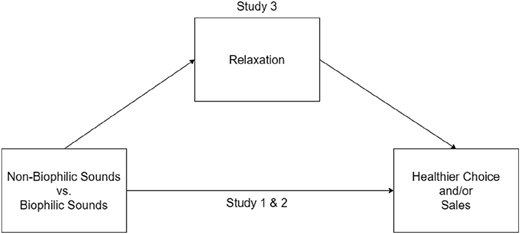
We propose biophilic soundscapes create a calming effect that facilitates food shopping through reduced stress (increased relaxation). Symbolic biophilic sounds (e.g. birds chirping, water running and wind through trees) promote a sense of relaxation (reduced stress), preserving regulatory resources and executive functioning. As a result, shoppers may be better able to engage in thoughtful and deliberate decision-making rather than relying on impulsive or affect-driven responses. This enhanced self-regulatory capacity increases the likelihood of selecting healthier food and beverage options. To investigate this relationship, we report the results of three experimental studies (real-world, virtual laboratory and online scenario).

Our research makes several contributions. We advance biophilic servicescape literature (Rosenbaum et al., 2018; Vinitha et al., 2025; see Table 2 for details) by isolating and empirically testing the effects of auditory biophilic cues (symbolic) on consumer emotion, choice and sales. We demonstrate biophilic cues can exert a restorative effect by fostering a sense of relaxation. Offering a novel conceptualisation of how biophilic cues influence consumer responses in a utilitarian and functional service environment such as a supermarket. We show symbolic biophilic sounds increase relaxation, encouraging consumer choices toward healthier options (Study 2 and 3). We observe a promising pattern of a positive effect on sales (Study 1). This is the first study to demonstrate how and why biophilic sound affects consumer choice. We extend prior work (e.g. Esan-Ojuri and You, 2021) by demonstrating that stress recovery theory (Ulrich, 1993) and regulatory depletion theory (Muraven and Baumeister, 2000) help to explain why biophilic sounds lead to healthier food and beverage choices in a supermarket setting.

Our findings have important managerial and public policy implications. Biophilic sound is a powerful yet underutilised element in service management. Incorporating biophilic sounds into service environments offer an easily implementable, low-cost strategy for encouraging healthier consumer behaviours and supporting public health outcomes.

Biophilic servicescapes integrate natural elements into retail and service environments (Rosenbaum et al., 2016, 2018). While early research focused on vegetation and its benefits (Joye et al., 2010), the concept encompasses a broader range of direct, indirect and symbolic representations of nature (Kellert, 2013). Retail and servicescape literature (see Table 2) largely examined visual biophilic cues, including daylight, greenery, water features, in-store plants, animal sculptors and natural materials, demonstrating their ability to create restorative experiences and positive consumer responses (Esan-Ojuri and You, 2021; Joye et al., 2010; Rosenbaum et al., 2016, 2018). Little is known about whether symbolic biophilic sounds produce similar effects, particularly in utilitarian and functional shopping environments.

To understand how biophilic stimuli function in such contexts, we draw on stress recovery theory (SRT). SRT posits that exposure to natural stimuli elicit positive affect and physiological recovery from stress (Joye et al., 2010). Humans have evolved adaptive responses to non-threating natural environments (Ulrich, 1993). This perspective is relevant in supermarkets where customers face cognitively demanding and often stressful shopping tasks (Brengman et al., 2012; d’Astous, 2000; Joye et al., 2010; Orth et al., 2016). SRT predicts biophilic cues may reduce stress and promote a more relaxed state.

We define biophilic sounds as acoustic elements derived from or inspired by natural environments. Consistent with Kellert’s (2013) framework, biophilic sounds may be direct (naturally occurring nature sounds), indirect (sounds produced through human-maintained natural features) or symbolic/vicarious (representations of nature). When incorporated into retail and service settings, these sounds create a biophilic soundscape extending traditional servicescape theory (Bitner, 1992) by positioning sound as a biophilic environmental cue.

Prior research demonstrates that natural sounds produce restorative effects, reducing perceived stress and negative mood while improving physiological recovery indicators (Michels and Hamers, 2023; Song et al., 2023; Zhang et al., 2025). These findings suggest that biophilic soundscapes can induce relaxation, even in stressful environments such as supermarkets. Relaxation “is the parasympathetic physiological opposite of the stress response” and experienced both physiologically and psychologically (Masih et al., 2017, p. 137); however, we focus on consumer’s subjective feelings of relaxation.

To explain how relaxation influences food and beverage choice, we draw on regulatory depletion theory (Muraven and Baumeister, 2000). This theory posits that individuals possess a limited pool of self-regulatory resources, which become depleted through repeated acts of decision-making. In “obesogenic” environments, such as supermarkets (Phillips et al., 2024), consumers make numerous self-regulatory decisions. Stress further exacerbates this depletion (Vohs and Baumeister, 2004), increasing reliance on impulsive behaviours and immediate rewards, including preferences for indulgent, energy-dense foods (Baumeister, 2002; Epel et al., 2001; Tice et al., 2001; Oliver and Wardle, 1999; Rutters et al., 2008; Vohs and Faber, 2007).

Reducing stress helps preserve self-regulatory resources and supports executive functioning. Consequently, consumer may be better able to engage in reflective decision-making and consider long-term health goals when selecting food and beverages. Consistent with this logic, prior research demonstrates that ambient sound can influence food purchasing behaviour, including increased sales of healthier foods under low-volume conditions (Biswas et al., 2019).

Integrating these perspectives, we propose that symbolic biophilic sounds promote relaxation, thereby preserving self-regulatory capacity and increasing the likelihood of selecting healthier food and beverage options. Given that point-of-purchase decisions often translate into consumption patterns, such effects have important implications for service managers, retailers and public health.

We formally predict:

H1a.

Symbolic biophilic (vs. non-biophilic) sound will lead to greater preference for, and sales of, healthier food and beverages.

H1b.

This effect is mediated by consumers’ feelings of relaxation.

Three experimental studies test the hypotheses. Study 1 tests the effect of biophilic sound on healthier beverage choices in a real supermarket. Study 2 extends the effect to healthier food choices in a virtual supermarket. Study 3 examines whether relaxation mediates these effects. Figure 1 presents the conceptual framework.

Study 1 was a field experiment conducted at a family-owned supermarket in Rio Grande do Sul, Brazil. The supermarket was 1200 m2, with approximately 6,500 SKUs. Due to the exploratory nature of the research and retail manager permissions, data collection was restricted to the beverage section. This minimized retailer disruption while enabling us to examine choices in a real shopping environment.

Grocery shoppers entering the store on the day of data collection were exposed to one of two sound conditions: biophilic or non-biophilic. Consistent with prior applications in retail settings (see Table 1), the biophilic condition featured symbolic nature sounds, including forest sounds (e.g. wind, birds and rustling leaves) and flowing water. Biophilic sound were layered over naturally occurring ambient store noise. The non-biophilic condition consisted of the store’s naturally occurring ambient sounds such as trolley movement, checkout beeps, people walking, equipment noise and people talking, with no music present.

The field experiment was conducted over four weeks (Monday–Saturday; see Table 3), deliberately excluding food-related holidays (e.g. Thanksgiving). To minimise temporal confounds, we opted for a longer period of data collection, rather than as a single day or week. Sound conditions were randomly assigned across 19 data-collection days. The retailer maintained consistent prices and promotions throughout the study. Sounds were played continuously between 8.30 a.m. and 7.30 p.m. via two speakers positioned above the beverage section near both healthy (water) and less healthy (beer) options. The beer was positioned first, and water next, in a left-to-right configuration.

To reduce demand effects, the speakers were positioned unobtrusively, and staff were not informed of the study hypotheses. Sound volume was calibrated to an audible but unobtrusive level and remained constant throughout the study. Staff were asked by the researcher whether they noticed anything different about the beverage section. Responses were mixed: some reported noticing the sound, while others did not.

Sales data were obtained from the retailer’s sales reports. The dependent variable was the daily number of units sold for water and beer. These categories were selected because they represent clearly distinguishable healthier and less healthy options. Water is widely recognised as a healthy choice, whereas reducing alcohol consumption has been identified as a global public health priority (World Health Organization, 2022).

We compared mean units sold across sound conditions (Table 4). Water sales volume was higher under the biophilic sound condition (M = 73.3) compared to the non-biophilic condition (M = 54.1), yielding a marginally significant effect t(18) = 1.764, p < 0.10. Beer sales were lower under the biophilic condition (M = 369.3) than the non-biophilic condition (M = 461.3), although this difference was not significant, t(18) = −0.552, p = 0.59. Baseline sales prior to the study averaged 53.3 units per day for water and 370 units per day for beer.

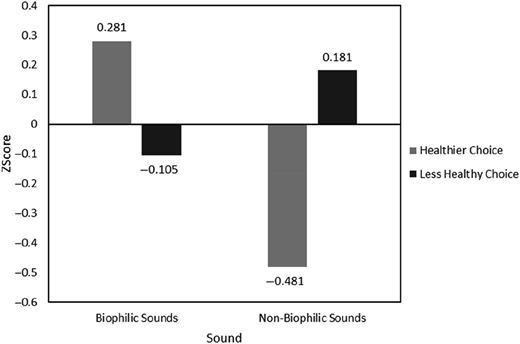
To statistically verify the patterns observed above, we conducted a two-way mixed ANOVA with sound condition as the between-subjects factor and beverage category (healthier: water; less healthy: beer) as the repeated-measures factor. Because sales volumes differed substantially across the two categories, we used standardized values (Z-scores) for the analysis.

No significant main effect emerged for the sound condition (p = 0.48) or beverage category (p = 1.0). The interaction between sound condition and beverage category was also non-significant, F (1, 17) = 2.496, p < 0.12. However, the pattern of means suggests that healthier beverages (water) sold relatively better under the biophilic sound condition, whereas less healthy beverages (beer) sold relatively better under the non-biophilic condition. Although this interaction did not reach conventional significance levels, it is directionally consistent with our predictions and illustrated in Figure 2.

This field study examined the effects of biophilic sounds on shopper behaviour, as measured by units sold. While the results did not reach statistical significance at the p < 0.05 level, the observed pattern was directionally consistent with prior research showing that natural and healthy soundtracks can encourage healthier food choices (Peng-Li et al., 2021, 2022). Specifically, healthier beverages appeared to sell relatively better under the biophilic sound condition, whereas less healthy beverages appeared to sell relatively better under the non-biophilic sound condition.

Given the lack of statistical significance, these findings should be interpreted with caution and cannot be taken as evidence that biophilic sounds increase healthier purchasing. Rather, they provide preliminary support for further investigation of biophilic soundscapes in retail settings. One possible explanation for the weak effect is that the biophilic sound was confined to a localised area rather than integrated throughout the entire soundscape. As a result, shoppers may not have experienced the immersive acoustic conditions necessary to influence decision-making. To explore this further, we aim to replicate and extend these findings in a more controlled setting where biophilic sounds can be delivered consistently throughout the shopping experience.

Study 2 aimed to replicate and strengthen the findings in Study 1 by testing biophilic sound in a more immersive and controlled laboratory environment. We also extend the investigation to include food choices.

One hundred and sixty-eight participants (75.2% female, M = 25.6 years old) recruited from Auckland, New Zealand and Passo Fundo, Brazil, participated in a between-subjects experiment in exchange for a small monetary gift. Participants were recruited from the wider community through university-based and social media advertisements. Online advertisements on Facebook, LinkedIn and Instagram were utilised. Individuals were screened during the recruitment process. Individuals under 18 years, non-food shopper or those unable to attend the laboratory session were excluded. Participants were randomly assigned through Qualtrics to either a non-biophilic (supermarket sound) or biophilic (nature + supermarket sound) condition.

Participants attended behavioural labs in Brazil or New Zealand, groups ranged from 1 to 8 people. The experimenter seated participants at a desktop computer, equipped with individual headphones plugged into the desktop, and provided instructions on the laboratory procedures. Once logged into the 3D virtual supermarket program, all participants were presented with a scenario to buy ice cream for dessert that evening. The virtual store was developed by Datacom in collaboration with a large New Zealand multinational publicly traded co-operative. The virtual store was powered by AWS (Amazon Web Services) platform, and the application could be used with VR headset, Windows Computers and IoS and Android devices.

In the non-biophilic (supermarket) condition, participants were exposed to ambient supermarket sounds (e.g. conversations, checkouts beeps and shopping carts). This condition did not include any accompanying music (refer to  Appendix 1 for the specific supermarket sound used in this study). In the biophilic condition, participants heard the same supermarket sounds combined with nature sounds (forest and water) used in Study 1 (refer to  Appendix 2 for the specific spmkt + nature sound used in this study). Supermarket sounds were included in both conditions aims to enhance ecological validity and replicate the sounds experienced in Study 1.

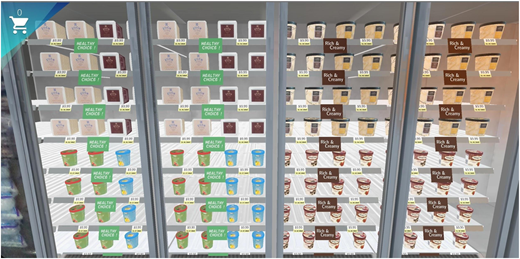
During the virtual shop, participants viewed a vertical ice cream shelf (see  Appendix 2) displaying four healthier options (reduced-fat and sorbet products) and four less healthy options (full-fat products), with product sizes and flavour variants matched across categories (Table 5). To increase ecological validity, we included a larger range of products as would be seen in a grocery store. Nutritional information was not available, and product positions remained fixed across conditions. We did not rotate the positioning of the healthy and unhealthy products on the shelf due to developer costs.

The key dependent measures were product interactions (pick up, put back and add to cart) and final product choice. Participants could interact with multiple products but were limited to selecting one final ice cream. Products were classified as healthier or less healthy using nutrient profile scores calculated with the Food Standards Australia and New Zealand Nutrient Profiling Scoring Criterion (adopted from Phillips et al., 2024). The nutrient panel information (i.e. energy, saturated fat, sodium, fruits, vegetables, sugar, dietary fibre and protein) was used to determine the ice cream’s nutritional composition, and thus healthiness. This information was recorded from a national supermarket chains online store.

Following product selection, participants responded to a series of measures: store quality index, self-control, health value, noise sensitivity, presence sound and sound pleasantness. These measures were included as covariates but did not significantly influence the dependent variable.

Product interaction

Participants in the biophilic condition added significantly more items to their carts overall (M = 2.64, SD = 2.127) than those in the non-biophilic condition (M = 1.73, SD = 1.517), t(98) = −2.635, p < 0.01. A similar pattern emerged for healthier products. Participants exposed to biophilic sounds added significantly more healthy items to their carts (M = 1.21, SD = 1.358) than participants in the non-biophilic condition (M = 0.62, SD = 1.151), t(108) = −2.5479, p = 0.01. None of the covariates had a significant effect on the dependent variable.

Healthy food choice

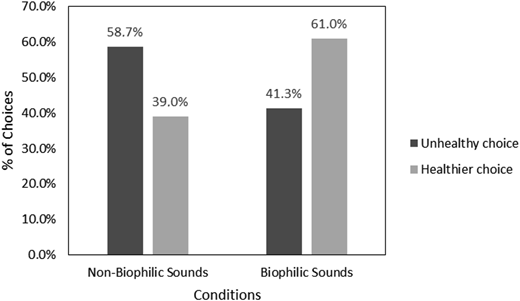
A chi-square test of independence revealed a significant association between sound conditions and healthier food choices, X2 (1, 116) = 4.096, p < 0.05. Participants exposed to biophilic sounds were more likely to choose a healthier option (44.6%) than those exposed to non-biophilic sounds (26.7%) Figure 3.

Study 2 found that participants exposed to biophilic sounds (nature + supermarket) added more items overall, more healthy items and were more likely to select a healthier option than participants exposed to non-biophilic sounds. The higher number of healthy items added to the cart may reflect greater interest in healthier products rather than an intention to purchase all of them, as online shoppers often use carts to support decision-making and product evaluation (Close and Kukar-Kinney, 2010). These findings extend the directional pattern observed in Study 1 and provide evidence that biophilic sounds lead to healthier choices in a more immersive and controlled shopping environment. Having established this relationship, Study 3 examines whether a sense of relaxation mediates the effect of biophilic sounds on healthy food and beverage choices.

Two hundred and seven participants (73.9% female, Mage = 28.7) from the United States were recruited through Prolific Academic and received a small monetary reward. Participants were English speaking adults (18+ years). The study employed a three condition between-subjects design: biophilic sound (forest and water), non-biophilic sound (supermarket) sound, and no sound (control). The biophilic and non-biophilic sounds were identical to those used in previous studies, except the supermarket sounds were not overlaid onto the biophilic condition, allowing for greater experimental control. Following Huang and Labroo (2020), participants were required to use an audio-capable device and headphones.

To verify the sound manipulation, participants reported whether they heard a sound during the choice task and described the sound they heard. Participants who failed either check were excluded from the analysis. The final sample consisted of 153 participants (72.6% of females, Mage = 28.9).

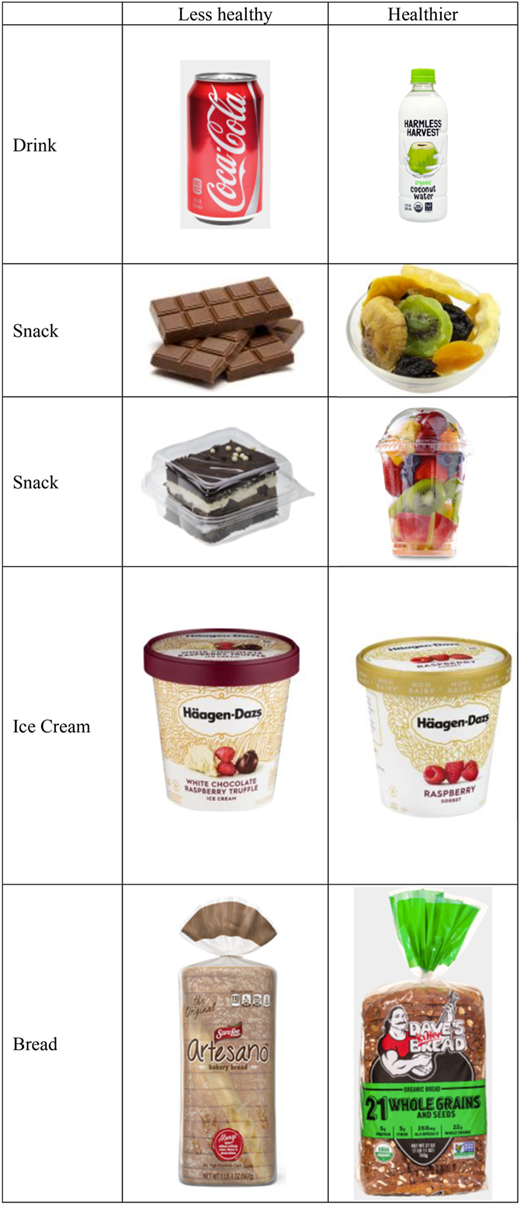
Participants were recruited through the Prolific Academic online platform and informed that the study involved selecting food and beverage items during a shopping experience. After providing consent, participants were instructed to wear headphones, adjust their volume to a comfortable level using a sound test and report their volume setting. Volume level was included as a control variable but was not significant (p > 0.05). Participants were randomly assigned to a biophilic sound (forest and water), non-biophilic sound (supermarket) or no-sound control condition. After reading a shopping scenario, they completed five product choice tasks across four product categories: beverages, snacks (two tasks), ice cream and bread ( Appendix 3). Each task required participants to choose between a healthier and a less healthy option. Product and category order were randomised. Among the four categories, five items were healthier and five were less healthy.

The dependent variable was the total sum of healthier choices selected across five tasks (range: 0–5). If the participant did not choose any healthy option, the score was 0 (zero). Relaxation was measured as the proposed mediator using a 7-point semantic differential scale (1 = not at all relaxed and 7 = very much relaxed; adopted from Biswas et al., 2019). Sex, health consciousness and morality [1] were included as control variables, with sex controlled due to the unintended prevalence of female participants in the sample.

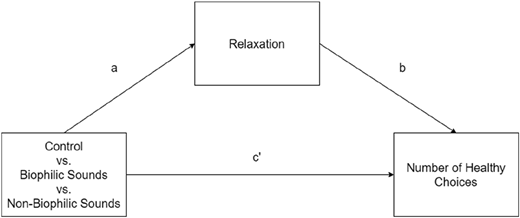
A mediation analysis using PROCESS Macro Model 4 (5,000 bootstrap samples) examined whether relaxation mediate the association between sound and number of healthy choices. We analysed the direct effect of sound condition on relaxation (a path – Figure 4). Consistent with our theorising, participants reported greater relaxation in the biophilic sound condition (M = 5.89) compared to the non-biophilic sound condition (M = 5.08; b = −0.81, SE = 0.310, p = 0.003, CI 95%: −1.43; −0.20). Participants in the no sound control condition (M = 6.06) were also more relaxed than those in the non-biophilic sound condition (M = 5.08; b = −0.98, SE = 0.29, p = 0.001, CI 95%: −1.55; −0.41). Relaxation did not differ between the biophilic (M = 5.89) and no sound (control; M = 6.06) conditions (p = 0.55).

The direct effects of the sound conditions on the number of healthy choices (c path  Figure 4) yielded significant results (F(3, 149) = 6.40, p < 0.001). Participants exposed to biophilic sounds made more healthy choices (M = 3.3) than those in the non-biophilic (M = 2.3; b = −0.85, SE = 0.31, p < 0.01; CI 95%: −1.46; −0.23) and control (M = 2.3; b = 0.93, SE = 0.264, p < 0.001; CI 95%: 0.41; 1.45) conditions. It corroborates with results of previous studies, where biophilic sounds can trigger healthier choices (Table 6).

When considering relaxation as a predictor (b path – Figure 4), there was a significant direct effect on the number of healthy choices (b = 0.17, SE = 0.079, p < 0.05; CI 95%: 0.01; 0.32).

The mediation analysis indicated a significant indirect effect of sound conditions on the number of healthy choices through relaxation (ab path – Figure 4) when comparing no sound (control) and non-biophilic (supermarket) sound conditions (b = −0.17, BootSE = 0.10; BootLLCI = −0.41; BootULCI = −0.01), and between biophilic sounds and non-biophilic (supermarket) sounds (b = −0.137, BootSE = 0.09; BootLLCI = −0.36; BootULCI = −0.0003). This result shows that participants who listened to the biophilic condition or the no sound (control) condition felt more relaxed and then chose healthier items compared to individuals who listened to the non-biophilic condition. The indirect effect when comparing no sound (control) condition versus biophilic sounds (b = −0.03, BootSE = 0.05; BootLLCI = −0.16; BootULCI = 0.06) was not statistically significant.

The results of Study 3 are summarised in Figure 4 and Tables 7 and 8. None of the control variables had significant effects on the model.

Study 3 replicates and extends the findings from Studies 1 and 2, providing further support for H1a. Participants exposed to symbolic biophilic sounds made more healthy food and beverage choices compared to those exposed to non-biophilic sounds or no sound. This finding aligns with prior consumer behaviour and sensory research demonstrating that auditory cues can influence food choices (Biswas et al., 2019; Peng-Li et al., 2021, 2022). To enhance experimental realism and ecological validity, participants made multiple choices, reflecting typical supermarket shopping behaviour. While we acknowledge that increased purchasing is not inherently healthier, a basket composed of more healthy items may indicate a relative shift in composition, leaving less room for less healthy alternatives.

The results also support H1b by showing that relaxation partially explains the relationship between soundscape and healthy choices. Both biophilic sound and silence elicited greater relaxation than non-biophilic supermarket sounds, and this heightened relaxation was associated with healthier choices. No difference emerged between the biophilic and no-sound conditions, suggesting that both environments are perceived as more relaxing compared to unavoidable and ubiquitous background noise typical of retail and service environments. This interpretation is consistent with prior research showing that background noise can be distracting, a source of stress and irritating (Kjellberg et al., 1996; Lin, 2004; Furnham and Strbac, 2002), whereas silence or reduced noise can enhance feelings of relaxation (Malakoutikhah et al., 2020).

Taken together, these suggests that reducing exposure to retail noise, either through biophilic soundscapes or quieter environments (like quiet hours, Perrottet, 2019), may encourage healthier food and beverage choices by increasing relaxation.

Retailers and service providers are embracing biophilic design elements to create restorative shopping and service environments (Esan-Ojuri and You, 2021; Rosenbaum et al., 2018; Xu, 2020). While popular press and practitioner interest suggest that biophilic design can encourage healthier food choices (Genelect, 2022), the role of biophilic sounds in shaping relaxation and food and beverage choices has received little attention (see Table 2).

Across three studies (Table 6), biophilic sounds were associated with healthier food and beverage choices and greater relaxation. In Study 1, the results were not statistically significant, although the observed pattern was consistent with our theorising. Healthier beverages were selling relatively better under biophilic than non-biophilic sounds. One possible explanation is that the biophilic sound was confined to a localised area rather than integrated throughout the store environment.

Study 2 and 3 replicated and extended these findings in a more immersive virtual and online shopping environment. Study 2 demonstrated effects on both food and beverage choices, while Study 3 identified relaxation as a novel mediator. Our results show that biophilic sounds increase feelings of relaxation, which in turn guide choices toward healthier food and beverage options. These finding align with and extend biophilic servicescape research by showing that restorative benefits of biophilic cues, previously linked to reduce stress and greater relaxation (Brengman et al., 2012; Rosenbaum et al., 2019), also influence downstream behavioural outcomes such as food and beverage choice.

For service managers, biophilic sounds offer a simple and scalable way to create more immersive and relaxing service environments. Creating immersive experiences is a common strategy used by service management scholars to enhance visitor experiences by leisure and tourism providers (Blumenthal and Gjerald, 2022). Our findings highlight the effectiveness of employing biophilic sounds to foster relaxation. This aligns with existing research indicating that natural elements within retail environments can have restorative outcomes for consumers (Joye et al., 2010; Rosenbaum et al., 2018) such as reduced stress (Brengman et al., 2012).

Natural elements can stimulate managerial relevant outcomes such as satisfaction, loyalty, positive word-of-mouth and greater approach responses from customers (Rosenbaum et al., 2016; Brengman et al., 2012). By strategically integrating biophilic sounds within the service environment, both online and offline, retail and service managers can tap into the influence of biophilia, enhancing the overall shopping experience for customers and driving greater choice of healthier foods and beverages. Our findings suggest biophilic sounds throughout the store could lead to healthier food and beverage choices across multiple product categories. While Study 1 revealed a positive pattern for healthier product sales, these findings were not statistically significant and should be interpreted cautiously.

The benefits of biophilic sounds extend beyond physical stores. As online, virtual and immersive retail experiences continue to grow (Power, 2025), sound may become an increasingly important but underutilised design element. Online shopping is expected to account for 23% of retail purchases by 2027 (Snyder and Aditham, 2026). Incorporating biophilic sounds into online retail and service settings, including virtual reality experiences, may enhance relaxation and promote healthier choices. Ambient sound could be automatically activated, as demonstrated by Alo Yoga’s relaxing virtual store.

To meet shopper desires for healthier food choices and to shift focus toward more nutritious products, retailers and service providers are experimenting with various forms of nudges. These include innovative approaches such as wristbands that flash red or green when food is scanned, allocating more space to healthier products, and making changes to the store design (Fulton, 2010; Gomes, 2020). Recognising the concerns of policymakers, consumers and public health advocates regarding personal and societal well-being (Nielsen, 2021; Wang et al., 2020), there is growing awareness of the role that utilitarian environments such as supermarkets play in shaping food consumption patterns (Story et al., 2008). Our findings suggest that biophilic sounds can be a valuable addition to the service managers toolbox, serving as an effective tool to nudge customers towards selecting more nutritious foods, with the goal of leading toward healthier eating and drinking habits.

This research makes several theoretical contributions. First, we extend the biophilic servicescape literature by conceptualising biophilic soundscapes as a distinct servicescape element. The concept builds on the servicescape (Bitner, 1992) by positioning biophilic sound as a key environmental cue that can shape the overall customer experience. While symbolic biophilic soundscapes have received limited attention (see Table 2), our findings demonstrate that they can function as restorative environmental cues that influence consumer choice in utilitarian shopping environments. Second, we contribute to the biophilic store design and servicescape literature by showing that biophilic cues influence not only attitudinal and behavioural outcomes, such as patronage behaviour, satisfaction, positive WOM and intent to purchase (Joye et al., 2010; Rosenbaum et al., 2016, 2018), but also downstream behavioural responses such as food and beverage choices.

Finally, we integrate stress recovery theory (Ulrich, 1993) and regulatory depletion theory (Muraven and Baumeister, 2000) to explain how biophilic sounds influence consumer behaviour. Our findings suggest that biophilic sounds have calming effects (increased relaxation), which in turn encourages healthier food and beverage choices. In doing so, we extend prior work (e.g. Esan-Ojuri and You, 2021) by suggesting that these theories help to understand the role of biophilic cues on food and beverage choices in utilitarian and functional types of service environments such as supermarkets.

This research combines field and laboratory studies across online and offline grocery environments to examine the effects of symbolic biophilic sounds. A key limitation is that the field study (Study 1) did not reach statistical significance. Although the observed pattern was consistent with our theorising, showing an increase of 11% in the sale of healthier beverages when biophilic sounds were present compared to non-biophilic (supermarket) sounds. Future research should examine whether stronger effects emerge when symbolic biophilic sounds played throughout the entire store rather than confined to a localised area.

A second limitation is the focus on one type of utilitarian and functional servicescape, the grocery store and on consumer outcomes. This reduces the generalisability of conclusions to other service types, and people within servicescapes. We encourage service management scholars to explore other settings such as hospitality, early childhood centres, convenience stores, pharmacies and train stations, to move the work beyond the current context. As Vinitha et al. (2025) proposes, ambient biophilia in servicescapes can have positive effects on employee affect, cognition and behaviours. We question: how does biophilic sounds go beyond customers to influence the health and well-being of staff, and does it encourage them to make healthier food and beverage choices also?

Finally, our focus on establishing the main effect and underlying mechanism meant that we did not examine potential boundary conditions. Future research could explore how individual differences (e.g. health or diet orientation) and situational variables (e.g. exposure duration, brand familiarity, sound awareness and other auditory characteristics such as slow or pleasurable music) strengthen or attenuate the effect of biophilic sounds on consumer choice. These may offer valuable managerial insights for future research.

Retailers and service managers can use biophilic sounds to create more relaxing and restorative retail and service environments. Our findings suggest that biophilic sounds enhance relaxation, which in turn encourages healthier food and beverage choices. As a low-cost and easily implementable servicescape cue, biophilic sound offers a practical way to improve customer experiences, support consumer well-being and contributing to positive managerial outcomes.

During the preparation of this work that author(s) used ChatGPT in order to improve the language and readability of the manuscript. After using this tool/service, the author(s) reviewed and edited the content as needed and take(s) full responsibility for the content of the publication.

Link for sounds

1.

There was a statistically significant effect of Health Consciousness on Relaxation (b = 0.295, SE = 0.132, p = 0.03, CI 95%: 0.039; 0.557); and there was a statistically significant effect of Sex on the Number of Healthier Choices (b = 0.504, SE = 0.257, p = 0.05, CI 95%: −0.003; 1.011). However, the model with the covariates did not change the magnitude and the patterns of the effects.
Baumeister
,
R.
(
2002
), “
Yielding to temptation: self-control failure, impulsive purchasing, and consumer behaviour
”,
Journal of Consumer Research
, Vol. 
28
No. 
4
, pp. 
670
-
676
, doi: .
Biswas
,
D.
,
Lund
,
K.
and
Szocs
,
C.
(
2019
), “
Sounds like a healthy retail atmospheric strategy: effects of ambient music and background noise on food sales
”,
Journal of the Academy of Marketing Science
, Vol. 
47
No. 
1
, pp. 
37
-
55
, doi: .
Bitner
,
M.
(
1992
), “
Servicescapes: the impact of physical surroundings on customers and employees
”,
Journal of Marketing
, Vol. 
56
No. 
2
, pp. 
57
-
71
, doi: .
Blumenthal
,
V.
and
Gjerald
,
O.
(
2022
), “
You just get sucked into it: extending the immersion process model to virtual gameplay experiences in managed visitor attractions
”,
Leisure Studies
, Vol. 
41
No. 
5
, pp. 
722
-
741
, doi: .
Brengman
,
M.
,
Willems
,
K.
and
Joye
,
Y.
(
2012
), “
The impact of in-store greenery on customers
”,
Psychology and Marketing
, Vol. 
29
No. 
11
, pp. 
807
-
821
, doi: .
Castro
,
I.
,
Honea
,
H.
,
Cornelis
,
E.
and
Majmundar
,
A.
(
2022
), “
The friluftslive response: connection, drive, and contentment reactions to biophilic design in consumer environments
”,
International Journal of Research in Marketing
, pp.
364
-
379
.
Close
,
A.
and
Kukar-Kinney
,
M.
(
2010
), “
Beyond buying: motivations behind consumers’ online shopping cart use
”,
Journal of Business Research
, Vol. 
63
Nos
9-10
, pp. 
986
-
992
, doi: .
Crockett
,
Z.
(
2024
),
The Wild Tale of the Man Who Founded Rainforest Café
,
The Hustle
,
available at:
 Link to the website
D’Astous
,
A.
(
2000
), “
Irritating aspects of the shopping environment
”,
Journal of Business Research
, Vol. 
49
No. 
2
, pp. 
149
-
156
, doi: .
Epel
,
E.
,
Lapidus
,
R.
,
McEwen
,
B.
and
Brownell
,
K.
(
2001
), “
Stress may add bite to appetite in women: a laboratory study of stress-induced cortisol and eating behavior
”,
Psychoneuroendocrionology
, Vol. 
26
No. 
1
, pp. 
37
-
49
, doi: .
Esan-Ojuri
,
O.
and
You
,
H.
(
2021
), “
How does the biophilic design of building projects impact on consumers’ responses? – Case of retail stores
”,
Journal of Retailing and Consumer Services
, Vol. 
62
, 102637, doi: .
Esteky
,
S.
(
2021
), “
Chirping birds and barking dogs: the interactive effect of ambient sensory cue source and valence on consumers’ choice of natural products
”,
Journal of Retailing and Consumer Services
, Vol. 
61
, 102513, doi: .
Fulton
,
A.
(
2010
), “
Nudging grocery shoppers toward healthy food
”,
available at:
 Link to the website
Furnham
,
A.
and
Strbac
,
L.
(
2002
), “
Music is as distracting as noise: the differential distraction of background music and noise on the cognitive test performance of introverts and extraverts
”,
Ergonomics
, Vol. 
45
No. 
3
, pp. 
203
-
217
, doi: .
Genelect
(
2022
), “
Genelec appeals to the senses at K-Supermarket Hertta
”,
available at:
 Link to the website
Gomes
,
J.
(
2020
), “
Food retailer can provide a nudge in the right direction
”,
Progressive Grocer
,
available at:
 Link to the website
High
,
C.
(
2025
),
How to Experience Tiki Culture in San Francisco
,
San Francisco Travel
,
available at:
 Link to the website
Hogg
,
R.
(
2025
), “
13 of the most iconic dishes at the Fat Duck
”,
available at:
 Link to the website
Huang
,
X.
and
Labroo
,
A.
(
2020
), “
Cueing morality: the effect of high-pitched music on healthy choice
”,
Journal of Marketing
, Vol. 
84
No. 
6
, pp. 
130
-
143
, doi: .
Joye
,
Y.
,
Willems
,
K.
,
Brengman
,
M.
and
Wolf
,
K.
(
2010
), “
The effects of urban retail greenery on consumer experience: reviewing the evidence from a restorative perspective
”,
Urban Forestry and Urban Greening
, Vol. 
9
No. 
1
, pp. 
57
-
64
, doi: .
Kellert
,
S.
(
2013
), “Dimensions, elements, and attributes of biophilic design”, in
Kellert
,
S.
,
Heerwagen
,
J.
and
Mador
,
M.
(Eds),
Biophilic Design: The Theory, Science and Practice of Bringing Buildings to Life
,
John Wiley & Sons Incorporated
,
Hoboken, NJ
, pp.
3
-
19
.
Kjellberg
,
A.
,
Landström
,
U.
,
Tesarz
,
M.
,
Söderberg
,
L.
and
Akerlund
,
A.
(
1996
), “
The effects of nonphysical noise characteristics, ongoing task and noise sensitivity on annoyance and distraction due to noise at work
”,
Journal of Environmental Psychology
, Vol. 
16
No. 
2
, pp. 
123
-
136
, doi: .
Kumar
,
D.
,
Purani
,
K.
and
Viswanathan
,
S.
(
2020
), “
The indirect experience of nature: biomorphic design forms in servicescapes
”,
Journal of Services Marketing
, Vol. 
34
No. 
6
, pp. 
847
-
867
, doi: .
Lin
,
I.
(
2004
), “
Evaluating a servicescape: the effect of cognition and emotion
”,
International Journal of Hospitality Management
, Vol. 
23
No. 
2
, pp. 
163
-
178
, doi: .
Malakoutikhah
,
A.
,
Dehghan
,
M.
,
Ghonchehpoorc
,
A.
,
Afshar
,
P.
and
Honarmand
,
A.
(
2020
), “
The effect of different genres of music and silence on relaxation and anxiety: a randomized controlled trial
”,
Explore
, Vol. 
16
No. 
6
.
Masih
,
T.
,
Dimmock
,
J.
,
Epel
,
E.
and
Guelfi
,
K.
(
2017
), “
Stress-induced eating and the relaxation response as a potential antidote: a review and hypothesis
”,
Appetite
, Vol. 
118
, pp. 
136
-
143
, doi: .
Michels
,
N.
and
Hamers
,
P.
(
2023
), “
Nature sounds for stress recovery and healthy eating: a lab experiment differentiating water and bird sound
”,
Environment and Behavior
, Vol. 
55
No. 
3
, pp. 
103
-
205
, doi: .
Muraven
,
M.
and
Baumeister
,
R.
(
2000
), “
Self-regulation and depletion of limited resources: does self-control resemble a muscle?
”,
Psychological Bulletin
, Vol. 
126
No. 
2
, pp. 
247
-
259
, doi: .
Nielsen
,
I.Q.
(
2021
), “
An inside look into the 2021 global consumer health and wellness revolution
”,
available at:
 Link to the website
Oliver
,
G.
and
Wardle
,
J.
(
1999
), “
Perceived effects of stress on food choice
”,
Physiology and Behavior
, Vol. 
66
No. 
3
, pp. 
511
-
515
, doi: .
Ortegón-Cortázar
,
L.
and
Royo-Vela
,
M.
(
2018
), “
Effects of the biophilic atmosphere on intention to visit: the affective states’ mediating role
”,
Journal of Services Marketing
, Vol. 
33
No. 
2
, pp. 
168
-
180
, doi: .
Orth
,
U.
,
Wirtz
,
J.
and
McKinney
,
A.
(
2016
), “
Shopping experiences in visually complex environments: a self-regulation account
”,
Journal of Service Management
, Vol. 
27
No. 
2
, pp. 
194
-
217
, doi: .
Peng-Li
,
D.
,
Mathiesen
,
S.L.
,
Chan
,
R.C.
,
Byrne
,
D.V.
and
Wang
,
Q.J.
(
2021
), “
Sounds Healthy: modelling sound-evoked consumer food choice through visual attention
”,
Appetite
, Vol. 
164
, 105264, doi: .
Peng-Li
,
D.
,
Andersen
,
T.
,
Finlayson
,
G.
,
Byrne
,
D.V.
and
Wang
,
Q.J.
(
2022
), “
The impact of environmental sounds on food reward
”,
Physiology and Behavior
, Vol. 
245
, 113689, doi: .
Perrottet
,
A.
(
2019
),
Countdown’s Quiet Hour: “Nice and Calming” for People With Autism
,
RNZ News
,
available at:
 Link to the website
Phillips
,
M.
,
Kapitan
,
S.
and
Rush
,
E.
(
2024
), “
From the store to the kitchen: herbal scents drive wholesome food choice
”,
Journal of Retailing and Consumer Services
, Vol. 
81
, 103959, doi: .
Power
,
R.
(
2025
),
Elevating Experiences: How Immersive Venues Drive Business Growth
.
Purani
,
K.
and
Kumar
,
D.
(
2018
), “
Exploring restorative potential of biophilic servicescapes
”,
Journal of Services Marketing
, Vol. 
32
No. 
4
, pp. 
414
-
429
, doi: .
Ratcliffe
,
E.
(
2021
), “
Sound and soundscape in restorative natural environments: a narrative literature review
”,
Frontiers in Psychology
, Vol. 
12
, 570563, doi: .
Retail and Leisure International
(
2024
),
Khaite Opens First flagship Store in Soho
,
Retail & Leisure International
,
available at:
 Link to the website
Romeyn
,
K.
(
2025
), “
A Klein JAN experience lets you dine where the wildebeest are
”,
Travel and Leisure
,
available at:
 Link to the website
Rosenbaum
,
M.
,
Otalora
,
M.
and
Ramírez
,
G.
(
2016
), “
The restorative potential of shopping malls
”,
Journal of Retailing and Consumer Services
, Vol. 
31
, pp. 
157
-
165
, doi: .
Rosenbaum
,
M.
,
Ramirez
,
G.
and
Camino
,
J.
(
2018
), “
A dose of nature and shopping: the restorative potential of biophilic lifestyle centre designs
”,
Journal of Retailing and Consumer Services
, Vol. 
40
, pp. 
66
-
73
, doi: .
Rosenbaum
,
M.
,
Ramírez
,
G.
and
Matos
,
N.
(
2019
), “
A neuroscientific perspective of consumer responses to retail greenery
”,
Service Industries Journal
, Vol. 
39
Nos
15-16
, pp. 
15
-
16
, doi: .
Rutters
,
F.
,
Nieuwenhuizen
,
A.
,
Lemmens
,
S.
,
Born
,
J.
and
Westerterp-Plantenga
,
M.
(
2008
), “
Acute stress-related changes in eating in the absence of hunger
”,
Obesity
, Vol. 
17
No. 
1
, pp. 
72
-
77
, doi: .
Shin
,
M.
,
Lee
,
R.
,
Min
,
J.
and
Legendre
,
T.
(
2023
), “
Connecting nature with luxury service
”,
Psychology & Marketing
, Vol. 
40
, pp.
300
-
316
.
Sina
,
A.
and
Wu
,
J.
(
2023
), “
The effects of retail environmental design elements in virtual reality (VR) fashion stores
”,
The International Review of Retail, Distribution and Consumer Research
, Vol. 
33
No. 
1
, pp.
1
-
22
, doi: .
Snyder
,
K.
and
Aditham
,
K.
(
2026
),
35 Top E-Commerce Statistics
,
Forbes Advisor
,
available at:
 Link to the website
Song
,
I.
,
Baek
,
K.
,
Kim
,
C.
and
Song
,
C.
(
2023
), “
Effects of nature sounds on the attention and physiological and psychological relaxation
”,
Urban Forestry and Urban Greening
, Vol. 
86
, 127987, doi: .
Spence
,
C.
and
Pillay
,
M.
(
2025
), “
Assessing the impact of exposure to nature on food perception and choice behaviour
”,
Appetite
, Vol. 
214
, 108213, doi: .
Spendrup
,
S.
,
Hunter
,
E.
and
Isgren
,
E.
(
2016
), “
Exploring the relationship between nature sounds, connectedness to nature, mood and willingness to buy sustainable food: a retail field experiment
”,
Appetite
, Vol. 
100
, pp. 
133
-
141
, doi: .
Story
,
M.
,
Kaphingst
,
K.
,
Robinson-O’Brien
,
R.
and
Glanz
,
K.
(
2008
), “
Creating healthy food and eating environments: policy and environmental approaches
”,
Annual Review of Public Health
, Vol. 
29
No. 
1
, pp. 
253
-
272
, doi: .
Tice
,
D.
,
Bratslavsky
,
E.
and
Baumeister
,
R.
(
2001
), “
Emotional distress regulation takes precedence over impulse control: if you feel bad, do it
”,
Journal of Personality and Social Psychology
, Vol. 
80
No. 
1
, pp. 
53
-
67
, doi: .
Ulrich
,
R.
(
1993
), “Biophilia, biophobia, and natural landscapes”, in
Kellert
,
S.
and
Wilson
,
E.
(Eds),
The Biophilia Hypothesis
,
Island Press
,
Washington
, pp. 
73
-
77
.
Vinitha
,
V.
,
Kumar
,
D.
and
Krishnan
,
H.
(
2025
), “
Biophilia in servicescapes – review, reconciliation and reflections
”,
Journal of Services Marketing
, Vol. 
39
No. 
3
, pp. 
202
-
217
, doi: .
Vohs
,
K.
and
Baumeister
,
R.
(
2004
), “Understand self-regulation: an introduction”,
Handbook of Self-regulation: Research, Theory, and Applications
,
The Guilford Press
, Vol. 
19
, pp.
1
-
9
.
Vohs
,
K.
and
Faber
,
R.
(
2007
), “
Spent resources: self-regulatory resource availability affects impulse buying
”,
Journal of Consumer Research
, Vol. 
33
.
Wang
,
C.
,
Mintoon
,
E.
and
Zhang
,
J.
(
2020
), “
Sense of Power: policy insights for encouraging consumers’ healthy food choice
”,
Journal of Public Policy and Marketing
, Vol. 
39
No. 
2
, pp. 
188
-
204
, doi: .
World Health Organisation
(
2022
), “
Alcohol
”,
available at:
 Link to the website
Xu
,
M.
(
2020
), “
‘Shanghai’s city’ super at HKRI Taikoo Hui
”,
available at:
 Link to the website
Zhang
,
X.
,
Shu
,
R.
,
Dong
,
J.
,
Hu
,
S.
,
Tong
,
Z.
,
Zhang
,
X.
and
Guan
,
H.
(
2025
), “
Effects of nature sounds at different sound levels on the recovery from noise-induced stress
”,
Building and Environment
, Vol. 
285
, 113573, doi: .
Spence
,
C.
,
Puccinelli
,
N.
,
Grewal
,
D.
and
Roggeveen
,
A.
(
2014
), “
Store atmospherics: a multisensory perspective
”,
Psychology and Marketing
, Vol. 
31
No. 
7
, pp. 
472
-
488
, doi: .
Published by Emerald Publishing Limited. This article is published under the Creative Commons Attribution (CC BY 4.0) licence. Anyone may reproduce, distribute, translate and create derivative works of this article (for both commercial and non-commercial purposes), subject to full attribution to the original publication and authors. The full terms of this licence may be seen at Link to the terms of the CC BY 4.0 licence.

Data & Figures

Figure 1
A conceptual framework diagram illustrating the relationship between non-biophilic sounds, biophilic sounds, relaxation, and healthier choices or sales.A conceptual framework diagram illustrating the relationship between non-biophilic sounds, biophilic sounds, relaxation, and healthier choices or sales. The diagram shows a flowchart with three main components connected by arrows. The first component, the independent variable, on the left is labeled Non-Biophilic Sounds vs. Biophilic Sounds. An arrow points from this component to a central box labeled Relaxation, the mediating variable, indicating that the type of sounds affects relaxation. Another arrow points from the central box labeled Relaxation to a component on the right labeled Healthier Choice and/or Sales, the dependent variables, suggesting that relaxation influences healthier choices or sales. The diagram is divided into two studies: Study 1 and 2, which cover the relationship between Non-Biophilic Sounds vs. Biophilic Sounds and Healthier Choice and/or Sales, and Study 3, which focuses on the relationship between Relaxation and Healthier Choice and/or Sales.

Conceptual framework

Figure 1
A conceptual framework diagram illustrating the relationship between non-biophilic sounds, biophilic sounds, relaxation, and healthier choices or sales.A conceptual framework diagram illustrating the relationship between non-biophilic sounds, biophilic sounds, relaxation, and healthier choices or sales. The diagram shows a flowchart with three main components connected by arrows. The first component, the independent variable, on the left is labeled Non-Biophilic Sounds vs. Biophilic Sounds. An arrow points from this component to a central box labeled Relaxation, the mediating variable, indicating that the type of sounds affects relaxation. Another arrow points from the central box labeled Relaxation to a component on the right labeled Healthier Choice and/or Sales, the dependent variables, suggesting that relaxation influences healthier choices or sales. The diagram is divided into two studies: Study 1 and 2, which cover the relationship between Non-Biophilic Sounds vs. Biophilic Sounds and Healthier Choice and/or Sales, and Study 3, which focuses on the relationship between Relaxation and Healthier Choice and/or Sales.

Conceptual framework

Close modal
Figure 2
A bar graph comparing the Z scores of healthier and less healthy choices under biophilic and non-biophilic sounds.The bar graph compares the Z scores of healthier and less healthy choices under biophilic and non-biophilic sounds. The x-axis represents the type of sound, divided into biophilic sounds and non-biophilic sounds. The y-axis represents the Z score, ranging from -0.6 to 0.4. There are four bars in total, two for each sound type. The healthier choices are represented by grey bars, and the less healthy choices are represented by black bars. For biophilic sounds, the Z score for healthier choices is approximately 0.281, and for less healthy choices, it is approximately -0.105. For non-biophilic sounds, the Z score for healthier choices is approximately -0.481, and for less healthy choices, it is approximately 0.181. All values are approximated.

Interaction sound × product category

Figure 2
A bar graph comparing the Z scores of healthier and less healthy choices under biophilic and non-biophilic sounds.The bar graph compares the Z scores of healthier and less healthy choices under biophilic and non-biophilic sounds. The x-axis represents the type of sound, divided into biophilic sounds and non-biophilic sounds. The y-axis represents the Z score, ranging from -0.6 to 0.4. There are four bars in total, two for each sound type. The healthier choices are represented by grey bars, and the less healthy choices are represented by black bars. For biophilic sounds, the Z score for healthier choices is approximately 0.281, and for less healthy choices, it is approximately -0.105. For non-biophilic sounds, the Z score for healthier choices is approximately -0.481, and for less healthy choices, it is approximately 0.181. All values are approximated.

Interaction sound × product category

Close modal
Figure 3
A bar graph compares the percentage of unhealthy and healthier choices under two conditions: Non-Biophilic Sounds and Biophilic Sounds.A bar graph compares the percentage of unhealthy and healthier choices under two conditions: Non-Biophilic Sounds and Biophilic Sounds. The horizontal axis represents the conditions, and the vertical axis represents the percentage of choices, ranging from 0.0 percent to 70.0 percent. There are two sets of bars, one for each condition. For Non-Biophilic Sounds, the percentage of unhealthy choices is approximately 58.7 percent, and the percentage of healthier choices is approximately 39.0 percent. For Biophilic Sounds, the percentage of unhealthy choices is approximately 41.3 percent, and the percentage of healthier choices is approximately 61.0 percent. The bars are vertical and grouped by condition. The color scheme uses dark gray for unhealthy choices and light gray for healthier choices.

Interaction sound × product category

Figure 3
A bar graph compares the percentage of unhealthy and healthier choices under two conditions: Non-Biophilic Sounds and Biophilic Sounds.A bar graph compares the percentage of unhealthy and healthier choices under two conditions: Non-Biophilic Sounds and Biophilic Sounds. The horizontal axis represents the conditions, and the vertical axis represents the percentage of choices, ranging from 0.0 percent to 70.0 percent. There are two sets of bars, one for each condition. For Non-Biophilic Sounds, the percentage of unhealthy choices is approximately 58.7 percent, and the percentage of healthier choices is approximately 39.0 percent. For Biophilic Sounds, the percentage of unhealthy choices is approximately 41.3 percent, and the percentage of healthier choices is approximately 61.0 percent. The bars are vertical and grouped by condition. The color scheme uses dark gray for unhealthy choices and light gray for healthier choices.

Interaction sound × product category

Close modal
Figure 4
A diagram of a theoretical model of study 3.The diagram illustrates a theoretical model of study 3. It features three main components: Control versus Biophilic Sounds versus Non-Biophilic Sounds, Relaxation, and Number of Healthy Choices. Arrows labeled 'a', 'b', and 'c'' indicate the relationships between these components. The arrow labeled 'a' points from Control versus Biophilic Sounds versus Non-Biophilic Sounds to Relaxation, suggesting that different sound conditions influence relaxation levels. The arrow labeled 'b' points from Relaxation to Number of Healthy Choices, indicating that relaxation affects the number of healthy choices made. The arrow labeled 'c'' points directly from Control versus Biophilic Sounds versus Non-Biophilic Sounds to Number of Healthy Choices, suggesting a direct influence of sound conditions on healthy choices.

Theoretical model of study 3

Figure 4
A diagram of a theoretical model of study 3.The diagram illustrates a theoretical model of study 3. It features three main components: Control versus Biophilic Sounds versus Non-Biophilic Sounds, Relaxation, and Number of Healthy Choices. Arrows labeled 'a', 'b', and 'c'' indicate the relationships between these components. The arrow labeled 'a' points from Control versus Biophilic Sounds versus Non-Biophilic Sounds to Relaxation, suggesting that different sound conditions influence relaxation levels. The arrow labeled 'b' points from Relaxation to Number of Healthy Choices, indicating that relaxation affects the number of healthy choices made. The arrow labeled 'c'' points directly from Control versus Biophilic Sounds versus Non-Biophilic Sounds to Number of Healthy Choices, suggesting a direct influence of sound conditions on healthy choices.

Theoretical model of study 3

Close modal
Figure A1
A refrigerated display case with various yogurt options.A refrigerated display case with various yogurt options. The case is divided into three sections. The left section contains Healthy Choice yogurt with prices ranging from 3.99 to 4.99. The middle section also contains Healthy Choice yogurt with prices ranging from 3.99 to 4.99. The right section contains Rich and Creamy yogurt with prices ranging from 3.99 to 4.99.

Virtual shelf

Figure A1
A refrigerated display case with various yogurt options.A refrigerated display case with various yogurt options. The case is divided into three sections. The left section contains Healthy Choice yogurt with prices ranging from 3.99 to 4.99. The middle section also contains Healthy Choice yogurt with prices ranging from 3.99 to 4.99. The right section contains Rich and Creamy yogurt with prices ranging from 3.99 to 4.99.

Virtual shelf

Close modal
Figure A2
A table comparing healthier and less healthy products.A table comparing healthier and less healthy products across categories such as drink, snack, ice cream, and bread. The table has five rows and three columns. The first row compares drinks, with a can of Coca-Cola on the left and a bottle of coconut water on the right. The second and third rows compare snacks, featuring chocolate bars on the left and mixed fruit on the right. The fourth row compares ice cream, with white chocolate raspberry truffle on the left and raspberry sorbet on the right. The fifth row compares bread, with Artesano on the left and Dave's Killer Bread on the right.

Examples of healthier and less healthy products

Figure A2
A table comparing healthier and less healthy products.A table comparing healthier and less healthy products across categories such as drink, snack, ice cream, and bread. The table has five rows and three columns. The first row compares drinks, with a can of Coca-Cola on the left and a bottle of coconut water on the right. The second and third rows compare snacks, featuring chocolate bars on the left and mixed fruit on the right. The fourth row compares ice cream, with white chocolate raspberry truffle on the left and raspberry sorbet on the right. The fifth row compares bread, with Artesano on the left and Dave's Killer Bread on the right.

Examples of healthier and less healthy products

Close modal
Table 1

Retailers around the globe employing biophilic servicescapes

Store nameStore typeBiophilic servicescape elementsLocationSource
K-Supermarket HerttaHigh end grocery storeLush forests, distant animals, shifting weather patterns, light and sea and harmonic cloudsHerttoniemi, Helsinki, FinlandGenelect (2022) 
Rainforest CafeThemed mainstream restaurantRainforest sounds (thunder, animal noises – monkeys, birds)USACrockett (2024) 
Restaurant Klein JanThemed fine dining restaurantNature sounds (waterfalls, creek, insect noises, crickets, birds)South AfricaRomeyn (2025) 
Tonga Room and Hurricane BarThemed mainstream restaurantPeriodic tropical rainstorms (thunder, lighting, rain), blue lagoon, greenery (faux palm trees), rocks, greenerySan Franciso, USAHigh (2025) 
KhaiteFashion RetailerBirds chirping piped into various spots, natural light, greenery (tree), lighting sources mimic the sun’s patternSoho, USARetail and Leisure International (2024) 
The Fat DuckFine-dining restaurantThe sound of the sea – waves crashing, seagulls squawking, chatter and laughter played over wireless headphones while eating a sea inspired dishBray, UKHogg (2025) 
Kitchen TheoryFine-dining RestaurantForest floor dish, greens of nature projected on the table, sounds of the forest played over the sound system, smell of earth after it rains, plate made from tree trunkLondon, UKSpence and Pillay (2025) 
Table 2

Related literature on biophilic design in retail and servicescapes

StudiesMethod/SampleBiophilic dimensionNatural elementsMediatorsDVMain findings
Brengman et al. (2012) Experiment, scenario-based with photographs, online consumer panel, fashion contextSymbolic/vicariousIn-store vegetationPleasure, stress, excitementApproach, avoidance intentionsIn a complex store interior, in-store greenery positively affected approach-avoidance intentions due to increased feelings of pleasure and reduced stress
Rosenbaum et al. (2016) In-person survey with mall shoppers, mall contextDirect and symbolic/vicariousGreen area (natural lighting, fake grass) Satisfaction, WOM, loyalty, NPS, planned expenditureShoppers who perceived the mall to have restorative qualities had more favourable attitudes and behavioural intentions toward the mall
Rosenbaum et al. (2018) Experiment, scenario-based with video, university students, lifestyle centre contextSymbolic/vicariousBirds flying, fountains, plants, wooden textures, natural light Perceived restorativenessParticipants perceived the green lifestyle centre to have restorative properties compared to a non-green lifestyle centre
Purani and Kumar (2018) Experimental design with images, hospital, restaurant and spa and bank contextSymbolic/vicariousGreenery, natural lighting, wooden finishesCognitive and mood restorationServicescape preferenceBiophilic servicescapes provide consumers with higher attention recovery, more positive affect which lead to greater preference for the environment compared to non-biophilic servicescapes
Rosenbaum et al. (2019) Experimental design with videos, shoppers at a mall. Emotive EPOC + EEGSymbolic/vicariousNatural greenery, flying birds, waterfall EmotionsBiophilia design stimulated neural responses associated with excitement, interest, decreased stress, engagement, attention and relaxation
Ortegón-Cortázar and Royo-Vela (2019) In-person survey with mall shoppersDirect and indirectPlants, green areasAffective states (interest, mood, energy, enthusiasm, well-being)Intention to visitPerception of a biophilic atmosphere positively influenced affective responses and led to greater desire to visit the shopping centre
Kumar et al. (2020) Online experimental design with images, university, students, architectural and design experts, fashion, restaurant and hospital contextSymbolic/vicariousCurvilinear layouts, liveable elements, natural posters/finishes, warm lightingPerceived attention restoration, perceived place identity (emotional and cognitive)Servicescape preference, perceived naturalnessThe indirect experience of nature can have positive effects on attention restoration, place identity and servicescape preferences of consumers
Esan-Ojuri and You (2021) Online survey with photographs, snowball sampling, fashion contextSymbolic/vicariousSpiral structure, wooden floors and shelving, plants, animal sculptures Intention to purchase, intention to recommendBiomorphic forms and patterns (i.e. spiral structure) and material connection with nature (wooden floors and shelving) are related to intention to purchase and recommend. Intention to recommend was higher in low (vs. high) biophilic design stores
Castro et al. (2022) Experiment, Scenario-based with photographs, Mturk and university students, electronic store, airport and counselling service contextSymbolic/vicariousGreenery, natural light, wooden materials, blue flooring, curved linesConnection to place, blended affective state (drive and contentment-based)Reduced situational anxiety, retailer choiceBiophilic design elements leads to reduced situational anxiety and higher retailer choice, due to positive connection to place and blended affective reactions
Shin et al. (2023) Experimental design, Prolific online consumer panel. Restaurant and hotel contextSymbolic and indirectIndoor plants, a living wall, nature themed patternsAesthetic value, luxury perceptionWillingness to pay a price premiumBiophilic design led to increased aesthetic value and luxury perceptions. This, in turn, improves customers’ willingness to pay a price premium
Sina and Wu (2023) Experimental design. VR apparel store. Females only. University students, MTurkSymbolic/vicariousGreenery, warm colour lighting Pleasure, arousal, satisfaction, purchase intention, perceived merchandise qualityRetail greenery creates more positive responses compared to non-greenery retail
Vinitha et al. (2025) Critical review of 56 servicescape studies over 33 years Incorporated Nature (greenery/plants, air, water, natural lights, natural scents, animals, natural materials), Inspired nature (nature images, animal shapes, natural geometry, natural colours)  The review defined biophilia in servicescapes as incorporating nature (direct biophilia), inspired nature (indirect biophilia) and nature interactions (human-nature relationship)
This studyExperiment, actual supermarket, scenario-based with virtual supermarket and photographs, university students and wider populationSymbolic/vicariouBiophilic sounds (Forest and Water)RelaxationHealthier food and beverage choice and salesIn a grocery shopping context, biophilic sounds led to healthier food and beverages choices due to feelings of relaxation. A positive pattern of biophilic sounds on sales was found
Table 3

Number of times each sound was played across the week

SoundDaysTotal number of days
SUNMONTUEWEDTHUFRISAT
Biophilic Sounds (Forest and Water)13132212
Non-biophilic sounds (supermarket)211127
Table 4

Means of units sold across conditions

ProductsSound conditionsTotal
BiophilicNon-biophilic
Beer (unhealthy)un369.3b461.3b830.6
%44%56%100%
Water (healthy)un73.3a54.1a127.4
%58%42%100%
Note(s)
a

t(18) = 1.764, p < 0.10

b

t(18) = −0.552, p = ns

Table 5

Ice cream availability in the virtual store

Product healthinessProduct brandFlavour
VanillaChocolateBerryLemon
HealthierZilch 946 mlReduced fat – vanilla ice creamReduced fat – chocolate ice cream  
Minno 460 ml  Wild berry sorbetLemon sorbet
Less healthyKapiti 1LVanilla bean ice cream  Lemon shortcake ice cream
Haagen-Dazs 475 ml Belgian chocolate ice creamStrawberry and cream ice cream 
Table 6

Mean number of healthy choices per condition

Sound conditionMean number of healthy choicesSD
Control (No sound)2.41.35
Biophilic (Forest and Water)3.31.38
Non-biophilic (Supermarket)2.31.53
Table 7

PROCESS results of the Study 3

ab (indirect effect)c’ (direct effect)
EffectBoot LLCIaBoot ULCIbEffectBoot LLCIBoot ULCI
Control (no sound) vs−0.03−0.160.060.930.411.45
Biophilic
Control (no sound) vs−0.17−0.41−0.010.08−0.490.66
Non-biophilic (supermarket)
Biophilic (forest and water) vs−0.14−0.36−0.00−0.85−1.46−0.23
Non-biophilic (supermarket)

Note(s): Significant results are in italic

a

Boot LLCI: Bootstrap Lower Limit Confidence Interval

b

Boot ULCI: Bootstrap Upper Limit Confidence Interval

Conditions were coded as: (1) Control, (2) Biophilic and (3) Non-biophilic

Table 8

Summary of the results

StudySettingConditionsVariablesMain results
1Field (Supermarket)
  1. Non-biophilic (supermarket) sounds

  2. Biophilic (forest and water) sounds

Sales Data (DV)Healthier beverages sales increased directionally compared to the non-biophilic (supermarket) sounds
2Lab (Virtual shelf)
  1. Non-biophilic (supermarket) sounds

  2. Biophilic (forest and water) sounds

Choice (Healthy x Unhealthy) (DV)Participants assigned to the biophilic sounds made significantly more healthy choices than the participants exposed to the non-biophilic sound
3Online (Scenario-based)
  1. No added sound (control)

  2. Biophilic (forest and water) sound

  3. Non-biophilic (supermarket) sound

Number of Healthy Choices (DV); Relaxation (Mediator)Participants in both control and biophilic sound conditions felt more relaxed and made more healthy choices than the ones exposed to non-biophilic sound

Supplements

References

Baumeister
,
R.
(
2002
), “
Yielding to temptation: self-control failure, impulsive purchasing, and consumer behaviour
”,
Journal of Consumer Research
, Vol. 
28
No. 
4
, pp. 
670
-
676
, doi: .
Biswas
,
D.
,
Lund
,
K.
and
Szocs
,
C.
(
2019
), “
Sounds like a healthy retail atmospheric strategy: effects of ambient music and background noise on food sales
”,
Journal of the Academy of Marketing Science
, Vol. 
47
No. 
1
, pp. 
37
-
55
, doi: .
Bitner
,
M.
(
1992
), “
Servicescapes: the impact of physical surroundings on customers and employees
”,
Journal of Marketing
, Vol. 
56
No. 
2
, pp. 
57
-
71
, doi: .
Blumenthal
,
V.
and
Gjerald
,
O.
(
2022
), “
You just get sucked into it: extending the immersion process model to virtual gameplay experiences in managed visitor attractions
”,
Leisure Studies
, Vol. 
41
No. 
5
, pp. 
722
-
741
, doi: .
Brengman
,
M.
,
Willems
,
K.
and
Joye
,
Y.
(
2012
), “
The impact of in-store greenery on customers
”,
Psychology and Marketing
, Vol. 
29
No. 
11
, pp. 
807
-
821
, doi: .
Castro
,
I.
,
Honea
,
H.
,
Cornelis
,
E.
and
Majmundar
,
A.
(
2022
), “
The friluftslive response: connection, drive, and contentment reactions to biophilic design in consumer environments
”,
International Journal of Research in Marketing
, pp.
364
-
379
.
Close
,
A.
and
Kukar-Kinney
,
M.
(
2010
), “
Beyond buying: motivations behind consumers’ online shopping cart use
”,
Journal of Business Research
, Vol. 
63
Nos
9-10
, pp. 
986
-
992
, doi: .
Crockett
,
Z.
(
2024
),
The Wild Tale of the Man Who Founded Rainforest Café
,
The Hustle
,
available at:
 Link to the website
D’Astous
,
A.
(
2000
), “
Irritating aspects of the shopping environment
”,
Journal of Business Research
, Vol. 
49
No. 
2
, pp. 
149
-
156
, doi: .
Epel
,
E.
,
Lapidus
,
R.
,
McEwen
,
B.
and
Brownell
,
K.
(
2001
), “
Stress may add bite to appetite in women: a laboratory study of stress-induced cortisol and eating behavior
”,
Psychoneuroendocrionology
, Vol. 
26
No. 
1
, pp. 
37
-
49
, doi: .
Esan-Ojuri
,
O.
and
You
,
H.
(
2021
), “
How does the biophilic design of building projects impact on consumers’ responses? – Case of retail stores
”,
Journal of Retailing and Consumer Services
, Vol. 
62
, 102637, doi: .
Esteky
,
S.
(
2021
), “
Chirping birds and barking dogs: the interactive effect of ambient sensory cue source and valence on consumers’ choice of natural products
”,
Journal of Retailing and Consumer Services
, Vol. 
61
, 102513, doi: .
Fulton
,
A.
(
2010
), “
Nudging grocery shoppers toward healthy food
”,
available at:
 Link to the website
Furnham
,
A.
and
Strbac
,
L.
(
2002
), “
Music is as distracting as noise: the differential distraction of background music and noise on the cognitive test performance of introverts and extraverts
”,
Ergonomics
, Vol. 
45
No. 
3
, pp. 
203
-
217
, doi: .
Genelect
(
2022
), “
Genelec appeals to the senses at K-Supermarket Hertta
”,
available at:
 Link to the website
Gomes
,
J.
(
2020
), “
Food retailer can provide a nudge in the right direction
”,
Progressive Grocer
,
available at:
 Link to the website
High
,
C.
(
2025
),
How to Experience Tiki Culture in San Francisco
,
San Francisco Travel
,
available at:
 Link to the website
Hogg
,
R.
(
2025
), “
13 of the most iconic dishes at the Fat Duck
”,
available at:
 Link to the website
Huang
,
X.
and
Labroo
,
A.
(
2020
), “
Cueing morality: the effect of high-pitched music on healthy choice
”,
Journal of Marketing
, Vol. 
84
No. 
6
, pp. 
130
-
143
, doi: .
Joye
,
Y.
,
Willems
,
K.
,
Brengman
,
M.
and
Wolf
,
K.
(
2010
), “
The effects of urban retail greenery on consumer experience: reviewing the evidence from a restorative perspective
”,
Urban Forestry and Urban Greening
, Vol. 
9
No. 
1
, pp. 
57
-
64
, doi: .
Kellert
,
S.
(
2013
), “Dimensions, elements, and attributes of biophilic design”, in
Kellert
,
S.
,
Heerwagen
,
J.
and
Mador
,
M.
(Eds),
Biophilic Design: The Theory, Science and Practice of Bringing Buildings to Life
,
John Wiley & Sons Incorporated
,
Hoboken, NJ
, pp.
3
-
19
.
Kjellberg
,
A.
,
Landström
,
U.
,
Tesarz
,
M.
,
Söderberg
,
L.
and
Akerlund
,
A.
(
1996
), “
The effects of nonphysical noise characteristics, ongoing task and noise sensitivity on annoyance and distraction due to noise at work
”,
Journal of Environmental Psychology
, Vol. 
16
No. 
2
, pp. 
123
-
136
, doi: .
Kumar
,
D.
,
Purani
,
K.
and
Viswanathan
,
S.
(
2020
), “
The indirect experience of nature: biomorphic design forms in servicescapes
”,
Journal of Services Marketing
, Vol. 
34
No. 
6
, pp. 
847
-
867
, doi: .
Lin
,
I.
(
2004
), “
Evaluating a servicescape: the effect of cognition and emotion
”,
International Journal of Hospitality Management
, Vol. 
23
No. 
2
, pp. 
163
-
178
, doi: .
Malakoutikhah
,
A.
,
Dehghan
,
M.
,
Ghonchehpoorc
,
A.
,
Afshar
,
P.
and
Honarmand
,
A.
(
2020
), “
The effect of different genres of music and silence on relaxation and anxiety: a randomized controlled trial
”,
Explore
, Vol. 
16
No. 
6
.
Masih
,
T.
,
Dimmock
,
J.
,
Epel
,
E.
and
Guelfi
,
K.
(
2017
), “
Stress-induced eating and the relaxation response as a potential antidote: a review and hypothesis
”,
Appetite
, Vol. 
118
, pp. 
136
-
143
, doi: .
Michels
,
N.
and
Hamers
,
P.
(
2023
), “
Nature sounds for stress recovery and healthy eating: a lab experiment differentiating water and bird sound
”,
Environment and Behavior
, Vol. 
55
No. 
3
, pp. 
103
-
205
, doi: .
Muraven
,
M.
and
Baumeister
,
R.
(
2000
), “
Self-regulation and depletion of limited resources: does self-control resemble a muscle?
”,
Psychological Bulletin
, Vol. 
126
No. 
2
, pp. 
247
-
259
, doi: .
Nielsen
,
I.Q.
(
2021
), “
An inside look into the 2021 global consumer health and wellness revolution
”,
available at:
 Link to the website
Oliver
,
G.
and
Wardle
,
J.
(
1999
), “
Perceived effects of stress on food choice
”,
Physiology and Behavior
, Vol. 
66
No. 
3
, pp. 
511
-
515
, doi: .
Ortegón-Cortázar
,
L.
and
Royo-Vela
,
M.
(
2018
), “
Effects of the biophilic atmosphere on intention to visit: the affective states’ mediating role
”,
Journal of Services Marketing
, Vol. 
33
No. 
2
, pp. 
168
-
180
, doi: .
Orth
,
U.
,
Wirtz
,
J.
and
McKinney
,
A.
(
2016
), “
Shopping experiences in visually complex environments: a self-regulation account
”,
Journal of Service Management
, Vol. 
27
No. 
2
, pp. 
194
-
217
, doi: .
Peng-Li
,
D.
,
Mathiesen
,
S.L.
,
Chan
,
R.C.
,
Byrne
,
D.V.
and
Wang
,
Q.J.
(
2021
), “
Sounds Healthy: modelling sound-evoked consumer food choice through visual attention
”,
Appetite
, Vol. 
164
, 105264, doi: .
Peng-Li
,
D.
,
Andersen
,
T.
,
Finlayson
,
G.
,
Byrne
,
D.V.
and
Wang
,
Q.J.
(
2022
), “
The impact of environmental sounds on food reward
”,
Physiology and Behavior
, Vol. 
245
, 113689, doi: .
Perrottet
,
A.
(
2019
),
Countdown’s Quiet Hour: “Nice and Calming” for People With Autism
,
RNZ News
,
available at:
 Link to the website
Phillips
,
M.
,
Kapitan
,
S.
and
Rush
,
E.
(
2024
), “
From the store to the kitchen: herbal scents drive wholesome food choice
”,
Journal of Retailing and Consumer Services
, Vol. 
81
, 103959, doi: .
Power
,
R.
(
2025
),
Elevating Experiences: How Immersive Venues Drive Business Growth
.
Purani
,
K.
and
Kumar
,
D.
(
2018
), “
Exploring restorative potential of biophilic servicescapes
”,
Journal of Services Marketing
, Vol. 
32
No. 
4
, pp. 
414
-
429
, doi: .
Ratcliffe
,
E.
(
2021
), “
Sound and soundscape in restorative natural environments: a narrative literature review
”,
Frontiers in Psychology
, Vol. 
12
, 570563, doi: .
Retail and Leisure International
(
2024
),
Khaite Opens First flagship Store in Soho
,
Retail & Leisure International
,
available at:
 Link to the website
Romeyn
,
K.
(
2025
), “
A Klein JAN experience lets you dine where the wildebeest are
”,
Travel and Leisure
,
available at:
 Link to the website
Rosenbaum
,
M.
,
Otalora
,
M.
and
Ramírez
,
G.
(
2016
), “
The restorative potential of shopping malls
”,
Journal of Retailing and Consumer Services
, Vol. 
31
, pp. 
157
-
165
, doi: .
Rosenbaum
,
M.
,
Ramirez
,
G.
and
Camino
,
J.
(
2018
), “
A dose of nature and shopping: the restorative potential of biophilic lifestyle centre designs
”,
Journal of Retailing and Consumer Services
, Vol. 
40
, pp. 
66
-
73
, doi: .
Rosenbaum
,
M.
,
Ramírez
,
G.
and
Matos
,
N.
(
2019
), “
A neuroscientific perspective of consumer responses to retail greenery
”,
Service Industries Journal
, Vol. 
39
Nos
15-16
, pp. 
15
-
16
, doi: .
Rutters
,
F.
,
Nieuwenhuizen
,
A.
,
Lemmens
,
S.
,
Born
,
J.
and
Westerterp-Plantenga
,
M.
(
2008
), “
Acute stress-related changes in eating in the absence of hunger
”,
Obesity
, Vol. 
17
No. 
1
, pp. 
72
-
77
, doi: .
Shin
,
M.
,
Lee
,
R.
,
Min
,
J.
and
Legendre
,
T.
(
2023
), “
Connecting nature with luxury service
”,
Psychology & Marketing
, Vol. 
40
, pp.
300
-
316
.
Sina
,
A.
and
Wu
,
J.
(
2023
), “
The effects of retail environmental design elements in virtual reality (VR) fashion stores
”,
The International Review of Retail, Distribution and Consumer Research
, Vol. 
33
No. 
1
, pp.
1
-
22
, doi: .
Snyder
,
K.
and
Aditham
,
K.
(
2026
),
35 Top E-Commerce Statistics
,
Forbes Advisor
,
available at:
 Link to the website
Song
,
I.
,
Baek
,
K.
,
Kim
,
C.
and
Song
,
C.
(
2023
), “
Effects of nature sounds on the attention and physiological and psychological relaxation
”,
Urban Forestry and Urban Greening
, Vol. 
86
, 127987, doi: .
Spence
,
C.
and
Pillay
,
M.
(
2025
), “
Assessing the impact of exposure to nature on food perception and choice behaviour
”,
Appetite
, Vol. 
214
, 108213, doi: .
Spendrup
,
S.
,
Hunter
,
E.
and
Isgren
,
E.
(
2016
), “
Exploring the relationship between nature sounds, connectedness to nature, mood and willingness to buy sustainable food: a retail field experiment
”,
Appetite
, Vol. 
100
, pp. 
133
-
141
, doi: .
Story
,
M.
,
Kaphingst
,
K.
,
Robinson-O’Brien
,
R.
and
Glanz
,
K.
(
2008
), “
Creating healthy food and eating environments: policy and environmental approaches
”,
Annual Review of Public Health
, Vol. 
29
No. 
1
, pp. 
253
-
272
, doi: .
Tice
,
D.
,
Bratslavsky
,
E.
and
Baumeister
,
R.
(
2001
), “
Emotional distress regulation takes precedence over impulse control: if you feel bad, do it
”,
Journal of Personality and Social Psychology
, Vol. 
80
No. 
1
, pp. 
53
-
67
, doi: .
Ulrich
,
R.
(
1993
), “Biophilia, biophobia, and natural landscapes”, in
Kellert
,
S.
and
Wilson
,
E.
(Eds),
The Biophilia Hypothesis
,
Island Press
,
Washington
, pp. 
73
-
77
.
Vinitha
,
V.
,
Kumar
,
D.
and
Krishnan
,
H.
(
2025
), “
Biophilia in servicescapes – review, reconciliation and reflections
”,
Journal of Services Marketing
, Vol. 
39
No. 
3
, pp. 
202
-
217
, doi: .
Vohs
,
K.
and
Baumeister
,
R.
(
2004
), “Understand self-regulation: an introduction”,
Handbook of Self-regulation: Research, Theory, and Applications
,
The Guilford Press
, Vol. 
19
, pp.
1
-
9
.
Vohs
,
K.
and
Faber
,
R.
(
2007
), “
Spent resources: self-regulatory resource availability affects impulse buying
”,
Journal of Consumer Research
, Vol. 
33
.
Wang
,
C.
,
Mintoon
,
E.
and
Zhang
,
J.
(
2020
), “
Sense of Power: policy insights for encouraging consumers’ healthy food choice
”,
Journal of Public Policy and Marketing
, Vol. 
39
No. 
2
, pp. 
188
-
204
, doi: .
World Health Organisation
(
2022
), “
Alcohol
”,
available at:
 Link to the website
Xu
,
M.
(
2020
), “
‘Shanghai’s city’ super at HKRI Taikoo Hui
”,
available at:
 Link to the website
Zhang
,
X.
,
Shu
,
R.
,
Dong
,
J.
,
Hu
,
S.
,
Tong
,
Z.
,
Zhang
,
X.
and
Guan
,
H.
(
2025
), “
Effects of nature sounds at different sound levels on the recovery from noise-induced stress
”,
Building and Environment
, Vol. 
285
, 113573, doi: .
Spence
,
C.
,
Puccinelli
,
N.
,
Grewal
,
D.
and
Roggeveen
,
A.
(
2014
), “
Store atmospherics: a multisensory perspective
”,
Psychology and Marketing
, Vol. 
31
No. 
7
, pp. 
472
-
488
, doi: .

Languages

or Create an Account

Close Modal
Close Modal