Research on the factors driving and inhibiting prolonged usage of voice-assisted smart products, such as smart speakers from well-known brands like Apple, Amazon and Google, is still emerging. As this knowledge is fundamental for researchers and brand managers aiming to leverage these devices as potential customer touchpoints, this study aims to develop and test the composition of value-in-use, which particularly captures perceptions during or after the usage experience, its product-induced cognitive and affective antecedents and its impact on continuance intention.
Partial least squares structural equation modeling was applied to validate the model using data from 397 actual smart speaker users who participated in an online survey.
The results underline that a benefit-cost trade-off forms the foundation of perceived value-in-use, which significantly predicts continuance intention. Perceived usefulness, ease of use, enjoyment and system quality increase perceived benefits, whereas device annoyance and security/privacy risk enhance perceived costs.
This study highlights that a benefit-cost trade-off translates product-induced variables into value-in-use and, in turn, into continuance intention. It offers practical implications for product and brand managers on how artificial intelligence voice-assisted products must be designed to serve as effective brand touchpoints along the customer journey. It further provides a new theoretical basis to investigate continuance intentions.
1. Introduction
Amazon’s Echo Dot or Apple’s HomePod are products with integrated voice assistant software that enable interactions through hands-free activation using a keyword (Ashfaq et al., 2021). These voice-assisted smart products revolutionized how individuals access information and entertainment and how they operate smart home applications (Kowalczuk, 2018; Lee et al., 2020). In 2018, 99.8 million smart speakers, a significant category of voice-assisted smart products, were sold worldwide (IDC, 2018). The volume of the global smart speaker market is expected to reach 362.9 million devices by 2029 (Statista, 2024). Technological advances in machine learning and artificial intelligence (AI) are reasons for the steady diffusion of these virtual conversational products (Donthu et al., 2022). To provide customers the best experience possible, brands try to simplify interactions and activities with their consumers and to provide more effective touchpoints on their customer journey (Smith, 2020; Yang and Mundel, 2022; Donthu et al., 2022). As a result, brands already switch from multichannel to omnichannel retailing (Mishra et al., 2021), where communication over products such as smart speakers could provide a fruitful extension.
To benefit from these products as new touchpoints, product and brand managers must understand how consumers derive value from the individual interactions with their products (Marchowska-Raza and Rowley, 2024), to establish prolonged usage and thus tie users to the smart products’ provider. This knowledge is essential for continuously optimizing the functionality of these products, generating supplementary purchases such as additional devices, skills and add-ins, and using them as advertising platforms to target customers. A concerning trend indicates that up to 25% of users discontinue using Amazon’s smart speakers within the first two weeks (Anand, 2021). This raises doubts about these products’ effectiveness and ongoing success for both brands and manufacturers. Hence, it is timely and needed to understand the factors constituting prolonged usage of voice-assisted smart products.
Although research explores continuance intention of these products (e.g. Ashfaq et al., 2021; Moussawi et al., 2023), knowledge regarding the underlying factors constituting their human–computer interaction is still lacking (Donthu et al., 2022). For brands, this knowledge is essential to take advantage of voice-assisted smart products as new touchpoints (Smith, 2020) and to build brand loyalty (Maroufkhani et al., 2022). This study tries to deepen the knowledge by developing a new and comprehensive value-based model explaining continuance intention of these products.
Specific drivers and obstacles affect the decision to initially (e.g. Xiao and Tan, 2024) or continuously (e.g. Lucia-Palacios and Pérez-López, 2023) use voice-assisted smart products. Previous literature transferred the major drivers from acceptance to continuous usage and proved the importance of perceived usefulness, ease of use, enjoyment, system quality and diversity (e.g. Nguyen et al., 2019; Lee et al., 2020). These studies primarily focus on drivers of voice assistant usage, neglecting to provide a detailed analysis of the factors inhibiting their usage (Jain et al., 2022). While literature provides fragmented insights by investigating security/privacy risks (Han and Yang, 2018), technology anxiety (Lee et al., 2021) and failure severity (Lucia-Palacios and Pérez-López, 2023), a comprehensive understanding of the risk factors and their impact on continuous usage is still missing (Donthu et al., 2022; Sun et al., 2022). This study contributes to literature by introducing a new inhibitor to voice-assisted smart product continuance: device annoyance. Device annoyance captures feelings of annoyance caused by unnecessary notifications, interruptions and faulty functions (Siepmann and Kowalczuk, 2021).
Furthermore, surveillance anxiety, the threat of being constantly monitored or wiretapped by permanently active microphones, is a strong inhibitor of initial smart speaker usage (Kowalczuk, 2018). Despite its relevance, however, its impact on ongoing usage has not been investigated. This study contributes to literature by examining the impact of surveillance anxiety in prolonged usage situations.
To test the factors over which these drivers and obstacles influence continuance intentions, studies built upon established models such as the technology acceptance model (Davis, 1989) or the expectation-confirmation model (Bhattacherjee, 2001). The first is an adoption model positing that the behavioral intention to use a system is influenced by perceived usefulness and perceived ease of use and was rather developed to explain initial usage intentions (Davis, 1989). The latter explains postusage expectations and suggests that continuance intention is driven by satisfaction and usefulness (Bhattacherjee, 2001). Satisfaction is further driven by usefulness and confirmation, described as the congruence between expected and actual use, and confirmation also influences perceived usefulness (Bhattacherjee, 2001). While these models provide good starting points, a comprehensive analysis from multiple perspectives (i.e. an integration of relevant acceptance factors into a value-based framework), including perceived benefits, costs, qualities and risks of voice-assisted smart products, has not yet been conducted. Although these perspectives can be well integrated into a value-based framework to understand how customers assess and evaluate products and services (Graf and Maas, 2008), there are only a few studies examining the perceived value of voice assistants (e.g. Jain et al., 2022) and smart speakers (e.g. Lavado-Nalvaiz et al., 2022; Lucia-Palacios and Pérez-López, 2023).
Up to now, the composition of perceived value-in-use and its impact on continuance intention has not been addressed. As the value-in-use captures customer experiences during or after the usage process (Grönroos and Voima, 2013), it is a suitable concept for examining postusage behavior and continuous use. The established trade-off model (Zeithaml, 1988) is commonly used to conceptualize perceived value. It can also be applied to the value-in-use context because both benefits and costs can be perceived during or after using smart products. In addition, various studies on perceived value of voice assistants are based on Kahneman and Tversky’s (1979) prospect theory (e.g. Jain et al., 2022; Maroufkhani et al., 2022) and beyond that Kleijnen et al.’s (2007) cost–benefit paradigm (Akdim and Casaló, 2023). These theoretical approaches form the basis of the current study, which aims to transfer the trade-off of benefits and costs to value-in-use and to assess its product-induced cognitive and affective antecedents as well as its effect on continuance intention. Consequently, the following research questions (RQ) will be answered:
What are the specific product-induced cognitive and affective drivers of perceived benefits and costs of voice-assisted smart products?
How do perceived benefits and costs shape value-in-use in the context of voice-assisted smart products?
To what extent does value-in-use influence the continuance intention of voice-assisted smart products?
Section 2 provides an overview of research on continuous usage and relevant factors in the context of voice-assisted smart products. Thereafter, the paper presents the conceptual basics of the customer’s perceived value-in-use of these products. Subsequently, hypotheses are derived and the research methodology is introduced. Following this, the results are empirically validated using partial least squares structural equation modeling (PLS-SEM) on data collected from 397 actual smart speaker users. Based on these findings, implications for research and management are derived. The finally discussed limitations provide a short view of future research directions.
2. Conceptual background
2.1 Voice-assisted smart products and identification of relevant constructs
Through the rapid diffusion of voice-assisted smart products in recent years, research interest has shifted from examining their initial to their continuous use (e.g. Molinillo et al., 2023; Wang et al., 2023). Because these insights are particularly beneficial for users and companies, this study focuses on prolonged usage intentions and provides an overview of related research through the lens of the benefit-cost framework in Table 1.
Building upon the assumptions of the technology acceptance model (Davis, 1989), research on voice-assisted smart products identified a positive impact of perceived usefulness and perceived ease of use on the attitude toward use, which in turn affects the continuance intention (e.g. Hsieh and Lee, 2021; Nguyen et al., 2019; Pal and Arpnikanondt, 2021), and a positive impact of perceived ease of use on perceived usefulness (e.g. Nguyen et al., 2019; Pal and Arpnikanondt, 2021). Moreover, research identified a positive effect of system quality on satisfaction (Nguyen et al., 2019; Pal and Arpnikanondt, 2021), and showed that perceived (functional) intelligence, the degree to which a smart speaker provides reliable information and functions correctly, is an important antecedent in the context of continued usage (Poushneh, 2021; Moussawi et al., 2023). Besides system quality, its diversity (e.g. Lee et al., 2020) or the related construct perceived compatibility (e.g. Pal and Arpnikanondt, 2021) influence satisfaction and continuous usage.
Beyond that, hedonic aspects were emphasized as drivers in voice-assisted smart product usage. Accordingly, researchers exposed the influence of hedonic motivation (e.g. Lee et al., 2020; Lee et al., 2021), enjoyment (e.g. Nguyen et al., 2019; Pal and Arpnikanondt, 2021) and hedonic value (e.g. Ashfaq et al., 2021) and showed a strong explanatory power of continuous usage intentions.
In contrast, inhibitors exist, which provide perceived costs to the users. Perceived privacy risk is a major cost variable, negatively influencing the attitude toward using a smart speaker (e.g. Han and Yang, 2018; Nguyen et al., 2019). This risk expresses concerns about data protection and security (McLean and Osei-Frimpong, 2019) and can harm acceptance and ongoing usage. Technology anxiety is another substantial cost factor inhibiting confirmation and continuance intention (Lee et al., 2021). Furthermore, privacy concerns are identified to moderate the effect of human–AI interaction fluency and rapport building on continuance intention (Xie et al., 2024).
In addition to these costs, Sun et al. (2022) examined the dark side of smart speakers and revealed information irrelevance as an important factor reflecting the failure of smart products. It captures the information provided by personal voice assistants that is useless for consumer decision-making (Sun et al., 2022), whereas device annoyance, previously examined in smartwatch research, extends this information failure by capturing the feeling of annoyance, caused by unnecessary notifications, interruptions and faulty functions (Siepmann and Kowalczuk, 2021). Accordingly, users may find voice-activated smart products annoying, causing them costs. Considering this current state of research, the cost components have not been examined in detail.
Multiple theoretical foundations have been applied in literature on continuous use of voice-assisted smart products. Research applied the parasocial relationship theory (Han and Yang, 2018; Xie et al., 2024), the unified model of IT continuance (Moussawi et al., 2023), the stereotype content model (Hsieh and Lee, 2024), or the expectation-confirmation model (Ghazali et al., 2023; Wang et al., 2023) to explain the continuous usage intention. Most studies used the technology acceptance model (Davis, 1989) as a theoretical basis, adjusted the dependent variable to capture the continuance intention, and extended it with product-induced constructs or theories (e.g. Acikgoz and Vega, 2022; Pal and Arpnikanondt, 2021). Regarding value research in the context of voice-assisted smart products, preliminary insights have already been established. Ashfaq et al. (2021) identified functional, hedonic and economic value as significant drivers of attitude toward use and, in turn, continuance intention of smart speakers. Further studies established a positive impact of perceived value on continuance intention (e.g. Jain et al., 2022; Lavado-Nalvaiz et al., 2022) and brand loyalty (Maroufkhani et al., 2022). While value-based approaches provide first insights when explaining consumer experiences of voice-assisted smart products, more research is required to gain a holistic understanding.
2.2 Theoretical foundation
Customer value can be divided into two value forms: the desired and the perceived customer value (Flint et al., 1997; Graf and Maas, 2008). The desired customer value captures customer-specific needs and wishes that arise before purchasing or using a product or service (Flint et al., 1997; Graf and Maas, 2008). The perceived customer value, in contrast, presupposes the usage of a certain product or service and thus captures postusage beliefs. More specifically, this study grounds on the conceptual understanding of Grönroos and Voima (2013), who define value-in-use as the extent to which a customer feels better or worse during or after a usage experience (Grönroos and Voima, 2013). This reinforces that the customer experience results from the usage process of a product or service and that customers want to achieve their desired goals through the usage process (Macdonald et al., 2016).
Consumer behavior research posits that decisions are formed based on value maximization (Zeithaml et al., 2020). In prospect theory, the value of decisions is described as a function of perceived gains and losses compared to a reference point, focusing on subjective weightings of probabilities (Kahneman and Tversky, 1979). The theory emphasizes that individuals tend to overvalue potential losses, even if they are unlikely (e.g. security/privacy risk), while undervaluing potential gains of similar likelihood (e.g. perceived usefulness or enjoyment). This can lead to risk-averse behavior in scenarios where perceived losses dominate, such as concerns over surveillance or privacy, but may also result in risk-seeking behavior if potential benefits are perceived as outweighing costs. The loss function in this context is composed of perceived costs (e.g. device annoyance, surveillance anxiety or security/privacy risk), whereas the gain function encompasses potential benefits (e.g. perceived usefulness, enjoyment and system quality). This weighing of gains and losses is also in line with the trade-off-approach of Zeithaml (1988, p. 14), who states that value is composed of “(…) the consumer’s overall assessment of the utility of a product based on perceptions of what is received and what is given.” Hence, the perceived value of products or services is composed of a trade-off between relevant costs and benefits, also known as the cost-benefit paradigm (Kleijnen et al., 2007). Transferring these understandings to the current study, the customer’s perceived value-in-use is represented by the individual trade-off between relevant benefits (drivers) and costs (inhibitors) that are perceived during or after using a voice-assisted smart product.
3. Model development
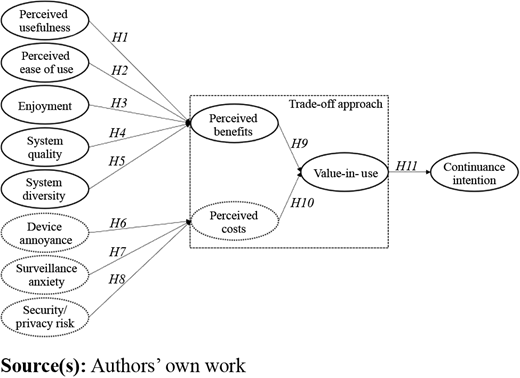
As shown in Figure 1, this study explains how the perception of cognitive (perceived usefulness, perceived ease of use, system quality, system diversity, security/privacy risk) and affective (enjoyment, device annoyance, surveillance anxiety) product-induced variables influence benefits and costs on a user-level, resulting in value-in-use and, subsequently, in continuance intention.
3.1 Drivers of perceived benefits
When users interact with novel products, they could, according to prospect theory (Kahneman and Tversky, 1979), perceive usefulness, ease of use, enjoyment, system quality and diversity as major potential gains. Following Davis (1989), perceived usefulness is defined as the degree to which individuals believe that using a smart product enhances performance. Previous research identified perceived usefulness as a driver of utilitarian value (Jo, 2022) and, over attitude, of the continuous use intention of smart speakers (Hsieh and Lee, 2021; Nguyen et al., 2019) or voice assistants in general (Pal and Arpnikanondt, 2021). Moussawi et al. (2023) identified a direct effect of perceived usefulness on continuance intention and of the comparable construct performance expectancy on the perceived competence of AI voice assistants (Hsieh and Lee, 2024). As an important value dimension, perceived usefulness can be allocated to the construct excellence, which captures the performance assessment of a product (Holbrook, 1994). Accordingly, perceived usefulness is proposed to be a fundamental driver of the overall perceived benefits:
Perceived usefulness has a positive impact on perceived benefits.
Perceived ease of use, defined as the degree to which a smart product is perceived to be free of effort, drives perceived usefulness and usage intentions (Davis, 1989). Although research on continuous usage postulates a wear-out-effect of perceived ease of use (Bhattacherjee, 2001; Bhattacherjee and Lin, 2015), in a voice-assisted smart product context, users will benefit from an easy-to-use product. Currently, some commands require using special phrases, as not all natural voice commands are initially understood by smart products. This reduces ease of use and increases the effort through repeating the commands. Consequently, ease of use will be relevant in prolonged usage situations as long as conversations with these products will not be like natural interactions with humans. Previous research on continuous usage of voice user interfaces and smart speakers proved ease of use or effort expectancy as a driver of attitude toward use (Hsieh and Lee, 2021; Nguyen et al., 2019), perceived usefulness (Pal and Arpnikanondt, 2021), or perceived competence (Hsieh and Lee, 2024). Also, value research identified the construct efficiency, capturing the convenience of using a product, and thus the perceived ease of use as a relevant value dimension (Holbrook, 1994). This leads to the following hypothesis:
Perceived ease of use has a positive impact on perceived benefits.
Enjoyment is a key hedonic value and affective driver influencing usage intentions. Adapted from Davis et al. (1992), enjoyment is defined as the extent to which the use of voice-assisted smart products is perceived as enjoyable, apart from any performance consequences that may be anticipated. While previous research identified no direct effect of enjoyment on continuance intention (Moussawi et al., 2023), a mediating effect over attitude was confirmed (Hsu and Lee, 2023; Nguyen et al., 2019; Pal and Arpnikanondt, 2021). Furthermore, the almost similar construct hedonic motivation increases satisfaction (Lee et al., 2020; Lee et al., 2021) and emotional value positively influences continuance intention of voice assistants (Molinillo et al., 2023). In value research, Sheth et al. (1991) and Sweeney and Soutar (2001) proved emotional value as a fundamental part of overall value. It becomes obvious that users who enjoy interacting with voice-assisted smart products will perceive higher benefits:
Enjoyment has a positive impact on perceived benefits.
System quality represents how well a smart speaker performs its functions and captures functionality, reliability and accuracy (Kowalczuk, 2018). It assesses the product’s unique features: understanding voice commands, processing these commands and giving the anticipated responses. Recent literature investigated manifestations of this construct and identified functionality as a factor representing perceived coolness, which positively impacts different value perceptions (Ashfaq et al., 2021). Regarding voice assistants, system and service quality are positive antecedents of satisfaction (Pal and Arpnikanondt, 2021). In value research, functional value, capturing the utility derived from a product’s quality and performance, is an important aspect of overall value creation (Sweeney and Soutar, 2001). System quality can be viewed as a degeneration of excellence and, consequently, as a value aspect (Holbrook, 1994). These results imply that it is beneficial when smart products deliver proper and immediate answers:
System quality has a positive impact on perceived benefits.
System diversity, defined as the perceived number of different functions a voice-assisted product can perform (Kowalczuk, 2018), is another important factor that can be summarized under functional value (Sweeney and Soutar, 2001) or excellence (Holbrook, 1994). Smart speakers can perform a variety of different services, such as setting timers, creating to-do lists and controlling smart home devices. The system’s diversity enhances perceived usefulness (Kowalczuk, 2018) and continuance intention (Lee et al., 2020). Compatibility, a similar construct, has been shown to increase attitude and, subsequently, continuance intention of voice assistants (Pal and Arpnikanondt, 2021). Building upon these insights, it is expected that the higher the perceived number of functions a voice-assisted smart product can perform, the more beneficial it is:
System diversity has a positive impact on perceived benefits.
3.2 Drivers of perceived costs
When using voice-assisted smart products, individuals also face potential costs such as device annoyance, surveillance anxiety and security/privacy risks. Following prospect theory (Kahneman and Tversky, 1979), these factors are related to the potential losses users may perceive during or after the usage process. If all functionalities are used, voice-assisted smart products are not only able to give direct feedback on request but also, depending on the product, to inform users about the delivery status of purchased items without being asked. If these notifications appear without preannouncement, they could be perceived as bothering. The smart products could also misinterpret conversations between humans and answer although not being asked. This degree to which individuals feel bothered by annoying notifications has previously been investigated as device annoyance in a smartwatch context (Siepmann and Kowalczuk, 2021). There, device annoyance had a negative influence on satisfaction. As device annoyance of smartwatches emerges through unpredictable notifications, it is comparable with the annoyance elicited by voice-assisted smart products. Perceived annoyance due to overexposure to a medium (Hutter et al., 2013), such as through unwanted notifications, represents a critical yet underexplored affective factor in voice-assisted smart products research. Beyond that, value research identified performance risk, the extent to which a product does not perform as expected or intended, as a negative value type (Leroi-Werelds, 2019). Hence, device annoyance is expected to be a relevant driver of the perceived costs:
Device annoyance has a positive impact on perceived costs.
A major risk factor that consumers perceive during usage is surveillance anxiety, the threat of being constantly monitored or wiretapped by the permanently active microphones of these devices (Kowalczuk, 2018). Qualitative findings show that some respondents are afraid of being spied on by a smart speaker and that its use compromises the inviolability of their homes (Lau et al., 2018). Because voice-assisted smart products are permanently online, users express a sense of distrust or discomfort. They are worried about the possible consequences when the smart speaker may have recorded intimate or private conversations. Despite these concerns, some nonusers report they would use such a product in the future if providers address surveillance concerns (Lau et al., 2018). Furthermore, Lee et al. (2021) identified a negative impact of the comparable construct technology anxiety on continuance intention. Thus, the affective factor surveillance anxiety is expected to increase perceived costs:
Surveillance anxiety has a positive impact on perceived costs.
Security/privacy risk reflects the fear that users’ data will be leaked or hacked by criminals when using smart speakers (Kowalczuk, 2018). In research on continuous usage of voice-assisted smart products, divergent findings exist. While some researchers found a significant positive impact of perceived security on satisfaction (Lee et al., 2020), others did not (Lee et al., 2021). In the same vein, perceived risk sometimes reveals a significant (Nguyen et al., 2019) and sometimes a nonsignificant negative impact over attitude on continuance intention (Pal and Arpnikanondt, 2021). Privacy risk negatively affects continuance intention over perceived value (Maroufkhani et al., 2022) but has a nonsignificant direct effect on continuance intention to use voice assistants (Molinillo et al., 2023). While these findings are rather ambiguous, value research identified security and privacy risks as negative value types (Leroi-Werelds, 2019). Publications of leaks or hacks of personal data, along with an amendment of general terms and usage conditions, could lead to a reassessment of the security/privacy risk. Hence, it is expected to be a relevant driver of perceived costs:
Security/privacy risk has a positive impact on perceived costs.
3.3 Composition of value-in-use and its impact on continuance intention
In a value-based framework, perceived benefits capture positive aspects (e.g. perceived quality or convenience), whereas perceived costs contain negative components, such as monetary and nonmonetary factors (Zeithaml, 1988). A positive value-in-use implies that customers perceive that they are better off using products or services, while negative value-in-use implies the opposite, i.e. that they perceive they are worse off (Grönroos and Voima, 2013; Plewa et al., 2015). Following prospect theory, individuals engage in behaviors that offer the greatest subjective gains in conjunction with the probability of occurrence and that they weigh between potential gains and losses (Kahneman and Tversky, 1979). As previously defined, the perceived gains (benefits) and losses (costs) are formed by the product-induced variables in distinct intensities. While Lucia-Palacios and Pérez-López (2023) conceptualized the customer experience value as a trade-off between benefits and costs, Hendricks (2018) applied the conceptualization of Zeithaml (1988) and proved perceived benefits and costs as significant antecedents of envisioned value-in-use in a customer solutions context. Consequently, the value-in-use results from the trade-off between the perceived benefits and costs of using voice-assisted smart products:
Perceived benefits have a positive impact on value-in-use.
Perceived costs have a negative impact on value-in-use.
The customer’s perceived value-in-use presupposes consumption experiences, i.e. it takes a postadoption view and refers to the perceived consequences of using a product, which can be positive or negative (Grönroos and Voima, 2013). In several contexts, value-in-use (e.g. Sweeney et al., 2018) predicts behavioral intentions such as purchase intention, satisfaction or word of mouth. For example, the envisioned referring to the value anticipated prior to actual product use was a significant driver of the intention to use a customer solution and to pay a price premium (Hendricks, 2018). In a social media setting, it was further found that value-in-use drives brand attachment (Welch et al., 2024). According to the expectation-confirmation model, continuance intention is the customer’s intention to continue using products (Bhattacherjee, 2001). Dissatisfied customers are more likely to refrain from using the product instead of continue using it (Bhattacherjee, 2001). This finding can be transferred to the current research, because dissatisfaction is reflected by a low perceived value-in-use, leading to a discontinued use. Likewise, satisfaction with a product is represented in a high value-in-use, resulting in continued usage. Different value forms enhance attitude toward use and, in turn, continuance intention of smart speakers (Ashfaq et al., 2021). Building upon this general understanding, the following hypothesis is proposed:
Value-in-use has a positive impact on continuance intention.
4. Research method
4.1 Measurement scales
Established reflective multi-item measurement scales were used to measure the latent constructs. When necessary, items were adjusted to the voice-assisted smart product context, in this case, to smart speakers. The scales for continuance intention (Bhattacherjee, 2001), value-in-use (Cronin et al., 2000; Hendricks, 2018), perceived benefits and costs (Hendricks, 2018), perceived usefulness (Bhattacherjee and Lin, 2015; Davis, 1989), perceived ease of use (Davis, 1989), enjoyment (Venkatesh and Bala, 2008) and device annoyance (Siepmann and Kowalczuk, 2021) were adapted to the smart speaker context. Scales for system quality, system diversity, surveillance anxiety and security/privacy risk were adopted from extant voice-assisted smart product research (Kowalczuk, 2018). To account for individual differences, the questionnaire included the control variables age, sex, smart speaker brand, usage frequency, smart speaker possession duration and use of compatible devices. All constructs were measured on seven-point Likert scales ranging from 1 (strongly disagree) to 7 (strongly agree). An overview is displayed in Table 2.
4.2 Data collection
A structured online questionnaire study following a nonprobability sampling procedure was administered from December 2021 to February 2022 in Germany to test the proposed relationships in the model. This study was conducted in accordance with ethical research standards (e.g. participants provided informed consent before taking part in the study; all responses were collected anonymously, and no personally identifiable information was recorded; participation was voluntary, and participants could exit the survey at any time without any consequences). To reduce the likelihood of bias and ensure the widest possible dissemination, the questionnaire link was distributed through email lists and social networks. Moreover, students enrolled in a marketing program were invited to participate in the survey and encouraged to disseminate it to their friends and fellow students.
The n = 397 participants, who fully completed the questionnaire, were on average 34.07 years old (SD = 12.49) and mostly female (56.7%). To ensure data validity, only completely answered questionnaires were considered for analysis, and invalid or repeated responses were discarded. Nonusers of smart speakers were filtered out. The convenience sample consists of relatively experienced users who have owned a smart speaker for at least two months (93.0%) and use it multiple times a week (82.4%). Participants predominantly used products of the well-known brands Amazon (Echo; 61.2%) and Apple (HomePod; 30.5%) for purposes such as playing music (89.9%), setting reminders (70.5%), searching for information (66.0%) and controlling home devices (52.4%). The majority (58.7%) used compatible devices such as lamps, shutters or thermostats.
5. Analysis and results
5.1 Measurement model assessment
To evaluate the reflectively specified measurement model and the structural model, R and the R-package “SEMinR” (Ray et al., 2021) were employed. In a first step, the reliability of the measurement scales was evaluated. Table 2 shows that indicator reliability is achieved, since, except for one item (0.644), all indicator loadings exceed the threshold of 0.708 and explain more than 50% of the indicator’s variance. As suggested in literature, the item with the weaker loading was not eliminated as a removal did not significantly improve reliability and validity (Hair et al., 2022). Internal consistency reliability is achieved in three ways. Besides the values for Cronbach’s alpha (α) and composite reliability (CR) (Hair et al., 2022; Nunnally, 1978), the consistent reliability coefficients (roh_A), which are more conservative than α and more liberal than CR (Dijkstra and Henseler, 2015) exceeded the recommended value of 0.700 for all constructs.
In the second step, the convergent and discriminant validity of the scales were assessed. Convergent validity was established because all average variance extracted (AVE) values were higher than 0.500 (Hair et al., 2022). As shown in Table 3, discriminant validity was achieved in two ways. First, by using the Fornell–Larcker criterion, the square root of each constructs AVE value exceeded the correlation values with all other examined constructs (Fornell and Larcker, 1981). Second, by using the heterotrait–monotrait ratio (HTMT) of correlations, all values were at least below the proposed threshold value of 0.900 (Henseler et al., 2015).
5.2 Common method bias
Common method bias (CMB) is a potential concern in survey research, especially when self-reported data are used (Podsakoff et al., 2003). To reduce CMB, as a procedural remedy, the order of the items in the online questionnaire was randomized. Three statistical tests were conducted to check whether CMB is present in the data. First, Harman’s single-factor test and unrotated exploratory factor analysis (Podsakoff et al., 2003) indicate that the single factor accounts for 35% (<50%) of the variance. Second, a common latent factor was included in the confirmatory factor analysis (Eichhorn, 2014), which explains 26.9% of the variance. Third, the common marker variable approach was conducted. Therefore, a short version of the Marlow–Crowne social desirability scale was integrated into the common latent factor model (Crowne and Marlowe, 1960; Fischer and Fick, 1993) and a common variance of 16.3% was received. Based on these results, CMB is not a threat in this study.
5.3 Structural model assessment
In PLS, the relationships between constructs are examined by estimating a series of regression equations (Hair et al., 2022). Thus, collinearity issues between predictor constructs could bias estimates and standard errors (Sarstedt and Mooi, 2019). To test for collinearity, variance inflation factor values were calculated. Because all values are below 3, no collinearity issues are present (Becker et al., 2015).
Based on the results outlined in Table 4, except for two relationships, all hypotheses are supported. Perceived usefulness (H1, β = 0.300, p ≤ 0.001), perceived ease of use (H2, β = 0.238, p ≤ 0.001), enjoyment (H3, β = 0.327, p ≤ 0.001) and system quality (H4, β = 0.148, p ≤ 0.001) turned out significant drivers of perceived benefits, whereas system diversity had no significant effect (H5, β = 0.012, p = 0.796). Beyond that, results showed a significant influence of device annoyance (H6, β = 0.206, p ≤ 0.001) and security/privacy risk (H8, β = 0.275, p ≤ 0.001) on perceived costs. The effect of surveillance anxiety on perceived costs (H7, β = 0.016, p = 0.794) was not found to be significant. Results imply that the conceptualization of value-in-use is valid, as perceived benefits (H9, β = 0.647, p ≤ 0.001) are a significant driver and perceived costs (H10, β = −0.208, p ≤ 0.001) a significant inhibitor of value-in-use. As expected, value-in-use has a strong positive impact on continuance intention (H11, β = 0.747, p ≤ 0.001).
An explained variance of 55.8% of continuance intention highlights the extreme relevance of the value-in-use when explaining prolonged usage. The model additionally shows a strong predictive power for value-in-use (61.4%) and perceived benefits (67.6%), whereas it remains rather weak for perceived costs (16.6%).
5.4 Robustness tests
To assess the result’s robustness, the impact of the control variables was tested. The results showed a significant positive impact of age (β = 0.093, p ≤ 0.010), possession duration (β = 0.122, p ≤ 0.001) and usage frequency (β = 0.235, p ≤ 0.001) on continuance intention. These results indicate that older users, those who possess their products for a long time and those who frequently use them, have a higher continuance intention. Including these variables increased the explained variance of continuance intention to 64.1%. All other results remained stable.
6. Discussion and contribution
6.1 General discussion
Previous studies explored reasons for continuance intentions of voice-assisted smart products (e.g. Ashfaq et al., 2021; Moussawi et al., 2023). However, an analysis of the underlying factors constituting the human–computer interaction from multiple perspectives, and especially a comprehensive understanding of risk factors impeding usage, is still missing (Donthu et al., 2022; Sun et al., 2022). To close this gap and to answer the RQs, this study investigated the relevant cognitive and affective antecedents driving customers’ perceived benefits and costs and the factors over which they translate into continued usage. In response to RQ1, perceived usefulness, ease of use, system quality and enjoyment constitute the specific product-induced drivers of perceived benefits, whereas device annoyance and security/privacy risk represent the key determinants of perceived costs.
Perceived usefulness significantly enhanced perceived benefits, reinforcing previous literature on voice-assisted smart product continuance (Moussawi et al., 2023) and attitudes (e.g. Nguyen et al., 2019; Pal and Arpnikanondt, 2021). In addition, perceived ease of use is still important in continued usage. This contrasts with previous research on continuous usage postulating a wear-out-effect of ease of use over time (Bhattacherjee, 2001; Bhattacherjee and Lin, 2015), supporting instead that ease of use is a crucial factor in continued product usage (e.g. Hsieh and Lee, 2021; Nguyen et al., 2019). Results indicate that perceived ease of use does not diminish over time but continues to be relevant for prolonged usage.
Interestingly, system quality emerged as a significant driver of perceived benefits, aligning with research on voice assistants (Pal and Arpnikanondt, 2021) and overall value creation (Holbrook, 1994; Sweeney and Soutar, 2001), but no effect was found for system diversity. This finding diverges from earlier studies emphasizing system diversity as a relevant attribute of value research (functional value: Sweeney and Soutar, 2001; excellence: Holbrook, 1994), initial adoption (Kowalczuk, 2018) and continuance intention of smart speakers (Lee et al., 2020). A potential explanation is that frequent users rely primarily on basic commands like playing music, creating to-do lists or setting timers, as reflected in a recent report about Amazon (Carpenter, 2022).
Besides these cognitive factors, enjoyment is an important affective driver of perceived benefits. This supports findings in both literature on information systems (Nguyen et al., 2019; Pal and Arpnikanondt, 2021) and value perceptions (Sheth et al., 1991; Sweeney and Soutar, 2001). The results underscore the importance of hedonic factors in the ongoing use of voice-assisted smart products.
This study also reveals that device annoyance and security/privacy risk enhance the perceived costs, while surveillance anxiety is considered irrelevant. Device annoyance is a key affective factor influencing perceived costs, extending previous research that demonstrated its significant impact on satisfaction of smartwatches (Siepmann and Kowalczuk, 2021). Security/privacy risk is not only a relevant inhibitor of perceived value (e.g. Maroufkhani et al., 2022), but also a cognitive driver of perceived costs. Contrary to previous research on the behavioral intention to use voice-assisted smart products (Kowalczuk, 2018), surveillance anxiety exerts no significant effect in prolonged usage situations. This aligns with Lau et al. (2018), who identified the threat of being listened to in one’s own home as a major deterring factor for smart speaker adoption, but not for individuals already using one. While nonusers are concerned about being wiretapped and are unlikely to purchase or use such a product, those who have already bought one perceive lower concerns and are likely to continue using it.
The findings related to RQ2 support the idea that value-in-use is composed of a trade-off between perceived benefits and costs, proving the applicability of the trade-off-approach (Zeithaml, 1988), the assumptions of the prospect theory (Kahneman and Tversky, 1979) and the cost-benefit paradigm (Kleijnen et al., 2007). The theories focus on gains (benefits) and losses (costs) and highlight the dynamic nature of value-in-use, where user perceptions evolve through ongoing product interaction. Perceived benefits have a stronger impact on value-in-use than perceived costs and a high value-in-use depends on whether the benefits outweigh costs.
While previous research has predominantly focused on the impact of different value perceptions on usage intentions (McLean and Osei-Frimpong, 2019), or attitudes toward use, and subsequently continuance intentions (Ashfaq et al., 2021), the findings addressing RQ3 highlight value-in-use as the sole dimension with strong explanatory power for continuance intentions. This research demonstrates that, in addition to perceived value – which reflects postusage beliefs following product usage (e.g. Lavado-Nalvaiz et al., 2022; Maroufkhani et al., 2022) – value-in-use, which more accurately captures beliefs formed during the usage experience, is not only a driver of brand attachment (Welch et al., 2024) but also a novel and essential driver of continuance intention.
6.2 Research contributions
This study makes several important theoretical contributions to the literature, advancing knowledge in the fields of information systems, value theory and product and branding research.
The current research melts information systems and value literature by integrating key cognitive factors – perceived usefulness and perceived ease of use – of initial (e.g. Davis, 1989) and ongoing usage (Bhattacherjee, 2001; Bhattacherjee and Lin, 2015) into a value-based framework for explaining continuance intention of voice-assisted smart products. For value research, these results indicate that these factors are not only parts of excellence and efficiency, respectively (Holbrook, 1994), but also direct drivers of perceived benefits. While the study confirms that system quality drives perceived benefits, it finds no significant effect for system diversity, contrasting prior assumptions in value research (Sweeney and Soutar, 2001; Holbrook, 1994). This suggests that for frequently used products like smart speakers, the variety of features may be less critical than previously expected.
By confirming enjoyment’s influence, the study expands current knowledge on affective factors in user experience, demonstrating that enjoyment enhances perceived benefits. This reinforces the notion that while utilitarian attributes satisfy functional needs, hedonic factors like enjoyment play a vital role in retaining user interest and satisfaction over time, contributing to a holistic understanding of value creation in smart products.
This study responds to a call for more research into the “dark side” of interconnected smart products (Sun et al., 2022) by introducing device annoyance as a new affective and important driver of perceived costs. This expands information systems literature by showing that annoyance, previously established in smartwatch research (Siepmann and Kowalczuk, 2021), is also crucial for voice-assisted smart product continuance. Security/privacy risk is confirmed as a further significant cost driver, emphasizing its importance not only for constituting perceived value (Maroufkhani et al., 2022) but also for value-in-use.
This study makes an important contribution to understand customers’ perceived value-in-use by differentiating between desired and perceived customer value (Flint et al., 1997; Graf and Maas, 2008). Desired customer value reflects customer-specific needs and goals before product usage, while perceived customer value captures postusage beliefs that emerge after interacting with a product or service. The introduction of value-in-use enriches the current understanding by reflecting the extent to which customers feel better or worse during or after the usage experience (Grönroos and Voima, 2013). It supports the notion that customers aim to achieve their desired goals through the usage process of smart products (Macdonald et al., 2016) and that value-in-use is crucial for understanding continuance intentions. This study further contributes to literature by showing that the trade-off-approach (Zeithaml, 1988), prospect theory (Kahneman and Tversky, 1979) and the cost–benefit paradigm (Kleijnen et al., 2007), are suitable to explain the dynamic nature of value-in-use as a trade-off between benefits and costs. Thereby, it offers a deeper and more nuanced theoretical understanding of value creation in the postadoption phase, expanding brand value theory (e.g. Marchowska-Raza and Rowley, 2024) to better account for both cognitive and affective aspects as fundamental drivers of perceived benefits and costs.
Finally, the research contributes to product and branding literature by examining how technological advances in machine learning and AI drive the dissemination of smart products (Donthu et al., 2022). As brands focus on simplifying interactions and enhancing customer experiences through effective touchpoints (Smith, 2020; Yang and Mundel, 2022), smart speakers provide a key extension to omnichannel retailing (Mishra et al., 2021). It provides key leverage points for product and brand managers to focus on when aiming for the seamless integration of voice-assisted smart products into their omnichannel strategies, ultimately enhancing consumer engagement across all platforms. This study advances branding literature by demonstrating that value-in-use influences not only brand attachment (Welch et al., 2024) but also continuance intention.
6.3 Managerial implications
Understanding the product-induced cognitive and affective factors establishing prolonged usage enables product and brand managers as well as developers to leverage voice-assisted smart products as new touchpoints on their customer journey (Smith, 2020) and subsequently foster brand loyalty (Maroufkhani et al., 2022). Because high perceptions of value-in-use result in prolonged usage, the overall aim should be to provide customers a positive user experience, i.e. high benefits and low costs. For product managers, prospect theory suggests prioritizing gain (benefits) amplification and loss (costs) mitigation to maximize value-in-use and foster long-term engagement. Developing and promoting advertising campaigns that highlight the enjoyment, usefulness and ease of use can be an effective strategy to increase the benefits. Product and brand managers should utilize established tools (e.g. social media clips, tutorials, webinars or personifications) to emphasize how enjoyable voice-assisted smart products are to use and how they enrich and simplify people’s lives. For example, they could promote the ability to program customizable routines, to also boost brand engagement (Harrison and Kwon, 2023). Brands could further include brand-related gamification elements such as quizzes or games to promote playful interactions with the brand.
While increasing the functionalities of these products will not bring additional benefits, better accuracy and reliability will. Thus, AI algorithms should be optimized to better understand and interpret different languages and accents (Ghazali et al., 2023). To further improve system quality, more advanced hardware could accelerate processing and response time, which enhances the overall user experience and, in turn, the brand image (Ghazali et al., 2023).
Likewise, perceived costs such as security/privacy risks should be reduced to increase continuance intentions. Thereto, credible information campaigns or certifications on data privacy and security standards could be used to ensure high transparency, which enhances brand loyalty (Maroufkhani et al., 2022). To reduce device annoyance and, in turn, costs resulting from unwanted reactions, notification settings should be easily accessible and customizable. Brand managers using voice-assisted smart products as touchpoints should ensure that communication with customers is neither too intrusive nor unexpected. In addition, they should advertise products in a way that is engaging yet unobtrusive, creating a seamless and positive user experience by decreasing perceived costs.
In addition, this study underscores the potential for voice-assisted smart products to serve as essential communication channels in modern retail environments. The findings that consumers primarily use basic commands (Carpenter, 2022) provide actionable insights for branding strategies focused on enhancing these core functionalities to meet user needs while maintaining simplicity.
6.4 Limitations and future research
This research’s limitations provide relevant starting points for future research. One limitation is the representativeness and generalizability resulting from the sample composition and convenience sampling. As data from German respondents and a large proportion of students (40.0%) were collected and analyzed, no generally valid statements for other countries and target groups can be made. Accordingly, the model should be tested in other countries for cross-validation.
Furthermore, the results revealed age-related differences in continuance intentions. Future studies could uncover differences regarding customer groups, operating systems or sociodemographic characteristics. Conducting a multigroup causal analysis would be a fruitful extension. Research should also test whether differences exist regarding product or brand familiarity.
Although the differentiation between perceived benefits and costs is appropriate for conceptualizing value-in-use of voice-assisted smart products, the explained variance of perceived costs (16.6%) is rather low. In line with Sun et al. (2022), more cost-specific variables must be uncovered, e.g. by conducting qualitative analyses such as in-depth or focus group interviews. Additional longitudinal studies would be suitable for identifying other relevant factors influencing value-in-use.
To establish a more profound understanding of continuance intentions, future research should explicitly consider different usage contexts and purposes, as well as the impact of personality traits to account for individual differences. Incorporating moderator variables would provide a more nuanced understanding of relationships between variables. For example, brand relationships (Veloutsou, 2015) could moderate the impact of product-induced variables (e.g. system quality and security/privacy risk) on perceived benefits and costs associated with the product. A strong brand relationship might create a sense of loyalty or a deeper connection, which could make consumers less sensitive to issues related to system quality or security/privacy concerns. As a result, the impact of these product-induced variables on perceived benefits and costs could be moderated by the strength of the consumer’s attachment to the brand. Consumers with stronger brand relationships may be more willing to tolerate potential negative aspects or perceive positive aspects more strongly. Customers’ technology readiness, particularly their optimism and innovativeness, could also moderate the relationship between perceived benefits, costs and value-in-use. Given that these factors play a crucial role in the continuance intention of smart services (e.g. Khashan et al., 2024), higher technology readiness may reduce the impact of perceived costs while amplifying the effect of perceived benefits on value-in-use.
Because this study relied on convenience sampling and tested a newly developed theoretical model, the analysis method (i.e. PLS-SEM) is rather exploratory. To corroborate or refute the results, a covariance-based approach could be used to test the model’s overall performance (e.g. Hair et al., 2017).
Despite these limitations, the study first conceptualizes value-in-use as a trade-off between benefits and costs, identifies relevant antecedents and shows its impact on the continuance intention of voice-assisted smart products. Hence, it is a starting point for investigating value-in-use of related products.
The authors thank the research and the student assistants for their help with data collection. The authors acknowledge support by the Open Access Publication Fund of the University of Duisburg-Essen.
Credit authorship contribution statement: Pascal Kowalczuk, Conceptualization, Data curation, Formal analysis, Investigation, Methodology, Project administration, Resources, Software, Supervision, Validation, Visualization, Writing – original draft, Writing – review and editing. Nick Hof, Conceptualization, Data curation, Formal analysis, Investigation, Methodology, Project administration, Resources, Software, Supervision, Validation, Visualization, Writing – original draft, Writing – review and editing.