An appropriate logo design is an important concern for managers of existing nostalgic brands that face challenges in balancing logo innovation with nostalgic brand image preservation or of brands aspiring to transition into nostalgic brands. However, relative scarce research has investigated the impact of logo design on consumer attitudes toward nostalgic brands. To address this gap, this research aims to explore how visual stability of logos influences consumer attitudes toward nostalgic brands.
Three experiments were conducted to examine the effect of visual stability of logos on consumers’ attitudes toward nostalgic brands. The online experiments used online platforms Prolific and Credamo. The hypotheses were tested using statistical methods, including t-tests, ANOVA and regression. All methods were implemented using the SPSS software.
The results indicate that visually stable (vs unstable) logos improve consumer attitudes toward nostalgic brands but not toward non-nostalgic brands. Consumers perceive greater brand stability when nostalgic brands use stable logos, rather than unstable logos, leading to a more favorable brand attitude. The effect of logo visual stability on consumer attitudes toward nostalgic brands is mitigated by presenting values cues of brand heritage.
This research contributes to the existing literature by exploring the precursory factors that improve consumer attitudes toward nostalgic brands. It investigates the downstream consequences of visual stability and the visual determinants that influence perceived brand stability. This research offers insights into logo visual stability design strategies, presenting an understanding of how logo visual stability can be leveraged to enhance consumer attitudes toward nostalgic brands.
1. Introduction
Nostalgic brands are defined as “brands that were popular when one was younger and that still exist today” (Kessous et al., 2015). Recently, many brands have repositioned themselves as nostalgic to regain popularity (Darpan, 2023; Quihuiz, 2023). One reason why nostalgic brands have become so popular is that the changing social circumstances in the 21st century have prompted people to seek stability (Han and Newman, 2022). Positioning a brand as nostalgic is perceived as an “act to restore a sense of socio-historic continuity,” which allows nostalgic brands to provide a sense of stability and appeal to consumers (Han and Newman, 2022). The importance of brand stability for nostalgic brands is particularly evident.
Previous studies have shown that nostalgic brands can create brand stability by emphasizing stable characteristics (Fritz et al., 2017). In the Internet age, the design of a brand’s visual elements is crucial in shaping brand attributes (Bokhua, 2023). Among visual elements, logo characteristics have been found to represent brand attributes more effectively (Grobert et al., 2016; De Lencastre et al., 2023; Torres et al., 2019). In contemporary brand management, nostalgic brands may face challenges in maintaining brand stability using an unchanged logo (Walsh et al., 2019). As a result, the ability to convey brand stability through visual features of the logo has become increasingly important. To adapt to the evolving landscape of information dissemination, nostalgic brands can consider leveraging logo design as a means to signal stability.
The visual stability of a brand’s logo can convey brand stability. Logo visual stability is defined as the likelihood of a logo tipping over or falling under the influence of imaginary gravitational or external forces (Cholewiak et al., 2013; Rahinel and Nelson, 2016). Previous research on visual stability focused on the positive effects of unstable logos, such as capturing consumer attention and reflecting a company’s dynamism and innovativeness (Baxter and Ilicic, 2018; Cian et al., 2014; Huang et al., 2021). However, relatively little research has been conducted on stable logos. Few studies have found that stable logos convey a sense of permanence and constancy (Cholewiak et al., 2013; Rahinel and Nelson, 2016).
This research aims to add to the research on stable logos by proposing that the visual stability of logos metaphorically symbolizes the stability of a brand. It focuses on nostalgic brands and investigates how logo visual stability influences consumer attitudes, which refers to the overall evaluations of brand liking and perceived quality (Jiang et al., 2016). The central hypothesis is that stable logos can improve consumer attitudes toward nostalgic brands by increasing perceived brand stability. This effect is expected to diminish in the context of non-nostalgic brands, or when nostalgic brands explicitly communicate brand heritage through value-related cues, such as an emphasis on the brand’s commitment to its core values (Han et al., 2021).
This research contributes to the existing literature in several aspects. It extends research on the visual design of nostalgic brands by identifying logo visual stability as an alternative approach to enhance consumer attitudes toward nostalgic brands. While prior studies have primarily emphasized the advantages of visual instability, this study reveals the positive effects of stable logo designs, thereby enriching the literature on visual stability. In addition, this research advances the understanding of how visual elements influence perceived brand stability by offering an unnoticed explanatory pathway. From a practical perspective, the findings offer guidance for brand managers to adopt logos with high visual stability to improve consumer attitudes toward nostalgic brands.
2. Literature review
2.1 Nostalgia and nostalgic brand
Nostalgia is defined as a sentimental longing for the past (Huang et al., 2016; Zhou et al., 2012). Some scholars have highlighted the inherently positive nature of nostalgic experiences, suggesting that nostalgia evokes warmth associated with past events or periods (Batcho, 1995). However, other scholars argue that nostalgia is a negative emotion based on its original meaning, which is a combination of “nostos” (return home) and “algo” (pain) (Wildschut et al., 2011). Both lines of research agree that nostalgia, whether positive or negative, indicates preservation of the past (Wildschut et al., 2006). When consumers experience nostalgia, especially when related to a brand, they associate their past with that brand (Vredeveld and Kara, 2022; Wu et al., 2025). This association yields a series of positive outcomes. Emotionally, it increases brand loyalty and builds a stronger sense of connection with the brand (Loh et al., 2021). Behaviorally, it enhances the intention to purchase brand extensions (Banerjee and Shaikh, 2022).
Considering that nostalgia can generate positive effects for brands, positioning a brand as nostalgic has become a common strategy for brand managers (Heinberg et al., 2020). Prior literature suggests that one of the essential conditions for a brand to be perceived as nostalgic is that it retains its historical appearance (Loveland et al., 2010). Nostalgic brands are well-known entities that persist over time (Gilal et al., 2020). The preservation of a brand’s past appearance links it to a bygone era, enabling consumers to project personal memories onto the brand and thereby reconnect with earlier stages of their lives (Goor et al., 2025). As a result, nostalgic brands are perceived to help consumers retain strong connections with the past (Kessous et al., 2015).
It is important to note that establishing a nostalgic brand does not necessarily require consumers to know or have used the brand in the past (Vredeveld and Kara, 2022). Research has highlighted that the core focus is on activating consumer memories of bygone periods through the past appearance of nostalgic brands, regardless of consumers’ lifecycle stages (Gilal et al., 2020; Kessous et al., 2015) or past brand use (Rana et al., 2020). This further confirms that preserving a brand’s past appearance serves as a central mechanism for evoking consumer nostalgia. The following section examines how perceived brand stability influences consumers’ positive evaluation of nostalgic brands.
2.2 Nostalgic brand and brand stability
Brand stability refers to the extent to which a brand’s attributes are perceived as consistent and unchanged over time (Leischnig and Enke, 2011). These attributes may encompass various dimensions including brand personality (Valette-Florence and De Barnier, 2013), brand identity (Da Silveira et al., 2013), brand image (Gioia et al., 2000) and brand behavior (Moulard et al., 2016). High brand stability implies that consumers perceive these attributes as consistent over time (Leischnig and Enke, 2011). By contrast, low brand stability indicates perceived changes or inconsistencies in a brand’s attributes.
This research infers that showcasing brand stability can improve consumer attitudes toward nostalgic brands. This effect stems from the inherent alignment between brand stability and the defining characteristics of nostalgic brands. Consistency theory posits that when a brand’s positioning is congruent with its messages, consumer attitudes toward the brand are likely to improve (Chae et al., 2013; Sundar and Kellaris, 2017). This phenomenon is commonly referred to as the congruence effect (Eklund and Helmefalk, 2022; Graeff, 1996). For example, expressing sophistication can enhance the evaluation of luxury brands (Costa Pinto et al., 2019). Brand warmth positively influences the attitudes toward service brands (Jiang et al., 2016). Perceived naturalness can increase consumers’ purchase intentions for green products (Li et al., 2024).
A sense of congruence also exists between nostalgic brands and high brand stability. For nostalgic brands, a high level of brand stability indicates the brands’ relative consistency over time. When elements from the past are preserved and maintained, consumers are more likely to perceive the brand as a legacy from a bygone era, thereby eliciting nostalgia (Bissell, 2005; Kessous et al., 2015). The existing research supports the positive role of stability and unchanged characteristics in nostalgic marketing, implying consistency between stability and nostalgia. When accounting for consumers’ proneness to nostalgia, brands can adopt a heritage-based strategy that emphasizes continuity and minimal change to enhance consumer attraction (Hallegatte et al., 2018). Retaining past features can improve consumer attitudes toward nostalgic brands (Burgess and Jones, 2020). Framing nostalgic products as stable and unchanged increases purchase intention (Han and Newman, 2022).
Nostalgia conflict the notion of “change,” which reflects a state of low brand stability. Nostalgia, by nature, often entails skepticism toward change, which can manifest as unfavorable attitudes toward new technologies such as artificial intelligence (Dang et al., 2024). Changes in nostalgic brands may undermine consumers’ feelings of nostalgia (Kremer et al., 2022) and, consequently, reduce brand evaluation (Shields and Johnson, 2016). Consistent with this view, research on retro brands also highlights the conflict between nostalgia and brand changes. Retro brands are a category of brands in the contemporary era that offer products from a prior historical period (Brown et al., 2003; Hallegatte et al., 2018). For consumers of retro brands who have high nostalgia proneness, adding modern elements to retro products can negatively affect their willingness to pay (Hallegatte et al., 2018). These findings suggest that consumers who are highly prone to nostalgia tend to reject modifications.
When nostalgic brands convey stability signals effectively, consumers are more likely to form favorable attitudes toward the brand. In marketing practices, nostalgic brands can emphasize the consistency of their core attributes over time through storytelling (Kessous et al., 2015; Leggett and Davies, 2025). For instance, Adidas explains the stories behind its classic logo (3-Stripes) to reinforce perceptions of brand heritage (Adidas, 2022). However, in contemporary marketing contexts, consumers may lack the time or cognitive resources required to process extensive textual narratives. The influence of visual elements on consumer perception has become increasingly salient (Bokhua, 2023). Simple visual cues, such as brand logos can play a vital role in shaping consumers’ perception of brand characteristics (Machado et al., 2015; Pathak et al., 2019; Torres et al., 2023). Logo design may serve as effective tools to communicate a sense of high brand stability, allowing consumers to quickly infer the brand’s enduring identity. This research proposes that the visual stability of a logo is a salient visual feature through which consumers perceive brand stability.
2.3 Logo visual stability
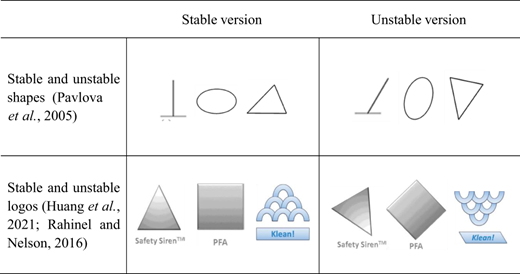
Visual stability refers to the perceived likelihood of a two-dimensional object tipping over or falling under imagined gravitational or external forces (Cholewiak et al., 2013; Rahinel and Nelson, 2016). As shown in Table 1, consumers assess objects, such as logos placed on a horizontal axis, judging their stability based on whether they appear prone to tipping or resistant to such forces (Cholewiak et al., 2013; Cian et al., 2014; Pavlova et al., 2005). Logos that seem likely to fall are perceived as unstable, whereas those that are resistant to gravitational effects are perceived as stable (Rahinel and Nelson, 2016).
Logos are perceived as unstable when their upper segments are larger than their lower segments, or when visual elements appear inclined or irregular (Figure 1). Conversely, stable logos typically feature larger lower segments or display visual elements arranged in a uniform and balanced manner (Cholewiak et al., 2013; Pavlova et al., 2005; Rahinel and Nelson, 2016). For instance, a logo composed of an inverted triangular graphic is often considered unstable, whereas one composed of a regular triangular graphic is perceived as stable (Rahinel and Nelson, 2016). Another example is an overall inclined image, such as a tilted parallelogram, which tends to be perceived as unstable, whereas a symmetrically aligned and regular rectangular shape is generally seen as stable (Huang et al., 2021; Rahinel and Nelson, 2016).
Unstable and stable logos have different effects on consumer perception. Unstable graphics can provide consumers with a sense of motion, which can have positive effects on a brand. Research has highlighted the efficacy of dynamic logos in capturing consumers’ attention (Cian et al., 2014). Guidelines that emphasize the dynamics of selecting or modifying logos have been shown to enhance consumers’ favorable responses to ad content by focusing on movement (Brasel and Hagtvedt, 2016; Cian et al., 2014). Prior research suggests that logo movement imagery and logo direction can jointly influence brand engagement (Tang et al., 2025). At the brand character level, dynamic logos have been shown to enhance consumers’ perceptions of brand innovativeness (Baxter and Ilicic, 2018) and openness (Huang et al., 2021). Stable logos have several advantages. Studies have indicated that stable logos can enhance consumers’ perceptions of the utility of safety-oriented products in some cases (Rahinel and Nelson, 2016).
While researchers have extensively explored the impact of logo visual stability across various marketing contexts, the literature on stable logos remains less comprehensive than the numerous studies on the positive effects of unstable logos. Building on current research trends (Cian et al., 2014; Rahinel and Nelson, 2016; Huang et al., 2021), this research extends this by investigating the positive role of stable logos in the context of nostalgic branding.
3. Theoretical framework and hypotheses
3.1 The effect of logo visual stability on consumer attitudes toward nostalgic brands
This research proposes that stable logos can activate a “stability” association related to high brand stability. Visual stability pertains to physical concepts (Cholewiak et al., 2013; Rahinel and Nelson, 2016). Evaluations of brand attributes (e.g. reliability, modernity, innovativeness) are often formed in social contexts, representing social concepts (Vinhas Da Silva and Faridah Syed Alwi, 2006). According to schema theory, when physical and social concepts share semantic similarity, they can form metaphorical links (Schmidt, 1975; Su et al., 2019).
Subsequent research has validated schema theory by identifying various metaphorical links based on semantic associations, such as the relationship between “high” in visual position and “high” in social status (Fiske, 2004; Schwartz et al., 1982), or the “softness” of circular shapes and “softness” in brand character (Jiang et al., 2016), and the connection between psychological emptiness and empty physical spaces (Su et al., 2019). More relevant to this research, previous research has highlighted that participants who experienced physical stability perceived more stability in relationships with their partners (Kille et al., 2013). This finding supports the premise that physical stability influences stable perceptions in the context of social relationships through metaphorical links.
Semantic similarity facilitates the formation of a metaphorical association between a logo visual stability and a brand’s perceived stability. Dictionary definitions support this alignment. According to the Oxford Dictionary, “stable” is defined as “not likely to give way or overturn; not likely to change or fail.” Similarly, the Cambridge Dictionary defines “stable” as “not likely to move or change.” In line with these definitions, logo visual stability refers to the perception that a logo is unlikely to move or be overturned (Cholewiak et al., 2013; Rahinel and Nelson, 2016). Likewise, in the brand stability context, a brand is considered stable when its core attributes are perceived as unlikely to change over time (Leischnig and Enke, 2011). The semantic meaning of “stability” thus remains consistent across both visual logo design and brand-level characteristics. Accordingly, a visually stable logo may symbolically represent a brand’s stability.
Extending the literature, this research posits that a stable (vs unstable) brand logo can enhance perceived brand stability, leading to more favorable attitudes toward nostalgic brands. Grounded in the consistency theory, this occurs because brand stability aligns well with that of nostalgic brands. However, this congruence was less applicable to non-nostalgic brands. Non-nostalgic brands, defined as those that did not exist or were not well known in the past (Loveland et al., 2010), lack the historical context and heritage (Kessous et al., 2015). For these brands, change and innovation are unlikely to diminish brand appeal (Shields and Johnson, 2016). Therefore, brand stability may not align with that of non-nostalgic brands. This research hypothesizes that, while stable logo designs can improve consumer attitudes toward nostalgic brands, their impact may diminish for non-nostalgic brands.
The following hypothesis is proposed:
Stable (vs.unstable) brand logos result in more favorable attitudes toward nostalgic brands. The effect of logo visual stability on consumer attitudes toward non-nostalgic brands is mitigated.
Perceived brand stability mediates the effect of logo visual stability on consumer attitudes toward nostalgic brands.Compared with unstable logos, stable logos increase perceived brand stability, resulting in more favorable attitudes toward nostalgic brands.
3.2 The moderating role of values cues of brand heritage
Nostalgic brands should retain their past appearance and emphasize heritage preservation (Hartmann and Brunk, 2019; Huang et al., 2016). Brand heritage encompasses a brand’s long-standing history and core values (Zhou et al., 2025). For nostalgic brands, maintaining the stability and continuity of brand heritage is crucial to evoke consumer nostalgia (Hallegatte et al., 2018; Kessous et al., 2015). By changing their original products, nostalgic brands may damage the brand heritage and reduce consumer evaluations (Shields and Johnson, 2016). This suggests that concerns over altering brand heritage are a key reason for consumers’ negative attitudes toward changes in nostalgic brands.
Research on heritage branding suggests that brand heritage and changes can coexist when brands communicate values cues of brand heritage (Han et al., 2021). Brands with a strong heritage often become synonymous with certain values (Han et al., 2021; Napoli et al., 2014; Zhou et al., 2025). Values cues of brand heritage refer to signals that convey the integrity of a brand’s legacy by expressing its internal commitments and guiding principles (Han et al., 2021; Morhart et al., 2015; Nunes et al., 2021). Heritage brands using values cues can mitigate negative consumer responses to product changes, as those changes do not necessarily contradict the brand’s internal values (Han et al., 2021; Nunes et al., 2021). Consequently, when values cues are presented, product modifications are less likely to compromise integrity of a brand’s heritage (Han et al., 2021).
For nostalgic brands, values cues may be effective in mitigating consumers’ negative responses to brand changes. The integrity of brand heritage enables consumers to perceive nostalgic brands as remaining “true over time,” fostering a sustained connection to the past (Heinberg et al., 2020). By highlighting the values cues, even amid brand changes, consumers may continue to feel connected to the nostalgic brand and maintain favorable attitudes. This implies that values cues increase consumer tolerance of changes in nostalgic brands. Accordingly, values cues may buffer incongruence between a message of low brand stability and the brand’s nostalgic positioning. The importance of conveying brand stability through visual elements such as logo design is likely to hold diminished significance.
This research posits that when the values cues of brand heritage are present, the visual stability of the logo may no longer influence consumers’ attitudes toward nostalgic brands. The following hypothesis is proposed:
Values cues of brand heritage (present vs.absent) moderate the effect of logo-visual stability on consumer attitudes toward nostalgic brands. Presenting values cues can reduce the difference in consumer attitudes between stable and unstable logos, such that this effect is insignificant.
4. Overview of the studies
This research comprises three studies. Study 1 tested the effect of stable (vs unstable) logo design on consumers’ attitudes toward nostalgic brands and provided evidence that for non-nostalgic brands, logo visual stability has no effect on consumer attitudes (H1). Study 2 explored the mediation of consumers’ perceived brand stability (H2). Study 3 tested the moderating effect of brand heritage values cues (H3). All studies were online experiments conducted using data collection platforms (Prolific and Credamo). Prolific and Credamo are professional data-collection platforms commonly used in marketing research and business surveys. These two platforms provide access to a representative pool of participants from a wide range of consumer demographics. Numerous consumer research studies use Prolific and Credamo for sample collection (Dai et al., 2023; Lu et al., 2023).
This research precisely controlled for the sample size within Prolific and Credamo. Sample sizes were determined by power analyses (Cohen’s d = 0.40) using G*power 3.1 (Faul et al., 2007). For two levels of the independent variable, a between-group experiment requires 200 participants (α = 0.05, power = 0.80). In all studies, 100 participants were included per condition. The sample selection process involved choosing a standard sample, and the studies in this paper did not include any screeners that would alter the demographic characteristics of the sample population, such as age, gender, occupation or income. This research adhered to established ethical research standards. Informed consent was obtained from all participants prior to their participation. Responses were collected anonymously, with no personally identifiable information recorded. Participation was entirely voluntary, and participants were free to withdraw from the study at any point without penalty.
All experiments used logo shapes that were previously used in research to manipulate visual stability (Rahinel and Nelson, 2016). This paper also adopted methods from prior studies to position the brands as nostalgic through advertisements (Barauskaitė et al., 2022; Muehling et al., 2004; Muehling et al., 2014). Pretests were conducted. The pretests for logos were conducted to control potential confounding variables. Considering prior research on the visual stability of logos (Rahinel and Nelson, 2016), the pretests measured attractive, complex, familiar, novel, arousal and uncommon as control variables. The results confirmed that these logos have significant differences in stability (Study 1: Mstable = 5.90, SD = 1.61, Munstable = 3.47, SD = 1.99, t(58) = 5.20, p < 0.001, Cohen’s d = 1.36; Study 2: Mstable = 4.93, SD = 2.33, Munstable = 2.73, SD = 1.66, t(58) = 4.21, p < 0.001, Cohen’s d = 1.11; Study 3: Mstable = 5.20, SD = 1.90, Munstable = 3.20, SD = 2.01, t(58) = 3.96, p < 0.001, Cohen’s d = 1.04). For all control variables, these were not significantly different across logos (ps >0.10).
Another pretest was conducted to test the effectiveness of manipulating the nostalgic brand perception. Participants indicated their brand nostalgia perception on four items (Shields and Johnson, 2016). Compared with non-nostalgic ads, the nostalgic ads led significantly higher brand nostalgia perception (Study 1&3: MNostalgic = 4.43, SD = 1.73, MNon-nostalgic = 3.27, SD = 2.04, t(68) = 2.56, p = 0.013, Cohen’s d = 0.62; Study 2: MNostalgic = 4.41, SD = 1.88, MNon-nostalgic = 3.08, SD = 2.01, t(68) = 2.87, p = 0.006, Cohen’s d = 0.70). Please see Supplementary Material Web Appendix D and E for the detailed results of the pretests.
5. Study 1
The main purpose of Study 1 was to test the effect of logo visual stability on consumer attitudes toward nostalgic and non-nostalgic brands. This study tests the hypothesis (H1) that stable (vs unstable) logos improve consumer attitudes toward nostalgic brands but do not influence consumer attitudes toward non-nostalgic brands.
5.1 Procedure
Study 1 used a 2 (logo visual stability: stable vs unstable) × 2 (brand type: nostalgic vs non-nostalgic) between-participants design. Four hundred two participants were recruited from Prolific (64.18% female, Mage = 40.33, SD = 13.02). After reading the informed consent with the purpose of the research and study procedures, participants were asked to evaluate a fictitious brand “Narciso.” Following the approach taken in prior research (Barauskaitė et al., 2022; Muehling et al., 2014), we manipulated brand type by presenting participants with advertisements. Participants were presented with either a nostalgic ad or a non-nostalgic ad and saw an image of the brand logo with stable or unstable design. The logo design (Rahinel and Nelson, 2016) and the ads (Barauskaitė et al., 2022) are from prior research (see Supplementary Material Web Appendix A and B). We conducted two independent pretests for logos (see Supplementary Material Web Appendix D) and ads (see Supplementary Material Web Appendix E).
Participants indicated their attitudes toward the brand on 3 items (1 = bad/unattractive/poor quality, 7 = good/attractive/good quality, α = 0.83; Jiang et al., 2016). Then, participants were asked to finish the manipulation check for brand (“The brand is a:” 1 = “Non-Nostalgic Brand”, 7 = “Nostalgic Brand”). After that, participants reported their age and gender.
5.2 Results and discussion
Manipulation check. The t-test showed that participants in nostalgic brand condition were more likely to perceive the brand as a nostalgic brand compared to those in the non-nostalgic brand condition (Mnostalgic = 5.78, SD = 1.68, Mnon-nostalgic = 3.90, SD = 1.99; t(400) = 10.26, p < 0.001, Cohen’s d = 1.03).
Consumer attitudes. A 2 × 2 ANOVA indicated that the interaction between logo visual stability and brand type was significant (F(1, 398) = 13.58, p < 0.001, partial = 0.03). The main effects of brand type (F(1, 398) = 0.02, p = 0.899, partial < 0.01) and logo visual stability (F(1, 398) = 2.50, p = 0.115, partial = 0.01) were not significant.
The stable (vs unstable) logo improved consumer attitudes toward the nostalgic brand (Mstable = 3.86, SD = 1.61, Munstable = 3.05, SD = 1.37; F (1, 398) = 13.87, p < 0.001, partial = 0.03). For the non-nostalgic brand, logo visual stability did not show significant influence on consumer attitudes (Mstable = 3.31, SD = 1.65, Munstable = 3.63, SD = 1.54; F(1, 398) = 2.21, p = 0.138, partial = 0.01).
Study 1 revealed that consumer attitudes were more favorable toward nostalgic brands with stable (vs unstable) logos. Meanwhile, for non-nostalgic brands, logo visual stability did not influence consumer attitudes. The results support H1. Study 2 further explores the mechanisms by which stable logos improve consumer attitudes toward nostalgic brands.
6. Study 2
Study 2 tests the mediating effect of perceived brand stability. Stable brand logos are hypothesized to enhance perceived brand stability, leading to more favorable consumer attitudes toward nostalgic brands (H2). This study also included alternative explanations of the relationship between logo visual stability and consumer attitudes toward nostalgic brands.
6.1 Procedure
Study 2 used a between-participants design (logo visual stability: stable vs unstable). A total of two hundred participants were recruited through Prolific (51.00% female, Mage = 41.30, SD = 12.73). After reading the informed consent with the purpose of the research and study procedures, participants were randomly assigned into the stable logo or unstable logo condition. Participants were told to evaluate a brand called “PFA.” They were presented with an image of the nostalgic ad (Muehling et al., 2014; see Supplementary Material Web Appendix A) with a stable or unstable logo of the brand (Rahinel and Nelson, 2016; see Supplementary Material Web Appendix B). The logos and nostalgic ads were pretested.
Participants indicated their attitudes toward the brand on 3 items (α = 0.93) same as in Study 1 (Jiang et al., 2016). Then perceived brand stability of the brands was measured on 3 items (“The brand did not change over time”/“The brand’s reputation has been good at all times”/“The brand’s image has been continuously positive over time”; 1 = Not at all, 7 = Very, α = 0.79; Leischnig and Enke, 2011). Study 2 also tested alternative explanations including attractive, complex, familiar, novel, arousal and uncommon using the same scale as in pretest. After that, participants reported their age and gender.
6.2 Results and discussion
Consumer attitudes. The t-test was used to examine the effect of logo visual stability on consumer attitudes toward the nostalgic brand. The stable (vs unstable) logo improved consumer attitudes toward the nostalgic brand (Mstable = 4.82, SD = 1.65, Munstable = 4.27, SD = 1.60; t(198) = 2.39, p = 0.018, Cohen’s d = 0.34).
Perceived brand stability. The t-test was used to examine the effect of logo visual stability on consumers’ perceived stability of the brands. The results revealed that perceived stability for nostalgia brand was higher in stable (vs unstable) logo condition (Mstable = 4.76, SD = 1.03, Munstable = 4.39, SD = 1.02; t(198) = 2.55, p = 0.011, Cohen’s d = 0.36).
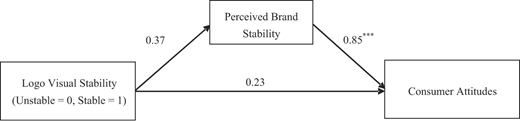
Study 2 conducted a mediation analysis (Model 4 in PROCESS; 5000 resamples; Hayes, 2017) with logo visual stability (0 = unstable, 1= stable) as the independent variable, attitudes toward the nostalgic brand as the dependent variable, perceived brand stability as the mediator (Figure 2). The results showed that the total effect of logo visual stability on attitudes toward the brand was significant in the model (b = 0.55, SE = 0.23, t = 2.39, p = 0.018), but the direct effect was not significant (b = 0.23, SE = 0.20, CI95% [−0.16, 0.62]). The mediation analysis results showed a significant indirect effect of logo visual stability on attitudes toward the brand through perceived brand stability (b = 0.32, SE = 0.12, CI95% [0.08, 0.57]).
Another mediation analysis (Model 4 in PROCESS; 5000 resamples; Hayes, 2017) added alternative explanations (attractive/complex/familiar/novel/arousal/uncommon) as mediators along with perceived brand stability. The mediation analysis results showed a significant indirect effect of perceived brand stability (b = 0.26, SE = 0.11, CI95% [0.06, 0.50]). The indirect effects of all alternative explanations were not significant (see Supplementary Material Web Appendix C). Taken together, perceived brand stability mediated the effect of logo visual stability on consumer attitudes toward nostalgic brands.
The mediation results showed that the indirect effect of perceived brand stability was significant and the direct effect of logo visual stability was not significant. When alternative explanations were incorporated into the mediation model, the results showed that the indirect effects of these alternatives were not significant. Only the indirect effect of perceived brand stability remained significant, thus enhancing the robustness of the mediated effect. The results of Study 2 support H2.
7. Study 3
Study 3 tested the moderating effect of brand heritage values cues. This study predicted that presenting values cues of brand heritage would diminish the effect of logo visual stability on consumer attitudes toward nostalgic brands (H3).
7.1 Procedure
Study 3 used a 2(logo visual stability: stable vs unstable) × 2 (values cues of brand heritage: present vs absent) between-participants design. Four hundred participants were recruited from Credamo (71.7% female, Mage = 31.24, SD = 7.96). After reading the informed consent with the purpose of the research and study procedures, participants were asked to evaluate a fictitious brand “Nette.” Participants saw a nostalgic ad (Barauskaitė et al., 2022, see Supplementary Material Web Appendix A) either with or without presenting the values cues of brand heritage and an image of the brand logo with stable or unstable design (Rahinel and Nelson, 2016; see Supplementary Material Web Appendix B). The logos and nostalgic ads were pretested. The description of values cues of brand heritage was from prior research (“Our guiding principles help us do business the right way. Over the years, Nette has survived and thrived by paying attention to what matters most: our values”, Han et al., 2021).
Participants indicated their attitudes toward the brand on 3 items (α = 0.82) same as in Study 1 (Jiang et al., 2016). Following prior research (Han et al., 2021), brand integrity was used as a manipulation check for values cues of brand heritage. The measure consisted of four items (e.g. “Nette seems like a brand that is true to a set of moral values”; 1= Strongly disagree, 7= Strongly agree, α = 0.76; Han et al., 2021; Morhart et al., 2015). Finally, participants reported their age and gender.
7.2 Results and discussion
Manipulation check. The t-test was used to examine the effect of brand heritage values cues on brand integrity. Presenting the values cues significantly improved brand integrity (Mpresent = 5.89, SD = 0.59, Mabsent = 5.63, SD = 0.77; t(398) = 3.69, p < 0.001, Cohen’s d = 0.37). Thus, the manipulation for values cues of brand heritage was successful.
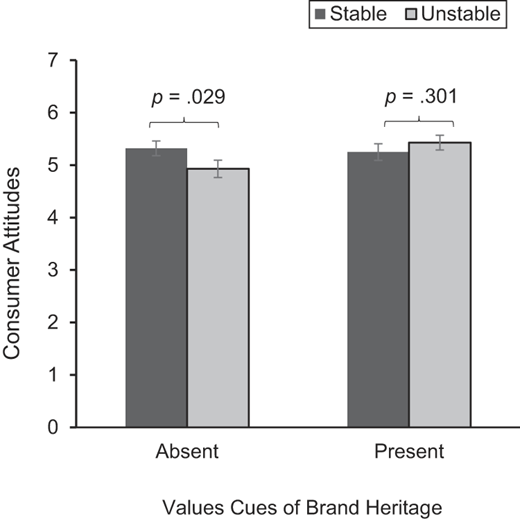
Consumer attitudes. A 2 × 2 ANOVA indicated that the interaction between logo visual stability and values cues of brand heritage was significant (F(1, 396) = 5.21, p = 0.023, partial = 0.01) (Figure 3). The main effects of values cues of brand heritage (F(1, 396) = 3.02, p = 0.083, partial = 0.01) and logo visual stability (F(1, 396) = 0.68, p = 0.410, partial < 0.01) were not significant.
Pairwise comparisons showed that, when the values cues were absent, the stable (vs unstable) logo improved consumer attitudes toward the nostalgic brand (Mstable = 5.32, SD = 1.18, Munstable = 4.93, SD = 1.38; F (1, 396) = 4.78, p = 0.029, partial = 0.01). But when presenting the values cues, there was no significant difference between the stable and unstable logo (Mstable = 5.25, SD = 1.33, Munstable = 5.43, SD = 1.17; F(1, 396) = 1.07, p = 0.301, partial < 0.01). The study further compared the effects of values cues of brand heritage across different levels of logo visual stability. In the stable logo condition, the presence or absence of values cues did not affect participants’ attitudes toward the nostalgic brand (Mpresent = 5.25, SD = 1.33, Mabsent = 5.32, SD = 1.18; F(1, 396) = 0.15, p = 0.700, partial < 0.01). In the unstable logo condition, presenting the values cues significantly improved participants’ attitudes toward the nostalgic brand (Mpresent = 5.43, SD = 1.17, Mabsent = 4.93, SD = 1.38; F(1, 396) = 8.07, p = 0.005, partial = 0.02).
Study 3 shows an interactive relationship between values cues of brand heritage and logo visual stability. Specifically, when nostalgic brands present values cues for brand heritage, the visual stability of the logo does not influence consumer attitudes toward the nostalgic brand. This finding supports H3. Further analysis demonstrated that values cues improved consumer attitudes under the unstable logo condition. The findings support the proposition that values cues reduce the incongruence between low brand stability and nostalgic brand positioning.
8. Discussion
Three studies demonstrated that a stable (vs unstable) logo improves consumer attitudes toward nostalgic brands. Study 1 discovered that compared to an unstable logo, a stable logo improves consumer attitudes toward nostalgic brands. For non-nostalgic brands, the effect disappeared. This initial result indicates that a stable logo positively influences consumer attitudes toward nostalgic brands, not non-nostalgic ones. Study 2 explored the underlying mechanism behind this effect and found that perceived brand stability mediates this relationship. The results also showed that alternative explanations, such as attractiveness, did not influence the effect of logo visual stability on consumer attitudes toward nostalgic brands, nor did they affect the mediating role of perceived brand stability. These results demonstrate that the visual stability of a logo affects consumers’ perceptions of brand stability, which, in turn, influences their attitudes toward nostalgic brands. Study 3 found that when values cues of brand heritage were presented, the logo visual stability did not influence consumer attitudes toward the nostalgic brand. This finding implies that the influence of logo visual stability on consumer attitudes may depend on the extent to which consumers accept changes in nostalgic brands.
The research found that, compared with an unstable logo, a stable logo can improve consumer attitudes toward nostalgic brands. This is because the visual stability of the logo increases consumers’ perceived brand stability, which in turn benefits nostalgic brands.
8.1 Theoretical contributions
This research makes three theoretical contributions to the literature. It expands the understanding of how visual design can enhance the appeal of nostalgic brands. Previous research has shown that visual elements positively influence nostalgic brands by directly evoking memories (Chen et al., 2023). For instance, to elicit nostalgic responses, brands often incorporate cues from the past, including black-and-white photographs (Lee et al., 2016) or retro design elements (Hallegatte et al., 2018). This research identifies an alternative approach to increasing the attractiveness of nostalgic brands: the visual stability of logos. By signaling brand stability, visually stable logos enhance consumer attitudes toward nostalgic brands. This finding supplements the literature by illustrating how visual stability can convey brand messages, such as high brand stability, which aligns with nostalgic brand positioning to positively influence consumer attitudes.
This research explored the role of logo visual stability in brand management. Previous studies have primarily focused on the impact of visual stability in specific contexts, including the effects of logo visual stability on the utility of safety-oriented products (Rahinel and Nelson, 2016), the effects of logo dynamism on consumer engagement (Cian et al., 2014), perceived brand energy (Baxter and Ilicic, 2018) and how brand openness influences preferences for unstable logos (Huang et al., 2021). Notably, while much of the existing literature emphasizes the positive effects of dynamic logos, recent studies reveal a contrasting reality that 91.2% of the top 500 global brands avoid dynamic logos and instead prefer stable, non-dynamic designs (Trehan and Kalro, 2024). These findings highlight the need to explore the benefits of stable logos. This research contributes to this discourse by demonstrating how visual stability influences consumer attitudes toward nostalgic brands and uncovering the specific benefits of stable logos in this context, thereby enriching research in this area.
This work complements research on the visual factors that influence the perception of brand stability. Previous studies suggest that maintaining a consistent brand identity through visual elements, such as designs that remain unchanged over time or incorporating heritage elements, can communicate brand stability (Lückenbach et al., 2023; Wang and Chen, 2020). This approach often assumes that consumers have prior knowledge of a brand and its history. In scenarios where brands are less known or are expanding into new markets, many consumers may lack such background knowledge. In such cases, visual design is a crucial tool for conveying brand stability messages. Existing visual marketing research has explored ways to demonstrate a stable message. For example, low-arousal potential designs are used to maintain consumers’ stable preference (Buechel and Townsend, 2018) or single-serving packaging to imply stable product efficacy (Ilyuk and Block, 2016). However, a notable gap remains in the literature focusing on brand stability.
Given the increasing importance of brand visual elements and rising consumer demand for a sense of stability through consumption choices (Han and Newman, 2022), the role of visual design in expressing brand stability has become even more critical. This research validates the impact of visual stability on communicating brand stability, offering a novel perspective on using logo design to convey this message, thereby enriching the literature on this topic.
8.2 Practical implications
The findings offer insights for managers of nostalgic brands, particularly regarding decisions related to logo visual stability. Managers of nostalgic brands may face strategic considerations regarding logo design. On one hand, with the rapid emergence of new design trends, nostalgic brands are often under pressure to update their traditional logos to align with contemporary aesthetic preferences (Bokhua, 2023; Wertz, 2023). On the other hand, as growing global economic uncertainties, consumer demand for safety and stability has surged (Han and Newman, 2022). In response, brands have turned to nostalgic repositioning (Quihuiz, 2023), often redesigning their logos to enhance nostalgic appeal (Darpan, 2023). In both cases, logo redesign for nostalgic brands appears inevitable.
This research identifies logo visual stability as a noteworthy consideration in the logo redesign for nostalgic brands. While prior industry commentary has acknowledged that visual stability is an important yet often overlooked element in general logo design (Cpluz, 2024; Kreafolk, 2025), our findings specifically underline its relevance for nostalgic brands. It highlights the positive impact of visually stable logos on consumer attitudes toward nostalgic brands, suggesting that managers of nostalgic brands could consider adopting logo designs with high visual stability. For instance, redesigned logos could incorporate stable geometric shapes such as triangles with larger lower segments or trapezoids, or feature visual elements arranged in a uniform and balanced layout. With the growing application of AI-generated design technologies, managers of nostalgic brands could also leverage AI to create logos that convey high visual stability.
This research demonstrates that emphasizing the values cues of brand heritage can mitigate the negative impact of unstable logos on consumer attitudes toward nostalgic brands, offering a practical solution for managers. If a nostalgic brand has already adopted an unstable logo and redesign is not feasible, managers may strategically highlight brand values cues in their brand messages to preserve positive consumer perceptions. Managers of nostalgic brands could directly highlight the brand’s longstanding commitment to its principles in advertising campaigns. For instance, nostalgic brands can launch advertisements that emphasize longstanding adherence to its core values, or highlight how current product offerings continue to reflect those values.
8.3 Limitations and future research
The limitations of this research should be addressed in future research. This research focuses on consumers’ current brand attitudes as the primary dependent variable. However, other behavioral outcomes such as brand loyalty (Loh et al., 2021) and brand love (Grappi et al., 2024), are also positive effects of nostalgic brand positioning. Future nostalgic brand research can build on this foundation and continue to explore the role of logo visual stability in these behavioral outcomes.
This research used fictitious brands as the experimental materials. Using fictitious brands is a common approach in brand research (e.g. Barauskaitė et al., 2022; Rahinel and Nelson, 2016), as it helps minimize biases stemming from pre-existing attitudes toward real brands. It is worth noting that for nostalgic brands with which consumers are already highly familiar or have formed strong self-brand connections, the act of updating a logo with high visual stability may still elicit negative consumer reactions. Future research could incorporate factors such as consumers’ familiarity with a brand, brand knowledge and the brand’s historical context. Future studies can explore how elements combined with consumer segmentation and brand update strategies contribute to brand attitudes in real-world brand contexts.
In closing, the moderating effect of brand heritage values cues identified in this research provides intriguing perspectives for future research on nostalgic brand innovation. Notably, brand stability may function as a double-edged sword for nostalgic brands; while it reinforces nostalgic positioning, it may also constrain innovative efforts. As social and technological environments evolve, nostalgic brands face innovation challenges. Although this research did not examine the impact of changes or innovations in nostalgic brands on consumer attitudes, the moderating role of values cues in Study 3 suggests their potential to reconcile the tension between nostalgic positioning and brand changes. Future research could investigate how brand values influence consumer responses to innovation in nostalgic brands.
Author contributions
Chunqu Xiao was responsible for conceptualization, data curation, formal analysis, and funding acquisition. Chenyu Wang led the work on investigation, methodology, and visualization. Yayu Zhou contributed to supervision, project administration, and validation. All three authors jointly contributed to writing in original draft and writing in review & editing. The three authors contributed equally to this work.
Acknowledgement
The authors of this work would like to thank the editors and reviewers who provided comments.
References
Supplementary material
The supplementary material for this article can be found online.