

In the democratic digital environment, brand managers frequently deal with the unauthorized use of the brand by third parties. The phenomenon, known as brand hijacking, has been treated in different and sometimes conflicting ways in the academic and professional literature. The aim of this paper is to clarify the meaning of brand hijacking and to shed light on the various motivations and intentions underpinning the phenomenon.
A Delphi-based survey among both academic and professional experts was conducted to explore the key features of brand hijacking and expand existing theories.
The results of the Delphi survey enable the main brand hijacking actions to be mapped, based on two motivational axes (utilitarian–idealistic and destructive–constructive) and on the various intentions that guide the hijackers. The results help re-define the key elements of brand hijacking, through the lens of non-collaborative brand co-creation.
Managerial implications are presented in terms of the corporate response to the two main effects of hijacking, namely, brand reputational damage and brand repositioning.
The paper helps to shed light on the main components of brand hijacking, thus gaining expert consensus in refining the existent conceptualization in relation to a rapidly changing brand management scenario because of the gradual loss by brand managers of their traditional control.
Introduction
In the current digitally empowering stakeholder eco-system, a brand’s identity and meaning have increasingly been open to negotiations through mutually influencing inputs (Ind et al., 2013; Gyrd-Jones and Törmälä, 2017; Vollero et al., 2019). The participatory nature of social media has emphasized the pro-active role of stakeholders in creating value for brands (Hatch and Schultz, 2010; Ramaswamy and Ozcan, 2016). Brand meaning has thus become the outcome of social processes between the brand owners and their stakeholders from a co-creation perspective (Iglesias et al., 2013; Kristal et al., 2016; Merz et al., 2018).
The positive aspects of brand co-creation have been widely debated, though Kristal et al. (2018) have shown that whenever a brand is collaboratively co-created, it can also be collaboratively co-destroyed. Through manipulation, artistic reinterpretation and other forms of non-collaborative brand co-creation, brands can be diverted in unwanted directions, often with a very strong impact on the brand’s equity (Hesseldahl, 2007). Brand transformation, in its various forms, happens when the impulse to collaborate goes beyond the control by managers (Thompson et al., 2006; Cova and Paranque, 2016). Recent cases, such as Walkers’ ill-fated social media campaign (McKirdy, 2017), the Netflix scam email (Noyes, 2019) or Greenpeace’s #plasticmonster campaign against Nestlé (Fela, 2019), involving the loss of control over the use of distinctive elements of the brand and, sometimes, its identity and ownership, have been reported as brand hijacking. However, in some cases, the brand was actually the object of an attack (i.e. Netflix or Nestlè); in other cases, it was the means to convey messages that had nothing to do with the brand and its communications (i.e. Walkers). It seems that the hijacking may arise from different motivations and intentions regarding the brand and, accordingly, the effects can be diverse.
The present research starts from different representations of brand hijacking, which are indicative of the underestimation of the diverse facets of the phenomenon, loosely described as an illicit use of various brand elements. Through a Delphi-type survey carried out among experts (academicians and practitioners), the paper helps to shed light on the main components of brand hijacking, thus gaining expert consensus in refining the existent conceptualization. The paper theoretically helps to advance the current perspectives on non-collaborative brand co-creation and to establish a cohesive standpoint. In particular, the paper clarifies the current thinking on brand hijacking in the light of the various acts of non-collaborative co-creation.
The novel conceptualization of brand hijacking that is proposed hereby encompasses its multidimensionality, thus overcoming the strictly negative understanding of the phenomenon, which frequently focuses on legal issues. Instead, the potential positive aspects for the company are suggested as being worth examining. The new perspective provides insights into how companies could respond considering the antecedents of the hijacking activity.
The structure of the paper is as follows. The next section reviews the extant literature on the unauthorized use of brands by third parties to elicit two main perspectives on brand hijacking and to derive the main propositions to be tested in the Delphi study. The various phases of the Delphi method, including the selection of participants, proposition development and round setting, are then described. Results of the two Delphi rounds generate a map of brand hijackers’ motivations, intentions and actions. A novel concept of brand hijacking constitutes the starting point for understanding the behavioral response of firms derived from the non-collaborative brand co-creation generated by different types of hijackers. Consequently, managerial implications are presented in relation to a brand management scenario that is rapidly changing because of the progressive loss by brand managers of their traditional control. Finally, limitations and future avenues of research in this direction are proposed.
Conceptual background
The academic and professional literature on brand hijacking is very diverse and overlaps different fields of study: branding and marketing communications (Wipperfürth, 2005; Cova and Pace, 2006; Fournier and Avery, 2011; Xanthopoulos et al., 2016; Luoma-aho et al., 2018; Benton and Peterka-Benton, 2020; Vollero et al., 2020), corporate reputation (Langley, 2016), risk management (Hofman and Keates, 2013; Mancusi-Ungaro, 2014), internet commerce (Wunder, 2009), law (Nurten and McDermott, 2009; Ramsey, 2010), computer fraud and security (Milam, 2008; Jain et al., 2015) and even tourism management (Denisselle, 2019). Multiple approaches to the interpretation of the phenomenon emerge. Some authors emphasize the legal implications of brand hijacking, by focusing on the illicit use of the brand name or elements of its identity, especially from the practitioners’ perspective (Hesseldahl, 2007; Ramsey, 2010; Hofman and Keates, 2013; Langley, 2016). Other contributions, instead, analyze the broader perspective of user-generated brand transformations, and focus on types of brand manipulation that have different meanings from those intended by the brand’s owner (Cova and Pace, 2006; Fournier and Avery, 2011; Cova and Paranque, 2016).
In its “strictest” sense, brand hijacking results from an individual or group of people who attempt to confuse, deceive and defraud consumers by pretending to be brand marketers. Hijackers create fake brand accounts using a brand name or brand logo in the username of social networks (username squatting) or in the website domain (cybersquatting – Wunder, 2009), in email communications (email phishing – Milam, 2008; Yearwood et al., 2012) or in advertisements on search engines (SEM hijacking – Jansen and Schuster, 2011). Hijackers impersonate the brand to spread misleading or dangerous information, such as fake news regarding a product recall or fake gift cards and coupons, or to promote the unauthorized website of a brand (Ramsey, 2010; Apte et al., 2019). When hijack corresponds to brand impersonation (see Table 1), it involves trademark infringement and counterfeiting (Waterman, 2009; Ramsey, 2010; Evans et al., 2019). Brand impersonation can also lead to a backlash for the brand, as users may well blame the legitimate brand owners rather than the fraudsters (Hofman and Keates, 2013).
Brand hijacking: a literature-based overview
| Main views related to brand hijacking | Focus | Hijacking initiatives | References |
|---|---|---|---|
| Brand impersonation | Emphasis on illicit use of the brand name or its identity elements (trademark infringement and counterfeiting) | Username squatting | Ramsey (2010), Apte et al. (2019) |
| Cybersquatting | Waterman (2009), Hofman and Keates (2013) | ||
| Counterfeiting internet commerce | Wunder (2009) | ||
| Jansen and Schuster (2011) | |||
| SEM hijacking | Milam (2008), Yearwood et al. (2012) | ||
| Phishing | |||
| Brand remake | Focus on various forms of brand transformation that elicit different brand meanings driven by various individual/group purposes | Alternative brand narratives | Cova and Pace (2006), Nakassis (2013); Cova and Paranque (2016) |
| Subvertising | Gabriel and Lang (2015) | ||
| Parodies, pranks, memes | Fournier and Avery (2011), Langley (2016); Kristal et al. (2018) | ||
| Branded carnival | O’Sullivan (2016) | ||
| Hashjacking and hashtag spam | Jain et al. (2015), Xanthopoulos et al. (2016); Vollero et al. (2020) |
The unauthorized transformation of various brand elements by third parties is quite common and not always associated with illegal actions or involving legal issues. Several studies, in fact, have focused on different forms of brand transformation generated by consumers and other societal actors (Cova and Pace, 2006; Nakassis, 2013; Cova and Paranque, 2016; Kristal et al., 2018), such as the symbolic appropriation of a brand (Cova and Paranque, 2016) and the brand surfeiting, that involve material and immaterial meanings that exceed the brand’s intent and authority (Nakassis, 2013). In general, studies about brand transformations claim that brands become an interface among actors in globalized societies (Kornberger, 2010), exceeding the mere function of identifying a seller’s good or service (Cova and Paranque, 2016) and involving an emotional and symbolic bonding between firms and consumers. In some cases, the brand transformations can generate potential benefits for firms from the “use value” related to consumer and community behavior (Fournier and Avery, 2011; Cova and Paranque, 2012, 2016; Füller, 2016; Black and Veloutsou, 2017).
In their seminal work on emotional branding strategies, Thompson, Rindfleisch and Arsel (2006) warn about the risks brands are exposed to when some form of transformation takes place. In particular, Thompson et al. (2006) refer to a “doppelgänger brand image,” i.e. a set of diverse images and stories around the brand promoted by individuals or groups which can spread in popular culture and divert the original emotional meaning that brand managers have tried to promote. In a similar vein, Cova and Paranque (2012) explain that enthusiastic consumers, when they feel that are over-exploited by brands (because of excessive shareholder pressure), can risk triggering a destruction of the brand value, by creating a rival product and/or brand thus damaging the “original” one. From this perspective, brand hijacking is the result of various consumer experiences such as consumer over-excitement, consumer dissatisfaction or ethical and value conflicts with the brand (branded carnivals, subvertising, bashtags, etc). and it consists in a decontextualized use and remake of the brand name, visual and/or messages for creating non-branded content and publicly distributing them for various purposes (Langley, 2016; Pegoraro et al., 2014; Kristal et al., 2018) (see Table 1). Brand hijacking is often associated with “culture jamming” (Du Plessis, 2018) and can generate appropriations, surfeits, elicit material forms and immaterial social meanings originally associated with the brand’s owner (Cova and Pace, 2006; Nakassis, 2013; O’Sullivan, 2016; Rokka and Canniford, 2016; Evans et al., 2019).
Brand remake practices sometimes involve the unintentional hijacking of brand ideology, especially when driven by the pursuit of excitement (O’Sullivan, 2016). In the present paper, the focus is instead on intentional practices, in which consumers and other actors are involved in brand transformation for deliberate and specific purposes. One of the main aims is to manifest consumer dissatisfaction with the brand or even boycott or sabotage the brand, when it does not seem to comply with established regulations, or it does not live up to hijackers’ (ethical) expectations (Wilson et al., 2014; Luoma-aho et al., 2018). Whether because of ethical issues or dissatisfaction with the brand, the purpose is to damage the credibility of the brand, for example, by diverting communication campaigns. In “brand remake” cases, hijacking is not hidden behind forms of impersonation and does not aim to confuse consumers but, rather, to focus their attention on brand behavior, through the alteration of brand messages and advertisements (i.e. subvertising), using parody and satire – parodies, pranks, memes, etc. (Gabriel and Lang, 2015). One main consequence is the dilution of the brand’s image, positioning and even equity (Fournier and Alvarez, 2013; Kristal et al., 2018; Kucuk, 2019).
Brand remake also comprises the hijacking of brand communications as in the frequent cases of hashtag hijacking (or hashjacking) (Xanthopoulos et al., 2016). Hashtag hijacking consists in using a branded hashtag for a different purpose than the one originally intended by the firm, such as discussing unrelated content (Jain et al., 2015) or expressing negative sentiments toward a popular brand (Vollero et al., 2020). In the literature, negative attitudes toward brands have largely been explored in terms of brand avoidance (Lee et al., 2009; Strandvik et al., 2013) and, in the most extreme form, brand hate (Hegner et al., 2017; Zarantonello et al., 2018) or brand sabotage (Kähr et al., 2016). In fact, the discrepancy between brand activities and brand values can lead to anti-brand consumption behaviors and “attack-like” strategies (Zarantonello et al., 2016) or even “brand sabotage” or “brand bullying” (Kähr et al., 2016; Breitsohl et al., 2018; Kucuk, 2019), with consumers deliberately wanting to punish and cause harm to firms (Zarantonello et al., 2018).
The hijackers seem to be driven by diverse motivations, ranging from utilitarian purposes (as in the case of brand impersonation) to ideological stances (e.g. because of value conflicts), to harmful intentions (brand bullying, brand sabotage, etc). but also to non-violent purposes related to obsessive brand passion or brand addiction (Swimberghe et al., 2014; Cui et al., 2018). Understanding the motivations that generate such hijacking are crucial in defining the boundaries of the hijacking construct and identifying its key dimensions. Following MacInnis’s framework (2011), the present study adopts the general conceptual goal of “envisioning” the brand hijacking phenomenon together with the more specific goal of “revising” the current perspectives on the topic to generate novel insights regarding the intentions and motivations of the hijackers. The present paper uses a Delphi-type approach, which involves informants with skills and knowledge on the topic, and can help in understanding the prevailing views, questioning the assumptions, finding anomalies (MacInnis, 2011) and shedding new light on the phenomenon.
Methodology
A Delphi-type survey was conducted among branding and brand management experts. The Delphi method was originally developed in the late 1950s by the Rand Corporation for technological forecasting. It has since been used for conceptualization, decision-making, planning and other purposes in a variety of disciplines, including management and marketing (Huang and Lin, 2005; Bonnemaizon et al., 2007). The Delphi method implies a qualitative approach that consists of collecting opinions and suggestions from a group of diverse experts in the absence of viable or practical statistical techniques (Armstrong, 2001; Bonnemaizon et al., 2007). The consensus-focus of the Delphi overcomes a key limitation of most quantitative research: the inability to build or advance theory (Shah and Corley, 2006; Brady, 2015). A Delphi-type study allows to summarize a wide range of interrelated features common to most complex problems when there is insufficiency of existing knowledge, models or approaches to capture all the aspects of a phenomenon. This method is relevant to our study’s question on refining the existing theories on brand hijacking.
The collection of responses through Delphi approach is strictly linked to the participants’ level of commitment, and therefore carries the risk of possible hasty judgments, dropouts and low response rates (Skinner et al., 2015). The effectiveness of the method depends on the adoption of specific procedures: anonymous replies, no direct comparison with and among experts (no expert knows the other experts that are going to be consulted); several rounds to interact with the data collected during each round; and a controlled feedback system (Okoli and Pawlowski, 2004). In general, at least two iterations are needed to reach an adequate consensus; there is no definitive answer to the optimal number of rounds, the only accepted criterion is to terminate the series when the stability of the responses emerges, as this is indicative of progressive agreement among the panel of experts (Rowe and Wright, 2001). The present study follows Donohoe and Needham’s (2009) synthetic framework, which suggests general procedures for the three main phases of a Delphi study, namely, preparation, convergence and consensus.
Preparation: problem statement, scoping round and expert panel development
The preparatory phase involves the problem statement, using an introductory information package (Day and Bobeva, 2005; Donohoe and Needham, 2009). Many of the issues and preliminary information sought can be acquired or resolved with a comprehensive literature review conducted by researchers, by eliminating the information that is not useful for the investigation and summarizing the propositions to be submitted to the experts’ panel (Wheeller et al., 1990). The exploration of the propositions is in line with Bonnemaizon, Cova and Louyot (2007) and includes preliminary “scoping” round (Round 0) aimed at piloting the survey questions. As suggested in Donohoe and Needham (2009), a “scoping round” is often recommended as it may help to identify ambiguities or difficulties (Powell, 2003; Garrod and Fyall, 2005).
The whole process of preparatory phase can be summarized as follows:
All the contributions in the literature were collected, inserting the words “brand hijacking” and “brandjacking,” and similar variants, as key terms for the research in Scopus and Google Scholar databases.
All the definitions of brand hijacking were identified, with all the sentences, including its features, actors, forms, motivations, intentions, effects, etc. All associated constructs were taken into account, to include additional studies that could contribute to the understanding of the phenomenon.
Over 30 sentences were developed, representative of the different perspectives on the phenomenon.
A “scoping round” was carried out, conducted primarily within the research group that set up the study, through informal meetings and departmental research seminars, to derive the first set of propositions to be submitted to the panel of experts.
The sentences were grouped by topic, by aggregating those dealing with closely related issues. The sentences were then reworked into new propositions, thus merging similar understandings in the same sentences, so that each proposition focused on a specific aspect.
A total of 21 propositions, organized into three blocks, were finally developed (see Table 2).
Dimensions and propositions of brand hijacking
| Dimensions | Propositions | Main references |
|---|---|---|
| Definitions of the phenomenon and its consequences | 1. Brand hijacking is a form of engagement initiated by stakeholders intended to influence the organizational decision-making agenda, according to their own interpretations and serving their own objectives | 1. Luoma-aho et al. (2018), George (2006) |
| 2. Brand hijacking is a form of reinterpretation of a brand’s purpose, through which a firm can discover new segments of consumers not previously targeted | 2. Wipperfürth (2005); Cova and Pace (2006), Luoma-aho et al. (2018) | |
| 3. Brand hijacking is a form of accentuated flattery that occasionally has some advantages for organizations (e.g. via heightened stakeholder attention and engagement) | 3. Wipperfürth (2005) | |
| 4. Brand hijacking is a crisis that happens in the digital environment and can turn businesses upside down | 4. Hofman and Keates (2013), Langley (2016) | |
| 5. Brand hijacking is a form of stakeholder contestation, which often shifts the public focus onto unintended issues that harm corporate reputation | 5. Pegoraro et al. (2014), Luoma-aho et al. (2018) | |
| 6. Brand hijacking consists of the undesired kidnapping of brand-related communications (both offline and online) by non-brand representatives | 6. Hesseldahl (2007), Mancusi-Ungaro (2014) | |
| 7. Brand hijacking is a form of brand abuse (such as phishing, domain PPC and counterfeits) aimed at taking control of the brand for the opposite purpose than what was originally intended | 7. Hofman and Keates (2013), Ramsey (2010); Wunder (2009), Milam (2008) | |
| Motivations and intentions of brand hijackers | 8. Brand hijackers seek to create pressure on an organization to change or affect its decision-making processes and actions | 8. Langley (2016), Wilson et al. (2014) |
| 9. Brand hijackers seek to change the terms of an organization’s stakeholder engagement process as well as the desired outcome | 9. Luoma-aho et al. (2018), Wilson et al. (2014) | |
| 10. Brand hijackers seek to appropriate recognizable elements such as logos, visual identities or brand stories to activate personalized processes of sense-making | 10. Hesseldahl (2007) | |
| 11. Brand hijackers seek to transform a promotional activity designed to generate favorable comments into a mechanism for generating negative publicity | 11. Luoma-aho et al. (2018) | |
| 12. Brand hijacking can be carried out by trolls, haters, crackers or any other subject wanting to damage the organization (flamers, spammers, etc). | 12. Mancusi-Ungaro (2014) | |
| 13. Brand hijacking can be carried out by enthusiastic fans, brand lovers, ambassadors advocates who want to emphasize, enrich and disseminate the philosophy and values of the brand | 13. Wipperfürth (2005); Wilson et al. (2014), Fournier and Avery (2011); Black and Veloutsou (2017) | |
| 14. Brand hijacking can be carried out from within an organization by its employees or from the outside by stakeholders, activists and interest groups to gain public attention in relation to ethical breaches or questionable practices by corporations. | 14. Pegoraro et al. (2014), Luoma-aho et al. (2018) | |
| Affinity with related theoretical constructs | 15. Brand hijacking is related to “brand assemblage” as it contributes to the construction of the brand meaning with new interpretations of its identity and purpose (e.g. juxtapositions, parodies, critiques, etc). | 15. Allen et al. (2008), Fournier and Avery (2011); Rokka and Canniford (2016) |
| 16. Brand hijacking is related to “brand surfeits” given that, to a different extent, it exceeds the authority and legibility of the brand (counterfeiting, knockoffs, fakes, appropriations, resignations, etc). | 16. Fournier and Avery (2011), Nakassis (2013); Evans et al. (2019) | |
| 17. Brand hijacking is related to “brand dilution” as it contributes to the weakening of the distinctive capacity of a well-known brand and to the devaluation of its exclusive associations (e.g. any illegitimate use of brand distinctive characteristics by third parties) | 17. Kucuk (2019), Kristal et al. (2018) | |
| 18. Brand hijacking is related to “brand hate,” as it reveals negative intentions, emotions and antipathy toward a brand in public (complaints, owning a brand hate site, involvement in hate group discussions, hacking actions, etc). | 18. Pegoraro et al. (2014), Kucuk (2019) | |
| 19. Brand hijacking is related to “brand bullying” as it is a consumer behavior aimed at harassing another consumer or the brand itself, without seeking a corporate remedy (personal criticism, provocations, teasing, trolling, etc). | 19. Breitsohl et al. (2018), Kucuk (2019) | |
| 20. Brand hijacking is related to “participatory branding,” i.e. a process of dialogue between stakeholder groups regarding the meaning of the brand (e.g. any stakeholder-initiated engagement activities during the branding process) | 20. Allen et al. (2008), Fournier and Avery (2011); Black and Veloutsou (2017) | |
| 21. Brand hijacking is related to “user-generated branding,” as it consists of handling all kinds of voluntarily created and publicly distributed brand messages undertaken by non-marketers | 21. Rokka and Canniford (2016); Füller (2016) |
The preparatory phase also included the selection of the panel of experts. For a rigorous expert panel development, whose combined knowledge and expertise should adequately reflect the full scope of the problem area (Rowe and Wright, 2001; Bonnemaizon et al., 2007), opinions from both the academic and professional worlds were collected on a global scale. The selection criteria of the panel members were designed to ensure a balance between the theoretical conceptualization of the phenomenon and the operational understanding. In the academic field, the search for experts focused on scholars whose lectures or research were related to the subject. The procedure consists in examining the profiles of the editorial board members of top-rated international journals specialized in branding or brand management (e.g. Journal of Product & Brand Management; Journal of Brand Management; Journal of Brand Strategy). Each scholar on the editorial boards was evaluated on the basis of the consistency between his/her academic research and the investigated themes. At the end of this process, 25 academic experts were selected.
In the professional field, a preliminary analysis was carried out to identify highly influential consultants on branding and brand management. Because the professional field can also be divided into different categories (marketing agencies, brand managers, professional authors and bloggers/web influencers), the search for profiles was based both on the results of the Google search engine and an analysis of the mentions on Twitter, by inserting the #brandhijacking and #brandjacking hashtags into the search engine. In the case of Google search engine, the organic results of agencies’ websites and blogs were considered. As for Twitter mentions, a mechanism similar to the Page Rank algorithm was applied, considering the network of mentions of people – in the months from June to October 2018 – as an indication of their level of reputation. The idea was to consider the frequency an expert was cited in the relevant domain (i.e. brand hijacking) as being more reliable than the number of followers (which can be easily manipulated or associated with other factors). The selection included professionals who had written books and/or studies on brand hijacking, traced through the Google Scholar. The total number of professionals contacted was 25 (5 marketing agencies, 5 brand managers, 5 bloggers, 5 Web influencers and 5 professional authors).
A total of 50 experts were invited to form the panel and participate in the survey ( Appendix 1). Although the number of invited experts seems very large (as the majority of Delphi studies used between 15 and 20 participants – Ludwig, 1997), the initial sample size was intentionally expanded to prevent drawbacks inherent in low response rates, which are quite common in Delphi technique (Hsu and Sandford, 2007). A representative pooling of judgments for each of the two groups (academics and practitioners) involved in the study was also needed. The number of experts agreeing to participate and complete the study (22 out of 50) confirmed the aforementioned rationale.
Convergence: questionnaire development and round setting
The 21 propositions derived at the end of scoping round were organized into a questionnaire to submit to the panel of experts in Round 1 (see Table 2). To allow experts a certain degree of freedom and facilitate their feedback, it was decided not to ask them direct questions but to solicit their spontaneous reactions to various propositions (Bonnemaizon et al., 2007). Experts were asked to express their level of agreement, their opinions and suggest amendments regarding a set of sentences to identify key dimensions of the phenomenon.
The questionnaire was sent by an online survey platform (Survey Monkey) to all experts. All of the experts were asked to revise the existing “propositions” and assess their adequacy, to suggest which items should be removed and/or to suggest adjustments regarding the proposition identification and description, or further items they considered relevant for each dimension to identify the boundaries of the phenomenon. At the end of the first round, the participants were asked to propose their own personal definition of “brand hijacking.”
The propositions were evaluated as follows:
The rejected propositions are those that reach at least 51% of “rejected.”
The accepted propositions are those that reach at least 51% of “accepted” or at least 75% between “accepted” and “partially accepted.”
A total of 30 experts agreed to participate out of 50 invitations sent. The analysis of the responses was limited to 22 complete responses (13 by academics, 9 by practitioners), to prevent a large group of incomplete answers. The rate of full participation (44%) was deemed satisfactory as it is in line with the participation rate of other studies adopting the Delphi method (an acceptance rate ranging from 35% to 75% – Gordon, 1994).
Analysis of the results
Delphi first-round results
Appendix 2 summarizes the evaluation of the propositions in the first round. The only proposition to be completely rejected was #3 as the majority of respondents (12 people out of 22) did not agree that “brand hijacking is a form of accentuated flattery that occasionally brings some advantages for organizations.” The results also showed that the respondents agreed that brand hijacking should be defined as the kidnapping of brand communication (Proposition #6) and as a form of abuse (phishing, domain PPC, counterfeits) aimed at taking control of the brand (Proposition #7).
Regarding motivations, most respondents agreed with the following: to create pressure on an organization to change or affect its decision-making processes and actions (Proposition #8); to activate personalized processes of sense-making (Proposition #10); and to generate negative publicity (Proposition #11). Among the subjects who are motivated to undertake brand hijacking actions, respondents agreed on the following types: trolls, haters, crackers or all the other types of people wanting to damage the organization (flamers, spammers, etc). (Proposition #12); enthusiastic fans, brand lovers, ambassadors and advocates who want to emphasize, enrich and disseminate the philosophy and values of the brand (proposition #13); employees, activists and interest groups who want to gain public attention regarding ethical breaches or questionable practices by corporations (Proposition #14).
The accepted motivations and the accepted profiles were then linked with the related theoretical constructs on which the majority of respondents agreed with. Employees, activists and other stakeholders aim to create pressure and push organizations to change their questionable decisions and actions. Influencing companies’ decisions is consistent with the idea of hijacking a brand related to “participatory branding” (Proposition #20) and “brand assemblage” (Proposition #15), as it can trigger a dialogue between the organization and its stakeholders regarding the meaning of the brand, enriching it with new interpretations of its identity and principles (through juxtapositions, parodies, critiques, etc)..
Fans, brand lovers, ambassadors and advocates, instead, are those that have a higher brand attachment and often attribute significance and meaning to their brand experiences. These individuals are regarded as highly satisfied with the brand and they voluntarily create and distribute brand-related messages to promote the brand’s success, initiating the process of “user-generated branding” (Proposition #21). Trolls, haters and crackers, on the other hand, often act with malicious intent to damage the reputation of the brand, triggering negative publicity or fraudulent actions. This is consistent with associating brand hijacking with “brand surfeits” (Proposition #16) and “brand dilution” (Proposition #17) and, in its most extreme form, with “brand hate” (Proposition #18).
In summary, even if there is an evident agreement about defining brand hijacking in its antagonistic sense, the comments of the experts on hijackers motivations do not point to a single (negative) direction but leave room for the positive effect (in terms of brand regeneration) of hijacking activities. The results highlight, however, a degree of uncertainty regarding the different aspects of brand hijacking. The second round of the survey was addressed at solving the remaining doubts.
Delphi second-round results
At the end of the first round, various propositions did not reach at least 51% of agreement or disagreement in terms of acceptance or rejection (see Appendix 2). Pending propositions were re-analyzed – in the light of the suggestions offered by the same respondents – to reformulate them for the second round of the Delphi. The second round included the selection of one (or in some cases, more than one) response option from those proposed and two open-ended questions.
Participants were first asked to choose keywords they associated with a definition of brand hijacking from a range of terms emerging from their previous responses. The keywords most selected by respondents were “unauthorized use” (66.7%) and “appropriation” (61.5%). However, the meaning that experts attributed to the phenomenon in terms of its impacts on organizations (negative or positive) was not univocal. On a scale ranging from “completely negative” to “predominantly positive,” the impacts of brand hijacking on organizations were considered as “completely negative” for 27.3% of respondents, “predominantly negative” for 31.8%; both negative and positive for 36.4% and “predominantly positive” for only 4.5% of respondents. Although primarily an unlawful act, these answers show that the experts also believe that brand hijacking could have positive implications for the organization.
A further doubt concerned the categories of people that commit brand hijacking. The majority of respondents (68.2%) agreed that the two main categories were “activists” (i.e. motivated by ethics and values) and “opponents” (i.e. driven purely by the desire to cause damage). Intentions and motivations varied among the different hijacker types: experts identified the main motivational drivers in the desire to cause damage (such as trolls or crackers), belief in an ideal or a set of rooted values (59%); to obtain a tangible profit/benefit from the action (50%); and to express a new interpretation of the brand or/and participate in its evolution (41%).
Experts were further asked whether they interpreted brand hijacking exclusively as a phenomenon “suffered” by the organization or if they accepted the idea that brand hijacking can be encouraged by the organization itself to stimulate new interpretations of the brand by its main stakeholders. Respondents moderately agreed (degree of agreement of 3.25/5) that organizations are not seen exclusively as “passive” subjects but can also stimulate hijacking to create new brand inspirations. Finally, our panel of participants was asked to suggest actions that could be taken to prevent or handle the hijacking, and “listening and dialogue on social media” and “structured crisis plans” were considered the main reputation management activities to prevent risks associated with brand hijacking.
Consensus: map of motivations, intentions and actions of brand hijackers
Consensus was deemed to have been reached at the end of the second round as the results obtained enabled the remaining doubts to be resolved. Experts agreed that brand hijacking is not only motivated by the desire to damage a brand but may also be guided by other motivational drivers, including the idea of participating in the evolution of a brand. The combined results of the Delphi rounds enabled us to identify the main motivations, intentions and actions of brand hijackers according to expert judgments. Motivation refers to the drives, urges, wishes or desires which initiate the sequence of events known as “behavior” (Bayton, 1958). Intention refers to a person’s commitment, plan or decision to carry out an action or achieve a goal (Eagly and Chaiken, 1993). The motivations should be understood the antecedent of the intentions, as the latter capture the motivational factors that influence behavior and intentional actions (Ajzen, 1991).
The map in Figure 1 categorizes the motivations, intentions and actions of the brand hijackers. Given that the motivations drive the actions, they were considered as the axial poles guiding the categorization. Two main motivational factors of hijacking emerged. The first is what can be obtained from hijacking; i.e. tangible profit versus idealistic interest, which constitutes the utilitarian/idealistic axes. The second is linked to the negative or positive impulse toward the brand; i.e. brand damage versus brand improvement, which constitutes the destructive/constructive axes. Each motivation was then associated with the main intentions.
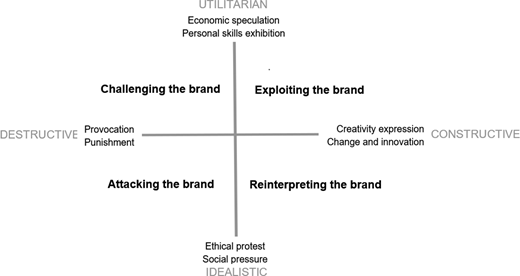
Map of brand hijackers’ motivations, intentions and actions
Map of brand hijackers’ motivations, intentions and actions
Regarding the destructive motivation, punishment (to inflict some sort of penalty on the brand) and provocation (the intention to tease the brand) were identified. Destructive motivations (and related intention) are easily traceable, for example, in the context of anti-brand communities or social pages, such as Anti Apple (Brand) Facebook page (www.facebook.com/Anti-Apple-Brand-111805398839139) in which attempts to hijack the success of the brand are expressed through articles, videos, graphics and other content focused on the quality shortcomings of Apple products as well as behaviors by the organization toward consumers and the planet that are deemed unethical. On the other hand, the constructive dimension drives intentions such as creativity expression, and promoting change and innovation. Creative expression refers to the hijacker’s personal drive to show artistic skills, appropriating the elements of the brand to give them new life through creative restatement. The constructive motivation also drives the intent to promote brand change and innovation, suggesting and inspiring new uses, meanings and brand behavior through hijacking. An example of hijacking driven by constructive motivations involved the AMC TV series “Mad Men,” which revolves around the world of advertising in the 1960s. Some Twitter users impersonated various characters from the TV series using a microblogging service, extending the series beyond the TV screen, and showing great respect for the tone of the show. The hijacking of the AMC brand (which consists in the lack of producer authorization), however, was very successful among fans of the series who evangelized the “fake” show on Twitter.
The utilitarian motivation is based on economic speculation, attainable, for example, through forms of brand impersonation (squatting, counterfeiting, etc).. The intention in relation to the exhibition of personal skills is also driven by utilitarian drives for money, work or/and public recognition (Cova and Pace, 2006). This is the case, for example, of the Egyptian graphic designer, Marwan Mohammed Younis, who gained popularity through his advertising parodies, a series of satirical advertisements that change the image and perception of famous brands (Apple, McDonald’s, Louis Vuitton, etc).. Conversely, the idealistic motivation is based on a disagreement with the brand on ethical issues, which could lead to a protest. An idealistic motivation is also based on the intention to generate social pressure on the brand, especially regarding corporate environmental or social responsibility. An example of this kind of motivation is Greenpeace’s peaceful battles against certain global brands (Nestlé, Shell, Volkswagen, etc)., aimed at safeguarding the environment (earth, sea, climate, biodiversity, etc). from their potentially damaging actions.
The intersection between the axes configures four quadrants in which the types of brand hijacking actions have been placed. The “destructive utilitarian” quadrant concerns “challenging the brand.” A bad customer experience or professional retaliation can motivate trolls, unsatisfied customers, disappointed employees, etc. who challenge the brand in “aggressive” forms of parody, subvertising or hashjacking, which represents some sort of revenge for the hijacker (Fournier and Avery, 2011; Freund and Jacobi, 2013; Kristal et al., 2018).
The “constructive utilitarian” quadrant refers to the “exploitation of the brand.” This includes hijackers (e.g. social media fans, brand fanatics, artists) who aim to benefit from the brand (financially, in terms of visibility, etc). but without wishing to damage the organization, but creatively support brand awareness, albeit unintentionally or indirectly. Exploitation may consist of a brand remake by disseminating creative content to show off the hijacker’s artistic skills. In this quadrant, the brand may serve as fodder for parody and pranks (Thompson et al., 2006; Fournier and Avery, 2011). When hijackers exploit the symbolic and distinctive elements of the brand, they enrich it with their personal contribution, making graphic and stylistic changes or suggesting new uses of the products/brands at no cost. Creativity expressed through user-generated branded content (memes, parodies, etc). is often a source of innovation for the brand itself (Burmann, 2010; Füller, 2016).
The “destructive idealistic” quadrant is characterized by “brand attacking.” Brand attacks represent strong opposition to an organization, tending toward hatred and retaliation. Crackers, anti-brand communities, haters, etc. attempt to aggressively subvert the brand, thus destructively re-imagining brand meanings (Romani et al., 2015; Zarantonello et al., 2016). The brand is considered as an enemy because of a symbolic and ethical incongruence and ideological incompatibility with the brand’s practices.
Finally, the “constructive idealistic” quadrant includes those initiatives aimed at “reinterpreting the brand,” implemented by hijackers (brand lovers, brand communities, influencers, etc). who consider the brand as being representative of a set of values in which they strongly believe. The intent is to change and innovate the brand in a constructive way, through user-generated content.
Discussion and theoretical implications
Unauthorized use and modifications of brand elements can be triggered by several motivations and generate multiple intentions and different actions. Based on the Delphi results, the conceptualization of brand hijacking was revised to overcome the current fragmentation of meanings in the literature. All four types of brand hijacking (challenging, attacking, exploiting and reinterpreting the brand) add further connotations to the brand, which are not in line with the original meanings attributed by firms. In proposing alternative brand meanings, hijackers essentially act as brand co-creators, in line with the recent increasing trend of brand co-creation (Ramaswamy and Ozcan, 2016; Merz et al., 2018). Consumers and other stakeholders become active creators and drivers of the brand meaning (Vallaster and Von Wallpach, 2013). However, hijackers act as contrasting brand meaning creators (Allen et al., 2008), competing with those meanings that were originally created by brand managers.
By generating divergent meanings from the brand values and brand positioning attributed by firms, brand hijacking is the result of a non-collaborative process of co-creation (Kristal et al., 2018) as it is not based on the agreement with or authorization by the firm nor is it carried out on the basis of an implicit mutual understanding between the company (informed in advance) and consumers/other stakeholders driven by proactive voluntary motivations. This type of non-collaborative co-creation is in opposition to the “facilitated” user-generated content in which brand meanings are orchestrated and stimulated by brand managers through several types of brand actions and associated multiple forms of fan reactions (Rosenthal and Brito, 2017).
Considering brand hijacking as non-collaborative co-creation theoretically places the phenomenon at the intersection between anti-brand community initiatives (Hollenbeck and Zinkhan, 2006; Dessart et al., 2016; Veloutsou and Guzman, 2017) and culture jamming (Kristal et al., 2018; Du Plessis, 2018). Brand hijacking, in fact, incorporates both the growing negativity toward brands (Demirbag-Kaplan et al., 2015; Veloutsou and Guzman, 2017) and a redefinition/distortion of the cultural symbols of iconic brands (Hewer and Brownlie, 2010; Romani et al., 2015). Hijackers, in fact, transform initial brand meanings by pursuing unwanted directions through the subversion of advertisements, the parodying of websites, etc., not only for destructive or confrontational purposes but also to playfully foster change and innovation in brand meanings (constructive purposes).
Non-collaborative brand co-creation shares some characteristics with the notion of value co-destruction during interactions between providers/employees and consumers/customers in the service sector (Plé and Chumpitaz Cáceres, 2010; Echeverri and Skalén, 2011). Likewise, the inconsistency of the hijackers’ opinions regarding brands resonates with incongruent perceptions regarding what procedures, understandings and engagements should apply in service (Plé and Chumpitaz Cáceres, 2010; Echeverri and Skalén, 2011). Brand hijacking as non-collaborative brand co-creation also highlights the need for flexibility (users’ perspective) as opposed to rigidity (managers’ perspective) in interpreting procedures and meanings (Echeverri and Skalén, 2011). Value co-destruction dynamics emerge in hijacking also in terms of the inappropriate or unexpected use of resources (Plé and Chumpitaz Cáceres, 2010), disparity of goals and inequality of power, misalignment of processes (Lefebvre and Plé, 2011), misintegration and non-integration (Plé, 2016; Xu et al., 2014; Laud et al., 2019).
Based on all these considerations, a novel conceptualization of brand hijacking can be proposed:
Brand hijacking is an unauthorized use and/or a transformation of the brand that manifests itself in forms of non-collaborative brand co-creation. It can be induced by different motivations and intentions that lead to different possible actions: challenging, attacking, exploiting or reinterpreting the brand.
The proposed definition incorporates all the characterizing elements of brand hijacking, encompassing its multidimensionality. Brand hijacking, however, it manifests itself, is likely to represent the attempt by stakeholders to morph brand meanings, to express their identity and (co-) evolve with confrontation to brand’s owner. The present conceptualization sheds further light on the different forms of non-collaborative brand co-creation, previously described by Kristal et al. (2018) through the dichotomies “brand play” vs “brand attack” and “consumers” vs “artists.” The bi-dimensional matrix on hijackers’ motivations and intentions, in fact, proposes further modalities through which several types of hijackers (crackers, dissatisfied customers, trolls, brand fanatics, etc). act as non-collaborative brand co-creators.
Besides any negative or positive outcomes that may be implied for the brand, hijacking can be read as an attempt at “cultural questioning of the logics of markets and brands” (Hewer and Brownlie, 2010, p. 434). A conceptualization of brand hijacking as a cultural phenomenon is, therefore, offered, as an expression of the social evolution determined by the empowerment of key players in a cultural economy of creativity (Hewer and Brownlie, 2010), thus revealing new possibilities for a (social) re-construction of the brand identity.
Implications for practice
The effects of hijacking on organizations and associated managerial implications can be explained following the novel conceptualization of brand hijacking as a form of non-collaborative co-creation. Because of its nature, brand hijacking can decrease/destroy the value of successful brands. By altering or/and subverting brand meanings, brands can be driven in unintended directions which conflict with the commercial interests of the firm (Fournier and Avery, 2011). Although not authorized, brand hijacking does not necessarily mean that organizations need to be daunted about interacting online with their stakeholders. Co-creation is not necessarily negative just because it is “non-collaborative” (Kristal et al., 2018).
Brand hijacking can have two main impacts on an organization. Although brand hijacking can damage the reputation of the brand, it can also create an opportunity for a new and favorable brand re-positioning (see Figure 2). These two effects involve two divergent response behaviors: “defensive” strategies aimed at reducing reputational damage, thus minimizing any negative consequences of brand hijacking, and “proactive” strategies aimed at favorable brand re-positioning, thus integrating positive inputs deriving from brand hijacking.
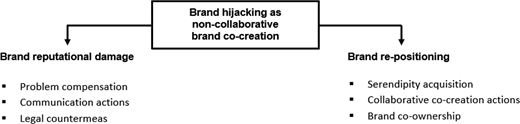
Main effects of hijacking as non-collaborative brand co-creation and possible corporate response behaviors
Main effects of hijacking as non-collaborative brand co-creation and possible corporate response behaviors
The potentially destructive effect of reputational damage (Rhee and Valdez, 2009; Bonardi and Breitinger, 2019) carries the risk that consumers will dislike the brand, and, in some cases, even hate and reject it (Strandvik et al., 2013; Zarantonello et al., 2018). The degree of severity of the hijack and its potential risks need to be assessed when negative reputation effects are likely to occur. Not all types of hijacking, in fact, require the same type of response, and this can range from denying and diminishing to rebuilding and bolstering. Based on Coombs’ strategies in crisis communication (2007) and studies on brand’s co-creation challenges (Fournier and Avery, 2011; Anker et al., 2015), response behaviors to brand hijacking have been codified considering different crisis situations (see Figure 2). Where hijacking is a direct result of a real problem caused by the organization, a rebuilding strategy seems appropriate: the problem must be immediately recognized and compensated for problem compensation. The first step is to publicly apologize and then solve the issue, trying to stem the damage as quickly as possible (Benoit, 1997; Coombs, 2007). Because of various contingency factors (Dutta and Pullig, 2011), different response behaviors can be implemented. The crisis can be publicly addressed through public statements of evasion of responsibilities or attempts at dialogue with hijackers (Coombs, 2007; Romenti et al., 2014) (communication actions). If the organization is not involved, a deny strategy could be chosen, by rejecting the hijacker’s accusations or dissociating the organization from any illegal behavior, through public posts and/or press releases. Alternatively, brand managers can opt for a diminishing strategy (Coombs, 2007; Dutta and Pullig, 2011) to contain the effects of the hijacking; to solve the problem with the hijacker privately, where possible; and then to use a bolstering strategy of the brand image, focusing public attention on the positive past actions of the organization (Coombs, 2007; Wang, 2016).
Finally, brand impersonation hijacking, involving counterfeiting, fraud or manifestations of unjustified hatred, could require a more assertive stance to control these forms of brand transformation, such as legal countermeasures to protect brand image (Anker et al., 2015). Leveraging the infringement of trademarks, copyrights or patents is the strongest and most unequivocal answer to preserve relations with brand consumers and other stakeholders (Chikada and Gupta, 2017). In some cases, in fact, protecting the brand means defending those who believe in the brand. Legal countermeasures, however, are time-consuming and costly, and not always sufficient to protect brand equity in the long term (M’zungu et al., 2010).
Early warnings regarding the subversion of brand meanings are useful in those forms of non-collaborative co-creation based on the remake of the brand’s identity, where new brand meanings are given by the hijackers (Figure 2). Consumers can spontaneously express their creative ideas regarding a brand by highlighting interesting opportunities for consumer engagement or business development (Arnhold, 2010). Although generating a disconnection between actual brand beliefs and perceived brand attributes, memes, parodies and other user-generated brand content could prompt the organization to reinterpret the brand (Klostermann et al., 2018). In such cases, the firm can decide to co-opt emerging positive brand meanings to gain benefits through re-positioning.
As stated by Wipperfürth (2005), in some cases, a serendipitous hijack could lead to unexpectedly positive inputs for branding. Such inputs, usually creative (memes, parodies, jokes, etc)., can be acquired by the organization (serendipity acquisition), adapting and including them in branding activities, from a user-generated branding perspective (Burmann, 2010; Füller, 2016). Also, accepting criticisms and incorporating them into a new brand meaning enable organizations to take advantage of unexpected opportunities (Knudsen and Lemmergaard, 2014). If positively addressed, the viral diffusion of user-generated brand content can increase brand awareness, generate new contacts, stimulate engagement on social networks and ultimately strengthen brand trust and loyalty (Arnhold, 2010; Ashley and Tuten, 2015). User-generated branded content should be considered from a co-creative perspective already during the planning of social media content (Confetto and Siano, 2018) and, accordingly, brand hijacking activities can also be regarded as an enrichment and growth opportunity for the brand. Wipperfürth (2005) stressed the possibility of transforming fortuitous brand hijacking into a co-creative activity if the company adopts a strategy aimed at transforming the non-collaborative activity into a collaborative one (collaborative co-creation actions). Unlike Wipperfürth’s (2005) suggestions about seizing the opportunities of serendipitous hijacks to create unconventional (and sporadic) “cool” marketing operations, the democratic and difficult-to-control social media environment makes brand hijacking a much more conventional phenomenon than expected. Brand managers not only need to be ready to grasp such opportunities, but also be prepared to transform serendipity from social media conversations into controlled collaborative co-creation processes. As stated by Kristal et al. (2018), for example, “it could be beneficial to recruit artists as co-creators of controlled brand play” (p. 334). However, a collaborative co-creation process implies that the organization has to develop the right attitude to actively involve consumers and brand communities, to interact and help shape the broader meaning of a brand. The behavior to be adopted is based on implicit trust toward brand fans: the responsibility is shared among and with the stakeholders in a “participatory” process (Vernuccio, 2014), necessary for open source or negotiated branding (Haarhoff and Kleyn, 2012; Vollero et al., 2019).
The idea of the brand as an open source artefact, which can be enriched, modified and evolved by consumers, requires considering the legal implications in terms of trademark and copyright. Lifting the legal restrictions on the transformative use of distinctive brand elements may involve a brand co-ownership between the organization and its constituencies. Monitoring and managing the first signs of non-collaborative co-creation (i.e. systematic observation of emerging hijacking phenomena in their immediate market domain) are crucial for effective corporate response behaviors in the context of a paradigm shift in brand management (Anker et al., 2015; Kristal et al., 2018; Merz et al., 2018).
Limitations and directions for future research
Brand hijacking is presented in this paper as a form of non-collaborative brand co-creation. This conceptualization goes beyond the predominantly destructive conceptualization of hijacking; rebalances the negative and positive stances; and integrates the different perspectives in the academic and professional worlds. Further research on brand hijacking is, however, needed to overcome some of the limitations of the present study, such as the impossibility of identifying and classifying all the different types of hijackers (e.g. when they use fake or/and anonymous profiles). It would be equally interesting to explore the points of view of the hijackers to further substantiate the perspective of brand hijacking as a form of non-collaborative brand co-creation.
Future research on non-collaborative brand co-creation can also help to shed more light on the unresolved issues in brand management. The study provides a first attempt to investigate the strategies firms can adopt in handling the negative or positive effects of brand hijacking. More studies are needed to examine the activities, techniques and tools used to monitor and manage brand hijacking, especially in terms of reputational damage and brand re-positioning. Exploring different methods for the real-time monitoring of social media and anti-brand communities could help in revealing and anticipating both anti-brand sentiments and constructive feedback, which could also help in addressing social media content and brand management decisions (Anker et al., 2015; Confetto, 2015; Klostermann et al., 2018). Monitoring techniques could be developed to support the identification, for example, of doppelganger brand image (Thompson et al., 2006) and related cultural aspects disseminated by potential brand avoiders. Additional studies could analyze the responses of brand strategists both in monitoring and managing something that they do not have full control over because of the non-collaborative nature of these forms of brand co-creation.
Open access funding provided by Università degli Studi di Salerno within the CRUI-CARE Agreement.
References
Further reading
Appendix 1
Panel of experts invited to participate to Delphi
| Scholars | Affiliation | Country | Practitioners | Type | Country |
|---|---|---|---|---|---|
| 1 | Tilburg University | The Netherlands | 1 | Blogger | USA |
| 2 | Hec Paris | France | 2 | Blogger | UK |
| 3 | Roehampton University | UK | 3 | Blogger | Switzerland |
| 4 | Dartmouth College | USA | 4 | Blogger | USA |
| 5 | Università Cattolica del Sacro Cuore | Italy | 5 | Blogger | Ghana |
| 6 | Brunel University | UK | 6 | Agency | USA |
| 7 | Boston University | USA | 7 | Agency | USA |
| 8 | University of Hannover | Germany | 8 | Agency | Canada |
| 9 | University of the Witwatersrand | South Africa | 9 | Agency | Australia |
| 10 | University of Bremen | Germany | 10 | Agency | UK |
| 11 | Vienna University of Economics | Austria | 11 | Brand manager | Italy |
| 12 | University of Antwerp | Belgium | 12 | Brand manager | UK |
| 13 | University of Glasgow | Scotland | 13 | Brand manager | Germany |
| 14 | Middlesex University | UK | 14 | Brand manager | USA |
| 15 | Sapienza University of Rome | Italy | 15 | Brand manager | USA |
| 16 | University of Amsterdam | The Netherlands | 16 | Influencer | USA |
| 17 | ESADE | Spain | 17 | Influencer | UK |
| 18 | Oslo School of Management | Norway | 18 | Influencer | USA |
| 19 | University of Ljubljana | Slovenia | 19 | Influencer | France |
| 20 | Baruch College – CUNY | USA | 20 | Influencer | UK |
| 21 | Kedge Business School | France | 21 | Professional author | Denmark |
| 22 | Northwestern University | USA | 22 | Professional author | USA |
| 23 | Griffith University | Australia | 23 | Professional author | Singapore |
| 24 | University of Auckland | New Zealand | 24 | Professional author | USA |
| 25 | University of North Texas | USA | 25 | Professional author | USA |
Appendix 2
Evaluation of answers to propositions (Delphi first round)
| No. of proposition | No. of respondents in relation to the degree of agreement | Evaluation | ||
|---|---|---|---|---|
| Accepted | Partially accepted | Rejected | ||
| 1 | 6 | 9 | 7 | Pending |
| 2 | 9 | 5 | 8 | Pending |
| 3 | 3 | 7 | 12 | Rejected |
| 4 | 7 | 9 | 6 | Pending |
| 5 | 9 | 6 | 7 | Pending |
| 6 | 14 | 8 | 0 | Accepted |
| 7 | 11 | 7 | 4 | Accepted |
| 8 | 12 | 8 | 2 | Accepted |
| 9 | 9 | 7 | 6 | Pending |
| 10 | 13 | 7 | 2 | Accepted |
| 11 | 5 | 14 | 2 | Accepted |
| 12 | 12 | 9 | 1 | Accepted |
| 13 | 9 | 8 | 5 | Accepted |
| 14 | 12 | 8 | 2 | Accepted |
| 15 | 13 | 5 | 4 | Accepted |
| 16 | 9 | 9 | 4 | Accepted |
| 17 | 6 | 12 | 4 | Accepted |
| 18 | 6 | 12 | 4 | Accepted |
| 19 | 4 | 11 | 7 | Pending |
| 20 | 7 | 11 | 4 | Accepted |
| 21 | 11 | 6 | 5 | Accepted |

