This paper aims to explore how facilitation and structural conditions in professional learning networks (PLNs), rooted within the context of a school system, influence collaboration, distribution of responsibility and decision-making processes, using power-theoretical frameworks. We analyze these dynamics within the context of four families of primary schools (FoPS).
Influencing factors, roles and hierarchies within the facilitation of the FoPS network are examined using a qualitative study approach. The data, comprising expert and group interviews with all FoPS participants as well as relevant documents, were obtained through a full census of project stakeholders. The analysis followed Mayring's (2022) qualitative content analysis, identifying key activities and relationships among the actors. The results were categorized into four areas: network initiation, influencing factors, facilitator tasks and dimensions of hierarchical relationships within FoPS.
The findings highlight how both structural and actor-centered dimensions shape the enactment of PLNs, underscoring the importance of addressing underlying hierarchies to foster more equitable collaboration. This includes, for example, selection process and composition of participants, focus and objectives of the network, architecture of meetings, prevailing attitudes and levels of trust, as well as shared agreements and commitment.
The qualitative findings are inherently limited in their generalizability as the data consist of the participants' self-assessment. The analyzed data were evaluated as part of a cross-sectional survey within a longitudinal study design.
The study highlights the critical role of facilitation in PLNs like the FoPS, offering insights for mutual partners in education. Facilitation fosters trust, collaboration and shared leadership by enabling members to adopt local objectives within broader goals. Effective facilitation requires dynamic role negotiation, avoiding predefined hierarchies, to promote shared responsibility and address power asymmetries. The findings emphasize the need to professionalize facilitation, as leadership in PLNs demands specific expertise. Globally, these insights underline the value of inclusive, interconnected structures to sustain equitable and impactful network-based educational approaches.
The paper explores issues of power structures in PLNs. It addresses a research topic that has received little attention despite its relevance for understanding collaborative dynamics in educational networks.
Introduction
Research about professional learning networks (PLNs) to date has predominantly focused upon general core characteristics of learning networks (Rincón-Gallardo and Fullan, 2016; Poortman et al., 2022), professionalization (Anderson et al., 2019; Brown, 2020; Schnellert and Butler, 2021), knowledge mobilization and sharing (Jesacher-Roessler, 2021; Datnow, 2021), the role of networked leadership (Azorín et al., 2020; Bryant et al., 2020; Brown et al., 2024) and, ultimately, questions about how active collaboration within networks leads to better learning for students (Schnellert, 2020; Rose et al., 2017). Factors or conditions to enable and generate collaborative practice are also frequently researched (Vankriegen et al., 2017; Brown and Poortman, 2017). However, one under-researched aspect is the question of how networks are facilitated and coordinated, and the specific role of a facilitator. The relevance of such questions is increasing, as PLNs are perceived to be a more collaborative and effective alternative to traditional top-down approaches to school improvement (Montecinos et al., 2020; Greany and Armstrong, 2022). That said, the PLN approach presents challenges in terms of structure and power relationships (Azorín et al., 2020). One of the key challenges arises in the juxtaposition of collaborative governance in PLNs with traditional hierarchical structures (Pino-Yancovic and Ahumada, 2020; Montecinos et al., 2014). Central questions arise regarding power distribution and potential conflicts of hierarchies, which can potentially be seen in a facilitator’s multiple roles as peer, leader and subordinate.
The theoretical framework of this paper aims to outline a pluralistic understanding of facilitation, while expanding it to include power-theoretical perspectives. Accordingly, the analysis focuses on the role of facilitation within both actor-centered and structural dimensions, and concepts from power theory (Hayward and Lukes, 2008; Bates, 2010) to investigate PLNs’ facilitation in four families of primary schools (FoPS).
The presented qualitative study (Mayring, 2020) examines how the mentioned factors influence facilitating networks with a special focus upon responsibility-distribution, decision-making and collaboration. Since the dynamics of power and hierarchy are strongly influenced by the nature of the educational sector in which they operate, this paper also offers a deeper understanding of the role that the educational context plays within the studied PLNs.
Focus on structural conditions for PLNs
PLNs are always embedded in the structures and processes of the context in which they evolve, with factors that either favor or hinder their development often being present within that context. However, Poortman et al. (2022) point out that a distinction must be made between defining components and influencing factors. While defining components are those characteristics that PLNs must exhibit to be classified as such (e.g. shared goals, reflective dialogue approach, etc.), influencing factors are characteristics that direct the work within PLNs. These can include the attitude of the participants, but also school and educational policy frameworks within which such networks develop. When structural conditions are discussed, this relates to influencing factors. The authors distinguish between factors at micro (e.g. individual characteristics), meso (e.g. structural aspects at school level) and macro levels (structural aspects at policy level).
One factor for successful PLNs is mutual trust (Lee et al., 2011; Pedersen, 2019). However, studies suggest that participants from schools with strong hierarchical structures often fail to build the trust needed for successful and long-term participation across PLNs (Schechter, 2012). At the meso level, influencing factors such as clear goals and objectives (Katz et al., 2009) and binding agreements are crucially important. Furthermore, initiation of networks (at meso and macro level) can create different conditions which influence the networks’ nature and thus the approach to networking. Aangenendt et al. (2023) distinguish between these different dimensions. The distinction between mandated and initiative networks (top-down vs. bottom-up) is particularly relevant to this work, as the FoPS are governance networks mandated from the top down (Krogh, 2022; Bianchi et al., 2021). Due to their origins within public authorities, such networks are more likely to adopt bureaucratic logic in their structural conditions (Krogh, 2022). This creates a contrast between the potential benefits of collaborative problem-solving and the limitations inherent in top-down mandated governance structures (Krogh, 2022). Additional influencing dimensions are discussed by Aangenendt et al. (2023), e.g. objectives (open vs. fixed), degree of goal integrity (combination of work, learning and innovation) and participation (voluntary vs. mandatory). Other factors include the diversity of members (professional, student, etc.), the organizational form (individual vs. interorganizational) and lifespan (temporary vs. permanent).
Focus on actor-related facilitation of PLNs
Actor-related facilitation of learning and innovation within the context of PLNs can be considered from two perspectives: as a social collective process and as a professional role.
Within organizational contexts, facilitation is defined as a goal-oriented, context-dependent social process that aims to integrate new knowledge into organizational routines. This is achieved by learning together and experimenting with processes to achieve sustainable improvements (Berta et al., 2015).
As a professional role, facilitation encompasses the support and moderation of processes in networks, via the promotion of self-organization and collaborative dialogue (Lillge, 2020). Studies show that a facilitator role brings challenges, such as designing networks or managing skill deficiencies (Hanraets et al., 2011). Facilitation requires a high degree of adaptability and alignment of activities to the needs of participants (Akkerman et al., 2008).
Gairín-Sallán et al. (2010) emphasize the central role of a “moderator” in collaborative communication processes exemplified by online learning networks. They suggest that debates form the core of such networks, and that new knowledge is created through this communication process. The facilitator acts as host, moderator and organizer of the learning community. This contrasts with the view of Schnellert et al. (2024), who understand facilitation as a collective learning journey for all network members. In this case, it is crucial that members take responsibility for and develop agency in their own practice. Additionally, the researchers consider it important that the members of a network are seen as equal partners within knowledge or power hierarchies.
This theoretical discussion demonstrates that facilitation within a network can extend beyond an individual as a moderator. Simultaneously, the review of existing literature highlights the relevance of power as a key factor in the context of facilitation. This is particularly evident from a structural standpoint, when horizontal collaborative network structures are integrated into or develop from formal top-down hierarchical systems. This impacts upon the assertion of equality of all actors within a network (Schnellert et al., 2024). The theoretical perspective is therefore extended to incorporate power-theoretical aspects.
Hierarchies, power and relationships in the context of facilitating in PLNs
PLNs often emerge in an environment characterized by hierarchies (Chapman, 2019). In this environment, the way in which the network is set up (facilitated) and who takes on the role of moderator or facilitator plays a significant role (Pino-Yancovic and Ahumada, 2020). Hence, the environment is characterized by structures and actors with certain levels of power, and it is recommended to examine the facilitation of PLNs using a power-theoretical approach. Here we draw upon Stephen Bates' text “Re-structured Power” (2010), further development of Steven Lukes' theory “Power: A Radical View” (1974/2005) and Clarissa Hayward’s “De-facing Power” (2000).
For Bates, power is conceptualized as follows:
[…] the capacity of an entity due to its intrinsic nature, which is reliant on external stimuli or conditions in order to be exercised. (Bates, 2010, p. 353)
This indicates that a distinction must be made between the power of structures and the power of actors. These are not reducible in nature but are necessarily related to each other in practice (Bates, 2010). Bates firstly considers Lukes’ (1974/2005) understanding of power, which suggests a connection between power and agency. Lukes defines power as the ability of actors to achieve significant effects that either benefit their own interests or influence the interests of others. This connection emphasizes moral and political responsibility, since power serves to assign responsibility for the consequences of actions or omissions. Lukes recognizes that structural factors must also be considered. In his view, power consists of the ability of actors to make decisions within given structures (boundaries) that may change over time. Bates criticizes this narrow view of the relationship between structures and power, by pointing out that structures should be seen not only as external constraints, but as factors actively shaping decisions and actions. Bates relates Lukes' understanding of power to that of Hayward’s (2000). She criticizes Lukes' understanding for focusing too much upon individual action and excluding important social constraints. Furthermore, Hayward argues that power should not be understood as an instrument used by actors, but as a network of social boundaries that shape opportunities for all actors. This “depersonalization” of power emphasizes structures such as laws, norms, and social identities that both restrict and enable action. However, Bates sees a structural determinism in Hayward’s approach in which individual action is pushed into the background by external structures. Bates therefore argues for a combination of both concepts. According to Bates, to dissolve existing power relations, structures that generate and maintain power need to be transformed.
PLNs are characterized by individuals from different personal and professional contexts, networking to collaborate on pedagogical issues (Brown and Poortman, 2017). The concept of PLNs seeks to create an environment free from traditional power structures, in which collective exchange and shared learning can occur. However, formal professional roles implicitly influence such networks. Literature shows that school leaders play a vital role in shaping conditions for PLNs (Rincón-Gallardo and Fullan, 2016; Brown, 2020), as they are often responsible for creating organizational and temporal spaces to enable networking. In many cases, school leaders also participate in PLNs, which leads to complex dynamics of position of power versus collaborative peers. Even where equity is sought in PLNs, school leaders often dominate sub-consciously, thus maintaining subtle hierarchies within the network.
Power structures then become apparent in conversations. Lillge (2020) draws upon data collected by teacher researchers on the facilitation of teachers' literacy learning. The author identifies several ideals, concerning distribution of power and equal status as learners such as “listening” and “admitting uncertainty” (Lillge, 2020, p. 405). Listening and responding to the articulated needs of participants is important for participant empowerment.
In highly hierarchical systems, schools and teachers are bound by top-down directives, which limits their ability to take the initiative (Hairon and Dimmock, 2012). PLNs aiming at self-directed professional development must operate within these strict guidelines (structures). The hierarchical order means that school leaders often play a significant role in steering PLNs, which reinforces existing power structures (Hairon and Dimmock, 2012). These hierarchical structures can also limit the willingness of participants to collaborate openly and equally, as the implicit “top-down” dynamic remains (Hairon and Dimmock, 2012).
Research provides several examples of how PLNs are initiated as a top-down governance structure and hence implemented as a hierarchical steering instrument (Atkinson et al., 2007). Chapman (2019) shows from a historical perspective that in hierarchical school contexts, there is a stark contrast between bureaucratic-organizational and network-cooperation structures. Specifically, PLNs within hierarchically organized school systems are tasked with addressing new policy demands (Datnow and Park, 2018).
Context and background – the project “family-of-schools”
The data presented here originate from a project that implemented a family-of-schools (FoS) approach in four areas of a German federal state (Klopsch and Sliwka, 2020; Sliwka and Klopsch, 2022). This intervention was not designed and implemented by the authors of this paper. The approach was modeled on a Canadian FoS concept. In the German adaptation of FoS, representatives from several primary schools formed a network, together with a representative of the regional school authority. This will now be referred to as a Family of Primary Schools (FoPS). FoPS fulfill the criteria of collaboration outside everyday practice in a multi-school setting, which is why the format in the German-speaking context also shows strong parallels to PLNs (Brown and Poortman, 2017).
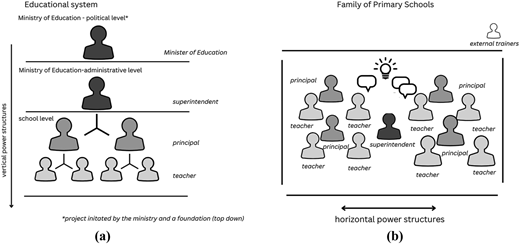
The aim of a FoPS is to analyze, discuss and develop pedagogical practice collaboratively. The project particularly targeted schools in which students do not achieve minimum standards. FoPS is an association of members of four to six primary schools with a superintendent (Schulrat). School representatives were the principal, plus one or two teachers who were either directed to participate or volunteered. The superintendents were primarily responsible for selecting the schools. Regardless of the new form of collaboration, the general vertical structures within the system remained intact. This meant that the superintendent (macro level) in each FoPS continued to hold formal authority over the principal, while the principal (meso level) served as an intermediary between school authorities and teaching staff, with the authority over the direct school personnel (Figure 1).
The concept was initiated by a consortium consisting of a foundation and the Ministry of Education. The foundation was responsible for a one-year qualification phase on four dates between December 2022 and June 2023. The training primarily focused on preparing the participants for cooperative work in networks and reflecting upon their roles within the network’s context. The qualification phase targeted all associated groups: superintendents, principals and teachers. During the modules, four “families” were formed. Superintendents were also systematically prepared for their roles as “moderators”.
Given the theoretical introduction, we are particularly interested in the following questions, using the example of the FoPS.
How is facilitation presented in the FoPS concept?
How are FoPS initiated?
What influencing factors emerge for the implementation of FoPS?
How is the facilitator role implemented in the project?
How are hierarchical relations depicted in the FoPS concept, particularly with regard to the facilitation of networking?
Method
The present study is a qualitative research project. The data basis is formed by two expert interviews (Kaiser, 2021) with the one-year qualification trainers (n = 2, I_TR), four expert interviews with superintendents (n = 4, I-1-4, SI) and four group interviews (n = 25, FoPS 1–4) with FoPS members. The members are school principals (P) and teachers (T). The four group interviews – which is a complete sample of all project participants in this cohort – were conducted in person in 2023, while the interviews with superintendents and trainers were conducted online. Documents (event agendas, task assignments, and documentation of work processes) and presentations from the one-year-qualification (nmaterial = 8) were used to gain insights into the qualifications of the members of the FoPS and served as an additional contextual data source. The research adopts a cross-sectional design encompassing all groups and intentionally foregoes a comparative case study approach. The primary objective is to generate comprehensive insights into the configuration of facilitation across all FoPS while systematically analyzing power dynamics associated with facilitation within and across the FoPS design.
The data corpus (interviews and documents) was analyzed using qualitative content analysis according to Mayring (2022). Category formation took place in five steps: In the first step, the transcripts and materials were viewed (1).
For this step, a search focus was formulated as a coding rule, which read as follows:
Relevant are all sequences in which core actors of the FoPS (except trainers, foundation and authority) describe or report activities (e.g. tasks, actions) that relate to the function of moderating, coordinating and orchestrating the cooperation of the school families.
A speech act (semantic unit) is defined as a unit of meaning in a paragraph of the transcript. If several activities relevant to the definition are described in a speech act breaking the unit of meaning, these are coded separately. Otherwise, the entire speech act is always coded.
To ensure reliability of the analysis, data material was coded by two researchers. They independently reviewed the first half of the material using the described search focus. There was 98.8% agreement (κ = 0.94 according to Brennan and Prediger, 1981). In a further step, a reflective discussion took place within the research group for the second half of the data. The search focus was then fine-tuned by formulating the following additions:
Addition 1: The focus is less on facilitation activities (since few facilitation activities were found in the first material access) and more on influencing factors, information about time and location, values, norms and specific activities related to planning and responsibilities.
Addition 2: Sequences that contain descriptions of the role of individual groups of actors or of hierarchical relationships within the school family (meetings) are also marked.
The resulting data corpus comprises 314 sequences (total number of facilitator sequences = 314). In a subsequent step, content-bearing sequences were paraphrased (2) using the prescribed method (inductive summarizing content analysis). Through paraphrasing, sequences were reduced to limit content. During this process, embellished text was dropped, and focus placed on formulating a uniform language level. This step is particularly recommended with several speakers, e.g. group discussion (Mayring, 2022). The third step involved generalizing (3) paraphrased content by determining an abstraction level. This included deciding upon omissions or combinations from the paraphrased sequences (Mayring, 2022). The researchers combined generalization and reduction steps due to the manageable amount of data. Generalization focused upon identifying recognizable activities and, where apparent, the respective actor. An example of the first three analytical steps can be found in Table 1.
In a further step, subcategories (4) were formulated from the generalizations. Finally, the subcategories were clustered and summarized into four themes (5). These themes were:
Initiation of FoPS network (2 subcategories),
Structure-related facilitation: Influencing factors (8 subcategories),
Actor-related facilitation: Facilitator tasks and responsibilities (3 subcategories),
Dimensions of hierarchical relationships (5 subcategories).
The categories are presented in detail in the results.
Results
Building upon theoretical assumptions, we can categorize the initiation of the FoPS and most of the identified conditions as structural dimensions, whilst findings regarding tasks and responsibilities of the facilitator adopt an actor-centered perspective. Similarly, the findings related to dimensions of hierarchical relationships within the FoPS are also considered actor-centered factors.
Initiation of the network
The data analysis revealed that the FoPS networks are initially top-down initiatives. Two phases can be identified in the FoPS: the guided phase, during which schools and their work in PLNs were directed externally by the participating foundation, and the self-regulated phase, which began after a one-year qualification period. In the self-regulated phase, superintendent (school authority) and school members (principals and teachers) took over the organization and meeting design for each FoPS.
Influencing factors
In order to implement PLNs, certain influencing factors must be created in which the meetings can (successfully) take place. Our findings show different responsibilities regarding the question of who is responsible for shaping certain structures. The data analysis produced the following category system related to conditions for FoPS work (Table 2).
In the subsequent depiction of findings, selected categories are explored in detail and their interrelations systematically elucidated.
The results demonstrate that the selection process was central to fostering trust and a positive group attitude. The selection of schools by superintendents and the nomination of teachers by principals affected diversity and stability within the groups (FoPS 3, 34, P; FoPS 3, 154, P). In this regard, the groups differ from one another. While some principals directly appointed members, others relied upon volunteers, contributing to varied group dynamics. The stable composition of participants was consistently highlighted as a critical factor in creating a “protected environment” conducive to trust and collaboration as joint work. Rotating participants to involve more teachers provided broader insights into the group’s work but occasionally disrupted stability, which some participants valued highly for fostering open communication and effective collaboration (FoPS 3, 192, P).
Trust was further strengthened by the diverse perspectives brought by different schools. The structural composition, which included teachers, principals, and superintendents, was widely appreciated as optimal for leveraging practical expertise:
The structural composition is optimal. Teachers, superintendents and principals. If the teachers weren't there, we wouldn't get anywhere because they have the practical experience. (FoPS 2, 9, P)
The way trust was addressed within the school families varied. While in some schools, trust was built through working together on a shared goal, others explicitly discussed trust or closely linked it to hierarchical proximity and distance (power structures).
Trust was also fostered through consistent collaboration in a stable group, which allowed for open communication and candid discussions. This openness was described as a key feature of the “protected environment” (FoPS 4, 15, P; FoPS 1, 53, T).
The term family makes it clear that it is really important to communicate openly with each other and that it is allowed to do so. (I 3, 28, SI)
The structural stability created through the selection process also facilitated the establishment of binding agreements within the groups. The participants adhered to commitments and agreements, such as complying with schedules and organizational planning, which led to a shared assumption of responsibility (I 5, 55, SI). These agreements also reinforced the commitment of participants to the group’s work (Mayring, 2022). However, interviews revealed that ensuring the participation of the same individuals was not equally easy for all schools, as smaller schools, for example, always had to find substitutes for missed lessons (FoPS 3, 176, T).
Additionally, the personal attitudes of participants emerged as a crucial factor for the success of the FoPS initiative. The participants’ (especially the teachers’) attitudes towards ownership and the dissemination of knowledge generated in the FoPS meetings was also addressed. In relation to the category school-related conditions, it was emphasized that the participation of both principals and teachers was crucial to ensure that new information is passed on not only vertically by the school leadership but also horizontally through colleagues.
The impetus then goes back to the teaching staff. […]. It's also very important that it's not just the principal. (FoPS 2, 21, P)
Commitment to agreements was further strengthened by the long-term nature of the initiative. Participants appreciated the security provided by the multi-year structure, which allowed for sustained trust-building and a sense of reliability (FoPS 1, 197, T).
The category of focus and objectives revealed that the structure of the FoPS offered essential guidance to the participants. The two-phase structure – comprising a guided phase followed by a self-regulated phase – shaped how objectives were addressed in the meetings. During the guided phase, objectives were set top-down, providing participants with clarity and alignment (I 4, 66, SI). As the initiative transitioned into the self-regulated phase, participants experienced varying degrees of autonomy. Some valued the ability to set their own thematic priorities, while others felt constrained by the overarching structures (FoPS 4, 37, P). Despite these differences, a “collective we” was consistently emphasized, underscoring a shared commitment to group objectives (I 3, 22, SI). The data did not suggest that superintendents took a leading role in shaping the content or strongly adhered to top-down directives.
Security and stability were reinforced for participants through the recurring structure and clear temporal framework of the meetings, held every 8–10 weeks. The data indicate that all four FoPS followed similar procedures and included consistent elements in their operational design, likely influenced by the qualification phase (guided phase). Additionally, the integration of a shared manual as part of the qualification process provided participants with a structured framework for collaboration. Developed by the scientific support team, this manual aimed to standardize definitions and to ensure alignment across all school families. Participants expressed high expectations of this tool, anticipating it would foster common understanding and promote unified direction (I 1, 77, TR).
A related feature of meetings was their rotation among different host schools, enabling the hosting school’s members to design and implement local elements of the event. This approach supports distributed responsibility for the meetings. Moderation duties are also shared, with local hosts taking on part of the facilitation, rather than this role resting solely with the superintendents.
Across all categories, the data suggests that decision-making within the FoPS was often a collaborative process.
Facilitators’ tasks and responsibilities
The moderating tasks encompassed preparation, facilitation, and follow-up activities. Preparatory duties included organizing the meeting location, managing schedules, sending invitations, and coordinating materials. During meetings, facilitators guided content discussions through presentations or moderated exchanges, such as collecting feedback. This task was undertaken by various members (SI, P, T) of the group. Follow-up tasks primarily involved disseminating information to staff at participating schools, often carried out without a standardized process across families.
The data indicate that moderation tasks became more routine due to established agreements and procedures (FoPS 1, 98, T). Moderation was not always the responsibility of a single person but was often shared among the groups. The document analysis highlighted that superintendents were prepared for moderation during training modules, where they took on roles like advisers, rapporteurs, and result coordinators. The training modules also included specific assignments to support their moderation role, such as reporting outcomes or securing findings (Modules 2–4). Additional training sessions with the Foundation’s trainers and the scientific support team further prepared them for moderating the PLNs (I 3, 22, SI).
Despite this preparation, interview data suggest that facilitation often operated as a collective effort, with plans and decisions made by groups rather than individuals. Consequently, the superintendents’ role in moderation appeared less dominant than their training emphasized. One participant noted,
When we thought about the fact that there would be no qualification modules this school year, but that we would design this school year on our own, it was clear that it would not be <person> designing it, but all of us together. (I 2, 48f., SI)
Dimensions of hierarchical relationships in FoPS
The data analysis revealed that the topic of ‘hierarchical relationships' was frequently discussed in the context of collaborative work within the FoPS. The highlighted sequences illustrate the various aspects of hierarchical relationships that evolved and developed through the work in the FoPS, ranging from collegial cooperation to changes in the role of the superintendent, and extending to cross-hierarchical participation. These results were unexpected, as the project design adhered to predetermined facilitation roles and existing power structures.
A central theme was the balance between the traditional hierarchical structure and cooperation on equal terms that was promoted in the FoPS (FoPS 2, 91, T). The FoPS aimed to organize its cooperation on a collaborative and equal basis, even if hierarchical decisions were still necessary:
We have a very hierarchical structure. […] In the school family, we work together very cooperatively and as equals, but then there are also moments when a directive or assignment is needed. (I 4, 114, SI)
The work in the FoPS led to closer cooperation between different hierarchical levels (FoPS 2, 11, T; FoPS 3, 62, P) and promoted personal relationships that had previously been less possible due to the perceived “distance” between formal roles:
I feel more confident saying things in front of the superintendents. A few years ago, I couldn't have imagined saying “I can't do this”. (FoPS 3, 194, P)
In the FoPS, the superintendents adopted a new role that emphasized guidance and collaboration rather than focusing on formal administrative tasks. This shift in role fostered a new form of collaboration:
It’s not just teachers and principals; the great thing is that the superintendent is now involved in a different capacity than usual […]. These three distinct professional groups are now working together on equal footing. (I 1, 14, TR)
Working within the FoPS allowed participants to gain insights into processes which were previously inaccessible due to hierarchical structures and physical distance (I 2, 34, SI). Another key aspect of hierarchical relationships in the FoPS context was that teachers without official leadership roles could still actively participate in decision-making and share their insights.
For me as an ordinary teacher, it was interesting to exchange ideas with principals from other schools and then also with the superintendent. (FoPS 4, 13, T)
It is an opportunity to be involved in such a setting even without a functional position. (FoPS 1, 98, T)
Discussion
This study analyzed the question of how facilitation (as a structural and actor-related dimension) is represented in the context of FoPS. For this purpose, the work was conducted in four FoPS that initially started under identical group conditions (superintendent, principal and teachers from 4–6 schools), global objectives (securing basic standards), and which completed a pre-qualification process. The results show that structural factors, such as the initiation of the network, selection and composition of members, and the architecture of the meetings, considering local, temporal and school-related conditions, influenced the networks’ activities. The findings indicate that structural dimensions were ultimately influenced by the actions of individuals acting as facilitators within the networks, shaping the dynamics and outcomes of network activities.
This study highlights two key aspects concerning both the objective and the selection of the actors involved, providing significant insights into power structures within the FoPS project.
Firstly, the actors within the FoPS network were aware that they were working towards an externally set objective. However, members of the FoPS emphasized that they had adopted these aims. In her research, Brodie (2021) underlines the connection between goal-setting and agency by highlighting that the choice of focus and its interpretation are crucial to the extent to which agency can be assumed and to the extent to which teachers remain members of a learning community or not. The appropriation of objectives by participants could be interpreted as an indication that the given framework has been accepted, but at the same time, their own autonomy of action is developed in the process of achieving the objectives. Studies on PLNs suggest that their effectiveness relies on being internally driven, with an emphasis on fostering collective autonomy and collaborative agency (Rincón-Gallardo, 2020). Additionally, Jones et al. (2023) point out the importance of allowing members of PLNs the freedom and flexibility to shape their networks according to specific contexts, goals, and activities. However, the interviews also reveal a clear break between the guided and the self-regulated phase. In the transitional phase, members felt relieved because they were now able to make more of their own decisions. This suggests that predefined structures of the initial phase were perceived as powerful but restrictive.
The second central aspect concerns the selection of the participating actors, which is also deeply rooted in power structures of a hierarchical school system. The superintendents, as decision-makers at the first hierarchical level, had the power to include or exclude schools in the FoPS. Nevertheless, it was noticeable that the original goal of the project, which was to support schools in challenging situations, was not discussed in the interviews. Being selected for inclusion in the project could have been problematic for some schools, as the implication might have been that a powerful external actor considered the school to have “problems”. To mitigate these risks and legitimize the selection process, superintendents employed alternative narratives, such as citing the geographical proximity of schools, their heterogeneity, or the inclusion of schools outside their direct area of responsibility. These narratives, while aiming to depoliticize the selection, reveal the ethical and political complexities inherent in the process. They reflect how superintendents navigated their role as gatekeepers, balancing their hierarchical authority with the need to maintain positive relationships and manage perceptions among stakeholders (Klein and Bremm, 2020). Nonetheless, these narratives could also obscure underlying power dynamics, potentially undermining transparency and creating further ambiguity around the selection criteria.
At the second hierarchical level, within the schools, the decision as to which members of the teaching staff would participate in the FoPS project was left to principals. Here, too, new power dynamics arose, as selected teachers took on new or changed roles compared with colleagues.
These changing power dynamics have the potential to impact seriously upon how the knowledge acquired in the FoPS is distributed and passed on in the schools (Jesacher-Roessler, 2021). Teachers who do not see themselves as “teacher leaders” but are pushed into such a role often fail to take on this implicitly ascribed leadership role successfully. Montecinos et al. (2014) found that being an exposed teacher (due to exceptional performance) can lead to conflicts, especially when it creates a perception of imbalance within egalitarian structures of the teaching profession. In the context of the FoPS, this could apply to the status of “member” or “non-member” teachers of the from the participating schools. Research about professional learning among peers suggests overcoming this separation by building alternative social relationships based upon trust and solidarity. This can be achieved by aligning the network’s values, goals, and objectives with those of the schools involved (Hofman and Dijkstra, 2010). This approach is evident in the FoPS, especially in the second self-directed phase, where the group set common goals and sought to strengthen interpersonal relationships through the exchange of experiences and values.
The two factors influencing attitude/trust, agreements and commitments cannot be understood as structural, but rather as actor-centered dimensions of the facilitation process. Extensive literature on conditions for the success of PLNs shows that trust within a network is an essential requirement for success (Chapman, 2019; Brown, 2020). It enables open communication, promotes willingness to collaborate and creates a safe space for joint problem-solving and participant self-development (Rincón-Gallardo and Fullan, 2016; Yin and Zheng, 2018). Steven Lukes’ power theory (1974/2005) makes clear that trust cannot be considered in isolation but has a complex relationship to power. Lukes’ theory of the three dimensions of power (decision-making power, non-decision-making power and ideological power) shows that power is not only based upon visible decisions or conflicts but is also exercised through subtle forms of influence and the shaping of perceptions. In this sense, trust can be interpreted as a form of “social control” that enables actors to exercise power through consensus and mutual recognition (Lukes, 2005). At the same time, a lack of trust carries the risk of distributing power asymmetrically, thus marginalizing actors who trust less. In this sense, establishing trust is a central condition for ensuring that power in PLNs is distributed.
Results examining the influence of hierarchical relationships showed that the FoPS participants experienced collaboration “on an equal footing” despite predominant vertical structures of the school system (Figure 1). Mutual insights into respective areas of responsibility of the other functionaries contributed significantly to breaking down existing structural power differentials. This transparency and shared understanding created a trusted space for exchange in which power relations were not dominant but relativized through cooperation and mutual appreciation. The joint qualification by an external actor (foundation) may also have contributed to this. However, it is very noticeable that many statements in the interviews emphasized the term “exchange” rather than collaboration and common goals. This may indicate that establishing clarity in social relationships is a prerequisite for engaging in more in-depth content-related work.
Another relevant aspect in the analysis of influencing factors is the assumption or delegation of responsibility, which must be considered in the context of a “collective we”. In the interviews, it became clear that this concept led to a lack of clarity regarding responsibilities in several areas. While it was initially assumed that the school superintendents would lead on moderation and hence the steering of the FoPS program, a tendency towards shared moderation emerged. This development raises additional critical questions, particularly regarding accountability for the success of FoPS initiatives.
Again, considered from a power-theoretical perspective, the uncertainty regarding responsibilities and the diffuse concept of the “collective we” not only blurs individual accountability, but also challenges the power structures within the network. In particular, the question of agency arises in this context. While the “collective we” suggests a certain shared responsibility, the unclear distribution of responsibility in practice can lead to a restriction of individual agency. Despite pronounced hierarchical structures of the education system embodied by various functionaries, it remains unclear who is ultimately responsible for achieving the set goals and what consequences result from a failure to achieve them.
These uncertainties of the accountability structure not only significantly impair the effectiveness of cooperation within the FoPS but also undermine the balance of power by both promoting and hindering individual commitment. Recent studies on leadership and PLNs suggest that shared responsibility, in the sense of distributed leadership, holds significant promise (Azorín, 2020; Jones et al., 2023; Azorín and Hernández, 2023). Azorín et al. (2020) argue that professional networks cannot be conventionally led but emerge through collective energy, agency and action, inherently embodying distributed leadership. Failures in professional networks, they note, often stem from excessive regulation or attempts to control their operations through rigid models or strict oversight. The apparent contradiction in the paragraph can be understood as a reflection of the broader challenge of aligning traditional accountability mechanisms with the logic of distributed leadership in networked settings. As Burns and Köster (2016) point out, hierarchical models of control often fail to capture the diffuse, horizontal dynamics of professional networks, suggesting the need for more adaptive accountability approaches that foster collaboration, mutual learning, and shared ownership. Ehren and Perryman (2018) emphasize that networked accountability relies above all on reciprocal trust, with a focus on shared responsibility instead of hierarchical control.
Implications
The study provides several key implications for policymakers, practitioners, and leaders of PLNs like the FoPS, emphasizing the importance of fostering trust, addressing power dynamics, enhancing collaboration and professionalization.
Firstly, the inclusion of a guided phase is crucial to the success of the FoPS project. In ensuring that the parameters for collaboration and common goals are set from the start, trust is built within the participants. This trust in shared objectives and broader goals supports and underpins the group as it moves towards the self-regulated phase, enabling members to act with agency to adopt local objectives within a supportive and collaborative environment.
Secondly, rather than predefining roles and responsibilities, networks succeed by adopting a dynamic process where roles are negotiated collectively as they evolve. This promotes shared responsibility and reduces confusion, reflecting the FoPS model’s horizontal network structure, which temporarily dissolves vertical hierarchies to promote effective collaboration. Additionally, in networked governance settings, it is crucial to reconsider traditional accountability frameworks. When school inspectors act as facilitators within networks, they must also assume responsibility for jointly developed approaches, avoiding asymmetries that place the burden of development solely on schools. In general, facilitators play a key role in creating such environments by guiding reflections on power relations, explicitly discussing accountability and encouraging trust-building to mitigate power asymmetries.
Thirdly, the study underlines the need for systemic alignment between networks like FoPS and broader professional development structures. Facilitators must adopt a systemic perspective, identifying synergies and ensuring that network insights are applied within schools, particularly by those not directly involved in the network. Facilitation itself requires professionalization and cannot be assumed to be an inherent skill of individuals in positions of power. Leadership and moderation in networked structures, aimed at fostering professional growth, demand specific expertise and should not automatically fall to the most powerful individuals. This requires targeted strategies to embed new knowledge into the system and sustain its impact.
Finally, the findings hold global relevance for countries adopting network-based educational approaches. They highlight the importance of shared leadership, as predefined structures assigning facilitation to the holder of the most powerful role are not always effective. Roles must be renegotiated to promote equitable participation, while facilitators should remain mindful of power asymmetries. Inclusive, interconnected structures which engage all stakeholders can enhance the equity, effectiveness, and sustainability of PLNs worldwide.
Limitations
The qualitative findings are inherently limited in their generalizability. The underlying data consists of self-reports from the participants and documents provided to us by the foundation. No in-situ data could be collected at the individual meetings – neither in the guided phase nor in the self-regulated phase. This should be considered when interpreting the data. The data for the self-regulated phase were collected at a point in time when the FoPS had only completed one independent meeting. This situation must also be considered when interpreting the data. Furthermore, it is not yet possible to draw any conclusions about the effect of the implemented FoPS due to the time of measurement.
We sincerely thank all participants for their valuable time and insights during the interviews. We extend our gratitude to Caroline Vinall for her assistance in enhancing the linguistic quality of the manuscript, particularly given that English is not our native language. For the linguistic revision of the manuscript – reductions and compression – LLM was employed (ChatGPT and DeepL). This research was funded by the Robert Bosch Foundation.