


Voter turnout in U.S. primary elections is very low. On average, only 20% of eligible nationwide voters participate in primaries. This raises questions about whether primary electorates distort representation in state legislatures and Congress. States frequently experiment with different rules about who can participate in primaries, such as adopting nonpartisan primaries to increase participation. This study uses individual-level panel data from state voter files nationwide to investigate whether nonpartisan and open primaries are associated with higher voter turnout in congressional primaries across multiple elections. While previous research using aggregate data or single-state case studies finds modest effects, the results of this study show that individuals living in nonpartisan primary states are 12 percentage points more likely to vote in the 2022 midterm elections compared to people living in closed or semi-closed primary states, controlling for other factors including electoral competition. The results further suggest that partisans and independents are more likely to vote in nonpartisan primary elections; independents uniquely benefit from the nonpartisan primary. Electoral competition in Senate and gubernatorial races is found to significantly boost turnout in primaries of all types.
Primary Election Type and Voter Turnout
On average, barely 20% of eligible voters participate in U.S. congressional primary elections. Many have argued that very low-turnout primary elections can distort representation in state legislatures and Congress because the voters in these elections tend to be ideologically extreme and in turn, nominate more extreme candidates (Ferrer and Thorning, 2023). Winners of these low-turnout nominating events often go on to win in general elections because their districts are lopsidedly partisan. Drutman (2021, p. 39) notes that “in most districts, the primary is the only election that matters.” Turnout can be affected, however, by state rules about who can participate in a primary. Traditional closed partisan primaries are increasingly understood as one source of increased polarization in the U.S. (Hall, 2015; Kujala, 2020; Drutman, 2021; Fortier et al., 2018, but see Hirano et al., 2010). Yet we know relatively little about how voter turnout changes under nonpartisan and open primaries compared to closed primaries (see Boatright, 2014).1
Since the adoption of the direct primary a century ago, many states have used closed primaries, which require voters to register as Democrats or Republicans prior to the election. Prior research has found that candidate nomination is controlled by voters who are strong conservatives or strong liberals in closed primaries (Gerber and Morton, 2018; Hill and Tausanovitch, 2018). This helps explain why Tea Party candidates—an ideological faction of the Republican Party—did well in many closed Republican primaries in 2010 (Blum, 2020). In contrast, states using open primaries in presidential primaries have electorates more ideologically similar to the general election voter than closed primaries with more younger voters (Kaufman et al. 2003).
Over the past two decades, four states (Alaska, California, Louisiana, and Washington) have implemented various forms of nonpartisan primaries (i.e. top-two or top-four). A nonpartisan primary is an election in which candidates for the same elected office run against each other at once, regardless of the political party. Under the nonpartisan primary, two Democratic candidates may run against each other in the general election in California (Alvarez and Sinclair, 2015), for example, because they were the top vote-getters in the primary. In conservative districts, the top two candidates may both be Republicans. While earlier research generally shows minimal effects, recent work by Christian Grose (2020) finds evidence that the nonpartisan primary moderates the ideology of legislators in California so more extreme candidates are less likely to win (see also Alvarez and Sinclair, 2012 who use a network approach).
Most studies of the nonpartisan primary focus on whether it moderates partisan polarization and candidate ideology (Alvarez and Sinclair, 2012, 2015; Cain and Gerber, 2022; Ahler et al., 2016; Gerber and Morton 1998; Grose, 2020; Hill, 2015, 2022; Hill and Kousser, 2016; Kaufman et al. 2003; Walz and Foote, 2020), improves voter satisfaction (Reilly et al., 2023), changes the number of candidates, campaign contributions, and spending (Hassell, 2018; Hill, 2022; Sparks, 2018), or affects voter information (Conway 1968; Manweller 2011; Schaffner et al., 2001; Sinclair and Wray, 2015). Existing research generally focuses on California, with fewer studies of Washington state (but see Donovan, 2012) or, more recently, Alaska (Reilly et al., 2023; Sinclair et al., 2024). Although there are important exceptions, many studies find that “primary type seems to make little difference on who votes, who runs, and who gets elected” (Drutman, 2021).
Despite passionate supporters and critics of the direct primary both historically (Merriam, 1908; Lawrence et al. 2011; Boatright, 2024) and today, few studies have systematically evaluated the effects of primary reforms on voter turnout across states (Geras and Crespin, 2018). The existing research generally focuses on single states (Bonneau and Zaleski, 2021 and Fisk 2021 for CA; Donovan 2012 for WA) or measures aggregate turnout, usually in presidential primaries (Norrander, 1986). This study seeks to measure whether nonpartisan primaries and open primaries are associated with higher voter turnout in congressional primaries nationwide using individual-level panel data across multiple elections compared to closed primary elections. We also measure the impact of nonpartisan primary and open primary systems on the turnout of independents, something that is hard to evaluate with aggregate data.
One reason why studies of primary voters are rare is that survey data is difficult to obtain nationally in low-turnout congressional primaries, and aggregate data requires making ecological inferences. Up until now, we have been able to say things about particular types of voters, drawn from survey data, or particular types of states, drawn from aggregated data, but not both. This study avoids this problem because it uses data from all 50 states’ voter files combined with industry data. Unlike many existing studies that measure aggregate turnout for states or districts over time, we analyze individual-level data and voting behavior. This allows us to measure if independents are more likely to vote under reformed primaries (see Hill and Kousser, 2016). The results show that nonpartisan and open primaries are consistently associated with higher voter turnout at the individual level.
Second, it is also difficult to make conclusive statements about primary rules because of wide variations in candidate competition across states and over time. Competition matters far more in primaries than it does in general elections in driving turnout; at the House level, for instance, uncontested primaries are the norm for incumbents. Combining a measure of statewide competitiveness with the national voter file allows us to better understand variations across states and, when we combine this variable with other voter attributes such as age, race, income, ideology, and so on, it enables us to have more confidence that we are seeing variations because of competitiveness and primary rules and not because of other attributes of the states or their voters.
Voter Turnout in Congressional Primaries
In this paper, we focus our attention on midterm elections. It is difficult to study variations in turnout in presidential election years because some states hold concurrent presidential and state primaries while others do not. In addition, presidential primary competition varies significantly across election years, and presidential candidates also make strategic choices about which states to contest. Midterm election years, in contrast, are somewhat easier to compare across years and (as we shall note below) variation in turnout that is caused by competitive races is easier to control for when we do not have to consider presidential elections.
Voter turnout in midterm primaries is a legitimate subject of concern. Every four years, about 80% of eligible voters choose not to participate in midterm election year primaries. Drawing on election returns from the 50 states, a study by the Bipartisan Policy Center (Ferrer and Thorning, 2023) concludes that the turnout of eligible voters nationwide was 21.3 % in the 2022 primaries, 19.9% in 2018, 14.3% in 2014, and 18.3% in 2010. Nationwide, more Republicans than Democrats participate in primaries (see Blum, 2020); a reverse from a half-century ago when more Democrats voted in primaries (Jewell 1988). In many cases, primaries are more consequential than general elections for determining the winning candidates, especially in congressional and state legislative elections where one party typically dominates. Due to partisan self-sorting (Brown and Enos, 2021) and partisan gerrymandering, the number of competitive seats for Congress and state legislatures has declined over the past half-century. Most seats are safe for the Republican or Democratic parties.
Despite the low national average, there is wide variation in primary turnout across states, with far more cross-state variation than in general elections. Often, there is a story to tell about the reason for high turnout. In 2022, Kansas had the highest primary turnout at 48% of eligible adults; this was almost certainly a result of the inclusion of a controversial referendum protecting abortion rights on the primary ballot. Wyoming ranked second-highest with 42% turnout; the Wyoming ballot included a primary for the state’s lone U.S. House seat, where incumbent Republican and Donald Trump antagonist Liz Cheney was running to retain her seat. Alaska ranked third with 37% turnout; its primary ballot included highly competitive Senate and House primaries and the first full use of the state’s new (top four) nonpartisan primary, which would be followed in November by a ranked-choice general election. Washington (using the nonpartisan primary) was fourth and Oregon fifth (Ferrer and Thorning, 2023) for the highest primary turnout. The lowest turnout states included Mississippi (12%), Delaware (10%), Connecticut (8%), and Virginia and New York (both 3%). Connecticut uses a "challenge primary” where candidates must get permission from the party to appear on the ballot, Virginia gives parties substantial latitude in determining whether to hold primaries, and New York and Mississippi separate statewide races and federal primaries.
One can identify some regional patterns among these states – Western states tend to have high turnout, followed by the Midwest, Southern states, and Northeastern states, which typically have lower primary turnout. But the challenge here is evident – how are we to distinguish between the effects of state primary rules and electoral competition?
One way to begin doing this is to visualize the patterns across states and to compare turnout in primary elections to turnout in general elections. Figure 1 shows a bivariate map of turnout in the 2018 primaries compared to the 2018 general election. Figure 2 presents a similar comparison for turnout in the 2022 primaries and general election. States shaded in dark green are in the highest tercile for primary and general election turnout, while states shaded in pink have the lowest.
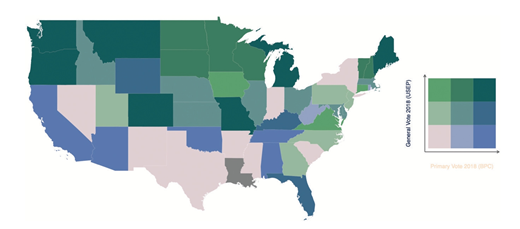
Bivariate Map of 2018 Voter Turnout in Midterm Election (US Election Project) and Primaries (Bipartisan Policy Commission).
Bivariate Map of 2018 Voter Turnout in Midterm Election (US Election Project) and Primaries (Bipartisan Policy Commission).
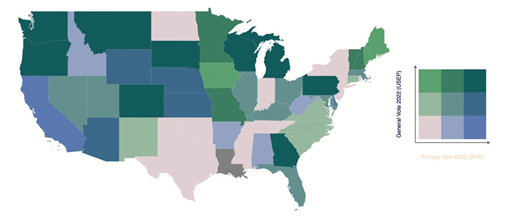
Bivariate Map of 2022 Voter Turnout in Midterm Election (US Election Project) and Primaries (Bipartisan Policy Commission).
Bivariate Map of 2022 Voter Turnout in Midterm Election (US Election Project) and Primaries (Bipartisan Policy Commission).
In 2022, states with nonpartisan primaries (Washington), statewide RCV (Maine), statewide mail voting (Colorado), battleground states (Michigan), and states with competitive primaries exhibited high primary and general election turnout. States with high primary turnout but low general election turnout are in medium blue, including many Southern states where the Republican primaries are competitive and California (nonpartisan primary). States with higher turnout in general elections but uncompetitive primaries are in green (i.e., Iowa, West Virginia), while states in pink have the lowest tercile of turnout in both types of elections. This group includes the populous states of Texas, New York, Illinois, as well as Nevada and South Carolina.
Partially continuing the pattern from 2018, states in the highest tercile for turnout in both elections in 2022 (Figure 2) include states with open primary systems (Washington, Wisconsin), battleground states (Michigan, Pennsylvania) and states with competitive primaries (Wyoming, Montana, Georgia). States with high primary turnout but low general election turnout (shaded blue) include California (nonpartisan primary + ballot measures), Wyoming (Cheney election), Nebraska, and Kansas (abortion ballot measure). States with higher turnout in general elections but uncompetitive primaries are in green (Iowa, Maine) while states in pink have the lowest tercile of turnout in both types of elections (again Texas, New York, and Indiana). The takeaway is that primary turnout is quite different than general election participation; here again, however, it is hard to separate the effects of primary type from the effects of competition.2
Previous Research–Primary Reform and Voter Turnout
Previous studies have analyzed the effects of primary laws on turnout in different ways. A handful of published studies have shown voter turnout is modestly higher in states with open primaries where independents are allowed to vote, roughly 2–3 percentage points higher than closed primaries (Geras and Crespin, 2018). Geras and Crespin’s analysis of congressional primaries controls for a variety of measures having to do with competitiveness, including the number of quality candidates, campaign fundraising, and the presence or absence of a Senate primary. They show that open primaries increase turnout for both parties but they do not find differences for top-two primaries, in part, perhaps, because there were simply fewer of them to look at given the timing of their study.
Analyzing aggregate turnout from the state over time, the Bipartisan Policy Center (BPC) finds the nonpartisan primary and open primary boost participation modestly. In the 2022 primary cycle, states with nonpartisan primaries (or top-two, top-four) had an overall average turnout of 24.5%, compared with 21.5% for states with semi-open primaries and 20.7% for states with closed primaries; thus, nonpartisan primaries had 3.8% higher turnout overall. Over the past four congressional primary cycles, states with fully open primaries averaged 21.9% turnout compared to 18.5% for closed states, or 3.5% difference (Ferrer and Thorning, 2023; 2018). Using difference-in-difference models for additional analyses beyond these descriptive statistics, the BPC Report includes a variety of controls related to competitiveness.3
Using difference-in-difference design and aggregate state data, Hill (2022) confirms that changing primary rules generally increases turnout, but political actors seek to circumvent reform. Results find turnout increases on average by 1.5 percentage points in open primaries and 6.1 percentage points in nonpartisan primaries. Similarly, using difference-in-difference design and multivariate methods on pooled state data, the BPC 2022 primary turnout report found a state’s switch from closed to open primaries boosts voter turnout by nearly 2 percentage points on average and 3 percentage points, or 16% higher turnout when changing to the nonpartisan primary. Hill’s results also find that campaign contributions also increase with reform. Implementing nonpartisan primaries lead to an estimated 9 and 21% increases in individual campaign contributions per cycle. This suggests a substitution effect (see Boatright, 2024).
In a recent study, Bonneau and Zaleski (2021) focused on ballot roll-off from the top-two primary in California when two Democrats (or two Republicans) appear on the general election ballot. Focusing on U.S. House races and using aggregate data at the congressional district level when one of the major parties is omitted from the ballot, the results find no effect on voter turnout overall, but ballot voter roll-off increases by upwards of 7 percent. Fisk (2021) finds a similar pattern of ballot drop-off using individual-level data from California.
But given such low turnout elections, what type of increase is meaningful? In a review for the New American Foundation, Drutman (2021) report’s that “changing the rules of primaries from closed to open, as many reformers propose, shows little evidence of reducing polarization, or significantly boosting turnout” (pg. 41). As the report notes, “At best, open primaries increase participation by only 2 or 3 percentage points, and top-two primaries by about 6 percentage points. Given already abysmally low turnout in primaries, and thus plenty of room to expand, these are hardly transformative numbers” (pg. 41). Such an increase may or may not meaningfully change the outcome, depending on the level of candidate competition.
Most existing research is not based on individual-level data, so we know less about who participates; existing studies focus on a single state. An unanswered question is whether moderates or independents are more likely to vote with open and nonpartisan primaries. A concern is that states that adopted primary reforms may have higher turnout in the first place. Individual-level panel data measuring change over time is needed.
Primary Reform and Individual Voting Behavior
The limited existing research on primary reforms and turnout in the US is in stark contrast to other election reforms adopted by states (i.e., same-day registration, mail voting, etc.) for which there is substantial empirical analysis over time. The lack of research may be rooted in limited data to measure voter turnout in primary elections. This presents a challenge for researchers because they need to differentiate primary reforms’ impact from other factors that are known to cause changes in participation rates such as a significant ballot measure or a competitive race. To address these concerns, this study uses administrative panel data from the fifty-state voter files over time for congressional primaries (2018, 2022) to test whether the nonpartisan primary and open primary are associated with higher individual-level voter turnout, with controls for competition. We test two main hypotheses.
H1: Individuals living in states that have implemented the nonpartisan primary will be more likely to vote in congressional primaries, controlling their vote history, and other demographic and state contextual factors.
H2: Individuals living in states that have implemented the open primary will be more likely to vote in congressional primaries, controlling their vote history, and other demographic and state contextual factors.
Using the State Voter Files with Panel Data to Measure Primary Turnout
Most research on election laws and turnout relies on either self-reporting from election survey data (i.e., Cooperative Election Survey, CES) or aggregate data from election returns for states, such as the Bipartisan Policy Center primary turnout report. Making inferences about individual behavior from aggregate data from congressional districts or states is difficult because of the ecological fallacy; aggregate election returns do not allow an analysis of individual-level factors known to predict individual voting decisions, including whether the person is a habitual voter (i.e., vote history). On the other hand, representative national surveys for primary elections are rare and hard to come by (and usually only sample in a handful of states with competitive primaries). Studying a single state that has adopted reform limits generalizability because of idiosyncratic local differences.
Recent research has highlighted problems with survey data stemming from self-reported turnout, smaller state samples, representativeness, and the use of survey weights that can affect the results (Ansolabehere and Hersh, 2012; Erikson and Minnite, 2009). National surveys can fail to reflect state voting populations since voters’ likelihood to respond can differ across demographic groups (Ansolabehere et al., 2022; Ansolabehere and Hersh, 2012), with some groups more likely to overreport voting. Some national surveys, such as the large sample Cooperative Election Study (CES) and recent Pew Research Center surveys, use validation procedures against the national voter files. This has significantly improved estimates of voting using survey data.4 Widely used data from firms conducting national surveys such as YouGov, Ipsos, Gallup, Pew and others extensively use survey weights to improve their samples, but the formula for these weights is not well understood. There are no survey weights when using state voter files.
In contrast, this study measures individual-level primary voting records with vote histories from the fifty-state voter files for registered voters combined with industry data to measure unregistered individuals. Data for this study includes a 1% random sample from the 2023 national voter file (Catalist) of 265 million U.S. adults, with over 2.5 million observations.5 The sample includes all US adults, including people who are registered to vote and those who are not. We use these data to gain the largest possible sample of who voted in recent primary elections.6 The national voter file combines official voting records from all state voter files with additional data (e.g., U.S. Postal Service National Change of Address data), industry data (cell phone records, credit bureau reports), and campaign canvass records from the near universe of the adult U.S. population. Catalist provides a random 1% sample to researchers, with a growing number of studies showing the utility of these data for measuring voter turnout.7
Besides providing an accurate measure of voter turnout that comes from state governments—rather than reporting from individuals—these data also include a panel component. Individual-level vote histories can address endogeneity problems by providing a measure of within-person change in turnout over time. The use of a lagged variable to measure past voting decisions effectively measures the change in individual voting decisions across two sequential primary elections. Using vote histories allows the use recursive models designed to measure factors associated with change in individual-level voting decisions. Like a within-group experiment, lagged panel data is widely used to improve causal inferences (Angrist and Pischke, 2009). In contrast, overreliance on cross-sectional data to make inferences can be misleading, as other factors (a competitive race, etc.) may be driving outcomes present in the data. These models make possible more precise measurements of participation in primary elections.
The primary explanatory variable is whether the respondent lives in a state that has adopted and implemented the nonpartisan primary (top-two or top-four), or partially open, or fully open primary with data from the National Conference of State Legislatures (NCSL).8 States that have adopted primary reform (i.e., open primary, semi-open primary, nonpartisan primary) are coded 1 while all other jurisdictions are coded 0. States with closed or semi-closed primaries serve as the reference category.
A second key variable measures how competitive the Senate or gubernatorial races were in the respondent’s state. Competitive Senate or governor primaries are measured by fractionalization; the intuition is that these two types of statewide elections are likely to drive turnout, while other statewide elections (Lieutenant Governor, Attorney General, and so forth) or elections in particular districts are less likely to affect turnout. Fractionalization is measured using a 0–1 index developed by Canon (1978). This index is operationalized as where F is the fractionalization index, C1 is the percentage of the total vote received by the first candidate, C2 is the percentage of the total vote received by the second candidate, and so on. A one candidate race has a fractionalization index of zero, a race where two candidates split the vote would have a fractionalization index of 0.5 (or 1– (0.52 + 0.52)), and larger index scores correspond to competitive races with more than two candidates; the larger the number of similarly competitive candidates, the closer the index is to 1. We use fractionalization measures within each party for each of these two types of races. We are aware that this measure does not capture all drivers of turnout – for instance, the statewide ballot referendum in Kansas would not be captured by this measure, nor would the competitive House primaries in states with a single at large district such as Wyoming or Alaska. Nonetheless, we would contend that competitive statewide primaries for governor or senate are potential drivers of turnout for all states, as opposed to the idiosyncrasies of the Kansas referendum or the special circumstances of at-large House districts.
A series of control variables are also included. While age (measured in years) and gender are generally included in the fifty-state voter files measured by females coded 1 and males 0, these data also include modeled estimates of an individual’s race (in some states race is reported on the state voter files). The statistical models include binary variables for Black, Latino, and other race (coded 1, all others 0), marital status (married coded 1, non-married 0), an ordinal scale for income (data from credit bureau reports), and education (coded on a 0–100 scale for the probability of having a BA degree).9 The statistical models also include a control for modeled partisanship on a 0–100 scale with 100 indicating a high probability of being a strong Democrat; this variable is provided to researchers by Catalist and is based on national survey data, canvassing data, campaign contributions, primary vote history, etc. Previous studies have shown these demographic data are highly reliable (Fraga, 2016, 2018; Hersh, 2015). Pew reports that national voter rolls are generally accurate when matched to respondents in their American Trends Panel (Igielnik et al., 2018). To recap, we test the effects of living in a state with a nonpartisan or open primary compared to closed primaries, controlling for competition.
Results
Table 1 reports four recursive logistic regression models predicting whether an individual voted in the 2022 primaries, lagging if they voted in the 2018 primaries. By including a variable indicating whether the individual voted in the previous congressional-only primary, the models measure the change in individual voter turnout to develop more causal models (Angrist and Pischke, 2009). The coefficients are reported as unstandardized logistic regression coefficients with standard errors in parentheses. Column 1 is for all US adults while column 2 presents a subsample of Republicans, column 3 independents, and column 4 Democrats.10
Probability of voting in the 2022 primaries, lagging turnout in the 2018 primaries, nationwide and for partisanship group
| Overall | Republicans | Independents | Democrats | |
|---|---|---|---|---|
| Vote in 2018 Primary | 2.24*** | 1.72*** | 2.71*** | 1.63*** |
| (0.028) | (0.041) | (0.114) | (0.049) | |
| Age | 0.03*** | 0.03*** | 0.05*** | 0.07*** |
| (0.005) | (0.005) | (0.007) | (0.007) | |
| Age Squared | −0.0001*** | −0.0001*** | −0.0002*** | −0.0002*** |
| (0.00004) | (0.00004) | (0.0001) | (0.0001) | |
| Female | 0.03*** | 0.10*** | −0.06*** | −0.10*** |
| (0.011) | (0.019) | (0.016) | (0.019) | |
| Asian | −0.64*** | −0.27** | −0.53*** | −0.04 |
| (0.104) | (0.131) | (0.204) | (0.115) | |
| Black | −0.39*** | −0.16* | −0.53*** | −0.13 |
| (0.078) | (0.082) | (0.076) | (0.111) | |
| Latino | −0.61*** | −0.12 | −0.79*** | −0.04 |
| (0.078) | (0.123) | (0.104) | (0.112) | |
| Race Other | −0.35*** | −0.11 | −0.35** | 0.00 |
| (0.049) | (0.083) | (0.142) | (0.067) | |
| Married | 0.11*** | 0.12*** | 0.10*** | 0.17*** |
| (0.023) | (0.031) | (0.037) | (0.027) | |
| Pr(Bachelor’s degree) | 0.001 | −0.01*** | 0.003 | −0.01*** |
| (0.001) | (0.001) | (0.002) | (0.001) | |
| Income | 0.22*** | 0.17*** | 0.15*** | 0.17*** |
| (0.018) | (0.019) | (0.027) | (0.029) | |
| Catalist Ideology | 0.01*** | −0.03*** | 0.03*** | 0.09*** |
| (0.002) | (0.010) | (0.004) | (0.008) | |
| Primary Type | ||||
| Open-Unaffl. Voters Primary State | 0.23 | 0.17 | 0.38 | 0.18 |
| (0.186) | (0.175) | (0.258) | (0.198) | |
| Open Primary State | 0.05 | 0.26 | 0.50** | 0.58** |
| (0.162) | (0.178) | (0.224) | (0.271) | |
| Non-partisan Primary State | 0.80*** | 0.54* | 1.21*** | 0.67*** |
| (0.240) | (0.326) | (0.310) | (0.180) | |
| Competition | ||||
| Dem. Senate Fract. 2022 | 0.79** | 0.90** | 0.91** | |
| (0.332) | (0.437) | (0.422) | ||
Probability of voting in the 2022 primaries, lagging turnout in the 2018 primaries, nationwide and for partisanship group. Continud
| Overall | Republicans | Independents | Democrats | |
|---|---|---|---|---|
| Dem. Governor Fract. 2022 | −0.13 | −0.50 | 0.45* | |
| (0.217) | (0.436) | (0.232) | ||
| Rep. Senate Fract. 2022 | (0.10) | 0.34* | 0.08 | |
| (0.254) | (0.189) | (0.352) | ||
| Rep. Governor Fract. 2022 | 0.57** | 0.67*** | 0.59 | |
| (0.264) | (0.227) | (0.373) | ||
| Constant | −4.91*** | −2.72*** | −7.51*** | −11.42*** |
| (0.168) | (0.278) | (0.420) | (0.840) | |
| Observations | 2,464,657 | 617,090 | 985,514 | 862,053 |
| Log-likelihood | −941058.79 | −330576.61 | −205055.75 | −308270.64 |
| Pseudo-R2 | 0.25 | 0.18 | 0.25 | 0.35 |
| BIC | 1882412 | 661393.20 | 410387.51 | 616787.28 |
Unstandardized logistic regression coefficients. Standard errors are clustered by state in parentheses. *p < 0.1, **p < 0.05, ***p < 0.01
As would be expected in low-turnout elections, the results show if an individual voted in 2018 they were much more likely to vote in 2022; this is consistent with previous research finding habitual voters are important in primary turnout (Norrander, 1991; Plutzer, 2002). Controlling for other factors, being a habitual voter (i.e., voted in the 2018 primaries) makes one significantly more likely to vote in the 2022 primaries. Older and more affluent individuals are more likely to vote in primaries (Norrander, 1991).
A main finding is that people living in states with a nonpartisan primary are consistently more likely to vote in 2022 overall and for the subsample of industry-coded Republicans, Democrats and independents. Holding all other factors constant at mean values, people living in states with nonpartisan primary are 12 percentage points more likely to vote in the 2022 primaries as those in closed primary states, controlling for their 2018 primary participation (see Table 2). The effect size is roughly the same for Republicans and Democrats (12 and 9 percentage point increase), while independents are 7 percentage points more likely to be primary voters if living in a state with a nonpartisan primary. Despite prior results of more modest effects, these are meaningful increases in turnout using individual-level data. The effect sizes for primary type are larger than for most demographic factors. This suggests state primary rules matter for increasing turnout, even after controlling for electoral competition.
Marginal Effect of Voting in the 2022 Primaries (Table 1, all other variables held constant mean values)
| Condition | Group | Marginal Effect |
|---|---|---|
| Nonpartisan primary (top-two or top-four) | Overall | + 0.12 |
| Republicans | + 0.124 | |
| Independents | + 0.069 | |
| Democrats | + 0.087 | |
| Open primary | Independents | + 0.021 |
| Democrats | + 0.073 | |
| Varying electoral competition | Democratic senate competition | + 0.10 |
| Republican governor competition | + 0.073 |
People living in states with fully open primaries were not more likely to vote than the reference group (closed primary states) overall, but the subsample for independents (column 3) and Democrats (column 4) shows a positive coefficient. Table 2 indicates independents have a 2 percentage point increase in the probability of voting in open primary states and Democrats have a 7 percentage point boost in voting, all else equal.
Table 1 and Table 2 also indicate that electoral competition measured by fractionalization is important. A one-unit increase in competition in the Democrat Senate primary raised the marginal effects of individual voting by 10 percentage points, slightly below the marginal effect size for the nonpartisan primary. Table 2 also shows that competition in Republican gubernatorial races is important for turnout overall (the marginal effect is a 7 percentage point increase in turnout). Republican gubernatorial and Senate competition increased voting among Republicans in the 2022 primaries, while Democratic gubernatorial and Senate competition boosted participation among the Democratic subsample (see Table 1).
Since fractionalization is an interval-level variable, Figure 3 (Democratic Senate races) and Figure 4 (Republican gubernatorial races) report predicted probabilities of voting in the 2022 primary (column 1) varying competition from low (minus 2 standard deviations from the mean) to high (plus two standard deviations from the mean). All else equal, including primary type, Democrats are 10 percentage points more likely to vote if their Senate race is highly competitive and Republicans are 16 percentage points more likely to vote under very high gubernatorial competition. Electoral competition has always been an important predictor of higher voter turnout (McDonald and Samples 2006), but in low-turnout primaries, competition matters more (Boatright, 2014).
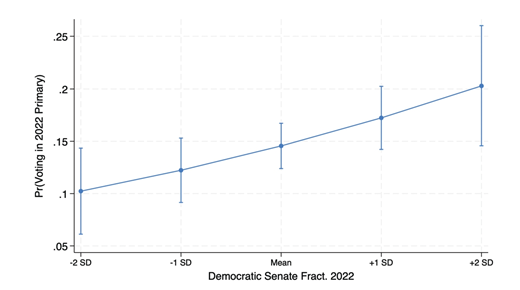
Probability a Democrat will vote in 2022 primary varying Democratic Senate Fractionalization (i.e., competition) (Table 1, col 4).
Probability a Democrat will vote in 2022 primary varying Democratic Senate Fractionalization (i.e., competition) (Table 1, col 4).
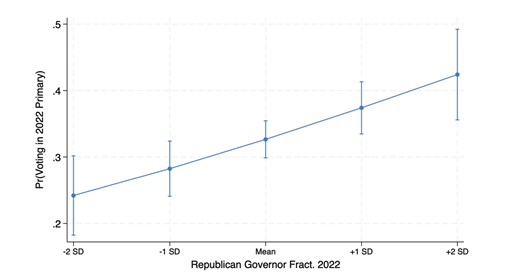
Probability a Republican will vote in 2022 primary varying Republican Governor Fractionalization (i.e., competition) (Table 1, col 2).
Probability a Republican will vote in 2022 primary varying Republican Governor Fractionalization (i.e., competition) (Table 1, col 2).
Table 3 replicates the previous models but adds an interaction term for independents living in states with the nonpartisan primary (column 1). The interaction term is positive and statistically significant, meaning that independents have significantly higher turnout under these electoral rules. Because interaction models can be difficult to interpret from the coefficients alone, Figure 5 shows the predicted probability of voting in the 2022 primary for individuals who didn’t vote in the prior election, all else equal varying whether the individual is an independent or partisan and whether they live in a state with or without the nonpartisan primary. Independents who don’t regularly vote in primaries have just a 5.6% chance of voting in 2022, which rises to just over 16% (0.163 probability) if they live in a state with a nonpartisan primary; a 10.7 percentage point difference. Partisans also do better under the nonpartisan primary, all else equal.
Probability of voting in the 2022 primaries, lagging turn out in the 2018 primaries for in dependents in nonpartisan primary states and open primary states
| Interacting Non-Partisan Primary and Independent | Interacting Open Unaffl. Primary and Independent | Interacting Open Primary and Independent | |
|---|---|---|---|
| Vote in 2018 Primary | 2.04*** | 2.04*** | 2.04*** |
| (0.030) | (0.029) | (0.030) | |
| Independent | −1.25*** | −1.22*** | −1.16*** |
| (0.128) | (0.094) | (0.128) | |
| Non-partisan Primary State | 0.73*** | 0.84*** | 0.83*** |
| (0.266) | (0.259) | (0.258) | |
| Non-partisan primary ∗ Independent | 0.46*** | ||
| (0.174) | |||
| Open Primary State | 0.31* | 0.25 | 0.29* |
| (0.173) | (0.212) | (0.171) | |
| Open Primary ∗ Independent | 0.14 | ||
| (0.291) | |||
| Open-Unaffl. Voters Primary State | 0.24 | 0.24 | 0.24 |
| (0.190) | (0.190) | (0.191) | |
| Open Unaffl. Primary ∗ Independent | −0.04 | ||
| (0.198) | |||
| Catalist Ideology | 0.01*** | 0.01*** | 0.01*** |
| (0.001) | (0.001) | (0.001) | |
| Age | 0.03*** | 0.03*** | 0.03*** |
| (0.005) | (0.004) | (0.004) | |
| Age Squared | −0.0001** | −0.0001** | −0.0001** |
| (0.00004) | (0.00004) | (0.00004) | |
| Female | 0.02** | 0.02** | 0.02** |
| (0.011) | (0.011) | (0.011) | |
| Asian | −0.55*** | −0.55*** | −0.54*** |
| (0.115) | (0.116) | (0.117) | |
| Black | −0.73*** | −0.71*** | −0.71*** |
| (0.068) | (0.071) | (0.067) | |
| Latino | −0.67*** | −0.67*** | −0.67*** |
| (0.095) | (0.097) | (0.096) |
Continued.
| Interacting Non-Partisan Primary and Independent | Interacting Open Unaffl. Primary and Independent | Interacting Open Primary and Independent | |
|---|---|---|---|
| Race Other | −0.36*** | −0.37*** | −0.37*** |
| (0.062) | (0.062) | (0.063) | |
| Married | 0.12*** | 0.13*** | 0.13*** |
| (0.024) | (0.025) | (0.025) | |
| Pr(Bachelor’s degree) | −0.002** | −0.002** | −0.002** |
| (0.001) | (0.001) | (0.001) | |
| Income | 0.21*** | 0.21*** | 0.21*** |
| (0.018) | (0.018) | (0.018) | |
| Competition | |||
| Dem. senate Fract. 2022 | 0.72** | 0.72** | 0.72** |
| (0.342) | (0.338) | (0.340) | |
| Dem. Governor Fract. 2022 | −0.14 | −0.14 | −0.14 |
| (0.237) | (0.234) | (0.235) | |
| Rep. Senate Fract. 2022 | 0.15 | 0.15 | 0.15 |
| (0.243) | (0.242) | (0.242) | |
| Rep. Governor Fract. 2022 | 0.55** | 0.55** | 0.55** |
| (0.276) | (0.273) | (0.274) | |
| Constant | −4.22*** | −4.23*** | −4.24*** |
| (0.169) | (0.164) | (0.167) | |
| Observations | 2,464,657 | 2,464,657 | 2,464,657 |
| Log-likelihood | −907127.56 | −907721.5 | −907829.69 |
| Pseudo-R2 | 0.27 | 0.27 | 0.27 |
| BIC | 1814579 | 1815767 | 1815983 |
Unstandardized logistic regression coefficients. Standard errors are clustered by state in parentheses. *p < 0.1, **p < 0.05, ***p < 0.01
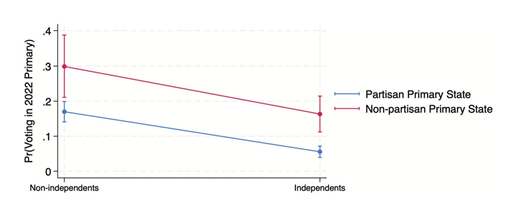
Predicted probability of voting in the 2022 primary comparing partisans versus independents, residing in states with partisan primary vs nonpartisan primary all else equal (Table 2, col 1).
Predicted probability of voting in the 2022 primary comparing partisans versus independents, residing in states with partisan primary vs nonpartisan primary all else equal (Table 2, col 1).
Table 3 also finds independents are not statistically more likely to vote when living in states with an open or partially open primary (see columns 2 and 3). The altered competition of the nonpartisan primary appears to make independents statistically more likely to participate than open primaries alone. While these estimates are approximate given the industry coding of partisanship, they do provide solid evidence that independents benefit from more open primary election rules nationwide.
Conclusion: Why Does Voter Turnout in Primaries Matter?
This study has sought to understand whether state primary reforms are related to individual voting decisions drawing on panel data from the 50 state voter files combined with industry data. These administrative data overcome a reliance on sparse survey data. The results provide consistent evidence that people living in states with nonpartisan primaries are more likely to vote, regardless of their individual partisanship (Republican, independent or Democrat), and that the open primary appears to boost participation rates for independents and Democrats, but more modestly. Interaction models found independents especially benefit from the nonpartisan primary. This is one of the few studies to use voter files to analyze these questions with repeated observations of voting for individuals over time.
Because of the availability of the voter file data, the time period of the study is limited to comparing the 2018 and 2022 congressional primaries. This is a limitation of the study. It is also a strength, as these data are more recent than past studies- therefore, the effect of the primary type when limited to a 2018 to 2022 time period suggests that it may take time for reforms to take full effect. Early studies of the nonpartisan primary in WA and CA, for example, finding minimal turnout effects may have been limited by studying primary elections recently after adoption (more than a decade ago). Use of the voter file data, but also more recent data, may explain why the findings are different.
Is the turnout boost provided by nonpartisan or open primaries large enough to justify advocacy for adopting these reforms? We are agnostic on this subject. This study also finds that competition in Senate and governor’s races has a positive impact in boosting voting rates in primaries, which can be on par or larger than the effects of primary type. Maybe changes in primary rules would change the degree of competition in elections. Hill (2022), Hassell (2018), and Boatright (2024) have noted, parties tend over time to find ways to limit the disruption caused by reforms.
Why, then, should we care about turnout, competition and primary rules? One reason is that very low turnout elections can result in more ideologically extreme voters who choose more extreme candidates. Gerber and Morton (1998) find that representatives from states with closed primaries are further from the district’s estimated ideological mean than lawmakers elected from closed primaries; thus, closed primary systems result in a greater likelihood of ideologically extreme congressional candidates being on the ballot in the general election. Similarly, Hill and Tausanovitch (2018) find that “more extreme primary electorates encourage the election of more extreme legislators... [resulting in] primary sorting, which narrows the primary electorate and makes it even more extreme.” Open systems are hypothesized to allow more moderate voters, leading to the nomination of more moderate candidates (see Gross 2020). Open primary presidential elections had electorates more ideologically similar to general election voters than voters in closed primaries (Kaufman et al. 2003). In presidential primaries, the ideology of electorates was the most moderate under the open primary and was more extreme under closed primaries and caucuses (Walz and Foote, 2020). Adding to this literature, we find independents are more likely to participate in open primary systems such as the nonpartisan primary. The threat of facing a larger, more politically representative electorate may have an effect of legislator behavior over time. Perceptions may shape legislator behavior (Anderson et al., 2020).
If a principal concern is the behavior of legislators, it is important to note that there are other reforms that have been proposed to curb or disincentivize political extremism. Beyond the primary reforms analyzed here, others seek to strengthen state party’s gatekeeping functions to deter unfit and politically extreme candidates from appearing on the general election ballot. The goal of such proposals is to give state parties more flexibility to modify primary laws to fit their unique circumstances. Ranked-choice voting has been suggested as a way to prevent extreme plurality winners from winning nominations in lopsided partisan districts. Pre-primary conventions allow state parties to limit which candidates appear on the election ballot. Parties can endorse candidates before the primary to give voters more information about candidates who would good political leaders.
This study finds electoral competition is an important factor alongside state primary laws in shaping turnout. These results are only one step toward a serious discussion of primary reform. We have not explored who participates beyond showing independents are more likely to vote under the nonpartisan primary. If a reform increases turnout, does it also increase turnout among people who are currently underrepresented? Some studies find closed primaries have demobilizing impacts on Asian American and Latinx voters, as these voters are registered as independents at higher rates than whites. Using nationally representative and validated survey data from 2012 to 2018, open and top-two primaries are associated with higher turnout from independent voters of color in both primary and general elections (Centeno et al., 2021). These are important questions for future research. Participation is important, but so is representativeness.
We acknowledge that here and elsewhere in the paper we conflate variations in primary rules; it is common to distinguish between closed primaries (where party registration is required in advance) and semi-closed primaries (where party registration is required but can be announced on the day of the election). Some research (e.g. Gerber and Morton 1998) has found important differences between primary type which are not necessarily linear in nature (that is, in the Gerber and Morton case, candidate moderation does not change in the same direction across types as primaries become more open). Other studies (e.g. Stone and Scott, 1984) have disputed this entire classification scheme. We acknowledge these differences but combine closed primary types because our intent is to explore whether proposed reforms to establish open primaries or nonpartisan primaries will increase turnout.
Note Louisiana is omitted, which has a a nonpartisan “jungle” primary which takes place on the same date as the general election. A runoff is subsequently held in races where the primary winner receives less than 50 percent of the vote.
These include a binary variable measuring the presence or absence of a referendum or initiative; a four-point variable measuring the number of statewide primary races on the ballot, and the Cook PVI, a measure of statewide partisan competitiveness.
Survey data with validated vote (such as CES) is as precise- or potentially more precise given the ability to ask voters specific questions about their party ID than in voter files.
This sample was pulled in August 2023, soon after the states had updated their voter files from the November 2022 general election. See Kim and Fraga (2022).
Ansolabehere et al. (2022), Cantoni and Pons (2021), and Hersh (2015); Fraga (2016, 2018), Fraga and Holbein (2020), Hersh and Nall (2016); Rogers and Aida (2014), Hersh and Ghitza (2018), Nickerson and Rogers (2014), Ritter and Tolbert (2020), Cooper et al. (2009); but see Kim and Fraga (2022) for some limitations.
Not all states require individuals to report race, or ethnicity and no state requires marital status, education, and income. As such, these latter variables are imputed by Catalist from commercial and canvassing data. Previous studies find that the imputed variables have high predictive validity (Hersh, 2015; Fraga, 2018).
Democrats are poeple scoring 75–100, Republicans score 0–24 and independents 26–74. The industry categories track closely with self identified partisanship (Catalist, 2017) and when merged with survey data.
2022 Collaborative Midterm Survey (Enns, Barry, & Schuldt) N = 19,818. Cornell Center for Social Sciences. Cornell University.

