This study aims to investigate how resistance to generative artificial intelligence (GenAI) emerges in small- and medium-sized enterprises (SMEs) when adoption promises to improve working conditions, and what this reveals about the benefits realised by those who do the work.
The study draws on 108 semi-structured interviews across 75 Dutch SMEs, involving founders, managers and operational staff. Sampling was stratified across these roles to triangulate perspectives and reveal where accounts converge, diverge and contest. The analysis coded how actors interpreted GenAI in everyday work.
Resistance to GenAI does not stem from technological incapacity but from an evaluability paradox: the technology feels accessible and functional while the organisational distribution of value, accountability and recognition remains opaque. Employees experience this as unrecognised labour, managers as eroded process visibility and owners as misunderstood benefit. Resistance takes the form of calibrated engagement, selective reliance and identity-preserving practices; where organisations redistributed information, preserved relational deliberation or drew boundaries around human-led work, it reconfigured into conditional, productive engagement.
The analysis captures GenAI adoption in Dutch SMEs during a formative phase. Comparative and longitudinal research would extend the framework.
The study offers SME managers a way to read employee resistance to GenAI as diagnostic feedback rather than obstruction. It provides a role-based checklist linking the signals owners, managers and employees display to their underlying causes and to concrete responses: redistributing system information, making value verifiable at the operational level, establishing protocols for interpreting outputs collectively, formalising feedback loops and drawing explicit boundaries around human-led work. Rather than overcoming resistance, managers are advised to interpret it, since it reveals where accountability, recognition or value distribution have broken down. Acting on these signals supports more durable and accountable GenAI adoption.
The study shows that GenAI’s social impact in SMEs is not delivered by the technology but negotiated in everyday work, through how its benefits, burdens and recognition are distributed among the people who do it. Promised improvements to working conditions often remain invisible or unevenly shared, with efficiency claimed organisationally while unrecognised labour accumulates locally. Resistance is how this contested distribution becomes visible. Interpreting it as feedback allows firms to align adoption with decent work (SDG-8) and accountable innovation (SDG-9). The social value of GenAI thus depends less on the tool than on whether organisations respond to those who use it.
This study advances understanding of the social impact of GenAI in small business: its benefits, burdens and recognition are not delivered by the technology but contested in everyday work. Resistance functions as situated ethical negotiation rather than opposition, and thus as a critical organisational capacity that, read as feedback rather than failure, enables more accountable, socially beneficial adoption.
1. Introduction
Generative artificial intelligence (GenAI) is increasingly promoted as a means of enhancing productivity, supporting creative work and alleviating demanding working conditions (Nah Fui-Hoon et al., 2023). Unlike AI systems that operate as back-end decision or classification tools, GenAI is user-facing and co-productive, with employees directly prompting, editing and evaluating outputs in everyday work (Rajaram and Tinguely, 2024). For SMEs facing labour shortages, limited specialist capacity and high operational pressure, its accessibility and low infrastructure requirements make it especially appealing (Dwivedi et al., 2023; Iyelolu et al., 2024). GenAI is therefore introduced not as a neutral tool but as a socially beneficial one, framed around easing workloads and improving working conditions. Yet, these social-impact claims are asserted before they can be observed, and how they play out for the people doing the work remains largely unexplored (Storey et al., 2025).
In practice, GenAI adoption in SMEs often encounters resistance even when employees can use these tools competently (Rajaram and Tinguely, 2024). This presents an empirical tension: if GenAI is introduced to improve working conditions rather than to automate labour, why does resistance persist where its social promise is strongest? Dominant explanations emphasise deficits in readiness, capability or acceptance (Laumer and Eckhardt, 2012), yet these sit uneasily with cases where organisations possess the necessary skills and anticipate no task displacement.
The tension is sharpest in SMEs, where informal coordination, close relationships and strong professional identities leave few institutional buffers between those who introduce GenAI and those expected to adopt it (Cisi and Sansalvadore, 2022; Atkinson, 2008). Here the social impact of GenAI is not abstract but a distribution of effort, responsibility and recognition felt directly between people who work side by side; when that distribution is hard to evaluate, resistance surfaces in relational rather than overt forms (Lapointe and Rivard, 2005).
This study examines how Dutch SMEs interpret and respond to GenAI introduced under the promise of improving working conditions. Drawing on qualitative interviews across 75 SMEs involving founders, managers and operational staff, it analyses how resistance takes shape around efficiency claims, decision-making authority and professional identity. It asks how resistance reveals the way the social impact of GenAI, its benefits, burdens and recognition, is distributed and evaluated within SMEs, and when it can be reconfigured into more socially beneficial adoption. The study thus treats GenAI’s social impact as negotiated in everyday work, not delivered by the technology.
1.1 Resistance to technology and its limits in AI-mediated contexts
User resistance has typically been theorised as a response to technological change that users can evaluate in terms of anticipated costs, benefits and disruptions to work (Joshi, 1991; Martinko et al., 1996). Even when research incorporated emotions, cognition and power relations (Markus, 1983; Kim and Kankanhalli, 2009; Rivard and Lapointe, 2012), it retained a core assumption: that consequences remain visible and attributable enough for users to judge what is gained, lost or redistributed (Marakas and Hornik, 1996). This breaks down with GenAI, where users interact with tools that produce competent-looking outputs while the consequences of adoption stay opaque (Bennett, 2025; Golgeci et al., 2025).
Dominant frameworks depend on this evaluability: status quo bias on loss aversion (Shirish and Batuekueno, 2021), attribution accounts on perceived managerial intent (Bhattacherjee, 2001) and power-oriented perspectives on identifiable shifts in control (Markus, 1983). In GenAI contexts, resistance often arises without observable disruption or clear decision-makers, not because work visibly changes but because its consequences are hard to interpret or contest (Abedin et al., 2022). When GenAI obscures value creation, benefit distribution and responsibility (Kellogg et al., 2020; Newell and Marabelli, 2015), resistance is not a reaction to identifiable harm but emerges where evaluation itself becomes uncertain, especially absent formalised governance.
1.2 Opacity and the evaluability of GenAI’s benefits at work
GenAI amplifies this uncertainty and does so in ways that are particularly difficult for organisations to mediate, by reorganising organisational knowledge, value creation and authority through opaque and probabilistic processes (Chalmers et al., 2026). Unlike back-end AI systems that classify, predict or optimise without direct user interaction, GenAI positions employees as co-producers who prompt, evaluate and refine outputs in real time creating a paradox in which the technology feels accessible while the basis of its outputs and their organisational value remain opaque (Rajaram and Tinguely, 2024). The same accessibility that makes GenAI feel useful therefore obscures whether it genuinely improves the work, leaving employees unable to judge whether its promised benefits are real.
This opacity makes the benefits of GenAI difficult to judge. Studies of algorithmic management show that employees may resist systems they recognise as effective when accountability and value remain unclear (Zhang et al., 2025; Kellogg et al., 2020). With GenAI, this tension takes a distinct form: while users can interrogate and refine outputs directly, efficiency gains are realised at the organisational level while the labour of prompting, correcting and supervising outputs remains local and unrecognised. Since such tools affect work through how roles are designed around them rather than through the technology itself (Parker and Grote, 2022), this hidden effort can degrade job quality even as output improves and has been linked to work alienation where value and accountability stay unclear (Hai et al., 2025). GenAI further exercises power indirectly by shaping how decisions are framed and justified, diffusing responsibility in ways that are difficult to contest organisationally (Shrivastava, 2025; Zhang et al., 2025). Through these dynamics, opacity, abstracted value and diffused authority, GenAI disrupts the hierarchical, functional and coordination proximities that characterise SMEs, shaping its social impact on those who do the work (Torres, 2004; Torrès and Julien, 2005).
1.3 Resistance as a signal of contested benefit in SMEs
Research on digital adoption in SMEs has typically framed resistance as a consequence of insufficient resources and limited digital capability (Rupeika-Apoga and Petrovska, 2022; Dwivedi et al., 2023). Yet evidence shows that resistance persists even in technologically capable SMEs when digital change intersects with the hierarchical, functional and coordination proximities through which work is organised (Torres, 2004; Iyelolu et al., 2024; Shaik et al., 2024).
These proximities shape whether GenAI’s benefits are realised and how they are distributed. Because founders and managers are personally known, efficiency claims become relational commitments open to moral evaluation rather than impersonal directives (Atkinson, 2008). Because roles are undifferentiated, the social benefit is unevenly shared: efficiency accrues to the firm while the added labour of prompting and correcting outputs, and the recognition for it, is borne by individuals who have no formal basis to claim it (Cisi and Sansalvadore, 2022; Buwalda, 2025). And because coordination is informal, GenAI’s reshaping of how decisions are justified disrupts the mechanisms through which authority and accountability were negotiated (Lapointe and Rivard, 2005).
This vulnerability is compounded when GenAI is framed as socially beneficial. Narratives of improved work invite employees to judge GenAI against expectations of fairness and reciprocity, since the same tool can enhance or diminish the dignity of work depending on how its benefits are shared (Hansen et al., 2025; Bankins and Formosa, 2023); judgement sharpens when adoption is seen to redistribute value upward, away from those doing the work (Ayinaddis, 2025; Sánchez et al., 2025). When the promised benefit stays captured organisationally while the effort remains local, resistance reflects a moral judgement about distribution, not technological immaturity (Spiekermann and Winkler, 2020; Cole et al., 2022).
What remains undertheorised is how resistance to GenAI functions as a moral evaluation of its social impact: of how the benefits, burdens and recognition of adoption are distributed, particularly when those benefits are opaque, authority is diffused and professional identity is unsettled. SMEs offer a revealing context because the hierarchical, functional and coordination proximities that characterise these organisations (Torres, 2004; Torrès and Julien, 2005) make such tensions both more personally experienced and less institutionally mediated. This study examines how resistance, across the dimensions of contested efficiency, algorithmic authority and professional identity, reveals the social impact of GenAI in Dutch SMEs.
2. Methodology
This study adopted a qualitative research design grounded in interpretivist assumptions to explore how SMEs in the Netherlands perceive and respond to generative AI (GenAI) implementation. Rather than treating resistance as a measurable variable, it was conceptualised as a situated organisational response to perceived shifts in values, power and workplace identity dimensions that become particularly salient when technologies are framed as socially beneficial (Zuboff, 2019). A qualitative interpretive approach is well suited to examining how SME actors construct meaning around sociotechnical change and the ethical, relational and wellbeing implications of GenAI integration in the workplace (Walsham, 1995; Dignum, 2019).
2.1 Research context: Dutch SMEs and GenAI adoption
Dutch SMEs typically feature flat organisational hierarchies, founder-led decision-making and close interpersonal work cultures features that exemplify the hierarchical, functional and coordination proximities characteristic of the SME form (Torres, 2004; Cisi and Sansalvadore, 2022; Zavodna et al., 2024). GenAI adoption in this context unfolds within dense interpersonal relations and informal governance structures, making Dutch SMEs a particularly relevant setting for examining how GenAI is introduced and discussed across organisational roles without reducing resistance to limited digital capability (Newell and Marabelli, 2015; Lapointe and Rivard, 2005).
The data collection period (December 2023–October 2024) captures GenAI adoption during a formative phase when its organisational consequences were actively being negotiated. The mechanisms examined here how efficiency claims are evaluated, how the labour of prompting, correcting and supervising outputs is recognised and how professional identity is contested are structural rather than contingent on specific model capabilities; they intensify as increasingly competent outputs render the human labour behind them even less visible and the redistribution of value more consequential.
2.2 Data collection: semi-structured interviews
Semi-structured interviews were conducted between December 2023 and October 2024 across 75 Dutch SMEs, resulting in 108 interviews. Depending on organisational size, access and the scope of GenAI-related initiatives, between one and three interviews were conducted per SME. Interviewees included founders or owners (n = 36), managers (n = 34) and frontline employees (n = 38).
A stratified purposive sampling strategy (Patton, 2015) was adopted to capture GenAI adoption from multiple organisational vantage points. Founders and owners, managers and operational employees occupy distinct positions in the authorisation, implementation and everyday enactment of GenAI initiatives; sampling across these three strata enables triangulation of perspectives and analysis of where accounts converge, diverge and contest one another.
Semi-structured interviews were used to balance cross-case comparability with openness to emergent themes (Silverman, 2022). Interviews lasted 30–60 min and were conducted in person or via video call. Most were audio-recorded and transcribed verbatim; where recording was not possible, detailed notes were taken (Halcomb and Davidson, 2006).
To enhance credibility, interview data were triangulated with supplementary organisational materials where available, including internal documents, related to GenAI initiatives, pilot projects and internal guidelines or policies. These materials were used to contextualise interview accounts and verify timelines of AI adoption (Bowen, 2009).
2.3 Sampling and access
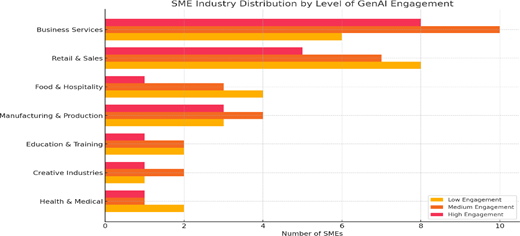
Alongside this stratified sampling across roles, a maximum variation strategy was applied across organisational size, sector and level of GenAI engagement (Patton, 2015), as illustrated in Figure 1. The sample included SMEs from diverse domains; retail, logistics, education, healthcare, food and hospitality, manufacturing, creative industries and professional services selected to reflect a range of digital maturities and sectoral pressures towards GenAI adoption (Ladu et al., 2024). Given the small size of participating firms and the risk of re-identification, company names and specific sectors are withheld from the presentation of findings; verbatim quotations are identified only by participant ID and role.
Sectoral contrasts were evident: business services and retail showed higher GenAI engagement, while education, healthcare and creative industries had lower uptake, often reflecting contextual or capability-related barriers. Sampling continued until thematic saturation was reached when no new rationales for resistance emerged (Guest et al., 2006). Though not statistically generalisable, the sample supports analytic generalisation and aligns with qualitative sufficiency thresholds in SME research (Malterud et al., 2016).
2.4 Analysis technique
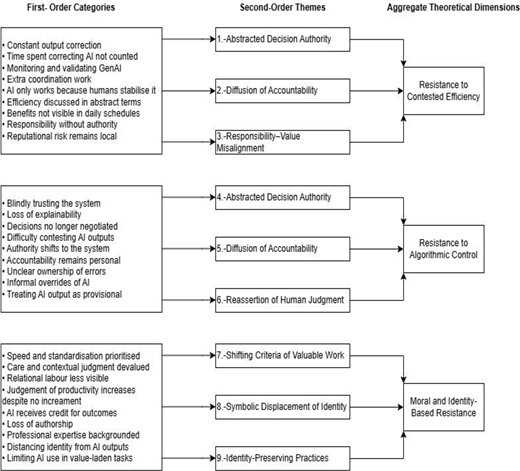
Data was analysed using the Gioia methodology (Gioia et al., 2013), following an inductive, informant-centric coding process progressing from first-order categories to second-order themes and aggregate dimensions (Braun and Clarke, 2006). Sensitising concepts from user resistance theory and sociotechnical systems research (Orlikowski, 1992; Laumer and Eckhardt, 2012) informed higher-level abstraction without pre-defining analytic categories. Coding focused on how organisational actors interpreted GenAI adoption when perceived benefits were abstract, unevenly distributed or institutionally distant.
Rather than classifying responses as acceptance or rejection, the analysis examined instances of uncertainty, hesitation and moral discomfort associated with Gen AI-enabled changes to work. These patterns were traced across organisational roles and triangulated with organisational documents related to GenAI initiatives, pilot projects and internal guidelines to assess alignment between formal framings and lived practice.
As shown in Figure 2, the analysis generated 29 first-order categories, which were iteratively consolidated into 9 s-order themes and 3 aggregate dimensions corresponding to the reported findings. This abstraction process indicates that GenAI resistance in SMEs is primarily moral and relational rather than technological in character.
3. Findings
3.1 Resistance to contested efficiency
Across the interviews, resistance frequently centred on a perceived disjunction between where GenAI-generated value was expected to accrue and where responsibility for making these systems function was located. While founders and senior managers framed GenAI as an organisational investment in efficiency or competitiveness, employees encountered it through the additional work required to stabilise, correct and legitimise Gen AI outputs in everyday practice.
Managers typically articulated GenAI benefits in aggregate terms, rarely linking them to specific roles or forms of redistributed recognition. By contrast, frontline employees evaluated GenAI through its immediate operational consequences, where adoption entailed monitoring outputs, correcting errors and absorbing reputational or relational risk when systems underperformed. This tension was particularly sharply felt by employees in client-facing roles, where the gap between managerial productivity claims and operational reality became part of everyday work:
“We have been told that the key feature of the system is accuracy and productivity but I don’t feel changing every draft is very productive especially when there are so many errors. When a client calls me back because the information was wrong, I’m the one who has to explain it. If something goes wrong, it’s still our name on it, not the AI’s.” (P18-staff)
This configuration positioned employees as de facto custodians of GenAI performance without corresponding authority over its use or the distribution of its benefits. The disruption was not confined to employees: middle managers also described a loss of process visibility, as GenAI introduced an opaque layer between decision and output that had previously been transparent through direct coordination with staff:
Now it is difficult to assess the process. Previously I had better connection with what employees were doing, so if there were discrepancies we knew exactly where and when it happened and we could solve the issue quickly. Now we spend some more time hunting mistakes. (P7-Manager).
Resistance did not take the form of open opposition. Instead, employees recalibrated their engagement to manage accountability, selectively using GenAI tools, limiting reliance on its outputs for consequential decisions or distancing themselves from responsibility when outcomes were uncertain. This recalibration was often task-specific, with employees establishing parallel manual processes to verify GenAI outputs in work where accuracy was personally consequential:
The tool is there and I am not saying it’s bad at all, but for example when it comes to order placement I rather do it on Excel, then I can double-check if the output is the same in the AI tool but at least I tell the order is accurate. I don’t want to be in the spotlight for messing with the order. (P35, Employee).
In a small number of cases, resistance softened when GenAI adoption was accompanied by visible and locally meaningful redistribution not of workload, but of information about the system itself, including access to vendor briefings and technical details that had initially remained with ownership. One owner described how initial employee hesitation, which had first been interpreted as a misunderstanding of benefits, prompted a change in approach:
I spent some good amount of money on the tool and I was briefed clearly by the company who procured it. I think it is just for all of us to adapt, but I think just some employees don’t understand wholly the benefits. As I shared more and was able to sit down with some of the managers to fully explain more features and ask them to contact the vendor, there were some improvements. (P62, Owner).
These accounts suggest that resistance to GenAI’s invisible gains reflects contestation over an emerging reorganisation of work in which responsibility is redistributed downward while value and information about the system remain opaque. In the proximate organisational settings that characterise SMEs, this dynamic was not absorbed at any intermediate layer: employees experienced it directly as unrecognised labour, managers as eroded process visibility and owners as misunderstood benefit yet in each case, resistance softened only where redistribution of information, access or workload made the organisational consequences of GenAI adoption locally meaningful.
3.2 Resistance to algorithmic control
A second pattern of resistance concerned how GenAI reshaped decision-making authority by introducing forms of control that were difficult to locate, explain, or contest. Participants described GenAI not as a neutral support tool but as an abstract decision-making presence that altered how choices were justified and how responsibility was assigned. In SMEs, where authority had historically been exercised through direct conversation between colleagues who know each other, this shift was experienced as a loss of the relational reasoning that had previously accompanied organisational decisions. An employee described how a GenAI-driven pricing adjustment left them without the explanations they would previously have been able to seek and exposed to the consequences when those adjustments were questioned externally:
The system has optimised some of the pricing of the products. To me it just doesn’t make sense, as they were slightly higher than before. So when I asked the management, they told me to just follow as it is part of the optimization, no more explanations. But one of the clients complained about the sudden increase, I was caught in between, and I just told the manager to respond to them directly.’ (P49, Employee).
This displacement of relational reasoning did not remove human accountability; instead, it was relocated upward without redistributing the epistemic resources required to exercise it. Managers in particular found themselves caught between employee requests for verification, their own limited understanding of GenAI outputs and the lack of alternatives to vendor support. A manager described the accumulating coordination burden:
Now I get an avalanche of requests from employees to check some of the output given by the GenAI tool when it comes to client reports. I also don’t fully understand all decisions and just keep on talking to the vendor help desk. I can’t just tell employees to go ahead but this is taking us more time to fix than optimise. (P75, Manager).
Authority was thus experienced as moving upward and outward towards systems and vendors, while responsibility remained personal and local. In SMEs, where managers have historically been close enough to their staff to explain and defend decisions, this accountability gap was particularly acute there was no intermediate function (a technology team, a dedicated data analyst) to absorb it.
In response, employees engaged in adaptive practices that neither rejected GenAI outputs nor accepted them at face value, treating recommendations as a starting point for relational deliberation rather than as directives. An employee described how GenAI-generated menu recommendations were filtered through collective discussion and practical constraints before any changes were made:
We can’t change all menu items based on the recommendations we got from the AI, but it does help us to see patterns and that is a good start. We still need all to sit down and discuss what is possible, also checking with the food supplier if it doesn’t go over their capacity. (P52, Employee).
This pattern of calibrated engagement using GenAI to surface patterns while preserving collective deliberation and stakeholder coordination was characteristic of SMEs where operational decisions involved the same individuals across multiple functions.
In a limited number of cases, resistance softened not through managerial reframing, but where employees possessed genuine epistemic access to the system. Across the sample, most employees lacked even a basic understanding of how the GenAI tool extracted data or produced its recommendations. However, in firms where employees had been involved in constructing the system contributing the operational inputs on which it drew and understanding how data was structured within their functional area the tool’s outputs became interpretable and therefore contestable on substantive rather than oppositional grounds.
3.3 Moral and identity-based resistance
Beyond concerns about value distribution and algorithmic authority, resistance also emerged around perceived shifts in how work was morally evaluated and symbolically recognised. Participants framed this resistance not in terms of functionality, but in terms of what GenAI appeared to redefine about legitimate contribution, judgement and organisational purpose.
This was most pronounced among employees whose professional identity was grounded in craft, creativity or relational expertise. In these roles, GenAI was not experienced as displacing tasks but as diminishing the authorship and originality that gave work its meaning. An employee at a creative studio described the introduction of a GenAI image-creation tool:
We’ve been introduced with this tool for image creation. It works, but it is just not my work. It is often not what I picture in my mind, it is just like copying images from Google. (P41, Employee).
For owners and managers, the identity concern operated at an organisational level. Rather than questioning whether GenAI worked, they questioned what its use signalled to clients and competitors and whether it undermined the distinctive value proposition on which the firm depended. A manager articulated this as an existential concern for the business:
I am just worried in using the tool to advise clients. Somehow now we fear they know we use such a tool and they just start using similar tools then we have nothing to offer to clients and business is over. (P5, Manager).
In a small number of cases, resistance was reconfigured when organisations drew explicit boundaries around what GenAI would and would not replace preserving the relational and evaluative dimensions of work as distinctly human while accepting the tool’s contribution in areas where it expanded rather than substituted professional judgement:
We feel the tool helps us better to advise clients on job placement as it gives options in jobs we didn’t think of before. But we still need our expertise in which we get to know the client, talk and choose what is most suitable based on their personality and needs. (P22, Employee).
Overall, moral and identity-based resistance reflects not opposition to GenAI, but negotiation over how work, dignity and authorship are recognised under shifting evaluative regimes. In SMEs, where professional identity is closely bound to the organisation’s market position and relational reputation, this negotiation carries particular weight: what the tool does to individual craft also reshapes what the firm signals to the markets it serves.
4. Discussion
This study examined why small- and medium-sized enterprises (SMEs) resist the adoption of GenAI when such technologies are introduced under promises of improved working conditions. The findings show that resistance does not primarily stem from technological incapacity or automation anxiety, but from a problem of evaluability: organisational actors struggle to determine whether, how and for whom GenAI adoption meaningfully improves work; a struggle intensified by the hierarchical, functional and coordination proximities through which SMEs organise everyday work. This dynamic is conceptualised as resistance to “invisible gains”, defined as follows:
Invisible gains refer to situations in which GenAI-generated benefits are articulated at an organisational level but remain opaque, abstract, or weakly translated into everyday work experience, particularly when the effort and risk of making GenAI systems function are borne locally.
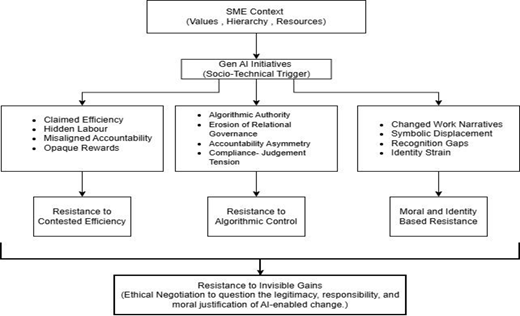
This form of resistance is structured around three interrelated tensions. First, GenAI’s co-productive character generates hidden labour; prompting, correcting, supervising, which is borne by employees and managers locally while efficiency gains are claimed organisationally. Second, GenAI reshapes decision-making authority by producing recommendations that guide action without transparent rationale, displacing the relational reasoning through which SMEs have historically negotiated choices. Third, GenAI unsettles professional identity not by replacing tasks but by shifting what counts as legitimate contribution from craft, judgement and relational expertise towards speed, output and system-generated metrics. Resistance therefore targets not GenAI as a technical artefact, but the organisational arrangements through which its benefits are claimed, governed and justified arrangements that in SMEs are personal, proximate and unmediated by formal structures.
Figure 3 integrates these findings into a conceptual framework that conceptualises resistance as a configurational condition in which resistance to contested efficiency, resistance to algorithmic control and moral and identity-based resistance occur simultaneously and mutually reinforce one another, rather than unfolding sequentially or hierarchically.
4.1 Theoretical contributions
This study advances understanding of the social impact of GenAI in small business by showing that evaluability, the foundational assumption of dominant resistance frameworks (Joshi, 1991; Martinko et al., 1996; Kim and Kankanhalli, 2009), breaks down in a distinctive way with GenAI. Unlike back-end AI systems whose opacity has been well documented, GenAI creates an evaluability paradox: its co-productive, user-facing character makes the technology feel accessible and functional while rendering the organisational distribution of value, accountability and recognition difficult to assess. Employees do not resist because GenAI fails, but because they cannot determine for whom it succeeds. This is where GenAI’s social impact in SMEs takes shape and, at the same time, becomes invisible: while broader debates locate that impact at the level of the technology and the economy (Storey et al., 2025), in SMEs it is felt in how the benefits, burdens and recognition of adoption are distributed among its employees. The hierarchical, functional and coordination proximities that define SME organisation (Torres, 2004; Torrès and Julien, 2005) are precisely what GenAI destabilises: efficiency claims bypass relational reasoning, invisible labour accumulates across undifferentiated roles and algorithmic recommendations displace informal coordination. GenAI thus erodes the very arrangements through which SMEs have historically evaluated work, distributed value and sustained accountability, so that its social impact is not delivered by the technology but produced through how these proximities absorb it.
The primary theoretical contribution of this study lies in reconceptualising resistance to GenAI not as an obstacle to adoption but as a form of situated ethical negotiation. The findings show that when employees recalibrate their engagement, when managers flag accountability gaps and when owners revisit how information and access are distributed, resistance functions as organisational feedback surfacing how GenAI’s social impact, the way its benefits, burdens and recognition are distributed, is misaligned with the moral economy of work. Crucially, where organisations responded to this feedback by redistributing information about the system, by preserving space for relational deliberation, or by drawing explicit boundaries around human-led work, resistance was not eliminated but reconfigured into conditional and productive engagement. Because a tool’s effect on work depends on how roles are designed around it rather than on the technology itself (Parker and Grote, 2022), these responses show that such work-design choices are not managerial givens, but terrain contested and negotiated through resistance. This positions resistance as a critical organisational capacity in AI-mediated contexts rather than a symptom of technological immaturity, and suggests that SMEs’ proximity-based governance, far from being a liability, may offer an advantage: the directness of relational feedback enables faster recognition of misalignment than formalised structures typically allow.
Finally, this study shifts where the social impact of GenAI in small business is decided. Because ethical principles do not by themselves ensure beneficial use (Mittelstadt, 2019), it is organisational practice, rather than policy or design, that determines how the benefits, burdens and recognition of adoption are distributed (Spiekermann and Winkler, 2020; Zuboff, 2019). Resistance is the mechanism through which this distribution can be questioned and realigned with the conditions for decent work (SDG-8) and accountable innovation (SDG-9) (Bankins and Formosa, 2023).
4.2 Practical implications
The findings suggest that resistance to GenAI in SMEs should be approached not as a barrier to adoption, but as a practical signal of how GenAI-enabled change is experienced and morally negotiated across organisational roles. Addressing resistance is central to sustaining decent work in GenAI-mediated settings (SDG-8) and guiding accountable innovation (SDG-9) and requires differentiated responses attentive to the distinct position each actor occupies. Table 1 translates this into a role-differentiated diagnostic that owners, managers and employees can apply directly, linking the signal each role exhibits to its underlying issue and the response it calls for.
Across all three roles, the checklist tracks a single question: whether the benefits, burdens and recognition of GenAI are being distributed and acknowledged, or quietly absorbed. Its value is to reframe resistance as information, surfacing accountability carried without the knowledge to exercise it, or correction work performed without recognition, so that the workarounds employees develop are read as practical intelligence rather than non-compliance. Acting on these signals is what keeps adoption aligned with decent work (SDG-8) and accountable innovation (SDG-9). Two cautions follow from the present study, however. First, these responses are derived from Dutch SMEs with flat hierarchies and high digital literacy; they are reasoned starting points rather than validated prescriptions, and resistance was observed to soften where firms responded, not shown to do so as a controlled effect. Second, the same visibility that enables recognition can enable control: logging errors and work patterns can support improvement, but also surveillance, and the distinction lies in whether employees retain a genuine voice in how the information is used.
Web Appendix A (Supplementary Material) develops this logic into a standalone diagnostic guide.
4.3 Limitations and future research
This study has its limitations. The analysis draws on Dutch SMEs characterised by flat hierarchies, direct communication norms and high digital literacy, conditions that may make proximity-based resistance unusually visible and that limit transferability to SMEs with steeper hierarchies or lower digital maturity. Then, resistance was observed at a single point in time, so the study describes how resistance is configured rather than how it evolves. The responses associated with resistance softening, information redistribution, collective interpretation and employee involvement, emerged from the accounts analysed and are associations rather than demonstrated effects; the design does not permit causal claims about what reconfigures resistance. Finally, as an interpretive qualitative study, the findings are intended to build theory rather than test it; although informed by observation, they rely substantially on participant accounts and reflect how resistance was reported and interpreted. GenAI tools were used in preparing this manuscript for language refinement only, as disclosed in full in Web Appendix B (Supplementary Material).
These boundaries mark productive directions for future work. Comparative research across SME contexts with different hierarchical and cultural norms would test the scope of the framework, while longitudinal designs could establish whether the responses identified here reconfigure resistance durably. As GenAI shifts from discrete prompting tools towards agentic and embedded systems, further research should examine how these dynamics change when GenAI becomes an embedded operational layer rather than a tool employees consciously engage.
References
Supplementary material
The supplementary material for this article can be found online.