


This study examines the direct effect of conscious leadership on organizational culture in small and medium-sized enterprises (SMEs) and tests whether higher purpose mediates this relationship, thereby advancing understanding of the micro-to-meso translation processes within conscious capitalism.
A cross-sectional survey of 115 Mexican SMEs was conducted. Data from senior executives were analyzed using partial least squares structural equation modeling (PLS SEM). Mediation was tested via bootstrapping with 5,000 resamples, and robustness checks addressed common method bias and predictive validity.
Conscious leadership has a strong direct effect on conscious culture (β = 0.512, p < 0.001). Higher purpose partially mediates this relationship (indirect effect β = 0.198, p = 0.007), revealing complementary behavioral and sensegiving pathways that together explain 55.1% of the variance in conscious culture.
SME leaders can embed higher purpose through purpose-based decision checklists, purpose-linked KPIs and stakeholder scorecards tracking safety, decent work and customer trust. Leadership development should train owner-managers as meaning makers skilled in sensegiving. At the policy level, existing SME training programs and public financing schemes could incorporate purpose-articulation modules at low cost, embedding ethical reflection into established support mechanisms without significant additional burdens.
Despite growing attention to conscious leadership and purpose, empirical research on how leaders shape culture in SMEs remains scarce – particularly in emerging economies such as Mexico, where strong founder imprinting and weaker formal institutionalization make leadership influence especially salient and observable. By theorizing and empirically testing higher purpose as a sensegiving mechanism, this study moves conscious capitalism toward greater explanatory rigor, offering a dual-pathway framework for cultivating ethical cultures through leadership enactment and purposeful institutionalization.
1. Introduction
Over the past decades, management scholarship has increasingly examined the role of consciousness, meaning, and ethics in organizational life. This shift responds to growing social, economic, and environmental challenges that have intensified scrutiny of traditional capitalist models (Ajmal et al., 2024; Marcus et al., 2010; Robra et al., 2025). Research on conscious leadership, purpose-driven organizations, and humanistic management has challenged conventional economic models by stressing stakeholder integration, moral awareness, and long-term value creation (Avolio and Gardner, 2005; Fry and Slocum, 2008; Waldman and Balven, 2014).
Within this movement, the framework of conscious capitalism proposed by Sisodia and Mackey (2014) has been particularly influential. It articulates four interdependent tenets—higher purpose, conscious leadership, conscious culture, and stakeholder orientation—as foundations of sustainable organizational performance. Originally framed as a normative approach to place business in service of human flourishing, conscious capitalism has become a key reference for studying purpose, leadership, and culture as organizational-level phenomena (Gartenberg et al., 2019; Rodríguez-Aceves et al., 2025; Waldman and Balven, 2014).
However, leadership studies often treat culture merely as a downstream outcome of leaders' values or behaviors. This leaves the underlying transformation processes theoretically underdeveloped (Alvesson and Sveningsson, 2015; Glynn and Raffaelli, 2010; Schein, 2010). The limitation is especially relevant because culture is an emergent phenomenon. It arises through collective sensemaking and social interaction rather than from individual cognition or intent alone (Hatch and Schultz, 2002; Weick, 1995). This gap has prompted debates about the theoretical rigor and empirical grounding of conscious capitalism, questioning its ability to explain organizational dynamics beyond prescribing ideal outcomes (O'Toole and Vogel, 2011).
This tension matters for two main reasons. First, without a clear explanation of how conscious culture emerges, research risks treating culture as an aspirational ideal instead of a socially constructed phenomenon (Alvesson, 2013; Schein, 2010). Second, leadership scholars have called for greater attention to micro-to-macro linkages—specifically, how leaders' values and sensegiving activities translate into collective organizational properties (Felin et al., 2015; Dinh et al., 2014).
These micro-to-meso processes are likely to be most visible in contexts where leadership imprinting is strong and formal structures are weak. Small and medium-sized enterprises (SMEs) in emerging economies offer such a setting. In Mexico, SMEs represent 4.7 million firms, generate 52% of business income, and employ 27 million people (68.4% of total employment) (Secretaría de Economía, 2024). These firms are typically founder-led, with limited professionalization and weak formal governance (Howell et al., 2007). This concentration of leadership authority makes the founder's influence on purpose and culture more observable than in larger, bureaucratized organizations (Jardon and Martinez-Cobas, 2019). Moreover, Mexico's institutional gaps—such as weak regulatory enforcement and limited access to formal financing—increase reliance on informal cultural mechanisms and on the leader as sensegiver. Thus, the country becomes a critical testing ground for purpose-driven theories developed mainly in advanced economies (Aguinis et al., 2020).
To examine how conscious leadership, understood as a firm-level attribute, translates into conscious culture under these conditions, this study investigates the mediating role of higher purpose in Mexican SMEs. Drawing on sensemaking theory (Weick, 1995), sensegiving and framing research (Cornelissen, 2012; Weiser, 2021), and institutional perspectives on culture (Schein, 2010), we propose that conscious leadership influences conscious culture through both enactment-based and meaning-based pathways. In this view, higher purpose acts as a complementary mechanism that translates leadership awareness into shared meaning. Although purpose has gained prominence in management theory, it remains undertheorized as a dynamic meaning system in shaping organizational culture (Gioia et al., 2013; Chua et al., 2024).
We test this model with survey data from 115 Mexican SMEs—a context where leadership influence, purpose articulation, and cultural imprinting are tightly coupled. Data were collected from top managers or directors as knowledgeable organizational informants, consistent with prior studies that treat leadership, culture, and purpose as organizational-level phenomena (Huber and Power, 1985; Kumar et al., 1993; Starbuck and Mezias, 1996). This firm-level approach aligns measurement with theory and avoids multilevel complications (Kozlowski and Klein, 2000). Measurement scales were adapted from established instruments in the conscious capitalism literature and were rigorously validated. The proposed relationships were examined using partial least squares structural equation modeling (PLS-SEM), which is well suited for theory development and mediation analysis in complex organizational models (Hair et al., 2022).
The study contributes to leadership and culture research by extending conscious leadership beyond individual-level effects, advancing a processual view of higher purpose, and providing a theoretically grounded explanation of how leadership influence becomes culturally embedded in SMEs.
2. Theoretical background
2.1 Conscious capitalism as an integrative but undertheorized framework
Conscious capitalism has emerged as an influential paradigm that challenges traditional profit-maximization logic. It foregrounds ethical awareness, stakeholder integration, and purpose-driven value creation. The framework offers a holistic organizing logic that embeds higher purpose into strategy and day-to-day decisions. It aligns stakeholder interests through conscious leadership and a conscious culture (Sisodia, 2011).
In Latin American contexts, conscious capitalism is especially visible as a sensemaking and legitimacy process. Here, purpose becomes consequential only when stakeholders collectively interpret, negotiate, and institutionalize it while balancing economic and social demands (Rodriguez-Aldana et al., 2024).
Mackey and Sisodia (2013) articulate the framework around four interdependent tenets: higher purpose, stakeholder integration, conscious leadership, and conscious culture. These tenets are designed to function as a holistic organizational system rather than isolated practices. Unlike traditional corporate social responsibility, which often treats social concerns as peripheral or instrumental, conscious capitalism places purpose at the center of organizational life. It shapes leadership, strategy, and cultural norms (Fyke and Buzzanell, 2013; Mackey and Sisodia, 2013; George et al., 2023).
Conscious capitalism builds on and extends stakeholder theory and humanistic management. It emphasizes value creation for a broad set of stakeholders (Freeman et al., 2021). While much stakeholder research focuses on governance and performance outcomes, conscious capitalism advances an integrative view. In this view, leadership, culture, and purpose are mutually reinforcing elements of an ethical and sustainable organization (Ocasio et al., 2023a, b). This integrative approach explains its growing visibility in both practice and scholarship.
Despite its appeal, scholars have noted that conscious capitalism remains undertheorized as an organizational process model. The framework clearly describes what characterizes conscious organizations, but it offers limited explanation of how its core tenets interact and become institutionalized over time (Fyke and Buzzanell, 2013; Ocasio et al., 2023a, b). Many discussions portray higher purpose, leadership, and culture simply as coexisting traits in exemplary firms. They do not explain how leadership turns purpose into lasting cultural patterns. This risks rendering the framework more normative than theoretically grounded.
This limitation is especially evident in the relationship between conscious leadership and conscious culture. Existing accounts often assume that leaders' values and intentions imprint directly onto organizational culture. This assumption echoes long-standing critiques in leadership and culture research (Glynn and Raffaelli, 2010; Schein, 2010). From an organizational theory perspective, the omission is important: culture is an emergent, collective phenomenon. It cannot be directly engineered or imposed. Instead, it must be stabilized through shared meanings, norms, and practices that guide collective action (Hatch and Schultz, 2002; Weick, 1995).
This reveals a fundamental micro-meso theoretical gap. Conscious leadership operates at the individual or top-management level, whereas conscious culture constitutes an organization-wide system of shared meanings and practices. Without a clear articulation of the cross-level mechanisms through which leadership becomes institutionalized, the framework's integrative explanatory potential remains underdeveloped.
Responding to calls for greater attention to micro–macro mechanisms in organizational phenomena (Felin et al., 2015; Dinh et al., 2014), conscious capitalism offers a fertile yet underdeveloped context for theorizing how leadership becomes culturally embedded. Rather than testing the framework holistically, research should examine its internal dynamics and core interrelations. Accordingly, this study focuses on the most theoretically consequential yet underspecified linkage in conscious capitalism: the relationship between conscious leadership and conscious culture. We theorize higher purpose as the critical mechanism through which leadership is institutionalized as shared meaning. This advances conscious capitalism from a normative framework toward a more precise organizational theory that bridges leadership, culture, sensemaking, and organizational identification.
2.2 Conscious leadership beyond individual awareness
Research on conscious leadership has grown alongside interest in ethical, responsible, and humanistic management approaches. In the conscious capitalism framework, conscious leaders are self-aware, values-driven individuals committed to serving a higher purpose while balancing multiple stakeholder needs (Mackey and Sisodia, 2013). Related streams—servant, authentic, and responsible leadership—similarly emphasize moral awareness, relational orientation, and follower well-being (Avolio and Gardner, 2005; Maak and Pless, 2006; van Dierendonck, 2011).
Despite these contributions, most of this literature remains at the individual level. Conscious leadership is typically conceptualized as leader traits or behaviors that influence individual outcomes such as job satisfaction, engagement, and ethical conduct (Al-Asadi et al., 2019; Waldman and Balven, 2014). This approach frames leadership mainly as a psychological attribute rather than a social process that shapes collective meanings and practices. As a result, it offers limited insight into the cultural effects of conscious leadership beyond dyadic influence.
Recent leadership scholarship has called for moving beyond trait-based or behavioral accounts. Scholars now advocate a processual and multilevel conception of leadership (DeRue and Ashford, 2010; Dinh et al., 2014; Yammarino et al., 2005). From this perspective, leadership emerges through ongoing interactions, sensegiving activities, and institutionalized expectations. These elements structure how organizational members interpret and enact their roles. This shift is particularly relevant for conscious leadership, which aims not only to influence behavior but also to transform how organizational actors understand purpose, responsibility, and value creation.
Within the conscious capitalism literature, Mackey and Sisodia (2013) move in this direction. They integrate servant leadership with systems thinking and spiritual intelligence through the SELFLESS model. This model presents a constellation of capabilities that underlie conscious leadership. Rather than treating emotional, systems, and spiritual intelligence as isolated skills, the SELFLESS framework points to leadership as a meaning-oriented logic. It shapes how leaders perceive interdependence, articulate purpose, and relate to others. Spiritual intelligence acts as an internal compass that connects personal values with broader existential and organizational questions. It clarifies not only how leaders lead but also why they lead (Oh and Wang, 2020; Samul, 2020).
Conscious leadership should be theorized as an organizational process, not merely a set of moral traits. Focusing only on inner awareness risks reducing it to personal virtue. It misses how leaders shape shared interpretive frames that coordinate collective action and link the individual level to culture and systems (Gioia and Chittipeddi, 1991; Cornelissen, 2012; Weiser, 2021).
This distinction is especially important in SMEs. In these firms, founders often occupy overlapping leadership roles and their influence is highly visible and weakly buffered by formal structures (Oldham, 2024; Jardon and Martínez-Cobas, 2019). Here, leaders act as powerful imprinting agents. Their sensemaking and sensegiving shape organizational norms and expectations (Johnson et al., 2007). Thus, conscious leadership in SMEs operates not only as an individual orientation but as a dominant organizational logic for structuring purpose, decisions, and relationships.
Taken together, this research suggests reconceptualizing conscious leadership as an organizationally consequential process. Through this process, leaders construct, communicate, and stabilize meaning. This view is essential for explaining how conscious leadership shapes conscious culture. It also highlights the need for a mechanism that translates leadership awareness into shared cultural patterns. In conscious capitalism, higher purpose serves as this mechanism. It enables conscious leadership to transcend individual influence and become organizationally institutionalized.
2.3 Conscious culture as an emergent meaning system
Organizational culture has long been conceptualized as a collective and emergent phenomenon. It reflects shared assumptions, meanings, and patterns of interaction rather than formal policies or espoused values (Schein, 2010). Thus, culture is not something organizations have, but something they are. It is continuously reproduced through social interaction and sensemaking processes (Hatch and Schultz, 2002; Weick, 1995).
In conscious capitalism, “conscious culture” is often summarized by the TACTILE acronym—trust, accountability, caring, transparency, integrity, loyalty, and egalitarianism (Mackey and Sisodia, 2013). This acronym provides a useful descriptive vocabulary for identifying conscious cultural attributes. However, when treated merely as a checklist of values, the TACTILE model risks obscuring the underlying cultural dynamics through which these attributes emerge and cohere.
From an organizational theory perspective, conscious culture is defined less by specific values than by a trust-based relational system. This system enables coordination, commitment, and moral accountability. Trust—grounded in positive expectations of others' integrity and reliability—is a socially constructed outcome. It is sustained through repeated interactions marked by integrity and transparency (Schein and Schein, 2018; Schoorman et al., 2007). Integrity reflects alignment between espoused principles and enacted behavior, while transparency facilitates open information flows that reduce ambiguity and support informed participation (Kayes et al., 2007; Albu and Flyverbom, 2019).
Accountability further stabilizes trust by clarifying responsibilities and consequences. It makes coordinated collective action possible and anchors moral commitments in concrete practices (Prinsloo and Hofmeyr, 2022).
When integrity, transparency, and accountability become institutionalized as shared expectations, they foster relational outcomes such as caring, loyalty, and egalitarianism. Research on organizational compassion shows that acknowledging human vulnerability and interdependence creates cultures that value individuals as whole persons rather than mere role occupants (Kanov et al., 2017; Dutton et al., 2014). Loyalty emerges as a relational response to supportive, trustworthy environments rather than as a personality trait (Hart and Thompson, 2007). Egalitarianism embodies commitment to equal moral worth and inclusive participation through empowerment, shared decision-making, and intolerance of abuse or exploitation (Steckermeier and Delhey, 2019; Siegel et al., 2013).
Taken together, these elements suggest that conscious culture is best understood not as a collection of discrete values, but as an emergent configuration of relational meanings anchored in trust. The components captured by the TACTILE model can thus be interpreted as mutually reinforcing manifestations of an underlying cultural logic rather than independent dimensions. This interpretation aligns with prior work emphasizing that cultural elements derive their significance from their interrelationships and from the meaning systems that bind them together (Hatch and Schultz, 2002; Schein, 2010).
This perspective clarifies why conscious culture cannot be engineered through leadership actions alone. Because culture emerges from shared interpretations, leadership behaviors require stabilizing interpretive frames to endure. Without such frames, cultural patterns remain fragile or superficial. Accordingly, conscious leadership shapes conscious culture only through mediating mechanisms that translate awareness into shared meaning. The present study examines this dynamic through the lens of higher purpose.
2.4 Higher purpose as a meaning-making mechanism
Organizational purpose is defined as an enduring goal that provides meaning and legitimacy beyond profit (Hollensbe et al., 2014; George et al., 2023). Prior research shows that authentic purpose strengthens employee identification, intrinsic motivation, and resilience by aligning actions with transcendent goals (Ashforth et al., 2016; Gartenberg et al., 2019).
In conscious capitalism, higher purpose is foundational. It energizes leadership, integrates stakeholders, and coheres culture (Mackey and Sisodia, 2013). However, much of the literature—both within and beyond conscious capitalism—treats purpose as a static organizational attribute or outcome, such as a formal statement or general orientation. This approach underexplores how purpose actually becomes consequential in practice (Chua et al., 2024).
Recent developments portray purpose as a meaning-making system. From a sensemaking perspective, it acts as a higher-order interpretive frame. It answers why the organization exists, what constitutes valued action, and how competing demands should be prioritized (Weick, 1995; Cornelissen, 2012; Weiser, 2021). Purpose also functions as a sensegiving device that shapes shared understandings, legitimizes certain behaviors, and constrains others (Gioia and Chittipeddi, 1991).
To align our theoretical conceptualization with our empirical measurement, we define higher purpose as “an observable manifestation of the early institutionalization of sensegiving processes within the organization.” This definition bridges the theoretical view of purpose as a dynamic mechanism and its empirical operationalization as a collectively perceived mission. It treats employees' shared perception of a transcendent purpose not merely as a static attribute, but as evidence that leadership's sensegiving efforts have begun to take root in the organization's interpretive fabric.
This processual perspective aligns with research on identification and institutionalization. Purpose fosters identification by linking self-concepts to collective moral commitments (Ashforth et al., 2016; Pratt et al., 2006). When repeatedly invoked and reinforced, purpose becomes institutionalized as a taken-for-granted logic that structures interactions (Gehman et al., 2013; Ocasio et al., 2023a,b). Thus, higher purpose acts as a symbolic and normative mechanism that stabilizes meaning across actors and over time.
This mechanism is central to conscious leadership. Through sensegiving, conscious leaders articulate and enact a transcendent “why.” This integrates personal and organizational meaning and frames decisions and stakeholder trade-offs (Cornelissen, 2012; Oh and Wang, 2020; Samul, 2020). In Latin American contexts, purpose is often not a stable statement but a contested and continuously negotiated meaning system. It must be built through stakeholders' interpretations and interactions. Evidence from a Brazilian credit cooperative illustrates this dynamic: the legitimacy of strategic purpose emerges through a retrospective, socially constructed process that guides behavior while the organization balances economic and social aims in a competitive market (Furlanetto et al., 2023).
Higher purpose becomes consequential only through collective recognition and enactment. It fosters coordination and reduces rivalry, especially in SMEs where leader sensemaking is highly visible (Henisz, 2023; Kraatz et al., 2020; Jardon and Martínez-Cobas, 2019).
Accordingly, higher purpose functions as a translational mechanism. It links micro-level leadership intent to meso-level shared cultural expectations and mediates the relationship between conscious leadership and conscious culture.
2.5 Bridging conscious leadership and conscious culture
Although conscious leadership and conscious culture are widely viewed as mutually reinforcing, the mechanisms that embed leadership influence into culture remain underspecified. Drawing on leadership, culture, and sensemaking research, this study proposes a dual-pathway explanation.
First, conscious leadership shapes conscious culture through enactment-based processes. These include modeling behavior, establishing relational norms, and reinforcing expectations through everyday practices. Such effects are especially salient in SMEs, where leaders are highly visible. This is consistent with imprinting theory (Schein, 2010; Waldman and Balven, 2014; Johnson et al., 2007; Jardon and Martínez-Cobas, 2019).
However, enactment alone cannot account for the emergence of a durable conscious culture. Because culture is fundamentally meaning-based, leadership behaviors must be interpreted and stabilized through shared cognitive and normative frames. Without these frames, leadership influence remains fragmented or overly dependent on the individual leader (Weick, 1995; Hatch and Schultz, 2002). Thus, meaning-based processes are essential for embedding leadership in culture.
Second, conscious leadership may influence culture indirectly through higher purpose, which acts as a meaning-making and institutional mechanism. As previously argued, higher purpose serves as a shared interpretive framework. It articulates why the organization exists, what it stands for, and how competing demands are prioritized (Hollensbe et al., 2014; Ocasio et al., 2023a,b). Through sensegiving, conscious leaders construct and communicate purpose narratives that align individual meaning with organizational direction. This fosters collective identification and coordinated action (Gioia and Chittipeddi, 1991; Cornelissen, 2012; Weiser, 2021).
When higher purpose is repeatedly enacted and collectively internalized, it becomes institutionalized as a normative reference point. It then structures expectations, relationships, and cultural assumptions (Gehman et al., 2013; Kraatz et al., 2020). In this way, higher purpose translates leadership awareness and intent into shared meaning systems that underpin trust, integrity, care, and egalitarianism—the core elements of conscious culture.
Importantly, this indirect pathway complements rather than replaces the direct influence of leadership behaviors. It provides a coherent rationale that explains why certain practices and values matter.
This dual-pathway explanation has important implications for how mediation is conceptualized in leadership research. Rather than assuming a single causal mechanism, the framework recognizes that leadership influence operates through multiple coexisting processes—behavioral and symbolic—that jointly shape organizational outcomes (Dinh et al., 2014; Yammarino et al., 2005). Methodological research on mediation shows that partial mediation often reflects the presence of parallel causal pathways rather than theoretical inconsistency or model misspecification (MacKinnon et al., 2007; Preacher and Hayes, 2008).
Taken together, higher purpose functions as a complementary mediator between conscious leadership and conscious culture, rather than a substitute for direct leadership influence. Conscious leadership is therefore expected to affect conscious culture both directly through enactment and indirectly through the institutionalization of higher purpose as shared meaning. The model does not presuppose the dominance or exclusivity of either pathway.
This dual-pathway explanation formalizes the micro-to-meso translation process that is central to the study.
To test this theoretical configuration empirically, we propose the following hypotheses:
Conscious leadership positively affects conscious culture in SMEs.
Higher purpose mediates the relationship between conscious leadership and conscious culture in SMEs.
Figure 1 summarizes the proposed research model, illustrating the dual pathways through which conscious leadership may influence conscious culture.
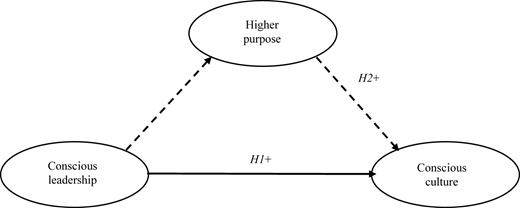
Relative to closely related empirical work that examines purpose primarily as an identity/performance feature (Bunderson and Thompson, 2009; Gartenberg et al., 2019) or leadership mainly through follower-level outcomes (e.g. Avolio and Gardner, 2005; Waldman and Balven, 2014), our study focuses on the micro-to-meso translation linking conscious leadership to conscious culture. Specifically, we test higher purpose as a mediating meaning mechanism in Mexican SMEs, extending predominantly descriptive conscious-capitalism accounts by empirically estimating how the tenets interact rather than assuming they co-occur.
This complements emerging Latin American work that treats purpose as negotiated and legitimized through stakeholder sensemaking (Furlanetto et al., 2023; Rodríguez-Aldana et al., 2024) by specifying and testing the within-firm mechanism through which purpose becomes culturally consequential.
3. Methodology
3.1 Research design and analytical approach
A cross-sectional quantitative research design was adopted to examine the relationships between key dimensions of conscious capitalism—namely, conscious leadership, higher purpose, and conscious culture—in the context of small and medium-sized enterprises (SMEs). Given the theoretical interest in mediation among latent variables, a structured survey was used to collect standardized responses, enabling rigorous hypothesis testing within a diverse SME sample (Bryman, 2016). This design is appropriate for theory-testing studies involving abstract constructs such as values, leadership styles, or organizational culture (Podsakoff et al., 2003). While this design is appropriate for theory-testing involving abstract constructs, it is important to note that it captures theoretically grounded associations among constructs rather than enabling causal identification.
To clarify the level of analysis and ensure conceptual alignment, all constructs were conceptualized and measured at the firm level and captured through key informants' assessments of shared organizational practices. While leadership originates from individuals, the study focused on leadership as a shared organizational phenomenon, in line with scholars that view leadership as a culture-shaping force (Denison, 1996; Brown and Treviño, 2006). Consistent with this firm-level orientation, the informants were asked to report on observable organizational characteristics, not on personal attitudes or individual-level perceptions. Therefore, a single-level SEM approach was deemed appropriate, as both predictor and outcome variables were aggregated at the firm level and assessed by informants with comprehensive organizational insight (Kozlowski and Klein, 2000). As such, the design prioritizes the examination of theoretically consistent relationships over the identification of temporal or causal ordering among constructs.
Partial least squares structural equation modeling (PLS-SEM) was selected for various methodological reasons. First, it is recommended for complex models with latent variables and is robust with moderate sample sizes, prioritizing predictive power and variance explanation (Hair et al., 2022; Henseler et al., 2016). Second, PLS-SEM does not require the assumption of multivariate normality, making it suitable for analyzing ordinal survey data that often exhibit non-normal distributions (Sarstedt et al., 2017). Third, unlike covariance-based SEM (CB-SEM), which emphasizes global model fit, PLS-SEM is oriented toward prediction and theoretical exploration, aligning with the goal of examining the predictive influence of conscious leadership on culture via higher purpose (Hair et al., 2022).
All constructs were specified as reflective measurement models, where indicators are manifestations of underlying latent variables. This specification is consistent with prior literature on leadership and culture and follows established criteria for reflective measurement models (Jarvis et al., 2003).
The sample size of 115 was evaluated against SEM-specific power recommendations. According to Hair et al. (2022), a sample between 29 and 63 observations is sufficient to detect standardized path coefficients above 0.3 with 80% power. The achieved sample exceeds even conservative thresholds for detecting moderate effects (pmax >0.2, which requires 51–112 cases), confirming adequate statistical power for hypothesis testing.
SMEs are selected as the empirical context due to their prominence in emerging economies and reliance on founder-led leadership, where top management directly shapes organizational purpose and culture (Wasserman, 2012). In such settings, conscious leadership is likely to exert stronger imprinting effects than in larger, more decentralized firms (Marquis and Tilcsik, 2013), rendering this context theoretically appropriate for the study's objectives.
3.2 Sample and data collection
To empirically test the proposed model, data were collected from a sample of Mexican SMEs through a structured survey. Specifically, a self-administered online survey was distributed via email to a privately owned database of 250 SMEs, who are partners of the Tecnologico de Monterrey, a private university in Mexico. The database was provided and managed by the university's outreach office, whose mission is to foster collaborative partnerships with regional companies to co-create educational and development programs.
The target population consisted of small and medium-sized enterprises (SMEs) located in Mexico's western region, specifically in the states of Sinaloa, Chihuahua, Aguascalientes, Sonora, Guanajuato, Michoacan, and Jalisco. The survey was addressed to CEOs, general managers, or other senior executives who possessed a comprehensive, firmwide perspective on leadership practices, strategic purpose, and organizational culture. These individuals were selected as key informants, a well-established practice in strategic management research when seeking reliable firm-level assessments (Homburg et al., 2012; Kumar et al., 1993; Starbuck and Mezias, 1996). Although single-informant designs have inherent limitations, empirical evidence indicates that data provided by top executives on organizational-level constructs demonstrate adequate reliability and validity, particularly when those executives are closely involved with the firm's strategic direction (Homburg et al., 2012; Starbuck and Mezias, 1996). To reduce common method bias and encourage objective reporting, the survey instructions explicitly asked respondents to describe observable organizational characteristics and behaviors rather than express personal opinions.
The final sample comprised 115 valid responses (46% response rate), which, as noted in the previous section, exceeds established power thresholds for SEM. All responses were screened for completeness, consistency, and adherence to SME classification criteria (based on employee count). Incomplete, duplicate, or ineligible responses were removed. Although only one respondent per firm was included, the sample comprised 70% directors, 24% managers, and 5% board members. This distribution reinforces the credibility of the responses, given the seniority and strategic insight of the participants. Moreover, prior research shows that top executives provide reliable and valid assessments of organizational-level constructs, particularly when closely involved in strategic decision-making (Homburg et al., 2012; Starbuck and Mezias, 1996).
The resulting sample exhibits considerable heterogeneity in terms of firm age, size, and sector, which enhances the robustness of the subsequent structural analyses. Regarding firm age, 19% of the firms were recently established (less than three years), 50% had been operating for 4–20 years, and 31% had been in business for more than 20 years. In terms of size, 53% employed fewer than 10 people and 30% employed between 11 and 250 people, aligning with Mexico's official SME classification. Sectoral distribution was also diverse: 56% of firms operated in services, 31% in commerce, and the remainder in manufacturing and other industries.
The sampling method was non-probabilistic (convenience-based), which limits the statistical generalizability of the findings. While this approach may introduce sampling bias, it is common in SME research due to the well-documented challenges of obtaining probability samples from this population (Deligianni et al., 2016). Additionally, the collaboration with a respected academic institution enhanced the credibility and diversity of the sample, mitigating some of the typical weaknesses of non-probability designs.
All participants were informed about the academic purpose of the study, the voluntary and anonymous nature of their participation, and their right to withdraw at any time. No incentives were offered.
3.3 Measures
The core constructs—conscious leadership, higher purpose, and conscious culture—were measured using adapted scales in a five-point Likert format (1 = “strongly disagree” to 5 = “strongly agree”), consistent with best practices in organizational survey research (Podsakoff et al., 2003).
Measurement items were adapted from the Conscious Capitalism Summary Audit (Sisodia and Mackey, 2014), a practitioner-oriented instrument designed to assess the implementation of conscious capitalism principles. To transform this tool into a validated research instrument suitable for our context, a rigorous two-stage adaptation process was followed. First, items were aligned with the foundational theoretical definitions of conscious leadership, higher purpose, and conscious culture as articulated by Mackey and Sisodia (2013). Second, wording was contextualized for SMEs in Latin America while preserving the original conceptual meaning. The translated items underwent a standard back-translation procedure by bilingual experts and were pre-tested for clarity and relevance with a small panel of managers (n = 5) (Brislin, 1976).
Construct definitions were as follows. Higher purpose was conceptualized as an observable manifestation of the early institutionalization of sensegiving processes—captured empirically through key informant's shared perception of the organization's commitment to a transcendent mission that creates long-term value for all stakeholders, beyond financial profit (Mackey and Sisodia, 2013; Gartenberg et al., 2019). Conscious leadership was defined as a leadership style characterized by high self-awareness, ethical grounding, and a stakeholder-oriented perspective (Brown and Treviño, 2006; Rego et al., 2012). Conscious culture refers to the shared organizational values and norms that promote integrity, trust, transparency, and care (Denison, 1996; Cameron and Quinn, 2011).
All constructs were modeled as reflective, and psychometric validation was conducted. Reliability was confirmed as Cronbach's alpha and composite reliability (CR) for all constructs exceeded the 0.70 threshold (Fornell and Lacker, 1981; Hair et al., 2022; Nunnally, 1975) (see Table 1).
Indicators loadings, convergent validity, and reliability tests
| Latent variable | Items | Standardized Loading | Squared multiple correlation | Cronbach α | Composite reliability (CR) | Average variance extracted (AVE) | Variance inflation factors (VIF) | Goodness of fit |
|---|---|---|---|---|---|---|---|---|
| Conscious culture | CC1 | 0.855 | 0.731 | 0.830 | 0.839 | 0.753 | 1.72 | SRMR = 0.038 |
| CC2 | 0.880 | 0.774 | 2.26 | |||||
| CC3 | 0.868 | 0.753 | 2.11 | NFI = 0.836 | ||||
| Conscious leadership | CL1 | 0.851 | 0.724 | 0.860 | 0.87 | 0.79 | 1.98 | |
| CL2 | 0.926 | 0.857 | 3.33 | Chi-sq = 107.3 | ||||
| CL3 | 0.892 | 0.796 | 2.56 | |||||
| Higher purpose | HP3 | 0.859 | 0.738 | 0.840 | 0.85 | 0.77 | 1.83 | |
| HP4 | 0.861 | 0.741 | 2.11 | |||||
| HP5 | 0.902 | 0.814 | 2.50 |
Note(s): For all measurement items, five-point Likert scales were used (i.e. 1 strongly disagree, 5 strongly agree)
Convergent validity was established as all indicator loadings met or exceeded the 0.70 significance-loading threshold (Carmines and Zeller, 1979; Hair et al., 2019), and the average variance extracted (AVE) for each construct was above 0.70, indicating that the items can explain more than 50% of their intended latent variable (Hair et al., 2022).
Discriminant validity was assessed via the Fornell–Larcker criterion, the heterotrait–monotrait ratio (HTMT), and cross-loadings. The diagonal AVE square roots exceeded inter-construct correlations (Fornell and Larcker, 1981), and HTMT values were below 0.90 (Hair et al., 2019; Kock, 2020) (see Table 2). No problematic cross-loadings were observed. In other words, the analysis demonstrated the existence of discriminant validity (Hair et al., 2019).
Discriminant validity: Fornell-Larcker criterion and heterotrait monotrait ratio (HTMT) results
| Fornell-Larcker criterion | HTMT results | |||||
|---|---|---|---|---|---|---|
| 1 | 2 | 3 | 1 | 2 | ||
| 1 | Conscious culture | 0.868 | ||||
| 2 | Conscious leadership | 0.709 | 0.890 | 0.827 | ||
| 3 | Higher purpose | 0.638 | 0.672 | 0.874 | 0.753 | 0.779 |
Note(s): HTMT stands for Heterotrait Monotrait Ratio
The psychometric validation process yielded a final, robust set of three items per construct (nine items total), which demonstrated strong reliability and validity. This final set provides a precise operationalization of the theoretical constructs. Conscious Leadership was measured by items reflecting leaders' self-awareness and service orientation (CL1), their stakeholder-oriented systems thinking (CL2), and the integration of virtue and integrity into formal leadership succession (CL3). This operationalization aligns with our firm-level conceptualization of leadership as a shared organizational phenomenon. Conscious Culture was measured by items embodying norms of integrity and truthfulness (CC1), compassion for stakeholders (CC2), and empowerment to act ethically (CC3). Higher Purpose was measured by items capturing the organization's guiding vision for a better world (HP3), the intrinsic employee commitment to that purpose beyond financial rewards (HP4), and the perceived creation of value for customers and community (HP5).
The final survey presented items in random order to reduce common method bias. Example items included “Our leaders are intuitive systems thinkers” (Conscious Leadership); “Employees in our company are empowered to do the right thing at all times” (Conscious Culture); and “Our employees believe the company creates positive value for the customer and community” (Higher Purpose). The full item set, adapted from Berens and Van Riel (2004), Jackson (2020), List (2006), Wartick (2002), and Sisodia (2017), is provided in Appendix.
In summary, the measurement model demonstrated strong reliability, convergent validity, and discriminant validity, satisfying criteria for reflective constructs in structural equation modeling (Hair et al., 2022; Bagozzi and Yi, 1988).
3.4 Data analysis
3.4.1 Common method bias
As the data for both predictors and outcomes were collected from a single informant per firm, common method bias (CMB) was a potential concern (Podsakoff et al., 2003). To address this, the full collinearity assessment approach (variance inflation factor, or VIF approach) proposed by Kock and Lynn (2012) and Kock (2015) was employed. This technique constitutes a robust statistical remedy for CMB within variance-based SEM, as it evaluates bias directly within the specified structural model. Its selection follows contemporary methodological guidelines, as it provides a direct statistical test for pathological collinearity, offering a conservative and integrative assessment (Kock, 2015; Podsakoff et al., 2003). The procedure was implemented in the SmartPLS model as follows: (1) a common latent factor with randomly generated values was added, and (2) all reflective indicators from each construct were specified as indicators of this factor. The inner variance inflation factors (VIFs) for the paths from the common latent factor to the endogenous constructs were then inspected.
According to Kock's (2015) conservative threshold, a VIF value equal to or greater than 3.3 indicates harmful collinearity that could be attributed to a common source. In this analysis, all inner VIFs ranged from 1.6 to 1.9, which are substantially below this critical cutoff (see Table 1). Therefore, results suggested that common method variance was not a significant confounding factor in the structural model.
3.4.2 Descriptives and correlations
Table 3 presents means, standard deviations, and inter-construct correlations for the validated scales and control variables. The mean scores were high, ranging from 4.30 (Higher Purpose) to 4.59 (Conscious Culture), indicating a generally positive perception of these principles among participating SMEs. All focal constructs were positively and significantly correlated (p < 0.01), providing initial support for the proposed relationships. Regarding control variables, SMEs' age showed a small but significant negative correlation with Conscious Culture (r = −0.185, p < 0.05), while SMEs' size was positively correlated with SMEs age (r = 0.424, p < 0.01) and negatively with Conscious Culture (r = −0.185, p < 0.05). These findings suggest that structural factors may influence organizational culture and should be considered in interpreting model results.
Means, standard deviations, and correlations
| Variables | Mean | SD | 1 | 2 | 3 | 4 | 5 | 6 |
|---|---|---|---|---|---|---|---|---|
| 1. Conscious leadership | 4.34 | 0.76 | 1 | |||||
| 2. Conscious culture | 4.59 | 0.68 | 0.710** | 1 | ||||
| 3. Higher purpose | 4.30 | 0.65 | 0.685** | 0.681** | 1 | |||
| 4. SMEs age | 2.68 | 1.11 | −0.147 | −0.185* | −0.18 | 1 | ||
| 5. SMEs sector | 1.82 | 0.64 | 0.112 | 0.128 | 0.171 | −0.009 | 1 | |
| 6. SMEs size | 1.76 | 0.87 | −0.092 | −0.185* | −0.008 | 0.424** | 0.014 | 1 |
Note(s): N = 115; **p < 0.01
3.4.3 Assessment of the structural model
The structural model was evaluated using PLS-SEM in SmartPLS 4 (Ringle et al., 2005), following recent guidelines that emphasize approximate model fit indices and prediction-oriented criteria (Hair et al., 2019; Shmueli et al., 2019; Sarstedt et al., 2021). First, collinearity was assessed using the outer Variance Inflation Factors (VIFs) (Diamantopoulos and Siguaw, 2006; Hair et al., 2019). All values ranged from 1.71 to 3.32 (see Table 1), remaining below the common cutoff of 5 (Hair et al., 2022), indicating that multicollinearity did not compromise the estimation of the path coefficients. Second, the model's global fit was examined using approximate fit indices. The standardized root mean square residual (SRMR) was 0.068 (see Table 1), below the recommended threshold of 0.08 and therefore consistent with a satisfactory correspondence between the model-implied and empirical correlation matrices (Hu and Bentler, 1999; Henseler et al., 2016). The normed fit index (NFI) of 0.836 and the chi-square value of 107.375 likewise support an acceptable level of global fit within a variance-based PLS-SEM framework (Hair et al., 2019). In line with contemporary methodological guidance for PLS-SEM (Hair et al., 2022; Henseler et al., 2016), our evaluation emphasizes criteria that are theoretically and statistically appropriate for variance-based, prediction-oriented models. Rather than relying on covariance-based fit logic, we prioritize SRMR as an approximate model fit index and assess predictive relevance through Stone–Geisser's Q2 and Q2_predict (see details below). This focus aligns directly with our theory-development objectives, which emphasize explanatory power and out-of-sample predictive capability (Chin et al., 2020; Shmueli et al., 2019).
The model's explanatory and predictive performance were subsequently evaluated. The coefficients of determination (R2) were 0.451 for Higher Purpose and 0.551 for Conscious Culture, values that align with contemporary PLS-SEM guidelines and indicate moderate to substantial explanatory power for behavioral research settings (Hair et al., 2022). The Stone–Geisser Q2 values obtained via blindfolding were 0.326 for Higher Purpose and 0.362 for Conscious Culture, both above zero and thus evidencing satisfactory in-sample predictive relevance for the endogenous constructs (Chin, 2009). To complement these results and follow recent prediction-oriented recommendations for PLS-SEM, the study also employed PLS predict to gauge out-of-sample prediction performance (Shmueli et al., 2019; Sarstedt et al., 2021). The Q2_predict values of 0.517 for Higher Purpose and 0.442 for Conscious Culture indicate high predictive relevance for both endogenous constructs, providing a more rigorous and contemporary evaluation than blindfolding-based Q2. Given that the central objective of the study is to test a mediation mechanism—from conscious leadership to conscious culture, both directly and indirectly through higher purpose—this combination of explanatory strength and predictive accuracy offers strong support for the validity of the proposed model.
In sum, these combined indicators suggest an adequate model fit and suitable predictive power for the structural model (Hair et al., 2022; Henseler et al., 2016). The next step was to test the hypotheses.
3.5 Findings
Bootstrapping procedures with 5,000 resamples were used to test the hypothesized theoretical relationships (predictive associations) and mediation effects. This method provided robust estimates of standard errors, confidence intervals, and significance levels (Hair et al., 2022). Bias-corrected and accelerated (BCa) confidence intervals complemented the p-values, and effect sizes (f2) were calculated to assess practical relevance. It is important to emphasize that these analyses, based on cross-sectional data, test the explanatory power and significance of theorized relationships; they do not establish causal or temporal precedence. Accordingly, the results should be interpreted as theory-consistent associations rather than definitive evidence of causal relationships. The results are summarized in Table 4.
Structural model results (bootstrapping with 5,000 resamples)
| Hypothesized path/Effect | β | Std. Error | t-value | p-value | 95% BCa CI [lower, upper] | f2 |
|---|---|---|---|---|---|---|
| Direct effects | ||||||
| H1: Conscious leadership → Conscious culture | 0.512 | 0.087 | 5.863 | < 0.001 | [0.342, 0.688] | 0.32 |
| Conscious leadership → Higher purpose | 0.672 | 0.067 | 10.099 | < 0.001 | [0.511, 0.774] | 0.822 |
| Higher purpose → Conscious culture | 0.294 | 0.107 | 2.754 | 0.006 | [0.070, 0.494] | 0.106 |
| Indirect (Mediation) Effect | ||||||
| H2: Conscious leadership → Higher purpose → Conscious culture | 0.198 | 0.073 | 2.701 | 0.007 | [0.056, 0.342] | – |
| Total Effects | ||||||
| Conscious leadership → Conscious culture (Total) | 0.709 | 0.069 | 10.335 | < 0.001 | [0.537, 0.816] | |
| R2 of Endogenous Constructs | ||||||
| Higher purpose | 0.451 | |||||
| Conscious culture | 0.551 | |||||
Note(s): β = Path coefficient; Std. Error = Standard Error; BCa CI = Bias-Corrected and Accelerated Confidence Interval; 2 = Effect size (f2 ≥ 0.02 small, ≥0.15 medium, ≥0.35 large)
Significant paths (p < 0.05) are in italic.*
Hypothesis 1 proposed a positive predictive relationship between conscious leadership on conscious culture. The results are consistent with this hypothesized relationship (β = 0.512, t = 5.863, p < 0.001, 95% BCa CI [0.342, 0.688]). The effect size (f2 = 0.32) aproaches Cohen's (1988) benchmark for a large effect (f2 ≥ 0.35 is large, 0.15 is medium, and 0.02 is small) pointing to conscious leadership as a meaningful correlate of a substantial proportion of variance in conscious culture beyond other predictors in the model. Practically, this implies that a one-standard-deviation increase in conscious leadership corresponds to just over half a standard-deviation increase in conscious culture. This pattern is compatible with the core tenet of conscious capitalism, indicating that leadership perceived as self-aware and stakeholder-oriented maps onto a cultural environment perceived as trust-based and integrity-driven. However, this association should be interpreted with caution. An alternative explanation is that underlying organizational conditions—such as pre-existing value orientations, relational climates, or informal norms—may simultaneously shape how respondents perceive both leadership and culture. In this sense, rather than leadership unilaterally shaping culture, both constructs may reflect a broader, co-evolving system of shared meanings and practices.
Hypothesis 2 posited that higher purpose mediates the relationship between conscious leadership and conscious culture. The analysis reveals a significant positive indirect effect (β = 0.198, t = 2.701, p = 0.007, 95% BCa CI [0.056, 0.342]). The total effect of Conscious Leadership on Conscious Culture was also significant (β = 0.709, t = 10.335, p < 0.001, 95% BCa CI [0.537, 0.816]), pointing to a substantial overall association in the model. Following the mediation typology of Zhao et al. (2010), we examined the pattern of direct and indirect effects to classify the nature of the mediation. Since both the direct effect (β = 0.512, p < 0.001) and the indirect effect (β = 0.198, p = 0.007) are significant and share the same positive direction, the mediation is classified as complementary partial mediation. This implies that higher purpose corresponds to a portion of the relationship between conscious leadership and conscious culture, while leadership also tracks a substantial direct path. The indirect effect accounts for approximately 28% of the total effect (0.198/0.709), underscoring that while higher purpose appears to be an important mechanism, it is not the sole explanatory pathway. Importantly, this pattern invites a more nuanced interpretation than a simple transmission model. The relatively strong direct effect suggests that leadership may relate to culture through additional pathways beyond purpose articulation, such as role modeling, symbolic actions, or structural reinforcement mechanisms. Moreover, given the cross-sectional nature of the data, alternative causal orderings cannot be ruled out—for instance, organizations with more developed cultures may enable leaders to articulate and enact purpose more effectively, or purpose and culture may be jointly shaped by broader organizational or institutional factors. Thus, the mediation should be understood as consistent with the proposed theoretical mechanism, rather than definitive evidence of a unidirectional process.
The model explains a substantial proportion of variance in the endogenous constructs. Higher Purpose exhibits an R2 of 0.451, indicating that conscious leadership accounts for 45.1% of its variance—a notable predictive relationship. This underscores the potential role of leadership in articulating and embedding a transcendent organizational purpose. Conscious Culture has an R2 of 0.551, reflecting the model's capacity to explain 55.1% of its variance. While this represents a considerable explanatory level in behavioral research (Hair et al., 2022), the remaining 44.9% unexplained variance implies that other factors—such as organizational structure, industry context, or employee characteristics—likely also play a role in shaping conscious culture. This suggests that the proposed model captures one important pathway among multiple, rather than a comprehensive account of cultural formation (see Figure 2).
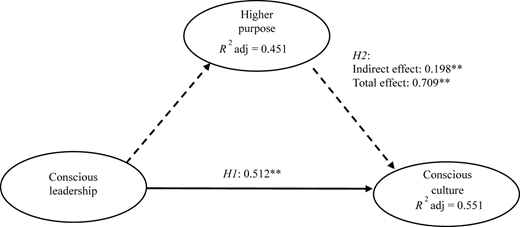
All key estimates are reported with standard errors, bias-corrected confidence intervals, and effect sizes (see Table 4). The use of BCa confidence intervals—which adjust for skewness in the bootstrap distribution—offers more accurate inference for mediation effects (Preacher and Hayes, 2008). The consistency between p-values and confidence intervals (neither includes zero) reinforces the reliability of the findings. Taken together, these findings are in line with the hypothesized theoretical model, revealing significant and theoretically meaningful associations. However, these relationships are best interpreted as conditional and context-dependent rather than universally generalizable. In SMEs—particularly those characterized by strong founder influence or concentrated ownership—leadership may exert a more direct imprint on both purpose and culture than in larger or more decentralized organizations. Conversely, in more structurally complex firms, these relationships may be weaker or mediated by additional organizational layers. In keeping with the cross-sectional design, the model estimates a specific theoretical direction (conscious leadership → higher purpose → culture), but cannot establish temporal precedence or rule out reciprocal relationships. Future longitudinal or experimental designs would be needed to probe alternative directional or reciprocal configurations, a point we address in the limitations and future research section.
4. Discussion
A central, yet undertheorized, question in conscious capitalism is how conscious leadership becomes organizationally consequential—that is, how leader-level awareness translates into conscious culture as a micro-to-meso process rather than remaining an individual attribute. Our findings are consistent with a dual-pathway interpretation: conscious leadership is associated with conscious culture both directly (via enacted practices, role modeling, and relational norms) and indirectly (via higher purpose as a shared meaning system). This pattern is especially salient in Mexican SMEs, where organizational outcomes are often conditioned by culture as an enabling context and therefore cannot be reduced to leader intent alone (Martínez-Arvizu et al., 2025a). It also converges with recent Mexican evidence that leadership effects frequently operate through organizational mediators—through climate and happiness in Salazar-Altamirano et al. (2025), and through higher purpose in our model—suggesting that meaning-based pathways may be particularly important for leadership to scale from the individual to the organizational level. Given the cross-sectional, single-informant design, we interpret these relationships as theory-consistent associations rather than definitive evidence of temporal causality.
The partial mediation we observe sharpens what these meaning-based pathways imply for theory: conscious culture is not produced by conscious leadership behaviors alone, nor by espoused values in isolation, but by the interaction between leaders' enacted cues and the shared meanings those cues activate. This aligns with sensemaking theory in which organizational members respond both to what leaders ‘do’ and to what those actions ‘mean’ in context (Weick, 1995). Importantly, this coupling may be especially pronounced in Mexican SMEs, where leadership, purpose, and culture are less differentiated: owner–manager imprinting, limited formalization, and reliance on relational coordination are likely to concentrate the micro-meso translation of sensegiving into shared norms. In this way, our strong direct path does not imply that culture is “designed”; rather, it is consistent with culture as emergent and socially constructed, while highlighting how leadership may become culturally consequential when enactment and meaning-making jointly stabilize ethical commitments over time (Gioia and Chittipeddi, 1991; Hatch and Schultz, 2002; Schein, 2010).
In this sense, higher purpose appears to support coordination of meaning among actors over time (Furlanetto et al., 2023), enabling leadership actions to endure beyond individual leaders and become embedded in organizational culture by providing a moral and transcendent reference point that renders leadership logics coherent, durable, and shared (Weick, 1995; Cornelissen, 2012). These patterns are compatible with the interpretation that in Mexican SMEs leadership may be most likely to become organizationally consequential when it is converted into shared interpretive infrastructure (purpose), rather than when it remains solely an individual-level moral orientation. This may help explain why the indirect pathway is sizable but incomplete: purpose stabilizes meaning, while other enactment-based mechanisms (role modeling, reinforcement, routines) also contribute to cultural emergence.
These mechanisms may be especially salient in emerging-economy contexts such as Latin America, where institutional volatility, inequality, and stakeholder pluralism intensify the need for internal coordination through shared meaning systems (Aguinis et al., 2020). When external institutions are weaker or less predictable, higher purpose can function as a low-cost “interpretive infrastructure” that helps organizational members align decisions and relationships around a consistent moral reference point, potentially strengthening the association between conscious leadership and cultural outcomes. This boundary condition aligns with recent Mexican evidence, where leadership effects appear to operate through organizational mediators—through climate and happiness in Salazar-Altamirano et al. (2025) and through purpose-based meaning in our model—suggesting that indirect, meaning-based pathways warrant further investigation as particularly important mechanisms for SME coordination under these conditions (Martínez-Arvizu et al., 2025b). Theoretically, this implies that Latin America may offer a high-visibility setting for building leadership–purpose–culture theory, given that the micro–meso translation from leader sensegiving to shared culture may be more concentrated and observable in SMEs operating amid institutional complexity.
4.1 Theoretical contributions
A first contribution of this study is to extend conscious leadership research beyond its predominant focus on individual-level or dyadic outcomes. Prior research has largely examined how conscious, authentic, or responsible leadership affects follower attitudes, ethical behavior, or well-being (Avolio and Gardner, 2005; Waldman and Balven, 2014). Our findings resonate with the view that conscious leadership is also associated with organizational-level cultural properties, responding to calls for stronger theorizing on how leadership can scale from micro-level processes to macro-level outcomes (DeRue and Ashford, 2010; Dinh et al., 2014). This extends the empirical reach of conscious leadership research by showing that its organizational-level associations can be empirically estimated, not merely theorized.
Second, the study contributes by clarifying the role of higher purpose as a meaning-based mechanism in the leadership–culture relationship. While purpose is often treated as an organizational attribute, identity marker, or performance-related feature (Bunderson and Thompson, 2009; Gartenberg et al., 2019), the observed partial mediation is in line with treating higher purpose as a shared interpretive frame that is enacted and reinforced through leadership sensegiving and everyday routines — rather than as a static organizational attribute. The complementary nature of the partial mediation further suggests that higher purpose functions as a meaningful—but not exclusive—pathway through which conscious leadership covaries with conscious culture, implying that meaning-based and enactment-based processes coexist rather than compete. This positioning brings purpose research into closer dialog with sensegiving and framing perspectives that emphasize how shared meanings structure action and coordination (Cornelissen, 2012; Gioia and Chittipeddi, 1991; Weiser, 2021).
Third, our findings underscore the multi-mechanistic nature of leadership influence on culture. Mediation scholarship notes that partial mediation often reflects coexisting pathways rather than model error (MacKinnon et al., 2007; Preacher and Hayes, 2008). Consistent with this view, conscious leadership is associated with conscious culture both directly (via enactment-based cues and reinforcement) and indirectly through higher purpose (as a meaning system), aligning with contemporary leadership perspectives that treat leadership as intertwined cognitive, relational, and symbolic processes (Dinh et al., 2014; Yammarino et al., 2005). This has an important theoretical implication: models that treat purpose solely as an outcome of leadership, or culture solely as an outcome of purpose, may underspecify the relational complexity through which ethical organizational environments emerge. More integrative frameworks that incorporate both meaning-based and practice-based processes are therefore needed to capture this complexity.
Finally, by examining these relationships in Mexican SMEs, the study contributes empirical groundings to a context where the micro–meso translation from leader sensegiving to shared culture may be especially visible due to concentrated leadership influence and lower formalization —conditions that are theoretically consequential but rarely tested empirically within conscious capitalism research. At the same time, given the cross-sectional and single-informant design, we interpret these contributions as theory-consistent associations that motivate longitudinal and multi-source tests of alternative causal configurations and boundary conditions.
4.2 Practical implications
The findings propose some guidance on translating the “higher purpose” into management practice in SMEs with limited resources in emerging economies. SME leaders can integrate the higher purpose by: (1) incorporating purpose-based questions or checklists at the start of key management meetings to evaluate important decisions; (2) linking the purpose to performance indicators and KPIs in monthly reviews; (3) integrating the purpose through regular briefings to give meaning to the business and narratives from the owner-manager (Gioia et al., 2013), and (4) tracking visible indicators via a simple one-page scorecard for stakeholders covering safety, decent work, and customer trust.
These mechanisms may help transform strong personal influence and limited formal structure into a stabilizing coordination tool aligned with organizational resilience and stakeholder trust (Gartenberg et al., 2019; Miller et al., 2012). Leadership development programs might train SME owners to become “meaning makers,” developing competencies in narrative construction and institutional thinking (Cornelissen, 2012; Golsorkhi et al., 2015). At the policy level, existing soft intervention tools—such as purpose-weighted public procurement, conditional credit lines with purpose-driven milestones, and well-being dashboards—could be adapted to extend these practices to Mexican SMEs, potentially improving retention, decent work, and overall social trust (Martínez-Arvizu et al., 2025b). For instance, entrepreneurship training programs delivered by public agencies or universities could include short modules in which SME owners explicitly define their firm's purpose and translate it into concrete practices, such as fair sourcing or transparent labor policies. Similarly, public financing schemes could integrate brief purpose-and-values statements into application processes, encouraging firms to reflect on their social contribution and ethical commitments as part of their growth strategy. These relatively simple additions would embed ethical reflection into already established support mechanisms, strengthening organizational culture without imposing significant additional burdens.
In emerging economies characterized by institutional volatility and limited enforcement capacity (Wright et al., 2005; Aguinis et al., 2020), the partial mediation observed in this study has broader implications. Our findings are consistent with the interpretation that higher purpose may function as an internal coordination mechanism associated with the stabilization of ethical expectations and relational norms when formal institutional safeguards are weaker. In this sense, purpose-driven leadership may be related to partially offsetting institutional gaps by fostering trust, reducing ambiguity in decision-making, and reinforcing responsible practices within SMEs, though longitudinal research would be needed to confirm this interpretation.
Recent Mexican evidence aligns with this interpretation: transformational leadership is associated with reduced turnover intentions through well-being and climate mechanisms (Martínez-Arvizu et al., 2025b), indicating that leadership-induced meaning systems may be related to improved psychosocial stability and employment quality. Our results extend this logic by suggesting that when higher purpose becomes embedded, leadership influence may be translated into more durable cultural norms, which in turn shape workplace quality, stakeholder trust, and responsible conduct.
From a policy perspective, this implies that supporting purpose-embedding practices, rather than only regulatory compliance, may represent a scalable lever for improving SME outcomes. Rather than proposing new institutional infrastructure, existing light-touch instruments—such as procurement incentives tied to purpose-to-governance routines, development-bank credit lines linked to purpose-based milestones, or subsidized leadership micro-credentials focused on sensemaking—could be adapted to reinforce internal meaning systems that foster decent work and relational accountability. In this way, policy does not substitute for leadership; it may amplify mechanisms that our findings suggest are associated with cultural stabilization. Thus, the societal relevance of this study lies not in claiming that conscious leadership directly transforms society, but in pointing out, based on associations observed in this sample, how meaning-based coordination within SMEs may contribute incrementally to workplace quality, generalized trust, and ethical business conduct in emerging institutional environments (Bapuji et al., 2020; Ferraro et al., 2015).
4.3 Limitations and future research
Despite its contributions, this study has limitations that open avenues for future research. First, its cross-sectional design limits causal inference and the capture of dynamic processes through which leadership, purpose, and culture co-evolve over time. This is particularly consequential for the mediation finding: while the indirect effect of conscious leadership through higher purpose is statistically significant, the cross-sectional design cannot rule out alternative causal orderings—for instance, that conscious culture shapes how leaders articulate purpose, or that both are jointly influenced by unobserved firm-level factors. Readers should therefore interpret the directionality of the proposed model as theory-consistent rather than empirically established. Prior research highlights that culture and meaning systems are inherently processual and historically embedded (Schein, 2010; Van de Ven and Poole, 2005). Longitudinal or process-based studies could thus deepen understanding of how higher purpose becomes institutionalized and how leadership influence unfolds across organizational life stages.
Second, while the use of single key informants is methodologically appropriate and widely accepted for capturing firm-level constructs (Huber and Power, 1985; Kumar et al., 1993; Starbuck and Mezias, 1996), it introduces a potential limitation: the same individuals who report on leadership are also those whose leadership is being assessed. This may, in principle, inflate observed relationships due to shared method variance. While our common method bias analysis suggests this does not constitute a critical threat, it cannot fully rule out perceptual consistency effects, particularly given that all three constructs were assessed by the same informant in a single survey administration. Readers should therefore interpret the observed effect sizes with appropriate caution. Future studies could triangulate findings using multi-informant, ethnographic, or qualitative designs. These methods would enable examination of how purpose and culture are enacted, contested, and negotiated across levels, responding to calls for richer accounts of cultural dynamics (Alvesson and Kärreman, 2011; Jarzabkowski et al., 2014).
Third, the study is limited to SMEs in a specific national and institutional context. The non-probabilistic sampling design further limits statistical generalizability, as the sample was drawn from firms affiliated with a single university network, which may overrepresent relatively engaged or purpose-oriented organizations. This selection effect could inflate the observed associations between conscious leadership, higher purpose, and conscious culture relative to a more representative sample of Mexican SMEs. Although emerging economies offer a theoretically rich setting for examining leadership and purpose amid institutional complexity and value pluralism (Aguinis et al., 2020; Wright et al., 2005), future research should test boundary conditions by comparing mechanisms across SMEs and large firms or examining cross-national differences to assess generalizability in diverse institutional settings.
Additionally, future studies could deepen understanding of higher purpose by exploring its moderating roles, interactions with other leadership processes, and broader contingencies (e.g. organizational maturity, stakeholder pressures, institutional logics; Gehman et al., 2013; Thornton et al., 2012). Such investigations would advance theory beyond linear models toward configurational and multilevel explanations of how leadership and meaning shape organizational culture.
5. Conclusion
This study advanced understanding of how conscious culture emerges by examining the interplay between conscious leadership and higher purpose in Mexican SMEs. It addressed the lack of quantitative evidence on the mechanisms through which conscious leadership contributes to a shared conscious culture in resource-constrained SMEs in emerging economies, where the founder's influence is predominant and formal institutionalization is weak.
By theorizing and empirically testing higher purpose as a key sensemaking mechanism, the results suggest that it constitutes one important—though not exclusive—pathway for translating micro-level dynamics into meso-level outcomes. From a sensemaking perspective, the findings indicate that higher purpose operates as a mechanism that helps translate conscious leadership into organizational culture. By examining this process in an emerging economy context, the study offers a dual-pathway framework that may help explain how ethical cultures are cultivated under conditions of resource scarcity and strong personal influence.
Considering these results, SME leaders could benefit from complementing their direct leadership practices with the clear articulation and institutionalization of higher purpose. Mexican government agencies and business associations might consider promoting conscious leadership and purpose articulation within existing SME support programs. Such efforts could help foster purpose-driven cultures with relatively low additional investment and may support improved employee retention, reputational capital, and long-term sustainability of the sector.
For practice, the findings highlight the potential value of complementing direct leadership enactment with the purposeful institutionalization of meaning. Higher purpose appears not merely as an aspirational goal, but as an interpretive process that can help embed conscious leadership into organizational culture.
This paper was reviewed by an AI assistant for grammar, punctuation, and spelling errors only. The AI did not contribute to the content, ideas, or structure of the paper, and all intellectual contributions remain the sole responsibility of the writers.
Appendix
Construct's definition, operationalization and measurement instrument
| Construct definition | Item code | Description |
|---|---|---|
| Conscious culture: Shared organizational values and norms promoting integrity, trust, transparency, and care | CC1 | In our culture, we say what we mean and we mean what we say. There is no sugar coating of tough reality, and there is a high level of commitment to truth and integrity in all matters |
| CC2 | We operate within a culture of genuine caring and compassion for all stakeholders. When times get tough, our company exhibits an even higher level of caring and compassion than in prosperous times. There is a real sense of altruism in our culture – people do things for others with no expectation of a return, reward or recognition | |
| CC3 | Employees in our company are empowered to do the right thing at all times. We use self managing, self-motivated and self-directed teams to accomplish our work | |
| Conscious leadership: Leadership characterized by self-awareness, ethical grounding, and a stakeholder-oriented perspective | CL1 | Our leaders are deeply self-aware individuals who are in their roles because they passionately believe in the purpose of our organization and in service to our people |
| CL2 | Our leaders are intuitive systems thinkers and systems feelers. They not only think in systems terms, they also feel the connectedness and interdependence that exists across stakeholders | |
| CL3 | In our company, power and virtue go together. In other words, we consciously seek to promote individuals with the greatest integrity and capacity for caring and compassion | |
| Higher purpose: The organization's commitment to a transcendent mission that creates value beyond profit for all stakeholders | HP3 | We have a clear vision of how the world would look if we fulfill our purpose |
| HP4 | Our employees find intrinsic satisfaction in their work that goes beyond the salary that they earn. The best ones would leave if we ceased being true to our purpose | |
| HP5 | Our employees are convinced that the work of the company delivers positive value to the customer and the community |
Note(s): Items were assessed with a 5-point Likert scale: 1 = Strongly Disagree to 5 = Strongly Agree

