Introduction
Services have always been more than transactional mechanisms; they are social and symbolic systems that shape aspirations, relationships and self-concepts. The rise in adoption of immersive technologies, such as virtual reality (VR), augmented reality (AR), artificial intelligence (AI) and generative AI (GenAI), is now transforming how services are conceived, delivered and experienced. These technologies integrate sensory, cognitive and emotional dimensions, enabling service providers to create encounters that are deeply engaging and personally meaningful. We conceptualize this shift as part of an emerging “Immersion Economy,” where value creation is no longer defined merely by access, efficiency or functionality, but by the depth of sensory, emotional and cognitive absorption that services can evoke. In the Immersion Economy, firms differentiate themselves by designing experiences that go beyond transactional exchanges to engage individuals holistically, stimulating imagination, fostering emotional resonance and prompting behavioral transformation. Enabled by advanced technologies such as AR, VR and AI, as well as by context-rich storytelling and design, immersion becomes the primary driver of customer decision-making, loyalty and advocacy.
These technologies are no longer peripheral tools but central enablers of experiences that immerse, engage and transform. Services are designed to provide solutions for the endless aspirations of humans, rather than just addressing short-term functional issues. As technologies advance, the way humans approach and expect the role of service is bound to change from merely delivering convenience to fostering engagement and experiences. Modern technologies, such as AI, augmented and VR, neuro-interfaces and multi-sensory simulations, are pushing services into a new frontier of immersion, offering transformative experiences. Technological development requires a deeper understanding of the meaning of immersive experiences in services. The service and marketing literature appear to be silent on what it means to have an immersive service experience (ISE), except for some recent attempts to define immersive service (Anderson et al., 2025). We define ISE as a technology-enabled, holistic and interactive process deliberately designed to produce deep emotional, cognitive and behavioral absorption within augmented, virtual, or blended realities. Unlike related constructs such as flow (primarily cognitive), presence (primarily perceptual), or engagement (often affective and behavioral but not necessarily technology-bound), ISE represents a multi-dimensional meta-construct that simultaneously integrates psychological states such as flow and telepresence; emotional mechanisms such as resonance and trust; and behavioral activation through co-creation, participation and advocacy. ISE is thus not merely an emergent user state but a managerially actionable design process that can be engineered, measured and optimized to create value. Its novelty lies in (1) explicitly linking technology affordances (VR/AR/AI) with psychological, emotional and behavioral mechanisms; (2) conceptualizing immersion as an orchestrated service process rather than a passive experience and (3) positioning behavioral transformation (e.g. advocacy, loyalty) as an intrinsic dimension of immersion rather than a downstream outcome. This framing moves service research beyond describing immersive states to offering a design-oriented, theoretically grounded blueprint for how organizations can systematically craft transformative service encounters.
The objective of this special issue is to explore how ISEs redefine service research, connect technological and social mechanisms, and offer pathways for both scholarly advancement and practical innovation. IKEA's online platform offers an immersive service bridge between functionality and consumer imagination. For example, when showcasing a desk lamp, the platform does not stop at displaying a plain product image. Instead, it provides contextualized visuals, such as the lamp illuminated on a study desk alongside books and decor, allowing customers to imagine how the product will look and feel in their own environment. This kind of presentation reduces uncertainty, engages the senses and fosters an emotional connection with the product. It illustrates how organizations can move beyond transactional listings to create holistic, multisensory and psychologically engaging service experiences. Such immersive design taps into cognitive simulation (“how it fits in my life”), emotional resonance (“this feels like my home”) and behavioral influence (increasing purchase intention). In doing so, IKEA demonstrates how its online platforms offer immersive services that are not only functional but also transformative, “Oh wow” moments that redefine consumer decision-making. Hilton has experimented with VR-powered room tours, allowing potential guests to “walk through” suites, amenities and even event spaces before booking. Similar to IKEA's contextual imagery, this immersive preview makes customers feel as if they have already experienced the service, reducing uncertainty and enhancing trust.
The notion of immersion is not new, with constructs such as flow, presence and engagement long-established in service research. What is emerging now is a multi-sensory and adaptive form of immersion that blurs the boundaries between physical and digital experiences (Mishra et al., 2023; Pangarkar et al., 2022). Customers no longer merely interact with services; they inhabit them. For instance, VR real estate tours and 360° tourism videos encourage episodic future thinking, enabling customers to “mentally travel” into imagined scenarios. Similarly, social media payment platforms demonstrate that immersion may also be cognitive and social, emerging from trust, interactivity and networked engagement. These examples underscore that immersion is not only a technological outcome but also a cognitive and emotional mechanism that shapes value perception and co-creation.
A framework for immersive service experiences
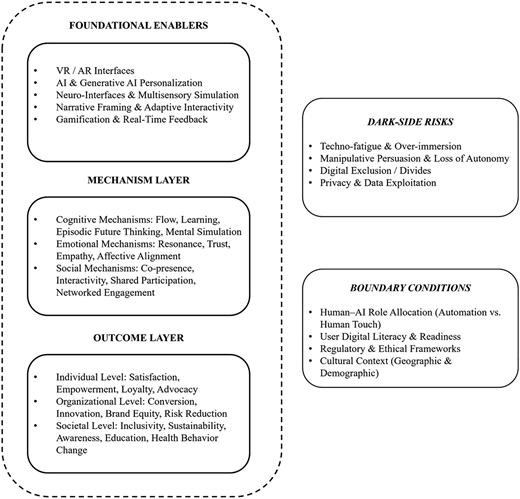
To consolidate emerging insights and provide a cohesive conceptual foundation, we propose the ISE framework (ISEF) (see Figure 1). ISEF is designed as a process-oriented, multi-level model that links technological design choices with psychological mechanisms, behavioral outcomes and societal implications. Its central premise is that immersion is not merely an experiential byproduct but a strategically engineered service phenomenon that can be shaped, optimized and governed.
Foundational layer: technological and design enablers
At the base of ISEF are the technological affordances and design elements that create the preconditions for immersion. These include VR and AR environments, AI-powered personalization, GenAI content creation, neuro-interfaces and multisensory simulations (e.g. haptic feedback, spatial audio). Importantly, ISEF views these not as standalone tools but as integrated service design components that enable adaptive, interactive and context-sensitive experiences. Together, these enablers form the “immersive scaffolding” that differentiates ISEs from traditional encounters. They enable personalization at scale, simulate alternative futures (e.g. virtual try-ons, VR walkthroughs) and dynamically adjust to user inputs, thereby continuously reinforcing a sense of presence and agency.
Mechanism layer: cognitive, emotional and social processes
The enablers activate three interdependent psychological and social mechanisms that drive immersion. The first layer is referred to as cognitive mechanisms, which include flow, learning, episodic future thinking and mental simulation. These processes absorb the user's attention, enable them to project themselves into future scenarios and reduce decision uncertainty.
The second layer encompasses emotional mechanisms, including resonance, trust, empathy and affective alignment with the service provider's values. These mechanisms foster emotional attachment, making the experience feel personally meaningful. The third layer comprises social mechanisms, including co-presence, interactivity and shared participation in communities or networks. These mechanisms transform immersion from a solitary to a collective experience, amplifying engagement and advocacy through social reinforcement. ISEF highlights that immersion is adaptive and reciprocal; users influence the system through interaction, and the system responds by recalibrating content and sensory cues, creating a feedback loop that sustains engagement.
Outcomes layer: multi-level value creation
ISEF organizes outcomes across three interconnected levels of analysis, highlighting that immersive service design has implications that go well beyond the dyadic service encounter. At the individual level, immersive experiences heighten satisfaction, empowerment and psychological ownership, fostering self-expression, loyalty and advocacy. By creating a sense of agency and emotional resonance, ISEs drive deeper behavioral commitment and encourage repeat interactions. At the organizational level, immersion supports higher conversion rates, reduces perceived risk and enables differentiation through innovative service design. These experiences help firms shorten decision cycles, enhance customer trust and strengthen brand equity. At the societal level, immersive services have the potential to promote inclusivity, raise awareness of sustainability, support education and influence health-related behavior change. However, ISEF also recognizes that these outcomes can lead to value co-destruction if poorly managed, manifesting as exclusion through digital divides, manipulative persuasion or over-immersion that leads to cognitive fatigue.
The impact of these outcomes is contingent on a set of moderators and boundary conditions that shape the effectiveness of immersion. Chief among these is the allocation of roles between humans and AI agents, which affects perceptions of authenticity and empathy. User digital literacy and readiness play a crucial role in determining whether immersive technologies enhance engagement or cause frustration. Regulatory and ethical frameworks define the acceptable boundaries of personalization, data use and persuasive design, while cultural context influences how presence, trust and interactivity are interpreted across geographies and market segments. By incorporating these moderators explicitly, ISEF avoids universalistic claims and encourages a more context-sensitive approach to theorizing and designing immersive services.
Importantly, ISEF acknowledges that immersion is not inherently positive. The framework explicitly integrates dark-side considerations as critical contingencies. Techno-fatigue and over-immersion may lead to cognitive overload, addiction and reduced well-being. Immersive design can also cross ethical lines when persuasive mechanisms nudge user behavior beyond their consent, undermining autonomy. Digital exclusion remains a significant risk for populations with limited access to technology, potentially deepening social inequalities. Furthermore, highly personalized, sensor-rich immersive environments amplify concerns related to privacy, surveillance and data exploitation. These considerations call for future research that explores when and how immersive services create value, and when they risk destroying it, to ensure that immersive design remains both effective and ethically responsible.
Collectively, ISEF contributes to service theory in several ways. It extends service-dominant logic by positioning immersion as a co-created resource embedded in the service ecosystem. It builds on transformative service research by explicitly linking immersive design to individual well-being, inclusivity and societal outcomes, while simultaneously identifying potential harms and tensions. Finally, it advances service quality theory by proposing new metrics that capture the sensory, adaptive and interactive dimensions of service performance, thereby moving beyond traditional measures of reliability, responsiveness and assurance.
This special issue, “Crafting Immersive Service Experiences: Bridging Fiction and Reality,” brings together six pioneering contributions that collectively operationalize and extend the ISEF framework. Chatterjee et al. (2025) demonstrate how human–AI collaboration enhances immersion and loyalty, underscoring the role of interactivity as a cognitive and social mechanism. Pandey et al. (2025) reveal how social media payment platforms act as immersive ecosystems that reshape trust and community behavior. Baiwir et al. (2025) demonstrate how 360° videos stimulate episodic future thinking, thereby influencing consumer decision-making. From a healthcare service perspective, Suess et al. (2025) show that biophilic hospital environments rich in natural views, plants and green décor substantially enhance patients' perceived healing and emotional recovery. By using VR to simulate service encounters in hospital rooms, the research demonstrates how nature-integrated design can enhance the therapeutic quality of the care experience and improve patient-centered service outcomes. Sama et al. (2025) provide a systematic TCCM-based review of immersive technologies, mapping antecedents, outcomes and future research gaps. Jeseo and Lindsey Hall (2025) advance the conversation by introducing the Framework for Inclusive Service Experiences (FISE), embedding equity and universal design into immersive contexts. Finally, Sundararajan et al. (2025) provide experimental evidence that VR enhances engagement, satisfaction, and advocacy through sensory presence and interactivity, while also calling for sector-wide validation and ethical consideration. Collectively, these contributions highlight the theoretical richness and managerial significance of immersion, demonstrating the diverse ways in which immersive services are transforming individual experiences, organizational strategies and societal outcomes.
A research agenda
The contributions also point to several directions for future research. There is a lack of validated scales to study ISE. Future researchers may consider proposing and validating a comprehensive measurement scale for ISE (ISE), capturing the multi-layered psychological and sensory mechanisms that define immersion in modern technology-enabled services. Such a scale could integrate several key dimensions. First, multi-sensory absorption may assess how vividly a service stimulates the senses (e.g. “the experience felt rich, vivid, and lifelike”, “I felt surrounded by the sensory environment”) in contexts such as VR hotel room tours, AR-assisted retail, or virtual biophilic hospital rooms. Second, cognitive immersion could evaluate focused attention and mental simulation (e.g. “I became mentally absorbed and lost track of time”, “the experience helped me imagine myself deeply in the situation”) as seen in VR real-estate walkthroughs or immersive tourism previews. Third, emotional immersion may capture the depth of affective resonance (e.g. “the experience generated meaningful emotional reactions”, “I felt emotionally connected to the environment”), which is particularly relevant for applications like AI-driven wellness coaching or immersive philanthropic storytelling. Finally, a unique and increasingly relevant dimension is agency in immersion, assessing how empowered users feel during the experience (e.g. “I felt in control of how the experience unfolded”, “I could influence or personalize the interaction”), especially in contexts such as patient-facing VR in healthcare, AI-guided fitness services, or immersive airport wayfinding systems. Validating such a scale across diverse service settings ranging from highly empowering environments (e.g. retail VR exploration) to lower-agency immersive settings (e.g. hospital stays or long-term care simulations) would help establish the empirical structure of ISE and clarify how immersion contributes to outcomes such as trust, well-being, co-creation and behavioral transformation. With the proposed measurement, theoretical and conceptual clarity is essential: immersion or ISEs must be distinguished from related constructions and measured using validated scales that capture their sensory, cognitive and social dimensions. Further research should investigate how humans and AI jointly shape immersion, raising questions of empathy, efficiency and recovery. GenAI challenges traditional service quality trade-offs by enabling infinite personalization, requiring a rethinking of constructs such as reliability and responsiveness. Ethical dimensions must also be examined, particularly the tension between immersive persuasion and consumer autonomy. Ultimately, research should investigate how immersive services impact societal outcomes, including sustainability, education and inclusivity, through comparative and policy-oriented approaches. This special issue highlights how immersion transforms services from functional interfaces into lived experiences of simulation and co-creation. By extending service theory and engaging with pressing ethical and societal concerns, immersive service research offers a new frontier for scholars and practitioners alike. The challenge now lies in ensuring that these experiences remain not only technologically sophisticated but also ethically responsible and socially beneficial. Building on this, we call for an exploration of how immersive experiences influence consumer well-being, trust, decision-making and value co-creation, as well as how service providers can balance engagement with ethical responsibility. Overall, service researchers need to address the following research questions:
How can immersion be conceptually distinguished from related constructs such as flow, presence and engagement, and what new validated measurement tools are required to capture the multidimensional nature of ISEs?
In hybrid service encounters, what is the optimal division of roles between humans and AI agents for creating immersion, particularly when balancing efficiency, empathy and authenticity?
What are the determinants of ISE, and how can it lead to outcomes such as profitability, customer lifetime value and total engagement value?
How do customers cognitively and emotionally navigate the blurred boundary between fictional simulations and real service outcomes, and what implications does this have for value co-creation?
What mechanisms shape trust and authenticity in immersive services when customers are aware that they are engaging with algorithmically generated content rather than human-driven interactions?
At what point does immersive persuasion (e.g. financial simulations or health gamification) shift from empowering to manipulative, and how should ethical guidelines be developed for immersive service design?
How can immersive service design ensure equitable access across diverse populations, including those with limited digital literacy or resources, so that immersive benefits do not reinforce social divides?
How do immersive technologies redefine traditional dimensions of service quality (e.g. reliability, responsiveness, personalization) when personalization becomes infinite and dynamically adaptive through GenAI?
What regulatory, governance and policy frameworks are required to ensure that immersive services contribute positively to societal outcomes such as sustainability, education and public health?
How does anticipatory immersion (e.g. imagining future journeys through VR/AR simulations) alter decision-making, satisfaction and loyalty compared to traditional service encounters?
How do cultural contexts shape the interpretation of immersion (e.g. presence, interactivity and inclusivity), and what cross-cultural differences emerge in customer responses to immersive services?
ISEs represent a profound shift in how services are conceived, delivered and consumed. By bridging fiction and reality, they move services beyond functional delivery into lived, multi-sensory encounters that are cognitive, emotional and social in nature. This transformation challenges service research to rethink long-standing constructs such as value co-creation, service quality and customer experience in light of technological affordances and human–AI collaboration. At the same time, it raises urgent ethical questions about trust, authenticity, persuasion and inclusivity, highlighting the need for governance frameworks that ensure equitable access and responsible design. As the contributions in this special issue demonstrate, immersion is not an isolated trend but a reconfiguration of the service landscape with implications for individuals, organizations and society. Future scholarships must therefore strike a balance between conceptual clarity and practical relevance, investigating how immersive services shape behavior, empower communities and influence societal outcomes. By integrating technological innovation with human values, service research can guide the development of immersive experiences that are not only engaging and transformative but also ethical and sustainable.