In business-to-business (B2B) contexts, innovativeness is often conceptualized as a firm-internal capability reflected in research and development investment, technological advancement and process improvements. This study examines how business customers evaluate supplier innovativeness in B2B service ecosystems and identifies the cues that shape such evaluations beyond innovation outputs or capabilities alone.
The study adopts an abductive qualitative multiple-case design. Empirical material comprises six in-depth interviews with boundary-spanning informants across five innovation-intensive B2B firms, complemented by secondary data. Data were analyzed through iterative coding and comparison within an abductive analytic logic. Service-dominant logic and service ecosystem theory are used as sensitizing lenses.
Customers evaluate supplier innovativeness through observable patterns of action embedded in interaction and coordination practices. These evaluations draw on three interrelated cue clusters: (1) credible enactment of innovation intent, (2) transparency in resource integration and coordination and (3) contributions to ecosystem arrangements that support customer value creation. Combined, these cues form a role-based evaluative frame that customers use while interpreting innovativeness across recurring interaction configurations.
Managers can strengthen customer perceptions of innovativeness by making innovation-related practices more transparent, selectively enabling customer involvement and coordinating collaboration across relevant ecosystem actors.
This study contributes an empirically grounded perspective on customer-perceived innovativeness in B2B services and develops a role-based framework conceptualized as a co-creation continuum that captures how customers draw on different evaluative logics when assessing supplier innovativeness.
1. Introduction
Innovativeness has been recognized as a central driver of competitiveness in business-to-business (B2B) markets. Traditionally, it has been conceptualized as a firm-internal capability grounded in investments in research and development (R&D), technological advancement and process improvements (Garcia and Calantone, 2002; Heirati and Siahtiri, 2019; Schiele et al., 2011). According to this perspective, innovativeness is treated as an organizational property manifested through structures, resources and innovation outputs, while customers are positioned primarily as recipients of innovation outcomes.
However, contemporary service research increasingly recognizes that customers also form evaluative judgments about how innovative a supplier is (Johansson et al., 2019; Pilawa et al., 2022). These judgments are shaped by not only observable innovation outputs but also relational experiences, collaboration practices and interaction patterns unfolding over time (Carbonell and Rodríguez-Escudero, 2014; Raddats et al., 2019). Notably, this shift reflects a change in analytical focus rather than firms’ awareness of customers: while customer relevance has been acknowledged, recent research foregrounds customers’ interpretive role in evaluating innovativeness (Grönroos, 2011; Jaakkola et al., 2024; Vargo and Lusch, 2008, 2016).
Building on service-dominant logic (SDL), innovation is conceptualized not as a linear, firm-driven pipeline but as a systemic process embedded in multi-actor resource integration and institutional arrangements (Lusch and Nambisan, 2015; Vargo and Lusch, 2016). According to this perspective, value is phenomenologically determined in use, and co-creation refers to distributed processes of resource integration rather than joint production alone (Akaka and Vargo, 2014; Vargo and Lusch, 2008). While SDL has extensively theorized value creation and resource integration, the interpretive formation of customer-perceived innovativeness has received comparatively limited conceptual attention as an object of customer evaluation, particularly at the ecosystem level (Jaakkola et al., 2024; Vargo and Lusch, 2016).
As service ecosystems have become a central unit of analysis in service research, increasing attention has been paid to how customers – as key ecosystem actors – evaluate supplier innovativeness across distributed interaction contexts (Kurtmollaiev et al., 2022; Lassila et al., 2023; Pilawa et al., 2022). Prior research demonstrates that customer evaluations are influenced by relational experiences, collaborative practices and suppliers’ demonstrated problem-solving capabilities in use situations (Carbonell and Rodríguez-Escudero, 2014; La Rocca et al., 2019; Raddats et al., 2019). In addition, innovation-related signaling, communication practices and suppliers’ ability to coordinate value-creation activities across organizational boundaries shape customer perceptions of innovativeness (Jaakkola et al., 2024; Kohtamäki and Rajala, 2016).
Despite these advances, limited research explores how customers embedded in multi-actor service ecosystems interpret and evaluate supplier innovativeness based on distributed interaction patterns, collaboration practices and institutional arrangements, rather than on firm capabilities or innovation outputs alone. This gap is consequential, as customer evaluations increasingly influence supplier differentiation, innovation partnerships and long-term value creation in B2B markets (Dotzel and Shankar, 2019; Goffin et al., 2021). Existing B2B innovation models remain largely inside–out, emphasizing efficiency gains and technological novelty while paying limited attention to how customers interpret innovation-related behaviors in context (Bryan Jean et al., 2017; Costa and Monteiro, 2016; Ozdemir et al., 2020). Consequently, sophisticated internal innovation efforts may fail to resonate with customer expectations, thereby limiting their impact on perceived innovativeness (Carbonell and Rodríguez-Escudero, 2014; Jaakkola et al., 2024; Raddats et al., 2019).
This gap is not merely conceptual but has important implications for B2B practice and research. When customer-perceived innovativeness remains underexplored, firms risk misaligning substantial innovation investments with how customers actually evaluate innovativeness in use. As a result, innovation efforts may fail to translate into competitive differentiation, partnership formation or long-term value creation. Beyond B2B services, understanding evaluative mechanisms is critical for broader innovation theory, as it shifts attention from innovation outputs to how innovation is interpreted, legitimized and acted upon across contexts. Thus, the study contributes not only to SDL but also to broader discussions on innovation evaluation, signaling and customer-based differentiation in interorganizational contexts.
To address this gap, this study draws on SDL and service ecosystem theory as sensitizing lenses. SDL conceptualizes firms, customers and other actors as resource integrators embedded in service ecosystems and highlights how value is determined in use instead of being produced unilaterally by firms (Lusch and Nambisan, 2015; Vargo and Lusch, 2008, 2016). This perspective provides a useful basis for examining how customers interpret innovation-related behaviors and signals across distributed, multi-actor environments, without assuming that innovativeness itself is co-created in a phenomenological sense.
Rather than advancing innovation theory within SDL, this study adopts SDL and service ecosystem theory to explain how customers interpret and evaluate supplier innovativeness in complex B2B service ecosystems. The contribution lies not in conceptually redefining innovation or innovativeness but in explaining how customer-perceived innovativeness is formed through observable interactional and institutional cues embedded in ecosystem practices. Accordingly, the current study focuses on customer-perceived innovativeness as an evaluative judgment shaped by ecosystem-level sensemaking instead of on innovation processes, outputs or capabilities as such.
Thus, this study addresses the following research question: how do customers interpret and evaluate supplier innovativeness within B2B service ecosystems by drawing on multiple, coexisting evaluative logics instead of a single dominant criterion?
To address this question, the study adopts a qualitative, abductive research design that enables iterative movement between empirical material and sensitizing concepts from SDL and service ecosystem theory (Dubois and Gadde, 2002; Timmermans and Tavory, 2012). Empirical analysis is structured using a Gioia-inspired coding approach as a systematic analytical device instead of a purely inductive methodology (Gehman et al., 2018; Gioia et al., 2013; Lundin and Kindström, 2024). From this perspective, customer-perceived innovativeness is conceptualized as a beneficiary-defined evaluative judgment of how effectively a supplier mobilizes and aligns resources within a service ecosystem.
2. Literature review
Prior B2B research conceptualizes innovativeness in diverse ways, reflecting variation in innovation domains, analytical levels and evaluative criteria (Azadegan, 2011; Garcia and Calantone, 2002; Zhang et al., 2016). As summarized in Table 1, these differences extend to where innovativeness is assumed to reside and who evaluates it, resulting in inconsistent treatment of innovativeness as either an organizational capability or a customer-derived judgment. However, existing research offers limited theorization of how customer evaluations of innovativeness are formed and stabilized in ongoing B2B interactions. This review integrates these perspectives to establish a foundation for examining customer-perceived innovativeness in B2B service contexts.
2.1 From supplier innovativeness to customer-perceived innovativeness in B2B
Innovativeness has been conceptualized across B2B research in relation to different innovation domains – product, process, service or business model (Garcia and Calantone, 2002; Santos-Vijande et al., 2013; Zhang et al., 2016) – units of analysis – firm, project or inter-organizational network (Inemek and Matthyssens, 2013; La Rocca et al., 2019) – and evaluative criteria, such as technological novelty, customer value and competitive outcomes (Azadegan, 2011; Heirati and Siahtiri, 2019; Raddats et al., 2019). This diversity highlights the absence of a unified conceptualization of innovativeness in B2B markets and the need to distinguish firm-internal innovativeness from customer-perceived innovativeness as evaluative judgment.
Historically, B2B research has adopted a supplier-centric perspective, defining innovativeness as a capability embedded in firm resources, technical competences or R&D intensity (Calantone et al., 2002; Costa and Monteiro, 2016; Kibbeling et al., 2013). Within this stream, innovativeness is typically assessed through internal indicators or observable outputs, such as new product introductions or technological advancements (Heirati and Siahtiri, 2019; Zhang et al., 2016).
By contrast, a smaller body of research conceptualizes innovativeness as a customer-derived evaluation reflecting customers’ perceptions of a supplier’s ability to generate useful and adaptive solutions (Azadegan, 2011; Schiele et al., 2011). Empirical studies show that customers often infer innovativeness from behavioral and relational indicators – such as responsiveness, knowledge sharing, collaborative problem-solving and adaptive coordination – rather than from technological attributes alone (Goffin et al., 2021; La Rocca et al., 2019; Raddats et al., 2019).
This divergence is evident in existing definitions (see Table 1), which outline that innovativeness varies in assumptions about where it resides, how it is conceptualized and who evaluates it (Bryan Jean et al., 2017; Kibbeling et al., 2013; Zhang et al., 2016). This variability reflects limited theoretical clarity regarding whether innovativeness should be understood primarily as organizational property or as evaluative judgment shaped through interaction. Addressing this gap requires a lens capable of explaining how customer evaluations are shaped by relational and systemic cues instead of firm capabilities alone. Explaining such evaluations requires a perspective that foregrounds interaction, resource integration and institutional context rather than firm capabilities alone.
2.2 Innovativeness and innovation through the lens of SDL
Several service perspectives offer insights relevant to the study of innovativeness. Service logic emphasizes firms’ role in facilitating customers’ value creation (Grönroos, 2011), while customer-dominant logic highlights customers’ broader life contexts beyond direct interaction (Heinonen et al., 2010). In this study, SDL is used as a sensitizing lens because of its explicit focus on multi-actor resource integration and service ecosystems, which aligns with the empirical focus on distributed interaction contexts.
SDL conceptualizes innovation not as the development of discrete offerings but as the reconfiguration of how actors integrate and coordinate resources across service ecosystems to enable new forms of value-in-use (Akaka and Chandler, 2011; Jaakkola et al., 2024; Lusch and Nambisan, 2015; Mele et al., 2014; Vargo and Lusch, 2016). Within this perspective, innovation reflects changes in resource-integration processes that may stabilize through shared practices, norms and meanings within the ecosystem (Vargo et al., 2020).
From an SDL perspective, customer-perceived innovativeness is best understood as a beneficiary-defined evaluative judgment of how effectively a focal actor mobilizes and aligns resources within a service ecosystem (Lusch and Nambisan, 2015; Vargo and Lusch, 2008, 2016). SDL differentiates between co-production as operational participation and value co-creation as a phenomenological process of value realization through both direct and indirect resource-integration activities (Vargo and Lusch, 2008, 2011). Accordingly, innovativeness is not co-created in the phenomenological sense of value-in-use but evaluated by customers through their interpretations of systemic changes in resource integration.
Recent B2B research aligns with this perspective by revealing that innovation-related effects of adaptive behavior are shaped through relationally embedded processes – such as interfirm learning, complementary resource mobilization and adaptive coordination – rather than through firm-internal capabilities alone (Jaakkola et al., 2024; Kohtamäki and Rajala, 2016; Rusanen et al., 2014; Salunke et al., 2019). These processes generate behavioral and institutional cues through which customers interpret the novelty and relevance of suppliers’ actions (Azadegan, 2011; Goffin et al., 2021; La Rocca et al., 2019; Raddats et al., 2019).
Combined, SDL positions innovativeness as a relational and systemic phenomenon that becomes salient through customers’ sensemaking of new resource configurations and institutional arrangements within service ecosystems (Akaka and Vargo, 2014; Wieland et al., 2017). This view provides a theoretical basis for conceptualizing customer-perceived innovativeness as an interpretive judgment shaped by distributed resource integration rather than inferred solely from supplier capabilities or innovation outputs.
2.3 Service ecosystems and institutional shaping of innovation evaluations
Service ecosystem theory extends SDL by explaining how innovation and innovativeness are shaped through institutional structures that coordinate and constrain value-creating activities across multiple actors (Chandler and Vargo, 2011; Vargo and Lusch, 2016). Institutional arrangements – shared norms, rules, meanings and role expectations – guide how actors interpret and evaluate novelty within a system (Akaka and Chandler, 2011; Scott, 2008).
From this perspective, innovation can be understood as an institutional phenomenon, whereby new resource configurations become recognized as “innovative” when they disrupt, reinforce or reconfigure existing institutional structures and acquire meaning through assessments of legitimacy, relevance and alignment with institutionalized practices (Koskela-Huotari et al., 2016; Mele et al., 2014; Wieland et al., 2017). Customers rely on institutional cues – such as transparency norms, communication practices and coordination routines – while interpreting suppliers’ behaviors and forming broader assessments of innovativeness (Edvardsson et al., 2012; Jaakkola et al., 2024; Mele et al., 2014). Notably, customer evaluations of innovativeness are not fixed or uniform but may draw on multiple interpretive considerations that vary across situations, relationships and institutional arrangements within the service ecosystem (Akaka et al., 2016; Vargo and Lusch, 2016).
In B2B contexts characterized by long-term relationships and complex coordination, such institutional influences are particularly salient (Kohtamäki and Rajala, 2016; Raddats et al., 2019). Customers frequently integrate signals from across the ecosystem – including governance structures, partner networks, industry standards and shared digital platforms – instead of relying on isolated dyadic encounters (Jaakkola et al., 2024; Mele et al., 2014). Consequently, customer-perceived innovativeness can be understood as an ecosystem-level evaluative judgment shaped by institutionalized interaction patterns (Mele et al., 2014; Vargo and Lusch, 2016).
2.4 Customer-perceived innovativeness: innovation signals and ecosystem sensemaking
Prior research on customer involvement in B2B innovation highlights how customers contribute knowledge, expertise and problem-framing capabilities to innovation processes (Aarikka-Stenroos and Jaakkola, 2012; Abrell et al., 2016; Salunke et al., 2019). Related streams on user and lead-user innovation further demonstrate customers’ roles as initiators of innovative ideas (Lüthje and Herstatt, 2004; von Hippel, 2005). However, across these studies, customers are primarily conceptualized as contributors to innovation activities, offering limited insight into how they evaluate a supplier’s innovativeness as an object of assessment (Aarikka-Stenroos and Jaakkola, 2012; Jaakkola et al., 2024; Lievens and Blažević, 2021; Kunz, 2024; Pilawa et al., 2022).
Early studies predominantly framed innovativeness as an internal organizational capability within supplier-led innovation processes, positioning customers as informants or contributors (Calantone et al., 2002; Santos-Vijande et al., 2013). Subsequent research highlighted more active customer roles, demonstrating how customers contribute operational expertise, contextual knowledge and problem-framing capabilities that shape innovation processes, particularly in complex and interdependent B2B relationships (Aarikka-Stenroos and Jaakkola, 2012; Abrell et al., 2016; La Rocca et al., 2019; Raddats et al., 2019; Salunke et al., 2019).
SDL and service ecosystem research clarify that participation in innovation activities does not equate to the evaluation of innovativeness, as evaluative judgments emerge through distributed resource integration and interactional processes rather than direct involvement alone (Grönroos, 2011; Vargo and Lusch, 2008). Therefore, customers may evaluate innovativeness based on how innovation-related practices are enacted, coordinated and made meaningful within the broader service ecosystem (Akaka and Chandler, 2011; Edvardsson et al., 2012).
Empirical research reveals that customers infer innovativeness from a range of innovation-related signals, including responsiveness, adaptability, transparency, collaborative competence and coordination capability (Goffin et al., 2021; Heirati and Siahtiri, 2019; Kohtamäki and Rajala, 2016). These signals are embedded in ecosystem arrangements such as governance structures, boundary-spanning communication routines and shared digital platforms (Lievens and Blažević, 2021; Zaefarian et al., 2025). From this perspective, customer-perceived innovativeness is constituted through interpretive sensemaking instead of participation intensity (Vargo and Lusch, 2008; Weick, 1995).
Service ecosystem theory helps explain how customers interpret innovation-related signals across distributed interactions. Evaluative judgments such as innovativeness are shaped by institutional arrangements and role expectations that guide how observed behaviors are made meaningful within the ecosystem (Akaka and Vargo, 2014; Mele et al., 2014; Jaakkola et al., 2024). Consistent with sensemaking theory, customers integrate cues across multiple touchpoints – such as coordination quality, continuity of collaboration and alignment with established practices – when assessing a supplier’s capacity to generate novel and meaningful value propositions (Weick, 1995; Wieland et al., 2017). Consequently, suppliers with strong internal innovation capabilities may nevertheless be perceived as non-innovative if such capabilities are not visible, interpretable or institutionally aligned within ecosystem interactions (La Rocca et al., 2019; Raddats et al., 2019).
Combined, this literature conceptualizes customer-perceived innovativeness as an ecosystem-level evaluative judgment shaped by customers’ interpretive sensemaking of distributed innovation signals, rather than by firm-internal capabilities or formal innovation outputs alone. This perspective provides a coherent theoretical foundation for examining how customers evaluate innovativeness in complex, multi-actor B2B service ecosystems. In this study, these evaluative logics are synthesized into a co-creation continuum, conceptualized as an analytical device that captures how customers draw on different forms of interactional and institutional evidence when evaluating innovativeness across recurring service ecosystem configurations.
3. Methodology
3.1 Research design
This study adopts a qualitative multiple-case design to examine how business customers evaluate supplier innovativeness in B2B service contexts. An abductive analytical logic was employed to support iterative engagement between empirical material and sensitizing concepts from SDL and service ecosystem research, allowing the analysis to remain grounded in observed practices while being informed by established theoretical perspectives (Dubois and Gadde, 2002; Timmermans and Tavory, 2012). Abduction was used as an analytical orientation instead of as a methodological contribution in itself. Theoretical concepts guided attention to relevant aspects of interaction, coordination and evaluation without prescribing categories or outcomes in advance. Consistent with prior service and innovation research, the current study focuses on observable innovation-related practices and interaction configurations through which customer evaluations of innovativeness become visible in practice (Edvardsson et al., 2012; Jaakkola et al., 2024; Mele et al., 2014).
The multiple-case design enables analytical comparison across different B2B service contexts, supporting the identification of recurring patterns of how customers interpret and evaluate innovativeness across interaction configurations rather than producing statistically generalizable findings (Eisenhardt, 2021; Yin, 2009). The research design is therefore suited to developing a contextualized, empirically grounded explanation of customer-perceived innovativeness as an evaluative judgment shaped through interactional and ecosystem-level practices.
3.2 Case selection and sampling
The empirical setting comprises five Swedish B2B firms operating in innovation-intensive service contexts. Cases were selected using a theoretical, information-oriented sampling logic aimed at capturing variation in how customer-perceived innovativeness is evaluated across different customer–supplier interaction configurations, rather than achieving statistical representativeness (Eisenhardt, 2021; Patton, 2002).
Case selection followed three criteria. First, firms were engaged in long-term customer relationships involving ongoing solution development, adaptation or innovation-related collaboration, ensuring that customers had sufficient experience to form evaluative judgments beyond isolated transactions. Second, firms operated in service contexts characterized by multi-actor collaboration involving partners, platforms or intermediaries beyond dyadic exchange. Third, firms varied in terms of industry context, organizational size and degree of formalization of innovation activities, enabling analytical comparison across different B2B service environments.
The sample includes both large firms with established innovation structures and smaller intermediary or consultancy firms, allowing comparison across different organizational settings. To ensure sectoral variation while maintaining analytical coherence, the cases span manufacturing, automation, digital consultancy and logistics (see Table 2), consistent with qualitative case research recommendations (Yin, 2009). Informants were selected among boundary-spanning actors involved in ongoing customer interaction and innovation-related activities, providing insight into how customer evaluations of innovativeness are articulated and interpreted within organizational practices. Accordingly, the study does not capture customer perceptions directly but rather examines how such perceptions are articulated, interpreted and operationalized within organizational practices through boundary-spanning actors and documented feedback.
Although direct customer interviews could not be conducted across all cases, this limitation was addressed through the inclusion of systematically documented customer feedback materials in two cases, complemented by interactional and organizational evidence in the remaining cases. Customer satisfaction summaries, innovation feedback reports and co-creation records provided insight into how customer evaluations of innovation-related practices were articulated and mobilized within ongoing relationships.
While the empirical material is limited in size, this is consistent with qualitative, theory-building case research that prioritizes depth and analytical insight over breadth (Eisenhardt, 2021; Yin, 2009). The purpose of this study is not statistical generalization but analytical generalization – developing a theoretically informed explanation of how customer-perceived innovativeness is evaluated across contexts. The selected cases provide information-rich settings where innovation-related interaction is sufficiently complex and visible to allow the identification of recurring evaluative patterns. The consistency of patterns across cases, despite contextual variation, supports the robustness of the proposed framework.
Interview data were triangulated with documented customer feedback materials and organizational records to ground interpretations of customer-perceived innovativeness in interactional and organizational evidence rather than relying on managerial recollection alone (Abrell et al., 2016; Pilawa et al., 2022). An overview of firms, informants and data sources is provided in Appendix A2 (see Appendix A2 for an overview of secondary data sources).
3.3 Data sources and data collection
Data were collected from multiple sources to capture how customer evaluations of supplier innovativeness are articulated and interpreted within ongoing B2B service interactions. Primary data consisted of six semi-structured interviews conducted across five firms, totaling 273 min, with an average interview duration of approximately 46 min. Informants were boundary-spanning actors directly involved in innovation-related activities and customer interaction, including solution providers, intermediaries and customer-facing roles. Interviews were conducted via Zoom in English, recorded with informants’ consent and transcribed verbatim.
Data collection involved multiple resources collected over time. Primary interview data were complemented by secondary materials documenting innovation-related activities and customer feedback. In addition, follow-up discussions with academic experts were conducted to support reflection on emerging interpretations and conceptual coherence.
Interview questions focused on innovation-related practices, interaction configurations and observable cues through which customer evaluations of innovativeness become visible in collaborative B2B settings. Informants occupied organizational roles related to innovation and customer interaction, including solution provision, intermediation and coordination activities. In two cases, informants also had access to systematically documented customer innovation evaluation data. Rather than eliciting speculative assessments of customer opinions, interviews focused on concrete interaction episodes, coordination practices and organizational interpretations of customer feedback. Field notes were taken following each interview to capture contextual observations and emerging analytical insights.
To complement interview data, secondary materials were collected from all firms. These included internal innovation reports, service and project documentation, customer feedback summaries, technical documentation and publicly available materials such as company reports and industry publications. In two cases, systematically documented customer feedback related to innovation activities was available and included in the analysis. These materials were used to contextualize interview accounts and to support interpretation of how customer evaluations of innovativeness are articulated and mobilized within organizational practices.
Interview data were triangulated with documented customer feedback materials and organizational records to support interpretation of customer-perceived innovativeness using interactional and organizational evidence (Abrell et al., 2016; Pilawa et al., 2022). Variation in the availability and formality of secondary data reflects differences in firm size and the degree of formalization of innovation and evaluation practices.
In addition, five follow-up interviews were conducted with academic experts in innovation, marketing and service research (45–70 min each). These interviews were used to discuss emerging interpretations and to assess the conceptual coherence of the analytical framework, instead of to generate additional empirical categories.
To enhance transparency and methodological rigor, all interview transcripts, field notes, secondary documents and analytic memos were organized into structured case databases for each firm, supporting systematic cross-case comparison and analytical traceability (Yin, 2009). Due to confidentiality constraints, these materials are not publicly available; detailed descriptions of data sources and document types are provided in Appendix A2.
3.4 Ethical considerations
Ethical considerations were addressed throughout the study. All informants were informed about the purpose of the research, the voluntary nature of participation and their right to withdraw at any time. Informed consent was obtained prior to data collection. To ensure confidentiality and anonymity, personal and organizational identifiers were removed, and firms and informants are referred to using anonymized labels. The study complied with the ethical guidelines of Karlstad University and General Data Protection Regulation. Interview recordings, transcripts and secondary materials were securely stored and accessed only by the research team. Customer-related secondary data were analyzed in aggregated or anonymized form and did not include personally identifiable information.
3.5 Data analysis
The analysis followed an abductive reasoning logic, enabling iterative movement between empirical material and sensitizing concepts from SDL and service ecosystem theory (Dubois and Gadde, 2002; Timmermans and Tavory, 2012). The aim was to explain how customer-perceived innovativeness is inferred in B2B service contexts through interactional evidence, organizational sensemaking and institutionalized customer feedback, instead of through direct elicitation of customer opinions.
Empirical insights were derived from boundary-spanning informants occupying different ecosystem roles. In four cases, informants were positioned at the customer–supplier interface and, thus, closely involved in collaborative interaction, coordination and innovation-related practices. In two cases, supplier-side informants had access to systematically documented customer evaluation materials (e.g. customer satisfaction summaries and innovation feedback reports), allowing analysis of how customer evaluations of innovativeness are articulated, interpreted and mobilized within organizational and ecosystem practices rather than inferred retrospectively.
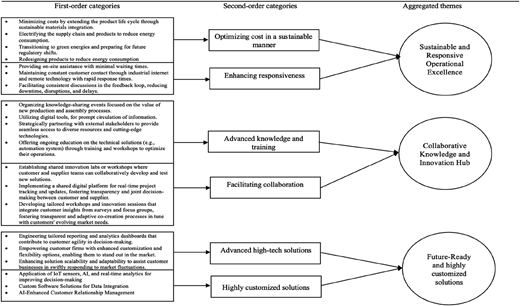
To structure the analysis, a Gioia-inspired analytical framework was employed as a systematic coding device within an abductive research logic, rather than as a purely inductive theory-building methodology (Gehman et al., 2018; Gioia et al., 2013; Lundin and Kindström, 2024). First-order analysis focused on informant-centric expressions, interaction episodes and documented evaluative cues related to innovation practices, collaboration, coordination and customer feedback. Approximately 50 initial codes were identified and iteratively consolidated into 21 first-order categories through constant comparison across cases (Eisenhardt, 2021).
In the second stage, these categories were examined in relation to sensitizing concepts drawn from SDL and service ecosystem theory – such as resource integration, role configurations and institutional arrangements – and organized into six second-order themes. At this stage, the co-creation continuum served as a sensitizing and integrative device that helped relate observed interaction configurations to distinct evaluative cues through which customers interpret innovativeness, while remaining open to empirical refinement rather than prescribing predefined categories.
In the final stage, second-order themes were further abstracted into three aggregate dimensions: (1) sustainable and responsive operational excellence, (2) collaborative knowledge and innovation hubs and (3) future-ready, highly customized solutions. Combined, these dimensions explain how customers evaluate supplier innovativeness based on relational, behavioral and ecosystem-level cues rather than firm-internal capabilities or innovation outputs alone.
Analytical rigor was enhanced through systematic cross-case comparison and collaborative coding. Two researchers independently coded the empirical material and reconciled interpretations through iterative discussion, supporting transparency and robustness (Elliott, 2018). All analytical steps – including coding iterations, analytic memos and conceptual development – were documented in structured case databases, enabling analytical traceability (Miles et al., 2014; Yin, 2009).
Consistent with abductive logic, data collection and analysis proceeded iteratively and concurrently (Dubois and Gadde, 2002; Schaarschmidt et al., 2018). Interviews were treated as situated meaning-making activities embedded in organizational and ecosystem contexts, maintaining sensitivity to interactional and institutional conditions shaping customer-perceived innovativeness (Alvesson, 2003).
Finally, insights from five academic expert interviews were used as a theoretical validation mechanism. These interviews did not generate additional empirical categories but supported assessment of the coherence, plausibility and theoretical resonance of the emerging dimensions and the refined co-creation continuum. The resulting framework offers a mid-range, empirically grounded explanation of customer-perceived innovativeness as an interpretive, beneficiary-defined evaluative judgment shaped through co-creation practices and ecosystem dynamics in B2B service contexts.
Taken together, the combination of boundary-spanning interviews, documented customer feedback and cross-case comparison provides a sufficiently rich empirical basis to identify recurring evaluative patterns and develop the proposed framework (Eisenhardt, 2021; Yin, 2009).
4. Results
The analysis yields an empirically grounded framework explaining how customer-perceived innovativeness is inferred in B2B service relationships. Three aggregate dimensions emerge: (1) sustainable and responsive operational excellence, (2) collaborative knowledge and innovation hubs and (3) future-ready, highly customized solutions (see Figure 1 and Table 3). Combined, these dimensions demonstrate that evaluative judgments arise from interactional evidence and institutionalized feedback across service ecosystem interactions, rather than from suppliers’ internal R&D intensity or self-reported innovation claims.
Notably, the empirical analysis does not map service ecosystems as structural configurations of actors, nor does it assess degrees of participation in innovation activities. Instead, it examines recurring evaluative logics through which customers, positioned differently within service ecosystem interactions, interpret suppliers’ innovativeness based on distributed interactional and institutional signals.
The dimensions represent distinct yet interrelated evaluative domains through which innovativeness becomes visible to customers. Notably, supplier-claimed innovation was not uniformly perceived as innovative; evaluations depended on whether innovation-related practices demonstrably advanced customers’ operational and strategic objectives.
Across cases, innovativeness was inferred from how collaborative practices enhanced operational efficiency, competitiveness and strategic adaptability. Perceived innovativeness was interpreted through service-oriented collaboration aligned with evolving customer contexts, rather than through discrete innovation outputs (La Rocca et al., 2019; Raddats et al., 2019).
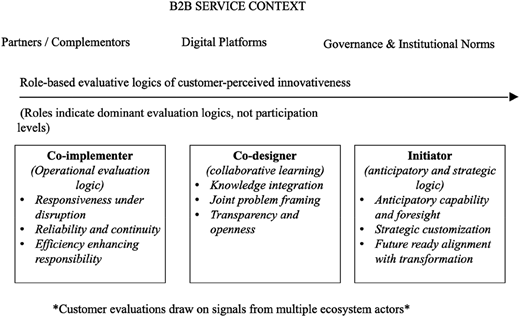
Through abductive cross-case comparison, these evaluative patterns were articulated through a co-creation continuum that captures how customers infer innovativeness across recurring ecosystem roles and interaction configurations, instead of levels of direct participation. Consistent with this continuum, evaluative logics varied with customers’ positioning in innovation-related interactions. When positioned as co-implementers, innovativeness was inferred from operational reliability and responsiveness. In co-designer configurations, it was associated with collaborative learning and knowledge integration. When customers acted as initiators – or when such expectations were articulated through documented feedback – innovative suppliers were those enabling long-term transformation through tailored, evolving solutions.
Therefore, the co-creation continuum should be understood as an analytical device capturing distinct customer evaluative logics, rather than as a representation of ecosystem structure or intensity of co-creation. It synthesizes how customers draw on different forms of evidence while evaluating innovativeness across recurring interaction configurations within service ecosystem. Figure 2 illustrates a conceptualization of customer-perceived innovativeness as a set of role-dependent evaluative logics through which customers interpret distributed interactional and institutional signals across a multi-actor B2B service ecosystem, rather than assessing innovativeness solely through dyadic interactions or discrete innovation outputs.
4.1 Sustainable and responsive operational excellence
4.1.1 Optimizing cost in a sustainable manner
Innovativeness has been frequently inferred when sustainability was embedded in routine operations and generated tangible cost and performance benefits. In co-implementation configurations, sustainability was evaluated less as symbolic positioning and more as a mechanism for improving efficiency, reducing risk and strengthening operational reliability. Consistent with prior research (Ranta et al., 2020; Tariq et al., 2017), sustainability-oriented initiatives were perceived as innovative when they delivered practical value-in-use.
Across cases, examples included optimized logistics fleets using fuel-efficient vehicles and transitions to eco-friendly packaging. Such initiatives were evaluated as innovative not only for their environmental contribution but also for reducing energy use, improving process efficiency and enhancing cost effectiveness, as illustrated by customer feedback:
Our supplier’s move to eco-friendly packaging is a win for our sustainability efforts – it’s great to see the difference it’s making. … We appreciate how their [supplier’s] transition to fuel-efficient vehicles is reducing emissions and making our operations more sustainable and cost-effective.
From a customer-evaluation perspective, these sustainability-driven practices functioned as credible signals of strategic alignment and reliability, particularly in procurement- and supply-chain-intensive settings. This aligns with evidence that innovations improving resource efficiency and reducing waste are evaluated as future-proof when they directly support customers’ operational goals (Mariadoss et al., 2011).
4.1.2 Enhancing responsiveness
Responsiveness emerged as a second evaluative domain within this dimension. Innovativeness has been inferred from how quickly and proactively suppliers addressed disruptions, coordination needs and adaptation requests – particularly when enabled by digital tools or real-time data. Rather than being treated as routine service quality, responsiveness was evaluated as an innovation capability when it reduced uncertainty and enhanced operational agility. As one informant noted:
Downtime is costly for our business … It would be innovative for us if suppliers could organize solutions that facilitate easier communication whenever we encounter production or sales issues.
Across cases, real-time monitoring, remote support and integrated communication routines enabled faster problem resolution and continuity. These practices were evaluated as innovative because they transformed coordination into a value-creating capability, consistent with prior research on responsiveness and value creation in B2B markets (Goffin et al., 2021; Lilien, 2016). For smaller firms, on-site assistance and mobile-enabled platforms were particularly salient due to their impact on service coordination and continuity, as reflected in the following account:
Real-time data and swift supplier responses not only prevented production halts but also strengthened our sense of partnership. Their synchronized approach makes it feel like we are working with a single, well-informed entity rather than separate departments … it improves the effectiveness of our strategies and boosts our competitiveness.
Notably, responsiveness functioned as an evaluative signal of innovativeness by making suppliers’ coordination capabilities visible and reliable under conditions of uncertainty. Although enabled by joint interaction, innovativeness was assessed through customers’ interpretations of suppliers’ ability to minimize disruption and enhance agility, underscoring its relational and context-specific rather than supplier intent alone.
4.2 Collaborative knowledge and innovation hub
4.2.1 Advanced knowledge and training
Customers perceived firms as highly innovative when suppliers fostered transparent, iterative collaboration that enabled joint learning and problem solving across organizational boundaries. In these contexts, suppliers were evaluated as not merely service providers but also collaborative partners that offered structured platforms – such as workshops, pilot projects and cross-functional forums – to support shared exploration and knowledge integration. This pattern reflects the co-designer position on the co-creation continuum, where innovativeness is inferred from dialogic interaction, experimentation and reciprocal sensemaking.
Consistent with prior research on collaborative engagement platforms in B2B innovation (Aarikka-Stenroos and Jaakkola, 2012; Chowdhury et al., 2023; Lievens and Blažević, 2021; Ojha et al., 2023; Salunke et al., 2019), the empirical material demonstrates that innovation-related knowledge was evaluated as most valuable when jointly developed, grounded in operational realities and informed by downstream user requirements. As one logistics manager explained:
We don’t have direct access to end users. Our role is to design machines for our customers, who produce household materials. In partnership with our customers, we lay the groundwork for optimized operational results in the production process. They perceive it as innovative when we jointly develop solutions that strengthen their capabilities within their consumer market.
Collaboration was particularly salient in open innovation arrangements involving customers and ecosystem partners in ideation, testing and refinement. These arrangements enabled suppliers to integrate contextual constraints, usage conditions and market-facing considerations, thereby enhancing implementation fit and strategic relevance. As another respondent noted:
Innovation sessions where we all collaborate really address the ever-changing needs of the market.
Through these practices, collaboration functioned as a capability-building mechanism rather than mere knowledge transfer. Customers evaluated joint workshops, training sessions and iterative feedback loops as credible signals of suppliers’ capacity to learn, adapt and evolve in relation to their needs, thereby reinforcing perceptions of innovativeness as a beneficiary-defined evaluative judgment instead of a unilateral supplier achievement.
4.2.2 Facilitating collaboration
Perceived innovativeness also depended on suppliers’ ability to orchestrate collaborative knowledge processes across organizational and ecosystem boundaries. Suppliers were perceived as innovative when they enabled customers to access, contextualize and apply specialized knowledge in ways that supported joint decision-making and ongoing adaptation. In this sense, collaboration functioned as a distributed learning mechanism embedded in the service ecosystem rather than as one-way information provision.
Customers particularly valued training, strategic updates and real-time technical support when these activities enhanced their capacity to evaluate alternatives, adopt new technologies or respond to operational change. As one multinational informant noted:
Having such an automation platform to update us on technical solutions has been pivotal in optimizing our operations. Access to our supplier’s expertise allows us to make better-informed choices.
These interactions frequently extended beyond transactional exchange to include joint innovation seminars, digital tool training and sustainability briefings. Suppliers that consistently disseminated relevant and up-to-date knowledge across customer-facing interfaces were perceived as forward-looking and reliable, thereby strengthening long-term relational value. As an R&D director explained:
The insights we gain from our networks have been instrumental in inspiring new ideas and approaches in our product development.
From the customer perspective, innovativeness was interpreted through collaborative sensemaking and capability-building processes, instead of being attributed to unilateral expertise transfer. Suppliers were evaluated based on their ability to help customers interpret complex information – such as AI-enabled analytics, market intelligence or sustainability benchmarks – and translate it into actionable practices (Biemans and Griffin, 2018; Costa and Monteiro, 2016; Petrescu et al., 2022). As one manager summarized:
Our most successful partnerships have been those where there is a continuous flow of knowledge. It’s a long-term investment.
In general, firms that cultivated hub-like collaborative environments were perceived as particularly innovative, not because of individual tools but due to their capacity to integrate knowledge, align actors and sustain collective learning over time within the service ecosystem.
4.3 Future-ready and highly customized solutions
4.3.1 Highly customized solutions
In co-creation contexts where customers acted as initiators, innovativeness was evaluated based on a supplier’s ability to tailor solutions to highly specific business needs and strategic priorities. Suppliers’ innovativeness was inferred when customization went beyond surface-level adaptation and reflected a deep understanding of customers’ operational contexts, competitive positioning and future-oriented objectives. This aligns with prior research demonstrating that contextually grounded customization enhances performance and agility in complex B2B settings (Goffin et al., 2021; Hong et al., 2023).
Across cases, customization ranged from incremental modifications of existing offerings to the joint development of entirely new solutions. Drawing on documented customer feedback, one technology-oriented informant noted:
This customization ranges from modifying existing products to creating entirely new solutions … offering solutions that are closely aligned with the needs of their market.
Similarly, in technology and automation settings, tailored digital solutions – such as customized reporting interfaces and analytics dashboards – were evaluated as innovative because they enabled responsive decision-making and operational flexibility:
… Tailored reporting and analytics dashboards improve our responsiveness in decision-making and provide flexibility, enabling us to stand out in the market …
Thus, from the customer perspective, innovativeness was not defined by novelty alone but by the relevance, usefulness and seamless integration of customized solutions into existing technical and organizational systems. Customization was particularly valued when it supported scalability, adaptability and smooth implementation across interdependent processes, as one manufacturing executive explained:
The real competitive edge comes from solutions that are not only advanced but also address our real needs.
In general, these findings show that meaningful customization functions as visible evidence of future-readiness. Innovativeness was interpreted as an evaluative judgment shaped through relational and iterative design practices, signaling a supplier’s capacity to co-evolve with customers within dynamic service ecosystems instead of as a unilateral supplier achievement.
4.3.2 Advanced high-tech solutions
Advanced digital and high-tech services – such as Internet of Things, artificial intelligence and advanced analytics – were evaluated as innovative when they operated as co-evolving service platforms rather than static technological features. Innovativeness was inferred when these technologies enabled continuous adaptation, learning and responsiveness over time, thereby supporting customers’ digital maturity and strategic flexibility.
Across cases, customers assessed innovativeness not by the presence of technology by itself but by how digital solutions were iteratively updated, refined and aligned with changing operational needs. Drawing on documented customer evaluations, one informant noted:
This IoT- and AI-infused solution is not static; it involves continuous updates and improvements based on customer feedback and technological advancements … ensuring the service remains relevant.
High-tech solutions were particularly valued when they addressed concrete operational challenges and supported forward-looking decisions. For example, predictive maintenance enabled customers to anticipate failures, reduce downtime and extend asset lifecycles, which they interpreted as signals of suppliers’ operational and strategic innovativeness:
Industrial Internet and remote technologies … minimize downtime, improve efficiency, and prolong equipment lifespan.
Suppliers were evaluated as especially innovative when they demonstrated anticipatory capability – translating technological potential into solutions that addressed emerging needs before these were explicitly articulated. As one IT-oriented supplier explained:
Customers do not buy the technology itself … innovation means understanding and delivering on future needs – even before they ask.
Overall, innovativeness depended less on technological sophistication alone and more on how digital solutions were co-developed, personalized and embedded within broader transformation processes. Technologies enacted through collaborative foresight and ongoing refinement functioned as visible evidence of future-readiness, positioning suppliers as partners capable of co-evolving with customers within dynamic service ecosystems.
Combined, these findings reveal that customer-perceived innovativeness is inferred through role-dependent evaluative logics grounded in observable practices and interaction configurations, rather than through abstract assessments of technological novelty. Thus, the co-creation continuum provides a structured way of organizing these evaluative logics without implying sequential stages or degrees of ecosystem participation.
5. Discussion
This study examines how business customers interpret and evaluate supplier innovativeness in B2B service ecosystems. Rather than proposing a new theory of innovation or co-creation, the current study applies SDL and service ecosystem theory as interpretive lenses to explain how customer-perceived innovativeness is formed through observable interactional and institutional cues that extend beyond dyadic exchange. The findings show that innovativeness is constructed as an ecosystem-level evaluative judgment grounded in customers’ sensemaking of how innovation-related practices are enacted, coordinated and made visible in use.
5.1 Customer-perceived innovativeness as an evaluative judgment
A central insight of this study concerns what customers actually evaluate when judging supplier innovativeness. Across cases, customers did not assess whether suppliers introduced novel technologies, invested heavily in R&D or labeled activities as innovative. Instead, innovativeness was inferred from observable patterns of action that signaled a supplier’s ability and willingness to support customers’ operational and strategic goals under conditions of complexity and uncertainty. These patterns included responsiveness in critical situations, transparency in collaboration, the integration of knowledge across organizational boundaries and the capacity to anticipate emerging needs.
5.2 The co-creation continuum as an organizing device for evaluative logics
The findings further show that customer evaluations of innovativeness follow distinct evaluative logics depending on how customers are positioned within innovation-related interactions. These logics are organized in the study through a co-creation continuum, which should be understood as an analytical device rather than as a representation of ecosystem structure, degrees of participation or stages of innovation.
This finding shifts attention from innovation as an outcome or capability to innovativeness as an evaluative judgment. From an SDL perspective, the results reinforce that value – and by extension innovativeness – is beneficiary-defined and phenomenologically determined in use. Therefore, innovativeness does not reside in the firm or discrete innovation outputs but in how customers interpret the supplier’s contribution to value creation through interaction and coordination over time.
When customers primarily occupy co-implementer positions, innovativeness is evaluated through operational criteria such as reliability, responsiveness and the ability to reduce disruption while improving efficiency and sustainability. When customers act as co-designers, innovativeness is evaluated through collaborative learning, knowledge integration and openness to experimentation and joint problem framing. When customers occupy initiator positions, innovativeness is inferred from suppliers’ anticipatory capability – their ability to translate emerging needs into highly customized, future-ready solutions that supported strategic differentiation.
Movement along the continuum reflects qualitative changes in how customers interpret innovation-related signals rather than increases in participation intensity. As customers’ ecosystem positions shift, their understanding of coordination across actors expands, and their evaluative focus moves from operational execution toward learning processes and anticipatory resource alignment. These roles are neither fixed nor mutually exclusive; customers may occupy hybrid positions or shift between roles as project demands, relational maturity and ecosystem configurations evolve.
Notably, the current study does not claim that innovativeness itself is co-created in the phenomenological sense associated with value-in-use. Instead, it illustrates how customers evaluate suppliers’ innovativeness by interpreting how innovation-related practices are enacted, coordinated and rendered meaningful within service ecosystem arrangements.
5.3 Ecosystem-level sensemaking beyond dyadic exchange
Although interviews were conducted primarily at the customer–supplier interface, the findings suggest that customer evaluations of innovativeness extend beyond dyadic interactions and are informed by cues embedded in broader ecosystem arrangements. Across the three empirical dimensions – sustainable and responsive operational excellence, collaborative knowledge and innovation hubs and future-ready customized solutions – customers drew on cues related to partner coordination, platform integration, governance arrangements and shared standards extending beyond the focal relationship.
These evaluations referenced suppliers’ ability to orchestrate distributed resource integration across wider service systems, an interpretation supported by secondary materials documenting ecosystem arrangements and coordination practices. However, such ecosystem-level insights are accessed primarily through supplier-side and interactional evidence rather than through direct observation of multiple ecosystem actors.
Therefore, innovativeness is interpreted as being informed by ecosystem-level sensemaking rather than confined to isolated dyadic assessment. This finding aligns with SDL’s conceptualization of innovation as a system-level process and clarifies how customer-perceived innovativeness emerges through interpretive judgments of distributed interactional and institutional signals.
Combined, the findings indicate that customer-perceived innovativeness can be understood as an ecosystem-informed evaluative judgment. Innovativeness does not reside in specific innovations, firm capabilities or technological artefacts but is constituted through customers’ ongoing interpretation of how suppliers contribute to value creation across interconnected actors, practices and expectations. The contribution is intentionally mid-range: it advances the understanding of how customers evaluate innovativeness in B2B service ecosystems without attempting to generalize across all forms of innovation or ecosystem dynamics.
5.4 Managerial implications
From a managerial perspective, the findings indicate that strengthening customer-perceived innovativeness requires moving beyond the communication of innovation outputs toward the enactment and visibility of innovation capabilities in use. Customers did not evaluate innovativeness based on technological novelty, formal R&D investments or innovation claims. Instead, they relied on observable interactional and systemic cues such as responsiveness, transparent collaboration and effective coordination across organizational and ecosystem interfaces.
The findings further indicate that engagement strategies should be aligned with the roles customers occupy in value creation, as these roles shape how innovativeness is evaluated rather than how innovation is produced. Operational reliability and responsiveness were most salient for co-implementers, collaborative learning and joint problem framing for co-designers, and anticipatory capability and future-readiness for initiators. Therefore, managers should design role-sensitive collaboration formats, governance routines and communication practices rather than assuming that increased customer involvement will automatically enhance perceived innovativeness.
Finally, firms perceived as highly innovative acted as knowledge orchestrators within service ecosystems rather than isolated solution providers. Advanced technologies and customized solutions were evaluated as innovative only when they were co-developed, iteratively refined and embedded in customers’ broader transformation trajectories. Thus, innovativeness depended on sustained alignment and coordination across ecosystem actors rather than on stand-alone technical features.
5.5 Limitations and future research directions
This study has a few limitations that point to directions for future research. First, the empirical setting comprises five Swedish B2B firms in innovation-intensive industries and is, therefore, context-specific and exploratory. The findings are analytically and not statistically generalizable. Future research can examine the framework across different institutional, national or sectoral contexts to assess boundary conditions.
Second, although the study focuses on customer-perceived innovativeness, direct access to customer organizations was not available in all cases. In two cases, insights were drawn from systematically documented customer feedback accessed through supplier-side boundary-spanning informants. Therefore, the findings reflect organizationally mediated interpretations of customer-perceived innovativeness rather than direct customer evaluations. While consistent with an ecosystem perspective, this distinction implies that the study explains how perceptions are constructed and mobilized in practice, rather than how they are phenomenologically experienced by customers themselves. Future studies can adopt multi-actor designs involving customers, suppliers and other ecosystem actors to further triangulate evaluative processes.
Third, relational dynamics such as trust, power asymmetries and role negotiation emerged as relevant but were not examined explicitly. Future research can investigate how governance mechanisms and institutional arrangements shape customer-perceived innovativeness over time.
Fourth, while the study adopts a service ecosystem perspective, the empirical access remains primarily at the customer–supplier interface. Therefore, ecosystem-level claims should be interpreted as analytically inferred rather than directly observed across all actors.
Finally, although the study proposes an empirically grounded framework for understanding customer-perceived innovativeness, further work is required to operationalize these evaluative logics quantitatively or through mixed-method approaches.
About the authors



Appendix Purpose and analytical positioning
The interview guide was designed to elicit accounts from boundary-spanning informants occupying different roles within the service ecosystem. Across the six interviews, informants were positioned either at the customer–supplier interface (e.g. solution providers, intermediaries or customer-facing roles) or as supplier representatives with access to systematically documented customer innovation evaluation data. Accordingly, questions were formulated to capture interactional evidence, documented feedback and organizational sensemaking processes through which customer-perceived innovativeness becomes visible and consequential, rather than to elicit speculative assumptions about customers’ subjective opinions.45