


This paper introduces digital praxiography as a qualitative digital research approach that extends netnographic and praxiographic principles to provide a framework for studying practices in digital service environments. The study explains the foundational aspects of digital praxiography, emphasizing means of data collection and analysis for digital and digitally mediated service settings.
This study follows a conceptual review methodology. The review process was iterative and interpretive, enabling the synthesis of diverse theoretical perspectives. This approach facilitated the development of a novel methodological toolkit tailored for studying service-related practices, allowing for a comprehensive understanding of digital praxiography.
The study reveals the potential of digital praxiography for researching digital service contexts. The paper discusses various data-collection modalities and their nuances, offering a detailed discussion of the application of digital praxiography and an agenda for future research.
This paper contributes to service research by offering a novel and advanced guide for applying digital praxiography. It breaks new ground by integrating and expanding praxiographic and netnographic approaches. The paper’s unique contribution lies in its detailed guidance on method adaptation that can be transferred to any digital and digitally mediated service setting.
1. Introduction
Digital technologies have become ubiquitous and ever-present intermediaries of human actions, transforming practices across multiple contexts, including service environments, the workplace and family and leisure activities (Amankwah-Amoah et al., 2021; Hobsbawm, 2022). The advancements brought about by digital technology have contributed to the blurring of lines between consumption, experience, work, life and play, particularly within service industries (Chevtaeva et al., 2024; Rainoldi et al., 2024, 2025; Zhou et al., 2024). This occurs because digital technology has created interconnected environments (Buhalis et al., 2023) that give rise to multidimensional customer journeys (Stickdorn et al., 2018; Neuhofer, 2022) composed of physical and digital touchpoints (Mieli, 2022) and practices. These developments present both opportunities and challenges for the service ecosystem and its stakeholders (Vargo et al., 2015; Hogg, 2024), as well as for research and the development of new methods.
Digital praxiography emerges from a pragmatist philosophy and is guided by the notion that practice constitutes the ontological unit of analysis rather than the actors and structures that generate it (Pratt, 2016). Practice is understood as a dynamic, experimental and evolving process that adapts to a constantly changing world (Bueger and Gadinger, 2015).
Digital praxiography is positioned as a research approach aimed at understanding the underlying patterns of practices that find place in digital settings or are mediated by digital tools. By harnessing the power that digital technology affords, digital praxiography builds upon praxiographic principles to develop a novel qualitative research toolbox specifically tailored to investigate the expanding terrain of practices situated in or related to a digital service environment. Importantly, the praxiographic approach enables data collection in digital service contexts where accessibility and mobility might limit direct data collection in the participant’s natural environment, revealing nuances in practices that traditional ethnographic research methods often fail to capture. Furthermore, digital praxiography is innovative in that it extends netnographic methods by leveraging digital tools to explore how practices unfold in or in relation to digital environments. While it builds on core elements of netnography, such as immersion and engagement, its distinctive contribution lies in shifting the analytical focus toward practices in the digital landscape through a practice-theoretical lens.
Digital praxiography offers an understanding of the contextual factors shaping practice highlighting the personal space, time and technological artifacts through which they are enacted. This approach offers unprecedented opportunities for service research and practice to study customer journeys, digital user experiences, digital service interactions and further consumer behavior topics by accessing naturalistic data online in the participant’s space.
This paper introduces digital praxiography as a novel extension of both praxiographic and netnographic approaches, designed to explore the complex and often hidden dynamics of service-related practices that are situated in or related to digital contexts. It examines the micromechanics of doing, the situational interplay of people and artifacts and how routine, tool-mediated actions unfold, evolve or break down within and through digital environments. This methodological evolution allows digital praxiography to access and analyze practices in ways that classic praxiography or traditional netnography might not fully capture. For example, rather than interpreting the cultural meaning of customer posts on a hotel’s social media page, a digital praxiographic analysis would focus on the actions involved in writing, posting or responding to comments – investigating how these practices shape the overall service experience.
Based on a conceptual review of the literature, it identifies the current state of research, highlighting gaps and formulates insights and directions for future research (Hulland, 2020). This paper thus follows the call made by Kozinets and Gretzel (2023) for innovation and versatility of methodological approaches, particularly due to the major changes in the technocultural landscape.
2. Conceptualizing practice research in service research
Practice theory is relevant to service research as it enables researchers to analyze social practices that determine service interactions in physical and digital service environments. Many traditional research approaches in service research tend to focus on the individual actor, specific technological resources that are acted upon and co-creation processes, as is common in studies following the service-dominant logic (e.g. Vargo and Lusch, 2004; Echeverri and Skålén, 2011; Mele et al., 2014; Skålén et al., 2015b; Rihova et al., 2018; Tu et al., 2018). In contrast, practice research emphasizes the need to investigate practices as the primary unit of analysis to yield a more comprehensive understanding of how services are delivered and consumed.
This is particularly relevant to numerous digital service settings. Digital technology is disrupting and transforming service businesses, business models and innovation (Heinonen and Sörhammar, 2024). Recent studies have identified several gaps when it comes to digital service research. A key challenge involves achieving seamless service integration across digital platforms that create meaningful experiences and customer journeys, as inconsistencies remain prevalent (Huang and Rust, 2021; Neuhofer et al., 2014). Service experiences are transforming at a rapid pace and are altering the fabric of how and by whom services are designed and delivered (Heinonen and Sörhammar, 2024). This creates new opportunities and challenges for services that emphasize high human touch and personalization (Blümel et al., 2023; Neuhofer et al., 2015) through novel AI-driven algorithms (Grundner and Neuhofer, 2021) and immersive metaverse environments (Dwivedi et al., 2022).
On a larger societal level, the service industry confronts challenges regarding service innovation (Heinonen and Sörhammar, 2024; Skålén and Gummerus, 2023) and the digital divide, which continue to remain underexplored, particularly regarding its impact on service accessibility (Van Deursen and Van Dijk, 2019). Another challenge across service contexts is the necessity for a deeper exploration of data privacy concerns and the navigation of practices surrounding personalization versus privacy, especially as digital services expand (Martin et al., 2017; Volchek et al., 2021).
Practice theory can help zoom into the issues and complexities of digital service experiences by deciphering the interplay between digital tools and human actions that form everyday service practices. Researchers can gain deeper insights into how practices unfold, how digital artifacts are enacted and how new forms of human and technology-centric agencies and structures emerge in the digital age. These enquiries position practice theory as a powerful perspective for examining the dynamics of digital services experiences and understanding the relationship among human actions, technological affordances and service processes, and how these are continually negotiated and redefined. Table 1 offers an overview of practice-theory-informed research in the service context.
Practice-theory-informed service research
| Author(s) year | Focus of investigation | Theoretical foundation(s) | Context | Method(s) | Research contribution(s) |
|---|---|---|---|---|---|
| Schau et al. (2009) | Value cocreation practices in brand communities | Schatzki’s practice theory and S-D logic | Multiple | Netnography | Services |
| Echeverri and Skålén (2011) | Practices used to cocreate and codestroy value | Schatzki’s practice theory and S-D logic | Elderly care | Interviews and field experiments | Service innovation |
| Lusch (2014) | Value cocreation practices | S-D logic and several practice theories | Theory | Conceptual | Services |
| Blocker and Barrios (2015) | Service practices used to cocreate transformative value | Giddens’s practice theory and S-D logic | Nonprofit | Interviews and observations | Services |
| McColl- Kennedy et al. (2015) | Cocreating service experience practices | Practice theory and S-D logic | Elderly care | Observations, interviews and diaries | Services |
| Skålén et al. (2015a, b) | Service innovation through change and creation of practices | Practice theory, S-D logic and service innovation | Multiple | Interviews, observations and documents | Service innovation |
| Skålén et al. (2015a, b) | Practices used to cocreate value in brand communities | Schatzki’s practice theory and S-D logic | Automotive | Netnography, interviews and documents | Services |
| Vargo et al. (2015) | Value cocreation practices | S-D logic and technology | Theory | Conceptual | Service innovation |
| Aal et al. (2016) | Institutionalization of new valuable practices | S-D logic and institutional theory | Food | Interviews and documents | Service innovation |
| Åkesson et al. (2016) | Test-driving practices of value proposition | S-D logic | Information and communication technologies | Interviews | Service innovation |
| Koskela-Huotari et al. (2016) | Institutional coordination of value cocreation practices | S-D logic and institutional theory | Multiple | Interviews | Service innovation |
| Baron et al. (2018) | Challenging and developing institutions and practices | S-D logic and institutional theory | Nonprofit | Interviews, observations and documents | Service innovation |
| Rihova et al. (2018) | Value co-creation practices | Schatzki’s practice theory, S-D and C-D logic | Festivals | Interviews and observations | Services |
| Kelleher et al. (2020) | Value cocreation practices | Several practice theories and cocreation research | Music orchestra and consumers | Interviews and observations | Services |
| Ellway and Dean (2020) | Customer engagement and value cocreation | Bourdieu’s practice theory | Theory | Conceptual | Services |
| Tuominen et al. (2020) | Institutional change and value co-creation practices | Several practice theories | Theory | Conceptual | Service innovation |
| Echeverri (2021) | Value co-formation practices | Schatzki’s practice theory, service ecosystem and resource integration research | Transportation and health | Interviews and observations | Services |
| Karlsson and Skålén (2022) | Resource integration and value cocreation practices | Several practice theories and S-D logic | Music market | Interviews | Service innovation |
| Skålén and Gummerus (2023) | Conceptualizing services and service innovation | Schatzki’s practice theory and service research | Music market | Interviews | Service innovation and services |
| Chronis (2024) | Practices in the service encounter | Several practice theories | Tourist tours | Observations | Services |
3. From praxiography to digital praxiography
Digital praxiography is a derivative of praxiography. The term praxiography, popularized by Mol (2002), refers to practice-based ethnography as “a story about practices” (p. 31). At the heart of praxiography is the exploration of people’s actions, which, together with various material artifacts, form the core of practices (Gherardi, 2019a). At its core, the praxiographic approach investigates “what people actually do while working, organizing, innovating, and learning” (Gherardi, 2019b, p. 742), which is crucial in services research.
Scholarly interest in practice research has led to two main conceptual streams: viewing practice as an “empirical object,” where a practitioner’s activities are central, or as a “way of seeing,” where practice is a lens to understand interactions and situational phenomena. The former focuses on the practitioner as an active participant in practices, while the latter shifts the focus to practice as a social phenomenon (Nicolini, 2012, 2017).
This view requires a shift in perspective from the practitioner as a carrier of practice to practice as a system of activities to explain the experience of practitioners in the doings of organizational life (Orlikowski, 2010; Schatzki, 2012). This perspective is valuable as it allows exploring how social actions and digital technology increasingly saturate each other, thereby creating novel formations and structures through which new dynamic patterns of interaction emerge, leading to new practices (Orlikowski and Scott, 2021; Valenduc, 2019; Ludwig et al., 2019). Digital tools can be seen as material artifacts that mediate practice by shaping how tasks are performed, how interactions are structured and how knowledge is co-created in service encounters (Giraldo, 2014). This highlights the dynamic nature of practice, which evolves through interactions and the integration of new digital tools, knowledge and experiences.
Gherardi (2019b) frames praxiography as a methodological framework for describing and reconstructing the intricate web of activities that constitute practice, while also highlighting how human and material actors are constitutively entangled within a practice. Ethnography, by contrast, focuses on documenting and understanding people’s ways of life as a manifestation of culture, emphasizing the social and symbolic dimensions of human behavior. While both methodologies share an emphasis on recording, describing and reconstructing (-graphy) (Bueger and Gadinger, 2018), praxiography shifts the analytical focus from interpreting meanings and cultural representations to tracing how practices are carried out, sustained and adapted.
Digital praxiography builds on this orientation by extending praxiographic inquiry into or through digital contexts. Philosophically, it departs from established ethnographic approaches – such as virtual and digital ethnography (e.g. Hendricks and Schmitz, 2022; Ritter, 2022) – by treating practice itself as the central unit of analysis. Its uniqueness lies in its specific focus on understanding the configurations, processes and material enactments of digitally situated or digitally mediated practices. In this sense, digital praxiography can be seen as a practice-oriented evolution of netnography but one that prioritizes the micromechanics of doing over the interpretation of symbolic meaning, shifting the emphasis from culture (ethno) to practice (praxis). For example, digital praxiography can be used to examine how individuals enact work-life boundaries through a range of micro-practices – such as muting notifications, activating focus modes, switching between professional and personal accounts or scheduling digital downtime (e.g. Rainoldi et al., 2025). Rather than interpreting the cultural meaning of these behaviors, the analysis focuses explicitly on how such practices are performed, configured and adjusted in everyday life.
Digital praxiography calls for researchers to adopt creative empirical strategies and novel forms of praxiographic inquiry allowing social phenomena in the digitalized world to be explored through observational, conversational or interpretative lenses. This gives room for observing practices as they unfold, engaging in discussions about what happens in practice and analyzing documents and records that reflect those practices. A key innovation of this approach is its integration of digital tools into the research process. This methodological evolution significantly broadens both the breadth and depth of data gathering and analysis. By leveraging technologies such as screen recordings, interaction logs and mobile apps, digital praxiography enables researchers to access, reconstruct and analyze practices as they unfold in situ – within and through the digital platforms, workflows and systems where service interactions actually occur.
This allows for a level of granularity and authenticity in the study of practice that was previously difficult to attain. For example, a researcher might reconstruct how travelers use a mobile airline app to manage bookings, check in and receive notifications – focusing not on user opinions or intentions, but on how the situated interplay of human actions, app features and contextual triggers constitutes a holistic digital service practice.
4. From netnography to digital praxiography
Digital praxiography and netnography share a common methodological foundation, but they target different focal points in the data. Netnography centers on deriving deep, cultural and contextual understandings from digital traces of varied nature (Kozinets and Gretzel, 2023). By contrast, digital praxiography views practice itself as the core unit of analysis, focusing on how actions are carried out and adapted. The digital praxiographer zeroes in on how practices come together, evolve or break down in digital environments. Digital praxiography closely examines the micromechanics of doing in digital contexts, the situational configurations of people and artifacts and the ways those doings may or may not coalesce into broader patterns.
Digital praxiography does not reject culture – but it does decenter it. Rather than treating cultural context as the starting point or endpoint of analysis, it integrates cultural elements only as they emerge through practice. Culture is not dismissed, but reframed as an effect or outcome of recurrent, patterned practices, rather than a standalone system of meaning. Where netnography might interpret various aspects of the posts and comments of an airline Instagram account through the lens of cultural and contextual understanding, digital praxiography would examine each micro-action of posting, scrolling, liking or commenting as constituents of a practice, analyzing how these actions create, maintain or alter the experience of the service context. In this way, digital praxiography offers a practice-centered lens that can still generate cultural insights – but only insofar as those insights emerge from observed patterns of doing, rather than pre-existing symbolic frameworks.
Similar to netnography, digital praxiography emphasizes the importance of researchers immersing themselves in the spaces where social and material entanglements occur, enabling a deeper understanding of the conditions under which these entities are organized, interwoven and integrated within practice (Schatzki, 2012). Netnography advocates a deep analysis of how the characteristics of digital platforms, such as virtual worlds, social media and forums, shape users’ interactions in digital and immersive service environments. It requires researchers to fully engage with digital data sites, for instance, by using avatars or digital personas to observe and interact in the digital space (Kozinets, 2020; Kozinets and Gambetti, 2021; Kozinets and Gretzel, 2023).
As in immersive netnography, digital praxiography also calls for a deep level of research engagement – intellectually, emotionally and contextually – but it expresses this immersion differently. While netnography relies heavily on the principle of the “researcher-as-instrument” to interpret cultural meaning, digital praxiography shifts the focus from cultural interpretation to the understanding of practice. Nevertheless, researcher reflexivity remains essential – not in the sense of projecting meaning onto behaviors, but in maintaining attentiveness to how one perceives, documents, interacts with and reflections upon unfolding practices.
Rather than positioning the researcher as a cultural insider, digital praxiography requires them to be a careful observer of the material, temporal and relational dynamics of doing. Reflexivity in this context means being aware of how digital configurations shape both the practices under investigation and the researcher’s position in the field. For instance, maintaining an immersion journal helps researchers document their situated experience of interacting with a system or platform – not to interpret symbolic meaning, but to identify subtle shifts in action, breakdowns or adaptations over time. Tools like screencast videography (Kozinets and Gretzel, 2023) serve to capture the unfolding of these practices as they occur, supporting the creation of detailed practice traces. From this reflexive position, a customer journey map derived from digital praxiographic immersion would emphasize the observable sequencing of interactions (e.g. app use, message exchanges, platform transitions) and the material-discursive arrangements enabling them. Moreover, the use of digital tools to collect fine-grained data requires critical reflection on issues such as consent, privacy, data ownership and the potential for researcher overreach (Kozinets, 2020; Opara et al., 2023). As such, digital praxiography demands not only methodological innovation but also a heightened sensitivity to the ethical implications of studying practice in digitally mediated service environments.
Digital praxiography as a novel research approach extends and adapts core netnographic principles while incorporating a distinct praxiographic orientation. It brings together multiple qualitative traditions under a unified methodological umbrella to study practices within digital and digitally mediated service contexts. Taken together, the strategic integration of digital tools, researcher immersion and a distinct practice-centered analysis marks a significant advancement in the study of service practices – offering both methodological rigor and analytical precision in a domain that remains under-explored in existing research. Table 2 outlines the differences among ethnography, netnography, praxiography and digital praxiography.
Positioning of digital praxiography
| Ethnography | Netnography | Praxiography | Digital praxiography | |
|---|---|---|---|---|
| Definition | A qualitative research method for studying people and cultures in their natural settings through immersion and direct engagement | An adaptation of ethnography for deriving cultural and contextual understandings from digital traces and experiences | A qualitative research method that studies practices as the core unit of analysis, focusing on their enactment, materiality and evolution | An extension of praxiography integrating netnographic principles to study practices in a digital context |
| Unit of Analysis | Social behavior and interactions | Varied units of analysis | Practices | Practices enacted, represented or discussed in a digital context |
| Key Focus | Cultural norms, lived experiences and social structures | Topics that are represented or can be experienced through digital means | Practices in different contexts | Practices situated in or related to a digital context |
| Data-Collection Methods | Participant observation, in-depth interviews, field notes, document analysis | Immersion, investigation, interaction with participants, archival research | Observations of practices, practitioner interviews, document and material artifact research | Practices diaries, online interaction with practitioners, exploration of digital archival materials and artifacts |
| Strengths | Provides rich, contextualized insights into human behavior and social dynamics | Immersive and reflective engagement, methodological clarity, ethical framework, adaptability, cultural and contextual understanding | Emphasizes the material, embodied and procedural aspects of practices | Combines the depth of praxiography with the strengths of netnography |
| Limitations | Time-intensive, prolonged immersion, participation, ethical challenges | Ethical challenges, access limitations, rapidly evolving digital landscapes | Difficult to capture tacit practices, requires deep engagement and access to practitioners | Difficulty in accessing certain digital practices, rapidly evolving digital landscapes |
| Application in a service-oriented context | In-person service encounters and interactions | Any kind of service experience related to a digital context | Service practices in different contexts | Any practices situated in or related to a digital context |
5. Digital praxiography data-collection strategies
Digital praxiography offers a toolkit of digital qualitative data-collection methods for (1) observing practice, (2) talking about practice and (3) reading about practice. Digital praxiography relies on a combination of observational methods, conversational techniques and artefactual analysis to explore how practices are enacted and sustained in digital contexts. These methods, though well-established within service studies, are remodeled by digital praxiography to serve the specific purpose of understanding practices that are situated in or related to digital contexts. Figure 1 presents a visual flowchart that summarizes the praxiographic research process from project idea, data collection and data analysis to interpretation and communication. As an adaption of the netnographic movements by Kozinets and Gretzel (2023), the graph shows how knowledge about practice can be obtained.
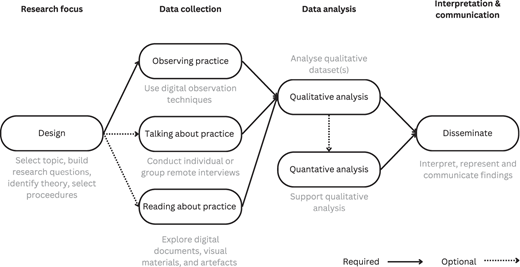
Digital praxiography research strategies. Source: Adapted from Kozinets and Gretzel (2023)
5.1 Digitally observing practice
While the praxiographic stance embraces a broad portfolio of data-collection methods, observations are often viewed as the most revealing approach for grasping the nature of everyday activities in a social system (Nicolini, 2012, 2017; Schmidt, 2016, 2017; Leonardi, 2015). In particular, Nicolini (2017) argues that observing the scenarios where actions unfold is essential for a comprehensive examination of practice. This is because observations allow an understanding of the situatedness of the doings and sayings constituting an unfamiliar practice (Gherardi, 2019b).
In the service industry, many interactions and transactions now occur online, which can be difficult to observe directly, or through artificial laboratory situations (e.g. eye-tracking of a website in a lab) (Rainoldi and Jooss, 2020). Digital praxiography, by contrast, enables the observation of practices in their actual environment – especially in digital or private settings – service contexts. Researchers can gain insights into the nuanced ways in which services are delivered, how staff interact and how customers engage with the service by capturing the full spectrum of practices without compromising privacy or missing out on fragmented digital interactions.
Virtual observations have emerged in service and consumer behavioral research to understand behaviors, interactions and practices within digital spaces (Bansal et al., 2024). Virtual observations refer to the methodological approach where researchers utilize digital tools and platforms to observe and study social interactions and behaviors without being physically present. This can include observing interactions on social media platforms (Damayanti et al., 2023), participating in video chats (Lynch et al., 2021) to understand group dynamics or immersive virtual spaces (Howie and Gilardi, 2019), such as the metaverse (Kozinets, 2022) to study service’s behaviors in a digital setting.
This digital observation approach is uniquely valuable for studying practices that exist primarily online and for observing them in environments that are challenging to access physically. Researchers can collect data with minimal interference, thereby preserving the authenticity of the digital interactions under scrutiny (Howie and Gilardi, 2021). For example, a researcher might reconstruct how travelers use a mobile airline app to manage bookings, check in and receive notifications – focusing not on user opinions or intentions, but on the observation of how of the situated interplay of human actions, app features and contextual triggers constitutes a digital service practice. However, this method also introduces challenges related to ethical considerations, such as privacy and consent, and needs robust frameworks to ensure the integrity and validity of the research findings. Kozinets (2020) underscores the necessity of respecting digital spaces as legitimate sites of personal and communal expression, requiring researchers to navigate the delicate balance between observation and intervention with care.
While a range of virtual observation techniques can be adopted in the study of practice, Czarniawska (2014a) argues that an observer can’t possess greater knowledge than the actors performing the practices under scrutiny. An observer may, however, notice different aspects of a situation that may not be apparent to the actors involved. As a result, every act of “seeing” is also an act of “non-seeing” because certain aspects may be overlooked. These reflections highlight that observations often fail to capture and represent practitioner’s actions when the observer is on the outside of the phenomenon. This challenge arises because achieving the necessary level of outsiderness – a critical distance needed to understand the practitioner – is difficult. Additionally, the observer may lack competence or become too engrossed in the practice they are observing, which can hinder their ability to maintain the ability to identify the elements that constitute a practice (Czarniawska, 2014b, 2017). In qualitative research, the separateness of the practitioner and the observer is problematic as it concerns the researcher’s ability to see significant events as they occur in a fragmented way and in multiple contexts that extend beyond the observable (Czarniawska, 2004). As noted by Bueger and Gadinger (2018), “there will remain situations in which practitioner or direct observation is impossible” (p. 149).
This is particularly true for various practices in digital service settings, which can include interwoven actions, such as creating, sharing, consuming and responding to digital content. These activities are not limited to the digital realm but often involve offline components, such as reflecting on interactions or discussing them with others. In this fragmented environment, digital practices stretch across time, locations and contexts, often blending the personal and professional in ways that are not accessible to public observation. For example, platforms, such as Snapchat or Upwork facilitate exchanges and activities that may remain private, requiring nuanced methods for understanding their dynamics (Jeffrey et al., 2022; Bucher et al., 2021). Observing such practices in their entirety is challenging and can be both ambitious and intrusive, often resulting in partial representations. As Czarniawska (2017) highlights, traditional observational methods are not always adequate for studying practices in contemporary, digital contexts.
To overcome the limitations of practitioner observations, practices can be explored through observant participation (Czarniawska, 1998, 2014a, b), which turns practitioners from simple informants into temporary praxiographers, who observe and record lived practice, much like field notes (Czarniawska, 2014a, b). Unlike traditional observation, this approach aligns with the immersive and engaged ethos of netnography (Kozinets and Gretzel, 2023) by embedding the researcher more deeply into the context of practice. As a self-report method, it is particularly suitable for digital practices (e.g. online service interactions, online bookings, social media and app use) as it is designed to capture the scene of action as it happens in situ. This type of participatory engagement mirrors what Ludwig et al. (2016) describe as studying practices “in the wild” (p. 487), a fundamental aspect of any study grounded in practice. Doing so provides insights into practice that go beyond the practitioner’s presentation of self in social life (Moeran, 2009), which Goffman (1959) described as frontstage expressive behavior. Gathering access to the backstage of service practices that are performed outside of the public eye, this method not only extends the limits of the observable but also provides opportunities to explore doings and sayings of activities. Moreover, self-report methods are particularly suitable for getting to the backstage of practice by “capturing information about people and their interactions with regard to their environment” (Ludwig et al., 2016, p. 489). They constitute a medium through which observed practice happening in situ can be documented.
Several digital tools can be used to collect self-reported information and expand researchers’ methods by providing access to larger, more diverse data captured in real time and within the actual environments where social practices take place. These include screen recording software, browser extensions for activity tracking and system-generated interaction logs. Screen recording tools (e.g. Loom) can capture real-time sequences of user interactions – such as how an individual navigates an app interface to manage bookings or configure notifications – revealing the procedural and material aspects of digital practices. Activity tracking tools (e.g. RescueTime) can document patterns of multitasking or switching between platforms, offering insights into how digital workflows are enacted and negotiated over time. Interaction logs from platforms (e.g. timestamps of edits in collaborative documents, customer support ticket histories) provide granular data on the rhythm and flow of digital collaboration. Within the digital service context, digital diaries represent a further valuable tool to collect self-reported information using different technologies and devices, including everyday mobile and smart devices (Ludwig et al., 2016; Schnauber-Stockmann and Karnowski, 2020). Digital diaries are particularly suited for exploring situated practices in naturalistic settings.
These methods offer not only immediacy and convenience in recording rich data by giving editorial power to the observant participant (Jarrahi et al., 2021), but they also empower participants to share a detailed account of practice as it unfolds (Symon and Whiting, 2019). The collection of data can be supported by techniques, such as the experience sampling method (Van Berkel et al., 2017) or the day reconstruction method (Kahneman et al., 2004). They allow participants to record rich data with ease and editorial control (Jarrahi et al., 2021), ensuring ecological validity (King and Brooks, 2017). Mobile apps (e.g. Indeemo) can also be used to enable participants to document their own situated practices through the collection of informative snippets – annotated videos, voice memos, screenshots or taken in the moment – adding contextual depth to the analysis of service experiences. Introduced by Brandt et al. (2007), snippets allow participants to quickly capture an occurrence’s essence by keeping its situational nature intact. Snippets then function as prompts for the subsequent data recordings. This approach is valuable for collecting information in mobile or active conditions. Doing so not only improves the validity of the captured data but also promotes the richness of data (Jarrahi et al., 2021).
By leveraging such tools, digital praxiography allows researchers to access, reconstruct and analyze practices as they unfold within the very environments where digital service interactions occur, enabling a more precise understanding of the micromechanics of doing. This enables us to achieve a level of detail and authenticity previously unattainable. Ultimately, incorporating digital tools into the study of service practices can significantly enhance service design and delivery. Insights gained from these methods can inform more customer-centric, efficient and innovative service solutions and customer journeys (Neuhofer et al., 2015; Stickdorn et al., 2018). Understanding the “how” behind service practices enables industry leaders to make informed decisions that enhance customer satisfaction and operational effectiveness. For instance, detailed customer interactions could be mapped out across various digital platforms, thereby identifying critical positive and negative touchpoints that influence customer satisfaction (Stickdorn et al., 2018). Moreover, the link to advanced data analytics and AI-driven methods can be explored, specifically when dealing with practices characterized by multidimensionality and complexity (Egger, 2024). These methods can illuminate various aspects of practice, such as habituality by identifying recurring patterns of action, and commonality or overlap by uncovering shared behaviors across different user groups. This could pave the way for predictive modelling of customer needs, enabling more personalized and adaptive digital service designs and digital service ecosystems.
5.2 Digitally talking about practice
Like netnographers, who often complement their immersion movement with an interaction movement (Kozinets and Gretzel, 2023), praxiographers can gain additional insights by conducting interviews with practitioners (Bueger and Gadinger, 2018). By talking with a practitioner about their practice, a rich understanding of practice in the digital world can be obtained (Jarrahi et al., 2021). This would include understanding the reasons behind their actions and the effects of their actions on themselves and others (Forsey, 2010).
Qualitative research scholars have called for interviewing strategies that produce insights into events and the practitioner’s stance in the course of action. An in-depth, lengthy and interactive praxiographic interview – whether conducted individually or in groups – is designed to elicit detailed accounts of how practices are performed, with a particular focus on the sequence of actions, tools used, decisions made and situational dynamics. When applied to digital contexts, this interview approach explores how individuals engage with digital platforms, navigate interfaces or adapt routines through technology. Rather than asking participants how they feel or what they believe, praxiographic interviews guide them to describe what they do, how they do it and under what conditions – thus offering rich, practice-centered insights.
Compared to traditional interviews, praxiographic interviewing represents an instrument to produce insights into significant activities and the practitioner’s stance in the course of action (Bueger and Gadinger, 2018; Gherardi, 2019a). These interviews enable an exploration of the situated, embodied and material aspects of practice. They also facilitate the reconstruction of actions, highlighting the interplay between practitioners, tools and contexts, which might otherwise remain implicit or overlooked in traditional interviews.
Rather than conducting classic face-to-face interviews, everyday digital technology, such as smartphones, tablets or computers can be used as a communication tool between the researcher and the study participants (Salmons, 2015). This is what Kozinets and Gretzel (2023) refers to as netnographic interaction, where data are collected through various digital means in virtual settings in synchronous or asynchronous, textual or audiovisual formats. This approach encompasses a range of techniques, including conducting interviews within immersive environments, leveraging screen recordings and utilizing videography to capture interactions. Netnography interaction allows researchers to explore how participants engage with digital platforms, providing insights into their behaviors, practices and social dynamics in a way that traditional methods might not. For example, interviews conducted in virtual reality spaces or augmented reality environments can reveal how users interact within these immersive contexts, while recordings and videography can document real-time interactions across different digital platforms. A key advantage of technology-supported interviews is their potential to enhance contextual naturalness (Mann and Stewart, 2002), as they allow conversations to take place in the very setting where the practices under investigation occur (King et al., 2019). This may include private spaces, work areas, leisure settings or anywhere in between.
Digital tools enable researchers to be virtually present in settings that would otherwise be impossible to access in person. In this way, praxiographic interviews become what Czarniawska (2014a) considers an observational encounter. Digital tools make it possible to reach participants beyond any geographical limitations (Salmons, 2015; Saunders et al., 2019; King et al., 2019) and ensure personal health and safety for both the researcher and participants (Bryman, 2016; Saunders et al., 2019). Kozinets (2020) emphasizes several crucial ethical considerations regarding interviews conducted through digital tools. First, he underscores the necessity of obtaining explicit informed consent from participants before recording or analyzing their interactions. Kozinets also highlights the importance of maintaining participant anonymity or confidentiality, especially in digital settings where the lines between public and private can be blurred. This is particularly challenging in digital interviews, where the researcher must navigate privacy settings and secure platforms to safeguard participant information.
A valuable technique to conduct praxiographic interviews online is the remote video technique. While this technique remains underused, its potential as an interviewing modus is becoming increasingly recognized in qualitative research (King et al., 2019). Interviewing practitioners via the same tool used in their everyday practice (e.g. computer, tablet, phone) gives participants a sense of comfort while contributing to the interview process in a familiar setting (Salmons, 2015). Furthermore, the remote video technique fosters engagement between the researcher and the practitioners, enabling nonverbal communication cues that closely resemble those of face-to-face interviews. This method allows for real-time, synchronous conversations combined with a visual element, enhancing the depth and immediacy of the interaction (Bryman, 2016; King and Brooks, 2017). For praxiographic interviews, this approach focuses on how specific practices are enacted, embodied and mediated through tools in specific settings. This highlights how praxiographic interviews prioritize the dynamics of practice itself, adding a practice-focused lens to netnographic approaches.
Despite its advantages, some researchers have highlighted potential issues of the remote video technique, including sampling limitations, practitioners’ acceptance of the technological medium and recording quality problems (King et al., 2019; Salmons, 2015; Bryman, 2016). The method, however, is of great value when exploring the practices of individuals who engage in digital and digitally mediated activities regularly. Video conferencing tools, such as Zoom, Microsoft Teams and Google Meets represent examples of well-suited instruments for the remote conduct of praxiographic interviews. For example, Zoom is a widely used digital work tool (Richter, 2020; Leonardi, 2021) used daily by 300 million practitioners (Reuters, 2020) on a wide range of everyday digital devices and operating systems. Besides its audio and video communication features (e.g. through speakers, microphones and webcams), Zoom also offers scheduling, recording and transcription solutions, which can facilitate not only the conduct of the interview but also data analysis.
The integration of digitally conducted praxiographic interviews in service studies offers several advantages, especially in understanding and improving service practices and employee-customer interactions. Firstly, conducting praxiographic interviews allows service industry professionals to gain deep insights into the practical knowledge and everyday actions of their customers. This approach can unravel the nuances behind service consumption, including the reasons behind specific practices and their impacts on both, the service providers and the recipients. Such in-depth understanding is crucial for refining service protocols, enhancing customer satisfaction and tailoring service experiences to meet consumer needs more effectively. This is especially relevant in digital and digitally mediated services, where understanding the digital aspect of service delivery becomes as important as the physical one.
Digital praxiographic interviews hold significant value for service research, offering a path towards more effective service delivery models, which are informed by a deep understanding of practices. To further advance the usefulness of this method, future studies could integrate digital praxiographic interviews with human–computer interaction tools, such as think-aloud protocols, to elicit deeper insights into practitioners’ thought processes and decision-making as they engage with specific platforms. This approach would complement the interviews by capturing data that extend beyond what can be directly observed, offering a window into the cognitive and reflective dimensions of practice. By combining interviews with techniques that encourage participants to verbalize their thoughts in real-time, researchers can gain a richer understanding of the interplay between actions, tools and contexts in service practices (Fraiss et al., 2017). Moreover, future research could use praxiographic interviews in virtual reality (e.g. Beck et al., 2019) and metaverse service environments (e.g. Kozinets and Gretzel, 2023) to get insights into practice emerging from virtually mediated service settings.
5.3 Digitally reading about practice
To further complement the above-mentioned methods, the exploration of written documents, visual materials and artifacts is integral to praxiography, as these components both shape and reflect practices. This approach emphasizes how texts, images and objects mediate, enable and structure practices. For instance, documents provide insights into the formal and informal rules that shape how practices are performed, while visual materials, such as photographs and videos, reveal how practices are enacted in specific contexts. Artifacts, including tools and objects, are central to capturing practices because they embody the skills, routines and tacit understandings necessary for their performance. The analysis of such materials serves as a starting point to explore the dynamic interplay between materiality and social action, highlighting their constitutive role in the performance and organization of practices (Bueger and Gadinger, 2018).
In digital and digitally mediated practices, digital artifacts, such as tools, applications and platforms are useful for understanding the practical knowledge embedded in the digital traces that practitioners leave online (Hand and Gorea, 2018; Leonardi and Vaast, 2017). This knowledge, often encapsulated in forums, blogs, newsgroups, bulletin boards and through the myriad of interactions on social media – ranging from reviews and comments to the sharing of images, videos and audio files – serves as a rich pool of information (Kozinets and Gretzel, 2023) useful to grasp how practices are produced both in the physical and the digital world. The digital footprints on these digital media encapsulate a wealth of situational information that are central to comprehending the nuanced nature of practices in a service setting.
Services are increasingly promoted, distributed and offered online. Digital traces of these services can reveal customer actions, patterns and material entanglement that guide fully digital and digitally mediated service practices. From interface designs and instructional texts to user-generated content and service-related visual cues, these elements function as mediators that structure, enable or constrain particular forms of doing. In service contexts, for instance, booking confirmations, chatbot scripts, mobile app layouts or FAQ pages all contribute to the organization and execution of user actions. Rather than analyzing these materials solely for their content or symbolic meaning, digital praxiography examines how such texts and objects participate in the configuration of practice – how they guide sequences of activity and influence the evolution of service-related routines over time.
This approach provides a richer understanding of how the material-discursive environment of digital services supports or disrupts the performance of everyday practices. For example, researchers can utilize tools like digital archives and historical records from online communities to track changes in practices over time, providing a deeper understanding of how these evolve, adapt and are influenced by shifting contexts and the dynamics between social and material actors. However, while these digital footprints offer valuable data, researchers must remain sensitive to ethical considerations, particularly regarding consent, vulnerability and platform policies. For a more detailed discussion of these ethical challenges in digital praxiography, see Kozinets (2020).
Digital praxiography offers a framework for investigating the multitude of digital textual data, visual materials and artifacts that structure and sustain service practices. By tracing the role of artifacts, tools and interfaces in the enactment of service practices, digital praxiography extends netnography’s methodological repertoire (Kozinets and Gretzel, 2023) and broadens its applicability to fields such as service research (e.g. Heinonen and Medberg, 2018) where understanding the mechanics of service delivery and user engagement is central. Digital praxiography advances the field by explicitly grounding its analysis in practice theory – emphasizing the relational, material and processual nature of doing which is embedded in the written documents, visual materials and artifacts that compose it. This shift brings a new theoretical lens to the study of digitally mediated service environments, focusing not on what digital content means, but on how it mediates and configures action. In doing so, digital praxiography bridges praxiography with netnography-oriented inquiry, offering a fine-grained and action-oriented approach to studying service phenomena in and through digital contexts.
These advancements foster a more nuanced understanding of digital service practices to capture their complexity and evolving dynamics in increasingly digitalized contexts. This may involve the use of tools for continuous, practice-focused monitoring and real-time analysis – not to track sentiment or popularity, as in conventional social media monitoring (Gretzel, 2018), but to identify how specific patterns of action emerge, stabilize or shift over time.
6. Digital praxiography data analysis strategies
Analyzing the large, qualitative dataset made of digitally curated textual and visual data from several praxiographic methods requires adequate analysis approaches to uncover meanings embedded within open, complex and rather unstructured narratives (Saunders et al., 2019). In praxiographic research, many analytical techniques can be adopted for this purpose, including thematic (Holton, 1975), narrative (Riessman, 1993), discourse (Brown and Yule, 1983) and conversation (Sacks, 1992) styles of analysis. Such analytical techniques offer useful strategies for systematically structuring and analyzing data and capturing the underlying meanings in the data (Bergin, 2018; Saunders et al., 2019). For example, thematic analysis can help identify recurring action patterns in self-reported user routines or platform use cases, while conversation analysis is particularly suited to studying turn-taking and interactional structure in chat-based or messaging-driven service practices. What distinguishes their use in digital praxiography is not the method itself, but the analytical focus. Rather than searching for abstract themes or latent meanings, the distinct goal is to uncover how actions, tools and environments are situationally entangled in sequences of doing.
The use of these qualitative analytical techniques enables the digital praxiographer to zoom in (Nicolini, 2012) on service practices and the process through which they are developed and enacted. In the digital service context, this entails applying a microscopic approach, similar to netnography, by closely examining specific online interactions, such as individual posts, comments and user-generated content. This allows for a detailed exploration of how practices are enacted, negotiated and reshaped within digital spaces, revealing insights into the interplay between user behaviors and the dynamics of online service practices. This detailed analysis helps understand the specific dynamics and micro-level interactions that contribute to broader trends within the digital space (Kozinets, 2020). For instance, examining the structure of an interaction log or user-generated FAQ thread can reveal how digital service routines are stabilized and negotiated over time. This microscopic view echoes netnography’s immersive approach but reorients it toward the mechanics of action and practice, rather than cultural and contextual interpretation.
To expand the analytical reach of digital praxiography, quantitative methods can be integrated to support pattern recognition across large or complex datasets. For example, after qualitatively coding digital practices, researchers can quantify the distribution of codes across cases or contexts to explore how certain practices cluster, recur or evolve. Technological advances have given rise to innovative machine learning and algorithm-based analytical approaches to analyze complex research problems dealing with postmodern practices and complex consumer behaviors in service settings, such as travel and tourism (e.g. Egger, 2024). These techniques serve as exploratory tools that complement praxiographic inquiry by identifying structural patterns without replacing deep contextual understanding.
Among these, archetypal analysis as suggested by Cutler and Breiman (1994) is particularly well-suited for digital praxiography. This method identifies extreme or distinctive configurations of behavior – termed archetypes – that represent key variations in how practices are carried out. When applied to practice-level data, such as platform usage logs or digital diary entries, archetypal analysis can reveal distinct types of user engagement or service routines (e.g. a “streamlined self-service” archetype vs. a “high-touch support-seeking” archetype). In this way, the method helps capture constellations of actions, tools and contexts that define meaningful practice patterns in digital service environments. As Macia (2015) and Tessier et al. (2021) show, the iterative movement between clustering and contextual interpretation preserves analytical depth and prevents data fragmentation – key concerns in praxiographic work. This method is particularly useful when service research involves persona development, or the mapping of user types based on how they perform and sustain digital practices.
Despite their promise, such pattern recognition techniques remain underutilized in qualitative service research. Given the growing reliance on digital methods for collecting practice-based data, the integration of tools like archetypal analysis into the digital praxiographic repertoire represents a valuable direction for future research. These methods allow for rigorous, scalable insights into how service practices are formed, shared and stabilized in the digital age – without compromising the contextual richness that praxiographic inquiry demands.
Such approaches serve as a further level of analysis and enable one to zoom out (Nicolini, 2012) on the identified practices and develop an understanding of how practices are connected and form the practice networks (Nicolini, 2012), constellations (Schatzki, 2002) or architectures (Kemmis and Mahon, 2017) that compose the texture of reality. Zooming out involves what in netnography is understood as telescopic analysis, which shifts the focus to broader patterns and contextual factors. This approach looks at larger trends, themes and overarching narratives across multiple data points or interactions, providing a comprehensive view of how individual behaviors aggregate into larger social phenomena (Kozinets and Gretzel, 2023). By examining these broader patterns, researchers can contextualize the detailed findings from the zoom in stage or microscopic analysis within the larger scope of digital communities and cultural trends.
7. Conclusions and implications
In this paper, we introduced the concept of digital praxiography as a novel extension of praxiography and netnography and a valuable methodological approach that holds significant promises for exploring practices in contemporary service settings. By harnessing the power of digital tools and platforms, this approach not only transcends the limitations of traditional physical praxiography but also unveils new dimensions of practice that are intertwined with digital technologies, providing innovative uses for netnography in studying complex practices.
Digital praxiography facilitates a deeper and more nuanced understanding of service practices, capturing the complexities of the doings and sayings that bundled constitute practices and the tacit knowledge that underpins these activities in a digital and digitally mediated world. Several implications for research, practice and society have been formulated below.
7.1 Research implications
Digital praxiography offers a valuable framework for conducting empirical studies in service research. By incorporating digital tools in combination with praxiographic and netnographic principles, researchers can capture real-time and dynamic practice data in situ to gather more nuanced insights into singular aspects of digital service ecosystems. The methodological richness and flexibility of digital praxiography allow for the combination of diverse qualitative methods, fostering a comprehensive understanding of practices anchored in digital systems.
The combination of multiple digital qualitative methods for observing, talking and reading about practices offers the possibility to enrich the quality of both the research process and the theoretical conclusions that can be drawn from the findings (Pritchard, 2012; Mik-Meyer, 2021). However, in alignment with praxiographic research paradigms and netnographic approaches, this stance is best understood as striking a balance between emic and etic perspectives. This involves immersing oneself in the practices and experiences of participants (emic) while simultaneously employing reflexivity to interpret these practices in their broader social and cultural contexts (etic). This dual focus allows researchers to maintain deep engagement without compromising the critical, interpretive lens central to qualitative inquiry (Kozinets, 2020).
As digital tools and platforms evolve, researchers must continuously assess and adapt their ethical practices to align with new developments and emerging norms within digital spaces. Although digital praxiography does not inherently possess its own ethical framework, its alignment with the well-established ethical guidelines of netnography offers a foundation for addressing these challenges. This alignment occurs because both emphasize contextual understanding. Netnography, as Kozinets and Gretzel (2023) highlight, emphasizes engagement, empathy and a strong commitment to ethical principles, including contextualization and researcher reflexivity. By adopting and adapting these principles, digital praxiographic studies can ensure rigorous ethical standards while addressing the situated and dynamic nature of digital service practices. This alignment also enables researchers to navigate the complex ethical terrain of digital spaces, ensuring the protection of participants and the integrity of the research process.
For future research, digital praxiography can be used in various ways. When practice is the unit of investigation, diverse methods of data collection can be combined aimed at unpacking practitioners’ views, experiences, perceptions and expert knowledge. This can address the call for methodological innovation in service research, as practice research can apply multiple data-collection techniques for collecting longitudinal and situational data (e.g. Leonardi, 2015; Gherardi, 2019b; King and Brooks, 2017), providing a more nuanced understanding of practices over time and across different contexts. Doing so enables a deep level of analysis and development of a comprehensive and holistic picture of the phenomenon under investigation (Mik-Meyer, 2021).
Moreover, digital praxiography is also suited for future studies seeking to adopt a mixed-method data analysis strategy, which in practice-oriented research remains an exception (e.g. Littig and Leitner, 2017; Dobernig et al., 2016; Tessier et al., 2021). As we move forward, digital praxiography stands as a testament to the adaptability and innovation required in methodological approaches to keep pace with the evolving landscape of service industries. It encourages scholars to rethink and expand the boundaries of how practices are studied, opening new avenues for services research, reflective of the digital era’s intricacies.
7.2 Practical implications
For service providers, digital praxiography offers a valuable lens for examining and improving service and experience delivery. By using digital tools that capture, monitor and analyze practices, businesses can see the effectiveness of specific service designs to address the need for high-quality service and consumer satisfaction key performance indicators. As Heinonen and Sörhammar (2024) argue, excelling in service quality is no longer simply a transactional outcome but has become a strategic imperative. In line with common service design methods found in the field (e.g. customer journey mapping, service blueprints) (Stickdorn et al., 2018), praxiography can be used for market research to gather a contextualized understanding of how services are performed and enacted between providers and customers and the role that digital technology plays as an artifact. Practitioners can benefit from digital praxiography by adopting it in longitudinal and dynamic ways to continuously monitor and refine practices, potentially leading to more informed strategic decision-making and improved service delivery processes.
7.3 Societal implications
Beyond its research and practice contributions, digital praxiography has wider implications for public policy and society by providing evidence-based insights into service practices. Policymakers can better understand the impact of digital technologies on service delivery and identify potential areas that require support, regulation and policies. On a larger societal level, digital praxiography helps offer a deeper understanding of how new digital solutions that are hyped and adopted (Gartner, 2024) transform everyday practices and interactions. It can highlight how digital tools influence individual human service interactions and collective social behaviors. Mapping out practices and archetypes can help better understand individuals and address larger societal issues in service environments, such as how individuals negotiate and navigate digital inclusion, accessibility, privacy concerns and the digital divide to guarantee that technological innovations meet societal values and human needs in service contexts and beyond.
This paper forms part of a special section “Netnography and Qualitative Digital Methods to Advance Service Theory and Practice”, guest edited by Robert Kozinets, Ulrike Gretzel.

