Spiritual tourism is becoming a significant growth area of the Indian travel market, with more Indians opting to go on pilgrimage to popular religious cities. There are many spiritual destinations where some of this life's essences can be sought to enjoy harmony and peace. The study aims to prioritize motivators driving the intentions of the tourists to visit the spiritual destination.
The current study applied the analytical hierarchical process, a multi-criteria decision-making technique, on the sample of visitors from all the six spiritual destinations to rank the motivational factors that drive the intentions of the tourist to visit a spiritual destination.
The study's results postulated that spiritual fulfillment motives and destination atmosphere are the top prioritized motivations, while destination attributes and secular motives emerged as the least prioritized.
The research study provides valuable insights to the spiritual tourism industry stakeholders to target the tourists' highly prioritized motivations to augment the visits to a particular spiritual destination.
Previous research has explored the motivations and modeled their relationships with tourists' satisfaction and intentions. But, the present study has applied a multi-criteria decision-making technique to add value to the existing knowledge base.
1. Introduction
Spiritual tourism attracts growing academic interest and is often seen as an extension of religious tourism (Kujawa, 2017). Religious tourism is a distinct kind of tourism (Medhekar and Haq, 2012) related to an individual's religious faith (Ali et al., 2019). People make these sacred journeys to diverse holy places with the motives of searching for truth, enlightenment or authentic experiences related to such places (Božic et al., 2016). Of lately, it has been found that the journey to religious places is also guided by other motives such as appreciating nature, educational or cultural fulfilment, relaxation, self-care and spending time with nature (Terzidou et al., 2018). These non-religious motives opened up a new strand within religious tourism termed as spiritual tourism (Cheer et al., 2017). Spiritual tourism, the exploration of religious places, is independent of religion, belief, region or country (Rawal and Sah, 2017). In spiritual tourism, the orientation of the tourists is toward personal growth than devotional aspects. Spiritual tourism is a quest to find the answer to all the problems in life one is facing (Norman, 2011). Haq and Wong (2010) posited that amidst of overwhelming response to spiritual tourism, spirituality could be seen as the fifth “S,” an extension of the framework suggested by Malcolm Crick in 1989. Malcolm Crick categorized types of tourism destinations in four “S” framework wherein each S stands for the sun, sex, sand and sea (Crick, 1989).
India, the land of snake charmers and mysticism, attracts numerous national and international guests who are in the quest of finding the purpose of life and want to experience mystical experiences with one-self (Bakar, 2020). In the past also, many powerful rulers and sovereigns experienced inner peace, absolute freedom or sovereignty at the Indian land and gave up their material goods, status and supremacy (Singh et al., 2017). Haridwar, Rishikesh, Puri, Shirdi and Varanasi are famous spiritual destinations that attract domestic and inbound travel. These destinations are serving travelers with both religious and non-religious purposes by offering traditional religious experiences on the one hand and an opportunity to rejuvenate through yoga retreats and ayurvedic spas on the other. For example, vipassana meditation (a popular technique to focus on self) has been practiced by many international celebrities like Jack Dorsey (chief executive officer of Twitter), Yuval Noah Harari (bestseller author), to name some (Business Insider, 2018).
The Indian tourism sector is expected to grow at a rate of 10% for the next five years from its current size of US$121.9bn in 2020 (IBEF, 2020). In 2019, India was positioned at 34th place in the Travel and Tourism Competitiveness Index by the World Economic Forum (WEF) (IBEF, 2020). To improve the ranking of India and convert the forecasted numbers into reality, the government has started putting serious efforts into developing the tourism industry, particularly spiritual tourism. Several programs have been initiated, such as Pilgrimage Rejuvenation and Spirituality Augmentation Drive (PRASAD), development of a spiritual circuit (connecting all major spiritual destinations through land or air networks), among others.
To establish India (or any place/country) as a spiritual destination, in addition to the complete understanding of key driving forces behind its selection, the knowledge about the hierarchy of these factors is also important. Till now, studies on spiritual tourism (Michopoulou and Jauniškis, 2020; Dabphet, 2021; Rybina and Lee, 2021) have identified the factors that a tourist considers before selecting any spiritual destination. However, literature is silent about the prioritization of these factors. We could not find any single study that has attempted to assign priority to the driving forces behind choosing a spiritual destination. Hence, the present study aims to identify the key factors contributing the spiritual destination selection and to examine the hierarchy of these factors. In particular, we contribute to tourism and practice by raising two pertinent questions.
What are the key factors behind choosing a spiritual destination?
How are these factors prioritized in the minds of the tourists while selecting a spiritual destination?
To answer these above-raised research questions, the present study excavated the key factors of choosing a spiritual destination from the literature and divided them into criteria and sub-criteria. These factors were then validated by the experts, and the final data were collected from the tourists (national and international) visiting India. After that, the analytic hierarchy process (AHP) technique was applied to provide ranking to the criteria and sub-criteria to identify the most influential factors of selecting a spiritual destination. AHP is a multi-criteria decision-making technique used to prioritize the alternatives through pair-wise comparisons. This technique is applied in solving real-life complex problems using human judgments, personal experiences, brainstorming, among others (Sonar and Kulkarni, 2021). The AHP technique is applied in this study to uncover the relative significance of specified factors for the choosing of spiritual destinations.
This study unleashes the preferences of the spiritual tourists based upon which they make travel decisions. Similar attempts have been made by the researchers for other forms of tourism such as health tourism (Büyüközkan et al., 2021), cycling tourism (Bakogiannis et al., 2020), agro-tourism (Joshi et al., 2020), to name some. Nonetheless, till date, to the best of our knowledge, no study has assigned the ranking to factors of spiritual tourism. Hence, the unique contribution of this work is to highlight the comprehensive set of selection criteria for a spiritual destination using AHP. This scientific information based on the users' inputs will be helpful for the practitioners, government bodies and organizations working in the tourism space for designing their strategies and policies.
The remainder of the study is structured as follows: Section 2 deals with the literature reviewed, Section 3 deals with the research methodology part, Section 4 depicts the identification of highly prioritized motivators and Section 5 concludes with the discussion part followed by some theoretical and managerial implications and directions for future research.
2. Review of literature
2.1 Spiritual tourism
Spiritual tourism as a center of research in the tourism context is still an unmapped area relative to other forms of tourism, e.g. recreational, cultural tourism (Almuhrzi and Alsawafi, 2017). Cohen (1979) is renowned as the first to uncover diverse dimensions of religious tourism and posits religion, spirituality and pilgrimage as vital aspects of tourism. Religious tourism was separated into “the popular” and “the formal.” The former covers tourists with non-religious motives (personal development and personal well-being), while the latter covers tourists with religious reasons. Spiritual tourism can be labeled as “tourism characterized by an intentional search for spiritual benefits that coincide with religious practices” (Norman, 2011, p. 1). Several studies on pilgrimages and religious tourism have been carried out under the term “spiritual tourism” (Sharpley and Sundaram, 2005). While in some circumstances, tourist's practices may not correspond with any religious ones, which questions the applicability of the above definition and thus segregates pilgrimage religious tourism from the spiritual tourism (Norman, 2014). Spiritual tourism is perceived as a journey to a holy destination or shrine with the aim of spiritual growth, which is vital for an individual's beliefs or faith (Jesurajan and Prabhu, 2012).
Thus, religious and pilgrimage tourism embraces only tourists traveling for pilgrimage or other religious motives. While on the other hand, spiritual tourism encompasses both religious and non-religious travel motives (Haq and Wong, 2013). Owen (2006) posited spiritual tourism as a spot of conjunction for modern tourism and pilgrimage-linked travel. People may travel to spiritual destinations for motives other than spiritual ones like education, knowledge and awareness (Shuo et al., 2009). Several studies have classified these recreational travelers as religious/spiritual tourists recreational (Gladstone, 2013; Cohen, 1979). Religious and pilgrimage tourism puts stress on religious activities and is well cherished by the multifaceted notion of spirituality to be viewed as one of the facets of spiritual tourism. Travelers in spiritual tourism are labeled as “seekers,” “pilgrims,” “devotees,” “practicing pilgrimage,” religious, a particular interest, cultural or “experiential tourists” (Haq and Medhekar, 2015). While Haq et al. (2008) characterized spiritual tourists as “someone who visits a specific place out of his/her usual environment, with the intention of spiritual meaning and/or growth, without overt religious compulsion, which could be religious, non-religious, sacred or experiential in nature, but within a divine context, regardless of the main reason for traveling.” In support of this view, Shuo et al. (2009) claimed that spiritual tourism also encompasses other tourism-related aspects, as even the most committed pilgrims have recreation desires. Spiritual tourism can be regarded as the integral concept, which includes both tangible (e.g. temple design, monastery, customs, traditions library) and intangible (e.g. atmosphere, culture, service quality attributes) aspects (McKercher, 2002), which may drive the visit intentions of the tourists.
2.2 Tourism motivation and visit intentions
The first stage in examining tourist behavior must be to find out who they are and what their motives for the travel are (Norman, 2004). Motivation is perceived as a mental/biological need that stimulates and leads the traveler's behavior and decisions (Park and Yoon, 2009). In tourism, studies examining motivations are aimed at exploring the rationale of undertaking traveling journeys and outlining the travel behavior (Li et al., 2016). Several studies on tourism motivation are grounded on diverse models and theories developed by renowned authors, comprising “the allocentric-psychocentric model” (Plog, 1974), “escape seeking model” (Ross and Iso-Ahola, 1991), “the travel career ladder model” (Pearce and Lee, 2005) and “the push-pull factor framework” (Dann, 1977). The “allocentric-psychocentric model” posited travelers' personality characteristics, or psychographics, as the key determinants of travel preferences. The “escape seeking model” speculated seeking and escape dimensions as the determinants of travel decision-making, while “the travel career ladder model” indicated that tourism needs change across their lives and accumulate travel experience. The “push-pull factor framework” is based on push and pull motivation, which drives the travelers’ decisions.
The paradigm for push and pull motivation has been frequently utilized for empirical assessments of tourist motivations (Liro, 2021; Suhud et al., 2021). These push and pull motivations are usually defined as internal and external motivations (Goodall, 1991). This theory postulates that travelers are first motivated by emotional or internal factors to visit a particular destination and then are pulled by outside/situational or tangible motivations, including destination characteristics, infrastructure, etc. (Tang, 2014). Moreover, both of these forces are assumed to be independent and interdependent. Few studies have reported push and pull motivations as the significant predictors of destination loyalty (Yoon and Uysal, 2005), satisfaction (Yoon and Uysal, 2005), behavioral intentions (Prayag, 2012) and revisit intentions (Taher et al., 2015). On the word of Battour et al. (2010), push factors are inner motivations, habitually emotional, which influences an individual's dearth to travel, devote time to family or friends, or engage themselves in nature. Pull factors are the extrinsic ones that are explicit to a particular type of destination, which are transportation factors (Nicolau and Mas, 2006), service attributes (Chen et al., 2014), shopping prospects (Sirakaya et al., 2003), destination image (Echtner and Ritchie, 1991) and restaurants and cafes (Quan and Wang, 2004).
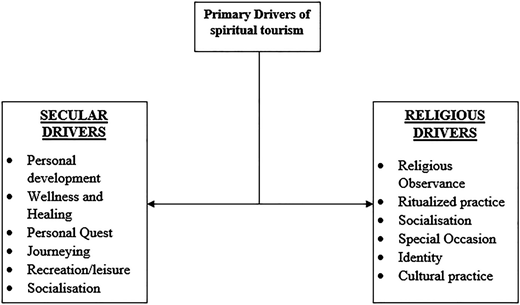
In the case of spiritual tourism, numerous factors drive destination decisions: connection with the site, cultural motives and famous events/festivals connected with destination, secular, educational, food and environmental (Michopoulou and Jauniškis, 2020; Dabphet, 2021; Rybina and Lee, 2021). Cheer et al. (2017), conceptualizing a framework for spiritual tourism, classified primary drivers of the spiritual parts into two categories, namely, secular and religious drivers, as displayed in Figure 1.
In a nutshell, the motives toward visiting a spiritual destination do not necessitate having spiritual reasons only. Travelers may possess secular or other non-spiritual motives that drive their visit or revisit intentions. Even though few studies have outlined the factors driving the visit intentions in the case of spiritual destinations, the study on the related significance of the factors depicting their priority is missing. Hence, the current study will consider all the motives discussed above and the experts' opinions while developing a hierarchical decision-making model for further analysis.
3. Research methodology
3.1 Sample design and data collection
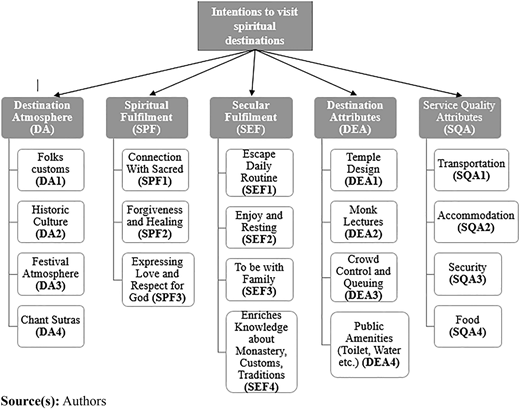
The pairwise comparison-based survey was designed based on the proposed hierarchical model (Figure 2) to assess the visitors' preference for different criteria and sub-criteria driving visit intentions. The study employed a quota cum convenience sampling technique. Quota sampling is regarded as the suitable method of all existing non-probabilistic sampling methods (Sharma, 2017). Keeping in mind the minimum sample requirements for AHP analysis, the quota of 100 visitors each from all the selected destinations (Varanasi, Golden Temple, Bodh Gaya, Haridwar and Rishikesh, and Vaishno Devi Temple) was fixed (Lee and Ross, 2012). After that, the convenience sampling method was used to collect the data from visitors during the month of September, October and mid-November 2020. Before collecting responses, all the respondents were briefed about the study's objective, the descriptions of the criteria/sub-criteria and how the response is to be provided. Out of 500 responses received, 463 responses were carried forward for further analysis (96 from Varanasi, 93 from the Golden Temple, 88 from Bodh Gaya, 93 from Haridwar and Rishikesh, and 93 from Mata Vaishno Devi), and the rest were excluded due to unengaged or incomplete responses. Among 463 responses received, 253 were males, while the rest were females. The sample comprises 130 foreign tourists and 333 domestic tourists. The age slab of respondents was 20–60 years.
3.2 Criteria and sub-criteria selection and model development
As discussed above, the first step comprises problem structuring grounded on which the goal, factors and sub-factors are confirmed. In the current research, the aim is to prioritize motivators inducing intentions to visit spiritual destinations. To finalize the criteria and sub-criteria, the factors were listed based on the push and pull motivation theory and were further grouped into five categories based on their description. A total of 23 sub-factors were grouped into five factors, which have been labeled as destination atmosphere (DA), spiritual fulfillment (SPF), secular fulfillment (SEF), destination attributes (DEA) and service quality attributes (SQA). The three-level hierarchal model was developed incorporating the ultimate goals, i.e. intention to visit spiritual destinations as level 1, the main factors as Level 2, and the 23 sub-factors as Level 3. All the factors (criteria) and the sub-factors (sub-criteria) finalized were validated through pilot testing among six experts. These experts include academicians from the tourism background having at least ten years of experience in the research field and have researched spiritual tourism perspectives. All the experts selected were first acquainted with the research objectives and asked to provide opinions on the significance and preciseness of the sub-factors chosen and the main factors formed. After implementing the necessary suggestions and final approval of all the experts, the hierarchical model carried forward for further analysis comprised 19 sub-criteria, which were grouped into five criteria. Hence, based on literature and expert validation, the list of criteria and sub-criteria finalized and their codes are shown in Table 1. The three levels of the hierarchical model are shown in Figure 2.
3.3 Analytical hierarchy process (AHP)
AHP, developed by Satty (1970), is considered a useful and flexible tool to solve complex decision-making problems and is also given due acceptance by the international scientific community (Bottero et al., 2011). AHP makes analysis of the quantitative and qualitative criteria/sub-criteria easy and helps to solve the decision-making problem of four-level hierarchy, i.e. goal, criterion, sub-criteria and alternatives (Tzeng and Huang, 2011). According to Kumar and Gupta (2020), AHP is applied to rank among the criterion, sub-criteria and alternatives.
The step-by-step procedure of the AHP technique is elucidated below:
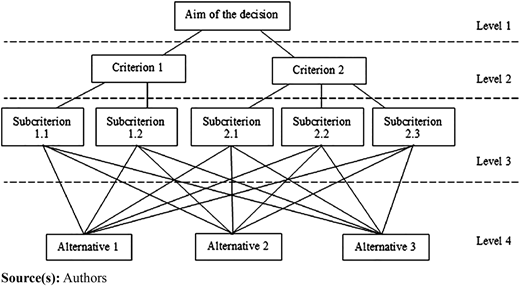
Step 1 – Construction of problem hierarchy: To achieve the study's objective, the problem can be divided into a four-level hierarchy (shown in Figure 3). The first level consists of the ultimate goal or aim or the problem to be solved. The second level comprises criteria (sub-goals) required to achieve the ultimate purpose or solve it. The third level includes diverse sub-criteria under each criterion. Level four consists of the various alternatives available.
Step 2 – Preparation of the AHP questionnaire and generation of pairwise judgment matrix: The AHP questionnaire was prepared with the help of Excel. The facts were collected from the decision-makers, and the pairwise judgment matrix was designed based on the Saaty scale (shown in Table 2).
Step 3 – Normalize (weight vector) the raw pairwise comparison matrix by taking average: The weight vector is calculated by taking the row average for each criterion, and sub-criteria and % of the weight vector are calculated.
Step 4 – Making the consistency matrix: The consistency matrix is prepared by multiplying the pairwise comparison matrix with the normalized weight vector (as shown in equation (1)).
Equation (1) is accomplished by dividing the weighted sum vector with the criterion weight (as shown in equation (2)).
Step 5 – Calculation of the consistency ratio: For evading the inconsistency in the pairwise comparison matrix, Saaty (1970) has proposed to check the consistency by using the maximum eigen value, i.e. (as shown in equation (3)).
The consistency index (CI) can be calculated with the help of (as shown in equation (4)).
After computing CI, the consistency ratio, i.e. CR, is calculated by using equation (5).
Random matrix (RI) shows the order of the pairwise comparison matrix, as shown in Table 3. The results are considered reliable only if the CR is < 0.10 (Saaty, 1970; Wong and Li, 2008). It represents the consistency in judgment making, and if these values exceed the maximum prescribed limit of 0.10, the decision-maker should review the decisions (Bottero et al., 2011).
4. Results
4.1 Results of local weights
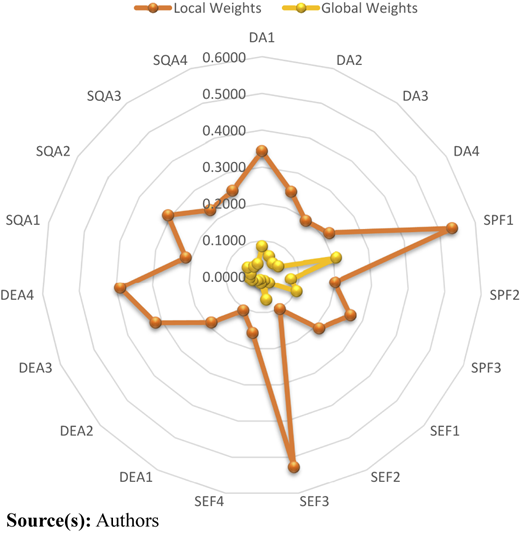
After finalizing the hierarchical decision model, a pairwise comparison matrix was prepared using a scale described in the above section. The LW and global weights (GW) were obtained, which are displayed in Table 4. The local weights (LW) specify the significance of sub-criteria within one specific category, while GW specifies the significance of sub-criteria among all the sub-criteria in the total. According to findings, the final rankings of the factors (criteria) came out to be is SPF > DA > SQA > SEF > DEA (the sign “>” stands for “More significant”). SPF (weight: 39.11%) emerged out to be the most important criterion, followed by DA (weight 24.31%), SQA (weight: 15.22%), SEF (weight: 12.38%) and DEA (weight: 8.98%) at second, third, fourth and fifth ranks, respectively, with the overall CR equal to 0.085, which is considerably less than the maximum recommended limit (< 0.10; Saaty, 1970; Wong and Li, 2008).
While looking at the relative importance given by tourists to the sub-criteria of SPF, connection with sacred (SPF1; weight 53.57%) was given more priority, followed by expressing love and respect for God (SPF3; weight: 26.41%) and forgiveness and healing (SPF2; weight: 20.02%) at second and fourth ranks, respectively, with the CR of 0.092.
Among different sub-criteria of the second most important criterion, i.e. DA, the priority ranking of came out to be was folks and customs (DA1; weight: 34.26%) > historic culture (DA2; weights: 24.53%) > chant sutras (DA4; weights: 21.84%) > festival atmosphere (DA3; weight: 19.37%). The CR in the case of DA sub-criteria evaluations was 0.089.
The local weight evaluations of SQA criteria revealed that tourists gave the most significance to the accommodation facilities (SQA2; weight: 30.66%), while food (SQA4; weight: 24.82%), security (SQA3; weight: 23.07%) and transportation facilities (SQA1; weight: 21.45%) stood at second, third and fourth ranks, respectively, with the CR of 0.096.
While looking at the relative importance given by tourists to the sub-criteria of SEF, with 0.082 CR, the priority ranking of came out to be was: To be with family (SEF3; weight: 52.80%) > escape daily routine (SEF1; weight: 21.15%) > enriches knowledge about the monastery, customs, traditions (SEF4; weight: 15.76%) > enjoy and resting (SEF2; weight: 10.28%).
Lastly, the results of prioritization done for the sub-factors revealed that public amenities (toilet, water, etc.) (DEA4; weight: 38.81%) was given more importance, while crowd control and queuing (DEA3; weight: 31.75%), monk lectures (DEA2; weight: 18.74%) and temple design (DEA1; weight: 10.74%) stood at second, third and fourth ranks, respectively, with the CR of 0.094.
4.2 Results of global weights
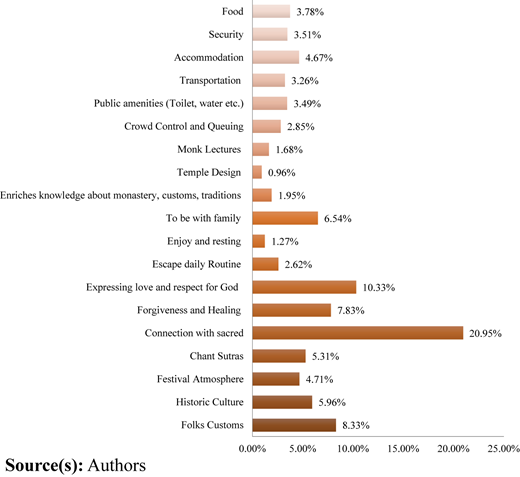
After calculating the LW of all the criteria and sub-criteria within their specific category, the next step was to estimate the sub-criteria's GW among all the total sub-criteria as a whole. GW was extracted by multiplying the local weight and weight of its respective factor (criteria). According to findings of the GW of 19 sub-criteria driving intention to visit spiritual destinations, the top five rankings of sub-criteria came out to be in connection with sacred (SPF1; weight 20.95%) > expressing love and respect for God (SPF3; weight: 10.33%) > folks and customs (DA1; weight: 8.33%) > forgiveness and healing (SPF2; weight: 7.83%) > to be with family (SEF3; weight: 6.54%) (The sign “>” stands for “More significant”). All these five sub-criteria cover approximately 54% of the total weightage, out of which approximately 40% was covered by all the three sub-criteria of the SPF criteria, the top-ranked criteria among all other criteria. Among all the sub-criteria driving intention to visit spiritual destinations, the least five ranked motivators were temple design (DEA1; weight: 0.96%) < enjoy and resting (SEF2; weight: 1.27%) < monk lectures (DEA2; weight: 1.68%) < enriches knowledge about monastery, customs, traditions (SEF4; weight: 1.95%) < escape daily routine (SEF1; weight: 2.62%) (The sign “<” stands for “Less significant”). All these least five sub-criteria in global rankings cover less than 9% of the total weightage. All these were from the least two prioritized criteria, i.e. DEA and SEF. Figure 4 displays all the sub-criteria's GW, in which top-ranked criteria are displayed in dark colors, and the least ranked criteria are displayed in light colors. The comparison of LW and GW of all the sub-criteria can be seen in Figure 5 in which the radar chart shows the LW and GW of the sub-criteria.
5. Discussion of results and implications
The study intended to determine the relative significance of different motivators and priorities or rank the motivational factors that drive the tourist's intentions to visit a spiritual destination. There is currently a deficiency in literature in terms of pairwise comparison of different motivators that drive tourists' intentions to visit spiritual destinations. Previous studies have explored and modeled the motivators of tourist to visit (Battour et al., 2017; Almuhrzi and Alsawafi, 2017), but hardly few studies were found that attempted to examine the relative and pairwise significance of the motivators for the tourists. The present study, therefore, sought to fill the gap by applying an AHP, a multi-criteria decision-making technique to examine the pairwise comparisons of motivators of tourists from all six spiritual destinations. Unlike previous studies that have applied structural equation modeling (SEM) to empirically inspect the relation among motivators and tourists' visit/revisit intentions or satisfactions, the current study adopted the AHP technique to prioritize the motivators on their significance. The study results revealed that SPF, DA and SQA emerged as the top highest prioritized motivators for the tourist. At the same time, SEF and DEA were the least prioritized factors augmenting spiritual destination visit intentions. The research study can provide valuable insights to the tourism industry stakeholders to target the tourists' highly prioritized motivations to augment the visits to a particular spiritual destination. Further awareness of essential attributes will help marketers tailor their products and services as per the needs of the tourists.
The results revealed that the SPF motives are the topmost prioritized motivator to stimulate intention to visit spiritual destinations among tourists visiting spiritual destinations in North and East India. The results confirm the recommendations and findings of the previous studies (Battour et al., 2017; Almuhrzi and Alsawafi, 2017), which reported its significant impact on tourist behavioral aspects. The global rankings also revealed that all three elements of SPF, i.e. connection with sacred, forgiveness and healing, and exhibiting love and respect of God, are the top-ranked motivators of intentions. This finding is vital for site management, as it directs the prerequisite to retain the site image as a sacred one. Marketing managers should create a destination image as a spiritual destination aimed at tourists' spiritual growth and development.
DA appeared to be the second topmost prioritized motivator augmenting spiritual destination visit intentions, consistent with prior studies' results (Battour et al., 2017). Among various aspects of DA (folks and customs, historical culture, festival atmosphere, chant sutras), folks and customs appeared in the top five global rankings. By contrast, historical culture, festival atmosphere and chant sutra were placed at the sixth, seventh and eighth ranks, respectively. Hence, transparency in rules regarding dress code, the prohibition of photography, etc., should be made to preserve a sacred destination's atmosphere. More space (benches, meditation rooms, etc.) should be provided to the visitors to connect with the holy and enjoy the atmosphere.
According to results, the third-highest prioritized factor was the SQA. Previous studies have also confirmed its significant influence on tourist destination decision aspects (Battour et al., 2017). The SQA covers transportation facilities, accommodation facilities, food facilities and security facilities. Visitors should be provided seamless experiences in respect of accommodation, transport and food facilities. Suggestions from the visitors should be invited, and future strategic decisions should focus on implementing those suggestions. Authorities should take suitable measures to promote safe and honorable tourism and increase awareness about helpline numbers regarding different issues to the visitors.
In addition to some managerial implications, the current study also delivers some theoretical implications. The current study results will strengthen the literature base in one of the vital aspects of spiritual tourism, i.e. visit intentions. The use of AHP is a new leaning to accompany and supplement the spiritual tourism literature with fresh insights. The preference hierarchy for motives built in this study offers theoretical foundations for stimulating applications and expansions of future empirical studies on spiritual tourism. This research provides novel insights to the researchers of the motivations that either have a strong or little influence on the spiritual destination visit intentions, which have been ranked to reflect the degree of preference. Lastly, applying a multi-criteria decision-making technique, i.e. AHP, opens the space for future studies to apply this technique to other spiritual destinations and other forms of tourism.
Moreover, COVID-19-related uncertainty and anxiety also affect people's mental and psychological well-being. To enhance their spiritual and psychological well-being, many people could engage in spiritual tourism. Strategic implementations based upon study results and the government and stakeholders' protection and recovery initiatives will help individuals increase their travel to spiritual destinations in the future.
6. Conclusion, limitations and future scope
Spiritual tourism has been an important sector of growth in the Indian travel market, with more visitors pilgrimaging to major holy locations. To define the marketing strategies of the spiritual destinations, understanding the preferences of the tourists is of priority for the stakeholders. Though several studies have examined the factors leading to the spiritual destination visiting intentions and modeled their relationships, there is hardly any study that highlights the relative importance of the visiting drivers. The current study attempted to fill the limited literature by examining motivators of visit intentions and that, too, through the AHP technique. This research provides a comprehensive framework of motivations for marketers/stakeholders to determine the competencies and resources needed for the development of spiritual destinations in the future. Identifying the priorities of factors leading to the spiritual destination visiting intentions would facilitate practitioners to design more sophisticated recovery and positioning strategies for spiritual destinations in the future.
With every study, there exist some limitations, which open the space for future studies. Firstly, the results cannot be generalized to other spiritual destinations as the sample consists of visitors from spiritual destinations of North and East India only. Secondly, the sample includes visitors of all age groups, gender categories and national foreign tourists, which may differ in their opinion. Lastly, the current study covered only limited motivators finalized after the experts' opinion. Therefore, in the future, studies should focus on other spiritual destinations from India and other countries to improve the generalizability of the results. Secondly, comparative studies of different demographic groups should explore whether differences in motivators' priorities exist between these groups. Third, future studies should cover other influencing motivators like destination image and past experiences, which significantly influence visit and revisit intentions in previous studies. Lastly, scholars can incorporate other techniques like fuzzy-AHP, interpretive structural modeling (ISM), analytic network process (ANP) to provide more valuable acumens in spiritual tourism.
The authors received no financial support for the research, authorship and/or publication of this article.