This study investigates the effect of COVID-19 pandemic perceived health risk on traveller's post-pandemic perception and future travel intention. The study aims to provide insight into the unprecedented COVID-19 pandemic and its potential influence on tourist behaviour.
Two hundred and forty-four responses were gathered quantitatively through an online survey. The research hypotheses were analysed using the partial least square structural equation modelling (PLS-SEM).
This study found that COVID-19 affects tourists' travel behaviour. Key findings found that perceived health risk discourages travel attitudes and eventually lessens their future travel intentions. Results also suggest future strategies/directions for restarting the tourism industry.
The study outcome assists tourism stakeholders in understanding the changes in tourist behaviour amid the heightened perceived health risk of COVID-19. Tourism policymakers and industry players should consider exploring how to mitigate similar health crises in the future.
By extending the theory of planned behaviour (TPB), this study establishes a theoretical framework in exploring the interrelationships between perceived risk, post-pandemic perception and future travel intention. This study sets a significant research agenda for future tourism research in understanding the mechanism behind health risk perceptions and tourist behaviour.
Introduction
The widespread coronavirus (COVID-19) has affected numerous lives, and the World Health Organization (WHO) has set the course of action to obstruct the virus from spreading widely (Catrin et al., 2020; Medical News Today, 2020). In the absence of a preventive vaccine, measures such as social distancing and lockdown were applied to contain the spread of COVID-19 (Abu and Rosbi, 2020; Li et al., 2020a, b) and are deemed as effective measures against COVID-19 utilised by many governments worldwide (Tang, 2020). Consequently, the Malaysian government announced a total lockdown due to the rapid increase in COVID-19 cases (Aziz et al., 2020; Karim et al., 2020), with the first case discovered on 25 January 2020 (Rampal et al., 2020). Notably, COVID-19 affected the Malaysian economic sector with substantial complexities in the Malaysian tourism industry.
Prior to the COVID-19 pandemic, the tourism industry was one of the significant economic driving forces around the world (Bakar and Rosbi, 2020; Foo et al., 2020; Shakeel et al., 2020). As a people-oriented industry, the Malaysian tourism industry has been one of the most affected economic sectors since the COVID-19 outbreak. Notably, the Malaysian inbound tourism demand is badly affected by border control (Foo et al., 2020). Besides, the strict movement control implementation limits domestic tourism demand. As a consequence, the Malaysian hotel occupancy rates plummeted, as work excursions and vacations were dropped.
The COVID-19 outbreak affected the Malaysian tourism industry within the first two months, with a loss of approximately MYR 3.37 billion (Dzulkifly, 2020). The Visit Malaysia Year 2020 (VM2020) campaign had to be cancelled due to the pandemic, which caused approximately MYR 68 million worth of losses from hotel room booking cancellations (Malaysian Association of Hotels, 2021). A significant decline in revenue (MYR 150 million) was estimated by the Malaysian Association of Tour and Travel Agents (MATTA) (Malek, 2021). Regardless of the cancellation and refund policies involving various service providers, travel agencies potentially encountered high liabilities as approximately MYR 500 million as affected customers sought monetary compensation. Subsequently, the tourism and hospitality workers were laid off, and numerous tourism-related businesses were forfeited (Olivia, 2020).
In this vein, the priority involved recovering domestic and foreign tourists' confidence by commencing the “Clean and Safe Malaysia” campaign (Awan et al., 2020). As the number of COVID-19 cases started to bearish, the movement control was loosened, as leisure travel was permitted and tourism operators were allowed to operate with a strict standard of procedures (SOPs). Notably, there is still eagerness to travel after COVID-19 (Bae and Chang, 2021; Ling et al., 2020). As a result, domestic travel gained momentum (Ganasegeran et al., 2020), but with limited demand. However, the domestic demand remains low as most local travellers are more cautious with their travel plans (Ahmad et al., 2021).
Conspicuously, the tourist's primary concern is the travel risk, which means they will avoid unfavourable destinations (Wong and Alias, 2021). The decision to travel entails risks because of the uncertainty about the conditions the tourists will face at the destination and the possible adverse effects of the COVID-19 virus (Williams and Baláž, 2015). Similarly, various researchers claimed that the fear of the COVID-19 pandemic, movement control regulation and the lockdown uncertainty changed the tourist's immediate behaviour as they were unwilling to travel (Altuntas and Gok, 2021; Ajzen, 2020; Rather, 2021). Notably, COVID-19 has changed the tourist behaviour, influenced mainly by limited knowledge about the coronavirus, the new-norm SOPs and social activities limitation regulations (Wen et al., 2021; Wong and Alias, 2021; Zheng et al., 2021).
Like previous tourism disaster studies, tourists are more likely to engage in travelling post-disaster (Aliperti et al., 2019; Chan et al., 2020). Besides, numerous studies have postulated heightened health risk concerns on tourism demand (Floyd et al., 2004; Leggat et al., 2010). During health crises, researchers argued that tourists prefer shorter road trips, precluding heightened contact with people, favouring outdoor activities, focusing more on hygiene and more concentration on ecotourism and green sites (Chebli and Said, 2020; Ling et al., 2020; Zheng et al., 2021).
In line with the proceeding notion, understanding travel motivation and tourist behaviour is vital for tourism businesses to help tourists build a market in decision-making, as indicated by numerous authors. Failure to consider travellers' current attitudes can lower their intention of repeating the experience (Davahli et al., 2020). Understanding post-pandemic tourist behaviour would offer the global and local tourism businesses, developers, tour operators and policymakers a strategic edge for the post-crisis recovery. The study results provide a basis of how COVID-19 affects travel behaviour, motivation, preferences and the broad range of tourist experiences. On the other hand, such information would provide universal academia an understanding of how COVID-19 affects travel behaviour, motivation and preferences.
This study investigates the effect of tourist perceived health risk on their post-pandemic perception and future travel intention. By extending the theory of planned behaviour (TPB), this study establishes a theoretical framework to explore the relationships between perceived health risk, post-pandemic perception and future travel. The study advances the TPB model by investigating how health risk perception influences tourist travel attitude and post-travel behaviour. Given the limited empirical studies on pandemic and tourism crisis literature, this study contributes a novel perspective of COVID-19 health risk perception and insights in understanding tourists' psychology after the COVID-19 outbreak. Besides, as the tourism business is strategising to attract tourists post-pandemic, more research is required to study the significant changes in tourist behaviour and how these changes would affect the effectiveness of their strategy.
Literature review
The COVID-19 pandemic refers to a widespread infectious disease that led to a significant economic crisis, with tourism being one of the most affected sectors in terms of revenue and employment (Fana et al., 2020; Li et al., 2020a, b). Currently, the survival of tourism enterprises is on the brink without an effective business continuity plan and the government's continuous support (Novelli et al., 2018; Rosselló et al., 2017). The way forward is to restore traveller confidence and understand travellers' psychology in post-pandemic travel better than simply predicting tourism demand as usual. However, the fear of health crises can exist over a long period, triggering fear-induced travel behaviours during and after the pandemic (Marques et al., 2020; Wong and Alias, 2021). Chua et al. (2021) argue that the traveller's mental well-being significantly predicted their attitudes towards outbound travel, while the perceived uncertainty greatly influenced their short-term avoidance to travel behaviour. Similarly, Perić et al.’s (2021) study indicates that the travel risk negatively affects overseas travel, while the health risk proved to be an adverse predictor of overseas travel during the COVID-19 pandemic. On a positive note, proactive individuals who received the vaccine and were accompanied by health insurance would be more motivated to travel sooner (Hotle et al., 2020).
Nonetheless, it is important to note that besides COVID-19, tourism has encountered several major health crises, with various researchers have studied how such crises affected the tourism industry. Health crises such as severe acute respiratory syndrome (SARS) have been considered a provisional tourism crisis, significantly impacting China's and the ASEAN tourism industry (Tran et al., 2020). Besides SARS, the avian flu severely impacted tourists' arrival in Asia (Kuo et al., 2009). Studies also show the adverse effect of hand, foot and mouth disease (HFMD) disease on tourism demand in the European region (Blake et al., 2003). Past studies also concentrated on dengue, Ebola, yellow fever and malaria outbreaks, focusing on their adverse impact on tourists' arrival in affected countries (Novelli et al., 2018; Oduber et al., 2014; Rosselló et al., 2017). Notably, the travellers' behavioural changes were expected to reduce during these health crises. As the COVID-19 pandemic is novel, there is a need to investigate how tourists behave from the fear of the COVID-19 pandemic and how it would affect their travel behaviour.
Ajzen's (1985) TPB represents one prominent example of predicting personal behaviour principle. The TPB was initially based on rational action theory (TRA) and included additional predictive factors, namely, perceived behavioural control and attitude and subjective norms. Accordingly, attitudes, subjective norms and perceived behaviour control are well-known determinants of behavioural intentions. Notably, as the TPB has been widely used in psychology, marketing and tourism fields, to name a few, other researchers have tried to include risk predictors in the model to improve its explanatory power (Ferdous, 2010; Han et al., 2010; Huanga et al., 2020).
Within the tourism industry context, risk-related variables have been added to deepen understanding of tourist behaviour (Girish and Lee, 2019; Park and Reisinger, 2010; Pennington et al., 2011). Previously, the perceived travel risk came in the form of diseases (Leggat et al., 2010; Pine and McKercher, 2004), terrorism (Wilks and Moore, 2003), natural disasters (Park and Reisinger, 2010) and adverse political events (Schroeder et al., 2013). Considering the COVID-19 crisis causes travel health risk, this study includes the perceived health risk construct as an extension of the original TPB model and treats attitudes, subjective norms and perceived behaviour control as tourist post-pandemic perception.
Study hypotheses
Tourist perception is a crucial aspect of the tourism industry. It is the process by which motivations are chosen, arranged and translated into a meaningful and rational representation (Gnanapala, 2015; Shariff et al., 2020). To quantify variables associated with tourist perception, various researchers highlighted multiple behaviour predictors, which include attitude, subjective norms and perceived behavioural control that influence tourist perception (Li et al., 2020a, b; Mahat and Hanafiah, 2020; Novelli et al., 2018; Singh et al., 2020). For several years, understanding tourist behaviour has helped tourist destinations in boosting their services to encourage new and repeat visitors (Shariff et al., 2020). However, with COVID-19, the potential threat affects not only the decision to which tourist destination to visit (Huanga et al., 2020; Hui and Fumin, 2020; Matiza, 2020), but also whether to travel or not in the first place (Liu et al., 2016; Neuburger and Egger, 2021; Rosselló et al., 2017).
The individual perspectives of a specific behaviour are impacted by behaviour-oriented complexities (Chua et al., 2021). The psychological changes reflected by tourists' good or flawed perceptions are described as tourist attitudes when involved in those actions (Liu et al., 2018). Attitude can be described as the extent to which an individual has a positive or negative appraisal or opinion of the behaviour questioned (Ajzen, 1991). Previous research in tourism has shown that attitude may be an essential factor in predicting, describing and influencing tourists' behavioural intentions (Hui and Fumin, 2020; Liu et al., 2018). Past studies affirmed that tourist perception and travel risk perception substantially impacted travel plan behaviours (Li et al., 2020a, b; Neuburger and Egger, 2021). On the other hand, subjective norms are attitudes and beliefs that a person will react, approve and support specific behaviour. It depends on other people's perceived social pressure on others to behave in a particular way and their motivation to follow these people's views (Ham et al., 2015). Various researchers also discussed the influence of subjective norms on attitude, which most of them claimed are correlated with individuals' intention (Hussain et al., 2021).
On the other hand, Ajzen et al. (2019) proposed that perceived behaviour control is defined as self-efficacy. It refers to an individual who believes that the behaviour in question is under their control. Usually, it evaluates the perceived control of the behaviour by the difficulty of the behaviour. Ham et al. (2015) revealed that subjective norms and perceived behaviour control would increase endurance to revisit the destination. Similarly, recent studies confirm that tourists' travel intentions are predictably influenced by perceived behavioural control and subjective norms (Sánchez-Cañizares et al., 2020). However, Ajzen and Fishbein (2005) believe that these three focal concepts (attitude, subjective norms and perceived behaviour control) are affected by individual differences and perceived value.
Similarly, past research has examined the effect of perceived health risk on tourism and identified risk as a multidimensional framework (Matiza, 2020; Liu et al., 2016). The possible risks of travelling would alter tourist behaviour – the intention of cancelling travel plans or avoiding specific risky destinations (Pennington et al., 2011; Schroeder et al., 2013). Because of safety and security, fear of going on a trip is natural, but the fear is heightened during health crises (Fennell, 2017). Since then, various researchers have linked perceived health risk to the perception of uncertainty by visitors and potentially harmful results arising from travel consumption and tourism offerings (Matiza, 2020; Huanga et al., 2020; Pennington et al., 2011). Their travel decision may be affected if the expected health risk exceeds by an appropriate amount (Chew and Jahari, 2014, pp. 383–384). Moreover, the fear of health risk becomes more unpredictable due to the primitive emotional effect of tourist perception of the COVID-19 infection threat.
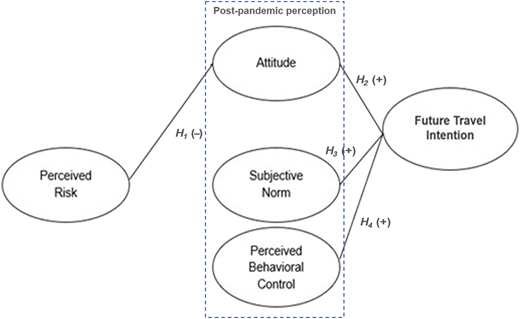
Based on the literature, the following hypotheses are proposed within the context of post-pandemic and future travel intention. Figure 1 depicts the research framework.
Tourist's perceived health risk significantly influences their travel attitude.
Tourists' travel attitude significantly influences their future travel intention.
Tourists' subjective norm significantly influences their future travel intention.
Tourists' perceived behaviour control significantly influences their future travel intention.
Methodology
The study aims to investigate the tourists' COVID-19 health risk perception influence on post-pandemic perception and their future travel intention. This research is cross-sectional. This study population was Malaysian domestic tourists aged 18 years or more and who are active travellers. This study opted for the purposive sampling methodology to collect the study data. The GPower software was utilised to calculate the minimum sample, where the software recommends a minimum size of 133 respondents. After cross-checking with Cohen’s (1992) sampling proposition, a minimum sample of 142 respondents was adequate for data collection.
The questionnaire has two sections. Section A investigates respondents' demographic profile: gender, age, place of origin, education level, occupation level and three screening test questions to validate the respondents. Meanwhile, Section B measures tourists’ COVID-19 health risk perception (Neuburger and Egger, 2021) and their post-pandemic perception and future travel intention (Li et al., 2020a, b). The questionnaire was measured using five-point Likert scales ranging from one (strongly disagree) to five (strongly agree). The questionnaires were prepared in English, and a pilot study was executed to confirm the instruments' validity and reliability.
The finalised survey was distributed online from November 2020 to April 2021. The eligibility of respondents was ensured to confirm their validity in this study. The survey link was repeatedly posted on various social media apps to encourage more responses, where the respondents were advised to spend 15 min completing the questionnaire. The respondents were asked to read the opening instruction, understand the study description and carefully respond to the survey questions. Two hundred forty-four (244) respondents participated in this study, where 59.8% of the respondents were between 21 and 30 years old. In all, 52.5% were men and 47.5% were women, and most of them were from the Peninsular Malaysia.
The collected data were coded, cleaned and analysed using the SPSS version 24 software. As per Podsakoff et al.’s (2003) suggestions, the study used Harman's single factor test to eliminate the common method bias (CMB). Next, the partial least square structural equation modelling (PLS-SEM) was selected to evaluate the study hypotheses via the SmartPLS 3.11 software. The PLS-SEM is a second-generation technique used to predict the relationships among multiple latent constructs (Hanafiah, 2020). As per this study’s aims, PLS-SEM is utilised as it is suitable for theoretical, causal model verification and predictive ability (Hair et al., 1998; Richter et al., 2016). Moreover, PLS-SEM has been widely used in many social sciences studies, including tourism and hospitality management (Ali et al., 2018).
Analysis and findings
A descriptive analysis was performed to report the tourists’ health risk perception, post-pandemic perception and future travel intention (Table 1).
As demonstrated in Table 1, in the perceived health risk section, most of the respondents felt nervous about travelling because of the large number of COVID-19 cases (M = 4.08, SD = 0.764), perceived it would be risky travelling due to pandemic COVID-19 (M = 4.09, SD = 0.825) and felt it is dangerous travelling because of COVID-19 (M = 3.99, SD = 0.852). In terms of travel attitude, most respondents agreed that it is not advisable to travel even when the pandemic is over (M = 3.02, SD = 1.258). Besides, most of them were not excited about travelling immediately after the pandemic was over (M = 3.01, SD = 1.228). Focusing on the subjective norms, most influential people around them think they should not travel when the pandemic is over (M = 2.75, SD = 1.145). Besides, most respondents agreed that they would not travel for leisure with their friends and family when the pandemic is over (M = 2.93, SD = 2.217). Moreover, their family and friends did not intend to travel as soon as the pandemic was over (M = 2.87, SD = 1.138).
In terms of the respondents' perceived behavioural control, most respondents claimed they would not travel even though they have the resources, time and opportunity to travel (M = 2.99, SD = 1.042). Besides, most of the respondents planned not to travel even if possible (M = 2.89, SD = 1.047), and they were not confident travelling even if they wanted it (M = 2.95, SD = 1.081). In terms of the respondents' future travel intentions, most of them claimed they would not make a travel plan soon (M = 2.91, SD = 1.037), will avoid making an effort to travel (M = 2.86, SD = 1.011) and also will avoid travelling even after the pandemic is over (M = 2.87, SD = 1.038). Notably, such negative travel behaviour is in line with their adverse perception of COVID-19 perceived health risk.
Structural Equation Modelling
Measurement model
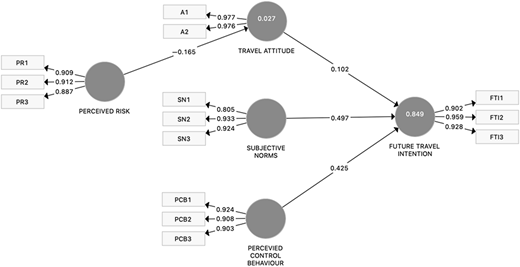
The following section describes the measurement model assessment by reporting the reliability, convergence validity and discriminative validity of the reflective constructs (Hanafiah, 2020; Hair et al., 2017). Figure 2 depicts the measurement model.
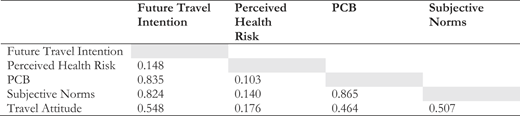
Table 2 reports the measurement model assessment. The research constructs' reliability was tested using factor loadings, composite reliability (CR), Cronbach's alpha and average variance extraction (AVE). The CR and the Cronbach's alpha value exceeded 0.70 (the minimum threshold), and all factor loadings exceeded 0.70, which endorsed the scale reliability. Besides, convergent validity and discriminant validity were also tested. Next, all AVEs exceeded the minimum value of 0.50. Finally, to assess discriminant validity, the heterotrait-monotrait (HTMT) ratio of correlation was examined. The HTMT values (Table 3) were below 0.85, confirming the scales' discriminant validity as Henseler et al. (2015) suggested.
Structural model
Next, the PLS-SEM path analysis was used to test the hypotheses based on structural modelling. The bootstrapping technique was used to determine the significance level of the path coefficient (Table 4).
The first hypothesis (H1) focuses on whether tourists' perceived health risk significantly influences their travel attitude. The path analysis confirms that the tourists’ travel health risk perception (β = −0.173**; p < 0.05) negatively correlated with tourists’ health risk perception and travel attitude. The study found that perceived health risks discourage travel attitude, similar to other recent researchers who argued that the possible risks of travelling would alter tourist behaviour by avoiding specific risky destinations (Matiza, 2020; Liu et al., 2016; Pennington et al., 2011; Schroeder et al., 2013). Perhaps, because of safety and security, fear of going on a trip is natural. However, their fear is heightened during health crises and would eventually demotivate them to travel (Fennell, 2017). On the other hand, the second hypothesis (H2) proposed that tourists' travel attitudes significantly influence future travel intentions. The result confirmed that travel attitude (β = 0.103**; p < 0.05) significantly affects future travel intention. Similarly, Hui and Fumin (2020) and Liu et al. (2018) also prove that attitude is essential in predicting, describing and influencing tourists' behavioural intentions.
The third hypothesis (H3) proposed tourists' subjective norms significantly influence their future travel intention. The result confirmed that subjective norms (β = 0.497***; p < 0.001) significantly affect future travel intention. Meanwhile, the fourth hypothesis (H4) recommended that tourists' perceived behaviour control significantly influenced future travel intentions. The result confirmed that perceived behaviour control (β = 0.424***; p < 0.001) significantly influenced future travel intention. Notably, various researchers also suggest the influence of subjective norms on attitude, which most of them claimed correlates with travellers' behavioural intention (Chua et al., 2021; Perić et al., 2021). Notably, Ham et al. (2015) revealed that subjective norms and perceived behaviour control would increase endurance to revisit the destination.
This study confirms that the perceived health risk construct can explain 27% of the variance in future travel intention (R2 = 0.270). Next, this study found that tourists' travel attitude, subjective norm and perceived behaviour control could explain 84.9% of the future travel intention variances (R2 = 0.849). On the other hand, the predictive sample reuse technique (Q2) assessed the structural model's predictive relevance (Chin, 1998). The result confirms the predictive reliability of both research models. The inner-model change in the effect size relation is calculated by employing the effect size function proposed by Hanafiah (2020).
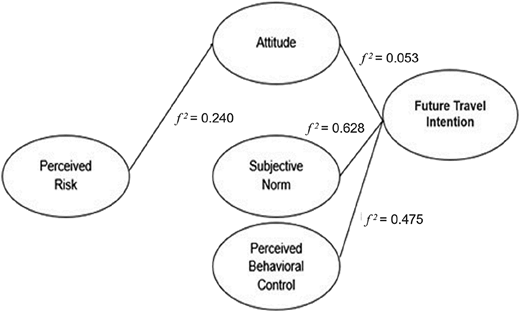
Referring to Figure 3, the effect size of subjective norms and perceived behaviour control and future travel intention is larger than 0.35, reporting a substantial effect size. On the other hand, the effect of the travel attitude on future travel intention (f2 = 0.053) reflects a small effect size. Lastly, the effect size of health risk perception on travel attitude (f2 = 0.240) is moderate.
Discussion
This study confirmed a significant adverse effect between travel health risk perception and travel attitude. This result is consistent with previous research, indicating that people's perception of health risks may change their travel behaviour (Liu et al., 2016; Matiza, 2020; Wen et al., 2020). Such findings highlight that perceived health risk is a significant predictor of travel attitude. According to Chew and Jahari (2014), health risk perception is critical in the tourist decision-making process because it can make rational decisions related to destination choice. The potential health risks of travelling in an open or closed area are directly related to the intention of cancelling travel plans and going to or avoiding specific destinations (Pennington et al., 2011).
Next, this study also confirms the significant impact of travel attitude on future travel intention. The psychological changes reflected by tourists' good or flawed perceptions are described as tourist attitudes when involved in those actions (Liu et al., 2018). With COVID-19, the study found that their travel attitude is low and directly influenced their reduced travel intention. This result is consistent with previous research on the tourism industry, which studied travellers' attitudes as an essential predictor of behavioural intentions (Hui and Fumin, 2020; Liu et al., 2018; Rather, 2021).
Subsequently, the results of this study showed that subjective norms significantly influence future travel intentions. Perceived social pressure from others affects individuals' behaviour in specific ways and their motivation to follow other perspectives (Ham et al., 2015). With COVID-19, the study found low social pressure to travel, directly influencing their reduced travel intention. Consistent with Hussain et al. (2021), this study confirmed that subjective norms could seriously alter people's behaviour, proving that travellers rely on the opinions of others when deciding on future travel.
Similarly, the study results also provide evidence that perceived behavioural control significantly affects future travel behaviour somehow. The study found that their perceived behaviour control is limited because of COVID-19 and directly influence their reduced travel intention. Likewise, Ham et al. (2015) highlighted the importance of favourably perceived behaviour control in increasing tourist fortitude towards revisiting intention.
Study implication
This study investigated the effect of COVID-19 pandemic perceived health risk on traveller's post-pandemic perception and future travel intention. This study confirms that COVID-19 will likely affect tourists' travel patterns. Key findings found that perceived health risk discourages travel attitudes and eventually lessens their future travel intentions. The research findings add directly to the body of knowledge concerning how the COVID-19 crisis demotivates tourist travel behaviour. Notably, COVID-19 affects future travel behaviour, preferences and willingness to travel, with heightened anxiety and concerns. Therefore, a post-crisis behaviour assessment is vital as everyone will travel differently in the foreseeable future, and their priorities will not be the same. By surveying their travel behaviour post-crisis, we can at least tease out their readiness to jump back into travel or gauge whether their behaviour has profoundly changed.
Understanding post-COVID-19 tourist behaviour would offer the tourist authorities a strategic edge for post-crisis recovery. On the other hand, such information would provide academia's understanding of how COVID-19 affects travel behaviour, motivation and preferences. With so many travellers changing their plans, the following is an obvious question: Where will they travel, and what would motivate them to travel? The study results confirmed that travel health risk perception has changed after the COVID-19 crisis. With safety and health security a significant concern, the travellers would hesitate to travel unless the domestic tourism industry implements tailor-made changes which suit their post-COVID behaviour and preferences. They can be the referral point for other researchers who intend to explore tourist health risk perception, post-pandemic perception and future travel intention for other preferred tourist destinations.
Notably, a new norm is being formed, and the tourism businesses must be ready to innovate and change their operations. The government must find ways to continue to support tourism businesses to recover and guarantee that the supply chain will thrive once the lockdown is lifted. Understanding and managing a crisis' impact is vital to reducing the adverse effects and improving the recovery time. Restarting tourism quickly and sustainably is highly important for destinations that are highly economically dependent on this industry. However, tourism recovery is not straightforward; in this COVID-19 crisis, it may take several years to rebuild tourist trust and motivate them to travel. Hence, travel practitioners and destination marketers need to quickly develop strategies to build travellers’ trust by effectively communicating COVID-19 policies (e.g. strict social distancing rules, new travelling rules) to encourage safe travel. In terms of tourism, it is vital to focus on vaccination passports for incoming tourists and ensure the domestic tourism workers are fully vaccinated.
It seems that post-COVID, notably, all well-established tourist behavioural models would be obsolete. Promisingly, people will travel again, but their travel behaviour would change. However, traditional assumptions in managing health risks may need to be modified. In addition, tourism businesses need to learn and relearn fast and prepare for a sharp increase in holidaymakers post-COVID. Notably, it is an excellent time to redesign tourism strategies and engage the stakeholders, including hoteliers, tour operators, food and beverages outlet owners and the media, to see how we can all work together towards the tourism industry's sustainability. Besides, COVID-19 showed that hospitality and tourism players need to be flexible amid the pandemic and economic uncertainties. Moreover, a recurrent COVID-19-style outbreak is very likely to occur again. This unprecedented (or maybe a future norm) event changes how the industry players operate their businesses and craft future strategies.
In response to this crisis, the tourism industry, specifically in the tourism destination settings, needs to revise its tourism promotion and marketing plan and turn its attention to other productive tourism markets and segments to curb the impact. Instead of selling the product to a market with no capacity or interest (inbound market), it is better to focus on the existing tourism market – the domestic tourist population. Specifically, the Malaysian Destination Marketing Organisation (DMO) needs to formulate a strong marketing campaign that suits the post-COVID market preferences. Besides focusing on local and short-term tactics for restarting tourism, it should not neglect the long-term Sustainable Developmental Goals (SDGs) agenda.
Perhaps, domestic tourism can be a sustainable and complementary way to replicate international tourism demand, and it can generate the growth of the local economy. Considering that the domestic tourism industry offers the prospect of keeping hotels, host families and resorts open to tourists, and families, this idea is not too far-fetched, unrealistic or even bizarre. However, there is no single policy or strategy that fits all, despite the World Tourism Organizations (UNWTO’s) recommendations, where each DMOs should adopt different dynamic strategic plans that suit their destination characteristics.
Conclusion
Most of the tourism industry develops its financial strategy around a trouble-free future, planning for the eternal blue sky with the expectation of high tourism demand throughout the year. This multibillion industry had defied the ups and downs of the market – only until COVID-19 arrived. Hence, there is a need to change how tourism operators run their businesses and how the government should treat the tourism industry as an essential economic contributor. The study findings highlighted how and why the respondents rated the degree of perceived health risks as relatively high, while their intentions to travel were relatively low. Hence, understanding travellers' post-COVID attitudes can be a valuable source of information for decision-makers and marketers in tourism destinations to modify inbound marketing strategies. Besides, a new post-COVID tourism marketing framework would improve any tourism destination competitiveness when the travel market opens. Therefore, DMOs could rejuvenate their tourism industry by fine-tuning their domestic marketing plan, product positioning and communication strategies. Also, the local tourism providers could improve their products and services by offering authentic, safe, secure, affordable experiences and packages that meet post-COVID travellers' needs. Besides, there is a need to develop a participative and integrated domestic tourism strategy to enable the tourism industry's resilience.
On the other hand, it is indisputable that this study has limitations. First, this research only focuses on a single tourism destination. Thus, the data received are not substantially adequate to be generalised. In line with that, future research should replicate the study framework in other settings, and the results may vary according to the nature of the tourism destination. Future research could also focus on respondents with experience of being affected by COVID-19 – what would their future travel behaviour be? Furthermore, the tourism sector can benefit from such a study by preparing tourism operators on their prospective customers' behaviour. Besides, it will be good if there are possibilities for other researchers to grab this chance to test the study framework in different research settings. Notably, future researchers must investigate post-COVID-19 tourist perception because tourist perception may significantly influence their future travel intention. Lastly, the COVID-19 uncertainty scenario brought different and unique impacts and outcomes; therefore, a much-structured analysis of health risk perception to varying pandemic stages is required.
About the authors




This study received funding support from Universiti Teknologi MARA under the Fundamental Research Grant - 600-RMC/FRGS 5/3 (026/2021).