This paper assesses the future potential of service robots in nature-based tourism in South Africa, including their roles, appearance and potential effect on guest experience and nature-based destinations.
Online in-depth interviews with 40 younger respondents (Millennials and Gen Z’s) examined their perceptions of service robots and thematic analysis was used to analyse the data.
We found that interviewees were cautious and unsure about the future function of service robots in nature-based tourism. They were concerned about the effect of robots on employment in the Global South, and whether robots should adopt human or animal forms.
Our qualitative research focusses on the perceptions of two younger generations, and cannot be generalised to other generations or research contexts. Further research is needed to understand the extent of service robot consequences on tourism destinations.
Providers should avoid giving the impression that robots are replacing human workers, and should be sensitive to guest attitudes to nature in robot use.
The future use of robots in nature-based tourism could threaten employment. There are also implications for robot design and whether these non-human actors in tourism should mimic animals.
This is the first paper to examine the role of robots in nature-based tourism, and analyses the delicate relationships between human workers, robots and other non-human actors in the Global South. It examines the attitudes of younger tourists, who will be crucial for future robotic acceptance and redresses the current geographical imbalance in research.
1. Introduction
Service robots are increasingly valued and embraced; they are here to stay (Lin and Mattila, 2021, p. 1).
The above quote is representative of many tourism and hospitality studies that predict that the tourism industry will be profoundly impacted by service robots (Lu et al., 2020). Indeed, Ladeira et al. (2023) argue that employing service robots in the tourism industry will increasingly be a competitive advantage for businesses and become commonplace. However, the geographical understanding of the influence of service robots on the tourism service industry remains limited. While there has been a dramatic increase in research on the impact of service robots on the tourism industry in East Asia and the global North more broadly (Cheong et al., 2023; Fusté-Forné and Ivanov, 2021; Saydam et al., 2022), the experience of the rest of the global South and especially Africa remains under-investigated (Wakelin-Theron, 2021).
The level of preparedness within the tourism and hospitality industry for the implementation and employment of service robots varies significantly between countries and between businesses (Park et al., 2023). Arguably countries of the global South and especially in the African continent have low levels of preparedness and implementation of service robots in the tourism industry. As an example, service robots within the tourism industry in South Africa have seen limited implementation, for numerous reasons. A key reason is that the country suffers from chronic unemployment and as implementation of service robots could replace human labour, this has been criticised by various stakeholders (Wakelin-Theron, 2021).
Despite the resistance, it is argued that it is inevitable that service robots will replace and/or shift human labour towards different tasks (Marwala, 2020). In addition, in their systematic literature review of service robots in hospitality and tourism industries, Mukherjee et al. (2023) identify a need for research on service robots’ adoption in emerging markets and more specifically the factors that will lead to adopting service robots in the tourism sectors of emerging markets, and also how travellers view the adoption of service robots in the tourism sectors of emerging markets. Therefore, it is important to understand the wants and needs of guests first before implementing service robots in tourism and hospitality settings (Seyitoğlu and Ivanov 2020).
Despite the significant growth in research on the role of service robots in the tourism and hospitality industry (see Cheong et al., 2023; Ivanov et al., 2019), the use of service robots in nature-based tourism contexts has seen a scant focus. Thus, it is important to define what is meant by “nature-based tourism” before dealing with service robots in nature-based tourism settings, i.e. in this regard we rely on Hall and Boyd (2005, p. 3) who defines nature-based tourism as “… tourism in natural setting (e.g. adventure tourism), tourism that focuses on specific elements of the natural environment (e.g. safari and wildlife tourism, nature tourism, marine tourism) and tourism that is developed in order to conserve or protect natural areas (e.g. ecotourism, national parks).”
Indeed, nature-based tourism is a major tourism product globally, especially in Africa (Balmford et al., 2009; Hoogendoorn and Visser, 2011). Therefore, a critical understanding of the role of service robots in nature-based tourism will be beneficial to the tourism industry to understand the benefits and pitfalls of the widespread implementation of service robots in the nature-based tourism industry. Furthermore, Mukherjee et al. (2023) as well as Liu et al. (2025) also call for research on service robots to be expanded to other areas of the tourism sector, and we believe nature-based tourism is one such sector.
Current research also points to generational differences playing a vital role in technology acceptance (Ali et al., 2022). Some studies (e.g. Fuentes-Moraleda et al., 2021; Pitsch et al., 2011) found that younger visitors are more positive towards robots. Hudson et al. (2017), and Reich-Stiebert and Eyssel (2015), found that older people seem to be more hesitant to interact with service robots than younger people. Thus, it is vital to investigate the specific perceptions of Millennials and Gen Z consumers in South Africa and, in doing so, inform both theory and guide nature-based tourism providers in their service provision design efforts.
As a result, this paper aims to contribute towards our understanding of the perceptions of potential users of service robots in a nature-based tourism context given the dearth of investigation on this topic both internationally and in the context of Africa. The specific objectives are:
To explore Millennials’ and Gen Z’s attitudes and willingness to use service robots in (a) tourism and (b) specifically in nature-based tourism.
To assess what the suitable tasks are for robots in nature-based tourism.
To determine what service robots should look like in nature-based tourism.
To identify the effect of service robots on the (a) guest experience and the (b) nature-based tourism destination in future.
The paper will be structured as follows. First, a literature review is provided on the main debates around the use of service robots in the tourism industry. Followed by a methods section and the results section. The paper is concluded against the backdrop of the specific aim and objectives of the study.
2. Literature review
Research on service robots has mainly focused on service robots’ role in restaurants, airports, hotels and bars (Ivanov et al., 2019). Especially where service robots provide information to tourists, automate dull, repetitive, dangerous and dirty tasks (e.g. cleaning floors) and improve the visitor experience (Webster and Ivanov 2022). Some argue that service robots tend to outperform human employees in menial tasks because of their “mechanical and analytical nature” (Reis et al., 2020:1; Ivanov et al., 2019; Zemke et al., 2020). Tung and Au (2018) suggest that where robots provide services, guests often report better quality experiences. Conversely, service robots’ efficiency in manual labour frees hospitality staff to focus on social interaction with tourists, increasing service quality (Ivanov et al., 2020). In addition, by introducing service robots, businesses can create a desire for tourists to interact with the robots, producing a unique experience (Choi et al., 2020). Despite these benefits, the tourism industry, the service sector and tourists seem hesitant to use service robots. This hesitancy stems from ethical concerns around surveillance, data access, dehumanisation, privacy breaches, malicious use and job replacement of human beings (Lin et al., 2024a). To understand these complexities around the willingness to use, the following section will explore some of the main themes highlighted in the literature.
2.1 Factors influencing willingness and hesitancy of use
Numerous factors influence tourists’ willingness or hesitancy to use service robots (Wang et al., 2023) including cultural differences. For example, tourists from Far East Asia are more comfortable with service robots compared with tourists from elsewhere (Chen et al., 2022; Choi et al., 2021; Kuo et al., 2017). This may relate to the widespread implementation of service robots in the tourism industry. The gender, education and generation of tourists also influence their willingness to use service robots. For example, Ayyildiz et al. (2022) found that older generations are generally less keen or interested in engaging with service robots. Whereas younger generations are more comfortable in a partially robotised or robotic environment within the tourism and hospitality industry (Palrão et al., 2023). Indeed, younger generations (such as Generation Z and Millennials) are also more likely to make use of service robots because of the high future likelihood of service robots becoming more commonplace as a consumer and/or employee in the tourism industry (Fu et al., 2024).
Belanche et al. (2021) note that many tourists find service robots disruptive and are not considered an ideal method of engagement with the tourism product (Wang et al., 2023). Tourists question the perceived service quality that service robots can offer (Choi et al., 2020), specifically the ability of service robots to respond to abstract queries or to respond to concerns outside of programmed parameters. In terms of the willingness to use, Jung et al. (2023, p. 103404) found that “care, moral obligation, willingness, and attitude were key contributors to boosting intention to adopt robot services”. Over and above the personal decision-making processes, the functionality and/or practicality of service robots in the tourism industry can override tourists’ hesitancy in using service robots (Fuentes-Moraleda et al., 2020). Previous experience or familiarity with service robots plays an important role in tourists’ attitudes (Lee and Kim, 2022; Sun et al., 2024). Over time, “rapport building” can take place between tourists and service robots. The willingness of employees to facilitate tourist/service robot interaction further increases the ease of use (Qiu et al., 2020, p. 247). Despite facilitation by employees, tourists might expect to exert significant effort to learn how to use robots and would therefore not be interested in adopting service robots while on holiday (Vimalkumar et al., 2021). This might harm the overall service experience, as negative perceptions created by service robots might sometimes surpass the positive perceptions they arouse (McLeay et al., 2021). There is thus a need to understand why consumers resist service robots so that the design and implementation can be improved.
In terms of external factors, Hou et al. (2021) found that tourists tend to favour service robots when faced with overcrowding, whereas in quieter settings they would prefer human interaction. There has been a marked increase in the acceptance of use of service robots since the Covid-19 pandemic (especially among Gen Z’s). This acceptance has consequently led to the normalisation of the use of service robots in the tourism industry globally (Gupta and Pande, 2023; Zhong et al., 2022). The Covid-19 pandemic has also quelled concerns around data privacy and job losses, as avoiding infection was seen as more important (Zeng et al., 2020).
Ultimately the tourist’s experience with service robots is co-created and is a reciprocal process between the tourist and the service robot (Lin et al., 2024b; Xie et al., 2022). In addition, Webster and Ivanov (2022) showed that if visitors see robots as useful in their experiences, they will be supportive of their implementation. While those who see the benefits of robots as opposed to humans, are more likely to be supportive of making use of robots.
2.2 Anthropomorphism
A key sub-theme of the investigation of service robots and the tourism industry is “anthropomorphism”. The type (mechanoid, humanoid and android), level and nature of anthropomorphic qualities or “human-likeness” of service robots are key considerations for usage. Often it is found that the more human-like the appearance of a service robot is, the more willing tourists are to use them (Belanche et al., 2021, p. 477; Saptura et al., 2024). Indeed, the appearance of a service robot is a key motivator for individuals to consider using a service robot in the first place (Lin and Mattila, 2021). However, in some cases, tourists are reluctant to have service robots replace human beings, even if they are anthropomorphic in nature (Christou et al., 2020). Tourists would sometimes like service robots to be animal-like or “zoomorphic” in appearance (McCartney and McCartney, 2020). Anthropomorphic service robots are certain to change the cultural and social environments of the hospitality and service industries more broadly (Skubis et al., 2024).
2.3 Service robots in nature-based tourism
Several authors have called for more research to understand the relationship between technology and tourists to advance theory and practice (Arici et al., 2024; Wang et al., 2017). To date, a few studies have mentioned how service robots could form part of the future of nature-based tourism (Liburd et al., 2023; Frost et al., 2014). It was only recently when Chang et al. (2025) studied tourists’ adoption of service robots in nature-based or ecotourism destinations. Specifically, they found that service robots’ language abilities can have a significant impact on the environmentally responsible behaviour of tourists.
While on the opposite end of the spectrum in a nature-based context, the concept of “digital detox” has also become more popular, where tourists want to avoid using technology in their experiences. Previous studies have revealed that nature-based tourism providers often erroneously assume that younger generations have a dependence on technology when in fact, in many cases they would prefer to escape technology while on holiday (Clark et al., 2021). Knowing the tourists’ perceptions on the acceptance of service robots in nature-based contexts is essential, because if tourists do not wish to be assisted by robots, then the destination would find it challenging to implement service robots (Pande and Gupta, 2023). Conversely, a key question is, if tourists see robots as suitable to assist in nature-based tourism contexts, are they likely to use them? Also, what factors influence tourists’ attitudes towards service robots (Webster and Ivanov 2022)? Consequently, this study attempts to contribute new knowledge to this domain.
3. Methods
The study follows a qualitative approach to determine younger generations’ (Millennials and Gen Z’s) perceptions of the use of service robots in a nature-based tourism context. Moreover, research into service robots in the tourism industry has mostly been quantitative, focusing less on qualitative perspectives (Mukherjee et al., 2023). In-depth interviews were conducted with 20 South African Millennials (born between 1981 and 1996) and 20 South African Gen Zs (born between 1997 and 2010) (Pew Research, 2019). Millennials and Gen Zs were selected as the target population since studies have shown that demographics influence how individuals perceive service robots in tourism. What is more, current research points to generational differences playing a vital role in technology acceptance (Ali et al., 2022). Thus, it is vital to investigate the specific perceptions of Millennials and Gen Z consumers in South Africa and, in doing so, inform both theory and guide nature-based tourism providers in their service provision design efforts.
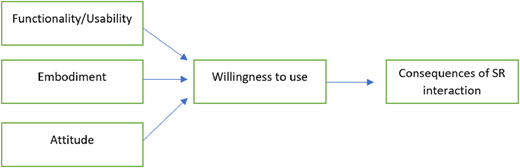
This study used two purposive sampling strategies, i.e. criterion and snowball sampling. Criterion sampling involves reviewing and studying the cases that meet a pre-determined criterion, in this case, individuals from either the Millennial or Gen Z generation. The researchers’ personal networks were used to source the initial interviewees. A snowball sampling strategy was also used. In this study, the initial participating respondents were given an opportunity to suggest other Millennials or Gen Zs. Data were collected between January and August 2024 through asynchronous online interviews, which were digitally recorded and transcribed verbatim. Online interviews were chosen for this study because of the content of technology and digital applications. Each participant was given a unique identifier (Service robots: SR-1 … SR-40) to ensure anonymity. Interviews had an average time of about 20 min. The semi-structured questions were based on some studies (Lu et al., 2019; Milman and Tasci, 2022; Seyitoğlu et al., 2021; Wang et al., 2023; Webster and Ivanov 2022) in the literature and covered participants’ expectations about human–robot interaction (HRI) including the determinants of willingness to use service robots, such as their attitudes toward service robots, the perceived functionality/usability of service robots as well as the appearance of service robots. In addition, participants were asked what the consequences of human interactions with service robots would be in terms of the guest experience and the impact on the destination. Figure 1 depicts our proposed framework.
It was essential for interviewees to understand what a service robot is. The authors self-defined a service robot as “a moveable or immovable physical device that can perform user instructions for either guests or owners and can interact, communicate and deliver services to an organisation’s customers. Service robots are used to provide frontline employee services, for example, check-in, check-out, take orders and carry luggage without the direct involvement of human employees”. The data collection phase concluded when interviewers felt that responses were being repeated. After 40 interviews, theoretical saturation was achieved, and these interviews were used for the final data analysis. To analyse and interpret the data, the thematic analysis framework of Strauss and Corbin (1990) was used. Excel was used in the data analysis process, as it promotes transparency and reproducibility, is easily transferable, compatible with other software and ensures the anonymity of data (Moncada, 2025). In the coding process, a continuous comparison method was used for the areas of systematic similarity and difference between the data, and the questions were evaluated independently. Two independent coders performed the data analysis, to enhance the analytical rigor (Andriopoulos and Slater, 2013). Several steps were followed to reach an agreement on themes and sub-themes. First, coders read the transcripts repeatedly to get a general understanding. Next, data were broken into smaller parts. The smaller parts were labelled by assigning codes and then grouping the codes into sub-themes and themes. The two coders recorded their themes and sub-themes. Then, they discussed the themes to form the results. Objectivity was ensured by allowing each coder to analyse the data separately and then critically discuss each other’s coding until a consensus was reached. The results were compared with those in the existing literature, and their consistency or inconsistency was revealed in the Discussion section. The sample was diverse in gender and population group and split between Gen Z and Millennials. Tracy (2010) mentions that researchers should pay more attention to ethical issues in qualitative research, as a way to enhance the rigor of the data, since it encourages respondents to share information more securely, thus leading to more credible data (Tracy, 2010). In this study, interviewees gave their informed consent to participate in the research, after being assured of the confidentiality of their data. All interviewees were over 18, and institutional ethical clearance was attained before interviews were conducted.
4. Results
The first part of the interview gauged the determinants of participants’ willingness to use service robots. Table 1 summarises these determinants.
4.1 Suitable tasks and appearance
Respondents were questioned about the suitable tasks for service robots to fulfil in a nature-based context. As Table 2 shows, most participants (23) mentioned information provision. In terms of information provision, some participants expected general information that would be applicable to any tourism context, such as providing maps or directions, offering information on local activities and offering recommendations on where to eat. Other participants mentioned information specific to a nature-based context, such as the fauna and flora in the area, the area’s biodiversity, geological features, where to spot animals and even animal tracking. Other popular tasks included facilitating check-in and check-out of accommodations (15), taking orders in a restaurant (8), carrying luggage (7), making room service deliveries (7) and cleaning (6). In terms of carrying luggage, room service and cleaning, participants often highlighted the barriers that nature-based destinations face, including uneven surfaces and exposure to the elements.
Regardless of the task, participants felt that robots should not take away jobs from humans but should create efficiency, comfort and convenience. SR-23 summed it up as: “It should not replace a job. It should enhance a job”, and SR-5: “Anything to assist you, but nothing to enlighten you.” This reverberates previous studies which found that service robots can assist human employees in service delivery (Tuomi et al., 2021). When service robots replace human employees, humans can concentrate on more complicated and dynamic service encounters (Chen et al., 2022). Participants were also cognizant that the task performed by a robot should not diminish the guest experience: “You would take away from the experience of the guest because of the potential interaction you could have had, that would enrich the guest’s experience” (SR-40) and “because I feel like if they engage with tourists, then that is taking away the whole purpose as to why the tourists are there” (SR-37).
Respondents were questioned about what a service robot should look like in a nature-based context. A total of 21 participants believed that service robots should look like animals (zoomorphic) in a nature-based context. SR-34 said: “If it’s like animals giving you the information, that would be really cool.” These respondents felt that robots resembling humans would be disturbing as portrayed in this quote by SR-34: “I think it would creep me out more if they looked like humans and to know that they’re not human, but they’re actually functioning or they’re actually trying to resemble a human, I wouldn’t like that at all” and SR-24 noted “Definitely not like humans. That is very creepy, in my opinion. If I see a robot that looks like a human, I’ll go the other way. It’s not natural or normal. I don’t like that.”
Nine participants preferred robots to look like humans – even as lifelike as possible, for example, SR-40 explained: “I would want one as lifelike as possible to humans, even silicone skin looking, that would impress me.” Eight participants wanted service robots to look like machines, and SR-27 responded with: “I would prefer it look like a robot. I don’t want it to look like an animal or a person that would creep me out because it tries to be something else, but it isn’t.” Regardless of the design, almost half of the participants said that robots should blend into the natural environment: “It should blend in as much as possible with the environment as to not be distracting. It should be visible but not distracting towards the environment” (SR-6).
4.2 Attitudes toward service robots in tourism and specifically in nature-based tourism
Most participants were positive about service robots in general tourism contexts. Those with positive attitudes attributed these to the tasks they felt robots could fulfil better than humans. Participants felt that in certain scenarios, service robots are more accessible and convenient to use and can perform tasks more efficiently and faster. SR-31 explained: “If you have questions that need to be answered, you don’t have to deal with someone that woke up and got out of the bed on the wrong foot. You actually have something that will give you a standard response”. In terms of standard responses, SR-11 added: “There are a lot of frequently asked questions that one can offload onto a service robot which would then alleviate the pressure from the actual person doing the work”. Participants also frequently mentioned the programming of robots to perform tasks that humans cannot necessarily perform effectively, for example speaking multiple languages as SR-39 explained: “I feel it can be a good contribution, especially because you can programme it to cater for different languages and you don’t have to have an employee that can speak all the languages.” Those who felt negative towards service robots highlighted the loss of personal contact and the ultimate job losses due to service robots as their biggest concerns. SR-37 explained the loss of jobs as: “So, we’re introducing an automated machine that’s going to take over the jobs that people want”, while SR-14 and SR-38 elaborated on the loss of personal contact as follows: “A robot can’t give you warmth. It can’t give you that interaction that makes the experience a bit more special” and “I always find a robot to be quite impersonal and a bit alienating.”
Participants’ attitudes toward service robots in nature-based tourism were less positive, with more than half having negative views. Those with negative opinions elaborated that when they go to a nature-based destination, they want to get away from technology as SR-16 said: “With nature-based tourism, you want to get away from technology, taking a break from all of these things.” SR-20 elaborated by mentioning: “It is supposed to be a place where there is less technology and buildings.” Participants also thought that technology could impact the authenticity of the nature-based experience; for example, SR-21 said: “For nature-based tourism, if we can keep it as natural as we can, that is a positive. So, I see the whole robot system as a negative.” SR-24 added, “When you spend time in nature, you’re mostly there for the peace, quiet, serenity and scenery.” This aligns with Anderson and Baker’s (2015), finding that nature-based tourists see an escape from technology as a vital motivation for travelling.
The eight participants who were optimistic about service robots in nature-based tourism again attributed their positivity to the functions that service robots could fulfil, especially in improving access. For example, SR-31 noted: “I think it can be very helpful in the sense that it can improve the public’s access to nature-based tourism. Not everyone can afford a guided drive or a guided hike. Therefore, service robots would improve nature-based tourism as a whole.” In addition, SR-22 explained: “I think it can provide some useful information as well as not having to be dependent on a person that is there.”
Some participants were uncertain how they felt about service robots in nature-based tourism, mainly because they lacked knowledge about how service robots would function in this context. There was a 50–50 split between the positives and the negatives. SR-27 explained her uncertainty: “Within nature-based tourism, I think it becomes a bit tricky because usually when you go to a natural environment, you want to get away from technology; you want to enjoy and appreciate what nature has to offer. But then again, you can also do something nature-based to get away from people.”
Participants felt more optimistic about service robots in the generalised tourism context rather than in nature-based tourism specifically. This could be because they are more familiar with service robots in a general tourism context and are not entirely sure what service robots would do in a nature-based context. Nevertheless, does a positive attitude toward service robots translate into a willingness to use them? And if respondents are willing to use service robots, what will be the consequences of this use on the guest experience, as well as the destination?
4.3 Willingness to use service robots in tourism and nature-based tourism specifically
Only two participants said they were unwilling to use service robots in general tourism contexts, and one was uncertain (Table 2). The overwhelming majority agreed that they were willing to use service robots under certain conditions. Participants said they were willing to use service robots if they did not take away jobs or negatively influence their overall experience, as SR-14 indicated: “ … if you are not replacing humans at every point of connection then, yes.” Others mentioned that they feel more comfortable with a service robot than human staff and that a service robot cannot be annoyed by someone asking too many questions. SR-16 explained it as follows: “I have noticed that I have a little bit of anxiety when I have to make phone calls or interacting with people in some contexts. So, I do opt for going more the people-less route.”
The picture changed when participants were asked about their willingness to use service robots within nature-based tourism. Opinions were equally split between those who were willing to use service robots and those who were not or were uncertain. Those who were not willing to use service robots in a nature-based context felt that it was “fake” and “out of place”, as evidenced by the following quotes: “If I was greeted by something that was fake or not real, I think it might not put me in that relaxing state that I want to be in when visiting a nature-based place” (SR-3) and “on the other hand I would not associate nature-based tourism with service robots, you just would not think about them” (SR-18). Again, participants’ willingness to use service robots was linked to the tasks that service robots could perform, such as providing information and carrying luggage. Participant 34 said: “… but maybe if you see an animal and you can select it on this thing, maybe that would help because then you don’t have to ask someone. I think it’s nice having that expertise with you.”
4.4 Preference: service robot vs. human staff
Although many participants were willing to use service robots in the general tourism context and nature-based tourism, when asked what their preference would be in a nature-based destination, 28 of the 40 still preferred to be served by a human. Only four participants preferred a robot, and eight were uncertain whether they preferred a human or a robot. Those who preferred a human highlighted the relational aspect of dealing with people. For example, SR-3 mentioned, “There is something about going to a place and just meeting people who come from there and know the place.” SR-4 elaborated on the relational aspect by saying: “Human staff, it would be easier to communicate, and there is really a relational aspect to it. I don’t want to hear about nature from a machine because that would take away the authenticity.” SR-15 also commented on the relational aspects that you cannot find in robots, such as empathy: “I would prefer a human because they have more empathy where AI does not. Human staff could genuinely help you and understand your situation.”
Those who preferred service robots highlighted the negative relational aspect of dealing with people and how this could be avoided when employing robots. SR-22 and SR-24 respectively commented on how robots cannot have bad moods that negatively affect the tourism experience: “It would be nice not to have to deal with people’s moods as well, because you know what you get then. I could also ask it more questions than I would necessarily be comfortable with to ask of a human” and “sometimes people have a bad day and then when they greet you or come to take your order or whatever, you can see they’re not very happy to see you. You can’t really see those facial expressions on a robot, they’re very neutral and they cannot have anything against you, because they’re robots.”
4.5 Suitable tasks and appearance
Regardless of whether participants were willing to use service robots and whether they preferred robots or humans, respondents were questioned about the suitable tasks for service robots to fulfil in a nature-based context. As Table 2 shows, most participants (23) mentioned information provision. Other popular tasks were facilitating checking in and out of accommodation (15), taking orders in a restaurant (8), carrying luggage (7), room service deliveries (7) and cleaning (6).
4.6 Consequences of service robot interactions
Finally, we wanted to determine the perceived consequences of service robots on the guest experience and the nature-based destination. Opinions about the effect on the guest experience were equally split between positive and negative responses. Those who perceived a positive effect on the guest experience mentioned that service robots can streamline processes and make them more convenient, effective, easier and faster. Others mentioned that robots could be programmed to give more information than humans could and that they would also make information provision easier since they are available 24 hours a day.
Some participants felt that service robots would make the experience novel and exciting. Those who mentioned a negative effect were worried that robots would make the experience cold and impersonal and lead to disconnection. For example, SR-16 explained: “I would miss-especially if you go to a new place-the interaction with a person, the nuances of in-person interactions when you want to know more about the place or ask about interesting things to do within the place.” Others mentioned that robots would be costlier to maintain, and those extra costs would be passed onto the guest, making the experience more expensive. This is despite Ivanov and Webster’s (2021) findings that should tourists engage with service robots, the overall cost of tourist experiences should considerably be reduced because of the lack of human interaction. Other participants questioned the functionality of service robots and were concerned that a robot might not understand the context of a nature-based destination.
Linked to this were perceptions of malfunctioning robots, which would lead to a frustrating experience. While those who perceived the consequences to be positive thought that they would feel more comfortable with robots than with humans, as SR-31 mentioned: “you’re never going to feel stupid asking a question to a robot.” However, the contrary was true for those who perceived the effect to be negative, as portrayed in the quote of SR-40: “But in a nature-based environment I wouldn’t recommend it, especially because nature-based environments also include an element of danger. You might have venomous spiders and snakes around. You might have potentially dangerous animals. You would need an experienced individual and not a robot. I believe that people would not feel as safe and confident within a potentially dangerous environment if they had a robot there.”
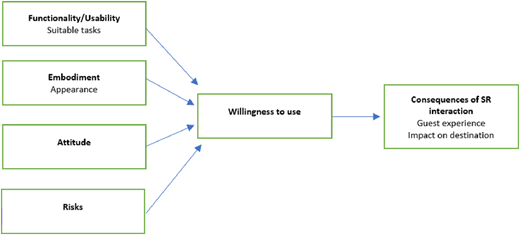
Participants were less opinionated about the effect of service robots on the nature-based destination itself, and only 16 responded to this question. Eight felt that it would positively affect the destination, citing that the infrastructure developments needed to accommodate robots might be beneficial to the destination. Others felt that service robots could increase visitor numbers to the destination, as potential visitors might be curious to experience robots and see them as novel experiences. Still, others felt that service robots might be more cost-efficient than human employees. Those who were pessimistic about the effect of service robots on the environment felt that the infrastructure needed for service robots might affect the environment negatively. For example, would robots be able to cope operating outside or would additional infrastructure such as paths affect the feel of the destination. Others felt that service robots could take away jobs, and still others were worried about the maintenance costs of robots. Figure 2 presents the determinants and consequences of using SR in nature-based tourism contexts, based on the findings of this study. Based on the findings a fourth determinant were added to the conceptual framework in Figure 1, namely the risks associated with using SR in a nature-based context. Specific risks that were mentioned throughout the interviews that would lessen participants’ willingness to use SR were safety, loss of authenticity, unemployment and loss of human contact.
5. Conclusions and implications
The aim of this paper is to understand the perceptions of potential future users of service robots in nature-based tourism especially within the South African context. The objectives were (1) to explore Millennials’ and Gen Z’s attitudes and willingness to use service robots in (a) tourism and (b) specifically in nature-based tourism, (2) to assess what the suitable tasks are for robots in nature-based tourism, (3) to determine what service robots could look like in nature-based tourism and lastly (4) to identify the effect of service robots on the (a) guest experience and the (b) nature-based tourism destination in the future. We reflect on the aim and objectives of the study in several ways:
This study is one of the first to explore tourists’ perceptions towards service robots within nature-based tourism destinations. This is despite nature-based tourism being a critical tourism product, specifically in Africa and South Africa. It explains how to satisfy younger generations’ technology needs (or lack of need) while participating in nature-based tourism activities, as Anderson and Baker (2015) call for. As Chen et al. (2022) suggested, different generations tend to behave differently. It is essential to consider the wants and needs of Millennial and Gen Z tourists, as these may differ from other generations because of their higher levels of acceptance of technology within the tourism industry (Fuentes-Moraleda et al., 2021). Whereas previous studies have called for nature-based tourism providers to increase younger generations’ participation by catering to their technology interests (Mehlhaf, 2019), our results show that some Millennials and Gen Zs specifically choose nature-based tourism experiences to escape and get away from technology. Therefore, nature-based tourism providers should increase their understanding of how to cater to the technology needs of these generations, where some want to escape from technology. In contrast, still others want to use technologies to enhance their experiences (Clark et al., 2021).
This study also answers ongoing calls for an in-depth exploration of HRIs, including tourists’ attitudes, willingness to use and general perceptions of service robots in hospitality and tourism (Cha, 2020; Shin and Jeong, 2020). Specifically, the paper responds to Chen et al.’s suggestion (2022) to examine service robots in different service delivery contexts – in this case a nature-based tourism context. We found that interviewees were cautious and, in some cases, unsure about how service robots should function in nature-based tourism contexts. Interviewees were generally happy for service robots to perform manual tasks such as cleaning and luggage services or providing basic information (check in, check out). To enable robots to perform these tasks, managers must ensure that their facilities are robot-friendly. The robot-friendliness of facilities are similar as for wheelchair access, according to Ivanov and Vespestad (2024), for example floor surface inclination and lack of steps. In addition, managers must also pay attention to issues related to access to electricity to recharge robot’s batteries, as this could be challenging in a nature-based context.
The study provides evidence that nature-based destinations indeed offer a unique context, where distinct determinants may influence tourists’ willingness to use service robots and HRIs. For example, certain participants were concerned that service robots would detract from the authenticity of the nature-based experience, and therefore regarded them as fake and out of place. Linked to this, some participants also commented on their need to get away from technology (digital detox) when visiting a nature-based destination, and were therefore less likely to use service robots. Where other studies have reported on the security risks when using service robots in terms of data privacy and threats to human identity (Rana et al., 2025), our results highlight fears about tourists’ safety when using service robots, as was evident in one participant’s response (SR-40), “nature-based environments also include an element of danger. I believe that people would not feel as safe and confident within a potentially dangerous environment if they had a robot there.” Interestingly, and also unique to a nature-based context, is the fact that some participants felt that introducing service robots, and more specifically the infrastructure required to do so, would have a negative environmental impact on the destination. Also unique to a nature-based context is the terrain that service robots are expected to cover to fulfil their tasks. Participants mentioned that in a nature-based context (such as a beach or a forest), surfaces are uneven, which may hinder the movement of robots and that robots will be more susceptible to the elements, potentially causing malfunction or damage to the robot. The appearance of robots is therefore vital for nature-based and outdoor activities – wheeled or two-legged humanoid robots do not work well on rough terrain yet, but four-legged robots cope well.
Our paper also gives a global South perspective on service robots. In a developing country such as South Africa, job losses and technological lag might more profoundly affect the use of robots as well as HRIs than in developed countries. The nature-based tourism industry may benefit from the current research in several ways. For example, globally, there are fears that service robots will systematically replace human beings in the tourism industry, leading to unemployment and social strife. These fears are especially palpable in developing economies in the global South, where unemployment is high (McLeay et al., 2021; Tuomi et al., 2021). Our findings confirm these fears, as participants were particularly cautious about using service robots because of concerns of increasing unemployment, which is already a chronic problem in South Africa. Therefore, if nature-based tourism providers decide to invest in robots, they may introduce one robot in their premise/setting under a condition of pivotal importance and to “assist tourists but not to enlighten them”, as one participant aptly explained. Based on the findings, this robot should blend into the natural environment. Providers should be very cautious to avoid giving guests the impression that robots are replacing the human face of the organisation. Furthermore, training should be provided to human staff members in aspects that robots are perceived to be incapable of offering, such as delivering a warm welcome, understanding intricate human needs and expressing genuine emotions. This will provide an exceptional guest experience and confirm the industry’s human-centred stance, as Christou et al. (2020) suggested. In addition, a number of interviewees mentioned their willingness to use robots, since it is an exciting and novel concept. In these cases, robots should be designed to provide innovative and entertaining experiences, and marketers need to highlight these features in their messages (Mandal et al., 2025). Taking it one step further, human workers can also form the bridge between service robots and customers, which ultimately gives human workers the high-level function to act as an intermediary between customers and robots which could lead to higher levels of acceptance of service robots and result in positive HRIs. Even though not measured in our study, in a nature-based tourism context, robots could be used to encourage tourists’ environmentally responsible behaviour. In their study, Chang et al. (2025) found that using the language feedback abilities of robots could build a positive atmosphere, for example robots can commend tourists who take part in environmentally responsible behaviours, while gently reprimanding those who display unsuitable behaviours. Therefore, managers can use robots to address conservation challenges. What is more, service robots could also be used to collect data that could be used to detect environmental degradation or illegal activities (such as poaching activities – which is a major challenge in South Africa) (Parra-Sanchez and Viviescas-Jaimes, 2025). Socially, service robots that provide translation and recommendation services can lessen literacy and language barriers, which supports wider inclusion of diverse tourist profiles (Parra-Sanchez and Viviescas-Jaimes, 2025). Indeed, insights into political, gendered and cultural aspects of HRI across various global markets may result in more successful and targeted designs, which will lead to broader adoption and sustainability of robots in tourism globally (Liu et al., 2025).
Moreover, there were interesting perspectives on the anthropomorphism of service robots, with some respondents conforming to previous research findings that service robots should be anthropomorphic, while some felt that service robots should be zoomorphic and some saying it should be neither anthropomorphic nor zoomorphic. Ultimately McCarthy and McCarthy (2020) are of the view that the acceptance of anthropomorphic or zoomorphic qualities of service robots depend on the task and design of the service robot at hand. The level anthropomorphism will also influence tourists’ perspectives around the impact of service robots on the guest experience at large and within a nature-based destination. The respondents were both negative and positive about the potential effect of service robots because of their ability to simultaneously hinder and advance the tourist experience in a nature-based tourism context. Further research is required within the field of service robots and tourism to understand the extent of service robot impacts on tourism destinations. Indeed, these findings have implications for robot design and influences debates around non-human actors in tourism.
As always, the findings of our study come with limitations due to our exploratory approach. While our findings cannot be assumed to represent the perceptions of all Millennials and Gen Zs in South Africa or elsewhere, they contribute to our understanding of service robots in a nature-based context. In addition, the study’s primary purpose was not to generalise the findings to the broader population of Millennials and Gen Zs but rather to offer in-depth explanations and meanings (Carminati, 2018). We only focused on the perceptions of two generations. Therefore, this study does not reflect the perceptions of all visitors to a nature-based destination. Future studies could incorporate other generations as well to understand the differences. Moreover, this qualitative study highlights the need for a quantitative investigation that explores the tourist views of all generations about the use of service robots in nature-based tourism destinations at a representative scale.