
Skip to Main Content
Purpose

Grounded in the Elaboration Likelihood Model (ELM), this study investigates how central and peripheral cues affect Generation Z (Gen Z) travelers’ adoption of electronic word-of-mouth on social media and their destination choice.

Design/methodology/approach

A convenient sample of 621 Gen Z travelers was collected in Hanoi, Vietnam. SmartPLS ver. 4.0 was used for testing the proposed hypotheses.

Findings

The results indicate that both central and peripheral cues play significant roles in predicting Gen Z travelers’ adoption of eWOM on social media and their choice of destinations. The quality of arguments and informativeness significantly enhances eWOM’s usefulness in the central route. The source expertise, credibility and information volume in the peripheral route positively affect eWOM credibility, in which the source’s expertise shows the most substantial impact. Furthermore, the peripheral route predominantly influences Gen Z travelers’ eWOM adoption (EA) and destination choice.

Originality/value

This is one of the pioneering studies to assess the relative importance of the central and peripheral cues on EA, hence the impacts on destination choice of Gen Z travelers. The findings provide valuable insights for identifying effective communication channels tailored to Gen Z tourists, thereby enabling the development of efficient and targeted eWOM strategies to attract this market segment effectively in the future.

In the tourism industry, products are often characterized by their intangible nature and lack of visual representation, making many tourism offerings perceived as high-risk purchases. Historically, tourists relied on information from tourism organizations, businesses or personal connections, such as family, friends and acquaintances to make travel decisions (Bansal and Voyer, 2000). However, in the digital era, individuals increasingly turn to online platforms, mainly social media networks like Twitter, Facebook, Instagram, LinkedIn, Pinterest and others, to seek information (Ngo et al., 2024; Tseng et al., 2024).

Nowadays, social media platforms have empowered users to create and share diverse content, including social media posts, textual updates, digital images, microblogs and general commentary (Grover et al., 2022; Nyagadza et al., 2023). These platforms have created new opportunities for forming and expanding the eWOM. According to Ismagilova et al. (2017), eWOM is a dynamic and continuous exchange of information between potential, current or former customers concerning a product, service, brand or company. This information is accessible to many individuals and organizations through the internet.

Information conveyed through eWOM on social media is considered an influential reference channel that significantly impacts human behavior (Filieri and McLeay, 2014; Nam et al., 2020) and plays a critical role in shaping tourists’ decision-making processes (Pourfakhimi et al., 2020). These eWOM sources enable travelers to make more innovative and effective travel decisions. However, much of the eWOM content on social media often stems from anonymous opinions expressed through comments by unfamiliar individuals, raising concerns about the usefulness and credibility of such information (Saidani et al., 2023) and the extent to which these streams influence tourists’ destination choices.

Over recent years, an expanding body of literature has emerged focusing on the phenomenon of eWOM on virtual platforms. Our extensive review of existing studies highlights that eWOM has attracted substantial scholarly interest with research emphasizing the identification of its activation factors and operational mechanisms, eWOM Adoption (EA) (Abbasi et al., 2023; Fan et al., 2013; Li and See-To, 2024; Reyes-Menéndez et al., 2019) and its association with behavioral variables (Tien et al., 2019; Yoo et al., 2017).

Although previous studies have suggested a theoretical framework for understanding the influence of eWOM on consumer behavior, they have yet to fully clarify the underlying socio-psychological processes that shape this behavior in the context of tourism, specifically Gen Z travelers (Meenakshy et al., 2024; Moradi and Zihagh, 2022). Moreover, previous studies on eWOM on social media in the tourism domain have predominantly focused on tourists without accounting for the distinct impact on specific generational or age groups (Barbe and Neuburger, 2021). As Gen Z matures, tourism organizations and businesses face the challenge of tailoring their communication strategies to align with the evolving travel behaviors of this demographic (Abbasi et al., 2023; Ngo et al., 2024).

Scholars have suggested various models in order to address these gaps. Amongst those, ELM stands out to be a novel approach that examines how different kinds of information can influence the tourists’ attitudes and behaviors. The ELM is a dual-process theory, describing changes of attitudes. It explains how stimuli are processed, why they are utilized and how they influence shifts in attitudes and behaviors (Petty et al., 2009). Existing studies on ELM in the context of eWOM on social media primarily investigate the role of central and peripheral cues in information processing (Hussain et al., 2017). Current literature suggests that information embedded in eWOM messages is processed through the central route by consumers, whereas information related to textual attributes, such as the characteristics of reviewers, is interpreted via peripheral cues (Moradi and Zihagh, 2022; Shahab et al., 2021). However, the remaining limited number of experimental studies investigating the variables of the ELM about EA on social media and tourist behavior makes it difficult to determine a clear link between EA and tourists’ decision-making processes (Luong, 2024; Moradi and Zihagh, 2022; Yadav et al., 2022).

These represent gaps in the existing literature that require further in-depth investigation. Consequently, it becomes essential to explore the role of information flows in influencing the adoption of eWOM on social media and destination choice behavior among Gen Z travelers.

This study aims to address the gaps in the existing literature by applying the ELM to examine the impact of cognitive heuristic cues on the attitude toward EA and its subsequent influence on destination choice among Gen Z travelers in Vietnam. Accordingly, the research focuses on addressing the following key questions:

RQ1.

How do socio-psychological processes influence eWOM adoption and the destination choice behavior of Gen Z travelers?

RQ2.

What are roles of central versus peripheral cues in forming Gen Z travelers’ attitude toward eWOM on social media and their destination choice?

RQ3.

Does eWOM adoption on social media influence the destination selection behavior of Gen Z travelers?

The ELM applies principles of persuasion from social psychology to explain attitude and behavior formation. According to ELM, attitude and behavior change occur through two distinct routes of information processing: the central route and the peripheral route. Individuals engaging with the central route process information objectively, focusing on critical analysis, while those following the peripheral route rely on minimal cognitive effort to form attitudes and behaviors (Petty and Cacioppo, 1984, 1986).

Consumers with high ability and motivation are more likely to scrutinize informational messages, making them more susceptible to logical content rather than peripheral cues. The central cues emphasize analyzing the quality of arguments through a detailed examination of information, requiring significant time and cognitive resources (Ismagilova et al., 2021; Liang and Lin, 2018; Petty and Cacioppo, 1986; Teng et al., 2014a, b). In contrast, peripheral cues influence consumers with lower ability and motivation than central arguments. The peripheral route utilizes more straightforward elements, such as the credibility of the information source, the number of arguments presented and factors associated with emotional appeal or visual attractiveness, that are often influenced by the technological medium employed (Ismagilova et al., 2021; Liang and Lin, 2018; Petty and Cacioppo, 1986). Based on this argument, ELM facilitates the creation of persuasive messages targeting consumers by considering their ability and motivation to process information (SanJosé-Cabezudo et al., 2009).

As a result, ELM is regarded as a critical theoretical framework in eWOM research (Cheng and Ho, 2015; Ismagilova et al., 2021; Moradi and Zihagh, 2022). Scholars who study eWOM communication often employ ELM to investigate the use of central and peripheral cues in processing information (Ismagilova et al., 2021; Moradi and Zihagh, 2022).

Petty and Cacioppo (1986) highlighted that in ELM, the central route involves a comprehensive analysis of information and related parameters by consumers, resulting in attitude and behavior changes. This study identified two key variables of the central route based on a review of prior studies (Ismagilova et al., 2021; Moradi and Zihagh, 2022; Shahab et al., 2021), namely the Argument Quality (AQ) and Perceived Informativeness (PI).

3.1.1 Argument quality

AQ refers to the persuasiveness of arguments embedded within an informational message (Cheung, 2014; Ismagilova et al., 2021; Petty and Cacioppo, 1986). AQ can be understood as the extent to which the arguments in a message are perceived as reasonable, logical and persuasive. Previous studies have defined AQ based on characteristics such as being “comprehensive,” “accurate,” or “timely” (Filieri and McLeay, 2014; Sussman and Siegal, 2003). These qualities reflect in clarity, coherence, persuasiveness, completeness and specificity, authenticity and reliability.

AQ is considered a critical determinant of the perceived usefulness of a message. It is confirmed that there is a positive relationship between AQ and its perceived usefulness in supporting tourists’ decision-making processes (Ayeh et al., 2013; Wang and Yan, 2022). In general, eWOM quality refers to the extent to which consumers perceive the content of eWOM messages as accurate, timely and comprehensive (Cheung, 2014; Tsao and Hsieh, 2015). Based on this reasoning, we propose the following hypothesis:

H1.

Argument quality positively influences the perceived usefulness of eWOM.

3.1.2 Perceived informativeness

According to Sussman and Siegal (2003), PI is one of the key factors influencing consumer decision-making. High-quality information not only enhances perceived value but also increases its usefulness in the eyes of consumers (Otterbacher, 2009). Researchers emphasize that perceptions of richness, relevance, clarity, transparency, timeliness and consistency strongly predict consumer behavior in online environments (Filieri et al., 2021; Gvili and Levy, 2016; Moradi and Zihagh, 2022).

In the context of eWOM, consumers evaluate information based on its completeness and alignment with their specific needs (Moradi and Zihagh, 2022; Tien et al., 2019). Otterbacher (2009) identified four key factors that constitute information quality: relevancy, comprehension, believability and objectivity. These factors play a crucial role in shaping consumer behavior. Based on this reasoning, we propose the following hypothesis:

H2.

Perceived informativeness positively influences the perceived usefulness of eWOM.

Petty and Cacioppo (1986) demonstrated that, in ELM, the peripheral route requires less cognitive effort from users than the central route. Instead, users are influenced by the number of arguments, appeal, Source Credibility (SC), social roles and emotional states. Studies have identified SC, Source Expertise (SE) and Volume of Information on social media as critical factors influencing the perceived credibility of eWOM (Ismagilova et al., 2021; Moradi and Zihagh, 2022; Shahab et al., 2021).

3.2.1 Source credibility

According to Nilashi et al. (2022), SC refers to the customer’s evaluation of the believability of an eWOM source. Credible sources typically generate positive and persuasive messages that foster favorable attitudes toward products or services associated with the reviews (Filieri et al., 2018, 2021; Ismagilova et al., 2021). Petty et al. (2009) suggested that when individuals perceive a source as credible, they are less likely to doubt the information and tend to accept it immediately. Several researchers have established a positive relationship between SC and the perceived credibility of eWOM (Ismagilova et al., 2021; Moradi and Zihagh, 2022; Tien et al., 2019). SC reflects the validity and honesty of the information (Ismagilova et al., 2021) and is considered a critical predictor of the persuasiveness of eWOM messages. Based on this reasoning, the following hypothesis is proposed:

H3.

Source credibility positively influences the perceived credibility of eWOM.

3.2.2 Source expertise

SE refers to the extent to which a source is perceived as competent in providing accurate and reliable statements. Due to the lack of personal information and contextual background, potential customers may find it challenging to evaluate the expertise and competency of reviewers. Researchers argue that individuals with higher levels of expertise are more persuasive, as consumers are more likely to trust reliable and accurate information (Lis and Horst, 2013; Teng et al., 2014a, b). Furthermore, when users experience information overload, they rely on sources perceived as experienced and highly competent. According to Ismagilova et al. (2021), sources with high expertise increase the trust consumers place in the provided information, as experts are believed to deliver accurate and valuable insights. When users perceive the information as accurate and credible, they evaluate eWOM as more trustworthy. Based on this reasoning, we propose the following hypothesis:

H4.

Source expertise positively influences the perceived credibility of eWOM.

3.2.3 Information volume

Information volume (EV) is defined as the total number of reviews, comments, or user-generated information on online platforms (Cheung and Thadani, 2012; Filieri and McLeay, 2014; Ismagilova et al., 2021; Liu, 2006). According to Filieri and McLeay (2014), an increase in the volume of reviews provides opportunities to verify the consistency of information, reducing doubts about bias or incompleteness and thereby enhancing credibility. Similarly, Cheung (2014) asserted that a large volume of information is often perceived as an indicator of social validation, suggesting that the information accurately reflects reality. Hence, EV positively impacts the eWOM Credibility (EC). Additionally, Ismagilova et al. (2021) emphasized that a high volume of reviews with diverse viewpoints increases user confidence in decision-making, notably when personal experience is lacking. Based on these discussions, we propose:

H5.

Information volume positively influences the perceived credibility of eWOM.

EA refers to the adoption and use of eWOM in decision-making (Cheung and Thadani, 2012; Ismagilova et al., 2021; Moradi and Zihagh, 2022). This study defines EA as the extent to which travelers consider online reviews valid and use them as a reference for their destination choices. Moradi and Zihagh (2022) found that eWOM Usefulness (EU) has a direct and positive effect on EA. Similarly, studies by Tien et al. (2019) and Ruangkanjanases et al. (2021) revealed that the perceived usefulness of information is critical to EA; when consumers perceive information as valuable, they are more likely to use it in their decision-making. Furthermore, EC also plays a crucial role in increasing EA. Studies indicate that when consumers perceive eWOM as credible, they are more likely to accept and trust the information. Literature on eWOM emphasizes that credible evidence is essential for EA; when eWOM is deemed trustworthy, consumers are more inclined to accept and use it without hesitation (Sussman and Siegal, 2003; Petty et al., 2009; Cheung and Thadani, 2012). Conversely, Filieri et al. (2021) pointed out that unreliable information makes consumers hesitant to adopt it due to concerns about risks and deception. Based on the above analysis, we propose the following hypotheses:

H6.

Higher eWOM usefulness leads to greater eWOM adoption.

H7.

Higher eWOM credibility leads to greater eWOM adoption.

Destination choice is a key outcome in previous studies (Nilashi et al., 2022). In the context of this research, destination choice is defined as the process by which tourists select a location for their travels. Previous studies have identified EU and EC as important factors influencing consumer decisions in contexts such as restaurants, healthcare services and banking (Moradi and Zihagh, 2022). Accordingly, we anticipate that EU and EC will directly influence destination choice decisions among Generation Z (Gen Z) travelers.

H8.

eWOM usefulness positively influences travelers’ destination choice decisions.

H9.

eWOM credibility positively influences travelers’ destination choice decisions.

This study posits that EA mediates the relationship between EU, EC, and destination choice decisions through eWOM. The positive impact of EA and EU drives destination choice. The mediating role of EA is based on the relationship between EU and adoption and the subsequent influence of EA on destination choice decisions. Previous studies have acknowledged the influence of EU and credibility in enhancing customer intentions and decisions through the positive impact of EA in contexts such as shopping, booking accommodations and using technological applications (Lee and Hong, 2019; Moradi and Zihagh, 2022). We expect EA to have a direct effect on destination choices among travelers.

H10.

eWOM adoption mediates the relationship between eWOM usefulness, eWOM credibility and destination choice decisions of Gen Z travelers.

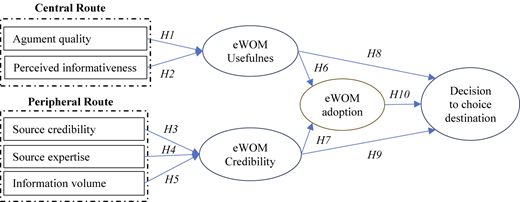
From the constructs and their relationships discussed above, the research model is illustrated in Figure 1.

The study was conducted using both qualitative and quantitative methods. The qualitative method employed document collection and desk research techniques to identify the factors of eWOM that influence the acceptance of eWOM and the destination choice behavior of Gen Z tourists. Based on this, hypotheses and a comprehensive model were developed. The quantitative method was used to measure the behavior of Gen Z tourists regarding the impact of eWOM on their destination choice decisions.

All constructs in the theoretical model were measured using multi-item scales adapted from prior studies to fit the context of travelers’ destination choices. Items were rated on a five-point Likert scale ranging from “strongly disagree” to “strongly agree.”

Regarding scale components, following Erkan and Evans (2016), Moradi and Zihagh (2022), AQ was measured using four items (AQ1–AQ4). Based on Tien et al. (2019) and Moradi and Zihagh (2022), PI was measured with three items (PI1–PI3). Drawing from Filieri et al. (2021) and Moradi and Zihagh (2022), SC was assessed using three items (SC1–SC3). The measurement of SE was adapted from Lis and Horst, 2013; Teng et al., 2014a, b using four items (SE1−SE4). EV was measured with four items (EV1–EV4) derived from Ismagilova et al., (2021) Liu (2006). EC and EU were measured using four items (EC1–EC4) and three items (EU1–EU3), respectively, developed based on Cheah et al. (2024), Nilashi et al. (2022) and Ismagilova et al. (2021). EA was measured using four items (EA1–EA4) following Moradi and Zihagh (2022). Finally, the Decision to Choose a Destination (DE) was assessed with four items (DE1–DE4) adapted from Nilashi et al. (2022) and Filieri and McLeay (2014).

Before conducting the primary survey, a pilot questionnaire was tested with a convenient sample of 100 tourists aged 16–28 at various tourist destinations in Hanoi. Additionally, three experts specializing in tourism and marketing research were invited to review and revise the questionnaire based on feedback. This approach ensured the validity and feasibility of the questionnaire before launching the full-scale formal survey.

A field survey was conducted at prominent tourist destinations in Hanoi, Vietnam, from October 5, 2024, to November 3, 2024. A total of 700 questionnaires were distributed to Gen Z tourists, defined as those born between 1997 and 2012 (Forleo and Bredice, 2025). However, to ensure the maturity and independence of responses, only participants aged 16–28 were included, as this age group is considered to have reached a sufficient level of cognitive and emotional maturity to form independent thoughts and opinions (Cohen et al., 2016; Icenogle et al., 2019). The survey received 670 responses, yielding a response rate of 95.7%. After excluding incomplete responses and those exhibiting patterns of uniform answering, a final dataset consisting of 621 valid questionnaires was retained for analysis. Detailed descriptive statistics on the demographic characteristics of the respondents are presented in Table 1.

In research on tourist behavior, selecting an appropriate analytical framework is a prerequisite for credible and scientifically valuable findings. Structural equation modeling (SEM) enables the simultaneous estimation of the measurement and structural components of a model, thereby facilitating comprehensive hypothesis testing and offering stronger control over measurement error than multivariate regression or traditional path analysis (Hair et al., 2019; Haenlein and Kaplan, 2004).

Two principal SEM approaches are widely used. Covariance-based SEM typically employs maximum likelihood estimation, which assumes approximate normality or requires sufficiently large samples to ensure asymptotic validity. In contrast, variance-based partial least squares SEM (PLS-SEM) maximizes explained variance via iterative ordinary least squares regressions and performs well with non-normal or asymmetric data (Hair et al., 2017). With large samples, empirical differences between the two approaches may narrow, particularly in models characterized by complex relations among latent constructs (Hair and Alamer, 2022).

In this study, we evaluated the normality assumption using the Kolmogorov–Smirnov test with Lilliefors correction and the Shapiro–Wilk test for the indicators of the latent variables (Ohms, 2025). All variables yielded p-values <0.001 in both tests (see Table 2), rejecting the null of normality. Accordingly, PLS-SEM was selected as the estimation strategy consistent with the data characteristics and the model’s architecture. This choice also aligns with the features of the proposed model multiple simultaneous relationships among constructs and the presence of formative measurement specifications contexts in which PLS-SEM is particularly effective (Ali et al., 2022; Dash and Paul, 2021).

PLS Algorithm (Partial Least Squares Algorithm) was conducted to evaluate the scales’ reliability, convergent validity and discriminant validity. Reliability was assessed by using Cronbach’s alpha and composite reliability (CR). Convergent validity was examined by calculating the Average Variance Extracted (AVE).

Table 3 summarizes the measurement items and the statistics for each construct. As shown in Table 3, all Cronbach’s alpha and CR values exceeded the recommended threshold of 0.7 suggested by Nunnally (1978) and Hair et al. (2017), confirming the internal reliability of these scales. Additionally, all constructs’ CR values were well above the suggested minimum of 0.7 (Chin and Gopal, 1995), indicating robust shared variance among the indicators.

Regarding the scales’ validity, both convergent and discriminant validity were assessed. The AVE values for the constructs, as listed in Table 3, ranged from 0.614 to 0.732, and the factor loadings for each item exceeded 0.6, indicating adequate convergent validity (Fornell and Larcker, 1981).

Furthermore, the square roots of the AVE values for all constructs were more significant than the inter-construct correlations in the model (Table 4), confirming that the constructs demonstrated satisfactory discriminant validity (Fornell and Larcker, 1981).

The results of the model fit assessment indicate that the indices meet the required criteria for model adequacy: Standardized Root Mean Square Residual (SRMR) = 0.047 (<0.08); d_ULS = 44.3% (<95%); d_G = 56.16% (<95%); Normed Fit Index (NFI)= 0.905 (>0.9) (Henseler et al., 2016).

To examine the relationships between the research constructs across all variables in the model, SEM was utilized. The bootstrapping technique with 5,000 resamples was applied to test the proposed hypotheses.

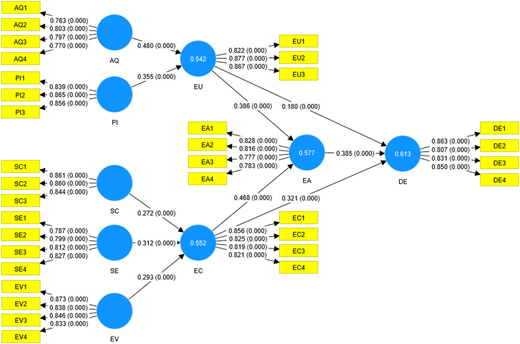
The path coefficients were significant at the default 1% significance level in SmartPLS (see Figure 2). Hypothesis testing was conducted by observing the path coefficients (beta) between latent constructs and their significance levels. The results show that all paths were statistically significant, showing all proposed hypotheses are supported (Table 5).

Hair et al. (2017) state that an R2 value above 0.5 indicates a substantial explanatory power. In this study, the R2 value for the usefulness of eWOM information on social media reached 0.542, explained by the AQ of eWOM information, as presented in Table 5. Additionally, the R2 value for the credibility of eWOM information on social media was 0.552, driven by SC, expertise and EV. Furthermore, the R2 value for EA on social media was 0.577, explained by the usefulness and credibility of eWOM information. Choosing a tourism destination, the primary dependent variable in the model, achieved an R2 value of 0.613. Overall, the model demonstrates substantial explanatory power.

Gen Z travelers, who have grown up with technology and social media, tend to adopt eWOM through online platforms. Answering the RQ1, the results indicate that, within the central route, AQ and PI have significant positive effects on the perceived usefulness of eWOM messages (Table 5). Hence, H1 and H2 are supported. These findings align with studies by Cheung (2014), Ismagilova et al. (2021) and Nyagadza et al. (2023), which suggested that AQ and persuasive messages assist recipients by providing clear reasoning to reinforce their perspectives, thereby encouraging the adoption of related recommendations.

Moreover, to determine whether an eWOM message is high-quality, realistic and valuable for their search objectives, travelers must evaluate its relevance (Cheung, 2014), comprehensiveness (Cheung, 2014), timeliness, accuracy, persuasiveness, specificity (Moradi and Zihagh, 2022) and the emotional tone embedded in the eWOM message (Ismagilova et al., 2021). As highlighted in previous research, these results consolidate various socio-psychological processes impacting eWOM content quality. The findings also reveal that, within the peripheral route, factors such as SC, SE and eWOM volume significantly influence the credibility of eWOM messages, confirming H3, H4 and H5 (Table 5). These results are consistent with the findings of Gunawan and Huarng (2015), who argued that consumers tend to prioritize SC over AQ when engaging with eWOM derived from social media. Furthermore, suppose recipients perceive an eWOM message posted by an individual with a credible profile or recognize a high volume of eWOM for a given destination, they are more likely to rate the information highly credible (Cheung and Thadani, 2012). Due to their knowledge and experience, experts are generally more effective in persuading other consumers and are thus perceived as more trustworthy (Wangenheim and Bayon, 2004).

To address RQ2, we examined the influence of the central route on the usefulness of eWOM, its impact on EA (β = 0.368, p < 0.001), the effect of the peripheral route on EC and its relationship with EA (β = 0.468, p < 0.001). The results confirm the positive effects of EU and EC on EA, supporting H6 and H7. Additionally, the findings highlight the significant positive effects of EU, EC and EA on Gen Z travelers’ destination choice decisions (p-values <0.001), validating H8, H9 and H10. These three variables collectively explain 61.3% of the variance in destination choice decisions (see Figure 2), indicating substantial explanatory power.

A critical insight from this research is that in the context of the tourism industry and Gen Z travelers, eWOM information on social media does not always exert uniform effects on attitudes toward EA and destination choice. Previous studies typically found that the central route strongly influences EA and consumer decisions, particularly for goods and services (Moradi and Zihagh, 2022; Tien et al., 2019). However, our findings reveal a different perspective: the peripheral route exhibits a higher coefficient, indicating a more substantial influence on EA and destination choice than the central route. This finding is a crucial foundation for stakeholders involved in managing, marketing and operating tourist destinations. Understanding Gen Z travelers’ tendencies to adopt peripheral-route-based eWOM enables the development of tailored tourism promotion strategies to engage this demographic effectively.

RQ3 proposed that EA exerts a mediating role in the relationship between EC and Gen Z travelers’ destination choice (β = 0.501, p < 0.001). When EA is included as a mediator, the direct effect of EC on destination choice decisions decreases (β = 0.321, p < 0.001), confirming partial mediation. This result suggests that EA bridges the relationship between EC and destination choice behavior. Similarly, the study finds a significant relationship between EU and Gen Z travelers’ behavior (β = 0.329, p < 0.001). When EA is added to the analysis, the direct effect of EU on behavior decreases (β = 0.180, p < 0.001), further supporting the partial mediation role of EA in this relationship. EA enhances the model’s explanatory power for travelers’ decision-making behavior, increasing the R2 value from 55.1% to 61.3%. This highlights the crucial role of EA within the ELM framework (Nyagadza et al., 2023; Tien et al., 2019).

This study reinforces prior evidence that the influence of eWOM on travel decision-making is best explained through mediating mechanisms. Jalilvand and Samiei (2012) demonstrated that eWOM influences attitudes, subjective norms and perceived behavioral control within the Theory of Planned Behavior. In contrast, González-Rodríguez et al. (2022) highlighted SC, perceived risk and information usefulness as key antecedents of online involvement and visit intention. Together with our findings, these studies confirm that EA constitutes a critical mediator, enhancing the explanatory power of predictive models and clarifying the evaluative processes through which eWOM informs tourist choices.

The theoretical contributions are threefold. First, building on the theoretical framework of the ELM, this study extends a dual-process model to examine influence of the central route and the peripheral route on the destination selection behavior of Gen Z travelers. The results reinforce recent findings in ELM literature, suggesting that both central and peripheral persuasion pathways operate concurrently to influence behavioral change (Moradi and Zihagh, 2022; Cheah et al., 2024). Moreover, this study further contributes to the existing literature by clarifying the distinctive roles of cognitive and affective processing in explaining Gen Z travelers’ adoption of eWOM on social media and their destination choice. The study supports that, in the context of social media, the peripheral route substantially impacts Gen Z travelers’ perceptions more than the central route does. Third, this study further extends the ELM by emphasizing the mediating role of EA in influencing Gen Z travelers’ destination selection behavior. By incorporating this construct into the model, the study offers a more comprehensive theoretical link between consumer persuasion processes and decision-making dynamics within the social media context. These insights underscore that EA is a critical factor that should not be overlooked when analyzing tourist cognitive processing and decision-making mechanisms.

This study offers critical insights for destination management stakeholders, enhancing their understanding of the impact of eWOM on social media on the destination selection decisions of Gen Z travelers. These insights help destination management organizations craft marketing strategies specifically tailored to this demographic. The findings also suggest that, in the future, stakeholders should implement policies that encourage travelers to more frequently share their experiences on social media platforms, thus facilitating the verification of the authenticity of the information shared. Additionally, there is a need to strengthen networks comprising experts, experienced travelers and key opinion leaders to provide reliable information. This will not only enhance the influence of eWOM but also expand its reach, ultimately fostering sustainable and effective destination management.

Based on the ELM, this study presents a two-stage process framework that comprehensively explores the impact of eWOM through cognitive routes on the destination selection decisions of Gen Z travelers in Vietnam. The findings indicate that eWOM significantly influences perceptions and plays a crucial role in shaping destination choice decisions. This research provides valuable insights into the behavior of current travelers while also making an essential contribution to predicting future tourism trends. As Gen Z, having grown up in a digital environment becomes an increasingly dominant force in the tourism industry, understanding the effects of eWOM and emerging technological trends on traveler behavior is essential. Gaining a deeper understanding of the behavior and preferences of this demographic will help tourism managers better meet future travelers’ needs, enabling the industry to prepare more effectively and develop sustainable and impactful marketing strategies that foster long-term relationships with customers.

Although this study provides significant results and implications, it is not free of limitations opening opportunities for future research.

First, our sample was relatively small and consisted entirely of participants from Vietnam; any generalization of the research findings should be taken with care. Given that tourist consumption habits and attitudes vary across nations and cultures, future studies should consider cross-cultural or international comparisons using larger sample size on a random sampling basic.

The second limitation concerns eWOM from social media platforms and Gen Z traveler’ behavior. Other online platforms, such as websites and popular electronic communication channels, have not been considered. Future studies could investigate the impact of central and peripheral routes on EA across different platforms, comparing their relative effects and efficiency in influencing traveler behavior.

Third, adopting eWOM from social media platforms can be associated with other aspects of personal characteristics and demographic generations. Therefore, analyzing the influence of eWOM across generations would provide insights into how eWOM impacts the travel behavior and destination choice of various groups. Likewise, there is a need to investigate whether any difference exists between different demographic groups by gender, age and income, as these demographic factors may influence the reception of information streams, affecting EA and destination choice.
Abbasi
,
A.Z.
,
Tsiotsou
,
R.H.
,
Hussain
,
K.
,
Rather
,
R.A.
and
Ting
,
D.H.
(
2023
), “
Investigating the impact of social media images' value, consumer engagement, and involvement on eWOM of a tourism destination: a transmittal mediation approach
”,
Journal of Retailing and Consumer Services
, Vol. 
71
, 103231, doi: .
Ali
,
M.
,
Tuhin
,
R.
,
Alim
,
M.
,
Rokonuzzaman
,
M.
,
Rahman
,
S.
and
Nuruzzaman
,
M.
(
2022
), “
Acceptance and use of ICT in tourism: the modified UTAUT model
”,
Journal of Tourism Futures
, Vol. 
10
No. 
2
, pp. 
334
-
349
, doi: .
Ayeh
,
J.K.
,
Au
,
N.
and
Law
,
R.
(
2013
), “
Predicting the intention to use consumer-generated media for travel planning
”,
Tourism Management
, Vol. 
35
, pp. 
132
-
143
, doi: .
Bansal
,
H.S.
and
Voyer
,
P.A.
(
2000
), “
Word-of-mouth processes within a services purchase decision context
”,
Journal of Service Research
, Vol. 
3
No. 
2
, pp. 
166
-
177
, doi: .
Barbe
,
D.
and
Neuburger
,
L.
(
2021
), “Generation Z and digital influencers in the tourism industry”, in
Generation Z Marketing and Management in Tourism and Hospitality: The Future of the Industry
,
Springer
, pp. 
167
-
192
, doi: .
Cheah
,
J.H.
,
Magno
,
F.
and
Cassia
,
F.
(
2024
), “
Reviewing the SmartPLS 4 software: the latest features and enhancements
”,
Journal of Market Analysis
, Vol. 
12
No. 
1
, pp. 
97
-
107
, doi: .
Cheng
,
Y.-H.
and
Ho
,
H.-Y.
(
2015
), “
Social influence's impact on reader perceptions of online reviews
”,
Journal of Business Research
, Vol. 
68
No. 
4
, pp. 
883
-
887
, doi: .
Cheung
,
R.
(
2014
), “
The influence of electronic word-of-mouth on information adoption in online customer communities
”,
Global Economic Review
, Vol. 
43
No. 
1
, pp. 
42
-
57
, doi: .
Cheung
,
C.M.K.
and
Thadani
,
D.R.
(
2012
), “
The impact of electronic word-of-mouth communication: a literature analysis and integrative model
”,
Decision Support Systems
, Vol. 
54
No. 
1
, pp. 
461
-
470
, doi: .
Chin
,
W.W.
and
Gopal
,
A.
(
1995
), “
Adoption intention in GSS: relative importance of beliefs
”,
ACM SIGMIS - Data Base
, Vol. 
26
Nos
2-3
, pp. 
42
-
64
, doi: .
Cohen
,
A.
,
Breiner
,
K.
,
Steinberg
,
L.
,
Bonnie
,
R.
,
Scott
,
E.
,
Taylor-Thompson
,
K.
,
Rudolph
,
M.
,
Chein
,
J.
,
Richeson
,
J.
,
Heller
,
A.
,
Silverman
,
M.
,
Dellarco
,
D.
,
Fair
,
D.
,
Galván
,
A.
and
Casey
,
B.
(
2016
), “
When is an adolescent an adult? Assessing cognitive control in emotional and nonemotional contexts
”,
Psychological Science
, Vol. 
27
No. 
4
, pp. 
549
-
562
, doi: .
Dash
,
G.
and
Paul
,
J.
(
2021
), “
CB-SEM vs PLS-SEM methods for research in social sciences and technology forecasting
”,
Technological Forecasting and Social Change
, Vol. 
173
, 121092, doi: .
Erkan
,
I.
and
Evans
,
C.
(
2016
), “
The influence of eWOM in social media on consumers' purchase intentions: an extended approach to information adoption
”,
Computers in Human Behavior
, Vol. 
61
, pp. 
47
-
55
, doi: .
Fan
,
Y.
,
Miao
,
Y.
,
Fang
,
Y.
and
Lin
,
R.
(
2013
), “
Establishing the adoption of electronic word-of-mouth through consumers' perceived credibility
”,
International Business Research
, Vol. 
6
No. 
3
, pp. 
58
-
65
, doi: .
Filieri
,
R.
and
McLeay
,
F.
(
2014
), “
E-WOM and accommodation: an analysis of the factors that influence travelers' adoption of information from online reviews
”,
Journal of Travel Research
, Vol. 
53
No. 
1
, pp. 
44
-
57
, doi: .
Filieri
,
R.
,
Hofacker
,
C.F.
and
Alguezaui
,
S.
(
2018
), “
What makes information in online consumer reviews diagnostic over time? The role of review relevancy, factuality, currency, source credibility, and ranking score
”,
Computers in Human Behavior
, Vol. 
80
, pp. 
122
-
131
, doi: .
Filieri
,
R.
,
Lin
,
Z.
,
Pino
,
G.
,
Alguezaui
,
S.
and
Inversini
,
A.
(
2021
), “
The role of visual cues in eWOM on consumers' behavioral intention and decisions
”,
Journal of Business Research
, Vol. 
135
, pp. 
663
-
675
, doi: .
Forleo
,
M.B.
and
Bredice
,
M.
(
2025
), “
Italian Gen Z and sustainable coastal tourism: a segmentation analysis of knowledge, attitudes, and pro-environmental behaviours
”,
Journal of Tourism Futures
. doi: .
Fornell
,
C.
and
Larcker
,
D.F.
(
1981
), “
Structural equation models with unobservable variables and measurement error: algebra and statistics
”,
Journal of Marketing Research
, Vol. 
18
No. 
3
, pp. 
382
-
388
, doi: .
González‐Rodríguez
,
M.
,
Díaz-Fernández
,
M.
,
Bilgihan
,
A.
,
Okumus
,
F.
and
Shi
,
F.
(
2022
), “
The impact of eWOM source credibility on destination visit intention and online involvement: a case of Chinese tourists
”,
Journal of Hospitality and Tourism Technology
, Vol. 
13
No. 
5
, pp. 
855
-
874
, doi: .
Grover
,
P.
,
Kar
,
A.K.
and
Dwivedi
,
Y.
(
2022
), “
The evolution of social media influence - a literature review and research agenda
”,
International Journal of Information Management Data Insights
, Vol. 
2
No. 
2
, 100116, doi: .
Gunawan
,
D.
and
Huarng
,
K.
(
2015
), “
Viral effects of social network and media on consumers’ purchase intention
”,
Journal of Business Research
, Vol. 
68
No. 
11
, pp.
2237
-
2241
, doi: .
Gvili
,
Y.
and
Levy
,
S.
(
2016
), “
Antecedents of attitudes toward eWOM communication: differences across channels
”,
Internet Research
, Vol. 
26
No. 
5
, pp. 
1030
-
1051
, doi: .
Haenlein
,
M.
and
Kaplan
,
A.M.
(
2004
), “
A beginner's guide to partial least squares analysis
”,
Understanding Statistics
, Vol. 
3
No. 
4
, pp. 
283
-
297
, doi: .
Hair
,
J.
and
Alamer
,
A.
(
2022
), “
Partial least squares structural equation modeling (PLS-SEM) in second language and education research: guidelines using an applied example
”,
Research Methods in Applied Linguistics
, Vol. 
1
No. 
3
, 100027, doi: .
Hair
,
J.F.
,
Hult
,
G.T.M.
,
Ringle
,
C.M.
and
Sarstedt
,
M.
(
2017
),
A Primer on Partial Least Squares Structural Equation Modeling (PLS-SEM)
, (2nd ed.) ,
Sage
,
Thousand Oaks, CA
.
Hair
,
J.F.
,
Risher
,
J.J.
,
Sarstedt
,
M.
and
Ringle
,
C.M.
(
2019
), “
When to use and how to report the results of PLS-SEM
”,
European Business Review
, Vol. 
31
No. 
1
, pp. 
2
-
24
, doi: .
Henseler
,
J.
,
Hubona
,
G.
and
Ray
,
P.A.
(
2016
), “
Using PLS path modeling in new technology research: updated guidelines
”,
Industrial Management and Data Systems
, Vol. 
116
No. 
1
, pp. 
2
-
20
, doi: .
Hussain
,
S.
,
Ahmed
,
W.
,
Jafar
,
R.M.S.
,
Rabnawaz
,
A.
and
Jianzhou
,
Y.
(
2017
), “
eWOM source credibility, perceived risk and food product customer's information adoption
”,
Computers in Human Behavior
, Vol. 
66
, pp. 
96
-
102
, doi: .
Icenogle
,
G.
,
Steinberg
,
L.
,
Duell
,
N.
,
Chein
,
J.
,
Chang
,
L.
,
Chaudhary
,
N.
,
Di Giunta
,
L.
,
Dodge
,
K.
,
Fanti
,
K.
,
Lansford
,
J.
,
Oburu
,
P.
,
Pastorelli
,
C.
,
Skinner
,
A.
,
Sorbring
,
E.
,
Tapanya
,
S.
,
Tirado
,
L.
,
Alampay
,
L.
,
Al-Hassan
,
S.
,
Takash
,
H.
and
Bacchini
,
D.
(
2019
), “
Adolescents' cognitive capacity reaches adult levels prior to their psychosocial maturity: evidence for a ‘maturity gap’ in a multinational, cross-sectional sample
”,
Law and Human Behavior
, Vol. 
43
No. 
1
, pp. 
69
-
85
, doi: .
Ismagilova
,
E.
,
Dwivedi
,
Y.K.
and
Rana
,
N.
(
2021
), “
The use of elaboration likelihood model in eWOM research: literature review and weight-analysis
”,
Responsible AI and Analytics for an Ethical and Inclusive Digitized Society: 20th IFIP WG 6.11 Conference on e-Business, e-Services and e-Society, I3E 2021
,
Galway, Ireland
,
September 1-3, 2021
,
Proceedings 20
,
Springer International Publishing
, pp. 
495
-
505
, doi: .
Ismagilova
,
E.
,
Dwivedi
,
Y.
,
Slade
,
E.
and
Williams
,
M.
(
2017
),
Electronic Word-Of-Mouth in the Marketing Context: A State of the Art Analysis and Future Directions
,
Springer International Publishing
,
Cham
.
Jalilvand
,
M.
and
Samiei
,
N.
(
2012
), “
The impact of electronic word of mouth on a tourism destination choice: testing the theory of planned behavior (TPB)
”,
Internet Research
, Vol. 
22
No. 
5
, pp. 
591
-
612
, doi: .
Lee
,
J.
and
Hong
,
I.
(
2019
), “
Consumer’s Electronic Word-of-Mouth Adoption: The Trust Transfer Perspective
”,
International Journal of Electronic Commerce
, Vol. 
23
No. 
4
, pp.
595
-
627
, doi: .
Li
,
H.
and
See-To
,
E.W.K.
(
2024
), “
Source credibility plays the central route: an elaboration likelihood model exploration in social media environment with demographic profile analysis
”,
Journal of Electronic Business and Digital Economics
, Vol. 
3
No. 
1
, pp. 
36
-
60
, doi: .
Liang
,
H.-L.
and
Lin
,
P.
(
2018
), “
Influence of multiple endorser-product patterns on purchase intention
”,
International Journal of Sports Marketing and Sponsorship
, Vol. 
19
No. 
4
, pp. 
415
-
432
, doi: .
Lis
,
B.
and
Horst
,
M.
(
2013
), “
Electronic word of mouth impacts: a spotlight on customer integration
”,
Journal of Media Business Studies
, Vol. 
10
No. 
4
, pp. 
41
-
62
, doi: .
Liu
,
Y.
(
2006
), “
Word of mouth for movies: its dynamics and impact on box office revenue
”,
Journal of Marketing
, Vol. 
70
No. 
3
, pp. 
74
-
89
, doi: .
Luong
,
T.B.
(
2024
), “
The moderating role of e-word of mouth in the relationships between destination source credibility, awareness, attachment, travel motivation, and travel intention: a case study of Vietnamese film tourism
”,
International Journal of Tourism Research
, Vol. 
26
No. 
4
, e2729,
Wiley Online Library
doi: .
Meenakshy
,
M.
,
Prasad
,
K.D.V.
,
Bolar
,
K.
and
Shyamsunder
,
C.
(
2024
), “
Electronic word-of-mouth intentions in personal and public networks: a domestic tourist perspective
”,
Humanities and Social Sciences Communications
, Vol. 
11
No. 
1
, 1226, doi: .
Moradi
,
M.
and
Zihagh
,
F.
(
2022
), “
A meta-analysis of the elaboration likelihood model in the electronic word-of-mouth literature
”,
International Journal of Consumer Studies
, Vol. 
46
No. 
5
, pp. 
1900
-
1918
, doi: .
Nam
,
K.
,
Baker
,
J.
,
Ahmad
,
N.
and
Goo
,
J.
(
2020
), “
Dissatisfaction, disconfirmation, and distrust: an empirical examination of value co-destruction through negative electronic word-of-mouth (eWOM)
”,
Information Systems Frontiers
, Vol. 
22
No. 
1
, pp. 
113
-
130
, doi: .
Ngo
,
T.T.A.
,
Vuong
,
B.L.
,
Le
,
M.D.
,
Nguyen
,
T.T.
,
Tran
,
M.M.
and
Nguyen
,
Q.K.
(
2024
), “
The impact of eWOM information in social media on the online purchase intention of Generation Z
”,
Cogent Business and Management
, Vol. 
11
No. 
1
, 2316933, doi: .
Nilashi
,
M.
,
Abumalloh
,
R.A.
,
Alrizq
,
M.
,
Alghamdi
,
A.
,
Samad
,
S.
,
Almulihi
,
A.
,
Althobaiti
,
M.M.
,
Ismail
,
M.Y.
and
Mohd
,
S.
(
2022
), “
What is the impact of eWOM in social network sites on travel decision-making during the COVID-19 outbreak? A two-stage methodology
”,
Telematics and Informatics
, Vol. 
69
, 101795, doi: .
Nunnally
,
J.
(
1978
),
Psychometric Methods
,
McGraw Hill
,
New York, NY
.
Nyagadza
,
B.
,
Mazuruse
,
G.
,
Simango
,
K.
,
Chikazhe
,
L.
,
Tsokota
,
T.
and
Macheka
,
L.
(
2023
), “
Examining the influence of social media eWOM on consumers' purchase intentions of commercialized indigenous fruits (IFs) products in FMCGs retailers
”,
Sustainable Technology and Entrepreneurship
, Vol. 
2
No. 
3
, 100040, doi: .
Ohms
,
B.
(
2025
), “
A quantitative approach to investigating cognitive biases in workplace decision-making in Singapore
”,
SocArXiv
,
[Preprint]
doi: .
Petty
,
R.E.
and
Cacioppo
,
J.T.
(
1984
), in
Kinnear
,
T.C.
(Ed.),
Source Factors and the Elaboration Likelihood Model of Persuasion
,
ACR North American Advances
, Vol. 
11
, pp. 
668
-
672
.
Petty
,
R.E.
and
Cacioppo
,
J.T.
(
1986
), “The elaboration likelihood model of persuasion”, in
Communication and Persuasion
,
Springer
, pp. 
1
-
24
, doi: .
Otterbacher
,
J.
(
2009
), “
Helpfulness in online communities: a measure of message quality
”, In
Proceedings of the 27th International Conference on Human Factors in Computing Systems (CHI ’09)
, ACM, pp. 
955
-
964
, doi: .
Petty
,
R.E.
,
Briñol
,
P.
and
Priester
,
J.R.
(
2009
), “Mass media attitude change: implications of the elaboration likelihood model of persuasion”, in
Media Effects: Advances in Theory and Research
,
Erlbaum
,
Mahwah, NJ
, pp. 
125
-
164
, doi: .
Pourfakhimi
,
S.
,
Duncan
,
T.
and
Coetzee
,
W.J.L.
(
2020
), “
Electronic word of mouth in tourism and hospitality consumer behaviour: state of the art
”,
Tourism Review
, Vol. 
75
No. 
4
, pp. 
637
-
661
, doi: .
Reyes-Menendez
,
A.
,
Saura
,
J.R.
and
Martinez-Navalon
,
J.G.
(
2019
), “
The impact of e-WOM on hotels management reputation: exploring TripAdvisor review credibility with the ELM model
”,
IEEE Access
, Vol. 
7
, pp. 
68868
-
68877
, doi: .
Ruangkanjanases
,
A.
,
Jeebjong
,
P.
,
Sonata
,
N.
and
Sanny
,
L.
(
2021
), “
eWOM and its impacts on purchasing behavior: a comparative study between Thai and Indonesian millennials
”,
International Journal of Electronic Commerce Studies
, Vol. 
12
No. 
1
, pp. 
65
-
82
, doi: .
Saidani
,
A.
,
Nechoud
,
L.
,
Ghidouche
,
F.
and
Ghidouche Ait-Yahia
,
K.
(
2023
), “
Serial mediation of perceived usefulness and eWOM adoption in virtual communities and the moderating effect of gender
”,
Tourism and Hospitality Management
, Vol. 
29
No. 
1
, pp. 
87
-
102
, doi: .
SanJosé-Cabezudo
,
R.
,
Gutiérrez-Arranz
,
A.M.
and
Gutiérrez-Cillán
,
J.
(
2009
), “
The combined influence of central and peripheral routes in the online persuasion process
”,
CyberPsychology and Behavior
, Vol. 
12
No. 
3
, pp. 
299
-
308
, doi: .
Shahab
,
M.H.
,
Ghazali
,
E.
and
Mohtar
,
M.
(
2021
), “
The role of elaboration likelihood model in consumer behaviour research and its extension to new technologies: a review and future research agenda
”,
International Journal of Consumer Studies
, Vol. 
45
No. 
4
, pp. 
1
-
26
, doi: .
Sussman
,
S.W.
and
Siegal
,
W.S.
(
2003
), “
Informational influence in organizations: an integrated approach to knowledge adoption
”,
Information Systems Research
, Vol. 
14
No. 
1
, pp. 
47
-
65
, doi: .
Teng
,
S.
,
Khong
,
K.W.
and
Goh
,
W.W.
(
2014a
), “
Conceptualizing persuasive messages using ELM in social media
”,
Journal of Internet Commerce
, Vol. 
13
No. 
1
, pp. 
65
-
87
, doi: .
Teng
,
S.
,
Khong
,
K.W.
,
Goh
,
W.W.
and
Chong
,
A.Y.L.
(
2014b
), “
Examining the antecedents of persuasive eWOM messages in social media
”,
Online Information Review
, Vol. 
38
No. 
6
, pp. 
746
-
768
, doi: .
Tien
,
D.H.
,
Amaya Rivas
,
A.A.
and
Liao
,
Y.K.
(
2019
), “
Examining the influence of customer-to-customer electronic word-of-mouth on purchase intention in social networking sites
”,
Asia Pacific Management Review
, Vol. 
24
No. 
3
, pp. 
238
-
249
, doi: .
Tsao
,
W.-C.
and
Hsieh
,
M.-T.
(
2015
), “
eWOM persuasiveness: do eWOM platforms and product type matter?
”,
Electronic Commerce Research
, Vol. 
15
No. 
4
, pp. 
509
-
541
, doi: .
Tseng
,
L.-Y.
,
Chang
,
J.-H.
and
Zhu
,
Y.L.
(
2024
), “
What drives the travel switching behavior of Chinese Generation Z consumers
”,
Journal of Tourism Futures
, Vol. 
10
No. 
1
, pp. 
131
-
146
, doi: .
Wang
,
H.
and
Yan
,
J.
(
2022
), “
Effects of social media tourism information quality on destination travel intention: mediation effect of self-congruity and trust
”,
Frontiers in Psychology
, Vol. 
13
, 1049149, doi: .
Wangenheim
,
F.
and
Bayon
,
T.
(
2004
), “
The effect of word of mouth on services switching: measurement and moderating variables
”,
European Journal of Marketing
, Vol. 
38
No. 
9
, pp. 
1173
-
1185
, doi: .
Yadav
,
N.
,
Verma
,
S.
and
Chikhalkar
,
R.D.
(
2022
), “
eWOM, destination preference and consumer involvement–a stimulus-organism-response (SOR) lens
”,
Tourism Review
, Vol. 
77
No. 
4
, pp. 
850
-
870
, doi: .
Yoo
,
C.W.
,
Goo
,
J.
,
Huang
,
C.D.
,
Nam
,
K.
and
Woo
,
M.
(
2017
), “
Improving travel decision support satisfaction with smart tourism technologies: a framework of tourist elaboration likelihood and self-efficacy
”,
Technological Forecasting and Social Change
, Vol. 
123
, pp. 
330
-
341
, doi: .
Published in Journal of Tourism Futures. Published by Emerald Publishing Limited. This article is published under the Creative Commons Attribution (CC BY 4.0) licence. Anyone may reproduce, distribute, translate and create derivative works of this article (for both commercial and non-commercial purposes), subject to full attribution to the original publication and authors. The full terms of this licence may be seen at Link to the terms of the CC BY 4.0 licence.

Data & Figures

Figure 1
A research model shows the relationships between Route, Usefulness, Credibility, adoption, and destination.The research model is organized into three main vertical sections, with paths indicating directional relationships. On the far left, two rectangular containers are stacked vertically. The top container is titled “Central Route” and contains two rectangular boxes: “Agument quality” and “Perceived informativeness”. Solid arrows labeled “H 1” and “H 2” point from these boxes to an oval labeled “e W O M Usefulness” in the center top. The bottom container is titled “Peripheral Route” and contains three rectangular boxes: “Source credibility”, “Source expertise”, and “Information volume”. Solid arrows labeled “H 3”, “H 4”, and “H 5” point from these boxes to an oval labeled “e W O M Credibility” in the center bottom. In the center of the model, two ovals, “e W O M Usefulness” and “e W O M Credibility”, flank a central oval labeled “e W O M adoption”. Solid arrows labeled “H 6” and “H 7” point from the top and bottom center ovals toward “e W O M adoption”. On the far right, a final oval is labeled “Decision to choice destination”. Three solid arrows converge on this oval: one from “e W O M Usefulness” labeled “H 8”, one from “e W O M Credibility” labeled “H 9”, and one from “e W O M adoption” labeled “H 10”.

Research model

Figure 1
A research model shows the relationships between Route, Usefulness, Credibility, adoption, and destination.The research model is organized into three main vertical sections, with paths indicating directional relationships. On the far left, two rectangular containers are stacked vertically. The top container is titled “Central Route” and contains two rectangular boxes: “Agument quality” and “Perceived informativeness”. Solid arrows labeled “H 1” and “H 2” point from these boxes to an oval labeled “e W O M Usefulness” in the center top. The bottom container is titled “Peripheral Route” and contains three rectangular boxes: “Source credibility”, “Source expertise”, and “Information volume”. Solid arrows labeled “H 3”, “H 4”, and “H 5” point from these boxes to an oval labeled “e W O M Credibility” in the center bottom. In the center of the model, two ovals, “e W O M Usefulness” and “e W O M Credibility”, flank a central oval labeled “e W O M adoption”. Solid arrows labeled “H 6” and “H 7” point from the top and bottom center ovals toward “e W O M adoption”. On the far right, a final oval is labeled “Decision to choice destination”. Three solid arrows converge on this oval: one from “e W O M Usefulness” labeled “H 8”, one from “e W O M Credibility” labeled “H 9”, and one from “e W O M adoption” labeled “H 10”.

Research model

Close modal
Figure 2
A latent variable model shows relationships of “A Q”, “P I”, “S C”, “S E”, and “E V” to “E U”, “E C”, “E A”, and “D E”.The latent variable model has numerous circles and rectangular boxes connected by arrows, each labeled with a numerical value. On the far left, five circles are vertically arranged. The top circle, “A Q”, is connected to four rectangular boxes labeled “A Q 1”, “A Q 2”, “A Q 3”, and “A Q 4” with values “0.763(0.000)”, “0.803(0.000)”, “0.797(0.000)”, and “0.770(0.000)”. The second circle, “P I”, is connected to boxes “P I 1”, “P I 2”, and “P I 3” with values “0.839(0.000)”, “0.865(0.000)”, and “0.856(0.000)”. Both of these circles point to a central circle “E U” with path values of “0.480(0.000)” and “0.355(0.000)”. In the lower left, three circles, “S C”, “S E”, and “E V”, each connect to their own set of rectangular boxes. “S C” connects to “S C 1” through “S C 3” with values “0.861(0.000)”, “0.860(0.000)”, and “0.844(0.000)”. “S E” connects to “S E 1” through “S E 4” with values “0.787(0.000)”, “0.799(0.000)”, “0.812(0.000)”, and “0.827(0.000)”. “E V” connects to “E V 1” through “E V 4” with values “0.873(0.000)”, “0.838(0.000)”, “0.846(0.000)”, and “0.833(0.000)”. All three of these circles point to the circle “E C” with path values of “0.272(0.000)”, “0.312(0.000)”, and “0.293(0.000)”. The center of the model contains three circles: “E U” at the top with a internal value of “0.542”, “E A” in the middle with a internal value of “0.577”, and “E C” at the bottom with a internal value of “0.552”. “E U” connects to boxes “E U 1” through “E U 3” with values “0.822(0.000)”, “0.877(0.000)”, and “0.867(0.000)”. “E C” connects to boxes “E C 1” through “E C 4” with values “0.856(0.000)”, “0.825(0.000)”, “0.819(0.000)”, and “0.821(0.000)”. “E A” connects to boxes “E A 1” through “E A 4” with values “0.828(0.000)”, “0.816(0.000)”, “0.777(0.000)”, and “0.783(0.000)”. Paths lead from “E U” to “E A” with a value of “0.386(0.000)”, and from “E C” to “E A” with a value of “0.468(0.000)”. On the far right, a final circle labeled “D E” with a internal value of “0.613” is connected to four rectangular boxes labeled “D E 1” through “D E 4” with values “0.863(0.000)”, “0.807(0.000)”, “0.831(0.000)”, and “0.850(0.000)”. Arrows point to “D E” from “E U” with a value of “0.180(0.000)”, from “E A” with a value of “0.385(0.000)”, and from “E C” with a value of “0.321(0.000)”.

Final structurally validated model (using the bootstrapping). Source(s): Authors’ survey, 2024

Figure 2
A latent variable model shows relationships of “A Q”, “P I”, “S C”, “S E”, and “E V” to “E U”, “E C”, “E A”, and “D E”.The latent variable model has numerous circles and rectangular boxes connected by arrows, each labeled with a numerical value. On the far left, five circles are vertically arranged. The top circle, “A Q”, is connected to four rectangular boxes labeled “A Q 1”, “A Q 2”, “A Q 3”, and “A Q 4” with values “0.763(0.000)”, “0.803(0.000)”, “0.797(0.000)”, and “0.770(0.000)”. The second circle, “P I”, is connected to boxes “P I 1”, “P I 2”, and “P I 3” with values “0.839(0.000)”, “0.865(0.000)”, and “0.856(0.000)”. Both of these circles point to a central circle “E U” with path values of “0.480(0.000)” and “0.355(0.000)”. In the lower left, three circles, “S C”, “S E”, and “E V”, each connect to their own set of rectangular boxes. “S C” connects to “S C 1” through “S C 3” with values “0.861(0.000)”, “0.860(0.000)”, and “0.844(0.000)”. “S E” connects to “S E 1” through “S E 4” with values “0.787(0.000)”, “0.799(0.000)”, “0.812(0.000)”, and “0.827(0.000)”. “E V” connects to “E V 1” through “E V 4” with values “0.873(0.000)”, “0.838(0.000)”, “0.846(0.000)”, and “0.833(0.000)”. All three of these circles point to the circle “E C” with path values of “0.272(0.000)”, “0.312(0.000)”, and “0.293(0.000)”. The center of the model contains three circles: “E U” at the top with a internal value of “0.542”, “E A” in the middle with a internal value of “0.577”, and “E C” at the bottom with a internal value of “0.552”. “E U” connects to boxes “E U 1” through “E U 3” with values “0.822(0.000)”, “0.877(0.000)”, and “0.867(0.000)”. “E C” connects to boxes “E C 1” through “E C 4” with values “0.856(0.000)”, “0.825(0.000)”, “0.819(0.000)”, and “0.821(0.000)”. “E A” connects to boxes “E A 1” through “E A 4” with values “0.828(0.000)”, “0.816(0.000)”, “0.777(0.000)”, and “0.783(0.000)”. Paths lead from “E U” to “E A” with a value of “0.386(0.000)”, and from “E C” to “E A” with a value of “0.468(0.000)”. On the far right, a final circle labeled “D E” with a internal value of “0.613” is connected to four rectangular boxes labeled “D E 1” through “D E 4” with values “0.863(0.000)”, “0.807(0.000)”, “0.831(0.000)”, and “0.850(0.000)”. Arrows point to “D E” from “E U” with a value of “0.180(0.000)”, from “E A” with a value of “0.385(0.000)”, and from “E C” with a value of “0.321(0.000)”.

Final structurally validated model (using the bootstrapping). Source(s): Authors’ survey, 2024

Close modal
Table 1

Demographics of the research sample (n = 621)

MeasureItemsFrequencyPercentage (%)
GenderMale23738.1
Female36358.5
Other213.4
EducationSecondary and less12620.3
Graduate36558.8
Postgraduate13020.9
RegionsNorth29046.8
Middle17428.0
South15725.2
Source(s): Authors’ survey, 2024
Table 2

Tests of normality

Kolmogorov–SmirnovaShapiro–Wilk
StatisticdfSig.StatisticdfSig.
AQ0.1556220.0000.9206220.000
PI0.1776220.0000.9246220.000
EU0.1716220.0000.8666220.000
SC0.1426220.0000.9316220.000
SE0.1266220.0000.9406220.000
EV0.1936220.0000.8706220.000
EC0.1386220.0000.9186220.000
EA0.1496220.0000.9396220.000
DE0.1866220.0000.8636220.000
Note(s)
a

Lilliefors significance correction

Source(s): Authors’ survey, 2024
Table 3

The measurement model analysis

ConstructItemStandardized
Loading
AVECRCronbach’s alphas
Argument qualityAQ10.7630.6140.8640.790
AQ20.803
AQ30.797
AQ40.770
Perceived informativenessPI10.8390.7280.8890.813
PI20.865
PI30.856
Source credibilitySC10.8610.7310.8910.816
SC20.860
SC30.844
Source expertiseSE10.7870.6510.8820.822
SE20.799
SE30.812
SE40.827
Information eWOMEV10.8730.7180.9110.869
EV20.838
EV30.846
EV40.833
eWOM credibilityEC10.8560.6900.8990.850
EC20.825
EC30.819
EC40.821
eWOM usefulnessEU10.8220.7320.8910.817
EU20.877
EU30.867
eWOM adoptionEA10.8280.6420.8770.814
EA20.816
EA30.777
EA40.783
Destination choiceDE10.8630.7020.9040.858
DE20.807
DE30.831
DE40.850
Source(s): Authors’ survey, 2024
Table 4

Discriminant validity of key constructs

AQDEEAECEUEVPISCSE
AQ0.784        
DE0.4640.838       
EA0.4920.7250.801      
EC0.4640.6920.6920.831     
EU0.6730.6200.6570.5800.856    
EV0.4110.5860.5390.6250.5510.848   
PI0.5420.5090.5320.4730.6150.4360.853  
SC0.4450.5520.5630.6250.5370.5780.4130.855 
SE0.4640.5240.5950.6370.5570.5610.4570.5890.807

Note(s): The italic value provided in Table 4 is the square root of the AVE for each construct

Source(s): Authors’ survey, 2024
Table 5

Path coefficients and R2 of the structural model

HypoPathStandardized estimate (β)t-valuep-valueResults
H1AQ → EU0.48011.1160.000Supported
H2PI → EU0.3557.8600.000Supported
H3SC → EC0.2726.0730.000Supported
H4SE → EC0.3126.4250.000Supported
H5EV → EC0.2936.0200.000Supported
H6EU → EA0.3869.4800.000Supported
H7EC → EA0.46812.3520.000Supported
H8EU → DE0.1803.7090.000Supported
H9EC → DE0.3215.7840.000Supported
H10EA → DE0.3856.9940.000Supported
Source(s): Authors’ survey, 2024

Supplements

References

Abbasi
,
A.Z.
,
Tsiotsou
,
R.H.
,
Hussain
,
K.
,
Rather
,
R.A.
and
Ting
,
D.H.
(
2023
), “
Investigating the impact of social media images' value, consumer engagement, and involvement on eWOM of a tourism destination: a transmittal mediation approach
”,
Journal of Retailing and Consumer Services
, Vol. 
71
, 103231, doi: .
Ali
,
M.
,
Tuhin
,
R.
,
Alim
,
M.
,
Rokonuzzaman
,
M.
,
Rahman
,
S.
and
Nuruzzaman
,
M.
(
2022
), “
Acceptance and use of ICT in tourism: the modified UTAUT model
”,
Journal of Tourism Futures
, Vol. 
10
No. 
2
, pp. 
334
-
349
, doi: .
Ayeh
,
J.K.
,
Au
,
N.
and
Law
,
R.
(
2013
), “
Predicting the intention to use consumer-generated media for travel planning
”,
Tourism Management
, Vol. 
35
, pp. 
132
-
143
, doi: .
Bansal
,
H.S.
and
Voyer
,
P.A.
(
2000
), “
Word-of-mouth processes within a services purchase decision context
”,
Journal of Service Research
, Vol. 
3
No. 
2
, pp. 
166
-
177
, doi: .
Barbe
,
D.
and
Neuburger
,
L.
(
2021
), “Generation Z and digital influencers in the tourism industry”, in
Generation Z Marketing and Management in Tourism and Hospitality: The Future of the Industry
,
Springer
, pp. 
167
-
192
, doi: .
Cheah
,
J.H.
,
Magno
,
F.
and
Cassia
,
F.
(
2024
), “
Reviewing the SmartPLS 4 software: the latest features and enhancements
”,
Journal of Market Analysis
, Vol. 
12
No. 
1
, pp. 
97
-
107
, doi: .
Cheng
,
Y.-H.
and
Ho
,
H.-Y.
(
2015
), “
Social influence's impact on reader perceptions of online reviews
”,
Journal of Business Research
, Vol. 
68
No. 
4
, pp. 
883
-
887
, doi: .
Cheung
,
R.
(
2014
), “
The influence of electronic word-of-mouth on information adoption in online customer communities
”,
Global Economic Review
, Vol. 
43
No. 
1
, pp. 
42
-
57
, doi: .
Cheung
,
C.M.K.
and
Thadani
,
D.R.
(
2012
), “
The impact of electronic word-of-mouth communication: a literature analysis and integrative model
”,
Decision Support Systems
, Vol. 
54
No. 
1
, pp. 
461
-
470
, doi: .
Chin
,
W.W.
and
Gopal
,
A.
(
1995
), “
Adoption intention in GSS: relative importance of beliefs
”,
ACM SIGMIS - Data Base
, Vol. 
26
Nos
2-3
, pp. 
42
-
64
, doi: .
Cohen
,
A.
,
Breiner
,
K.
,
Steinberg
,
L.
,
Bonnie
,
R.
,
Scott
,
E.
,
Taylor-Thompson
,
K.
,
Rudolph
,
M.
,
Chein
,
J.
,
Richeson
,
J.
,
Heller
,
A.
,
Silverman
,
M.
,
Dellarco
,
D.
,
Fair
,
D.
,
Galván
,
A.
and
Casey
,
B.
(
2016
), “
When is an adolescent an adult? Assessing cognitive control in emotional and nonemotional contexts
”,
Psychological Science
, Vol. 
27
No. 
4
, pp. 
549
-
562
, doi: .
Dash
,
G.
and
Paul
,
J.
(
2021
), “
CB-SEM vs PLS-SEM methods for research in social sciences and technology forecasting
”,
Technological Forecasting and Social Change
, Vol. 
173
, 121092, doi: .
Erkan
,
I.
and
Evans
,
C.
(
2016
), “
The influence of eWOM in social media on consumers' purchase intentions: an extended approach to information adoption
”,
Computers in Human Behavior
, Vol. 
61
, pp. 
47
-
55
, doi: .
Fan
,
Y.
,
Miao
,
Y.
,
Fang
,
Y.
and
Lin
,
R.
(
2013
), “
Establishing the adoption of electronic word-of-mouth through consumers' perceived credibility
”,
International Business Research
, Vol. 
6
No. 
3
, pp. 
58
-
65
, doi: .
Filieri
,
R.
and
McLeay
,
F.
(
2014
), “
E-WOM and accommodation: an analysis of the factors that influence travelers' adoption of information from online reviews
”,
Journal of Travel Research
, Vol. 
53
No. 
1
, pp. 
44
-
57
, doi: .
Filieri
,
R.
,
Hofacker
,
C.F.
and
Alguezaui
,
S.
(
2018
), “
What makes information in online consumer reviews diagnostic over time? The role of review relevancy, factuality, currency, source credibility, and ranking score
”,
Computers in Human Behavior
, Vol. 
80
, pp. 
122
-
131
, doi: .
Filieri
,
R.
,
Lin
,
Z.
,
Pino
,
G.
,
Alguezaui
,
S.
and
Inversini
,
A.
(
2021
), “
The role of visual cues in eWOM on consumers' behavioral intention and decisions
”,
Journal of Business Research
, Vol. 
135
, pp. 
663
-
675
, doi: .
Forleo
,
M.B.
and
Bredice
,
M.
(
2025
), “
Italian Gen Z and sustainable coastal tourism: a segmentation analysis of knowledge, attitudes, and pro-environmental behaviours
”,
Journal of Tourism Futures
. doi: .
Fornell
,
C.
and
Larcker
,
D.F.
(
1981
), “
Structural equation models with unobservable variables and measurement error: algebra and statistics
”,
Journal of Marketing Research
, Vol. 
18
No. 
3
, pp. 
382
-
388
, doi: .
González‐Rodríguez
,
M.
,
Díaz-Fernández
,
M.
,
Bilgihan
,
A.
,
Okumus
,
F.
and
Shi
,
F.
(
2022
), “
The impact of eWOM source credibility on destination visit intention and online involvement: a case of Chinese tourists
”,
Journal of Hospitality and Tourism Technology
, Vol. 
13
No. 
5
, pp. 
855
-
874
, doi: .
Grover
,
P.
,
Kar
,
A.K.
and
Dwivedi
,
Y.
(
2022
), “
The evolution of social media influence - a literature review and research agenda
”,
International Journal of Information Management Data Insights
, Vol. 
2
No. 
2
, 100116, doi: .
Gunawan
,
D.
and
Huarng
,
K.
(
2015
), “
Viral effects of social network and media on consumers’ purchase intention
”,
Journal of Business Research
, Vol. 
68
No. 
11
, pp.
2237
-
2241
, doi: .
Gvili
,
Y.
and
Levy
,
S.
(
2016
), “
Antecedents of attitudes toward eWOM communication: differences across channels
”,
Internet Research
, Vol. 
26
No. 
5
, pp. 
1030
-
1051
, doi: .
Haenlein
,
M.
and
Kaplan
,
A.M.
(
2004
), “
A beginner's guide to partial least squares analysis
”,
Understanding Statistics
, Vol. 
3
No. 
4
, pp. 
283
-
297
, doi: .
Hair
,
J.
and
Alamer
,
A.
(
2022
), “
Partial least squares structural equation modeling (PLS-SEM) in second language and education research: guidelines using an applied example
”,
Research Methods in Applied Linguistics
, Vol. 
1
No. 
3
, 100027, doi: .
Hair
,
J.F.
,
Hult
,
G.T.M.
,
Ringle
,
C.M.
and
Sarstedt
,
M.
(
2017
),
A Primer on Partial Least Squares Structural Equation Modeling (PLS-SEM)
, (2nd ed.) ,
Sage
,
Thousand Oaks, CA
.
Hair
,
J.F.
,
Risher
,
J.J.
,
Sarstedt
,
M.
and
Ringle
,
C.M.
(
2019
), “
When to use and how to report the results of PLS-SEM
”,
European Business Review
, Vol. 
31
No. 
1
, pp. 
2
-
24
, doi: .
Henseler
,
J.
,
Hubona
,
G.
and
Ray
,
P.A.
(
2016
), “
Using PLS path modeling in new technology research: updated guidelines
”,
Industrial Management and Data Systems
, Vol. 
116
No. 
1
, pp. 
2
-
20
, doi: .
Hussain
,
S.
,
Ahmed
,
W.
,
Jafar
,
R.M.S.
,
Rabnawaz
,
A.
and
Jianzhou
,
Y.
(
2017
), “
eWOM source credibility, perceived risk and food product customer's information adoption
”,
Computers in Human Behavior
, Vol. 
66
, pp. 
96
-
102
, doi: .
Icenogle
,
G.
,
Steinberg
,
L.
,
Duell
,
N.
,
Chein
,
J.
,
Chang
,
L.
,
Chaudhary
,
N.
,
Di Giunta
,
L.
,
Dodge
,
K.
,
Fanti
,
K.
,
Lansford
,
J.
,
Oburu
,
P.
,
Pastorelli
,
C.
,
Skinner
,
A.
,
Sorbring
,
E.
,
Tapanya
,
S.
,
Tirado
,
L.
,
Alampay
,
L.
,
Al-Hassan
,
S.
,
Takash
,
H.
and
Bacchini
,
D.
(
2019
), “
Adolescents' cognitive capacity reaches adult levels prior to their psychosocial maturity: evidence for a ‘maturity gap’ in a multinational, cross-sectional sample
”,
Law and Human Behavior
, Vol. 
43
No. 
1
, pp. 
69
-
85
, doi: .
Ismagilova
,
E.
,
Dwivedi
,
Y.K.
and
Rana
,
N.
(
2021
), “
The use of elaboration likelihood model in eWOM research: literature review and weight-analysis
”,
Responsible AI and Analytics for an Ethical and Inclusive Digitized Society: 20th IFIP WG 6.11 Conference on e-Business, e-Services and e-Society, I3E 2021
,
Galway, Ireland
,
September 1-3, 2021
,
Proceedings 20
,
Springer International Publishing
, pp. 
495
-
505
, doi: .
Ismagilova
,
E.
,
Dwivedi
,
Y.
,
Slade
,
E.
and
Williams
,
M.
(
2017
),
Electronic Word-Of-Mouth in the Marketing Context: A State of the Art Analysis and Future Directions
,
Springer International Publishing
,
Cham
.
Jalilvand
,
M.
and
Samiei
,
N.
(
2012
), “
The impact of electronic word of mouth on a tourism destination choice: testing the theory of planned behavior (TPB)
”,
Internet Research
, Vol. 
22
No. 
5
, pp. 
591
-
612
, doi: .
Lee
,
J.
and
Hong
,
I.
(
2019
), “
Consumer’s Electronic Word-of-Mouth Adoption: The Trust Transfer Perspective
”,
International Journal of Electronic Commerce
, Vol. 
23
No. 
4
, pp.
595
-
627
, doi: .
Li
,
H.
and
See-To
,
E.W.K.
(
2024
), “
Source credibility plays the central route: an elaboration likelihood model exploration in social media environment with demographic profile analysis
”,
Journal of Electronic Business and Digital Economics
, Vol. 
3
No. 
1
, pp. 
36
-
60
, doi: .
Liang
,
H.-L.
and
Lin
,
P.
(
2018
), “
Influence of multiple endorser-product patterns on purchase intention
”,
International Journal of Sports Marketing and Sponsorship
, Vol. 
19
No. 
4
, pp. 
415
-
432
, doi: .
Lis
,
B.
and
Horst
,
M.
(
2013
), “
Electronic word of mouth impacts: a spotlight on customer integration
”,
Journal of Media Business Studies
, Vol. 
10
No. 
4
, pp. 
41
-
62
, doi: .
Liu
,
Y.
(
2006
), “
Word of mouth for movies: its dynamics and impact on box office revenue
”,
Journal of Marketing
, Vol. 
70
No. 
3
, pp. 
74
-
89
, doi: .
Luong
,
T.B.
(
2024
), “
The moderating role of e-word of mouth in the relationships between destination source credibility, awareness, attachment, travel motivation, and travel intention: a case study of Vietnamese film tourism
”,
International Journal of Tourism Research
, Vol. 
26
No. 
4
, e2729,
Wiley Online Library
doi: .
Meenakshy
,
M.
,
Prasad
,
K.D.V.
,
Bolar
,
K.
and
Shyamsunder
,
C.
(
2024
), “
Electronic word-of-mouth intentions in personal and public networks: a domestic tourist perspective
”,
Humanities and Social Sciences Communications
, Vol. 
11
No. 
1
, 1226, doi: .
Moradi
,
M.
and
Zihagh
,
F.
(
2022
), “
A meta-analysis of the elaboration likelihood model in the electronic word-of-mouth literature
”,
International Journal of Consumer Studies
, Vol. 
46
No. 
5
, pp. 
1900
-
1918
, doi: .
Nam
,
K.
,
Baker
,
J.
,
Ahmad
,
N.
and
Goo
,
J.
(
2020
), “
Dissatisfaction, disconfirmation, and distrust: an empirical examination of value co-destruction through negative electronic word-of-mouth (eWOM)
”,
Information Systems Frontiers
, Vol. 
22
No. 
1
, pp. 
113
-
130
, doi: .
Ngo
,
T.T.A.
,
Vuong
,
B.L.
,
Le
,
M.D.
,
Nguyen
,
T.T.
,
Tran
,
M.M.
and
Nguyen
,
Q.K.
(
2024
), “
The impact of eWOM information in social media on the online purchase intention of Generation Z
”,
Cogent Business and Management
, Vol. 
11
No. 
1
, 2316933, doi: .
Nilashi
,
M.
,
Abumalloh
,
R.A.
,
Alrizq
,
M.
,
Alghamdi
,
A.
,
Samad
,
S.
,
Almulihi
,
A.
,
Althobaiti
,
M.M.
,
Ismail
,
M.Y.
and
Mohd
,
S.
(
2022
), “
What is the impact of eWOM in social network sites on travel decision-making during the COVID-19 outbreak? A two-stage methodology
”,
Telematics and Informatics
, Vol. 
69
, 101795, doi: .
Nunnally
,
J.
(
1978
),
Psychometric Methods
,
McGraw Hill
,
New York, NY
.
Nyagadza
,
B.
,
Mazuruse
,
G.
,
Simango
,
K.
,
Chikazhe
,
L.
,
Tsokota
,
T.
and
Macheka
,
L.
(
2023
), “
Examining the influence of social media eWOM on consumers' purchase intentions of commercialized indigenous fruits (IFs) products in FMCGs retailers
”,
Sustainable Technology and Entrepreneurship
, Vol. 
2
No. 
3
, 100040, doi: .
Ohms
,
B.
(
2025
), “
A quantitative approach to investigating cognitive biases in workplace decision-making in Singapore
”,
SocArXiv
,
[Preprint]
doi: .
Petty
,
R.E.
and
Cacioppo
,
J.T.
(
1984
), in
Kinnear
,
T.C.
(Ed.),
Source Factors and the Elaboration Likelihood Model of Persuasion
,
ACR North American Advances
, Vol. 
11
, pp. 
668
-
672
.
Petty
,
R.E.
and
Cacioppo
,
J.T.
(
1986
), “The elaboration likelihood model of persuasion”, in
Communication and Persuasion
,
Springer
, pp. 
1
-
24
, doi: .
Otterbacher
,
J.
(
2009
), “
Helpfulness in online communities: a measure of message quality
”, In
Proceedings of the 27th International Conference on Human Factors in Computing Systems (CHI ’09)
, ACM, pp. 
955
-
964
, doi: .
Petty
,
R.E.
,
Briñol
,
P.
and
Priester
,
J.R.
(
2009
), “Mass media attitude change: implications of the elaboration likelihood model of persuasion”, in
Media Effects: Advances in Theory and Research
,
Erlbaum
,
Mahwah, NJ
, pp. 
125
-
164
, doi: .
Pourfakhimi
,
S.
,
Duncan
,
T.
and
Coetzee
,
W.J.L.
(
2020
), “
Electronic word of mouth in tourism and hospitality consumer behaviour: state of the art
”,
Tourism Review
, Vol. 
75
No. 
4
, pp. 
637
-
661
, doi: .
Reyes-Menendez
,
A.
,
Saura
,
J.R.
and
Martinez-Navalon
,
J.G.
(
2019
), “
The impact of e-WOM on hotels management reputation: exploring TripAdvisor review credibility with the ELM model
”,
IEEE Access
, Vol. 
7
, pp. 
68868
-
68877
, doi: .
Ruangkanjanases
,
A.
,
Jeebjong
,
P.
,
Sonata
,
N.
and
Sanny
,
L.
(
2021
), “
eWOM and its impacts on purchasing behavior: a comparative study between Thai and Indonesian millennials
”,
International Journal of Electronic Commerce Studies
, Vol. 
12
No. 
1
, pp. 
65
-
82
, doi: .
Saidani
,
A.
,
Nechoud
,
L.
,
Ghidouche
,
F.
and
Ghidouche Ait-Yahia
,
K.
(
2023
), “
Serial mediation of perceived usefulness and eWOM adoption in virtual communities and the moderating effect of gender
”,
Tourism and Hospitality Management
, Vol. 
29
No. 
1
, pp. 
87
-
102
, doi: .
SanJosé-Cabezudo
,
R.
,
Gutiérrez-Arranz
,
A.M.
and
Gutiérrez-Cillán
,
J.
(
2009
), “
The combined influence of central and peripheral routes in the online persuasion process
”,
CyberPsychology and Behavior
, Vol. 
12
No. 
3
, pp. 
299
-
308
, doi: .
Shahab
,
M.H.
,
Ghazali
,
E.
and
Mohtar
,
M.
(
2021
), “
The role of elaboration likelihood model in consumer behaviour research and its extension to new technologies: a review and future research agenda
”,
International Journal of Consumer Studies
, Vol. 
45
No. 
4
, pp. 
1
-
26
, doi: .
Sussman
,
S.W.
and
Siegal
,
W.S.
(
2003
), “
Informational influence in organizations: an integrated approach to knowledge adoption
”,
Information Systems Research
, Vol. 
14
No. 
1
, pp. 
47
-
65
, doi: .
Teng
,
S.
,
Khong
,
K.W.
and
Goh
,
W.W.
(
2014a
), “
Conceptualizing persuasive messages using ELM in social media
”,
Journal of Internet Commerce
, Vol. 
13
No. 
1
, pp. 
65
-
87
, doi: .
Teng
,
S.
,
Khong
,
K.W.
,
Goh
,
W.W.
and
Chong
,
A.Y.L.
(
2014b
), “
Examining the antecedents of persuasive eWOM messages in social media
”,
Online Information Review
, Vol. 
38
No. 
6
, pp. 
746
-
768
, doi: .
Tien
,
D.H.
,
Amaya Rivas
,
A.A.
and
Liao
,
Y.K.
(
2019
), “
Examining the influence of customer-to-customer electronic word-of-mouth on purchase intention in social networking sites
”,
Asia Pacific Management Review
, Vol. 
24
No. 
3
, pp. 
238
-
249
, doi: .
Tsao
,
W.-C.
and
Hsieh
,
M.-T.
(
2015
), “
eWOM persuasiveness: do eWOM platforms and product type matter?
”,
Electronic Commerce Research
, Vol. 
15
No. 
4
, pp. 
509
-
541
, doi: .
Tseng
,
L.-Y.
,
Chang
,
J.-H.
and
Zhu
,
Y.L.
(
2024
), “
What drives the travel switching behavior of Chinese Generation Z consumers
”,
Journal of Tourism Futures
, Vol. 
10
No. 
1
, pp. 
131
-
146
, doi: .
Wang
,
H.
and
Yan
,
J.
(
2022
), “
Effects of social media tourism information quality on destination travel intention: mediation effect of self-congruity and trust
”,
Frontiers in Psychology
, Vol. 
13
, 1049149, doi: .
Wangenheim
,
F.
and
Bayon
,
T.
(
2004
), “
The effect of word of mouth on services switching: measurement and moderating variables
”,
European Journal of Marketing
, Vol. 
38
No. 
9
, pp. 
1173
-
1185
, doi: .
Yadav
,
N.
,
Verma
,
S.
and
Chikhalkar
,
R.D.
(
2022
), “
eWOM, destination preference and consumer involvement–a stimulus-organism-response (SOR) lens
”,
Tourism Review
, Vol. 
77
No. 
4
, pp. 
850
-
870
, doi: .
Yoo
,
C.W.
,
Goo
,
J.
,
Huang
,
C.D.
,
Nam
,
K.
and
Woo
,
M.
(
2017
), “
Improving travel decision support satisfaction with smart tourism technologies: a framework of tourist elaboration likelihood and self-efficacy
”,
Technological Forecasting and Social Change
, Vol. 
123
, pp. 
330
-
341
, doi: .

Languages

or Create an Account

Close Modal
Close Modal

Gift article access

As a benefit of your subscription, you can share temporary access to restricted articles.

Each link will stop working after 30 days or 10 uses. You may create up to 10 links in a 30 day period.

Please sign in to your personal account to gift article access.

Register

Gift article access

As a benefit of your subscription, you can share temporary access to restricted articles.

Each link will stop working after 30 days or 10 uses. You may create up to 10 links in a 30 day period.

Gift articles remaining: --

Gift article access

Each link will stop working after 30 days or 10 uses. You may create up to 10 links in a 30 day period.

Gift articles remaining: --

Gift article access

As a benefit of your subscription, you can share temporary access to restricted articles.

Each link will stop working after 30 days or 10 uses.

You have reached the limit of 10 links within a 30 day period.
