
Skip to Main Content
Purpose

The digital era contributes significantly to the rapid growth of the street food sector. However, it also brings about food poisoning risks as the street food vendors are busy inventing frivolous food trends. This study, therefore, aims to explore new viewpoints on Vietnamese consumers' engagement with the street food trend under the influence of social media, peers and their own sensory appeals, through the dual mediating roles of perceived novelty (freshness and excitement) and perceived saturation (overexposure).

Design/methodology/approach

A cross-sectional survey was conducted with 229 Vietnamese respondents aged 18–35 in urban cities. A covariance-based structural equation modelling approach was afterwards employed to examine both direct and mediated effects in the structural relationships among key variables.

Findings

Sensory appeal, social media and peer influence positively affected perceived novelty. Only sensory appeal negatively influenced perceived saturation, while peer influence uniquely increased both novelty and saturation. Notably, perceived novelty significantly predicted trend engagement, indicating that emotional freshness, rather than fatigue, drives participation.

Research limitations/implications

Food vendors and marketers should prioritise novelty reinforcement through sensory innovation, emotional appeal and socially shareable experiences to sustain participation in fast-paced culinary trends. The findings also suggest that high visibility on social media does not lead to disengagement as long as the vendors and marketers can maintain the “newness” of the content.

Originality/value

By integrating the Rogers's diffusion of innovations theory with social media influence theory, this research explores the two-sided psychological mechanisms underlying trend engagement in digital era and short life-cycle markets. Consequently, it supplements another perspective to the traditional S-curve of trend adoption.

Street food vending bodies are intrinsically woven into developing countries' cultures and informal economies (Hasan, 2022), standing as popular as fast-food restaurants in high-income nations (Rosales Chavez et al., 2021). Despite historical debates around sanitary practices (Kamboj et al., 2020), its immense benefits are widely acknowledged: providing affordable ready-to-eat dishes (Adeosun et al., 2022), fostering employment (Zhong and Scott, 2020), and offering tourists authentic gastronomic experiences (Henderson, 2019). However, the “informality” of this sector causes persistent challenges for governments in managing overall quality, encompassing hygiene, sanitation, and nutritional value (Henson et al., 2023). Vietnam's food market exemplifies the above paradox. The market is estimated to be $24.77 billion by 2025. It has critical positive externalities on the country's informal economy, cultural dynamics, and tourism, particularly in more vibrant cities like Ho Chi Minh (Beard, 2025). A recent shift in consumer preference has emerged: young Vietnamese consumers increasingly favour trendy street food, sometimes accepting hygiene risks for novelty and low prices (VOV, 2025). Since unhygienic street food is a major cause of foodborne illnesses, this trend poses a significant public health concern (Barua et al., 2024). However, as this is taken for granted even by consumers, it encourages vendors to promote the trends with provocative content rather than prioritising the food quality (Roy et al., 2023), leading to concerns about ethical business and the high risk of food poisoning.

Furthermore, the research from iPOS (2024) indicates that 94% of Vietnam's young consumers, the food-dominant consuming body, view online content on TikTok, Facebook, Google, and YouTube before making dining decisions. This phenomenon contradicts the conventional wisdom that convenience and familiarity primarily drive street food choices. The young people's heavy digital content consumption and reference make a novel trend emerge quickly and spread in the digital space (Zyma, 2025), and the behaviour patterns become more complex (Bhagat et al., 2024), making it difficult for food safety governance. Specifically, the online residence may engage with online trends such as commenting and sharing the trends (namely consumer engagement) but does not purchase and consume the street food (trend adoption), or vice versa (Halibas et al., 2023). Those behaviours challenge the casual belief of popular behavioural prediction conceptual models, such as the theory of planned behaviour, or the diffusion of innovations (Khanna et al., 2022).

However, the current research on consumer behaviour toward the novel street food trend, considering the quick pace of social media involvement, remains under-explored, causing difficulty for policymakers to have timely and appropriate actions to manage and prevent the harmful food trends. This research aims to fill this gap by integrating Rogers' diffusion of innovations (DOI) with social media influence theory to assess how external and internal factors relate to the young consumers' engagement with novel street food trends in Vietnam, focussing on the role of the digital space. Besides, it is found that social media enhances a trend's perceived novelty without necessarily causing oversaturation, challenging the traditional S-curve model. The research fills the gaps in preceding papers by examining the two distinct psychological mechanisms of perceived novelty (excitement from freshness) and perceived saturation (fatigue from overexposure) to see if high volumes of digital content would inherently lead to trend fatigue. Lastly, from the research results, the authors propose some practical implications for street food vendors and governments, and also contribute a few theoretical implications to the existing bodies of literature.

In general, the current research contributes to the existing literature in several ways. First, the paper reveals that consumer engagement is driven primarily by the internal feeling of novelty rather than by social exposure alone. Second, trend fatigue does not necessarily follow the S-curve from the theory of the diffusion of innovations. In addition to the theoretical implications, the paper also provides several practical implications. On the one hand, it plays the role as a wake-up call for the street food vendors about investing wisely for their product cores and point-of-sales experiences rather than frivolous trends; on the other hand, it suggests some insights for policymakers to govern this vital informal sector sustainably, ensuring healthy and hygienic food for the consumers.

The diffusion of innovations (DOI) theory outlines five stages (knowledge, persuasion, decision, implementation, and confirmation) to explain how trends disseminate within social communities (Rogers, 2003; Genné-Bacon et al., 2020). Key personal attributes influencing early trend diffusion include trialability, complexity, relative advantage, compatibility, and observability (Tussyadiah, 2020; Grover et al., 2022). DOI is extensively applied in technology fields, including technology adoption (Acikgoz et al., 2023), social media marketing (Spann et al., 2022), and media communications (Joy et al., 2024), and has also been recently used to understand trend discontinuation (Lynch and Giles, 2024). Historically, DOI has been used in the food industry to demonstrate the influence of chefs and restaurants on local food promotion (Inwood et al., 2009). However, the application of DOI in studying street food trends in the digital era is still limited. This research, thus, integrates DOI with social media influence theory developed by Rachmad (2023) to analyse young consumers' psychological responses, proposing social media influence and peer influence as external factors and sensory appeal as an internal factor.

Social media platforms such as YouTube, TikTok, Facebook, X, Instagram, and Flickr enable users to share content. These platforms vary in communication styles and usage patterns (Zeng and Li, 2022) and are now a common subject in social science research (Grover et al., 2022). Rachmad (2023) proposed a theoretical framework called social media influence (SMI). This framework emphasises the dual impact of social media on society, norms, and cultural values. Examples of this dual effect include positively boosting employee performance (Cao et al., 2016) and student interactions (Yohanna, 2020) or negatively impacting a politician's image during election campaigns (Biswas et al., 2014). Rachmad (2023) posits that algorithms, content, influencers, and discussions influence social media users (Nguyen and Nguyen, 2025). This research integrates Rachmad's SMI theory as an external factor in the early stages of street food trend diffusion, supplementing the DOI theory. This integration explores how social media can lead to customers perceiving novelty and engaging with street food trends, or perceiving saturation and eventually rejecting them.

Perceived novelty, defined by Berlyne (1960) in his novelty categorisation theory, describes a customer's subjective psychological state of excitement and pleasure towards a product. Conversely, perceived saturation occurs when customers are overwhelmed by information, leading to a loss of interest (Jobes, 1973). Luan and Kim (2022) found that a higher perception of novelty correlates with a more positive product evaluation. Notably, a product's perceived novelty does not always align with its newness. The complex interplay of unexpectedness, complexity, atypicality, innovativeness, uncertainty, and ambiguity contributes to the perception of novelty or saturation (Frasquet et al., 2024); customers do not simply accept a trend as novel or saturated because they are told it is (Berlyne, 1960).

While social media plays a crucial yet debatable role in the persuasion stage of DOI (Genné-Bacon et al., 2020), its influence is multifaceted. Social media's diverse formats (e.g. videos and images) can simplify ideas and reduce ambiguity (Ranginwala and Towbin, 2018). However, this simplification might paradoxically diminish a trend's perceived novelty, even leading to saturation (Förster et al., 2010).

Conversely, pervasive social media exposure can lead to information overload (Kaufhold et al., 2020), causing consumers to withdraw from or ignore trends (Shahrzadi et al., 2024). Furthermore, as social media algorithms are designed to show users preferred content, it can lead to trend fatigue. This, in turn, may cause algorithms to reduce trend visibility, contributing to its gradual fading and the perception that the trend has passed. It is aligned to the proposed S-curve in trends adoption of the DOI theory. Given these conflicting perspectives, this research proposes two potential scenarios for young consumers exposed to social media content:

H1a.

Social media influence is positively related to perceived novelty

H2a.

Social media influence is positively related to perceived saturation

Sensory appeal, rooted in sensory marketing, utilises stimuli to one or more of the five senses to influence customer perceptions and behaviours (Sokolova and Krishna, 2016), sometimes leading to subconscious decisions (Kulkarni and Kolli, 2022). Sensory appeal is a widely discussed concept in marketing and branding, particularly within the food and beverage industry (Kheireddine and Saleh, 2025).

Modern social media content formats now allow brands to stimulate consumer senses virtually, generating online orders (Yaiprasert and Hidayanto, 2023). This innovation challenges the traditional view that food's perceived value primarily stems from in-person sensory experiences at the point of sale (Hoang and Tučková, 2021) and social representations (Bäckström et al., 2003). Researchers have consistently highlighted sensory appeal's influence on consumer cognitive processes (Imtiyaz et al., 2021).

However, there are conflicting views on sensory appeal's role in reinforcing novelty. Specifically, while Tan et al. (2017) argue that food novelty diminishes sensory appeal. Conversely, Lancelot et al. (2016) found that novelty can be communicated through sensory appeal, evidenced in food product labelling experiments, aligning with the DOI theory. Therefore, this study proposes the following hypotheses:

H1b.

Sensory appeal is positively related to perceived novelty

H2b.

Sensory appeal is negatively related to perceived saturation

Peer influence describes how an individual's perceptions, beliefs, and behaviours are shaped by friends or colleagues (Brechwald and Prinstein, 2011), particularly among youth and adolescents (Chung et al., 2021). This influence can lead to positive outcomes, like prosocial and pro-environmental behaviours (e.g. energy savings; Wolske et al., 2020), and negative ones, such as drug use (Bauman and Ennett, 1994) or smoking. A cross-cultural study by Chung et al. (2021) also found that friends' opinions and social media information can promote healthier adolescent eating habits. Therefore, peer influence is a significant environmental factor in young consumers' engagement with street food trends.

Beyond novelty and familiarity, peer influence has a dual role in shaping perceived novelty and saturation. Initially, active involvement and adoption by a customer's peers greatly enhance the relative advantage of the invention or trend, based upon social learning theory (Bandura and Walters, 1977) and the early stages of DOI theory (Rogers, 2003), during which opinion leaders and early adopters decrease uncertainty and enhance the possibility of trend adoption. However, as widespread adoption makes an item ubiquitous within a peer group, this same influence contributes to a perception of saturation, causing the food to lose its exclusive appeal and become common (Rogers, 2003). This shift is further supported by the theory of non-exclusive resources (Cheung, 1970). Based on these points, the paper proposes two hypotheses:

H1c.

Peer influence is positively related to perceived novelty

H2c.

Peer influence is positively related to to perceived saturation

According to the DOI theory, the trend diffusion will eventually end up with a trend adoption, where consumers engage in concrete actions such as purchasing or trying the product (Rogers, 2003). However, Halibas et al. (2023) confirm that participation in trends in the digital era often varies in both online emotional engagement and offline behavioural adoption. To capture this broader scope of consumer involvement, this study conceptualises a single latent construct, trend engagement, which incorporates both online sentiment toward culinary trend content and actual physical adoption behaviour. Specifically, on the one hand, it reflects how consumers emotionally connect with and respond to street food trends on social media; on the other hand, it captures real-world behaviours such as purchasing, trying, or recommending the food (Lim and Rasul, 2022). This holistic view allows trend engagement to account for varying levels of engagement, from digital interaction to physical consumption.

While perceived novelty has been linked to more positive product evaluations (Luan and Kim, 2022), encompassing both physical consumption and digital interaction with emerging street food trends (Lim and Rasul, 2022). Conversely, perceived saturation can cause consumers to withdraw from or ignore trends (Shahrzadi et al., 2024). The complex interplay of various factors contributes to whether a trend is perceived as novel or saturated (Frasquet et al., 2024). Therefore, building upon the existing research, this research proposes the two hypotheses:

H3.

Perceived novelty is positively related to trend engagement

H4.

Perceived saturation is negatively related to trend engagement

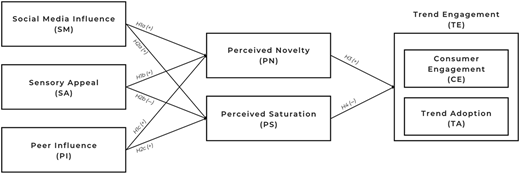
Besides, the indirect impacts of the independent constructs, including social media influence, sensory appeal, and peer influence on trend engagement through mediators perceived novelty and perceived saturation, are also examined. From the literature review, the authors propose the conceptual framework as shown in Figure 1:

To examine the proposed conceptual framework, a quantitative research approach employing exploratory factor analysis (EFA), confirmatory factor analysis (CFA) and structural equation modelling (CB-SEM) was utilised for data analysis, following established procedures (Hair et al., 2017). This method is suitable for validating the cognitive behavioural theories within the conceptual model (Nguyen and Yang, 2025).

Measurement items were adapted from prior research and measured using a 5-point Likert scale, ranging from 1 “strongly disagree” to 5 “strongly agree.” Social media influence was measured by three items adopted from Kaplan and Haenlein (2010). Sensory appeal was measured by four items adopted from (Krishna, 2019). Seven items from Cheung et al. (2011) were used to measure peer influence. Perceived novelty was measured by four items from Rogers (2003) and Tussyadiah (2020). Four items adopted from Zhou et al. (2012) were used to measure perceived saturation. Trend engagement was operationalised as a single latent construct measured by seven Likert-scale items, which reflect both consumers' emotional engagement with street food trends on digital platforms and their intention to take physical action, such as trying or purchasing the trending food, in line with Kaplan and Haenlein (2010). Respondents also provided demographic data and answered screening questions regarding their personal experiences with trending street food.

The English survey underwent a rigorous double-back-translation process for cultural relevance in Vietnam by proficient bilingual researchers. A pilot study with 30 participants was conducted to assess reliability and validity. Subsequently, minor phrasing modifications were implemented before the main data collection.

Given the effectiveness of online data collection (Lefever et al., 2016), a structured questionnaire was distributed via Google Forms between July and September 2024. A purposive sampling approach was adopted to target respondents aged 18 to 35 from Vietnam's three major urban centres, including Hanoi (North), Danang (Central), and Ho Chi Minh City (South), to ensure geographical representation across Vietnam's cultural and economic zones. This demographic was selected due to their digital savviness and role as early adopters in digitally driven environments. These cities also represent dynamic culinary landscapes and are recognised for their vibrant street food cultures and high exposure to social media trends (MTAPURI et al., 2024; Beard, 2025).

To reach the target demographic, respondents were approached through several popular online channels such as Facebook and Instagram. The survey link, accompanied by a brief introductory message explaining the research purpose and guaranteeing anonymity, was posted on. This was supplemented by a snowball sampling technique, where initial participants were encouraged to forward the survey to eligible friends and peers. There is a screening question identifying those who have never tried social media-trending street food to filter the responses. While the minimum sample size calculation was based on a medium effect size (f2 = 0.15), a significance level of α = 0.05, a statistical power of 0.80, and a model with five predictors (Cohen, 2013), indicating a required sample of 92 participants.

Eventually, there were 296 complete questionnaires, of which 67 were deemed invalid and eliminated through the screening question to filter those who had never tried street food. Invalid responses included straight-liners, whose standard deviation of all responded items scored less than 0.5, or those who reported never trying street food trending on social media. This yielded a final sample size of 229 valid responses across Vietnam, providing robust statistical power to ensure the reliability of the findings and minimise the risk of type II errors (Cohen, 2013). The demographic profile of the respondents was predominantly female (69.4%, n = 159), with 30.6% (n = 70) identifying as male. The age distribution skewed towards younger consumers; the largest group was under 22 years old (40.2%, n = 92), followed by the 22 to under 26 age group (31.0%, n = 71). Participants were drawn from three major regions: the North (Hanoi, 34.5%, n = 79), Central (Danang, 20.1%, n = 46), and South (Ho Chi Minh City, 45.4%, n = 104), ensuring geographic diversity in the sample.

The participants' profiles are presented in Table 1.

The Kaiser–Meyer–Olkin (KMO) measure of sampling adequacy yielded a high value of 0.915, and Bartlett's Test of Sphericity was statistically significant (Sig. = 0.000), confirming the suitability of the data for factor analysis (Kaiser and Rice, 1974). Exploratory factor analysis (EFA) extracted six latent factors from the 29 observed variables, following the criterion of eigenvalues greater than 1. The six-factor solution accounted for 60.727% of the total variance, exceeding the commonly accepted 50% threshold and indicating satisfactory explanatory power. All items exhibited factor loadings above 0.5 (Table 2), and the composite reliability (CR) values for all latent constructs exceeded 0.6, supporting adequate internal consistency (Qu, 2007).

Confirmatory factor analysis (CFA) demonstrates a high degree of model fit. The CMIN/df ratio of 1.59 (less than 3) confirms the overall model fit. Fit indices, including GFI (0.823), CFI (0.915), NFI (0.802), IFI (0.916), and TLI (0.906), all exceeded the threshold of 0.7. Furthermore, an RMSEA value of 0.051 (less than 0.06) and a PCLOSE value of 0.408 (greater than 0.05) indicate a close fit between the model and the empirical data (Hu and Bentler, 1999; Byrner, 2013). These results affirm the model's empirical adequacy and provide a solid foundation for testing the hypothesised structural relationships.

Convergent and discriminant validity were both supported by the analysis. The average variance extracted (AVE) of all six latent constructs exceeded the recommended threshold of 0.5 for convergent validity, as suggested by Fornell and Larcker (1981). Furthermore, the AVE of all latent constructs were greater than their corresponding maximum shared variance, satisfying the criterion for discriminant validity. These results confirm that the latent constructs are both internally coherent and empirically distinct from one another (Table 3).

To reduce the risk of common method variance (CMV), this study implemented both design-level and analytical safeguards. During data collection, participant anonymity was guaranteed, and instructions clarified that there were no “correct” answers, minimising social desirability bias (Podsakoff et al., 2003). The questionnaire was designed to be clear and unambiguous, avoiding complex or double-barrelled items as recommended by Podsakoff et al. (2003). Measurement-wise, each construct was captured using multiple items, minimising potential distortion at the item level (Harrison et al., 1996).

Three separate statistical tests were performed. First, an examination of the construct correlation matrix (Table 3) showed that no correlation exceeded the 0.90 threshold, suggesting multicollinearity was not an issue. Second, Harman's single-factor test was conducted; the first unrotated factor accounted for only 31.54% of the variance, well below the 50% limit. Finally, and most importantly, a common latent factor analysis was performed. The results showed that the paths from the CLF to the substantive indicators were statistically insignificant (p > 0.05). This comprehensive set of checks provides strong evidence that CMV is not a significant concern in this study.

4.4.1 Direct effects

Hypothesis tests on direct relationships revealed that hypotheses: H1a, H1b, and H1c, are supported (β = 0.381, p < 0.001; β = 0.408, p < 0.001; and β = 0.200, p = 0.011, respectively) (Hair et al., 2010) (Table 4). The translation is that the spread of social media content, sensory attributes, and peer influence are paramount for enhancing perceptions of novelty in trends. Regarding the impacts of the independent variables on perceived saturation, H2c showed a significant effect (H2c supported: β = 0.357, p = 0.011), supporting that peer influence has a positive impact on the perception of saturation. Meanwhile, H2a is unsupported (β = 0.060, p = 0.646 > 0.05), denoting that the social media influence had no significant impact on the perception of trend saturation. H2b exhibited an inverse, significant effect of sensory appeal on perceived saturation (H2b supported at p < 0.10: β = −0.313, p = 0.055). This implies that the richness of sensory appeal can reduce the perception of saturation, suggesting consumers may not feel a dish is overexposed if its sensory qualities remain compelling. Furthermore, H3 exhibited a strong influence of perceived novelty on trend engagement (H3 supported: β = 0.893, p < 0.001). This highlights the pivotal role of novelty in drawing interest and encouraging participation in culinary trends. However, H4 is not supported (β = 0.018, p = 0.765 > 0.05), indicating that the perception of trend saturation does not necessarily diminish the trend engagement.

4.4.2 Indirect effects

This study also examined indirect impacts through mediating roles among social media influence, sensory appeal, and peer influence to trend engagement via perceived novelty and perceived saturation. Hypothesis tests on indirect relationships revealed the significance through the perceived novelty path (β = 0.382, p = 0.001; β = 0.409, p = 0.001; β = 0.201, p = 0.026, respectively). This suggests that the dissemination of culinary trends on social media, the appealing presentation of street food items, or getting peer recommendations raises the feeling of novelty, in turn, urging interest and participation with those trends. Conversely, hypotheses of indirect effects through perceived saturation were not statistically significant (β = 0.001, p = 0.816; β = −0.006, p = 0.658; β = 0.007, p = 0.675, respectively) (Table 5). In brief, these findings highlight the central role of perceived novelty as a key mechanism linking trend antecedents to engagement, whereas a similar mediating role for perceived saturation was not found in this study.

Results found in the study highlight the influences of external social drivers, namely social media influence, peer influence, and internal product-cues sensory appeal, which shape perceptions regarding street food trends among young consumers. The analysis presents that social media influence (H1a), sensory appeal (H1b), and peer influence (H1c) significantly and positively contribute to the customers' perceptions of novelty. Therefore, attractive content about the sensory look and tastes of dishes and endorsement from peers and influencers are paramount in making a new street food item or trend more perceived as fresh and exciting by young consumers. This forms a firm theoretical base with the Diffusion of innovations theory (Rogers, 2003) under “observability” conditions during the early stage of adoption, as found in the study of Ausat (2023) and the role of social media in shaping public opinion. The causative relationship between sensory appeal and perceived novelty also affirms what Imtiyaz et al. (2021) and Lancelot et al. (2016) found in their studies about how sensory aspects impact the perception of newness. Furthermore, social media influence, sensory appeal, and peer influence significantly and indirectly boosted trend engagement by creating a sense of perceived novelty. This means that these powerful influences first make a street food trend seem new and exciting, and that feeling of newness strongly drives young consumers to get involved. For instance, when social media content about a dish has striking visuals or sounds, it directly makes the dish feel new, and this newness then encourages people to try it (Rogers, 2003).

Furthermore, peer influence significantly increased both perceived novelty (H1c) and perceived saturation (H2c), suggesting that consumers may simultaneously find a trend more exciting and more commonly encountered when peers are actively discussing or recommending it. This dual effect is theoretically supported by social cognitive learning theory (Bandura and Walters, 1977), which emphasises how social behaviour is shaped by both observation and reinforcement within a social network. On one hand, when a peer introduces or recommends a trend, it heightens the recipient's curiosity and stimulates novelty perception through social validation. On the other hand, repeated mentions or constantly shared experiences from the peer network can also create a perception that the trend has become widespread or overexposed. This aligns with the idea that novelty and saturation are not conceptually opposites, but rather independent cognitive responses that can co-occur depending on the depth and frequency of social exposure. Interestingly, social media influence (H2a) did not significantly predict perceived saturation, despite being a primary channel of trend amplification. This may be explained by platform-specific algorithms that prioritise content diversity and personalisation (Rachmad, 2023), reducing cognitive fatigue even when content is frequently encountered. This finding diverges from prior assumptions about digital trend fatigue (e.g. Rini et al., 2024). Additionally, sensory appeal exhibited a near-significant negative relationship with perceived saturation (H2b), while strongly predicting perceived novelty (H1b), implying that when food items are rich in visual, textural, or flavour cues, they do not become boring easily even when encountered repeatedly. The absence of significant paths from perceived saturation to trend engagement reinforces that while consumers may recognise overexposure, their participation decisions are primarily shaped by how novel and emotionally stimulating the trend still feels to them.

Finally, this study highlights how young consumers react differently to the feelings of “newness” versus “overexposure” when engaging with viral street food trends. The results show that perceived novelty has a strong and significant positive influence on trend engagement, which captures both sentimental resonance and action-driven participation. This means that when young people see a street food item as new, exciting, or different, they are more likely to try it, talk about it, or post about it. The sense of novelty works like a mental trigger that motivates them to participate in the trend. This aligns with psychological literature highlighting novelty as a primary catalyst of consumer approach behaviours (Berlyne, 1960) and the appeal of “newness” in experience-based consumption (Holbrook and Hirschman, 1982).

On the other hand, perceived saturation, the feeling that a trend is “everywhere” and overused, does not reduce their engagement. This finding challenges the conventional diffusion argument that excessive trend visibility dilutes consumer interest (Rogers, 2003) and media oversaturation leads to avoidance (Shahrzadi et al., 2024). However, our findings show that even when a street food trend becomes highly visible online or in public spaces, young consumers still participate. This may reflect the dual role of street food not only as a consumable product but also as a socially embedded symbol of connection and shared identity. In the case of Vietnam, where street food is deeply tied to daily life and cultural identity (Alimi, 2016), even widely seen trends do not necessarily become boring or less desirable.

First, this study expands Rogers' diffusion of innovations (2003) by combining it with social media influence theory to better explain how digital environments shape how young people adopt street food trends. The original DOI theory focuses on how new ideas spread over time in the S-curve model without addressing digital content's fast and viral nature. The traditional view from the theory states that the more frequent exposure to the contents may lead to the loss of interest. Contrarily, our findings show that social media boosts the feeling that a trend is new and exciting, but does not necessarily make it overused or boring. This opens the idea that DOI theory may be applied differently, especially in the digital context.

Second, this study adds to the social media influence theory by showing that high volumes of online content do not always cause trend fatigue. Although previous studies suggest that digital oversaturation can reduce attention, we find that people still stay interested in popular street food trends, especially when the content is visually appealing or comes from people they know. This may be due to how social media algorithms personalise content and keep it engaging.

Finally, this study also separates internal product features, like how tasty or appealing the food looks (sensory appeal), from external social factors, such as peer pressure and social media exposure. All these factors influence how “new” a trend feels to consumers. However, they do not directly push consumers to follow the trend. Instead, what really drives engagement is the sense of novelty. This shows that Trend engagement depends more on internal feelings of excitement than on external exposure alone.

For street food vendors, maintaining a constant sense of “newness” to drive consumer engagement is vital in the long run. It can be best supported by enhancing the food's sensory appeal through online and offline efforts. Even in the online space, building and maintaining active social media channels is suggested, using high-quality photos and videos to showcase the aesthetic qualities of their dishes. Besides, the findings suggest that pursuing new menu item invention is redundant, while creative presence and garnishing existing dishes are more helpful. This method effectively refreshes the customer experience, avoids oversaturation, and efficiently uses available resources.

Furthermore, the research results show that peer influence is also significant. Vendors can implement strategies that encourage group participation and social sharing. Some concrete old-but-gold tactics are promotions such as “buy-one-get-one-free” to encourage customer sharing. Additionally, the vendors can make an offline experience go online and viral by creating a visually appealing offline experience that is “Instagrammable”. Besides, using QR codes to link customers to online community groups can foster a sense of belonging and keep them informed about promotions, extending engagement beyond the initial purchase.

Finally, governments and city planners have a strategic role in developing street food as a sustainable pillar of culinary heritage, tourism, and the informal economy. Because younger consumers might prioritise trends over safety, clear and enforced hygiene regulations are essential. Practical support can include providing vendors with training on presentation and cleanliness, assisting them in professionalising their businesses, and guiding their transition online. Introducing official review and scoring systems can incentivise vendors to uphold quality standards and embrace modernisation. These policies protect public health while ensuring the vibrant street food industry can thrive.

Despite the meaningful contributions, this study has limitations that suggest directions for future research. First, street food trends vary in how quickly they rise and fade, which a cross-sectional design may not fully capture. A longitudinal or mixed-methods approach, combining surveys with behavioural data, would better reflect these dynamics. Second, the non-significant role of perceived saturation invites further theoretical exploration. Future research could refine its conceptualisation or examine moderators such as novelty-seeking traits. Third, future work should consider the content formats (video vs image) to examine the different effects of each format on sensory and psychological responses. Finally, the growing use of AI-generated content in food marketing may alter how consumers perceive novelty and saturation. Investigating how AI influences trend diffusion opens new insights for both scholars and practitioners.

As this study utilised an anonymous questionnaire, approval from an ethics committee was not deemed necessary. Therefore, this requirement is not applicable.
Acikgoz
,
F.
,
Elwalda
,
A.
and
De Oliveira
,
M.J.
(
2023
), “
Curiosity on cutting-edge technology via theory of planned behavior and diffusion of innovation theory
”,
International Journal of Information Management Data Insights
, Vol. 
3
No. 
1
, 100152, doi: .
Adeosun
,
K.P.
,
Greene
,
M.
and
Oosterveer
,
P.
(
2022
), “
Informal ready-to-eat food vending: a social practice perspective on urban food provisioning in Nigeria
”,
Food Security
, Vol. 
14
No. 
3
, pp. 
763
-
780
, doi: .
Alimi
,
B.A.
(
2016
), “
Risk factors in street food practices in developing countries: a review
”,
Food Science and Human Wellness
, Vol. 
5
No. 
3
, pp. 
141
-
148
, doi: .
Ausat
,
A.M.A.
(
2023
), “
The role of social media in shaping public opinion and its influence on economic decisions
”,
Technology and Society Perspectives (TACIT)
, Vol. 
1
No. 
1
, pp. 
35
-
44
, doi: .
Bäckström
,
A.
,
Pirttilä-Backman
,
A.M.
and
Tuorila
,
H.
(
2003
), “
Dimensions of novelty: a social representation approach to new foods
”,
Appetite
, Vol. 
40
No. 
3
, pp. 
299
-
307
, doi: .
Bandura
,
A.
and
Walters
,
R.H.
(
1977
),
Social Learning Theory
, Vol. 
1
,
Prentice Hall
,
Englewood Cliffs, NJ
, pp. 
141
-
154
.
Barua
,
P.
,
Banik
,
K.S.
,
Saha
,
S.
,
Jamee
,
A.R.
,
Trina
,
A.T.
and
Musa
,
S.
(
2024
), “
Risk factors associated with street food consumption in Dhaka city due to faeco-oral parasitic infection in food vendors
”,
Food and Humanity
, Vol. 
3
, 100441, doi: .
Bauman
,
K.E.
and
Ennett
,
S.T.
(
1994
), “
Peer influence on adolescent drug use
”,
American Psychologist
, Vol. 
49
No. 
9
, pp. 
820
-
822
, doi: .
Beard
,
G.
(
2025
), “
The world's 20 best cities for food right now
”,
Time Out
,
available at:
 https://www.timeout.com/travel/worlds-best-cities-for-food (
accessed
 May 2025).
Berlyne
,
D.E.
(
1960
), “Novelty, uncertainty, conflict, complexity”, in
Berlyne
,
D.E.
(Ed.),
Conflict, Arousal, and Curiosity
,
McGraw-Hill Book Company
, pp. 
18
-
44
, doi: .
Bhagat
,
S.
,
Khanna
,
S.
,
Sharma
,
P.
and
Bhat
,
D.A.R.
(
2024
), “
Street food in the digital era: unraveling the influence of food vloggers credibility and information quality on consumer intentions
”,
International Journal of Social Economics
, Vol. 
52
No. 
7
, pp. 
1022
-
1036
, doi: .
Biswas
,
A.
,
Ingle
,
N.
and
Roy
,
M.
(
2014
), “
Influence of social media on voting behavior
”,
Journal of Power, Politics and Governance
, Vol. 
2
No. 
2
, pp. 
127
-
155
.
Brechwald
,
W.A.
and
Prinstein
,
M.J.
(
2011
), “
Beyond homophily: a decade of advances in understanding peer influence processes
”,
Journal of Research on Adolescence
, Vol. 
21
No. 
1
, pp. 
166
-
179
, doi: .
Byrne
,
B.M.
(
2013
),
Structural Equation Modeling with Mplus: Basic Concepts, Applications, and Programming
,
Routledge, New York, NY
.
Cao
,
X.
,
Guo
,
X.
,
Vogel
,
D.
and
Zhang
,
X.
(
2016
), “
Exploring the influence of social media on employee work performance
”,
Internet Research
, Vol. 
26
No. 
2
, pp. 
529
-
545
, doi: .
Cheung
,
S.N.
(
1970
), “
The structure of a contract and the theory of a non-exclusive resource
”,
The Journal of Law and Economics
, Vol. 
13
No. 
1
, pp. 
49
-
70
.
Cheung
,
C.M.
,
Lee
,
M.K.
and
Rabjohn
,
N.
(
2011
), “
The impact of electronic word-of-mouth: the adoption of online opinions in online customer communities
”,
Internet Research
, Vol. 
18
No. 
3
, pp. 
229
-
247
.
Chung
,
A.
,
Vieira
,
D.
,
Donley
,
T.
,
Tan
,
N.
,
Jean-Louis
,
G.
,
Gouley
,
K.K.
and
Seixas
,
A.
(
2021
), “
Adolescent peer influence on eating behaviors via social media: scoping review
”,
Journal of Medical Internet Research
, Vol. 
23
No. 
6
, e19697, doi: .
Cohen
,
J.
(
2013
),
Statistical Power Analysis for the Behavioral Sciences
,
Routledge, New York, NY
.
Fornell
,
C.
and
Larcker
,
D.F.
(
1981
), “
Evaluating structural equation models with unobservable variables and measurement error
”,
Journal of Marketing Research
, Vol. 
18
No. 
1
, pp. 
39
-
50
, doi: .
Förster
,
J.
,
Marguc
,
J.
and
Gillebaart
,
M.
(
2010
), “
Novelty categorization theory
”,
Social and Personality Psychology Compass
, Vol. 
4
No. 
9
, pp. 
736
-
755
, doi: .
Frasquet
,
M.
,
Ieva
,
M.
and
Mollá-Descals
,
A.
(
2024
), “
Customer inspiration in retailing: the role of perceived novelty and customer loyalty across offline and online channels
”,
Journal of Retailing and Consumer Services
, Vol. 
76
, 103592, doi: .
Genné-Bacon
,
E.A.
,
Wilks
,
J.
and
Bascom-Slack
,
C.
(
2020
), “
Uncovering factors influencing instructors' decision process when considering implementation of a course-based research experience
”,
CBE-Life Sciences Education
, Vol. 
19
No. 
2
, ar13, doi: .
Grover
,
P.
,
Kar
,
A.K.
and
Dwivedi
,
Y.
(
2022
), “
The evolution of social media influence-A literature review and research agenda
”,
International Journal of Information Management Data Insights
, Vol. 
2
No. 
2
, 100116, doi: .
Hair
,
Jr. F.
,
Anderson
,
R.
,
Babin
,
B.
and
Black
,
W.
(
2010
),
Multivariate Data Analysis: A Global Perspective
, Vol. 
7
,
Pearson
,
Upper Saddle River. NJ
.
Hair
,
J.F.
, Jr
,
Matthews
,
L.M.
,
Matthews
,
R.L.
and
Sarstedt
,
M.
(
2017
), “
PLS-SEM or CB-SEM: updated guidelines on which method to use
”,
International Journal of Multivariate Data Analysis
, Vol. 
1
No. 
2
, pp. 
107
-
123
, doi: .
Halibas
,
A.S.
,
Van Nguyen
,
A.T.
,
Akbari
,
M.
,
Akram
,
U.
and
Hoang
,
M.D.T.
(
2023
), “
Developing trends in showrooming, webrooming, and omnichannel shopping behaviors: performance analysis, conceptual mapping, and future directions
”,
Journal of Consumer Behaviour
, Vol. 
22
No. 
5
, pp. 
1237
-
1264
, doi: .
Harrison
,
D.A.
,
McLaughlin
,
M.E.
and
Coalter
,
T.M.
(
1996
), “
Context, cognition, and common method variance: psychometric and verbal protocol evidence
”,
Organizational Behavior and Human Decision Processes
, Vol. 
68
No. 
3
, pp. 
246
-
261
, doi: .
Hasan
,
R.
(
2022
),
Entrepreneurial Behaviour in Informal Economy: A Case Study on Street Food Entrepreneurship in Dhaka, Bangladesh (Doctoral Dissertation
,
University of Essex and University of Suffolk, Colchester and Ipswich)
.
Henderson, J.C.
(
2019
), “
Street food and tourism: a Southeast Asian perspective
”, in
Park, E., Kim, S. and Yeoman, I. (Eds)
,
Food Tourism in Asia
,
Springer Singapore
, pp.
45
-
57
, doi: .
Henson, S., Jaffee, S. and Wang, S.
(
2023
), “
New directions for tackling food safety risks in the informal sector of developing countries
”,
International Livestock Research Institute (ILRI), Nairobi, available at:
 https://www.ilri.org/knowledge/publications/new-directions-tackling-food-safety-risks-informal-sector-developing (
accessed June 2023
).
Hoang
,
D.S.
and
Tučková
,
Z.
(
2021
),
The Impact of Sensory Marketing on Street Food for the Return of International Visitors: Case Study in Vietnam
,
Scientific Papers of the University of Pardubice, Series D: Faculty of Economics and Administration
,
University of Pardubice (Faculty of Economics and Administration), Pardubice, Czech Republic
.
Holbrook
,
M.B.
and
Hirschman
,
E.C.
(
1982
), “
The experiential aspects of consumption: consumer fantasies, feelings, and fun
”,
Journal of Consumer Research
, Vol. 
9
No. 
2
, pp.
132
-
140
, doi: .
Hu
,
L.T.
and
Bentler
,
P.M.
(
1999
), “
Cutoff criteria for fit indexes in covariance structure analysis: conventional criteria versus new alternatives
”,
Structural Equation Modeling: A Multidisciplinary Journal
, Vol. 
6
No. 
1
, pp. 
1
-
55
, doi: .
Imtiyaz
,
H.
,
Soni
,
P.
and
Yukongdi
,
V.
(
2021
), “
Role of sensory appeal, nutritional quality, safety, and health determinants on convenience food choice in an academic environment
”,
Foods
, Vol. 
10
No. 
2
, p.
345
, doi: .
Inwood
,
S.M.
,
Sharp
,
J.S.
,
Moore
,
R.H.
and
Stinner
,
D.H.
(
2009
), “
Restaurants, chefs and local foods: insights drawn from application of a diffusion of innovation framework
”,
Agriculture and Human Values
, Vol. 
26
No. 
3
, pp. 
177
-
191
, doi: .
iPOS.vn
(
2024
), “
Báo Cáo Ngành F& B Việt Nam 2024 [Vietnam F& B industry report 2024]
”,
available at:
 https://ipos.vn/bao-cao-nganh-fnb-2024/ (
accessed
 May 2025).
Jobes
,
P.
(
1973
), “
An empirical study of short‐term mass communication saturation and perception of population problems
”,
Journal of Sex Research
, Vol. 
9
No. 
4
, pp. 
342
-
352
, doi: .
Joy
,
A.
,
Pathak
,
R.
,
Shrestha
,
A.
,
Spezzano
,
F.
and
Winiecki
,
D.
(
2024
), “
Modeling the diffusion of fake and real news through the lens of the diffusion of innovations theory
”,
ACM Transactions on Social Computing
, Vol. 
7
Nos
1-4
, pp. 
1
-
24
, doi: .
Kaiser
,
H.F.
and
Rice
,
J.
(
1974
), “
Little jiffy, mark IV
”,
Educational and Psychological Measurement
, Vol. 
34
No. 
1
, pp. 
111
-
117
, doi: .
Kamboj
,
S.
,
Gupta
,
N.
,
Bandral
,
J.D.
,
Gandotra
,
G.
and
Anjum
,
N.
(
2020
), “
Food safety and hygiene: a review
”,
International Journal of Chemical Studies
, Vol. 
8
No. 
2
, pp. 
358
-
368
, doi: .
Kaplan
,
A.M.
and
Haenlein
,
M.
(
2010
), “
Users of the world, unite! The challenges and opportunities of Social Media
”,
Business Horizons
, Vol. 
53
No. 
1
, pp. 
59
-
68
, doi: .
Kaufhold
,
M.A.
,
Rupp
,
N.
,
Reuter
,
C.
and
Habdank
,
M.
(
2020
), “
Mitigating information overload in social media during conflicts and crises: design and evaluation of a cross-platform alerting system
”,
Behaviour and Information Technology
, Vol. 
39
No. 
3
, pp. 
319
-
342
, doi: .
Khanna
,
S.
,
Nagar
,
K.
,
Chauhan
,
V.
and
Bhagat
,
S.
(
2022
), “
Application of the extended theory of planned behavior to street-food consumption: testing the effect of food neophobia among Indian consumers
”,
British Food Journal
, Vol. 
124
No. 
2
, pp. 
550
-
572
, doi: .
Kheireddine
,
M.
and
Saleh
,
H.
(
2025
), “
The impact of sensory marketing on consumer buying behavior: primary study–starbucks–Lebanon
”,
Journal of Logistics Management
, Vol. 
13
No. 
1
, pp. 
20
-
28
.
Krishna
,
A.
(
2019
), “
It should not take a funeral: an introduction to the dialogue on the self-control construct
”,
Journal of Consumer Psychology
, Vol. 
30
No. 
1
, pp.
178
-
180
, doi: .
Kulkarni
,
P.
and
Kolli
,
H.
(
2022
), “
Sensory marketing theory: how sensorial stimuli influence consumer behavior and subconscious decision-making
”,
Journal of Student Research
, Vol. 
11
No. 
3
, pp. 
1
-
15
, doi: .
Lancelot Miltgen
,
C.
,
Pantin Sohier
,
G.
and
Grohmann
,
B.
(
2016
), “
Communicating sensory attributes and innovation through food product labeling
”,
Journal of Food Products Marketing
, Vol. 
22
No. 
2
, pp. 
219
-
239
, doi: .
Lefever
,
S.
,
Dal
,
M.
and
Matthíasdóttir
,
Á.
(
2016
), “
Online data collection in academic research: advantages and limitations
”,
British Journal of Educational Technology
, Vol. 
38
No. 
4
, pp.
574
-
582
, doi: .
Lim
,
W.M.
and
Rasul
,
T.
(
2022
), “
Customer engagement and social media: revisiting the past to inform the future
”,
Journal of Business Research
, Vol. 
148
, pp. 
325
-
342
, doi: .
Luan
,
Y.
and
Kim
,
Y.J.
(
2022
), “
An integrative model of new product evaluation: a systematic investigation of perceived novelty and product evaluation in the movie industry
”,
PLoS One
, Vol. 
17
No. 
3
, e0265193, doi: .
Lynch
,
M.
and
Giles
,
A.
(
2024
), “
Using Diffusion of innovations theory to examine a discontinued heathy corner store pilot program
”,
Journal of Hunger and Environmental Nutrition
, Vol. 
19
No. 
3
, pp. 
313
-
328
, doi: .
Mtapuri
,
O.
,
Dłużewska
,
A.
,
Dang
,
T.P.A.
,
Giampiccoli
,
A.
,
Mnguni
,
E.M.
and
Hong Long
,
P.
(
2024
), “
Street food tourism. Perspectives and experiences of two countries-Vietnam and Poland
”,
Annales UMCS, Geographia, Geologia, Mineralogia et Petrographia
, Vol. 
79
, pp. 
49
-
68
, doi: .
Nguyen
,
D.M.
and
Nguyen
,
T.
(
2025
), “
Fostering second-hand luxury purchases through social media influencers: insights from young adults in Taiwan
”,
Young Consumers
, Vol. 
26
No. 
4
, pp. 
606
-
628
, doi: .
Nguyen
,
D.M.
and
Yang
,
A.J.F.
(
2025
), “
Cultivating consumer extra-role behaviors via green psychological benefits: the roles of gratitude and perceived consumer effectiveness
”,
Journal of Hospitality Marketing and Management
, Vol. 
34
No. 
7
, pp. 
1017
-
1042
, doi: .
Podsakoff
,
P.M.
,
MacKenzie
,
S.B.
,
Lee
,
J.-Y.
and
Podsakoff
,
N.P.
(
2003
), “
Common method biases in behavioral research: a critical review of the literature and recommended remedies
”,
Journal of Applied Psychology
, Vol. 
88
No. 
5
, pp. 
879
-
903
, doi: .
Qu
,
X.
(
2007
), “
Multivariate data analysis
”,
Technometrics
, Vol. 
49
No. 
1
, pp. 
103
-
104
, doi: .
Rachmad
,
Y.E.
(
2023
),
Social Media Influence Theory
,
Phoenix Cactus Book Publishing
, doi: .
Ranginwala
,
S.
and
Towbin
,
A.J.
(
2018
), “
Use of social media in radiology education
”,
Journal of the American College of Radiology
, Vol. 
15
No. 
1
, pp. 
190
-
200
, doi: .
Rini
,
L.
,
Schouteten
,
J.J.
,
Faber
,
I.
,
Frøst
,
M.B.
,
Perez-Cueto
,
F.J.
and
De Steur
,
H.
(
2024
), “
Social media and food consumer behavior: a systematic review
”,
Trends in Food Science and Technology
, Vol. 
143
, 104290, doi: .
Rogers
,
E.M.
(
2003
),
Diffusion of Innovations
, (5th) ed.,
Free Press
.
Rosales Chavez
,
J.B.
,
Bruening
,
M.
,
Ohri-Vachaspati
,
P.
,
Lee
,
R.E.
and
Jehn
,
M.
(
2021
), “
Street food stand availability, density, and distribution across income levels in Mexico City
”,
International Journal of Environmental Research and Public Health
, Vol. 
18
No. 
8
, p.
3953
, doi: .
Roy
,
P.
,
Mohanty
,
A.K.
,
Dick
,
P.
and
Misra
,
M.
(
2023
), “
A review on the challenges and choices for food waste valorization: environmental and economic impacts
”,
ACS Environmental Au
, Vol. 
3
No. 
2
, pp. 
58
-
75
, doi: .
Shahrzadi
,
L.
,
Mansouri
,
A.
,
Alavi
,
M.
and
Shabani
,
A.
(
2024
), “
Causes, consequences, and strategies to deal with information overload: a scoping review
”,
International Journal of Information Management Data Insights
, Vol. 
4
No. 
2
, 100261, doi: .
Sokolova
,
T.
and
Krishna
,
A.
(
2016
), “
Take it or leave it: how choosing versus rejecting alternatives affects information processing
”,
Journal of Consumer Research
, Vol. 
43
No. 
4
, pp.
614
-
635
, doi: .
Spann
,
B.
,
Mead
,
E.
,
Maleki
,
M.
,
Agarwal
,
N.
and
Williams
,
T.
(
2022
), “
Applying Diffusion of innovations theory to social networks to understand the stages of adoption in connective action campaigns
”,
Online Social Networks and Media
, Vol. 
28
, 100201, doi: .
Tan
,
H.S.G.
,
Tibboel
,
C.J.
and
Stieger
,
M.
(
2017
), “
Why do unusual novel foods like insects lack sensory appeal? Investigating the underlying sensory perceptions
”,
Food Quality and Preference
, Vol. 
60
, pp. 
48
-
58
, doi: .
Tussyadiah
,
I.P.
(
2020
), “
A review of research into automation in tourism
”,
Annals of Tourism Research
, Vol. 
81
, 102883, doi: .
VOV
(
2025
), “
Vietnam's F& B Market focuses on sustainable growth
”,
available at:
 https://english.vov.vn/en/society/vietnams-fb-market-focuses-on-sustainable-growth-post1162368.vov (
accessed
 May 2025).
Wolske
,
K.S.
,
Gillingham
,
K.T.
and
Schultz
,
P.W.
(
2020
), “
Peer influence on household energy behaviours
”,
Nature Energy
, Vol. 
5
No. 
3
, pp. 
202
-
212
, doi: .
Yaiprasert
,
C.
and
Hidayanto
,
A.N.
(
2023
), “
AI-driven ensemble three machine learning to enhance digital marketing strategies in the food delivery business
”,
Intelligent Systems with Applications
, Vol. 
18
, 200235, doi: .
Yohanna
,
A.
(
2020
), “
The influence of social media on social interactions among students
”,
Indonesian Journal of Social Sciences
, Vol. 
12
No. 
2
, pp. 
34
-
48
, doi: .
Zeng
,
L.
and
Li
,
R.Y.M.
(
2022
), “
Construction safety and health hazard awareness in Web of Science and Weibo between 1991 and 2021
”,
Safety Science
, Vol. 
152
, 105790, doi: .
Zhong
,
T.
and
Scott
,
S.
(
2020
), “
Informalization” of food vending in China: from a tool for food security to employment promotion
”,
Journal of Agriculture, Food Systems, and Community Development
, Vol. 
9
No. 
4
, pp. 
135
-
137
, doi: .
Zhou
,
Z.
,
Zhang
,
Q.
,
Su
,
C.
and
Zhou
,
N.
(
2012
), “
How do brand communities generate brand relationships? Intermediate mechanisms
”,
Journal of Business Research
, Vol. 
65
No. 
7
, pp. 
890
-
895
, doi: .
Zyma
,
O.
(
2025
), “
Modeling the behavior of entertainment content consumers taking into account digital technologies
”,
Integrated communications
, Vol.
1
No.
19
, pp.
42
-
49
, doi: .
Published in Journal of Trade Science. Published by Emerald Publishing Limited. This article is published under the Creative Commons Attribution (CC BY 4.0) licence. Anyone may reproduce, distribute, translate and create derivative works of this article (for both commercial and non-commercial purposes), subject to full attribution to the original publication and authors. The full terms of this licence may be seen at Link to the terms of the CC BY 4.0 licence.

Data & Figures

Figure 1
A framework shows the impact of independent constructs on trend engagement through mediators.The conceptual framework diagram shows three predictor constructs on the left, arranged vertically: “Social Media Influence (S M)” at the top, “Sensory Appeal (S A)” in the middle, and “Peer Influence (P I)” at the bottom. Each predictor connects to two mediators in the center: “Perceived Novelty (P N)” above and “Perceived Saturation (PS)” below. The hypothesis labels on the connecting paths read as follows: from S M to P N is “H 1 a (plus)”, from S M to P S is “H 2 a (plus)”, from S A to P N is “H 1 b (plus)”, from S A to P S is “H 2 b (minus)”, from P I to P N is “H 1 c (plus)”, and from P I to P S is “H 2 c (plus)”. From the two mediators, separate arrows extend rightward to the final construct labeled “Trend Engagement (T E)”, which contains two components: “Consumer Engagement (C E)” at the top and “Trend Adoption (T A)” at the bottom. The arrow from P N is labeled “H 3 (plus)”, and the arrow from P S is labeled “H 4 (minus)”.

Conceptual framework and hypotheses

Figure 1
A framework shows the impact of independent constructs on trend engagement through mediators.The conceptual framework diagram shows three predictor constructs on the left, arranged vertically: “Social Media Influence (S M)” at the top, “Sensory Appeal (S A)” in the middle, and “Peer Influence (P I)” at the bottom. Each predictor connects to two mediators in the center: “Perceived Novelty (P N)” above and “Perceived Saturation (PS)” below. The hypothesis labels on the connecting paths read as follows: from S M to P N is “H 1 a (plus)”, from S M to P S is “H 2 a (plus)”, from S A to P N is “H 1 b (plus)”, from S A to P S is “H 2 b (minus)”, from P I to P N is “H 1 c (plus)”, and from P I to P S is “H 2 c (plus)”. From the two mediators, separate arrows extend rightward to the final construct labeled “Trend Engagement (T E)”, which contains two components: “Consumer Engagement (C E)” at the top and “Trend Adoption (T A)” at the bottom. The arrow from P N is labeled “H 3 (plus)”, and the arrow from P S is labeled “H 4 (minus)”.

Conceptual framework and hypotheses

Close modal
Table 1

Sample demographic characteristics (n = 229)

ClassificationN%
GenderMale7030.6%
Female15969.4%
Age<229240.2%
22 to < 267131%
26 to < 304720.5
>30198.3%
RegionsHanoi (North)7934.5%
Danang (Central)4620.1%
Hochiminh (South)10445.4%
Source(s): Data analysis
Table 2

Exploratory factor analysis

Constructs and measurement itemsCodesMeanStd. DeviationLoadings*CR
Social Media InfluenceSM   0.789
I often use social media to discover new street food trendsSM14.300.9740.967 
I often follow food bloggers to stay updated on new street food trendsSM23.771.0860.614 
Viral food/drink videos on social media particularly catch my attentionSM33.861.0360.624 
Sensory AppealSA   0.859
I find street food visually appealingSA13.910.9670.729 
The smell and taste of street food are very attractiveSA23.870.8620.637 
The novel way street food/drinks are prepared makes me feel interestedSA33.860.8870.886 
The unique flavour combinations in street food make me want to try themSA43.900.8950.843 
Peer InfluencePI   0.882
I often look for and try street food/drinks recommended by my friendsPI13.991.0170.641 
If my friends like a certain food/drink, I also want to try itPI23.901.0040.694 
I feel more confident trying street food/drinks if my friends have already tried themPI34.040.9750.767 
I want to experience street food/drinks that my friends post about on social mediaPI43.661.0330.657 
I trust my friends' recommendations about street food more than advertising clipsPI54.041.0190.692 
Street food/drinks that my friends post about multiple times make me curiousPI63.881.0440.675 
I am motivated to try new street food trends if my friends highly praise themPI74.100.9410.892 
Perceived NoveltyPN   0.861
Rising trend of Street food/drinks often feature different flavours compared to the existing onesPN13.571.0090.861 
I feel that the way street food/drinks are made and presented is very creativePN23.820.9120.717 
I consider a street food trend novel if the food/drink is not something I see frequently in my daily diet.PN33.810.9810.704 
Unique variations in the preparation of street food (for familiar dishes/drinks) can make me feel they are newPN43.820.9450.830 
Perceived SaturationPS   0.815
A food or drink appearing everywhere (every street, every alley) makes it no longer interesting to mePS13.411.2490.692 
Social media pages repeatedly posting information about a street food or drink for a long time makes it less appealingPS23.661.0630.771 
A street food trend will no longer excite or intrigue me when it becomes too popularPS33.771.0900.787 
I don't want to continue trying a street food/drink when it is sold everywherePS43.561.1130.643 
Trend EngagementTE   0.893
I often feel excited when discovering new street food/drinks through social mediaTE13.641.0980.672 
I often recommend or tag friends in social media posts about trendy street food/drinkTE23.701.1080.760 
I often follow hashtags or subscribe for information about street foodTE33.021.3750.847 
I often look for and try street food/drinks as soon as they become popular on social media platformsTE43.990.9640.748 
Among the people I know, I am usually the first to try new street food/drinksTE53.441.1820.633 
I frequently return to or continue buying trendy street food/drinksTE63.521.1260.620 
When planning outings with friends, I often suggest visiting places known for trendy street food/drinks I saw on social mediaTE73.671.0870.861 

Note(s): Factor loadings >0.5

Source(s): Data analysis
Table 3

Convergent and discriminant validity

ConstructsAVEMSVMaxR(H)TEPIPSSASMPN
TE0.5480.5450.9040.740     
PI0.5210.4350.8850.607***0.722    
PS0.5270.0340.8270.145†0.185*0.726   
SA0.6080.4940.8940.642***0.640***−0.0120.780  
SM0.5670.5450.7910.738***0.584***0.0920.557***0.753 
PN0.6100.4990.9010.706***0.659***0.1390.703***0.634***0.781

Note(s): AVE >0.5

Source(s): Data analysis
Table 4

Direct impacts

HypothesisPathEstimateS.E.C.R.SigConclusion
H1aSocial Media Influence→Perceived Novelty0.3810.0814.6950.000Accepted
H1bSensory Appeal→Perceived Novelty0.4080.0974.1890.000Accepted
H1cPeer Influence→Perceived Novelty0.20.0792.5350.011Accepted
H2aSocial Media Influence→Perceived Saturation0.060.1320.4590.646Rejected
H2bSensory Appeal→Perceived Saturation−0.3130.163−1.920.055Accepted
H2cPeer Influence→Perceived Saturation0.3570.1412.5270.011Accepted
H3Perceived Novelty→Trend Engagement0.8930.147.1470.000Accepted
H4Perceived Saturation→Trend Engagement0.0180.0620.2990.765Rejected

Note(s): Accepted when p-value <0.05

Source(s): Data analysis
Table 5

Indirect impacts

PathTypeβ coefficientSig.Conclusion
Social Media Influence→Perceived Novelty→Trend EngagementMediation0.3820.001Accepted
Sensory Appeal→ Perceived Novelty→Trend EngagementMediation0.4090.001Accepted
Peer Influence→ Perceived Novelty→Trend EngagementMediation0.2010.026Accepted
Social Media Influence→ Perceived Saturation→Trend EngagementMediation0.0010.816Rejected
Sensory Appeal→ Perceived Saturation→Trend EngagementMediation−0.0060.658Rejected
Peer Influence→ Perceived Saturation→Trend EngagementMediation0.0070.675Rejected

Note(s): Accepted when p-value <0.05

Source(s): Data analysis

Supplements

References

Acikgoz
,
F.
,
Elwalda
,
A.
and
De Oliveira
,
M.J.
(
2023
), “
Curiosity on cutting-edge technology via theory of planned behavior and diffusion of innovation theory
”,
International Journal of Information Management Data Insights
, Vol. 
3
No. 
1
, 100152, doi: .
Adeosun
,
K.P.
,
Greene
,
M.
and
Oosterveer
,
P.
(
2022
), “
Informal ready-to-eat food vending: a social practice perspective on urban food provisioning in Nigeria
”,
Food Security
, Vol. 
14
No. 
3
, pp. 
763
-
780
, doi: .
Alimi
,
B.A.
(
2016
), “
Risk factors in street food practices in developing countries: a review
”,
Food Science and Human Wellness
, Vol. 
5
No. 
3
, pp. 
141
-
148
, doi: .
Ausat
,
A.M.A.
(
2023
), “
The role of social media in shaping public opinion and its influence on economic decisions
”,
Technology and Society Perspectives (TACIT)
, Vol. 
1
No. 
1
, pp. 
35
-
44
, doi: .
Bäckström
,
A.
,
Pirttilä-Backman
,
A.M.
and
Tuorila
,
H.
(
2003
), “
Dimensions of novelty: a social representation approach to new foods
”,
Appetite
, Vol. 
40
No. 
3
, pp. 
299
-
307
, doi: .
Bandura
,
A.
and
Walters
,
R.H.
(
1977
),
Social Learning Theory
, Vol. 
1
,
Prentice Hall
,
Englewood Cliffs, NJ
, pp. 
141
-
154
.
Barua
,
P.
,
Banik
,
K.S.
,
Saha
,
S.
,
Jamee
,
A.R.
,
Trina
,
A.T.
and
Musa
,
S.
(
2024
), “
Risk factors associated with street food consumption in Dhaka city due to faeco-oral parasitic infection in food vendors
”,
Food and Humanity
, Vol. 
3
, 100441, doi: .
Bauman
,
K.E.
and
Ennett
,
S.T.
(
1994
), “
Peer influence on adolescent drug use
”,
American Psychologist
, Vol. 
49
No. 
9
, pp. 
820
-
822
, doi: .
Beard
,
G.
(
2025
), “
The world's 20 best cities for food right now
”,
Time Out
,
available at:
 https://www.timeout.com/travel/worlds-best-cities-for-food (
accessed
 May 2025).
Berlyne
,
D.E.
(
1960
), “Novelty, uncertainty, conflict, complexity”, in
Berlyne
,
D.E.
(Ed.),
Conflict, Arousal, and Curiosity
,
McGraw-Hill Book Company
, pp. 
18
-
44
, doi: .
Bhagat
,
S.
,
Khanna
,
S.
,
Sharma
,
P.
and
Bhat
,
D.A.R.
(
2024
), “
Street food in the digital era: unraveling the influence of food vloggers credibility and information quality on consumer intentions
”,
International Journal of Social Economics
, Vol. 
52
No. 
7
, pp. 
1022
-
1036
, doi: .
Biswas
,
A.
,
Ingle
,
N.
and
Roy
,
M.
(
2014
), “
Influence of social media on voting behavior
”,
Journal of Power, Politics and Governance
, Vol. 
2
No. 
2
, pp. 
127
-
155
.
Brechwald
,
W.A.
and
Prinstein
,
M.J.
(
2011
), “
Beyond homophily: a decade of advances in understanding peer influence processes
”,
Journal of Research on Adolescence
, Vol. 
21
No. 
1
, pp. 
166
-
179
, doi: .
Byrne
,
B.M.
(
2013
),
Structural Equation Modeling with Mplus: Basic Concepts, Applications, and Programming
,
Routledge, New York, NY
.
Cao
,
X.
,
Guo
,
X.
,
Vogel
,
D.
and
Zhang
,
X.
(
2016
), “
Exploring the influence of social media on employee work performance
”,
Internet Research
, Vol. 
26
No. 
2
, pp. 
529
-
545
, doi: .
Cheung
,
S.N.
(
1970
), “
The structure of a contract and the theory of a non-exclusive resource
”,
The Journal of Law and Economics
, Vol. 
13
No. 
1
, pp. 
49
-
70
.
Cheung
,
C.M.
,
Lee
,
M.K.
and
Rabjohn
,
N.
(
2011
), “
The impact of electronic word-of-mouth: the adoption of online opinions in online customer communities
”,
Internet Research
, Vol. 
18
No. 
3
, pp. 
229
-
247
.
Chung
,
A.
,
Vieira
,
D.
,
Donley
,
T.
,
Tan
,
N.
,
Jean-Louis
,
G.
,
Gouley
,
K.K.
and
Seixas
,
A.
(
2021
), “
Adolescent peer influence on eating behaviors via social media: scoping review
”,
Journal of Medical Internet Research
, Vol. 
23
No. 
6
, e19697, doi: .
Cohen
,
J.
(
2013
),
Statistical Power Analysis for the Behavioral Sciences
,
Routledge, New York, NY
.
Fornell
,
C.
and
Larcker
,
D.F.
(
1981
), “
Evaluating structural equation models with unobservable variables and measurement error
”,
Journal of Marketing Research
, Vol. 
18
No. 
1
, pp. 
39
-
50
, doi: .
Förster
,
J.
,
Marguc
,
J.
and
Gillebaart
,
M.
(
2010
), “
Novelty categorization theory
”,
Social and Personality Psychology Compass
, Vol. 
4
No. 
9
, pp. 
736
-
755
, doi: .
Frasquet
,
M.
,
Ieva
,
M.
and
Mollá-Descals
,
A.
(
2024
), “
Customer inspiration in retailing: the role of perceived novelty and customer loyalty across offline and online channels
”,
Journal of Retailing and Consumer Services
, Vol. 
76
, 103592, doi: .
Genné-Bacon
,
E.A.
,
Wilks
,
J.
and
Bascom-Slack
,
C.
(
2020
), “
Uncovering factors influencing instructors' decision process when considering implementation of a course-based research experience
”,
CBE-Life Sciences Education
, Vol. 
19
No. 
2
, ar13, doi: .
Grover
,
P.
,
Kar
,
A.K.
and
Dwivedi
,
Y.
(
2022
), “
The evolution of social media influence-A literature review and research agenda
”,
International Journal of Information Management Data Insights
, Vol. 
2
No. 
2
, 100116, doi: .
Hair
,
Jr. F.
,
Anderson
,
R.
,
Babin
,
B.
and
Black
,
W.
(
2010
),
Multivariate Data Analysis: A Global Perspective
, Vol. 
7
,
Pearson
,
Upper Saddle River. NJ
.
Hair
,
J.F.
, Jr
,
Matthews
,
L.M.
,
Matthews
,
R.L.
and
Sarstedt
,
M.
(
2017
), “
PLS-SEM or CB-SEM: updated guidelines on which method to use
”,
International Journal of Multivariate Data Analysis
, Vol. 
1
No. 
2
, pp. 
107
-
123
, doi: .
Halibas
,
A.S.
,
Van Nguyen
,
A.T.
,
Akbari
,
M.
,
Akram
,
U.
and
Hoang
,
M.D.T.
(
2023
), “
Developing trends in showrooming, webrooming, and omnichannel shopping behaviors: performance analysis, conceptual mapping, and future directions
”,
Journal of Consumer Behaviour
, Vol. 
22
No. 
5
, pp. 
1237
-
1264
, doi: .
Harrison
,
D.A.
,
McLaughlin
,
M.E.
and
Coalter
,
T.M.
(
1996
), “
Context, cognition, and common method variance: psychometric and verbal protocol evidence
”,
Organizational Behavior and Human Decision Processes
, Vol. 
68
No. 
3
, pp. 
246
-
261
, doi: .
Hasan
,
R.
(
2022
),
Entrepreneurial Behaviour in Informal Economy: A Case Study on Street Food Entrepreneurship in Dhaka, Bangladesh (Doctoral Dissertation
,
University of Essex and University of Suffolk, Colchester and Ipswich)
.
Henderson, J.C.
(
2019
), “
Street food and tourism: a Southeast Asian perspective
”, in
Park, E., Kim, S. and Yeoman, I. (Eds)
,
Food Tourism in Asia
,
Springer Singapore
, pp.
45
-
57
, doi: .
Henson, S., Jaffee, S. and Wang, S.
(
2023
), “
New directions for tackling food safety risks in the informal sector of developing countries
”,
International Livestock Research Institute (ILRI), Nairobi, available at:
 https://www.ilri.org/knowledge/publications/new-directions-tackling-food-safety-risks-informal-sector-developing (
accessed June 2023
).
Hoang
,
D.S.
and
Tučková
,
Z.
(
2021
),
The Impact of Sensory Marketing on Street Food for the Return of International Visitors: Case Study in Vietnam
,
Scientific Papers of the University of Pardubice, Series D: Faculty of Economics and Administration
,
University of Pardubice (Faculty of Economics and Administration), Pardubice, Czech Republic
.
Holbrook
,
M.B.
and
Hirschman
,
E.C.
(
1982
), “
The experiential aspects of consumption: consumer fantasies, feelings, and fun
”,
Journal of Consumer Research
, Vol. 
9
No. 
2
, pp.
132
-
140
, doi: .
Hu
,
L.T.
and
Bentler
,
P.M.
(
1999
), “
Cutoff criteria for fit indexes in covariance structure analysis: conventional criteria versus new alternatives
”,
Structural Equation Modeling: A Multidisciplinary Journal
, Vol. 
6
No. 
1
, pp. 
1
-
55
, doi: .
Imtiyaz
,
H.
,
Soni
,
P.
and
Yukongdi
,
V.
(
2021
), “
Role of sensory appeal, nutritional quality, safety, and health determinants on convenience food choice in an academic environment
”,
Foods
, Vol. 
10
No. 
2
, p.
345
, doi: .
Inwood
,
S.M.
,
Sharp
,
J.S.
,
Moore
,
R.H.
and
Stinner
,
D.H.
(
2009
), “
Restaurants, chefs and local foods: insights drawn from application of a diffusion of innovation framework
”,
Agriculture and Human Values
, Vol. 
26
No. 
3
, pp. 
177
-
191
, doi: .
iPOS.vn
(
2024
), “
Báo Cáo Ngành F& B Việt Nam 2024 [Vietnam F& B industry report 2024]
”,
available at:
 https://ipos.vn/bao-cao-nganh-fnb-2024/ (
accessed
 May 2025).
Jobes
,
P.
(
1973
), “
An empirical study of short‐term mass communication saturation and perception of population problems
”,
Journal of Sex Research
, Vol. 
9
No. 
4
, pp. 
342
-
352
, doi: .
Joy
,
A.
,
Pathak
,
R.
,
Shrestha
,
A.
,
Spezzano
,
F.
and
Winiecki
,
D.
(
2024
), “
Modeling the diffusion of fake and real news through the lens of the diffusion of innovations theory
”,
ACM Transactions on Social Computing
, Vol. 
7
Nos
1-4
, pp. 
1
-
24
, doi: .
Kaiser
,
H.F.
and
Rice
,
J.
(
1974
), “
Little jiffy, mark IV
”,
Educational and Psychological Measurement
, Vol. 
34
No. 
1
, pp. 
111
-
117
, doi: .
Kamboj
,
S.
,
Gupta
,
N.
,
Bandral
,
J.D.
,
Gandotra
,
G.
and
Anjum
,
N.
(
2020
), “
Food safety and hygiene: a review
”,
International Journal of Chemical Studies
, Vol. 
8
No. 
2
, pp. 
358
-
368
, doi: .
Kaplan
,
A.M.
and
Haenlein
,
M.
(
2010
), “
Users of the world, unite! The challenges and opportunities of Social Media
”,
Business Horizons
, Vol. 
53
No. 
1
, pp. 
59
-
68
, doi: .
Kaufhold
,
M.A.
,
Rupp
,
N.
,
Reuter
,
C.
and
Habdank
,
M.
(
2020
), “
Mitigating information overload in social media during conflicts and crises: design and evaluation of a cross-platform alerting system
”,
Behaviour and Information Technology
, Vol. 
39
No. 
3
, pp. 
319
-
342
, doi: .
Khanna
,
S.
,
Nagar
,
K.
,
Chauhan
,
V.
and
Bhagat
,
S.
(
2022
), “
Application of the extended theory of planned behavior to street-food consumption: testing the effect of food neophobia among Indian consumers
”,
British Food Journal
, Vol. 
124
No. 
2
, pp. 
550
-
572
, doi: .
Kheireddine
,
M.
and
Saleh
,
H.
(
2025
), “
The impact of sensory marketing on consumer buying behavior: primary study–starbucks–Lebanon
”,
Journal of Logistics Management
, Vol. 
13
No. 
1
, pp. 
20
-
28
.
Krishna
,
A.
(
2019
), “
It should not take a funeral: an introduction to the dialogue on the self-control construct
”,
Journal of Consumer Psychology
, Vol. 
30
No. 
1
, pp.
178
-
180
, doi: .
Kulkarni
,
P.
and
Kolli
,
H.
(
2022
), “
Sensory marketing theory: how sensorial stimuli influence consumer behavior and subconscious decision-making
”,
Journal of Student Research
, Vol. 
11
No. 
3
, pp. 
1
-
15
, doi: .
Lancelot Miltgen
,
C.
,
Pantin Sohier
,
G.
and
Grohmann
,
B.
(
2016
), “
Communicating sensory attributes and innovation through food product labeling
”,
Journal of Food Products Marketing
, Vol. 
22
No. 
2
, pp. 
219
-
239
, doi: .
Lefever
,
S.
,
Dal
,
M.
and
Matthíasdóttir
,
Á.
(
2016
), “
Online data collection in academic research: advantages and limitations
”,
British Journal of Educational Technology
, Vol. 
38
No. 
4
, pp.
574
-
582
, doi: .
Lim
,
W.M.
and
Rasul
,
T.
(
2022
), “
Customer engagement and social media: revisiting the past to inform the future
”,
Journal of Business Research
, Vol. 
148
, pp. 
325
-
342
, doi: .
Luan
,
Y.
and
Kim
,
Y.J.
(
2022
), “
An integrative model of new product evaluation: a systematic investigation of perceived novelty and product evaluation in the movie industry
”,
PLoS One
, Vol. 
17
No. 
3
, e0265193, doi: .
Lynch
,
M.
and
Giles
,
A.
(
2024
), “
Using Diffusion of innovations theory to examine a discontinued heathy corner store pilot program
”,
Journal of Hunger and Environmental Nutrition
, Vol. 
19
No. 
3
, pp. 
313
-
328
, doi: .
Mtapuri
,
O.
,
Dłużewska
,
A.
,
Dang
,
T.P.A.
,
Giampiccoli
,
A.
,
Mnguni
,
E.M.
and
Hong Long
,
P.
(
2024
), “
Street food tourism. Perspectives and experiences of two countries-Vietnam and Poland
”,
Annales UMCS, Geographia, Geologia, Mineralogia et Petrographia
, Vol. 
79
, pp. 
49
-
68
, doi: .
Nguyen
,
D.M.
and
Nguyen
,
T.
(
2025
), “
Fostering second-hand luxury purchases through social media influencers: insights from young adults in Taiwan
”,
Young Consumers
, Vol. 
26
No. 
4
, pp. 
606
-
628
, doi: .
Nguyen
,
D.M.
and
Yang
,
A.J.F.
(
2025
), “
Cultivating consumer extra-role behaviors via green psychological benefits: the roles of gratitude and perceived consumer effectiveness
”,
Journal of Hospitality Marketing and Management
, Vol. 
34
No. 
7
, pp. 
1017
-
1042
, doi: .
Podsakoff
,
P.M.
,
MacKenzie
,
S.B.
,
Lee
,
J.-Y.
and
Podsakoff
,
N.P.
(
2003
), “
Common method biases in behavioral research: a critical review of the literature and recommended remedies
”,
Journal of Applied Psychology
, Vol. 
88
No. 
5
, pp. 
879
-
903
, doi: .
Qu
,
X.
(
2007
), “
Multivariate data analysis
”,
Technometrics
, Vol. 
49
No. 
1
, pp. 
103
-
104
, doi: .
Rachmad
,
Y.E.
(
2023
),
Social Media Influence Theory
,
Phoenix Cactus Book Publishing
, doi: .
Ranginwala
,
S.
and
Towbin
,
A.J.
(
2018
), “
Use of social media in radiology education
”,
Journal of the American College of Radiology
, Vol. 
15
No. 
1
, pp. 
190
-
200
, doi: .
Rini
,
L.
,
Schouteten
,
J.J.
,
Faber
,
I.
,
Frøst
,
M.B.
,
Perez-Cueto
,
F.J.
and
De Steur
,
H.
(
2024
), “
Social media and food consumer behavior: a systematic review
”,
Trends in Food Science and Technology
, Vol. 
143
, 104290, doi: .
Rogers
,
E.M.
(
2003
),
Diffusion of Innovations
, (5th) ed.,
Free Press
.
Rosales Chavez
,
J.B.
,
Bruening
,
M.
,
Ohri-Vachaspati
,
P.
,
Lee
,
R.E.
and
Jehn
,
M.
(
2021
), “
Street food stand availability, density, and distribution across income levels in Mexico City
”,
International Journal of Environmental Research and Public Health
, Vol. 
18
No. 
8
, p.
3953
, doi: .
Roy
,
P.
,
Mohanty
,
A.K.
,
Dick
,
P.
and
Misra
,
M.
(
2023
), “
A review on the challenges and choices for food waste valorization: environmental and economic impacts
”,
ACS Environmental Au
, Vol. 
3
No. 
2
, pp. 
58
-
75
, doi: .
Shahrzadi
,
L.
,
Mansouri
,
A.
,
Alavi
,
M.
and
Shabani
,
A.
(
2024
), “
Causes, consequences, and strategies to deal with information overload: a scoping review
”,
International Journal of Information Management Data Insights
, Vol. 
4
No. 
2
, 100261, doi: .
Sokolova
,
T.
and
Krishna
,
A.
(
2016
), “
Take it or leave it: how choosing versus rejecting alternatives affects information processing
”,
Journal of Consumer Research
, Vol. 
43
No. 
4
, pp.
614
-
635
, doi: .
Spann
,
B.
,
Mead
,
E.
,
Maleki
,
M.
,
Agarwal
,
N.
and
Williams
,
T.
(
2022
), “
Applying Diffusion of innovations theory to social networks to understand the stages of adoption in connective action campaigns
”,
Online Social Networks and Media
, Vol. 
28
, 100201, doi: .
Tan
,
H.S.G.
,
Tibboel
,
C.J.
and
Stieger
,
M.
(
2017
), “
Why do unusual novel foods like insects lack sensory appeal? Investigating the underlying sensory perceptions
”,
Food Quality and Preference
, Vol. 
60
, pp. 
48
-
58
, doi: .
Tussyadiah
,
I.P.
(
2020
), “
A review of research into automation in tourism
”,
Annals of Tourism Research
, Vol. 
81
, 102883, doi: .
VOV
(
2025
), “
Vietnam's F& B Market focuses on sustainable growth
”,
available at:
 https://english.vov.vn/en/society/vietnams-fb-market-focuses-on-sustainable-growth-post1162368.vov (
accessed
 May 2025).
Wolske
,
K.S.
,
Gillingham
,
K.T.
and
Schultz
,
P.W.
(
2020
), “
Peer influence on household energy behaviours
”,
Nature Energy
, Vol. 
5
No. 
3
, pp. 
202
-
212
, doi: .
Yaiprasert
,
C.
and
Hidayanto
,
A.N.
(
2023
), “
AI-driven ensemble three machine learning to enhance digital marketing strategies in the food delivery business
”,
Intelligent Systems with Applications
, Vol. 
18
, 200235, doi: .
Yohanna
,
A.
(
2020
), “
The influence of social media on social interactions among students
”,
Indonesian Journal of Social Sciences
, Vol. 
12
No. 
2
, pp. 
34
-
48
, doi: .
Zeng
,
L.
and
Li
,
R.Y.M.
(
2022
), “
Construction safety and health hazard awareness in Web of Science and Weibo between 1991 and 2021
”,
Safety Science
, Vol. 
152
, 105790, doi: .
Zhong
,
T.
and
Scott
,
S.
(
2020
), “
Informalization” of food vending in China: from a tool for food security to employment promotion
”,
Journal of Agriculture, Food Systems, and Community Development
, Vol. 
9
No. 
4
, pp. 
135
-
137
, doi: .
Zhou
,
Z.
,
Zhang
,
Q.
,
Su
,
C.
and
Zhou
,
N.
(
2012
), “
How do brand communities generate brand relationships? Intermediate mechanisms
”,
Journal of Business Research
, Vol. 
65
No. 
7
, pp. 
890
-
895
, doi: .
Zyma
,
O.
(
2025
), “
Modeling the behavior of entertainment content consumers taking into account digital technologies
”,
Integrated communications
, Vol.
1
No.
19
, pp.
42
-
49
, doi: .

Languages

or Create an Account

Close Modal
Close Modal

Gift article access

As a benefit of your subscription, you can share temporary access to restricted articles.

Each link will stop working after 30 days or 10 uses. You may create up to 10 links in a 30 day period.

Please sign in to your personal account to gift article access.

Register

Gift article access

As a benefit of your subscription, you can share temporary access to restricted articles.

Each link will stop working after 30 days or 10 uses. You may create up to 10 links in a 30 day period.

Gift articles remaining: --

Gift article access

Each link will stop working after 30 days or 10 uses. You may create up to 10 links in a 30 day period.

Gift articles remaining: --

Gift article access

As a benefit of your subscription, you can share temporary access to restricted articles.

Each link will stop working after 30 days or 10 uses.

You have reached the limit of 10 links within a 30 day period.
