Organizations are increasingly relying on the power of coaching not only to support and develop leaders but also to create sustainable, deep transformational change. As in many domains, artificial intelligence (AI) has entered the coaching arena. Human resource (HR) practitioners responsible for offering coaching to leaders now face a new challenge: how to integrate the cognitive power of AI with the relational depth of human coaches to support leaders with deep, transformative learning (TL).
This non-empirical, conceptual paper addresses that challenge by proposing a hybrid intelligence model where AI and human coaches work collaboratively to guide leaders through the ten stages of Mezirow's TL process.
Using a fictional narrative vignette of Jaya, a senior leader facing a leadership identity crisis, the paper illustrates how AI excels at structured diagnostics, pattern recognition and goal-tracking, yet struggles with emotional resonance and contextual sensitivity. In contrast, human coaches bring empathy, trust and the capacity to hold meaning-making conversations, essential for TL.
We propose the first hybrid intelligence integrated framework to guide when and how AI or human coaches should take the lead across each stage of transformation. We offer organizations, HR, coaches and AI developers a roadmap for deploying hybrid coaching models that balance efficiency with empathy and insight with connection to help leadership coaching remain effective, accessible and deeply human in an increasingly automated world.
Introduction
Jaya, a senior leader at a global logistics firm, sat across from her AI coach, which flagged her as high on performance but low on relational trust, asking how she might build empathy. Jaya hesitated, wondering how to do so without seeming inauthentic. The AI offered no guidance beyond data correlations. Later, at a virtual town hall, employees described her leadership as “detached and robotic,” echoing the AI’s insight. She felt unsettled: “Why now? And how do I build trust without sounding fake?” For the first time, she questioned her leadership style.
The next day, she turned to her human coach. Together, they explored her leadership beliefs, the pressures she faced as a woman of color, and her fear of appearing weak. Through that conversation, Jaya began to reframe vulnerability not as a liability, but as a strength. Supported by both data and dialogue, she started to see a path toward meaningful transformation.
In today's uncertain environment, leaders are challenged not only in what they do but also in who they are. As artificial intelligence (AI) scales decision-making, leadership requires a balance of efficiency and empathy that neither AI nor human coaching can fully provide alone. AI offers structure and analytics but lacks relational depth, which is critical for transformative learning (TL). Human coaching provides this depth but is difficult to scale. A hybrid approach, combining AI's cognitive capabilities with human relational insight, offers a promising solution. However, the key question remains: When can AI support or replace human coaches, and what remains uniquely human?
Problem statement
AI is increasingly entering the domain of organizational coaching as organizations seek ways to scale development opportunities, provide continuous access to support and deliver personalized feedback to leaders. Advances in AI-enabled coaching platforms suggest that technology can augment leadership development by offering on-demand guidance, structured reflection prompts and goal-tracking tools (Terblanche, 2020, 2024). Empirical work comparing AI and human coaching indicates that AI-based coaching tools can support goal attainment and developmental progress, suggesting their potential as scalable coaching interventions (Terblanche et al., 2022). At the same time, scholars caution that AI coaching may risk becoming a superficial replacement if it overlooks the relational and dialogic dimensions that characterize effective coaching practice (Bachkirova and Kemp, 2024). In particular, human coaches bring emotional attunement, empathy and relational trust, qualities that are difficult for AI systems to replicate and that are central to effective developmental relationships (Bozer et al., 2012).
Within the coaching literature, substantial evidence demonstrates that coaching can produce meaningful learning and performance outcomes for leaders. Meta-analytic research shows that workplace coaching positively influences goal attainment, well-being and performance (Jones et al., 2016), and controlled studies have demonstrated improvements in resilience and workplace functioning through executive coaching interventions (Grant et al., 2009). One particularly influential approach is cognitive-behavioral coaching (CBC), which adapts principles from cognitive-behavioral therapy to help individuals examine underlying beliefs, challenge cognitive distortions and develop more adaptive thinking and behavior patterns (Neenan, 2008). CBC interventions have been shown to address issues such as perfectionism and self-handicapping by encouraging structured reflection and behavioral experimentation (Kearns et al., 2007). Because CBC emphasizes cognitive restructuring and deliberate practice, it is especially relevant for leadership development contexts that require sustained behavioral change.
These coaching processes align closely with the theory of TL, which describes how adults revise deeply held assumptions and frames of reference through critical reflection and discourse (Mezirow, 1997). TL involves questioning previously taken-for-granted beliefs and engaging in reflective dialog that enables individuals to construct more inclusive and integrative perspectives (Hoggan, 2016). Critical reflection on power and assumptions is central to this process (Brookfield, 2000). Because TL entails deep cognitive, emotional and relational engagement, it typically unfolds through guided reflection and dialog, conditions that coaching relationships can support.
However, TL is a complex developmental process that may not be fully facilitated by AI alone. While AI tools can assist with reflection prompts, feedback and structured exercises, they currently lack the relational depth and contextual judgment required to navigate the emotional and interpersonal dimensions of transformative change. At the same time, emerging scholarship suggests that AI can meaningfully complement human coaching by handling routine developmental tasks and supporting reflective processes between coaching sessions (Terblanche, 2024). Early empirical studies of hybrid human-AI coaching arrangements demonstrate the potential of these approaches but remain limited in scope. For example, Eijkenboom et al. (2025) examine hybrid coaching in organizational settings by exploring the experiences of coaches and AI agents in customer service environments, providing practical insights into workflow integration and complementary roles while not addressing learning outcomes. Barger (2025) compares AI and human coaches in terms of working alliance formation or short-term interaction quality, highlighting differences in relational engagement, but does not examine deeper developmental outcomes such as perspective transformation. Similarly, emerging “human-in-the-loop” models emphasize complementary roles for AI and human coaches but provide limited theoretical guidance on how such collaboration supports complex adult learning processes (Saxena and Ganuthula, 2026). Complementing this, qualitative research with professional coaches further highlights ongoing uncertainty about how AI coaching tools might reshape coaching practice and developmental relationships in the future (Bruning and Boak, 2025). More broadly, systematic reviews indicate that the empirical literature on AI coaching remains relatively small and dispersed across studies examining AI integration, usefulness, outcomes and ethical considerations, and they highlight ongoing gaps in understanding relational, individualized and long-term developmental processes, underscoring the need for stronger theoretical frameworks to guide future research and practice (Passmore et al., 2025; Plotkina and Sri Ramalu, 2024; Sipondo and Terblanche, 2026).
Consequently, a key gap in the current literature is the absence of a theoretically grounded model explaining how hybrid human-AI coaching can support deep and long-term developmental processes such as TL. Existing research largely focuses on technological capabilities, user perceptions, or short-term coaching outcomes, rather than on how AI and human coaches might jointly scaffold the critical reflection, dialogic engagement and meaning-making processes associated with transformational change in leaders. The problem addressed in this conceptual paper is as follows: What are the respective roles of human and AI coaching in facilitating TL in organizational leaders? Addressing this question is particularly important as coaching scholarship continues to evolve toward more interdisciplinary and technologically informed approaches to leadership development (Kim, 2025). In response, this paper proposes the first hybrid intelligence framework that integrates AI coaching and human coaching to support TL in organizational leaders. Rather than viewing AI and human coaching as competing approaches, the framework conceptualizes them as complementary elements of a developmental ecosystem. AI coaching can support scalable reflection, goal monitoring and cognitive exercises, while human coaches provide relational depth, emotional insight and dialogic engagement necessary for transformative change.
To build this framework, we first review key theories and concepts related to organizational coaching, which has traditionally been delivered by human coaches within relational developmental partnerships (Palmer and Whybrow, 2006). We then examine CBC as one of the most empirically supported approaches for facilitating deep cognitive and behavioral change. Next, we review the emerging literature on AI coaching and digital coaching assistants, including studies exploring their design and their influence on the coach–client working alliance (Terblanche et al., 2024). Finally, we synthesize these perspectives with TL theory to develop a hybrid intelligence model that outlines how AI and human coaching can be intentionally integrated to foster deep TL in organizational leaders.
Organizational coaching
The proposed hybrid human-AI coaching model is grounded in organizational coaching, which has evolved into a mainstream leadership development practice focused on facilitating personal transformation rather than just knowledge transfer (Jones et al., 2016). Organizational coaching captures the triadic relationship between coach, coachee and organization, aligning individual development with strategic goals and situating coaching as a personal development intervention with organizational impact (Bozer et al., 2012).
The field has rapidly professionalized, supported by accrediting bodies and growing global adoption (Kim, 2025). Coaching is now widely used to support leadership transitions, emotional intelligence and performance, with research highlighting the importance of trust, structured agreements and reflective dialog in promoting self-awareness and behavioral change (Jones et al., 2016).
Cognitive-behavioral coaching for sustainable behavior changes
One of the most widely used approaches to organizational coaching is CBC, which focuses on changing thinking patterns to influence behavior (Palmer and Whybrow, 2006). CBC helps clients identify and challenge unhelpful beliefs, develop more adaptive perspectives and translate these into effective action. For example, a leader like Jaya may believe, “If someone gets upset with my leadership style, I've failed.” CBC challenges this assumption through structured reflection, enabling a reframing toward more constructive leadership behavior.
Empirical evidence shows that CBC improves goal attainment, resilience and emotional regulation (Grant et al., 2009; Kearns et al., 2007) and is effective in addressing leadership challenges such as avoidance and perfectionism (Neenan, 2008). Its structured approach, often operationalized through the Activating event, Beliefs, Consequences, Disputation, Effective new outlook (ABCDE) model, supports systematic reflection and behavioral change. The structure of CBC makes it well suited to AI coaching and TL.
Transformative learning
The main aim of the hybrid model we propose in this paper is to facilitate the outcome of TL. An overview of TL is therefore warranted.
In the 1970s, Jack Mezirow introduced a powerful idea that continues to shape how we think about coaching leaders: TL (Mezirow, 1997). At its core, this theory suggests that real, lasting learning often comes from moments that shake us up: what Mezirow called disorienting dilemmas. These are the kinds of life events, like a personal loss, a major setback, career transition, or even a workplace crisis (like what the leader, Jaya, in our opening case vignette is facing) that force us to pause and reexamine the beliefs and assumptions we have been carrying. At the heart of TL is the process of critical reflection, which requires taking a hard look at the beliefs and assumptions that shape how we think and act (Mezirow, 1997). According to Stephen Brookfield (2000), this process unfolds in three connected steps. First, we have to surface those underlying assumptions, often ones we do not even realize we hold. Next, we examine whether those assumptions really hold up: Do they fit with our actual experiences, or are they out of sync with reality? Finally, if we find some gaps or blind spots, we work to reshape those assumptions so they are more open, inclusive and better aligned with the world as it is. In his original work, Mezirow (1997) identified ten steps of the TL process. We illustrate these 10 steps in Table 1 by referring to the case of Jaya.
For a learning experience to really count as transformative, it must lead to profound, lasting changes in how someone sees, makes sense of and engages with the world around them (Hoggan, 2016). The case illustrating TL in Table 1 seems easy, but in real life, change like this is difficult and often requires support. Coaching, and specifically CBC, is well placed to offer such individualized support, and there is compelling evidence that human coaching does indeed facilitate deep, permanent change. While TL explains what changes through shifts in meaning perspectives and identity, CBC explains how such change can be facilitated through the structured examination and revision of beliefs and behaviors. In this way, CBC operationalizes key stages of TL by translating reflection into deliberate cognitive and behavioral experimentation.
With the advent of AI in the coaching domain, it raises the question of how AI might support a human coach in this TL process to optimize efficiency through a hybrid intelligence approach.
AI coaching: scaling human insight through intelligent design
This brings us to the final concept that supports the proposed hybrid coaching model: AI coaching. AI coaching has moved from an experimental concept to a viable solution in a remarkably short period of time. Propelled by the rapid evolution of generative AI since late 2022, coaching chatbots now offer natural, human-like interactions at scale. These tools use advanced natural language processing to mimic human coaching conversations, delivering support through user-friendly, always-available platforms (Terblanche, 2024). In practice, AI coaching spans a spectrum: from tools that augment the work of human coaches to fully autonomous systems that guide users toward specific outcomes. We now have evidence that AI coaching chatbots can perform at levels similar to human coaches in certain situations such as goal attainment (Terblanche et al., 2022). While there are concerns about ethics, privacy, bias and the inability of AI to assess the morality of user goals (Bachkirova and Kemp, 2024), its benefits are hard to ignore: low-cost scalability, global accessibility and 24/7 availability make AI coaching a powerful force for democratizing personal development.
One of the most pressing challenges is designing AI coaches that people use and that deliver meaningful outcomes. To address this, AI coach designers use a framework that maps human coaching behaviors known to drive coaching success to chatbot behaviors (see Terblanche, 2020): trust (communicate data privacy); empathy (remember user preferences); transparency (chatbot self-disclosure); predictability (state behavioral change due to machine learning); reliability (confirmation messages); ability (use theoretical models for interactions); benevolence (positive language); and integrity (clear purpose and consistent alignment with agreed-upon principles). The idea is that if these attributes are embedded in an AI coach, coaching outcomes will improve. Some of these are easier to encode in an AI coach than others. Predictability, reliability and integrity, for instance, may be more achievable in AI than in humans, given that bots can be programmed to behave consistently. Empathy and trust, however, remain difficult to authentically replicate in an artificial agent. While generative models can simulate empathy linguistically, true emotional resonance is still beyond AI's reach.
The effectiveness of an AI coach also depends on context. For well-defined, narrow coaching goals like setting objectives or improving resilience, AI coaches have shown strong results. But for more complex or emotionally nuanced challenges, human support may still be essential (Eijkenboom et al., 2025; Saxena and Ganuthula, 2026; Passmore et al., 2025). Ultimately, AI coaching should not be seen as a replacement for human coaches but as a complementary tool. Its strengths lie in reach, consistency and responsiveness. With thoughtful design and ethical oversight, AI coaching can extend the power of coaching into areas and to people where it was previously inaccessible. Empirical studies suggest that human coaches and clients value the convenience and ability of AI coaches to act as accountability partners. In fact, many clients report that they feel psychologically safe with an AI coach (Terblanche et al., 2024). As organizations seek scalable ways to support talent development, AI coaching is no longer just an experiment. It is part of the future of learning and leadership and could assist human coaches to facilitate deep, lasting TL in leaders.
Review synthesis
The literature reviewed highlights four aspects that underpin a hybrid human-AI coaching model for TL of leaders. Organizational coaching provides a known process for individual development, while cognitive-behavioral coaching (CBC) offers a specific and practical method for examining and reshaping beliefs and behaviors. TL represents the deeper developmental outcome, involving shifts in assumptions, meaning perspectives and leadership identity. AI coaching introduces scalability, accessibility and analytical capability to this process but has certain limitations, especially when it comes to the deep work required for TL. The combination of these fields offers the basis for a hybrid coaching model that could potentially facilitate TL.
Deriving the hybrid coaching model
The framework was developed using an integrative, theory-building approach that synthesizes insights from TL, cognitive-behavioral coaching (CBC) and AI coaching literatures, as proposed by Jaakkola (2020). Seminal and recent peer-reviewed studies were reviewed to identify key constructs and mechanisms across these domains. These elements were then analytically aligned and mapped onto Mezirow's stages of TL to develop a hybrid human-AI coaching framework.
The process was theory-driven and iterative, involving continuous comparison, abstraction and refinement of conceptual relationships. The relative roles of human and AI coaching were assigned based on established theoretical strengths and empirical insights. Conceptual rigor was enhanced through iterative critical discussion between the authors, who have extensive complementary expertise in coaching theory, AI-enabled coaching and TL theory. In case of disagreement, the final decision was based on the strongest theoretical support for one or the other argument, in line with what Jaakkola (2020, p. 21) refers to as “theory synthesis.”
A new synergy
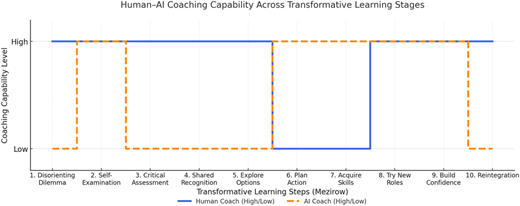
The unique strengths of each of human and AI coaching guided our classification of human and AI coaching applicability as high or low in each of the TL steps as illustrated in Figure 1.
Table 2 provides more details and lists the 10 steps and for each, and we show the most likely step in the ABCDE coaching model from a CBC perspective; the strongest coaching attributes that can be modeled by human and AI coaches, respectively, suggesting level of relative hybrid intelligence.
We will now illustrate each step of the TL process in reference to the situation that the leader in our case vignette, Jaya, is facing by highlighting how a human and AI coach, respectively, collaboratively play to their strengths.
Step 1: Disorienting dilemma
In TL, change is triggered by a disorienting dilemma, a gap between one's perspective and reality. In CBC, this aligns with an activating event. In Jaya's case, feedback challenges her leadership assumptions.
Human Coach: I understand how difficult this realization must be for you … Would it be okay if we gently sat with what that moment stirred in you?
AI Coach: It’s completely understandable to feel unsettled … I’m here to support you as you make sense of it.
Human coaching provides empathetic, relational depth that fosters trust and emotional safety, while AI offers transparent, nonjudgmental support. At this early stage, human coaching is more critical.
Step 2: Self-examination with guilt or shame
At this stage, clients begin to reflect on internalized beliefs, often experiencing emotional discomfort as they question long-held assumptions. In CBC terms, this is the “B – Beliefs” stage, where clients examine the beliefs driving their reactions. For instance, Jaya must explore her definitions of effective leadership and consider whether they can be challenged or expanded. Coaches can support this by normalizing emotions, cultivating trust and creating a judgment-free space, approaches that may vary depending on whether the coach is human or AI.
Human Coach: It’s completely natural and relatable to feel a bit of self-doubt right now. Can we hold this space for those feelings together, and explore what they might be trying to tell you?
AI Coach: It sounds like this situation may have triggered some difficult questions for you. Would you like to explore what beliefs might be underlying those feelings, and whether they still serve your leadership today?
At this stage, human coaching supports emotional normalization and psychological safety, while AI coaching provides a structured, nonjudgmental scaffold for examining beliefs, making their combined contribution particularly effective. For Step 2, both human and AI coaches are needed as their approaches are uniquely useful.
Step 3: Critical assessment of assumptions
In this step, clients critically examine underlying beliefs and assumptions. In Jaya's case, this involves questioning whether her leadership style reflects internalized norms around performance and vulnerability.
Human Coach: I wonder how much of your leadership style has been shaped by expectations … and whether those still align with the kind of leader you want to be?
AI Coach: It may be helpful to examine whether the belief that leadership must be stoic and performance-driven is serving you or limiting deeper connection.
While AI supports structured analysis, human coaching enables deeper reflection on identity and social conditioning. At this stage, human coaching plays a more critical role.
Step 4: Recognizing shared transformation
At this stage, clients realize that their struggles are not isolated, fostering connection and normalizing the transformation process. From a CBC view, this aligns with “C - Consequences,” highlighting belief-driven experiences. For instance, it would help for Jaya to realize that she is not the only leader contemplating how to modify and expand her leadership style to build trust with her teams better. This insight can enable her to view past mistakes as part of the learning process, rather than something to be stigmatized. Coaches facilitate growth by helping clients see shared experiences through empathizing with their clients.
Human Coach: Jaya, what you’re going through is deeply human. So many leaders I’ve walked alongside have reached a point where they realize the old rules no longer fit, and that realization, while painful, is often the beginning of something far more authentic.
AI Coach: While I don’t experience these challenges myself, many leaders in similar roles have reflected on the need to evolve their leadership approach. Would it be helpful to explore how your experience fits within that wider pattern?
Recognizing that transformation is shared relies primarily on relational empathy and human connection, with AI coaching playing a supportive role by situating the client's experience within broader leadership patterns. For Step 4, the role of a human coach is more important than the AI coach.
Step 5: Exploring new roles, relationships and actions
In this step, clients actively redefine roles and behaviors in alignment with their evolving beliefs. Coaches help clients to critically examine options and envision new possibilities. In CBC, this aligns with the “D – Disputation of beliefs,” where clients challenge and replace limiting beliefs. In Jaya's case, she might be wrestling with replacing her belief that vulnerability is a weakness for leaders.
Human Coach: What might it look like to lead with more openness while still honoring the strength and resilience that have brought you this far? And what risks might that openness carry for you, especially in spaces where vulnerability hasn’t always been safe?
AI Coach: Adopting vulnerability is linked to stronger team trust. Would you like to explore how this applies to your context?
While AI highlights evidence-based patterns, human coaching is better suited to exploring the personal and identity-related risks of change. At this stage, the human coach plays a more critical role.
Step 6: Planning a course of action
Transitioning from exploration to action, clients set clear steps to implement new perspectives. This step requires coaches to maintain agreements and provide accountability. In CBC, this aligns with the “E – Effective new approach,” where new beliefs are applied in real scenarios.
Human Coach: Before you dive into next steps, what feels most important for you to stay true to as you begin turning these insights into action?
AI Coach: Based on your stated priorities and recent reflections, I can help you create a step-by-step action plan with milestones and reminders. Shall we begin by identifying one small, measurable behavior that reflects your new leadership approach?
At this stage, AI coaching is particularly effective due to its ability to deliver structured learning, targeted practice and personalized skill development aligned with the client's stated goals. The role of an AI coach is therefore more important than that of a human coach.
Step 7: Acquiring Knowledge and Skills for Implementation
At this stage, clients focus on the skill-building necessary for transformation. Coaches ensure access to resources and support. In CBC, this continues under the “E - Effective New Approach,” reinforcing learning through experience. So, Jaya needs a coach at this stage who can guide her to undertake a well-planned learning effort needed to complement her evidence-based leadership style with empathic communication.
Human Coach: It sounds like you’re feeling ready to grow in this area. What kind of support or structure would help you feel confident as you begin building those skills through more focused practice?
AI Coach: Based on your goal to strengthen empathic communication, I can recommend targeted microlearning modules and conversation simulations. Would you like to begin with scenarios focused on active listening in leadership settings?
While the human coach offers empathic exploration, the AI coach excels in offering a starting point through personalized skill development grounded in predictability and theory. Accordingly, at Step 7 of TL, the AI coach plays a more prominent role.
Step 8: Trying New Roles Provisionally
In this step, clients experiment with new roles and behaviors, testing transforming beliefs in real situations. This step incorporates feedback loops to refine approaches. Coaches need to encourage Jaya to embrace exploration and reflection, ensuring she assesses her progress constructively. CBC aligns this with the “E – Effective new approach,” applying and refining new beliefs.
Human Coach: As you begin experimenting with these new ways of showing up, what would help you stay kind to yourself when things don’t go exactly as planned?
AI Coach: I will track your feedback across these new leadership interactions and highlight patterns. Shall we set regular check-ins to assess what’s working and where small adjustments might help you stay aligned with your intentions?
While the AI coach aids structured tracking and adaptive feedback driven by theoretical models of leadership behavior needed to address the needs for ability and predictability in coaching, the need for trust and empathy remain essential as clients like Jaya will benefit from exercising self-compassion when plans need adjustment along the way. Both human and AI coaches are needed.
Step 9: Building competence and self-confidence
In this step, clients deepen competence and confidence in applying their new beliefs. For Jaya, at this stage, coaches can help to reinforce her self-belief and guide sustainable transformation. In CBC, this remains under the “E – Effective new approach,” integrating new beliefs into identity.
Human Coach: Can you acknowledge how far you’ve come, and who you’re becoming as a leader?
AI Coach: From my records your recent interactions show consistent empathic behaviours. Shall we review what’s strengthening your confidence?
AI coaching reinforces progress through tracking and feedback, whereas human coaching supports motivation and identity integration. Both are needed at this stage.
Step 10: Reintegration into life with a transformed perspective
The final stage signifies full integration of new beliefs and behaviors requiring clients to operate with fundamentally altered perspectives. CBC continues under the “E – Effective new approach,” securing belief transformation. After Jaya successfully manages to expand her beliefs about effective leadership, coaches can ensure sustainability through final challenges. At this stage, it is still possible for Jaya to slip into old patterns of her leadership style when the circumstances are challenging. While the AI coach can track progress in a reliable and predictable manner, it lacks the deep emotional connection needed for Jaya to feel psychologically safe to share those slip-ups with her coach.
Human Coach: Even with all the growth you’ve made, it’s completely natural to feel pulled back into old ways when things get tough. When that happens, I’m here, and we can face those moments together without judgment.
AI coach: While I can continue monitoring your leadership behaviors and flag potential shifts, moments of self-doubt or pressure may be better explored with your coach who can hold that space more personally. Would you like me to help you prepare reflections to bring into those sessions?
In this final step, the role of a human coach is more important than the AI coach, although the AI coach can help to prepare the client for their sessions with the human coach.
Discussion and contributions
This framework extends coaching and adult learning theory by specifying how TL may unfold in AI-supported environments. Traditional coaching has positioned the human coach as the primary driver of development. In contrast, a hybrid intelligence perspective distributes coaching functions across human and AI modalities based on their strengths. AI systems can support structured, data-driven and cognitive-behavioral processes at scale, while human coaches remain essential for relational, emotional and identity-level work that underpins transformation.
Integrating AI into coaching also raises ethical considerations. Issues of confidentiality, informed consent and data transparency are critical, particularly regarding how user data are stored and used in algorithmic decision-making. While AI can provide consistent, nonjudgmental support, it lacks emotional depth and moral reasoning, limiting its effectiveness in trauma, identity threat, or ethical complexity. In such cases, escalation pathways to human coaches are essential. Therefore, a hybrid approach requires ethical governance, human oversight and clear role differentiation to ensure AI enhances, rather than compromises, psychological safety and coaching standards.
Theoretical contribution
The novelty of this paper is that it proposes a new synergy between human and AI coaching in the context of TL to provide guidelines on how to utilize AI coaches that could collaborate with human coaches to facilitate TL. It is known that human and AI coaches have different strengths in coaching skills that could complement each other in each step of the TL process. Empirical studies have shown that human coaches, because of their ability to feel emotions and show vulnerability, excel at building trust and showing empathy and benevolence. AI coaches, on the other hand, because of their 24/7 availability and ability to execute algorithms consistently, are perceived as reliable, predictable and transparent (if the algorithmic details are shared). This paper advances coaching theory by specifying when human or AI coaching is theoretically most appropriate across the stages of TL, rather than treating coaching modalities as interchangeable. In doing so, it challenges human-centric assumptions in coaching theory and extends TL theory into the digitally assisted developmental contexts.
Practical implications
This framework suggests that AI coaching should complement, not replace, human coaching in leadership development. Human resource functions can deploy AI for structured diagnostics, goal-tracking, skill-building and between-session reinforcement, while reserving human coaches for identity-level work, emotionally sensitive transitions and sense-making processes central to TL. Leaders should be encouraged to engage both modalities intentionally, using AI for continuous reflection and accountability and human coaches for deeper exploration of values, assumptions and leadership identity. Human coaches can view AI as an augmentation of their practice, enabling them to focus on high-impact relational and transformational work rather than routine monitoring. At the same time, AI developers must design systems that explicitly acknowledge their limitations in empathy and meaning-making, embed transparency, ethical guardrails and clear hand-offs to human coaches at critical points in the learning journey. Strong governance across stakeholders is essential to mitigate risks such as over-automation, algorithmic bias, privacy concerns and inappropriate reliance on AI in emotionally or ethically sensitive situations, ensuring responsible and effective integration.
Limitations and future research questions
This conceptual paper does not empirically test the proposed hybrid intelligence framework. Future research should validate the model through longitudinal and experimental studies examining outcomes, working alliances and ethical risks in human-AI coaching. Additional work should explore boundary conditions, including the cultural context, leader readiness and the types of developmental challenges best suited for AI support. Because this framework draws largely on Western theories, it may not fully capture variations in coaching norms across cultures. In higher power distance or collectivist contexts, for instance, AI coaching may be perceived differently. Future studies should examine how hybrid coaching operates across diverse cultural settings and contexts. We suggest the following research questions for further exploration:
How effective are hybrid human-AI coaching models compared to human-only and AI-only coaching in facilitating transformative learning outcomes in organizational leaders?
This question tests the core proposition of the paper: that combining AI and human coaching produces deeper or more sustainable learning than either modality alone.
At which stages of the transformative learning process do AI coaches and human coaches, respectively, contribute most to leader development outcomes?
This question evaluates the framework that allocates different strengths of human and AI coaching across Mezirow's stages.
What contextual and individual boundary conditions influence the effectiveness and acceptance of hybrid human-AI coaching models?
Relevant conditions include leader readiness for reflection, cultural context (e.g. power distance), organizational climate and attitudes toward AI.
Conclusion
This paper proposes that the future of transformative leadership coaching lies in a hybrid intelligence model, where AI and human coaches work together in the knowledge of where each one's strengths lie. AI brings scalability, structure and predictability. Human coaches offer the relational depth and emotional presence essential for deep insights and perspective change. Together, they can guide leaders not only to perform better but also to undertake the complex work of rethinking who they are at a fundamental level and how they lead in complex, evolving contexts.
Declaration of generative AI and AI-assisted technologies in the writing process
During the preparation of this work, the author(s) used ChatGPT to generate the scenario-based AI and human coaching conversation extracts used as illustrations in the section “A new synergy”. These excerpts are labeled as “human coaches” and “AI coach”. After using this service, the author(s) reviewed the generated content and adjusted it to align with what they intended to illustrate in terms of typical human and AI coach responses. The AI-generated content is therefore purely illustrative and is not intended as scholarly text or empirical data.