


This study aims to investigate the critical soft skills required to succeed in Society 5.0, defined by the deep integration of artificial intelligence (AI) into all areas of life. It aims to identify which soft skills are universally valued and assess gaps between their perceived importance and societal mastery. From a business and organizational perspective, the study focuses on how companies, leaders and employees can develop human-centric capabilities to complement AI-driven work systems.
A two-phase qualitative approach was used. First, a “veil of ignorance” thought experiment inspired by Rawls was applied through an expert survey to reveal unbiased perspectives on essential soft skills. Second, in-depth interviews with generative AI professionals provided further insight. Data were thematically analyzed using grounded theory.
Five key categories of soft skills emerged: interpersonal, communication, thinking related, leadership/management and coping with uncertainty. Skills such as empathy, adaptability, critical thinking and digital literacy were highly valued but insufficiently mastered. A significant skills gap was identified, particularly in interpersonal and thinking-related areas.
Findings are based on a select expert sample; broader studies are needed for generalization.
The results guide educational institutions, organizations and policymakers in developing targeted training strategies for human-centric skills.
Emphasizing empathy, ethics and adaptability supports equitable, responsible AI integration and societal resilience.
This study uniquely applies the veil of ignorance framework to soft skills analysis, offering an impartial, future-oriented view of competencies needed in an AI-driven world. It also introduces a skills development model highlighting areas with the highest development need.
1. Introduction
The 21st century is defined by rapid technological change, with artificial intelligence (AI) reshaping industries and society (Liu et al., 2018). As we move toward Society 5.0 – where advanced technologies permeate daily life – the nature of work, innovation and social interaction is transforming (H-UTokyo Lab., 2020). Society 5.0 is a socio-technical system in which technological, social and organizational dimensions interact to advance economic, social and environmental sustainability. (Beier et al., 2020; Barata and Kayser, 2024). Originating in Japan, it promotes a human-centric model leveraging IoT, AI and cloud computing to enhance quality of life, social responsibility and sustainability (Ferreira and Serpa, 2018; Fukuyama, 2018). While promising efficiency and novel solutions, this shift also demands a rethinking of required competencies; research increasingly underscores soft skills as central to effective digital transformation (Mourtzis et al., 2022; Pappas et al., 2023).
Soft skills – intangible interpersonal and cognitive abilities for communication, collaboration and problem-solving – are gaining prominence (Cardon et al., 2024). As AI handles routine tasks and data-driven decisions, distinctly human capabilities become crucial for navigating AI-augmented contexts, a trend highlighted by public releases of large language models such as ChatGPT (Brynjolfsson and McAfee, 2014; Hutson and Ceballos, 2023). In labor markets where technical proficiency alone may not suffice, soft skills are emerging as key differentiators (Polaková et al., 2023; Schislyaeva and Saychenko, 2022).
Yet which soft skills matter most – and how to cultivate them – remains contested. AI can support soft skills development (Kasneci et al., 2023), but technological change often outpaces education and workforce systems (Goldin and Katz, 2008). Integration of AI also raises questions about human–machine collaboration, ethics and managing human–AI teams (Flathmann et al., 2021). Thus, soft skills matter not only for careers but for societal well-being and the responsible evolution of AI (Julliard and Schwab, 2000).
This study examines expert perspectives from academia and business on soft skills for an AI-based society. Using a “veil of ignorance” thought experiment inspired by Rawls (Rawls, 1971), we identify universal competencies that transcend roles and industries, mitigating bias and emphasizing skills resilient to uncertain technological trajectories. We also assess perceived relevance and current development levels, revealing skills gaps and targets for intervention.
Our contributions are threefold: clarifying how human capabilities complement AI; informing curricula, corporate training and lifelong learning; and illuminating societal implications by showing how soft skills development can support ethical AI adoption and resilience amid disruption. The findings will guide educators, help organizations foster human-centered innovation and inform policymakers on equitable access to skills development and responsible AI integration. As this paradigm shifts, aligning soft skills with human values, creativity and ethics is vital to realizing AI’s potential; this study offers a roadmap so individuals, organizations and societies can thrive in the age of AI and beyond.
2. The emergence of soft skills
Soft skills have evolved alongside social and technological change. In the 13th century, “skills” meant dexterity, coordination and applied know-how (Touloumakos, 2020, p. 2). Over time, discourse has shifted from “skilled work/labour” to the broader “skills” (Touloumakos, 2020, p. 3). Soft skills – contrasted with technical “hard skills” – denote competencies enabling effective functioning in organizations, largely via relations with others, spanning intra- and interpersonal domains (Cimatti, 2016). Interpersonal skills engage others (e.g. communication), while intrapersonal skills support self-regulation and performance (e.g. time management) (Anggraeni and Tarmidi, 2021).
Hard skills concern profession-specific tasks – equipment, data, software – and the knowledge “what” (Lamberti et al., 2023; Laker and Powell, 2011), e.g. using a computer or program, writing correctly or selecting statistical procedures (Vasanthakumari, 2019).
The term soft skills traces to US Military’s post-war systems-based training (Silber and Foshay, 2009, p. 62). In 1968, “Systems Engineering of Training” defined them as job-related competencies centered on human interaction and paperwork (Silber and Foshay, 2009, p. 63). The 1972 CONARC Soft Skills Conference formalized a machine-independent, generalized definition (Whitmore and Fry, 1974). Later, tacit/implicit knowledge underscored experiential learning (Joie-La Marle et al., 2022, p. 6), and the term spread widely in the early 1990s. Robles (2012) identified executives’ top ten: integrity, communication, courtesy, responsibility, social skills, positive attitude, professionalism, flexibility, teamwork and work ethic.
A systematic review reported 119 labels across 237 documents (from 636 papers). Under “soft skills”, the most cited were teamwork, communication, planning/organizing, responsibility, leadership, creativity, commitment, adaptability and ethics; across all umbrella terms, communication led, then teamwork, specific technical skills, planning/organizing, lifelong learning, leadership, problem-solving, technology use, creativity and ethics (Joie-La Marle et al., 2022, p. 16). Europe has advanced taxonomies via DigComp, EntreComp, LifeComp and GreenComp, which propose lists, behaviors and levels (Vuorikari et al., 2016; Bacigalupo et al., 2016; Punie et al., 2020).
Terminology is debated: Godin argued these are hard to acquire and suggested “power skills” (Runyon, 2022). Taxonomy work remains fragmented, with many lists developed independently using varied methods (Joie-La Marle et al., 2022, p. 5). Soft skills are also framed as green skills, life skills or metacognitive skills (Mitsea et al., 2021; Ammani and Chitra, 2020; Guerra-Báez, 2019; Qadir et al., 2020).
Across 6,000 + sources, Cukier et al. (2015) found consensus on economic importance but noted definitional variance and employer–graduate gaps, urging better coordination (Cukier et al., 2015, p. 24). Joie-La Marle et al. (2022) call for clearer definitions, hierarchical relationships, context-specific adaptability and links to executive functioning and emotional intelligence. Touloumakos (2020) critiques proliferation without evidence-based grounding and conceptual incoherence, advocating a more inclusive, embedded view. Psychological research – positive and social psychology and emotional intelligence – connects soft skills to personality and related constructs (Heckman and Kautz, 2012; Goleman, 1995).
3. Soft skills in the context of technological advancements and societal changes
Rapid advances in AI and automation are reshaping which competencies matter – and how they evolve (Alekseeva et al., 2021; Holm and Lorenz, 2021). As societies move toward Society 5.0, the demand for soft skills rises markedly (Armstrong and Torres Vergara, 2024; Lubis, 2021; Polaková et al., 2023). Their absence already imposes time and cost burdens on firms (Cinque, 2016; Foerster-Metz and Golowko, 2018; Ghani et al., 2018; Houghton and Proscio, 2001; “European Skills Agenda – employment, social affairs and inclusion”, European Commission, 2020; “Organization for Economic Co-operation and Development”, OECD, 2015; “World Economic Forum”, 2016). This reflects a persistent skills gap – between labor-market demand and candidate capabilities (Cinque, 2015; Singh and Jaykumar, 2019) – which affects countries’ innovation and prosperity (International Labour Office, 2015; Cerina and Manca, 2018). Higher education therefore has a pivotal role in Europe’s economic and social development (Pucciarelli and Kaplan, 2016). Yet curriculum efforts to include soft skills remain insufficient in some sectors (Ghani et al., 2018; Wilson and Marnewick, 2018), prompting ongoing European calls for and subsidies for such skills, as anticipated by Dutton (2012).
Technological disruptions have long altered work and skill needs (Cascio and Montealegre, 2016; Djankov and Saliola, 2018/2019). Today, AI and automation are set to take over routine tasks and unsettle industries (Tschang and Almirall, 2021). Consequently, hard skills alone are insufficient; interpersonal, cognitive and self-regulatory soft skills are critical for adaptation, collaboration and complex problem-solving (Dolev and Itzkovich, 2020).
Adaptability will grow in importance (Dolev and Itzkovich, 2020; Rizal et al., 2022), as people must rapidly pivot skills and embrace new tools (Al-Mughairi and Bhaskar, 2024). Resilience – persevering through disruption – will likewise be valued (Shrier et al., 2023).
AI’s spread also elevates human-centric capacities: empathy, emotional and social intelligence and cultural sensitivity (Dolev and Itzkovich, 2020; Goleman, 1995). These are essential for ethical and socially responsible deployment amid diverse perspectives and contexts (Bankins, 2021; Zhang et al., 2022).
Communication – conveying complex ideas and collaborating with humans and AI – becomes paramount (Joie-La Marle et al., 2022; Leaua et al., 2024; Zhang et al., 2023). So does critical thinking and creativity for evaluating information, generating novel solutions and driving innovation (Spector and Ma, 2019). Overall, the shift toward Society 5.0 demands a renewed focus on developing broad, human-centered competencies to navigate disruption, enable effective human–machine collaboration and align progress with societal values.
From a business perspective, the soft skills gap directly affects organizational performance, innovation capacity, leadership effectiveness and responsible AI adoption (Cukier et al., 2015; Dolev and Itzkovich, 2020; Cascio and Montealegre, 2016). As companies increasingly operate with hybrid human–AI teams, employees will be required not only to use advanced technologies but also to communicate across functions, exercise judgment in AI-supported decisions, manage uncertainty and maintain trust with stakeholders (Flathmann et al., 2021; Bankins, 2021; Tschang and Almirall, 2021). Prior research shows that deficits in empathy, critical thinking and adaptability are associated with higher coordination costs, weaker change management and increased ethical risks during digital and AI-driven transformations (Cinque, 2016; Singh and Jaykumar, 2019; Sony and Mekoth, 2022). Consequently, understanding which soft skills are most critical – and where development gaps exist – is essential for business strategy, workforce planning and sustainable competitive advantage in the context of Society 5.0 (Brynjolfsson and McAfee, 2014; Joie-La Marle et al., 2022). To explore the importance of soft skills in this workplace context, we ask the following research questions:
What are the essential soft skills that experts believe individuals need to thrive in organizations, workplaces and professional roles within a Society 5.0 characterized by the integration of artificial intelligence and advanced technologies into various aspects of life?
What is the importance of these soft skills and which ones should be developed the most?
These questions target which soft skills will be crucial in the AI era and how best to develop them, informing actionable strategies for individuals, organizations and societies.
4. Theoretical framework and methods
4.1 Study design
This qualitative study aims to inductively explore and conceptually structure expert perspectives on soft skills in AI-driven organizational contexts (Denzin and Lincoln, 2005). It proceeded in two phases as:
an open-ended questionnaire with importance ratings of described soft skills and
in-depth semi-structured interviews were guided by grounded theory principles (Strauss and Corbin, 1990).
This study adopts an interpretivist qualitative research paradigm, aiming to explore how experts make sense of soft skills in the context of AI-driven work and organizations. While it does not seek to build a full grounded theory, it draws on grounded theory principles – such as inductive coding, constant comparison and theory-informed abstraction – to structure data analysis.
4.2 Phase 1: veil of ignorance survey
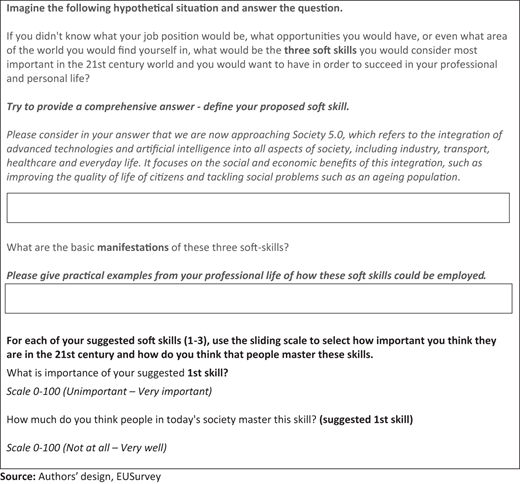
To minimize role- and context-driven bias, we used a “veil of ignorance” thought experiment inspired by Rawls (1971), a device applied across domains to elicit impartial judgments (Huang et al., 2019; Pinto-Prades and Abellán-Perpiñán, 2005). Experts evaluated soft skills while imagining they lacked knowledge of their future job, location or advantages – consistent with the uncertain, shifting roles anticipated in Society 5.0. This foregrounds transferable competencies with enduring, society-wide value (Rawls, 1971). The task assignment is shown in Appendix 1.
4.2.1 Data collection and study sample.
Data were collected via the European Commission’s EUSurvey platform (available at: Link to ec.europa.euLink to a website of ec.europa.eu), which supports anonymous participation. We targeted two groups. The academic group comprised leading professors and scholars in business ethics, management, entrepreneurship and related fields, including philosophers of economics and ethics, to connect theoretical and normative insights with practice. The practitioner group included influential CEOs advancing sustainability, award-winning social entrepreneurs, B-Corp representatives and senior executives from globally recognized employers, ensuring cross-sectoral and international relevance. The strategy of participant recruitment is shown in Appendix 2.
In total, 35 participants completed the questionnaire and open-ended tasks on soft skills for Society 5.0 and AI. Respondents are anonymized as P1–P35; nine (P27–P35) also participated in a broader Delphi study that included the veil of ignorance task, with additional results reported elsewhere (Kubátová et al., 2025) and data available (Müller et al., 2025). Embedding the veil task within the Delphi method (Lynn et al., 1998) yielded richer responses than a conventional online survey (Brady and O’Connor, 2014). A list of participants is presented in Appendix 3. Figure 1 displays the reported life values by perceived importance.
 The word cloud presents values and interpersonal qualities, with Honesty displayed most prominently at the centre. Other large terms include Respect, Integrity, Creativity, Transparency, Compassion, Fairness, Justice, Empathy, Tolerance, and Trust. Smaller words distributed throughout the layout include Kindness, Professionalism, Friendship, Unity, Peace, Authenticity, Leadership, Responsibility, Cooperation, Sustainability, Learning, Resilience, and Conscientiousness. The arrangement emphasises ethical behaviour, social responsibility, interpersonal understanding, and positive human relationships.
Participants’ life values importance
Source: Authors’ research, visualization by jasondavies.com/wordcloud/
The word cloud presents values and interpersonal qualities, with Honesty displayed most prominently at the centre. Other large terms include Respect, Integrity, Creativity, Transparency, Compassion, Fairness, Justice, Empathy, Tolerance, and Trust. Smaller words distributed throughout the layout include Kindness, Professionalism, Friendship, Unity, Peace, Authenticity, Leadership, Responsibility, Cooperation, Sustainability, Learning, Resilience, and Conscientiousness. The arrangement emphasises ethical behaviour, social responsibility, interpersonal understanding, and positive human relationships.Participants’ life values importance
Source: Authors’ research, visualization by jasondavies.com/wordcloud/
4.2.2 Analysis.
Data analysis followed grounded theory-informed coding procedures (Strauss and Corbin, 1991; Charmaz, 2006). First, line-by-line open coding was used to identify meaningful units in the data relevant to the research questions. Through constant comparison, the codes were iteratively refined and grouped into higher-order categories. These categories were further integrated into broader conceptual dimensions representing key soft-skill domains relevant to AI-driven organizational contexts. Throughout the process, analytical memos supported reflexive interpretation and conceptual coherence.
4.3 Phase 2: in-depth interviews with generative artificial intelligence experts
The second phase comprised in-depth semi-structured interviews to deepen the understanding of challenges and opportunities in generative AI and the soft skills required for its adoption (Charmaz, 2006). Experts discussed the skills needed for the advent of these technologies and the specific role of soft skills.
4.3.1 Data collection and sample.
Data were collected January–April 2024 as the first phase of a broader project. Researchers conducted online semi-structured interviews (45–90 min) after informed consent; sessions were recorded on platforms such as Zoom and MS Teams and later transcribed. The focus was on knowledge workers – professionals performing intellectual, cognitive tasks that create and apply new knowledge (Curado and Bontis, 2006). Participants used and generated knowledge, engaged in continuous learning and supported others’ development (Drucker, 1999). All were actively exploring generative AI in their work and were primarily recruited via LinkedIn. Fourteen knowledge workers participated; characteristics appear in Appendix 4.
All interviews were conducted online (via Zoom and Microsoft Teams) and audio-recorded with prior informed consent. Participants were informed about the purpose of the study, voluntary participation and their right to withdraw at any time. Data were anonymized, and identifiers (E1–E14) were used to protect confidentiality. Recordings and transcripts were stored securely and accessed only by the research team, ensuring compliance with ethical standards for qualitative research.
4.3.2 Analysis.
Interviews were transcribed and coded using meaning-making units. Transcripts were annotated for concepts tied to the research questions, relevant linguistic terms and notes. Interview transcripts were analyzed using grounded theory-informed coding, applying constant comparison to identify recurring patterns, categories and relationships relevant to the research questions (Charmaz, 2006).
5. Results: identification of soft skills (RQ1)
5.1 Interpersonal human skills
Interpersonal skills are pivotal in Society 5.0. Participants emphasized empathy, listening, emotion-related skills, cultural skills and ethical reasoning as foundational across professional and personal contexts.
Empathy. Multiple respondents foreground empathy. P4 lists it among the top three; P8 stresses connecting “on an equal basis despite financial, cultural differences; be kind.” P25 highlights “sensitivity to cultural differences” and finding “common ground,” echoed by P11, P17, P24 and P26. For P26, empathy means “bridging over differences” and recognizing complexity and multiple perspectives. In AI-pervasive settings – industry, health care, daily life – empathy steers inclusive, ethical implementation and differentiates human value as automation expands. Empathic capacity also supports managing bias and ethical risks in human–AI interactions and aligns with Society 5.0’s human-centric aims. Table in Appendix 5 shows expert’s opinion.
Listening skills. Active/“responsive” listening (P9; P22) is critical as tech-mediated communication grows. For “technology warriors,” listening principles humanize systems. Chatbot research shows that embedding active listening improves user experience and interaction depth (Xiao et al., 2020).
Emotion-related skills. Participants emphasized emotion regulation, emotional intelligence, self-awareness, self-regulation, self-control and reflexivity. P1 calls emotional intelligence “a complex skill… a set of skills.” P10 notes “emotion regulation/emotional intelligence” is pivotal for thriving in new settings; P21 and P29 stress self-regulation; P24 stresses self-awareness (“being aware of how you come across…”). While AI raises efficiency, sustainable performance requires coupling it with emotional intelligence in leadership and operations (Bhardwaj et al., 2023).
Cultural skills. Participants underscored cultural sensitivity and bridging differences. P25 emphasizes respect across backgrounds and finding common ground; P26 points to recognizing differing cultural logics while respecting one’s own; P28 links empathy with cultural understanding.
Facing injustice and ethical reasoning. These skills are very closely related to the ability to empathize, because the ability to empathize with others is often a common motivator for ethical behavior. According to some theories, prosocial motivation, which stems from a sense of empathy for a person in distress, leads to goals that benefit the disadvantaged person rather than the one providing the help (Batson et al., 1988 , p. 52). Some participants (P15, P23) explicitly mentioned justice and ethical reasoning and action. A strong emphasis was then placed on the ability to act ethically and build kindness by experts during the interviews. A good example is mentioned by the following expert and is shown in the Appendix 6.
5.2 Communication skills
Effective communication skills are paramount in the 21st century, especially with the advent of Society 5.0 and the integration of advanced technologies and AI into various aspects of life. The participants’ responses highlight two major groups of communication skills: general communication skills and rhetoric and presentation skills.
General communication skills. P1 and P23 both prioritize “communication skills” (P1: “without good communication there is no successful business”); P23 adds the “ability to present with confidence.” P10 points to communication, self-presentation and negotiation; P22 to “clear and effective communication, both oral and written.” These skills are central to human–AI collaboration, to engaging nontechnical stakeholders and to addressing ethical/social issues around AI (Seelaboyina et al., 2023).
Rhetoric and presentation skills. Participants cited storytelling, rhetorical skills, presentation, critical reading/writing and public speaking. P19 emphasizes “storytelling”; P18 highlights nuanced reading/writing; P25 stresses “rhetorical skills” to “communicate, explain and persuade” via structured argument and narrative. In Society 5.0, persuasive, clear communication builds trust and fosters adoption. P6 notes “presentation skills”; P2 stresses “public speaking.”
5.3 Thinking-related skills
In relation to thinking skills, the participants’ responses highlight four distinct groups of skills: critical thinking, analytical skills, problem-solving and creativity.
Critical Thinking. P1 ranks “critical thinking” among the top three; P27 provides an extended definition of disciplined analysis and evaluation. As AI generates outputs at scale, human critical thinking interprets, tests for bias/limits and situates decisions ethically and contextually. See Appendix 7 for the expert’s opinion.
Analytical skills. P30 calls for “analytical skills” to define/classify quality-of-life and social problems and appraise technology/AI. With abundant data, analysis enables insight extraction and value-aligned decisions.
Problem-solving. P16 notes that the digital age’s “wicked problems” require heightened problem-solving; P34 adds that challenges persist regardless of technological progress, making general issue-tackling vital.
Creativity. Creativity differentiates humans as automation scales. P27 defines it as the attitude/ability/style of creative thinking leading to intentional activity. P4 lists “creativity” among the top three; P28 points to “creativity and innovation” for seizing opportunities and novel solutions.
5.4 Managing and leading
Managing and leading skills. Several management and leadership skills emerge as crucial for individuals to thrive. The participants’ responses highlight four distinct groups of skills: decision-making, teamwork and collaboration, leadership and time management.
Decision-Making. Judgment and prudence matter. P5 lists “judgment” among the top three; P22 stresses “resolution when hard actions must be taken”; P32 links “prudence” to managing stress/tension. As AI permeates decisions, human judgment weighing ethical, social and contextual factors grows in value.
Teamwork and collaboration. P27 defines teamwork as qualities enabling effective co-work across tasks; P29 lists “collaboration,” emphasizing respectful group engagement. Human–AI teaming heightens the premium on collaborative skills.
Leadership. Leadership – people management, facilitation, face-to-face engagement – was frequently cited. P19 highlights “group facilitation”; P6 cites “people skills”; P9 lists “the ability to engage in face-to-face interactions.” Leaders must guide hybrid (human + AI) teams and manage conflicts.
5.5 Facing uncertainty
The participants’ responses highlight three distinct groups of skills that are essential for navigating the uncertainties and challenges brought about by rapid technological change: adaptability and flexibility, resilience and learning.
Adaptability and flexibility. P20 lists “adaptability” among the top three; P29 names “flexibility” for managing transitions; P28 emphasizes openness to change amid confusion and chaos. These capacities enable re-skilling and pivoting in evolving AI contexts (Sony and Mekoth, 2022).
Resilience. P7 prioritizes “resilience”; P27 defines it as sustaining effectiveness under load, handling frustrations and adapting; P31 also ranks it highly. Resilience supports perseverance and a positive orientation through disruption.
Learning. Learning mindsets are essential. P32 stresses “willingness to learn and accept new things” with new technologies; P20 emphasizes motivation to learn; P33 highlights rapid orientation and adaptation. Continuous learning sustains relevance in shifting roles (Lim and Lee, 2024).
Dealing with complexity. Participants called for systems thinking and comfort with ambiguity. P26 urges “thinking in systems” (e.g. sustainability); P35 advocates “making a deal with complexity” and iterative learning (Agile). P30 notes understanding “societal realities” and one’s position to “design reality”; P29 values “exploratory thinking” that links disciplines and experiments; P35 stresses “understanding diversity and accepting cognitive dissonance.” Such cognition enables holistic problem framing and innovative responses in AI-rich systems.
5.6 Digital soft skills emerging in AI-driven society
Several participants emphasized the importance of developing skills related to computers, digital technologies and AI. P15 suggests a “combination of Artificial Intelligence and Game Theory techniques” for advanced analyses and designs across various fields. P23 directly mentions “information technology capability” as a crucial skill, whereas P28 highlights the significance of “digital literacy,” which encompasses the ability to understand, use and evaluate digital technologies.
P14 emphasizes the need for “digital soft skills”, especially in the wake of the COVID-19 pandemic, which has accelerated the need for remote working and digital collaboration. P27 also stresses the importance of “using digital tools in the workplace,” recognizing that the tools and technologies we use are rapidly evolving, and a nuanced understanding of their capabilities and limitations is essential. The experts’ opinion is shown in Appendix 8.
6. Results: the need for soft skills development (RQ2)
Figure 2 summarizes the soft-skill categories, their components and the metrics (frequency, importance, mastery and the importance–mastery gap, I–M). Interpersonal human skills show a large need for development (weighted average I–M = 48.61), driven by empathy, active listening and cultural sensitivity. Thinking-related skills and creativity follow (I–M = 47.64), spanning critical thinking, analytical skills, problem-solving and creativity. Management and leadership also reveal sizable gaps (I–M = 45.89), especially in decision-making and leadership. Facing uncertainty shows a moderate but meaningful need (I–M = 41.29) for adaptability and resilience. Communication skills warrant attention (I–M = 38.41). Digital skills register a particularly high gap (I–M = 57.33).
 The framework organises soft skills into six categories connected to detailed competencies and comparative evaluation measures. The categories include Interpersonal Human Skills, Communication Skills, Thinking Related Skills and Creativity, Managing and Leading, Facing Uncertainty, and Digital Skills, Not Only Soft. Each category includes an Importance minus Mastery weighted mean value. Connected competencies include Empathy, Active and Responsive Listening, Emotion Related Skills, Cultural Sensitivity, Communication, Critical Thinking, Analytical Skills, Problem Solving, Creativity, Teamwork and Collaboration, Leadership, Time Management, Adaptability and Flexibility, Resilience, Learning, and Digital Soft Skills and Literacy. The right side presents a table with columns for Frequency, Importance, Mastery, and Need of Development, calculated as Importance minus Mastery. Analytical Skills, Time Management, Critical Thinking, and Digital Soft Skills and Literacy display some of the largest development gaps, while Teamwork and Collaboration shows one of the smallest gaps. The framework highlights priority areas for professional and personal skill development.
Evaluation of soft skills
Source: Authors’ processing
The framework organises soft skills into six categories connected to detailed competencies and comparative evaluation measures. The categories include Interpersonal Human Skills, Communication Skills, Thinking Related Skills and Creativity, Managing and Leading, Facing Uncertainty, and Digital Skills, Not Only Soft. Each category includes an Importance minus Mastery weighted mean value. Connected competencies include Empathy, Active and Responsive Listening, Emotion Related Skills, Cultural Sensitivity, Communication, Critical Thinking, Analytical Skills, Problem Solving, Creativity, Teamwork and Collaboration, Leadership, Time Management, Adaptability and Flexibility, Resilience, Learning, and Digital Soft Skills and Literacy. The right side presents a table with columns for Frequency, Importance, Mastery, and Need of Development, calculated as Importance minus Mastery. Analytical Skills, Time Management, Critical Thinking, and Digital Soft Skills and Literacy display some of the largest development gaps, while Teamwork and Collaboration shows one of the smallest gaps. The framework highlights priority areas for professional and personal skill development.Evaluation of soft skills
Source: Authors’ processing
At the skill level, empathy has the highest frequency (12) and a large gap (I–M = 52.66). Critical thinking, though less frequently cited (7), shows a high need (I–M = 53.72). Adaptability and flexibility carry high importance (91.25) with a notable gap (I–M = 38.12). Analytical skills exhibit the largest discrepancy: importance 100% vs mastery 38.33%, yielding I–M = 61.67. Digital software skills and literacy, despite lower frequency (3), show substantial need (I–M = 57.33), underscoring the rising technological competence demands.
Overall, respondents judged these skills as highly important but insufficiently mastered across categories, signaling urgent, targeted development efforts. As Society 5.0 advances, closing these gaps – especially in interpersonal and thinking-related skills – will be essential to complement and steer technology ethically and effectively.
Figure 3 offers a schematic model of the key skills for AI and Society 5.0. Bubble color encodes development need (green < 35, orange 35–50, red > 50); bubble size represents importance. Centered on “Essential Skills for an AI 5.0 World and Society”, four branches radiate: facing uncertainty, interpersonal human skills, thinking-related skills and communication skills. The prominent, red-coded position of digital soft skills/digital literacy highlights their critical development need as AI diffusion deepens. This visual clarifies priorities for education and professional development programs.
 The bubble chart presents core skills for A I and Society 5.0 inside a large oval divided into soft skills and hard skills. A dark central circle reads Core skills for A I and society 5.0. Five arrows around the centre are labelled Managing and leading, Communication skills, Thinking related skills, Interpersonal and human skills, and Facing uncertainty. Skills under Managing and leading are Decision making, Leadership, Teamwork, and Time management. Skills under Communication skills are Communication and Rhetoric and presentation. Skills under Thinking related skills are Analytical thinking, Exploratory thinking, Problem solving, Creativity, and Critical thinking. Skills under Interpersonal and human skills are Ethical reasoning, Emotion related skills, Cultural sensitivity, Active listening, and Empathy. Skills under Facing uncertainty are Adaptability and flexibility, Learning, Resilience, and Dealing with complexity. Digital soft skills and literacy are positioned between hard and soft skills. Hard skills are labelled outside the oval. A legend at the upper right states Need for development score with categories Lower need, less than 35, Medium need, 35 to 50, and High need, greater than 50. Another legend states Importance score with larger circles indicating higher importance and smaller circles indicating lower importance. Teamwork, Learning, and Problem solving are lower need. Communication, Rhetoric and presentation, Leadership, Adaptability and flexibility, Resilience, Emotion related skills, Cultural sensitivity, Creativity, and Exploratory thinking are medium need. Decision making, Time management, Analytical thinking, Critical thinking, Ethical reasoning, Active listening, Empathy, Dealing with complexity, and Digital soft skills and literacy are high need.
Soft skills development model
Source: Authors’ processing
The bubble chart presents core skills for A I and Society 5.0 inside a large oval divided into soft skills and hard skills. A dark central circle reads Core skills for A I and society 5.0. Five arrows around the centre are labelled Managing and leading, Communication skills, Thinking related skills, Interpersonal and human skills, and Facing uncertainty. Skills under Managing and leading are Decision making, Leadership, Teamwork, and Time management. Skills under Communication skills are Communication and Rhetoric and presentation. Skills under Thinking related skills are Analytical thinking, Exploratory thinking, Problem solving, Creativity, and Critical thinking. Skills under Interpersonal and human skills are Ethical reasoning, Emotion related skills, Cultural sensitivity, Active listening, and Empathy. Skills under Facing uncertainty are Adaptability and flexibility, Learning, Resilience, and Dealing with complexity. Digital soft skills and literacy are positioned between hard and soft skills. Hard skills are labelled outside the oval. A legend at the upper right states Need for development score with categories Lower need, less than 35, Medium need, 35 to 50, and High need, greater than 50. Another legend states Importance score with larger circles indicating higher importance and smaller circles indicating lower importance. Teamwork, Learning, and Problem solving are lower need. Communication, Rhetoric and presentation, Leadership, Adaptability and flexibility, Resilience, Emotion related skills, Cultural sensitivity, Creativity, and Exploratory thinking are medium need. Decision making, Time management, Analytical thinking, Critical thinking, Ethical reasoning, Active listening, Empathy, Dealing with complexity, and Digital soft skills and literacy are high need.Soft skills development model
Source: Authors’ processing
The unequal prominence of skills in Figure 3 reflects their organizational leverage in AI-driven contexts. Skills such as analytical thinking, empathy and digital literacy exhibit larger importance–mastery gaps because they are simultaneously critical for decision-making, ethical judgment and effective human–AI collaboration, yet remain underdeveloped in many organizations. In contrast, skills with lower gaps tend to be either more routinely trained or less central to strategic AI adoption. From a business standpoint, this explains why investments in analytical, interpersonal and adaptive capabilities yield disproportionate returns in productivity, trust and innovation.
7. Implications for business practice, policy and society
7.1 Implications for business and organizational practice
Building on prior research that highlights the growing importance of soft skills in digitally intensive workplaces (Cukier et al., 2015; Dolev and Itzkovich, 2020; Joie-La Marle et al., 2022), the findings of this study provide actionable guidance for organizations operating in AI-driven environments. While earlier literature documents the relevance of soft skills in general, this study advances the discussion by identifying which specific soft skills exhibit the largest importance–mastery gaps under conditions of increasing AI integration.
From a strategic management perspective, the results suggest that soft skills should be treated as core organizational capabilities rather than auxiliary training outcomes. As AI systems increasingly automate analytical and routine tasks (Brynjolfsson and McAfee, 2014; Tschang and Almirall, 2021), competitive advantage shifts toward human capabilities that enable interpretation, judgment, coordination and ethical oversight. In line with Bankins (2021) and Flathmann et al. (2021), the strong emphasis on empathy, ethical reasoning and communication underscores that effective AI adoption depends not only on technical performance but also on trust, legitimacy and socially responsible decision-making within organizations.
The pronounced development gaps identified for analytical thinking, critical thinking and empathy reinforce earlier concerns about misalignment between labor-market needs and existing workforce skills (Cinque, 2016; Singh and Jaykumar, 2019). For managers and HR professionals, this implies a need to redesign learning and development systems toward integrated human–AI skill portfolios, combining digital literacy with interpersonal and cognitive skills. Rather than offering isolated soft skills workshops, organizations should embed these competencies into leadership development, performance management and team-based work structures.
Furthermore, the findings align with research on adaptability and resilience as essential responses to technological disruption (Sony and Mekoth, 2022; Shrier et al., 2023). Companies facing continuous AI-driven change should foster cultures of continuous learning and psychological safety, enabling employees to experiment with AI tools while maintaining critical distance and ethical awareness. The soft skills development model proposed in this study can thus serve as a diagnostic and prioritization framework for organizations seeking to allocate training resources where they yield the highest organizational returns.
7.2 Implications for policy and society
The findings also extend policy-oriented debates on skills development in the context of Society 5.0 and Industry 5.0 (Fukuyama, 2018; Beier et al., 2020; Armstrong and Torres Vergara, 2024). While European and international frameworks such as DigComp and LifeComp provide valuable taxonomies (Vuorikari et al., 2016; Punie et al., 2020), this study contributes evidence on where the most critical soft skills gaps currently lie, particularly in relation to AI-driven work and organizational decision-making.
For policymakers, the results highlight the importance of integrating soft skills explicitly into AI strategies, labor-market policies and lifelong learning. As emphasized by Goldin and Katz (2008) and the International Labour Office (2015), technological change often outpaces institutional adaptation. The substantial importance–mastery gaps identified in empathy, analytical thinking and digital soft skills suggest that without targeted policy interventions, AI diffusion may exacerbate inequality, skill polarization and exclusion.
At the societal level, the emphasis on empathy, ethical reasoning and cultural sensitivity supports calls for human-centered and responsible AI development (Pappas et al., 2023; Rana et al., 2024). These skills are not only economically valuable but also socially stabilizing, as they enable individuals and organizations to navigate moral dilemmas, cultural diversity and uncertainty associated with AI adoption. Strengthening such capabilities can enhance public trust in AI systems, improve quality of life and support social cohesion in technologically advanced societies.
Finally, the study reinforces Touloumakos’s (2020) critique of fragmented soft skills discourse by offering a context-sensitive, future-oriented framework grounded in expert judgment. By linking soft skills development to organizational performance, ethical governance and societal resilience, the findings demonstrate that progress toward Society 5.0 is not merely a technological challenge but a collective capability-building project involving businesses, educators and policymakers alike.
8. Discussion and conclusion
This study advances understanding of soft skills in the Society 5.0 amid growing AI integration, offering a future-oriented view that accounts for technological opportunities, ethical stakes and global challenges. We identify specific soft skills that academic and business experts deem critical for human–AI collaboration and fluid, rapidly changing roles – extending prior work that documented their general workplace importance (Kyllonen, 2013). As technologies reconfigure occupations – eliminating some and creating new ones (Rožman et al., 2022; Tredinnick, 2017) – professional identities will also shift (Goto, 2021).
Findings foreground empathy and emotional intelligence as foundational in AI-pervasive contexts. This supports and extends Dolev and Itzkovich (2020), positioning these human-centered skills as essential for ethical, socially responsible AI (Rana et al., 2024) and for addressing tensions inherent in expanding human–AI interactions (Zirar et al., 2023). Anticipated dilemmas – e.g. managers navigating future worker roles (Horváth and Vicsek, 2023) and policymakers confronting options such as universal basic income (King and Petty, 2021) – further elevate emotion-management skills.
Empathy and cultural sensitivity also emerge as market-facing capabilities: successful AI entrepreneurs must deliver solutions that are technically sound and culturally attuned, extending work on responsible AI entrepreneurship (Zhang et al., 2022). The salience of adaptability and flexibility aligns with Joie-La Marle et al. (2022) while situating these skills explicitly in AI-enabled workflows: thriving in the Society 5.0 requires adopting new tools and practices alongside AI.
While prior research highlights critical thinking and problem-solving (Cukier et al., 2015), our results point to a more holistic cognitive stance suited to AI-era complexity – what participants termed “thinking in the context of complex reality,” i.e. navigating systems, multiple perspectives and uncertainty.
We also document sizable importance–mastery gaps, indicating urgent needs for targeted education and workforce development. Methodologically, applying the “veil of ignorance” elicited judgments that transcend personal roles and biases, offering a robust lens for selecting universally valuable soft skills under uncertain technological trajectories.
Finally, we illuminate the interplay between digital literacy and traditional soft skills, extending digital-skills research (Alekseeva et al., 2021) by showing how technological competence complements communication, collaboration and judgment in AI integration. For technology management, this implies a more holistic approach: effective managers must orchestrate human–AI interaction, collaboration and adaptation (Bankins, 2021).
Future work should examine how to develop and assess these skills in business and technology-management practice. Longitudinal studies could track their effects on organizational performance and AI integration, and observe how their salience evolves as AI becomes more advanced and ubiquitous.
The documented importance–mastery gaps are both a challenge and an opportunity. Educational institutions, organizations and policymakers should collaborate to bridge them by rethinking curricula, building targeted training and fostering cultures of continuous learning and adaptation. Progress toward Society 5.0 is not only technological: but also it depends on cultivating the human capabilities that guide, complement and humanize that progress.
References
Further reading
Appendix 1. Veil of ignorance task
Appendix 2. Strategy of participants recruitment
Academic group
Journals’ editorial boards
Academy of Management Annals, Journal of Innovation and Knowledge, Academy of Management Review, Harvard Business Review, Annual Review of Organizational Psychology and Organizational Behavior, Journal Of Management, Journal of Business Venturing, Entrepreneurship Theory and Practice, Business Ethics, the Environment and Responsibility, Journal of Organizational Behavior, Journal of Business and Psychology, Business and Society, Ethics, The International Journal of Management Education, Management Learning, Human Relations, Journal of Business Ethics, Business Ethics Quarterly, Journal of Management, Philosophy of Management
The most cited academic’s writing about skills
Web of Science, search topic, “soft skills,” the most cited first, authors of articles with 50 and more citations
Top professors in business and the most influential philosophers
Business group
Influential CEOs of most sustainable corporations
World’s best employers (CEOs, managers, available contacts.)
Awarded social entrepreneurs
Schwab Foundation awardees Link to Meet the social entrepreneurs and innovatorsLink to the website of Meet the social entrepreneurs and innovators.
Representatives of B-corp organizations
Source(s): Authors’ processing
Appendix 3. Participants characteristics
Sample of questionnaire participants
| No. | Gender | Age | Occupation | Nationality |
|---|---|---|---|---|
| P1 | Female | 35–44 | Academic | Croatian |
| P2 | Female | 45–54 | Academic | Italian |
| P3 | Male | 35–44 | Academic | Turkish |
| P4 | Male | 45–54 | Scientist | Dual Spanish/British |
| P5 | Male | 45–54 | Scientist | German |
| P6 | Male | 35–44 | Manager; other | Czech |
| P7 | Female | 45–54 | Academic | Indian |
| P8 | Male | 75 and over | Academic | South African |
| P9 | Female | 35–44 | Scientist | British |
| P10 | Male | 55–64 | Academic | Israeli, Portuguese |
| P11 | Non-binary | 45–54 | Academic; scientist; philosopher; writer; other | British |
| P12 | Male | 35–44 | Academic | Thai |
| P13 | Male | 45–54 | Academic; other; writer | Greek |
| P14 | Female | 25–34 | Academic | Tunisian |
| P15 | Female | 45–54 | Academic | Turkish |
| P16 | Female | 55–64 | Academic | Australian |
| P17 | Female | 45–54 | Academic; manager | Lithuanian |
| P18 | Male | 75 and over | Academic | American |
| P19 | Male | 35–44 | Academic | British |
| P20 | Female | 25–34 | Academic | Hong Konger |
| P21 | Female | 45–54 | Academic | French |
| P22 | Female | 55–64 | Academic | American |
| P23 | Male | 55–64 | Academic | British |
| P24 | Female | 65–74 | Academic | American |
| P25 | Male | 55–64 | Academic | Spanish |
| P26 | Female | 45–54 | Academic | Swedish |
| P27 | Male | 55–64 | Academic; scientist; business expert, consultant | Greek |
| P28 | Male | 65–74 | Academic | British |
| P29 | Female | 45–54 | Business expert, consultant; other; writer | Italian |
| P30 | Male | 65–74 | Academic; scientist; CEO | Germann |
| P31 | Female | 35–44 | Manager | Spanish |
| P32 | Male | 35–44 | Academic; scientist; manager | Slovak |
| P33 | Female | 25–34 | HR expert | Czech |
| P34 | Male | 35–44 | Academic; scientist; business expert, consultant | Polish |
| P35 | Male | 55–64 | Academic; entrepreneur; business expert, consultant; philosopher | British |
Appendix 4
List of interview participants
| No. | Sex | Age (years) | Nationality | Occupation |
|---|---|---|---|---|
| E1 | Female | 58 | American | AI consultant, entrepreneur |
| E2 | Male | 38 | Brazilian | Senior machine learning engineer |
| E3 | Male | 40 | Uzbekistani | Marketing specialist, AI powered marketing expert |
| E4 | Male | 52 | Czech | Consultant with a background in data analytics, economics and psychology |
| E5 | Male | 48 | Brazilian | Consultant with electrical engineering background |
| E6 | Male | 38 | Belgian | AI business consultant, entrepreneur |
| E7 | Male | 47 | Polish | Sale manager in health-care industry, business consultant |
| E8 | Male | 24 | German | Business consultant, research in field of AI |
| E9 | Male | 20 | Brazilian | Support analyst |
| E10 | Male | 54 | Indian | Expert in persuasion and neuromarketing for business leaders, GenAI implementation consultant for sales growth |
| E11 | Male | 50 | Australian | Recruitment director, business development manager, education and AI |
| E12 | Female | 34 | Brazilian | Quality assurance analyst |
| E13 | Male | 50 | Greek | CEO – AI platform business, customer experience and loyalty |
| E14 | Male | 27 | Brazilian | Mechanical engineer |
Appendix 5. GenAI experts’ story – empathy, equality and guaranteed income as the AI-related challenge of our time
Excerpt from an interview with Expert 13
So, why are we afraid of not working? Imagine a system with a universal basic income where everyone receives €2,000 to €3,000 just for living. If you want to pursue additional work or start a business, you can earn more, but if not, you can live comfortably on the basic income. Currently, in Greece, for example, out of 10 million people, only 3 million are working, yet the other 7 million manage just fine.
Another point I make to managers, CEOs, and executives is about discrimination. We agree that there should be no discrimination based on gender, sexual orientation or religion. Yet, the biggest accepted discrimination is based on intelligence. If you are smarter than me and produces more wealth for the company, you earn more. But intelligence and other abilities are often the result of luck, not hard work.
AI is changing this dynamic. Research from the Boston Consulting Group shows that top performers with AI see 10% improvement, while lower performers see a 50% improvement. This narrows the performance gap significantly. With AI tools being affordable, it doesn’t make sense for one person to earn five times as much as another.
Are business executives ready to create more equitable salaries due to AI’s influence? With advancements like GPT-4 and the upcoming GPT-5, even those with less mental ability will perform almost as well as top executives. This shift necessitates a change in perception and potentially a change in our financial systems.
Appendix 6. GenAI experts’ story – training kindness
Excerpt from an interview with Expert 13
I strongly believe that we should go to a more to more spirituality and philosophy and start competing in kindness. I believe that we cannot go against our nature, which is that, for instance. We need competition. Why we need competition? Because we are going, you know, to be acknowledged as leaders in the group. So, we are going to find them, mate and we’re going to make kids so and so on. I mean, this is pure Darwin. So, we are hard coded with such feelings. We cannot go against those feelings, but we could start competing in kindness.
For instance, I would expecting a video game that would reward the kindest player, which is something that I see with my daughter that there isn’t. There isn’t such a video game. I mean, all the goals are either to kill your enemies or, you know, to solve the riddles, to show that you are smart, that kind of stuff. So, maybe a video game that starts rewarding kindness and emotional intelligence.
You know, transform the society to respect more, to kindness. Maybe this is the only thing that will remain human. I mean kindness. And we have we have a real meaning after AI being able to accomplish everything. I don’t know. I don’t know.
But this is what I’m trying to do with my daughter. I mean, I always try to teach her that. For instance, to make her friend happy, this is the most important thing. More important than, you know, making the exercise from school or whatever. Did you make your friend happy today in school? She said yes. I help her to drink water. Excellent. Excellent. You will get a reward. Let’s go to McDonald’s and eat a Big Mac. Unfortunately, she loves McDonald’s anyway.
Appendix 7. GenAI experts’ story – the need for real critical thinking
Excerpt from an interview with Expert 4
A lot of people now talk about critical thinking and that we have to think critically, but it’s not really enough. We have to live through this dramatic period here. And it’s about maybe the overall setting of all these protests and lifestyle changes. And it doesn’t help me to think critically if I haven’t read the books.
Frankly, the level of discussion about critical thinking in the public space is tragic, and it shows most of all how little critical thinking the people who talk about it the most do.
The discussion is analytical. That is, those people feel that to think critically is to learn about the five cognitive fallacies and that’s it. Yeah, it’s quite the opposite, it’s just that nobody can think critically, who doesn’t have a developed emotional intelligence, who doesn’t have a very broad outlook that takes decades to acquire. Yeah, there’s just no fig leaf to accelerate that, and thus the discussion of it is like completely toothless in my opinion. I actually don’t like the term as quite a lot and I’ve written two critical articles on it. So, I would just much prefer it if critical thinking wasn’t actually discussed, because I think it’s mainly the people who talk about it the most that make the most mistakes. I don’t want to point fingers here, but for example, a well-known writer has a course in critical thinking, and frankly, he’s a textbook case for me of a person who can’t think critically. And he’s teaching the next generation here?
Appendix 8. GenAI experts’ story – the importance of soft skill in digital world
Excerpt from an interview with Expert 11
These soft skills with technology will break through, but it is a challenge to be able to help customers or other team members to continue to use the technology or to find good ways to use the technology.
And I don’t think that’s been handled very well in the past, and I think in the last decade and a half that I’ve lived through, I would say even though a lot of people are getting in touch with technology, they’re interacting with it in a way that fails to provide them with additional interpersonal skills that are not digital connections. And I’ve noticed that when we talk about kids these days, it’s kind of an old-man thing to say that graduates communicate in a way that lacks a lot of understanding and a lot and a lot of meaning in those interactions.
And so, in terms of the future, there are clearly opportunities for culture and society to do something. It’s about improving the way we communicate, improving the outcomes of personal interactions to make them more meaningful and more consistent, to make them more true, more authentic.
How will artificial intelligence, and perhaps a new era of the way we interact with technology, affect us is the big question. It’s a big open question. I think it’s within our power to go in one direction or the other.
Either we’ll be ably assisted by very fast neural processes that can identify problems, suggest solutions and provide help in understanding threats and opportunities to improve them, or we can stick our heads in the sand and pretend nothing is happening and see where that takes us. I think we need to be proactive, to actively manage this and the opportunities.

