


Importance of corporate social responsibility (CSR) in marketing domain is increasing immensely. The effect of CSR perception on the purchase intention differs on the basis of mediators and contexts. The objective of this study is to examine the consumer behaviour of young consumers. For this, impact of CSR perception on purchase intention, satisfaction and price fairness of Generation Z is studied.
Preliminary data analysis is run to check normality, skewness and common method bias. PLS-SEM is deployed to examine the relationships amongst the research variables. Sequential mediation through PLS bootstrapping helped in exploring new and exciting research results which are supported with literature.
The CSR perception of Generation Z does not have a direct effect on their purchase intention. Interestingly, satisfaction and price fairness fully mediate the relationship between CSR perception and purchase intentions separately, i.e. CSR perception of Generation Z influences purchase intention only through satisfaction and price fairness. Furthermore, satisfaction and price fairness are also found to sequentially mediate the relationship between CSR perception and purchase intentions.
The research will aid not only the fast-food industry but the industries that are looking to focus on what Generation Z consumers expect in emerging markets including India. Understanding consumer expectations out of CSR initiatives will help them to incorporate social considerations into their marketing strategies and increase their profitability. Generation Z is regarded as the most challenging consumer demographic to market due to their proclivity for conducting extensive research and comparison shopping before making a purchase decision. As a result, the companies that want to use CSR as a strategy may find it advantageous to investigate how marketing of their CSR initiatives will lead to competitive edge and influence purchase decisions of this generational cohort.
This study adds to the academic literature by developing and evaluating a research model for consumer responses of a very important generation cohort to CSR in an emerging economy setting. CSR activities alone may not be enough to improve purchase intention of Generation Z adults. Sequential mediation for Generation Z adults' relationship between CSR and price fairness flows through satisfaction and finally to purchase intention is interesting because it clearly establishes a link amongst belief, attitude and actions of the target audience under study in a meaningful way within the framework given by cognitive consistency theory.
1. Introduction
The businesses across industries are increasingly designing corporate social responsibility (CSR) initiatives for strategic reasons (Dembek, Singh, & Bhakoo, 2016; Lindorff, Prior Jonson, & McGuire, 2012). These reasons may include building reputation (Branco & Rodrigues, 2006); mitigating negative environmental or social impact of business (Dahlsrud, 2008); attracting customers (Kuokkanen & Sun, 2020); attracting and retaining employees (Turban & Greening, 1997). In the context of service companies such as fast food, telecommunications and banking, the customers are the most important stakeholder because of their salience (Lee, Park, Kwon, & del Pobil, 2015; Weber & Marley, 2012) and a major concern for these type of organisations is whether activities undertaken as part of the CSR can attract them (Ahn & Kwon, 2020).
Customers response to CSR may take the form of recommend intention, loyalty, trust and purchase intention amongst others (Deng & Xu, 2017). Though the research on customer response to CSR is in nascent stage, research scholars have concluded that perception about CSR has led to positive impact on customer outcomes, in particular, consumers' purchase intention (Grappi, Romani, & Bagozzi, 2013). This relationship flows through CSR outcome variables such as satisfaction (Luo & Bhattacharya, 2006). Interestingly, customers are even willing to pay higher prices for the products of a company that in their perception are socially responsible (Barone, Miyazaki, & Taylor, 2000; Sen & Bhattacharya, 2001). The researchers have studied relationship between CSR perception on one hand and one of the mentioned outcomes on the other in a limited way and the interrelations amongst these have largely been ignored (Bianchi, Bruno, & Sarabia-Sanchez, 2019). In order to improve the understanding of the causal relationship between CSR perception and purchase intention, we present an integrated multiple mediation model of all these three important customer related outcomes of CSR – satisfaction, price fairness and purchase intention as such a model will allow us to understand importance of each construct simultaneously along with exploring the importance of shared link between the variables under study (Hayes, 2013).
We have collected empirical data from Generation Z adults (Youth aged between 18 years and 24 years) in Indian context and are studying the relationship amongst CSR perception outcomes against the background of fast-food industry. Generation Z covers children and adults born between 1997 and 2012 (Gentilviso & Aikat, 2019; McKee-Ryan, 2021). The behaviour of Generation Z appears to be different from that of earlier generations which may lead to changes in consumer behaviour (Casalegno, Candelo, & Santoro, 2022; Schlossberg, 2016). Puiu (2016) is of the view that this generation of consumers has distinct preferences and a different approach to decisions related to social issues, hence studying their preferences and decision-making process is essential. Researchers such as Jain (2021) and Tangsupwattana and Liu (2018) have studied the consumption behaviour of Generation Y in emerging markets context that of Generation Z are almost untouched by researchers especially in the said context (Kautish & Sharma, 2019). The Generation Z population is the largest generation cohort and constitutes approximately 32% of the world population (Miller & Lu, 2018). This cohort is expected to have an enormous impact on consumer spending on a globally, therefore, there is a need to conduct research taking this generation as research population (Wolf, 2020). In context of India, about 50% of population is below the age of 25 [1], and because of huge numbers, high importance should be accorded to them. This is the first reason for choosing Generation Z adults as our study group. Secondly, Generation Z is socially conscious and takes into cognisance the social impact of their actions (Priporas, Stylos, & Fotiadis, 2017).
The global youth spend money on “feel-good products: cosmetics, posters, and fast food” (Solomon, White, Dahl, Zaichkowsky, & Polegato, 2017, p. 500). Amongst these feel good products Indian youth too spends on fast food like their global counterparts (Goyal & Singh, 2007). Fast-food is defined as food that can be prepared quickly and is easier to preserve. This provides the reason for its other name Quick Service Restaurants (QSRs). Due to the taste, appearance and hype created by the media, fast foods are quite popular amongst young adults in India (Bassi et al., 2021). Mandal and Tripathi (2022) in a study amongst preadolescents (9–14 years age group) found that even their respondent group considered fast food as “fun” and “cool”. For these reasons we have taken the context of fast food for our study as youth can easily relate to it.
Since the retail food space including the fast-food sector is highly competitive (Calvo-Porral & Levy-Mangin, 2016); it is very important to build a strong relationship with consumers. Generation Z is a significant consumption group across the world (Ha, 2021). Perception of this cohort regarding CSR is important as it will influence use of CSR as a strategy by the businesses and will help them to boost their customer base (Amoroso & Roman, 2019). According to a recent study, 69% of US millennials intend to purchase goods and services from the companies that practice good corporate social responsibility (Sky Strategies, 2017). In this paper, we attempt to demystify the influence of CSR perception on the purchase intention of Generation Z.
To fill the research gap, our research questions are as follows:
Does CSR perception of Generation Z adults have a significant direct impact on consumers' purchase intention in context of fast-food industry?
Do satisfaction and price fairness act as mediators in the relationship between CSR perception and positive purchase intention in case of Generation Z in context of fast-food industry?
Accordingly, our research objectives are:
To examine the impact of CSR perception on purchase intention, satisfaction and price fairness of Generation Z in context of fast-food industry.
To study the role of satisfaction in the relationship of CSR perception and purchase intention of Generation Z in context of fast-food industry.
To study the role of price fairness in the relationship of CSR perception and purchase intention of Generation Z in context of fast-food industry.
To study the impact of CSR perception on purchase intention of Generation Z through satisfaction and price fairness in context of fast-food industry.
The remaining paper is divided into four sections to achieve above objectives. Next section contains a literature review on full spectrum of theoretical constructs that support the proposed conceptual model. The method, sample and variables used in this study are described in following section. Quantitative findings are presented in penultimate part, which includes model's fit and hypothesis testing outcomes. Final section discusses the research's academic and management consequences.
2. Literature review
2.1 Cognitive consistency theory
According to cognitive consistency theory, people tend to seek consistency amongst their beliefs, their attitudes and their behaviours (Heider, 1946). Its core assumption is that “humans possess a deep-seated need for cognitive consistency, the frustration of which engenders distress” (Kruglanski et al., 2018, p. 45). The distress or tension caused by any inconsistency is similar to the psychological one the individual (motivational state) experiences in a state of hunger or thirst (Sharma, Borna, & Stearns, 2009). In the field of research, cognitive consistency theory helps to understand how the customer reaches the purchase decision amongst many offerings in the market (Prince, 2020). If he/she builds a positive attitude about a business, then this will transfer into positive behavioural intention (Ahn & Kwon, 2020).
Researchers such McGaha (2018) and Seemiller and Grace (2017) have argued that Gen Z's mind-set is geared towards social change, they have a strong urge to make a difference in the society and also want to contribute towards social causes. In consumer theory, this manifests in the form of customers developing favourable intentions towards a firm and its products as they attribute a favourable image to the firm that engages in CSR activities. A part of CSR expense or an increase in cost of an environment-friendly product may result in increase in price of product/service for the customers. The customers are willing to pay higher prices in such cases because of satisfaction (Leonidou, Leonidou, & Kvasova, 2010) and cognitive consistency theory provides justification for such behaviour.
2.2 Hypothesis formulation
2.2.1 CSR perception and purchase intention
Corporate social responsibility has many definitions (Dahlsrud, 2008). The core idea is that corporations not only have duty of economic and legal compliances but they also have certain moral duties towards society as a whole (McGuire, 1963). For the purpose of present research, we adopt the societal perspective proposed by Brown and Dacin (1997, p. 68) that looks at CSR as company's “status and activities with respect to (i.e. responsiveness to) its perceived societal obligations.” Purchase intention can be simply defined as the likelihood of a customer to buy a product or service and their willingness to repurchase the same (Dodd & Supa, 2011). It is often regarded as an essential indicator of the actual purchase as, “purchase intentions are formed under the assumption of a pending transaction” (Chang & Wildt, 1994, p. 5). CSR research works, that have customers as central stakeholder group, have established beyond doubt that the customers reward organisations which are actively involved in CSR activities (Dawkins & Lewis, 2003). A strong purchase intention is a manifestation of transactional nature of these rewards (Smith, 2003). Mohr and Webb (2005) proposed that CSR had significant positive effect purchase intent. The results of study by Olšanová, Escobar Ríos, Cook, Král, and Zlatić (2022) indicate a significant positive association between buyers' awareness of a luxury brand's CSR-related activities and their intention to purchase.
In Indian context, researchers have studied relationship between the various generation cohorts and purchase intention though in context of environmental concern. Yadav and Pathak (2016) reported a significant positive relationship between purchase intentions of Indian youth and their attitude towards buying green products. On the other hand, Chaudhary and Bisai (2018) concluded that environmental concern had an insignificant direct effect on purchase intention of millennials in India. Kautish and Sharma (2019) attempted to determine purchase intentions of young Indian consumers towards green products by understanding consumer value orientation and concluded that the latter positively influences the former. Though purchase intention is one of the most important determinants of customer behaviour and is influenced by CSR activities because many of them perceive CSR programmes of corporates as values and strategies that are not driven by profit making objective alone (Ellen, Webb, & Mohr, 2006), relationship between CSR perception and purchase intention of Generation Z remains unexplored.
Hence, we propose the following hypothesis:
CSR perception positively influences customers purchase intention.
2.2.2 CSR perception and satisfaction
Various authors have suggested that CSR perception directly influences satisfaction (Rivera, Bigne, & Curras-Perez, 2016; Saeidi, Sofian, Saeidi, Saeidi, & Saaeidi, 2015). Satisfaction refers to a customer's positive or negative evaluation of consumption experience obtained by using a product or availing a service (Gerpott, Rams, & Schindler, 2001). Satisfied consumers had a higher chance of returning to the same brand that they had purchased (Lee, Park, Moon, Yang, & Kim, 2009). CSR is capable of creating an enhanced sense of perceived value and utility, which have a direct influence on customer satisfaction (Mithas, Krishnan, & Fornell, 2005; Luo & Bhattacharya, 2006). A positive CSR perception can provide additional benefits to customers in the form of self-esteem (Carvalho, Sen, de Oliveira Mota, & de Lima, 2010) Moreover, even from corporate identity framework lens, one can say that CSR perception determines how a customer identifies with it, i.e. how he/she feels connected with the company (Marin, Ruiz, & Rubio, 2009). Highly identified consumers are more likely to feel satisfied with the company (Yuen, Thai, & Wong, 2016).
We, thus, present the hypothesis:
CSR perception and satisfaction are positively related.
2.2.3 CSR perception and price fairness
Price fairness judgements are a consumers' subjective comparison between the reference price and the price being judged. Research has suggested that consumers consider prices to be fair if their perceived benefit meets or better yet, exceeds their perceived costs (Xia, Monroe, & Cox, 2004). If customers see a company engaging in CSR activities, this may increase their perceived benefit and they may evaluate the price as fairer (Habel, Schons, Alavi, & Wieseke, 2016). When a company engages in CSR, it gives out the image that it cares about the environment and its customers. This causes its customers to label the product price as reasonable (Semuel & Chandra, 2014). It is expected that CSR will have a direct positive effect on price fairness. Therefore, we propose the following hypothesis:
CSR perception and price fairness are positively related.
2.2.4 Satisfaction and purchase intention
Customer satisfaction holds a strong relationship with their purchase intention. It enhances the customer's repurchasing behaviour and also increases their confidence of purchasing other products (Cardozo, 1965; Yip, Chan, Kwan, & Law, 2011). It has been shown that satisfaction with a business can influence purchase intention (Alnawas & Aburub, 2016; Yu, Han, Ding, & He, 2021).
Previous empirical research has also confirmed a strong correlation between customer satisfaction and loyalty (Yoon, Lee, & Lee, 2010). Thus, besides being repeat customers of the same company (Harun, Prybutok, & Prybutok, 2018), satisfied customers also resist reasonable offers from the company's competitors (Walsh & Bartikowski, 2013). If businesses succeed in creating satisfaction in customers' minds, they can then cultivate broader commitment and a stronger connection between customers and sellers (Voss, Godfrey, & Seiders, 2010). This is believed to be so because satisfied customers are less likely to be sensitive towards price (Hansemark & Albinsson, 2004).
Hence, we come to the next hypothesis:
Satisfaction and purchase intention are positively related.
2.2.5 Price fairness and purchase intention
The perception of price fairness has been identified as a strong forecaster of purchase intention according to research (Lee, Illia, & Lawson-Body, 2011). Past studies suggest that price fairness has a direct impact on customers' purchase intention (Kahneman, Knetsch, & Thaler, 1986). How buyers react when they perceive the price to be unfair has a negative impact for the product and can lower purchase intention. (Campbell, 1999). Price unfairness can lead to any of the three or all three responses from the customers: disloyalty towards the product and the brand, filing complaints, switching to the competitor's products (Semuel & Chandra, 2014). Based on previous research, we expect a similar affirmative relationship between price fairness and purchase intention. Hence, we hypothesise:
Price fairness and purchase intention are positively related.
2.2.6 Satisfaction and price fairness
“Price is an important element in consumers' purchases; therefore, it has a large influence on consumers' satisfaction judgments” (Herrmann, Xia, Kent, & Huber, 2007. p. 56). Consumers usually consider price when evaluating the value of a purchased product or service (Matute-Vallejo, Bravo, & Pina, 2011). In terms of the price-satisfaction relationship, Zeithaml and Bitner (1996) found that the degree of satisfaction was influenced by price along with other elements such as service quality, product quality, situation and personal aspects. Satisfied customers have a willingness to pay even a higher price for the product or service offered (Homburg, Hoyer, & Koschate, 2005). Thus, satisfaction and price fairness are directly related.
Satisfaction and price fairness are positively related.
2.2.7 Mediating relationship
Relationship between CSR perception of consumers and their purchase intention is complex because “CSR can affect purchase intentions directly or indirectly” (Öberseder, Schlegelmilch, & Murphy, 2013, p. 1,840). The direct effect implies that CSR is considered a sufficient criterion for a consumer to have a purchase intention while the indirect effect refers to the fact that CSR can influence purchase intent only through certain elements, i.e. through mediators (Alniacik, Moumen, & Alniacik, 2020). In fact, Peloza and Shang (2011) after literature review of 163 articles concluded that the relationship between the two flows through mediators. Researchers have identified customer satisfaction and price fairness as important mediators to understand the relationship between CSR perception and purchase intention (Carvalho et al., 2010; Hameed, Qayyum, & Awan, 2018). Hence, on the basis of literature, we propose.
Satisfaction mediates the relationship between CSR perception and purchase intention.
Price fairness mediates the relationship between CSR perception and purchase intention.
Satisfaction and price fairness sequentially mediate the relationship between CSR perception and purchase intention.
3. Methodology
3.1 Research paradigm and research design
Research paradigm helps a researcher to choose appropriate methodology, leading to choice of methods for gathering data and data analysis (Feilzer, 2010). We adopted epistemological – positivism paradigm for this study as we wanted to tested empirically our hypotheses, confirm or disconfirm them and look at generalising the same (Eichelberger, 1989). We chose cross-sectional explanatory research design because we wanted to “establish causal relationship between variables” (Saunders, Lewis, & Thornhill, 2003, p. 140). Our research methodology is quantitative and questionnaire survey is the technique of gathering data that we have used (Chilisa & Kawulich, 2012).
3.2 Survey instrument and pre-testing
We developed the scale items after a rigorous literature review and measured them on a five-point Likert scale. Table 1 shows the list of survey constructs and associated research works. In order to ensure the face validity of the questionnaire and its contextualisation in Indian scenario, we took suggestions from three academicians and same number of industry experts. Then, we conducted a pre-test on 50 people in line with the rule of thumb for sample size for such testing recommended by Sheatsley (1983). Following their feedback, we designed the questionnaire by slightly modifying the words and the layout to ensure that questionnaire captures the perception of respondents accurately.
Survey constructs and sources
| Construct | Dimension/variable | Reference |
|---|---|---|
| CSR perception | C1: Fast food restaurants treat employees very well | Bianchi et al. (2019) |
| C2: Fast food restaurants are socially responsible | ||
| C3: Fast food restaurants help civil society organisations in the community | ||
| C4: Fast food restaurants are committed to ecological issues | ||
| C5: Fast food restaurants return some of what they have received to society | ||
| C6: Fast food restaurants act thinking about society | ||
| C7: Fast food restaurants integrate philanthropic contributions in their business activities | ||
| C8: Fast food restaurants behave honestly with their customers | ||
| C9: Fast food restaurants respect legal regulations | ||
| Price fairness | PF1: Fast food restaurants offer the best possible price plan that meets my needs | Hassan, Hassan, Nawaz, and Aksel (2013), Namkung and Jang (2010) |
| PF2: The food price charged by fast food restaurants is reasonable | ||
| PF3: The food of fast-food restaurants gives value for money | ||
| PF4: Overall, fast food restaurants provide superior pricing options compared to other non-fast food service providers | ||
| Satisfaction | S1: Buying from fast food restaurants was an intelligent decision for me | Bigné, Alvarado, Aldás, and Currás (2011), Severt, Shin, Chen, and DiPietro (2020) |
| S2: Fast food restaurants offer exactly what I needed/expected from them | ||
| S3: Buying fast food has made a positive impression on me | ||
| S4: Overall, I am satisfied with my decision to eat at/order in from fast food restaurants | ||
| Purchase intention | PI1: I have a high chance of buying food from fast food restaurants | Harun et al. (2018) |
| PI2: I will consider fast food restaurant products | ||
| PI3: Fast food restaurants are my first choice | ||
| PI4: I will recommend fast food restaurant products to other people | ||
| PI5: I repurchase the fast-food restaurant offerings | ||
| PI6: I maintain a close fast food restaurant relationship |
3.3 Participants
The non-probabilistic snowballing sampling technique is adopted to meet the research objectives of study (Cooper & Schindler, 2014). Our sample consisted of Generation Z adults. Our target group was students who were either presently pursuing under-graduation or post-graduation degree at any university in India in line with previous such research studies (Cheah & Shimul, 2021). Since teaching-learning at most of the universities was being organised virtually due to COVID-19 during our study period, we use social media channels to reach our target audience in line with similar researches amongst university students in India (Trivedi & Yadav, 2020). The existing research also supports our assumption that students frequent fast food restaurants on a regular basis (Harun et al., 2018). Data collection was conducted over a period of three months from June to August 2021. We collected 512 unique responses and removed 12 outliers. Out of final 500 valid responses selected for the purpose of analysis, 51.2% were males, 46.2% females, and 2.6% others. Respondents had different education levels – 67.6% people were pursuing graduation and 32.4% pursuing their post graduate degrees. The sample fairly represented Indian Generation Z adults as data were collected from all four regions of India – 38% of respondents were from North India, 24.8% from the South, 16.2% from the East and 21% of them hailed from the West India.
3.4 Data analysis
3.4.1 Statistical tools and techniques and preliminary analysis
The collected data were analysed for missing values and any outliers. Common method bias was also checked (which showed satisfactory results) before moving on to the final data analysis. SMART-PLS-3 is deployed to analyse the structural relationships between the model constructs.
Despite some of the limitations of PLS-SEM, it is considered an appropriate statistical technique, especially while testing the relationships amongst the latest variables (Dash & Paul, 2021). One school of thought has completely disregarded PLS-SEM (Rönkkö, McIntosh, Antonakis, & Edwards, 2016), while another one has countered the disregard with evidence (Sarstedt, Hair, Ringle, Thiele, & Gudergan, 2016). PLS-SEM can overcome some of the major limitations of CB-SEM, like calculating composite based models and complex models. Further, it can also work on non-normal sample and also helps in predictions regarding research variables (Sarstedt, Hair, Nitzl, Ringle, & Howard, 2020). Acknowledging all these advantages of PLS-SEM, and due to the various model complexities, this study has deployed PLS-SEM through SMART-PLS-3.
Skewness and kurtosis were measured for assessing the normality of data, and all these values lied within the lenient range of ±2 (Cooper & Schindler, 2014). Further, a two-step approach, as used in similar work (Sharma, Paço, & Kautish, 2022), was adopted, where the measurement model and structural model were analysed through PLS algorithm.
3.4.2 Measurement model assessment
Measurement model assessment includes reliability and validity analysis. As all the four research constructs were reflective in nature, factor loadings are analysed. All the loadings showed satisfactory results with values lying above 0.6 (shown in Table 2) (Hair, Sarstedt, Ringle, & Mena, 2012). Composite reliability values as well as Cronbach's alpha were above the threshold limit of 0.7, thus establishing internal consistency (Hair, Howard, & Nitzl, 2020).
Measurement model assessment
| Constructs | Items | Factor loadings | Cronbach's alpha | Composite reliability | Average variance extracted (AVE) |
|---|---|---|---|---|---|
| CSR perception | C1 | 0.603 | 0.836 | 0.876 | 0.504 |
| C2 | 0.620 | ||||
| C3 | 0.646 | ||||
| C4 | 0.691 | ||||
| C5 | 0.691 | ||||
| C6 | 0.746 | ||||
| C7 | 0.700 | ||||
| C8 | 0.614 | ||||
| C9 | 0.598 | ||||
| Purchase intention | P1 | 0.807 | 0.849 | 0.888 | 0.571 |
| P2 | 0.647 | ||||
| P3 | 0.796 | ||||
| P4 | 0.730 | ||||
| P5 | 0.771 | ||||
| P6 | 0.771 | ||||
| Price fairness | PF1 | 0.788 | 0.799 | 0.867 | 0.620 |
| PF2 | 0.812 | ||||
| PF3 | 0.819 | ||||
| PF4 | 0.727 | ||||
| Satisfaction | S1 | 0.785 | 0.793 | 0.866 | 0.619 |
| S2 | 0.667 | ||||
| S3 | 0.834 | ||||
| S4 | 0.848 |
Convergent validity is checked through the AVE values (average variance extracted), and were above 0.5, thus establishing the convergent validity (Hair et al., 2020). Discriminant validity, another important measure of the measurement model, was examined through the HTMT values (Hetrotrait-Monotrait ratio) as shown in Table 3. All these values were below the threshold limit of 0.8, thus establishing the discriminant validity (Henseler, Ringle, & Sarstedt, 2015).
3.4.3 Structural model
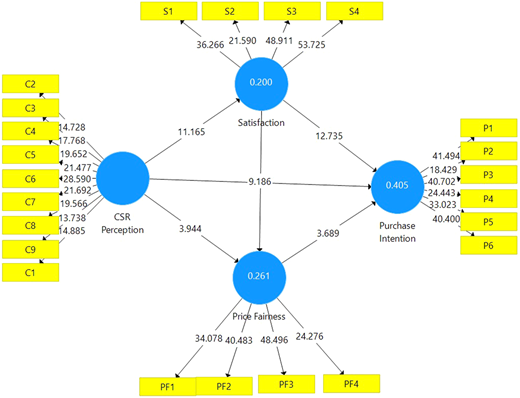
Structural model assessment starts with the investigation of co-efficient of determination, model fit index, predictive relevance, effect sizes, hypotheses testing and mediation analysis. Table 4 shows the R2 value for the model. R2 = 0.405 implies that around 40% variations in purchase intention can be explained through the other three research variables of the model. Purchase intention, being a broad marketing concept, depends upon numerous exogenous factors. Thus, this co-efficient of determination should be considered satisfactory in present case.
The global model fit index, SRMR value, showed satisfactory result, with value lying below the threshold limit of 0.08 (Hair, Ringle, & Sarstedt, 2011). The out-of-sample predictive relevance is also measured for the research model with Q2 value through the process of blind-folding (Sampaio, Hernández-Mogollón, & Rodrigues, 2019). As the value is different from zero, the model has good predictive relevance (Hair, Sarstedt, Ringle, & Gudergan, 2017).
Measuring the effect size for each independent variable is also crucial in a research model. The f2 values measure the individual effect sizes for each variable as shown in Table 5. CSR perception has a medium effect size on price fairness but high effect size on satisfaction, price fairness has a low effect size on purchase intention, satisfaction has high effect size on purchase intentions (Hair et al., 2020).
3.4.4 Hypotheses testing
Table 6 shows the result of hypotheses testing for the research model through bootstrapping procedure of SMART-PLS-3 at 5,000 sub-samples. All these hypotheses are supported at 5% significance level. CSR perception has a significant positive influence on price fairness with a t-value of 3.998 (p-value = 0). CSR perception also has a significant positive influence on satisfaction with a t-value of 11.179 (p-value = 0). Price fairness impacts purchase intention significantly with a t-value of 3.640 (p-value = 0). Satisfaction also significantly impacts purchase intention positively with a t-value of 12.690 (p-value = 0). The structural model results are shown in Figure 1 below.
Hypotheses testing
| Original sample (O) | T statistics (|O/STDEV|) | p-values | |
|---|---|---|---|
| Direct effects | |||
| H1: CSR perception → Purchase intention | 0.030 | 0.737 | 0.461 |
| H2: CSR perception → Price fairness | 0.182 | 3.998 | 0.000 |
| H3: CSR perception → Satisfaction | 0.447 | 11.179 | 0.000 |
| H4: Satisfaction → Purchase intention | 0.536 | 12.690 | 0.000 |
| H5: Price fairness → Purchase intention | 0.148 | 3.640 | 0.000 |
| H6: Satisfaction → Price fairness | 0.403 | 8.982 | 0.000 |
| Specific indirect effects | |||
| H7: CSR perception → Satisfaction → Purchase intention | 0.240 | 8.262 | 0.000 |
| H8: CSR perception → Price fairness → Purchase intention | 0.027 | 2.802 | 0.005 |
| H9: CSR perception → Satisfaction → Price fairness → Purchase intention | 0.027 | 2.998 | 0.003 |
3.4.5 Mediation analysis
The research model proposed three mediating relationships which were also investigated at 5,000 sub-samples through the bootstrapping procedure. The first mediation relationship (H7) proposed a mediating effect of satisfaction on the relationship of CSR perception and purchase intention. The specific indirect effect was found significant in the model at 5 significance level as shown in Table 6. As the direct effect of CSR perception was found to be significant on purchase intention (p-value = 0.000) after the introduction of the mediator, it is a case of full mediation (Hair et al., 2017). Furthermore, the second mediation (H8) is assessed amongst CSR perception, price fairness and purchase intention shown in Table 6. The specific indirect effect was found significant (t-value = 2.802) (p-value = 0.005), with the same insignificant direct effect. It also resulted in a case of full mediation. Thus, it is concluded that the research model witnessed two cases of full-mediation. The sequential mediation of satisfaction and price fairness (H9) is also found to statistically significant (t-value = 2.998) (p = 0.003).
4. Discussion and conclusion
The main objective of this study is to measure the influence of CSR perception of Generation Z consumers on their purchase intention taking fast-food industry as context. The summary of findings is as below:
CSR perception does not have direct influence on purchase intention of Generation Z adult consumers.
CSR perception positively influences their satisfaction and perception of price fairness.
Satisfaction and price fairness sequentially mediates the relationship between CSR perception and purchase intention in that order.
Studies on perceptions of CSR have shown a significant positive association between CSR and purchase intention (Gupta, 2011; Planken, Nickerson, & Sahu, 2013). But the results of our study support the findings of Castaldo, Perrini, Misani, and Tencati (2009) and Ramesh, Saha, Goswami, Sekar, and Dahiya (2019) who found through their research that there is no direct relationship between the two. Most of the South Asian food companies including Indian QSRs do not spend much on CSR (Ikram, Qayyum, Mehmood, & Haider, 2020). Even when they spend, the communication about CSR to them is not effective to influence purchase intention (Ramesh et al., 2019). CSR activities alone may not be enough to improve purchase intention of Generation Z adults in the fast-food industry. They may be looking for service and product quality. Hence, the direct influence of CSR perception on purchase intention is not there.
The study found a direct positive relationship of CSR perception with satisfaction. This is in agreement with the findings of researchers such as Rivera et al. (2016) and Saeidi et al. (2015). The reason for satisfaction being an outcome of CSR perception is in line with the social psychological perspective captured by cognitive consistency theory that states that people engage in ethical or pro-social behaviours at least partly due to selfish reasons – they want to feel good about themselves. Generation Z has a very high need of self-esteem (Arıker & Toksoy, 2017) that gets satisfied to a certain extent when they buy products of companies that take CSR initiatives (Bhattacharya & Sen, 2004).
According to our study, there is a significant positive relationship between CSR perception and price fairness. Thus, customers are willing to pay higher prices for the products of a company that is socially responsible (Barone et al., 2000; Sen & Bhattacharya, 2001). Social identity and social justice theories propound that the relationship between a customer and a firm has an exchange angle, based on customers' own wants, and a citizenship dimension, influenced by social values (David, Kline, & Dai, 2005). Consequently, perceived price fairness is affected not only by the value that the customer obtains from the exchange of goods and services but also how value is distributed amongst other stakeholders such as employees, the society as a whole or the environment. Generation Z is more socially conscious than previous generations and as it has better access to information, it has a fair idea about CSR activities undertaken by different organisations (Ha, 2021). “Generation Z tends to choose brands that can show their identity and are willing to pay higher brand premiums” (Zhang et al., 2021, p. 1,358). Based on tenets of cognitive consistency theory we can, thus, conclude that Generation Z consumers are ready to pay even a higher price for products of fast-food companies engaging in CSR activities.
Our study establishes that CSR perception has a powerful effect on consumers' purchase of fast-food with satisfaction and price fairness acting as dual mediators. This implies that CSR perception about fast-food service provider will lead to purchase intention only when CSR initiatives provide customer satisfaction and Generation Z perceives the prices charged as fair. Thus, allowing restaurants to recoup some of the increased costs on account of CSR expenditure.
5. Implications and limitations
5.1 Theoretical implications
This study adds to the academic literature by developing and evaluating a research model for consumer responses to CSR in the context of an emerging economy setting. This study also shows the importance of consideration of demographics in CSR research amongst consumers. In Indian context, we found that Generation Z responds positively to CSR whereas Tian, Wang, and Yang (2011) obtained similar results, albeit for middle aged consumers and not for young adults, in the context of another emerging economy – China.
Secondly, our results show that CSR perception does not result in purchase intention directly. To put it another way, CSR initiatives may not be enough to boost Generation Z consumers' desire. Thus, the advantage offered by CSR as a strategy may not necessarily lead to competitive edge. Furthermore, the findings suggest that the cognitive consistency theory can aid researchers in better understanding the perception and behaviour processes in the CSR literature. When using the cognitive consistency theory to find the association between CSR perception and purchase intention, future researchers should examine additional mediators and influence of moderators such as CSR awareness (Boccia & Sarnacchiaro, 2018) and brand image (Li, Teng, Liao, & Lin, 2020).
Regarding sequential mediation results, our empirical findings show that satisfaction and price fairness fully mediates the relationship between CSR perception and price intention. Carvalho et al. (2010) have found similar results in context of the emerging economy of Brazil but without taking into account the effect of demographics of consumers. Sequential mediation results also indicate that for Generation Z adults' relationship between CSR and price fairness flows through satisfaction and finally to purchase intention. This finding is interesting because it clearly establishes a link amongst belief, attitude and actions of our target audience under study in a meaningful way within the framework given by cognitive consistency theory. In this manner, it adds to literature on Generation Z even.
5.2 Managerial implications
This research finds that fast-food restaurants that have a positive CSR perception attached to them have a greater chance to be successful in a very competitive industry by increasing satisfaction and price fairness of their most important customers – Generation Z. Our research will aid not only the fast-food industry but entire hospitality sector that is looking to focus on what Generation Z consumers expect in emerging markets including India. Understanding consumer expectations out of CSR initiatives will help them to incorporate social considerations into their marketing strategies and increase their profitability.
The companies should ensure that they not only invest in CSR initiatives but also create awareness about either CSR initiatives to ensure CSR perception translates into buying behaviour. This, they can easily do by entering into tie-ups with educational institutions and involving students in their CSR activities. Generation Z will be willing to contribute because they are social conscious and want to create an impact in the society (Ha, 2021). The members of this generation in India want to contribute to the development of the nation (Hameed & Mathur, 2020).
Generation Z is considerably technology savvy and uses information acquired through it to make decisions (Kautish, Hameed, Kour, & Walia, 2022). As a result, this generation “has a good understanding of right and wrong” (Williams & Page, 2015, p. 48). If they are satisfied with the kind of CSR initiatives being undertaken by companies, they understand that these bring additional burden to the companies that are passed to the consumers. This further necessitates the importance of communicating about CSR initiatives to Generation Z consumers. In their research, Serra-Cantallops, Peña-Miranda, Ramón-Cardona, and Martorell-Cunill (2018) state that the dissemination of such information by a company can give it a clear advantage over others who do not. Even in the restaurant setting, customers' perception of CSR initiatives, affects their evaluation of the same (Sung, Tao, & Slevitch, 2020). The managers should use all possible social media platforms for this purpose as almost 40% of adult Gen Zers say social media has the greatest influence on their purchase intention (Bhargava, Finneman, & Schmidt, 2020). Researchers such as Djafarova and Bowes (2021) have studied the effectiveness of Instagram, a popular social media platform, as a marketing tool for influencing purchase intention of Generation Z. Fast food companies can also use such platforms to influence behaviour of Generation Z in their favour.
Our research has implications for marketing managers and experts in strategy making not only in case of food industry but also hospitality sector. In fact, restaurant industry has been using CSR as a strategy since last two decades (Lee & Heo, 2009). Generation Z is regarded as the most challenging consumer demography to market to, due to their proclivity for conducting extensive research and comparison shopping before making a purchase decision (Thangavel, Pathak, & Chandra, 2021). As a result, the companies that want to use CSR as a strategy may find it advantageous to investigate how marketing of their CSR initiatives will lead to competitive edge and influence purchase decisions of this generational cohort. The companies can use cultural and sports events organised by universities and business school to do branding of their CSR initiatives. At the industry level, the players in this space can come together and their association can set the agenda by designing CSR initiatives specifically aimed at enthusing Generation Z. Similar exercises have been pioneered by restaurant associations of countries such as the United States (Park & Lee, 2009).
5.3 Limitations and future research
The objective of the study was to examine the influence of CSR perception on purchase intention.
We introduced only two mediators – satisfaction and price fairness. Influence of moderators such as CSR awareness and mediators such as brand loyalty and values may be incorporated in future studies. Secondly, our sample consisted of Generation Z university students only and was restricted to fast-food industry, making this an important limitation on the extent of coverage of the current study. Future studies can be applied to a wider field of participants and comparisons drawn between different generational cohorts in across industry context. Though members of Generation Z in India exhibit behaviours and preferences that are identical to those of their global counterparts (Hameed et al., 2018); it would be interesting to carry this study in context of other emerging economies. Finally, this study was conducted as cross-sectional survey-based research. In order to better understand the causal relationship between our research constructs, future researchers can conduct experimental scenario-based studies.

