This study is threefold. First, it explores the key predictors of turnover intention (TI) among academic staff. It further examines how transformational leadership (TL) is associated with TI among these staff, and whether organizational culture (OC) mediates this association.
This study adopted a quantitative and cross-sectional survey design. Data were obtained using a structured questionnaire on a sample of 574 respondents drawn from a population of 4,192 academic staff using cluster and simple random sampling techniques. Data were analyzed using SPSS statistical software v23 and hypotheses were tested using Process Macro v4.2 (Model 4).
This study found a negative relationship between TL and TI. Furthermore, OC partially mediates the relationship between TL and TI. Thus, our study proves that there is both a direct and indirect relationship between TL and TI through OC.
First, the study was limited to academic staff at selected universities in Uganda, which may limit the generalizability of the findings.
In order to retain valuable academicians, leadership and culture are of central concern for universities. Accordingly, university managers need to invest in the development and promotion of TL traits to effectively foster an inclusive and encouraging atmosphere (OC) that facilitates staff to stay longer.
The study adds to the body of knowledge by providing key evidence on the predictors of TI among academic staff. The indirect mediation results offer some new insights into theory and practice. This is relevant to understanding the concept of TI and filling the empirical and practical gaps that exist in the academic context.
Introduction
In a time marked by globalization and swift technological progress, competition has intensified across various sectors, making human resources (HR) a key factor in determining an organization’s success (Tran et al., 2020). Unlike other resources, HR brings unique knowledge, skills and competencies that are essential for maintaining a competitive edge and ensuring long-term growth (Chen et al., 2023). Consequently, higher education institutions (HEIs) must also focus on retaining skilled and experienced HR, as they play a vital role in driving societal development and economic progress (Al-Sada et al., 2017). Specifically, HEIs are tasked with producing knowledgeable individuals who can compete globally, which is particularly critical for countries like Uganda as they strive to recover from the impacts of COVID-19 (Haque, 2023; Khan et al., 2022). Retaining top academic talent is crucial for upholding the quality and consistency of educational programs (aligned with SDG 4) and directly affects the knowledge, innovation and research capabilities of universities. This, in turn, influences national development objectives, such as those outlined in Uganda’s Vision 2040 (Hom et al., 2017).
However, Ugandan HEIs face an ongoing challenge in retaining academic staff, leading to turnover intentions (TI) (Haque, 2021) that threaten both the knowledge base and the financial resources of institutions (Dubey et al., 2022). For example, 40% of academic units at Makerere University operate at a low staff level. In addition, between 2012 and 2018, 68 staff voluntarily quit Makerere, Kyambogo (38), Gulu and Kampala International (26), Mbarara (29) and Ndejje University (17) (Tumwesige et al., 2020; Opolot et al., 2023). High turnover rates result in the loss of institutional memory, reduce productivity, and increase recruitment and onboarding costs, all of which hinder HEIs’ ability to meet their strategic goals of enhancing Uganda’s capital development (Hom et al., 2017). In response, HEIs are implementing HR policies aimed at fostering staff commitment and mitigating TI, yet many of these strategies fall short due to an incomplete understanding of the underlying drivers of TI. Therefore, this unprecedented puzzle pauses the question: What is the role of leadership and culture within HEIs toward staff retention? How does culture mediate this link?
Past research highlights transformational leadership (TL) as a particularly effective style for enhancing retention, as it fosters employee engagement and loyalty through individualized support, inspirational motivation and intellectual stimulation (Noureen and Abbas, 2017). TL inspires a sense of purpose and alignment with institutional goals, thus addressing both intrinsic and extrinsic motivational factors that reduce TI (Johnson et al., 2018). However, while this relationship is acknowledged, limited studies have explored the mechanisms by which TL impacts TI within educational settings (Kim et al., 2023), and fewer still have done so in the context of developing countries like Uganda (Shahzad et al., 2022). This lack of research on the relationship between TL, OC and TI in Uganda, a landlocked and one of the fastest-growing countries in the East African region due to its contribution to the development of the global economy, is an issue of concern to practitioners and policymakers (Shahzad et al., 2022). This omission provides the opportunity to test the association within the Ugandan HEIs with the aim of generating solutions to the TI impasse. The theory of social exchange and specifically the reciprocity norm further support this line of inquiry, suggesting that positive leadership practices create a reciprocal relationship with employees, enhancing their sense of loyalty and reducing TI.
Despite the theoretical foundation supporting the link between TL and TI, gaps remain in understanding how organizational culture (OC) could mediate this relationship (Givens, 2008). OC defines how things are done within an organization following established values and norms that shape organizational practices, employee attitudes and performance (Schein, 2017). Organizations that invest in supportive and mission-aligned OC not only reinforces leadership initiatives but also creates an environment where staff feel valued and connected to the institution’s mission, thereby reducing TI (Ogbonna and Harris, 2000; Pawirosumarto et al., 2017). Notably, research indicates that improvement in OC is an underpinning antecedent in maintaining staff retention, suggesting that the competing value framework (CVF) is a means to align the internal and external business environment (Krajcsak, 2018). To develop and maximize a robust OC that responds to both employee and organizational needs, organizations need to undergo cultural transformation (Hashmi et al., 2020; Krajcsak, 2018). In the future, the organizational cultures can be studied in the context of other leadership styles. Universities can be successful at sustainable talent retention and performance when clan, adhocracy, hierarchy and market culture typologies are adopted. However, despite the projected benefits of the CVF, few scholars have adopted it in relation to TI (Opolot et al., 2023). In addition, the effect of OC on TI has produced inconsistent results, justifying our study in a university context with varied cultural orientations (Nhat Vuong et al., 2023). By examining OC as a potential mediator, this study aims to clarify how TL and OC interact to influence TI, thus providing actionable insights for HEIs in developing contexts like Uganda.
Our research aims to fill gaps in current knowledge in several ways. Firstly, addressing how TL influences TI among academic staff in Ugandan universities, with a specific focus on the mediating role of OC. Guided by social exchange theory (SET), we propose that TL fosters a positive work environment by nurturing trust, reciprocity and shared values, which are further reinforced by a supportive OC. Through this approach, we aim to provide a comprehensive understanding of the complex interplay between TL, OC and TI, thereby informing both theory and practice which had previously been ignored (Malokani et al., 2023). This study not only confirms the mediating role of OC but also contextualizes its impact in Ugandan HEIs, highlighting how OC can amplify the positive effects of TL on employee retention. This represents a critical addition to the literature, as it challenges assumptions and generalizations drawn from studies in more developed contexts and offers a culturally nuanced understanding. Secondly, we focus on the higher education sector in the developing world, differentiating our study from previous research conducted in developed economies and specific contexts (Rubenstein et al., 2018). Unlike research conducted in developed economies, where organizational structures and resources are more robust, this paper sheds light on how TL, when supported by a strong and adaptive OC, can mitigate TI in resource-constrained environments. By doing so, it bridges the gap in understanding the specific challenges and mechanisms of leadership and culture in developing economies, offering localized strategies that can guide policy and managerial practices. Thirdly, the study’s findings are expected to offer valuable insights for policymakers, HEI administrators and HR practitioners seeking to implement leadership and cultural strategies that enhance staff retention, thereby supporting Uganda’s higher education sector in achieving long-term stability and growth. Finally, the paper’s structure includes, theoretical and literature review, methodology, results, discussion, conclusion, implications and limitations.
Empirical literature review and hypotheses development
Theoretical foundation
This study pivots on the social exchange theory (SET), which states that employment relationships are evaluated based on reciprocity in terms of cost–benefit, risk or reward (Chernyak-Hai and Rabenu, 2013). The theory suggests that employers and employees interact on a social level of give and take. In our study, positive interactions facilitated by TL create a supportive and harmonious OC, which in turn leads to increased commitment and reduced TI among academic staff (Herman et al., 2013). As a result, a cycle of positive social exchange is established in the academic work environment. SET underpins our study because it clarifies how OC acts as a mechanism through which TL influences TI (Ali et al., 2024).
Transformational leadership (TL) and turnover intention (TI)
TL has been shown to affect employee behavior and attitudes, as indicated by previous research in the field of leadership (Donkor et al., 2021; Haq et al., 2022). Providing a supportive and inspiring work environment encourages employees to stay, as they feel valued, engaged and connected to a meaningful organizational vision (Yücel, 2021). This relationship between leadership and employee retention is supported by SET, which suggests that stakeholders engage in social relationships with the expectation of receiving benefits or compensation in return for their contributions (Saeed and Jun, 2022). TL, with its inspirational and supportive behaviors, creates a positive exchange dynamic that fosters a sense of reciprocity among employees (Ali et al., 2024). As a result, TL creates a social environment characterized by trust, open communication, mutual respect and commitment, which reduces the likelihood of employees seeking alternative employment opportunities (Malokani et al., 2023). Moreover, Promchart and Potipiroon (2020) established that TL significantly impacts on TI decision by transforming the self-interests of followers to a collective vision and inspiration to reach the higher organizational goals (Park and Pierce, 2020). Further, Diko and Saxena (2023) resonate that TL significantly impacts on TI decision. While some studies suggest that TL negatively correlates with TI, others have found this link to be insignificant (Long et al., 2012; Manoppo, 2020; Ram and Prabhakar, 2010). This study questions the relevance of TL in predicting TI among academic staff (Yücel, 2021). By conducting a localized study, this research adds to the existing literature on the topic (Chen and Francesco, 2000).
TL is significantly related to TI.
Organizational culture (OC) and turnover intention (TI)
OC continues to be a crucial factor in predicting TI. The SET posits that culture functions as an exchange mechanism that fulfills the needs of both employees and their organizations (Kim et al., 2017). As a result, OC shapes the work environment, values and practices that influence the employment relationship. A strong OC fosters team cohesion, collaboration and collective efficacy (Alzubi, 2018), which are essential in determining employee retention. A positive culture promotes a sense of belonging among employees, making them feel valued, respected and appreciated, thus increasing their prospect of staying (Helalat et al., 2023). In contrast, a toxic or unsupportive culture can lead to higher TI due to perceived cultural dissatisfaction (Idiegbeyan-Ose et al., 2018).
To curtail effects of TI, organizations should align their culture with employee expectations and address the factors driving intention to leave (Vizano et al., 2020). Studies have shown that culture and its dimensions play a crucial role in retaining experienced staff, and that negative attitudes toward culture can accelerate to TI (Lee and Jang, 2020). However, there is a lack of empirical research identifying specific OC mix that predict TI (Kim et al., 2017). Similarly, these studies seem to contradict each other, pausing a theoretical gap (Akanji et al., 2021; Bosomtwe and Obeng, 2018; Kim et al., 2017). To fill this gap, our study uses the CVF, a validated and comprehensive cultural model, to examine the relationship between OC and TI in universities (Chatman and O’Reilly, 2016). The CVF provides a mechanism for organizations to assess their culture and understand how these internal and external factors impact employee behavior. This model balances the interests of both employees and the organization, providing an environment characterized by respect and concern for employees, fairness, innovation and stability of tenure. Therefore, the more staff are satisfied with OC, the more they are likely to stay with their employer. Hence, the subsequent hypothesis is derived:
OC is negatively associated with TI.
Transformational leadership (TL) and organizational culture (OC)
The success and effectiveness of an organization are heavily influenced by its culture, which is shaped by its leaders (Pedraza-Rodríguez et al., 2023). These leaders play a crucial role in creating a supportive and effective OC. This culture is important for navigating the turbulent business environment (Guimaraes et al., 2017). OC refers to the shared values, attitudes, expectations and work patterns of an organization (Calciolari et al., 2018). Leaders, as top decision-makers, are responsible for crafting, refining and motivating their followers to adopt the proposed culture (Kim and Toh, 2019). TL, with its focus on vision and forward-thinking, uses OC as a tool to unify employee behavior with organizational values (Mwangi and Waithaka, 2018). TL uses their experience to shape the tone, direction and identity of the institutional culture, aligning their actions, behaviors and interactions with their subordinates according to the accepted culture (Nguyen et al., 2023; Mlinarevic et al., 2022). As a result, TLs who impact followers by valuing and fulfilling their needs, promoting equity and goal attainment tend to earn their respect, trust and admiration (Wells et al., 2019). In line with the above, Lasrado and Kassem (2021) confirm that TL and OC studies don’t report any non or negative connection. However, Park and Pierce (2020) established a weak and non-significant link between TL and TI of child welfare workers. Similarly, there is limited research on this topic in HEIs (Gyensare et al., 2017). Further, the present evidence on this has been concluded in other developed contexts, undermining the generalization of the findings (Lasrado and Kassem, 2021). Therefore, it remains to be explored whether TL exerts a positive impact on OC in Uganda, a non-western country. Our study integrates SET and literature to provide a nuanced understanding of how TL can effectively influence follower and organizational expectations via OC. Thus, we hypothesize that:
TL is significantly related to OC.
Mediating role of organizational culture
Over the years, researchers have aimed to develop effective strategies to decrease TI in organizations (Yücel, 2021). Drawing from the SET, OC can act as a mediating variable in the relationship between TL and TI. Specifically, leaders who practice and promote transformative values create a favorable work environment characterized by mutual respect, involvement in decision-making and problem-solving, and free interpersonal interactions with staff members. This environment fosters staff members' affective and empathic response to their leaders, an increase in their prosocial behaviors and a reduced desire to leave the organization. Previous studies have supported the mediating role of OC between TL and performance (Nguyen et al., 2023), TL and knowledge management (Esfahaniet al., 2021), TL and organizational excellence (Lasrado and Kassem, 2021), employee dissatisfaction and TI (Faeq and Ismael, 2022), and TL and change management (Bagga et al., 2023). However, empirical studies that confirm the role of OC in reducing TI in developing nations are scarce (Gyensare et al., 2016). The positive association between TL and OC (Kumar et al., 2024; Ince, 2023) and a negative link between OC and TI (Jacobs and Roodt, 2008; Bosomtwe and Obeng, 2018) have been established by previous studies, with OC also serving as a moderator or predictor in TI studies (Golden III and Shriner, 2019). Nonetheless, contradictory evidence exists where OC was not found to mediate significantly. Qi et al. (2022) observed that while TL reduced TI directly, its effect through OC was contextually dependent. The inconsistent findings regarding TL and TI could be attributed to other interrelated factors, suggesting an opportunity to clarify the relationship between them via the OC mechanism (Helalat et al., 2023). The mechanism sheds light on how TL instills a value and belief system that influences academic staff’s behavior and job retention (Gyensare et al., 2016; Kariuki et al., 2022). By building strong TL values and OC, job switching behavior among academic staff can be curbed. OC provides a mediating role through which TL influences the work environment and staff behavior, including TI. In line with the above empirical logic and SET, we hypothesize that:
OC mediates the link between TL and TI.
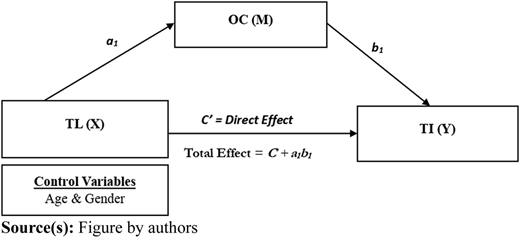
To address the gaps identified in the literature review section, this study used Figure 1 as its conceptual model, with the primary goal being to investigate how TL (X) influences TI (Y), with OC (M) acting as a mediator. OC is the proposed mechanism through which HEIs can apply TL to reduce job switching (TI) among academic staff. In testing these relationships, MacKinnon (2012) procedure was followed, which entails:
- (1)
Existence of a significant connection between TL (X) and OC (M), path a1 of Figure 1.
- (2)
Existence of a significant connection between OC (M) and TI (Y), path b1 of Figure 1.
- (3)
Testing the influence of TL (X) on TI (Y) in the presence of OC (M), path C′ of the conceptual Model (Direct effect). It is not mandatory for this relationship to exist for mediation to take place. If a significant relationship exists in this path, then we have a partial mediation. However, existence of insignificant relationship reveals a full mediation.
- (4)
Testing for mediation involves multiplying the coefficient of path a1 of the conceptual model and the coefficient of path b1 of Figure 1.
- (5)
Getting Total effect = Direct effect (C′) + Indirect effect (a1 × b1).
Methodology
Research design and sampling procedures
A cross-sectional study was undertaken to explore the influence of TL and OC on TI in universities characterized by high staff turnover rates (Raveendran and Gamage, 2019). In this design, we collected data at a particular point in time without making a revisit to scrutinize the possible changes that could arise with the lapse of time, as opposed to a longitudinal design. The use of this design has been validated by various TI studies (Ali et al., 2024; Alzubi, 2018; Kim et al., 2023; Nilsen et al., 2023) as being cheap and fast in data collection, given the limited time and resources available to undertake research. The sample consisted of 878 participants out of a population of 4,192 academic staff from the rank of assistant lecturer to professor drawn from eight universities (Yamane, 1967). Cluster sampling was used to divide the population into groups for data collection. Each university was a cluster, and academic staff were selected using a simple random technique at the departmental level. A total of 578 questionnaires were received from the respondents, resulting in a 65.8% response rate. The final sample comprised 367 males (63.9%) and 207 females (36.1%). The respondents' age distribution was as follows: 54 (<30 years), 260 (31–40 years), 193 (41–50 years), 60 (51–60 years) and 7 (>60 years).
Variables measurement
The variables in this study were measured using self-reported scales that have been used in previous studies. The scales were assessed on a 7-point Likert scale, ranging from 1 (strongly disagree) to 7 (strongly agree) and were found to be reliable (Kusmaryono et al., 2022). The multifactor leadership questionnaire was used to measure TL and had a sample item of “My supervisor spends time coaching employees” (Hosseini et al., 2020). OC was observed as a 24-item measure (Cobbinah et al., 2020; Cameron and Quinn, 2011). This scale had elements like “The academic staff in my university share a lot of things in common”. TI was measured on 14 items by Jacobs and Roodt (2008). A representative item is “I think a lot about leaving this university”. The final scores for the variables were obtained by computing the mean values of their respective scales (Madi Odeh et al., 2023). The reliability of all scales exceeded the 0.70 threshold value (Madrigal et al., 2016), ensuring the reliability of the study’s measures.
Correlation results
Before analyzing the data, the relationship between TL, OC and TI was examined using a Pearson correlation analysis. The results, shown in Table 1, indicate a positive correlation between TL and OC (r = 0.633; p < 0.001). Additionally, the analysis revealed a negative correlation between TL and TI (r = −0.129; p < 0.001). Furthermore, OC is negatively correlated with TI (r = −0.305; p < 0.001).
Hypotheses tests
We conducted hierarchical regressions as shown in Table 2 to test our theoretical model. In model 1, the control variables (gender and age) were found to be non-significant, suggesting that our model is not biased. The results also showed that the control variables explain only 0.2% of the variance in TI as shown by (R2 = 0.002, F = 0.445, p > 0.05). In model 2, TL was found to negatively and significantly influence TI (β = −0.035; p = 0.002) after holding constant gender and age. Both control variables were insignificant in this model, as shown by p > 0.05. The model is statistically significant (F = 9.551; p < 0.01), and the variables in this model (covariates and TL) account approximately 2% of the variability in TI as shown by R2 = 0.018. Additionally, the change in R-square value of 0.016 implies that TL explains 1.6% of the variance in TI. These results support H1. In model 3, OC was found to be negative but significantly related to TI (β = −0.981; p < 0.001). Both covariates were found to be insignificant, as TL (β = 0.030; p < 0.05) was found to have a significant effect on TI. This model is statistically significant (F = 52.931; p < 0.001), and the variables in this model (controls, TL, and OC) show an R2 of 0.102, indicating that the model explains 10.2% of the variability in TI. Additionally, the change in R-square value of 0.084 suggests that OC accounts for 8.4% of the variance in TI. These results support H2.
Mediating effect
To investigate the mediating effect of OC, Hayes (2022) PROCESS macro version 4.2 (Model 4) was employed following MacKinnon (2012) conditions as previously discussed under the conceptual model section (Figure 1). These conditions include a mandatory relationship between TL and OC (path a1). Results in Table 3, Model 1 reveal that both the covariates (Gender, β = −0.001, p > 0.05, and Age, β = −0.002, p > 0.05) were insignificant. However, TL was found to be positively and significantly related to OC (β = 0.066, p < 0.05). Results further indicate that this model accounts for 40.2% of the variance in OC as shown by R2 = 0.402, F = 127.581, which was significant at p = 0.000. Based on these results, condition (i) is confirmed by the study. Model 2 of the same Table 3 presents the results of the relationship between OC and TI which is indicated as (path b1) of the conceptual Model. Findings in this model show that both the covariates (Gender and Age) remained insignificant as indicated by p > 05. Most importantly, results reveal that OC was found to be negatively but significantly having an influence on TI, as shown by β = −0.981, p = 0.000. These results also confirm the mandatory condition (ii) of MacKinnon (2012). The same Table 3 and Model 3 highlights the findings of testing the relationship between TL and TI in the presence of the covariates and OC (path C′). Findings indicate that a positive and significant relationship exists between these variables (β = 0.030, p = 0.035). In addition, all the variables in this model 3 explain 10.2% of the variance in TI as shown by R2 = 0.102, F = 16.085, p = 0.000. A bootstrapping approach was used to test for the mediation process, with confidence intervals resampled 5,000 times at 95% CI (Ferm and Thaichon, 2021). To get the mediation results, the product of path a1 × b1 was computed = 0.066 × −0.981 = −0.065, with both CI = −0.087, −0.044 having a non-zero it confirms the existence of a mediation process between TL and TI via OC. Since the results of path C’ (direct effect) were also found to be significant, the study reveals partial mediation. Finally, model 4 of the same Table 3 indicates the results of the total effect. Findings show that both the covariates were insignificant as TL remained significant with β = −0.035, p = 0.002. This model explains approximately 2% of the variance in TI as indicated by R2 = 0.018, F = 3.485, significant at p < 0.05.
Discussion
The higher education sector plays a significant role in achieving sustainable goals for a country through the adoption of sustainable TL practices and a supportive OC. The first objective of this study was to assess the relationship between TL and TI. The study found that TL has a significant negative relationship with TI. This implies that the level of TL displayed by academic leaders in their day-to-day interactions in terms of empowerment, support, guidance and encouragement motivates employees to develop a sense being valued and supported reduces one’s quest to leave. In essence, employees who identify with values of their leaders exhibit high commitment and performance which forces them to reciprocate the just and exemplary actions by staying. This finding is in line with Ariyabuddhiphongs and Kahn (2017) in a tourist entity in Thailand observed that managers who exhibit TL style provide an environment where employees share ideas freely are challenged, guided through challenges, respected and obtain constructive feedback are likely to trust their leaders because they feel valued. This feeling of being surrounded by a supportive supervisor or mentor induces employees to remain with the organization. Indeed, Yücel (2021) study confirms that TL was instrumental in reducing TI among Turkish hospital managers during Covid 19. In addition, Xiong et al. (2023) elucidated that TL has a negative predictive effect on the TI of the new generation of knowledgeable employees in China. While these studies offer support to our study, they were carried out from varying contexts. Hence, our study provides more insight into how TL impacts on the academic staff desire stay in the university. Accordingly, SET is supported by the study findings. Academic staff who feel appreciated, cared for, supported and empowered are likely to retain their institutional membership due positive feelings, collegiality and close exchanges between them and their leaders. To maintain effectiveness and headcount in emerging economies, organizations should implement strategies that foster TL.
Secondly, our findings affirm that TL reinforces OC in universities. This implies that organizational leadership precedes OC as a means to regulate employee behavior in the continuously changing environment. This result illuminates TL as an activator of OC that needs to be nurtured and maintained. In summary, TLs are instrumental in shaping OC that aligns with their inspirational and developmental leadership approach. This can be achieved by increasing appreciation of lecturers’ contributions, exhibiting openness to new ideas, trust, offer guidance and address any potential obstacles that may emerge in the course of work, which goes beyond traditional OC-building channels. This result resonates with Odetunde and Ufodiama (2017) who postulate that TL has significant impact on OC within the Nigerian oil and gas service sector. Similarly, Nguyen et al. (2023) signaled the importance of TL in fostering a valuable OC to enhance the effectiveness of Vietnamese manufacturing firms. Mlinarevic et al. (2022) researched a preschool environment in Croatia and found that TL who worked with teachers reported high positive social relationships with subordinates due to their ability to create a positive, open, supportive and innovative OC. Further, our findings uphold the tenets of reciprocity, positive exchange and long-term relationships inherent in social interactions under SET. TLs who invest in inspiring, respect, freedom and motivating their followers benefit from followers who contribute to the development and maintenance of a positive and thriving OC (Rodrigues et al., 2024). Therefore, this study adds to the literature on the role of TL in building OC, following the CVF model in the university setup.
In addition, the study offers evidence that OC is linked to staff retention in HEIs. This suggests that once OC is understood, embodied and embraced by all stakeholders, it acts as a glue for social knowledge, identity and behavior that could impact staff stay. Specifically, OC shapes the workplace environment and influences how individuals perceive and interact within the organization. In the context of HEIs, an examination of the sub-dimensions of OC revealed that teamwork, support, fairness, rewarding and innovative cultures promote staff retention. This occurs as employees reciprocate the positive environment with an extended stay. In doing so, it signals that organizational leaders should pay attention to cultural aspects that may be causing dissatisfaction among academic staff. Addressing cultural issues could be a key strategy for retaining valuable and experienced talent within HEIs. This finding is consistent with previous studies. For example, Prajogo et al. (2021) linked employees' job happiness and intention to stay with the current establishment to the supportive and inspiring workplace culture. Recently, Faeq and Ismael (2022) observed that OC impacts the work environment in shaping employee behaviors and interactions while also contributing to the extent to which employees prolong their stay. Equally, our study expands SET by affirming that a reciprocal link between academic staff and their leaders can be developed through pleasant interactions (culture) between the two parties, resulting in increased job pleasure, loyalty and an inclination to stay (Rawashdeh and Tamimi, 2020). Hence, academic staff tend to stay when the OC displayed by their leaders is visionary, caring, non-blaming, supportive and respectful.
The most novel finding is that OC partially mediates between TL and TI. This means that the impact of TL on TI is transmitted through OC. Our study underscores the importance of cultivating a positive culture as a key pillar in reducing TI among academic staff. Usually, universities that prioritize collaborative, flexible, reward oriented and innovative work culture that align with the values of employees benefit from reduced TI. That is, the influence of TL is not always direct; instead, it can also be channeled through OC. As such, TLs are ideally responsible for establishing OC, which could in turn impact TI. Moreover, this study is in line with the study of Kharabsheh et al. (2017), which affirmed that OC partially mediated between TL and TI among Jordanian public hospital nurses. Further, Upadhyay and Kumar (2020) established the intermediating role of OC in the nexus between internal analytical knowledge and the capability of big data analytics in India. To this end, organizations that embed TL into their OC leverage the capabilities for better staff retention. This is reflected in the reciprocal convention of SET, where creation of a positive OC by TLs is viewed as a positive action for which followers are motivated reciprocate positively by extending their membership (Blau, 1968). By integrating TL, OC and TI into a single model, our study illuminates a better understanding of the fit of these constructs. Therefore, the present finding adds to the empirical evidence of negative direct and indirect linkages between TL and TI through OC.
Research implications
The study emphasizes our theoretical comprehension of TI and the practical part played by educational managers in curtailing TI.
Theoretical implications
This study presents valuable contributions to HR literature. Firstly, our study extends the social exchange theory (SET) by validating the core principle of reciprocation, affirming that academic staff’s intention to stay or leave are dependent on how supervisors fulfill their needs that form their decision to leave or stay. We contend that how supervisors treat staff through involvement, open dialogue, trust and respect will foster a positive culture that reduces TI. By fostering a supportive OC, leaders can leverage these reciprocal relationships to reduce TI, underscoring SET’s relevance in academic settings. Secondly, the partial mediation role of OC in the relationship between TL and TI adds a new dimension to the literature on organizational behavior within HEIs. This finding underscores that TL alone is insufficient for retention; the leadership style must be embedded in a positive OC to amplify its impact on TI. This aligns with the CVF model, which suggests that collaborative and supportive cultures contribute to organizational effectiveness. Thirdly, prior research has examined TL and OC independently, but few studies have integrated these elements within a single model, especially in HEIs in developing countries. Our study advances the literature by exploring the interconnectedness of TL, OC and TI, thus offering a comprehensive view of how these constructs interact in higher education contexts. This integrated approach contributes to a more nuanced understanding of retention dynamics in academia. Finally, previous studies have studied TI using a qualitative approach, particularly using case studies. The challenge with this is that they limit generalization. In this study, we have made a contribution in the use of quantitative data. This study extends the debate from the qualitative to the quantitative, where the results can be generalized to developing nations.
Practical implications
The findings of this study are a valuable resource for the HEIs and HR managers to build TL and OC to mitigate TI in the emerging nations like Uganda that grapple with talent retention in their quest attain global economic standing. Firstly, universities need to invest in the development and promotion of TL traits like inspiration, creativity, innovativeness, coaching and motivation among present and future academic leaders through training, mentorship and secondment to enhance talent retention in Ethiopian and South African universities (Mashile et al., 2021; Mulie et al., 2018). These examples demonstrate how tailored leadership practices and supportive OC in Ethiopian and South African universities can directly reduce TI by creating a positive and empowering workplace. Secondly, given that TL and TI can be heightened through the OC mechanism, HEIs should prioritize cultivating a collaborative, flexible and recognition-oriented OC. Key cultural elements like teamwork, fairness and recognition can promote staff retention by creating an environment where employees feel valued and connected to institutional goals. University administrators should consider periodic cultural assessments to identify and address areas for improvement, ensuring that OC aligns with the principles of SET and contributes positively to staff retention.
Limitations and future research
The proposed model was effective in addressing the objectives of the study in relation to the specified hypotheses, but several limitations should be acknowledged. First, the study was limited to academic staff at selected universities in Uganda, which may limit the generalizability of the findings. Future research in different settings could help validate these results by expanding the scope of respondents. Secondly, the study was conducted in a developing country, Uganda, future research could explore this phenomenon in other universities in East African states and other developing countries around the world. Thirdly, the study adopted a cross-sectional design, which was limited by time and cost constraints, provided only a snapshot of the variables under investigation. While this design offers timely data at relatively low cost, it does not capture changes that occur over time, making it difficult to determine the directionality of relationships or causality. Consequently, it is practically impossible to obtain exact variations in TI as predicted by TL and OC. A more comprehensive understanding can be achieved through a longitudinal design that considers the time lags and causal relationships between the variables. Finally, this study focused only on TL as a predictor of TI among academic staff. Future studies could explore other leadership styles such as ethics and sustainability to provide more representative results.
Conclusion
The importance of leadership in retaining staff within HEIs worldwide is crucial. By focusing on the case of Uganda, we found that university managers with TL traits foster staff retention. This is because TLs who address staff emotional, motivational and professional needs trigger an environment where staff desire to reciprocate their supervisor’s vision, admiration and empathy by protracting organizational tenure. Importantly, leaders shape the organizational cultural path. Our study demonstrates that TLs who exercise individual consideration, inspirational motivation, intellectual stimulate and ideal influence qualities have capacity to adjust OC to preserve social bonding and institutional existence. Additionally, OC is a key element to lower TI. A strong culture that promotes fairness, staff growth, teamwork and innovation enhance the organization’s overall appeal toward employees, persuading them to stay. Finally, OC partially enables the link between TL and TI. For universities to dwindle TI, they should focus not only on TL but also on OC as well. This calls for university leaders to institutionalize a strong culture that supports employees' well-being, aligns with their values and fosters inclusion and recognition. Thus, organizations that invest in TL and cultivate a positive culture significantly reap improved employee retention.