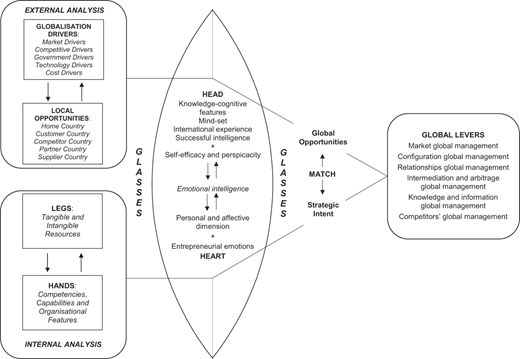
The purpose of this study is to build a proposal for an integrated analysis / evaluation / decision / implementation framework to suit entrepreneurial companies intending to redefine their strategic behaviours and their competitive schemes in the global environment.
A conceptual approach, based on theoretical perspectives relating to globalisation-based management and decision-making of entrepreneurs, is adopted.
The paper presents a conceptual framework useful for supporting entrepreneurial decisions for global strategies, drawing on an integrated analysis of external environment and internal components, with a specific focus on the entrepreneur's characteristics in terms of cognitive and emotional profiles. It is suggested to adopt a logical process aimed at identifying which strategic levers are available for entrepreneurial players to implement their strategies.
Entrepreneurial decision-making may benefit from an integrated framework which helps entrepreneurs, who aim to compete in the global marketplace, to explore and exploit all the key factors useful to defining their strategies.
There is a lack of decision-making frameworks that put the entrepreneur at the centre and, at the same time, present a potential balance between the external factors (globalisation drivers and local opportunities) and the resources and competences required to manage risks and difficulties of the global environment (internal factors). The originality of the proposed framework consists in filling this gap. Moreover, this framework can be useful for “re-born global” or “global-again” firms that are currently a neglected typology of studied firms.
1. Introduction
Scholars in the entrepreneurial field apply the general concepts and principles of the decision-making literature to entrepreneurs' decision-making (Berner et al., 2012; Shepherd and Rudd, 2014; De Winnaar and Scholtz, 2019). However, considering that entrepreneurs want to have control over their future when dealing with uncertainty (Alvarez and Barney, 2004), decisions are affected not only by the features of the decision-making process (e.g. rational vs intuitive) but also by the entrepreneurs' individual characteristics (Cardon et al., 2012). These characteristics are crucial for the creation, success, longevity and survival of entrepreneurial firms (Shane and Venkataraman, 2000; Pellegrini and Ciappei, 2015; Caputo et al., 2016). Academic contributions focused on antecedents of entrepreneurial orientation (Lumpkin and Dess, 1996; Shane and Venkataraman, 2000; Koellinger, 2008; Penco et al., 2020) have studied “personal” dimensions such as pro-activeness, risk-taking and innovativeness (Wiklund and Shepherd, 2005). The literature on decision-making has incorporated the role of the entrepreneur within the process, since an entrepreneur's individual characteristics affect the entire decision-making process and contents (Andersson, 2011; Sarasvathy et al., 2014).
In the international entrepreneurship domain, some contributions have investigated the topic of decision-making models. They are designed to employ decision makers' individual characteristics as factors that influence the decision-making process (Jones and Coviello, 2005; O'Cass and Weerawardena, 2009; Musso and Francioni, 2013; Verbeke and Ciravegna, 2018).
While contributions on international entrepreneurship are copious, studies focused on the decision-making process for entrepreneurial global firms are still limited. The authors understand that these studies are devoted to the specificity of the “born global firms”; companies that discover and exploit opportunities in multiple countries from inception (Andersson, 2011; Cavusgil, and Knight, 2015). Such findings lead us to believe that gaps exist in the current literature on this topic.
First, there is little attention paid to the peculiarity of the decision-making process for globalisation; this is the consequence of a significant chunk of the business literature studying internationalisation and globalisation that follow similar frameworks, based on the premise of irrefutable connection between these phenomena but without properly highlighting the differences (Levitt, 1983; Douglas and Craig, 1995; Hofstede et al., 1999). Globalisation is the process of supranational development, growing integration and deep interconnection affecting all human activities (Giddens, 1990, 1999; Govindarajan and Gupta, 2001), and it is based on deep integration, interrelation and interdependency between different economies and markets (Dicken, 2007; Baldwin, 2016). Therefore, companies that wish to compete in the global environment need a specific decision-making process to redefine their strategic behaviours and their competitive schemes in this context and to develop global strategies accordingly.
Second, the prevailing literature that is focused on decision-making in the global economy usually refers to large managerial corporations (Porter, 1986; Dunning and Lundan, 2008; Yaprak et al., 2011; Kim and Aguilera, 2015) and, more recently, on emerging market multinationals (Cuervo-Cazurra and Ramamurti, 2014; Buckley, 2018).
Third, focussing on the smallest and most entrepreneurial firms, the decision-making process for globalisation is studied only for the “born global firms”. These studies tend to accentuate the internal features of the “born global” phenomenon, following the resource-based perspective, the network-based approach and the international entrepreneurship framework (Andersson, 2011; Cavusgil and Knight, 2015), with a limited focus on the external drivers (Harveston et al., 2000; Dib et al., 2010; Bhardwaj et al., 2011).
Finally, considering that the core of global strategy is the integration of companies' competitive moves through key world markets whilst seizing global and local opportunities (Porter, 1986; Birkinshaw et al., 1995; Ghoshal, 1987; Cuervo-Cazurra, 2011), there is a lack of decision-making frameworks that put the entrepreneur at the centre and, at the same time, present a potential balance between the globalisation drivers and the exploitation of local opportunities on the one hand (Yip, 2003; Spulber, 2007; Ghemawat, 2007) and the resources and competences required to manage the risks and difficulties of the global environment on the other hand. This is especially true in the contemporary context in which new trends are changing the picture of globalisation, making it more difficult and risky for companies to act in the global market (Bhattacharya et al., 2017; O'Sullivan, 2019). We refer to recent phenomena such as the rise of protectionism, the slowdown of global value chains and the growth of digitalisation and automation of supranational business processes (Baldwin, 2016; Lund and Manyika, 2017; Miroudot and Nordström, 2019; Ketels et al., 2019).
Moreover the impact of micro-foundations literature on a global strategy is now emerging (Foss and Pedersen, 2004; Felin and Foss, 2005; Contractor et al., 2019); the focus is mainly on the behaviour and the characteristics of individual actors managing the decision-making process (Contractor et al., 2019). Nevertheless, it is recognised that the entrepreneur presents different profiles, unlike managers, founders/founding team and so on. In this vein, the personal characteristics of the entrepreneur strongly influence the potential way of defining the proper implementation patterns of global strategies.
Based on these premises, the purpose of this study is to increase understanding of entrepreneurial decision-making in relation to global strategies. A conceptual framework (proposed as a decision-making instrument) was developed with the aim of managing market interdependencies in the global context and defining the implementation patterns of global strategies. The model incorporates the external characteristics of the international environment (analysed in the double dimensions of globalisation drivers and local specificities) and the firm's internal factors. The model also considers the individual characteristics of entrepreneurs. This framework is useful for entrepreneurial global firms, especially to those that can be defined as “re-born global” or “global-again” firms; those firms that are well-established in their domestic markets that suddenly embrace rapid internationalisation due to “critical” organisational events or due to changes in the external environment (Bell et al., 2001). These firms face the management of various local factors, as well as global emerging drivers, transferring knowledge and capabilities developed in the domestic situation to global markets and seizing appropriate opportunities (e.g. market, innovation and institutional drivers such as de-regulation).
A global strategy emerges from different levels of analysis: macro (global or country environment), meso (firm) and micro (entrepreneur, manager or decision-maker) levels (Contractor et al., 2019). This paper offers a contribution to the literature that examines these complex relationships in a global context, where global and local external drivers (Yip, 2000; Spulber, 2007), factors related to the firms and entrepreneurs' personal profiles influence processes and content of the decisions and impact the prospects of success (O'Cass and Weerawardena, 2009; Bolzani and Der Foo, 2018). This study also has managerial implications, supporting global entrepreneurial firms (especially the “re-born” firms) to face problems and make decisions to define the strategic global levers offering a frame to use and check (Yip, 2003).
The remainder of this paper is organised as follows. Section 2 introduces the concepts of the entrepreneurial decision-making process (with a focus on entrepreneurs' personal characteristics) and the specificities of decision-making process for global strategies. Section 3 explains the proposed framework. Section 4 introduces a narrative case study to offer a first example of the possibilities of application of the framework. Section 5 discusses the academic and practical implications of the framework. Finally, Section 6 describes limitations and future research directions.
2. Theoretical background
2.1 Entrepreneurial decision-making
Decision-making by entrepreneurs has recently emerged as one of the most important topics within the field of entrepreneurship, and it has been studied within the context of general concepts and principles of the decision-making literature (Shepherd and Rudd, 2014; De Winnaar and Scholtz, 2019; Berner et al., 2012). The existing literature has identified different approaches, some of which are discussed below.
The first approach is a “rationalistic” one. From a rationalistic perspective, decision-makers are aware of all the impacts and consequences and make decisions to maximise their performance (Lunenburg, 2011). Simon (1955), proposing the concept of bounded rationality, suggests that decision-makers cannot be perfectly rational. The limited amount of information that they have, as well as the articulated motivational frame that is the basis of their actions, leads decision-makers to build a simplified model of the reality they are interested in. This model is also influenced by other factors, such as the external pressure of time constraints and moral obligations (Klein, 2008). In the strategic management field, the rationalistic (and bounded) approach adds to the strategic planning approach (Lorange, 1980). The literature on entrepreneurship has underlined the relevant role of strategic planning in supporting entrepreneurial decision-making (Chwolka and Raith, 2012).
The second approach is “intuitive” and “behavioural”: a successful strategy is an emergent one and a “pattern in a stream of actions” taken by members of an organisation, as opposed to a rationalistic plan (Mintzberg, 1987). A dilemma in management theories is often whether decisions are more effective and successful if they stem from rationality or if they stem from “creative intuition” (Mintzberg, 1987). Consistent with Sadler-Smith (2004), rationality and intuition comprise two different cognitive styles, the diversity of which depends on the information analysis (rational and intuitive) and on the organisation of information in the mind of the decision-maker.
In the entrepreneurship domain, several contributions have focused on aspects of decision-making (Shepherd et al., 2015). Investigating how an entrepreneurial decision process is structured, as well as why some decisions succeed or fail, is important for the creation, success, longevity and survival of entrepreneurial firms in their different forms (e.g. start-ups, small and medium enterprises (SMEs), family firms, etc.). In the entrepreneurial decision-making process, the intuitive approach is in line with the theory of bounded rationality (De Winnaar and Scholtz, 2019).
Focussing on the international entrepreneurship domain, two dominant theories regarding the decision-making process can be identified. The first theory, discussed by Sarasvathy (2001), refers to the causation process (derived from the rational decision-making perspective), while the second is focused on the effectuation process, which starts from a given set of characteristics of the entrepreneur (e.g. traits, mindset and skills) that affect her/ his knowledge and social networks (Andersson, 2011). In this latter perspective, the entrepreneur is regarded as one who “effectuates”, that is […] an imaginative actor who seizes contingent opportunities and exploits all means at the hand to fulfil a plurality of current and future aspirations, many of which are shaped and created through the very process of economic decision-making and are not given a priori (Sarasvathy, 2001, p. 262). The “effectuation theory” explicitly situates the entrepreneur at the centre of the international decision-making process (Andersson, 2011; Sarasvathy et al., 2014). In this vein, the literature devoted to international decision-making processes studies the entrepreneur's personal profile.
2.2 Factors affecting entrepreneurial decision-making: the role of an entrepreneur's profile
Studies focused on understanding how decision-making processes develop in entrepreneurial firms have analysed the entrepreneur's personal profile (Shepherd, 2015). As Wickham (2001) remarks, the entrepreneur is the individual at the core of the process and her/his creativity and leadership form the inception of the entrepreneurial adventure, and an in-depth analysis of these variables is key in understanding the path towards decisions.
In the cognitive-knowledge approach, the sociology literature considers entrepreneurs to be embedded in a social context; in this view, their socio-economic characteristics, such as family; education and training level; entrepreneurial and technical background and previous experiences, are all relevant in shaping how they develop the decision-making process (Koellinger, 2008; Shane and Venkataraman, 2000). In the psychology domain, on the other hand, other variables addressing individual attributes have been examined: innovativeness, creativity, self-confidence, locus of control, risk-taking, high level of individualism, openness to change and self-enhancement. Low levels of power, conformity and security represent some of the most frequently deepened features (e.g. Tan, 2001; Wiklund and Shepherd, 2005; Wakkee et al., 2010).
Considering the fact that entrepreneurs attempt to match their mental images of the environment and perceptions of opportunities with the action of the company, Pellegrini and Ciappei (2015) focus on the concept of perspicacity as the ability to correctly detect exceptional cases and, in turn, to correctly enact the entrepreneurial orientation process. One concept that has received a lot of attention is self-efficacy (Bandura, 1997; Cardon and Kirk, 2015), that is the person's belief in her/his ability to perform a task and to obtain a desired outcome. This is recognised as a basic characteristic, and its presence can make a difference in the process. Reinforcing the role of entrepreneurial self-efficacy, Sternberg (2004) proposes the concepts of successful intelligence, which is necessary to build the specific path through which an entrepreneur reads the external and internal context.
In terms of decision-making, these profiles together bring a more versatile thinking style that balances both rationalistic and intuitive approaches to decisions.
Decision-making is also affected by the entrepreneur's emotional filters (Cardon et al., 2012; Shepherd, 2015). Welpe et al. (2011, 2012) find that emotions influence both the evaluation of opportunity and the exploitation of entrepreneurial decisions while, according to Shepherd (2015), emotions and knowledge-cognitive profiles have reciprocal influence on the decision-making process and content. Emotional intelligence may help connect these profiles (Salovey and Mayer, 1990; Ingram et al., 2019). Further perspective is added by the works of Cardon et al. (2012, 2013), who have argued that entrepreneurial passion is the core of entrepreneurship.
The profiles are also included in studies that are focused on international entrepreneurship, so as to underline features which seem to play a specific role in this field (Jones and Coviello, 2005; Butler et al., 2010; Bolzani and Der Foo, 2018). Thus, a deeper awareness of opportunities and a larger capability to create competitive advantage are considered a strong point for the entrepreneur (McDougall et al., 1994). Additionally, the ability to accept risks and innovate, applied to the early identification of opportunities, seems to make the difference (Zahra and George, 2002). Generally, a specific mindset towards the international horizon summarises the profile of this type of entrepreneur.
2.3 Global strategies and the decision-making process
The previous decision-making models are generally linked to international entrepreneurship, while the definition of a strategic decision-making process that is suitable for global entrepreneurship has been investigated less frequently. In the global strategy domain, the literature has proposed several decision-making models that aim to identify factors that a global decision-maker should consider. Traditional models are mainly focused on external factors (Yip, 1992). Addressing the industrial organisation-based theory or resource-based theory (Barney, 1991; Roth et al., 1991), the literature suggests that the strategic choice of a firm competing in global markets is not just a function of market contexts, underlining the importance of internal factors (Birkinshaw et al., 2005). In this vein, Yaprak et al. (2011) present a framework of global strategy implementation in multinational enterprises in which the role of internal factors (resources and capabilities to compete in the global marketplace) is relevant. Addressing the human resource management’s perspective, Harvey et al. (2009) analyse the global decision-making processes of managers, focussing on the concept of multiple aspects of intelligence that these managers need in order to be able to address the issues associated with global decisions. It is evident that these frameworks, that present an external–internal approach, are designed keeping large managerial companies in mind.
More recently, current contributions focus on the global strategies of emerging market multinational enterprises, which, based on their experience at home, are developing aggressively and rapidly in foreign markets (Buckley et al., 2007; Zhu et al., 2011; Khan et al., 2020).
The definition of a decision-making framework for globalisation that is suitable for entrepreneurial firms in their different forms (e.g. start-ups, SMEs, family firms, etc.) can only be found in the “born global” domain. It is well known that “born global” firms are “young, entrepreneurial start-ups that initiate international business (typically exporting) soon after their inception” (Knight and Cavusgil, 2005). This perspective tends to focus on organisational capabilities (Knight and Cavusgil, 2005; Cavusgil and Knight, 2015), or on personal networks of the entrepreneur, for rapid international growth (Coviello, 2006). Andersson (2011) and Sarasvathy et al. (2014), addressing the effectuation theory, include the pro-active role of an entrepreneur, thus enriching the rational planning view that has been dominant in many studies on “born global” firms. These approaches, however, tend to emphasise the entrepreneurial role and the decision-making style, neglecting the external factors and drivers that a global entrepreneur should consider. In particular, these models do not include the core of global strategy, that is the integration of a company's competitive moves through the key global markets and the interdependencies of the company's competitive positioning in different countries (Ghoshal, 1987; Birkinshaw et al., 1995; Ghemawat, 2007; Peng and Pleggenkuhle-Miles, 2009; Peng, 2014). A global strategy seeks benefits from both comparative and competitive advantages by leveraging economies of scale derived from common market demand and dispersion of operations across world markets, in order to take advantage from factor cost differences (Kim et al., 2003). The degree of similarity among markets will incentivise firms to adopt a globally-integrated strategy, with a high level of coordination of value chain activities (Porter, 1986) that will lead to efficiency and effectiveness in strategy and improvement in performance (Zou and Cavusgil, 2002). As the competitive advantage in adopting a global strategy lies in the firms' ability to effectively link competitive actions across national markets, global integration becomes a critical task in coping with the challenges posed by the integrated global competitive arena (Kim et al., 2003). Thus, firms adopting a globally-integrated strategy seek to integrate their globally-dispersed activities in a manner that will help them develop combinations of comparative (i.e. location-specific) and competitive (i.e. firm-specific) advantages that will foster more effective responses to cross-national competitive forces (Roth et al., 1991; Inkpen and Ramaswamy, 2007; Peng, 2014).
3. Conceptual framework
The proposed conceptual framework addresses both the global strategy and entrepreneurial decision-making literature.
A considerable amount of literature focused on the global strategy define the different external factors influencing the decision-making process for globalisation (Porter, 1986, 1990; Bartlett and Ghoshal, 1989; Doz et al., 2001; Zou and Cavusgil, 1996; Yip, 1989, 1992, 2003; Spulber, 2007; Ghemawat, 2007; Cuervo-Cazurra, 2011; Peng, 2014).
The role of the entrepreneur in the process of decision-making is derived from the entrepreneurship-themed literature, with a focus on international entrepreneurship (Musso and Francioni, 2013) and on “born global” firms (Cavusgil and Knights, 2015). In order to integrate external strategic analysis with internal analysis and to provide the potential balance between global and local drivers in a unitary way, a new decision-making framework has been created.
The proposed framework focusses on both the external drivers and the internal forces that arise from globalisation and that act on companies' strategies and behaviours, as the foundations of a new competitive advantage. The underlying hypothesis is that a global strategy must exploit a strategic advantage. This is defined as the additional value that a company can generate through the coordination of resources, productions and markets in a “global value connection” (Spulber, 2007).
Our framework is composed of several phases, into which the global strategic decision-making process can be organised (Benevolo, 2013). The process begins with an external environment analysis according to the following perspectives: (1) the strategic drivers leading an industry towards globalisation and (2) the local specificities that can be exploited, as strengths and distinctive factors, via a global strategy. The first step identifies the external strengths and defines the degree of globalisation of the industry by considering several drivers of varying importance (Yip, 1992, 2003). The second step investigates the local specificities to be exploited through a global strategy. These specificities are important because a global competitive advantage originates from the ability to seize and exploit differences and to combine original uniformities and differences (Ghemawat, 2007; Spulber, 2007; Peng and Pleggenkuhle, 2009; Cuervo-Cazurra, 2011). Globalisation uses interdependence between different countries, markets and actors (Yip, 2000), and this fact represents the foundation of global competitive advantage (Lasserre, 2007; Inkpen and Ramaswamy, 2007). According to Yip (2000), it is no longer sufficient for a firm to disperse its activities all over the world, as they must also be globally integrated because it is necessary to adopt globally-coherent strategies; build global networks and maximise profits in equally global terms, transforming their vision from country-specific to that of global scope.
The internal analysis, on the other hand, is based on the company's specific features (Collis, 1991), which we call “legs” and “hands” (see infra) to underline their operational roles in strategy development.
The entire decision-making process is affected by the entrepreneur's ability and enthusiasm to play her/his role, which includes, on the one hand, the analysis of all the inputs and, on the other hand, the search for a synthesis by scanning global opportunities. We call this aspect “entrepreneurial glasses” as a mix of two complementary dimensions through which she/he sees the path towards decisions: the “head”, comprising the entrepreneur's personal knowledge-cognitive attitude and the “heart”, comprising the entrepreneur's emotions.
Global opportunities and strategic global intent emerge from the result of external and internal analysis, filtered through the entrepreneur's vision. When the main features of global strategy are delineated, the final output of the framework consists of selecting the most appropriate strategic levers to compete in the global marketplace. This framework is synthesised in Figure 1.
3.1 External environment analysis: globalisation drivers and local opportunities
The external environment analysis adapts and enriches frameworks originally proposed by Yip (1992, 2003) and Spulber (2007). The firsts step identifies the industry's underlying features called the globalisation drivers, creating the necessary conditions to develop global strategies and impact the modes and directions of global strategy. The second step in external environment analysis deals with local specificities and is based on the hypothesis that a global competitive advantage arises from the ability to combine global opportunities that are derived from global integration, with local specificities (country factors) that are suitable for deployment as strengths on a wider basis (Benevolo, 2013). For this reason, country factors need to be identified. For this, we enlarge and enrich Spulber's (2007) “star analysis” and Ghemawat's (2007) approach to global strategies.
The proposed framework aims to identify the most important variables and indicators that help the decision maker to evaluate how to manage a global strategy. For this purpose, the variables are operationalised into several indicators (Yip, 1992, 2003; Whitla, 2003); the operationalisation of the external variables was the result of direct and original analyses carried out at industry level and for case studies (Benevolo and Caselli, 2008, 2009a, b; Benevolo et al., 2012; Benevolo, 2013). The value of operationalisation is twofold: to support the strategic analysis process for globalisation and to underline the integration between the dimension of global drivers and country factors. The results of the operationalisation is shown in Table 1
3.2 Internal analysis: the firm's legs and hands
The internal analysis considers resources and competencies required to manage the risks and difficulties of the global environment. We call these features as legs and hands, which together define the company as a complex and organic system and may characterise the various key resources in different ways.
Legs. The strategic management literature addresses this aspect within the theory of resource-based view (Barney, 1991; Roth et al., 1991). Resources must be evaluated by a process of internal auditing. Examples of legs for a global strategy are business model transferability, firm presence at a global level and the availability of tangible and intangible resources. They are retrieved from the existing literature in the international and global business (Moen and Servais, 2002; Dib et al., 2010; Bhardwaj et al., 2011).
Hands. Hands can be evaluated by addressing the firm's culture, the analysis of core competence (Hamel and Prahalad, 1994) and through the concept of dynamic capabilities (Teece et al., 1997). In their seminal article, Teece et al. (1997) define a dynamic capability as the firm's ability to address rapidly changing situations; consequently, they purport that the use (and usefulness) of dynamic capabilities is greater in vibrant environments. In a changing environment, the role of such capabilities is to reconfigure ordinary capabilities to fit the new challenges and deploy new ones. In the global environment, Teece (2017) evaluates the most important dynamic capabilities: (1) identification and assessment of opportunities at home and abroad (sensing), (2) mobilisation of resources globally to address opportunities and to capture value from doing so (seizing) and (3) continued renewal (transforming). Studies focused on organisational design help to focus on this factor. Examples of “hands” for a global strategy are management culture and quality, relational qualities, coordination capacity and the possibility of leveraging competitive advantage at a global level. A good mix normally translates into a high potential for globalisation and can lead to a “global value connection”, which is the best combination of internal factors and opportunities, leveraging differences and interrelations in the global environment (Spulber, 2007; Benevolo, 2013).
Table 2 summarises these aspects.
3.3 Evaluation of entrepreneurial glasses: the entrepreneur's head and heart
The originality of our framework is that it also includes the entrepreneur's features and characteristics. We based this approach on the assumption that these features make the difference in the way that the decision-making is done. Consistent with the effectuation theory (Andersson, 2011; Sarasvathy et al., 2014), the entrepreneur is indeed the crucial and central part of the process to be evaluated since decisions are affected by her/his capabilities of detecting, understanding, anticipating and synthesising all the environmental inputs in order to envisage a direction to move towards (Shepherd, 2015).
The entrepreneur's capabilities are called “glasses” since they serve to look ahead, forecast and imagine the future; and they filter and perceive internal and external factors in order to scan global drivers and local opportunities to create global strategic intent.
Our framework considers glasses to be the combination of “head” and “heart”. Head is an overall and synthetic way of understanding, which comprises the cognitive perspective of the entrepreneur and the potential impact this perspective has on how she/he perceives environmental information. Heart is as an overall and synthetic way to consider the emotions, moods and feelings which influence entrepreneurial thinking and the exploitation of possible opportunities.
3.3.1 Head
According to Pellegrini and Ciappei (2015), the knowledge-cognitive perspective helps the entrepreneur to evaluate her/his personal knowledge endowment, identifying those elements that could be more relevant for the external / internal context and the actions to acquire missing elements. The knowledge-cognitive perspective is considered crucial in the international entrepreneurship domain since it helps to understand the interrelationship between environment, experience, cognition and entrepreneurs' decisions regarding different global strategies.
Working on the back of international entrepreneurship literature, our framework includes an assessment of individual entrepreneurs' objective and sociological factors such as age, education, training, years of experience, family background, network of ties and mindset (Musso and Franciosi, 2012, 2013; Shepherd, 2015; Zucchella and Magnani, 2016). The framework aims to consider the critical and predictive role of these variables in terms of the entrepreneur's knowledge-cognitive features. Karra et al. (2008) has found that these factors lead to the creation of entrepreneurial capabilities for global firms when they are present in a greater intensity; this is different to the internationalisation processes, as authors engaged in “born global” paths suggest (Oviatt and McDougall, 2005; Evangelista, 2005).
In the decision-making for global strategies in particular, it is important to evaluate the entrepreneur's international/geocentric mindset (Cavusgil and Knight, 2015), for example, the interest in international expansion and the perception of international opportunities (Dib et al., 2010). Other factors are her/his international experience (e.g. years lived abroad or education abroad) (Harveston et al., 2000), which is related to a strong capacity for cross-cultural collaborations (Karra et al., 2008). Another important aspect is the level of education and the knowledge of foreign languages (Musso and Francioni, 2013). These elements can help to enhance the entrepreneur's social capital, helping in the creation of the international networks (e.g. international MBA programmes may provide an excellent source of international contacts) that are important for a global perspective (Arenius, 2005; Evangelista, 2005).
For the definition of the knowledge-cognitive profile, our framework follows Stenberg (2004) and adopts the concept of successful intelligence, comprising the analytical, creative and practical aspects of intelligence. These aspects are applied to create a concrete scheme for the assessment of entrepreneurial cognitive aspects.
The evaluation of analytical intelligence is aimed at understanding the entrepreneur's ability to scan, collect and interpret complex information (Baum and Bird, 2010). Managerial skills, such as strategy and planning skills (Casson, 2005), can be considered the most important requirement for the construction of an analytical intelligence.
Creativity-based intelligence is the result of an entrepreneur's profile, for example, personal characteristics, experience and training. Creativity-based intelligence generates new and high-quality ideas, consistent with the needs of the internal or external environment (Sternberg, 2004). This form of intelligence is considered a valid support for entrepreneurs operating in international contexts (Butler et al., 2010), where environmental conditions cannot be reasonably foreseen merely by applying rationalistic procedures (Zucchella and Magnani, 2016). For international ventures, the creativity allows an entrepreneur to envision new opportunities (Karra et al., 2008).
Practical intelligence comprises the entrepreneur's ability to identify solutions for “day to day” problems. In a global context, the main problem is often understanding and managing the interdependencies among markets. The entrepreneur's personal experience is considered a predictor of practical intelligence.
These complementary forms of intelligence are also influenced by other personal factors concerning the entrepreneur's “cognitive” sphere. Baum and Bird (2010) note the moderator role of self-efficacy, which is the confidence that someone has in her/his ability to attain a goal or perform a task successfully. Here, it reflects the entrepreneur's risk-taking and belief in the perspective of innovation, marketing, management and financial resources with global decisions (Bandura, 1997). The literature on “born global” firms has found that higher tolerance to risk and superior innovative capabilities (due to the possession of technical and scientific know-how) are predictors of a “global mindset” (Dib et al., 2010).
Pellegrini and Ciappei (2015) introduce the concept of perspicacity as the ability to detect exceptional cases correctly and, in turn, to enact the entrepreneurial orientation process correctly as well. All these variables are considered important points for the evaluation of an entrepreneur's personal cognitive traits.
3.3.2 Heart
Coherent with Baron's (2008) suggestion that entrepreneurship is an “emotional journey”, this study includes emotions in the whole process of decision-making for globalisation opportunities. Reference is made to the concept of entrepreneurial emotions as proposed by Cardon et al. (2012). This concept is used in our framework to summarise the whole phenomenon of subjective feelings related to an entrepreneur's affective perspective; the assumption is that an entrepreneur's reactions to particular stimuli, and all those emotional states emerging from general situations in the entrepreneur's life and contextualised in a specific entrepreneurial process, lead to a decision. Emotions have a pervasive influence on decision-making, particularly in complex situations (such as the “global context”), and they directly influence an individual's exploitation approach (Welpe et al., 2012). We discuss some of these emotions below:
Fear: a negative emotion related to the anticipation of an event which indicates threat, supporting an attitude to avoid entering new situations (Krause, 2004; Higgins, 2005) and preventing risk-taking. This is suggested to be particularly relevant for international dimensions where risks can be greater, and it may be useful to be cautious (Cardon et al., 2012).
Joy: a typical positive emotion which reinforces exploitation tendencies and supports the greater effort which has to be done in a less-familiar international context (Baron, 2000; Brundin et al., 2008).
Anger: a negative emotion significantly related to low-risk perceptions, so as to influence positive exploitation tendencies and suggest making a run in unexplored contexts (Foo, 2009).
Passion: which is considered the heart of entrepreneurship, for its role in fostering entrepreneurs' efforts, dedication, persistence towards goals or in improving new venture survival and performance (Cardon et al., 2013). It is also suggested that the entrepreneur's passion affects employees' commitment, thereby supporting decision implementation effectiveness (Breugst et al., 2012). This passion also influences the development of relationships and networks, which is integral for the success of “born-global” firms (Arenius, 2005).
To further analyse the role of emotions in entrepreneurship, we also suggest the introduction of the concept of emotional intelligence; defined as a person's ability to realise her/his emotions, understand the emotions of others and use them to achieve a desired goal (Salovey and Mayer, 1990). Ingram et al. (2019) organise this concept into “intrapersonal” emotional intelligence, which can reinforce passion and “interpersonal” emotional intelligence, which can help in managing relationships with colleagues. The work of Shepherd (2015) finds that emotional intelligence offers a strong contribution in connecting the knowledge-cognitive and emotional domains in the decision-making process, representing an additional linking element between the head and the heart.
3.4 Output of the decision-making framework: identification of strategic levers for globalisation
The results of the external and internal analysis represent a starting point for the identification of the tools required to implement global strategies. These tools are termed strategic levers, here, to underline the possibility of using and combining them into an original mix for a globalisation strategy. There are six types of “global” levers (summarised in Table 3) that can be combined and implemented with each other in various ways (Benevolo, 2013).
4. A narrative case study of a “heart–head” approach for global strategies
A narrative case study is discussed to illustrate the relevance of the “heart–head” approach in redefining the firm's strategic behaviours and its competitive schemes in the global environment, in particular for “born-again” global firms (Bell et al., 2001). A narrative case study comprises of sequential events which lead to unpredictable outcomes (Buttriss and Wilkinson, 2006). This method gained popularity in entrepreneurship research (Buttriss et al., 2006; Marlow and McAdam, 2012; Bodolica and Spraggon, 2015).
The case study is represented by a medium-sized company (called HONEY) and by its founder (called Mr. D). Data collection comes from a variety of sources such as financial reports, newspapers and the company's website. Considering that the company is a medium-sized firm and not well known, we also carried out an explorative interview with the commercial director, on behalf of the entrepreneur. Two investigators participated in the semi-structured interviews (one on site and then follow-up correspondences with the firm's respondent via e-mail and telephone). Since we did not want to confine our respondents to a set of pre-established answers, we first introduced general and open questions to encourage the interviewed to share information, and then we continued with more specific questions to fine-tune the discussion into the areas of relevance to the study: we used the decision-making framework (external drivers: relevant global drivers and country factors; internal factors such as legs and hands; entrepreneurial profile in terms of head and heart) in order to redefine questions and to obtain the proper information.
We triangulated primary data with secondary data, analysing the results and their coherence and reinforcing the knowledge of the company.
4.1 The HONEY's story: the relevance of global and country drivers
Starting from the entrepreneurial beginnings, HONEY is part of a multibusiness family group established in 1918 in Argentina, with the company still being run by the founder's descendants. HONEY was founded in Argentina by Mr. D in 1980 (the fifth generation of the family). In 1980, he started to build beehives from the production scraps of his family's sawmill. However, as Argentinian beekeepers preferred to pay by honey (and not by cash), Mr. D started to trade honey, first within the national boundaries and then abroad. The process of internationalisation was undertaken because the most important honey markets are the US and the European Union.
The globalisation process started during the late 1990s. Mr. D visited Europe in order to find new market opportunities. He set up the headquarters of HONEY in Savona (Italy), which eventually become the trading company for the entire European market. Savona in Italy was selected because the origins of the family were from this territory, and the Italian culture is very similar to the Argentinian one (home country factors). Another key office was established in the US. Italy was considered a hub for the European market, whereas the US is an important country and market, where the company was forced to operate (market and government globalisation drivers and customer country factors).
The global vision was created. The company started to find exporting companies in the big honey-producing countries, buying honey all over the world directly from beekeepers in Argentina, Australia, Brazil, Canada, Chile, Ethiopia, Italy, Mexico, New Zealand, Romania, Spain, Ukraine, Uruguay and Vietnam. In this business, the supplier countries are crucial because bees that feed on specific local plants make honey with truly unique flavour profiles (supplier country factors and cost globalisation drivers).
Actually, HONEY now represents 5% of the global honey trade. It trades in a wide variety of honey and produces honey blends for brands (70%) and corporations in the food, cosmetics and pharmaceutical industries (70%). Its clients are domestic producers as well as large multinationals. From 2015, HONEY started the production of Honey Energy Drink that is distributed in Italy, Germany, Switzerland and Iran.
4.2 The entrepreneur's features: Mr. D
The entire case story is characterised by the entrepreneur's personal profile. He utilised his “glasses” in order to look ahead, scanning global drivers and local opportunities to create global strategic intent. In particular, he listened to his heart in order to exploit the possible opportunities, and he used the head in order to scan and evaluate the environmental information.
During the early period (1980s), the “trigger” of his entrepreneurial adventure was the passion for business (heart); the will to create a new productive activity and different from the family group's direction was the starting point. In order to understand what and how, the entrepreneur's perspicacity (head) was important (Pellegrini and Ciappei, 2015) because he showed the ability to detect opportunities correctly and create a new entrepreneurial direction for the business. The ideas were “born on the ground” (creative intelligence), evaluating the opportunities and threats that the business presents (analytical intelligence).
The “jump” in terms of globalisation started by creating a relationship with international beekeepers and international honey producers, with a new entrepreneurial head–heart mindset. His family's international experience, such as his international education/culture and the knowledge of foreign languages (English, Spanish and Italian), were the personal basis for Mr. D's attitude towards cross-cultural relationship and collaborations, confirming the extant literature (Harveston et al., 2000; Karra et al., 2008; Musso and Francioni, 2013). Mr. D learned to be a citizen of the world, since “the single operation of import/export does not mean anything … being global means understanding and interiorising international cultures and standards”.
Using his analytical intelligence, Mr. D understood the importance of becoming a small MNE company. During the trip to Italy, he decided to create the trading company for the European Union (late 1990s); he selected Italy, since he felt this territory to be perfect for the role because of its similarity to the Argentinian culture as well as the roots of his family being in that region. Regarding the identification of export countries, Mr. D seized international opportunities (Dib et al., 2010), using the analytical, creative and practical aspects of intelligence “successful intelligence”.
His attitude in facing and intermediating among different cultures represented an important profile of the emotional intelligence that creates a “bridge” between the heart and the head. The entrepreneur's social capital, deriving from the family's experience in trading, supported further the creation of international networks. This reinforced his “intrapersonal” emotional intelligence. Also, the entrepreneur still retains the ability to perform his “interpersonal emotional intelligence” (Ingram et al., 2019), which supports relationships with global partners.
The entire history of this venture is dominated by entrepreneurial passion, reinforced by the “intrapersonal” emotional intelligence (Ingram et al., 2019), which is essential in focussing efforts, dedication, pride and persistence towards goals. This passion triggers the employees' commitment in supporting strategy implementation.
In particular, it was the Mr. D's passion for business that brings HONEY to become a business-to-consumer producer of energy drinks, the propensity to innovate and take risks, in a sector that is dominated by large corporations (e.g. Red Bull, Monster and Coca-Cola). Mr. D cared about the Energy Drink's image and, consequently, become a sponsor and partner of Juventus (one of the biggest football teams in Europe). This investment was high and risky for the entire company, but Mr. D's passion, joy and pride were the drivers for this entrepreneurial adventure. Currently, Mr. D is facing fear because the high-risk operation of being an energy drink producer is full of problems and fallacies, with negative consequences on the firm's sustainability (Cardon et al., 2012): a mix of passion and practical intelligence is helping the entrepreneur to face “day to day” problems, to identify solutions and to stimulate the employees' commitment.
This case study demonstrates how the entrepreneur's emotional intelligence, that is, the linkage between head and heart, enhances the knowledge-cognitive and emotional domains in the global decision-making process (Shepherd, 2015).
5. Conclusion and scholarly / managerial implications
This study has developed an integrated analysis / evaluation / decision / implementation framework to suit companies intending to redefine their strategic behaviours and competitive schemes in the global market.
A suitable framework has been proposed to support global strategy formulation for entrepreneurial firms that want to exploit opportunities deriving from a global strategy based on interrelations and interdependencies between different markets. This will be useful for international entrepreneurial firms that want (or need) to become global; for both “re-born global” or “global again” entrepreneurial firms that want to manage their markets in a more coordinated way.
A logical process is suggested to identify the strategic levers available for global players to implement strategies, instead of simply highlighting them. The topic of this work is among key international business issues developed by scholars (Porter, 1986; Buckley, 2002; Yip, 2003; Peng, 2014). It is based on the literature on global strategies and has the additional value of representing an integrated framework. While globalisation processes are increasingly pervasive and radical, they do not lead to the homogenisation of competitive models; neither from the perspective of countries nor with regards to markets or companies. It seems that companies' ability to develop and exploit a global competitive advantage is increasingly linked to the ability to detect and manage the interdependencies between different markets, through innovative and flexible modes of managing markets, competitors, information and knowledge. Starting from these premises, several insights into theoretical, managerial and political perspectives are proposed.
This paper provides an original conceptual framework for global decision-making in which external and internal factors coexist, and the entrepreneur's personal characteristics (heart and head) are considered to be basic variables for evaluation, as drivers that affect the entire decision-making process.
In terms of managerial implications, our framework can help entrepreneurial firms to face challenges and check, make decisions and define their strategic levers of globalisation. It proposes descriptions of the different variables connected to the external environment, features of the internal firm and personal traits of the entrepreneur; all elements which an entrepreneur decision-maker should take into account during the decision-making process in order to attain a successful decision. This framework, in fact, has been constructed primarily keeping the entrepreneurial “re-born” global firms in mind, which often face new environments. These firms must face the management of local factors and global emerging drivers, transferring knowledge and capabilities developed in the domestic situation to global markets and seizing opportunities. This is useful for entrepreneurial born global firms but also for firms that are gradually globalising. This framework helps the entrepreneur to identify and clarify the most important drivers to focus on when facing a global scope, referring both to the external and to the internal environment. It supports the entrepreneur in finding the correct balance between global and local opportunities in order to formulate the global strategic intent and to identify suitable levers. Focussing the attention on her/his individual profile, the entrepreneur has the possibility to self-evaluate and find possible gaps; this can lead to discovering potential opportunities arising from this approach.
This framework can be extended to other players and potential “users”. First, it is useful for managers those operate within the organisation; considering that the decision-making process tends to be affected by an effectuate style, they have the possibility to rationalise, ex-post, the factors that affect the decision-making process, supporting it or suggesting amendments.
Moreover, there are implications for human resource management as well, since the model can serve to explain the entrepreneurial culture and the leadership style so as to communicate in the best way the factors that have shaped and created the “global strategic intent”. Understanding the resources / competencies gap in a general assessment can prove to be useful for an organisation operating on a global scale.
From a broader perspective, policy makers can use this scheme in order to gain a better understanding of their potential role in promoting a global perspective among firms. This framework can help encourage policy makers in investing in the promotion of specific interventions aimed at supporting entrepreneurs in enhancing their capacity to manage effective decision-making processes for globalisation. A few examples of such practical actions are research programs, training courses, the creation of agencies that help to identify the most important global opportunities and identification of the supporting levers.
6. Limitations and future research
This study has a few limitations. First, this is a conceptual paper, and our framework is applied to a narrative case study, but it is untested in an empirical setting. Further research is required to address this gap, analysing multiple case studies in an experimental setting by presenting hypothetical situations to entrepreneurs in order to understand its applicability. A comparative research in the future could consider the differences between several types of global entrepreneurial firms, with a specific industry focus, defined in terms of pace (from “born global” to “gradual global” firms) and mode (FDI / export / strategic alliances) so to enlarge the possibility of verifying its usefulness and to propose further improvements to catch the evolution of this phenomenon.
Second, the number of the included variables seems limited; we have particularly simplified those variables related to the cognitive and emotional aspects of the entrepreneur. The extension to other aspects could be a suitable subject for specific future research. For example, the role of the entrepreneur's cultural background when defining and implementing global strategies asks for more attention. In this perspective, we suggest that in-depth analysis will develop to test the role of training paths followed by entrepreneurs, if characterised by international dimension or not; and also previous experiences in enterprise creation could be useful to evaluate his/her entrepreneurial inclination. Moreover, a specific focus on the dimensions of the successful intelligence (i.e. analytical, creative and practical) through comparative analysis among entrepreneurs engaged at different stages of internationalisation and globalisation processes could offer interesting concerns to support our framework. At the same time, the central question regarding intensity, which is suggested to be greater for “born global” enterprises, needs to be focused more precisely using in-depth analysis of specific success experiences.
Finally, collecting results from a case-study research and enhancing the number of variables, this framework can help to validate a model based on different hypotheses, with the help of further research that is based on an extensive survey.
The authors wish to dedicate this article to Professor Clara Caselli, whose studies on globalisation were pioneering. To Clara their deep gratitude and warm affection.