This study aims to explore the mechanisms of community resilience and adaptability strategies manifested in coworking spaces (CWs) amidst the significant disruptions caused by the COVID-19 pandemic.
The research employs a mixed-method approach, integrating quantitative topic modeling with qualitative open coding. Data were collected from 99,745 tweets and 1,255 media documents. The Latent Dirichlet Allocation (LDA) algorithm was used to identify key topics, which were further refined through open coding to uncover deeper insights into community resilience dynamics.
Our analysis revealed three dimensions connected to CWs’ community resilience: instrumental dimension (physical and virtual interactions), cognitive dimension (sense-making and understanding) and affective dimension (emotional connections) in reinforcing community resilience to CWs.
The findings offer valuable insights for CWs managers on the importance of integrating virtual practices with physical spaces and fostering emotional and cognitive connections among members to build resilient communities.
This research highlights the importance of building supportive communities and collaborative environments, especially during global crises. This has implications for various community-centric business models beyond CWs.
This study offers a novel perspective on the multidimensional nature of resilience in collaborative environments by intertwining evolving practices and emotional dynamics. It provides a holistic understanding of community resilience in CWs and adaptability during crises, emphasizing the interplay among three dimensions: instrumental, cognitive and affective.
1. Introduction
Coworking spaces (CWs) have carved a distinctive niche in the rapidly evolving world of contemporary workplaces, exemplifying collaboration, community spirit and nimbleness (e.g. Kojo and Nenonen, 2017; Spinuzzi, 2012; Fuzi, 2015). Defined not merely by their architectural configurations but more so by their organic ecosystems, CWs have thrived by fostering profound interpersonal dynamics, spawning collaborative ventures and cultivating a tangible sense of belonging (Robelski et al., 2019; Capdevila, 2014; Spinuzzi, 2012). However, the sudden onset of the COVID-19 pandemic posed an existential threat to this model, fundamentally disrupting the very interaction processes that are at the core of CWs. The global health crisis, with its stringent restrictions, presented a paradox where the essence of CW – the physical space and onsite interactions – became their biggest weakness.
Yet, contrary to predictions of decline, CWs exhibited remarkable resilience (e.g. Bednář et al., 2023; Ceinar and Mariotti, 2021; Belso-Martínez et al., 2020). Projections, as indicated by studies like those from Cabral and Van Winden (2022), even hint at a promising expansion path for CW, with estimates suggesting a twofold rise in global CW spaces by 2024.
The existing literature highlights that successful CWs are often fueled by strong and dynamic communities of people and identifies community resilience as one of the most compelling aspects of CWs’ ability to change and adapt (Gandini and Cossu, 2021). However, how CW’s community resilience manifests is still controversial and understudied. While some studies have highlighted the key role of physical space interactions (e.g. Capdevila, 2013; Butcher, 2018), others have suggested that the transition of CW spaces toward virtual environments, a shift significantly accelerated by the COVID-19 pandemic (Cabral and Van Winden, 2022), can also provide valuable alternative paths to CW community resilience. Therefore, this research explores and identifies the mechanisms (space-driven and non) through which CW communities develop and sustain community resilience during crisis-induced challenges. This study provides important new insights into community resilience mechanisms within coworking spaces, emphasizing the interplay between physical and virtual dimensions during crises. Integrating quantitative and qualitative approaches, it theorizes about the instrumental, cognitive and affective dimensions of resilience. Such dimensions reflect, respectively, the services and ambience of the physical and virtual space, the sense-making processes essential for nurturing a participative community and the complex web of emotions reinforcing people’s connection to the CW space. Thus, the study offers a comprehensive framework that enriches the understanding of hybrid coworking models and their capacity to adapt and thrive amidst unparalleled challenges.
The paper proceeds as follows. Section 2 reviews the theoretical framework, focusing on the interplay between physical and virtual dynamics in coworking spaces. Section 3 describes the data collected and outlines the mixed-methods approach, integrating quantitative topic modeling with qualitative open coding. Then, in Section 4, the findings are presented, highlighting the cognitive, instrumental and affective dimensions of resilience. Finally, Section 5 discusses the implications of these findings, followed by a conclusion that reflects on contributions, limitations and future research directions.
2. Theoretical framework and problem setting
2.1 Coworking space: from onsite to hybrid communities
Coworking (from now onward, CW) is a space characterized by a physical set-up and dynamics between the people who live in the space. The people who attend the space (called coworkers) do not necessarily work for the same organization or on a common project but carry out independent activities by sharing the physical space and establishing relationships (Spinuzzi, 2012). There are many reasons for attending a CW space, such as cost reduction, the attractiveness of new ways of working, work–life balance, efficiency, sustainability and regional development incentives (e.g. Cochis et al., 2021; Kojo and Nenonen, 2017; Spinuzzi, 2012). The trend of CW spaces is constantly growing because CWs facilitate professional and social interactions, which allow joint work, knowledge exchanges, work satisfaction and the development of entrepreneurship, increasing innovation and creativity (Bouncken et al., 2016; Capdevila, 2015; Spinuzzi, 2012; Moriset, 2013; Bouncken and Aslam, 2019). In recent years, the interest in the literature on these spaces as incubators and facilitators of entrepreneurship has increased. The CWs provide coworkers with numerous services, from the most common, such as desks, private offices, meeting rooms, reception and facilitators, to management tools, such as virtual environments for inventory management, project management, data warehouses or physical warehouses.
Moreover, common places are designed to encourage encounters and sociality (e.g. Spinuzzi, 2012; Garrett et al., 2017). These spaces are created according to aesthetic and comfort standards, favoring the coworkers’ embeddedness with space (see, e.g. Capdevila, 2013; Butcher, 2018). Therefore, since the physical space’s characteristics are fundamental for the CW model, the role of the physicality of the space is central (Bouncken et al., 2018b; Ungureanu, 2023). Studies on the ergonomics and physical characteristics of the space have shown how the CWs are designed to create a productive physical atmosphere that improves performance (e.g. De Vaujany et al., 2019).
However, it is widely acknowledged that coworkers benefit from attending CWs, not only in terms of cost reduction and social isolation but also from being socially embedded in CW communities (Robelski et al., 2019; Capdevila, 2014; Spinuzzi, 2012). Social networks that stem from collaborative spaces offer social and professional interactions, which can lead to knowledge sharing and learning, innovation and business growth (Bouncken et al., 2016).
Given their importance, much attention has been devoted to understanding how CW communities can be enhanced. CW communities refer to networks of individuals who share CW spaces, characterized by a blend of professional collaboration and social interaction (Spinuzzi, 2012; Capdevila, 2014). These communities foster knowledge exchange, innovation and a sense of belonging among their members. On the one hand, physical aspects have been highlighted. The materiality of the CW space triggers the establishment of interpersonal relationships that, in turn, allow the development of the community (e.g. Capdevila, 2013; Spinuzzi, 2012; Spinuzzi et al., 2019). Many studies have already demonstrated the necessary role of the community in the success of the CW (e.g. Fuzi, 2015; Clifton et al., 2019; Garrett et al., 2017) and how the sense of belonging to a CW community allows the development of relationships based on shared values, such as mutual respect and trust, and creates a climate of entrepreneurial passion and self-efficacy (Bouncken et al., 2018a; Fuzi, 2015). The concept of communities of practice (CoP) introduced by Wenger (1999) is highly relevant here. CoPs are groups of people who share a concern or a passion for something they do and learn how to do it better through regular interaction. This framework aligns well with the dynamics observed in CW spaces, where mutual engagement, joint enterprise and a shared repertoire of resources facilitate the development of a strong community. These communities are not only essential for the professional growth of individuals but also for fostering a sense of belonging and shared identity. Cohendet et al. (2014) further elaborate on this concept in the context of CWs by highlighting the importance of the localization of such communities, as geographic proximity facilitates frequent interactions, trust-building and the exchange of tacit knowledge.
On the other hand, studies have suggested that the digital age affords new opportunities for CWs to build strong and resourceful communities that go beyond physical places (Cochis et al., 2021). Virtualization, as a key enabler within the broader digitalization process, is driven by several factors, including integrating physical and digital elements to create flexible and collaborative work environments (Leclercq-Vandelannoitte and Isaac, 2016; Ungureanu et al., 2018; Cabral and Van Winden, 2022). Even well before the COVID-19 crisis, the integration of technologies such as high-speed Internet, cloud-based collaboration tools and virtual meeting platforms allowed CW spaces to offer their members a seamless blend of physical and virtual workspaces. In addition, by offering virtual memberships, access to digital resources and online networking opportunities, CW spaces could attract a broader range of professionals, including remote workers, freelancers and digital nomads (Cabral and Van Winden, 2022; Leclercq-Vandelannoitte and Isaac, 2016).
In sum, the hybridization of CW spaces, combining physical and virtual interactions, could help foster a more inclusive and flexible environment for diverse users (Yang et al., 2019), provided CWs can ensure essential elements such as robust digital infrastructure and coworker training and support (Andrade et al., 2013).
2.2 COVID-19 pandemic: the crisis of the CW model and the emergence of community resilience
The COVID-19 pandemic triggered an unparalleled disruption to the global socio-economic landscape, bringing a number of profound recalibrations across industries, with the CW model standing out as one of the most affected (Orel et al., 2023). The social distancing and lockdown measures necessary to contain the COVID-19 pandemic disrupted the very tenets of physical interaction above described that CW spaces thrive upon (Ceinar and Mariotti, 2021), so that these spaces began to reimagine their operational paradigms (Hu, 2020). For example, Ceinar and Mariotti (2021) provide a panoramic view of the pandemic’s ramifications on the CW industry. Drawing data from an international survey directed at CW managers, their research shows how work habits and lifestyles changed due to the pandemic.
The early adoption of digital tools laid the foundation for the hybrid CW model that became essential during the COVID-19 pandemic (Endrissat and Leclercq-Vandelannoitte, 2021). According to some studies, the main challenge faced by CWs’ managers was to innovatively remodel their businesses, anchoring them in both the physical and digital spheres—a concept aligning with the notions of hybrid CW trajectories (Yang et al., 2019). This melding of physical and digital dimensions was not merely a reactive adjustment but a strategic evolution to preserve the community ethos while adapting to the “new normal.”
As important as these findings are, we still know little about how this shift occurred during the CWs’ fight against adversity during the COVID-19 crisis (Mariotti et al., 2022) and what has been the role of resilience in the process (Corvello et al., 2023). The literature on community resilience can provide a useful lens to better understand the process.
The literature defines community resilience as a dynamic process that reflects a community’s capacity for adaptation, reorganization and evolution in the face of adversity (Norris et al., 2008; Manyena and Gordon, 2015; Magis, 2010). This literature emphasizes a set of critical factors and processes for community-level resilience. Social factors such as proactive community engagement and participatory decision-making are described as the most critical for fostering resilience and advocating grassroots initiatives to reduce vulnerabilities in the face of adversity (Coles and Buckle, 2004). Social capital has also been shown to play a fundamental role in a community’s adaptive capacity (Aldrich and Meyer, 2015). Social networks, with their bonding and bridging functions, are instrumental in developing resilience, providing emotional support and solidarity within a group and connecting diverse groups, allowing for resource sharing, which is vital during recovery efforts (Putnam, 2000; Aldrich and Meyer, 2015). Some studies have called for an integrative approach to community development and resilience, stressing the importance of social cohesion, economic vitality, as well as environmental and territorial embeddedness (Zautra et al., 2008). However, attention to places and spaces has remained limited both in community resilience research as well as to virtual forms of connections that may occur within communities in times of crisis. Even less is known about how space-embedded and virtual processes contribute to a community’s resilience in times of crisis. This gap becomes particularly evident in times of disruption, where the interplay between physical and virtual spaces emerges as a critical factor for fostering resilience in CW communities. The hybridization of CW, driven by crises, provides a unique opportunity to explore how these interconnected dimensions contribute to community resilience. From such a standpoint, the literature on CWs can not only benefit from a community resilience lens but also contribute to advancing the state of the scholarly debate in this field.
Despite the comprehensive examination of CW spaces and their adaptative strategies during pandemic-induced challenges (Mariotti et al., 2022), the emergence of community resilience within CW communities represents an under-researched avenue in scholarly discourse.
Some studies have highlighted the relationship between resilience and physical space. For example, Gandini and Cossu (2021) discuss the gravitation toward alternative CW spaces in opposition to the neo-corporate model and describe them as “resilient.” Often rooted in non-urban contexts, these spaces blend entrepreneurial endeavors with activism. Through deeper engagement with their local environment, these spaces show more adaptability and responsiveness than their counterparts, and therefore more resilience.
Other studies, however, also highlight that the essence of CW spaces extends beyond the physicality of shared work environments. Bednář et al. (2023) emphasize that the resilience of CWS is intrinsically tied to their capacity for knowledge-sharing and collective learning, which expands beyond specific places and spaces. Such communal processes amplify members’ innovative potential and support them with the collective resources to navigate challenges.
Yet, others highlight that CWs resilience may be a hybrid endeavor based on both spatial embeddedness and extensive social networks that go beyond space configurations. For instance, Cabral and Van Winden (2022) showed how CW spaces pivoted their business models during the COVID-19 pandemic through hybrid approaches. Grounding their analysis on the dynamic capabilities’ perspective, they found that these spaces employed adaptive strategies to navigate the operational disruptions instigated by the pandemic. These adaptive strategies include reconfiguring layouts for social distancing, home delivery of office essentials for remote work, enhancing virtual event platforms, for example introducing “CollabNow,” a digital platform designed to support remote collaboration by providing tools for virtual meetings, file sharing and team communication [1], for intra-community support and targeting new customer segments like corporate employees seeking non-traditional workspaces. Their insights offer a seminal understanding of the multi-dimensional nature of resilience in CW spaces. However, despite the importance of this study, the authors have not discerned how resilience emerges in response to the crisis and what fuels its sustenance.
In summary, it becomes evident from existing literature that diverse factors and perspectives lead to the resilience of CW spaces, such as their adaptability to global challenges, their ability to build and maintain strong connections with spaces and places, the focus on support networks, and community-driven knowledge exchange, and the capacity to evolve in ways that diverge from conventional models (Mariotti et al., 2022). A consistent theme throughout these studies is the significance of community, providing these spaces with the necessary support and resources to navigate the complexities of crisis time. Nonetheless, despite the comprehensive exploration of CW spaces’ responses to pandemic-induced challenges, there is a notable gap in research addressing the emergence of resilience within these communities. For instance, is it merely the capacity to adapt spatial configurations or accelerate virtualization, or does it extend into other community-related processes such as shared problem-solving, collective innovation and mutual support? This study aims to investigate the resilience arising in the CWs’ communities. Specifically, we address the following research question: How does community resilience manifest within CWs during times of crisis? This foundational inquiry seeks to understand the tangible and intangible manifestations of resilience within these spaces. It attempts to uncover the underpinnings that enable CWs to withstand and actively navigate, adapt and even thrive amidst adversity.
3. Methodology
3.1 Data collection
We sourced data from Twitter (called X from July 2023) and the media to gain insights into how communities associated with CWs reacted to the COVID-19 disruption. Twitter is an ideal platform for investigating community resilience mechanisms because it is widely used for communication within the community, serves as a powerful institutional tool and provides extensive big data that reveal trends and collective sentiments (Bollen et al., 2011). Moreover, Obschonka et al. (2017) provide valuable insights that support the use of Twitter data for research, particularly in understanding personality traits and behaviors in a business context. They highlight the methodological strengths of using digital footprints for large-scale data analysis, which can be directly applied to studying the resilience and adaptive strategies of CW spaces during crises. We delved into the discourse of CWs’ stakeholders on Twitter to grasp the responses to the COVID-19 disruption and the discussions surrounding CWs’ adaptive practices. Over a year, from 1st September 2019 to 31st August 2020, we collected 99,745 tweets using a scraping technique, focusing on the keyword “coworking” and filtering for English language content. The data collection period was chosen to capture the status quo of CW before the pandemic and the significant disruptions caused by the global lockdowns that began in March 2020. This timeframe allows for longitudinal comparative analysis, highlighting how CW adapted their business models and community practices in response to the unprecedented challenges posed by the COVID-19 crisis. We focused only on English-written posts to ensure a consistent and standardized dataset. English is widely used as a global language on social media platforms like Twitter, providing a substantial volume of data that reflects the global discourse on CW spaces (Hemsley et al., 2020; Gerosa and Ceinar, 2022; Reuschke et al., 2021). This approach helps avoid potential biases and inconsistencies from translations or language variations.
In line with Twitter’s API policy, we applied for a developer account, enabling us to scrape historical data beyond the standard two-week limit.
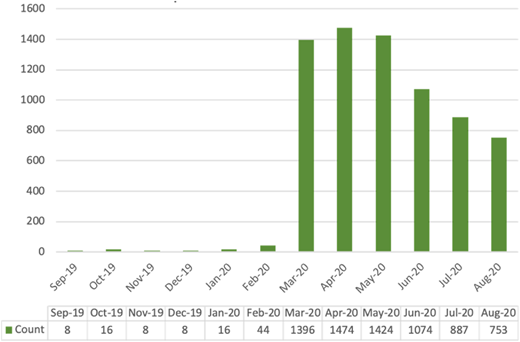
It is pivotal to differentiate between pre-crisis and during-crisis phases to discern changes prompted by external crises. We achieved this by examining hashtags and keywords linked to the pandemic, such as “coronavirus,” “COVID” and “stayhome.” Figure 1 shows the split of our dataset: the first subset comprises tweets from September 2019 to February 2020 (Pre-COVID-19 period, 53,995 tweets) and the second spans from March to August 2020 (During-COVID-19 period, 45,750 tweets).
Given the unstructured nature of textual data, which often lacks consistent syntax, we subjected our dataset to a rigorous pre-processing phase. This involved transforming the raw text into structured linguistic components, making it amenable to machine learning (ML) algorithms (Sarkar, 2019). Our preprocessing steps included the following:
Converting all text to lowercase;
Removing punctuation, URLs, hashtags, mentions, reserved words, emojis and smileys; and
Implementing stop-words removal, tokenization, stemming and lemmatization.
To optimize our analysis, we determined the coherence score for both datasets, settling on 16 topics for the Pre-COVID-19 dataset and 14 for the During-COVID-19 dataset (see Table A1, in Appendix).
To estimate the collective attention toward the issue, we compiled 783 media documents from the Pre-COVID-19 phase and 462 from the During-COVID-19 phase, totaling 1,255 documents. These were sourced from LexisUni, ensuring the validity and reliability of our data. The documents were filtered for “newspaper articles” in English with the keyword “coworking” from 1st September 2019 to 31st August 2020.
3.2 Analysis: combining topic modeling and open coding for grounded model development
To ensure a comprehensive understanding of our dataset, we employed a mixed-method approach that combined both quantitative and qualitative research techniques.
Initially, we utilized a topic modeling dataset from Twitter to gain a preliminary comprehension of the primary topics present in our dataset (see Figure A1, in Appendix). This technique, based on the Latent Dirichlet Allocation (LDA) method (Blei et al., 2003), provided us with a high-level overview, highlighting overarching themes or patterns in the data. The LDA algorithm identifies co-occurring words within documents and views them as a mixture of latent topics, each characterized by a word distribution (Blei et al., 2003). The LDA output comprises a topic-word matrix and a topic-document matrix, which can be harnessed to discern patterns and models. Topic modeling, especially with vast textual datasets, offers breadth by identifying broad topics across the dataset (Hannigan et al., 2019). The topic modeling analysis was conducted utilizing the R programming language (version 4.2.3). Specifically, we employed the “topicmodels” package (Grün and Hornik, 2011) to construct topic models, which provides essential functionality for fitting topic models based on the underlying data structures (see Figure A2, in Appendix). For preprocessed textual data and text mining tasks, we utilized the “tm” package (Feinerer et al., 2008), offering a comprehensive set of tools for cleaning, preprocessing and transforming text data into suitable formats for subsequent analysis.
Following this, we delved deeper into the data using open coding, a qualitative analysis method (Strauss and Corbin, 1998). This step was crucial for a nuanced comprehension of the data. While topic modeling gave us broad topics, open coding facilitated the identification of subtleties, nuances and specific patterns within those topics (Saldaña, 2015). Special attention was given to the actors involved to understand who acts inside the CWs’ community. We can thus give voice to two main actors: CWs’ managers and coworkers. We adopted an iterative process, oscillating between the topic model results and the open coding. The topics discerned in the topic modeling guided our open coding process and insights from open coding were used to refine our topic model (Hannigan et al., 2019). A mixed-method approach, combining quantitative topic modeling with qualitative open coding, offers distinct advantages (Jockers, 2013; McCallum, 2002).
This synergy allows for a holistic data analysis, where both methods validate each other, enhancing the reliability of findings. While topic modeling captures the overarching themes, open coding delves into data intricacies. We utilized the Dedoose platform for synchronized collaborative analysis, coder training and coding agreement assessment. To further explain the methodological method, we reported data-structured tables.
Table 1 presents the data structure emanating from the LDA analysis for the Pre-COVID period. This table reflects our systematic approach to finding significant themes from the extensive discourse on CW spaces before the pandemic.
Table 2 outlines the data structure from the LDA analysis During-COVID crisis. Mirroring the pre-crisis analysis structure, this table tracks the thematic shifts in discourse, underscoring the heightened emphasis on community value and the resilience mechanisms activated in response to the crisis.
Tables 1 and 2 are designed to illustrate the results from the LDA analysis conducted on the CW space data. They include multiple layers of categorization to facilitate a deeper understanding of the underlying themes. The “LDA Keywords” are the terms identified by the LDA model that best represent each topic. These keywords are then grouped into “First-order Labels,” which categorize the terms into more descriptive themes based on their content. Further, “Aggregate-Order Labels” provide a broader categorization by grouping similar first-order labels together. Finally, the “Aggregate LDA with Open Coding” combines the insights from the LDA analysis with open coding techniques to refine and better comprehend the overarching themes.
We turned to open coding to deepen our understanding of these thematic evolutions. Tables 3 and 4 present the grounded models derived from our open coding analysis for the Pre-COVID and During-COVID periods. These tables provide a granular view of the actors’ contributions, CW managers and coworkers, to the resilience narrative, elaborating on the specific actions, perceptions and emotional engagements that define the community’s adaptive strategies.
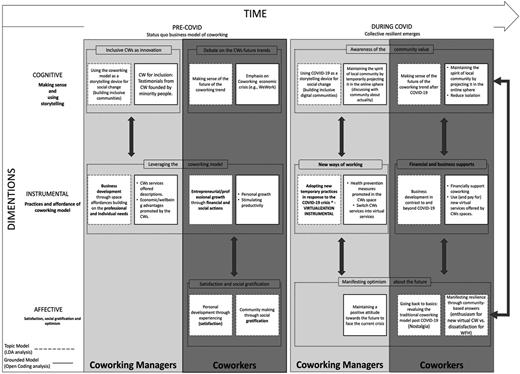
Ultimately, using insights from both methods, we developed a grounded model (Figure 2). This model, rooted in the data (hence “grounded”), summarizes the main themes, patterns and relationships identified in our research (Charmaz, 2006). Through this iterative examination, we identified key actions and discerned three foundational dimensions – cognitive, instrumental and affective – that characterize the CW model. At this stage, we also went back-and-forth between emergent data and the literature. These dimensions, while emergent from our open coding process, resonate with well-established theories in organizational studies. Specifically, the instrumental dimension reflects tangible attributes essential for organizational attractiveness and functionality (Lievens and Highhouse, 2003), while the cognitive and affective dimensions are grounded in research on organizational communication, which emphasizes the integration of cognitive and emotional processes in shaping interactions and outcomes (Te’eni, 2001). Although these dimensions existed within the CW model even before crises necessitated the use of resilience, their interactions and the dynamics between them shift notably during crises.
4. Findings
Our grounded model provides a detailed examination of the dynamics in CW spaces, particularly during the Pre-COVID and During-COVID periods. This model (Figure 2) is structured around three foundational dimensions of the CWs’ model: cognitive, instrumental and affective. The cognitive dimension refers to the efforts to make sense of the role, purpose and utility of the CW model before and after the COVID-19 crisis. The instrumental dimension refers to the CWs practices and affordances that offer coworkers individual gains and opportunities before and after the COVID-19 crisis; the affective dimension refers to the emotional relationships established between coworkers and the CW space before and during the crisis. Thus, to understand how resilience emerged in the face of a crisis, we organized our findings by discussing how each dimension manifested before and during the crisis. Each dimension is further explored from the viewpoints of two key actors: the CW managers and the coworkers. The decision to analyze responses separately for CW space managers and coworkers is grounded in their distinct roles and perspectives within the CW ecosystem. Managers focus on strategic and operational aspects, while coworkers engage primarily with the physical and social environment to meet their professional and social needs. Therefore, understanding these roles and behaviors within the studied context is essential for capturing resilience dynamics.
4.1 Cognitive processes: making sense and storytelling
The cognitive dimension is characterized by sensemaking about the role, purpose and utility of the CW model and unfolds both before and after the COVID-19 breakout, with some differences that will be highlighted in the following sections.
4.1.1 Pre-COVID-19: status quo CW model
When the COVID-19 pandemic struck, the CW model was already widely spread. In the months preceding the pandemic, attempts to make sense of CWs often consisted of press coverage of the experience of coworkers and entrepreneurs involved with CWs.
In their discourse, media emphasize the key aspects that make CWs unique compared to traditional offices, such as flexible work arrangements and community embeddedness. Positive predictions about the future of CWs also represent an important part of media storytelling before the pandemic. Accordingly, CWs are in an expansion phase all over the world, becoming the new normal:
[C]oworking is sure looking at becoming the new normal in the work environment space (The Financial Express, November 25, 2019)
A key storytelling strategy in our data was highlighting virtuous CWs initiatives with social resonance and significant impact in creating inclusive and innovative communities. According to these stories, with the constant spread of CWs worldwide, innovative strategies and a consistent value proposition are needed not only to compete in the market but also to generate massive societal change. To respond to these needs, CWs managers are committed to building increasingly inclusive communities of individuals around the physical spaces of CWs. For this purpose, CWs promote informative and educational podcasts and use testimonies of people who have distinguished themselves for inclusive innovation and social activism, highlighting the core mission of CWs of promoting inclusive communities and serving often marginalized groups such as ethnic minorities, women and mothers.
Its [RISE] membership and programming are female-focused, and part of its mission is to help women establish professional connections. A mentorship program was a natural extension of RISE’s core philosophy of women helping women, according to its founders. Rising Leaders recruit junior and senior girls who, like Grace, are eager for an opportunity to preview professional life. […] It’s like a farm team for women in business. (St. Louis Post-Dispatch (Missouri), November 10, 2019)
The #futureofwork will be defined by personalized solutions, well-being and a focus on culture and inclusivity. workplace learning will be essential. technology will augment leading to greater productivity and creativity: https://allwork.space/2020/01/future-of-work-4-dimensions-of-the-workplace-that-will-unfold-during-this-decade/ vía@allwork_space #coworking
Twitter 2020-02 From: AlphaEspai
In addition to social purpose, pre-pandemic sensemaking about CWs also focused on the future of CW. Positive (new openings and expansions) and negative (bankruptcy cases, failures) experiences are showcased to understand the challenges of the CW model and how it will evolve in the future. The media often report examples of CW ventures that faced challenges, serving as a testament to the dynamic nature of the CW industry. In particular, we found that before the pandemic, the CW business model was often discussed using the WeWork failure case, as suggested in the following excerpt:
WeWork is investing again with fundraise for proptech: wework has apparently recovered enough from its attempted initial public offering rollout to invest again. The coworking company recently took part in a $4.6 million venture round for the commercial …
Twitter on 2019-10; From: kevinthebroker
4.1.2 During-COVID-19
Emergence of community resilience. The COVID-19 pandemic and the related dramatic challenges shifted the CW paradigm. Emblematic of this transformative journey is the awareness that the main value of CW lies in its community. Data underscore a pronounced turn to digital platforms, with CW spaces and their members navigating the uncharted waters of virtual events, online community moments and other digital engagements to keep the spirit of community alive. The following excerpt exemplifies the accelerated trend of CWs virtualization:
Reminder: i’m hosting a virtual #scicomm coworking session tomorrow! if you need to get some work done, join us march 18th 1 pm gmt (9 am edt) to get a reminder email before it starts, sign up here: https://www.eventbrite.co.uk/e/online-scicomm-coworking-session-tickets-100057504690 where we’ll hang out: Twitter on 2020-03 From: easternblot
In continuation with the pre-crisis trends, CWs storytelling based on the experience of coworkers and entrepreneurs occupies a central role in the public debate. The health crisis offers an additional opportunity for CWs managers to engage in storytelling, through podcasts and online broadcasts, about the need to accelerate the development of inclusive communities around digital platforms. Similarly, the sensemaking process regarding CW’s future persists During-COVID-19, emphasizing the CW model as a constantly growing trend. Two new topics that were not present in the pre-crisis period add to the cognitive dimension of CW resilience During-COVID-19. The first topic deals with the limits of the CW business model. The debate centers on the future of CW, questioning whether, after the crisis, the CW model will still be sustainable due to the massive shift of workers to their own homes:
What does the future hold for #coworking spaces? going bust due to the massive homeworking shift or benefitting from established companies looking for flexible solutions? will nimble, local players or deep-pocketed unicorns have the upper hand #ftsnews
Twitter on 2020-08; From: FTSGroupEU
The second topic opens the debate on the impact of the CW model on the concept of community-centered spaces. As the pandemic necessitates a shift toward home working, a critical question arises: could this define the decline of CW spaces and their communities? What emerges is a widespread dissatisfaction with the solitary nature of home working. The intrinsic value of community emerges as a driver for adopting new virtual CW solutions designed to mitigate the sense of isolation brought on by the pandemic.
In sum, as explained in the excerpt below, while CWs are still defined by their physical characteristics, the challenges brought along by the COVID-19 crisis question the dominant CW model. As the trend of CW virtualization accelerates, increasingly hybrid CWs emerge and take the spotlight:
While the physical space is home to more than 200 members and includes a waiting list for others to join, Ethel’s Club’s digital community has unlocked access for an unlimited number of virtual members to join nationwide. The pivot to virtual has allowed everyone to be a part of what we’ve been doing here, Austin said. We can’t predict the future, but we want people to know we’re building a place that people can depend on (Usa today, 27 marzo 2020).
4.2 Instrumental dimension: practices and affordance of coworking model
The instrumental dimension refers to the practices and affordances of the CW model whereby CW users are offered individual gains and opportunities. Drawing from the LDA keywords like “office service,” “technology services” and “supporting innovation,” these spaces emerge as crucibles for self-serving purposes such as business innovation and personal growth. We found that the instrumental dimension was highly present in public debates about CWs before the COVID-19 crisis and followed a decreasing trend during the crisis, as explained below.
4.2.1 Pre-COVID-19: status quo CW model
Before the pandemic, the CW affordances are prevalently material/physical; they refer to the spatial configurations inside the CW adopted to fit business and professional needs. Instrumental concerns invoke practices that promote and facilitate CW-driven business development, which responds to the specific professional needs of entrepreneurs and coworkers. For instance, CWs offer the possibility of using private spaces that guarantee privacy and customize spaces according to professionals’ needs. For instance, CWs often emphasize how the location and structural characteristics of their spaces can benefit the professional development of coworkers (e.g. make available meeting rooms in central and prestigious geographic locations), as exemplified in the excerpt below:
Some key advantages of working in a co-working space include: Hassle-free and cost-efficient infrastructure: Coworking spaces allow businesses and individuals to work in a fully equipped office space without having to worry about setting it up. Usually, coworking spaces provide with high-speed internet, PAN India plus 24 x 7 access, free coffee and tea, bright open workspaces and secure private cabins. For smaller companies with teams of limited people, co-working offices give them a dedicated office rather than hopping from coffee shops or working from home. Individuals can save on various overhead and utility costs when they choose co-working (The Financial Express, 31st December 2019).
As can be seen in the excerpt below, many CWs even offer opportunities to produce, stock, fulfill or inventory goods, in this way further bringing to the fore the centrality of CWs’ physical space configurations:
You will love palletized for many reasons: the warehouse available for your business, affordable fulfilment services, inventory management, drop shipping service. If you need for info contact us. http://palletized.us. #miami #florida #warehouse #entrepreneur #coworking Twitter: 2019-10 From: palletizedfl
This instrumental facet of CW spaces was seamlessly intertwined with personal growth avenues and community-building initiatives, underscoring the holistic and immersive experience these spaces offered. In particular, the CW model affords coworkers to achieve entrepreneurial or professional growth through personal development, financial and social opportunities.
Regarding personal development, CWs support well-being and innovation at work through customized solutions (flex-place and flex-time) which allow coworkers to manage spaces and times in total flexibility, facilitate coworkers’ work/no-work time management and promote the exchange of supply/demand between coworkers in a sort of “job market plaza” managed by the CW. Financial opportunities involve ensuring CWs are cost-effective for coworkers and include initiatives like promotions, special offers and tailored plans. The social actions, conversely, underline the importance and richness of the network created in the CW space for professionals and entrepreneurs. The following excerpts provide some examples of these instrumental dimensions:
Common Ground’s take on co-working spaces take it a notch higher with features designed to inspire creativity, build communities, and cater to the evolving nature of jobs. When you have a space to work, you also create space to dream to get your best ideas off the ground (Manila Bulletin, 23 october 2019).
Novel coworking client story: we believe financial planning is about matters of the heart as much as matters of the spreadsheet. Indianapolis-based wayfinder financial is a different kind of financial advisor with a unique fee structure. #writeyourstory Twitter on 2019-1; From: NovelCoworking
4.2.2 During-COVID-19
Emergence of community resilience. The discourse on the practices and affordances of the CW model decreased during the pandemic due to the lack of contact with the physical space. During the lockdown, worldwide, there were total closures of CWs that alternated to partial closures and reopening. This moved coworkers away from the CW, making the material affordances promoted by physical space less detectable. Nonetheless, two topics still highlight the need to leverage the CW model to allow business development regardless of the COVID-19 pandemic. The first topic promoting the advantages of CW despite the threat of the COVID-19 crisis does not refer specifically to the lockdown or the social distance imposed by the pandemic, but continues to promote the affordances of the CW model’s in the same way as in the pre-crisis period. The second topic concerns mobilizations of financial support for local CW communities and entrepreneurs in contrast to the COVID-19 crisis. This topic also does not refer to specific changes in the CW model consequent to the COVID-19 crisis. Instead, it focuses on the need for generalized mobilization to make available resources (financial and other) to respond to the global health crisis and safeguard the CW model.
In addition, we found specific topics that discussed new temporary practices adopted by CWs to adapt to the restrictive measures imposed by the health crisis. Due to the lockdown and the consequent impossibility of physically attending CW spaces, the value proposition of the CW model is strengthened through virtual services and events. For example, the events that would have occurred in the physical space (conferences, meetings and moments of sharing) are moved online, at least temporarily. CWs also complement their offers to the community with new online experiences (e.g. Bootcamping, Hackathons, etc.). Additionally, online initiatives that involve coworkers on social media aim at maintaining the spirit and uniqueness of the local community while projecting it temporarily into the online sphere:
Hi friends, we’re temporarily closing our physical space. We’ll be hosting virtual coworking, and giving folks a new place to host their own meetings, via @whereby team accounts for all study hall members. Stay healthy, stay home Twitter on 2020-03 From: studyhallspace
4.3 Affective dimension: satisfaction, social gratification and optimism
The third and final dimension that we retrieved from public discourse about CWs is the affective dimension. It refers to the affective bond that coworkers develop toward the CW space before and during the pandemic, as follows.
4.3.1 Pre-COVID-19: status quo CW model
Before the COVID-19 crisis, public discourses about CWs were pervaded with signs of CW affection that coworkers expressed on social media and that the public press also covered in their articles. Given the experiential and familiar nature of the CW, individuals often expressed stable and constant bonds with their CW spaces by voicing their emotions and their (i.e. cognitive) beliefs about the importance of these spaces for their well-being. The affective dimension in CWs was characterized by feelings of satisfaction that coworkers experienced during their mundane use of CWs and by the social gratification that emerged from their sense of belonging to the CW community. In the pre-crisis period, discourses in the media and on social media highlight how these feelings of satisfaction and personal gratification can foster personal development. For instance, many testimonies explain that experiences of personal fulfillment stem from the atmosphere of the CW space, especially from the good vibes that the CW transmits through intimate, comfortable and aesthetic environments. Social gratification also arises from the CW’s effort to create vibrant social communities. These communities allow individuals not only to avoid the isolation of working from home that often affects flexible workers but also to engage in meaningful exchanges and sharing experiences during work.
Happy faces, yummy cupcakes and a new thing learned for the day. At #indiqubetownhub, our associates came together for a delightful cupcakes workshop. #food #coworking #coworkingcommunity #coworkinglife #coworkingspace #sharedworkspace #funplacetowork #happinessatwork Twitter on 2019-09 From: indiqube
4.3.2 During-COVID-19: emergence of community resilience
During the crisis period, the affective dimension shifts the boundaries from experiential to resilient. That means that the community’s collective emotional landscape becomes a fundamental driver for enduring and overcoming the pandemic’s challenges. Rather than emotions merely enriching the CWs, they now serve as crucial components in the community’s response to adversity. Thus, resilience is based on the (positive) responses of the community. Enthusiasm for remote work, as opposed to dissatisfaction with working from home, arises. Determination and enthusiasm are shown to resume CW life with an optimistic and future-oriented attitude. Through nostalgia about the physical space of the CW, the attention focuses on the need to resume and reopen CWs, as explained in the following excerpt:
I miss seeing friends without worrying they’re worried I put them at risk. I miss just browsing round town. I miss walking anywhere without being worried about strangers. I miss random food meets with friends. I miss coworking in person. I miss just going somewhere for a weekend Twitter on 2020-0; From: mandyceline
The positive emotions expressed by users in association with changes in work practices increased during the COVID-19 pandemic. Despite the need to close physical spaces to keep the community safe during COVID-19, discourses about CWs were imbued with positive emotions. This trend was exemplified above and is further documented in the following excerpt:
The COVID-19 is certainly not an end to the co-working culture as people would discover that the benefits of social gatherings in terms of emotional and intellectual fulfilment would be a crucial necessity for the overall health of a society, adds Mehrotra at 315Work Avenue (Business Line, 28 maggio 2020).
Amidst the pandemic challenges, manifesting optimism about the future signaled hope, resilience and collective determination. The CW community and managers rallied together, disseminating messages of hope and optimism and casting a vision for a brighter, post-pandemic world.
4.4 From the CW model path to the community resilient path
The arrows in our model represent the dynamic pathways that explain the complex relationships and interdependencies between the cognitive, instrumental and affective dimensions of the CW experience. In the Pre-COVID landscape, these arrows suggest the existence of a somewhat rigid CW model. The cognitive dimension, which encapsulates the overarching ethos and vision of CW spaces, and the affective dimension, which delves into the emotional and communal bonds formed within these spaces, seemed to operate somewhat independently. This is largely due to the overshadowing presence of the instrumental dimension, which in the pre-crisis stage was the most recurrent, tangible and immediate aspect of the CW experience, emphasizing physical amenities, spatial configurations and service offerings as CWs’ main opportunities. The instrumental dimension acts as a connector between the cognitive and affective dimensions.
However, as the pandemic spread out, the configuration of these arrows underwent a transformation. No longer were these dimensions operating in isolation. The pandemic-induced shifts catalyzed a more intertwined relationship between these dimensions. The instrumental dimension, while still pivotal, had to rapidly adapt to the changing landscape, moving from a focus on physical space to virtual and hybrid offerings. This shift, in turn, amplified the significance of the cognitive and affective dimensions. The cognitive dimension became the guiding light, providing direction and purpose in uncertain times, while the affective dimension became the glue, binding the community together in solidarity and mutual support.
This newfound interplay between the three dimensions testifies to the CW community’s resilience. In their reconfigured form, the arrows capture this resilience, showing the journey through which CW spaces navigated the pandemic. They depict the flow of priorities, strategies and emotions, highlighting the adaptability and tenacity of the CW community. As portrayed by the arrows, this resilience is not just about survival but about thriving, innovating and reimagining the CW narrative in the face of a global crisis.
In summary, our research model presents a comprehensive analysis of CW spaces, delineating their progression from the Pre-COVID phase through the adversities of the pandemic. The synergy between the cognitive, instrumental and affective dimensions underscores the development of community resilience. As this resilience is fortified, the boundaries between these dimensions become increasingly permeable. The model further clarifies the roles and interplay of diverse CW actors, emphasizing that resilience is not an attribute exclusive to coworkers or managers. Each stakeholder plays a pivotal role in fostering a more encompassing, community-centric resilience through their distinct beliefs, emotional responses and actions.
5. Discussion and conclusion
This study explored the mechanisms of community resilience and adaptability within CWs during the COVID-19 pandemic, a time that fundamentally disrupted their core interaction processes. Using a mixed-methods approach, we examined Twitter and traditional media discourse to understand how CWs responded to these challenges. Our analysis identified three pivotal dimensions – instrumental, cognitive and affective – underpinning the resilience observed in CWs. These findings not only expand the theoretical understanding of CWs and community resilience but also provide practical insights for CW managers, highlighting the critical role of virtual practices and emotional connections in maintaining community cohesion and resilience during crises.
5.1 Theoretical implications
Our exploration of CWs’ community resilience offers several contributions to CW and community resilience literature.
5.1.1 Advancements in coworking studies
First, our study enriches the CW literature by delineating the process leading to community resilience. In a landscape of pronounced disruptions (Guaita Martinez et al., 2024), the resilience of CW communities can also favor the evolution of CW spaces. We have shown how the COVID-19 crisis, by questioning the efficacy of investments in physical assets and simultaneously accelerating investments in digital assets (Belso-Martínez et al., 2020), harnessed the dual nature of the CWs as physical spaces and as broader infrastructures of digital tools at the community’s disposal and weaving a new concept of “hybrid coworking” (Yang et al., 2019). Our findings contribute to the debate about the roles of physical space (Gandini and Cossu, 2021; Ungureanu et al., 2021) and virtualization (Cabral and Van Winden, 2022) in the creation and growth of CW communities, as follows.
Extant theory about CWs largely posits that physical spaces play a pivotal role in making the CW model unique and distinctive. As highlighted above, CWs are designed to encourage physical interactions and sociality, improving performance and fostering the development of interpersonal relationships (e.g. Spinuzzi, 2012; Garrett et al., 2017). Other research, however, has also shown that CW virtualization can play an important role in expanding and strengthening CW communities beyond physical spaces (Cabral and Van Winden, 2022; Yang et al., 2019). The theory suggests that the shift toward virtual environments in CWs has led to the development of hybrid CW models that combine physical and digital elements (Cabral and Van Winden, 2022; Yang et al., 2019). During the pandemic, the lack of access to physical spaces further shifted the focus to virtual services, amplifying the current virtualization trend in the pre-pandemic period.
On the one hand, our research shows that the physical characteristics of CWs remain essential for fostering a sense of individual belonging and fulfillment once they reopen (e.g. Spinuzzi, 2012; Capdevila, 2013; Butcher, 2018). This confirms the importance of the materiality of space, highlighting that a balance between physical and virtual elements is necessary to sustain community engagement (Cochis et al., 2021). On the other hand, our research confirms that virtualization was already underway before the pandemic but was significantly expedited during the crisis. This allowed CWs to maintain community cohesion and support collaborative efforts despite physical distancing measures. Importantly, our study documents that space affection can constitute an important bridge toward virtualization processes, leading to the hybridization of the CW model. As crises strike, individuals’ affective attachment to CW spaces fuels resilience and fosters adaptive practices that include temporary experiments with the CW model, such as virtual events and virtual community building. The study thus demonstrates that integrating digital tools and physical spaces enhances the overall resilience of CWs. However, we also caution that, if isolated, instrumental virtualization is not sufficient. It needs to be harmoniously integrated with cognitive and affective sensemaking. The emotions central to CW communities developed around physical spaces fueled the virtual realm, sustaining online community development and enforcing the vitality of the CWs’ business models. However, virtualization may also weaken the sense of community belongingness in the long term, especially in the prolonged absence of physical interactions, with uncertain consequences for the evolution of the CW model.
The study also discusses what virtualization discourses mean for organizations that had tailored a distinctive identity around the notion of physical presence and place embeddedness, suggesting how these distinctive characteristics are being replaced with ideas of social capital derived from virtual social networks (Murphy, 2007) and the ability of a community to generate resilient and adaptive responses in times of crisis. While going “back to normal” eventually occurred, it is important to understand how CWs coped with the hybridization processes already in course and the opportunity to return to a place-centered distinctive identity.
In sum, these findings contribute to CW theory by theorizing how hybrid models function in practice and their critical role in ensuring the continuity and resilience of CW communities (Cabral and Van Winden, 2022; Yang et al., 2019). We also underscore the pivotal roles played by CW managers and coworkers (Bednář et al., 2023) in shaping each dimension of the resilience-building process. Community managers played a pivotal role in spotlighting CW communities by curating and nurturing community interactions outside of the physical space of CWs, in this way facilitating the shift toward adaptive strategies of temporary virtualization (Cabral and Van Winden, 2022). Our study shows that CWs exhibited remarkable resilience during the COVID-19 pandemic by rapidly adapting through the integration of virtual and physical spaces.
5.1.2 Advancements in community resilience studies
Second, our insights contribute to the literature on community resilience. We conceptualize resilience during crises as a multidimensional concept and emphasize the permeability and interconnectedness among instrumental, cognitive and affective dimensions. While the role of emotions in collaborative resilience and particularly in relation to community resilience, has been extensively explored (Fredrickson et al., 2003; Gloria and Steinhardt, 2016; Ungureanu and Bertolotti, 2020), our study provides fresh insights into how affections and cognitions influence the relation between space-driven mechanisms and mechanisms that exceed spatial arrangements.
We have shown these relations by theorizing about the interplay among the instrumental, cognitive and affective dimensions of CWs’ resilience. It is important to note that the boundaries separating these dimensions are not rigid; rather, they are fluid and dynamic, with affective and cognitive components emerging as pivotal drivers of resilient collective responses to crisis. Our study showed how affective dimension can support adaptive strategies during crises. Extant literature suggests that positive and negative emotions are potent catalysts for community resilient action. Shared emotional experiences can act as a binding force, enhancing the community’s cohesive strength, while negative emotions can trigger change and innovation, especially when also accompanied by positive emotions (Waters-Lynch and Duff, 2019). In addition, the phenomenon of emotional contagion, where emotions spread rapidly within communities, can significantly influence not only the collective mood but also beliefs about the crisis, concrete actions and decision-making processes (Barsade, 2002; Corvello et al., 2024). Our study adds to this literature by showcasing the role of emotions in catalyzing community resources such as cognitive, affective and instrumental support in the face of crisis, which in turn are pivotal for community resilience. We have shown that social support, a cornerstone of community resilience, is often sought during crises, with emotional bonds forged during challenges enduring and strengthening the community’s resilience (Zhao et al., 2022). Our findings describe how social support stems from community affection toward places and spaces and extends beyond familiar configurations, albeit temporarily (see the discussion in the previous section). These findings highlight how affective, cognitive and instrumental dimensions are integral to building genuine adaptive community resilience because they are key triggers of community resourcefulness, especially in the case of innovative organizational models like CW spaces.
Our insights thus contribute to a better understanding of the role of affection in resilience processes at large. While a severe crisis can trigger both positive and negative emotions, whether these will lead to proactive resilience or to more passive and destructive responses, as documented by Sonenshein and Nault (2023), depends on the interplay between affective, instrumental and cognitive practices enacted within the organizational context and, in our case, concerning the physical space and the broader network of social relations in which the space was embedded.
5.2 Managerial implications
In terms of managerial implications, we suggest that CW managers become aware of the importance of virtual practices and affective dimensions. Virtual practices in normal times allow for feeding the community constantly, improving an attachment to the CW through affectivity. These virtual practices are also essential for coworkers, fueling people’s need for continuous knowledge sharing and learning and fostering innovation and creativity. CW managers should adopt a holistic approach that simultaneously addresses coworkers’ instrumental, cognitive and emotional perceptions. For instance, leveraging feedback tools, organizing hybrid events and fostering emotional well-being through virtual and physical activities can help create a sense of belonging and community. On the other hand, policymakers can support CW spaces by offering incentives for hybrid work models that integrate physical and digital infrastructures, promoting sustainability and regional development. Finally, the coworkers can benefit from increased awareness of CW spaces as adaptive hubs for innovation and collaboration during crises.
5.3 Conclusion
In conclusion, our study provides a comprehensive framework for understanding the resilience mechanisms within CWs. It offers a nuanced perspective on how CWs can navigate and thrive amidst crises. It contributes to the literature on CWs and to the broader organizational literature on community resilience and adaptability in times of external shocks. We underscore the necessity of balancing physical and virtual elements of CW organizations, fostering cognitive and affectional connections between its members and leveraging the strengths of hybrid physical–virtual models to sustain long-term community engagement and resilience.
5.3.1 Limitations and future research directions
Even if our work provides implications for theory and practice, it is not without limitations. Some limitations of this work are that, although longitudinal, the discourse investigation does not include the post-pandemic period. We recognize that Twitter data has limitations, particularly in providing direct evidence of how many CWs survived or did not. While our analysis of language and narrative is valuable for understanding how CWs attempted to motivate and engage their communities, it does not directly measure these spaces’ long-term outcomes or survival rates. Our primary focus was on the discourse and strategies for building resilience, but we acknowledge the importance of examining the correlation between this discourse and the evolution of CWs. Further data will be necessary to cover the return period to normal conditions. Additionally, we studied everything posted in English, so we did not collect information related to the geographical location of the data. Studying whether discourse practices develop differently in different countries could be highly valuable.
Therefore, future research should conduct longitudinal studies to track the performance and sustainability of CWs over an extended period, develop in-depth case studies of specific CWs to understand the nuanced impact of resilience strategies on their evolution and incorporate financial data, occupancy rates and other metrics to provide a more comprehensive understanding of CW resilience. However, future studies could clarify how instrumental, cognitive and affective mechanisms interplayed as CWs faced the return to normality.
This paper forms part of a special section “Collective resilience: The role of self-organized leadership communities in uncertain times”, guest edited by Karine Goglio, Florence Crespin-Mazet, Marion Neukam and Laurent Simon.
Methodological appendix
Data collection summary
After collecting the data through scraping techniques on Twitter (called X from July 2023) and LexisUni (a product of LexisNexis) platforms, we obtained four different datasets illustrated in the following Table A1 (see manuscript for further details on the data collection).
Analysis
Stage 1: Topic modeling of social media data. We employed LDA for Pre-COVID-19-Twitter and During-COVID-19-Twitter datasets, using the “tm” package in R for social media data topic modeling. LDA is a generative probabilistic model that assumes documents are mixtures of topics and that topics are mixtures of words (Blei et al., 2003). This algorithm focuses on co-occurring words inside documents and treats documents as a random set of latent topics, where each topic is a word distribution (Blei et al., 2003). Generating topics starting from probabilistic models has three benefits. First, researchers must not impose dictionaries and interpretative rules on data. Second, this method recognizes essential themes that humans cannot discern. Finally, it allows for polysemy because the topics are not mutually exclusive; the single words appear in the topics with different probabilities, and the topics can overlap or group (DiMaggio et al., 2013).
Using LDA, each tweet is represented as a distribution over topics, and each topic is a distribution over words, following this formula:
where:
is the probability of word w in document d.
is the probability of word w in document k.
is the probability of topic k in document d.
For instance, a tweet mentioning “inclusive” and “community” might have high probabilities for topics related to inclusivity and community-building.
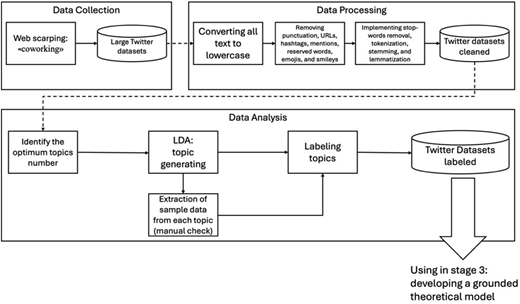
Several pre-processing steps are conducted to increase the quality of the datasets. First, standard pre-processing tasks are performed, including converting to lowercase and removing numbers, punctuation and stop words (Manning et al., 2009) using “topicmodels” (Hornik and Grün, 2011) and “tm” (Feinerer, 2013) libraries in R. Figure A1 shows the process scheme for the collecting, pre-processing and analysis of the Twitter dataset.
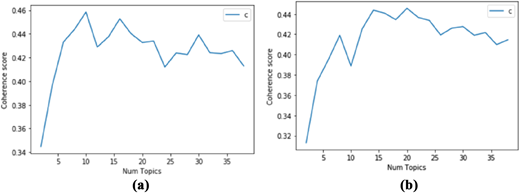
Currently, there are no commonly accepted rules of thumb for selecting the optimum number of topics (k), but several researchers provide best practices. Following Griffiths and Steyvers’s (2004) study, we used a harmonic mean method to determine k. To find our corpus’s best value (k), we ran a sequence of topic models with different values for k, generating numerous topic models with different numbers of topics and creating a vector holding the harmonic mean for each k-value. We used a sequence of numbers from k = 2 to k = 100, stepped by one.
The first cut-off threshold was k = 15, where the optimal topic value was 10 for the Pre-COVID-19 dataset (see Figure A2-a) and 8 for the During-COVID-19 dataset (see Figure A2-b). However, after analyzing the results of the 10 themes, we realized that the themes were very heterogeneous and different, making a deeper level of investigation desirable. We have, therefore, defined a new cut-off threshold k = 20, where the second optimal topic number is 16 for the Pre-COVID-19 dataset, and the optimal topic number is 14 for the During-COVID-19 dataset. Unfortunately, there is no universally accepted validation method for thematic models. Therefore, we followed DiMaggio’s (2015) suggestions and verified whether the resulting thematic model effectively deals with polysemy. DiMaggio (2015) proposes that the thematic model is valid if it classifies identical words in different topics with interpretable meanings. From the manual verification, we verified that 16 topics for the Pre-COVID-19 dataset and 14 topics for the During-COVID-19 dataset perfectly identified the higher level of aggregation topics with high variability of themes and no repetitions of topics. Even though some words are repeated between the various topics in the keywords that identify the topic, the topic’s meaning is entirely distinct with 23 topics. For example, the themes (T4, T5, T6, T7, T8 and T9 from the Pre-COVID-19 dataset) all speak of the space of coworking (keywords “space” is present in each topic), but each topic has a different declination. To see details of all topics identified, see Tables 1 and 2 of the manuscript.
Tables 1 and 2 of the manuscript show, for each topic, the keywords that have been returned by the algorithm, the label we gave to the topic following the rule-based approach to “prototypical text-based interpretation” (PTBI) of topic models recently proposed by Marchetti and Puranam (2020). The method implies mapping topics into categories by reading the content of a selected subsample of documents associated with each topic.
We started with selective coding on a tweet sample and then applied labels to each topic.
Subsequently, we aggregated to a higher order where possible. Finally, we reported for each topic representative topic tweets.
To ensure the robustness of our findings, we implemented a rigorous validation process through triangulation with qualitative data. This process involved the manual extraction and analysis of tweets to verify the consistency and reliability of the identified themes. Two researchers independently reviewed and labeled a representative sample of tweets from each topic, ensuring that the interpretation of themes was consistent and accurate. Through this manual verification process, we confirmed that the strong claims identified, such as those related to “inclusivity,” were not isolated statements but were representative of a broader discourse within the community. For instance, our analysis showed that inclusivity-related topics were discussed by a substantial proportion of users, indicating that these claims were widespread and not confined to a few individuals.
Stage 2: Open coding of archival data. We used the grounded theory method to perform open coding (Strauss and Corbin, 1998) on the archival data containing media data. We imported documents into a unique database on Dedoose, using time range as a descriptor to discern the original two datasets. Dedoose is a cross-platform application for analyzing qualitative and mixed methods data using collaborative and cloud-based features: https://www.dedoose.com/. We started open coding for involved actors, main events, practices, operations and community engagement. We identified and categorized key themes and patterns within each dataset through meticulous line-by-line coding. This process unveiled the complex interplay between pre-established resilience mechanisms and the innovative adaptations that emerged in response to the crisis. By analyzing these datasets separately, we could trace the evolution of CW spaces’ resilience strategies from the pre-pandemic era to the height of the COVID-19 crisis. The detailed framework of our findings, including the categorization and thematic aggregation of the data, is outlined in the Data Structure (Tables 3 and 4 in the manuscript). This table delineates the distinct yet interconnected themes that emerged from our analysis, offering a comprehensive view of the resilience pathways activated by CW spaces across different stages of the COVID-19 pandemic.
Stage 3: Developing a grounded theoretical model. As we progressed to Stage 3 of the data analyses, we grouped topics into tentative theoretical aggregates by comparing keywords and contents (e.g. Hannigan et al., 2019). An emergent stream of methodological literature studies the combination of grounded theory and machine learning (see DiMaggio, 2015; Muller et al., 2016; Nelson, 2020), highlighting that every process to analyze data through GT and ML crucially requires human interpretation and judgment at each stage of theory building (Muller et al., 2016). ML fully automates the iteration at the lowest level, such that human intervention is not required at this stage (Nelson, 2020; Muller et al., 2016). In grounded theory, low-level data iteration is also performed by human researchers (e.g. Strauss and Corbin, 1998). When aggregation analyses are performed at a higher level of abstraction, human judgments play an important role in both GT and ML (Muller et al., 2016; Nelson, 2020). Integrating topics from the LDA and open codes from GT in higher-level theoretical constructs requires a continuous iteration between the open coding categories and the LDA topic labels. Going back-and-forth between data and literature (Muller et al., 2016), we started paying attention to instances in which vocabularies express emotions or descriptions of practices (which may change between two periods). We used this perspective to refine our tentative second-order coding of archival data (Stage 2) and the tentative theoretical aggregates of the topic model (Stage 1). By combining these two approaches, we ensure that the strong claims we present are supported by multiple data points and reflect the collective voice of the community. For example, the themes related to managerial emphasis on inclusivity were identified through LDA and corroborated by qualitative analysis of tweets and archival data. This integrated approach allows us to capture the complex dynamics of manager and coworker interactions, providing a more nuanced and reliable understanding of the discourse.
By analyzing code co-occurrences, it also became evident that three main dimensions emerge: instrumental dimension, focusing on the blend of physical and virtual interactions; cognitive dimension, revolving around community-driven sensemaking processes; and affective dimension, spotlighting the pivotal role of emotions in reinforcing community resilience and attachment to CWs.