Using transcripts of 6 classroom debates that took place in 4 urban schools, the present study takes a closer look at what middle school students do during classroom debates in the context of a social studies curriculum designed to support student argumentation in debate. Two coding schemes were used to analyze student comments in the transcripts: argumentative moves and the quality of grounds (reasons/evidence used to support a claim). Results show that: (a) students used textual evidence to support their arguments over a third of the time (37.6%), which is a higher rate than what might be expected given previous studies; (b) students connected their evidence to their claims 20.3% of the time (also a much higher rate than what might be expected given previous studies); and (c) argumentative moves were related to text-based grounds quality at a statistically significant level (p = 0.006). Students were more likely to support positions with textual evidence than support oppositions and supporting comments with textual evidence. Implications for middle school practice are discussed.
Classroom debate is an activity that can be found across the disciplines and across grade levels, from elementary up through graduate school. Formats for classroom debates range from formal situations, in which opposing sides present their arguments and have the opportunity to rebut in turn, to more informal situations, in which class discussion is based on considering the arguments of opposing sides (Bonwell & Eison, 1991). Classroom debate also has its share of critics. Kohn (1986) and Tannen (1998) suggested that learning goals are lost in debate because students focus too much on winning. Tumposky (2004) went further, arguing that debate fosters a classroom environment that is confrontational, putting students who are not comfortable with oppositional interactions at a disadvantage. She also argued that classroom debate “reinforces a Western bias toward dualism and ignores the multiplicity of perspectives inherent in many issues” (pp. 5354). Middle school teachers, in particular, may sympathize with these critiques, as their students are anecdotally more likely than high school students to: (a) get emotionally overinvolved in the “game” of debate, and (b) be challenged by both the social and cognitive demands of a classroom debate.
Notwithstanding the critiques of researchers and teachers, the National Council for the Social Studies (NCSS) supports the use of debate in both middle and high school classrooms. According to their position statement, debates are part of powerful teaching and learning: “Through discussions, debates, the use of authentic documents, simulations, research, and other occasions for critical thinking and decision making, students learn to apply value-based reasoning when addressing problems and issues” (NCSS, 2008, para. 11). Debates can also serve as valuable assessments. In the College, Career, and Civic Life (C3) Framework for Social Studies State Standards, debates are listed as one of the recommended collaborative formats through which students can communicate their explanations and arguments, and thus demonstrate to teachers what they understand (NCSS, 2013). Furthermore, one could argue that having students observe and engage in civil debate, using evidence and reasoning, is more important than ever in a democratic society given the false information and personal attacks that are frequently found in current public and political discourse.
Despite the support for and importance of classroom debate in social studies, the research on this topic is limited. The small number of studies that do exist suggest that students do not meet basic expectations when they engage in this particular instructional activity. In this study, I attempt to broaden the literature, and specifically inform middle school instructional practice around social studies classroom debates, by exploring what middle school students do during such debates in the context of a curriculum that was designed to support student participation in debates.
Background
Though there are no studies to date that show empirical differences between debate1 and discussion, I offer two reasons why the phenomena one would observe in classroom debates versus classroom discussions are different enough to warrant separate investigations of these two forms of discourse at the middle school level. First, perhaps because of the prevalence of debate in American culture, middle school students are probably more likely to think of classroom debate as a competitive and fun activity compared to classroom discussion. Although the perceived competitiveness of debate may be a detriment to the quality of student participation, as Kohn (1986) and Tannen (1998) have argued, the competitive nature of debate may also motivate students to engage in an effort to outperform the opposing side. If such motives exist, one can imagine students’ contributions in classroom debate looking different from those in classroom discussion (i.e., more oppositions offered or more strategies used in debate). Second, classroom debate often limits student exchange to two known opposing perspectives, whereas classroom discussion is not often as restrictive or transparent. Because of their dichotomous nature, classroom debates may “oversimplify and misrepresent the nature of knowledge” (Tumposky, 2004) but may also scaffold entry into conversations about more complex topics, which is especially important for middle school students. By offering two-sided simplicity and clear purpose over more open-endedness and greater ambiguity, as found in many classroom discussions, classroom debates may yield higher participation from middle school students of all ability levels, as suggested by MacArthur, Ferretti, and Okolo (2002). Given these projected differences in the nature and amount of student engagement, I contend that outcomes of and processes underlying middle school classroom debate should be examined apart from those of middle school classroom discussion, even if those classroom discussions are: (a) argumentative in nature, or (b) centered on controversial public issues. In the present study, I focus on what happens during classroom debates in middle school.
Though there is research that suggests that classroom debate helps improve valuable skills and learning for undergraduate and graduate students (Alibert, 1998; Combs & Bourne, 1989; Jagger, 2013; Moeller, 1985; Tessier, 2009), after an extensive search I have not found any research studies that identify similar benefits for younger students, and I have found very few studies that have examined what happens during classroom debates with middle and high school students. In fact, I located only two, and both seem to focus on the general quality of argumentation within debates. In the first, Walker and Zeidler (2007) found that in debates about socioscientific issues, high school students often used personal attacks and fallacious argumentation, which they described as “reasoning … based on extreme examples, erroneous grounds, and hasty generalizations to personalize the dilemma and evoke an affective response” (p. 1401). The authors attributed this poor debate performance to students’ lack of background knowledge, which several studies have suggested is a problem when students engage in argumentation (De La Paz, 2005; Felton & Herko, 2004; Ferretti, Lewis, & Andrews-Weckerly, 2009; Gleason, 1999). In the second study, which analyzed sixth graders’ debates about American immigration in the early 20th century, MacArthur et al. (2002) found that participation was widespread among students and that boys, girls, and students with and without disabilities participated equally. However, the students struggled to produce “academic arguments,” in which participants “provide evidence to support the claims they make and offer explanations about the warrants that underlie their inferences” (p. 171). The authors traced students’ lack of specific evidence and explanations to the fact that the students were never specifically instructed on argumentation. Hence, these two studies suggest that middle and high school students do not make strong arguments during classroom debates on social studies topics and, therefore, they may not emulate the kind of reasoning that the social studies educators value and expect from student debate participation.
The Present Study
The extant research highlights weaknesses in middle and high school students’ argumentation in classroom debates on social studies topics (MacArthur et al., 2002; Walker & Zeidler, 2007). However, the students participating in the extant studies received little support for argumentation. The purpose of the present study was to explore what urban middle school students do during classroom debates in the context of a social studies curriculum, called Social Studies Generation (SoGen), that supports argumentation in debate. By also considering possible connections between what students do and the curriculum materials used for debate preparation, the present study may help bring researchers and practitioners closer to creating more targeted supports to help a wider range of students at a critical time—the middle school years—improve their ability to participate productively not only in social studies classroom debates but in debates across the disciplines and in their out-of-school lives. The research questions guiding the present study were:
What argumentative moves do urban middle school students make in classroom debates within the context of a debate-supporting social studies curriculum?
How do these students support their argumentative moves in these debates?
How do students connect their argumentative moves and evidence, if at all?
Are specific argumentative moves related to the kinds of support they offer for their argumentative moves?
It is important to emphasize that although historical content is used for the debates examined in the present study, students are not doing historical argumentation. It has been argued that the SoGen curriculum helps move middle school students toward disciplinary literacies in history (Duhaylongsod, Snow, Selman & Donovan, 2015), but given that students are not analyzing authentic historical documents in the SoGen curriculum, it would be inappropriate to conclude that students are doing historical argumentation in the debates analyzed herein. I do contend, however, that having middle school students work on historical argumentation skills and debate skills separately, before combining these two very cognitively demanding skills, is a sensible instructional decision given where most middle school students are developmentally.
Method
Context and Data
In the present study I analyzed six classroom debates transcribed from audio recordings of six different class sessions. The recordings came from two classes of seventh-grade students and four classes of sixth-grade students. The classes, involving five teachers— four veterans and one early-career teacher (three of the six class sessions were taught by the same teacher, one of the class sessions was cotaught by two teachers), were from four racially and ethnically diverse K–8 public schools located in the Northeast. These four schools are part of what Milner, Murray, Farinde, and Delale-O’Connor (2015) categorize as urban emergent school districts, which are “located in large cities, but not as large as the major cities” (p. 531) and have “some of the same characteristics as [schools and districts in the major cities] in terms of resources, qualification of teachers, and academic development of students” (p. 531). Among the four schools, the average percentage of students participating in the free or reduced-price lunch program was 80, the average percentage of students who are Black or Hispanic was 76.7, and the average percentage of English language learners was 21.5. Table 1 summarizes information on the six debates and the schools where they took place.
The recordings were drawn from the Catalyzing Comprehension Through Discussion and Debate (CCDD) research project (ccdd.serpmedia.org), a large-scale school-level cluster randomized trial investigating the impact of classroom discussion and debate on middle school students’ reading comprehension. Funded by the Institute of Education Sciences under their Reading for Understanding Initiative, the CCDD project evaluated the Word Generation (WordGen) curricular program (wordgen.serpmedia.org). WordGen was designed to promote fourth- through eighth-grade students’ discussion and argumentation skills, as well as their learning of academic vocabulary— “words that students are likely to encounter in textbooks and on tests, but not in spoken language” (Strategic Education Research Partnership, 2011). The program consists of four curricula: WordGen Weekly, an interdisciplinary curriculum for grades 6–8 offering units based on discussable dilemmas on general topics of interest; WordGen Elementary, the fourth- and fifth-grade version of WordGen Weekly; Science Generation (Sci-Gen), a science curriculum for Grades 6–8 based on the same principles as WordGen Weekly; and Social Studies Generation (SoGen), the social studies counterpart to Sci-Gen.
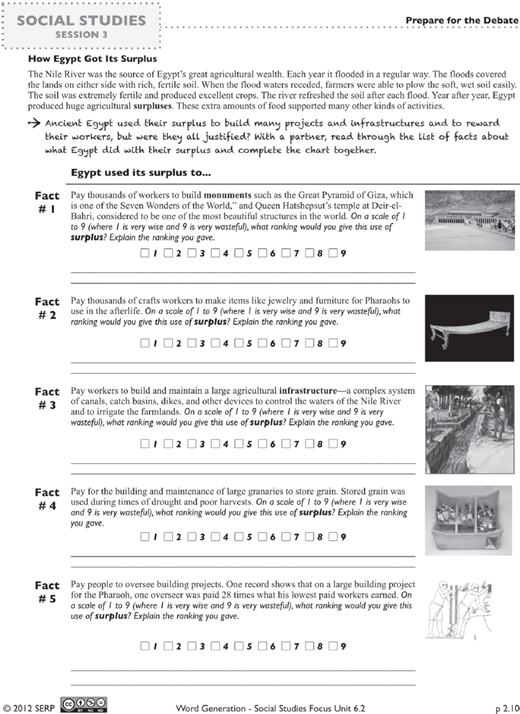
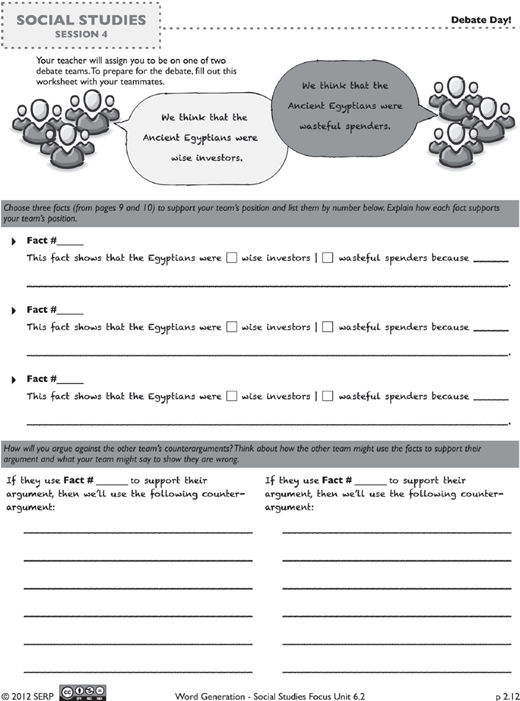
The recorded debates analyzed in the present study came from classrooms where the SoGen curriculum for Grade 6 was enacted. The sixth-grade SoGen curriculum is themed around ancient civilizations and contains a total of 6 week-long units—2 on ancient Egypt, 2 on ancient Greece, and 2 on ancient Rome. Each unit consists of five sessions. In the first session, students engage in a Reader’s Theater, a fictional skit featuring middle school students who are debating a modern-day topic that is analogous to the unit’s history-based debate topic. For example, in Unit 6.2’s Reader’s Theater, the fictional characters are arguing about whether their school’s decision to build a new swimming pool is wise or wasteful. The debate question for Unit 6.2 is: Were the pharaohs of ancient Egypt wise investors or wasteful spenders? One of the goals of the Reader’s Theater is to galvanize students’ interest in the historical topic. Another goal is to help prepare students for the debate. The Reader’s Theater is followed by activities that encourage students to identify the different perspectives in the skit, and to use the content of the skit to practice generating elements of argumentation (i.e., claims, evidence, warrants, counterarguments, etc.). In the second session of the units, students build background knowledge for the debates by reading and discussing short texts with partners. For example, Unit 6.2 features short texts on the pyramids, Egypt’s surplus, and the historical strike at Deir el-Medina. For the third session, students review texts that can be used as evidence in the debates. In Units 6.2 and 6.3, students are given a list of facts from which they can choose to support their side of the debate (see Figure 1). Though ideally students would critically read through many pages of text and extract pieces of evidence to analyze and use in debate, research on scientific argumentation suggests that when students are first learning to do argumentation, making the data set from which they can draw evidence small may help “facilitate students in engaging in other aspects of argumentation in more complex ways” (Berland & McNeill, 2010, p. 765). This hypothesis is supported by a study showing more sophisticated historical reasoning among middle school students who were given simplified materials, one of which was a list of facts about the Roman Empire (Wolfe & Goldman, 2005). Session 4 of the units is the debate day. Before starting the debate, students continue their debate preparation from the previous session. Units 6.2 and 6.3 have detailed scaffolds for this preparation. As seen in Figure 2, students are asked to provide the numbers of the facts they chose from the fact list and explain how each specific fact supports their debate position. Students are also asked to anticipate facts their opponents will use and generate counterarguments based on these anticipated facts. In Session 5, the final session, students are asked to write an argumentative essay on the debate topic of the unit.
Each of the six debates I analyzed took place during session 4, the debate day, and each debate focused on one of three unit topics/debate questions: (a) “The Pharaohs of Ancient Egypt: Oppressors or Great Leaders/Protectors of Order?” (b) “The Egyptian Pharaohs: Wise Investors or Wasteful Spenders?” or (c) “Which city-state was better overall: Athens or Sparta?” (Strategic Education Research Partnership, 2012). The format of the six debates varied. Three of the debates had a “fishbowl” format, in which two teams of two students debated the topic while the rest of the class observed them and gave feedback when the debate was over. The three remaining debates were whole-class debates in which the entire class was split into two teams or more. The length of the debates and the extent of teacher intervention during each of the debates varied as well.
Coding
Each of the six classroom recordings was transcribed in full. I divided each transcription into three sections: predebate activities, the debate itself, and postdebate activities. I only coded the debate section of each transcript. For three of the debates, I coded from the first student contribution to the debate to the last student contribution. In two of the debates there were major teacher interventions, including one teacher rather unfairly giving one team arguments to use during the debate. In these cases, I stopped coding before the teacher intervention. One debate was conducted in three rounds, and in between rounds, students worked in teams to prepare for the next round. For this debate I only coded the rounds, not the preparation sessions between rounds.
The unit of analysis for this study was a student “turn of talk” or “TOT” (Boyd & Rubin, 2006). To develop the two coding schemes (see below), I selected the student turns of talk from the six transcripts to be coded. For a TOT to be selected, it needed to be eligible to receive a grounds quality code (i.e. a turn of talk containing a claim or a rebuttal is eligible for a grounds quality code whereas a turn of talk containing a clarification question or an off-task comment is not eligible). After I developed a preliminary codebook from the selected TOTs, a research assistant independently coded the preidentified TOTs from one third of the transcripts using this first codebook. The research assistant and I then vetted and refined the coding scheme by discussing and clarifying divergences. This resulted in a revised coding scheme, which I used to recode the full set of TOTs.
Coding Scheme 1: Argumentative Moves. I adapted Clark and Sampson’s (2008) coding framework for discourse moves to include only student comments that establish, oppose or support an argument—comments I call “argumentative moves.” I replaced the authors’ three claim codes with the following two codes: (a) “position,” which emerged from the data, as the claims students offered were often one position in the debate or the other, and (b) “nonposition claim,” which also emerged from the data because students misinterpreted the debate question and, as a result, made a claim that did not fall on either side of the debate. I also consolidated the authors’ three rebuttal codes into one code I call “opposition” for simplification. My full coding scheme for argumentative moves is outlined in Table 2.
Coding Scheme 2: Grounds quality. Using as a model Clark and Sampson’s (2008) coding scheme for the quality of grounds offered by students in online science discussions, I developed a new coding scheme for the quality of grounds offered by students in standard classroom debates where textual evidence is ideally used. Table 3 outlines the coding scheme. The levels delineate whether and how a student used text from the curriculum materials to support an argumentative move. At the lowest levels (0 and 1), students did not use text at all to support their moves. At the middle levels (2 and 3), students used general references to the text itself (e.g., “It [the text] didn’t say that!”), general references to concepts in the text (e.g., the concept of revolution appears in the text and a student used “revolution” in a comment without repeating verbatim, paraphrasing, or inferring from text), or text-based inferences as grounds. To qualify as a text-based inference, a statement was required be a logical conclusion from identifiable information in the text. The inference did not have to be accurate to be coded as a text-based inference. At the highest levels (4 and 5), students used textual evidence or textual evidence plus text-based reasoning to back their arguments. To qualify as textual evidence, the information had to be either repeated verbatim or paraphrased from the curriculum packet. To determine if students had paraphrased text from the packet, I compared the original text in the packet to the comment, and if the overall meaning of the two were comparable, I considered the text paraphrased. I included paraphrasing that was and was not factually accurate to the text. Three different types of comments qualified as text-based reasoning. Explaining how one’s position/claim is connected to the textual evidence was the first type of comment (e.g. “They had their beliefs so they thought they would go into the afterlife, they would need all this jewelry and all this stuff so that they could live in the afterlife. So it’s not wasteful because they thought this.”). Using a text-based inference to bolster one’s textual evidence constituted a second type of comment (e.g., “Um, and, in Fact #3 Sparta has had two kings in a group of elders … so if they had two kings, that would make them like more—like responsible for more stuff?”), and posing a text-related question to challenge the opposition constituted the third type (e.g., “it would be a waste of money to … build another pyramid for the pharaoh [if] he already has one. It’s like, he already has a pyramid so why must he have another pyramid for more people to remember him?”).
Results
There were 128 student turns of talk in the six transcripts that were eligible to receive a grounds quality code. Five of those turns received more than one code for argumentative move, and thus those turns were also assigned more than one code for grounds quality. Therefore, there was a total of 133 argumentative moves and a total of 133 ratings for grounds quality.
Frequency and Type of Argumentative Moves and Grounds Quality
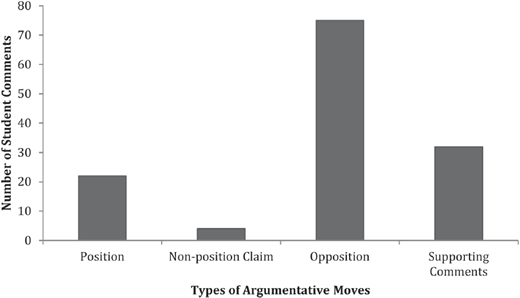
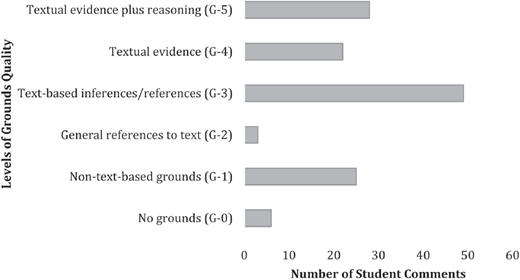
Over half (56.4%) of the argumentative moves in the debates were oppositions while just under a quarter (24.1%) were supporting comments. The remaining moves were mostly positions (16.5%). Nonposition claims made up only 3% of the turns of talk (Figure 3). To support their argumentative moves, students used textual evidence over one third of the time (with and without text-based reasoning, 21.1% and 16.5%, respectively). Nearly matching that was students’ use of text-based inferences and general references to concepts in text as support (36.8%). General references to text as grounds appeared in only 2.3% of comments. Students also justified their argumentative moves with grounds not derived from texts 18.8% of the time, whereas 4.5% of argumentative moves had no grounds at all (Figure 4).
Connections Between Claims and Evidence
Students connected their claims (because students connect positions, oppositions, and supporting comments to evidence in these debates, I use the term “claim” here to summarize these three argumentative moves and connect to findings of previous research) and evidence in 20.3% of argumentative moves.
A closer look at students’ claim/evidence connections in the debates indicated that Berland and Reiser’s (2009) descriptions of how students explain the connection between claims and evidence in science applies to social studies as well. Specifically, Berland and Reiser (2009) listed two ways students can explain how evidence supports a claim in science argumentation: “(1) include relevant background knowledge … and (2) describe the logical connections between the evidence and their claim” (p. 34). Among the student comments in the debates that contained claim/evidence connections, I found that 70.4% of the time students used logic to connect the two, whereas students used relevant background knowledge to make the connection only 29.6% of the time.
The logic students used to explain how evidence supports a claim was sometimes very simple. For example, one student stated:
At first [Athens] money was kept on the island of Delos, but in 454 b.c., the money was moved to Athens where the Athenians could control it. And … the reason that [Athens] would be a better place to live is ‘cause they have money.
In this example, the student’s position is that Athens is better than Sparta. She uses as evidence the fact that Athens moved its money from Delos to Athens. To connect her position and evidence, she argues that the having of this money makes Athens better. At other times, students’ logic was more sophisticated:
Sparta has had two kings in a group of elders … so if they had two kings, that would make them like more—like responsible for more stuff?
Here the student’s position is that Sparta is superior to Athens. To support her position, she offers as evidence that Sparta had two kings. To make the claim-evidence connection, the student infers that two kings can take on more responsibilities than one. The next example shows even more sophistication:
[Athens is] the center of art and all that, so they have a lot of background knowledge, so … they have like a better chance of winning fights because they have bigger strategies?
To support her position that Athens is superior to Sparta, she presents as evidence the fact that Athens is a center of art. To connect this evidence to her position, she first infers that Athenians have a lot of knowledge because they live in a center of art. Then she infers, from this first inference, that Athenians are better prepared to win fights because they have all this knowledge. However, in some cases, logic was tainted by presentism:
But [the pharaoh was] still wasteful because … even if he did believe in an afterlife, he did not need all that jewels when he already had enough … jewels on top of jewels.
Here the student’s claim is that the pharaohs were wasteful. The evidence he presents was that the pharaohs paid people to make jewelry for the afterlife. The student’s claim-evidence connection uses modern-day values. He argues that having tons of jewelry is not needed. Yet, in other cases, students were able to use logic without presentism. For example:
[the Ancient Egyptians] had their beliefs, like we have our beliefs. They had their beliefs so they thought they would go into the afterlife, they would need all this jewelry and all this stuff so that they could live in the afterlife. So it’s not wasteful because they thought this.
This student’s position is that the pharaohs were not wasteful. As evidence, he uses the fact that
the ancient Egyptians believed in the afterlife. I think he infers from this belief that the Egyptians believed they needed things like jewelry in the afterlife, and from this he concludes that they were not wasteful.
The background knowledge students used to explain how evidence supports a claim also varied. In a few instances, they drew background knowledge from the curriculum packet:
I think Sparta was the better city-state overall because, like, um, in Sparta women, like in Fact #17, women in Sparta could own property when in Athens you couldn’t ‘cause women couldn’t really own anything.
In this example, the student compares facts about Athenian and Sparta women from the fact list in the curriculum to show why Sparta is better. In other instances, students drew on their own general background knowledge to make the connection, as shown in this example:
We bring to the table Fact 3—pay workers to build and maintain a large agricultural infrastructure, a complex system of canals, catch basins, dikes and other devices to control the waters of the Nile. Well, this is very important because water is the basis of life whether you’re a royal or whether you’re a peasant. Ya know, without water nothing can survive.
Here the student uses his knowledge about the importance of water to help explain why the Egyptians were wise spenders.
Relationship Between Argumentative Move and Grounds Quality
To determine at what points during classroom debates students were most likely to demonstrate strengths in argumentation, I first collapsed the six grounds quality levels into three levels: low (levels 0 and 1), medium (levels 2 and 3), and high (levels 4 and 5). I made the decision to combine the levels because there are very few student comments at Level 0 and Level 2. I then created a contingency table showing the argumentative move and grounds quality level for each student comment analyzed. (Nonposition claims were excluded from analysis because there were only four such comments identified.) To see if there was a relationship between argumentative move and grounds quality level, I conducted a Fisher’s Exact Test for the contingency table. I used a Fisher’s test rather than a chi-square test because two cells had a frequency of less than five (only two positions at low level grounds and four positions at medium level grounds).
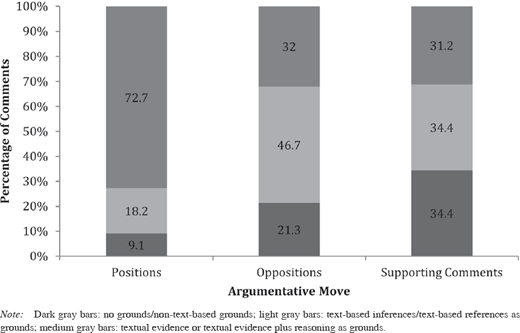
The result was statistically significant (p = 0.006). To explore the nature of this statistically significant relationship, I created a stacked bar chart as seen in Figure 5. This chart shows the percentage of comments at each grounds quality level based on the argumentative move. Over 72% of positions were assigned the highest level of grounds (textual evidence with and without added reasoning), whereas only 32% of oppositions and 31.2% of supporting comments were assigned this level. Only 9.1% of positions were assigned the lowest level of grounds (no grounds or nontext-based grounds, which include personal opinion and “made-up” knowledge as grounds), whereas 21.3% of oppositions and 34.4% of supporting comments were assigned this lowest level. It is important to note that the number of supporting comments without grounds is somewhat inflated in this sample because students would say they agreed with something a previous speaker stated without saying why (perhaps out of politeness or to subtly change the subject) before making their intended argumentative move (e.g., “Okay, I agree with you, but I’m gonna say my thing.”). The last set of results in Figure 5 shows that for the medium level of grounds (general references to concepts in the text and text-based inferences), oppositions had the highest percentage (46.7%), followed by supporting comments (34.4%) and positions (18.2%).
Discussion
I examined urban middle school students’ classroom debates in the context of SoGen, a social studies curriculum designed to support student argumentation in classroom debate. I found that students demonstrated strengths in argumentation that have not yet been identified in the literature on classroom debates in social studies.
First, the middle school students offered specific text-based evidence during classroom debates at higher rates than what might be expected given previous studies on classroom debates. One possible explanation for this is the way evidence was scaffolded in the curriculum. In four of the six debates students were given a list of facts, as mentioned earlier, which could be used as evidence to support their chosen/assigned positions in the debates or to attack the positions of their opponents. Thus, students did not have the difficult task of deciding what was relevant from dense paragraphs across several pages of text. Rather, relevant evidence was laid out before them on one or two pages. Students’ main challenge was to choose, among a random mix of pro and con facts, a select number that best supported their side of the debate. This simplification of text serves as key scaffolding for the very cognitively demanding task of academic argumentation within the context of oral classroom debate.
Students also offered claim-evidence connections at higher rates than what might be expected given previous studies on classroom debates. One possible explanation for this is the very explicit support for connecting positions and evidence in the social studies curriculum packets used by the students in the current study. Specifically, students were given sentence starters to help them make the connection.
Students successfully used either logic or background knowledge to connect their claims and evidence. Though historical inaccuracies and logical fallacies existed in students’ claim/evidence connections, one must weigh that problem against a different problem – students not connecting claims and evidence at all. Thus, one could argue that the fact that middle school students in these debates are at least making connections between claims and evidence is a very good thing even with mistakes, given that young students do not typically connect claims and evidence in their everyday arguments (Anderson, Chinn, Chang, Waggoner, & Yi, 1997). Teachers might even prompt students for counterarguments based on the historical inaccuracies and logical fallacies offered, which may lead to students becoming better at spotting these mistakes themselves.
Finally, students often used text-based inferences to support oppositions during debate. Though such inferences are “second best” to textual evidence, they are noteworthy in that they demonstrate students making at least some reference to text. These results may make sense if information accessibility to students is conceived as a spectrum. Personal opinion and “made-up” knowledge would be on one end of the spectrum, textual evidence would be on the other, and text-based inferences would be somewhere in between, considering that text-based inferences are often personal interpretations of textual evidence – not as exact as textual evidence and not as unrestricted as personal opinion. Because text-based inferences are theoretically more accessible than textual evidence, inferences are probably easier for middle school students to use “on the fly” in oppositions and supporting comments in classroom debate.
Implications for Practice
The present study’s findings indicate that middle school students are capable of academic argumentation in classroom debates on topics in social studies. Thus, middle school teachers who are wary of such debates should consider giving them a “second chance.” The findings also suggest there are several things middle grade teachers can do that may help improve the quality of their students’ argumentation during debates.
First, teachers can provide middle school students with simplified texts to be used as evidence during debates, so that these students can focus on the heavy cognitive task of analyzing the evidence for the debate instead of the heavy cognitive task of finding evidence to use from texts that are dense and lengthy, or the doubly heavy task of doing both. As students’ debate skills improve over time, teachers can offer increasingly complex texts from which to draw evidence. Second, teachers can offer middle school students sentence stems to help scaffold their generation of claim/evidence connections and counterarguments during debate preparation. Teachers can likewise slowly withdraw these supports as students gain more confidence in producing elements of argumentation within the context of classroom debates. Any argumentative task can benefit from the use of simplified texts and claim-evidence sentence stems, but the oral and impromptu nature of classroom debates make the lightening of some of the many cognitive tasks involved in debate particularly important for students in middle school.
The findings also suggest that middle school students are more likely to produce effective academic arguments when they first introduce and defend their positions in classroom debates and less likely to produce effective academic arguments when opposing others’ arguments, even when students spend some time predicting what their opponents’ arguments might be and planning responses. Thus, a teacher might try restructuring classroom debates so that students have time to prepare their oppositional responses based on what opponents actually said rather than what they anticipate opponents will say. Such an intervention would temporarily eliminate the “thinking on your feet” aspect of debate with the thought of reintroducing it once students become accustomed to producing rigorous opposition with ample preparation.
Conclusion
Though classroom debate at the middle school level is sure to present challenges to both students and teachers of social studies, especially those who are engaging in this activity for the first time, the National Council for the Social Studies posits that classroom debate is well worth the effort because debates have the potential to: (a) engage students in critical thinking and reasoning based on values, and (b) provide teachers with valuable information not only about what students know but what they understand about social studies content (NCSS, 2008; 2013). The findings of the present study support the supposition that middle school students are not limited to ad hominem, nonacademic arguments in social studies classroom debates as extant research suggests. Rather, students are capable of thoughtfully presenting and analyzing evidence in classroom debates. The findings further suggest that curricular supports for middle school students, such as readily available evidence and sentence stems to support the generation of claim-evidence connections, may help them do some of the heavy cognitive tasks demanded by debates, and may therefore help classroom debates be more successful overall. However, social studies teachers who choose to make room in their regular curriculum for classroom debates are doing much more than potentially promoting their students’ oral argumentation skills. They are giving their students valuable opportunities to practice both listening to different perspectives and sharing their differences in a manner that is civil, which is what we want future citizens to do in public discourse, whether on paper, online, or face to face on a stage.
Author Note
The research reported here was supported by the Institute of Education Sciences, U.S. Department of Education, through Grant R305F100026 to the Strategic Education Research Partnership as part of the Reading for Understanding Research Initiative. The opinions expressed are those of the author and do not represent views of the Institute or the U.S. Department of Education. The author expresses thanks to the teachers and students who made these data so interesting. Thanks also to the coprincipal investigators on the Catalyzing Comprehension through Discussion and Debate research project from which I drew the data—Catherine Snow, Robert Selman, Jonathan Osborne, and Suzanne Donovan; the team that produced the social studies curriculum featured in this study—Claire White, Bob Selman, Erin Ruegg, Halley Wheeless, Jacob Fay, Alyse Krantz, Elisabet Sena, and Matt Ellinger; the RAs who collected the video and audio data—Gretchen Wagner and Ling Hsiao; and Catherine Snow, Bob Selman, and Tina Grotzer for their help in the preparation of this manuscript.
Note
The debate I refer to here and throughout the paper is debate that takes place in a classroom where students are face to face, not online debate.