

Life cycle and environmental mismatches in electronics for critical applications
Life cycle and environmental mismatches in electronics for critical applications
Worldwide sales of electronics promise to reach $1 trillion shortly. A major portion consists of sales of volume driven electronic products, such as computers,telecommunications products, and consumer products. A smaller, but still vitally important portion, however, consists of low volume complex electronic systems for critical applications such as avionics, automotive electronics, and energy development. Over the last 20 years, there have been remarkable advances in the fuel efficiency and safety of automobiles, the efficiency and safety of jet aircraft, and the ability to locate and tap new sources of oil, all as a result of the development and integration of electronic sensors and control systems. However, the electronic systems for these critical IC applications are different from those in volume driven electronic products in that they must operate for longer periods of time in harsher and higher temperature environments. These advances are now being threatened by the shrinking availability of components that are being sold for use in these more severe applications. This editorial will examine the root causes of this mismatch between the system needs and the component availability and will discuss the ongoing programs to address this problem.
Since 1976, sales of ICs have increased 40-fold, owing to the increasing use of ICs in desktop computers,telecommunications, and consumer products. Over that same period, growth in the sales of ICs for low volume complex electronic systems has not kept pace,causing the market share for avionics and defense applications to shrink from 17 percent to less than 1 percent, as shown in Figure 1, and for automotive to shrink to less than 5 percent, even though the electronics content of the automobile has more than tripled. This shrinking market, coupled with the more severe application environments, the more extensive assurance procedures, and the stringent certification requirements, has led many major semiconductor manufacturers, such as Motorola, Intel, and Philips, to eliminate businesses directed exclusively at serving low volume complex electronic systems industries. Furthermore, because of the high cost and low quality of replacement components supplied by small custom device manufacturing and packaging companies, the Department of Defense has released policy directives encouraging the use of commercial off-the-shelf components to ensure early affordable access to leading edge technology rather than relying on remanufactured or warehoused older technology components.
Reliance of critical application systems on components from supply chains dedicated to other products introduces significant business and technical risks that are not present for volume driven electronic products. For example, Boeing's 777 relies on Intel 80486 microprocessors for flight management. However, this microprocessor is no longer being manufactured by Intel, which has directed its resources to the production of the more profitable Pentium, Pentium Pro, and Pentium II product lines which are desired by its high volume desktop computing partner companies. Furthermore, Intel has no corporate interest in developing custom products for avionics, because at less than 1 percent the market is insignificant. Resorting to a custom device manufacturing and packaging company to provide either warehoused or new versions of the discontinued part is not cost-effective as these components can cost as much as 20 times the price of the component when it was available from the manufacturer.
This anecdote highlights the mismatch between the long design, development, production, and application life cycles that are one of the defining characteristics of low volume complex electronic systems, and the much shorter life cycles typical of components. Low volume complex electronic systems typically require three to five years for design and certification; have a production life of 5-20 years; and have a service life of ten to 40 years. Traditionally, system designers have relied on the ability to purchase MIL-SPEC parts throughout the 20 year production life to support new production and spares. However, as the market share has shrunk and major semiconductor manufacturers have withdrawn from the market, there has been widespread discontinuance of many of these older parts. The lack of availability of these parts is referred to as the problem of diminishing manufacturing sources.
This lack of availability of MIL-SPEC parts has led many LVCES designers to consider the use of commercial off-the-shelf (COTS) parts, and in doing so, they have also come to appreciate the cost, size, and weight advantages of COTS components. However, the continuous technological advancement which is required for volume driven companies to remain competitive requires these components to be replaced by a newer version on average every 18 months. Thus, an off-the-shelf component can be expected to have a design cycle of six to nine months, and a production life of 18-36 months. This creates a significant life cycle mismatch with respect to low volume complex electronic systems, the production life cycle of which may cover as many as ten to 12 changes in component technology and as many as five or six changes in assembly technology. Thus it is impossible to continue to order the same component from the original manufacturer throughout the production and service life of the system. This problem is referred to as the problem of parts obsolescence. This difference in service life between systems and components affects not only the maintainability and supportability of the systems, but also the functionality if substitute components must be used; the quality if the components have to be custom made; the reliability if the components have experienced long periods of warehousing; and the affordability of continued use if the distributor chooses to increase the price of a scarce component.
A number of techniques have been proposed to address the twin concerns of diminishing manufacturing sources and parts obsolescence. These include using aftermarket distributors and manufacturers, making lifetime buys of components, die banking, developing reconfigurability strategies, emulating microcircuit functionalities (GEM). Further work is needed focusing both on developing tools for assessing the expected time-to-discontinuance for individual components, and on developing techniques for creating new systems containing new technology that can serve as form-fit-function matches for existing systems.
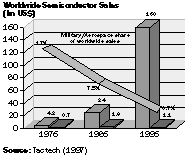
Figure 1Shrinking size of the military/aerospace market for ICs
Another significant factor separating low volume complex electronic systems from their volume driven counterparts is the environment in which they are expected to operate. While volume driven electronic products, such as desktop computers and consumer electronics, are traditionally operated in climate controlled office and home environments, which are considered benign, low volume complex electronic systems often alternate from low pressure, subfreezing temperature environments, such as are found at high altitudes, to high temperature, high humidity environments,such as are found in the tropics. Furthermore, the operational stresses of power dissipation, shock, vibration, current, and voltage are often substantially greater than those of the volume driven electronic products. Not only are these systems exposed to harsh environments, they are often placed in applications where failure could result in loss of life or great financial liability. When the 30-40 year application life cycle is factored in, these systems must have extremely high reliability.
The desire to exploit the advantages of distributed control is now driving low volume complex electronic systems to be used in even more harsh environments. Traditionally, harsh environment applications have utilized centralized control systems, where a central processing unit located in an environmentally controlled location, such as a passenger compartment or equipment bay, receives signals from a number of remotely placed sensors and responds via remotely placed actuators. This control architecture can require many meters of cable, along with many permanent and separable interconnects to relay the signals.
Significant cost, size,and weight savings can be achieved by replacing these traditional centralized control systems with a more distributed architecture, where the sensors,processors, and actuators are all housed in a single, remotely placed, unit. The savings result from the elimination of cables, interconnects, and environmental controls. The elimination of these historically unreliable elements also has the potential to significantly increase the reliability of the electronic system. Distributed control systems also improve maintainability since these systems are integrated field replaceable units (FRU), thus eliminating the need to troubleshoot electrical problems in the field. Finally, they can improve performance by reducing the signal transmission length.
The challenge of distributed control is that it requires the electronics to be operated at the ambient temperature of the remote location, which can reach 150°C for oil well logging, and 193°C for flight surfaces on supersonic aircraft. The classic example of this type of environment is that encountered by an automotive engine control system, where temperatures can range from 40°C when unpowered on a cold winter day to 165°C when powered on a hot summer day.
The desire for distributed control comes at a time when the availability of extended temperature range components is being drastically reduced. The same MIL-SPEC parts which provided a stable technology base over 20 years also were guaranteed to operate from55°C to 125°C. Semiconductor design rules were used which ensured continued operation at 125°C without causing device-level failure mechanisms such as electromigration or loss of oxide integrity. In addition, the device speeds and timing were derated and the margins placed on the electrical parameter specifications were sufficiently wide to ensure devices would perform within these specifications over the extended temperature range. The packaging was engineered with materials that would stand up to continued high temperature use, and the hermeticity of the packages provided the perception of increased reliability under all harsh environment conditions.
Programs aimed at solving this problem include the DARPA sponsored TRP for the development of High Temperature Distributed Control Systems (HiTeC). This program is aimed at developing the component and packaging technologies needed to design prototype smart engine control actuators for aerospace and integrated motor controllers for commercial and industrial use. These prototypes are expected to operate in the temperature range from 125°C-225°C. Organizations involved in this program include companies such as Honeywell, AlliedSignal, United Technologies,Ford, Boeing, Rockwell International, Moog, and Parker Hannifin; and research centers such as the CALCE EPRC at the University of Maryland. Programs such as this are resulting in the introduction of a growing number of high temperature components. A number of typical functionalities, such as quad op amps, voltage regulators, and memories, which are shared by customers in the avionics,automotive, oil well drilling, chemical processing, and radiation hardened electronics industries, are now commercially available in versions which can operate for up to five years at 300°C. Now that active devices are available, there is a growing desire for passive components as well. While surface mount and wirewound resistors have no trouble in achieving 300°C,that is not the case with currently available capacitors and magnetic components. The lack of magnetic components is driven by a variety of technical factors including loss of core magnetization over time at temperature. The lack of capacitors, however, is driven by both technological and economic factors. Large capacitor manufacturers have shelved their high temperature development programs owing to the relatively small size of the market, a market which will likely grow much larger now that active devices are available. A full slate of components is needed to take advantage of the market for electronics operating at temperatures greater than 125°C, which is expected to reach $1 billion by 2005.
For the applications requiring components that perform in the range from 70°C-125°C that is being affected by component discontinuance, efforts are under way to develop testing standards that will permit system manufacturers to purchase 0°C-70°C components and specify their electrical performance parameters over a wider temperature range. These manufacturers can then design systems to these new performance specifications that permit use of these components over the wider temperature range. This specification method is called "performance derating". At the same time, work is being conducted to extend the range of components,thermal management studies are being pursued to control the microclimate in the vicinity of the device. These include the use of thermoelectric coolers and the use of phase change materials.
These programs and efforts at obsolescence management, high temperature electronics, performance derating,and thermal management must continue to be vigorously pursued in order to ensure that the benefits of electronics technologies are shared by the critical application industries and well as by the high volume consumer industries in the next millennium.
F. Patrick McCluskeyCALCE Electronic Products and Systems Center,University of Maryland, USA

