

Then I saw that there was a way to Hell, even from the Gates of heaven [1]
Then I saw that there was a way to Hell, even from the Gates of heaven[1]
Keywords Internet, Information technology
I am writing this on New Year's Day, so am still in a festive mood, so let me tell you a little joke. Bill Gates died and when he met St Peter he was delighted to learn that he could have an Internet connection through ISDN. He was shown into a room, beautifully furnished, with a brand new computer on the table. But his jaw dropped down to his navel when he saw it was a Mac. He asked Peter whether he could not have a PC instead and was told that he would have to go downstairs for that. On arrival there, he was met by Satan and said he would like to design a Web site for the establishment. He was shown into a fireproof room, with flames licking up outside the window and door and was delighted to see the back of a PC on a plain wooden table, with a one-legged wooden stool on the floor beside it. Satan told him that this was his lot for eternity. He eagerly dashed round, balanced his backside on the stool and switched the computer on. To his dismay, he found it was a 286 with 1 Mb memory, running at 4.3 MHz, with a 5 Mb hard disk drive and a 1200 bit/s modem. As it booted up,his dismay increased when he realised that it was running MS-DOS 4, Windows 2 and Netscape. As Windows ever-so-slowly came on the screen, it crashed. Then he discovered the keyboard didn't have Ctrl, Alt or Delete keys!
I have an ulterior motive in recounting this jest, other than reminding us what we were using only ten or 15 years ago. It is to remember that there are hundreds of thousands of such computers still in service in developing countries and even, to some extent, in developed countries. I visited, just a couple of months ago, a small European company using a 9.6 kbit/s modem with fax/modem software that they bought with a 386/16 computer ten years ago. The only thing added was the DOS Compuserve Mozilla software they have been using for the last five years or so. When I asked them why, I was told, "if it ain't broke,don't fix it!". Yet they use it daily as an Internet data source, even though it was painfully slow: in fact, I had forgotten how slow downloading a large Web page could be.
There is a flourishing business in some developing countries where small concerns import scrap IT equipment from developed countries and repair them. As a rule, they are mainly 386, 486 and early Pentium machines, with 14" monitors. Out of ten sets of equipment, they can average a recycling of seven to eight which are then sold, as complete systems, for less than half the price of even the cheapest new computers – and they are snapped up, even by large companies.
This is one, but very good, reason for Web site designers to moderate the size of their Web pages. My recommendation is an absolute maximum for the Home Page of a technical site of 50 kilobytes, but preferably less, including all the graphics and other bells and whistles. I would even recommend a target of half this figure, if possible. My own Web Home Page has a relatively modest 10 kilobytes aggregate file size and it contains everything that a Home Page needs to contain, brief information of the various sub-webs, logo, name, address,navigational menu, meta description and keywords, and so on. Of course, it is simple, with an appropriate background, yet I have been told that it looks good and well-balanced.
Other pages should, wherever possible, follow the same rules. However, more flexibility may be needed, depending on the content. It is preferable to use click-on "thumbnail" pictures, if you wish to have photograph(s) or other graphics exceeding an aggregate of, say 30 or 35 kilobytes, with a warning as to the size of the large graphics. Long text is best split into pages of a maximum of about two screens height, where feasible. No one likes scrolling up and down indefinitely. Judicious use of bookmarks with a page contents at the beginning can help, too, if the page must exceed a reasonable length.
However, the problems do not end with "surfers" using old and slow equipment. The Internet, itself, is often inherently slow. When you try to download a page, it goes through a number of "hops", each with at least one computer interposed. Typically, when you type a URL, such as, "www.joebloggs.com"into your browser or click onto a hyperlink, you send it to your local dial-up ISP which has a gateway and then into a DNS server which checks the domain name against a list to determine its Internet Protocol number and the whereabouts of the host server. It then tentatively calculates a routing and tries it out, over as many as ten to 30 hops. If it works, the server starts sending the requested page in packets, each one requiring handshakes, over the same route (with exceptions possible). This may take, under reasonable conditions, between 200 and 500 milliseconds for a single packet and handshake, running at two to five kilobytes/second for the download. There are two things that can slow this data transfer rate down very significantly. The more important one is the host server and its connection into the Internet backbone. Many companies do their own hosting on "any old computer" with a couple of ISDN connections. If all goes well and you are the only surfer seeking to download from it, you may not notice more than a fairly slow download but, if half-a-dozen surfers are trying at the same time, it becomes catastrophically slow with data transfer rates as low as 100 bytes/second or even less. It does not need a degree in advanced mathematics to find out that a 100 kilobyte page would need 1,000 seconds to download at 100 bytes/second, nor do you need to have studied psychology to know that few will wait 16 minutes or so for such a download. The moral of this is that host servers should have, at least, the hardware and software to manage a rapid connection into the Internet. The other problem is that each node, between the "hops", must be working efficiently. This is usually the case but there is a limit to the traffic that it can handle, called the bandwidth. If the bandwidth is insufficient, the data transfer slows down or may even grind to a total halt under the worst conditions. This is why "worm viruses", such as Melissa, LoveLetter and Navidad (and virus hoaxes) are so successfully catastrophic: for a few hours, they simply cause the Internet nodes to be overloaded.
So far, I've been talking essentially about telephone-line modem connections. If you have a faster connection, starting with ISDN going all the way to a glass fibre T3 connection, you are amongst the privileged few, probably counting in the top 10 percent of all surfers. However, if the host server from which you are trying to download is slow and the connection bandwidth is unavailable at the nodes, you are no better off than you would be with a 9.6 kbit/s phone modem(worse off, in fact, because you are paying for the privilege you enjoy!). Of course, you benefit when the connection is good. Some systems are asymmetrical,notably most satellite and TV cable ones. Your outgoing packets of data go along a phone line while the incoming downloaded data comes along the fast channel. This is usually advantageous, because the handshakes are very small packets compared with the data ones.
Another bottleneck is often the company intranet server, even if it has a T3 connection into the Internet backbone. Many company networks are hopelessly overloaded: just imagine a couple of hundred employees surfing at the same time and as many again handling their e-mail, not to mention data transfers within the company, over a twisted pair network, even a Fast system. My advice is that,if you are spending a lot of time on the Net during peak hours, ask your system administrator for a direct ISDN connection. He should be happy to give it to you to reduce the internal network overloading and, at the same time, you will benefit from a better connection.
A final point is that anyone surfing from a notebook or palm computer through a mobile cellular telephone is usually limited, in most countries, to a 9.6 kbit/s data transfer rate. If you imagine that anyone travelling may want to look at your site, have pity on him and do not make him suffer from his forcefully slow connection.
In conclusion, I reiterate, the more compact your Web pages, the faster they will download, even under poor conditions. This will not frighten your prospective customers to a competitive supplier's site, like many do. I, for one, have frequently stopped a slow download and given up after the second or third try (I suggest that you stop the download a couple of times and try again:a re-routing may give you a better connection if the bottleneck is in an intermediate node).
The Home Page on this site is a little bit on the heavy side, totalling about 60 kilobytes. It lacks the company co-ordinates and does not have meta keywords or description. In appearance, it consists of a photograph of some hybrid circuits on a dark background, with a menu in small white text. The legibility is mediocre. The company manufactures hybrid circuits and multichip modules. Happily, the other pages are ordinary black on a white background, although the menu at the top of the page is almost unreadable, despite being a graphic with a large file size. If you look hard at this menu, you will see the phone number and e-mail address of the company. These pages are generally of a more reasonable size than the Home Page. The information on the Web site gives the impression of technical competence in high-tech manufacture. I believe that anyone seeking a supplier of thick film MCMs for a high-tech application may well put this company on their short list for consideration. One point, which I did like, and which I urge other webmasters to copy, is the provision of a page which gives the name, telephone number and e-mail address of the relevant persons for each type of application.
If you want an example of what I consider a Home Page should not look like,go to this one. Other than a "Your full service electronics manufacturing partner", there is no clue as to what this company offers, there is no address (they are in Canada), it is loaded with clip art which not only conveys nothing to the user, it gives an image of not being a serious firm. On the other hand, this Home Page does have meta key words and description. The aggregate files size is too long for downloading with a slow connection. The sub-pages are not much better. The sub-page micro_thickfilm.htm shows the kind of hybrid module that the company makes and is slightly better than what the Home Page would promise. Some of the other pages reflect the Home Page more than this one. The "Contact us" page is a little annoying, although it does have the names of key personnel. Why is it annoying? Because it uses a script for a simple send-mail operation, making the page much longer than is necessary. Equally annoying, representatives in the USA do not have their e-mail addresses posted, at least in many of the States or in Canada. Nor is there any address outside North America, but perhaps this company does not export. Detailed ways of getting to the different plants are provided and one point which I particularly liked was that nearby hotels for each plant were listed. This feature deserves to be copied by other companies.
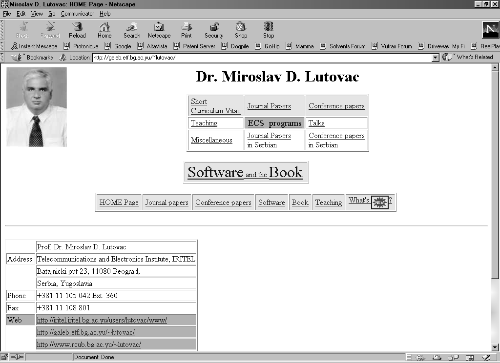
Occasionally, one gets a surprise when surfing the Internet. I got a small one here; the site belongs to a professor at the Telecommunications and Electronics Institute in Belgrade. There are many pages devoted to pure electronics but there is one page which will be of interest here, with the URL http://galeb.etf.bg.ac.yu/~lutovac/miel99js.htm. This gives the abstract of a paper entitled "Characterization and processing of thick film materials for MCM-C applications". The full paper – quite short – is downloadable, but only in Postscript format. For those who are not quite sure how to do it, the easiest way is to save the file (and I recommend using the Zip format and unzipping it). If you have a Postscript printer, you can then obtain a hard copy by going into MS-DOS mode, moving to the directory in which the file is situated and typing "type miel99js.ps> LPT1" (assuming that the printer is on this port). Otherwise, you may require a conversion software. The paper describes the method used to obtain a four conductor-layer hybrid circuit, in 20 operations. It is oriented to one particular manufacturer of conductor, dielectric, fill and resistor pastes. The Professor's Home Page (Figure 1) is short, sweet and simple, albeit without meta description or keywords. The daughter-page is even simpler.
The Home Page of this company is not well designed. It conveys nothing, has no address, is long to download and serves no useful purpose other than to invite the surfer to enter into another page. On the other hand, it does contain all the necessary meta description and keywords. Entering the second page, also very long to download, takes one to a graphic menu system describing the various aspects of the company. We still have no idea, though, where the company is situated. It is only by entering the "Contact Us" page that we can learn that it is in the USA, Nebraska to be more precise. Amongst other things, the company manufactures custom hybrids and multichip modules. In the pages describing these, there is a list of the features that the company offers and,on the left hand side, there are some small photographs of typical products. One is invited to click on them to enlarge, but this does not work, at least for me. I get the impression that this site is of the "see-how-clever-my-Web-site-is-but-to-hell-with-anyone-who-has-to-view-it!"category. Anyway, it is far from earning full marks according to my criteria of sound design.
This is the URL of a Norwegian company whose name has nothing whatsoever in common with it, Kitron Microelectronics AS. The firm manufactures hybrids and multichip modules. If the Home Page consisted only of its bottom frame, then it would have been good but it has been totally spoilt by the top frame with a logo, a slogan and a gigantic background but which renders the whole too big. Another negative point is that there are no meta keywords or description. The"Products" and "Services" pages are adequate for the kind of site that it is. I was quite amused at the "Contact" page, which correctly gives the e-mail addresses of the key personnel but, more unusually,with what looks like passport photographs of each of them it reminds one of the FBI's most wanted men list! The whole site is fairly simple, as it appears to the casual observer. However, I have found more information about the company outside the menu system by clicking onto http://www.amitech.no/english/infoeng.htm, which can also lead to the geographical details of where it is situated.

Brian EllisCyprusb_ellis@protonique.com
Note
- 1.
John Bunyan, The Pilgrim's Progress (1678) pt. 1, p. 133 (modified by me by capitalising "gates". Interestingly, Bunyan must have thought that Hell existed, because he made it a proper noun, while heaven did not, because he made it a common noun!)

