


This research addresses a gap in the literature that encourages more inquiries to enhance the effectiveness of negative public service advertisements (PSAs).
The research engages two laboratory experiments (N = 179 and N = 219) and a field study (N = 216) to test our hypotheses.
Under mortality salience, negatively (vs positively) framed messages were found to be more effective in encouraging positive health compliant behaviours (follow covid safety rules, flu vaccination intention) and this effect was mediated by message effectiveness.
Policy makers at various levels (local, state and federal government) should consider the strategies discussed in this study to make PSAs more effective.
The current study makes significant original contributions to theories of PSAs and negative framing.
Introduction
Public service advertisements (PSAs) are critical in communicating social issues to the public with examples being health behaviour, drug abuse, drink driving amongst others. The key focus of PSAs is to achieve positive attitude and behavioural changes (e.g. take flu shots) and prevent adoption of risky behaviours. Given their strategic importance, PSAs are ubiquitous across television, radio, magazine and social media. PSAs have been known to engage both positive and negative message framing (Block and Keller, 1995; Davies et al., 2024). A positive framing typically shows the benefits of adhering to the advice provided in the message (e.g. taking the vaccine can save your life), while a negative framing may focus on the dire consequences (e.g. not taking the vaccine can make you sick).
Despite extensive research, studies report mixed evidence on the effectiveness of negative message framing (Ma et al., 2021; McCall and Ginis, 2004; Meyerowitz and Chaiken, 1987). For example, while negative framing was found to be effective in changing health behaviours (Fernandez-Lores et al., 2024; Meyerowitz and Chaiken, 1987), contradictory evidence supports the effectiveness of positive framing as well (Barnes et al., 2023; McCall and Ginis, 2004). A meta-analysis suggests that negatively framed messages could be less persuasive compared to positive ones (O’ Keefe and Jensen, 2008). Such mixed evidence regarding effectiveness of negatively (vs positively) framed message is abundant (Ma et al., 2021). Scholars suggest further research to explore additional ways to enhance persuasiveness of negative PSAs (Ma et al., 2021; Wang et al., 2020). This research proposes that mortality salience, a condition when people are consciously aware of the eventuality of their death (Chittaro et al., 2017; Burke et al., 2010) – enhances effectiveness of negative PSAs.
The current work further posits that mortality salience, and negative PSAs will enhance message effectiveness, to positively influence health behaviours (e.g. public health compliance during pandemic, higher intention to take flu vaccines). This fills a gap calling for more research on the role of message effectiveness on health behaviours (Noar et al., 2020; Yzer et al., 2015). Encouraging positive health behaviours remains a challenge to public health managers. A major challenge during COVID-19 was ensuring public compliance with health safety measures (Six et al., 2023; Corey et al., 2020). Similarly, flu vaccination rates have dropped in Australia, despite the government’s free vaccine program (Rigby, 2024). The current contexts (pandemic related health and safety behaviours, decision to take flu vaccines) remain topics of interest to both academics and managers (Rigby, 2024; Courtney et al., 2022). This study addresses the research question about how mortality salience and negative framing jointly influence health compliance through message effectiveness.
Theoretical background
PSAs and framing
PSAs commonly use both positive and negative message framing (Ma et al., 2021; Hevey and Dolan, 2014). Prospect theory (Tversky and Kahneman, 1981) underpins message framing. Prospect theory suggests people react differently to messages framed as gains (positive outcomes) or losses (negative outcomes). People take risks when negative outcomes are salient and avoid risks when positive outcomes are emphasized (Ganzach and Karsahi, 1995; Shiv et al., 1997). When behaviours involve risk, negative framing is often more effective. For example, women responded better to negatively framed self-breast exam PSAs (Meyerowitz and Chaiken, 1987). Several research show that negative messages can indeed be more persuasive compared to positive ones (Fernandez-Lores et al., 2024; Leshner and Cheng, 2009; Meyerowitz and Chaiken, 1987).
Other studies suggest positive messages can also be more effective (Barnes et al., 2023; McCall and Ginis, 2004; Millar and Millar, 2000). For example, Barnes et al. (2023) demonstrated that positive messages were more effective in changing health behaviours. Similarly, McCall and Ginis (2004) showed that positively framed messages ensured higher adherence to cardiac rehabilitation exercise program. In the context of these mixed findings, past research has investigated the role of moderators in PSA message processing. For example, past works have looked at several factors like nature of message consequences (Teng et al., 2019a, b), counterfactual thinking engaged by the subjects (Baek et al., 2013) or individual variables like regulatory focus (Teng et al., 2019a, b).
PSAs tend to favour negative framing since it drives stronger cognitive, emotional and behavioural responses (Leshner and Cheng, 2009; Vaish et al., 2008; Rozin and Royzman, 2001). Negative PSAs can provide more shocking information, capture attention, raise awareness and are more likely to be shared (Rozin and Royzman, 2001; Stieglitz and Dang-Xuan, 2013). The basic premise of this work is that the effectiveness of negative (vs positive) PSA will be moderated by mortality salience.
Mortality salience
Greenberg et al. (1986) introduced mortality salience in Terror Management Theory (TMT). Mortality salience refers to a condition when people are conscious of the eventuality of their death (Burke et al., 2010). TMT proposes that when mortality salience is high, people’s actions are driven by their motivation to avoid death (Whitley and Kite, 2010). Feelings of the eventuality of death and their own powerlessness in its wake tend to lower their self-esteem (Morris et al., 2019). To raise their levels of self-esteem once again, people indulge in self-preserving behaviours (Morris et al., 2019). Self-preserving behaviours can involve enhancing physical health and prioritizing growth-oriented goals, fostering positive standards and beliefs and creating a supportive and harmonious community leading to better well-being (Chittaro et al., 2017; Vail et al., 2012).
Mortality salience directly increases adherence to societal norms and values, driven by a heightened desire for social acceptance (Fa and Kugihara, 2020; Gailliot et al., 2008; Crocker and Park, 2004; Greenberg et al., 2003; Hirschberger et al., 2003; Wisman and Koole, 2003). This behaviour stems from the understanding that norm violations can result in negative social perceptions (Fa and Kugihara, 2020; Crocker and Park, 2004).
Hypotheses
Mortality salience encourages self-preserving behaviours such as enhancing physical health (Morris et al., 2019). Further, it increases the desire for social acceptance (Greenberg et al., 2003; Hirschberger et al., 2003; Wisman and Koole, 2003), leading to adherence to societal norms (Gailliot et al., 2008; Crocker and Park, 2004). Supporting this, Sherman et al. (2000) reported that people were more compliant with regards to risky health behaviours (e.g. condom usage to prevent HIV) when they were trying to preserve the self. In the case of public service advertisements, communicating social issues to the public and effecting positive behavioural change is the key focus. In other words, PSAs persuade adherence to normative behaviours that keep the public safe (e.g. do not drink and drive). Triggering mortality salience in individuals will motivate people to preserve the self as well as adhere to social norms. Further, negative (vs positive) messages would be more effective under mortality salience for the following reasons. First, prospect theory underpinning message framing predicts that when behaviours are associated with risks (e.g., not taking adequate health measures could lead to death), negative messages could be more effective (Meyerowitz and Chaiken, 1987). Further, negative messages are more effective under risky situations that demands more detailed and careful processing (Maheswaran and Meyers-Levy, 1990; Meyerowitz and Chaiken, 1987). Based on this we posit that:
In the presence of mortality salience, a negative (vs positive) framed message would lead to more positive health compliant behaviours. This effect will disappear in the absence of mortality salience.
Moderated mediation: underlying process
We posit that mortality salience, and negative PSA will combinedly enhance message effectiveness and lead to positive health behaviours. There is considerable evidence in the mainstream consumer behaviour literature which shows that when people make a favourable decision, it could be driven by salience of the information, such as product attributes (Roy and Naidoo, 2021; Van Ittersum et al., 2007). We have previously argued that under mortality salience, negative (vs positive) PSA would be considered more relevant for decision making and influence behaviour (i.e. H1). This also suggests that negative information could be deemed more salient and important in comparison to positive information, thereby rendering it more effective for decision making.
Extant meta-analysis shows that message effectiveness can predict health behaviours like intentions to quit smoking as well as cessation behaviour (Noar et al., 2020). Similarly, in the context of health-related PSAs, extant evidence shows that when a message is perceived as effective, it has positive influence on desired health compliance behaviours (Yzer et al., 2015). Based on this we hypothesize that:
In the presence of mortality salience, a negative (vs positive) framing will enhance message effectiveness leading to more positive health compliant behaviours. This effect will disappear in the absence of mortality salience.
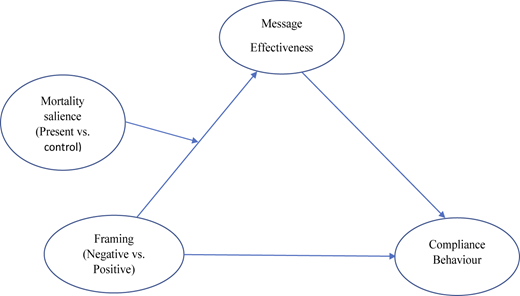
The conceptual model embodying our work is represented in Figure 1. The theoretical contribution of the current work to the PSA and framing literature is represented in Table 1.
Review of literature on framing and health PSA
| Study | Independent variables | Dependent variables | Key findings |
|---|---|---|---|
| Fernandez-Lores et al. (2024) | Three health campaigns with different narrative frames and emotions in the messages | Persuasive effectiveness | Negative framing and high levels of emotional intensity worked effectively |
| Satybaldiyeva et al. (2024) | Nature of outcomes (gain versus loss) and for whom (individual versus collective) | Intention to vaccinate | Gain (vs loss) framed messages performed better with a collective appeal when promoting HAV vaccinations among populations with high perceived barriers |
| Luo et al. (2024) | Loss-versus-gain framing affects HPV vaccination among Chinese female college students | HPV vaccination intention | Gain framed message activated greater hope than the loss-framed one, with hope influencing vaccine intention |
| Davies et al. (2024) | Positively framed, negatively framed and ambiguous messages presented on alcohol labels | Drinking intentions | Positive and negative messages, in comparison to ambiguous responsible drinking messages were more likely to change behaviour |
| Barnes et al. (2023) | Framing and vaccine familiarity | COVID-19 booster vaccine intention | Positive (vs negative) framing of side effect information increased vaccine intent |
| Barbaros (2022) | Stages of change (contemplation or preparatory stage), perceived risk and vulnerability and perceived control | How people interpret message framing and their subsequent intentions regarding the behaviour of accepting or refusing anti-COVID-19 vaccination | Choice of gain-framed or loss-framed narratives was contingent on peoples’ stages of change (contemplation or preparatory stage), perceived risk and vulnerability and perceived control |
| Reinhardt et al. (2022) | Gain- or loss-framed messages, distraction vs non-distraction | Recognition, intention to seek further information | Gain-framed radio PSAs are an appropriate tool to raise awareness for a vaccination campaign and its contents, especially when recipients are concentrating |
| Pang et al. (2021) | Graphic health warnings using negative framing | Increasing quit intentions and perceptions of health risks | Graphic health warning increases quit intentions. Wear out effects were also observed for graphic health warnings |
| Timmons et al. (2021) | Negative vs positive framing, anonymity | Compliance with COVID-19 guidance | Compliance was reduced by negatively framing questions and increasing anonymity |
| Bertoni et al. (2020) | Informational content (restricted or enhanced information) and the framing (gain or loss framing) | Participation in breast cancer screening program | Providing enhanced loss-framed information about the risks of not having a mammography increases the take-up |
| D’Antoni et al. (2019) | Positive and negative framing, agency | Intentions to use the antivirals | Virus agency and positive framing increased response efficacy |
| Rosenblatt et al. (2018) | Negative vs positive framing, text vs graphic based | Dietary self-control | Negatively framed text health warnings and positively framed graphic health warnings promoted greater dietary self-control than positively framed text health warnings and control images |
| Notthoff and Carstensen (2017) | Positive vs negative framing, perceived walkability | Message effectiveness | Positively-framed messages promote walking in older adults better than negatively-framed messages, which was further contingent on perceived walkability |
| Nandakumar et al. (2017) | High efficacy and loss framed message | Attitudes and intentions | High efficacy public health messages in combination with high threat messages can significantly influence consumer attitudes and intentions |
| Haydarov and Gordon (2015) | Attribute and goal frame | Vaccination behaviour | Combination of the positive attribute frame and the negative goal frame was the only condition that was significantly more persuasive than the control condition |
| This study | Mortality salience and framing | Covid-19 health compliance and flu vaccine intention | Under mortality salience, negatively (vs positively) framed messages were found to be more effective in encouraging positive health compliant behaviours |
Source(s): Authors’ own work
In the following section, we discuss three studies that were undertaken to examine the proposed hypotheses. These studies were conducted across multiple countries (India, USA) where most pandemic related deaths or problem with vaccine uptake occurred (Elflein, 2024). For example, based on Elflein (2024), USA reported about 1.16 million, while India reported about 0.53 million deaths, placing them as the first and third countries in the world where most COVID-19 deaths occurred. Similarly, in terms of vaccination, reports from USA show that by November 2024 only 34.7% of adults reported taking a flu vaccine, thereby indicating low uptake (Beusekom, 2024). Based on these reports, both India and USA provide relevant samples to empirically test our conceptual model.
Study 1: laboratory experiment
Design
A two-way Mortality Salience (present vs control) × Framing (negative vs positive) between subjects’ laboratory experiment was conducted to test the key hypotheses. In this experiment, 179 students (average age = 23.92 years, 72% male) from a large Indian university were randomly allocated to one of the four experimental conditions.
Procedure
The study was conducted in two unrelated parts. The first part involved mortality salience manipulation. Following extant literature (Burke et al., 2010), participants wrote about the emotions related to thoughts of their own death, followed by further thoughts about what happens to them once they are physically dead. In the control condition, participants wrote about emotions and thoughts associated with dental pain. After this essay, subjects were asked to report a range of positive and negative emotions that included happiness, cheerfulness, fear, anxiety, sadness, depression amongst others (Lambert et al., 2014). Subjects also responded to two manipulation check questions, “After completing the above task, it seems that death is inevitable”, and “After completing the above task, it seems any one can have dental pain”.
In the second part of the experiment, subjects were exposed to the scenario of a public service advertisement. In particular, subjects learned that while watching television, they came across an advertisement recommending public to maintain coronavirus related health and safety behaviours. This scenario was further manipulated for positive versus negative framing. In the positive (negative) framing scenario, participants learned that adhering (non-adhering) to health and safety advise will keep them safe or expose them to the virus. The framing manipulation was adapted from the literature (Davies et al., 2024; Barnes et al., 2023) and can be found in the web appendix.
Measures
A number of emotions, e.g. fear, anxiety, sadness amongst others were measured (Lambert et al., 2014) using a seven-point Likert scale with endpoints 1 = strongly disagree and 7 = strongly agree. The key dependent variables for this study were health compliance behaviour and message effectiveness. Compliance behaviour was measured with four items on a seven-point scale; the items being “I will wear mask in public places”, “I will sanitise my hands frequently”, I will wash my hands as recommended” and finally “I will maintain a safe distance from others in public places” (Cronbach alpha = 0.94). Similarly, message effectiveness was adapted from the literature (Dillard et al., 2007) and measured with three items on a seven-point scale, the items being “The advertisement message is effective/useful/persuasive” (Cronbach alpha = 0.87).
Analysis and results
A one-way ANOVA was conducted using mortality salience as the independent variable, while the different manipulation checks, and emotional measures served as the dependent variables. With regards to the manipulation checks, subjects in the mortality salience agreed more to the statement that death in inevitable compared to the dental pain condition (Ms of 6.41 vs 5.91, F(1, 177) = 4.44, p < 0.05). Similarly, subjects agreed more with the statement that anyone can have dental pain (Ms of 5.69 vs 5.16 (F1, 177) = 5.10, p < 0.05) in the dental pain (vs mortality salience), condition. Thus, the manipulation for mortality salience seems successful. Further, in line with the literature (Lambert et al., 2014), subjects in the mortality (vs control) condition reported higher levels of fear (Ms of 3.14 vs 2.42, p < 0.01), with no other emotions (such as sadness, anxiety, sadness, depression, happiness and cheerfulness) being significantly different across the conditions.
To test for H1, we conducted a two-way between subjects ANOVA. Mortality salience (present vs control) and framing type (negative vs positive) served as the independent variables while health compliance behaviour was the dependent variable. Findings show a main effect, with negative (vs positive) framing leading to higher compliance behaviour (Ms of 6.49 vs 6.09, p < 0.01). More importantly, the two-way interaction was significant (F (1,175) = 7.27, p < 0.01). Contrast analyses showed that subjects in the negative (vs positive) framing were more likely to comply with health and safety behaviour, under the presence of mortality salience (Ms of 6.67 vs 5.86; t (175) = −4.04, p < 0.001), with this difference disappearing under control condition (Ms of 6.38 vs 6.28; t (175) = −0.60, p > 0.05). These findings therefore support H1. The two-way ANCOVA with “fear” as the control variable showed findings still held, with the two-way interaction remaining significant (F (1,173) = 6.73, p < 0.05).
Moderated mediation
To test for H2, we used Hayes (2013) Model 7 with 5,000 bootstrap analyses. We used framing (positive vs negative) as the independent variable, mortality salience (present vs control) as the moderator; while message effectiveness served as the mediator and compliance behaviour was the key dependent variable.
Findings showed that the two-way interaction between framing and mortality salience had a significant effect on the mediator “message effectiveness” (β = 0.76, t = 2.29, p < 0.05), and the mediator had a further positive influence on the dependent variable, compliance behaviour (β = 0.38, t = 7.37, p < 0.001). The conditional indirect effect of framing on compliance behaviour through message effectiveness revealed further insights. In the presence of mortality salience, a negative (vs positive) framing enhanced message effectiveness leading to higher compliance behaviour (conditional indirect effect = 0.25, 95% confidence interval does not straddle zero), while this indirect effect was not significant when mortality salience was absent (conditional indirect effect = −0.04, 95% confidence interval straddles zero). Based on these findings, our H2 is supported. Findings from the moderated mediation model are presented in Table 2.
Process model results for study 1
| Coeff | SE | t | P | |
|---|---|---|---|---|
| Dependent variable: message effectiveness | ||||
| Constant | 5.63 | 0.15 | 35.9 | 0.00 |
| Frame (negative = 1, Positive = 0) | −0.11 | 0.21 | −0.51 | 0.61 |
| Mortality salience (1 = Present, 0 = Control) | −0.55 | 0.23 | −2.36 | 0.02 |
| MS × Frame | 0.76 | 0.33 | 2.29 | 0.02 |
| Dependent variable: compliance behaviour | ||||
| Constant | 4.03 | 0.29 | 13.84 | 0.00 |
| Frame (negative = 1, positive = 0) | 0.32 | 0.12 | 2.75 | 0.00 |
| Message effectiveness | 0.38 | 0.05 | 7.37 | 0.00 |
| Conditional indirect effect of frame on compliance behaviour through message effectiveness | ||||
|---|---|---|---|---|
| MS | Effect | BootSE | LLCI | ULCI |
| MS = Absent | −0.04 | 0.09 | −0.23 | 0.14 |
| MS = Present | 0.25 | 0.09 | 0.08 | 0.46 |
Source(s): Authors’ own work
Discussion
Based on extant theories, we had predicted that when thoughts of death are prominent on one’s mind, people would pay more attention to a negatively (vs positively) framed PSA. This combination of mortality salience and negative framing will further enhance message effectiveness leading to higher compliance with health and safety advice. In line with this, findings from our laboratory experiment supported both H1 and H2. We now turn to our second study which is conducted in the field engaging the general population, to enhance external validity of our laboratory-based findings.
Study 2: field study
Design
An online field experiment with general population was conducted for the second study. The advertising stimuli used for this study engaged positive and negative message framing combined with absence or presence of mortality salience. The advertisement stimuli for this study were developed with inputs from creative people from the advertising industry to incorporate realism (Morales et al., 2017). Further, the key dependent variables for the field experiment were intention to wear a mask and follow covid safety rules. A total of 658 respondents from the general public in India were approached out of which 216 respondents (average age = 34 years, Male = 72%) completed the field study.
Procedure
All advertisement copies involved scenarios where a target person claims that a loved one was safe (absence of MS) or faced death (presence of MS), an outcome, which was either based on adherence (non-adherence) to health messages. In the scenarios, the target person further encouraged the safe or unsafe behaviour of the loved one, leading to the outcome. The stimuli can be found in the web appendix. Requests to participate in the experiment (by clicking on a web link) were sent out through social media (Facebook, LinkedIn and WhatsApp). Participants were randomly assigned to the experimental conditions. Upon viewing the advertisement, the participants were asked to record their intention to wear a mask and comply with covid safety.
Measures
Participants completed the manipulation check questions before they answered the key dependent variables. The manipulation check questions were – “In the message, the person says they have put their loved one’s life at risk”, “In the message, the person says they have protected their loved one’s life from risk”, with strongly agree/strongly disagree as endpoints. Intention to wear a mask was measured using a set of three items on a seven point Likert scale (1 = Strongly Disagree and 7 = Strongly Agree). The three items used for our dependent variables were “Based on the message, in your opinion, people will/intend to/will never forget to wear masks in public spaces” (Cronbach alpha 0.77). Additionally, intention to follow COVID 19 safety rules was measured with a seven point single item, “Based on the message, in your opinion, people will follow covid safety rules”.
Analysis and results
Results of an independent sample t-test showed that participants exposed to negative (vs positive framing) agreed that the person described in the advertisement was responsible for the loved one’s death (Ms 6.02 vs 2.27, t = 15.198, p < 0.001). On the other hand, participants exposed to the positive (vs negative frame) agreed the person depicted in the advertisement was responsible for the loved one’s safety (Ms 5.88 vs 2.68, t = −12.759, p < 0.001). Manipulation of framing was thus deemed successful.
We conducted an independent samples t-test between the two groups of participants – negative frame combined with MS vs positive frame combined with absence of MS. Findings showed the means of responses to be significantly higher among the group that received negatively framed messages combined with MS compared to their counterparts. The construct – intention to wear a mask, obtained by taking the average of responses on the three individual items, also showed a similar trend (Ms 5.04 vs 4.51, t = 2.98, p < 0.01). The means are reported in Table 3.
Study 2 means for dependent variables
| Results of hypothesis testing via independent sample t-tests | ||||
|---|---|---|---|---|
| Item | Mean | t-value | p-value | |
| Negative framing | Positive framing | |||
| n = 106 | n = 110 | |||
| Based on the message, in your opinion, people will wear masks in public spaces | 5.09 | 4.7 | 1.884 | 0.061 |
| Based on the message, in your opinion, people will intend to wear masks in public spaces | 5.54 | 4.96 | 2.870 | 0.005 |
| Based on the message, in your opinion, people will never forget to wear masks in public spaces | 4.49 | 3.88 | 2.649 | 0.009 |
| Based on the message, in your opinion, people will comply with COVID safety rules | 4.84 | 4.4 | 2.124 | 0.035 |
| Intention to wear mask (average of the first three questions) | 5.04 | 4.51 | 2.981 | 0.003 |
Note(s): df = 214
Source(s): Authors’ own work
Discussion
The field experiment was designed to enhance the external validity of findings from our laboratory experiment. While the lab experiment engaged a MS vs control situation, with different framing types, our approach for field study stimuli was different. In order to ensure realism, we incorporated framing types with presence or absence of MS. The social media message itself ensured positive outcome and safety from adherence (absence of MS) or negative outcome leading to death from non-adherence (presence of MS). In continuation with our findings from lab experiment, results from the field study showed that combining mortality salience with negative framing can motivate people to comply with covid safety rules that include intention to wear masks. Next, we report study 3 which was conducted in the context of a different health compliance behaviour.
Study 3: laboratory experiment
A two-way Mortality Salience (present vs control) × Framing (negative vs positive) between subjects’ laboratory experiment was conducted to replicate the findings for our first hypothesis. In this experiment, 219 consumers (average age = 36.3 years, Male = 38%) from the USA were randomly allocated to one of the four experimental conditions.
Procedure
Study 3 was also conducted in two unrelated parts. Similar to study 1, mortality salience was manipulated in the first part following the same procedure (Burke et al., 2010). Subjects then reported a wide range of emotions (Lambert et al., 2014), followed by manipulation checks for mortality salience. In the second part of the study, participants read about a public service advertisement requesting people to take the influenza vaccine. Two versions of the PSA were engaged using positive and negative framing. In the positive version, subjects read about how the flu vaccine has saved lives over the years and taking the vaccine could keep one safe. In the negative version, subjects learned that not taking the vaccine led to loss of millions of lives over the years, and not taking the vaccine could make them sick from the flu. The stimuli can be found in the web appendix.
Following this, the key dependent variable intention to take the vaccine was measured with four items “I will probably get the flu vaccine”, “I intend to get the flu vaccine”, “I will definitely get the flu vaccine” and “I will make an appointment with my doctor to get the flu vaccine” (Cronbach alpha = 0.96). After completing the key dependent variable, subjects also responded to two manipulation check measures for framing, the items being, “The advertisement message is positive/negative”. The third study also incorporated two measures about past vaccination history involving covid and flu vaccines. Finally, subjects completed their demographic variables and were thanked for their participation.
Analysis and results
A one-way ANOVA with the emotional measures did not show any significant differences between mortality (vs control) conditions for happiness, cheerfulness, fear, anxiety, sadness, depression (all ps > 0.5). Further, a one-way ANOVA with the mortality salience manipulation check showed that subjects thought that death was inevitable, but more so in the mortality salience condition (Ms of 6.61 vs 6.14, F(1, 217) = 8.15, p < 0.01). Similarly, subjects in the control condition (dental pain) agreed more to the statement that anyone can have dental pain (Ms of 5.98 vs 5.45, F(1, 217) = 7.69, p < 0.01). Based on this, the manipulation for mortality salience seemed successful.
The manipulation checks for message framing (which were measured after the key dependent variable) was subjected to a one-way ANOVA as well. In the positive (vs negative) framing, people agreed that the message was more positive (Ms of 4.79 vs 3.89, F (1, 217) = 14.90, p < 0.001). Similarly, subjects agreed that the message was more negative in the negative (vs positive) framing condition (Ms of 3.64 vs 2.49, F(1, 217) = 25.37, p < 0.001). The framing manipulation was thus successful.
The key dependent variable (intention to vaccinate) was subjected to a two-way ANOVA with mortality salience and framing as the independent variables. Findings showed a main effect for framing with the negative (vs positive) message leading to higher intention to vaccinate (Ms of 4.61 vs 3.38, F (1, 215) = 21.07, p < 0.001). More importantly, we obtained the predicted interaction between mortality salience and framing (F (1, 215) = 4.15, p < 0.05). Results of planned contrast analyses showed that under mortality salience, negative framing led to higher intention to vaccinate compared to positive framing (Ms of 4.84 vs 3.09, t (215) = −4.72, p < 0.001). There was no significant difference between intention to vaccinate across positive and negative framing when mortality salience was absent (Ms of 3.68 vs 4.35, t (215) = −1.79, p > 0.05). Findings, once again, supported H1.
We also conducted a two-way ANCOVA with control variables (e.g. covid or flu vaccine taken in the past). Results of the ANCOVA showed that the two-way interaction was still significant (F (1,213) = 5.68, p < 0.05), with a significant main effect for the covid vaccine (F (1, 213) = 31.44, p < 0.001) only. There was no significant main effect for the past flu vaccine. The findings, therefore, showed that the intention to take flu vaccine was significant even after controlling for past covid vaccination history.
Discussion
Study 3 was designed to replicate the findings from studies 1 and 2, albeit using a different health context, that is flu vaccination. Study 3 also engaged manipulation checks for mortality salience and message framing. Findings showed that the manipulations worked as intended. More importantly, findings once again supported that subjects were more inclined to vaccinate in response to negative (vs positive) PSAs under mortality salience.
Overall discussion
The basic objective of this research was to propose a parsimonious model that will enhance the effectiveness of negative PSAs. The contexts of covid and flu vaccination used in the framing manipulation in our laboratory studies fall under the domain of public health advertisements (Satybaldiyeva et al., 2024; Barbaros, 2022). Findings from the lab experiments showed that under mortality salience, negative framing motivated more positive health compliant behaviours (such as following covid safety practices and intention to vaccinate). This effect disappeared in the absence of mortality salience. The underlying process for the observed effect was based on enhanced message effectiveness. The field study showed that negative message and mortality salience can drive intentions to wear masks, compared to a positive framing that highlights the absence of death. Our findings are consistent and robust across the three studies which engage different methodologies (laboratory experiments for internal validity, field experiment for realism), samples (student versus general population) and countries (India, USA).
We also conducted additional analyses to compare our findings across different countries. The data from both countries had framing and mortality salience as the key independent variables. The dependent variables across these different samples (wearing mask, intention to vaccinate) can be considered as health compliance behaviours (Satybaldiyeva et al., 2024; Barbaros, 2022). With this logic, we conducted a three-way ANOVA with mortality salience, message framing and country (USA vs India) as our key independent variables.
Results showed that country had a main effect, with findings showing that the overall effect of framing was higher in India vs USA (Ms of 6.35 vs 3.99, F (1,390) = 211.57, p < 0.001). This is aligned with prior findings that loss related scenarios could have a more pronounced impact in the collectivist (vs individualist) culture (Im and Chen, 2022). According to Hofstede’s cultural dimensions and extant findings, India is a collectivist while USA is an individualist culture (Paul et al., 2006; Hofstede, 1997). More importantly, we found a significant two way-interaction between MS and framing (F (1, 390) = 7.54, p < 0.01), with findings suggesting that the negative (vs positive) message was more effective under mortality salience in both India (Ms of 6.75 vs 5.87) and USA (Ms of 4.84 vs 3.09). There were no significant differences between means in the absence of mortality salience across these countries. Finally, the lack of a significant three-way interaction between MS, framing and country (F (1,390) = 0.33, p = 0.56) further demonstrated that the combined effect of MS and negative framing held, despite the country differences. Findings, therefore seemed robust across these countries.
Theoretical contributions
The current study makes significant contributions to the theories of PSAs, mortality salience and negative framing. First, the extant literature posits that future research should explore additional ways to enhance persuasiveness of negative PSAs (Ma et al., 2021; Wang et al., 2020) and address an ongoing debate about the effectiveness of negative versus positive PSAs (O’ Keefe and Jensen, 2008; McCall and Ginis, 2004). Past literature also demonstrates that negative PSAs can lead to impediments in message processing leading to lower effectiveness (Ma et al., 2021; Raghunathan and Trope, 2002). Addressing these gaps, the current work demonstrates that mortality salience can enhance the effectiveness of negative PSAs, a novel finding of this work. Further, the literature review table presented in our work shows that the health PSA literature has not studied the combined effect of mortality salience and negative framing so far. In terms of mortality salience, extant work shows that thoughts of death can motivate adhering to social norms (Gailliot et al., 2008; Crocker and Park, 2004). The current study extends this further by showing that such adherence to normative advice can happen in the domain of public health also.
The current research also contributes to help understand the role of “message effectiveness” in health communication, with researchers encouraging more research in the area of message effectiveness on health behaviours (Noar et al., 2020; Yzer et al., 2015). Extant work shows that advice contained in health messages may not be adhered to, even when these messages are personally relevant (Sherman et al., 2000). This could have in turn explained, why people, at times, failed to comply with health-related guidelines for the pandemic. The current work argues and provides empirical evidence to show that under the influence of right antecedents (e.g. mortality salience, negative framing), the effectiveness of the health message can increase and guide health compliant behaviours. The current findings, therefore, extend the work on public health behaviours (Hevey and Dolan, 2014; Leshner and Cheng, 2009).
Managerial implications
One of the significant challenges in the face of pandemic was to motivate and encourage people to comply with public safety advice (Barbaros, 2022; Barnes et al., 2023), with many incidences of non-compliance across the globe reported (Six et al., 2023). Such non-compliance was also observed with people declining to take the flu vaccine (Rigby, 2024). This in fact is surprising, given the significance of lives lost across the world. The findings from this study show that people become more compliant when the PSA combines thoughts of death with negative framing. Managers can therefore think of creating messages, similar to the advertisements we have used in our field study. Further, these messages can be communicated through social media to the wider public, or to a specific area (covid catchment, specific regions with low vaccination rates) to ensure higher compliance.
Policy implications
Based on our findings, policy makers (federal, state and local governments) can develop a toolkit for crafting health messages that resonate with the target audience. This can be particularly useful when policy makers are addressing health issues like the flu and pandemic. Public health policies that combine thoughts of death and negative framing can create effective public messages leading to higher compliance behaviour. Further, since the combination of thoughts of death and negative framing enhanced message effectiveness, such messages are likely to be more persuasive and adhered to.
The suggested public policy-related campaigns (vaccination reminders) can reduce the health system’s burden and lower the long-term costs of treating preventable diseases such as flu. Carefully crafted messages can also ensure public support for policies that protect public health, even if such policies may involve uncomfortable adjustments (be available for flu vaccines, wearing masks, travel restriction during pandemic). It is also important to balance such emotional campaigns (e.g. death related thoughts) with actionable solutions (accessible vaccination clinics, free vaccines from government), without which, such distressing messages may be less effective.
Limitations and future research
The current study is not without limitations. First of all, across the studies our scenarios engage social media, television for our PSAs. It is possible that different demographics may have preferences for different media, or the nature of media itself can enhance the seriousness of the message. Future studies can therefore examine our model across a range of media types or even across different countries to inquire effectiveness. We used message effectiveness as our key mediator. Future research can study additional pathways (e.g. mediators) that drives the underpinning process for mortality salience and negative framing.
We have used specific scenarios of pandemic and flu vaccine as it poses significant challenges to policy makers. Future studies can apply our model in the context of PSAs involving other health related behaviours (e.g. cigarette smoking cessation), given that past research shows that graphic images on cigarette packaging may have a wear out effect and may only increase quitting intention, but not smoking cessation (Pang et al., 2021). Finally, our studies engaged cross-sectional design. Future studies can therefore engage longitudinal design to see if the effects obtained in our studies are long lasting or fleeting, or in other words wane quickly with passage of time.
References
The supplementary material for this article can be found online.

