


Drawing on conservation of resources (COR) theory, this study explores two resource dynamics underlying the relationship between personalized employment arrangements and work engagement. Specifically, we investigate whether idiosyncratic deals (i-deals) mitigate perceptions of job insecurity (resource conservation) and alleviate feelings of overqualification (resource acquisition).
Study 1 analyzes survey data from 4,803 employees to examine the indirect effects of various types of i-deals on work engagement through job insecurity and overqualification perceptions. Study 2 employs a vignette-based experimental design to establish causal evidence regarding the effects of granting versus denying i-deals on these perceptions.
Study 1 demonstrates that task, responsibility and developmental i-deals are positively associated with work engagement through both mediators. Study 2 complements these findings, revealing that granting desired i-deals reduces anticipated job insecurity, whereas denying them exacerbates feelings of overqualification.
This research advances understanding of the dual role of i-deals in fostering work engagement by simultaneously addressing resource threats and enhancing resource alignment. It sheds light on the complex dynamics of i-deal negotiations and their implications for employees’ resource perceptions.
Introduction
Idiosyncratic deals (i-deals) – personalized work arrangements negotiated to benefit both employees and employers (Rousseau et al., 2006) – have emerged as a vital tool for addressing employees’ unique needs (Simosi et al., 2021) while enhancing organizational effectiveness (Guerrero and Challiol-Jeanblanc, 2017). Beyond their well-documented contributions to employee well-being and performance (Ererdi et al., 2023; Rofcanin et al., 2017), i-deals can provide immediate, tangible resources, such as enhanced flexibility and financial gains, or enrich tasks, expand responsibilities, and tailor developmental opportunities aligned with employee preferences (Rosen et al., 2013).
Work engagement reflects the extent to which employees can bring their full energy, focus, and enthusiasm to their roles (Bakker and Albrecht, 2018). While substantial evidence links i-deals to favorable outcomes (Liao et al., 2016), including enhanced work engagement (Davis and Van der Heijden, 2018), these effects have predominantly been interpreted through a relational perspective, typically framing i-deals as eliciting employees’ reciprocal responses to improved working conditions (e.g. Karakitapoğlu-Aygün et al., 2024). In parallel, work engagement is most often studied through a resource-based framework (Lesener et al., 2020), particularly the job demands-resources (JD-R) model (Bakker and Demerouti, 2007), which conceptualizes engagement as the result of balancing job demands with available resources. To better capture the proactive and individualized nature of i-deals, we extend this lens by drawing on Conservation of Resources (COR) theory (Halbesleben et al., 2014; Hobfoll, 1989). COR theory offers a dynamic account of how employees acquire, conserve, and invest resources in pursuit of valued goals. From this perspective, i-deals not only serve instrumental functions (e.g. tangible resources) but also symbolic ones that could affirm employees’ worth and potential. COR theory therefore provides a suitable foundation for examining how i-deals can foster work engagement by helping employees navigate salient resource threats, such as job insecurity and overqualification.
Job insecurity is a pervasive concern worldwide (Nappo, 2022), driven by economic disruptions (Jiang and Lavaysse, 2018) and the rapid integration of artificial intelligence into work processes (Pan and Froese, 2023). Simultaneously, overqualification has emerged as a pressing issue (OECD, 2019), stemming from both employment concerns and the overemphasis on educational credentials that leads many employees feeling their skills and qualifications exceed job requirements (Erdogan and Bauer, 2021). Both job insecurity and overqualification have significant organizational consequences, as they are consistently linked to reduced work engagement (Erdogan and Bauer, 2021; Harari et al., 2017; Shoss, 2017).
This research intends to make two primary contributions. First is to expand the theoretical understanding of i-deals by integrating COR theory to examine how i-deals alleviate resource threats (e.g. job insecurity) and facilitate resource alignment (e.g. addressing overqualification). Prior explanations grounded solely in social exchange theory fail to capture the full range of employee reactions to i-deals (Conway and Coyle-Shapiro, 2016), which may include entitlement (Bal, 2018) or indifference (Wu et al., 2022). To address this variability, we focus on i-deals that enhance job substance (Study 1: task, responsibility, and development i-deals) and those that improve working conditions (Study 2: adding flexibility and financial i-deals).
Second, we reverse the dominant perspective that positions job insecurity and overqualification as antecedents of i-deal negotiations (e.g. Probst et al., 2021; Ng and Lucianetti, 2016). Instead, we examine how i-deals can actively alleviate these employment-related concerns, offering novel insights into the literatures on job insecurity (e.g. Jiang and Lavaysse, 2018; Shoss, 2017), overqualification (e.g. Erdogan and Bauer, 2021; Harari et al., 2017), and work engagement (e.g. Lesener et al., 2020). To ensure methodological rigor and robustness, we adopt a multimethod approach, supplementing a large-scale survey (Study 1) with a randomized vignette experiment (Study 2), thereby also addressing calls for more diverse methodologies in i-deals research (Liao et al., 2016).
Theoretical background and hypotheses
I-deals and conservation of resources theory
I-deals are defined as “voluntary, personalized agreements of a nonstandard nature negotiated between individual employees and their employers regarding terms that benefit each party” (Rousseau et al., 2006, p. 978). COR theory is based on the tenet that individuals are driven to protect existing resources and acquire new ones (Hobfoll, 1989), particularly those critical to employment and well-being (Hobfoll et al., 2018). In the context of i-deals, resources, broadly defined as “anything perceived by the individual to help attain his or her goals” (Halbesleben et al., 2014, p. 1338), typically include direct benefits (e.g. flexibility or financial perks) or other benefits created by tailor-fitting tasks, responsibilities, and developmental opportunities (Rosen et al., 2013).
From a COR perspective, the resources inherently connected with i-deals could help to secure other resources that facilitate optimal functioning. Although scarce, recent empirical evidence highlights such resource gains, including enhanced emotional support (Kelly et al., 2020) and decreased exhaustion (Kong et al., 2020). Building on this framework, we contend that the resource value of i-deals operates on two levels. First, i-deals serve reactively as strategies to counter resource loss, addressing perceived threats such as job insecurity or work-qualification misalignment. For example, employees concerned about overqualification often negotiate improved work arrangements to align their roles with their aspirations and skills (Erdogan et al., 2018; Ng and Lucianetti, 2016). Second, but less explored, i-deals can proactively act as signals of organizational support, reinforcing stability and facilitating pathways for long-term growth. This aligns with COR theory’s concept of “resource caravans”, where interconnected clusters of resources generate positive gain spirals (Hobfoll, 2011). By addressing potential resource threats (conservation) and enabling resource acquisition, i-deals are expected to mitigate perceptions of job insecurity and overqualification, ultimately fostering higher levels of work engagement.
I-deals and perceived job insecurity
Perceived job insecurity refers to “an overall concern about the continued existence of the job in the future” (De Witte, 1999, p. 156). According to COR theory, resource loss (e.g. a decline in perceived job security) carries a stronger psychological impact than equivalent resource gains (e.g. increases in perceived job security; Hobfoll, 1989). The threat of job loss, inherent in job insecurity, can trigger defensive strategies or self-enhancement behaviors to demonstrate indispensability (Shoss et al., 2023). One such strategy may involve pursuing and negotiating i-deals.
Although negotiating i-deals may initially feel resource-depleting, particularly for employees with lower resilience or grit (Probst et al., 2021), successfully securing an i-deal should also result in resource replenishment. For example, developmental i-deals reinforce employees’ perceived value and signal their growth potential within the organization (Ng et al., 2021). Similarly, flexibility i-deals foster mutual trust and commitment between employees and employers, enhancing perceptions of job stability (Lee and Hui, 2011). In this way, the successful negotiation of favorable working conditions can help offset resource loss by restoring a sense of stability and control. Accordingly, based on the idea that i-deals serve a protective function by helping employees conserve existing resources and acquire new ones, we hypothesize:
I-deals are negatively related to perceived job insecurity.
I-deals and perceived overqualification
Perceived overqualification arises when employees believe that their available resources (e.g. skills, knowledge, and abilities) exceed the requirements of their current job (Johnson and Johnson, 2000). From a COR perspective, such resource misalignment can result in frustration and disengagement (Hobfoll, 1989), as valued capabilities remain underutilized. In response, overqualified employees may voice concerns (Erdogan et al., 2020). At the same time, these individuals may also view their surplus resources as assets to be further invested and expanded, particularly through proactive behaviors aimed at improving their work context, including the negotiation of personalized work arrangements to reflect the contributions they feel entitled to (Liao et al., 2024).
By securing more challenging tasks or expanded responsibilities, employees can optimize the alignment between their job perceptions and their capabilities or aspirations (e.g. Yang et al., 2015). Research demonstrates that developmental i-deals promote resource accumulation by providing avenues to acquire new skills and knowledge, helping overqualified employees better utilize their potential and sustain performance (Luksyte and Spitzmueller, 2016). Task i-deals, similarly, allow employees to leverage underutilized strengths, reducing boredom sensations at work (Howard et al., 2022). Other forms of i-deals, such as flexibility or financial incentives, may function in comparable ways but also help to acknowledge employees’ contributions or provide a form of compensation for the lack of role alignment. Consistent with COR reasoning (Hobfoll et al., 2018), we propose that i-deals help reduce perceived overqualification by facilitating the acquisition, application, and recognition of relevant resources, transforming underutilized potential into valuable – and valued – contributions. Accordingly, we hypothesize:
I-deals are negatively related to perceived overqualification.
Work engagement
Work engagement is defined as a “work-related state of mind that is characterized by vigor, dedication, and absorption” (Schaufeli et al., 2002, p. 74). This psychological state is associated with numerous benefits for employees and organizations, including enhanced employee well-being and improved performance outcomes (Bakker and Albrecht, 2018).
According to COR theory, work engagement emerges from gain spirals, whereby the accumulation of resources enables individuals to further invest and expand their resource reservoirs, generating energy, motivation, and sustained involvement at work (Hobfoll, 2011). Conversely, the threat or anticipation of resource loss, such as that associated with prolonged job insecurity (Cheng and Chan, 2008; De Witte et al., 2016; Sverke et al., 2019) or overqualification (Erdogan and Bauer, 2021), can erode energetic and motivational resources, ultimately undermining work engagement (Jiang and Lavaysse, 2018).
From a resource-based perspective, i-deals function as mechanisms for securing or expanding resources that are instrumental in sustaining work engagement (Hornung, 2018). Consistent with COR principles (Hobfoll, 1989), successfully negotiating i-deals may enable employees to safeguard their current resources while positioning themselves for future gain, gradually improving their employment outlook and reinforcing their engagement. We therefore propose that employees pursue i-deals as a strategy to conserve and build valued resources, and that securing such arrangements contributes to the maintenance or enhancement of work engagement. Therefore, we hypothesize that i-deals are positively related to work engagement, mediated by reductions in perceived job insecurity and overqualification:
There is an indirect relationship between i-deals and work engagement through perceived job insecurity. Specifically, i-deals are negatively associated with perceived job insecurity, which is, in turn, negatively associated with work engagement.
There is an indirect relationship between i-deals and work engagement through perceived overqualification. Specifically, i-deals are negatively associated with perceived overqualification, which is, in turn, negatively associated with work engagement.
The present research
We propose that i-deals foster work engagement by enabling employees to acquire and safeguard critical resources, thereby mitigating perceptions of job insecurity and overqualification. To test these hypotheses, we conducted two complementary studies. Study 1 employed a large-scale survey to examine these relationships in a real-world context, focusing on three widely studied types of i-deals: task, responsibility, and developmental i-deals (Rousseau et al., 2009).
Study 2 used a randomized vignette experiment to establish causal evidence by investigating how the granting or denial of a desired i-deal influences perceptions of job insecurity and overqualification. Beyond replication, this extended the scope of our investigation in two ways: (1) it prompted participants to consider any personally desired i-deal, addressing calls in COR research to account for individual resource valuation (Halbesleben et al., 2014), and (2) it captured participants’ anticipated reactions to the specific event i-deal attainment or denial, rather than measuring these independently.
Study 1
Method
Sample and procedure. The data came from a nationwide talent management survey in Belgium, with its collection conducted in collaboration with two leading job magazines. Participation was voluntary, anonymous, and incentivized through a prize draw. This survey incorporated a measurement instrument (detailed in the Appendix 1) designed by the authors and specific to the research goals. After removing duplicates and incomplete responses, the final sample consisted of 4,803 full-time employees, representing the manufacturing (28%) and service industries (72%) and organizations of varying sizes (27% with fewer than 50 employees, 27% with more than 1,000 employees). The sample was 42% female, with an average age of 34.98 years (SD = 8.46) and an average organizational tenure of 5.39 years (SD = 6.14). A majority (81%) held a higher education degree, with 68% at the post-graduate level.
Measures
I-deals: Respondents were provided with a detailed description of non-standardized, personalized work arrangements, accompanied by examples of i-deals. Consistent with prior research on i-deals (e.g. Hornung et al., 2010), respondents indicated whether they currently held such arrangements (0 = no, 1 = yes). Specifically, they reported on task i-deals (“Specific tasks, projects, and/or assignments that your direct colleagues do not receive”), responsibility i-deals (“More responsibility within your job than your direct colleagues”), and development i-deals (“Access to unique training(s) that your direct colleagues do not have access to”).
Perceived job insecurity: We used three items from Vander Elst et al.’s (2014) job insecurity scale. The items were rated on a 5-point scale ranging from (1) “totally disagree” to (5) “totally agree”. Cronbach’s alpha (α) was 0.89.
Perceived overqualification: Johnson and Johnson’s (1996) 7-item scale was used, measuring overqualification as a reflection of surplus education and lacking opportunities for skill use and growth. The items were rated on a 5-point scale ranging from (1) “totally disagree” to (5) “totally agree”. Cronbach’s α was 0.82.
Work engagement: Schaufeli et al.’s (2006) 9-item version of the Utrecht Work Engagement Scale was used, measuring its core components (i.e. vigor, dedication, and absorption) by three items each. The items were rated on a 7-point scale ranging from (1) “never” to (7) “every day”. Cronbach’s α was 0.94.
Control variables: Gender (0 = female, 1 = male), organizational tenure (in years), and educational attainment (0 = no higher education degree, 1 = higher education degree) were included. Prior research indicates that male, more tenured, and higher-educated employees are less likely to face precarious work conditions (Shoss, 2017). Conversely, female, less tenured, and higher-educated employees are more likely to perceive overqualification (Liao et al., 2024).
Results
The summary statistics presented in Table 1 reveal notable associations between the study variables. All i-deal types demonstrated negative correlations with perceptions of job insecurity (r = −0.06 to −0.09) and overqualification (r = −0.15 to −0.18), while exhibiting positive correlations with work engagement (r = 0.15 to 0.20). Both perceived job insecurity (r = −0.19) and overqualification (r = −0.55) were negatively correlated with work engagement. Demographic patterns were also evident in the data. Male respondents and those with longer organizational tenure reported higher levels of obtained i-deals and lower perceptions of overqualification. Organizational tenure was additionally positively associated with work engagement. Educational attainment correlated with greater possession of responsibility i-deals, lower perceptions of job insecurity and overqualification, and more work engagement.
Descriptive statistics, correlations and Cronbach’s alphas
| Study 1 | M | SD | 1 | 2 | 3 | 4 | 5 | 6 | 7 | 8 | 9 |
|---|---|---|---|---|---|---|---|---|---|---|---|
| 1. Gender (1 = male) | 0.58 | 0.49 | – | ||||||||
| 2. Organizational tenure (in years) | 5.39 | 6.14 | 0.04** | – | |||||||
| 3. Education (1 = Higher education degree) | 0.81 | 0.39 | 0.01 | −0.07*** | – | ||||||
| 4. Task i-deal | 0.32 | 0.47 | 0.04* | 0.06*** | 0.02 | – | |||||
| 5. Responsibility i-deal | 0.27 | 0.44 | 0.06*** | 0.06*** | 0.03* | 0.35*** | – | ||||
| 6. Developmental i-deal | 0.20 | 0.40 | 0.05*** | 0.07*** | 0.01 | 0.25*** | 0.21*** | – | |||
| 7. Perceived job insecurity (1–5) | 2.12 | 0.98 | 0.01 | 0.00 | −0.04* | −0.07*** | −0.09*** | −0.06*** | (0.89) | ||
| 8. Perceived overqualification (1–5) | 2.78 | 0.84 | −0.06*** | −0.05*** | −0.05*** | −0.16*** | −0.15*** | −0.18*** | 0.18*** | (0.82) | |
| 9. Work engagement (1–7) | 4.69 | 1.05 | 0.02 | 0.06*** | −0.04 | 0.18*** | 0.21*** | 0.15*** | −0.19*** | −0.55*** | (0.94) |
| Study 2 | |||||||||||
| 1. Gender (1 = male) | 0.59 | 0.49 | – | ||||||||
| 2. Organizational tenure (in years) | 10.66 | 10.97 | 0.13* | – | |||||||
| 3. Employment contract (1 = Permanent) | 0.81 | 0.39 | 0.01 | 0.29*** | – | ||||||
| 4. Baseline job insecurity (1–5) | 2.09 | 0.99 | 0.11 | −0.19** | −0.25*** | (0.86) | |||||
| 5. Baseline overqualification (1–5) | 3.16 | 0.80 | −0.04 | −0.14* | −0.14* | 0.27*** | (0.74) | ||||
| 6. Desired i-deal (1 = granted) | 0.59 | 0.49 | −0.00 | −0.02 | −0.01 | 0.12 | −0.05 | – | |||
| 7. Perceived change in job insecurity (1–5) | −0.27 | 0.79 | −0.01 | −0.01 | 0.07 | 0.26*** | 0.12 | −0.35*** | (0.80) | ||
| 8. Perceived change in overqualification (1–5) | 0.09 | 0.64 | −0.01 | 0.02 | 0.01 | 0.19** | 0.38*** | −0.28*** | 0.30*** | (0.82) | |
Note(s): N = 4803 for Study 1 and 252 for Study 2. M = Mean, SD = Standard deviation. ***, p < 0.001; **, p < 0.01; *, p < 0.05. Cronbach’s alphas are reported on the diagonal in parentheses
Source(s): Authors’ own creation
Hypotheses Testing. The measurement model was validated through confirmatory factor analysis (CFA) using the Lavaan package in R (Rosseel, 2012), followed by structural equation modeling (SEM) to test the hypotheses. To address potential deviations from multivariate normality, the maximum likelihood estimator with robust standard errors (MLR) was employed, ensuring reliable parameter estimation given the large sample size. Model fit was evaluated using chi-square (χ2) values alongside four complementary fit indices: comparative fit index (CFI), Tucker – Lewis index (TLI), root mean square error of approximation (RMSEA), and standardized root mean square residual (SRMR).
The proposed measurement model included three constructs: job insecurity (3 items), overqualification (a higher-order factor with 7 items loading onto 2 subfactors), and work engagement (a higher-order factor with 9 items loading onto 3 subfactors). This model demonstrated good fit based on Hair et al. (2010) cutoffs (χ2 = 2533.40, df = 144, CFI = 0.95, TLI = 0.94, RMSEA = 0.06, SRMR = 0.04). The factor loadings, which can be seen in Appendix 1, were within acceptable ranges (Tabachnick and Fidell, 2013), and McDonald’s Omega (ω) values ranged from 0.70 to 0.90, which reflects satisfactory internal reliability (McNeish, 2018). Construct and discriminant validity were supported through scaled difference (Δ) χ2 tests (Satorra and Bentler, 2001), detailed in Table 2. The results reinforced the robustness of the measurement model (Model 1), as removing the factor structure of work engagement (Model 2) or overqualification (Model 3) reduced model fit. Similarly, merging job insecurity into the overqualification construct (Model 4) diminished model fit. Lastly, Harman’s single-factor test (Model 5) indicated that a single-factor solution inadequately explained the variance, alleviating concerns about common-method bias (Podsakoff et al., 2012).
Measurement model and comparisons (study 1)
| Model | Structure | χ2 | df | Δχ2 | CFI | TLI | RMSEA | SRMR |
|---|---|---|---|---|---|---|---|---|
| Mode1 1 | Proposed three-factors with two higher-order factors | 2533.40 | 144 | – | 0.95 | 0.94 | 0.06 | 0.04 |
| Mode1 2 | Three-factors with one higher-order factor (overqualification) | 3832.97 | 147 | 1299.57 | 0.92 | 0.91 | 0.08 | 0.04 |
| Mode1 3 | Three-factors with one higher-order factor (work engagement) | 3072.94 | 146 | 539.54 | 0.94 | 0.93 | 0.07 | 0.05 |
| Mode1 4 | Two-factors with job insecurity and overqualification combined | 2549.27 | 145 | 15.87 | 0.95 | 0.94 | 0.06 | 0.04 |
| Mode1 5 | One-factor | 14858.70 | 152 | 12325.30 | 0.67 | 0.63 | 0.16 | 0.12 |
Note(s): ***, p < 0.001
Source(s): Authors’ own creation
A subsequent SEM analysis incorporated the three types of i-deals as observed variables within a structural model, examining their predicted paths with perceived job insecurity (Hypothesis 1), overqualification (Hypothesis 2), and work engagement, as well as their indirect effects via the mediators (Hypotheses 3 and 4). Control variables were regressed on all variables. This structural model demonstrated adequate fit (χ2 = 4452.87, df = 244, CFI = 0.92, TLI = 0.90, RMSEA = 0.06, SRMR = 0.06) and substantial explanatory power, with a squared multiple correlation (R2) of 0.54 for work engagement. The standardized estimates (β), summarized in Table 3, indicate that all i-deal types predicted perceived job insecurity (β = −0.09 to −0.16) and overqualification (β = −0.23 to −0.35), supporting Hypotheses 1 and 2. Both mediators, perceived job insecurity (β = −0.09) and overqualification (β = −0.71), were negative predictors of work engagement. The indirect effects of i-deals, which were stronger through overqualification (β = 0.17 to 0.25) compared to job insecurity (β = 0.01 to 0.02), provide support for Hypotheses 3 and 4. These findings suggest that the possession of i-deals fosters higher work engagement through reductions in job insecurity and overqualification perceptions.
Direct and indirect structural path coefficients (study 1)
| Path | Standardized estimates |
|---|---|
| Direct effects on perceived job insecurity | |
| Task i-deal → perceived job insecurity | −0.09* |
| Responsibility i-deal → perceived job insecurity | −0.16*** |
| Developmental i-deal → perceived job insecurity | −0.10* |
| Direct effects on perceived overqualification | |
| Task i-deal → perceived overqualification | −0.23*** |
| Responsibility i-deal → perceived overqualification | −0.25*** |
| Developmental i-deal → perceived overqualification | −0.35*** |
| Direct effects on work engagement | |
| Task i-deal → work engagement | 0.07* |
| Responsibility i-deal → work engagement | 0.16*** |
| Developmental i-deal → work engagement | −0.03 |
| Perceived job insecurity → work engagement | −0.09*** |
| Perceived overqualification → work engagement | −0.71*** |
| Indirect effects through perceived job insecurity | |
| Task i-deal → job insecurity → work engagement | 0.01** |
| Responsibility i-deal → job insecurity → work engagement | 0.02*** |
| Development i-deal → job insecurity → work engagement | 0.01* |
| Indirect effects through perceived overqualification | |
| Task i-deal → overqualification → work engagement | 0.17*** |
| Responsibility i-deal → overqualification → work engagement | 0.18*** |
| Development i-deal → overqualification → work engagement | 0.25*** |
Note(s): All latent variables were standardized. ***, p < 0.001; **, p < 0.01; *, p < 0.05
Source(s): Authors’ own creation
The direct effects further indicate that task (β = 0.07) and responsibility i-deals (β = 0.16) positively related to work engagement, while developmental i-deals did not. Although the control variables were not tabulated for brevity, notable patterns emerged. Male respondents were more likely than female respondents to possess i-deals (β = 0.03 to 0.05, p < 0.05), report lower levels of overqualification (β = −0.05), and experience higher work engagement (β = 0.08). Longer organizational tenure was associated with i-deal possession (β = 0.004, p < 0.001) and work engagement (β = 0.01, p < 0.01). Higher education was negatively related to perceived job insecurity (β = −0.10, p < 0.05), overqualification (β = −0.23, p < 0.001), and work engagement (β = −0.22, p < 0.001).
Study 2
While the findings of Study 1 support the hypotheses, they cannot assess directionality. We therefore additionally investigated how the hypothetical attainment of a desired i-deal influences beliefs about job insecurity and overqualification, using a vignette experiment. Given work engagement’s well-documented association with job insecurity, overqualification (e.g. Erdogan and Bauer, 2021; Jiang and Lavaysse, 2018) and i-deals (Davis and Van der Heijden, 2018), it was excluded from this study. This decision was further justified by the limitations of vignette experiments in reliably predicting well-being states, such as work engagement (Sanders et al., 2014).
Method
Sample and procedure. We recruited 300 participants from a professional research panel (Qualtrics) to ensure a diverse sample representative of the context of Study 1. Eligibility required at least one year of professional experience. Participation was voluntary, anonymous, and could be withdrawn at any time as outlined in the informed consent. Following Aguinis and Bradley’s (2014) recommendations, we designed two experimental scenarios to manipulate i-deal attainment (see Appendix 2). Each vignette included contextual information about i-deals, based on Rousseau et al.’s (2006) conceptualization, and asked participants to carefully reflect on the type of i-deal that would most improve their current work situation. To encourage realistic choices, participants were presented with four options from Rosen et al.’s (2013) i-deals typology. These included the i-deals examined in Study 1 (task/responsibility, and developmental i-deals) as well as additional options for greater flexibility in work location, schedule, and method, or a financial benefit. After selecting their preferred i-deal, participants had to specify how it would be implemented in practice via a free-text response to enhance engagement and scenario realism. Participants were then randomly assigned to imagine their chosen i-deal was either granted or denied, before completing a survey to assess how this outcome would change their perceptions of job insecurity and overqualification.
To ensure data integrity, we screened out inattentive participants by excluding records with implausibly short completion times and failed instructional checks. This process retained 252 participants who accurately identified whether the vignette depicted the granting or denial of an i-deal. Of these, 41% were female, with an average age of 41.10 years (SD = 12.15). Participants had an average work experience of 12.86 years (SD = 18.16) and organizational tenure of 10.97 years (SD = 10.66). The majority were full-time employees (83%) with indefinite contracts (81%) and possessed higher education degrees (54%). They represented diverse sectors (26% manufacturing, 74% service industry) and organizations of varying sizes (number of employees: 45% 1–249, 12% 250–499, 12% 500–999, 31% 1,000 or more).
Measures
To fit our purpose of capturing participants’ situation-specific reactions, the study variables were measured using five-point Likert-type scale anchors ranging from −2 (“I would have this feeling or thought much less than before”) to +2 (“I would have this feeling or thought much more than before”), with the scale’s midpoint representing no experienced change.
Perceived change in job insecurity: We used Vander Elst et al.’s (2014) 4-item job insecurity scale. Cronbach’s α was 0.80.
Perceived change in overqualification: We used Maynard et al.’s (2006) 5-item scale, adapted from Johnson and Johnson’s (1996) measure employed in Study 1. This scale was designed to more accurately capture the public understanding of overqualification by tapping into perceptions of surplus education, experience, knowledge, skills, and abilities. Cronbach’s α was 0.82.
Control variables: Consistent with Study 1, we controlled for gender (0 = female, 1 = male), organizational tenure (in years). Additionally, we included controls for participant’s type of employment contract (0 = temporary, 1 = permanent) and actual job insecurity and overqualification perceptions (labeled as baseline), using the same instruments but with the original scale anchors. Cronbach’s α values were 0.86 and 0.74.
Results
The correlations in Table 1 indicate negative associations between anticipating a desired i-deal and change in job insecurity (r = −0.35) and overqualification (r = −0.28). Gender, organizational tenure, and employment contract remained uncorrelated with these outcomes. Baseline job insecurity correlated positively with both perceived change in job insecurity and overqualification; baseline overqualification only correlated positively with perceived change in overqualification. Based on this, we only retained the baseline indicators as controls.
To assess the effects of the i-deal obtainment manipulation on perceived changes in job insecurity and overqualification, we conducted an analysis of covariance (ANCOVA). Effect sizes were determined using partial Eta Squared values. The adjusted means (marginal means) were estimated, and Bonferroni correction was applied for comparisons. Figure 1 displays the means of perceived changes in job insecurity and overqualification after being denied (n = 103) or granted (n = 149) a desired i-deal. The effect of the manipulation on perceived change in job insecurity was significant (F(1, 249) = 45.87, p < 0.001), indicating that those in the granted condition expected a decrease (M = −0.52, SE = 0.06, 95% CI: −0.63 to −0.41), while those in the denied condition projected the status quo (M = 0.10, SE = 0.07, 95% CI: −0.04 to 0.24). The effect size was 0.16. The effect of baseline job insecurity was also significant (F(1,249) = 29.03, p < 0.001, effect size = 0.10). Following a violation of the homogeneity of variance assumption (Levene’s test, F(1,250), 13.09, p < 0.05), the Mann-Whitney test confirmed that the perceived changes in job insecurity differed significantly across the two conditions (U(103, 149) = 4599,50, z = −5.53, p < 0.001).
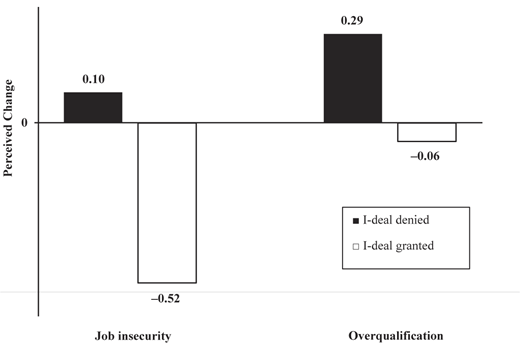
The effects of I-deals on perceived change in job insecurity and overqualification (study 2). Note(s): N = 103 for desired i-deal denied and = 149 for i-deal granted. The means of perceived change in job insecurity and perceived overqualification are adjusted for the effect of the covariate. Source(s): Authors’ own creation
The effects of I-deals on perceived change in job insecurity and overqualification (study 2). Note(s): N = 103 for desired i-deal denied and = 149 for i-deal granted. The means of perceived change in job insecurity and perceived overqualification are adjusted for the effect of the covariate. Source(s): Authors’ own creation
The effect of the manipulation was also notable on perceived change in overqualification (F(1, 249) = 22.40, p < 0.001, effect size = 0.08). The participants in the granted condition foresaw no change (M = −0.06, SE = 0.05, 95% CI: −0.15 to 0.04), while those in the denial condition presumed a deterioration in their overqualification perceptions (M = 0.29, SE = 0.06, 95% CI: 0.18 to 0.40). The effect of baseline overqualification was also significant (F(1,249) = 41.67, p < 0.001, effect size = 0.14) and Levene’s test (F(1,250), 2.10, p = 0.15) further endorsed these results.
Discussion
This research contributes to a deeper understanding of the relationships between i-deals, critical employment concerns, and work engagement. By examining the resource-based mechanisms underpinning these associations, we provide novel insights with meaningful theoretical and practical implications.
Theoretical implications
Our findings advance theoretical understanding of i-deals in three key ways. First, we offer a complementary perspective to the prevailing social exchange lens. Although not inconsistent with previous research attributing the positive outcomes of i-deals to reciprocal reactions to improved conditions (e.g. Davis and Van der Heijden, 2018), our findings underscore the resource value of i-deals. Models such as the JD-R model (Bakker and Demerouti, 2007) can explain how existing job resources contribute to engagement, yet they primarily focus on static resource-demand balances without fully accounting for how employees proactively shape their resource environment. COR theory (Hobfoll, 1989) enabled us to conceptualize i-deals not merely as responses to contextual conditions or perceived mismatches, but as strategic, forward-looking actions through which employees mitigate resource threats and initiate gain spirals. Study 1 demonstrates that i-deals are negatively associated with job insecurity and overqualification perceptions, which in turn positively predict work engagement. Consistent with COR’s gain spiral principle (e.g. Halbesleben et al., 2014), the indirect effect through overqualification emerged as stronger, suggesting that resource alignment (e.g. occupying roles closely matched with qualifications) may strongly position employees for further resource accumulation. Job insecurity also appears to be responsive to i-deals, but to a lesser extent, which is likely due to its broader dependence on demographic, economic, and political contexts (Jiang et al., 2021). Nonetheless, the observed associations together emphasize that i-deals extend beyond short-term resource gains; they symbolically stabilize perceived resources and are instrumental to facilitate sustained resource acquisition. This reconciles prior research that positions i-deals as critical job resources, both safeguarding against resource losses and threats (Lee and Hui, 2011; Ng et al., 2021) and promoting resource development (Lichtenthaler and Fischbach, 2018).
Second, we extend the i-deals literature by examining the underexplored consequences of denied i-deals (Simosi et al., 2021). While, Study 1 supports the premise that resolving job insecurity and overqualification concerns promotes work engagement (Erdogan and Bauer, 2021; Jiang and Lavaysse, 2018), Study 2 uncovers a deeper complexity. Aligned with COR’s primacy of resource loss principle (Hobfoll, 1989), our analysis revealed an asymmetry in reactions to resource loss versus resource gains. Successfully granted i-deals effectively seemed to mitigate explicit resource threats (e.g. job insecurity), and denied requests to exacerbate feelings of unrecognized potential, likely reinforcing misalignment and amplifying the anticipated emotional toll of resource loss.
Third, this research repositions i-deals as proactive interventions for addressing employment concerns, supplementing prior work that primarily treated job insecurity and overqualification as antecedents of i-deal seeking (Probst et al., 2021; Ng and Lucianetti, 2016). By showing that employees who hold i-deals report fewer concerns about job insecurity and overqualification, we enrich the broader literatures on job insecurity (e.g. Jiang and Lavaysse, 2018; Lee et al., 2018; Shoss, 2017) and overqualification (e.g. Erdogan and Bauer, 2021; Harari et al., 2017). In contexts characterized by job worries and inadequate job conditions, i-deals emerge as valuable tools for conserving resources and enhancing their alignment.
Practical implications
Based on our findings, we offer several actionable recommendations for cultivating an engaged workforce. First, organizations operating under conditions of economic uncertainty or workforce disruption are likely to employ workers who experience heightened job insecurity. By granting i-deals, managers can help alleviate these concerns and reinforce employees’ perceptions of job stability. In doing so, they foster work engagement, which is especially critical in navigating turbulent periods.
Second, i-deals also signal continued investment in employees’ potential. This is particularly salient for individuals who feel overqualified, as i-deals can help mitigate the sense of underutilization or deprivation stemming from a perceived mismatch between one’s skills and job demands. Given the generally high level of educational attainment in many labor markers, a substantial share of employees may experience that their qualifications exceed job requirements (Erdogan and Bauer, 2021; OECD, 2019). Managers can address this by tailoring work conditions through i-deals, for example by assigning more challenging tasks or supporting professional development initiatives aligned with employees’ capabilities.
Third, while i-deals are often reserved for a select group of star employees (Rofcanin et al., 2018), this narrow application risks overlooking their broader potential. Our findings suggest that i-deals can play a vital role in addressing widespread resource threats. As limiting i-deals to a privileged few may constrain their capacity to address prevalent employee concerns, we advocate instead for a more inclusive, individualized Human Resource Management (HRM) approach (Bal and Dorenbosch, 2015), one that encourages and equips managers to engage in i-deal negotiations with a broader segment of the workforce. Extending i-deals more widely can enhance their organizational impact. However, this approach is not without challenges. In particular, risks not only include adverse coworker reactions (Van Waeyenberg et al., 2023) but also the psychological consequences of denied i-deals, especially among overqualified employees who may already feel undervalued. While managers cannot prevent employees from initiating negotiations, they play a critical role in managing expectations and mitigating any negative aftermath. Transparency in how i-deal decisions are made and clear communication about the constraints managers face (e.g. budgetary limits) will be essential to fostering employee acceptance of both favorable and unfavorable outcomes, and to minimizing any negative repercussions.
Finally, although i-deals are typically negotiated with direct supervisors, HRM departments have an essential role to play. Supporting an individualized HRM strategy requires equipping managers with the training and resources needed to negotiate i-deals effectively and fairly (Marescaux et al., 2021). HRM professionals must also provide guidance on how to communicate and implement i-deal decisions, regardless of whether a negotiation succeeds. Only then can organizations fully realize the benefits of i-deals.
Limitations and directions for future research
This research is not without limitations, which open avenues for future investigation. First, Study 1 relied on cross-sectional survey data, which limits the ability to draw causal inferences. Although Study 2 employed a vignette experiment to establish directionality, the hypothetical nature of vignettes may not fully capture real-world responses to i-deal granting or denial. Future research could address this by using longitudinal designs or experience sampling methods to track the effects of i-deals over time (Rofcanin et al., 2021) and explore whether their impact on job insecurity and overqualification perceptions is enduring or temporary.
Second, there are important variations in how employees respond to different i-deal types (e.g. Marescaux et al., 2013) and how these mitigate the negative consequences of overqualification (Luksyte and Spitzmueller, 2016; Howard et al., 2022). Although Study 1 differentiated between task, responsibility, and developmental i-deals, Study 2 treated i-deals as a unified construct, which may have masked their effects on perceptions of job insecurity and overqualification. Our finding that i-deals may enhance work engagement by alleviating such employment concerns further suggests that individualized arrangements may appeal to employees with distinct motivational orientations, particularly those seeking either security or growth. To deepen this understanding, future research should move beyond aggregated i-deal measures to examine the discrete effects of different i-deal types. In doing so, scholars might draw on regulatory fit theory (Higgins, 2000) to explore whether alignment between employees' regulatory focus (promotion vs prevention) and the content of i-deals enhances their motivational impact. For example, promotion-focused employees (i.e. motivated by advancement and achievement) may derive greater engagement from i-deals centered on career development or task enrichment. In contrast, prevention-focused employees (i.e. motivated by stability and risk avoidance) may benefit more from i-deals that enhance job stability or ensure predictable working conditions. Such insights would contribute to a more nuanced understanding of when and for whom i-deals are most effective in sustaining engagement.
This research has been funded by the Fund for Scientific Research (FWO; G.0697.16N).
References
Appendix 1
Scale items and confirmatory factor analysis results (study 1)
| Latent variable (scale) | Factor loading |
|---|---|
| Perceived job insecurity (1–5) | |
| 1. Chances are, I will soon lose my job | 0.89 |
| 2. I feel insecure about the future of my job | 0.81 |
| 3. I think I might lose my job in the near future | 0.86 |
| Perceived overqualification (1–5) | |
| 1. Based on my education, I am overqualified for the job I hold | 0.52 |
| 2. My talents are not fully utilized on my job | 0.92 |
| 3. Continuing education related to my job has improved my job performance | 0.43 |
| 4. My job frequently provides me with new challenges (R) | 0.83 |
| 5. The day-to-day content of my job seldom changes | 0.63 |
| 6. My job has a lot of potential for growth and change (R) | 0.75 |
| 7. My job provides opportunities to learn new things (R) | 0.82 |
| Work engagement (1–7) | |
| 1. At my work, I feel bursting with energy | 0.89 |
| 2. At my job, I feel strong and vigorous | 0.90 |
| 3. I am enthusiastic about my job | 0.90 |
| 4. My job inspires me | 0.90 |
| 5. When I get up in the morning, I feel like going to work | 0.78 |
| 6. I feel happy when I am working intensely | 0.65 |
| 7. I am proud on the work that I do | 0.81 |
| 8. I am immersed in my work | 0.79 |
| 9. I get carried away when I’m working | 0.85 |
Note(s): p < 0.001 for all factor loadings. (R) denotes a reversed scored item. All items were loaded on their hypothesized factor. For perceived overqualification, items 1–2 reflect surplus education (ω = 0.70), items 3–7 the lack of growth and skill use (ω = 0.83). For work engagement, items 1, 2, and 5 reflect vigor (ω = 0.90), items 6, 8, and 9 absorption (ω = 0.82), and items 3, 4, and 7 dedication (ω = 0.90). The ω value for perceived job insecurity was 0.89
Source(s): Authors’ own creation
Appendix 2
Overview of the experimental scenarios (study 2)
| Standardized contextual information | |
| Organizations typically formalize financial arrangements (salary, bonuses, allowances, fringe benefits, etc.), job content (tasks, responsibilities, etc.), flexibility (remote work, additional leave, flexible hours, etc.), and development opportunities (training and education, etc.) in a standard employment contract. While certain employment terms cannot be altered (example: minimum wage), others may occasionally be negotiated and revised during your career. A one-on-one conversation with your direct supervisor evolves into a discussion about your current work situation. Specifically, you negotiate the possibility of deviating from the standard employment terms. The conversation reveals that certain adjustments could better address your personal circumstances while also benefiting the organization | |
| Manipulation of i-deal attainment | |
| I-deal granted condition: After discussing the desired changes to your working conditions, your supervisor shows understanding and agrees to the exceptional work arrangement | I-deal denied condition: After discussing the desired changes to your working conditions, your supervisor shows understanding but does not agree to the exceptional work arrangement |
Source(s): Authors’ own creation

