Skip to article sections
Purpose

The purpose of this study is to analyze the research output in the field of Sustainable Development Goals (SDGs) and to examine various trends in the scientific literature on SDGs using bibliometric analysis.

Design/methodology/approach

The data was collected from the Web of Science database for the period 2020–2024 to assess the literature on the topic. A total of 6,340 retrieved documents/articles from 1,157 journals were analysed by using various modules of Biblioshiny and Excel.

Findings

The study highlights the rapid growth and global collaboration in research on SDGs, with China leading in scientific output, followed by the USA and the UK. Sustainability and the Journal of Cleaner Production are the most prolific and influential journals. Leading institutions include Beijing Normal University and the University of Chinese Academy of Sciences, with significant input from the University of Oxford. Keyword analysis emphasises “Impact”, “Management” and “Performance”. Annual scientific production peaked in 2023. The data reveal a dynamic research landscape with significant international collaboration, reflecting the global commitment to achieving sustainable development goals.

Practical implications

This study traces trends in the field of SDGs. It can guide researchers and institutions to focus on the impactful areas of SDG research and foster international collaboration to achieve global sustainability goals.

Originality/value

This study provides the most recent and temporally comprehensive assessment of the worldwide SDG research since it extends the analysis to mid-2024. It provides deeper insights into research structures and evolving thematic priorities in the research areas.

SDGs

= Sustainable Development Goals;

WoS

= Web of Science;

MDG

= Millennium Development Goals;

USA

= United States of America;

UK

= United Kingdom;

UN

= United Nations;

TS

= Topic Search;

TC

= Total Citations;

PY

= Publication Year; and

DT

= Document Type.

The United Nations (UN) Sustainable Development Goals (SDGs) are a universal political agenda that address collective action to achieve a better and more sustainable future for all, solving the social, economic and environmental issues that hinder global progress towards sustainability intended to be achieved by the year 2030 (Bennich et al., 2020; Pradhan et al., 2017; United Nations, 2015). The UN General Assembly approved Resolution A/RES/70/1 on “Transforming our world: the 2030 Agenda for Sustainable Development” (United Nations, 2017). The agenda outlines 17 SDGs and specific targets and indicators for each of the 17 SDGs, totalling 169 targets and 213 indicators that form a global action plan (Li et al., 2023; Telleria and Garcia-Arias, 2021). The SDGs are a recognized blueprint essential for achieving shared and sustainable prosperity with global action among governmental and non-governmental organizations, businesses, industry, civil society organizations, research and technology development (Husainy et al., 2024; Khaled et al., 2021). As part of the 2030 Agenda for Sustainable Development, which outlined a 15-year strategy to attain these Goals, all the United Nations Member States adopted these 17 goals in 2015 (Donoghue and Higgins, 2023; Singh, 2024).

The United Nations General Assembly set these objectives in 2015 with the intention of addressing several global issues, such as poverty, inequality, environmental degradation, climate change, peace and justice (Bukhari et al., 2023). The Millennium Development Goals (MDGs), which were implemented from 2000 to 2015, have yielded successes and lessons that the SDGs were built upon (Hickmann et al., 2022; Knox and Orazgaliyev, 2024). As a worldwide challenge requiring cooperative action, sustainable development is recognized by the SDGs, which are universal and applicable to all countries, in contrast to the MDGs, which primarily focus on developing nations (Fukuda-Parr, 2023; Kushnir and Nunes, 2022). The objectives of SDGs are related to one another, with advancements in one field frequently influencing advancements in another (Henderson and Loreau, 2023; Leal Filho et al., 2018; Salvia et al., 2019).

An unprecedented amount of input and involvement from various stakeholders, including governments, academia, the commercial sector and civil society, has led to the creation of the SDGs (Donoghue and Higgins, 2023). These goals are relevant and sensitive to the various needs and interests of many nations and groups (Berrone et al., 2023; Siegel and Bastos Lima, 2020). A strong set of indicators and targets that serve as a foundation for oversight and accountability support the SDGs. Tracking advancement, spotting gaps and directing resources and efforts where they are most needed depends on this framework (Arora-Jonsson, 2023).

Scientometric analysis offers a valuable approach for examining scientific literature on SDGs (Raman et al., 2024; Sianes et al., 2022; Yamaguchi et al., 2023). By relying on scientometric techniques and data mining analyses, this study collected and analysed 6,340 papers published on the SDGs. The primary purpose of this paper is to develop a critical yet comprehensive scientometric analysis of global academic production on SDGs from 2020 to 2024, conducted using the Web of Science (WoS) database, which is a multidisciplinary citation indexing platform that provides access to high-quality scholarly literature for bibliometric and research analysis. Scientometrics (see  Appendix) can provide insights into how research efforts align with SDGs, highlight key focus areas and identify emerging trends and other novel insights. This study will analyze publication trends, citation patterns, author collaborations, thematic focus of research, annual scientific production (see  Appendix), core sources, most relevant affiliations, country production and social network analysis. By providing a detailed overview of the scientific contributions towards the SDGs, this research seeks to contribute to a deeper understanding of the role of research in advancing sustainable development.

This study provides quantitative insights into the global research landscape on SDGs, offering valuable data for universities, libraries, funding agencies and policymakers to mobilize resources effectively. This study contributes as a comprehensive assessment of the impact of research, enabling stakeholders to identify prioritised research areas concerning publications and emerging trends. Knowing the scientometric trends in SDG research is essential for showcasing the focused scholarly efforts at the global level. Scientometric mapping not only concerns research productivity metrics but also plays a significant role in guiding education policies and pedagogical innovations to support effective SDG implementation at different levels. Such mapping ensures that scientific information aligns with policy requirements and societal challenges, which is crucial given the urgency of accomplishing Agenda 2030. Thus, the present study further adds value to the global discourse on sustainability and provides recommendations for enhancing the alignment of academic research with the SDG agenda.

Given the significance of SDGs, numerous bibliometric and scientometric mapping studies have been conducted worldwide on the body of literature. Several countries and institutions have actively contributed to SDG research (Bautista-Puig et al., 2021). The USA, China and UK account for 31% of the contributions in the scientometric analysis of publications published between 2015 and 2022, which provides important insights into research output and trends in SDG literature (Mishra et al., 2023). Alfirevic et al. (2023) reveal that the USA is the most productive country, and the results also show that scientific productivity is high in the UK, followed by India, Germany, Australia, China and Spain. The G20 countries have also actively contributed to SDGs, as their research publications account for approximately 57.75% of all research publications worldwide over the relevant period (Singh, 2024). Another study by Hsieh and Yeh (2024) also highlights that the countries with the most research in this field are China, India, the USA, the UK and Australia, with Environmental Sciences and Ecology being the most published domain.

Yamaguchi et al. (2023) present a thorough bibliometric analysis of literature reviews on the SDGs from 2015 to 2022 and found most documents within the general sustainability categories, such as Green Technology and Environmental Sciences. However, there were additional unidentified essential research fields, such as Economic Growth (SDG 8) and Technology (SDG 9). Hsieh and Yeh (2024) also identified 19 clusters intersecting climate change and SDGs, with the top five clusters in terms of proportion related to Agricultural and Food Systems, Water and Soil Resources, Energy, Economy, Ecosystem and Sustainable Management. The study by Raman et al. (2024) showcases that three main themes emerge: Poverty, Renewable Energy and Sustainable Development. The Global burden of diseases, Women’s and Maternal health and Universal health coverage were also important themes (Sweileh, 2024). SDGs 11, 12, 13 and 15 were found to be among the most investigated SDGs. In contrast, SDGs 8 and 14 were among the least researched (Raman et al., 2024). SDG research spans diverse subject areas, including health (SDG 3), Climate Action (SDG 13) and Gender Equality (SDG 5), and has received significant attention (Morales-Zapata et al., 2021).

Despite the breadth of existing bibliometric and scientometric analyses on SDG-related research, certain gaps remain evident. As noted, most studies have concentrated on highly visible goals such as health (SDG 3), climate action (SDG 13) and gender equality (SDG 5), while comparatively less attention has been given to underexplored areas such as economic growth and decent work (SDG 8), industry, innovation and infrastructure (SDG 9) and life below water (SDG 14). This study directly addresses these gaps by systematically mapping the overlooked domains and identifying emerging interdisciplinary linkages that connect them with broader sustainability agendas. In doing so, this study not only expands the scope of SDG-related bibliometric research but also provides policymakers, researchers and institutions with a more balanced and comprehensive understanding of research trends. By highlighting these neglected areas and their intersections with dominant SDG themes, this work offers a significant contribution to guiding future.

Regarding journal contributions, Sustainability has produced the most SDG studies, with 2.7% of papers participating in WoS categories relevant to the environmental SDGs. The Journal of Cleaner Production is the second most prominent journal (Sianes et al., 2022). Another study by Yumnam et al. (2024) aligns with the above study, as the results indicate that the Journal of Cleaner Production and Sustainable Development is not far behind. When citing publications, per publication were averaged, Environmental Research Letters was undoubtedly at the top. In terms of the h-index (see appendix), the most notable sources are Sustainability and Journal of Cleaner Production. The Lancet journal has been recognized for publishing significant and high-calibre research pieces (Hossain et al., 2022).

The top 10 most referenced research papers on SDGs published between 2015 and 2021 were thoroughly analysed by Yamaguchi et al. (2023), providing a valuable opportunity to understand the current level of knowledge on the particular topic. “Global, regional, and national causes of under-5 mortality in 2000–15: an updated systematic analysis with implications for the Sustainable Development Goals,” written by Liu et al., has the greatest overall citation count. Researchers visualize the possibility for clusters in each keyword from the reviewed papers using VOSviewer software (Sood et al., 2021). The studies by Sianes et al. (2022), Singh et al. (2023) and Yamaguchi et al. (2023), highlight the importance of understanding citation patterns to identify influential papers and authors related to SDGs.

The USA and the UK were the top two nations in terms of publications, working with 11 and 9 countries, respectively, which means these two countries actively participate in international partnerships for SDG research publications. Yumnam et al. (2024) support this claim through the findings that researchers from the USA and the UK collaborated the most, with an astounding frequency of 103 publications. India is ranked eighth with 38,261 citations, 99.12 citations per paper and an h-index of 152.

Conceptual structure analysis, which reveals clusters of keywords related to the SDGs, Sustainable Development, Poverty and Renewable Energy, have emerged as the central themes (Bellantuono et al., 2022; Gunnarsdottir et al., 2021). Three-field plotting visualizes trends across disciplines, linking environmental science, economics and social sciences (Singh, 2024; Wani et al., 2023 ). Co-citation coupling and bibliographic coupling provide insights into intellectual networks (Bernatović et al., 2022). The study by Kleminski et al. (2020) also explored co-citation patterns among influential authors.

This study holds significant relevance, as it provides a comprehensive scientometric mapping of global research on the SDGs, thereby generating valuable evidence for universities, libraries, funding agencies and policymakers to effectively mobilize and redirect resources. By quantitatively assessing research impact, high-impact publications and emerging thematic areas, the study enables stakeholders to identify priority domains and optimize strategies for advancing sustainability. Beyond traditional productivity metrics, this analysis underscores the broader role of scientometric mapping in shaping educational policies and informing pedagogical innovations that directly support SDG implementation at multiple levels. Importantly, it ensures that scholarly output remains aligned with pressing policy needs and societal challenges, an essential consideration given the urgency of achieving the targets of Agenda 2030. Thus, the present research contributes not only to strengthening the evidence base for sustainable development but also to advancing the global discourse on aligning academic research with the SDG agenda.

  1. To analyze annual scientific output, country-wise contributions.

RQ1.

What are the trends and patterns in annual scientific publication output across countries, and how do these contributions vary over time?

  1. To analyze and assess authorship productivity, including patterns, prolific authors and citation impact.

RQ2.

What are the patterns of authorship productivity, which authors are most prolific, and how does citation impact vary among contributors?

  1. To identify leading Sources, top institutions and key keywords that highlight emerging thematic trends.

RQ3.

Which sources, institutions and keywords dominate the literature, and what emerging thematic trends can be identified?

  1. To analyze collaboration networks, document coupling, research clusters and thematic connections within the literature.

RQ4.

How are collaboration networks, document coupling and research clusters structured, and what key thematic connections exist within the research landscape?

The methodology adopted for the study consists of the following four main stages, including database selection, data acquisition and refinement, software tools and analytical procedures.

The Web of Science (WoS) Core Collection was selected as the primary database because of its rigorous indexing standards, multidisciplinary coverage and suitability for bibliometric and scientometric studies. It provides structured citation metadata and comprehensive coverage in environmental sciences, sustainability and policy-related research, which ensures reliability and comparability.

Data was retrieved in July 2024, using the following search query: TS = (“SUSTAINABLE DEVELOPMENT GOALS” OR “SDGs”) AND PY = (2024 OR 2023 OR 2022 OR 2021 OR 2020) AND DT = (“Articles”). This search yielded 6362 records. To enhance validity and replicability, the data cleaning process was undertaken. Duplicate entries, mainly caused by indexing overlaps across WoS sub-collections, were removed. After thorough verification, the final data set comprised 6340 unique peer-reviewed journal articles published across 1,157 Sources. The other formats, like editorials, meeting abstracts, reviews and letters, were excluded to ensure analytical comparability and scientific rigour.

The analysis was conducted using a combination of tools.

Biblioshiny (see appendix) (R-based) web-based application for the analysis of extracted data using its distinct modules to draw bibliometric inferences like productivity patterns, collaboration mapping and thematic evolution. MS Excel was used for the refinement and building of summary tables.

The analysis combined both traditional indicators and advanced techniques to provide a richer picture of the research landscape. These indicators include descriptive indicators for revealing annual growth rates, country contributions, prolific authors, leading journals and citation impact. Performance indicators to highlight top institutions, sources and influential keywords. This step is further enriched by incorporating more advanced techniques for analysing, such as coupling network of documents, cluster mapping, keyword clouds and tree maps, etc. (Figure 1).

Table 1 represents the primary information regarding the data set. The data spans from 2020 to 2024, encompassing 6,340 documents from 1,157 journals. This represents a substantial body of literature with an annual growth rate of 10.44%, indicating a continuously expanding field. The analysis reveals an average of 12.68 citations per document, indicating a moderate level of scholarly exchange within the field. Furthermore, 320,487 references are identified, highlighting the extensive body of knowledge that informs current research. An examination of document content reveals a diverse range of keywords. A higher number of author-assigned keywords (16,853) suggests a focus on emerging or domain-specific terminology. Authorship patterns (see  Appendix) indicate a prevalence of collaborative research, with an average of 5.11 co-authors per document. While a small number of single authors exist (538), the data suggest a trend towards collaborative research efforts. Interestingly, 44.09% of documents include international co-authorship, highlighting an increasing level of global collaboration within the field.

Table 2 depicts Annual Scientific Production, highlighting a steady increase from 783 in 2020 to a peak of 1,659 in 2023, with an average annual growth rate over the years of 10.44%. These results align with those of Yamaguchi et al. (2023), revealing an increase in the yearly scientific production of documents in the field. However, a slight decline is projected for 2024, with only 1,165 articles. The drop is attributed to mid-year data extraction but could also reflect indexing delays, global policy or research shifts, affecting citation count as well.

This trend indicates a strong upward trajectory in SDG-related research, reflecting growing global interest and investment in sustainability studies.

Table 3 shows countries’ scientific production by examining the total research output produced by each country in the data set. China leads significantly with a frequency of 5255, followed by the USA (2,027) and the UK (1,992). India (1,694) and Spain (1,597) also contributed substantially. Mid-range contributors include Australia (1,217), Italy (1,143) and Germany (963). Japan (741) and Brazil (687) occupy the lower end of this data set. The results highlight China’s dominance in scientific output, producing more than double the publications of the USA, with the UK closely trailing. Raman et al. (2024) also came up with similar results, where China topped the list regarding the most publications. These figures indicate significant regional disparities in research output, with a concentration of productivity in a few leading nations. This underscores global differences in research capacity and investment.

Table 4 presents the findings from the present corpus of literature through Lotka’s law (see  Appendix), which is one of the principles in bibliometrics (see  Appendix) that helps to understand scientific productivity and the relationship between authors and the number of papers they contribute to (Kawamura et al., 2000). The study found that among 23,409 authors, the majority (19,503) authored one article, (2,488) authored two articles and (22) contributed ten articles. The frequency of authors declines exponentially with increasing output, demonstrating Lotka’s principle: a few authors dominate output, while most contribute minimally. For instance, 75 authors produced six articles. The results demonstrated a high degree of author dispersion in SDG research. This pattern suggests a broad and diverse research community that contributes to this field.

Fractionalized articles, which measure an author’s share of contribution in multi-authored papers, are used to analyze collaboration patterns and impact distribution (Goh and See, 2021; Scheinerman and Ullman, 2011). Table 5 depicts the most prolific authors, with Liu Y leading as the most prolific author, having a Total Article Count of 54 and Fractionalized Articles of 10.29, indicating both a high research output and a substantial independent contribution. Further, Wang Y and Li Y follow with 48 and 46 articles, respectively, along with notable fractionalized scores of 8.07 and 8.33. Several authors, such as Zhang Y, Liu J and Wang J, exhibit high fractionalized scores relative to their total article counts, suggesting active collaboration in multi-author publications. This ranking highlights the influential researchers driving academic discourse on sustainability, with authors such as Liu Y not only producing the highest volume of work but also maintaining substantial independent contributions, making them key figures in the field.

Table 6 lists authorship trends in the field of SDG. A total of 5,801 authors were found in varying collaboration patterns, ranging from 2 to 255, revealing that three-authored works are predominant, with 1,278 (20.15%), followed by 1,182 (18.64%) four-authored works, 1,095 (17.27%) as two-authored documents and 2,246 (35.42%) documents ranging from 5 to 255 authored documents. The maximum number of multi-authored works was 1,662, published in 2023, followed by 1,537 and 1,193 in 2022 and 2021, respectively. Similarly, a total of 539 (8.50%) single-authored publications were retrieved during the study period, with 136 publications in 2022, followed by 123 works in 2023. Moreover, this study highlights the research papers with authorship patterns of 26, 31, 32, 75, 153, 168, 186 and 250 have a frequency of 1.

Table 7 identifies the most locally cited authors, providing insight into those most frequently referenced within the data set (Appio et al., 2014). Pradhan P leads with 156 local citations, signifying a strong influence and substantial recognition within the research community. Sinha A (114) and Warchold A (100) also rank highly, cementing their roles as pivotal figures in shaping the discourse. Adebayo TS and Kim RE each have 95 citations, reflecting similar levels of impact and relevance in local academic discussions. Authors such as Pradhan P and Sinha A are critical intellectuals for subsequent studies. Simultaneously, the presence of several other high-impact contributors demonstrates the field’s collaborative and multifaceted nature.

Table 8 demonstrates the authors based on key bibliometric metrics. Adebayo TS has the highest h-index (17) and m-index (see appendix) (4.25), indicating its recent and impactful productivity since 2021. Zhang J leads in the g-index (33), reflecting the influence of highly cited work, while Sinha A has the highest total citations (1,819), showcasing cumulative scholarly impact. Liu Y emerged as the most prolific with 54 publications. These metrics highlight diverse strengths and underscore varied contributions to the field.

Table 9 ranks countries by total citations (TC) and average citations per article. China leads with 14,556 citations but averages 12.9 citations per article, indicating high output but relatively moderate impact per paper. The Netherlands has the highest average citations (16.8) despite a lower total number of citations (2,094), signalling high-impact research. The USA and Germany also exhibit high averages (16.2 and 16.4, respectively), reflecting impactful research outputs. Other notable contributors include the UK (5,512 citations, 13.8 average) and Italy (4,407 citations, 14.7 average). While Yamaguchi et al. (2023) highlighted the UK as the most prolific region. This data highlights China’s volume-driven prominence in global research, while Western nations and The Netherlands, in particular, lead in citation efficiency and impact.

Table 10 illustrates the average number of citations per document per year, trending downwards over the selected period. It reached a high of 5.85 in 2020 and then decreased to 1.19 in 2024. Such a decline may be due to an increased publication volume, a decrease in citation counts, or a change in the subject matter of studies over a given period. Here again, the exponential decline in mean citations in 2024 is because data was collected in mid-2024. Even though there has been a decrease in the index over the period, the figures for 2020 and 2021 clearly show a significant number of citations that depict the relevance and standard of such publications.

From Table 11, which depicts the journals with the number of articles, it is evident that the journal Sustainability tops the list with 1,131 articles, followed by the Journal of Cleaner Production with 256 articles and Sustainable Development with 174 articles. The journals containing the least number of articles included Science of the Total Environment (86 articles), Journal of Environmental Management (77 articles) and Sustainability Science, which contains the fewest articles (68). This study aligns with Raman et al. (2024) and Meschede (2020). These journals are leading platforms for disseminating SDG research, highlighting their central role in advancing knowledge in this field.

Table 12 emphasizes Most Locally Cited Sources, where the Journal of Cleaner Production is the most locally cited source with 12,508 articles, followed by Sustainability with 10,984 articles and Environmental Science and Pollution Research with 4,997 articles. In contrast, Nature is the least cited source, with only 2,389 articles. This study aligns with Pizzi et al. (2020), where the Journal of Cleaner Production is the most Cited Journal. This suggests significant research interest and output in these areas, reflecting their critical importance in addressing global environmental challenges.

By using Bradford’s law (see  Appendix) to identify the core sources in the given field of research, the journals have been categorized into three zones: a core zone, i.e. Zone 1, containing highly relevant sources. Zone 2 has a large number of moderately relevant sources, and Zone 3 has fewer relevant sources. From Table 13, Sustainability ranks 1st among Zone 1 sources with both Frequency and Cumulative Frequency of 1,131, followed by the Journal of Cleaner Production, indexed to WoS categories related to Environmental SDGs, with a Frequency of 256. These results are in tune with the study conducted by Sianes et al. (2022). This reflects Bradford’s Law of Scattering, where a small core of journals captures the bulk of research influence, whereas journals in Zone 2, having less frequency, such as Energies (66), LAND (63) and PLOS ONE (62) represent less central but relevant contributions. Zone 1 journals are pivotal in advancing the sustainability discourse, making them a primary literature review and publication resource. These sources have been identified as key repositories of SDG research and play a key role in disseminating high-impact studies.

Sources Local Impact by h-index, a method of analysing the influence of specific sources within a particular research area by examining their h-index. Table 14 presents a bibliometric analysis of the top 10 journals based on several indices. These metrics offer insights into the journal’s impact, productivity and relevance. The h-index indicates the number of articles with a significant number of citations. The Journal of Cleaner Production (47) and Sustainability (38) ranked highest, indicating their strong academic influence. The g-index (see  Appendix), which emphasizes highly cited papers, is also the highest for Journal of Cleaner Production (71), reinforcing its impactful contributions.

Regarding productivity, Sustainability leads to NP (1131) and TC (9800), showcasing its prolific publication volume and significant community engagement. The m-index, reflecting the citation impact adjusted for time, is the highest for the Journal of Cleaner Production (9.4), indicating its rapid influence since 2020. This study is in line with Raman et al. (2024), which provides insights into the leading sources of scientometric research on SDGs, suggesting that Sustainability accounts for the highest number of publications related to SDG research, while the Journal of Cleaner Production leads with the most citations and average citations.

Table 15 depicts the most relevant affiliations contributing to the present research, with Beijing Normal University and the University of the Chinese Academy of Sciences leading with 177 articles each. The Institute of Geographic Sciences and Natural Resources Research follows with 125 articles, while the University of Oxford has 111, reflecting significant global participation. Other notable contributors include the Tehran University of Medical Sciences (104 articles), Wuhan University (97) and Istanbul Gelisim University (91), showing regional diversity with strong representation from Asia, Europe and the Middle East.

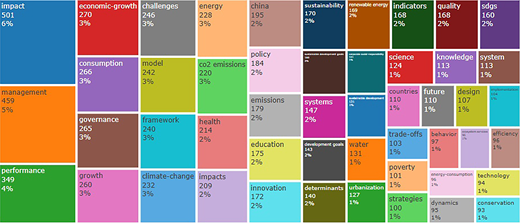
The most prolific keywords were analysed using Word Cloud (Figure 2) and TreeMap (Figure 3). By clustering at the 50-word level, this method captures the most significant and recurring keywords in the data set. The keywords represent prominent themes or topics within the study, emphasizing their significance in understanding the broader research area.

According to a keyword analysis (see Figure 2, Table 16), the most common terms are “Impact” (488 instances), “Management” (468) and “Performance” (346). This indicates that the SDG scholarship has a strong focus on measurement and real-world results. Significant increases since 2021 have been seen in “Economic Growth” (268), “Governance” (267) and “Energy” (247), indicating similar trends with heightened global policy advocacy on green growth and sustainable governance frameworks. Temporal keyword analysis, visualized in Figure 3, shows emerging attention to themes such as “Trade-off” and “Interdisciplinary Collaboration,” while previously strong tags like “Inequality” and “No Poverty” have plateaued or modestly declined. This evolution aligns with periodic shifts in SDG funding and the increasing complexity of research connecting multiple SDGs. Themes that are missing or declining, such as “Partnerships” (SDG 17) and “Infrastructure” (SDG 9), could be signs of research saturation, a lack of new measuring frameworks, or a reduction in financing, all of which should be taken into consideration by funding agencies in the future.

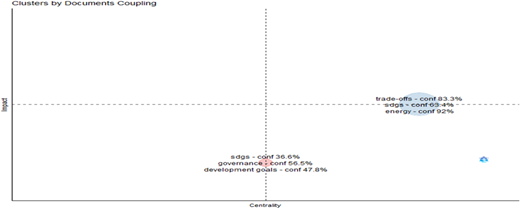
Document coupling clusters can reveal information about collections of documents that are connected by common references. Information regarding groups of documents linked by shared references can be uncovered using document-coupling clusters (García-Lillo et al., 2023) . Moving to clusters, research publications on governance confidence make up the majority of Cluster 1, with 56.5% of the total, followed by development goals at number two (47.8%) and SDGs (36.6%).In cluster 2, the second most common theme was energy, which had a 92% confidence rate, followed by trade-offs and SDGs, which had 83.3% and 63.4% confidence rates, respectively. Cluster 2 had more than twice as many documents as Cluster I, which had 64 documents. This suggests that debates and conversations regarding the role of governance in sustainable energy use and SDG trade-offs are more common in the data set. In terms of cited references, Cluster 2 has a higher centrality score of 0.445 as compared to 0.331 of Cluster 1, suggesting that documents in Cluster 2 are more central or influential regarding cited references (Table 16 and Figure 4).

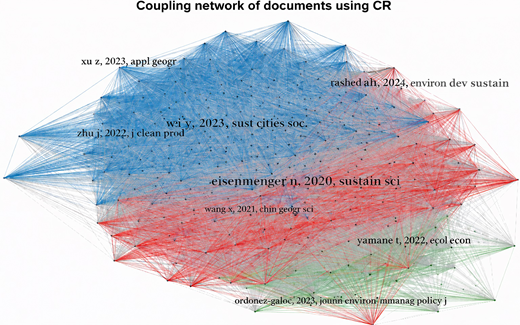
Figure 5 represents the visualization of a coupling network of documents based on Citation Relationship (CR), showcasing how academic papers are interconnected through shared references. Each node is a research paper, and the lines connecting them indicate how frequently they cite the same sources. The different colours represent different research themes, in which blue, red and green clusters represent closely related individual studies. The most prominent and central document is (Eisenmenger et al., 2020, Sustainability Science) as a keystone reference in connecting clusters, i.e. the reference is cited by various clusters. Other influential papers, including Wei et al. (2023, Sustainable Cities and Society), Rashid et al. (2024, Environment, Development and Sustainability), also exhibit strong citation linkages, reflecting their influence on a specific academic.

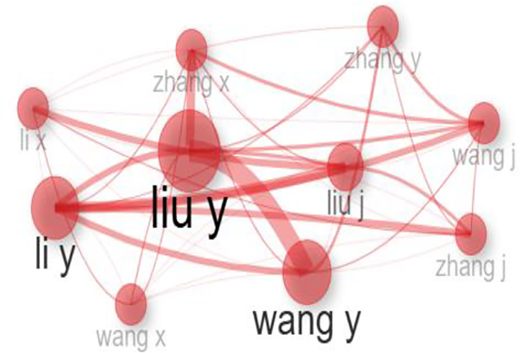
Figure 6 represents the collaboration network among authors, where nodes represent collaborative relationships. A threshold of 10 nodes was applied, ensuring the only significant collaborations are highlighted, allowing for a clearer visualization of key research connections and influential partnerships within the study. “Liu y” emerges as the most central figure with the largest node size and numerous strong connections, whereas “Wang y” also plays a significant role, while individuals like “li y” and “liu j” form secondary connections.

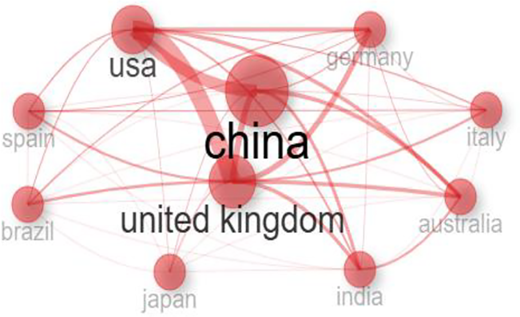
Figure 7 illustrates a global collaboration network between countries, where “China” is the central hub with the most extensive connections, followed by “USA” and “UK.” Both networks are densely interconnected, indicating a collaborative environment. These visualizations are valuable for identifying influential stakeholders and optimizing collaboration strategies.

SDGs have been a serious concern of the stakeholders at different levels, including funding agencies, policy-making and governing bodies, research institutions and agencies, focus groups, etc. This is quite evident through the depth of the available research in this area. The current study’s results generally concur with the corpus of literature already available on scientometric assessments of SDG-related research. According to our findings (Table 2), research production increased steadily between 2020 and 2023, with a minor decline in 2024 as a result of mid-year data extraction. This is consistent with Yamaguchi et al. (2023), who also reported an increasing trend in yearly scientific production of SDG-related documents. The domination of China, followed by the USA and the UK (Table 3), is consistent with the findings of Mishra et al. (2023), Raman et al. (2024) and Hsieh and Yeh (2024), who found that the most productive contributors were China, the USA, the UK, India and Australia. The application of Lotka’s Law (Table 4) revealed that a majority of authors contributed only one article, reflecting a dispersed authorship pattern. This observation resonates with global bibliometric principles (Kawamura et al., 2000) and further validates the broad and diverse participation in SDG research, also emphasized by Raman et al. (2024). Prior research (Yamaguchi et al., 2023) found similar tendencies in important author contributions, which is consistent with the dominance of Liu Y, Wang Y and Li Y as prolific authors (Table 5).

The predominance of multi-authored works (Table 6) reflects increasing collaboration, which aligns with Yumnam et al. (2024), who reported high co-authorship and cross-country collaboration, especially between the USA and the UK. Our results (Tables 7–8) support previous research (Sianes et al., 2022; Hossain et al., 2022) that identified prominent individual researchers as intellectual leaders by confirming that authors such as Pradhan P and Adebayo TS have great citation impact and h-/m-indices. China leads in total citations, while Western nations such as The Netherlands and Germany exhibit higher citation averages per article (Table 9). This supports Yamaguchi et al. (2023) who emphasized the UK’s strong performance and citation efficiency, underscoring regional disparities in research quality versus quantity. Similar to patterns observed in Sweileh (2024), where citation impact varied over time, the downward trend in average citations per year after 2020 (Table 10) is a result of growing publication output diluting citations.

In terms of publication volume, citations and h-/g-/m-indices, Sustainability and the Journal of Cleaner Production are prominent (Tables 11–14). These findings are consistent with those of Sianes et al. (2022), Yumnam et al. (2024) and Raman et al. (2024), who found that these journals are essential to the conversation around the SDGs. The strong representation of Chinese universities (Table 15) corresponds with China’s overall publication dominance as noted by Mishra et al. (2023) and Hsieh and Yeh (2024).

The importance of themes such as “Impact,” “Management,” and “Performance,” as well as growing interest in “Economic Growth,” “Governance,” and “Energy,” is confirmed by our keyword mapping (Figure 2–3). This mirrors the thematic clustering of Poverty, Renewable Energy and Climate Action highlighted by Raman et al. (2024), Hsieh and Yeh (2024) and Morales-Zapata et al. (2021). The findings of Yumnam et al. (2024) and García-Lillo et al. (2023) are supported by document coupling (Tables 16, Figures 4–5) and collaboration networks (Figures 6–7), which show how SDG research is interconnected through thematic clusters and international collaboration, with China, the USA and the UK serving as important hubs. Overall, our findings support worldwide growth, nation dominance, journal prominence and thematic concentration in SDG research, and they are generally consistent with other bibliometric evaluations (e.g. Yamaguchi et al., 2023; Sianes et al., 2022; Mishra et al., 2023). However, our research also identifies new tendencies that were not as prominent in previous studies, such as changing keywords (e.g. “Trade-offs,” “Interdisciplinary Collaboration”), uneven regional influence and a fall in citations around the middle of 2024. This draws attention to both new and ongoing developments in bibliometric research on the SDGs.

The study relied entirely on WoS. As such, pertinent publications indexed in other databases, such as PubMed or Scopus, might have gone unnoticed. The language was selected as English, which limits the inclusion of multilingual documents in the analysis. By emphasizing only Research Articles and quantitative metrics, bibliometric approaches limit our understanding of the qualitative aspects of SDG-related research.

Building on these results, Future scientometric studies on SDGs should go beyond descriptive metrics and integrate longitudinal thematic evolution, policy linkages and socio-economic impacts of scientific collaboration. This includes:

  • mapping research gaps in underexplored SDGs (such as SDG 8 “Decent Work” and SDG 14 “Life Below Water”);

  • expanding coverage to non-English and Global South outputs often excluded from WoS;

  • conducting comparative analyses across databases (WoS, Scopus, PubMed) to minimize index bias; and

  • incorporating qualitative and mixed-method approaches alongside citation-based metrics to capture societal and policy relevance.

Continuous analysis will frequently update new trends and changes in research patterns. Opportunities for more inclusive research initiatives can be found by examining how low-income and developing nations participate in SDG research collaboration. Future research might also analyze how academic efforts are translating into real-world policy adoption, technology transfer and progress towards SDG targets.

The insights from this study can guide researchers and institutions to focus their efforts on the most impactful areas of SDG research and foster international collaboration to achieve global sustainability goals. By identifying key trends and influential contributors, this study provides a roadmap for strategic research planning to ensure that research efforts are aligned with global sustainability priorities. Governments and UN agencies can use these insights to prioritize neglected SDGs (e.g. 8 and 14) by channelling targeted funding. Themes such as “Impact,” “Management” and “Performance” highlight priority areas for targeted research and suggest that SDG research is shifting toward implementation and outcome evaluation, providing opportunities for organizations to link academic outputs to on-the-ground SDG monitoring and reporting directly. Institutions can use these insights to benchmark their efforts, while researchers can focus on influential journals such as Sustainability and the Journal of Cleaner Production for maximum impact and to enhance global visibility. Institutions can use these findings to compare their efforts.

Alfirevic
,
N.
,
Malesevic Perovic
,
L.
and
Mihaljevic Kosor
,
M.
(
2023
), “
Productivity and impact of sustainable development goals (SDGs)-related academic research: a bibliometric analysis
”,
Sustainability
, Vol.
15
No.
9
, p.
7434
, doi: .
Appio
,
F.P.
,
Cesaroni
,
F.
and
Di Minin
,
A.
(
2014
), “
Visualizing the structure and bridges of the intellectual property management and strategy literature: a document co-citation analysis
”,
Scientometrics
, Vol.
101
No.
1
, pp.
623
-
661
, doi: .
Aria
,
M.
and
Cuccurullo
,
C.
(
2017
), “
Bibliometrix: an R-tool for comprehensive science mapping analysis
”,
Journal of Informetrics
, Vol.
11
No.
4
, pp.
959
-
975
, doi: .
Arora-Jonsson
,
S.
(
2023
), “
The sustainable development goals: a universalist promise for the future
”,
Futures
, Vol.
146
, p.
103087
, doi: .
Bautista-Puig
,
N.
,
Aleixo
,
A.M.
,
Leal
,
S.
,
Azeiteiro
,
U.
and
Costas
,
R.
(
2021
), “
Unveiling the research landscape of sustainable development goals and their inclusion in higher education institutions and research centers: Major trends in 2000–2017
”,
Frontiers in Sustainability
, Vol.
2
, doi: .
Bellantuono
,
L.
,
Monaco
,
A.
,
Amoroso
,
N.
,
Aquaro
,
V.
,
Lombardi
,
A.
,
Tangaro
,
S.
and
Bellotti
,
R.
(
2022
), “
Sustainable development goals: conceptualisation, communication and achievement synergies in a complex network framework
”,
Applied Network Science
, Vol.
7
No.
1
, doi: .
Bennich
,
T.
,
Weitz
,
N.
and
Carlsen
,
H.
(
2020
), “
Deciphering the scientific literature on SDG interactions: a review and reading guide
”,
Science of The Total Environment
, Vol.
728
, p.
138405
, doi: .
Bernatović
,
I.
,
Slavec Gomezel
,
A.
and
Černe
,
M.
(
2022
), “
Mapping the knowledge-hiding field and its future prospects: a bibliometric co-citation, co-word, and coupling analysis
”,
Knowledge Management Research & Practice
, Vol.
20
No.
3
, pp.
394
-
409
, doi: .
Berrone
,
P.
,
Rousseau
,
H.E.
,
Ricart
,
J.E.
,
Brito
,
E.
and
Giuliodori
,
A.
(
2023
), “
How can research contribute to the implementation of sustainable development goals? An interpretive review of SDG literature in management
”,
International Journal of Management Reviews
, Vol.
25
No.
2
, pp.
318
-
339
, doi: .
Bradford
,
S.C.
(
1934
), “
Sources of information on specific subjects
”,
Engineering
, Vol.
137
, pp.
85
-
86
.
Bukhari
,
S.A.A.
,
Hashim
,
F.
and
Amran
,
A.
(
2023
), “
Green banking: a strategy for attainment of UN-Sustainable development goals 2030
”,
International Journal of Environment and Sustainable Development
, Vol.
22
No.
1
, p.
13
, doi: .
Donoghue
,
D.
, and
Higgins
,
E.O.
(
2023
), “The united nations sustainable development goals: a pathway to value creation for a sustainable world”,
Palgrave Studies in Sustainable Business In Association with Future Earth
,
Springer International Publishing
, pp.
41
-
62
, doi: .
Egghe
,
L.
(
2006
), “
Theory and practise of the g-index
”,
Scientometrics
, Vol.
69
No.
1
, pp.
131
-
152
, doi: .
Eisenmenger
,
N.
,
Pichler
,
M.
,
Krenmayr
,
N.
,
Noll
,
D.
,
Plank
,
B.
,
Schalmann
,
E.
and
Gingrich
,
S.
(
2020
), “
The sustainable development goals prioritize economic growth over sustainable resource use: a critical reflection on the sdgs from a socio-ecological perspective
”,
Sustainability Science
, Vol.
15
No.
4
, pp.
1101
-
1110
, doi: .
Fukuda-Parr
,
S.
(
2023
), “Sustainable development goals (SDGs) and the promise of a transformative agenda”,
International Organization and Global Governance
,
Routledge
, pp.
708
-
723
, doi: .
García-Lillo
,
F.
,
Seva-Larrosa
,
P.
and
Sánchez-García
,
E.
(
2023
), “
What is going on in entrepreneurship research? A bibliometric and SNA analysis
”,
Journal of Business Research
, Vol.
158
No.
113624
, pp.
1
-
14
, doi: .
Goh
,
K.H.
and
See
,
K.F.
(
2021
), “
Twenty years of water utility benchmarking: a bibliometric analysis of emerging interest in water research and collaboration
”,
Journal of Cleaner Production
, Vol.
284
, p.
124711
, doi: .
Gunnarsdottir
,
I.
,
Davidsdottir
,
B.
,
Worrell
,
E.
and
Sigurgeirsdottir
,
S.
(
2021
), “
Sustainable energy development: History of the concept and emerging themes
”,
Renewable and Sustainable Energy Reviews
, Vol.
141
, p.
110770
, doi: .
Henderson
,
K.
and
Loreau
,
M.
(
2023
), “
A model of sustainable development goals: Challenges and opportunities in promoting human well-being and environmental sustainability
”,
Ecological Modelling
, Vol.
475
, p.
110164
, doi: .
Hickmann
,
T.
,
Biermann
,
F.
,
Spinazzola
,
M.
,
Ballard
,
C.
,
Bogers
,
M.
,
Forestier
,
O.
,
Kalfagianni
,
A.
,
Kim
,
R.E.
,
Montesano
,
F.S.
,
Peek
,
T.
,
Senit
,
C.
,
van Driel
,
M.
,
Vijge
,
M.J.
and
Yunita
,
A.
(
2022
), “
Success factors of global goal‐setting for sustainable development: Learning from the millennium development goals
”,
Sustainable Development
, Vol.
31
No.
3
, pp.
1214
-
1225
, doi: .
Hirsch
,
J.E.
(
2005
), “
An index to quantify an individual’s scientific research output
”,
Proceedings of the National Academy of Sciences
, Vol.
102
No.
46
, pp.
16569
-
16572
, doi: .
Hood
,
W.W.
and
Wilson
,
C.S.
(
2001
), “
The literature of bibliometrics, scientometrics, and informetrics
”,
Scientometrics
, Vol.
52
No.
2
, pp.
291
-
314
, doi: .
Hossain
,
S.
,
Batcha
,
M. S.
,
Atoum
,
I.
,
Ahmad
,
N.
and
Al-Shehri
,
A.
(
2022
), “
Bibliometric analysis of the scientific research on sustainability in the impact of social media on higher education during the COVID-19 pandemic
”,
Sustainability
, Vol.
14
No.
24
, p.
16388
, doi: .
Hsieh
,
Y.-L.
and
Yeh
,
S.-C.
(
2024
), “
The trends of major issues connecting climate change and the sustainable development goals
”,
Discover Sustainability
, Vol.
5
No.
1
, doi: .
Husainy
,
A.S.N.
,
Mangave
,
S.S.
,
Patil
,
C.C.
and
Mane
,
S.D.
(
2024
), “
Harmonising responsibilities: Challenges and opportunities in the integration of climate change and sustainable development goals (SDGs)
”,
The Asian Review of Civil Engineering
, Vol.
13
No.
1
, pp.
30
-
43
, doi: .
Kawamura
,
M.
,
Thomas
,
C.D.L.
,
Tsurumoto
,
A.
,
Sasahara
,
H.
and
Kawaguchi
,
Y.
(
2000
), “
Lotka’s law and productivity index of authors in a scientific journal
”,
Journal of Oral Science
, Vol.
42
No.
2
, pp.
75
-
78
, doi: .
Khaled
,
R.
,
Ali
,
H.
and
Mohamed
,
E.K.A.
(
2021
), “
The sustainable development goals and corporate sustainability performance: mapping, extent and determinants
”,
Journal of Cleaner Production
, Vol.
311
, p.
127599
, doi: .
Kleminski
,
R.
,
Kazienko
,
P.
and
Kajdanowicz
,
T.
(
2020
), “
Analysis of direct citation, co-citation and bibliographic coupling in scientific topic identification
”,
Journal of Information Science
, Vol.
48
No.
3
, pp.
349
-
373
, doi: .
Knox
,
C.
and
Orazgaliyev
,
S.
(
2024
), “
Sustainable development goals and good governance nexus: Implementation challenges in Central Asia
”,
Public Administration and Development
, Vol.
44
No.
4
, pp.
237
-
251
, doi: .
Kushnir
,
I.
and
Nunes
,
A.
(
2022
), “
Education and the UN development goals projects (MDGs and SDGs): definitions, links, operationalisations
”,
Journal of Research in International Education
, Vol.
21
No.
1
, pp.
3
-
21
, doi: .
Leal Filho
,
W.
,
Tripathi
,
S.K.
,
Andrade Guerra
,
J.B.S.O.D.
,
Giné-Garriga
,
R.
,
Orlovic Lovren
,
V.
and
Willats
,
J.
(
2018
), “
Using the sustainable development goals towards a better understanding of sustainability challenges
”,
International Journal of Sustainable Development and World Ecology
, Vol.
26
No.
2
, pp.
179
-
190
, doi: .
Li
,
S.
,
Cifuentes-Faura
,
J.
,
Talbi
,
B.
,
Sadiq
,
M.
,
Si Mohammed
,
K.
and
Bashir
,
M.F.
(
2023
), “
Dynamic correlated effects of electricity prices, biomass energy, and technological innovation in Tunisia’s energy transition
”,
Utilities Policy
, Vol.
82
, p.
101521
, doi: .
Lotka
,
A.J.
(
1926
), “
The frequency distribution of scientific productivity
”,
Journal of the Washington Academy of Sciences
, Vol.
16
No.
12
, pp.
317
-
323
.
Meschede
,
C.
(
2020
), “
The sustainable development goals in scientific literature: a bibliometric overview at the meta-level
”,
Sustainability
, Vol.
12
No.
11
, p.
4461
, doi: .
Mishra
,
M.
,
Desul
,
S.
,
Santos
,
C.A.G.
,
Mishra
,
S.K.
,
Kamal
,
A.H.M.
,
Goswami
,
S.
,
Kalumba
,
A.M.
,
Biswal
,
R.
,
da Silva
,
R.M.
,
dos Santos
,
C.A.C.
and
Baral
,
K.
(
2023
), “
A bibliometric analysis of sustainable development goals (SDGs): a review of progress, challenges, and opportunities
”,
Environment, Development and Sustainability
, Vol.
26
No.
5
, pp.
11101
-
11143
, doi: .
Morales-Zapata
,
D.
,
Valencia-Arias
,
A.
,
Garces-Giraldo
,
L.F.
,
Toro-Vanegas
,
E.
, and
Quiroz-Fabra
,
J.
(
2021
), “Trends in research around the sustainable development objectives: a bibliometric analysis”,
Sustainable Development Goals Series
,
Springer International Publishing
, pp.
247
-
260
, doi: .
Pradhan
,
P.
,
Costa
,
L.
,
Rybski
,
D.
,
Lucht
,
W.
and
Kropp
,
J.P.
(
2017
), “
A systematic study of sustainable development goal (SDG) interactions
”,
Earth’s Future
, Vol.
5
No.
11
, pp.
1169
-
1179
, doi: .
Pritchard
,
A.
(
1969
), “
Statistical bibliography or bibliometrics
”,
Journal of Documentation
, Vol.
25
, p.
348
.
Raman
,
R.
,
Lathabhai
,
H.
,
Pattnaik
,
D.
,
Kumar
,
C.
and
Nedungadi
,
P.
(
2024
), “
Research contribution of bibliometric studies related to sustainable development goals and sustainability
”,
Discover Sustainability
, Vol.
5
No.
1
, doi: .
Raman
,
R.
,
Pattnaik
,
D.
,
Achuthan
,
K.
,
Hughes
,
L.
,
Al-Busaidi
,
A.S.
,
Dwivedi
,
Y.K.
,
Ramesh
,
M.V.
and
Nedungadi
,
P.
(
2024
), “
Mapping research in the journal of innovation; knowledge to sustainable development goals
”,
Journal of Innovation and Knowledge
, Vol.
9
No.
3
, p.
100538
, doi: .
Salvia
,
A.L.
,
Leal Filho
,
W.
,
Brandli
,
L.L.
and
Griebeler
,
J.S.
(
2019
), “
Assessing research trends related to sustainable development goals: Local and global issues
”,
Journal of Cleaner Production
, Vol.
208
, p.
841
-
849
, doi: .
Scheinerman
,
E.R.
and
Ullman
,
D.H.
(
2011
),
Fractional Graph Theory: A Rational Approach to the Theory of Graphs
,
Courier Corporation
.
Sianes
,
A.
,
Vega-Muñoz
,
A.
,
Tirado-Valencia
,
P.
and
Ariza-Montes
,
A.
(
2022
), “
Impact of the sustainable development goals on the academic research agenda. A scientometric analysis
”,
Plos One
, Vol.
17
No.
3
, p.
e0265409
, doi: .
Siegel
,
K.M.
and
Bastos Lima
,
M.G.
(
2020
), “
When international sustainability frameworks encounter domestic politics: the sustainable development goals and Agri-food governance in South America
”,
World Development
, Vol.
135
, p.
105053
, doi: .
Singh
,
U.K.
(
2024
), “Implementation of sustainable development goals in India: progress and challenges”,
Advances Ingeographical and Environmental Sciences
,
Springer Nature Singapore
, pp.
39
-
91
, doi: .
Singh
,
A.
,
Kanaujia
,
A.
,
Singh
,
V.K.
and
Vinuesa
,
R.
(
2023
), “
Artificial intelligence for sustainable development goals: Bibliometric patterns and concept evolution trajectories
”,
Sustainable Development
, Vol.
32
No.
1
, pp.
724
-
754
, doi: .
Singh
,
R.
(
2024
), “
Scientometric evaluation of cutting‐edge research on sustainable development and environmental concern
”,
Sustainable Development
, Vol.
33
No.
1
, doi: .
Sood
,
S.K.
,
Kumar
,
N.
and
Saini
,
M.
(
2021
), “
Scientometric analysis of literature on distributed vehicular networks : vOSViewer visualisation techniques
”,
Artificial Intelligence Review
, Vol.
54
No.
8
, pp.
6309
-
6341
, doi: .
Subramanyam
,
K.
(
1983
), “
Bibliometric studies of research collaboration: a review
”,
Journal of Information Science
, Vol.
6
No.
1
, pp.
33
-
38
, doi: .
Sweileh
,
W.
(
2024
), “
Bibliometric analysis of income inequality research published in top public health, environmental and occupational health journals
”,
Journal of Poverty
, Vol.
29
No.
6
, pp.
1
-
18
, doi: .
Telleria
,
J.
and
Garcia-Arias
,
J.
(
2021
), “
The fantasmatic narrative of ‘sustainable development’. A political analysis of the 2030 global development agenda
”,
Environment and Planning C: Politics and Space
, Vol.
40
No.
1
, pp.
241
-
259
, doi: .
Thangavel
,
P.
and
Chandra
,
B.
(
2023
), “
Two decades of M-Commerce consumer research: a bibliometric analysis using R biblioshiny
”,
Sustainability
, Vol.
15
No.
15
, pp.
11835
, doi: .
United Nations
(
2015
), “
A/RES/70/1 - Transforming our world: the 2030 agenda for sustainable development. Resolution adopted by the general assembly on the 25th of September 2015
”, p.
35
.
United Nations
(
2017
), “
A/RES/71/313 – Work of the statistical commission pertaining to the 2030 agenda for sustainable development. Resolution adopted by the general assembly on the 6th of July 2017
”, p.
25
,
available at:
Link to A/RES/71/313 – Work of the statistical commission pertaining to the 2030 agenda for sustainable development. Resolution adopted by the general assembly on the 6th of July 2017Link to the cited article.
Wani
,
J.A.
,
Ganaie
,
S.A.
and
Rehman
,
I.U.
(
2023
), “
Mapping research output on library and information science research domain in South africa: a bibliometric visualisation
”,
Information Discovery and Delivery
, Vol.
51
No.
2
, pp.
194
-
212
, doi: .
Yamaguchi
,
N.U.
,
Bernardino
,
E.G.
,
Ferreira
,
M.E.C.
,
De Lima
,
B.P.
,
Pascotini
,
M.R.
and
Yamaguchi
,
M.U.
(
2023
), “
Sustainable development goals: a bibliometric analysis of literature reviews
”,
Environmental Science and Pollution Research
, Vol.
30
No.
3
, pp.
5502
-
5515
, doi: .
Yumnam
,
G.
,
Gyanendra
,
Y.
and
Singh
,
C.I.
(
2024
), “
A systematic bibliometric review of the global research dynamics of united nations sustainable development goals 2030
”,
Sustainable Futures
, Vol.
7
, p.
100192
, doi: .
Anderson
,
M.H.
and
Lemken
,
R.K.
(
2020
), “
Citation context analysis as a method for conducting rigorous and impactful literature reviews
”,
Organizational Research Methods
, Vol.
26
No.
1
, pp.
77
-
106
, doi: .
Asatani
,
K.
,
Takeda
,
H.
,
Yamano
,
H.
and
Sakata
,
I.
(
2020
), “
Scientific attention to sustainability and SDGs: Meta-Analysis of academic papers
”,
Energies
, Vol.
13
No.
4
, p.
975
, doi: .
Asubiaro
,
T.
,
Onaolapo
,
S.
and
Mills
,
D.
(
2024
), “
Regional disparities in web of science and Scopus journal coverage
”,
Scientometrics
, Vol.
129
No.
3
, pp.
1469
-
1491
, doi: .
Bakır
,
M.
,
Ozdemir
,
E.
,
Akan
,
S.
and
Atalık
,
Ö.
(
2022
), “
A bibliometric analysis of airport service quality
”,
Journal of Air Transport Management
, Vol.
104
, p.
102273
, doi: .
Bauer
,
I.
(
2021
), “6.1 Web of science, Scopus and further citation databases”,
Handbook Bibliometrics
,
De Gruyter
, pp.
409
-
420
, doi: .
Carlsen
,
L.
and
Bruggemann
,
R.
(
2021
), “
The 17 united nations’ sustainable development goals: a status by 2020
”,
International Journal of Sustainable Development and World Ecology
, Vol.
29
No.
3
, pp.
219
-
229
, doi: .
Cernev
,
T.
and
Fenner
,
R.
(
2020
), “
The importance of achieving foundational sustainable development goals in reducing global risk
”,
Futures
, Vol.
115
, p.
102492
, doi: .
Cobo
,
M.J.
,
Martínez
,
M.A.
,
Gutiérrez-Salcedo
,
M.
,
Fujita
,
H.
and
Herrera-Viedma
,
E.
(
2015
), “
25years at Knowledge-Based systems: a bibliometric analysis
”,
Knowledge-Based Systems
, Vol.
80
, pp.
3
-
13
, doi: .
Dang
,
H.-A.H.
and
Serajuddin
,
U.
(
2020
), “
Tracking the sustainable development goals: Emerging measurement challenges and further reflections
”,
World Development
, Vol.
127
, p.
104570
, doi: .
de Lázaro Torres
,
M.L.
,
Borderías Uribeondo
,
P.
and
Morales Yago
,
F.J.
(
2020
), “
Citizen and educational initiatives to support sustainable development goal 6: Clean water and sanitation for all
”,
Sustainability
, Vol.
12
No.
5
, p.
2073
, doi: .
Gaberli
,
U.
(
2023
), “
Tourism growth: a bibliometric analysis from the web of science (WoS) database
”,
Sosyal Bilimler Metinleri
, Vol.
2023
No.
1
, pp.
28
-
39
, doi: .
Guerra
,
J.B.S.O.A.
,
Hoffmann
,
M.
,
Bianchet
,
R.T.
,
Medeiros
,
P.
,
Provin
,
A.P.
and
Iunskovski
,
R.
(
2021
), “
Sustainable development goals and ethics: Building “the future we want
”,
Environment, Development and Sustainability
, Vol.
24
No.
7
, pp.
9407
-
9428
, doi: .
Gulseven
,
O.
and
Ahmed
,
G.
(
2022
), “
The state of life on land (SDG 15) in the United Arab Emirates
”,
International Journal of Social Ecology and Sustainable Development
, Vol.
13
No.
1
, pp.
1
-
15
, doi: .
Hariram
,
N.P.
,
Mekha
,
K.B.
,
Suganthan
,
V.
and
Sudhakar
,
K.
(
2023
), “
Sustainalism: an integrated socio-economic-environmental model to address sustainable development and sustainability
”,
Sustainability
, Vol.
15
No.
13
, p.
10682
, doi: .
Indana
,
F.
and
Pahlevi
,
R.W.
(
2023
), “
A bibliometric approach to sustainable development goals (SDGs) systematic analysis
”,
Cogent Business and Management
, Vol.
10
No.
2
, doi: .
Liu
,
W.
,
Ni
,
R.
and
Hu
,
G.
(
2024
), “
Web of science core collection’s coverage expansion: the forgotten arts and humanities citation index?
”,
Scientometrics
, Vol.
129
No.
2
, pp.
933
-
955
, doi: .
M
,
C.S.
,
Kumar
,
P.D.
and
Biradar
,
B.S.
(
2017
), “
Scientometric dimensions of chemical engineering research in India with reference to web of science citation database
”,
SSRN Electronic Journal
, doi: .
Mongeon
,
P.
and
Paul-Hus
,
A.
(
2015
), “
The journal coverage of web of science and Scopus: a comparative analysis
”,
Scientometrics
, Vol.
106
No.
1
, pp.
213
-
228
, doi: .
Morton
,
S.
,
Pencheon
,
D.
and
Squires
,
N.
(
2017
), “
Sustainable development goals (SDGs), and their implementation
”,
British Medical Bulletin
, pp.
1
-
10
, doi: .
Omodan
,
B.I.
(
2024
), “
Advancing interdisciplinary management science: a pathway to sustainable development goals
”,
Interdisciplinary Journal of Management Sciences
, Vol.
1
, pp.
1
-
9
, doi: .
Requejo
,
J.
,
Strong
,
K.
,
Agweyu
,
A.
,
Billah
,
S.M.
,
Boschi-Pinto
,
C.
,
Horiuchi
,
S.
,
Jamaluddine
,
Z.
,
Lazzerini
,
M.
,
Maiga
,
A.
,
McKerrow
,
N.
,
Munos
,
M.
,
Park
,
L.
,
Schellenberg
,
J.
and
Weigel
,
R.
(
2022
), “
Measuring and monitoring child health and wellbeing: Recommendations for tracking progress with a core set of indicators in the sustainable development goals era
”,
The Lancet Child and Adolescent Health
, Vol.
6
No.
5
, pp.
345
-
352
, doi: .
Robert
,
K.W.
,
Parris
,
T.M.
and
Leiserowitz
,
A.A.
(
2005
), “
What is sustainable development? Goals, indicators, values, and practice
”,
Environment: Science and Policy for Sustainable Development
, Vol.
47
No.
3
, pp.
8
-
21
, doi: .
Roy
,
S.
,
Rautela
,
R.
and
Kumar
,
S.
(
2023
), “
Towards a sustainable future: Nexus between the sustainable development goals and waste management in the built environment
”,
Journal of Cleaner Production
, Vol.
415
, p.
137865
, doi: .
Sahle
,
M.
,
Lahoti
,
S.A.
,
Lee
,
S.-Y.
,
Kamiyama
,
C.
,
Tan
,
X.
,
Kozar
,
R.
,
Saito
,
O.
and
Takeuchi
,
K.
(
2024
), “
Mapping the evolving research landscape of sustainability science from 2006 to 2023: Unveiling its transformation
”,
Sustainability Science
, Vol.
19
No.
5
, pp.
1735
-
1750
, doi: .
Sandu
,
A.
,
Cotfas
,
L.-A.
,
Delcea
,
C.
,
Crăciun
,
L.
and
Molănescu
,
A.G.
(
2023
), “
Sentiment analysis in the age of COVID-19: a bibliometric perspective
”,
Information
, Vol.
14
No.
12
, p.
659
, doi: .
Soergel
,
B.
,
Kriegler
,
E.
,
Weindl
,
I.
,
Rauner
,
S.
,
Dirnaichner
,
A.
,
Ruhe
,
C.
,
Hofmann
,
M.
,
Bauer
,
N.
,
Bertram
,
C.
,
Bodirsky
,
B.L.
,
Leimbach
,
M.
,
Leininger
,
J.
,
Levesque
,
A.
,
Luderer
,
G.
,
Pehl
,
M.
,
Wingens
,
C.
,
Baumstark
,
L.
,
Beier
,
F.
,
Dietrich
,
J.P.
and
Popp
,
A.
(
2021
), “
A sustainable development pathway for climate action within the UN 2030 agenda
”,
Nature Climate Change
, Vol.
11
No.
8
, pp.
656
-
664
, doi: .
Sonetti
,
G.
,
Brown
,
M.
and
Naboni
,
E.
(
2019
), “
About the triggering of UN sustainable development goals and regenerative sustainability in higher education
”,
Sustainability
, Vol.
11
No.
1
, p.
254
, doi: .
Sufiani
,
O.
,
Sahini
,
M.G.
and
Elisadiki
,
J.
(
2023
), “
Towards attaining SDG 6: the opportunities available for capacitive deionisation technology to provide clean water to the African population
”,
Environmental Research
, Vol.
216
, p.
114671
, doi: .
Tatishvili
,
T.
(
2014
), “
Academic citation indices and databases
”,
Law and Modern States
, Vol.
3
, doi: .
Toloo
,
M.
,
Khodabandelou
,
R.
and
Oukil
,
A.
(
2022
), “
A comprehensive bibliometric analysis of fractional programming (1965–2020)
”,
Mathematics
, Vol.
10
No.
11
, p.
1796
, doi: .
Tsalis
,
T.A.
,
Malamateniou
,
K.E.
,
Koulouriotis
,
D.
and
Nikolaou
,
I.E.
(
2020
), “
New challenges for corporate sustainability reporting: United nations’ 2030 agenda for sustainable development and the sustainable development goals
”,
Corporate Social Responsibility and Environmental Management
, Vol.
27
No.
4
, pp.
1617
-
1629
, doi: .
Vaverková
,
M.D.
,
Polak
,
J.
,
Kurcjusz
,
M.
,
Jena
,
M.K.
,
Murali
,
A.P.
,
Nair
,
S.S.
,
Aktaş
,
H.
,
Hadinata
,
M.E.
,
Ghezelayagh
,
P.
,
Andik
,
S.D.S.
,
Rahmana
,
A.
and
Franc‐Dąbrowska
,
J.
(
2024
), “
Enhancing sustainable development through interdisciplinary collaboration: Insights from diverse fields
”,
Sustainable Development
, Vol.
33
No.
3
, doi: .
  • Annual Scientific Production: Annual scientific production refers to the total number of research publications produced by an author, institution, or country in a given year (Aria and Cuccurullo, 2017).

  • Lotka’s Law: Lotka’s Law explains the frequency distribution of scientific productivity, showing that few authors publish many papers while most publish only a few (Lotka, 1926).

  • Bradford’s Law: This law states that if journals are arranged in order of decreasing productivity on a subject, they can be divided into a core zone and several zones containing the same number of articles (Bradford, 1934).

  • Authorship Pattern: Authorship pattern refers to the distribution of publications by single and multiple authors, indicating collaboration trends in research (Subramanyam, 1983).

  • h-index: The h-index measures both productivity and citation impact, where a scholar has an h if h papers are cited at least h times each (Hirsch, 2005).

  • m-index: The m-index is calculated by dividing the h-index by the number of years since the first publication, normalizing productivity by career length (Hirsch, 2005).

  • g-index: The g-index defines the highest number g such that the top g papers have at least g2 citations in total, giving more weight to highly cited works compared to the h-index (Egghe, 2006).

  • Bibliometrics/Scientometrics: Bibliometrics and scientometrics are quantitative methods for analyzing academic publications and citations, assessing research productivity, impact, collaboration and knowledge growth patterns (Pritchard, 1969; Hood and Wilson, 2001).

  • Biblioshiny: Biblioshiny is a Web interface for the R-package bibliometrix, designed for easy bibliometric and scientometric analysis, providing interactive tools for data visualization, performance analysis and science mapping (Thangavel and Chandra, 2023).
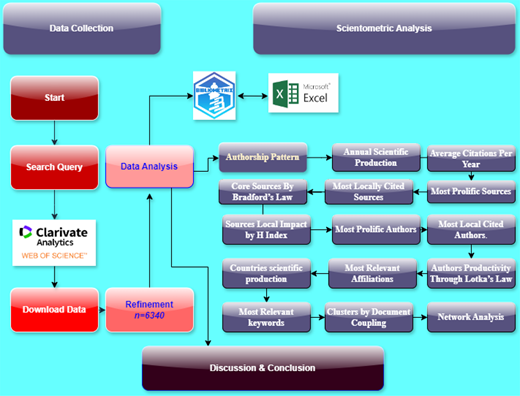
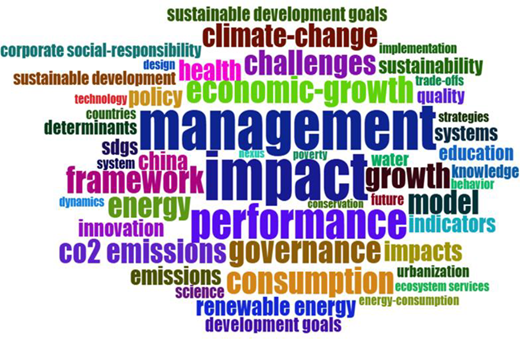
Published by Emerald Publishing Limited. This article is published under the Creative Commons Attribution (CC BY 4.0) licence. Anyone may reproduce, distribute, translate and create derivative works of this article (for both commercial and non-commercial purposes), subject to full attribution to the original publication and authors. The full terms of this licence may be seen at Link to the terms of the CC BY 4.0 licenceLink to the terms of the CC BY 4.0 licence.

Data & Figures

Figure 1.
A flowchart outlines a bibliometric study workflow from data collection and refinement to scientometric analysis and final discussion.The workflow presents a structured process for conducting a bibliometric and scientometric study. The sequence begins with Start, followed by Search Query, data retrieval through Clarivate Analytics Web of Science, and Download Data. A refinement stage specifies a dataset size of n equals 6340 before progressing to Data Analysis. Data analysis links to Bibliometrix and Microsoft Excel, which support multiple analytical outputs. These outputs include authorship pattern, annual scientific production, average citations per year, most prolific sources, most locally cited sources, core sources by Bradfords law, sources local impact by H index, most prolific authors, most locally cited authors, authors productivity through Lotkas law, countries scientific production, most relevant affiliations, most relevant keywords, clusters by document coupling, and network analysis. All analytical paths lead to Discussion and Conclusion, indicating synthesis and interpretation of results.

Brief illustration of steps involved in methodology

Source: Self Illustration

Figure 1.
A flowchart outlines a bibliometric study workflow from data collection and refinement to scientometric analysis and final discussion.The workflow presents a structured process for conducting a bibliometric and scientometric study. The sequence begins with Start, followed by Search Query, data retrieval through Clarivate Analytics Web of Science, and Download Data. A refinement stage specifies a dataset size of n equals 6340 before progressing to Data Analysis. Data analysis links to Bibliometrix and Microsoft Excel, which support multiple analytical outputs. These outputs include authorship pattern, annual scientific production, average citations per year, most prolific sources, most locally cited sources, core sources by Bradfords law, sources local impact by H index, most prolific authors, most locally cited authors, authors productivity through Lotkas law, countries scientific production, most relevant affiliations, most relevant keywords, clusters by document coupling, and network analysis. All analytical paths lead to Discussion and Conclusion, indicating synthesis and interpretation of results.

Brief illustration of steps involved in methodology

Source: Self Illustration

Close modal
Figure 2.
A word cloud highlighting sustainability research themes, with management, impact, and performance shown as the most prominent terms.The content presents a word cloud of sustainability and development research concepts, where larger words indicate higher prominence. The most dominant terms are management, impact, and performance. Strongly associated themes include economic growth, governance, consumption, framework, and energy. Environmental topics such as climate change, C O 2 emissions, renewable energy, water, ecosystem services, and conservation are clearly visible. Social, policy, and development dimensions appear through health, education, quality, indicators, policy, strategies, systems, and corporate social responsibility. Additional terms such as innovation, technology, model, determinants, countries, China, urbanization, poverty, trade-offs, knowledge, behavior, and future reflect an interdisciplinary focus linking environmental, economic, and governance perspectives.

Keyword Cloud

Source: Primary Data

Figure 2.
A word cloud highlighting sustainability research themes, with management, impact, and performance shown as the most prominent terms.The content presents a word cloud of sustainability and development research concepts, where larger words indicate higher prominence. The most dominant terms are management, impact, and performance. Strongly associated themes include economic growth, governance, consumption, framework, and energy. Environmental topics such as climate change, C O 2 emissions, renewable energy, water, ecosystem services, and conservation are clearly visible. Social, policy, and development dimensions appear through health, education, quality, indicators, policy, strategies, systems, and corporate social responsibility. Additional terms such as innovation, technology, model, determinants, countries, China, urbanization, poverty, trade-offs, knowledge, behavior, and future reflect an interdisciplinary focus linking environmental, economic, and governance perspectives.

Keyword Cloud

Source: Primary Data

Close modal
Figure 3.
A treemap summarising sustainability research keywords, led by impact, management, and performance, with counts and percentages shown.The treemap displays the distribution of sustainability and development research keywords using rectangles sized by frequency and labelled with counts and percentages. The largest category is impact, with 501 occurrences at 6 percent, followed by management, with 459 at 5 percent, and performance with 349 at 4 percent. Prominent three percent categories include economic growth, consumption, governance, challenges, model, framework, climate change, and carbon dioxide emissions. Two percent categories include energy, policy, emissions, health, impacts, innovation, education, sustainability, renewable energy, indicators, quality, systems, development goals, and determinants. Smaller one percent categories include science, knowledge, system, countries, future, design, water, trade-offs, behaviour, poverty, urbanization, strategies, dynamics, efficiency, technology, energy consumption, conservation, and ecosystem services, showing a broad interdisciplinary spread across environmental, economic, social, and governance themes.

Tree Map

Source: Primary Data

Figure 3.
A treemap summarising sustainability research keywords, led by impact, management, and performance, with counts and percentages shown.The treemap displays the distribution of sustainability and development research keywords using rectangles sized by frequency and labelled with counts and percentages. The largest category is impact, with 501 occurrences at 6 percent, followed by management, with 459 at 5 percent, and performance with 349 at 4 percent. Prominent three percent categories include economic growth, consumption, governance, challenges, model, framework, climate change, and carbon dioxide emissions. Two percent categories include energy, policy, emissions, health, impacts, innovation, education, sustainability, renewable energy, indicators, quality, systems, development goals, and determinants. Smaller one percent categories include science, knowledge, system, countries, future, design, water, trade-offs, behaviour, poverty, urbanization, strategies, dynamics, efficiency, technology, energy consumption, conservation, and ecosystem services, showing a broad interdisciplinary spread across environmental, economic, social, and governance themes.

Tree Map

Source: Primary Data

Close modal
Figure 4.
A centrality versus impact map showing document coupling clusters for sustainability topics with confidence percentages.The plot presents clusters by document coupling on a two-dimensional space defined by centrality on the horizontal axis and impact on the vertical axis. Dashed reference lines divide the space into quadrants. In the upper right area, the cluster labelled trade-offs shows confidence of 83.3 percent, alongside energy at 92 percent and SDGs at 63.4 percent, indicating high impact and high centrality. Near the lower central region, governance appears with confidence of 56.5 percent, development goals with 47.8 percent, and S D G s with 36.6 percent, reflecting moderate centrality and lower impact. A small isolated cluster appears at the far right with high centrality but lower impact.

Clusters by document coupling in Sustainable development research

Source: Primary Data

Figure 4.
A centrality versus impact map showing document coupling clusters for sustainability topics with confidence percentages.The plot presents clusters by document coupling on a two-dimensional space defined by centrality on the horizontal axis and impact on the vertical axis. Dashed reference lines divide the space into quadrants. In the upper right area, the cluster labelled trade-offs shows confidence of 83.3 percent, alongside energy at 92 percent and SDGs at 63.4 percent, indicating high impact and high centrality. Near the lower central region, governance appears with confidence of 56.5 percent, development goals with 47.8 percent, and S D G s with 36.6 percent, reflecting moderate centrality and lower impact. A small isolated cluster appears at the far right with high centrality but lower impact.

Clusters by document coupling in Sustainable development research

Source: Primary Data

Close modal
Figure 5.
A dense coupling network shows clustered documents linked by shared references, highlighting three main groups with prominent central studies.The image presents a coupling network of documents using C R, where nodes represent individual publications and connecting lines indicate shared reference relationships. The network is organised into three main clusters. A large blue cluster dominates the upper left and central area, labelled with key studies such as Wei Y 2023 in Sustainable Cities and Society, Zhu J 2022 in Journal of Cleaner Production, and Xu Z 2023 in Applied Geography. A red cluster occupies the central and right region, centred on eisenmenger n 2020 in Sustainability Science and wang x 2021 in Chinese Geographical Science, with dense internal connections. A smaller green cluster appears at the lower right, anchored by yamane t 2022 in ecological economics and Ordonez Galoc 2023 in the Journal of Environmental Management and Policy. Numerous inter-cluster links indicate strong coupling across themes, with several highly connected hub documents acting as bridges between clusters.

Figure coupling network of documents in sustainable development research using cited reference

Source: Primary Data

Figure 5.
A dense coupling network shows clustered documents linked by shared references, highlighting three main groups with prominent central studies.The image presents a coupling network of documents using C R, where nodes represent individual publications and connecting lines indicate shared reference relationships. The network is organised into three main clusters. A large blue cluster dominates the upper left and central area, labelled with key studies such as Wei Y 2023 in Sustainable Cities and Society, Zhu J 2022 in Journal of Cleaner Production, and Xu Z 2023 in Applied Geography. A red cluster occupies the central and right region, centred on eisenmenger n 2020 in Sustainability Science and wang x 2021 in Chinese Geographical Science, with dense internal connections. A smaller green cluster appears at the lower right, anchored by yamane t 2022 in ecological economics and Ordonez Galoc 2023 in the Journal of Environmental Management and Policy. Numerous inter-cluster links indicate strong coupling across themes, with several highly connected hub documents acting as bridges between clusters.

Figure coupling network of documents in sustainable development research using cited reference

Source: Primary Data

Close modal
Figure 6.
A co-authorship network highlights key researchers, with larger nodes and thicker links indicating stronger collaboration around central authors.The co-authorship network displays researchers as red circular nodes connected by curved red lines that represent collaborative links. Node size varies, indicating relative collaboration intensity, with Liu Y and wang y appearing as the most prominent and central contributors. Other labelled nodes include li y, li x, liu j, wang j, wang x, zhang x, zhang y, and zhang j, arranged around the central pair. Thicker and more numerous connections cluster around Liu Y and wang y, showing frequent joint work with multiple partners. Thinner links connect peripheral authors, forming a dense but uneven collaboration structure centred on a few highly connected researchers.

Author network

Source: Primary Data

Figure 6.
A co-authorship network highlights key researchers, with larger nodes and thicker links indicating stronger collaboration around central authors.The co-authorship network displays researchers as red circular nodes connected by curved red lines that represent collaborative links. Node size varies, indicating relative collaboration intensity, with Liu Y and wang y appearing as the most prominent and central contributors. Other labelled nodes include li y, li x, liu j, wang j, wang x, zhang x, zhang y, and zhang j, arranged around the central pair. Thicker and more numerous connections cluster around Liu Y and wang y, showing frequent joint work with multiple partners. Thinner links connect peripheral authors, forming a dense but uneven collaboration structure centred on a few highly connected researchers.

Author network

Source: Primary Data

Close modal
Figure 7.
A country collaboration network shows China and the United Kingdom as central hubs with dense links to multiple partner countries.The collaboration network presents countries as red circular nodes connected by curved red lines that represent international research links. China appears as the largest and most central node, indicating the strongest level of collaboration. The United Kingdom and the U S A also appear prominent, with many connections radiating to other countries. Additional labelled nodes include Germany, Italy, Australia, India, Japan, Brazil, and Spain, positioned around the central cluster. Thicker and more numerous links concentrate around China and the United Kingdom, while thinner connections link peripheral countries, showing an uneven but highly interconnected global collaboration structure.

Countries network

Source: Primary Data

Figure 7.
A country collaboration network shows China and the United Kingdom as central hubs with dense links to multiple partner countries.The collaboration network presents countries as red circular nodes connected by curved red lines that represent international research links. China appears as the largest and most central node, indicating the strongest level of collaboration. The United Kingdom and the U S A also appear prominent, with many connections radiating to other countries. Additional labelled nodes include Germany, Italy, Australia, India, Japan, Brazil, and Spain, positioned around the central cluster. Thicker and more numerous links concentrate around China and the United Kingdom, while thinner connections link peripheral countries, showing an uneven but highly interconnected global collaboration structure.

Countries network

Source: Primary Data

Close modal
Table 1.

Description about data

Main information about data
DescriptionResults
Timespan2020–2024
Sources (journals, books, etc)1,157
Documents(Articles)6,340
Annual growth rate10.44%
Article average age1.81
Average citations per article12.68
References320,487
Document contents
Keywords plus (ID)7,424
Author keywords (DE)16,853
Authors
Authors23,518
Authors of single-authored docs487
Author collaboration
Single-authored Documents538
Co-authors per document5.11
International co-authorships %44.09
Source(s): Primary Data
Table 2.

Annual scientific production

YearNo. of articles
2020783
20211,190
20221,535
20231,659
20241,165
Source(s): Primary Data
Table 3.

Countries scientific production

RegionFrequency
China5,255
USA2,027
UK1,992
India1,694
Spain1,597
Australia1,217
Italy1,143
Germany963
Japan741
Brazil687
Source(s): Primary Data
Table 4.

Authors’ productivity through Lotka’s law

No. of articlesNo. of authorsFrequency
119,5030.82
22,4880.10
37190.03
43210.01
51450.006
6750.0031
7610.0025
8410.0017
9340.0014
10220.0009
Source(s): Primary Data
Table 5.

Most prolific authors

AuthorsTotal no. articlesArticles fractionalised
Liu Y.5410.29
Wang Y.488.066
Li Y.468.32
Liu J.427.27
Wang J.396.58
Zhang J.396.15
Zhang Y.397.39
Wang X.386.14
Zhang X.376.97
Li X.356.46
Source(s): Primary Data
Table 6.

Authorship pattern

Publication year
Authorship pattern20202021202220232024Grand total
19810713612375539
21402252432901971,095
31672562853152551,278
41252072923262321,182
587129177207157757
6488912814576486
73446787852288
81730594934189
92025373823143
101223272221105
117918161464
12481319953
1331143425
144628323
152454318
1622103219
175132213
18235111
191214
201315
2121227
22112
231214
241113
251113
2611
272114
2822
3111
3211
3311
37112
46112
7511
15311
16811
18611
25011
25511215
Grand total7851,1931,5371,6621,1636,340
Source(s): Primary Data
Table 7.

Most local cited authors

AuthorLocal citations
Pradhan P.156
Sinha A.114
Warchold A.100
Adebayo T.S.95
Kim R.E.95
Thijssens T.93
Van Der Waal J.W.H.93
Rosati F.86
Pizzi S.80
Venturelli A.80
Source(s): Primary Data
Table 8.

Authors local impact by h-index

Authorh-indexg-indexm-indexTCNPPY
Adebayo T.S.17324.251,412322021
Bekun F.V.14242.8613272020
Sinha A.14182.81,819182020
Wang X.14232.8566382020
Leal Filho W.13242.6680242020
Liu Y.13222.6574542020
Zhang J13332.61,125392020
Alola A.A.12182.4760182020
Liu J.12282.4844422020
Wang J.12292.4864392020
Note(s):

TC=Total Citations (Total Citations is the measure of cumulative amount of citations that a source/journal has received within the given period of time) NP=Number of Papers/Articles(Total number of papers/articles published within the given period of time PY=Publication Year (Publication Year refers to the year in which a document was published, with the first year of the selected time period taken as the starting point for analysis)

Source(s): Primary Data
Table 9.

Top 10 most cited countries

CountryTotal citationsAverage article citations
China14,55612.9
United Kingdom5,51213.8
USA5,15816.2
Spain4,67311.3
Italy4,40714.7
India3,89611.4
Germany3,44316.4
Australia3,25614.6
The Netherlands2,09416.8
Japan1,96012.8
Source(s): Primary Data
Table 10.

Average citations per year

YearMean TC per articleNo. of articlesMean TC per yearCitable years
202029.247835.855
202120.931,1905.234
202213.951,5354.653
20235.851,6592.922
20241.191,1651.191
Note(s):

TC = Total Citations (Total Citations is the measure of cumulative amount of citations that a source/journal has received within the given period of time)

Source(s): Primary Data
Table 11.

Most prolific sources

SourcesNo. of articles
Sustainability1,131
Journal of Cleaner Production256
Sustainable Development174
Environmental Science and Pollution Research134
Environment Development and Sustainability101
International Journal of Sustainability in Higher Education96
Science of the Total Environment86
Journal of Environmental Management77
Sustainability Science68
Source(s): Primary Data
Table 12.

Most locally cited sources

SourcesNo. of articles
Journal of Cleaner Production12,508
Sustainability10,984
Environmental Science and Pollution Research4,997
Science of the Total Environment4,589
Renewable and Sustainable Energy Reviews3,310
Energy Policy2,917
Sustainable Development2,779
Journal of Environmental Management2,573
Nature2,389
Source(s): Primary Data
Table 13.

Core sources by Bradford’s law

SourcesRankFrequencyCumulative frequencyZone
Sustainability11,1311,131Zone 1
Journal of Cleaner Production22561,387Zone 1
Sustainable Development31741,561Zone 1
Environmental Science and Pollution Research41341,695Zone 1
Environment Development and Sustainability51011,796Zone 1
International Journal of Sustainability in Higher Education6961,892Zone 1
Science of the Total Environment7861,978Zone 1
Journal of Environmental Management8772,055Zone 1
Sustainability Science9682,123Zone 1
Energies10662,189Zone 2
Land11632,252Zone 2
Plos One12622,314Zone 2
Heliyon13572,371Zone 2
Remote Sensing14562,427Zone 2
International Journal of Environmental Research and Public Health15552,482Zone 2
Resources Policy16502,532Zone 2
International Journal of Sustainable Development and World Ecology17452,577Zone 2
Water18432,620Zone 2
Business Strategy and the Environment19422,662Zone 2
Source(s): Primary Data
Table 14.

Sources local impact by h-index

Sourceh-indexg-indexm-indexTCNPPY
Journal of Cleaner Production47719.46,6232562020
Sustainability38547.69,8001,1312020
Science of the Total Environment32546.43,173862020
Environmental Science and Pollution Research29435.82,2351342020
Journal of Environmental Management22374.41,590772020
Sustainable Development22354.41,6931742020
Sustainability Science19353.81,383682020
Renewable & Sustainable Energy Reviews18313.61,014312020
Technological Forecasting and Social Change18303.6943342020
World Development18353.61,251352020
Note(s):

TC = Total Citations (Total Citations is the measure of cumulative amount of citations that a source/journal has received within the given period of time) NP = Number of Papers/Articles(Total number of papers/articles published within the given period of time PY = Publication Year (Publication Year refers to the year in which a document was published, with the first year of the selected time period taken as the starting point for analysis) h-index = A researcher has an h-index of h if h of their publications have each received at least h citations, indicating balanced productivity and impact g-index = A researcher has a g-index of g if their top g most-cited publications together received at least g2 citations, giving more weight to highly cited works m-index = The m-index is calculated as the h-index divided by the number of years since the first publication, reflecting consistent scholarly impact over time

Source(s): Primary Data
Table 15.

Top 10 most prolific affiliations

AffiliationArticles
Beijing Normal University177
University of Chinese Academy of Sciences177
Institute of Geographic Sciences and Natural Resources125
University of Oxford111
Chinese Academy of Sciences109
Tehran University of Medical Sciences104
Wuhan University97
Zhejiang University92
Istanbul Gelisim University91
Lebanese Amer University88
Tsinghua University87
Source(s): Primary Data
Table 16.

Cluster by document coupling

LabelGroupFrequencyCentralityImpact
SDGs – conf 36.6% governance – conf 56.5% development goals - conf 47.8%1670.3315.37
Trade-offs – conf 83.3% SDGs – conf 63.4% energy – conf 92%21580.4456.538
Source(s): Primary Data

Supplements

References

Alfirevic
,
N.
,
Malesevic Perovic
,
L.
and
Mihaljevic Kosor
,
M.
(
2023
), “
Productivity and impact of sustainable development goals (SDGs)-related academic research: a bibliometric analysis
”,
Sustainability
, Vol.
15
No.
9
, p.
7434
, doi: .
Appio
,
F.P.
,
Cesaroni
,
F.
and
Di Minin
,
A.
(
2014
), “
Visualizing the structure and bridges of the intellectual property management and strategy literature: a document co-citation analysis
”,
Scientometrics
, Vol.
101
No.
1
, pp.
623
-
661
, doi: .
Aria
,
M.
and
Cuccurullo
,
C.
(
2017
), “
Bibliometrix: an R-tool for comprehensive science mapping analysis
”,
Journal of Informetrics
, Vol.
11
No.
4
, pp.
959
-
975
, doi: .
Arora-Jonsson
,
S.
(
2023
), “
The sustainable development goals: a universalist promise for the future
”,
Futures
, Vol.
146
, p.
103087
, doi: .
Bautista-Puig
,
N.
,
Aleixo
,
A.M.
,
Leal
,
S.
,
Azeiteiro
,
U.
and
Costas
,
R.
(
2021
), “
Unveiling the research landscape of sustainable development goals and their inclusion in higher education institutions and research centers: Major trends in 2000–2017
”,
Frontiers in Sustainability
, Vol.
2
, doi: .
Bellantuono
,
L.
,
Monaco
,
A.
,
Amoroso
,
N.
,
Aquaro
,
V.
,
Lombardi
,
A.
,
Tangaro
,
S.
and
Bellotti
,
R.
(
2022
), “
Sustainable development goals: conceptualisation, communication and achievement synergies in a complex network framework
”,
Applied Network Science
, Vol.
7
No.
1
, doi: .
Bennich
,
T.
,
Weitz
,
N.
and
Carlsen
,
H.
(
2020
), “
Deciphering the scientific literature on SDG interactions: a review and reading guide
”,
Science of The Total Environment
, Vol.
728
, p.
138405
, doi: .
Bernatović
,
I.
,
Slavec Gomezel
,
A.
and
Černe
,
M.
(
2022
), “
Mapping the knowledge-hiding field and its future prospects: a bibliometric co-citation, co-word, and coupling analysis
”,
Knowledge Management Research & Practice
, Vol.
20
No.
3
, pp.
394
-
409
, doi: .
Berrone
,
P.
,
Rousseau
,
H.E.
,
Ricart
,
J.E.
,
Brito
,
E.
and
Giuliodori
,
A.
(
2023
), “
How can research contribute to the implementation of sustainable development goals? An interpretive review of SDG literature in management
”,
International Journal of Management Reviews
, Vol.
25
No.
2
, pp.
318
-
339
, doi: .
Bradford
,
S.C.
(
1934
), “
Sources of information on specific subjects
”,
Engineering
, Vol.
137
, pp.
85
-
86
.
Bukhari
,
S.A.A.
,
Hashim
,
F.
and
Amran
,
A.
(
2023
), “
Green banking: a strategy for attainment of UN-Sustainable development goals 2030
”,
International Journal of Environment and Sustainable Development
, Vol.
22
No.
1
, p.
13
, doi: .
Donoghue
,
D.
, and
Higgins
,
E.O.
(
2023
), “The united nations sustainable development goals: a pathway to value creation for a sustainable world”,
Palgrave Studies in Sustainable Business In Association with Future Earth
,
Springer International Publishing
, pp.
41
-
62
, doi: .
Egghe
,
L.
(
2006
), “
Theory and practise of the g-index
”,
Scientometrics
, Vol.
69
No.
1
, pp.
131
-
152
, doi: .
Eisenmenger
,
N.
,
Pichler
,
M.
,
Krenmayr
,
N.
,
Noll
,
D.
,
Plank
,
B.
,
Schalmann
,
E.
and
Gingrich
,
S.
(
2020
), “
The sustainable development goals prioritize economic growth over sustainable resource use: a critical reflection on the sdgs from a socio-ecological perspective
”,
Sustainability Science
, Vol.
15
No.
4
, pp.
1101
-
1110
, doi: .
Fukuda-Parr
,
S.
(
2023
), “Sustainable development goals (SDGs) and the promise of a transformative agenda”,
International Organization and Global Governance
,
Routledge
, pp.
708
-
723
, doi: .
García-Lillo
,
F.
,
Seva-Larrosa
,
P.
and
Sánchez-García
,
E.
(
2023
), “
What is going on in entrepreneurship research? A bibliometric and SNA analysis
”,
Journal of Business Research
, Vol.
158
No.
113624
, pp.
1
-
14
, doi: .
Goh
,
K.H.
and
See
,
K.F.
(
2021
), “
Twenty years of water utility benchmarking: a bibliometric analysis of emerging interest in water research and collaboration
”,
Journal of Cleaner Production
, Vol.
284
, p.
124711
, doi: .
Gunnarsdottir
,
I.
,
Davidsdottir
,
B.
,
Worrell
,
E.
and
Sigurgeirsdottir
,
S.
(
2021
), “
Sustainable energy development: History of the concept and emerging themes
”,
Renewable and Sustainable Energy Reviews
, Vol.
141
, p.
110770
, doi: .
Henderson
,
K.
and
Loreau
,
M.
(
2023
), “
A model of sustainable development goals: Challenges and opportunities in promoting human well-being and environmental sustainability
”,
Ecological Modelling
, Vol.
475
, p.
110164
, doi: .
Hickmann
,
T.
,
Biermann
,
F.
,
Spinazzola
,
M.
,
Ballard
,
C.
,
Bogers
,
M.
,
Forestier
,
O.
,
Kalfagianni
,
A.
,
Kim
,
R.E.
,
Montesano
,
F.S.
,
Peek
,
T.
,
Senit
,
C.
,
van Driel
,
M.
,
Vijge
,
M.J.
and
Yunita
,
A.
(
2022
), “
Success factors of global goal‐setting for sustainable development: Learning from the millennium development goals
”,
Sustainable Development
, Vol.
31
No.
3
, pp.
1214
-
1225
, doi: .
Hirsch
,
J.E.
(
2005
), “
An index to quantify an individual’s scientific research output
”,
Proceedings of the National Academy of Sciences
, Vol.
102
No.
46
, pp.
16569
-
16572
, doi: .
Hood
,
W.W.
and
Wilson
,
C.S.
(
2001
), “
The literature of bibliometrics, scientometrics, and informetrics
”,
Scientometrics
, Vol.
52
No.
2
, pp.
291
-
314
, doi: .
Hossain
,
S.
,
Batcha
,
M. S.
,
Atoum
,
I.
,
Ahmad
,
N.
and
Al-Shehri
,
A.
(
2022
), “
Bibliometric analysis of the scientific research on sustainability in the impact of social media on higher education during the COVID-19 pandemic
”,
Sustainability
, Vol.
14
No.
24
, p.
16388
, doi: .
Hsieh
,
Y.-L.
and
Yeh
,
S.-C.
(
2024
), “
The trends of major issues connecting climate change and the sustainable development goals
”,
Discover Sustainability
, Vol.
5
No.
1
, doi: .
Husainy
,
A.S.N.
,
Mangave
,
S.S.
,
Patil
,
C.C.
and
Mane
,
S.D.
(
2024
), “
Harmonising responsibilities: Challenges and opportunities in the integration of climate change and sustainable development goals (SDGs)
”,
The Asian Review of Civil Engineering
, Vol.
13
No.
1
, pp.
30
-
43
, doi: .
Kawamura
,
M.
,
Thomas
,
C.D.L.
,
Tsurumoto
,
A.
,
Sasahara
,
H.
and
Kawaguchi
,
Y.
(
2000
), “
Lotka’s law and productivity index of authors in a scientific journal
”,
Journal of Oral Science
, Vol.
42
No.
2
, pp.
75
-
78
, doi: .
Khaled
,
R.
,
Ali
,
H.
and
Mohamed
,
E.K.A.
(
2021
), “
The sustainable development goals and corporate sustainability performance: mapping, extent and determinants
”,
Journal of Cleaner Production
, Vol.
311
, p.
127599
, doi: .
Kleminski
,
R.
,
Kazienko
,
P.
and
Kajdanowicz
,
T.
(
2020
), “
Analysis of direct citation, co-citation and bibliographic coupling in scientific topic identification
”,
Journal of Information Science
, Vol.
48
No.
3
, pp.
349
-
373
, doi: .
Knox
,
C.
and
Orazgaliyev
,
S.
(
2024
), “
Sustainable development goals and good governance nexus: Implementation challenges in Central Asia
”,
Public Administration and Development
, Vol.
44
No.
4
, pp.
237
-
251
, doi: .
Kushnir
,
I.
and
Nunes
,
A.
(
2022
), “
Education and the UN development goals projects (MDGs and SDGs): definitions, links, operationalisations
”,
Journal of Research in International Education
, Vol.
21
No.
1
, pp.
3
-
21
, doi: .
Leal Filho
,
W.
,
Tripathi
,
S.K.
,
Andrade Guerra
,
J.B.S.O.D.
,
Giné-Garriga
,
R.
,
Orlovic Lovren
,
V.
and
Willats
,
J.
(
2018
), “
Using the sustainable development goals towards a better understanding of sustainability challenges
”,
International Journal of Sustainable Development and World Ecology
, Vol.
26
No.
2
, pp.
179
-
190
, doi: .
Li
,
S.
,
Cifuentes-Faura
,
J.
,
Talbi
,
B.
,
Sadiq
,
M.
,
Si Mohammed
,
K.
and
Bashir
,
M.F.
(
2023
), “
Dynamic correlated effects of electricity prices, biomass energy, and technological innovation in Tunisia’s energy transition
”,
Utilities Policy
, Vol.
82
, p.
101521
, doi: .
Lotka
,
A.J.
(
1926
), “
The frequency distribution of scientific productivity
”,
Journal of the Washington Academy of Sciences
, Vol.
16
No.
12
, pp.
317
-
323
.
Meschede
,
C.
(
2020
), “
The sustainable development goals in scientific literature: a bibliometric overview at the meta-level
”,
Sustainability
, Vol.
12
No.
11
, p.
4461
, doi: .
Mishra
,
M.
,
Desul
,
S.
,
Santos
,
C.A.G.
,
Mishra
,
S.K.
,
Kamal
,
A.H.M.
,
Goswami
,
S.
,
Kalumba
,
A.M.
,
Biswal
,
R.
,
da Silva
,
R.M.
,
dos Santos
,
C.A.C.
and
Baral
,
K.
(
2023
), “
A bibliometric analysis of sustainable development goals (SDGs): a review of progress, challenges, and opportunities
”,
Environment, Development and Sustainability
, Vol.
26
No.
5
, pp.
11101
-
11143
, doi: .
Morales-Zapata
,
D.
,
Valencia-Arias
,
A.
,
Garces-Giraldo
,
L.F.
,
Toro-Vanegas
,
E.
, and
Quiroz-Fabra
,
J.
(
2021
), “Trends in research around the sustainable development objectives: a bibliometric analysis”,
Sustainable Development Goals Series
,
Springer International Publishing
, pp.
247
-
260
, doi: .
Pradhan
,
P.
,
Costa
,
L.
,
Rybski
,
D.
,
Lucht
,
W.
and
Kropp
,
J.P.
(
2017
), “
A systematic study of sustainable development goal (SDG) interactions
”,
Earth’s Future
, Vol.
5
No.
11
, pp.
1169
-
1179
, doi: .
Pritchard
,
A.
(
1969
), “
Statistical bibliography or bibliometrics
”,
Journal of Documentation
, Vol.
25
, p.
348
.
Raman
,
R.
,
Lathabhai
,
H.
,
Pattnaik
,
D.
,
Kumar
,
C.
and
Nedungadi
,
P.
(
2024
), “
Research contribution of bibliometric studies related to sustainable development goals and sustainability
”,
Discover Sustainability
, Vol.
5
No.
1
, doi: .
Raman
,
R.
,
Pattnaik
,
D.
,
Achuthan
,
K.
,
Hughes
,
L.
,
Al-Busaidi
,
A.S.
,
Dwivedi
,
Y.K.
,
Ramesh
,
M.V.
and
Nedungadi
,
P.
(
2024
), “
Mapping research in the journal of innovation; knowledge to sustainable development goals
”,
Journal of Innovation and Knowledge
, Vol.
9
No.
3
, p.
100538
, doi: .
Salvia
,
A.L.
,
Leal Filho
,
W.
,
Brandli
,
L.L.
and
Griebeler
,
J.S.
(
2019
), “
Assessing research trends related to sustainable development goals: Local and global issues
”,
Journal of Cleaner Production
, Vol.
208
, p.
841
-
849
, doi: .
Scheinerman
,
E.R.
and
Ullman
,
D.H.
(
2011
),
Fractional Graph Theory: A Rational Approach to the Theory of Graphs
,
Courier Corporation
.
Sianes
,
A.
,
Vega-Muñoz
,
A.
,
Tirado-Valencia
,
P.
and
Ariza-Montes
,
A.
(
2022
), “
Impact of the sustainable development goals on the academic research agenda. A scientometric analysis
”,
Plos One
, Vol.
17
No.
3
, p.
e0265409
, doi: .
Siegel
,
K.M.
and
Bastos Lima
,
M.G.
(
2020
), “
When international sustainability frameworks encounter domestic politics: the sustainable development goals and Agri-food governance in South America
”,
World Development
, Vol.
135
, p.
105053
, doi: .
Singh
,
U.K.
(
2024
), “Implementation of sustainable development goals in India: progress and challenges”,
Advances Ingeographical and Environmental Sciences
,
Springer Nature Singapore
, pp.
39
-
91
, doi: .
Singh
,
A.
,
Kanaujia
,
A.
,
Singh
,
V.K.
and
Vinuesa
,
R.
(
2023
), “
Artificial intelligence for sustainable development goals: Bibliometric patterns and concept evolution trajectories
”,
Sustainable Development
, Vol.
32
No.
1
, pp.
724
-
754
, doi: .
Singh
,
R.
(
2024
), “
Scientometric evaluation of cutting‐edge research on sustainable development and environmental concern
”,
Sustainable Development
, Vol.
33
No.
1
, doi: .
Sood
,
S.K.
,
Kumar
,
N.
and
Saini
,
M.
(
2021
), “
Scientometric analysis of literature on distributed vehicular networks : vOSViewer visualisation techniques
”,
Artificial Intelligence Review
, Vol.
54
No.
8
, pp.
6309
-
6341
, doi: .
Subramanyam
,
K.
(
1983
), “
Bibliometric studies of research collaboration: a review
”,
Journal of Information Science
, Vol.
6
No.
1
, pp.
33
-
38
, doi: .
Sweileh
,
W.
(
2024
), “
Bibliometric analysis of income inequality research published in top public health, environmental and occupational health journals
”,
Journal of Poverty
, Vol.
29
No.
6
, pp.
1
-
18
, doi: .
Telleria
,
J.
and
Garcia-Arias
,
J.
(
2021
), “
The fantasmatic narrative of ‘sustainable development’. A political analysis of the 2030 global development agenda
”,
Environment and Planning C: Politics and Space
, Vol.
40
No.
1
, pp.
241
-
259
, doi: .
Thangavel
,
P.
and
Chandra
,
B.
(
2023
), “
Two decades of M-Commerce consumer research: a bibliometric analysis using R biblioshiny
”,
Sustainability
, Vol.
15
No.
15
, pp.
11835
, doi: .
United Nations
(
2015
), “
A/RES/70/1 - Transforming our world: the 2030 agenda for sustainable development. Resolution adopted by the general assembly on the 25th of September 2015
”, p.
35
.
United Nations
(
2017
), “
A/RES/71/313 – Work of the statistical commission pertaining to the 2030 agenda for sustainable development. Resolution adopted by the general assembly on the 6th of July 2017
”, p.
25
,
available at:
Link to A/RES/71/313 – Work of the statistical commission pertaining to the 2030 agenda for sustainable development. Resolution adopted by the general assembly on the 6th of July 2017Link to the cited article.
Wani
,
J.A.
,
Ganaie
,
S.A.
and
Rehman
,
I.U.
(
2023
), “
Mapping research output on library and information science research domain in South africa: a bibliometric visualisation
”,
Information Discovery and Delivery
, Vol.
51
No.
2
, pp.
194
-
212
, doi: .
Yamaguchi
,
N.U.
,
Bernardino
,
E.G.
,
Ferreira
,
M.E.C.
,
De Lima
,
B.P.
,
Pascotini
,
M.R.
and
Yamaguchi
,
M.U.
(
2023
), “
Sustainable development goals: a bibliometric analysis of literature reviews
”,
Environmental Science and Pollution Research
, Vol.
30
No.
3
, pp.
5502
-
5515
, doi: .
Yumnam
,
G.
,
Gyanendra
,
Y.
and
Singh
,
C.I.
(
2024
), “
A systematic bibliometric review of the global research dynamics of united nations sustainable development goals 2030
”,
Sustainable Futures
, Vol.
7
, p.
100192
, doi: .
Anderson
,
M.H.
and
Lemken
,
R.K.
(
2020
), “
Citation context analysis as a method for conducting rigorous and impactful literature reviews
”,
Organizational Research Methods
, Vol.
26
No.
1
, pp.
77
-
106
, doi: .
Asatani
,
K.
,
Takeda
,
H.
,
Yamano
,
H.
and
Sakata
,
I.
(
2020
), “
Scientific attention to sustainability and SDGs: Meta-Analysis of academic papers
”,
Energies
, Vol.
13
No.
4
, p.
975
, doi: .
Asubiaro
,
T.
,
Onaolapo
,
S.
and
Mills
,
D.
(
2024
), “
Regional disparities in web of science and Scopus journal coverage
”,
Scientometrics
, Vol.
129
No.
3
, pp.
1469
-
1491
, doi: .
Bakır
,
M.
,
Ozdemir
,
E.
,
Akan
,
S.
and
Atalık
,
Ö.
(
2022
), “
A bibliometric analysis of airport service quality
”,
Journal of Air Transport Management
, Vol.
104
, p.
102273
, doi: .
Bauer
,
I.
(
2021
), “6.1 Web of science, Scopus and further citation databases”,
Handbook Bibliometrics
,
De Gruyter
, pp.
409
-
420
, doi: .
Carlsen
,
L.
and
Bruggemann
,
R.
(
2021
), “
The 17 united nations’ sustainable development goals: a status by 2020
”,
International Journal of Sustainable Development and World Ecology
, Vol.
29
No.
3
, pp.
219
-
229
, doi: .
Cernev
,
T.
and
Fenner
,
R.
(
2020
), “
The importance of achieving foundational sustainable development goals in reducing global risk
”,
Futures
, Vol.
115
, p.
102492
, doi: .
Cobo
,
M.J.
,
Martínez
,
M.A.
,
Gutiérrez-Salcedo
,
M.
,
Fujita
,
H.
and
Herrera-Viedma
,
E.
(
2015
), “
25years at Knowledge-Based systems: a bibliometric analysis
”,
Knowledge-Based Systems
, Vol.
80
, pp.
3
-
13
, doi: .
Dang
,
H.-A.H.
and
Serajuddin
,
U.
(
2020
), “
Tracking the sustainable development goals: Emerging measurement challenges and further reflections
”,
World Development
, Vol.
127
, p.
104570
, doi: .
de Lázaro Torres
,
M.L.
,
Borderías Uribeondo
,
P.
and
Morales Yago
,
F.J.
(
2020
), “
Citizen and educational initiatives to support sustainable development goal 6: Clean water and sanitation for all
”,
Sustainability
, Vol.
12
No.
5
, p.
2073
, doi: .
Gaberli
,
U.
(
2023
), “
Tourism growth: a bibliometric analysis from the web of science (WoS) database
”,
Sosyal Bilimler Metinleri
, Vol.
2023
No.
1
, pp.
28
-
39
, doi: .
Guerra
,
J.B.S.O.A.
,
Hoffmann
,
M.
,
Bianchet
,
R.T.
,
Medeiros
,
P.
,
Provin
,
A.P.
and
Iunskovski
,
R.
(
2021
), “
Sustainable development goals and ethics: Building “the future we want
”,
Environment, Development and Sustainability
, Vol.
24
No.
7
, pp.
9407
-
9428
, doi: .
Gulseven
,
O.
and
Ahmed
,
G.
(
2022
), “
The state of life on land (SDG 15) in the United Arab Emirates
”,
International Journal of Social Ecology and Sustainable Development
, Vol.
13
No.
1
, pp.
1
-
15
, doi: .
Hariram
,
N.P.
,
Mekha
,
K.B.
,
Suganthan
,
V.
and
Sudhakar
,
K.
(
2023
), “
Sustainalism: an integrated socio-economic-environmental model to address sustainable development and sustainability
”,
Sustainability
, Vol.
15
No.
13
, p.
10682
, doi: .
Indana
,
F.
and
Pahlevi
,
R.W.
(
2023
), “
A bibliometric approach to sustainable development goals (SDGs) systematic analysis
”,
Cogent Business and Management
, Vol.
10
No.
2
, doi: .
Liu
,
W.
,
Ni
,
R.
and
Hu
,
G.
(
2024
), “
Web of science core collection’s coverage expansion: the forgotten arts and humanities citation index?
”,
Scientometrics
, Vol.
129
No.
2
, pp.
933
-
955
, doi: .
M
,
C.S.
,
Kumar
,
P.D.
and
Biradar
,
B.S.
(
2017
), “
Scientometric dimensions of chemical engineering research in India with reference to web of science citation database
”,
SSRN Electronic Journal
, doi: .
Mongeon
,
P.
and
Paul-Hus
,
A.
(
2015
), “
The journal coverage of web of science and Scopus: a comparative analysis
”,
Scientometrics
, Vol.
106
No.
1
, pp.
213
-
228
, doi: .
Morton
,
S.
,
Pencheon
,
D.
and
Squires
,
N.
(
2017
), “
Sustainable development goals (SDGs), and their implementation
”,
British Medical Bulletin
, pp.
1
-
10
, doi: .
Omodan
,
B.I.
(
2024
), “
Advancing interdisciplinary management science: a pathway to sustainable development goals
”,
Interdisciplinary Journal of Management Sciences
, Vol.
1
, pp.
1
-
9
, doi: .
Requejo
,
J.
,
Strong
,
K.
,
Agweyu
,
A.
,
Billah
,
S.M.
,
Boschi-Pinto
,
C.
,
Horiuchi
,
S.
,
Jamaluddine
,
Z.
,
Lazzerini
,
M.
,
Maiga
,
A.
,
McKerrow
,
N.
,
Munos
,
M.
,
Park
,
L.
,
Schellenberg
,
J.
and
Weigel
,
R.
(
2022
), “
Measuring and monitoring child health and wellbeing: Recommendations for tracking progress with a core set of indicators in the sustainable development goals era
”,
The Lancet Child and Adolescent Health
, Vol.
6
No.
5
, pp.
345
-
352
, doi: .
Robert
,
K.W.
,
Parris
,
T.M.
and
Leiserowitz
,
A.A.
(
2005
), “
What is sustainable development? Goals, indicators, values, and practice
”,
Environment: Science and Policy for Sustainable Development
, Vol.
47
No.
3
, pp.
8
-
21
, doi: .
Roy
,
S.
,
Rautela
,
R.
and
Kumar
,
S.
(
2023
), “
Towards a sustainable future: Nexus between the sustainable development goals and waste management in the built environment
”,
Journal of Cleaner Production
, Vol.
415
, p.
137865
, doi: .
Sahle
,
M.
,
Lahoti
,
S.A.
,
Lee
,
S.-Y.
,
Kamiyama
,
C.
,
Tan
,
X.
,
Kozar
,
R.
,
Saito
,
O.
and
Takeuchi
,
K.
(
2024
), “
Mapping the evolving research landscape of sustainability science from 2006 to 2023: Unveiling its transformation
”,
Sustainability Science
, Vol.
19
No.
5
, pp.
1735
-
1750
, doi: .
Sandu
,
A.
,
Cotfas
,
L.-A.
,
Delcea
,
C.
,
Crăciun
,
L.
and
Molănescu
,
A.G.
(
2023
), “
Sentiment analysis in the age of COVID-19: a bibliometric perspective
”,
Information
, Vol.
14
No.
12
, p.
659
, doi: .
Soergel
,
B.
,
Kriegler
,
E.
,
Weindl
,
I.
,
Rauner
,
S.
,
Dirnaichner
,
A.
,
Ruhe
,
C.
,
Hofmann
,
M.
,
Bauer
,
N.
,
Bertram
,
C.
,
Bodirsky
,
B.L.
,
Leimbach
,
M.
,
Leininger
,
J.
,
Levesque
,
A.
,
Luderer
,
G.
,
Pehl
,
M.
,
Wingens
,
C.
,
Baumstark
,
L.
,
Beier
,
F.
,
Dietrich
,
J.P.
and
Popp
,
A.
(
2021
), “
A sustainable development pathway for climate action within the UN 2030 agenda
”,
Nature Climate Change
, Vol.
11
No.
8
, pp.
656
-
664
, doi: .
Sonetti
,
G.
,
Brown
,
M.
and
Naboni
,
E.
(
2019
), “
About the triggering of UN sustainable development goals and regenerative sustainability in higher education
”,
Sustainability
, Vol.
11
No.
1
, p.
254
, doi: .
Sufiani
,
O.
,
Sahini
,
M.G.
and
Elisadiki
,
J.
(
2023
), “
Towards attaining SDG 6: the opportunities available for capacitive deionisation technology to provide clean water to the African population
”,
Environmental Research
, Vol.
216
, p.
114671
, doi: .
Tatishvili
,
T.
(
2014
), “
Academic citation indices and databases
”,
Law and Modern States
, Vol.
3
, doi: .
Toloo
,
M.
,
Khodabandelou
,
R.
and
Oukil
,
A.
(
2022
), “
A comprehensive bibliometric analysis of fractional programming (1965–2020)
”,
Mathematics
, Vol.
10
No.
11
, p.
1796
, doi: .
Tsalis
,
T.A.
,
Malamateniou
,
K.E.
,
Koulouriotis
,
D.
and
Nikolaou
,
I.E.
(
2020
), “
New challenges for corporate sustainability reporting: United nations’ 2030 agenda for sustainable development and the sustainable development goals
”,
Corporate Social Responsibility and Environmental Management
, Vol.
27
No.
4
, pp.
1617
-
1629
, doi: .
Vaverková
,
M.D.
,
Polak
,
J.
,
Kurcjusz
,
M.
,
Jena
,
M.K.
,
Murali
,
A.P.
,
Nair
,
S.S.
,
Aktaş
,
H.
,
Hadinata
,
M.E.
,
Ghezelayagh
,
P.
,
Andik
,
S.D.S.
,
Rahmana
,
A.
and
Franc‐Dąbrowska
,
J.
(
2024
), “
Enhancing sustainable development through interdisciplinary collaboration: Insights from diverse fields
”,
Sustainable Development
, Vol.
33
No.
3
, doi: .

Languages

or Create an Account

Close Modal
Close Modal