As we strive to provide quality and sustainable online learning experiences, we must frame instructional design decisions around learners’ current needs and interaction with technology. This article explores the implications of technology transience on instructional design. We provide numerous examples of programs assuming a purposeful approach to creating quality online learning opportunities, while straddling the myriad of issues that arise with transience of technologies. The impact on quality, currency, and effectiveness in the design of learning experiences needs to be considered in relationship to the ways technology changes the learning environment. Recommended practices and standards will be shared as considerations for instructional designers working in various sectors, including corporate and higher education.
Context
Jordan reviews the feedback given by her instructional coach regarding her videorecorded teaching lesson. Gabriel works with his English-speaking peers in a massive open online course to solve a complex business negotiation while using his native Spanish language. Yuna interviews a peer using his mobile phone. These three cases highlight the responsibility instructional designers have to ensure the current transience in technology is transformative (Puentedura, 2006) and not just a substitution of use. While they are three different cases, the common theme revolves around: How do we as instructional designers create meaningful learning opportunities amidst the transience in technology?
Paradigms for Understanding Innovations and Transience in Technology
First we must understand how technologies are adopted. In 1962 Rogers introduced diffusion of innovation theory to explain how innovations in technology and ideas are accepted through a process of social change. Diffusion occurs through the innovation-decision process as members of a system decide whether an innovation will be implemented, rejected, or if an innovation will evolve or be rejected over time (2003), as seen in emerging technology. Rogers’ model has been applied to fields including, engineering, economics, medicine and, most pertinent to this conversation, distance education. This theoretical framework provides guidance for the transience of technology as seen in how interaction is enhanced in online courses (Rogoza, 2007), the integration of mobile devices in nursing education (Doyle, Garrett, & Currie, 2014), and the incorporation of online games as a potential component for online textbooks (Kim, Dinu, & Chung, 2013).
Diffusion of Innovation theory takes into account that decisions regarding the adoption of an innovation are often made by individuals who may not understand the consequences of the adoption. Puentedura (2006) writes about the need for technology to be used to create new meaning—to redefine what is accomplished as a result of its use. Puentedura also notes that corporations may spend inordinate amounts of money on technology without any considerable return on investment. Subsequently, the question becomes: How can we keep up with the transience in technology while still maintaining a focus on quality?
State of Change in Corporations, K–12, and Higher Education
What changes are currently happening in corporate and higher education? Amirault (2012) offers a thorough review of how higher education institutions have been adapting to change over the past eight centuries. Whether it be responding to the introduction of modern medical techniques in the 14th century, the development of the printing press in the 15th century, or the technological advancements of the 20th and 21st centuries, universities have and will continue to adapt. However, given the increase in change (both in terms of significance and frequency), and the reduced lifespans of more recent technologies, universities are facing complex decisions. This transience is further exacerbated by a number of other challenges facing universities, including reductions in funding for higher education, difficulties with workforce expectations, and a general uncertainty about the nature of universities in the 21st century.
In recent years many disruptive changes (including those involving technology) have been fueled by demands from employers who note that graduates are not sufficiently prepared for the global workforce. In the United States, employers increasingly invest in elementary, secondary, and higher education through programs and initiatives designed to systemically tackle the achievement gap. This has been especially evident in the science, technology, engineering, and math disciplines. At the Learning Consortium, for example, over 200 major corporations met to benchmark, network, research, and collaborate on topics of learning and training in the workforce (Masie, 2012). Some of the trends in corporate technology and training documented at that time included: creating courses for use on mobile devices, using scenario-based learning and branching to create meaningful lessons, implementing video and 3D opportunities for realworld learning scenarios, and providing performance support for learners’ postgraduate and workforce preparation.
Corporate universities fall somewhere between the formal traditional university and corporations. While upon initial examination it may appear as though they are the amalgamation of the two concepts, they are equally criticized as privatizing knowledge (Ohmann, 2003, as cited in Gilbert, 2013). However, they tend to have the unique opportunity to ensure that learning is directly tied to performance. Furthermore, the technologies discussed in the classrooms are being implemented at the job site. Using a problem-centered and case-based approach, corporate universities can utilize technologies to their greatest extent (Gunawardena, Linder-VanBerschot, LaPointe, & Rao, 2010).
It is important to note that this high level of transience is apparent only in the most developed countries, including Iceland, New Zealand, Korea, and the United States to name a few. Although organizations and universities in the most wired countries find it difficult to keep up with the myriad of changes and opportunities presented by technology, this is not the case worldwide (Bryner, 2013). Jayaraman (2006) reminds us that in places such as India, technology is abundant yet they lack the trained faculty required to research and therefore teach. Cantrell and Visser (2011) note that in places such as South Africa, there is a reported decrease in the use of technologies in the classroom given the lack of teacher training. When comparing countries, South Africa is much further along than other more isolated areas such as Timor-Leste, Myanmar, Sierra Leone, and Niger (Bryner, 2013). And while women in developing countries may have less access to education and technology, they turn out to be “more active users of digital tools than men” (Hilbert, 2011, p. 479).
Evolution of Instructional Design
So what is instructional design? And how can it help us respond to the changes related to technology in corporate and higher education? Instructional design emerged as a solution to a growing need. Thousands of soldiers needed to be trained in preparation for World War II (De Vaney & Butler, 1996). At the same time Skinner (1938) was researching operant conditioning and training based on observable behaviors. Skinner suggested that with purposeful repetition and meaningful feedback, mastery was possible for all learners in a short amount of time. In order to find cost-effective solutions to issues in human performance, instructional design model became widely adopted by military and corporate education.
The field of online education seems to be creating a space for instructional design to merge with curriculum development. It tends be systematic in organization and presentation of material with the purpose to solve a problem in human performance (often through the form of a course). While some instructional design models may be antiquated, the foundational principles keep the field current despite the transience in the field. If we keep learners’ needs at the forefront of all design decisions, we will in turn be able keep up with the transience in technology.
Considering the Learner
Let’s see some examples of cases in which instructional design decisions impact learning experiences. In fact, there are several examples of programs in higher education and corporations that are keeping their online learners at the forefront of their design. As we review the following design practices, you might begin to develop a list of practices you would consider duplicating.
Scenario-Based Learning
Scenario-based learning began as problembased learning (PBL) in medical education, although it has expanded into a variety of professions (Clark, 2013). Scenarios based on real-life situations allow for employees to participate in decision making, gain critical thinking skills, make mistakes in a safe environment, and practice communicating effectively (Clark, 2013; Schank, 2002; Schank, Berman, & Macpherson, 1999). Subsequently, the military uses scenario-based training for numerous purposes, including the strengthening of cross-cultural skills.
While scenario-based training is not dependent upon a specific technology, an instructional designer must allow for the possibility of mistakes, which makes designing scenariobased training more complex and time-intensive. Instructional design time for a 45-minute scenario ranges from 300 hours for a basic problem-based solution to 800 hours for a branching scenario where the learner may choose from three or four responses in a scenario (Clark, 2013). In addition, an instructional designer should allow time to interview subject matter experts on how they would potentially execute a variety of instances within the same given scenario. Without this training, instructional designers risk the chance of the scenario lacking a realistic representation. However, when designed well, scenario-based learning promotes reflective thinking and analysis (Rosson & Carroll, 2002), two skills that are directly transferable in the real world.
Just-In-Time Learning Opportunities
Current technology allows for “greater flexibility, accessibility, immediacy, interaction, and collaboration … this means asking what we can do through technology instead of what can we do with the technology?” (Warren, Lee, & Najmi, p. 96). Just-in-time training refers to learning on demand when an individual pulls the specific information wanted to accomplish a task in contrast to the information being pushed on someone (Tozman, 2012). As technology evolves, consumers’ just-in-time learning becomes more informal. Relevancy increases retention of what is learned.
This needs-based training has long been a standard in military training and is starting to become more of a standard in large organizations. However, now individuals want to have the power to learn what they want when they want. Massive open online courses, while plagued by high dropout rate, serve the need of providing just-in-time training to learners. And some of the best massive open online courses are adopting problem-based learning approaches to help students solve complex problems in their efforts to learn more about the “real world.” For example, a “Foundations of Business Strategy” course was offered by University of Virginia’s Darden School of Business. The final project invited students to help a real organization by performing a strategic analysis of an existing firm’s business operations. In partnership with Coursolve, the students were connected with organizations and the complex problems were explored within a global learning community of 90,000 learners from 143 countries participating with over 100 organizations (Nurmohamed, Gillani, & Lenox, 2013). Similarly, “International Business” or “Negocios Internacionales,” offered in both Spanish and English by the University of New Mexico, uses an inquirybased approach to understanding complex structures of international business. Lectures, including materials and videos, are offered in Spanish and English, providing learners the opportunity to test their knowledge in both languages.
The Continuing and Professional Education program with the School of Education and Human Development at the University of Colorado Denver has started a professional learning center, EDU (ed-u) to provide just-in-time, personalized professional learning for educators as a way to encourage educators to stay in the profession (2014). Advancements in technology have provided the means for teachers to receive professional learning and instructional coaching just in time, as needed, regardless of one’s location or after-work schedule. One example is of an instructional coaching cycle in which a teacher digitally records a series of class sessions and uploads the recordings to a software program. An instructional coach then analyzes the digital footage to determine strengths and make suggestions about classroom management and pedagogy. The instructional coach provides text-based feedback at specific points during the filmed observation within the software. The quality of the online professional learning experience is based on the personalized feedback provided to the teachers regardless of location or schedule.
Mobile Learning
To extend the impact of just-in-time learning, mobile learning is more of a recent development due to the advancement of smartphone usage. In mobile learning, also referred to as m-learning, learners use a mobile device, such as a smartphone or a tablet, to engage in the learning curriculum. Oftentimes with mobile learning, an individual may choose to learn something based upon a personal interest or a sudden need, offering a clear example of learning on demand.
Mobile learning is also being used more extensively in remote military operations. Schulman et al. (2012) conducted a comparative evaluation on the topic of medical shock being delivered as a didactic lecture or a mobile learning module. One hundred thirteen members from the U.S. Army Forward Surgical Team were randomly assigned to a treatment and then completed a preand posttest scenario assessment. While there was no significant difference between the two groups’ performance, the time saved between the two groups was substantial. Traditional didactic lectures take between 30 to 60 minutes, whereas the mobile lecture was 10 minutes (Schulman et al., 2012). The authors determined that the time saved using the mobile lectures could be better used in simulations or other hands-on learning opportunities.
Likewise, SkillStore (2014) has created a mobile application allowing learners to engage in brief learning modules to enhance their knowledge of soft skills through the use of peer engagement and feedback. With SkillStore, learners log on to the app and review a brief summary of the content. They complete several multiple-choice questions to check their learning. And then they are given the opportunity to practice their newly acquired skills in a mix of individual practices and roleplays. With the individual practices, learners record their response to an application-based question (e.g., drafting behavior-based interview questions). Then the learner engages with another learner to complete a scenario-based role-play on the topic. In the case of interviewing, for example, the first learner may be the hiring manager and the second learner may be the interviewee. Observers (also completing the lesson as learners) review the videos and use a structured rubric to provide feedback. Through practicing the scenario as an actor, partner, and observer, the learner is given the opportunity to have real-world practice in a safe and convenient learning environment. It may take the learner three weeks to improve the process of leading a behavior-based interview, but when she can practice and learn using her mobile phone while on her bus ride home, she does not have to wait for the next company-sponsored training event.
Credentialing
How do we measure just-in-time training? Diverse forms of credentials in the form of certificates, badges, and learning markers reflect the myriad ways learners are demonstrating mastery of the material they have learned. A critical uncertainty in the field of credentialing is the extent to which employers will accept and value alternative forms of credentialing.
Badging is an emerging trend that aims to make implicit learning goals explicit. Farzan et al. (2008) investigated the use of leveled badging at IBM in an effort to encourage contribution in a social networking site called Beehive. In order for this internal site to meets its purpose of building community, it was important that the site have high and consistent levels of participation (Farzan et al., 2008, p. 563). After engaging in several research cycles, they decided to use a point-based system with leveled badges. And while the users who saw the point system initially demonstrated an increase in site contribution, the effect began to decline. Another interesting finding showed that participants were often motivated to acquire just enough points to get to the next level, and then were happy to cease contributing.
Higher education institutions are also investigating the use of badges. At the Center for Technology in Learning and Teaching at Iowa State University, for example, preservice teachers use a badging system to document their learning of technology skills (SchmidtCrawford, Thompson, & Lindstrom, 2014). After successfully attaining a predetermined number of badges, they complete challenges to test their knowledge. The leveled results were acknowledged in an awards ceremony that recognizes students’ achievements. As with many emerging trends, there may be more questions than answers when it comes to the adoption of these trends. And as Wiley (2013), a leader in the badging movement, said in response to a question on badges, some of the best solutions “coevolve organically with the problem” (para. 21).
Using Research to Inform Learning
With all these innovations in online education, how do we track the impact of each new opportunity? At the eLearn Center of the Open University of Catalonia (n.d.), research is embedded in the teaching process. They research what they are doing in their online classrooms, and implement changes as a result of their findings. For example, when considering the adoption of an ePortfolio requirement, numerous researchers from the eLearn Center traveled around the world to see how other universities were incorporating ePortfolios within their educational programs. They also designed studies to measure the impact of ePortfolios on a learner’s educational program (Barbera, Bautista, Espasa, & Guasch, 2006). After findings concluded that the ePortfolios were assisting in the development of students’ professional competencies, they took it a step further and investigated the use of netfolios, a network of student ePortfolios. Barbera (2009) found that students were more likely to go through additional revision processes when they shared their ePortfolios with their peers, and subsequently, the public review leads to a conscious effort to produce a higher quality product.
Similarly, Penn State’s Center for Online Innovation in Learning (COIL) aims to create a culture of innovation and collaboration through research and development of methods transforming the educational paradigm. In an effort to enhance teaching and learning through online innovation, they offer a Center for Online Innovation in Learning Research Initiation Grant that allows research teams to apply for funding to explore tools, methods, technologies, and equipment. Some of the recently funded grant topics included an eyetracking technology to enhance an online educational game for individuals with autism and the use of formative assessments to create more personalized study materials. By focusing on a culture of innovation and collaboration, the Center for Online Innovation in Learning hopes to improve learning opportunities through a transformation of the educational paradigm (Penn State, 2015).
Considering Quality Amidst the Transience
After reviewing the current trends, it appears only appropriate to capture some of the lessons learned. This section of the article is written as a set of recommendations for instructional designers, as they are often in the role of writing curriculum.
Learning About Learners
In order to create meaningful learning opportunities, instructional designers must know their learners. Rothwell and Kazanas (1998) outline a relatively formal process to assess relevant characteristics of learners in an effort to analyze the work/learning environment. They also recommend that an assessment be conducted in order to identify the gaps that need to be reduced/eliminated as a result of the intervention. Identifying basic demographic characteristics, experiences, learning styles, and language can assist an instructional designer create more applicable learning modules.
In a corporate environment, instructional designers often set aside time early in the project to conduct a needs analysis through the consideration of topics such as learners, learning environment, potential tools, and budget. Instructional designers may work on-site for six months, for example, to complete a frontend analysis report before moving in-person training to online modules.
In both corporate and higher education it is important to recognize that the learner population and learning environment is subject to change at any point. This potential for change can be a concern for module development if updates do not occur as quickly as the environment changes. Subsequently, it is necessary to continue to ask questions about learners so that course design and tool adoption decisions are relevant to learners’ ever-changing needs.
Purposeful Design
With knowledge of the learners and the learning or organizational environment, an instructional designer can be purposeful in the design of each aspect of the course. This purposeful approach must address multiple aspects of learning:
Delivery Mode. The first decision to be made is regarding how the learning object will be delivered. This decision should be made as a result of knowing the learners and the organization. In corporate education, this decision is unfortunately often made as a result of budget constraints; in higher education this decision is often made as a result of the LMS currently being used. With that said, it is frequently the early adopters who choose to introduce disruptive technologies in hopes of changing an existing standard.
Course Objectives. Course objectives should follow the SMART model in that they are specific, measurable, achievable/ attainable, relevant/realistic, and time bound. Objectives inform course outcomes, which inform assignments and assessments. The U.S. Coast Guard has taken to identifying performance objectives. They prefer to identify the actions that their learners will take as a result of the performance objectives. This approach becomes clearer when we consider the application of learning material; learners are more likely to apply what they have learned when given the opportunity to practice application techniques and when they have support in the organization (Gunawardena et al., 2010).
Resources. Now that access to information is at our fingertips, one essential task of an instructional designer is to identify the resources that learners will use to support their learning both during and after the formal experience. These resources may come in the form of existing articles, books, blogs, or podcasts, to name a few. Equally important is connecting learners to existing social learning communities, whether that be on Facebook, LinkedIn, Twitter or other social networks.
Delivery Methods. The instructional designer has a tremendous amount of input on delivery methods and techniques. In fact, the delivery methods are often a result of outlining the learner and organizational characteristics, delivery mode, and course objectives. The Center for Teaching and Learning at University of North Carolina Charlotte (2015) has established a list of 150 teaching methods. At first glance, it seems as though the list includes only faceto-face delivery methods, but in fact most of the methods could be adapted to an online or mobile learning delivery format, particularly when we think about using online tools such as blogs, wikis, games, discussion boards, interviews, presentation slides, visual graphics, podcasts, or videos.
Assessment techniques. The assessment techniques should be aligned not only with the course outcomes, but also with the performance that learners/workers will be expected to achieve as a result of the new learning. If the course is on programming, for example, it only makes sense that learners demonstrate their learning through a final submission of a computer program project. Similarly, if the mobile learning application offers video modules on the features of medical equipment, the learner should be able to share those features in a presentation format.
Creating a design document, a curriculum map, or even a concept map can be an excellent method to confirm that your design is purposeful at every stage of the learning experience. After multiple conversations with the client, and using findings from the needs assessment, instructional designers write a design document with a plan to respond to the learning need. This process is similar, but often less formal, with online course development. Typically an instructor is assigned to a course and, using what one knows about the learners and the program, identifies learning objectives and begins drafting assignments and assessments. Depending on the instructor’s comfort level, certain tools will be adopted/ introduced into the course.
Meaningful Interaction
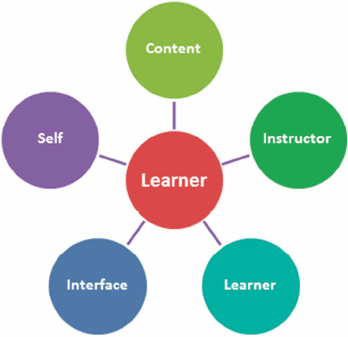
In a distance education environment, a distance learner interacts with multiple elements in an effort to learn. Moore (1989) outlined three types of interaction: learner-content, learner-instructor, and learner-learner. A fourth type of interaction is especially important in online education—learner-interface (Hillman, Willis, & Gunawardena, 1994). Hirumi (2002) suggested a fifth type of interaction, learner-self, which includes the cognitive and metacognitive processes that help the learner monitor his/her own learning. All forms of interaction are critical to establishing a strong network of communication in an online course.
Rogoza (2007) suggests that quality is determined by the ability to maintain effective communication between facilitator and learner, engagement of the learner, and peer interaction. When online courses are designed well, students collaborate and reflect with each other more (Liu, 2005; Sprague, 2006).
The standards for interaction should be outlined in the early course communications, in a syllabus, opening screens, et cetera. In massive open online courses and corporate web-based training, there is minimal interaction between the instructor and the learner. Instead, the necessary interaction must be built into the course so the learner feels supported in the learning process. Typically in higher education, there are strict guidelines for the amount of interaction required between learners and the expected interaction standards between learners and instructors and learner and content. However, it is important to model good standards, meaning highlight good learner-learner interaction so participants know the instructor’s academic expectations. Similarly, instructors have a consistent presence, particularly in online courses.
Feedback
One of the most valuable forms of interaction is feedback. Learners want to know how they are progressing in their learning journey. Using LMS and web-based tools, learners can receive immediate automated feedback on their work. For example, as a learner submits a quiz through Canvas, an LMS, he will receive immediate feedback upon submission. If the individual is unsatisfied with his score, he will have the opportunity to complete the quiz again consisting of an entirely different set of questions from the answer pool. At the same time, the instructor is able to view the students’ scores, number of attempts, and time spent in the quiz with a click of a button. The feedback in this scenario is automated, but equally valuable for the learner and instructor alike.
However, learners want to receive individualized feedback from their instructor (Johnson, 2013) regardless of the format in which it is offered. Broup, West, Thomas, and Graham (2014) examined the use of video to provide learners with feedback, and while the learners generally preferred video feedback, there was no statistical difference in establishing instructor social presence. However, the burden to provide feedback does not solely fall on the instructor. In a regression analysis of 57 university students enrolled in an online course, Xie (2013) found that peer feedback significantly enhanced student motivation, as well as had a positive influence on the length of posts (in an asynchronous discussion board). Even online tutoring systems and networks can provide learners with powerful feedback on their writing.
The success of video-based coaching also requires a feedback loop. Strengths are noted from the video observation and questions are asked to promote more in-depth, reflective critical thinking and problem solving. A key component of feedback involves encouraging learners to find the answer for themselves when prompted by instructors’ thoughtful questions.
Opportunity to Achieve Mastery
All aforementioned recommendations operate under the assumption that participants have a desire to learn and, in many cases, want to master the content they are learning. Even learners who want a just-in-time learning opportunity for exploration purposes are often interested to know what is considered mastery of the subject.
In reviewing all the challenges associated with change and innovation, one concept continues to be repeated: what if it’s not enough? What if our learners are not prepared to apply the learning after their experience with a particular learning tool or teaching technique? Again, this is why purposeful course design and development is essential. When learning objectives are matched with learning outcomes, assignments, and assessments, learners are aware of what is required to achieve mastery of content.
Final Thoughts
The transience in technology offers rich opportunities for growth and enhancement of the learning landscape. Whether using scenariobased learning, just-in-time learning, or mobile learning, learners are being introduced to a vast variety of distance learning options. We improve technology through an iterative cycle. Likewise, we should continue to enhance quality of learning opportunities through an iterative cycle with research informing our decisions.
While we have focused on transience in technology throughout this article, there is similar transience in global realities. With the availability of real-time news, we are more aware of the complex problems that inundate our world. We cannot imagine how technology will continue to evolve. However, we can continue to frame instructional design issues around the learner and his interaction with technology in an effort to uncover shared solutions to resolve complex problems.