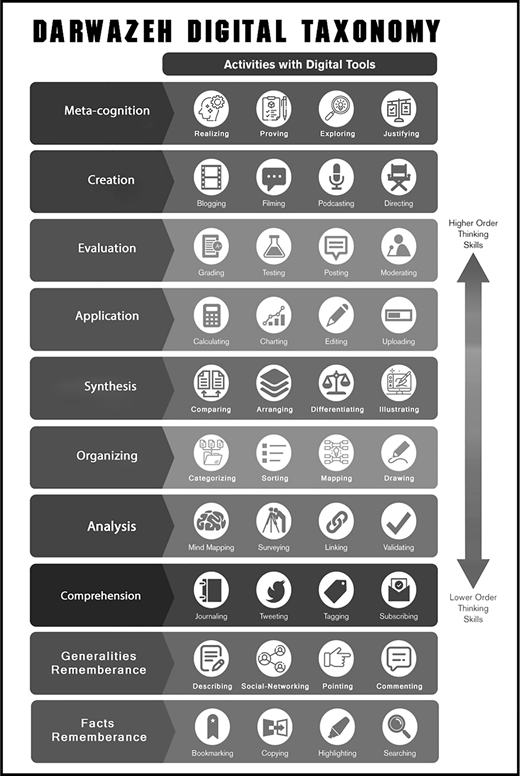
This article aims to propose a digital version of Darwazeh’s learning taxonomy. The DLT consists of 10 cognitive processes sequenced hierarchical from simple to complex either vertically from one mental process to another, or horizontally in each mental process. These cognitive processes are facts’ remembrance, generalities’ remembrance, comprehension, analysis, organizing, syntheses, application, evaluation, creation, and meta-cognition. The digital version merges specific pedagogical technology tools and applications with each process and presents implementing guidance in a pedagogical perspective. The digital learning taxonomy will inform instructions and directions on how to use digital tools to facilitate students e-learning experiments and outcome. In addition, the main objective of this article is to integrate and implement technology as an essential part of e-learning especially in this age of information and technology.
Introduction
Early engagement with higher order thinking skills has been a distinguishing and growing need in the field of education contexts (Gagne & Driscoll, 1988; Rajovic, 2012) and expanded throughout the entire educational process in all over the world (Collins, 2014). This allows learner not only to acquire the necessary knowledge and skills, but also to apply them to new situations. Higher order thinking (Gagne, 1977) can be applied in and outside the life school, where thinking is seen as a series of transfer opportunities rather than as a series of assignments to be completed (Brookhart, 2010). Educators need to keep in mind that humans live in a digital world and tend to teach the generations of digital natives most often in addition to the necessity of expanding the range of thinking skills at our disposal (Prensky, 2010). Consequently, teachers and students are expected to be digitally literate and fluent (Crockett et al., 2011). Being both (digitally literate and fluent) implies that educators are able to use educational tools in various ways (Crockett et al., 2011; Dabic, 2014; Hart, 2015; Silaski, 2012).
Learning objectives are considered as the intended learning outcomes in the learning process. Learning objectives formulate the learning activities avenues and their needed tools. Bloom (1956) proposed a cognitive objective taxonomy known as Bloom’s educational taxonomy which specifies the levels of cognitive thinking in a paradigm format (knowledge, comprehension, applying, analysis, synthesis, and evaluation). In 2001, Anderson and Krathwohl proposed a revised Bloom’s taxonomy which became: remember, understanding, apply, analysis, evaluate, and create. Recently, Darwazeh et al. (2015; Darwazeh, 2016, 2017) had made an extra revision to Anderson revised Bloom’s taxonomy based on the extensive review of the literature, and produced a new taxonomy which presents additions and modifications accompanied with justifications to Anderson revised Bloom’s taxonomy.
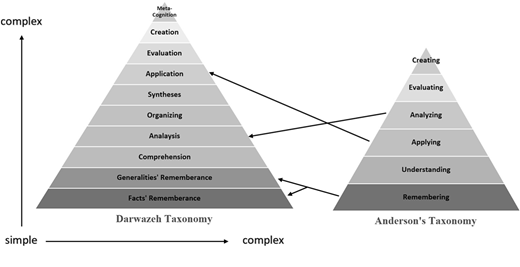
Darwazeh’s main additions and modifications were: Altering the metacognitive process to be under the cognitive dimension instead of the knowledge dimension, the metacognitive process is at the top level of the cognitive dimension and the most complex level as well, adding the principle content to the types of content which was missing in Anderson’s taxonomy, moving the application process to be after synthesis rather after comprehension, splitting the remember level into two levels according to Merrill’s component theory (Merrill, 1983; fact’s remembrance level and generalities’ remembrance level), the organizing mental process was added to the cognitive dimension according to West and his associates (West et al., 1991, pp. 36-49), and finally reordering the mental levels from simplest to complex.
Darwazeh’s learning taxonomy based mainly on two hypotheses: (1) presenting knowledge in a right sequence which consistence with human memory’s function will help learners to store, retrieve, recall, and use information in an appropriate manner, (2) enhancing students’ cognitive strategy by using technology will help them learn not just on remember level, but also on higher levels, such as, application, evaluation, creation, problem solving, and higher order rules (e.g., Ausuble et al., 1961; Gagne, 1977; Lindsay et al., 1977; Merrill, 1983).
In this age of information and technology, the effective use of technology tools is crucial to the success of the educational process and students’ e-learning. It also has a good impact on the competency of teachers. Furthermore, due to their features and characteristics, the use of technological tools improves the educational activities of students and achieves many of the desired educational goals (Rajabi, 2020). In fact, the use of modern technology will aid in narrowing the achievement gap between students of varying abilities. It has also been demonstrated that technological tools can assist in the resolution of curriculum- related issues by making it easier for students and teachers to deal with vast amounts of information in less effort and time. For example, facilitating the storage of such information can be accomplished by the cloud or by displaying it in more interesting and stimulating ways(Abdul-Razziq, 2018; Othman 2014).
According to Darwazeh (2017), the cognitive processes ranged from simple to complex not just vertically according to the difficulty level of the mental process but also horizontally according to the number of items that the mental process gets involved in (see Figure 1).
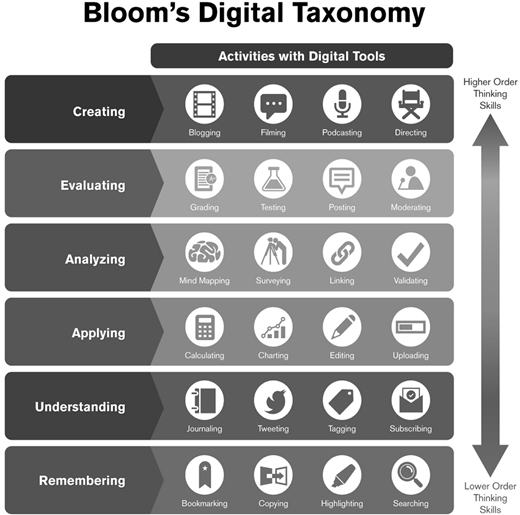
Andrew Churches (2007) updated Bloom’s taxonomy one step further when he produced Bloom’s Digital Taxonomy. He intended to integrate Bloom’s cognitive levels into 21st century digital skills (seeFigure 2).
Once the Darwazeh’s digital learning taxonomy is the latest learning taxonomy (Darwazeh et al., 2015; Darwazeh, 2016, 2017, 2020; Darwazeh Figure 2. Anderson’s [Revised] Bloom’s digital taxonomy, 2022), this paper aims to integrate technology applications with each level of Darwazeh’s learning taxonomy. Each level is accompanied by a clarification of its relevance and examples of digital tools that relate and connect with the taxonomy framework.
Darwazeh’s Digital Learning Taxonomy
It is important to add regulating, controlling, evaluating under meta cognitive in Figure 3.
Table 1 provides a selective list of some digital tools and maps them to the cognitive levels of Darwazeh’s taxonomy. Interactive tools such as mind mapping applications offer new ways for learners to develop their own ideas and projects at high level of thinking. Collaborative tools such as canvases boards, discussion forums, and live virtual meetings shift the focus of online learning from content delivery to learning creation. Although each tool is mapped to a specific level, many may be used at more than one cognitive level.
These digital tools enable collaboration, a crucial knowledge-age survival skill Trilling, and Hood identify. As a result, digital tools allow students to understand, retrieve, transform, and create knowledge themselves in one hand, and transforming the instructor into a colearner on the other. Choosing the right application for instructional use can be challenging, as there are so many digital solutions that can be used. Criteria in Table 2 can be used to assess whether the applications you are considering support cognitive processes.
Conclusion
Darwazeh’s digital learning taxonomy is like the original taxonomy in that it provides lists of related verbs for teachers and instructional designers to use when developing learning objectives. In the process of creating content, they can develop lower order skills like recalling information and defining terms, up to higher order skills like identifying connections between concepts or ideas, applying information to new situations, evaluating content to form an opinion or determine whether it is credible, and creating new things.
In sum, teachers, educators, supervisors, instructors, professionals, curriculum planners and designers, and evaluators are expected to use the latest proposed learning taxonomy in abroader and comprehensive manner to be a framework for promoting students’ thinking especially for, so they can be more productive and comfortable in today’s information technology era as well as to be good thinkers, creators, discoverers, builders, and critical thinkers when they learn by e-learning strategy.