


There is a gap in best practices to teach “hands-on” skills in a blended environment in the physical therapy literature. The purpose of this study was to explore faculty perceptions. A mixed methodology gathered information from faculty who taught or published in blended learning. Data analysis included descriptive statistics and the coding of narrative responses. The findings generated a list of the benefits and challenges and recommendations for educators, which support student onboarding, faculty training, and institutional provisions. Additional research may help faculty make informed decisions based on evidence, feasibility, and availability of technologies.
Introduction
Distance education in postsecondary institutions continues to grow (U.S. Department of Education, 2014). The proliferation of online programs in all areas of study meet the ongoing demands for doctoral education. In a 2018 report from the Babson Research Group, distance education enrollments grew for the 14th consecutive year (Seaman, Allen, & Seaman, 2018). Over 6 million students attended at least one online course (31%of all students) with similar proportions taking complete online (14.9%) and blended (16.7%) coursework (Seaman et al., 2018).
The presence of online degrees in healthcare is also on the rise. Many education programs in athletic training, occupational therapy, nursing, and physical therapy (PT) offer a combination of online and face-to-face (F2F) instruction to obtain a bachelor’s, master’s or doctoral degree (All Star Directories, 2016; American Occupational Therapy Association, 2016; American Physical Therapy Association, 2016; Commission on Accreditation of Athletic Training Education, 2016). The University of St. Augustine requires a bachelor’s degree and offers an entry-level flexible doctor of physical therapy degree with an online-based curriculum and weekend lab sessions (University of St. Augustine, 2016). In the past year, new entrants into the marketplace upset traditional educational methods with nontraditional methods such as hybrid accelerated PT degrees (South College, 2017; University of Southern California, 2018). However, no fully accredited online entry-level athletic training, occupational therapy, or PT programs exist in the United States at this time (American Occupational Therapy Association, 2016; American Physical Therapy Association, 2016; Commission on Accreditation of Athletic Training Education, 2016). Given the proliferation of online learning, healthcare programs may transition to a fully online format sooner rather than later.
Faculty’s role in blended instruction is important (Betts, 2014). Not all faculty favor online instructional methods. One common myth of online education is online teaching and learning is easier than traditional learning and requires less time (Blackinton, 2013). While the classroom time appears shorter, careful planning and preparation must support appropriate student selection, adequate faculty preparation, decentralized technology, and careful budgeting (Blackinton, 2013; Macznik, Ribeiro, & Baxter, 2015). In 2012, Armstrong Atlantic State University surveyed faculty and deans to determine motivating and inhibiting factors related to faculty participation and retention in online and blended education. Experienced online faculty reported lack of equipment, lack of technical support, concern about workload, lack of release time and concern about course quality as the top five reasons hindering faculty from participation in distance education (Betts, 2014). Inexperienced online faculty reported similar concerns, but the order of importance differed (Betts, 2014).
Other faculty concerns related to online instruction include: The potential for cheating, loss of control over the academic process, lack of time, large class sizes, intellectual property and copyright issues, decreased student participation and preparedness, differences in student learning styles, and cultural challenges (Islam, Beer, & Slack, 2015; Smith, Cavanaugh, & Moore, 2011). Despite these shortcomings, globalization of education with the potential to eliminate geographical and social barriers encourage faculty to embrace online teaching and learning (Islam et al., 2015).
Purpose of the Study
There is a gap in best practices to teach “hands-on” skills in a blended environment in the physical therapy literature. The purpose of this study was to explore faculty perceptions and to provide recommendations for faculty and student support. The research addressed the following questions:
What are faculty perceptions of the benefits and challenges related to teaching orthopedic hands-on skills in a blended environment?
What are the recommended support strategies for faculty and students in a blended environment?
Theoretical Framework
The theoretical framework supporting this research comes from three fields of study: Theory of instructional design, adult learning theory, and social constructivism. The fields connect and work together. Their interdependency influences the teacher, shapes the student, and creates the environment for an online environment. The primary theorists whose work provides the theoretical framework for this study are Richard Clark, Malcolm Knowles, and Lev Vygotsky.
Richard Clark’s theory of instructional design supports learning based on the curricular instructional design and not the medium. Many definitions describe the term “instructional design” in education. One formal definition of instructional design is the “systematic and reflective process of translating the principles of learning and instruction into plans for instructional materials, activities, information resources, and evaluation” (Smith & Ragan, 1999, p. 4). Another definition of instructional design addresses creativity, originality, and complex processes involved (Kurt, 2017). Regardless of one’s definition for the term instructional design, how does the medium influence student success?
Does the teaching medium shape cognitive processes or influence student achievement? Clark claims “The best current evidence is that media are mere vehicles that deliver instruction but do not influence student achievement any more than the truck that delivers our groceries causes changes in our nutrition” (Clark, 1983, p. 445). In essence, the instructional medium does not affect learning or student outcomes (Clark, 1994). However, other aspects of instructional design and pedagogy may influence student achievement (Koehler, 2016).
In an article as recent as 2016, Koehler (2016) addressed the ongoing debate between instructional design versus mediums to deliver instruction. Clark theorized learning occurs through cognitive activation. Medium choices did not matter, and it simply dictated what type of learning events could be possible. Furthermore, he stated teachers’ roles are to select the least expensive medium and most efficient methods to deliver course content (Clark, 1994). Therefore, some believe the teachers’ instructional methods influence learning but not the medium, such as F2F delivery versus an online format (Clark, 1994).
In 1994, an opposing view from Robert Kozma challenged Clark’s position. His viewpoint supported a direct relationship between the medium and instructional design. He stated, “In good designs, a medium’s capabilities enable methods, and the methods that are used take advantage of these capabilities. If media are going to influence learning, method must be confounded with medium” (Kozma, 1994, p. 20). In agreement with Kozma’s position, Dede revisited this issue in 2007 and stated, “Knowledge does not radiate from computers, infusing students with learning as fires infuse their onlookers with heat. However, media are able to aid various aspects of learning, such as visual representation, student engagement, and the collection of assessment data” (Dede, 2007, p. 23).
Despite the somewhat conflicting viewpoints between Clark and Kosma, instructional design and media selection resonates in today’s PT educational environment (Koehler, 2016). As blended education evolves in PT, careful selection of instructional design and mediums could offer cost-effective and effective strategies for student success.
In addition to the selection of appropriate instructional design and mediums, students’ readiness as adult learners is critical for success in blended pedagogy. Malcolm Knowles described the principles of andragogy in his work in adult learning (Knowles, 1973). He believed adult learners bring knowledge and experience to the learning environment (Knowles, 1973). In his later work, he defined the learner as central to the learning process (Knowles, 1984). Adults have unique characteristics for learning: Experience, self-directedness, readiness to learn, autonomy, and intrinsic motivation. Within the last several years, Blackley and Sheffield (2015) coined the term digital andragogy, which described adult learning practices in an online environment. The authors identified four skills important for 21st century online teaching and learning: Critical thinking, communication, collaboration, and creativity (Blackley & Sheffield, 2015). Online adult attributes require students to find relevant information in the information “digital flood,” to foster communication and collaboration among teachers and learners, and to inspire creativity (Blackley & Sheffield, 2015).
Equally important to the instructional methods and adult learning principles is a learning environment supportive of connec-tivism and collaboration. Lev Vygotsky believed learning occurs through individual cognitive processes and social interactions with others (Vygotsky, 1978). Additionally, collaborative environments support teamwork, problem solving, and enhances the understanding of information over time (Vygotsky, 1978). Learning opportunities can occur through dialogue, discussion, and debate combined with real-world examples (Wicks, n.d.). In the same collaborative spirit, connectivism can help students create meaning through the experiences and networks we share with others (Schneider, n.d.). Knowledge develops with information construction through communication and peer interaction (Wicks, n.d). The potential for learning is greater under social constructivism. Motivation is intrinsic and extrinsic to the learners’ needs and perceived benefits provided by the learning community (Vygotsky, 1978). Collaboration in an online environment affirms teams can learn better together as a community than as individuals.
The research question related to faculty perceptions of the benefits and challenges of teaching hands-on skills in a blended environment addressed student and environmental characteristics important in blended teaching. Information obtained from the literature review, survey instrument, and interviews assisted in the development of recommendations for faculty and student support. Figure 1 illustrates the theoretical framework for teaching hands-on skills in a blended environment.
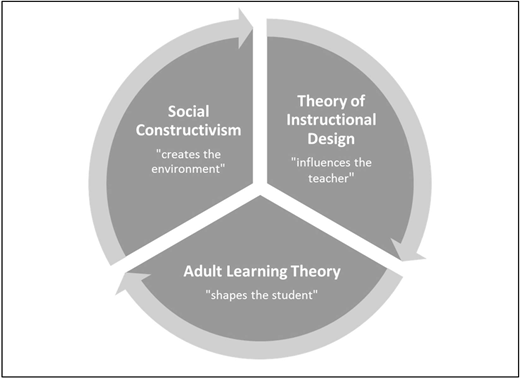
The Theoretical Framework for Blended Pedagogy
The Theoretical Framework for Blended Pedagogy
Literature Review
Faculty Perceptions of Blended Pedagogies
Faculty reported mixed feelings over the use of blended teaching and learning. One reported benefit of blended learning is the accommodating environment, which offers students the opportunity to learn anytime, anywhere (Blackinton, 2013; Dal Bello-Haas, Proctor, & Scudds, 2013; Green & Whitburn, 2016). The flexibility of blended teaching and learning helps students manage work, family, and personal responsibilities. Another benefit of blended learning is the ability for students to review and repeat course information at their convenience (Cooper & Higgens, 2015; Dal Bello-Haas et al., 2013; Gaida et al., 2016; Moore & Smith, 2012; Wilson & Greig, 2017). Other benefits include efficient use of class time (Gaida et al., 2016), improved student satisfaction (Cooper & Higgens, 2015; Dal Bello-Haas et al., 2013; Lazinski, 2017; Wilson & Greig, 2017), improved course satisfaction (Adams, 2013), and improved instructor feedback (Gaida et al., 2016). Online resources, such as videos, can encourage active student participation and student engagement (Greenberger & Dispensa, 2015; Lazinski,2017).
Adams (2013) used computer-assisted instruction in a condensed semester to teach physical modalities. The control group (traditional format) received F2F lecture and lab instruction for 9 consecutive days over 2 weeks. Students in the experimental group (hybrid format) received lecture material via a CD-ROM over a 3-week period followed by 9 days of F2F lab instruction. Focus groups and surveys collected students’ opinions related to course satisfaction. The control group’s comments focused on passive learning and a preference for instructor-led learning. For example, students’ reported inadequate class preparation, dependency on notes for memorization, and dissatisfaction for reflective thinking (Adams, 2013). In contrast, the hybrid group showed adult learning characteristics. Students saw the need for class preparation, active engagement, and self-directed learning (Adams, 2013).
Gaida et al. (2016) used video demonstration for teaching orthopedic clinical skills. Faculty created videos to illustrate procedures for lumbar spine and vestibular assessment. Students completed online surveys to evaluate the new teaching methods. The authors coded the free text responses. Three themes emerged: Student responsibility for learning, practical skill development, and efficient learning (Gaida et al., 2016). In addition to the students' benefits, the authors reported an economic surplus after the third year of implementation (Gaida etal.,2016).
However, studies showed negative aspects of blended pedagogy: Higher workloads (Adams, 2013; Green & Whitburn, 2016), frustration with the active-learning approach (Adams, 2013), “transactional distance” communication gaps (Adams, 2013; Moore & Smith, 2012), lengthy video lectures (Boucher, Robertson, Wainner, & Sanders, 2013), poor organization (Boucher et al., 2013; Green & Whitburn, 2016) or inconsistencies/lack of appropriate course content (Greenberger & Dispensa, 2015), ineffective online instructors, and technology limitations (Boucher et al., 2013).
Islam et al. (2015) described the challenges educators face when teaching in an online environment. The challenges can be grouped into five categories: Learning styles and culture, online pedagogy, technology, technical training, and time management. Faculty may find it difficult to determine students’ learning styles in an environment with limited F2F interaction between the teacher and student (Islam et al., 2015). An online environment requires a different pedagogical approach that requires the learner to engage with the teacher, other learners, and the course content using online mediums. Technological challenges in the online literature can cause a wide variety of problems for faculty ranging from malfunctions to slow Internet speed (Islam et al., 2015). Lastly, time management is a concern for online faculty. If adequate faculty training programs are in place, technology can offer administrative efficiency, simpler communication, and a central location for information (Islam et al., 2015).
Methods
Instrument Development
The researcher developed a survey instrument based on the literature review and results from a coauthored pilot study. This study was part of a larger study which looked at resources used, instructional methods, and recommended best practices for the profession. The survey consisted of 14 questions (closed-ended questions, open-ended questions, and Likert-type questions). The interviews consisted of 12 structured, yet open-ended questions related to the “how” and “what” of hands-on instruction in a blended environment. The consensus among content experts (n = 3) established content validity and verified the survey and interviews questions acceptable for dissemination. A copy of the survey instrument and interview questions are in Appendix A.
Subjects
The study used a mixed methodology to solicit opinions from PT faculty who taught hands-on skills. Purposeful sampling helped recruit subjects for the study. The survey respondents consisted of faculty assigned to teach orthopedic course content in PT education programs. Faculty with recent blended instruction publications or current teaching experience in blended programs participated in interviews to provide narrative descriptions not captured in the survey instrument.
Procedure
An e-mailed cover letter included a link to the survey and video from the researcher, which explained the purpose and implied consent procedures for participation. The survey launched using Survey Monkey in September 2018, to the roster of PT program chairs (n = 247) with a request to forward the survey to orthopedic PT faculty within their respective programs. A second e-mail launched 2 weeks later to capture nonresponders of the initial survey. Interviews transpired throughout October and November 2018. The researcher selected GoToMeeting.com or Zoom.com and a digital handheld recorder to conduct and record the remote interviews. Interview subjects provided informed consent. Each interview ranged between 40 and 60 minutes in duration.
The institutional review boards at the University of Findlay and Hanover College approved the study.
Data Analysis
Microsoft Excel software assisted in the descriptive statistical analysis and visual data representation in the survey instrument. Chisquare analysis helped determine potential differences among the respondent’s replies. Interview data analysis used an integrative approach and an a priori list developed from the pilot study. Following interview transcription, MAXQDA software helped code and identify themes among the participants’ narrative responses.
Results
Of the 247 e-mail invitations sent, 72 faculty (survey respondents) responded to the survey (response rate = 29%) and four faculty (interview subjects) participated in the interviews. Chi-square analysis of the data (p < 0.05) revealed no significant differences among the categorical responses in the survey instrument.
Faculty Perceptions—Benefits
The most common benefits of blended teaching and learning hands-on skills reported by the survey respondents (n = 72)included flexibility of learning (73.1%), the ability to review and repeat course content (71.6%), increased student participation and preparedness (67.1%), increased class time used for application of concepts (61.2%). A smaller minority of respondents reported deeper understanding of course content (49.2%), increased student satisfaction (46.3%), increased communication between the student and teacher (35.8%) personalization of learning (33.0%), increased teacher satisfaction (31.3%), less use of classroom space (10.4%), and improved examination scores (7.5%). Several respondents reported they did not use a blended environment in the “other” response option. Figure 2 illustrates the what survey respondent reported as perceived benefits of teaching hands-on skills in a blended environment.
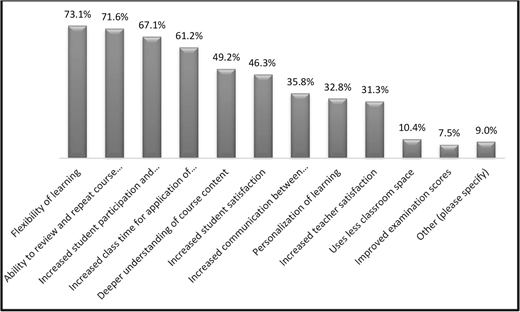
Survey Respondents’ Reported Perceived Benefits of Teaching Hands-On Skills in a Blended Environment
Survey Respondents’ Reported Perceived Benefits of Teaching Hands-On Skills in a Blended Environment
Narrative responses from the interview subjects confirmed the survey respondents reported benefits of blended teaching strategies. The flexibility of learning was a common theme. Another subject mentioned increased student participation, engagement, and preparation. Several subjects felt more connected to students in the online environment. In the same sense of connectedness, another subject believed online learning had the ability to address individual students’ needs.
A new finding mentioned by the interview subjects was the ability for online learning to lessen student anxiety. The ability for students to view a demonstration of hands-on skills before face-to-face lab time could have a positive effect on lessening student stress. Figure 3 illustrates the interview subjects’ perceived benefits of teaching hands-on skills in a blended environment.
 The rectangular chart with five rows. Each row has a black box on the left with a label and a gray box on the right with a student quote. Row 1: Flexibility of Learning – “[Students] can listen throughout the day, as they’re working out, in the evening... anytime anyplace learning, which is what students of today want.” Row 2: Review and Repeat – “They can speed it up, or they can slow it down. They can stop it. They can think about it. They can go back to it.” Row 3: Student Engagement – “It allows more of the learning to come from the student and puts less... it’s really up to them.” Row 4: Connectedness – “I know my students better. I know 80 students by name by the time they came onsite for the first lab... interacting with them as much every day as I do online.” Row 5: Student Anxiety – “[Students] reported that it reduced anxiety in lab, because they knew everything they had seen before and they had it again to revisit on their own time.”
Interview Subjects Reported Benefits of Teaching Hands-On Skills in a Blended Environment
The rectangular chart with five rows. Each row has a black box on the left with a label and a gray box on the right with a student quote. Row 1: Flexibility of Learning – “[Students] can listen throughout the day, as they’re working out, in the evening... anytime anyplace learning, which is what students of today want.” Row 2: Review and Repeat – “They can speed it up, or they can slow it down. They can stop it. They can think about it. They can go back to it.” Row 3: Student Engagement – “It allows more of the learning to come from the student and puts less... it’s really up to them.” Row 4: Connectedness – “I know my students better. I know 80 students by name by the time they came onsite for the first lab... interacting with them as much every day as I do online.” Row 5: Student Anxiety – “[Students] reported that it reduced anxiety in lab, because they knew everything they had seen before and they had it again to revisit on their own time.”Interview Subjects Reported Benefits of Teaching Hands-On Skills in a Blended Environment
Faculty Perceptions—Challenges
The most common challenges of teaching hands-on skills in a blended environment were differences in students’ learning styles (53.6%) followed by student frustration with the active learning approach (47.8%), higher teacher workloads (40.6%), and communication gaps between the student and teacher (40.6%). Common, but less prevalent responses included higher student workloads (39.1%), lack of technological support (39.1%), intellectual or copyright issues (36.2%), lack of available technology (39.1%), lack of release time for instructional preparation (33.3%), decreased student participation and preparedness (27.5%), increased potential for cheating (13.0%), and decreased examination scores (2.9%). In the “other” category, several respondents expressed a lack of technology reliability, lack of student motivation, and lack of individualized feedback as challenges for teaching hands-on skills in a blended environment. Figure 4 illustrates the survey respondents’ reported perceived challenges of teaching hands-on skills in a blended environment.
 The vertical bar chart showing percentages of challenges in learning. Categories from highest to lowest: Differences in student learning styles 53.6 percent, Student frustration with active learning 47.8 percent, Higher teacher workloads 40.6 percent, Communication gaps with students 40.6 percent, Lack of technological support 39.1 percent, Increased student workloads 39.1 percent, Intellectual copyright issues 36.2 percent, Lack of release time for faculty 36.2 percent, Decreased student participation 33.3 percent, Increased potential for cheating 27.5 percent, Decreased motivation to learn 13.0 percent, Other 15.9 percent, and Decreased potential for cheating 2.9 percent. Bars are arranged left to right, with percentages decreasing.
Survey Respondents’ Reported Perceived Challenges of Teaching Hands-on Skills in a Blended Environment
The vertical bar chart showing percentages of challenges in learning. Categories from highest to lowest: Differences in student learning styles 53.6 percent, Student frustration with active learning 47.8 percent, Higher teacher workloads 40.6 percent, Communication gaps with students 40.6 percent, Lack of technological support 39.1 percent, Increased student workloads 39.1 percent, Intellectual copyright issues 36.2 percent, Lack of release time for faculty 36.2 percent, Decreased student participation 33.3 percent, Increased potential for cheating 27.5 percent, Decreased motivation to learn 13.0 percent, Other 15.9 percent, and Decreased potential for cheating 2.9 percent. Bars are arranged left to right, with percentages decreasing.Survey Respondents’ Reported Perceived Challenges of Teaching Hands-on Skills in a Blended Environment
Perceptions varied among the survey respondents and the interview subjects in the challenges of teaching hands-on skills in a blended environment. Differences in student learning styles appeared in several interview subjects’ responses. One subject voiced concerns with the inability to identify struggling students in the online environment. In contrast to subjects who felt connected to students in a blended environment, half of the subjects disagreed. Subjects described communication gaps because of the inability to ask questions in real time. As students self-select blended PT programs as a preference for learning, faculty reported the potential for distractions from family and work obligations as challenges.
Interview subjects did not mention faculty workload or lack of technological support as challenges in the blended environment. Perhaps, workload and support issues were not a concern because subjects had blended teaching experience. Figure 5 illustrates the interview subjects’ perceived challenges of teaching hands-on skills in a blended environment.
 The chart with four rows, each containing a black label box on the left and a gray quote box on the right. Row 1: The Ability to Identify Struggling Students – “Identifying those students early before they fail the first exam... directing them to a tutor or whoever that may be. If they aren’t upfront about that, they’re definitely going to fall behind really quickly.” Row 2: Lack of Connectedness – “Students report that by using these online tools or apps, they feel like they miss this connection with a professor, where I am passing on something special to you. My clinical pearls, my experience as an expert.” Row 3: Communication Gaps – “There is a challenge of not being able to ask the professor in that moment a question that is relevant to the content that’s before them.” Row 4: Life Distractions – “Most of the students that are in an online program have families and jobs. There is a reason that [students] want that flexibility. It is because school isn’t the main priority. It’s usually second or third tier.”
Interview Subjects Reported Challenges ofTeaching Hands-On Skills in a Blended Environment
The chart with four rows, each containing a black label box on the left and a gray quote box on the right. Row 1: The Ability to Identify Struggling Students – “Identifying those students early before they fail the first exam... directing them to a tutor or whoever that may be. If they aren’t upfront about that, they’re definitely going to fall behind really quickly.” Row 2: Lack of Connectedness – “Students report that by using these online tools or apps, they feel like they miss this connection with a professor, where I am passing on something special to you. My clinical pearls, my experience as an expert.” Row 3: Communication Gaps – “There is a challenge of not being able to ask the professor in that moment a question that is relevant to the content that’s before them.” Row 4: Life Distractions – “Most of the students that are in an online program have families and jobs. There is a reason that [students] want that flexibility. It is because school isn’t the main priority. It’s usually second or third tier.”Interview Subjects Reported Challenges ofTeaching Hands-On Skills in a Blended Environment
Discussion
Blended Environment Benefits
As blended instruction permeates into the classroom, many faculty reported benefits to teaching orthopedic hands-on skills in a blended environment for both faculty and students. In this study, the most common benefits of teaching hands-on skills in a blended environment included flexibility of student learning, the ability for students to review and repeat information, increased student participation and preparedness, and increased class time for course content application.
Numerous studies report the benefits of blended teaching and learning (Cooper & Higgens, 2015; Milanese, Grimmer-Somers, Souvlis, Innes-Walker, & Chipchase, 2014; Moore & Smith, 2012; Wilson & Greig, 2017). Similar to the findings of this research, both faculty and students believe blended teaching and learning can positively enhance the learning experience.
Blended learning offers the flexibility of learning. The survey respondents and subjects interviewed voiced the benefit of a flexible learning environment. The ability for students to learn “anytime” or “anyplace” is an important convenience for today’s busy students. In addition, smartphones, laptops, and tablets are indispensable resources in most college students’ lives. The combination of the various modes of technology paired with a mobile learning environment can promote “on-demand” course content viewing. Flexibility and timely options for study can support different learning styles and individual students’ needs (Milanese et al., 2014). In essence, the flexibility of learning is highly individualized. No “one size fits all” approach applies to blended learning.
While a flexible learning environment offers the opportunity to study and review information at the learner’s pace, recorded lectures and videos give students the ability to review and repeat course information. The ability to review course content at one’s own pace and review as often as necessary was an important attribute of blended learning. In addition, the time to master hands-on skills may vary from student to student. For example, some students may grasp concepts easily. Other students may require repeated practice and more time to learn. Therefore, having control over the rate of exposure and the repeated contact with course information may help students in a blended environment. Findings in the literature support the benefit for the ability to review and repeat course content (Cooper & Higgens, 2015). Moore and Smith (2012) and Wilson and Greig (2017) found physical therapy students favored blended learning to repeat information at their leisure and review important concepts before practical examinations.
Adult learning principles may play a role in blended learning. Adult learning requires selfdirectedness, readiness to learn, and intrinsic motivation (Conaway & Zom-Amold, 2015). Orientation to learning focuses on the problem-centered approach, where learners apply relevant information in the “here and now.” For success in this approach, a role reversal occurs between the teacher and student in the blended learning environment when compared to a traditional classroom. The teacher’s position in the classroom shifts from the “sage on the stage” to the “guide on the side” (Frand, 2000). Besides the teacher-student role reversal, technology can facilitate self-directed learning strategies (Hayward, 2004). Recent literature supports this claim (Gaida et al., 2016). In a survey of 72 physical therapy students, Gaida et al. (2016) reported a power shift from the teacher to the student for learning. Other studies in the literature support blended strategies for self-directed learning, which increased student participation and student engagement (Dal Bello-Haas et al., 2013; Gray & DiLoreto, 2016; Lazinski, 2017; Smith etal.,2011).
Students showing ownership of the learning process can make better use of class time (Gaida et al., 2016). Instead of using class time for lecture, student preparedness can free up class time for student questions, practice, and concept application. Many authors agreed and created blended experiences to maximize face-to-face time in the classroom. Greenberger and Dispensa (2015) created video podcasts for the teaching of orthopedic special tests. The authors reported less time in class used for demonstration, which allowed more time for student practice. Van Duijn, Swanick, and Donald (2014) combined online videos with face-to-face instruction to improve skill acquisition, which expanded class time for more hands-on instruction. Adams (2013) consolidated a therapeutic modalities class using blended learning strategies and reported increased student engagement without compromising student learning or satisfaction.
One new finding from this study identified in the interviews was the potential benefit for blended learning to decrease student anxiety. PT school stressors and the pressure to maintain a certain grade point average can be overwhelming and difficult to manage. Perhaps, the ability to control the rate of exposure to course content combined with the flexibility of when and where learning occurs gives the student more control of the learning environment. As expressed by one of the interview subjects, blended learning can offer a safe environment and the freedom to make mistakes. For anxious students, blended learning may help reduce student stress and present new opportunities for enhancement of the learning experience.
Blended Environment Challenges
Despite the numerous benefits of blended learning, both faculty and students reported challenges. Blended learning may not be for everyone. Challenges to teaching and learning in a blended environment were similar to the findings reported in the literature.
In this study, over half of the survey respondents and one of the interview subjects reported challenges with accommodating students’ learning styles in a blended environment. Individual online students’ learning styles can be unclear and difficult for faculty to customize learning activities. The identification of struggling students can be a challenge in any classroom. If blended learning decreases face-to-face time with the instructor, blended learning may pose a greater challenge for faculty to identify students needing more attention. Students may appear technologically savvy in a blended environment. However, technological skills do not equate with understanding course content. Struggling students may fall behind and may not receive the needed individualized attention or instruction. Van Doom and Van Doom (2014) completed a study in search of students’ online learning styles to identify differences in learning needs among traditional/nontraditional and undergraduate/graduate students. The authors’ findings created a typology of learning styles and needs in order to help faculty improve student performance and enrollment retention rates. Traditional graduate students required course flexibility to fit part-time work schedules, “inperson” access to campus resources and required utmost time working with a research supervisor (Van Doom & Van Doom, 2014). In contrast, nontraditional graduate students required technology training, flexibility to fit full-time work schedules, less “in-person” access to campus resources, and limited time with a research supervisor (Van Doom & Van Doom, 2014). Therefore, learning needs between traditional and nontraditional students may vary, and faculty need to recognize the differences.
In addition to recognizing the differences between traditional and nontraditional students, an overall student support services assessment at the institution would help promote student success for both traditional and nontraditional students. An objective instrument to assess student support, such as the Online Learning Consortium’s online student support scorecard, could help institutions determine the quality of existing services and opportunities for improvement (Online Learning Consortium, 2019). The scorecard includes an assessment of the admissions process, financial aid, pre/postenrollment advising, disabilities services, library, new student orientation, and technology services. With the right student support systems in place, both traditional and nontraditional students could thrive in the blended environment. Blended learning can address a variety of learning styles and offer a great learning experience for students if the institution commits to having the appropriate support systems in place (Van Doom & Van Doom, 2014).
Faculty and student workload is another challenge in a blended environment. Survey respondents reported potential for increased workloads for both faculty and students. The literature reported similar findings. As early as 2005, Ford, Mazzone, and Taylor (2005) reported less time for students to learn musculoskeletal special tests with the use of technology. Betts (2014) described faculty concerns over workload due to lack of technological support, lack of release time for online course preparation, and lack of equipment. Dal Bello-Haas et al. (2013) supported enough allocated time to help students build new technological skills to avoid excessive extra workload. Temporary reduction in workload for faculty could provide time for professional development opportunities to improve online instructional strategies.
Lastly, challenges in a blended environment may include a combination of factors mentioned in this study, such as student frustration with new technologies, communication gaps, and lack of technological support. Challenges can lead to dissatisfaction in the learning process for both faculty and students (Boucher et al., 2013). However, careful planning can help to anticipate challenges. An assessment of faculty and student readiness for blended teaching and learning could help determine knowledge gaps or areas for improvement. Training or mentorship programs can support faculty and students. In addition to the challenges above, student perceptions of instructor presence may lead to communication gaps in a blended environment. Faculty will need to learn how to humanize the faculty: Student relationships with strategies such as responding timely to emails, providing meaningful feedback, learning students’ names, and sharing personal information. In summary, as faculty strive to improve the blended learning experience, well thought-out plans have the potential to enrich the learning environment for all.
Recommendations
The findings from this research created a list of recommendations for the PT profession to help enhance the blended learning experience for students and faculty.
Recommendation 1
Determine student readiness to engage in blended teaching and learning. In this study, faculty expressed concerns for struggling students who might not thrive in a blended environment. Faculty may want to consider a student readiness survey early in the curriculum to determine technological knowledge gaps requiring additional training or attention. An analysis of student preparedness obtained from the readiness survey can help faculty head off potential problems before the learning begins.
Recommendation 2
Provide student onboarding and orientation to the blended environment. After determining students’ readiness, an onboarding process before classes start could allow students time to familiarize themselves with some of the technologies used in the PT program. Many students may not anticipate the rigor, expectations, or self-directedness required in the blended environment. A structured, online onboarding process can help establish online and face-to-face relationships between faculty and other students. Onboarding plans can also expose students to preclass work required for the flipped classroom approach, video teleconferencing mediums, and video platforms. Therefore, through a gradual introduction of the blended experience, faculty may better identify struggling students throughout the onboarding and orientation process and anticipate needs for student support.
Recommendation 3
Evaluate institutional student support. In addition to provisions for student onboarding and orientation, institutions should assess support resources, so plans are in place for blended students. An objective instrument, such as the Online Learning Consortium’s online student support scorecard, can help institutions determine the quality of existing services in the admissions process, financial aid, pre-/postenrollment advising, disabilities services, library, new student orientation, and technology services. The student-support scorecard results can help institutions create a prioritized list for improvements. In the end, a strong student support framework can lead to higher student satisfaction and greater student retention in the PT program.
Recommendation 4
Dedicate time for faculty training. Another reported challenge from the survey respondents was the lack of time for instructional preparation. For PT programs wanting to incorporate blended learning within the current curriculum, PT program chairs should consider release time for faculty. Faculty may not want to change current instructional methods without adequate support. Time and monies allocated for instructional design coursework, mentorship, and peer review would be a valuable use of program resources. Money spent today could support tomorrow’s faculty. Financial support and faculty release time could create a new, innovative culture moving into the future.
Recommendation 5
Begin gradually with blended learning strategies. Fortunately, faculty can choose from a variety of resources based on the preferences, cost, or accessibility. Emerging resources such as polling software, phone apps, and games can enhance the learning experience. However, faculty can be easily overwhelmed with resources. For slow technology adopters, faculty can gradually add new resources into the classroom. For example, faculty can try one online synchronous class session or create one instructional videos module. As the faculty’s skill sets and confidence increase, they can incorporate complex resources such as polling software or video feedback for class assignments. At a higher instructional expertise level, adopting the flipped classroom can further push boundaries and facilitate an active learning culture among students.
Recommendation 6
Use a variety of instructional strategies and resources to promote active learning. Resources vary and may include traditional and online resources. Faculty can use an assortment of preclass activities, instructional methods, and resources based on personal interest, user-friendliness, cost, and available time. Faculty have many options in a blended environment. However, time and initiative require faculty to change current teaching practices.
Recommendation 7
Encourage faculty to build a blended culture. An unexpected finding of this research was the unique characteristics and underlying attitudes of the interview subjects and a small minority of survey respondents toward blended teaching and learning. Faculty appeared open-minded, willing to experiment, and flexible. Because blended learning is relatively new to PT, a spirit of innovation can also inspire ongoing personal improvement and life-long learning. Attendance at online teaching conferences outside of the PT profession could generate new ideas adaptable to PT. Online baby showers, virtual cooking demonstrations, and water cooler chat rooms could foster relationships among faculty. Program chairs can select faculty champions within the department to mentor or coach underdeveloped faculty. The potential to build a new and exciting blended culture can engage and support faculty.
Conclusion
In conclusion, faculty reported numerous benefits of teaching hands-on skills in a blended environment. Students benefited from the flexible environment, the ability to review and repeat information, increased participation and preparedness, and increased class time for the course content application. Despite the benefits of blended learning, there were challenges described in the blended environment. Faculty reported differences in students’ learning styles, student frustration with the active learning approach, higher teacher workloads, and communication gaps. In order to overcome adversity and to enhance the blended learning experience, this research generated a list of recommendations for faculty and students working in a blended environment.
Our role as PT educators is to best prepare students for clinical practice. As new resources and technologies move into PT education, ongoing research studying faculty and students’ perceptions, benefits and challenges, and outcomes will help faculty adopt effective teaching strategies to best prepare PT students. Future studies that look at blended instructional techniques and student anxiety levels could add new strategies for faculty to improve outcomes and student experiences in blended learning. As the profession of PT and technology evolves, future studies in blended learning can answer these questions and help shape the future of PT education.
References
Appendix A
Survey Instrument
Which learning management system (LMS) do you use?
□ Blackboard
□ Canvas
□ Desire to Learn
□ Moodle
□ Sakai
□ Other (please specify): —————)
To what extent do you agree with the statement? “The LMS meets my needs to deliver orthopedic hands-on content.”
□ Strongly agree
□Agree
□ Neither agree nor disagree
□Disagree
□ Strongly disagree
How would you describe the curriculum format used to deliver orthopedic hands-on course content?
□ Traditional face-to-face Instruction
□ Complete online instruction
□ Blended Instruction (combination of in person and online instruction)
□ Other (please specify): —————)
What percentage of your orthopedic curriculum is taught in an online format?
□ 0%
□ 1-25%
□ 26-50%
□ 51-5%
□ 76-99%
□ 100%
Which of the following traditional resources do you use to deliver orthopedic hands-on content? Mark all that apply
□ Textbooks
□ Lab manuals
□ Overhead video projectors
□ Smartboards
□ Other (please specify): —————)
To what extent do you agree with the following statement? “Textbooks provide online teaching resources that are useful.”
□ Strongly agree
□ Agree
□ Neither
□ Agree nor disagree
□ Disagree
□ Strongly disagree
Which of the following online resources do you use to deliver orthopedic hands-on content? Mark all that apply.
□ Discussion boards
□ Blog postings
□ Podcasts (audio or video)
□ Wikis
□ Prerecorded lectures (audio or video)
□ Live streaming videos (YouTube or Vimeo)
□ Student interactive platforms (Quizlet Live, Kahoot, PollAnywhere, etc.)
□ Other ((please specify): —————)
How do you use traditional and/or online resources to deliver hands-on content?
Please elaborate:
Which instructional method/s do you currently use to teach orthopedic hands-on content? Mark all that apply.
□ CD-ROMs
□ Face-to-face instruction
□ Flipped classrooms
□ Websites
□ Self-made podcasts (audio or video)
□ Professionally produced podcasts (audio or video)
□ Live streaming videos (such as YouTube or Vimeo)
If you use the Flipped Classroom to teach orthopedic hands-on content, why do you use this approach? Mark all that apply.
□ Promotes flexible learning environment
□ Establishes an active learning culture
□ Allows class time for clinical reasoning skills
□ Supports teacher as classroom resource □ Promotes intentional teaching in person instruction verses student independent exploration
□ I do not use the Flipped Classroom approach
What are the some of the new or emerging teaching techniques that you use to teach orthopedic hands-on content?
Please elaborate:
How did you acquire the skill set to deliver orthopedic hands-on skills in an online or blended format? Mark all that apply.
□ Self-taught methods
□ Researched the literature
□ Mentorship from peer colleagues
□ University training
□ Continuing education courses
□ Other (please specify): —————)
What do you perceive as some of the benefits of teaching hands-on skills in an online environment? Mark all that ïĩ’?’· .
□ Flexibility of learning (time/place) □ Ability to review and repeat □ Facilitates active learning
□ Increased student motivation
□ Increased student participation and preparedness
□ Increased communication between student and teacher
□ Deeper understanding of course content
□ Improved examination scores
□ Increased class time for application of concepts
□ Personalization of learning
□ Classroom space limitations
□ Increased student satisfaction
□ Increased teacher satisfaction
□ Other (please specify): —————)
What do you perceive as the challenges of teaching hands-on skills in an online environment? Mark all that apply.
□ Higher student workloads
□ Higher teacher workloads
□ Decreased student participation and preparedness
□ Student frustration with an active learning approach
□ Communication gaps between student and teacher
□ Decreased examination scores
□ Increased potential for cheating
□ Lack of release time for instructional preparation
□ Differences in student learning styles
□ Intellectual property or copyright issues
□ Lack of available technology
□ Lack of technology support
□ Other (please specify): —————)
Interview Questions
Whichlearning management system do you use?
Does the learning management system meet or not meet your needs to deliver hands-on PT content? Why or why not?
How would you describe the curriculum format used to deliver course content (traditional, in person, blended)?
Which traditional resources do you use to deliver orthopedic hands-on content?
Which online resources do you use to deliver orthopedic hands-on content?
How do you combine traditional and online resources to distribute course content?
How do you currently teach orthopedic lab content (videos, flipped classroom, websites)? Can you give me an example of one of your labs?
How did you acquire skills to deliver orthopedic lab content online?
How do you blend the use of online resources with your instructional methods to deliver hands-on content? Can you provide specific examples? (Areas may include: palpation, posture assessment, goniometry, manual muscle testing, repeated movement testing, muscle length tests, joint play/mobilizations, spinal manipulation, and special tests.)
Do you have any new/emerging instructional methods that you would like to share?
Which type of hands-on content do you choose not to put online? Why?
What do you perceive as some of the benefits and challenges in online teaching and learning? Why?

