


Higher education in the United States faces an online retention crisis. Online enrollment is increasing, spurred on by the COVID-19 online shift, yet online students are failing and dropping out at rates far higher than face-to-face students. We present data from 2 empirical studies to demonstrate that faculty who establish rapport— or positive relationships and communication—with their students are more likely to retain them. Study 1 uses data from 35 online classes (n = 910) to demonstrate that rapport improves retention for all student populations. Study 2 is an experiment (n = 394), which shows even minimum exposure to rapport can improve student retention.
Introduction
Online classes play an increasingly central role in higher education in the United States. Long before the onset of the COVID-19 pandemic in the spring of 2020 led most universities to suddenly move all classes online, online enrollments had been on the rise. From 2012 to 2017, online enrollment in the United States grew from 26% of total enrollment to 33.7% of total enrollment (Snyder et al., 2019). By 2019, approximately one third of all college students were enrolled in at least one online class, with 15% of students enrolled in fully online programs (Snyder et al., 2019).
Many students need the flexibility that online classes can provide; traditional colleges and universities are expanding online offerings as students with children, full-time jobs, and long commutes flock to online courses (Levitz, 2016). Four-year not-for-profit institutions are experiencing the greatest growth in online education (Allen & Seaman, 2016), in part due to a strategic pivot as they see concurrent declines in traditional enrollments. From the 2010–2011 school year to the 2017–2018 school year, national university enrollments in the United States declined by 10.4% (Snyder et al., 2019). At the same time, the number of students taking online courses has steadily climbed—up 17.2% from 2012 to 2016 (Seaman et al., 2018, p. 12).
Despite this rosy picture of growth, there is a darker side to online education: online students are failing and dropping out at rates far higher than face-to-face students (Glazier, 2016; Xu & Jaggars, 2011, 2014). Even when researchers statistically account for demographic and academic variables, there remains a persistent gap in retention between online and face-to-face classes (Jaggars, 2013; Willging & Johnson, 2009). This means that the very same students who are failing and dropping out of online classes would be succeeding if they were taking those classes online.
We believe that this problem has brought higher education to an online retention crisis, one which can best be solved through pedagogy. Here, we present evidence in support of rapport-building, a teaching approach that prioritizes making human connections with students in online classes, as a key way to reverse the retention crisis. Two empirical studies demonstrate that building rapport with students significantly and positively influences their persistence in a class.
Student Retention In Online Classes
While online education has the potential to make college accessible to traditionally underserved and at-risk populations, low retention rates limit that potential. Studies place online retention rates between 10% and 35% lower than in-person retention rates (e.g., Bawa, 2016; Boston et al., 2012; Dutton et al., 2001; Patterson & McFadden, 2009; Stover, 2005; Terry, 2001). Student retention and success in online classes is a serious concern for institutions of higher education. The high drop and failure rates for online students raise critical questions regarding how best to foster the success of non-traditional and underrepresented college students who struggle at higher rates than traditional university students (Wladis et al., 2015; Xu & Jaggars, 2014), including drop-out rates for online Latinx students twice as high as those in face-to-face courses (Kaupp, 2012).
At our own university, the fall-to-fall retention for first-year students is about 58% for students in face-to-face classes. For students taking online classes, however, retention drops 14 percentage points to 44% (University of Arkansas at Little Rock, 2019). Given that 58% of students at [university redacted] are enrolled in at least one online class, the retention issue is a serious one. While (university redacted]) may exemplify a university that is increasingly dependent on online enrollment, it is far from an outlier. Virtually every major college or university in the United States offers some online courses (Bowers & Kumar, 2015; Capra, 2011), and more than a third of college students are enrolled in them (Snyder et al., 2019). With online enrollments making up an increasing share of many universities’ total student enrollment, retaining these students is becoming more critical than ever.
To address this crisis, some universities have attempted technological solutions—early alert systems and algorithms to identify at-risk students (e.g., Tampke, 2013; Villano et al., 2018). Others have deployed resources to expand orientation programs to online students to make them aware of university support services (e.g., Ali & Leeds, 2009; Gilmore & Lyons, 2012). While these interventions have merit, they only address a fraction of the problem of online attrition. Here, we provide statistical and experimental data in support of a student-centered approach based on building rapport with students through creating human connection.
Rapport And Online Learning
The literature on what makes a good class, whether online or face to face, indicates that in both modalities, students meet learning outcomes more often when faculty teach using rapport (Glazier & Skurat Harris, 2020). Rapport—defined as instructor immediacy, instructor caring, and effective communication—has primarily been studied as a measure of teaching effectiveness (Shevlin et al., 2000) and has a demonstrated positive impact on student learning outcomes in face-to-face classes (Benson et al., 2005; Frisby & Martin, 2010; Frisby & Myers, 2008; Granitz et al., 2009; Wilson, 2006). Benson et al. (2005) characterize faculty rapport as encouraging, open-minded, creative, interesting, accessible, happy, having a good personality, creating class discussion, approachable, concerned, and fair. Other studies center rapport around communication acts that demonstrate interest, concern, caring and encouragement (Creasey et al., 2009; Wilson et al, 2010).
Online rapport has only recently begun to be defined (Murphy & Rodríguez-Manzanares, 2012), measured (Lammers & Gillaspy, 2013), and evaluated (Kupczynski et al., 2010; Sher, 2009). These studies indicate that rapport appears to be more difficult to create in online classes than in face-to-face classes. Community college students indicated that face-to-face courses had better peer-to-peer and student-instructor interaction than online courses, and that students preferred to take more important or difficult courses face-to-face (Jaggars, 2013). Baker (2010) showed a significant positive relationship between instructor immediacy and presence and student affective learning, cognition, and motivation. Thus, the pedagogical approach of rapportbuilding we are advocating for here builds on earlier research on humanizing (Pacansky-Brock, 2020), “pedagogical warmth” (Bond, 2019), and instructor immediacy (Arbaugh, 2001; Hutchins, 2003; Richardson & Swan, 2003; Woods & Baker, 2004).
The study of rapport in online education is important because of its potential to counter lower rates of retention in online courses. Studies of select student populations shed some light on retention in online classes. For example, research on online developmental writing classes (Carpenter et al., 2004), an undergraduate education program at a doctoral granting institution (Hodges & Forrest Cowan, 2012), working students at a nonprofit university (Lo et al., 2016), and students enrolled in a 2-year community college program (Fike & Fike, 2008) showed that rapport is related positively to online retention. Retention in single online courses using rapport improved by as much as 17% (Dickinson, 2017; Glazier, 2016). Glazier (2016) found, though an experimental study of introduction to political science classes taught both with and without rapport-building elements, that students in the classes with rapport were significantly more likely to be retained, with gains of 13% in online retention.
This literature indicates that building rapport can be a powerful tool to help retain online students and reverse the current retention crisis. To test the effects of rapport-building, we conducted two empirical studies, described below.
Materials And Methods
We present the results of two studies conducted at the University of Arkansas at Little Rock between 2016 and 2018. In Study 1, we asked faculty teaching online classes in the College of Social Sciences and Communication to allow us to contact and survey their students. The instructors of 35 online classes agreed to participate in the study, and we distributed online surveys to the students enrolled in these 35 classes (n = 910). A total of 318 students responded to the surveys, for a 34.9% response rate.
The survey included nine questions about the instructor and their presence in the course, which are summarized in a single rapport measure. That rapport measure is used as a key independent variable in the following analysis. The component questions that make up the rapport measure are reported in Table 1 and have an Alpha of 0.92, indicating high scale reliability.
Measuring Rapport: Question Wording and Descriptive Statistics for Study 1
| Question Wording | Response Scale | Descriptive Statistics |
|---|---|---|
| I received useful feedback from the instructor on tests and class assignments | Likert agreement, 1 to 5 | N = 312, M = 4.27, SD = 1.16 |
| I felt the instructor was approachable to discuss class-related issues | Likert agreement, 1 to 5 | N = 316, M = 4.32, SD = 1.03 |
| Instructor effectively monitored students ‘ understanding of subject matter through questions and support | Likert agreement, 1 to 5 | N = 308, M = 3.37, SD = 0.811 |
| My questions about course assignments were answered in a timely manner by the instructor | Likert agreement, 1 to 5 | N = 316, M = 4.25, SD = 1.00 |
| My performance in this course was directly related to the positive learning environment created by the instructor | Likert agreement, 1 to 5 | N = 316, M = 4.21, SD = 0.94 |
| I would be willing to take another online class taught by this professor | Likert agreement, 1 to 5 | N = 315, M = 4.23, SD = 1.12 |
| My professor cares about students | Likert agreement, 1 to 5 | N = 316, M = 4.49, SD = 0.79 |
| My professor and I communicate well | Likert agreement, 1 to 5 | N = 284, M = 4.18, SD = 0.99 |
| My professor is enthusiastic | Likert agreement, 1 to 5 | N = 316, M = 4.22, SD = 0.91 |
| Summative measure of student perceptions of rapport | Scale from 9 to 45 | N = 277, M = 38.73, SD = 6.21 |
Using the data from the responding students in each online class, we calculated an aggregate rapport score for each course (M = 38.73, SD = 6.21, Min = 18, Max = 44). We then requested anonymized student data on all 910 students enrolled in the 35 classes from the university’s office of institutional research. These data provided us with the ultimate grade each student earned in the course, which we coded into a binary variable for success (1 = earning an A, B, or C in the class, 0 = earning a D, F, Withdrawal, or Incomplete). They also provided us with academic and demographic controls, including gender (female = 1), race/ ethnicity (non-White = 1), age, GPA, transfer status (transfer = 1), the year the student was admitted, and whether the course was in the student’s major.
In Study 2, we designed an experiment to test the effects of what we thought of as the conditions of “minimum rapport” based on student survey data. Was is possible to build rapport and improve retention with very little effort on the part of the instructor? In this experiment, we created two online courses, using Google Classrooms. The classes were generic ethics classes similar to what students might take as part of a general education core.
The control condition included a reading, a Google Slide presentation (embedded in the Google Site with no explanation), a Google Forms reading response, and a multiple-choice Google Forms quiz. In addition, the students had to send an email to the professor, and the text they got back was impersonal and difficult to read. The instructions in the control condition provided only basic instructions on how to access course materials and proceed in the course (see Appendix A for specific language used in the control condition). There was no picture of the instructor or feedback on the quizzes, and the methods of contacting the instructor were limited to email only.
In the experimental condition, we included the same assignments and course materials. However, we implemented rapport features based on information from a student survey of 2,009 students about their best and worst classes at our university (full details on this study are available in Glazier & Skurat Harris,in press). Students identified the following features as important for building rapport:
The instructor explains how the class prepares them for their future careers/life.
The instructor explains materials clearly and gives clear instructions.
The instructor is available and approachable.
The instructor in the class is organized.
The instructor responded promptly to questions.
Because we wanted to implement a minimum amount of rapport for this experiment, we focused on embedding rapport in only the first week of an online course. Minimum rapport conditions included a photo of the instructor (a stock photo of a White, male instructor), a video narration over the Google Slides deck (recorded by a male colleague), language that encouraged the students to contact the instructor, a brief explanation of why the course was important to their lives, and encouraging messages on the instructor email, reading response, and quiz (including an immediate score on the quiz). For a table of how the experimental and control courses differed on the minimum elements of rapport, see Appendix A.
Students in this study were also asked a series of questions to measure rapport, summarized in Table 2. The summary measure has an Alpha scale reliability coefficient of 89.6.
Measuring Rapport: Question Wording and Descriptive Statistics for Study 2
| Question Wording | Response Scale | Descriptive Statistics |
|---|---|---|
| I received useful feedback from the instructor on tests and class assignments | Likert agreement, 1 to 5 | N = 263, M = 3.82, SD = 1.01 |
| The instructor makes me more interested in taking this class | Likert agreement, 1 to 5 | N = 264, M = 3.63, SD = 1.03 |
| The instructor does not view teaching as a high priority (reversed) | Likert agreement, 1 to 5 | N = 264, M = 3.57, SD = 1.19 |
| The instructor is helpful | Likert agreement, 1 to 5 | N = 264, M = 3.86, SD = 0.92 |
| The instructor is accessible | Likert agreement, 1 to 5 | N = 263, M = 3.98, SD = 0.91 |
| The instructor communicates in a way that makes students feel inferior or stupid (reversed) | Likert agreement, 1 to 5 | N = 263, M = 3.77, SD = 1.12 |
| The instructor cares about students | Likert agreement, 1 to 5 | N = 265, M = 3.89, SD = 0.92 |
| The instructor is not very good at communicating (reversed) | Likert agreement, 1 to 5 | N = 265, M = 3.56, SD = 1.18 |
| The instructor is NOT friendly (reversed) | agreement, 1 to 5 | N = 263, M = 3.77, SD = 1.05 |
| Summative measure of student perceptions of rapport | Scale from 9 to 45 | N = 260, M = 33.96, SD = 6.94 |
In the analysis that follows, this summative rapport measure is used in difference of means tests and as a key independent variable in a logit model. Other individual-level data collected from student respondents participating in the minimum rapport experiment in Study 2 included gender (male = 1), race/ethnicity (non-White = 1), year in college, interest in the subject, GPA, and online experience (higher numbers mean online classes make up a larger portion of their course load). We also asked the students questions about the course and their likelihood of staying in the class, if it was one they were really enrolled in.
Results Of Study 1
We can look at the effect of student perceptions of rapport across 35 different online classes in the College of Social Sciences and Communication through the results of the logit model presented in Table 3. We calculated aggregate rapport scores for each course, not an individual score for each student, thus taking into account the general rapport environment of the course, and not each student’s specific experience.
Study 1: Logit Model of Student Success in 35 Online Courses
| Variables | Coefficients |
|---|---|
| Female | 0.121 (0.198) |
| Non-White | 0.254 (0.191) |
| Age | -.009 (0.010) |
| Course is in major | 0.339 (0.193) |
| GPA | 1.749 (0.145)** |
| Transfer | 0.340 (0.209) |
| Year admitted | 0.048 (0.027) |
| Course rapport score | 0.056 (0.023)* |
| Constant | –103.124 (55.123) |
| N = 825 | |
| Pseudo R2 = 0.2687 |
Note: Standard errors are in parentheses.
There are only two significant predictors of success in Table 3 : GPA and the course rapport score. GPA is easy to understand here; students who are academic high-achievers are more likely to pass the class with a C or better. It is no surprise that this variable has such a strong and positive influence on student success in this model. The course rapport score is the only other significant variable, indicating that the more the students in the class have a positive, rapport-filled, relationship with the instructor, the more likely they are to be successful in the course. Because we based the analysis on an aggregate rapport score, even students who may not personally have a close relationship with the instructor but who are in a class where the instructor is generally available, communicates well, and connects with students makes all of the students in the course more likely to stay enrolled and complete the course successfully.
The instructors teaching the surveyed classes had not received prior training in teaching with rapport; they taught their online courses as they usually would. There are almost certainly differences in the ways that instructors in these courses built rapport with their students, but what we saw consistently is when students felt the instructor was accessible, responsive, and cared about their success, they did better in the class.
We look more closely at these trends through predicted probabilities in the figure. Predicted probabilities allow us to take a hypothetical student and, holding all of their characteristics constant, vary only the amount of student-perceived rapport in the course in order to determine the influence of that rapport. Figure 1 shows these statistical manipulations for a variety of student characteristics.
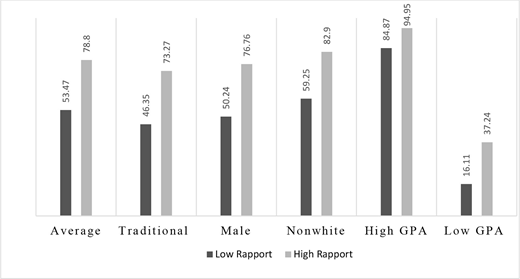
Predicted Probabilities of Student Success, by Course Rapport Score and Student Characteristics
Predicted Probabilities of Student Success, by Course Rapport Score and Student Characteristics
In the first pair of columns, we have a statistically average student at the University of Arkansas at Little Rock: a White, female trans
fer student who is 28.5 years old, taking a nonmajor class, with a GPA of 2.79, who was admitted to the university in 2013. If this average student is in an online class with low rapport, they will be successful in the class, as measured by passing the class with a grade of C or better, about 53% of the time. If we take that same student, however, and put them in a class with very high levels of rapport, their probability of successfully passing the class increases by 25%. Remember that all other student characteristics are held constant here, so the 25% increase in success in the course is completely attributable to rapport.
In the other columns in Figure 1, we look at other composite student profiles to see how rapport might affect different student populations. The second set of columns looks at a traditional college student, since our average student from (university redacted) was a non-traditional, 28-year-old transfer student. The traditional student has the same profile, a White female admitted in 2013, taking a nonmajor class, and with a GPA of 2.79, but she is 20.5 years old and a nontransfer student. The predicted probabilities reveal a slightly stronger effect of rapport for this hypothetical traditional student, moving from 46% success in the low-rapport class to 73% success in the high-rapport class—a 27% increase.
We repeat the predicted probabilities for male students in the third set of columns— keeping all other student characteristics the same as for our original average student but changing the gender to male—and see a very similar 26% increase in success as the student moves from the low-rapport to the high-rapport class. Men and women seem to benefit similarly from rapport in online classes. The hypothetical non-White student does slightly better in our predicted probability models, succeeding in the high-rapport class 83% of the time and gaining 23% on the low-rapport predicted probability.
But perhaps the most interesting findings come when we manipulate the GPA of the hypothetical student. In the final two columns of Figure 1, we compare the success of the average student in our sample, this time manipulated to have a high GPA of 3.75, compared to the same average student who has been statistically manipulated to have a low GPA of 1.75. The results in Figure 1 reveal the effect of rapport on the success of different student profiles.
In Figure 1, we see that even for the student with a high GPA—a student who is already consistently earning As and is on the dean’s list—being in a high-rapport class improves their probability of success by 10%. These are students that we may not think would need much help, but the data reveal that rapport can significantly improve even high-performing student course outcomes. The numbers are even more striking when we look at students with low GPAs, who will succeed in online classes with low levels of rapport only 16% of the time. When these students enroll in online classes where the instructor does not connect with the students to build rapport, they are almost guaranteed to fail. Even in the classes with the highest levels of rapport, these students are only succeeding 37% of the time. Online classes can be particularly challenging environments for struggling students under the best of circumstances, but without instructors that are willing to build relationships with them, they are almost certain to fail.
In the results from our next study, we look closely at exactly what students view as rapport-building, to get a better sense of what online instructors can do to connect with their students and support their success.
Results Of Study 2
For this experiment, participants completed a series of tasks in an online course we created. Half of them were randomly assigned to a course we designed with minimum rapportbuilding principles as identified from student surveys. The other half were assigned to a control course designed without rapport. Of the 394 experiment participants, 204 were randomly assigned to the rapport condition, and 190 were randomly assigned to the control condition. Students only worked in the course for 10–15 minutes, so this experiment truly represents a difficult test of rapport. Would we be able to see any effects of the rapport-building efforts in the experimental conditions in such a short exposure?
We asked the student respondents nine questions to measure instructor rapport, summarized in Table 2 in the methods section above. When we compare the mean scores on this measure for those students in the rapport condition (M = 36.76, SD = 5.78) to those in the control condition (M = 30.94, SD = 6.89), we see a statistically significant difference between the two: t(256) = –7.36, p = 0.00. This indicates face validity for our rapport adjustments in the experimental condition— students in the rapport condition notice the efforts of the instructor to be present and accessible. This comparison and other difference of means tests are presented in Table 4.
Study 2: Difference of Means Tests for Rapport and Control Conditions
| Rapport Mean | Control Mean | Difference | Significant | |
|---|---|---|---|---|
| How interested are you in the subject of this course? | 2.98 | 2.7 | 0.27 | Yes |
| The instructor makes me more interested in taking this course | 3.88 | 3.35 | 0.52 | Yes |
| The course content makes me more interested in taking this class | 3.99 | 3.71 | 0.27 | Yes |
| What grade do you think you would earn in this class? | 5.61 | 5.46 | 0.14 | No |
| How likely would you be to stay enrolled in this class? | 4.41 | 4.11 | 0.3 | Yes |
| Course evaluation summary measure | 20.56 | 19.3 | 1.25 | Yes |
| Instructor rapport summary measure | 36.76 | 30.94 | 5.82 | Yes |
Recall that we made no changes in the content of the course. Students in both conditions read the same short article, viewed the same PowerPoint slides, and completed the same assignments. The interactions with both the control and experimental professor are all asynchronous—there was no real person interacting with the student participants in real time. Instead, we created instructor presence through writing accessible instructions, making a slide deck video with narration, giving automated assignment feedback, and creating a welcoming homepage with a photo of the instructor.
We were pleasantly surprised that the short exposure to rapport-building measures had a significant impact on how students viewed the instructor presence in the course. But might those same rapport-building measures influence how they view the course and the assignments?
We asked students about the content of the course through a series of questions about the fairness and relevance of the assignments, the clarity of the syllabus, and the course organization (specific question wording is available in Appendix B). The summary measure of five course-related questions is fairly reliable with an Alpha statistic of 70.9. Comparing the mean course evaluation scores for the rapport condition (M = 20.56, SD = 3.14) and for the control condition (M = 19.31, SD = 3.76), t (258) = –2.93, p = 0.003, we do see a small but statistically significant difference. Thus, we were surprised to find that having an engaged instructor not only improves students’ views of the instructor, but also improves their views of the course.
Additional difference of means tests presented in Table 4 also show that students completing assignments in the rapport condition of the course we created were significantly more interested in the subject of the course, significantly more likely to say that the class content makes them more interested in taking the course, and significantly more likely to say that the instructor makes them more interested in taking the course. We were surprised that such a short amount of time spent in the rapport-building course would produce these significant results.
Having established the face validity of the rapport condition, and with a stronger effect of this short exposure to rapport-building than one might have expected, we can now test its impact on our variables of interest—the students’ self-evaluations of their likelihood of staying in the class, if this were a real class they were taking, and their estimation of the grade that they would earn in the class. We believe that when faculty build relationships with students and let them know that they care about their success, those students will be more likely to stay in their courses and do better in them.
Students who were randomly assigned to the rapport condition of the experiment were significantly more likely to report that they would stay in the class (M = 4.41, SD = 0.08), if it were a course they were actually enrolled in, compared to those who were randomly assigned to the control condition (M = 4.11, SD = 0.09), t(214) = –2.47, p = 0.014. When it comes to the grade that they believe they will earn in the class, however, we see no significant difference between the rapport condition (M = 5.61, SD = 0.07) and the control condition (M = 5.46, SD = 0.08), t (267) = –1.34, p = 0.180.
We can look more closely at these relationships through statistical models. We ran ordered logit models on the dependent variables of staying in the course and the expected grade earned, controlling for interest in the subject, gender, GPA, online experience, whether the student is non-White, their year in college, and, of course, whether they were in the rapport condition. The results are presented in Table 5.
Study 2: Logit Models of the Effects of Rapport on Staying Enrolled and Expected Grade
| Staying Enrolled in the Course | Expected Grade Earned | |
|---|---|---|
| Variables | ||
| Rapport | 0.594 (0.278)* | 0.740 (0.302)* |
| Interest in subject | 0.520 (0.165)** | 0.695 (0.175)** |
| Year in college | 0.079 (0.139) | 0.083 (0.152) |
| Male | -0.221 (0.281) | 0.496 (0.326) |
| Nonwhite | -0.438 (0.285) | –.395 (0.299) |
| GPA | 0.064 (0.029)* | 0.142 (0.031)** |
| Online experience | 0.033 (0.149) | 0.281 (0.157) |
| /cut1 = -1.901 (1.100) | /cut1 1.264 (1.034) | |
| /cut2 = –0.607 (0.928) | /cut2 1.457 (1.019) | |
| /cut3 = 1.557 (0.874) | /cut3 2.375 (0.976) | |
| /cut4 = 2.861 (0.889) | /cut4 4.728 (0.996) | |
| Log likelihood = –227.53035 | Log likelihood = –183.53998 | |
| N = 213 | N = 261 | |
| LR chi2(7) = 26.47 | LR chi2(7) = 53.34 | |
| Prob > chi2 = 0.0004 | Prob > chi2 = 0.0000 | |
| Pseudo R2 = 0.055 | Pseudo R2 = 0.1269 | |
Looking first at the binary dependent variable of staying enrolled in the course, the first column of results in Table 5, we see that there are three variables that significantly predict student participants reporting that they would stay enrolled in the course. Students with higher GPAs are more likely to stay enrolled, students who are more interested in the subject are also more likely to stay enrolled, and students who are in the rapport condition are also significantly more likely to stay enrolled in the course.
In fact, predicted probabilities of the average student staying enrolled in the course indicate that the rapport condition increases the probability that the student respondent will say they are “very likely” to stay enrolled by 14% (from 51.3% to 65.1%). This is about half of the effect size of interest in the subject matter. The most interested student is about 30% more likely to say they are “very likely” to stay in the class than the least interested student. Faculty may not be able to do much to influence the subjects that students are interested in taking, but they can do a lot to reach out and build rapport with them. The latter is not only in our control but it has a significant and positive impact on student success.
The second column of Table 5 shows the results of the linear regression model of the expected grade earned in the class. The same three variables are again significant: rapport, interest in the subject, and GPA. These results indicate a consistent and positive effect of rapport on student success.
Discussion
Retention in online classes is lower than in face-to-face courses, even as colleges and universities increase their online course offerings. Research across disciplines has demonstrated that nontraditional and underserved populations are retained at even lower levels in online classes.
Research on online retention has tended to focus on the qualities and attitudes of the online student in an effort to understand what student characteristics impact online student success. However, if we turn the lens of our research from student to faculty behavior, we see that faculty can make a significant difference when it comes to retaining online students. This is important because, as online faculty, we have little control over the qualities or life experiences and situations of our online students. What we can control is our presence in our online classes. And increasing our rapport in online classes can, ultimately, improve retention and successful completion in online classes.
The results we have presented here clearly demonstrate, both in the classroom and through an experiment, that higher levels of student-perceived rapport lead to greater student success and retention. The data from student surveys across 35 online classes reveal predicted probabilities of success that are 25% higher when students are in high-rapport, versus low-rapport, online classes. The minimum rapport experiment similarly demonstrated that—within just 15 minutes of working in a class designed with rapport principles in mind—students were significantly more likely to stay enrolled. These kinds of improvements in student success and retention could be transformational for universities that are increasingly reliant on online enrollment, and for the students who are taking online classes.
We make the following recommendations for simple adjustments online faculty can make to improve rapport. In each step, the instructor should consider how to make a human connection, when communicating course materials, content, and goals.
Explain how course materials will prepare students for their future careers/ lives early in and throughout the course. Why will students be learning this material? How will it fit into and enhance their current knowledge? Consider asking students about their future career goals in an early discussion thread or presemester survey.
Explain assignments and instructional material clearly and give clear instructions. Written instructional materials should NOT be transcripts of lectures or lecture notes posted online. Instead, write materials that use visual formatting and clear language to communicate clear instructions for what the students should know and do (see Hewett, 2015, Chapter 14). Invite students to contact you if they have questions.
Be available and approachable. Include a faculty photo and information about how to contact you, including information about anticipated response times (i.e., “I answer emails within 24 hours on weekdays and 48 hours on weekends.”). Online instructors do not need to be available 24/ 7, but they do need to clearly communicate their availability.
Provide prompt, encouraging feedback. Faculty who use exams in a learning management system can use the response features in the exam area to include feedback on tests and quizzes and, if the exam is not going to be autoscored, a message letting students know the approximate time they will need to wait to receive a score and feedback. Use students’ names and give personal feedback whenever possible.
Organize the course clearly and provide instructions of what to do in the course. Course navigation should be consistent with clear weekly schedules and instructions about how to complete assignments (in addition to what to complete and why). Introductory materials should demonstrate how to navigate the course to help students get started immediately. Weekly announcements can direct students to what they need to complete for each week. Consider making these announcements by recording short videos and make them friendly and engaging.
For examples of how to use simple rapportbuilding techniques in your first few days and weeks of classes, please see Appendix A (see also, Glazier, 2020).
While rapport can be added in small ways that may seem simple at first, these improvements can be transformational for student success and retention, supporting online students through to successful graduation.
Acknowledgments
This work was supported by a University of Arkansas at Little Rock Seed Grant and research funding from the College of Social Sciences and Communications at the University of Arkansas at Little Rock. The authors wish to thank Leah Santos for her help with data collection. Declaration of interest statement: The authors have no conflicts of interest to report.
References
Appendix
Appendix A: Differences In Control And Experimental Class Conditions In The Minimum Rapport Study
| Feature | Experimental | Control |
|---|---|---|
| The instructor explained how the course materials prepares them for their future career/life. | On course homepage: I know that some of you are taking this class because it is required, and you might not be looking forward to studying something as “boring” as “ethics.” But this class will help to connect ethics to how you use technology in your everyday life and your future career. | On course homepage: Repeats catalog course description from syllabus. |
| The instructor explains materials clearly and gives clear instructions. | On course homepage: To get started:
What is Ethics? Assignment included video screencast of the Google Slides with friendly voiceover. | On course homepage: Read the syllabus to get started in the class. Then complete the assignments in Unit One. What is Ethics? Assignment included only embedded Google Slides with no explanation. |
| The instructor is available and approachable. | On course homepage: A photo of the faculty member and the text, “Please email me at bxsmith33 @ualr.edu if you have any questions. I generally respond to emails the first week of class within 12 hours.” | On course homepage: No photo and no email address or information inviting them to contact the instructor. |
| Email response to question about final exam:Hello, [student]! Thank you for your email. As you could tell from the syllabus, the date for the final exam has not yet been posted. I will have that information as soon as possible. Looking forward to a great semester! Dr. Smith | Email response to question about final exam: See the syllabus for information about your final exam. Dr. Smith | |
Contact Information on Syllabus:
| Contact Information on Syllabus:
| |
| Welcome message on syllabus: Welcome to this online course in ethics and technology! If you own a smartphone or a computer (please do for this class!), have (or want to have) a job, or interact with others through any kind of digital technology, then you should find this class will benefit you! Please read this syllabus to understand how our class works! A few minutes of reading now will prevent headaches later. | No welcome message on syllabus. | |
| Under Late Work Policy: I understand that life happens. You can submit one assignment late for any reason (with the exception of the final because I have to have final grades in on time!). Please arrange alternative due dates for your late submission with me in advance. I do not take late work submitted after the deadline if you have not contacted me in advance. | Under Late work Policy: All work should be submitted by the deadlines on the syllabus. No late work will be accepted. | |
| Under Attendance Policy: I want to see you participating in this online class! Students are what make this class work, so please plan to complete the online activities (which works like attendance in a regular course). You should plan to log in and complete all of the activities by the deadlines in the course in order to be counted present in the course. If you haven’t completed the activities each week, expect an email from me asking you where you went! | Under Attendance Policy: Because this course is online, completing the online activities counts as course attendance. You should plan to log in and complete all of the activities by the deadlines in the course in order to be counted present in the course. | |
| The instructor in the class is organized. | On the homepage: To get started:
| On the homepage: Read the syllabus to get started in the class. Then complete the assignments in Unit One. |
| Instructor responded promptly to questions. | On homepage: States “Please email me at bxsmith33@ualr.edu if you have any questions. I generally respond to emails the first week of class within 12 hours.” | On homepage: No language about how promptly instructor will answer. |
| On Syllabus: Email: bxsmith33@ualr.edu (I respond to all emails within 24 hours during the week and within 48 hours on weekends and holidays. If you haven’t heard from me within these times, please email again.) Students will receive immediate email response to their final exam question. | On Syllabus: Students will receive an immediate email response to their final exam question. | |
| Feedback on Quiz: Thanks for completing this quiz! The grade is released immediately. | Feedback on Quiz: Your response has been recorded (the generic form script). The grade is not released immediately. | |
| Feedback on Reading Response: You did it! Your first reading summary is done! I will grade your answer by Friday. | Feedback on Reading Response: Your response has been recorded (the generic form script). |
Appendix B: Survey Question Wording And Descriptive Statistics For Course Evaluation Measure
| Question Wording | Response Scale | Descriptive Statistics |
|---|---|---|
| The assignments in this course were fair | Likert agreement, 1 to 5 | N = 264, M = 4.21, SD = 0.86 |
| It was difficult to see how the material in this class was connected to the assignments (reversed) | Likert agreement, 1 to 5 | N = 263, M = 3.54, SD = 1.34 |
| The syllabus material is clearly presented | Likert agreement, 1 to 5 | N = 265, M = 4.27, SD = 0.92 |
| The course content makes me more interested in taking this class | Likert agreement, 1 to 5 | N = 264, M = 3.85, SD = 0.98 |
| This course was well organized | Likert agreement, 1 to 5 | N = 264, M = 4.05, SD = 0.98 |
| Summative measure of student evaluations of the course | Scale from 2 to 25 | N = 262, M = 19.95, SD = 3.49 |

