


Communities play an important role in eLearning because effective learning occurs where there is active social communication and interaction. An eLearning community has been misrepresented as a place where individuals learn together. We argue that an eLearning community is a place where individuals learn and where the community as a whole also learns. This thesis is examined by considering effective eLearning communities, discussing the impact of eLearning communities on human learning, reviewing frameworks used for examining eLearning communities, and proposing a refined theoretical framework for future research and development. The refined theoretical framework encompasses three major dimensions: “instruction,” “social interaction,” and “technology.” It is necessary that eLearning communities be implemented with a more relaxed structure than currently found in teacher-directed environments, accompanied by effective systemic strategies that address the three major dimensions.
Active approaches to effective learning present learning as a social process that takes place through communication with others in communities (Hiltz, Coppola, Rotter, Turoff, & Benbunan-Fich, 2000; Mead, 1934). From a social learning perspective, a learning community is defined as a common place where people learn using group activity to define problems affecting them, to decide upon solutions, and to act together to achieve these solutions. As these communities mature, they gain new knowledge and skills (MacNeil, 1997). Members of successful communities share, love, and value their commitments to the community rather than attempting to own or to possess the community. This process is much more profound than merely appreciating one another (McCarter, 1996). Although the importance of eLearning communities has been emphasized by recent studies (e.g., Tu & McIsaac, 2001; Haythornthwaite, Kazmer, & Robins, 2000; Hiltz et al., 2000; Hiltz, 1998; Gordin, Gomez, Pea, & Fishman, 1996; Tu & McIsaac, 2002; Tu & Corry, 2001), the definition of an eLearning community remains obscure. The concept is still evolving (Office of Learning Technologies, 1998). Few conceptual frameworks have been developed regarding this new learning environment.
When learning activities and interactions occur electronically, the resulting environment is referred to as an eLearning community, an online learning network, a virtual learning community (VLC), or an online learning community (OLC). When learning occurs individually in an electronic environment it is called correspondence study or independent study. Researchers are now advancing toward a definition of community that learns, retains, and evolves knowledge (e.g., Tu & McIsaac, 2001; Schlager, Fusco & Shank, 2000). How learners gather and apply appropriate information to knowledge construction is more critical than simply obtaining information; thus, it is necessary to examine knowledge construction in an eLearning community and advancing it to the level of a community that learns, rather than a location where information is simply shared and individuals learn together.
CURRENT RESEARCH WEAKNESS
A comprehensive literature review reveals four weaknesses in eLearning environment research: differences between online and traditional communities are not clearly addressed, focus is usually directed at end products, not the level of self; most data are derived from short-term studies; and existing frameworks do not account for key variables affecting the development of eLearning communities (Tu & Corry, 2001).
First, current research fails to differentiate between eLearning and traditional face-to-face (f2f) communities. Most studies transfer the traditional community model to an electronic environment (McIsaac & Gunawardena,1996). However, traditional community models do not necessarily apply to eLearning communities and often do not lead to the elaboration of critical questions. Key variables, such as multiple identities and the capability to deliver single communication channels that stem from the use of technology, affect how communities form and operate. To address this weakness, one must gain a comprehensive understanding of eLearning communities by determining the roles played by the participants. In other words, one must define what is meant by online situations (Hewitt, 1991); and under these definitions, determine what scripts (or thought processes) participants follow and what kind of languages they use to interact and communicate with each other under varying situations.
Second, current studies examine messages (the end-product of community communications). They fail to analyze how and why individuals became electronic participants and the scripts that participants follow to produce their messages. In other words, most studies ignore the development of the electronic self in the formation of the electronic community. Simple discourse analysis is not adequate to capture the social life of an eLearning community. The development of “electronic self” must be understood before one can begin to compile a comprehensive understanding of an eLearning community.
Third, the fundamentals of a community require more time to develop in electronic social environments than in f2f social environments (Tu & McIsaac, 2002). Therefore, shortterm observations cannot adequately describe the formation of an eLearning community and are inadequate for evaluating the dynamics of a community. Longitudinal studies are required that allow the community and participants to develop mature social learning processes.
Fourth, existing frameworks do not take into account key variables that affect the development of eLearning communities. Three current frameworks are analyzed in terms of key components and weaknesses.
Hiltz, et. al. (2000) proposes an eLearning community framework that includes three major types of theories: pedagogical theories (education), media effect theories (communication), and social interaction theories (social psychology and sociology). Hiltz’s framework is well grounded in theory. However, it neither portrays cognitive learning as a knowledge construction process, nor addresses how electronic technology may be used to construct knowledge. Bonk, Hay, and Fischler (1996) noted, “Currently popular ideas about students using electronic tools to be designers of knowledge are akin to Dewey’s arguments that children must actively construct and interrelate knowledge by learning in more authentic ways” (p. 95). An eLearning environment can provide students with a complex laboratory in which to observe, question, practice, and validate knowledge (McClintock,1992). Thus, it is important to consider how electronic technology can be integrated into instructional activities and the formation of eLearning communities to enrich and extend knowledge construction.
Researchers at the Office of Learning Technology (OLT) (1998) posited a framework that consists of four basic components: community, learning, network, and technology. The OLT framework is based on field experience and presents a useful framework for explaining the workings of an eLearning community from a practical perspective. However, it fails to address the hierarchical nature of a community. It places four basics components (community, learning, network, and technology) on the same level. Community should be on the top of the framework to cover the other three components. Based on its interpretation, the four components have theoretical overlaps, such as network and technology. The framework suggests that both components are mechanisms that contribute to sustaining a community. Once again, this is exemplified by the relationships between the components of learning and technology; both components are related as specific to learning, but the relationship was not amplified.
Tu and Corry (2001) reinterpret the four basic components of the OLT framework and propose an alternative framework that consists of four refined constructs: Community of Practice (CoP), Social Presence, Collaborative Learning, and Knowledge Construction Technology. The model identifies CoP (Wenger, 1998) as an ideal foundation for enhancing community learning. Collaborative learning is merely a way to conduct instruction, social presence is the most important factor affecting social interaction, and knowledge construction technology should be personalized and self-adaptive. CoP is not the only strategy that can meet the needs of learners. There are other types of community learning, such as communities of interest, communities of purpose, and communities of passion, that were not addressed (CommuniSpace, 2001). A solid and well-grounded theoretical framework should have the capacity to encompass relevant theories and be specific enough to address critical issues. In the strictest sense, Tu and Corry’s model does not take into account the relationships between key components. How does each component integrate with other components? How do they impact each other? These questions were not addressed. A new framework is necessary to guide future research in and the development of eLearning communities.
REFINED FRAMEWORK
Based on the current weakness in research, we propose a new and refined theoretical framework for developing and examining eLearning communities. It is a preliminary model that provides an appropriate direction for future research, but it is still necessary to ground and cultivate the framework with appropriate studies.
It is believed that in a community learning occurs as a social process. In an eLearning community, members work together to solve their problems and to improve their communities using knowledge construction media and technology. A community following this refined framework will encompass community of interest, community of practice, community of purpose, and community of passion. These different communities share the same foundations that sustain the community, but their individual focus slightly differs. Members of communities of interest share common interests but may not observe common practices. Communities of practice focus on a common set of activities and are composed of people who share common or related professional responsibilities and activities that can often catalyze breakthrough thinking (CommuniSpace, 2001). Communities of purpose focus on a common interest and are composed of people who share a common desire to promote the interests of the organization as a whole. Members of a community of purpose span a wider range of backgrounds and are less likely to have a unified view of life, but they do articulate a shared view of the future. Communities of passion promote a unified focus on an interest and are composed of small bands of renegades who pursue their interests to the point of becoming passionate advocates. This community can foster an exceedingly powerful phenomenon within an organization. The community of passion may evolve into a community of purpose as more people join the movement. Which type of community one should join depends upon the individual’s purposes and intentions. The type of community should be built and should be distinguished before efforts at construction begin.
A “learning community” is decidedly different from “community learning.” Several researchers agree with this argument (Schlager et al., 2000; Tu & McIsaac, 2001). Learning community is seen as a community for participants to learn together where learning is gained horizontally. In comparison, in community learning, learning is gained both horizontally and vertically. Community members learn and the community itself also learns. Both types of learning are critical because community growth and development and the learning of community members enhance each other. Therefore, the model that stretches learning from a school learning community to lifelong learning is a good example of the relationship between learning community and community learning.
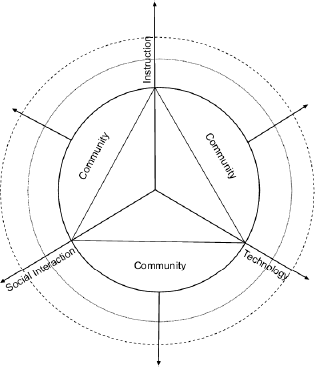
In the proposed framework, “instruction,” “social interaction,” and “technology” are the major dimensions of eLearning communities (Figure 1). To develop an ideal eLearning community, the three dimensions should be consistently maximized. Somewhat lopsided development may result in different learning experiences. However, balanced development is not a static force. The development of eLearning communities may focus on different dimensions at different times, situations, and opportunities. The community may start with a greater focus on social interaction and technology. After the formation of the community, instruction can be integrated to facilitate communications. As the community develops, its influence increases and expands outward (the arrowhead for each dimension). Figure 1 represents a theoretical framework for eLearning communities that is dynamic, not static, flexible, not fixed, and negotiable, not pre-set.
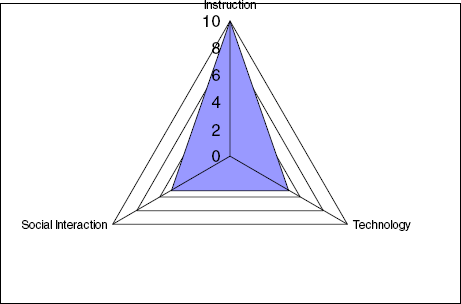
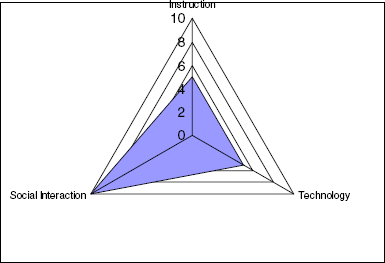
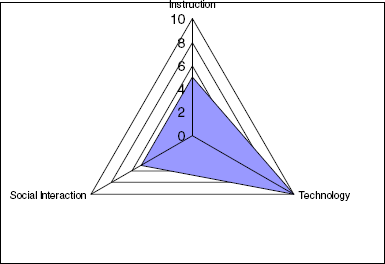
When one dimension applies more force than others, a different learning process is being applied. For example, focusing on instruction can lead to tighter information processing structures that explain why teachercentered instruction that emphasizes information storage and retrieval is often created in traditional learning environments (Figure 2). An emphasis on social interaction (Figure 3) can result in a loss of structure (de-emphasizing storing and retrieving information). Less structure, in turn, can promote social interaction, lifelong learning, or informal learning. However, generally speaking, it takes longer for learners to reach specified objectives when emphasis is placed on social interactions. When one focuses on the technology dimension, a tool-rich learning experience often results (Figure 4). A tool-rich environment frequently focuses on the impact of technology on human learning, rather than instruction and social interaction. The three dimensions (i.e., instruction, social interaction and technology) do not interfere with each other. They are interrelated and enhance each other’s development. Unbalanced development may result in learning that is not community oriented. Therefore, an ideal learning community is well developed and balanced in all three dimensions.
Implementation of the proposed framework requires the application of several key concepts within each dimension that deserves further examination.
Instruction
Interactivity, community engagement, collaboration, and moderation are key concepts associated with the instruction dimension of effective eLearning communities.
Interactivity
One should engage community members in authentic and interactive activities. Community members who are experts or more experienced than others should function as mentors to stimulate knowledge construction and internationalization. Information should be presented in a fashion that stimulates and indicates to members what is to be understood. Coaching processes should allow novice members to receive appropriate feedback, increase awareness of how they deviate from mastery and show them how can they can modify and improve their processes. Experts and novices should work together rather than be involved in one-way communications. Scaffolding should also be given to novice members as a conceptual framework for building their own understanding of the content through their own explanations of the knowledge construction process.
Community Engagement
Community learning is not only active but also interactive. As such, community engagement serves as an appropriate concept for the development of eLearning communities. For example, Tu and McIsaac (2001) identify several factors for building a CoP: determine knowledge, build important topics or issues, gain members’ background contexts and design pull technology. One must also determine: which connections to make between learners, what kind of knowledge to share, what kind of community will result, and how tightly sharing knowledge needs to link with work. Therefore, community engagement is an optimal goal in an eLearning community. A grounded approach for designing and sequencing such eLearning interactions is posited by Hirumi (in this issue).
To enhance learning, one does not need to create and build communities from the ground up because they arise spontaneously in most organizations. However, one needs to identify and nurture them with the necessary resources, structure, and systems. Developing communities is closer to husbandry than architecture; there is a broadening acceptance and understanding of learning as a socially mediated and constructed process where knowledge is no longer “fixed” in time or structure (Billett, 1996). People influence their everyday practice by having reflective conversations, frame their understanding of a situation in light of experience, try out actions and reinterpret or reframe the situation based on the consequences of their actions (Marsick & Watkins, 1992).
Collaboration
Collaboration enhances the active exchange of ideas within small groups, increases interest among participants, and promotes critical thinking (Garrison, 1999). The community of collaborative learning, the grouping and pairing of learners for the purpose of achieving an academic goal, has been widely examined and is advocated throughout the professional literature. “Collaborative learning” refers to an instruction method in which students at various performance levels work together in small groups toward a common goal. The learners are responsible for another’s learning as well as their own. Thus, the success of one student helps other students to be successful. The basic elements of eLearning teams have been defined as people, purpose, and links (Lipnack & Stamps, 1997). Hiltz (1998) also proposed several activities for enhancing collaborative learning such as seminar-style presentations and discussions, debates, group projects, simulations, role-playing exercises, and the collaborative composition of essays, exam questions, stories, and research plans.
Moderation
Recent publications emphasize the importance of moderators, individuals who are able to maintain a discussion and offer some technical assistance in an eLearning community (Berge & Collins, 2000). Knowledgeable use of strategic moderation can enrich and deepen the dialogue among community members. Moderation should be seen as an art rather than a mechanical process; therefore, it may take time to conduct and craft appropriate moderation to foster eLearning and deeper critical thinking. Appropriate moderation should assist participants in regular postings; help meet the needs of the members of the online community; express honest opinions; encourage participant-to-participant collaboration; ensure that spontaneous communications occur among the participants; promote reasonable venting about technology, content and even the facilitator; and show support and concern for participants (Collison, Elbaum, Haavind, & Tinker, 2000).
Social Interaction
The social context and the development of socio-cultural and socio-cognitive environments are important to consider within the social interaction dimension of eLearning communities.
Social Context
Social context is constructed from the community members’ characteristics and their perceptions of the eLearning environment.
Bauman (1997) argued that social factors can be as powerfully motivating as intellectual ones in keeping learners on task. Research should focus on the relationships of community members and their perception of elements in the eLearning community that may affect their participation, such as: familiarity with recipients, assertive and acquiescent social interaction, informal and formal community relationships, trust relationships, social relationships, psychological attitudes toward eLearning community, access and location, and members’ characteristics.
Socio-Cultural and Socio-Cognitive Environments
Both socio-cultural (Vygotsky, 1978) and socio-cognitive theories value behaviors, personal factors, and environments. Ideal eLearning engages community members in deep thinking, provides multiple viewpoints, supports reflection, and offers frequent feedback and guidance toward higher standards. Kearsley (1998) contended that the most important overall impact of an eLearning environment is the emphasis it places on critical thinking and discourse. Community members (novice and experts) often communicate more with each other during eLearning than in traditional classroom environments. Members discuss, analyze, evaluate, argue, debate, and question different information from various aspects. This process encourages students to solve problems, participate, support, and guide each other to arrive at a conclusion based on experimental evidence (an interpsychological process), and solve conflicts by articulating argumentation (an intrapsychological process). An eLearning community redirects learning towards a constructivist and experiential mode from externalization to internalization. Therefore, socio-cultural and sociocognitive eLearning environments must be provided (Roschelle & Pea, 1999). The Socratic dialogue presents a famous example in which students learn through progressive questioning from an expert. Engaging in reflective and interactive activities, especially those leading to explaining, justifying and evaluating problem solutions are very important to learning processes (Ferry, Kiggins, Hoban & Lockyer, 2000).
Technology
Electronic computing and telecommunications are converging into knowledge construction technologies. Technology not only delivers content (information), but it has the capability to trigger and stimulate chances for knowledge construction. In fact, contents, bits, learning, and cognitive science are converging into “knowledge media” (Eisenstadt, 1995).
When using knowledge construction technologies, one should move beyond a forum for exchanging tidbits and opinions to structures that readily capture knowledge-value and foster rapid accumulation and growth of a community’s capabilities. For example, a technology should have the capacity to capture and index knowledge construction processes and patterns and to allow users to retrieve information from and manipulate the knowledge data bank. In that manner, an eLearning community can lead to the development of personalized, self-adaptive learning systems. In an eLearning community, one should have an opportunity to make contributions and others should be able to readily locate and retrieve each contribution. The processes involved in contributing, locating, and retrieving are keys to knowledge mining and knowledge construction. Knowledge becomes an emergent property that transcends the fixed-size-and-space concepts of media and information. It transcends the notion that one can impart knowledge to students by filling them up from the teacher’s vessel. Knowledge mining and knowledge construction are critical processes and are similar to the five interactive media characteristics identified by Hiltz et al. (2000): feedback, symbol variety, parallelism, rehearsability, and reprocessability.
Several computer mediated communication (CMC) technologies should be examined extensively, such as bulletin boards, database management applications, and programs to capture thinking trails. The sharing of thinking patterns among virtual learning communities would be central practice, rather than having to visit different technologies. The difficulty is that often valuable information about past project history generated by an individual is not captured, retained, or maintained in a useable format to enrich the community. Therefore, if the individual leaves the community, the community returns to where it started and considerable time and resources may be required to reconstruct the lost knowledge or expertise. Weiser and Morrison (1998) pointed out the importance of retaining knowledge, a concept that was emphasized 57 years ago by Bush (1945) The ability to capture thinking trails was crucial in future thinking devices so that individuals and groups could trace connections and the branching of thinking to examine their own process and learn from it.
Effective knowledge management can lead to significant improvements in learner performance. A community that can effectively manage their knowledge assets is able to treat the knowledge component of learning activities as an explicit concern of learning reflected in strategy, policy, and practice at all levels of the learning environment. Five steps to implement a knowledge management solution are: identify the essential elements of knowledge management; assess infrastructure by evaluating network, computer systems, security, and information; anticipate new roles, knowledge officer, managers, or administrators, and responsibilities; select the right tools, technologies and partners to ensure scalability and usability; and support and adopt realistic collaboration. Tu and McIsaac (2001) stressed the importance of knowledge management tools for eLearning, making a direct connection between both explicit (recorded) and tacit (personal know-how) intellectual assets. In practice, knowledge management often encompasses identifying and mapping intellectual assets within the learning environment, generating new knowledge for competitive advantage within the learning environment, making vast amounts of information accessible, sharing the best practices, and implementing technologies that enable all of the above, including groupware, database, intranets, etc. Discovering the important factors that have an impact on the knowledge construction process should occur in future research. In addition, the selection and use of appropriate technologies to support the process is also critical.
RECOMMENDED ACTIVITIES
An ideal eLearning community should integrate three dimensions proposed in this thesis dynamically. One does not need to start an eLearning community from scratch, because students and instructors may be acquainted from previous encounters and may be members of existing communities. Regardless of whether the community is a new community or is based on an existing one, an eLearning community should emphasize the social interaction dimension to establish familiarity, trust, and positive attitudes toward eLearning. With adequate social interaction, one can infuse instructional strategies into community activities, such as feedback, community engagement, collaboration, and moderation. Instructional strategies integrating with appropriate “technology” will enhance community learning and sustain the knowledge generated in current learning for future learning. The social interaction dimension may be reduced after the instruction and technology dimensions have been firmly established; however, it is necessary to maintain an appropriate level of social interaction throughout the entire community building and maturation process. A successful eLearning community will not be affected by the departure of a community member; instead, effective knowledge will be captured for newcomers. This is true “community learning.”
Table 1 summarizes the new framework and lists several activities for building an effective eLearning community. One may find that some activities overlap and are interrelated. It is true that the three dimensions are intermingled. When one intends to study eLearning, an examination of how each dimension and component affects human learning is recommended.
Activities Recommended for Building eLearning Community
| Dimensions | Components | Activities |
|---|---|---|
| Instruction | ||
| Interactivity | Coaching with feedbacks. | |
| Community engagement | Determine knowledge. Build important topics or issues. Gain members’ background context. Pulling information together for reflection. | |
| Collaboration | Adopt seminar-style presentations/discussions. Apply debates. Conduct group projects. Apply simulations. Apply role-playing exercises. Engage the collaborative composition of essays. Exam questions, stories and research plans. | |
| Moderation | Participate in discussion regularly. Express honest opinions. Engage peer moderations. Venting toward technology, content & even the facilitator is acceptable & evident. Show concern & support for the community. | |
| Social Interaction | ||
| Social context | Become familiar with recipients. Build informal social relationship. Build trust relationships. Foster positive attitude toward eLearning community. Support private & convenient access & location. Become familiar with members’ characteristics. | |
| Socio-cultural & socio-cognitive environment | Provides multiple viewpoints. Supports reflection. Offers frequent feedback. Encourage critical thinking. | |
| Technology | Assess infrastructure by evaluating network, computer systems, security, & information. Anticipate new roles & responsibilities. Select the right technologies & partners. Adopt realistic collaboration. |
CONCLUSION
eLearning community is an important concept in technology-based learning. Concerns for community learning have been largely disregarded in current traditional learning environments as well as in eLearning environments. An effective eLearning community reaches beyond the point that community members learn together and should be perceived as a community that learns. The fundamental elements discussed in this paper are believed to be essential to the development effective eLearning communities; namely, effective design for online collaboration, higher level of social presence, and intensive infusion of knowledge and experiences. One should be aware of weaknesses in current research and proceed with studies that are grounded in the level of self; conducting long-term studies and adopting a comprehensive theoretical framework such as the refined framework posited in this paper.

