


With online education continuing its meteoric rise, some educators continue to debate the efficacy of the medium—in particular, the ability to discuss complex subjects online. However, the online asynchronous discussion environment seems to offer some advantages over the traditional classroom including increased time for students to research and reflect on ideas and physical anonymity that may decrease inhibitions and foster broad participation. This article examines the theoretical advantages of online discussion groups and the survey results from 122 experienced faculty members to determine, first, how many faculty members prefer the online environment and, second, what is the relationship of this preference to their assessment of the superiority of online discussion. The results indicate that half of the faculty who teach online and on-ground prefer teaching in both environments and that three quarters of those educators believe the online environment facilitates more substantive discussion. As online education continues to explode, the implications for educators include the need to understand and embrace the inherent online classroom advantages and how to integrate those advantages with traditional classrooms including hybrid (on-ground/online) models. Educators failing to do this will find themselves left behind in the fastest-growing education segment and potentially less effective in the traditional classroom where younger students have come to increasingly rely on interactive/asynchronous communication as a preferred method of communication.
ONLINE DISCUSSION
Most online classes engage several forms of communication, including synchronous and asynchronous modes. These communications can include e-mail, posting of notices, streaming video, discussion boards, and chat rooms. However, one of the most popular communication methods of online interaction is “asynchronous discussion,” sometimes called “threaded discussion.” Threaded discussion uses a portion of the class Web site in a “bulletin board” environment where the faculty member presents a question or topic for discussion, and students can “read and comment on a topic under discussion at their leisure” (Paloff & Pratt, 1999, p. 4). Discussion groups allow students to participate actively and interact with students and faculty. As such, they supplement content delivery. This study examines one critical component, classroom discussion, since discussion has been instrumental to student learning and is perceived as a problem in the online classroom. It is examined from the faculty’s perspective, the gatekeeper for online instruction.
Discussion, in the traditional classroom, offers many benefits. The knowledge that each participant contributes to the discussion may be as important as the knowledge the facilitator contributes. Students are able to learn from one another (Addesso, 2000). Interaction and feedback from other students assists in testing ideas, refining positions, and improving critical thinking skills (Brooks & Brooks, 1993; Cranton, 1994). Ideally, all students should be active participants instead of passive listeners (Strauss, 1996). It places greater responsibility on students to learn the material, since they will be discussing it with other students during class. It is rarely recorded and critiqued later. This interactive discussion “engenders greater understanding and memory retention than non-participatory techniques because it requires interpretations through analysis, synthesis and evaluation, in sum, a higher-order-learning” (Bonwell & Eison, 1991, p. iii). This has been documented in the classroom and should transfer to the online world.
The primary student benefit of threaded discussion is that it supports the flexibility needs of the adult learner, while allowing time for research and reflection and reducing participation anxiety for shy students. Questions may be posted before discussion occurs, and discussion may encompass hours or days: Questions may be posed to the entire class, and subgroups can be defined or evolve, based on the material and course guidelines. Allowing students time to reflect, it is proposed, may enhance the richness and variety of discussion. Some authors (Carpenter, 1998; McClenahen, 1997) noted that online discussion may have conversations of higher quality because students have an opportunity to build constructive positions because of the additional time to reflect and synthesize comments from their peers prior to posting. Overall,
the bulletin boards offers more time to reflect on and discuss deeper issues; they allow a more equitable/more comfortable environment in which all students can participate; they are more student centered in their learning approach, and students are taking more responsibility for their own opinions: Students are out of their comfort zone; the politeness, structure, and formality of face-to-face tutorials are removed, encouraging more direct, in-depth, and critical responses. (Sweeney & Ingram, 2001, p. 62)
The drawbacks of threaded discussion are that communication dynamics are limited, body language is unobservable and, therefore, learning possibly reduced. Although some may argue that online students are not developing personal communication skills, an equal argument could be made that developing online communication skills, heavily used in companies like Microsoft, is equally important. Younger adult learners (25-35) may be quite accustomed to using symbols and phrases to create virtual body language (e.g., smiley face :) ). Students in their 20s and 30s have been conditioned to communicate electronically with their peers, a trend that will continue. Additionally, it appears that the advantages available as a result of time flexibility, reflection, and reduced participation anxiety may produce outcomes that are beneficial to well defined/framed learning objectives. This potentially improves participation as a result off “physical anonymity,” and the technology drives advantages that faculty can leverage to stimulate and improve student learning suggest online discussions may offer advantages over the classroom.
Physical Anonymity
McGrath found that those who have not typically excelled in a face-to-face environment may do well in an online environment. McGrath also observed greater inquisitiveness, expressiveness, and risk taking; decreased inhibition and gender barriers; and increased social connectedness as a result of electronic conferencing (Sweeney & Ingram, 2001). Hiltz, Johnson, and Turoff (1986) similarly claimed that the written word allows students to be freer in expressing themselves. This “physical anonymity” may encourage students to challenge both students and faculty, hopefully in a respectful manner as encouraged by “netiquette rules.” Furthermore, Hiltz (Sweeney & Ingram, 2001) found that asynchronous online discussion, which allows students to participate at a time that suits them, increased the effectiveness of learning.
With the physical anonymity of cyberspace, students reticent to participate in class may actively join the discussion from the comfort of their home, free from the social pressures of classroom cohorts (Corston & Colman, 1996; Straus, 1996). Introverts in the online world, for instance, do not have to wait to be acknowledged by the faculty member before asking a question (Yellen, Winniford, & Sanford, 1995). Students can participate when they feel most productive, since they are not bound by the traditional classroom and its regimented times. This should result in a more equal distribution of discussion among students than in the traditional classroom (Bailey & Coltar, 1994; Hiltz et al., 1986).
Equitable Distribution
As with any classroom, virtual or real, there will be a tendency for some students to dominate discussions or force opinions. The faculty member must reduce negative learning experiences by controlling those who interfere with course dialogue, such as a slacker offering a superficial answer, to dominators and know italls, who enjoy having others listen to them. This may require more active faculty participation initially, while striving to minimize unneeded intervention. The faculty member’s goal is to empower students to assume control of the discussion, but the faculty member is always a participant learner, a member of the group, expressing his or her views as an individual (Williams & Cothrel, 2000). With dialogue recorded, faculty members can quickly identify extremes: those students dominating and those shirking responsibility and “balance” the discussion by guiding both the slacker and the dominator.
Faculty Role
Faculty members, in addition, can facilitate higher levels of participation by specifying the number of posts required per student, number of interactions required between students, and depth and substance within each post. Because the discussion is recorded, the faculty member can reflectively evaluate each participant’s contribution and, based on these transcripts, feedback to the student can be improved compared to the traditional classroom. Ultimately, the faculty member must allow students to converse among themselves so they feel empowered enough to assume control of the discussion (Addesso, 2000). The faculty member should explain why discussions are being used, especially why they are critical, and make clear that respondents will be expected to think, not just give standard answers. It is important that students understand the “p’s and q’s” of discussion groups, including sticking to the topic, not dominating conversations, or avoiding over-aggressive rebuttals/comments (Moore, Winograd, & Lang, 2001).
Furthermore, all communication is heavily dependent on computer-mediated technologies. The instructor or facilitator can thus be seen as a manager of this educational virtual community, and an evaluation of the overall effectiveness of an online course can also be seen as an evaluation of the effectiveness of the virtual community experience as perceived by the student. Using an entertainment analogy, the educator in an online environment is less of an actor and more of a director or producer. Faculty participation, setting standards, and using the technologically inherent advantages of the asynchronous environment are crucial to the success of online discussions.
Superiority of Online Discussion to the Traditional Classroom
The online environment inspires, facilitates debate and, when faculty members establish netiquette rules, requires students to substantiate their ideas and recognize that others have done so as well. It may have a richer, more vibrant discussion, compared to the traditional classroom. From the student’s perspective, this is because the threaded discussion inherently drives preparation and reflection along with the benefits of the environment’s anonymity, and the virtual community created. Students are being asked to take the information presented by faculty and students and synthesize the information. Students must see patterns and discover hidden meanings (specified in the discussion instructions and grading criteria). They are provided with the time to reflect and gather additional information and collaborative interactively. Leidner and Jarvenpaa (1993) suggested that collaborative learning is best suited for the Internet, where the asynchronous option for discussion allows for high levels of reflection (Dumont, 1996).
Because the discussion is recorded, the faculty member can reflectively evaluate each participant’s contribution and, based on these transcripts, feedback to the student can be improved compared to the traditional classroom. The transcript serves to ensure all participate equally and that the discussion is substantive and adds to the group’s knowledge. This compares positively to the traditional environment, where content is relegated to memory. Rarely are classes videotaped. When they are videotaped, evaluation is based on the spoken words, which can only be heard multiple times by the time-consuming process of rewinding. Evaluations are then based on content and delivery style. This is inherently problematic and rarely used, as compared to the online transcript. The following hypotheses are proposed comparing online and the traditional classroom discussion.
Hypothesis 1: The online classroom, according to faculty, facilitates more substantive discussion than the traditional classroom because of greater research and reflection, physical anonymity, and a more equitable distribution of participation. The more equitable distribution of participation is partly attributable to faculty’s ability to identify those dominating discussion and get them to participate less. These variables will form a single construct (online discussion superiority/inferiority).
Faculty teaching preference for online teaching or the traditional classroom offers a mixed picture. Two thirds of management faculty in a national study listed courses entirely online as their least preferred instructional technology (Peluchette & Rust, 2005). In contrast, a survey of college faculty belonging to the nation’s largest union found 72% of those who taught online had a favorable opinion about the medium, while only 51% were favorable among those who had not taught online (Carr, 2000). Crucial to teaching online for faculty is proper training on technology and the online environment (Lao & Gonzales, 2005; Care & Scanlan, 2001). Professors surveyed for this study receive training in both and are working for an organization that has refined and invested in technology dramatically over 7 years. Thus, we would expect 50% prefer the online environment (individually or equally with the traditional classroom) since critical elements such as training, experience, and technology are met.
Hypothesis 2: Half of professors will prefer the online environment or both (online environment and traditional classroom). Professors also will find the online environment pleasurable, fun, and exciting (online teaching enjoyment scale).
Teaching preference may be a moderating factor in evaluating online discussion in comparison to traditional classroom discussion. Thus, those preferring the online environment maybe predisposed to evaluate online discussion as superior to that of the traditional classroom. Although preference may involve multiple constructs—enjoyment, perceived superiority, convenience, time commitment, and ease of use—we are concerned with preference beyond merely enjoyment. This construct also is influenced by perceptions: a common belief is that online teaching is more time consuming than the traditional classroom, yet a recent study found the opposite (Hislop & Ellis, 2004). Preference should be related to perceived student learning. Teachers, in general, choose this vocation because we want to instill in others our love of learning and knowledge. When faculty believe online teaching is enjoyable, this will be conveyed to students through their enthusiasm, a contagious emotion. Enthusiasm, as perceived by students, is a quality inherent in good teachers.
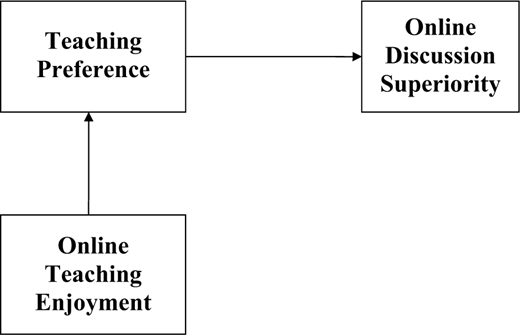
Hypothesis 3: Teaching preference will moderate respondents’ evaluation of online discussion’s superiority/inferiority to traditional classroom discussion. Those preferring the online environment will view online discussion as superior and enjoyable, and those preferring the traditional classroom will find the opposite. Those preferring both will find the online discussion environment superior to the traditional classroom (Figure 1).
METHODS
The survey’s impetus developed from a desire to validate literature-based constructs with experienced faculty. Additionally, we wanted to determine how to leverage the positive aspects of online discussion in “hybrid” classes—classes that meet online and in the traditional classroom. In attempting to understanding how to structure this class, we discussed incorporating the best components of each, which led us to examine how faculty perceive student discussion in both environments. We pretested the survey instrument using a protocol analysis with six faculty members who teach in both the online and traditional classroom environments. Modifications were made to the survey. Pretest results were analyzed for face validity and reliability. The final pretest required the authors to complete the survey online.
The sampling frame included 303 faculty members currently teaching online for a private southeastern university. The institution has been offering online classes for over 7 years, encompassing students across the world and faculty across the United States. The survey was posted to the Zoomerang.com Web site to allow respondents to complete the survey online. The collection method involved notifying respondents through e-mail of the survey’s purpose and directing them to a Web site to complete the survey. This method eliminated data entry errors associated with surveys.
We created two scales from the survey: superiority/inferiority of the online discussion (4-item scale: online discussion more substantive discussion because of a more equitable discussion distribution; physical anonymity; and less monopolizing by participants) and online teaching enjoyment (3-item scale: pleasurable, fun, and exciting). To establish reliability and unidimensionality, we estimate coefficient alpha and factor analyze the scales using Principal Components Factor Analysis (PCFA). (Note: Although unidimensionality indicates internal consistency, we do analyze Coefficient Alpha before estimating unidimensionality through factor analysis to determine whether scale changes need to be made at that juncture.) An Oblimin rotation is used since the constructs should be correlated theoretically. Summated scales are developed once unidimensionality is established. (Note: Some questions were reverse coded to ensure respondents were taking the exercise seriously.) Any negative loadings are reverse coded before scale creation. The summated scale is tested against neutral; that is, the number of questions multiplied by the midpoint per question. Individual questions were on a 7-point scale, with different anchors and were tested against a mean of four (mid-point on a 1-7 scale) in a two-tailed test, except for hypotheses which dictated direction; these were done in a onetailed test, both at a .05 level. Hypotheses one and two are tested through a t test of individual question means, coefficient alpha, factor analysis, and t test of scale means.
Online Discussion Superiority and Teaching Preference
Online Discussion Superiority and Teaching Preference
The summed scales are used in an ANOVA, to test hypothesis three, where preference and online teaching enjoyment is regressed on online superiority/inferiority (discussion) to understand the role preference plays in evaluating the constructs. The mathematical model tested is:
where y is online discussion superiority/inferiority, x1 is teaching preference, and x2 is online teaching enjoyment. Variable x1 is a categorical variable with three levels: traditional classroom, online environment, and both. Variable x2 is a covariate to separate enjoyment from teaching preference. Hypothesis three predicts that β1 and β2 will be statistically significant. Pairwise comparisons are tested for the three levels of teaching preference: online, traditional, and both, for the two dependent variables. Comparisons are tested using Tukey HSD at a .05 level.
RESULTS
E-mail invitations were sent to 303 faculty members. One hundred and fifty visited the Web site after being notified through e-mail about the survey, and 122 completed the survey. Five faculty members notified the author that they did not teach in both environments, and they were instructed not to complete the survey. The response rate was 40%. Data were downloaded from the Zoomerang.com Web site to an Excel file, and then uploaded into SPSS 14.0 for analysis. A field edit revealed no major abnormalities. Four respondents did not complete the second section (classification variables); however, their data from section one were included in the survey.
Sixty-nine percent of the sample have taught more than 21 traditional class sections, and 66% have taught more than 21 online class sections. Forty-three percent of the faculty primarily teach in the online environment. Half of our sample prefer teaching in both environments, while 21% prefer the traditional classroom and 29% prefer online. The sample is 62% male and 38% female. Fifty percent have their doctorate.
Univariate Results
The online discussion, according to our respondents, is more substantive than the traditional classroom discussion (t(120) = –1.91, p = .058, M = 3.66) (Table 1). This is partly attributable to the fact that there is a more equitable distribution of participation among students in the online environment compared to the traditional classroom (t(120) = –6.65, p = .000, M = 2.93), and that students have physical anonymity (t(120) = –3.46, p = .001, M = 3.43). Probably alone in the comfort of their homes while posting, students are less inhibited. We did not find that the online environment is more conducive to eliminating monopolizing of discussion time by students (t(120) = –.454, p = .650, M = 3.93). Overall, three of the four individual questions support hypothesis one.
Individual Question Results (N = 121)
| Hypotheses | Hypothesized Path | t | p | Hypothesis Testing |
|---|---|---|---|---|
| H1 | The online classroom facilitates more substantive discussion than the traditional classroom | –1.91 | .058 | Supported |
| H1 | Within a course, there will be a more equitable distribution of participation in online discussion than in a traditional classroom. | –6.65 | .000 | Supported |
| H1 | Because of anonymity, debate will increase with students and faculty members in an online discussion than the traditional classroom. | –3.46 | .001 | Supported |
| H1 | Faculty members who ask students who dominate discussions groups to speak less will have a more equal distribution of participation among students in the online environment than the traditional environment. | .454 | .650 | Not supported |
| H2 | Online environment is pleasurable | 14.302 | .000 | Supported |
| H2 | Online environment is exciting | –10.276 | .000 | Supported |
| H2 | Online environment is fun | –15.053 | .000 | Supported |
Teaching in the online environment according to our experienced sample is enjoyable. When examining the online environment separately, respondents find it pleasurable (t(117) = –14.302, p = .000, M = 2.00), fun (t(117) = –15.053, p = .000, M = 2.19), and exciting (t(117) = –10.276, p = .000, M = 2.49). This bodes well in a discipline where technology will continue to grow as a delivery method. This partially supports hypothesis two.
Multivariate Results
No multivariate outliers were found when the seven items (superiority/inferiority and teaching enjoyment scale questions) were regressed on an identification number and Mahalanobis distance estimated and tested using a chi-squared test (Tabachnick & Fidell, 2001). The internal consistency of the fouritem superiority/inferiority of the online environment scale, as measured by coefficient alpha, is acceptable (CA(121) = .732, M = 13.95), although it does rise to .783 (M = 10.02) with the deletion of the question on monopolizing discussion by students (question not statistically significant). Testing the scale mean of respondents against neutral on the scale indicates statistical significance and the superiority of online discussion in comparison to the traditional classroom (t(120) = –4.23, p = .000, M = 13.95). (The three-item superiority/inferiority of the online discussion is also statistically significant (t(121) = –4.716, p = .000, M = 10.02). The three-item online teaching scale is also internally consistent (CA(118) = .709, M = 6.69). The scale is different from neutral (t(117) = –16.377, p = .000, M = 6.69).
Construct unidimensionality is tested through a Principal Components Factor Analysis. The seven items are factor analyzed using PCFA and an Oblimin rotation. KMO is greater than .5 (.718), and Bartlett’s tests is statistically significant (χ2(21) = 224.62, p = .000). Both indicate significant relationships among variables; however, the commonality for the question on monopolizing discussion time is only .32 (Table 2). With less than 30% of the variation in the question on mitigating monopolizing by students during online discussion accounted for by the underlying factor, we reran the factor analysis omitting the variable will low common variance resulting in all commonalities above .56 and explained variance increasing to 68% from 61%. Since both models have two eigenvalues greater than one and are interpretable, we used the more parsimonious results (Tables 2 and 3). Also, Tucker’s Coefficient of Congruence between the two models is .98 or greater for each factor.
Significant relationships exist among the now six variables (superiority/inferiority and teaching enjoyment scales) since KMO’s measure of sampling adequacy is above .5 (.714) and Bartlett’s Test of Sphericity, which indicates that the correlation matrix is not an identify matrix (χ2(15) = 208.76, p = .000), is statistically significant. All items loaded on the predicted factors with no noteworthy cross-loadings (Table 3). Since factors are assumed correlated and an oblique rotation was used, the pattern matrix was used for factor interpretation. The structure matrix includes the direct (variable and factor) and indirect relationship (mediated by the other factor). Factor two is the three-item online discussion superiority scale, and factor one is assessing online teaching enjoyment (since respondents evaluate online discussion as superior, we drop inferior from the scale label). Pleasure and fun correlate highest with factor one, and the online classroom facilitates more substantive and equitable discussion correlates highest with factor two. The smallest correlation on the hypothesized factor is .64. We now create a summed scale for the superiority of online discussion over the traditional classroom and online teaching enjoyment; this supports hypothesis one.
| Oblim Rotated Loadingse | ||||
|---|---|---|---|---|
| Mean (SD) | Factor 1 Online Teaching Enjoyment | Factor 2 Online Discussion Super. | ||
| The online environment is: | ||||
| ONL1 | Pleasurable | 6.00 (1.52)a | .843 | –.119 |
| ONL2 | Exciting | 5.51 (1.59)b | .632 | .252 |
| ONL3 | Fun | 5.81 (1.30)c | .866 | –.002 |
| Comparing online classroom discussion to the traditional classroom | ||||
| SUP1 | The online classroom facilitates more substantive discussion | 3.67 (1.95)d | .061 | .813 |
| SUP2 | Within a course, there will be a more equitable distribution of participation in online discussion | 2.94 (1.79) | –.001 | .856 |
| SUP3 | Because of anonymity, debate will increase with students and faculty members | 3.45 (1.81) | .218 | .652 |
| SUP4 | Faculty members who ask students who dominate discussions groups to speak less will have a more equal distribution of participation among students | 3.93 (1.60) | –.115 | .561 |
| Factor diagnostics | ||||
| Eigenvalue | 2.88 | 1.36 | ||
| Cumulative variance explained | 41.17% | 60.52% | ||
Scale was anchored with 1, do not find it pleasurable; … 7, find it pleasurable (reverse coded for analysis)
Scale was anchored with 1, exciting; … 7, unexciting
Scale was anchored with 1, not fun; … 7, fun (reverse coded for analysis)
Scales were anchored with 1, strongly agree; … 7, strongly disagree
Factor analysis yielded only two factors with eigenvalues larger than the requisite 1.0 and the next “factor” had an eigenvalue of .894. Two factors were identified through the scree plot, and the two-factor model is interpretable.
| Oblim rotated loadingse | ||||
|---|---|---|---|---|
| Mean (SD) | Factor 1 Online Teaching Enjoyment | Factor 2 Online Discussion Super. | ||
| The online environment is: | ||||
| ONL1 | Pleasurable | 6.00 (1.52)a | -.870 | -.146 |
| ONL2 | Exciting | 5.51 (1.59)b | -.638 | -.228 |
| ONL3 | Fun | 5.81 (1.30)c | -.836 | -.043 |
| Comparing online classroom discussion to the traditional classroom | ||||
| SUP1 | The online classroom facilitates more substantive discussion | 3.67 (1.95)d | -.033 | -.887 |
| SUP2 | Within a course, there will be a more equitable distribution of participation in online discussion | 2.94 (1.79)d | -.080 | .906 |
| SUP3 | Because of anonymity, debate will increase with students and faculty members | 3.45 (1.81)d | -.174 | -.670 |
| Factor diagnostics | ||||
| Eigenvalue | 2.77 | 1.30 | ||
| Cumulative variance explained | 46.29% | 67.97% | ||
Scale was anchored with 1, do not find it pleasurable; … 7, find it pleasurable (reverse coded for analysis)
Scale was anchored with 1, exciting; … 7, unexciting
Scale was anchored with 1, not fun; … 7, fun (reverse coded for analysis)
Scales were anchored with 1, strongly agree; … 7, strongly disagree
Factor analysis yielded only two factors with eigenvalues larger than the requisite 1.0 and the next “factor” had an eigenvalue of .894. Two factors were identified through the scree plot, and the two-factor model is interpretable.
Preferences
Half of the respondents prefer teaching in both environments, 29% preferring the online environment, and only 21% prefer the traditional classroom. This, along with our previous findings, supports hypothesis two. ANOVA is run with the superiority/inferiority of online discussion as the dependent variable, teaching preference the independent variable, and online teaching enjoyment a covariate. Mean differences according to preference are found for both summed variables (Table 4). Leverne’s Test indicates that the error variance of the dependent variable is equal across groups.
N, Mean, and Standard Deviations by Teaching Preference
| Teaching Enjoyment | Superiority/Inferiority | |||||
|---|---|---|---|---|---|---|
| Traditional | Online | Both | Traditional | Online | Both | |
| N | 25 | 34 | 59 | 25 | 34 | 59 |
| Mean | 10.56 | 5.73 | 5.59 | 13.48 | 8.44 | 9.54 |
| Std. dev. | 2.99 | 3.51 | 2.47 | 3.80 | 4.40 | 4.41 |
Note: The values represent summated scales.
Teaching enjoyment is a three-item scale (3 to 21, with 12 the midpoint) on the online teaching environment, with low indicating that the online teaching is pleasurable, exciting, and fun.
Superiority/inferiority of the online environment is a three-item scale (three to 21, with 12 the midpoint:)
The online classroom facilitates more substantive discussion; Within a course, there will be a more equitable distribution of participation in online discussion; Because of anonymity, debate will increase with students and faculty members.
Lower score on the superior/inferiority scale indicate strong agreement, while high numbers indicate strong disagreement.
ANOVA
| Superiority of Online Discussion = Teaching Preference (Tukey HSD) | |
| Superiority | |
| F (p-value) | p = .000 |
| R2 | .165 |
| Teaching preference (traditional-online) | 8.17 / 5.33 / 2.48 (p = .000) |
| Teaching preference (traditional-both) | 6.37 / 3.88 / 1.39 (p = .001) |
| Teaching preference (online-both) | 3.87 / 1.45 / –.965 (p = .442) |
The model is significant (F(3) = 7.5, p = .000). Effect size for online discussion superiority is .165 (R2) (Table 5). Teaching preference is significant (F(2) = 11.24, p = .000). Pairwise comparisons reveal, as expected, those faculty preferring the traditional classroom differ with those preferring the online environment (M difference = 5.33, p = .000) and those preferring both (M difference = 3.88, p = .001) on whether online discussion is superior to the traditional classroom discussion. Means for the three groups are: 13.48 traditional (SD = 3.80), 8.44 online (SD = 4.40) and 9.54 both (SD = 4.41). The overall mean is 10.06 (SD = 4.63), and the scale neutral point is 12. Those preferring the online classroom or both the traditional and online environments view online discussion as superior to the traditional classroom, while those preferring the traditional classroom view online discussion as inferior. Hypothesis three is supported.
CONCLUSION
Online discussions, according to our sample of experienced professors, provide more substantive discussion than the constructionally informal classroom discussion because of research and reflective time, physical anonymity, and equitable distribution. With many faculty equally preferring both mediums, cross-pollination in hybrid classes will continue to flourish. Traditional classes may avail themselves of the richer dialogue that online classes offer. “One of the challenges facing marketing educators concerns identifying the specific attributes important in a well-designed course for today’s pedagogical practice in light of rapid technological change” (Taylor, Humphreys, Singley, & Hunter, 2004, p. 43). Understanding the inherent advantages of an online discussion, therefore, is critical even to traditional classroom teachers who may not like the online experience.
Preference influences how respondents evaluate the traditional and online environment’s ability to generate substantive discussion and, in general, on how they evaluate the online space. Those preferring the traditional classroom do not believe online discussion is superior, nor do they truly believe it enjoyable. This perspective is succinctly made by one faculty member:
The reason I don’t want to do it again is the hours in front of the computer is 10% as gratifying to me as the same hours face-toface with … I just don’t enjoy sitting in front of the computer and reading people’s responses and responding to them and so on … I found myself dreading sitting down in front of the computer and doing all those interactive stuff, whereas I don’t dread going to the class to work with students. Not my cup of tea. But for someone else that likes that type of a format, it’d be great. (Lao & Gonzales, 2005, p. 464)
However, they are a minority; more than two thirds of respondents prefer the online space or both the online and traditional classroom. Those preferring the online or both environments have equal opinions about online’s superiority in discussion and enjoyment with teaching online over on-ground.
In conclusion, the literature and experience suggest that online discussion groups offer a technologically-rich environment for developing virtual learning communities in which students can develop strong analytic and critical thinking skills based on inherent time, reflection, and distribution advantages. While the traditional classroom discussion can be structured with preassignments and sequential classes, the inherent time, reflection, community, and assessment advantages using recorded transcripts offers advantages superior to “real-time” discussion. Ultimately, this suggests an opportunity to improve learning, a compelling reason for all professors to incorporate online discussion into their classrooms.
FUTURE RESEARCH
The professor’s perception of online discussion’s rich debate should be corroborated from students. Many students have taken classes in both environments and, therefore, could address the substantive benefits of online discussion or not. Although many components may contribute to enhancing online discussion, further research is necessary in disentangling those of greater import.
Ultimately, the learning achieved in online discussions can be measured, like traditional classrooms, on tests. Whether the learning objective is knowledge formation (facts, sequences) or critical thinking (concepts, solutions), appropriate test construction and measurement of student performance, particularly as it compares to classroom test performance, may offer the most tangible assessment of online discussion groups in the ability to develop student knowledge.

