Teachers’ support and challenges are influenced by their interactions with managers, colleagues and parents across various contexts and necessitate a practical approach for investigation.
This paper introduces the activity system analysis methodology within cultural-historical activity theory (CHAT) to examine the contextual factors in teachers’ practices comparatively. A literature review establishes the theoretical foundation. Following a discussion of activity system analysis as a lens for exploring teacher practices, an example of how to apply it in schools is presented.
Recommended data collection methods include document reviews and in-depth semi-structured interviews, capturing diverse perspectives. By analyzing the core components of activity systems – subject, tools, object, rules, community and division of labor – researchers can identify key themes and contradictions. Themes reveal factors that support teacher practices while also indicating certain challenges; contradictions, meanwhile, highlight deeper challenges in school-based practices, particularly through a comparative perspective.
This research highlights the effectiveness of activity system analysis within CHAT to comparatively explore teacher practices in real-world settings. It provides valuable insights into the complexities of educational environments and serves as a foundation for future studies to adopt this methodology, ultimately contributing to educational transformation.
Introduction
Teacher practices play a crucial role in improving educational quality in a rapidly changing society, yet various social factors shape them. How can we identify the supports and challenges teachers encounter in their practices under these influences? A practical and systemic approach is essential to investigate what drives these dynamics and why they occur.
This paper draws on evidence from an investigation of teachers’ practices in public and private preschools to demonstrate the effectiveness of Cultural-Historical Activity Theory (CHAT) combined with activity system analysis methodology. This approach proves to be a powerful tool for identifying the supports and challenges teachers face, offering a comparative perspective across different institutional contexts. By uncovering the influences on practices in real-world settings, this research provides actionable insights and highlights potential directions for improving teacher practices and fostering educational transformation.
An activity system is represented as a triangular model developed by Engeström (1987) in the second generation based on previous CHAT scholars’ works such as Vygotskiĭ (1978) and Leont’ev (1978). The activity system model has six core components – subject, tool(s), object, rules, community and division of labor (Engeström, 1987, 2014; Yamagata-Lynch, 2010). Many CHAT scholars used this practice theory in various research areas, including educational research (Cole et al., 2018; Postholm and Vennebo, 2020).
The following sections begin by tracing the development of CHAT across its three generations and introducing the activity system analysis methodology. Subsequently, the methodology is compared with other approaches within CHAT, with an outline of their respective advantages and limitations. Finally, the lens of the activity system analysis methodology in exploring teacher practices is discussed.
Building on the preceding discussion, a detailed, step-by-step strategy for the comparative use of the activity system analysis methodology in investigating teachers’ practices is presented, which includes a practical example to demonstrate its effectiveness. This section provides insights into identifying the supports and challenges teachers face in their professional experiences and explains why this methodology is particularly effective for comparing practices across diverse contexts.
Literature review of CHAT and activity system analysis methodology
In the 20th century, the development of CHAT as a model of human activity went through three generations: a fundamental triangular model with three components, an activity system with six core components and a set of activity systems in an expansive learning cycle (Engeström, 2001, 2014; Cole et al., 2018).
The first generation of CHAT focuses on individual-mediated action
CHAT originated in Russia (Yamagata-Lynch, 2010). In 1920, the Russian psychologist Vygotskiĭ created his theory of “mediated action, zone of proximal development, internalisation” to explain how individuals interact with their social surroundings (Vygotskiĭ, 1978, p. 86). In the first generation of CHAT, Vygotskiĭ (1978, p. 40) created a fundamental triangular model to explain the mediated action through a simple stimulus (S)–formula response (R). The three basic components comprising this triangular model are adapted by following CHAT scholars as S – the engaged individual(s), R – the individual(s)’ goal, and X – the mediating artefacts/instruments/tools following Vygotskiĭ (Yamagata-Lynch, 2010; Engeström, 2014).
Vygotskiĭ’s mediating artefacts included technical tools and psychological tools for mediated action (Yamagata-Lynch, 2010). However, the first generation of CHAT limited the mediation actions to individuals’ behavior without addressing other cultural constructions such as communities (Yamagata-Lynch, 2010; Postholm and Vennebo, 2020).
The second generation of CHAT produced a community-based activity system model
The second generation overcame the limitation of this individual-focused analysis (Engeström, 2014). As its representative, Leont’ev (1978) developed the concept of object-oriented activity based on Vygotskiĭ’s original formulation. Leont’ev (1978) did not develop the original model into a collective activity system. Engeström (1987, 2001) further developed the second generation with an activity system model based on Leont’ev’s (1978) work, including six core components: subject, mediating artefacts/instruments, object, rules, community and division of labor. The activity system created by Engeström (1987, 2001) turned the fundamental triangular tool from Vygotskiĭ upside-down with the X–tools at the top (Postholm and Vennebo, 2020). Yamagata-Lynch (2010) adopted what Engeström (1987, 2001) viewed as the six core components of the activity system as a representative for the second generation of CHAT.
Yamagata-Lynch (2010, p. 9) argued that many North American researchers reported difficulty in understanding CHAT because of translation issues, as “the original texts of CHAT are in Russian”. One representative study in educational research is Yamagata-Lynch and Smaldino’s (2007) study, focusing on understanding the partnerships between K-12 schools and universities in the USA. Some other scholars, such as Hedegaard and Fleer (2008), proposed a cultural-historical research methodology along with examples for understanding young children’s development. Oers et al. (2008) also discussed various CHAT scholars’ understanding of Vygotskiĭ. They argued for how to apply CHAT in studying children’s learning process, such as understanding the value of pretend play for preschoolers. Grimalt-Álvaro and Ametller (2021) discussed CHAT and the design of methods for data gathering in science educational research, with a focus on middle schools. The second generation of CHAT focuses on understanding real-world data, while the third generation developed an intervention approach for making changes.
The third generation of CHAT with interventions for making changes
A network of activity systems represents the third generation of CHAT (Postholm and Vennebo, 2020). How the new activity system is produced from the old activity system through an expansive learning cycle is related to the formative intervention methodology created by Engeström (1987, 2014), which is based on the four systemic levels of contradictions. The old activity system was also called the “central activity” and the new activity system was the “culturally more advanced activity” by Engeström (1987, p. 70, 2014, p. 71).
As Engeström (1987) defined them, the level 1 contradictions lie in each of the six core components, between the value and exchange value. The level 2 contradictions are between the components of the central activity (the old activity system). The level 1 and level 2 contradictions are the foundation of the level 3 tertiary contradictions, which are between the current activity system (central activity) and a new activity system (culturally more advanced activity). This means “analysis of contradictions as successive forms of the expansive development of a new activity” (Engeström, 2014, p. 73).
The contradictions in levels 1 and 2 trigger the next step in the expansive learning cycle, where researchers introduce new tools as interventions, generating level 3 contradictions in the new activity system, and later level 4 contradictions (Engeström, 2014). Engeström (2001, 2014) conceptualized the expansive learning cycle to visualize developmental processes (Postholm and Vennebo, 2020). Cole et al. (2018) described artefacts as “doubly artificial” tools, reshaping activity systems within this cycle. Such interventions are foundational in developmental work research (DWR), a form of design-based research, where boundary crossing becomes a mediating tool (Engeström, 1987; Engeström et al., 1995). CHAT-based studies have applied these methods in schools and early education (Postholm and Vennebo, 2020; Nuttall, 2022). While DWR requires longitudinal commitment (Cole et al., 2018; Engeström et al., 2022), Yamagata-Lynch’s (2010) second-generation model allows cross-sectional insights in a short period. However, this lacks Engeström’s detailed contradictions framework.
This paper argues that contradiction analysis across six core components offers a novel lens on teacher practices. The reason is that the nature of the systemic contradictions proposed by Engeström (1987, 2014) can identify the challenges in six core components through level one contradictions, between the six core components in level two contradictions and then point out possible change directions in level three contradictions. More examples will be given later.
Methodological framework
This paper argues for the novelty of the activity system analysis methodology with three levels of contradictions, focusing on “understanding” (Engeström, 2014, p. 14) teacher practices in the real world, identifying supports and challenges comparatively and pointing toward further directions for change. The advantage of this methodology in investigating teacher practices is that it is feasible to apply in cross-sectional studies, poses fewer ethical issues than interventional methodologies, and meets various research needs. Data collection can be completed within a short timeframe rather than over a lengthy period. This allows for the timely identification of issues in teachers’ practices across various schools and provides valuable information for making informed decisions to improve practices simultaneously.
The lens of the activity system analysis methodology in exploring teacher practices
CHAT provides a practical framework that bridges theory, policy, and practice, allowing researchers to explore educational institutions critically and comparatively. As discussed, the CHAT activity system is effective in examining human activities by accounting for multiple dimensions (Foot, 2014) and has been widely used to study such activities in diverse contextual settings (Cole et al., 1997).
Teacher practices, as contextually situated human activities, involve curriculum design, selecting and adapting teaching methods in the classroom, interacting with children, conducting observations and assessments, collaborating with colleagues and communities, taking on leadership roles within schools, and navigating institutional policies and socio-cultural influences (NAEYC, 2022). In this light, teachers’ practices within a school can be conceptualized as an activity system comprising a series of motivating individual-based actions and community-based activities (Leont’ev, 1978).
The activity system analysis methodology proposed by Yamagata-Lynch (2010), based on the theoretical work of Engeström (1987, 2001, 2014), offers a robust tool to “make sense of complex real-world data sets in a manageable and meaningful manner” (Yamagata-Lynch, 2010, p. 5). For example, preschool teachers’ practices represent a motivated process guided by specific rules. These teachers actively employed techniques and physical tools to achieve their object, in cooperation with managers, co-workers, and parents in both public and private preschools. The activity system framework effectively positions preschool teachers within a structure of motivations, tools, rules, and social connections, making complex interactions more manageable. Furthermore, it supports the understanding of multiple perspectives and voices in teachers’ practices, including those of managers, colleagues, and parents.
In addition, teacher practices should be viewed through a historical lens, acknowledging the influence of past events (Miller, 1981). For example, the implementation of early learning goals by preschool teachers, as part of early childhood education and care (ECEC) quality improvement, has been significantly shaped by demographic, economic, and social trends (OECD, 2001). By studying how early learning goals are enacted in preschool settings and considering a range of contextual factors, researchers can reflect on the community’s “previous, current, and anticipated practices and the multi-level sociocultural, political-economic” influences (Foot, 2014, p. 345). In this way, the CHAT activity system has helped transform data analysis into a deeper understanding of preschool teachers’ current practices by partially overcoming the limitations of time and space.
This paper further argues that the activity system analysis methodology is particularly effective for investigating preschool teachers’ practices in a comparative manner. This is achieved by analyzing the six core components of the activity system and considering three levels of systemic contradictions.
The activity system model for investigating teacher practices
This section offers the conceptual framework for designing studies that investigate teacher practices using the activity system analysis methodology. The activity system model guides data collection and analysis. Examples from investigations of preschool teachers enacting learning goals will be provided to enhance understanding.
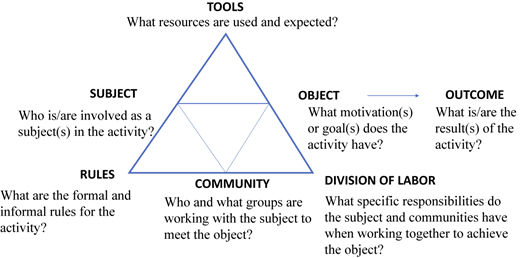
As introduced, an activity system was produced in the second generation with many previous scholars’ efforts (Leont’ev, 1978; Engeström, 1987). The theoretical framework under CHAT in Figure 1, following Engeström (1987, 2014) and Yamagata-Lynch (2010), provides a conceptual definition of six core components of the activity system. Teachers in a school’s practices could be viewed as an activity system in Figure 1. This activity system analysis framework enables a clear comparison between teachers’ practices in different institutions.
The process of producing this conceptual framework in Figure 1 was based on theoretical knowledge given by Engeström (1987), examples from Yamagata-Lynch (2010), and a previous project investigating preschool teachers’ enactment of early learning goals (Pei, 2022). In this project, the researcher listed elements and possible factors focusing on understanding preschool teachers’ practices. Teachers enacting learning goals in an institution were viewed as an activity system. Based on the elements and possible factors, the researcher provided the conceptual definitions of the activity system components as shown in Figure 1, which could be used for further educational research.
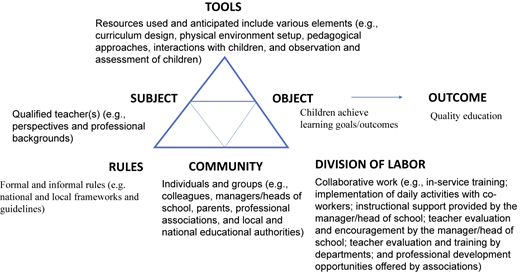
Tools that have an important mediating role are the resources the subject is using and expected to use in the activity system (Yamagata-Lynch, 2010; Engeström, 2014). Teachers, as the subjects involved in the activity system, generate their tools, including the curriculum, educational approach, etc., based on the learning goals. Object is the motivation(s) or goal(s) of the activity (Yamagata-Lynch, 2010; Engeström, 2014). Teachers (subject) are using tools to achieve the object: children achieving learning goals/outcomes, which will result in the outcome of quality education. Community refers to the individuals and groups who work with the subject, including managers, co-workers and parents in this research. Division of labor is the specific distribution of responsibilities between the subject and the community as they work together to achieve the object. Factors influencing teacher practices can be identified under the six core components. Figure 2 illustrates how this activity system model can be implemented within a school setting.
Research related to specific teachers’ practices in a particular school is to be analyzed through the lens of an activity system. In this way, the practices of teachers across different schools can be holistically examined and represented as distinct activity systems, allowing for meaningful comparison. Examples will be provided in the application section (see Figure 4 and Tables 1-3).
Supports and challenges identified in six core components and systemic contradictions
The factors identified under the six core components that actively influence teacher practices are considered supports, referring to contextual and professional elements, such as collaborative environments, pedagogical leadership, and professional development, that positively shape teachers’ practices (OECD, 2021; Hewett and La Paro, 2020). Challenges, on the other hand, are factors that negatively impact teacher practices, such as limited resources and unsatisfactory social recognition (Molla and Nolan, 2019; Pei, 2022).
Supports and challenges are stable in an activity system at a given point in time and will change when the components in the activity system are transformed, either artificially or through natural emergence. As Leont’ev (1978) states, an activity is a system that has a structure, its own development and its own internal transitions and transformations. In addition, artificial interventions can also change the supports and challenges (Engeström, 2014).
Investigating the systemic contradictions can reveal more challenges (Engeström, 2014), as well as the underlying reasons for those challenges in teacher practices. Level 1 contradictions lie in each of the six core components in the activity system (Engeström, 2014). A level 1 contradiction arises when what works best in practice (use value) does not align with what is officially required or rewarded (exchange value) (Engeström, 2014). For example, within the component of tools, use value refers to how teachers perceive the practical effectiveness of a method, while exchange value relates to how that method is recognized or rewarded through rules, policies, or external standards. If the teaching method used by a teacher in practice aligns with what is officially required or rewarded, no contradiction or challenge occurs. However, if the method a teacher uses in practice does not align with official requirements or rewards, a contradiction emerges.
Level 2 contradictions occur between the six core components of the central activity system (Engeström, 2014). They were identified in the investigation of the relationships between the components of the activity systems, such as teachers expecting more professional training opportunities, which can be identified as a contradiction between the subject and community/division of labor.
Level 3 contradictions occur when a culturally more advanced or innovative activity model is introduced into an existing activity system, leading to tensions between the new and established practices. These contradictions build upon the foundational tensions identified in level 1 (primary) and level 2 (secondary) contradictions (Engeström, 2014). In other words, they facilitate change by offering potential solutions to the challenges identified in levels 1 and 2.
As discussed in the above section, the activity system analysis methodology focuses solely on understanding teacher practices by identifying supports and challenges at a given time, and suggesting directions for improvement, rather than implementing changes through the research itself as in an experimental study. Thus, it does not apply new changes in practices as an intervention to modify the activity during the research or to elicit level 4 contradictions, which are related to level 3 contradictions and should only be explored after the educational experiment of a new activity system has been completed (Engeström, 2001). More examples of identifying the three levels of contradictions will be discussed in the application section.
Application
Ethical considerations
An example study to discuss activity system analysis methodology in this paper has received ethical approval from the Deakin University Ethics Advisory Group (Reference HAE-19–108). The researcher received signed Plain Language Statements and Consent Forms from all the participants of the sample preschools. Participants were aware that their audio would be recorded. Transcriptions from the audio recording and documentation provided by the participants used in this research were approved by them.
Data collection and analysis with activity system analysis methodology
Data collection and analysis under the activity system analysis methodology are a constructive and interpretive process (Charles and Lisa, 2019). The concept of six core components in the activity system effectively instructs what data should be collected. Activity system analysis serves as both a methodology and a method, according to the descriptions provided by Engeström (1987) and Yamagata-Lynch (2010). Themes generated under the components clearly describe teachers’ practices and then reveal three levels of contradictions under activity system analysis.
A purposive sampling
A purposive sampling method with clear criteria was used in the example study applying activity system analysis. Eighteen managers, teachers, and parents from three preschools in Chengdu were selected to ensure trustworthy and contextually rich data on implementing updated early learning goals. Chengdu, a culturally rich modern city, has been designated as a preschool education reform pilot zone in China since 2016 (MOE, 2020). One public (A), one private (B), and one universal private preschool (C) participated. In each, a certified headteacher from a 5–6-year-old class, a colleague (assistant/head teacher), and three interested parents from the same class were interviewed in 2019.
In-depth semi-structured interview and document review
Through the activity system analysis methodology, researchers can use in-depth semi-structured interviews (Denscombe, 2010) to obtain multiple voices from teachers, managers, co-workers and parents. Semi-structured interviews are effective for qualitative research with research questions focusing on what and why (Theophilus, 2018). In semi-structured interviews, the interviewer has “a clear list of issues and questions to be answered” (Denscombe, 2010, p. 113). This list can be developed based on the research question and guided by the six core components of the activity system model (see Figures 1 and 2). The interviewer can have a flexible order of interview questions to question the interviewees broadly based on what they are interested in elaborating on. In addition, documents could be requested during the interview to let the participants interpret their opinions, which would effectively enhance the trustworthiness of the data.
The document review method (Bretschneider, 2017) should be adopted for two main reasons. First, it provides researchers with essential background information. Second, the documents supplied by interviewees corroborate their interview statements, serving as “substitutes for records of activity the research could not observe directly” (Stake, 1995, p. 68).
In the example study, during the in-depth semi-structured interview conducted between 4 September to 13 October 2019, the researcher asked the interviewees to provide relevant documentation for interpreting their opinions during the interview process when needed, as this clarified their interpretation and the researcher’s understanding from an interpretive perspective (Denzin and Lincoln, 2000).
Data analysis: coding in six steps and reveals three levels of contradictions
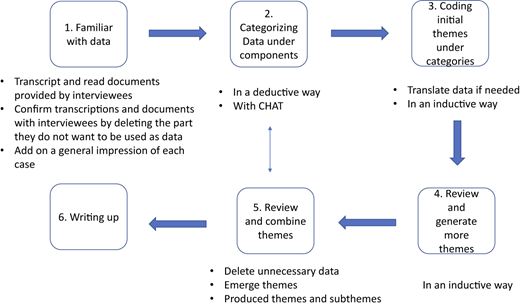
In the CHAT-activity system analysis, data can be coded with a combined deductive and inductive approach (Theophilus, 2018) in six steps as the main part of data analysis, as in Figure 3.
The first step is to familiarize the investigator with the data. The second step is to categorize data in a deductive analysis. The categories come under the existing six core components in the activity system (Engeström, 2014), as shown in Figure 1. Some qualitative analysis software, such as NVivo, helps code the raw data into clusters under the six core components.
In steps three to six, ideas for generating themes were inspired by Maguire and Delahunt (2017), who described how to generate themes from grounded data using the thematic analysis method. Themes should be identified based on whether they are related to answering the research question. Coding with the original transcriptions and translating selected data into English (if needed) helps improve data analysis efficiency.
The fourth step was reviewing and generating more themes inductively. In addition to coding the data within the predefined categories, the investigator may identify additional potential themes based on the original data and the initial themes. The fifth step is reviewing and combining the themes. Some unnecessary themes must be deleted or merged based on whether they are related to answering the research question. The final themes and subthemes will be produced. The final themes will answer the research question. The sixth step is writing up. Each theme is addressed in the findings in turn.
Following the six steps of data coding, the activity system of teachers’ experience in the institute is generated. The next vital part of data analysis is about the three levels of systemic contradictions. Contradictions and related tensions in the activity system explore the challenges in teachers' experience and generate possible changes in the future.
The nature of an activity system with six core components and contradictions allows a comparison of teachers’ practices in various contexts. More examples will be discussed in the next section.
How to reveal challenges and supports with activity system analysis
As discussed above, utilizing the activity system analysis in six steps, the activity system would be generated with specific themes under six core components–subject, tool(s), object, rules, community, and division of labor (Engeström, 1987; Yamagata-Lynch, 2010). The factors supporting teachers’ practices and some challenges lie within these themes under the six core components. More challenges negatively influencing teachers’ practices are mainly based on the analysis of three levels of systemic contradictions. The clear structure of the six core components and systemic contradictions in the activity system enable a comparison of teachers’ practices in different contexts. The following subsections give examples for a better understanding.
Supports and challenges in the themes under activity systems
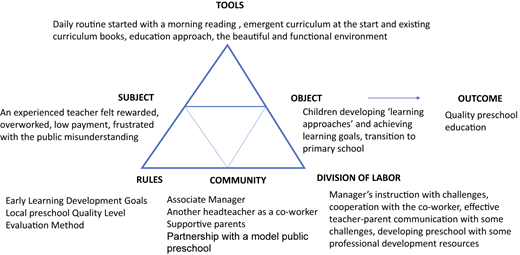
The conceptual definitions of the six core components in the activity system for investigating teachers’ practices are given in Figure 1. Supports and challenges in teachers’ practices could be identified in the themes within each of those six core components. Here is an example of themes under the six core components generated from preschool B as an activity system of teachers enacting early learning goals.
As shown in Figure 4, the subject was an experienced teacher with job-related satisfaction from interaction with children. She was overworked, had low pay with some side benefits and was frustrated by the lack of public understanding of her role. The subject used tools including a daily routine that started with morning reading, initial implementation of the emergent curriculum and existing curriculum books, educational approaches of being child-centered, learning through play and daily life experience and learning stories, as well as a beautiful and functional physical environment. The object was for children to develop “approaches to learning”, achieve learning goals and transition to primary school. The subject followed the rules of the early learning development guideline (ELDG). Chengdu preschool quality level evaluation method and preschool teachers’ professional standards. The associate preschool manager, another headteacher as a co-worker, supportive parents and the educational group, including a model public preschool, were the community in Activity System B. The division of labor means the associate manager’s instruction with challenges, cooperation between the two headteachers, effective teacher-parent communication with some challenges and developing the preschool with some professional development resources.
In the example project, teachers’ enactment of early learning goals also produced an activity system A in preschool A, and an activity system C in preschool C. This part further discusses how to reveal supports and challenges in the themes under activity systems comparatively, by providing examples related to the activity system components of the subject and the tools in the three preschools. In the example project investigating preschool teachers enacting learning goals in the preschool, the researcher produced themes in Table 1 in three different preschools A, B, and C under the subject, one of the six core components. Themes under the subject should reveal the person or group involved as the subject in the specific practices.
The themes in the table allow for a comparison of teachers as subjects across the three different contexts. Those themes reveal support across all three preschools that teachers were all experienced teachers with passion or job-related satisfaction. Also, it finds that all three preschool teachers faced challenges in a disadvantaged situation with low pay and high workloads. Comparatively, teachers in public preschool A and private preschool B were more concerned with challenges related to undervaluation in social recognition.
Tools, as another one of the six core components in the activity system, are vital as they could explain the teachers’ behavior and reflect their thinking in detail. Subthemes might be generated from data to better summaries what specific resources were used and expected for teachers.
A selection of evidence related to tools in the example project is outlined below. As presented in Table 2, the tools in public preschool A included a well-prepared timetable, systemic guideline-based emergent curriculum, education approach and effective physical environment. In private preschool B, identified themes under tools were the timetable, education approach, initial implementation of emergent curriculum and existing curriculum books, education approach and beautiful physical environment. The tools in the universal private preschool C were identified as the timetable, emergent curriculum at the initial stage, educational approach with challenges, various activities without effective documentation on child observation and scarce resources.
The themes identified under the activity system component tools in Table 2 show that it’s effective to comparatively analyze what resources were used and expected in three preschools for teachers’ practices with more details in the subthemes. For example, the three preschools had similarities in the timetable, curriculum design, various activities, educational approach and physical environment. Differences lie in teachers at the public preschool A having sufficient resources to apply action research with creative thematic activities and a supportive physical environment as a support. Comparatively, teachers in private preschools B and C had the physical environment as a challenge or scarce resources to support activities. Also, the public preschool A had a systemic emergent curriculum as support. Conversely, private preschools B and C both had an emergent curriculum in the initial stage and referred to existing curriculum books to some extent as a challenge.
More challenges in three levels of contradictions
Beyond identifying supports and challenges through themes across the six activity system components, systemic contradictions are further analyzed to reveal challenges in teachers’ practices. The explicit three levels of contradictions enable a comparison in various contexts. Level 1 contradictions lie in the components of the activity system and are strongly related to the themes themselves under the six core components. Table 3 shows how level 1 contradictions were identified from the themes under six core components in the example project.
It’s clear to compare teachers’ challenges in three preschools from the systemic contradictions as evidenced in Table 3. Private preschools B and C had more challenges as the level 1 contradictions were revealed. Similarly, the three preschool teachers all had challenges of disadvantaged situations.
Level 2 contradictions are between the components in the activity systems, which are related to the level 1 contradictions. For example, contradictions between the subject and the tools were identified in all three preschools in the example project. They were challenged by how to meet different individual needs and apply a child-centered approach. In comparison, teachers in the private preschool were especially challenged by extensive paperwork. Teachers in private preschool B were occupied with many tasks, such as preparing materials and paperwork. Heavy workload demands prevented them from interacting with the children as much as they wanted. In universal private preschool C, the shortage of educational resources made interaction with individual children significantly more difficult.
Many contradictions could be identified in level two between the six core components. Another example is identified between the subject and the community/division of labor. These examples demonstrate how powerful activity system analysis is in discovering facts in the real world by involving multiple voices in the community.
Contradictions were identified between Preschool managers’ pedagogical leadership and appropriate instructions (community/division of labor) and teachers (subject) in private preschools B and C, but not in preschool A. The experienced manager in public preschool A was very supportive of teachers’ practices. Conversely, the professional confusion about how to conduct action research by the manager in private preschool B negatively influenced teachers’ enactment of early learning goals. The manager of universal private preschool C expressed reservations about enhancing teacher qualifications due to concerns about high staff mobility. Different instructions from managers resulted in various teachers’ behaviors. Teachers in preschools A and B had opposite opinions regarding using the integrated curriculum books. For the certified teacher in preschool A, the activities in the books limited her creative environment design. She thought the ideas about environment design should come from the children. In comparison, the certified teacher in preschool B thought the integrated curriculum books supported her environment design when she had no idea about the emergent curriculum. These differences reflect their different abilities to generate emergent curriculum from the children’s perspective under the various influences from the manager’s pedagogical leadership.
Level 3 contradictions go beyond the activity system and are based on the level 1 and level 2 contradictions. Possible changes as solutions can be identified in level 3 contradictions (Engeström, 2001, 2014). Comparatively, in public preschool A, the change may center on adding tools to better support individual learning. In contrast, teachers in the two private preschools require more changes. Apart from benefiting the transition to primary school, the tools in the new activity system for private preschool B could also include a developmentally appropriate curriculum and effective physical environment support. For the universal private preschool C, the tools in the new activity system could also include sufficient educational resources, such as materials and training opportunities. The changes will bring new supports and challenges to teachers’ practices when those new tools are adopted.
Conclusion
The CHAT activity system analysis methodology offers a powerful lens for identifying supports and challenges in teacher practices, especially through a comparative approach. This is because the six core components in the activity system and systemic contradictions provide a structured framework for understanding teacher practices by involving multiple voices and unpacking real-world data into digestible insights. This paper outlines how to apply CHAT to educational research using activity system analysis methodology (Engeström, 1987, 2014; Yamagata-Lynch, 2010), along with in-depth semi-structured interviews (Denscombe, 2010), document review (Bretschneider, 2017), and aligned data analysis methods. The activity system model guides both data collection and analysis in exploring teacher practices.
Purposive sampling was used for case selection. In-depth semi-structured interviews (Denscombe, 2010), from an interpretive perspective, are effective for uncovering what’s happening in teachers’ practices and why. Data from transcriptions and documentation provided by the interviewees build a strong foundation for understanding teachers’ practices from the multiple perspectives of teachers, colleagues, managers and parents, reinforced by document review (Bretschneider, 2017).
Data analysis consists of two parts. First, themes are coded under the six core components—subject, tools, object, rules, community, and division of labor (Engeström, 1987, 2014; Yamagata-Lynch, 2010), following six steps shown in Figure 3. Second, analysis explores three levels of contradictions in activity systems to reveal deeper challenges and suggest directions for change (Engeström, 1987, 2014). This process clarifies what should be found, what has been found, and what should be selected to investigate teacher practices.
This illustrative study on teachers’ enactment of learning goals shows the effectiveness of activity system analysis in identifying supportive and constraining factors within practices across educational settings. It demonstrates that the methodology yields significant theoretical insight into shared and differing challenges among teachers comparatively. Future cross-cultural research may also benefit from applying this methodology within CHAT.
The activity system analysis methodology focuses on understanding influences on “human activity” (Engeström, 2014, p. 33) and suggests possible directions for improvement, rather than initiating changes during the research (Postholm and Vennebo, 2020). This is both a limitation and a strength. Compared to Engeström’s (2014) formative intervention methodology, which experimentally drives change, activity system analysis is more suited to short-duration or fieldwork-constrained research. Additionally, it is more feasible to apply, as it involves fewer ethical complexities than formative interventions (Nuttall, 2022).
In conclusion, activity system analysis is a robust methodology for investigating teacher practices with various influences. Aligned with in-depth semi-structured interview methods, identifying themes across six core components and systemic contradictions of the activity system becomes a valuable tool for exploring support and challenges in educational settings.
I sincerely thank the managers, teachers, and parents who participated in this study. Special thanks go to Associate Professor Jeanne Allen for her guidance in selecting CHAT, and to Professor Andrea Nolan, Associate Professor Anne-Marie Morrissey, and Dr Karen Guo for their insights that helped shape my Ph.D. project. I am also grateful to Professors Bruce Fuller, Linda Hobbs, and Nicola Yelland for their encouragement to pursue publication. I deeply appreciate the constructive feedback from the anonymous reviewers, the support of the editorial team, and the valuable comments received during my presentations at the 2022 National Association for the Education of Young Children (NAEYC) Annual Conference and the 2024 American Sociological Association (ASA) Annual Meeting.