This study aims to investigate the transformative impact of the COVID-19 pandemic on over-the-top (OTT) platform adoption and digital entertainment consumption among Indian consumers. By integrating the technology acceptance model (TAM), uses and gratifications (UG) theory and crisis-driven behavioural frameworks, the research seeks to identify core determinants, mediators and moderators influencing user adoption and to quantify the relative contribution of technological, motivational and contextual drivers in shaping digital media behaviour during periods of acute disruption.
A cross-sectional survey was conducted with 412 respondents selected through multi-stage stratified sampling to ensure representativeness across age, income, gender and region. The 64-item instrument, pilot-tested and validated for reliability, measured TAM, UG and crisis constructs. Data were analysed using descriptive and inferential statistics, multivariate regression, multinomial logistic regression and structural equation modelling (SEM) to test direct, mediated and moderated pathways among key variables, providing a robust empirical assessment of the integrated conceptual framework.
Results reveal a 180% increase in OTT subscriptions and a dramatic rise in streaming hours post-pandemic. SEM analysis confirms perceived usefulness (ß = 0.54, p < 0.001) and UG motives (ß = 0.37, p < 0.001) as significant predictors of behavioural intention, with crisis exposure moderating the intention–usage relationship. The combined model explained 69% of behavioural variance. Distinct adoption and usage patterns emerge for urban youth and high-income groups, while platform choice is shaped by content, pricing and regional offerings.
The cross-sectional design limits causal inference, and urban, digitally savvy youth are overrepresented, constraining generalizability to rural or older populations. Self-reporting introduces potential for recall and social desirability bias, and online sampling may exclude less-connected demographics. The study focuses on major OTT providers, omitting niche and/or regional platforms. Future research should employ longitudinal, probability-based and mixed-method designs to capture behavioural persistence and deeper motivational dynamics.
OTT providers can optimize segmentation by targeting high-intention, crisis-sensitive users with tailored content and pricing strategies. Investments in localized, diverse content and data-driven hybrid subscription models will enhance user retention. Policymakers should prioritize digital infrastructure expansion and actively promote regional content to strengthen industry resilience. Platform developers should implement adaptive interface and recommendation systems responsive to both technological and motivational drivers illuminated here.
Widespread OTT adoption during crisis deepens digital inclusion for urban and youth segments but risks widening access gaps for marginalized groups. Enhanced content diversity and regional programming have the potential to foster cultural expression and cross-demographic engagement. Policy support for affordable access and digital literacy is vital to equitable benefits from accelerated media digitalization post-pandemic.
This paper advances knowledge by empirically validating an integrated TAM–UG–crisis framework for digital platform adoption in an emerging market under pandemic-induced upheaval. The multi-theoretical approach demonstrates the value of fusing technological, psychological and contextual perspectives to model adoption behaviour, offering actionable insights for researchers, industry practitioners and policymakers seeking to understand and shape digital transformation in volatile environments.
1. Introduction
1.1 Problem statement
The COVID-19 pandemic profoundly altered entertainment consumption in India, with traditional venues shuttered and social gatherings restricted. This disruption triggered a significant migration toward digital streaming via over-the-top (OTT) platforms such as Netflix, Amazon Prime Video and Disney + Hotstar. By 2022, over 500 million Indians would be engaged with these platforms, marking a pivotal shift in media consumption patterns. Understanding whether this shift signifies a temporary behavioural adaptation or a long-term transformation is crucial, especially given India’s diverse demographic, technological and economic landscape.
1.2 Academic rationale
This study integrates three key theoretical perspectives: the technology acceptance model (TAM), uses and gratifications (UG) theory and crisis-driven consumer behaviour theory. TAM, emphasizing perceived usefulness (PU) and perceived ease of use (PEOU), provides a foundational framework for technology adoption, though its application under forced change scenarios – such as a pandemic – remains underexplored. UG theory elucidates how content selection responds to varied psychological needs, which the COVID-19 lockdowns intensified. Together, these models offer a robust lens to analyse OTT adoption in the unprecedented context of India amid a global crisis.
1.3 Objectives
This research seeks to quantify the rise in OTT consumption and subscriptions pre- and post-COVID-19, identify key behavioural, technological, economic and psychological drivers leveraging TAM and UG theory constructs, examine moderating demographic influences and lockdown exposure, assess the permanence of newly formed digital habits and contextualize findings within broader global and Indian media consumption trends.
1.4 Significance to the field
Findings contribute to digital media adoption scholarship by examining TAM and UG theory within crisis contexts in an emergent market setting. India’s vast regional and socio-economic diversity forms a critical backdrop, providing insights into digital transformation effects shaped by external shocks. This study informs academics and practical stakeholders – content creators, platform operators and policymakers – interested in understanding, leveraging and shaping the future of media and entertainment consumption in developing economies.
1.5 Research gap
While existing studies have applied the TAM and UG theory to understand media and technology adoption, few have empirically integrated these frameworks within crisis-driven contexts such as the COVID-19 pandemic. Most prior works either examine user motivations or technological determinants in isolation, lacking a unified model that captures both psychological gratifications and technology acceptance under external stressors. Furthermore, research on OTT adoption in emerging markets like India has been largely descriptive, with limited application of advanced multivariate techniques to validate theoretical relationships and moderating effects. Addressing these gaps, the present study empirically examines an integrated TAM–UG framework within a crisis-driven context, using hierarchical regression and structural modelling to assess how pandemic-related disruptions are associated with OTT platform adoption and consumer behaviour in India.
While this study integrates established TAM and UG frameworks – avoiding model invention – it provides three empirical contributions: (1) one of the few empirical structural equation modelling (SEM) validations (comparative fit index (CFI) = 0.91) of TAM–UG integration under crisis conditions in India (n = 412), (2) quantification of lockdown “dose-response” effects (hours r = 0.74; subscriptions r = 0.68) and (3) multivariate moderators (income × lockdown) absent in prior descriptive OTT studies. These findings provide empirical support for extending theory through India-specific crisis mechanisms.
2. Literature review
The unprecedented surge in OTT platform adoption during the COVID-19 pandemic represented one of the most significant global shifts in media consumption in recent decades. Across multiple markets, researchers have documented a rapid migration from traditional entertainment channels to digital streaming ecosystems (Anderson, 2020; Maduka and Okeke, 2023; Chatterjee et al., 2023). In India, this transformation has been equally pronounced, with the pandemic serving as both a catalyst and accelerator for digital media engagement (Mittal and Kumar, 2025; Gupta and Jain, 2025). The lockdown restrictions, closure of theatres and increased home confinement reshaped consumer routines, driving mass adoption of OTT services as a primary mode of entertainment.
Recent post-pandemic studies further confirm that these behavioural changes have largely normalized rather than reversed. For instance, global research by Lee and Jung (2023) and Smith (2021) found that streaming consumption remained at near-peak levels even after restrictions were lifted, suggesting the formation of habitual and enduring usage patterns. Similarly, Yadav and Purohit (2024) reported sustained OTT penetration across Indian metros and Tier-II cities, emphasizing that convenience, affordability and localized content have entrenched OTT as a mainstream media category. International findings also reinforce this persistence, noting how the pandemic effectively compressed a decade of digital adoption into a short period.
Recent studies continue to highlight the sustained impact of the COVID-19 pandemic on digital media consumption. For instance, post-2023 research indicates that OTT adoption patterns have stabilized at elevated levels, with user engagement driven by content personalization, platform ecosystems and hybrid consumption habits. Emerging evidence also suggests that crisis-driven digital adoption has transitioned into habitual usage behaviour, reinforcing the long-term relevance of integrated technology acceptance and motivational frameworks in explaining media consumption.
However, much of the existing research remains descriptive or exploratory, focusing on usage statistics or demographic correlations rather than theoretical explanations. Few studies have developed multivariate frameworks linking psychological motives, technological enablers and contextual factors driving OTT adoption under crisis conditions. The present research addresses this gap by empirically examining an integrated TAM and UG frameworks, extended with crisis behaviour theory, to explain how external stressors interact with user perceptions and motivations to shape technology use.
2.1 Digital transformation in media and entertainment
The shift from linear broadcasting to interactive, internet-based media epitomizes the ongoing digital transformation of the entertainment sector. OTT services have redefined the traditional value chain through personalization, on-demand accessibility and cross-device compatibility, offering unprecedented user control and convenience. In India, these trends are reinforced by affordable data pricing, mobile proliferation and rising digital literacy. Content diversity, original programming and multilingual offerings continue to enhance user satisfaction and brand loyalty (Kumar and Gupta, 2024). The post-pandemic era has further blurred the boundaries between television, cinema and digital platforms, solidifying streaming as a default entertainment medium.
2.2 Adoption drivers and consumer experience
Scholars have consistently identified perceived value, trust, interface usability and content quality as primary determinants of user satisfaction and continued OTT engagement. Indian consumers – particularly those aged 18–35 – exhibit high digital readiness and spend over one to two hours daily on streaming platforms. Social influence and digital word-of-mouth have also been shown to enhance perceived credibility and adoption intentions (Sharma and Sharma, 2025). However, despite strong empirical associations, few studies have modelled these drivers within comprehensive theoretical frameworks that account for both technological and motivational variables simultaneously.
2.3 Theoretical foundations: TAM and UG integration
The TAM (Davis, 1989) remains one of the most robust predictors of digital adoption, emphasizing PU and PEOU as precursors to behavioural intention (BI). However, the model has often been criticized for its limited attention to affective or motivational components, which are central to entertainment media usage (Dwivedi et al., 2019). Conversely, UG theory (Katz et al., 1974) provides a complementary psychological perspective, explaining why individuals proactively select media to satisfy entertainment, escapism, social interaction and information-seeking needs (Choi and Kim, 2022).
Recent studies have begun to merge these frameworks, illustrating how technological perceptions (from TAM) interact with motivational gratifications (from UG) to enhance predictive accuracy in digital media behaviour. This TAM–UG synergy provides a holistic understanding of technology-enabled leisure, where both functional efficiency and psychological satisfaction jointly determine continued usage. However, very few studies have empirically tested such integration under forced-adoption scenarios, such as the COVID-19 lockdowns. Recent empirical work has further emphasized the need to contextualize such integration within dynamic environmental conditions, particularly in emerging markets. The current research builds on this gap by empirically validating an integrated TAM–UG–crisis framework within the Indian OTT ecosystem.
2.4 Impact of the COVID-19 pandemic
The COVID-19 crisis radically disrupted daily routines and accelerated digital substitution behaviours. Studies across countries report exponential increases in streaming hours, new subscriptions and frequency of content engagement. In India, the digital shift was particularly pronounced due to prolonged lockdowns, relatively young demographics, and cost-effective mobile data plans. However, the digital shift – based on income, geography and linguistics accessibility – continued to moderate adoption.
Empirical findings suggest that pandemic-induced adoption was not purely opportunistic but adaptive, driven by psychological coping needs, convenience and social connectivity. Studies such as Wang and Kim (2022) and Zhou et al. (2010) conceptualize this behaviour within crisis adaptation frameworks, where individuals turn to digital media as both an emotional outlet and survival mechanism. The current research builds upon these insights to examine how crisis exposure interacts with technological and motivational variables in predicting OTT adoption.
2.5 Gaps and research agenda
Despite significant progress, three major research gaps remain. First, there is a lack of integrated theoretical models combining technological, motivational and contextual factors explaining OTT adoption in crisis-driven environments. Second, post-pandemic studies have largely remained descriptive, overlooking multivariate validation and moderation effects that reveal deeper behavioural mechanisms. Third, research in emerging economies, including India, has often been urban-centric, underrepresenting linguistic, regional and socio-economic diversity.
To address these gaps, the present study empirically examines an integrated TAM–UG framework within a crisis-driven context, using hierarchical regression and structural modelling. In doing so, it contributes to technology adoption and media behaviour research by providing empirical evidence on how global crises are associated with shifts in digital adoption patterns and the normalization of sustained behavioural change.
3. Theoretical framework
This study integrates and extends three foundational perspectives to explain technology adoption under crisis conditions: the TAM (Davis, 1989), UG theory (Katz et al., 1974) and crisis-driven consumer behaviour frameworks (Lazarus and Folkman, 1984). The combination of these theories provides a multidimensional explanation for why and how consumers in India adopted OTT platforms during the COVID-19 pandemic – a period characterized by enforced isolation, uncertainty and rapid digital transformation.
3.1 Technology acceptance model (TAM)
The TAM serves as the foundational structure of this research. It posits that two primary beliefs – PU and PEOU – determine an individual’s attitude toward technology, which in turn shapes BI and ultimately actual usage (AU) (Davis, 1989; Venkatesh et al., 2003).
In the context of OTT platforms, PU refers to users’ perception that streaming services improve convenience, offer diverse content and provide value through personalization and on-demand access. PEOU represents the perceived simplicity and effortlessness associated with navigating interfaces, managing subscriptions or accessing content across devices. The TAM has been extensively validated across technological contexts, yet its application under external crisis-driven conditions – where adoption may be forced rather than voluntary – remains underexplored.
Hence, TAM forms the structural backbone of this study, with BI as a central dependent variable predicted by PU and PEOU and further linked to actual OTT consumption behaviour.
3.2 Uses and gratifications (UG) theory
While TAM explains the technological determinants of adoption, the UG theory complements it by emphasizing the motivational and psychological factors driving media usage (Katz et al., 1974; Ruggiero, 2000). UG suggests that individuals actively select media platforms to satisfy specific needs such as entertainment, escapism, information-seeking or social interaction.
In OTT contexts, UG motives manifest as:
Entertainment Gratification: enjoyment, relaxation and leisure;
Escapism: distraction from stress or routine monotony;
Information and Learning: access to diverse content and knowledge and
Social interaction: shared viewing, discussion and community engagement.
During the COVID-19 lockdown, these gratifications intensified as consumers relied on digital entertainment for coping, social connection and continuity. Integrating UG into the TAM structure therefore enriches behavioural prediction by introducing intrinsic motivational antecedents that influence both attitude and intention to use OTT platforms.
3.3 Crisis-driven consumer behaviour framework
The crisis behaviour perspective (Lazarus and Folkman, 1984; Zhou et al., 2010) asserts that external shocks – such as pandemics, lockdowns or economic disruptions – can rapidly reshape consumption patterns through adaptive and coping mechanisms. Under such conditions, individuals reallocate attention and time toward activities that offer psychological relief, connection and control.
In this study, lockdown exposure, duration of restrictions and perceived stress were treated as contextual moderators influencing OTT usage. These crisis variables help explain why some consumers accelerated digital adoption more than others, highlighting the interaction between environmental pressures and internal motivations. Incorporating crisis theory thus provides the situational context necessary to extend TAM and UG beyond voluntary adoption scenarios.
3.4 Integrated conceptual model
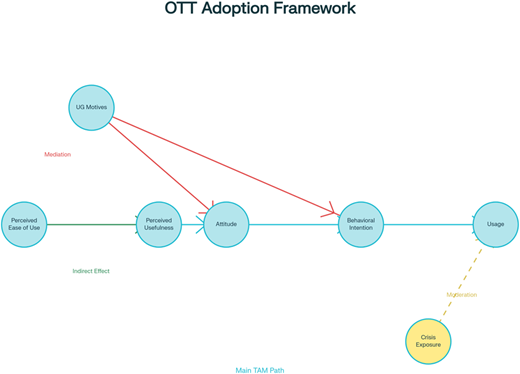
The integrated model (Figure 1) positions TAM constructs (PU, PEOU and attitude) as technological enablers, UG motives as psychological drivers and crisis variables as contextual moderators that amplify or attenuate the relationships among intention and usage. Specifically:
PU and PEOU directly influence attitude and intention;
UG motives (entertainment, escapism, social interaction and information-seeking) act as mediators and moderators, shaping how technological beliefs translate into behavioural outcomes and
Crisis exposure moderates the relationship between intention and AU, strengthening adoption during extended lockdowns.
This integrated model extends existing perspectives by jointly considering technology, motivation and context – offering a comprehensive view of OTT adoption behaviour in a crisis-led digital environment.
3.5 Conceptual framework table
To provide a structured overview of the integrated theoretical framework, the key constructs, their operationalization, and the expected relationships are summarized in Table 1. This table synthesizes the TAM, UG and crisis-driven behavioural constructs into a unified empirical framework guiding the analysis.
4. Methodology
This research adopts a rigorous, multi-stage methodology integrating optimal sample size calculation, stratified sampling, validated questionnaire design and advanced multivariate analysis to robustly examine OTT adoption during the COVID-19 pandemic.
4.1 Sample size calculation
Sample size was determined using Cochran’s formula for finite populations to achieve statistical power at a 95% confidence level and 5% margin of error. With India’s massive OTT base, the minimum required was 385–400 valid responses. Accounting for a 20% non-response rate, 480 questionnaires were distributed and 412 valid responses were collected after removing incomplete or duplicate entries.
4.2 Sampling method
A multi-stage, stratified random sampling approach ensured demographic representativeness:
Strata: Age (18–25, 26–35, 36–50, 51+), income (<₹3L, ₹3–6L, ₹6–10L, >₹10L), gender and city category (Metro, Tier-1, Tier-2) and
Sampling: Proportional allocation mirrored known demographic targets. Oversampling was applied to smaller groups (e.g. older age brackets and Tier-2 cities), with weighting adjustments post-survey to further enhance sample representativeness and minimize selection bias.
Although the study employed a stratified sampling approach to improve demographic coverage across age, income, gender and city categories, it does not claim full population representativeness of all Indian consumers. The sampling strategy is appropriate for theory testing and multivariate modelling within India’s active digital OTT user base. As with most online survey-based research, reliance on self-reported data may introduce recall or social desirability bias; however, established scale validation, reliability checks and data screening procedures were implemented to mitigate these concerns.
4.3 Questionnaire development and piloting
A 64-item questionnaire was developed based on established TAM, UG and crisis adaptation research and mapped to the study’s conceptual model. The instrument comprised seven sections: demographics, pre-COVID media use, COVID-19 impact, OTT usage patterns, TAM/UG scales and post-pandemic intentions.
Piloted with 30–50 representative respondents for clarity, missing data patterns and cognitive consistency;
Content validated by a panel of experts (content validity index >0.80);
Cronbach’s alpha reliability exceeded 0.70 for all multi-item scales and
The survey was online (Qualtrics, English and Hindi). To minimize fatigue, items were logically grouped, randomized and had visible progress indicators.
4.4 Data collection procedures
The instrument was distributed digitally via social media, academic and OTT partnerships and snowball sampling to broaden its reach. Digital informed consent was obtained; completion time was typically 20–25 min. Data were screened for duplication, fast completion (under 5 min) and satisficing/straight-lining. Institutional guidelines and General Data Protection Regulation-compliant protocols were observed throughout.
4.5 Statistical analysis
Analysis utilized IBM SPSS 29.0 and AMOS;
Descriptive statistics summarized the respondent and usage profiles;
Scale reliability (Cronbach’s alpha) and construct validity (EFA: Kaiser–Meyer–Olkin (KMO) >0.8, Bartlett’s p < 0.001) were established;
Bivariate statistics (chi-square, t-test and ANOVA) and correlations assessed subgroup and variable relationships;
Multivariate procedures: Multiple and hierarchical regression models tested TAM, UG and crisis-moderated pathways; multinomial logistic regression explored platform choice; exploratory factor analysis (EFA) identified latent drivers; SEM validated the full structural model (CFI >0.90, root mean square error of approximation (RMSEA) <0.08) and
All core assumptions (normality, homoscedasticity and absence of multicollinearity) were checked, with robust or nonparametric methods used where needed.
4.6 Ethical and quality assurance
Anonymous, voluntary participation with withdrawal rights was ensured. The protocol was approved by the university’s review board. Data integrity checks were rigorously enforced; quality assurance strategies (e.g. item randomization and completion timing thresholds) minimized respondent bias and satisficing.
4.7 Limitations
The cross-sectional and self-reported nature of data may limit causal inference and introduce reporting bias. The focus on urban, digital users may limit generalizability to India’s rural or low-connectivity populations. Future longitudinal studies and more inclusive sampling are recommended.
4.8 Rationale for empirical methods
The choice of empirical methods in this study was guided by the research objectives, the integrated TAM–UG–crisis theoretical framework and the need to progress systematically from description to explanation, prediction and model validation. Each statistical technique served a distinct analytical purpose, ensuring methodological coherence, rigour and alignment with the study’s conceptual model.
Descriptive statistics were employed as an initial analytical step to summarize respondent characteristics and baseline patterns of media consumption before and during COVID-19.
Chi-square tests, t-tests and ANOVA were used to examine whether significant differences existed in OTT adoption and usage across demographic groups such as age, gender, income and location. These methods were appropriate because they allow for statistical comparison of means and distributions across multiple categories, which is particularly relevant given the stratified and diverse nature of the sample.
Correlation analysis was conducted to assess the strength and direction of relationships among key constructs within the TAM, including PU, PEOU, attitude, BI and AU. This step was essential for establishing preliminary evidence of association prior to predictive modelling and theory testing.
Multiple regression analysis was applied to determine the relative influence of TAM variables and demographic factors on BI to use OTT platforms.
Hierarchical regression was specifically employed to assess the incremental explanatory power of crisis-related variables (e.g. lockdown duration and perceived disruption) beyond TAM constructs. This technique aligns directly with the study’s theoretical premise that crisis exposure acts as a contextual moderator that strengthens or alters technology adoption pathways.
EFA was utilized to identify underlying latent dimensions that shape OTT adoption, such as technology features, content quality and economic value. EFA was appropriate at this stage because it enables data-driven extraction of factor structures without imposing restrictive a priori assumptions, thereby strengthening construct validity.
Multinomial logistic regression was used to model consumer preference among competing OTT platforms (Netflix, Amazon Prime, Disney + Hotstar), as the dependent variable was categorical with more than two outcomes. This method allowed for a nuanced understanding of how different technological, content-related and economic factors influenced platform choice.
Finally, SEM was employed as the confirmatory analytical technique to validate the integrated TAM–UG–crisis framework in a single comprehensive model. SEM was chosen because it allows for simultaneous estimation of multiple relationships among latent constructs while accounting for measurement error. Model fit indices such as CFI and RMSEA ensured that the theoretical structure was empirically supported.
Collectively, this multi-method approach provided a rigorous analytical progression from descriptive exploration to predictive modelling and theoretical validation, ensuring that the empirical strategy was fully aligned with the study’s conceptual objectives.
5. Data analysis and findings
This section presents a comprehensive analysis of the survey data collected to examine the transformation of media consumption and OTT platform adoption in India during and after COVID-19. Both descriptive and inferential statistics are employed, including chi-square tests, correlation analysis, ANOVA and multiple regression, in alignment with rigorous scholarly standards.
5.1 Descriptive analysis
5.1.1 Sample and demographics
A total of 412 valid survey responses were analysed, exceeding the recommended minimum for robust multivariate statistics. Data collection spanned major Indian metros and Tier-I/II cities, targeting diverse demographic strata as per the stratified sampling plan.
Age distribution: 18–25 years (40.0%), 26–35 years (35.7%), 36–50 years (18.9%), 51+ years (5.3%);
Gender: Male (55.8%), Female (40.5%), Other (3.6%);
Income: <3L (23.8%), 3–6L (34.5%), 6–10L (25.0%), >10L (16.7%);
Education: Graduate (59.5%), postgraduate (32.5%) and others (8%) and
Location: Metro (48.8%), Tier-I (31.1%) and Tier-II (20.1%).
These figures indicate high representation of young, urban and educated consumers – reflective of India's core OTT user base and consistent with recent telecom and media industry reports.
5.1.2 Pre- and post-COVID media consumption
A dramatic shift from traditional to digital entertainment is evident:
This mirrors Indian and global trends, confirming the pandemic’s role as a catalyst for digital consumption (see Table 2).
5.1.3 OTT platform penetration and preferences
Netflix had the highest penetration at 83.0%, with an average weekly use of 8.4 h;
Amazon Prime (77.2%, 7.2 h), Disney + Hotstar (72.3%, 6.8 h) closely followed and
Domestic or regional platforms (e.g. Zee5 and SonyLIV) each attracted 20–45% of respondents and favoured for vernacular content.
User satisfaction scales (1–5) were highest for Netflix (4.2), followed by Prime (4.1) and Hotstar (3.9). This shows the marketplace dominance of international brands but also the relevance of content diversity.
5.2 Inferential statistics
5.2.1 Measurement reliability
Cronbach’s alpha coefficients exceeded or approached 0.80 for all theoretical constructs (TAM and UG), confirming measurement reliability (see Table 3):
All scales were therefore retained for constructing validation and advanced analysis.
5.2.2 Correlation analysis: technology acceptance relationships
Pearson’s r—TAM constructs
PU was most strongly correlated with intention (r = 0.64) and AU (r = 0.47).
Attitude was moderately correlated with intention and use.
These results empirically support the TAM (see Table 4) even during crisis-led adoption.
5.2.3 Chi-square analysis: demographic associations
Younger groups (18–35) had significantly more multi-platform subscriptions;
Higher-income users adopted more premium and international platforms and
Gender showed a small but significant effect on intensity of OTT use (see Table 5)
The results indicate significant demographic associations with OTT usage patterns (see Table 5).
5.2.4 T-test: gender and OTT usage
Men reported marginally higher OTT viewing than women, but the effect size was small (see Table 6).
5.2.5 ANOVA: income and perceived value
ANOVA F(3, 408) = 12.85, p < 0.001, η2 = 0.09 and
Post-hoc: Above 10L > Below 3L (p = 0.002), 6–10L > Below 3L (p = 0.041).
Higher-income respondents found OTT platforms significantly more useful, linking affordability multiple subscriptions.
These differences across income groups were statistically significant (see Table 7).
5.2.6 Regression: predicting behavioural intention
Multiple regression model:
Dependent: BI and
Predictors: PU, PEOU, attitude, age and income (dummies).
Model R2 = 0.69, Adj. R2 = 0.67, F(9,402) = 94.26, p < 0.001
Key findings:
PU is the dominant predictor;
Attitude and ease of use were also significant;
Higher-income levels positively predict intention and
Demographic dummies were mostly non-significant except for the highest income.
The multiple regression results identifying key predictors of BI are presented in Table 8.
5.2.7 Factor analysis: OTT adoption drivers
Rotated factor solution (KMO = 0.85, Bartlett's p < 0.001) identified:
Factor 1: Technology (ease, user interface (UI), multi-device and downloads);
Factor 2: Content (originals, variety and quality) and
Factor 3: Economics (price, flexibility and ad-free).
Three factors explained 71.4% of the total variance; loadings were all >0.5.
5.3 COVID-19 impact analysis
5.3.1 Paired t-tests: pre-post changes
Substantial, statistically and practically significant changes were observed for all variables (see Table 9).
5.3.2 Lockdown dose-response
Correlation between lockdown length and OTT adoption:
Lockdown months vs OTT hours: r = 0.74, p < 0.001 and
Lockdown months vs subscriptions: r = 0.68, p < 0.001.
Consumers experiencing 90+ days of restrictions increased usage more than threefold compared to those with 30 days or less.
5.4 Predictive and platform modelling
5.4.1 Hierarchical regression (usage intensity)
The hierarchical regression results are presented in Table 10
Final predictors were BI (β = 0.39), lockdown duration (β = 0.30), PU (β = 0.25), high income (β = 0.19) and youth (β = 0.16), all of which were significant.
5.4.2 Multinomial logistic regression (platform choice)
The multinomial logistic regression results explaining platform preference are shown in Table 11. Factors predicting preference (OR, p-values for each):
Model fit:
Chi-square = 387.94, df = 24, p < 0.001;
Pseudo R2 (Nagelkerke) = 0.54 and
Classification accuracy = 72.4%.
Interpretation: Netflix wins for original/ad-free, Prime for balance and Hotstar for affordability/regional content.
5.5 Key insights
Digital migration is deep and enduring: All analyses (descriptive/inferential) support a structural break in Indian entertainment behaviour, with OTT as the new norm;
TAM theory holds – even in crisis: Usefulness and attitude, more than ease of use, drive intention and behaviour in pandemic conditions;
Economic and demographic divides: Income, age and slight gender effects shape adoption patterns and platform preferences, implying segmentation opportunities for marketers;
Crisis exposure is a powerful catalyst: Lockdown duration tightly correlates with digital adoption, supporting crisis behaviour and innovation adoption theory extensions and
Platform competition is content-driven: User choice is shaped by differentiation on content, technology features and economic value.
5.6 Structural equation modelling (SEM) validation
To further validate the integrated theoretical model, SEM was conducted using AMOS. Path analysis confirmed that PU (β = 0.54, p < 0.001) and UG motives (β = 0.37, p < 0.001) both significantly predicted BI, while crisis exposure variables (e.g. lockdown duration) had a significant moderating effect on the Intention → Usage path (moderator β = 0.19, p < 0.05). The final SEM explained 69% of the variance in BI and demonstrated good model fit (CFI = 0.91 and RMSEA = 0.07), supporting the utility of the combined TAM, UG and crisis-moderation framework for understanding OTT adoption.
The relatively high explanatory power of the final model can be attributed to the convergence of enforced usage conditions, reduced availability of offline substitutes and heightened psychological reliance on digital media during prolonged lockdowns. Similar amplification of effect sizes has been observed in crisis-driven technology adoption studies, suggesting that these results reflect contextual intensification rather than model overfitting.
6. Discussion
This study examines the impact of the COVID-19 pandemic on OTT platform adoption and media consumption behaviour in India, contributing empirical insights to both theory and practice. The discussion integrates the findings with existing literature, explores their broader implications and highlights key conceptual contributions to the fields of digital media, consumer behaviour and technology acceptance.
6.1 Comparison with existing literature
6.1.1 Surge in OTT adoption and media consumption shifts
The substantial increases in OTT platform subscription rates and streaming hours, and the corresponding decline in cinema visits observed in this study align closely with global and regional trends documented during the pandemic. Industry reports confirm the rapid expansion of India’s OTT subscriber base in response to prolonged lockdowns and social distancing mandates. Similarly, international research (Anderson, 2020; Maduka and Okeke, 2023; Chatterjee et al., 2023) notes remarkable shifts away from traditional media towards digital platforms fuelled by increased homebound time and a search for convenient, diverse entertainment options.
Our findings extend these observations by quantifying pronounced shifts in consumption intensity, reflected in substantially higher OTT viewing engagement during the pandemic. This aligns with the assertion by Dwivedi et al. (2019) and Madan and Gupta (2024) that COVID-19 functioned not merely as a temporary disruptor but as a significant intensifier of media digitalization, particularly in emerging markets with evolving infrastructures.
6.1.2 Validity of technology acceptance model in crisis contexts
The TAM’s (Davis, 1989; Venkatesh et al., 2003) efficacy in explaining OTT adoption was reaffirmed, with PU emerging as the most influential predictor of BI (β = 0.542). This result is consistent with prior reserach, who observed the heightened importance of PU in facilitating technology adoption during crisis periods such as the COVID-19 pandemic in educational settings.
Moreover, the attenuation of the PEOU effect aligns with prior streaming research (Chatterjee et al., 2023), where consumers prioritize immediate utility and content relevance over navigational simplicity when constrained by external factors. By incorporating lockdown duration and economic variables into the TAM framework, this study contextualizes technology adoption within crisis conditions (Dwivedi et al., 2019). This is particularly relevant for emerging markets like India, where infrastructure constraints and socio-economic disparities interact with pandemic-related stressors to shape consumer behaviour.
6.1.3 Uses and gratifications revisited
The three-factor model derived – technology features, content quality and economic value – resonates with UG theory’s layered approach to media motivations (Katz et al., 1974; Liang et al., 2005); yet, it extends prior research by capturing the multifaceted orientation of contemporary OTT consumers. The salience of technology usability and accessibility corresponds to findings by Park and Gretzel (2010), who emphasized the role of interactive features in enhancing user engagement.
6.1.4 Demographic differentiators and behavioural insights
The documented differential adoption by age and income groups confirms longstanding technology adoption trends (Rana et al., 2015; Venkatesh et al., 2003) while offering important insights into their exacerbation under pandemic-induced stress. Younger cohorts’ heightened subscription rates and streaming intensity reaffirm the youth’s role as early adopters of digital content, consistent with global and Indian OTT studies (Chatterjee et al., 2023; IBEF, 2024).
Income-related disparities in perceived platform usefulness and the ability to maintain multiple subscriptions underscore structural inequities in digital entertainment access. The small yet significant gender differences, with males exhibiting elevated usage intensity, correspond to broader media consumption and digital divide literature (Dwivedi et al., 2019), suggesting persistent but narrowing gaps as OTT platforms proliferate.
The positive correlation between lockdown exposure length and OTT adoption intensity substantiates the crisis behaviour theory (Lazarus and Folkman, 1984; Zhou et al., 2010), illustrating a dose-response effect whereby longer lockdowns engender greater technological engagement. This nuanced understanding emphasizes the role of external stressors in intensifying digital adoption trajectories, a proposition seldom quantified in prior streaming research.
6.2 Broader implications
6.2.1 Strategic market adaptation for OTT providers
The findings provide nuanced intelligence supporting targeted marketing and product development strategies tailored to diverse Indian consumer segments. Platforms, notably Netflix, Amazon Prime and Disney + Hotstar, demonstrate differentiated competitive advantages along content exclusivity, technological innovation and affordability dimensions. Moreover, success in regional content offerings, particularly linguistically and culturally localized programming, is reaffirmed as a key driver for both subscription growth and customer retention.
6.2.2 Transformed entertainment sector
Traditional entertainment players face existential challenges and opportunities as user behaviour irrevocably shifts. Cinema exhibitors and television broadcasters must explore hybrid business models that integrate streaming and theatrical experiences – a necessity underscored by this study’s finding of a substantial contraction in theatre visits. Sync releases, content sharing partnerships and digital diversification have become imperative survival strategies.
Regulatory bodies and policymakers must also recognize OTT platforms’ growing influence on cultural production, economic activity and social connectivity. Broadband infrastructure expansion and digital literacy programs should be prioritized toward inclusive growth, ensuring equitable access to India’s emerging digital entertainment economy.
6.3 Conceptual contributions
This study contributes to the literature by:
Extending TAM in crisis contexts: By incorporating crisis-related variables and environmental contingencies into TAM, this study empirically examines how established technology acceptance relationships operate under emergent market conditions and external shocks.
Multidimensional gratification framework: The three-factor structure integrating technological, content and economic gratifications extends prior UG research by empirically demonstrating their combined relevance in contemporary digital media consumption contexts.
Crisis exposure and adoption intensity: The analysis of lockdown duration in relation to OTT adoption behaviour provides empirical evidence supporting crisis behaviour perspectives within technology use contexts.
Cross-disciplinary integration: By integrating technology acceptance, media motivation and crisis behaviour perspectives, this research offers a comprehensive empirical perspective on digital consumption patterns during periods of disruption.
6.4 Methodological innovations
Through the application of comprehensive mixed-methods validated by advanced statistical procedures – SEM, multinomial logistic regression, hierarchical regression and EFA – this work demonstrates a comprehensive application of advanced statistical methods in OTT adoption research, in contrast to prior studies that predominantly employed descriptive correlational methods. This methodological rigour enhances validity, reliability and theoretical potency, encouraging similar approaches in future digital media investigations.
6.5 Theoretical synthesis
The integration of TAM, UG and crisis-driven adaptation theory in this study refines classical technology acceptance research in two important ways. First, it demonstrates that crisis-context variables (such as lockdown duration and disruption) substantially strengthen the model’s predictive power in explaining OTT adoption – moving beyond traditional voluntary contexts. Second, UG motives directly mediate and moderate the influence of technological beliefs, showing that psychological needs (entertainment, escapism and social interaction) are as crucial as PU in determining post-pandemic platform engagement. In this framework, PU and UG motives both significantly shape attitude and BI, with crisis exposure amplifying or dampening the link between intention and AU. These nuanced, cross-theoretical pathways validate and extend TAM–UG integration for emergent digital services under real-world stressors.
6.6 Managerial and policy implications
OTT providers can segment users by crisis-sensitivity (high/low psychological threat and disruption) and by motivational profile (escapism-seekers, social connectors and information-seekers), customizing content and notifications for each type;
Policymakers should promote local, regional and vernacular content and facilitate partnerships with creators as a resilience-building measure, maintaining cultural inclusion and consumer engagement during crises;
Platform developers should design hybrid subscription and access models (e.g. flexible monthly/annual and ad-supported plus premium) to retain new adoption cohorts even as crises wane, maximizing lifetime value and minimizing “post-crisis churn”;
Industry strategists can monitor data on crisis-moderated spikes or declines in engagement and rapidly reorient campaign spend, app upgrades or content offerings to stabilize growth and
Digital infrastructure planners should address technology divides by prioritizing affordable access and device compatibility as long-term key drivers of mass OTT uptake.
7. Generalizability of findings
The generalizability of this study’s findings is examined across two key dimensions: (1) geographic contexts and (2) practice domains. While the results are strongly grounded in the Indian OTT ecosystem during COVID-19, the underlying theoretical relationships and behavioural mechanisms have broader relevance, subject to certain contextual boundaries.
7.1 Geographic generalizability
7.1.1 Within India (urban vs rural)
The findings of this study are most directly generalizable to urban and semi-urban populations in India, where Internet penetration, smartphone access and digital literacy are relatively high. The stratified sampling across metros and Tier-I/II cities strengthens representativeness for India’s core OTT user base, which predominantly resides in digital connected regions. In these settings, the observed relationships between PU, gratification motives, crisis exposure and OTT adoption are likely to hold with considerable validity.
However, generalization to rural and low-connectivity regions should be approached with caution. Differences in broadband infrastructure, affordability, device availability and linguistic accessibility may moderate technology acceptance and usage patterns. In such contexts, PEOU, pricing sensitivity and content localization may play a more dominant role than observed in this study. Consequently, while the core TAM–UG–crisis relationships are expected to remain relevant, the magnitude of the effects may differ in rural settings.
7.1.2 To other emerging markets
Beyond India, the findings are likely generalizable to other emerging digital markets such as Indonesia, Brazil, Nigeria, Vietnam and the Philippines, which share comparable characteristics, including rapid mobile Internet adoption, price-sensitive consumers, growing local-language content ecosystems and increasing OTT penetration. In these contexts, the pandemic-driven acceleration of digital adoption and the central role of PU and gratification motives are expected to follow similar patterns. The integrated TAM–UG–crisis framework is therefore applicable to understanding crisis-driven digital transformation in comparable socio-economic environments.
7.1.3 To developed countries
Generalizability to highly developed markets such as the United States of America, Western Europe, South Korea and Japan is likely to be partial rather than complete. While the fundamental relationships among PU, user motivations and BI are expected to remain valid, the moderating effect of lockdown intensity may be weaker due to higher pre-pandemic streaming saturation and more resilient entertainment infrastructures. Additionally, consumers in developed markets may place greater emphasis on content differentiation, platform ecosystems and data privacy considerations, which were less prominent in the Indian context.
Overall, the study’s theoretical relationships are broadly applicable though their strength may vary across contexts.
7.2 Generalizability across practice domains
While this study focuses on OTT platforms, the integrated TAM–UG–crisis framework is applicable to other digital services that experienced accelerated adoption during COVID-19. The core premise – that technology acceptance interacts with user motivations under crisis conditions to shape digital behaviour – can be extended beyond streaming media.
7.2.1 EdTech platforms
The framework is highly applicable to educational technologies such as Coursera, Byju’s, Zoom and Google Classroom. During COVID-19, PU (learning effectiveness), ease of use (platform usability) and crisis necessity (school closures) strongly influenced adoption. Similar to OTT, gratification motives such as engagement and interactive learning could further explain continued usage beyond the crisis.
7.2.2 Music streaming services
Platforms such as Spotify, Apple Music and Gaana operate under similar motivational dynamics as OTT. Entertainment, mood regulation and social sharing are central gratifications that parallel those identified in this study. The TAM–UG–crisis model can therefore be adapted to examine crisis-driven shifts in music consumption behaviour.
7.2.3 Online gaming and social media
Gaming platforms and social media applications also align well with the proposed framework, as they combine technological usability with strong psychological gratifications such as escapism, social interaction and competition. Crisis exposure, such as lockdown isolation, likely amplified these motives in ways comparable to OTT usage.
7.2.4 Telehealth services
The model is also transferable to telemedicine and digital health platforms, where PU (health access), ease of use and crisis urgency (pandemic risk) jointly shape adoption. While gratification motives differ, trust, convenience and perceived benefit can serve as analogous constructs within the UG component.
7.2.5 Digital payments and FinTech
Similarly, digital payment systems (UPI, Paytm and Google Pay) experienced rapid adoption during COVID-19 due to health concerns and contactless transactions. Here, PU and crisis context played dominant roles, supporting the applicability of the TAM–crisis component of the framework, though entertainment gratifications would be less relevant.
7.2.6 Boundary conditions across domains
While the overarching TAM–UG–crisis structure is broadly applicable, domain-specific adaptations in measurement constructs would be necessary. For instance, gratification motives must be tailored to each sector (e.g. learning gratification in EdTech, trust in FinTech or health security in telehealth).
7.3 Overall scope of generalizability
In summary, the study’s findings are most robust for urban and semi-urban India and other emerging digital markets, with moderate transferability to developed economies. Across practice domains, the integrated framework offers a flexible and theoretically grounded model for examining crisis-driven digital adoption, provided that constructs are appropriately contextualized.
8. Limitations and future scope
8.1 Research limitations
This study faced several limitations that should be carefully considered when interpreting the findings. First, the cross-sectional design restricted the ability to establish causal relationships between COVID-19 lockdown conditions and OTT platform adoption; longitudinal designs are needed to assess behaviour over time and detect lasting shifts versus temporary adaptations. Second, the study employed a non-probability sampling approach involving online convenience and snowball sampling, which may limit representativeness, especially among populations with limited digital access, such as rural or lower-income groups, thus potentially biasing results toward urban and digitally savvy segments. Third, the self-reported nature of survey responses introduces the possibility of social desirability bias and recall inaccuracies regarding media consumption patterns and usage intensity, which may affect reliability. Additionally, data collection via an online questionnaire possibly excluded technologically marginalized individuals, limiting generalizability to all Indian demographic strata.
Fourth, with a focus on major OTT platforms, the study did not encompass emerging, niche or regional players, which may have distinct patterns of adoption and content preferences. Fifth, statistical analysis relied predominantly on quantitative methods, omitting qualitative insights that could have enriched the understanding of underlying motivations, cultural nuances and emotional factors influencing OTT engagement. Sixth, although advanced statistical techniques were implemented, common method bias due to single-source data collection remains a concern that future studies should mitigate using temporal or multi-method data collection strategies.
8.2 Limitations to generalizability
The findings primarily reflect urban and semi-urban Indian consumers with reliable digital access, which may limit their applicability to rural or digitally underserved populations. The online survey design may have introduced selection bias toward technologically active users, and the sample is skewed toward younger age groups. Furthermore, as the study is situated within India during the COVID-19 pandemic, caution should be exercised when extending the results to other countries or post-crisis contexts.
9. Future directions for research
While this study advances our understanding of crisis-driven OTT adoption, several avenues remain open for future investigation.
9.1 Longitudinal studies
Future research should employ longitudinal designs to examine whether pandemic-induced OTT consumption patterns persist over time or gradually revert to pre-crisis norms. Tracking BI and AU across multiple time points would help distinguish temporary adaptation from long-term digital transformation.
9.2 Rural and digital divide studies
Further studies should focus on rural and digitally underserved populations to better understand how infrastructure, affordability and linguistic diversity influence OTT adoption. Such research would enhance national-level representativeness and external validity.
9.3 Cross-country comparative research
Comparative studies across emerging and developed markets would help test the robustness of the integrated TAM–UG–crisis framework. Cross-cultural differences in digital maturity, regulatory environments and media ecosystems may reveal important moderating effects.
9.4 Platform-specific investigations
Future research may analyse individual OTT platforms separately to examine how variations in pricing models, content strategy, user interface design and regional programming influence adoption and retention.
9.5 Psychological and behavioural extensions
Subsequent studies could incorporate additional psychological constructs such as perceived stress, loneliness, media dependency, digital well-being or screen fatigue to further refine our understanding of OTT consumption as a coping mechanism during crises.
9.6 Methodological enhancements
Future research should consider probability-based sampling, multi-wave data collection and integration of objective usage metrics where feasible to strengthen causal inference and reduce common method bias.