This study aims to examine the relationship between the social value of really new products (RNPs), particularly technological ones, and the intention to consume this type of product when the individual’s materialistic motivation moderates this relationship.
To achieve this objective, this study conducted a quantitative and exploratory study using non-probabilistic data collection with 211 interviewees online. A self-administered questionnaire on a fictional technological RNP (a smartphone) designed with numerous innovative features was used. The partial least squares structural equation modeling (PLS–SEM) technique was used to verify the relationships proposed in the conceptual model.
The results show that the social value proposition as a second-order variable, reflecting the construct’s perceived prestige and perceived conspicuity, affects the consumption intention, being enhanced by the moderation of materialistic motivation.
The findings enhance the theoretical comprehension of the significance of social value in the context of RNPs, particularly technological ones, and provide evidence that materialistic motivation is a key moderator in the proposed model. As a limitation, this study is characterized as correlational and not generalizable. Furthermore, causal studies (experimental, for example) and longitudinal studies are needed to validate the effects of the constructs proposed in this model and to understand the effects of other possible intervening variables in the conceptual relationships proposed in the model.
From a managerial standpoint, developers of this type of product, marketing managers and advertising agents ought to consider the degree of conspicuity of the product and the prestige features to generate social value, always focusing on the willingness of individuals to acquire products.
The study examines how RNPs can provide social value, acting as functional tools and as means of social expression. This can encourage the adoption of technologies that bring symbolic and status value to consumers, which reflects a change in consumer behavior, where technology is seen as a symbol of prestige and social differentiation. Furthermore, products with prestige features can contribute to strengthening the social identity of individuals within their social groups.
The study adds to the existing literature by arguing that RNPs can possess societal significance, challenging the notion that technological products are merely functional and demonstrating that the prestige and conspicuity characteristics of RNPs can boost consumption intention, particularly among individuals with a strong materialistic motivation. The proposed model presents a novel perspective, demonstrating that the social value of products is comprised of the amalgamation of conspicuity and prestige and how these factors influence the adoption of RNPs in the market.
1. Introduction
Consumers often buy products that provide high-level expressions with emotional and symbolic benefits for reasons beyond functional benefits (Sahin & Nasir, 2022). More specifically, they buy and use products with symbolic cues to improve their self-perceptions, reinforce their identities and create the images they desire to make a favorable impression in their reference groups. From a materialistic viewpoint, seeking status involves using products to gain acceptance in a group.
Conspicuous consumption is not only about displaying wealth or owning status-laden possessions but also about communicating a self-image and enhancing social standing through visible consumption (Chaudhuri & Majumdar, 2006), so consumers may express themselves by buying products or brands that are congruent with their values (Kahle & Xie, 2018).
Conspicuous consumption has been intensively investigated concerning specific products, such as expensive or luxury ones. For many products, including luxury products, demonstrating uniqueness through consumption is often related to enhancing social value, derived from the product’s capacity to enhance social self-concept and show customer differences (Sweeney & Soutar, 2001). The consumer behavior literature has offered a wide range of evidence for the success of unique, innovative technological products, especially considering features that satisfy consumers’ hedonic and utilitarian needs (Arruda Filho, da Costa, & dos Santos Miranda, 2022). In this study, we focused on really new products (RNPs) – those that revolutionize existing product categories, define new categories, or defy classification within existing categories (Feurer, Hoeffler, Zhao, & Herzenstein, 2021) – emphasizing technological products. Such products bring specific individual possibilities and, thus, unique product functionalities to the market (Arruda Filho, Simões, & De Muylder, 2020).
Owing to their uniqueness, RNPs can generate prestige as a social value (Henrich & Gil-White, 2001). In the context of technological products, possessing them offers technological skills derived from learning about the products’ functionalities or recognizing their functional importance (Ahn et al., 2021) and aesthetics (Kumar & Noble, 2016). Displaying technological skills may signal differentiation and uniqueness, consequently lending prestige to the user (Flurry, Swimberghe, & Allen, 2021).
In this sense, we conceptualize that the social value of truly innovative technological products reflects the functional characteristics (generating prestige) and the degree of conspicuity promoted by the product. In this context, social value is a construct that quantifies the degree to which individuals consider the desires and values of their social groups when making decisions (Kapferer & Valette-Florence, 2019; Arruda Filho et al., 2022).
We posit that RNPs generate significant social benefits for consumers due to their distinctiveness in the market. Consequently, our objective in this study was to explore the relationship between the social value of RNPs, specifically technological ones, and the intention to consume this type of product. As Cui & Im (2021), we assume that when consumers are able to perceive social value from RNPs, their intention to adopt or consume these products increases.
Consumers often seek to communicate and enhance their self-concepts to their social groups through consumption (Belk, 1988). However, the current literature still lacks an understanding of how consumers perceive such social value in adopting new products (Cui & Im, 2021). Herein, we contribute to the literature on social value and RNPs in several ways. First, from a theoretical and methodological perspective, we analyze the social value of an RNP as a second-order variable arising from the concepts of conspicuity and prestige, which are not commonly used to describe this kind of product. In the literature, conspicuity and prestige are commonly associated with luxury or other products that may signal wealth to others. Technological products, such as smartphones and laptops, are typically overlooked in the literature on conspicuity and prestige, as they are not necessarily categorized as highly expensive or luxury products despite their potential uniqueness due to their innovativeness (Chaudhary & Kumar, 2021). In this sense, brands can build differentiation strategies to increase products’ perceived value through their social benefits instead of their functional or aesthetic ones (Sahin & Nasir, 2022).
Second, from a managerial perspective, investigating RNPs as a way for consumers to perceive social value can provide insights into how conspicuity and perceived prestige can accelerate the adoption of this type of product in the market. In addition, we include materialistic motivation as a moderator in the proposed model. With this concept, we aim to examine aspects of the product category effect that can influence more materialistic consumers to seek new and exclusive products (Gautam & Sharma, 2018). In this sense, we believe this construct can moderate the perception of the product’s social value (see Gurel‐Atay et al., 2021), enhancing decision-making toward consumption intention, especially of technological RNPs.
The relevance of this study is based on researchers’ previous demands (e.g. Cooper, 2019) for a deeper understanding of the factors that drive technological RNPs, specifically motivators involving the seeking for status of those who own these products. In this way, the contribution of this study focuses on the relationship of social value, based on the characteristics (perception of prestige) and conspicuity of the product, owing to innovation, as a basis for consumer differentiation, generating a social benefit of status and fashion.
2. Theory
2.1 Really new products
Innovative products can be presented to consumers as either RNPs or incrementally new products (INPs). From a consumer perspective, RNPs allow consumers to perform differently and require them to modify their behavior to use these products (Feurer et al., 2021).
Because of this, consumers purchase exclusive products, such as RNPs, because they are likely to showcase the unique features of these products, thereby establishing distinct product images (Cui & Im, 2021) so they can be admired by others who perceive high social value in these products. In a technological context, consumers may seek products that – in addition to their technological features – possess characteristics related to the self, which few users can access due to factors such as the complexity of use (e.g. demanding learning effort or changes in the status quo) or high prices.
Thus, we assume consumers evaluate innovative products by considering their social benefits. Social and psychological factors, psychological satisfaction and functional value determine consumer attitudes. Factors beyond a product’s inherent qualities influence consumer behavior, and a particularly important external factor is the action taken by other consumers regarding a product. Therefore, the adoption of RNPs may be driven by a need for differentiation, explained by the snob effect (Bindra, Sharma, Parameswar, Dhir, & Paul, 2022), a phenomenon that occurs when the demand for a product decreases because others are consuming it.
In summary, the success of an RNP can be attributed to both technical and social factors (Gatignon, Gotteland, & Haon, 2016). Although these factors may vary according to product categories, research (e.g. Cooper, 2019) has shown that the social value of technological innovation is a determinant of innovation adoption.
2.2 Conspicuous and prestigious characteristics of technological really new products
The social value of a product is strongly linked to consumers’ likelihood of demonstrating competence in handling it, aside from the differentiation signaled by their access to, or their possession of, such a product (Belk, Ger, & Askegaard, 2003). Thus, the fundamental source of motivation to purchase visible goods is prestige (Belk, 1988), and given that the consumption of technological RNPs may be considered a signal of uniqueness (Kolańska-Stronka & Gorbaniuk, 2022), such products certainly have conspicuous value.
2.2.1 Perceived prestige of really new products.
Prestige is defined as respect and admiration that is given to someone or something, usually because of a reputation for high quality, uniqueness, success or social influence (Lee, Chen, & Wang, 2015). Consumers seek to adopt models (products) that promote the best possible learning experience and facilitate the cultural transmission of associated values (Henrich & Gil-White, 2001). They seek to achieve recognition through these products via the process of asymmetric exchange, such that the prestige attributed to a product is equivalent to that of its possessor in other people’s views (Ibáñez-Sánchez, Flavián, Casaló, & Belanche, 2021), owing to the image association resulting from the very possession of the product (Henrich & Gil-White, 2001).
Hence, prestige is a value that translates into status. Key criteria for judging a brand or product as prestigious include the unique insights conveyed by the specific attributes, overall quality and performance (Ibáñez-Sánchez et al., 2021). However, the hedonic effect – in which perceptions of prestige in products with hedonic characteristics enhance positive affect in consumers (Hirschman & Holbrook, 1982) – can be decisive in enhancing the perceived utility of certain products (Vigneron & Johnson, 1999).
A product’s characteristics can define its use and value (Henrich & Gil-White, 2001), which depend on the levels of utility, pleasure, fun and prestige that the possession or use of the product can bring to the user. Products with attributes that enhance self-esteem and demonstrate superiority or promote recognition are perceived as prestigious and, consequently, generate prestige for those who use them (Panchal & Gill, 2020). Here, we assume that prestige is a unidimensional construct resulting from product characteristics (Cheng, Tracy, & Henrich, 2010) recognized and admired by consumers within the context of social value. Associating the individuals’ images with specific products requires the public display of deference for prestige transmission to attract new admirers.
2.2.2 Product conspicuity.
Several authors have extensively studied the consequences of conspicuous consumption in terms of status attainment (e.g. Bindra et al., 2022). They have pointed out that the ostentation of symbols has a personal and social function, which makes consuming essential in itself rather than essential due to the use or utilitarian value of material goods (Chaudhuri & Majumdar, 2006). This is because products can be catalysts of the emulation phenomenon – that is, they can be used as symbols within the consumers’ competition process. Many evaluations of these products are linked to mimetic behaviors that stem from the feeling of inferiority arising from economic comparisons or social exposures (Bindra et al., 2022). So, products serve as symbols that construct the consumer’s social reality and promote interpersonal communication (Vigneron & Johnson, 1999; Sahin & Nasir, 2022), helping in the constitution and expression of the consumer’s self-concept and in connecting them with society (Chaudhuri & Majumdar, 2006).
Product conspicuity is the degree to which a given product presents and promotes uniqueness and communicates a differentiated self-image (Chaudhuri, Mazumdar, & Ghoshal, 2011). As described in the previous discussion on prestige, a product’s conspicuity can be perceived and identified by users as high or low. Therefore, the conspicuous value of an object can be understood not as a motivating factor for compensatory consumption but rather as a positive attribute that contributes to the emotional stability of specific consumer groups (Chaudhuri et al., 2011). In the context of technology, conspicuity motivates consumers to interpret products differently to assign unique meaning to these products for social value generation (Wattanasuwan, 2005).
2.2.3 Social value of the product.
Social values are understood as fundamental goals that guide individuals’ life decisions, including their product choices (Kahle & Xie, 2018). From this perspective, the social value of a product is correlated with its characteristics, which align with these essential values for the individual. Furthermore, products that allow consumers to express their identities tend to be more attractive within their social group (Kapferer & Valette-Florence, 2019). Thus, the greater the social value of a product, the greater the social value of those who own or commonly use it (Ibáñez-Sánchez et al., 2021). In the case of NPRs, product visibility contributes to the diffusion process (Rogers, 2003). However, the functional characteristics affect the learning process, generating prestige for the product (Panchal & Gill, 2020).
Based on this information, we propose that the greater the conspicuity and prestige of a product, the greater the social value promoted. An example would be visiting an innovative, differentiated, or unique restaurant, which brings uniqueness to the consumption experience. In this scenario, posts on Instagram (e.g. photos of the dishes consumed) might demonstrate conspicuity in addition to prestige via the innovation or reputation of the restaurant, the beauty of the location or the quality proposals. These aspects might then lead to recognition and even status for the consumer. Many studies on conspicuity have presented ostentation as a differential to consummate luxury (e.g. Das, Habib, Saha, & Jebarajakirthy, 2021). However, the differential described here lies in innovation and differentiation, conveying ostentation by showing that the consumer owns and uses something different from the ordinary without necessarily needing to be expensive or luxurious. This aspect of consumer behavior is evidenced in some theories, as shown in Table 1.
Thus, we postulate that the social value construct used in our study involves product features that enhance the user’s image in relation to their social group (conspicuity). This value is then conferred on the individual who owns and/or uses the product (prestige), providing visibility and recognition for both the product and its owner/user. We also assume that materialism has an important influence on our model, as described below.
2.3 Materialistic motivation
Materialism is the importance of material goods in an individual’s life (Richins, 2017). Highly materialistic people value possessions and their acquisition as the central goal of social relationships and believe that material possession is a means to achieve happiness, in that the possession or usage of products expresses individual success to others (Richins & Dawson, 1992).
Materialism is treated in the consumption literature as a human personality trait (Belk et al., 2003) or as a cultural value of a given society (Richins & Dawson, 1992). Within these contexts, materialism has been perceived as a strong influence on motivations for consuming innovative technological products (Chang, Wong, & Chu, 2018). Thus, the relationship between an object and its possessor results in a social stereotype (Shrum, Chaplin, & Lowrey, 2022), as in the case of individuals seeking social differentiation by owning technologies inaccessible to most people.
The visible consumption of products is one facet of individuals’ materialistic motivations. This is partly due to personality traits, such as jealousy and envy, as consumers perceive others as acquiring greater and better quantities of goods (Belk et al., 2003). This fact, along with the cultural learning of a given society that values material goods as symbols of success, promotes the willingness to consume with the aim of access to maintain individual relationships in social strata (Podoshen & Andrzejewski, 2012).
Although there is evidence that materialistic motivation has negative effects on individuals’ social behavior involving selfishness or coercion, such as behavior demonstrating low concern for public welfare (Flurry et al., 2021), highly materialistic consumers prefer to consume products that promote their presentation to other members of their social groups (Segal & Podoshen, 2013). This preference does not vary across genders (Segal & Podoshen, 2013) or generations (Kim & Jang, 2017).
2.4 Conceptual model for consumption intention
Products presented as RNPs are those that transform or challenge existing product categories or define new categories, whereas INPs represent just some improvement to existing products. Additionally, RNPs demand that consumers undergo a learning process to keep up with innovation, which confers to technology users the prestige of having updated technological knowledge (Hoeffler, 2003).
Therefore, this product type can generate social value for those who present and/or handle them. This is because the social value of a product is strongly linked to the possibility of demonstrating competence in handling and differentiating that product by individuals. Members of groups with greater skill and exclusivity in the use and/or possession of this type of product tend to have more influence over other members of the social group to which they belong (Fernandes & Panda, 2019). Because of this, individuals with greater skill and exclusivity in the use and/or possession of RNPs tend to have more influence over other members of their social groups (Nunes & Arruda Filho, 2018).
In this consumption context, intention is the immediate antecedent of behavior (Ajzen, 1991; Jaafar, Lalp, & Naba, 2012), so the social characteristics of technological products can affect consumers’ willingness to engage in pro-product behavior (e.g. Toufani, Stanton, & Chikweche, 2017).
From this perspective, innovation has social representation for those who communicate and possess the product (Ibáñez-Sánchez et al., 2021), in addition to being simply technological due to the characteristics that represent new functionalities (Rogers, 2003). Therefore, we present our first hypothesis:
The social value of RNPs positively affects RNP consumption intention.
Compared to general technologies on the market, RNPs involve a different learning process. The lack of similar models that consumers can use for comparison increases their perception of risk in adopting RNPs (Esfahani & Reynolds, 2021), which can generate a social advantage for their adopters (Rogers, 2003). Technologies similar to INPs, on the other hand, are easier to compare and learn (Taylor, Pham, Rivkin, & Armor, 1998), making the product features “common” for social groups so that they perceive the social value of these products. However, considering that consumers face greater uncertainty when predicting the benefits of RNPs than when predicting those of INPs (Hoeffler, 2003), consumers must have specific learning characteristics to adopt technological INPs to be successful. Thus, consumers of RNPs seek recognition and deference by visibly consuming a product that most people in their social group have not yet had access to and/or the attitude to consume.
Because of this, we assume that the social value consumers perceive in RNPs is composed of prestige and visibility, as RNPs inform how users’ social groups perceive them in relation to their access to technology and distinction.
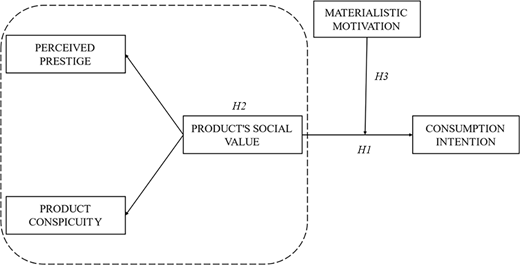
Therefore, we understand that these aspects encompass most of the symbolic value of RNPs, as they are how technological products’ hedonic and utilitarian characteristics are transmitted. Figure 1 presents social value as a two-dimensional construct formed from the perceived prestige and conspicuity of the product.
In this scenario of RNPs, the consumer’s social value is thus made up of prestige elements related to the status value of possession and access to innovation that the consumer may have (Henrich & Gil-White, 2001), added to the visibility of this product to its peers (conspicuous value of the product; Hamilton, Ferraro, Haws, & Mukhopadhyay, 2021). This generates more status through the perception of the social group of those who are up-to-date and thus impose themselves as innovative. Therefore, being innovative becomes a socially differentiated position, thus acquiring status through consumption and possession concerning social aspirations (Chaudhuri & Majumdar, 2006). Thus, we posit our second hypothesis:
Product conspicuity and perceived prestige form the two-dimensional construct of social value in the context of RNPs.
In the context of RNPs, materialistic motivation refers to the degree to which individuals purchase or own goods to demonstrate success (Richins & Dawson, 1992). Thus, it is presumed that part of socialization, cultural learning experiences (Flurry et al., 2021) and individuals’ cognitive exposure (Hopp & Gangadharbatla, 2016) has consumption showing off as its central goal (Richins, 2017).
For individuals with higher levels of materialistic motivation, the effect of social value on their intention to purchase technological RNPs is more significant. This occurs because their need to own a particular product enhances the perceived social value of the product, increasing both the visibility of those who own the product and the recognition received through its access and use (Belk et al., 2003). These aspects amplify the product’s conspicuity and prestige, increasing its social value.
Therefore, an individual’s materialistic motivation, characterized by the need for ownership and consumption, positively moderates the relationship between social value and purchase intention, enhancing the prestige of ownership (Richins, 2017) as well as the visibility of that ownership (Srinivasan, Srivastava, & Bhanot, 2014). This further increases purchase intention due to the perceived social benefits, which leads us to our third hypothesis:
Consumers’ materialistic motivation moderates the relationship between product social value and RNP consumption intention.
Based on the information above, the intensity of the willingness to consume RNPs – whether purchasing, using or adopting them – will depend on the consumer’s materialistic motivation.
3. Methods
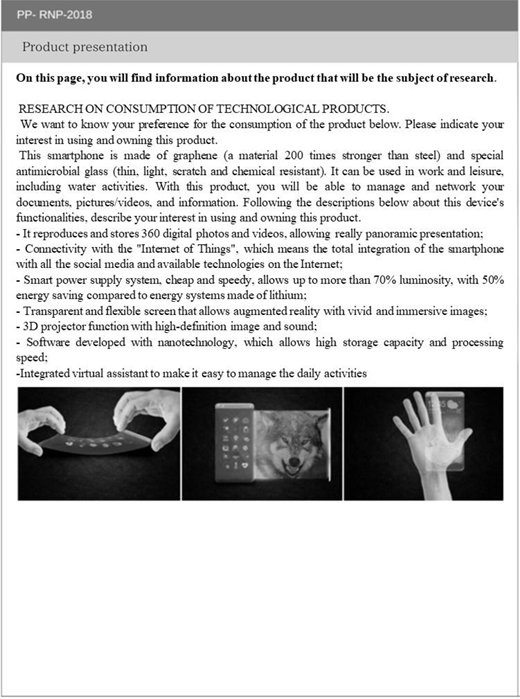
To stimulate the social properties that the product can convey through its functional and conspicuous characteristics, a fictitious smartphone model was developed (Appendix 1). The scales utilized in the data collection instrument were adapted from previous studies (see Appendix 2). To verify that this model met the criterion of being an RNP from the technological sector, we used the validation filter question “What is the level of novelty of this product in your opinion?” (Hoeffler, 2003). Respondents answered this question on a seven-point scale ranging from 1 = not very innovative to 7 = very innovative [x̅ = 5.39 (the sample mean) and SD = 1.61 (the standard deviation)]. Finally, 211 consumers responded to a self-administered online questionnaire made available on social media and via email, in a “snowball” format, seeking a cosmopolitan audience (Rogers, 2003). Among these consumers, 68% were male and 90.5% stated they possess at least a bachelor’s degree. In addition, 56% of respondents reported having an average family income above BR$5,225.00 (approximately US$991.50).
Furthermore, we conducted a post-test with 75 participants to verify whether the product presented in the scenario could be characterized as genuinely new or whether the perception of the characteristics could be more identified with those of luxury products. Owing to this, a paired t-test was conducted, and the results indicate that Innovation (MInnovation = 5.71, SD = 1.19) and Luxury Perception (MLuxury perception = 4.60, SD = 1.27), being (Innovation – Perception of luxury) with M = 1.11, SD = 1.86, t = 5.166, df = 74, and p-value < 0.001.
The power of the sample was analyzed using the Analytics Calculator (www.analyticscalculators.com/calculator.aspx?id=89) platform. For f2 = 0.30, a statistical power (1 – β err prob) = 0.955 with α < 0.05 (Cohen, 1992) was obtained. This procedure follows the recommendations of Hair, Hult, Ringle, & Sarstedt, (2017) for the use of partial least squares structural equation modeling (PLS-SEM) based on the number of observable and latent variables in the model. The PLS-SEM technique was chosen because it is more appropriate for the characteristics of the proposed conceptual model, such as the number of variables involved and sample characteristics, size and normality. Furthermore, our study has a conceptual predictive nature, making PLS-SEM intrinsically interesting (see Sarstedt, Hair, & Ringle, 2023).
The adequacy of the data for factor analysis was verified using the Kaiser–Meyer–Olkin (KMO) test, with KMO = 0.917, p < 0.01. At this stage, we sought to show that social value is a reflective construct of the conspicuity and perceived prestige constructs for products with RNP characteristics. Table 2 presents the components tested for social value using the SPSS 23 software. This procedure followed the deductive analysis method proposed by Hinkin (1998). Although it is questionable from a methodological perspective (see Bido, Mantovani, & Cohen, 2017), it is legitimate for theoretical testing purposes, as it proves the non-unidimensionality of the construct.
The conceptual model (see Figure 1) was then tested using the SmartPLS software version 4. Table 3 presents the sources and psychometric properties of the scales used in this study (all are seven-point Likert scales). The scales used are full and/or partial adaptations of items from the original scales, which capture the central characteristics of the proposed constructs (Haynes, Richard, & Kubany, 1995).
The results of the psychometric tests show adequate values, factor loadings above 0.7, AVE > 0.5 and α > 0.7 (Hair et al., 2017). Discriminant validity analysis was performed at the item level (cross-loadings) and at the construct level using the Fornell–Larcker test (see Table 3).
4. Results
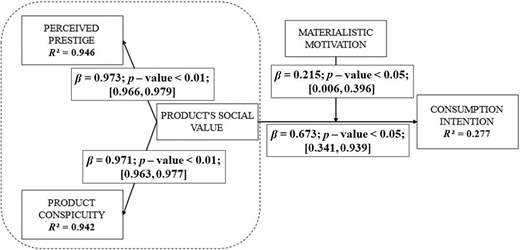
The hypotheses were tested using the PLS-SEM path model, which allows for a correlational multifactorial analysis between reflective latent variables (Hair et al., 2017). This approach is less sensitive to common method bias due to its ability to handle complex models with multiple indicators and constructs and small sample sizes (Sarstedt et al., 2023). Nevertheless, we used the variance inflation factor (VIF) to perform the full collinearity test (Kock, 2017). This test predicts VIF values above 3.3 May indicate common method bias; the VIF results obtained are [1; 2.874]. Therefore, we can safely state that common method bias and multicollinearity are absent. Figure 2 shows the coefficients and R2 values of the tested model. According to Henseler, Ringle, & Sarstedt, (2014), a good indicator of model fit is the SRMR, which should be < 0.08 (SRMR of our model = 0.064). Thus, all criteria for the proposed model’s internal, external and predictive validity followed the standard (Hair et al., 2017) proposed for PLS-SEM.
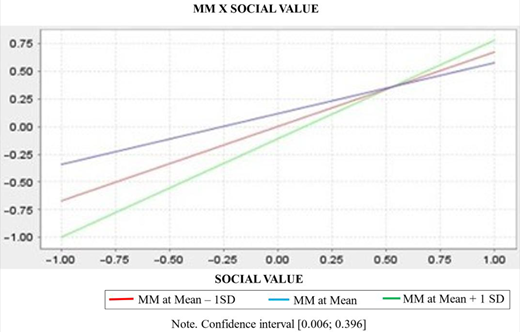
Figure 3 presents materialistic motivation as a moderating variable on the effect of the product’s social value on RNP consumption intention, with a significant and positive moderating effect (β = 0.215, p < 0.05). Furthermore, this graph presents consumption intention – depending on the social value of RNPs – at the mean, high and low intensities of materialistic motivation. With high materialistic motivation, increasing the social value of the product was found to increase consumption intention. Meanwhile, the inverse relationship was found for low materialistic motivation, reinforcing that the consumer’s materialistic motivation increases their perception of the social value of technological RNPs, consequently increasing their consumption intention for such products.
RNPs – present characteristics related to the self (Belk, 1988), such as conspicuous value, that can generate social interest (Chaudhuri & Majumdar, 2006). In the context of RNPs, this is suggested by the relationship between social value and product conspicuity (β = 0.971; p < 0.01).
Our model shows that the perception of product prestige (β = 0.973; p < 0.01; R2 = 0.946), understood as the deference attributed based on its unique characteristics, is a consumer strategy to attribute and receive prestige (Ibáñez-Sánchez et al., 2021). In the context of RNPs, we considered social value a two-dimensional construct composed of product conspicuity and perceived prestige – characteristics acknowledged as beneficial by the consumer’s social group.
The capacity of products to signal and communicate social self-image can influence purchase intention because consumption value goes beyond satisfying functional needs (Cui & Im, 2021). In the context of RNPs, this is suggested by the relationship between social value and RNP consumption intention (β = 0.673; p < 0.05), which, depending on the product category, can be significant (Hoeffler, 2003).
5. Discussion
Linking social characteristics to products has been shown to be an effective way of increasing consumption intention (e.g. Kahle & Xie, 2018). However, the literature on RNP adoption has rarely considered the social value of RNPs, prioritizing their usefulness and other hedonic attributes (see Cui & Im, 2021, for an exception) instead.
The perceived usefulness of an RNP, especially a technological RNP, depends largely on the product’s perceived social utility (Nunes & Arruda Filho, 2018); the consumer’s ability to access and use the product, which generates authentic pride (Henrich & Gil-White, 2001) through the demonstration of unique skills; and the possibilities provided by the product’s functionalities. The consumption of products is triggered not only by consumers’ motivation to display their social status but also by their need to demonstrate uniqueness to others (Gierl & Huettl, 2010), which leads to admiration and prestige conferred by elements of the social group (Cheng et al., 2010).
Previous literature has already evidenced that individuals’ social behavior impacts their consumption preferences (Jeon, Lee, & Jeong, 2018), including concerning RNPs (Esfahani & Reynolds, 2021). Consumers regard consumption and possessions as extensions of themselves and frequently communicate their self-concepts through consumption (Belk, 1988). This aspect has become evident in today’s technological and digital world, where the social value of innovative and updated individuals is increasing. Being considered the first to access, possess and consume a product can bring prestige and, consequently, status, personal meaning and self-esteem (Sindhwani et al., 2022).
In the present study, as indicated (Figure 3), consumers’ materialistic motivation had a moderating effect. Specifically, we found that the greater the motivation to acquire goods, the greater the effect of a product’s social value on consumption intention. This is in line with the findings of previous studies on the effect of materialism on consumers’ search for social value (Richins, 2017).
5.1 Theoretical and managerial implications
The present study contributes to the comprehension of the social value of products by indicating that really innovative products (RNPs), by incorporating specific social features, can enhance their consumption intention through visibility (conspicuity) and the display of distinctive characteristics (prestige). The traditionally proposed understanding of social value within the extant literature has presented this construct within the context of a value chain that spans from physiological needs to self-actualization (Kahle & Xie, 2018). However, in the context of RNPs, innovation seems to catalyze social differentiation through the product’s conspicuousness and prestige.
As a large proportion of RNPs launched on the market are not successful (Cooper, 2019), this study may be helpful for product and marketing managers, as it demonstrates that the conspicuous characteristics of a product associated with characteristics that generate prestige for innovation are essential to attract consumer attention when adequately integrated with technological attributes. Similarly, the explicit demonstration of abilities promoted by a product’s functionalities and conspicuous features may be important for the consumer’s sense of authentic pride, a facet of prestige stimulated by the asymmetric associative relationship between a product and its possessor (Henrich & Gil-White, 2001). Thus, RNPs must be designed from the perspective of cultural learning and presented through marketing campaigns, which demonstrate their possible social benefits, as well as differentiating attributes that generate deference by enabling the comparison of learning models between the product and others in similar categories.
Conceptually, the proposed model represents a new element of consumption-related decision-making. This element involves a specific assessment of social value (composed of the prestige and conspicuity offered by a product), influencing RNP consumption intention in the technological arena. The proposed model also demonstrates that the consumer’s level of materialism increases this social effect on consumption intention. This means that for innovative individuals – who have a high need for innovation consumption – the greater their materialistic needs, the greater the social effect on their intention to consume a product.
The present study focuses on specific consumer profiles and products perceived as really new by consumers, who must have the aforementioned characteristics to increase their interest in the market. While simpler products are less socially elevated, more innovative/new products target social attributes, are conspicuous and generate considerable prestige.
6. Conclusion
Our research demonstrates that RNPs’ social value, formed by product conspicuity and perceived product prestige, increases RNP consumption intention and that the consumer’s materialistic motivation moderates this relationship. These findings advance the theoretical understanding of the meaning of social value in the context of really innovative products, especially those in the technological sector.
Our findings may also point to future research that will advance the understanding of the human characteristics that lead to identifying socially valued product aspects, especially those related to authentic pride that generates deference, esteem and love. These feelings are fundamental to the success of technological RNPs, as they demonstrate the connection between consumers and innovation.
The conspicuity of products generates social value, as showing off the possession and use of RNPs can meet the consumer’s need for ostentation, differentiation and centrality as a social positioning strategy. This concept should be further explored, especially regarding its interface with hubristic pride (arrogance). Further research can look at authentic and hubristic pride as mechanisms of status acquisition in the context of RNP adoption (Henrich & Gil-White, 2001).
The present study has limitations that can be overcome with further research. This study is correlational in nature; although we identified significant associations between the variables, these relationships should not be interpreted as evidence of causality. In addition, the analysis technique (PLS-SEM) tends to inflate the indication of the degree of explanation of the model based on the correlations between the constructs (Hair, Ringle, & Sarstedt, 2011). Further research using experimental or longitudinal models is needed to establish causal links between social value, materialistic motivation and consumption intention.
We used a fictitious smartphone to represent a really new technological device because smartphones tend to provide high conspicuity, an important factor for indicating social value. However, future research can test our model with other types of RNPs or with really new technologies not necessarily possessed by consumers, such as natural language processing tools driven by artificial intelligence technology (e.g. ChatGPT).
Author contributions: Everaldo Marcelo Souza da Costa: Investigation; Data curation; Software; Formal analysis; Methodology and data analysis; Project administration; Writing – original draft. Emílio José Montero Arruda Filho: Conceptualization; Formal analysis; Writing – original draft. Delane Botelho: Conceptualization; Supervision; Writing – review.