


Building on the conservation of resources (COR) theory, this study aims to investigate employee empowerment’s moderation effect on the relationship of situational (job satisfaction, affective commitment) and dispositional (positive affectivity, emotional intelligence) variables toward the emotional exhaustion of service employees amidst the pandemic.
In total, 288 service employees from various sectors in Indonesia participate as the study’s respondents. This study applies a two-stage structural equation modeling approach to test the hypotheses.
The results show that employee empowerment moderates situational and dispositional variables differently. While employee empowerment significantly influences situational variables, a different situation is found on dispositional variables, that employee empowerment does not significantly influence these variables. This study’s findings portray the COR theory in practice and clarify the importance of employee empowerment for employees with particular attributions.
The present study bears four limitations: the cross-sectional design; no exploration of dispositional and situational variables’ antecedents; the findings are limited to the service workers; and lastly, this study only takes Indonesian samples.
From a practical perspective, this study reveals which type of service employees are responsive to empowerment policy and which are prone to experience emotional exhaustion, particularly during a crisis.
By understanding what factors determine employee empowerment’s effectiveness, managers could maximize the impacts of their empowerment policies. Subsequently, it will create better service deliveries which might benefit the broader societal scope.
This study contributes to both theoretical and practical understanding. Theoretically, this study adds and promotes using a categorical lens to examine the pattern of interactions between organizations and employees.
1. Introduction
More than one year after the first detected case, the COVID-19 pandemic still becomes a significant concern worldwide. Particularly for service workers, the pandemic brought many challenges as it affected their emotional health and intensified the unpredictable customer emotions they have to serve (Loustaunau et al., 2020). Most studies examine the COVID-19 effects on service workers either only focusing on the negative impacts of the pandemic (Johnson, Ebrahimi, & Hoffart, 2020; Rosemberg et al., 2021) or examining the work arrangement alternatives as triggered by the pandemic (Gross, Asante, Pawluk, & Niemeläinen, 2021; Linando et al., 2022). Only a handful of studies try to investigate the effort organizations and managers could perform to minimize the pandemic’s negative effects on their workers (Phungsoonthorn & Charoensukmongkol, 2022), creating a gap of knowledge on this particular front. The undesirable work features for service workers during the pandemic and the existing knowledge gap triggered the authors to investigate which employees would likely be able to cope well with working during the pandemic and which would unlikely keep up. Further, the authors also aim to add what could organizations and managers do to help service workers cope with the pandemic.
The authors set emotional exhaustion as the indicator of “failure” to cope with working amidst the pandemic. Meanwhile, various independent variables representing positive personal characteristics and individual–organizational relationships act as “the resources” employees possess to avoid emotional exhaustion at work. Such interpretations of “resources” align with previous studies (Charoensukmongkol & Puyod, 2022; Thanacoody et al., 2014). That depiction of the “battle” between “resources” against “failure” service workers endure during the pandemic is relevant to what Hobfoll (1989) postulates on the conservation of resources (COR) theory. Furthermore, this study also aims to test the role of employee empowerment as the source of resource enhancement at work amidst the COVID-19 pandemic. The addition of employee empowerment is also significant according to COR theory, wherein social support plays an essential role in the resource conservation process (Hobfoll, 2001). Accordingly, COR will serve as the basic theory to explicate this study’s argumentation and discussion.
This study offers two contributions. First, from a theoretical angle, this study will extend the knowledge of variable categorizations. While the discourse of situational and dispositional attributions separation has been long established (Miller et al., 1981), to date, only a few management and organization studies (Chhabra & Srivastava, 2022; Ilies et al., 2011) apply clustered situational and dispositional variables interplay within a single frame. Such a situation restricts understanding of how different variable categories react to particular variables. The present study aims to complement the scant literature by depicting the unique categorical comparative analysis in the COVID-19 pandemic context. The authors examine the effects of employee empowerment on two variable categories: situational (affective commitment and job satisfaction) and dispositional attribution (positive affectivity and emotional intelligence).
Second, this study presents information to help managers craft practical organizational policies. During the crisis, organizations should concentrate on managing resources strategically (Drucker, 2012), making an effort to comprehend which employee’s resources (situational, dispositional, both or none) will productively react to organizational strategy (employee empowerment), becoming more relevant than ever. The findings of this study will reveal to which type of employees an employee empowerment policy will work. In addition, this study will also show which type of employees are prone to experience emotional exhaustion amidst the COVID-19 crisis so that managers can pay particular attention to them.
2. Literature review
This study applies the COR theory (Hobfoll, 1989) as the theoretical framework to explain the interplay between tested variables. The COR theory has been established as a reliable basis for understanding the processes involved in experiencing and coping with stress (Hobfoll, 2001). The COR theory explains that individuals are motivated to protect their current resources (conservation) and acquire new resources (acquisitions) (Hobfoll, 1989). The present study interprets selected situational and dispositional variables as the resources employees possess.
Researchers (Mischel, 1968; Storms, 1973) propose that two main attributions generally explain how humans behave. The first is dispositional, an internal driver of human behavior, including relatively stable features such as personality, traits, attitudes and desires (Miller et al., 1981; Storms, 1973). The second is situational, a situation-related behavior triggered by external stimuli (Miller et al., 1981). This study categorizes positive affectivity and emotional intelligence as dispositional variables because of their personality-like and stable features (Mayer & Salovey, 1997; Watson et al., 1988). On the other hand, the degree of job satisfaction and affective commitment depends on external stimuli such as culture and leadership style (Lok & Crawford, 2001), which act as situational variables.
2.1 Hypotheses justifications
Job satisfaction is the satisfaction measure of workers toward their job-related factors such as the relationship with their supervisor, benefits, peers or the job itself (Locke, 1969). The authors argue that job satisfaction negatively influences emotional exhaustion. The claim is based on Eagly and Chaiken’s (1993) assertion that individuals who evaluate an object favorably tend to engage in behaviors that support the object and vice versa. Job satisfaction indicates the favorable assessment employees give toward their job, making those satisfied with their jobs unlikely to experience emotional exhaustion as it might hinder their job progression.
During the pandemic, workers are exposed to many uncertainties at work, enhancing the stress level in their working circumstances (Charoensukmongkol & Suthatorn, 2021). In working during the pandemic, job satisfaction acts as a source of resilience (Giménez-Espert et al., 2020), enabling the workers to cope with unprecedented extreme circumstances. In addition, within various service sector occupations, job satisfaction has been proven to negatively influence emotional exhaustion (Mena & Bailey, 2007; Saxton et al., 1991). To verify this argumentation, the authors propose the following hypothesis:
Job satisfaction negatively influences emotional exhaustion during the COVID-19 pandemic.
The authors estimate that affective commitment negatively impacts emotional exhaustion because of the COVID-19 pandemic, which made the professional sphere uncertain. Such a situation may embolden the risk of emotional exhaustion, whereas commitment may lessen the uncertainty (Tang & Vandenberghe, 2020). Affective commitment also plays a role in buffering the instance of emotional exhaustion among employees (Öztürk et al., 2017); other studies (Lapointe, Vandenberghe, & Panaccio, 2011) empirically find that affective commitment negatively influences emotional exhaustion. In addition, recent studies on the affective commitment during the pandemic reveal that affective commitment links to positive organizational outcomes that conceptually contradict emotional exhaustion. For instance, affective commitment relates to job-related well-being (Mihalache & Mihalache, 2022), organizational citizenship behavior (Alshaabani et al., 2021) and presenteeism (El-Kurdy et al., 2022) during the pandemic. Based on those argumentations, the proposed hypothesis is as follows:
Affective commitment negatively influences emotional exhaustion during the COVID-19 pandemic.
Emotional intelligence is the ability to rationalize, access and produce the ideal emotions to enhance emotional and intellectual growth (Mayer & Salovey, 1997). Empirical studies (Chan, 2006; Moon & Hur, 2011) find that emotional intelligence negatively relates to emotional exhaustion. During COVID-19, some studies (Moroń & Biolik-Moroń, 2021; Sun et al., 2021) found that emotional intelligence relates negatively to undesirable emotions management. It might be because of the emotional intelligence feature as an ability to regulate and perform an accurate rationale of emotions (Mayer et al., 2008). Therefore, emotion management is one of the critical factors determining individuals’ survival amidst the pandemic (Dowrick et al., 2021). Consequently, it is logical to infer that an individual with good emotional management can deal well with emotional exhaustion during the pandemic:
Emotional intelligence negatively influences emotional exhaustion during the COVID-19 pandemic.
Positive affectivity defines positive emotions people possess and determines how they interact with environments (Ashby et al., 1999). A person with positive affectivity will feel passionate, focused and energetic (Watson et al., 1988). Empirical research (Lee & Chelladurai, 2016; Linando & Sitalaksmi, 2017) discovered that positive affectivity negatively relates to emotional exhaustion. As individuals with positive affectivity tend to experience pleasurable moods, they should be spirited at work and consequently implausible to encounter emotional exhaustion. The authors argue that employees with a high degree of positive affectivity will likely cope with the work challenges amidst the pandemic. That is because those workers with positive affectivity tend to have good resilience to deal with the crisis, as also proven by Zhang et al.’s (2021) study of workers’ affectivity during the pandemic. Hence, the authors postulate that those employees with a high degree of positive affectivity will be more immune from experiencing emotional exhaustion during the pandemic:
Positive affectivity negatively influences emotional exhaustion during the COVID-19 pandemic.
2.2 Moderating role of employee empowerment
The word “empowerment” has various dimensions and a broad range of definitions. However, in essence, empowerment relates to power authorization (Honold, 1997). In the service sector context, it plays an imperative role in ensuring organization and customers relationship transpires in harmony (Lashley, 1999). That is because, in service sectors, employees are commonly interpreted as “the service” given by the company (Chebat & Kollias, 2000). The authors argue that using employee empowerment during the pandemic will positively impact the workers. The ground for such a claim is Morris and Feldman’s (1996) assertion that four critical emotional work dimensions affect emotional exhaustion:
emotional display frequency;
attentiveness to required display rules;
variety of displayed emotions; and
emotional dissonance (Morris & Feldman, 1996).
During the COVID-19 pandemic, those dimensions were distorted in practice.
For instance, many questions might emerge about whether the workers still need to maintain the emotional display’s standard duration while delivering online services or whether they still need to express various emotions. The pandemic also dismisses or decreases the degree of supervision. Consequently, it declines work ambiguity and uncertainty as the workers become more independent and are expected to make decisions on their own. The low degree of ambiguity and uncertainty makes the workers more adaptable to delivering services (Chebat & Kollias, 2000), which the authors posit will decrease emotional exhaustion. The argument is in line with other researchers’ arguments (Hochschild, 2003; Rafaeli & Sutton, 1987) that autonomy given to workers to express their emotions at work will lead to positive outcomes.
Albeit both selected dispositional and situational variables in this study act as favorable factors for the workers, the authors argue that employee empowerment will only enhance the negative impact of situational variables toward emotional exhaustion. This statement is grounded on Thomas and Velthouse’s (1990) explanation that the empowerment process involves the interaction between the work context and individual personality. Hence, empowerment will more likely affect situational variables rather than dispositional variables. Researchers (Campbell, 1963; Heider, 1958) also commonly argue that dispositional variables tend to be stable in various circumstances regardless of external stimuli. Henceforth, the authors hypothesize the following:
Employee empowerment significantly enhances the negative relationship between situational variables and emotional exhaustion.
3. Method
3.1 Research design and respondents
The data were gathered using online questionnaires. Primarily, the questionnaires were distributed through the authors’ and their colleagues’ social media groups, making the respondent reach beyond the regional (province, in Indonesia) scope. This study applied a convenience sampling approach, and it does not limit the sectors – all service business workers in Indonesia might fill out the questionnaire. The respondents were also informed that the data was anonymous and would only be used for academic research purposes, and they consented to it. Firstly, the authors obtained 303 replies, which were then filtered by omitting the respondents who stopped working because of the COVID-19 pandemic. Finally, 288 replies were further examined. Table 1 shows the detailed descriptive data.
Descriptive data
| Data | N (%) |
|---|---|
| Gender | |
| Male | 117 (40.6) |
| Female | 171 (59.4) |
| Generation | |
| Boomers and Gen X | 179 (62.1) |
| Gen Y | 97 (33.7) |
| Gen Z | 12 (4.2) |
| Marital status | |
| Single | 47 (16.3) |
| Married | 241(83.7) |
| Work tenure | |
| <2 years | 21 (7.3) |
| 2–8 years | 66 (22.9) |
| >8 years | 201 (69.8) |
| COVID-19 work adjustment | |
| Work from home (WFH) | 194 (67.4) |
| Still work from office (WFO) with adjustments | 70 (24.3) |
| Mix of WFH and WFO/work in shifts | 24 (8.3) |
| Industry sector | |
| Education | 240 (83.3) |
| Non-education | 48 (16.7) |
3.2 Measures
All measurements use a six-point Likert scale to deter central tendency bias, with 1 = “strongly disagree” to 6 = “strongly agree.” The questions are in Bahasa Indonesia to suit the language used by the respondents. All scales were translated from English into Bahasa Indonesia by a competent translator company: the Center for International Language and Cultural Studies (CILACS).
This study uses Maslach and Jackson’s (1981) scale, which consists of nine items to assess emotional exhaustion. The measurement for emotional exhaustion happened in the context of working during the COVID-19 pandemic. This study uses Seashore et al.’s (1982) scale, which consists of three items to assess job satisfaction. This study uses Allen and Meyer’s (1990) scale, which consists of eight items for affective commitment to measure organizational commitment. To assess emotional intelligence, this study uses the Wong and Law Emotional Intelligence Scale (Wong & Law, 2002). The present study treated emotional intelligence as a unidimensional construct aligned with the commonly applied practice in management studies (Schlaegel et al., 2022).
To assess positive affectivity, this study uses I-PANAS-SF (Thompson, 2007), which consists of five items. Lastly, this study uses the five employee empowerment items proposed by Hayes (1994). This study also controlled five demographic variables that have been found to be significantly related to emotional exhaustion which are age, gender (1 = male, 2 = female), marital status (1 = single, 2 = married) and work tenure (1 = <2 years, 2 = 2–8 years, 3 = >8 years). In addition, the authors also controlled work mode [1 = work from home (WFH), 2 = work from office (WFO) with adjustments, 3 = mix between WFH and WFO]. Most respondents work in the educational sector (83,3%), so the authors also controlled the work sector (1 = educational sector, 2 = non-educational sector).
4. Data analysis and results
4.1 Preliminary analysis of the measurement model
Before testing the hypotheses, this study first conducted a confirmatory factor analysis using AMOS 26 to test the research constructs’ validity. Then, following the recommendations from Hair, Black, Babin, and Anderson (2014), this study removed indicators to increase model fit and the average variance extracted (AVE) from <0.50 to >0.50. Finally, based on the factor loadings and standardized residual covariances, the authors removed EE_2, AC_3 and AC_7 to improve the model fit and AVE. Table 2 shows that the proposed research model has met convergent validity. In particular, the composite reliability (CR) and Cronbach’s alpha are above the threshold (>0.70), as recommended by Anderson and Gerbing (1988). The results presented in Table 2 show that the factor loadings are all above the threshold (>0.50): CR ranged from 0.799 to 0.928, while AVE ranged from 0.503 to 0.678. These results confirm sufficient convergent validity for the constructs of this study.
Result of the measurement model, validity and reliability
| Construct | Total items | After deletion | Items | Factor loadings | α | CR | AVE |
|---|---|---|---|---|---|---|---|
| Emotional exhaustion | 9 | 8 | EE_1 | 0.753 | 0.907 | 0.904 | 0.544 |
| EE_3 | 0.78 | ||||||
| EE_4 | 0.699 | ||||||
| EE_5 | 0.791 | ||||||
| EE_6 | 0.855 | ||||||
| EE_7 | 0.613 | ||||||
| EE_8 | 0.743 | ||||||
| EE_9 | 0.714 | ||||||
| Positive affectivity | 5 | 5 | PA_1 | 0.791 | 0.911 | 0.913 | 0.678 |
| PA_2 | 0.873 | ||||||
| PA_3 | 0.72 | ||||||
| PA_4 | 0.842 | ||||||
| PA_5 | 0.879 | ||||||
| Emotional intelligence | 16 | 16 | SEA | 0.833 | 0.797 | 0.799 | 0.503 |
| OEA | 0.579 | ||||||
| UOE | 0.715 | ||||||
| ROE | 0.686 | ||||||
| Self-emotion appraisal | 4 | 4 | SEA_1 | 0.651 | 0.824 | 0.832 | 0.560 |
| SEA_2 | 0.837 | ||||||
| SEA_3 | 0.857 | ||||||
| SEA_4 | 0.616 | ||||||
| Other’s emotion appraisal | 4 | 4 | OEA_1 | 0.615 | 0.838 | 0.842 | 0.581 |
| OEA_2 | 0.641 | ||||||
| OEA_3 | 0.871 | ||||||
| OEA_4 | 0.878 | ||||||
| Use of emotion | 4 | 4 | UOE_1 | 0.706 | 0.889 | 0.894 | 0.680 |
| UOE_2 | 0.849 | ||||||
| UOE_3 | 0.877 | ||||||
| UOE_4 | 0.856 | ||||||
| Regulation of emotion | 4 | 4 | ROE_1 | 0.870 | 0.918 | 0.922 | 0.747 |
| ROE_2 | 0.894 | ||||||
| ROE_3 | 0.778 | ||||||
| ROE_4 | 0.909 | ||||||
| Affective commitment | 8 | 6 | AC_1 | 0.869 | 0.904 | 0.907 | 0.625 |
| AC_2 | 0.752 | ||||||
| AC_4 | 0.623 | ||||||
| AC_5 | 0.774 | ||||||
| AC_6 | 0.717 | ||||||
| AC_8 | 0.962 | ||||||
| Job satisfaction | 3 | 3 | JS_1 | 0.889 | 0.701 | 0.764 | 0.532 |
| JS_2 | 0.484 | ||||||
| JS_3 | 0.756 | ||||||
| Employee empowerment | 5 | 5 | Eemp_1 | 0.692 | 0.863 | 0.864 | 0.560 |
| Eemp_2 | 0.767 | ||||||
| Eemp_3 | 0.799 | ||||||
| Eemp_4 | 0.700 | ||||||
| Eemp_5 | 0.777 |
For discriminant validity assessment, the square root of AVE is compared with the between-constructs correlation for each variable. The results show that the square roots of AVE for all variables are greater than between constructs correlation; hence, the results fulfill discriminant validity criteria (Hair et al., 2014). After testing the constructs’ validity, this study assessed the measurement model’s goodness of fit (GOF) indices. The six-factors model has χ2 = 2122,549, RMSEA = 0.054 (i.e. <0.08) which is acceptable (Kline, 2015); SRMR = 0.063, CMIN/DF = 2.135, CFI = 0.902 and TLI of 0.900 also meet the threshold (Hair et al., 2014). Based on the overall evaluation of the GOF measurement model, the proposed model has met the model fit so that the GOF measurement model in this study can be accepted.
Because all measurements are collected from a common source, common method bias may exist in the data. Therefore, the authors conducted Harmans’ single-factor test per Podsakoff et al.’s (2003) suggestion. The results of the fit statistic showed that the single-factor model did not fit the data well (χ2 = 8,421.114, p < 0.001; RMSEA = 0.137; CFI = 0.328; SRMR = 0.238). These results suggest that common method bias is not an issue in the observed data.
4.2 Hypotheses testing
This study used structural equation modeling (SEM) to examine the hypotheses. The control variables were entered into Step 1, and the independent variables were entered into Step 2. The model in Step 2 shows that job satisfaction negatively relates to emotional exhaustion (β = −0.305, p < 0.01). Therefore, H1a is supported. Affective commitment (β = −0.209, p < 0.01), positive affectivity (β = −0.241, p < 0.01) and emotional intelligence (β = −0.151, p < 0.01) also associate negatively with emotional exhaustion. Therefore, H1b–d are also supported. Table 3 shows the detailed testing results.
Interactive effect of employee empowerment on independent variables and emotional exhaustion
| Variable | Emotional exhaustion | ||
|---|---|---|---|
| Step 1 (β) | Step 2 (β) | Step 3 (β) | |
| Gender | 0.063 | – | – |
| Age | −0.221* | −0.242** | −0.239** |
| Marital status | 0.141 | – | – |
| Tenure | 0.111 | – | – |
| Sector | 0.095 | – | – |
| COVID-19 work adjustment effect | 0.033 | – | – |
| Job satisfaction | −0.305** | −0.331** | |
| Affective commitment | −0.209** | −0.197** | |
| Positive affectivity | −0.241** | −0.213** | |
| Emotional intelligence | −0.151** | −0.164** | |
| Employee empowerment | −0.431** | −0.459** | |
| Job satisfaction × employee empowerment | −0.173* | ||
| Affective commitment × employee empowerment | −0.184* | ||
| Positive affectivity × employee empowerment | 0.029 | ||
| Emotional intelligence × employee empowerment | −0.126 | ||
| R2 | 0.515 | 0.609 | |
Notes:
*p < 0.05; **p < 0.01
To test H2, this study first tested the interaction of all research variables using the mean-centered approach, as Aiken and West (1991) suggested. Then, following the approach proposed by Baron and Kenny (1986), this study built one additional SEM step to examine the moderating effects of employee empowerment. The third model examines the effect of the interaction terms on the dependent variable. The interaction between the situational variables and employee empowerment in this study was assessed by examining the relationship between the situational variables and emotional exhaustion at high (1 SD above the mean) and low (1 SD below the mean) values of employee empowerment.
Step 3 indicates that the interaction effect between job satisfaction and employee empowerment weakens emotional exhaustion (β = −0.173, p < 0.05) when employee empowerment is high. Step 3 also shows that the interaction effect of affective commitment and employee empowerment weakens emotional exhaustion (β = −0.184, p < 0.05) when employee empowerment is high. Employee empowerment moderated the negative relationship of both job satisfaction and affective commitment to emotional exhaustion, as shown by the simple slope analysis in Figure 1. When individuals have higher job satisfaction and affective commitment, a higher degree of employee empowerment will lower emotional exhaustion.
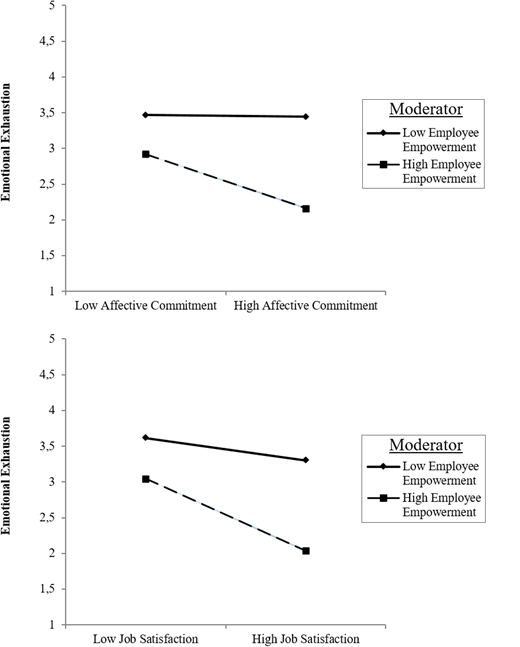
In addition to the main hypotheses testing, the authors also conducted an exploratory analysis concerning employee empowerment’s moderating effect on the relationship between dispositional variables and emotional exhaustion. The exploratory analysis results reveal insignificant moderation effect of employee empowerment on positive affectivity (β = 0.029, p > 0.05) and emotional intelligence (β = −0.126, p > 0.05) correlations toward emotional exhaustion. Overall, the results assert that employee empowerment moderates the effect of situational and dispositional variables on emotional exhaustion differently. Furthermore, the authors address the moderator’s effect size (f2) to present the findings comprehensively. Kenny (2018) classifies interaction terms f2 of 0.005, 0.01 and 0.025 as small, medium and large, respectively. The effect size of the interaction term in the present study has a value of 0.094, indicating a large effect.
5. Discussion
The findings that all independent variables negatively influence emotional exhaustion are hardly surprising as both theoretical perspectives and past empirical findings (Chan, 2006; Judge et al., 2009; Lapointe et al., 2011; Saxton et al., 1991) reach similar conclusions. During the pandemic, like in any other standard (not crisis) conditions, employees with a high degree of positive affectivity, emotionally intelligent, satisfied with their job and affectively committed to their organization tend to be able to cope with emotional exhaustion at work. Nevertheless, this study provides fresh knowledge by revealing the different interaction effects on each tested variable category during the unprecedented COVID-19 crisis.
The moderation effect of employee empowerment only affects situational variables and does not affect dispositional variables. These different patterns explain Hobfoll, Halbesleben, Neveu and Westman (2018) corollaries in an empirical setting. Those having a high degree of selected dispositional variables (positive affectivity and emotional intelligence) are the ones who possess resources. They are less susceptible to resource loss and more capable of resource attainment. Those employees are naturally safe from stress and negative emotional experiences as they do not fulfill the three conditions where stress might occur: the resources are threatened; the resources are lost; and the effort to gain resources fails (Hobfoll et al., 2018). Henceforth, the existence of employee empowerment is unlikely to have much effect on employees with high dispositional aspects. The findings on the relationship between employee empowerment and dispositional variables align with the first Hobfoll et al.’s corollary.
On the other hand, the findings on the relationship between employee empowerment and situational variables explicate the second and third corollaries from Hobfoll et al. (2018). The second corollary covers resource loss, and the third corollary is about resource gain. Those losing resources, which in this study are shown as having a low degree of situational variables (unsatisfied and uncommitted), will likely repeat the loss of resources. Hence, when given more freedom to act independently (empowered), employees with low situational resources will have a higher degree of emotional exhaustion, which symbolizes losing other resources. A similar explanation applies to those possessing resources (satisfied and committed). Like the case of resource loss (Corollary 2), resource gain (Corollary 3) also has a spiraling nature. Those with strong resources will likely reiterate owning, gaining and preserving resources (lower degree of emotional exhaustion) when given the momentum (empowered).
These findings also explain the importance of resources on each employee’s perception. Those who already possess dispositional resources will not place empowerment as a valuable resource; hence, it does not impact them. In contrast, because situational resources are more fluctuating than dispositional variables, the employees whose resources are mainly situational will value empowerment more. That is because empowerment may act as the potential replacement to counterbalance the condition in case their situational resources are lost. This explanation is pertinent to Hobfoll’s (1989) thesis.
6. Limitations and suggestion
While the present study did not observe the common method bias threat according to a posteriori test, future studies may consider including a temporal separation survey to enhance the research design robustness a priori. Second, future researchers need to explore the nomological network of this research. This study did not test other antecedents in both dispositional and situational factors. The selected variables are also hypothesized to influence emotional exhaustion negatively. Another variable with another tone of hypothesis may generate a different finding pattern. Third, while this study may contribute to understanding service workers further, the findings might be attached to the context and cannot be fully generalized for other occupational types.
Furthermore, the majority of the respondents work in the educational sector. Future researchers may consider collecting respondents from various service sectors in a better composition to enhance the findings’ generalizability. Fourth, this study only takes an Indonesian sample. Future researchers may replicate the research model in other locations to further investigate the model’s universality.
7. Theoretical implications
The present study adds to the knowledge of the interaction of the tested variables, particularly in the context of crisis. Furthermore, following the limited extant studies in management and organization domains, this study stimulates the use of a categorical lens to see the pattern of interactions beyond single variables. The present study provides evidence for the use of dispositional and situational categorization in management and organizational studies. Each variable category may have a different interaction pattern with particular variables. This study also contributes to the understanding of COR theory, wherein different resources (dispositional or situational) bear different resource conservation results. This study’s empirical findings may also help future researchers better understand these three aspects:
Hobfol’s resource corollaries in empirical settings;
the subjective importance of resources; and
and the rationale of replacement resources in practice.
8. Practical implications
This study focuses on service workers’ emotional exhaustion, especially during the COVID-19 pandemic that heavily impacted service businesses. The findings reveal that workers who possess positive affectivity are emotionally intelligent, satisfied with their job, are affectively committed to the organization and are relatively safe from emotional exhaustion. It means that companies should focus on employees who do not hold the abovementioned characteristics, as they are the ones prone to experience emotional exhaustion. Therefore, training programs that potentially develop positive affectivity and emotional intelligence may be fruitful. Furthermore, this study shows that employee empowerment will help to reduce emotional exhaustion, especially for employees who are affectively committed to the organization and satisfied with their job.
However, employee empowerment may not always have a positive impact. The findings show that employee empowerment has the opposite effect on employees who are unsatisfied with their job and not affectively committed to the organization. For these employees, empowerment will amplify the degree of emotional exhaustion instead. In conclusion, companies must understand their employees’ characteristics before creating organizational policies, as each employee may require unique treatment.
9. Conclusion
This study confirms the negative relationship between selected dispositional (positive affectivity and emotional intelligence) and situational variables (job satisfaction and affective commitment) toward emotional exhaustion. The results also confirm that the interaction between employee empowerment and situational factors plays an essential role in reducing emotional exhaustion. On the other hand, employee empowerment does not significantly affect the interaction between dispositional factors and emotional exhaustion. Drawing from the COR theory, this study proposes employee empowerment as one of the policies a company can produce to help its employees preserve the resources amidst the crisis. Nevertheless, empowerment should not be applied to all employees, considering it is a double-edged sword. It may turn out positive for employees with high situational variables and harmful for employees with low situational variables. Finally, this study portrays the logic of resource management during a crisis, specifically during the COVID-19 pandemic.
Funding: This work was supported by Pusat Pengembangan Manajemen (PPM) UII.
References
Author contributions are as follows: Jaya Addin Linando – Corresponding Author, Conceptualization (Lead); Data curation (Equal); Formal analysis (Equal); Funding acquisition (Lead); Investigation (Lead); Methodology (Supporting); Project administration (Lead); Resources (Lead); Software (Supporting); Supervision (Lead); Validation (Lead); Visualization (Supporting); Writing – original draft (Lead); Writing – review & editing (Lead).
M. Halim: Conceptualization (Supporting); Data curation (Equal); Formal analysis (Equal); Funding acquisition (Supporting); Investigation (Equal); Methodology (Lead); Project administration (Supporting); Resources (Supporting); Software (Lead); Supervision (Supporting); Validation (Supporting); Visualization (Lead); Writing – original draft (Supporting); Writing – review & editing (Equal).

