This study examines IPO underpricing in Brazil from 2010 to 2021, focusing on differences in post-IPO stock performance between pre-pandemic and pandemic-period offerings.
The sample includes 113 companies that went public (55 pre-pandemic and 58 during the pandemic). Initial returns, short- and long-term performance and a pandemic fear index were used to assess the relationship between underpricing and the pandemic while controlling for firm, management and investor characteristics.
Pre-pandemic IPOs exhibited stronger capital structures, longer operating histories and higher profitability, whereas pandemic-period IPOs showed higher leverage, greater governance standards and larger offering volumes. The analyses indicate higher underpricing during the pandemic, which increases with higher pandemic-related fear. This relationship intensified with institutional investors' participation and the percentage of capital increase. Further analyses show this effect remains only in the short term.
The study is limited to the Brazilian market and the period spanning 2010–2021; therefore, the findings may not be generalized to other markets or periods.
Investors gain insights into IPO risks during crises, while issuers can adjust their strategies.
Informing policymakers and regulators about market stability and investor protection.
Novel evidence on IPO underpricing in an emerging market during an extreme exogenous shock, highlighting the role of pandemic-related fear.
1. Introduction
The COVID-19 pandemic, which began in 2020, has become one of humanity's greatest recent adversities, causing over seven million deaths and 774.3 million infections worldwide by January 2024 (World Health Organization, 2024). In Brazil, the virus led to 709,000 deaths and 38.3 million infections by 2024 (Ministério da Saúde, 2024).
Given the limited knowledge about the virus and the time needed to develop vaccines, the World Health Organization declared a pandemic on March 11, 2020. Shortly after, Brazil's National Health Council recommended strict social distancing measures (Conselho Nacional de Saúde, 2020). While these measures helped contain transmission, they also disrupted the global and Brazilian economies, affecting supply chains, financial stability and the stock market (Caldas, Silva, Silva Júnior, & Cruz, 2021).
Extensive academic research on stock market behavior followed during the crisis. Studies examined specific sectors, such as tourism (Santos, 2020) and Brazilian industries (Caldas et al., 2021), as well as broader themes including fear and commodity price returns (Salisu, Akanni, & Raheem, 2020), global stock market performance and uncertainty (Lyócsa, Baumöhl, Výrost, & Molnár, 2020), liquidity and volatility in the US market (Baig, Butt, Haroon, & Rizvi, 2021) and Initial Public Offerings (IPOs) underpricing.
Mazumder and Saha (2021) note that prior research largely explains IPO underpricing through endogenous factors (firm characteristics), but exogenous factors (market conditions) are also important. Analyzing 81 IPOs in the United States between January and July 2020, Mazumder and Saha (2021) examine the sensitivity of IPO returns to pandemic-related fear. They measured fear as an equally weighted index between reported cases and deaths, following Salisu et al. (2020) and Salisu and Akanni (2020). Their results show that average market-adjusted returns fell by 18.6% when fear remained high and by 23.9% when the fear index dummy shifted from 0 to 1.
In Brazil, when the pandemic started, the Bovespa Index suffered the steepest drawdown compared to several other countries, falling by 46.8% (FGV, 2020), and closing the year with a 2.92% positive return after a rebound. Yet, despite the crisis, 2020 and 2021 marked one of the largest IPO waves on the Brazilian stock exchange, with 26 and 32 offerings, respectively, second only to 2007 (58 IPOs), making it a hot market period (Reis, Taimo, Miranda, Almeida, & Souza, 2024). Though apparently surprising, considering the increased uncertainty with the pandemic, the historically low interest rates and the sudden increase in demand for technological services (Oliveira, Oliveira Carneiro, Maia, & Franca, 2023) boosted the stock market in the country, laying the ground for the increased IPO activity. Thus, despite lower economic activity and many businesses with restricted operations, many firms saw a window of opportunity for an IPO (Reis et al., 2024). For instance, the monthly average trading volume for the Bovespa Index in 2018–2019 was R$268.5 billion, almost doubling in the next two pandemic years (2020–2021) to R$562.8 billion, according to data from Economatica. As Derrien (2005) puts it, greater demand from investors leads to higher IPO prices, larger initial returns and poor long-term performance, so that even in hot markets, IPO stocks are still underpriced, as Ljungqvist, Nanda, and Singh (2006) explain.
This underscores the need to examine the Brazilian case. Thus, the study aims to investigate the underpricing phenomenon in Brazilian IPOs from 2010 to 2021, analyzing the effect of the pandemic on this phenomenon and, more specifically, the effect of pandemic-related fear during the years 2020 and 2021. The sample included all 55 companies that went public before the pandemic (2010–2019) and the 58 companies that went public during the pandemic (2020–2021). The analysis focused on the relationship between IPO first-day returns and the pandemic-related fear index, following Mazumder and Saha's (2021) approach.
The results show that pre-pandemic companies entered the market better prepared in terms of capital structure, operating history, profitability indices and funds included in their shareholder base. In contrast, companies that went public during the pandemic had higher leverage, higher levels of corporate governance and required larger financial volumes per offering. Regression results show that during the pandemic, after controlling for company, managers and investors' characteristics, underpricing was higher and pandemic fear was statistically significant and positive, indicating that the higher the fear, the greater the offerings' underpricing. The analyses show that this effect is intensified by greater capital increases and institutional investors' participation.
This study examines how external factors, particularly the pandemic, influence IPOs in the Brazilian market, an emerging economy. It contributes empirical evidence on underpricing from a market perspective, highlights its consequences for individual investors and illustrates IPO behavior during periods of crisis and heightened risk.
From the issuers' standpoint, this study informs the decision to go public, emphasizing that in times of uncertainty and risk aversion, executives should seek higher proceeds to offset potential “money left on the table” from underpricing.
The next section, Literature review, covers studies on IPOs and their motivations, relating them to the COVID-19 pandemic. The Research Design section describes the procedures for data collection and the rationale for the analyses. The Results section presents the research findings and discussion. Finally, the Concluding Remarks section highlights the main contributions and suggestions for future research.
2. Literature and hypotheses
Steffen and Zanini (2012) argue that growth needs and market competition drive firms to seek external financing, with capital markets serving as a key source. According to Bomfim, Santos, and Júnior (2007), going public provides permanent funding for projects, growth, capital structure improvement and modernization. Röell (1996) highlights advantages of IPOs (resource inflow, greater visibility, management engagement, shareholder divestment opportunities, governance improvements and stronger capital structure) as well as disadvantages, such as offering costs, underpricing, fees and taxes and potential loss of control.
Steffen and Zanini (2012) show that Brazilian CFOs perceive IPOs in line with the life cycle theory, with firms going public at specific growth stages to optimize their capital structure. Market timing theory also influences this decision-making process. Deloitte (2020) adds that IPOs mark a major milestone, offering benefits such as access to capital, divestment mechanisms, competitiveness, improved governance, visibility and attractiveness to companies.
A central theme in the literature is underpricing, when the stock's first-day closing price significantly exceeds the offering price, suggesting that the firm could have raised more capital. Ljungqvist (2007) classifies explanations into four groups: (i) informational asymmetry, (ii) control, (iii) institutional and (iv) behavioral. Early studies include those by Reilly and Hatfield (1969), Stoll and Curley (1970), Logue (1973), Reilly (1973) and Ibbotson (1975). Later contributions emphasized information asymmetry (Baron, 1982) and the “winner's curse” (Rock, 1986). In Brazil, several studies have documented this phenomenon, as compiled by Rodarte and de Camargos (2013). Thus, the first hypothesis is as follows:
IPOs in Brazil from 2010 to 2021 showed underpricing.
According to the information asymmetry theory of underpricing, one may expect more uncertain times to give rise to higher underpricing. The COVID-19 pandemic is one such example. For instance, Baig and Chen (2022) examined 143 U.S. IPOs during COVID-19 versus 278 pre-pandemic, found higher underpricing as pandemic severity increased, especially in the technology and healthcare sectors. In India, Narang and Pradhan (2026) found an additional underpricing of 30.7% for COVID-19 IPO compared to before the pandemic. According to the authors, market volatility conditional on COVID-19 policies increased risk premia and, consequently, initial return. Investigating several countries, including developed and emerging ones, Panda and Guha Deb (2023) also found higher initial returns for IPO during the pandemic. Thus, the second hypothesis is as follows:
IPOs in Brazil showed higher underpricing during the pandemic.
This hypothesis is also in line with the hot market explanations for higher returns on the first trading day. According to Derrien (2005), issuers time their offerings to exploit periods when investors' demand is higher, which yields higher first-day returns and more money on the table. For the author, this can be driven by individual investors' sentiment, despite the rationale that issuers in hot markets should overprice their shares according to the market timing theory (Alti, 2005). Ljungqvist et al. (2006) argue that, though it seems plausible that under high investor sentiment offer prices should be higher and, therefore, underpricing should be lower, in hot markets, “regular” investors are allocated stocks that are later sold to overoptimistic investors and underpricing exists to compensate their risk in these transactions.
Nevertheless, despite the pandemic period in Brazil being a hot market, pandemic-specific sentiment is likely relevant for explaining underpricing. Investor demand was high, but risk was also particularly high under general uncertainty due to the pandemic. Several studies have examined the relationship between pandemic-related fear and stock returns. Lyócsa et al. (2020) found that increases in Google searches for coronavirus-related terms corresponded to higher short-term volatility in at least 10 major global stock markets. Baig et al. (2021) reported that rising COVID-19 cases, deaths and stricter lockdowns increased uncertainty, reducing liquidity and heightening IPO underpricing and post-IPO volatility in the US market. To quantify pandemic fear, Salisu and Akanni (2020) developed the Global Fear Index (GFI), based on reported cases and deaths, which Mazumder and Saha (2021) later used to explain IPO performance during the pandemic.
Thus, this study tests the following hypothesis:
The higher the pandemic fear index in Brazil, the higher the underpricing of IPOs.
Understanding the relationship between pandemic fear and IPO first-day returns is helpful in differentiating the role of higher risk perception under COVID-19 and the hot market hypothesis (Derrien, 2005; Ljungqvist et al., 2006).
Salles (2021) compares the pandemic to past crises, including the 2008 financial crisis, the 1929 Great Depression and the 1918 Spanish flu, noting that the World Bank (2020) projected a 5.2% global economic contraction in 2020, worse than that of Second World War. Lockdowns disrupted supply chains, workforce allocation, corporate financial planning and stock markets (Caldas et al., 2021), and exacerbated mental health issues (Netto et al., 2021).
The first COVID-19 case in Brazil was reported on February 26, 2020, in São Paulo, followed by the first death on March 17, involving an elderly person with comorbidities (Colombo, Belufi, Bender, & Moraes, 2021; Ferreira, Magalhães, Carnaúba, & Pol-Fachin, 2021). With rapidly increasing cases, hospitals nearing capacity and no effective vaccine, the National Health Council (2020) recommended restrictive social distancing measures (lockdown) in May 2020, which were enforced by municipal and state authorities (Colombo et al., 2021).
Economic forecasts shifted dramatically: the Brazilian Central Bank expected GDP growth of 2.3% in January 2020, which was later revised to −6.5% in June and −4.4% by December, with the exchange rate rising from R$4.09 to R$5.14. Similarly, the World Bank lowered expectations for developed economies and emerging markets (World Bank, 2020). Balassiano (2020) emphasized that COVID-19 intensified pre-existing economic problems despite emergency aid mitigating a deeper downturn.
High uncertainty typically reduces hiring, consumption and investment (Altig et al., 2020), yet new IPOs not only continued but also increased in Brazil, driven by investors' increasing appetite for the stock market under historically low fixed-income interest rates. However, high economic uncertainty is followed by information asymmetry, which exposes investors to high uncertainty, leading to discounted bids (Li, Liu, Liu, & Tsai, 2018). Therefore, the pandemic likely increased IPO risk and amplified underpricing.
3. Research design
This study uses information on B3 IPOs from 2010 to 2019 (pre-pandemic) and from 2020 to 2021 (during the pandemic). Thus, the sample consists of 55 companies that went public between 2010 and 2019 (pre-pandemic) and 58 companies that went public between January 2020 and December 2021 (during the pandemic period). The sample considered only offerings classified as “IPO” (ICVM 400), disregarding secondary offerings “Follow-on” (ICVM 476). Additionally, only the listed segments Level I, Level II and Novo Mercado were included, excluding Brazilian Depositary Receipts (BDRs).
Financial and market information were obtained from Economatica. Listing information was gathered from B3's website, and data for the control variables (explained later in this section) were collected from the definitive prospectus disclosed to the market, along with each company's investor relations website. Finally, the pandemic variables were obtained from the database available on the portal managed by the Ministry of Health.
Underpricing is calculated using the log return on the stock's first trading day, using the closing and offer prices. Subsequently, the market-adjusted return is calculated as the difference between the first-day return and the market return on the same date. The Bovespa Index (Ibovespa) return is the proxy for the market return.
Thus, to test the first research hypothesis (H1 – Brazilian IPOs from 2010 to 2021 exhibited underpricing), a Student's t-test is used to evaluate the average value of the adjusted returns (), which, if positive (and statistically significant at usual levels), indicates the presence of underpricing in IPOs conducted during the period.
Next, the following regression is estimated to test the second research hypothesis (H2: IPOs in Brazil showed higher underpricing during the pandemic):
In Equation (1), is the adjusted return on the first day for each IPO on each date; is a dummy variable that equals 1 for the years during the pandemic (2020 and 2021) and 0 otherwise; and is the matrix of control variables, including characteristics of firms, offerings, coordinating banks and macroeconomic factors (Fung, Cheng, & Chan, 2004; Arthurs, Busenitz, Hoskisson, & Johnson, 2009; Gao & Jain, 2011; Rodarte & de Camargos, 2013; Baig & Chen, 2022; Tutuncu, 2023). The complete description of all variables is in Table 1. In Equation (1), if is positive and statistically significant, underpricing is higher during the pandemic years after controlling for the related factors found in the literature.
Finally, to test the third hypothesis of the research (H3 – The higher the pandemic fear index in Brazil, the higher the IPO underpricing), the following regression is estimated:
In Equation (2), is the Local Fear Index (LFI) on the date of each IPO. Fear is measured using an index of equal weights between the Reported Cases Index (RCI) and the Reported Deaths Index (RDI) of COVID-19, following previous literature (Mazumder & Saha, 2021; Salisu et al., 2020; Salisu & Akanni, 2020). The RCI captures the estimate of how reported cases during the incubation period (previous 14 days) deviate from cases reported on each date.
The second component, RDI, captures the estimate of how reported deaths during the incubation period (previous 14 days) deviated from the deaths reported on each date:
After calculating both indices, the LFI, which considers data related to the Brazilian territory, is calculated as an average (equal weights) between RCI and RDI:
Therefore, the higher the LFI on a given date, the greater the fear of the pandemic on that date. According to Salisu and Akanni (2020), like RDI and RCI, the index is represented on a scale from 0 to 1, where 0.5 indicates moderate perception, 0 indicates low perception and 1 indicates the highest point of risk perception related to the pandemic. In the pre-pandemic periods, the LFI index equals zero (equivalent to an interaction between LFI and the pandemic dummy in Equation (3)), and as case and death numbers are reported, the index grows, potentially reaching one.
Lastly, as an additional analysis, the study also investigates the role of the pandemic and its related fear on the short- and long-term performance of the sample companies, since underpricing is usually seen as a short-term phenomenon (Ritter, 1991). Thus, the adjusted returns were recalculated considering the prices on the 5th and 21st days (short term) after the IPO, as well as one and five years later (long term). Then, Equations (1) and (2) are re-estimated with the new return measures as dependent variables.
Out of the total 55 IPOs between 2010 and 2019 (pre-pandemic) and 58 between January 2020 and December 2021 (during the pandemic), two observations were excluded (BRPR3 and VIVA3) from the pre-pandemic IPO sample due to a lack of data (adjusted fixing price) in the Economatica database. After these exclusions, the final sample consisted of 53 IPO in the pre-pandemic period and 58 IPO in the pandemic period. The regression models are estimated via Ordinary Least Squares (OLS); all continuous variables are winsorized at 1% to avoid the impact of outliers that may distort the results; standard errors are robust to heteroskedasticity and autocorrelation, and the Variance Inflation Factor (VIF) is used to test for multicollinearity problems.
4. Results
To formally test the first hypothesis (H1 – IPOs in Brazil from 2010 to 2021 showed underpricing), a t-test was performed for the full sample, regardless of the period. The test shows an average (winsorized) underpricing of 0.038 (3.8%), statistically significant at 1% (t-statistic = 3.867). Thus, the evidence is consistent with H1 hypothesis of the study, that is, the results identified the presence of the underpricing phenomenon in the sample period.
Table 2 shows the mean values of all variables separately for the pre-pandemic period (53 IPOs) and the pandemic (58 IPOs). The first-day adjusted return suggests the presence of underpricing in both periods. T-tests indicate that the underpricing in the pre-pandemic period is statistically significant only at 10%, while during the pandemic period, the test is significant at the 1% level. This suggests stronger underpricing during COVID-19, but confirmation will only be possible in the analyses ahead, with the linear regression including control factors.
Table 2 shows noticeable differences in some variables between the two periods. First, while the first-day and first-week returns are larger in the pandemic, one-month, one-year and five-year returns are worse for the firms that became public during the pandemic. Pandemic IPO firms were generally younger, smaller, more leveraged and less profitable. Plus, there was a greater presence of PEVC in issuers before the pandemic, indicating firms were better prepared for listing before. However, there was greater participation of CEO founders during the pandemic, as well as more companies seeking the highest level of governance, Novo Mercado. These data support the idea that companies that came to the market during the pandemic period were younger, riskier and less profitable, while pre-pandemic issuers were better structured from a financial, accounting and professional management perspective.
The data show that the average number of individual investors almost doubled (from 5,647 before the pandemic to 9,440 during the pandemic) while the average number of institutional investors decreased (from 635 to 517), which suggests an increase in investor sentiment, characteristic of hot market periods (Derrien, 2005; Ljungqvist et al., 2006). However, as Table 2 shows, the average retail investment (ARI) value was relatively smaller during the pandemic; that is, although the number of retail investors increased, the ARI variable shows that the amount invested decreased. Concurrently, the percentage of offers captured by institutional investors doubled from 28.5% to 56.6%. Thus, while the number of retail investors increased, the economic power of institutional investors increased. Indeed, the percentage of offers allocated to institutional investors almost doubled during the pandemic; thus, investor sentiment might not have been prominent in explaining IPO returns during the pandemic. Further, offer size also grew, increasing by 20.46% during the pandemic. This IPO scenario change can be explained by the last variable in Table 2. Historically, fixed income in Brazil has yielded an average rate of 9.4% per year with relatively low risk. However, during the pandemic, the rate fell to an average of only 2.7%, nudging investors into the stock market, seeking higher returns, even if under greater risk.
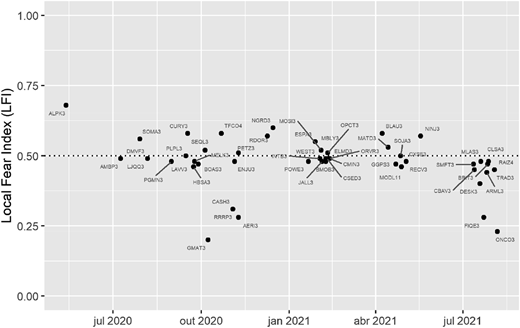
Figure 1 illustrates the behavior of the LFI. Of the 54 cases, most IPOs (36) occurred during lower fear (LFI under 0.5). The IPOs under the highest fear occurred on May 13th, 2020, when the index reached 0.68. Circa two months before, on March 22nd, 2020, the LFI reached the value of one, when the local media reported an acceleration in the transmission rate of the virus worldwide, with 2,000 confirmed cases and 34 deaths in Brazil. Moreover, the pandemic had just imposed the closure of several businesses and services, causing concerns and uncertainties about salary payments. On the same day, vaccination against the flu for healthcare professionals and individuals over 60 years of age began, a measure to try to increase the protection of the population.
Models (1) and (2) in Table 3 show the estimation results of Equation (1), where Model (2) adds the year dummies. Since the COVID-19 dummy variables capture year effects, the year dummies range from 2011 to 2020, while the data include the period from 2010 to 2021. When year dummies are not included, the COVID dummy period is not statistically significant, which suggests that the larger underpricing under COVID can be explained by the other characteristics included in the model. Nevertheless, Model (2) shows a positive and statistically significant coefficient for the COVID-19 dummy variable. Thus, there was a higher demand for IPO investments during the COVID-19 pandemic, but investors also required higher returns. Hence, the results in Table 3 provide evidence supporting Hypothesis H2, that is, after controlling for issuer, offering, lead coordinator bank and macroeconomic characteristics, is positive and statistically significant. In other words, Brazilian IPOs showed higher underpricing during the pandemic. Therefore, the results indicate that underpricing is due not only to different firms' and offerings' characteristics but also to different external factors, namely, the higher risk brought by the pandemic.
To further explore this, Model (3) in Table 3 shows the estimation results of Equation (2), which considers the effect of the evolution of the COVID-19 pandemic, measured using the LFI. This approach aims to explain how the fear of the pandemic could explain the underpricing of offerings conducted between 2020 and 2021. Because the LFI variable is absent in the pre-pandemic period, the analysis considers only IPOs carried out during the pandemic, reducing the number of available observations. The results show that the fear index is positive and statistically significant, indicating that underpricing increases as the fear of the pandemic, measured by the LFI index, increases. Thus, the study also provides evidence consistent with Hypothesis 3, that is, the higher the fear sentiment related to the pandemic, the higher the underpricing of the offering.
Although this result contradicts the findings of Mazumder and Saha (2021), who noticed a lower initial return as the fear of the pandemic increased, it aligns with Baig and Chen (2022), who concluded that as the severity of the pandemic increased, initial public offerings had a higher underpricing. Due to greater uncertainty during the pandemic, the intensity of the phenomenon was higher, as evidenced by Model (2) in Table 3.
We explore how this greater uncertainty is translated into higher IPO underpricing. As Table 3 shows, the ARI variable is negative and statistically significant in Model (2), indicating that larger returns are associated with smaller retail investment per capita in Brazil, in line with the Chinese market in Tutuncu (2023). This suggests that the hot market hypothesis, where larger first-day returns are driven by individual investors' sentiment (Derrien, 2005), does not support the Brazilian market during COVID-19. Accordingly, retail investment is not statistically significant in Model (3). If retail investors do not drive higher underpricing, institutional investors may be the culprit. However, the participation of institutional investors is not statistically significant in any of the models in Table 3. However, interacting LFI with the % Institutional Investors yields interesting results, which are reported in Supplementary File 1. As Model (1) shows, if there are no Institutional Investors in the offering, the model predicts lower underpricing with higher fear. However, as the percentage bought by institutional investors increases, underpricing also increases with LFI. The same does not occur with the ARI variable, as Model (2) shows. Therefore, institutional investors, not retail investors, drive higher underpricing.
A similar pattern occurs when interacting LFI with % Capital Increase: Model (3) in Supplementary File 1 shows that the stronger the effects of the LFI variable the higher the capital increase the offering provides. This is consistent with the hot market hypothesis, but institutional investors heated the market, not retail investors. Thus, as the pandemic intensified, institutional investors, who controlled larger pools of capital, demanded higher expected returns, which firms were willing to offer because they expected larger IPO proceeds to be generated.
When considering the different characteristics of companies that went public during the pandemic compared to those that went public in previous years, it is worth noting a possible self-selection bias of companies that conducted IPOs during the pandemic in the analysis, which may be influencing the results. Notwithstanding, from a theoretical perspective, greater uncertainty due to the pandemic can explain the higher intensity of the underpricing phenomenon, as institutional investors, to take on such risks, demanded a higher return and underwriters underpriced the offerings to avoid potential losses, in line with Baron's theory (1982), and issuers, on average, raised more funds. Accordingly, firm characteristics (namely Age, Equity and Leverage in Models (4), (5) and (6)) are not statistically significant when interacting with LFI, as shown in Supplementary File 1. Moreover, adding interactions in the model results in LFI losing significance in many versions, likely due to higher multicollinearity, since the sample is small. In the models, the interacted variables reached VIF values much higher than 10.
Additional analyses investigate the cumulative adjusted returns for the fifth and twenty-first trading days since the IPO. All models use the same set of control variables listed in Table 3. Supplementary File 2 presents these results. As in the previous results, the pandemic variables are positive and statistically significant in explaining the first week's adjusted returns (Models (1) and (2), Supplementary File 1). However, when analyzing the first 21 trading days (Models (3) and (4) in Supplementary File 2), the pandemic variables lose statistical significance. Thus, the effect of the pandemic is observed only in the very short term, that is, on the first day and in the first week after the initial offering.
Finally, Supplementary File 3 considers the long-term adjusted returns of IPOs. Whether one year or five years later, the fact that the IPO took place during the COVID-19 pandemic no longer affects the cumulative adjusted returns. Therefore, the extra returns required by institutional investors as compensation for higher uncertainty during the pandemic did not follow publicly listed firms in the long term, but only in the first day and week of trading. The control variables are the same as in the previous analyses, except for ARI, which is not included here because retail investors are short-termists (though including it does not change the conclusion regarding the COVID-19 variables). In the first two models (1-year), only profitability is statistically significant, showing that IPO firms with larger ROA yield higher returns. In Models (3) and (4), a larger number of factors can explain the cumulative 5-year returns: IPOs from older firms with larger equity and higher profitability have better 5-year returns. However, IPOs led by banks with more prestige are associated with lower long-term returns. This is consistent with the idea that firms with more solid accounting indicators do not necessarily perform better when coming to the public (short-term returns), but they do perform better in the long run.
5. Concluding remarks
This study examined IPOs in the Brazilian stock market from 2010 to 2021, with special attention to the effects of the COVID-19 pandemic on IPO underpricing. The descriptive analysis reveals that the wave of new offerings in 2020–2021 was accompanied by issuers that were generally younger, more leveraged and less profitable, characteristics that typically heighten investor risk perception. The regression results confirmed that underpricing was consistently present throughout the period and became more pronounced during the pandemic, increasing as the pandemic fear increased.
These findings reflect the unique conditions of the Brazilian market during this period. Despite the severe uncertainty brought on by the pandemic, IPO activity surged to levels not seen since 2007. This paradox can be partly explained by the drastic fall in interest rates to a historic low of 2% (August 2020 to March 2021), which pushed investors toward riskier assets in search of higher yields. In turn, local fund managers pressed for new IPOs, even from riskier issuers, creating a fertile ground for underpricing. Consistent with the market timing hypothesis, firms took advantage of this window of opportunity to raise capital despite their weaker fundamentals and, consistent with the hot market hypothesis, institutional analysts pressed for higher returns as the pandemic worsened.
This study contributes to the literature by empirically highlighting the phenomenon in the Brazilian market, especially during a crisis and due to an external factor. In practical terms, this study raises a warning about the risks of investing in initial public offerings during a crisis, especially for long-term investors. The analyses show that the pandemic effect is only significant in the short-term (the first trading day and week), so that in the long term (one and five years after the IPO), only firms' accounting indicators (and banks' prestige) are significant in explaining cumulative adjusted returns. For executives, the study suggests that in a crisis period, marked by the scenario described above, companies should demand higher financial volumes to “compensate” for the money left on the table due to the underpricing phenomenon.
The supplementary material for this article can be found online