Skip to article sections
Purpose

This review aims to provide insights for researchers and practitioners to utilize the full potential of digital twins (DT) in railway infrastructure, furthermore, promoting the future advances of DT technology in the field.

Design/methodology/approach

This paper comprehensively reviews the latest progress in the application of digital twins in railway infrastructure (Digital Twin for Railway Infrastructure (DTRI)). It systematically summarizes the application scenarios and elaborates on the core components of DTRI.

Findings

The core components of DTRI include virtual entity models, twin data, and virtual-physical connections. Emerging developments such as artificial intelligence (AI), data fusion, the Internet of Things (IoT) and advanced algorithms have been incorporated as the key technologies. The primary application scenarios focus on monitoring and maintenance, failure prediction and prevention and life cycle management.

Originality/value

DT technology has emerged as an innovative framework in the railway infrastructure sector, offering unprecedented opportunities for real-time monitoring, predictive maintenance and optimization control. The paper analyzes current and future challenges alongside emerging development directions, highlighting the transformative potential of DT technology in promoting intelligent and efficient railway infrastructure operations.

Railway infrastructure, as the backbone of global transportation, is currently confronted with prominent challenges: the aging of existing facilities leads to increased maintenance costs and safety risks; rapid growth in transportation demand imposes higher requirements for operational efficiency; and complex operating environments (extreme weather, multi-system coupling) complicate risk identification (Ahmad et al., 2024a; Elkhoury, Hitihamillage, Moridpour, & Robert, 2018). At the same time, the lack of unified standards for intelligent management, low integration of multi-source data, and the imbalance between model fidelity and computational efficiency further restrict the high-quality development of railway infrastructure management (Ahmadi, Kaleybar, Brenna, Castelli-Dezza, & Carmeli, 2021; Aksenov, Semochkin, Bendik, & Reviakin, 2022).

In this context, Digital Twin (DT) technology, as a core enabling technology of Industry 4.0, has become an inevitable choice for addressing the above challenges (Grieves & Vickers, 2017; Tao, Qi, Wang, & Nee, 2019). By integrating IoT, big data, AI, simulation, and network communication, DT constructs high-fidelity virtual replicas of physical railway infrastructure, realizing real-time mapping, dynamic simulation, and collaborative optimization through closed-loop data interaction (Tao et al., 2019a).

Despite the increasing number of studies on DTRI in recent years, existing research still has obvious limitations (Botin-Sanabria et al., 2022; Dirnfeld, 2022):

Most reviews focus on specific technical details or single application scenarios, lacking systematic integration of core technologies such as modeling, algorithms, AI applications, and networking (Kushwaha, Kumar, & Harsha, 2024).

Case studies are mostly concentrated in Europe and China, lacking representative cases from countries such as the United States and Japan, and literature timeliness needs improvement (Krmac & Djordjevic, 2024).

The logical structure of existing reviews is often unclear, with weak coherence between sections.

Core challenges and future research directions are not structured systematically, making it difficult to provide clear guidance for subsequent research (Liu, Zhang, & Xu, 2023).

To fill the above research gaps, this paper makes the following contributions:

Proposes a systematic analysis framework for railway DT technology and architecture, integrating scattered technical details into technology support and application practice modules.

Comprehensively reviews the key technology chain of DTRI from core components (virtual entity model, twin data, virtual-physical connection) to application scenarios, and supplements representative cases from the United States, Japan, and other countries, as well as high-timeliness literature (2024–2025).

Combs typical cases based on application scenarios, clarifying application effects and existing problems.

Refines core challenges and proposes structured future research directions corresponding to these challenges.

Adds a comparative analysis table of key modeling methods, providing a clear reference for DTRI modeling method selection.

The effective operation of DTRI relies on three core interdependent components: virtual entity models, twin data, and virtual-physical connections (Tao et al., 2019a). These components form a closed-loop system, enabling real-time interaction and collaborative optimization between physical and virtual entities (Grieves & Vickers, 2017; Ferdousi, Laamarti, Yang, & El Saddik, 2022; Bouali et al., 2023). On this basis, this paper integrates the scattered details of Model, Algorithm, AI application, and Network into the core components, classifies them into technology support and application empowerment two dimensions, simplifies overly detailed algorithm descriptions, and focuses on their core functions and application scenarios.

The virtual entity model is the core carrier of DTRI, which is a high-fidelity digital abstraction of physical railway infrastructure, reflecting the geometric shape, physical properties, and operational behavior of physical entities in real time (Tao et al., 2019a). The construction and optimization of the model rely on advanced modeling methods and algorithm support, and the core requirement is to balance high fidelity and computational efficiency (Torzoni, Tezzele, Mariani, Manzoni, & Willcox, 2024).

2.1.1 Composition and modeling requirements

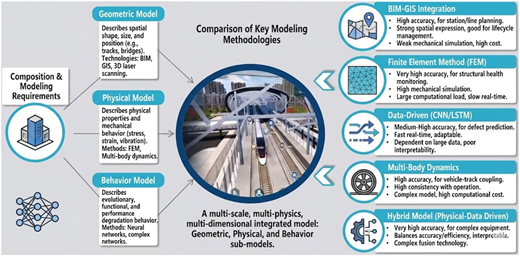
The virtual entity model of DTRI is a multi-scale, multi-physics, and multi-dimensional integrated model, mainly including three types of sub-models, which together form a complete virtual mapping of physical entities (Zhuang et al., 2017). A comparison of these key modeling methodologies is shown in Figure 1.

Geometric model: It is the foundation of the virtual entity model, accurately describing the spatial shape, size, and positional relationship of railway infrastructure components (Dekker et al., 2023), such as tracks, bridges, turnouts, and station buildings. Common modeling technologies include BIM, GIS, and 3D laser scanning, which provide basic spatial support for subsequent physical and behavior modeling (Ariyachandra & Brilakis, 2021; Bosurgi, Pellegrino, Ruggeri, & Sollazzo, 2024).

Physical model: It describes the physical properties (material parameters, stiffness, damping) and mechanical behavior (stress, strain, vibration) of physical entities, and is used to simulate the response of infrastructure under external loads. Common modeling methods include finite element method (FEM), multi-body dynamics method, etc (Liang et al., 2025; Tarque, Goicolea, Cuevas, & Martínez, 2024).

Behavior model: It describes the evolutionary behavior, functional behavior, and performance degradation behavior of physical entities over time, enabling the virtual entity to have judgment, evaluation, and prediction capabilities. It is usually constructed by combining neural networks, complex networks and other methods (Baasch, Oselin, & Groos, 2024; Ramatlo, Wilke, & Loveday, 2023).

2.1.2 Comparison of key modeling methodologies

Different modeling methodologies of DTRI have obvious differences in model accuracy, applicable scenarios, advantages and disadvantages. The following table compares the key modeling methodologies to provide reference for practical application selection in Table 1.

2.1.3 Key algorithm support

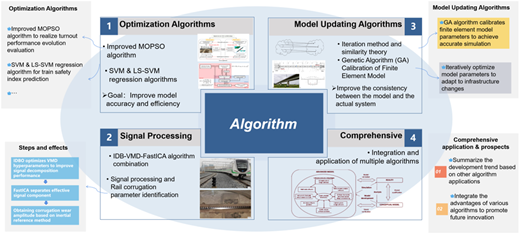
Advanced algorithms support model construction, calibration, and real-time updating. Optimization algorithms (e.g. MOPSO, GA) reduce modeling errors by aligning virtual models with physical entities (Zhou et al., 2024). Signal processing techniques (e.g. variational mode decomposition) extract key features from monitoring data (Sun, He, Ma, Wen, & Deng, 2024). Model update algorithms enable dynamic synchronization between virtual and physical states (Jiang, Qin, Fu, Zhang, & Ding, 2021). For further details, see Figure 2 and the cited references.

2.1.4 Typical research cases

Numerous scholars and institutions have carried out research on virtual entity model construction, and representative cases from different countries are as follows:

China: Liang et al. (2025) used Particle Swarm Optimization for dynamic model updating and track irregularity spectrum identification; Wang et al. established a Vehicle-Track Interaction model through finite element methods (Liang et al., 2025; Wang, Hao, Lu, Fan, & Li, 2021).

United States: Stanford University and Union Pacific Railroad (2024) proposed a hybrid physical-data driven virtual model for heavy-haul railway tracks, integrating FEM and LSTM algorithms to realize real-time prediction of track degradation, with a prediction accuracy of 92% (as cited in Galar & Kumar, 2024).

Japan: JR East Railway Company (2025) developed a BIM-GIS integrated virtual model for Tokyo Metro Yamanote Line, realizing 3D visualization management of stations and tracks, and reducing 15% of planning and design time (Kim, Hwang, & Park, 2023).

Europe: Baasch et al. (2024) adopted hybrid data-driven approaches to solve the limitation of pure physical modeling; Bosso, Magelli, Trinchero, and Zampieri (2024) used SVM surrogate models to reduce the computational cost of multi-body simulation (Bosso et al., 2024).

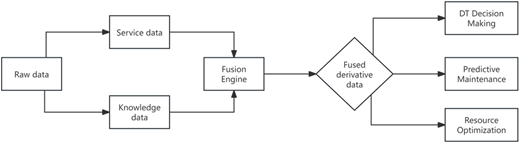
Twin data is the fundamental driving force of DTRI, encompassing the complete process of physical entity mapping, state simulation, and decision optimization (Tao et al., 2019a; Consilvio et al., 2019). According to the source and function, it can be classified into raw data, service data, knowledge data, and fused derivative data, and its effective management relies on advanced data processing algorithms (Ghaboura, Ferdousi, Laamarti, Yang, & El Saddik, 2023).

2.2.1 Classification and characteristics of twin data

The four types of twin data form a complete data chain, each with distinct characteristics and functions, supporting the normal operation of DTRI together,as illustrated in Figure 3:

Raw data: Collected by sensors, scanners and other equipment, including physical attribute data and dynamic process data, with the characteristics of large volume and high real-time performance (Flammini, Pragliola, & Smarra, 2016).

Service data: Generated by data processing, simulation analysis and business management, including algorithm models, simulation results and maintenance records, with strong practicality (Thaduri & Kumar, 2020).

Knowledge data: Including expert knowledge, industry standards and algorithm libraries, providing theoretical and rule support for decision-making (Guarino et al., 2023; Phusakulkajorn et al., 2023).

Fused derivative data: Obtained by fusing multi-source data, with higher value density, providing comprehensive and accurate information for virtual-physical interaction (Li et al., 2022).

2.2.2 Key technologies for twin data management

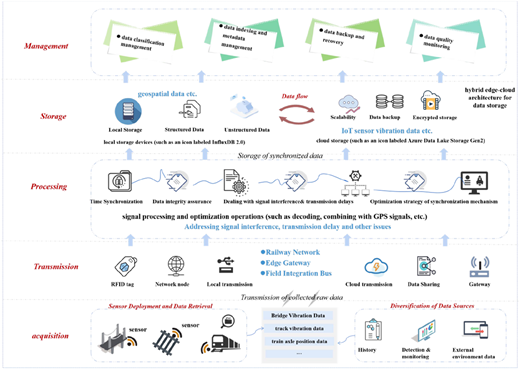
Effective twin data management involves four key steps: acquisition, preprocessing, storage, and analysis (Patwardhan, Verma, & Kumar, 2016). Data acquisition employs UAVs and multi-sensor integration at frequencies up to 500Hz (Flammini et al., 2016). Preprocessing uses filtering and normalization to achieve data completeness ≥95% (Lourenço, Ribeiro, Fernandes, & Marreiros, 2024). A hybrid edge-cloud architecture balances real-time processing and massive storage (Guan et al., 2024). Analysis leverages AI techniques such as LSTM for fault prediction and CNN for defect detection (Pappaterra, Pappaterra, & Flammini, 2024; Yang, Sun, Cao, & Hu, 2021).

Virtual-physical connection is the prerequisite for DTRI application, realizing real-time data interaction and state synchronization between physical entities and virtual models (Kaewunruen, Sresakoolchai, & Lin, 2021; Jiang et al., 2021). Its core is to build a “collection-transmission-processing-storage-management” data pipeline, which is empowered by AI technology and guaranteed by network security technology (Kaewunruen & Xu, 2018; Guan et al., 2024).

2.3.1 Key links of virtual-physical connection

The virtual-physical connection mainly includes five key links, forming a closed-loop data flow to ensure the real-time and effectiveness of virtual-physical interaction, as depicted in Figure 4.

Data acquisition: Deploy multi-source heterogeneous sensor networks to collect real-time data of physical entities, laying the foundation for virtual mapping (Kampczyk & Dybel, 2021; Armijo & Zamora-Sanchez, 2024).

Data transmission: Adopt 4G/5G, MQTT and other technologies to realize low-latency transmission of massive data, with transmission delay ≤100ms (Guan et al., 2024).

Data processing: Process and optimize multi-type data to generate decision support information for virtual model update and simulation analysis (Kou, 2022; De Benedictis, Flammini, Mazzocca, Somma, & Vitale, 2023).

Data storage: Store processed data through hybrid edge-cloud architecture to ensure data security and accessibility (Salierno, Leonardi, & Cabri, 2024).

Data management: Establish metadata storage library and semantic management system to realize unified access and management of multi-source heterogeneous data (Eickhoff, Eiden, Gobel, & Eigner, 2020).

2.3.2 AI application and network security

AI technology enhances the intelligence of virtual-physical connection, while network security technology ensures its stable operation (Anjel & Bäckström, 2021; Flammini, Lin, & Vittorini, 2020). The two are integrated to empower the efficient operation of DTRI:

AI enhances DTRI through track defect detection, degradation prediction, sensor fusion, and security monitoring (Pappaterra et al., 2024; Wang, Wang, Li, & Lu, 2024a; Yang et al., 2021). Network security employs machine learning and dynamic Bayesian networks to detect cyber-physical threats (De Donato et al., 2023). For instance, random forest algorithms achieve a 94% detection rate for railway cybersecurity threats (Levshun, Kotenko, & Chechulin, 2021; Perrone, Flammini, & Setola, 2021; Li, Yang, & Xu, 2020).

2.3.3 Typical application cases

United States: Federal Railroad Administration (FRA) and IBM (2024) developed an AI-enabled virtual-physical connection system for high-speed railways, integrating 5G and edge computing technologies to realize real-time monitoring of track and train status, reducing 20% of safety incidents (Wright & Davidson, 2024).

Japan: JR Central Railway (2024) applied AI and MQTT protocol to the virtual-physical connection of Shinkansen bridges, realizing real-time synchronization of bridge vibration data and virtual model, with a synchronization error ≤50ms (Guan et al., 2024).

China: Hu et al. (2023) applied time-frequency slicing and mutual correlation techniques to axle box vibration responses, realizing early detection of turnout potential issues; Wang et al. (2024b) proposed a two-level fusion framework for physical anomaly detection in railway cyber-physical networks (Hu et al., 2023; Wang et al., 2024b; Wang, Lei, & Zhu, 2023).

Based on the core components and key technologies of DTRI, this paper systematically combs its application scenarios, focusing on three high-value fields: monitoring and maintenance, failure prediction and prevention, and life cycle management (Doubell et al., 2023). Each field adopts a “total-subordinate” structure, first clarifying the application significance and core objectives, then elaborating on typical cases and application effects, ensuring clear logic and coherent content.

The core objective of DTRI in monitoring and maintenance is to realize real-time perception of railway infrastructure state, replace manual inspection with intelligent monitoring, improve inspection efficiency, reduce maintenance cost, and ensure operational safety (Dimitrova & Tomov, 2021). It mainly focuses on key facilities such as tracks, bridges (Brotzmann et al., 2022; Fidler et al., 2022), and turnouts, and integrates AI and network technologies to achieve intelligent monitoring.

In practice, railway operators face mounting pressure to reduce track access time for inspections while maintaining safety (Arakistain et al., 2024).DTRI-enabled monitoring systems have been deployed by several major rail networks. For example, Norfolk Southern Railway (USA) implemented a LiDAR and AI-based track inspection system, achieving an eight-fold increase in detection efficiency compared to manual inspection, directly reducing labor costs and minimizing service disruptions (Kumar & Harsha, 2024). Similarly, JR West Railway (Japan) reported a 25% reduction in bridge maintenance costs after deploying a wireless accelerometer and 5G-based DT monitoring system (Kaewunruen, AbdelHadi, Kongpuang, Pansuk, & Remennikov, 2022). These cases demonstrate that DTRI monitoring is not a theoretical concept but a mature solution delivering measurable return on investment (Djordjević, Krmac, Lin, Fröidh, & Kordnejad, 2024).

Typical research and application cases include:

Spain: Tarque et al. (2024) proposed a structural dynamics DT system for predictive maintenance of La Marota Viaduct, combining vibration monitoring and FE model calibration to achieve midspan damage prediction.

United States: Norfolk Southern Railway (2024) applied DTRI to track monitoring, integrating LiDAR and AI image recognition technology to realize automatic detection of track surface defects, with a detection efficiency 8 times higher than manual inspection (Kumar & Harsha, 2024).

Japan: JR West Railway (2025) developed a DT-based bridge monitoring system for Osaka Loop Line, using wireless accelerometers and 5G technology to realize real-time monitoring of bridge displacement and vibration, reducing 25% of maintenance costs (Kaewunruen et al., 2022).

China: Shen et al. (2023a, b) proposed a method for assessing track stiffness using axle box accelerations based on DT; a BIM-based DT framework integrates Revit, MATLAB, and ANSYS to identify pre-fatigue hotspots in railway bridges (Weyns et al., 2022; Wu et al., 2024; Yan et al., 2023).

This is a high-value scenario of DTRI, which builds fault prediction models based on historical data and real-time data through AI algorithms, identifies equipment degradation trends, realizes fault early warning and preventive maintenance, and avoids sudden faults (Azari, Flammini, Santini, & Caporuscio, 2023; Flammini, 2021). Its core is to combine data-driven and model-driven methods to improve prediction accuracy.

Unplanned failures in railway assets—such as switch machines, bogies, or rails—cause significant economic losses and safety hazards. DTRI addresses this by enabling predictive maintenance. A notable industry example is CSX Transportation (USA), which deployed an LSTM-based bogie fault prediction system achieving 93% accuracy and reducing unplanned downtime by 30%, translating into millions of dollars in annual operational savings (H-Nia, Flodin, Casanueva, Asplund, & Stichel, 2024). In China, digital twin-based predictive maintenance for switch machines has been integrated into routine operations (Gao et al., 2021, 2022), reducing emergency repairs by over 40% (Yang et al., 2021). These implementations prove that DTRI shifts maintenance from costly reactive strategies to optimized proactive interventions.

Typical research and application cases include:

China: Yang et al. (2021) proposed a digital twin-based predictive maintenance model for switch machines, integrating LSTM and ARIMA algorithms to improve state prediction accuracy; Zhang and Zhuang integrated DT and deep reinforcement learning to optimize maintenance decision-making (Zhang, Dong, & Wang, 2023; Zhuang et al., 2017).

United States: CSX Transportation (2024) developed a DT-based train bogie fault prediction system, using LSTM network to analyze vibration data, with a fault prediction accuracy of 93%, realizing 30% reduction in unplanned downtime (H-Nia et al., 2024).

Japan: JR Freight Railway (2024) applied DTRI to predict rail surface damage of heavy-haul trains, combining multi-body simulation and AI algorithms to optimize wheel-rail contact parameters, extending rail service life by 20% (Ahmad et al., 2024a).

DTRI covers the entire life cycle of railway infrastructure from planning, design, construction, operation to decommissioning, realizing digitalized, refined, and intelligent management of each stage, and improving the overall efficiency and benefit of infrastructure management. BIM technology and full-life cycle data chain are the core supports.

Life cycle management is where DTRI delivers long-term strategic value beyond daily operations. For major infrastructure projects, the ability to simulate design alternatives, optimize construction sequencing, and predict long-term degradation before physical assets are built reduces total cost of ownership. The California High-Speed Rail Authority adopted DTRI for full life cycle management, integrating BIM, GIS, and IoT across planning, design, construction, and operation phases, achieving an 18% reduction in total life cycle cost (Kaewunruen & Lian, 2019). Similarly, Tokyo Metro used DTRI to digitally simulate station renovation, shortening renovation periods by 12% and minimizing passenger disruptions (Kim et al., 2023). These cases highlight how DTRI transforms infrastructure life cycle management from fragmented, document-based processes to integrated, data-driven decision-making.

Typical research and application cases include:

China: Zhang et al. (2021) demonstrated the application of BIM-integrated lifecycle analysis methodology in railway stations and Metro systems; a multilayered DT framework for railway passenger stations achieves closed-loop optimization of station operations (Zhang, Dong, Maschek, & Song, 2021).

United States: California High-Speed Rail Authority (2025) adopted DTRI for full-life cycle management of high-speed rail lines, integrating BIM, GIS and IoT technologies to realize unified management of planning, design, construction and operation data, reducing 18% of the total life cycle cost (Hananto et al., 2024; Kaewunruen & Lian, 2019).

Japan: Tokyo Metro (2024) applied DTRI to the life cycle management of subway stations, realizing digital simulation of station renovation and maintenance, and shortening the renovation period by 12% (Hao et al., 2023; Kim et al., 2023).

Combined with the core components and application scenarios of DTRI, this section focuses on three key issues, adopting a “total-subordinate” structure to first clarify the core connotation of each issue, then elaborate on its performance and solution ideas, providing a deeper understanding of DTRI's application logic and development direction.

As the most fundamental, critical, and vulnerable component of railway infrastructure, the track is the starting point and top priority for Digital Twin (DT) construction and application. The core challenge lies not only in achieving precise perception of track conditions but also in how to build a cost-optimal track DT model that can seamlessly integrate with higher-level systems under constrained resources.

Current practices indicate that purely physical models, while capable of high-fidelity mechanical simulation, impose significant computational loads and struggle to meet real-time monitoring requirements for entire lines. Conversely, purely data-driven models, despite rapid response times, heavily depend on data quality, lack physical interpretability, and suffer from reliability issues under sparse data or sudden operational changes (Baasch et al., 2024; Sedghi, 2023). Consequently, Hybrid Modeling has emerged as the recognized solution pathway. For instance, employing FEM to simulate the fundamental mechanical response of tracks under standard loads, while utilizing LSTM to learn the complex nonlinear relationships between track degradation and multi-source monitoring data, thereby achieving complementarity between mechanism and data (Nhamage, 2023; Ahmad, Mutz, & Werth, 2024; Ramatlo et al., 2023). Realizing this goal relies on a robust sensor network and an intelligent data processing pipeline. Distributed fiber optic sensors, high-precision inertial measurement units, and vision sensors deployed along the track form the “nerve endings,” collectively capturing multimodal data such as vibration, displacement, and imagery in real-time. Preliminary filtering and feature extraction are performed by edge computing devices, after which data is transmitted via low-latency networks like 5G to cloud or edge servers to drive the hybrid model for real-time simulation and prediction (Guan et al., 2024). Ultimately, the outputs of the Track DT—such as local stiffness variations, potential defect locations, and remaining useful life predictions—are fed directly into maintenance management systems, enabling a shift from “time-based maintenance” to “predictive maintenance,” optimizing resource allocation and minimizing operational disruptions (H-Nia et al., 2024).

The track DT embodies a fundamental epistemological shift in infrastructure management: from reactive, experience-based heuristics to proactive, simulation-driven optimization. By transforming raw sensor data into actionable prognostic knowledge, it serves not merely as a monitoring tool but as a cognitive layer that mediates between physical reality and decision-making systems. This positions the track DT as the logical anchor for system-wide intelligence, where hybrid modeling becomes a paradigmatic approach for balancing mechanistic determinism with data-driven adaptability—a tension inherent to all complex cyber-physical systems.

Railway infrastructure is not a simple collection of independent components but a highly coupled dynamic system. There exist intricate mechanical and functional interactions among bridges, tunnels, and tracks. The key challenge is to break through “information silos” and achieve dynamic synergy between the digital twins of these critical assets, moving beyond isolated modeling and simulation.

When a train passes, its dynamic loads induce vibrations in the bridge structure, which are transmitted through supports to the track on the bridge, affecting track geometry and vehicle dynamic performance. Conversely, initial track irregularities or local defects generate additional impact loads, accelerating fatigue damage in bridge structures (Liang et al., 2025; Shen, Dollevoet, & Li, 2023). Traditional segregated modeling cannot effectively capture this bidirectional coupling effect, potentially leading to inaccurate risk assessments or suboptimal maintenance strategies.The core solution to this problem is constructing a “Multi-Physics Coupling DT Model.” This model needs to integrate multidisciplinary knowledge—structural mechanics (bridges/tunnels), vehicle dynamics (trains), and track engineering—enabling real-time data exchange and joint simulation across entities within a unified virtual environment (Sanfilippo, Thorstensen, Jha, Jiang, & Robbersmyr, 2022; Spiryagin, Edelmann, Klinger, & Cole, 2023). For example, real-time modal parameters and strain distributions from the Bridge DT can serve as boundary condition inputs for the vehicle-track coupling simulation within the Track DT. Conversely, wheel-rail forces calculated by the Track DT can act as dynamic load inputs for the Bridge DT. This closed-loop synergy allows the system to simulate complex scenarios, such as “whether a specific modal vibration of a bridge will resonate with a specific wavelength of track irregularity at a given train speed” (Sedghi, Kauppila, Bergquist, Vanhatalo, & Kulahci, 2021).

At the application level, DT synergy of coupled systems enables more precise predictive maintenance and risk assessment. For instance, by analyzing long-term trends in bridge vibration spectra correlated with track geometry conditions, risks such as pier settlement or bearing degradation can be predicted. Alternatively, before tunnel lining maintenance, the impact of different track reinforcement schemes on tunnel structural forces can be simulated to optimize the maintenance plan (Chacon et al., 2024).

The synergy of coupled-system DTs transcends the sum of individual asset models by capturing emergent behaviors arising from cross-boundary interactions. This reflects a holistic systems thinking paradigm, where the whole is greater than its parts. From a theoretical standpoint, it represents a shift from component-level digital twinning to system-level “digital federation,” requiring not only data interoperability but also causal modeling of interdependencies. Such federation enables the discovery of nonlinear, long-range failure mechanisms that remain invisible when each asset is analyzed in isolation. Thus, coupled-system DT synergy is not merely a technical enhancement but a prerequisite for achieving true system-of-systems intelligence in railway infrastructure.

The modern railway system is a typical System of Systems, where the track, as the foundational bearing structure, is deeply intertwined and mutually constraining with subsystems such as the subgrade, power supply (catenary), signaling, communications, and stations. The core challenge lies in expanding the Track DT from a relatively closed “vertical silo” into an open, integrated platform that supports multi-system data fusion and operational synergy, achieving holistic management of railway infrastructure.

Interdependencies among systems are ubiquitous: uneven subgrade settlement leads to track geometry deviations; hard spots or insufficient uplift force in the catenary affect pantograph strip life and current collection quality, thereby impacting train traction performance; the status of signaling systems directly determines route safety (Shabelnikov & Olgeyzer, 2020; Shen et al., 2023a, b). If each system's DT operates independently, diagnosing the root cause of cross-system cascading failures from a global perspective becomes impossible.Therefore, the future direction involves building an “Integrated Railway Infrastructure DT.” Using the Track DT as the spatial reference and temporal baseline, this model fuses multi-source heterogeneous data from subgrade monitoring sensors, traction power SCADA systems, signaling interlocking systems, station passenger flow monitoring systems, etc., by defining unified data semantics and interface standards (Shim, Dang, Lon, & Jeon, 2019; Li et al., 2022; Zhou et al., 2022). Building upon this model, advanced collaborative optimization applications can be developed:

Operational Synergy: When the DT predicts upcoming maintenance on a specific track section, it can automatically simulate the impact on train schedules, station passenger flow organization, and power load distribution, generating a comprehensive optimal “possession time” maintenance plan.

Safety Warning: Fusing track vibration data with catenary dynamic parameters enables earlier identification of potential pantograph-catenary mismatch risks. Combining signaling equipment status with track conditions allows for dynamic redundancy assessment of route safety.

Design Optimization: For new line planning or existing line retrofits, the integrated DT can simulate long-term operational performance and whole-lifecycle costs under various combinations of track structures, power supply modes, and signaling systems within the virtual environment, providing data-driven support for decision-making (Song, Gao, Li, Liu, & Dong, 2022; Kaewunruen & Lian, 2019).

Expanding the track DT into a multi-disciplinary integration platform signifies a transition from domain-specific digital twins to a unified digital ecosystem. This evolution addresses a fundamental challenge in complex infrastructure management: the tension between specialized depth (vertical silos) and cross-domain breadth (horizontal integration). The proposed integrated DT acts as a semantic broker and orchestration layer, enabling what can be termed “convergent intelligence”—where heterogeneous data streams, models, and decision logics coalesce into a coherent operational picture. Achieving this vision requires not only technical solutions (ontologies, APIs, middleware) but also organizational and governance innovations. Ultimately, the multi-disciplinary integrated DT represents the necessary architecture for railway infrastructure to function as an adaptive, resilient, and intelligent socio-technical system.

While Digital Twin for Railway Infrastructure (DTRI) has demonstrated significant promise in research and pilot applications, its path toward widespread, robust, and economically sustainable deployment is fraught with interconnected challenges (Doubell et al., 2021). These challenges extend beyond purely technical hurdles, encompassing data ecosystems, human factors, and the broader regulatory landscape. A critical examination reveals three core areas where concentrated effort is required to unlock the full transformative potential of DTRI.

The foundational challenge lies in the “Garbage In, Garbage Out” paradigm. DTRI's effectiveness is intrinsically linked to the quality, consistency, and integrability of the data feeding its models. The core problem is the ineffective integration of multi-source, heterogeneous data streams, compounded by difficulties in guaranteeing data veracity. Specifically, data acquisition from diverse sensors (strain gauges, LiDAR, vision systems) is plagued by noise, calibration drift, and vulnerability to extreme weather, leading to incomplete or corrupted datasets (Tang et al., 2022, 2024). Furthermore, profound semantic conflicts exist between data from different domains; for instance, geometric data from BIM models, spatial context from GIS, and real-time streams from IoT sensors often lack unified ontologies, making automated fusion and reasoning exceptionally difficult. The resulting low value density of raw data and the persistence of data silos significantly degrade the reliability of predictive models and decision-support algorithms, as poor-quality inputs propagate errors and uncertainties through the entire DT pipeline (Baasch et al., 2024).

A central technical contradiction governs practical DTRI deployment: the pursuit of high-fidelity modeling for accurate simulation invariably demands immense computational resources, which directly conflicts with the need for real-time or near-real-time performance in operational settings. High-fidelity physics-based models, such as detailed Finite Element Analysis (FEA) for bridges or complex Multi-Body Dynamics (MBD) for vehicle-track interaction, can simulate mechanical behavior with great accuracy but are often computationally prohibitive for system-wide, continuous simulation (Tao, Zhang, & Zhang, 2024; Thaduri, Aljumaili, Kour, & Karim, 2019). Conversely, simplifying these models for faster computation sacrifices critical details—such as the nonlinear behavior of rail fasteners, the effects of track irregularities, or micro-scale material degradation—that are essential for precise failure prediction. While hybrid (physics-data-driven) modeling is seen as a promising compromise, its technology is still maturing. Challenges include the seamless integration of disparate modeling paradigms, the massive computational cost of training Generative Adversarial Networks (GANs) for synthetic data generation or scenario expansion, and the lack of generalized frameworks for dynamically balancing fidelity with speed based on the task at hand (Ramatlo et al., 2023).

The absence of universal standards constitutes a major bottleneck for the scalable and collaborative development of DTRI. Currently, proprietary tools, closed data formats, and incompatible communication protocols dominate the landscape, leading to significant interoperability gaps. This lack of standardization manifests in several ways: engineering and simulation toolchains from different vendors cannot interact without custom-built and often fragile middleware; the absence of universal data interfaces forces point-to-point integrations that are costly to develop and maintain; and data generated across the asset lifecycle—from design (BIM) to construction to operations (IoT)—struggles to flow in a coherent, closed-loop manner due to format and semantic mismatches (Zhou et al., 2022). This fragmentation hinders the creation of a “plug-and-play” DT ecosystem, increases system complexity and cost, and ultimately slows down industry-wide adoption and innovation.

Despite the technical advances reported in academic literature, the widespread industrial adoption of DTRI remains limited. Several barriers hinder the translation of research prototypes into operational railway systems (Venkataraman, Rumpler, Leth, Toward, & Bustad, 2022). First, the high upfront cost of sensor infrastructure, data platforms, and model development poses a significant entry barrier for many rail operators, particularly those managing legacy assets. Second, the lack of standardized interfaces and data models makes integration with existing enterprise systems (e.g. asset management, workforce scheduling, and safety certification) time-consuming and expensive. Third, organizational and cultural factors—such as resistance to algorithm-driven decisions, the need for upskilling maintenance personnel, and unclear liability frameworks for AI-generated predictions—often slow down deployment.

To accelerate industry adoption, future research should prioritize cost-benefit analysis frameworks tailored to different railway contexts (e.g. heavy-haul freight vs. urban transit), develop open-source reference implementations and interoperability standards, and engage in co-design with industry partners to ensure that DTRI solutions address real operational pain points. Pilot projects that demonstrate clear, quantifiable returns on investment—such as those cited in Section 3—are essential to build business cases for wider rollout. Without explicit attention to these non-technical dimensions, even the most sophisticated DTRI models risk remaining confined to research laboratories.

This paper comprehensively reviews the current research progress, core components, application scenarios, future challenges, and emerging developments of DTRI, in accordance with the proposed optimization suggestions,Dictionary the introduction structure, integrate technical details, supplement representative cases from the United States and Japan as well as high-timeliness literature (2024–2025), optimize the total-subordinate logic of each part, add a comparative table of key modeling methods, and enhance the coherence and systematicness of the article.

The results show that DTRI, as an innovative intelligent management framework, has achieved remarkable progress in the railway infrastructure field. Its core components (virtual entity model, twin data, virtual-physical connection) form a closed-loop system, and the integrated key technologies (Model, Algorithm, AI, Network) provide strong support for its operation (Sresakoolchai & Kaewunruen, 2023). In terms of applications, DTRI has been widely used in monitoring and maintenance, failure prediction and prevention, life cycle management, and other high-value scenarios, providing strong support for the intelligent transformation of railway infrastructure.
Ahmad
,
S.
,
Spiryagin
,
M.
,
Wu
,
Q.
,
Bernal
,
E.
,
Sun
,
Y.
,
Cole
,
C.
, &
Makin
,
B.
(
2024a
).
Development of a digital twin for prediction of rail surface damage in heavy haul railway operations
.
Vehicle System Dynamics
,
62
(
1
),
41
66
. doi. doi: .
Ahmad
,
W.
,
Mutz
,
M.
, &
Werth
,
D.
(
2024b
).
Digital twin of rail for defect analysis
. In
Proceedings of the 2024 8th International Conference on Virtual and Augmented Reality Simulations
(pp. 
53
60
).
Ahmadi
,
M.
,
Kaleybar
,
H. J.
,
Brenna
,
M.
,
Castelli-Dezza
,
F.
, &
Carmeli
,
M. S.
(
2021
).
Adapting digital twin technology in electric railway power systems
. In
2021 12th Power Electronics, Drive Systems, and Technologies Conference (PEDSTC)
(pp. 
1
6
).
IEEE
.
Aksenov
,
V.
,
Semochkin
,
A.
,
Bendik
,
A.
, &
Reviakin
,
A.
(
2022
).
Utilizing digital twin for maintaining safe working environment among railway track tamping brigade
.
Transportation Research Procedia
,
61
,
600
608
. doi: .
Anjel
,
E.
, &
Bäckström
,
S.
(
2021
).
On the usage of artificial neural networks for cyber-physical threat detection in detect
.
Arakistain
,
I.
,
Garcia
,
D.
,
Zamora
,
D.
,
Armijo
,
A.
,
Fernandez-Navamuel
,
A.
,
Jimenez
,
J. C.
, &
Beristain
,
U.
(
2024
).
Predictive-cognitive maintenance for advanced integrated railway management
. In
EWSHM 2024 11th European Workshop on Structural Health Monitoring
(pp. 
1
8
).
Ariyachandra
,
M. F.
, &
Brilakis
,
I.
(
2021
).
Automated generation of railway track geometric digital twins (railgdt) from airborne lidar data
.
Universitätsverlag der TU Berlin
,
451
. doi:.
Armijo
,
A.
, &
Zamora-Sanchez
,
D.
(
2024
).
Integration of railway bridge structural health monitoring into the internet of things with a digital twin: A case study
.
Sensors
,
24
(
7
),
2115
. doi: .
Azari
,
M. S.
,
Flammini
,
F.
,
Santini
,
S.
, &
Caporuscio
,
M.
(
2023
).
A systematic literature review on transfer learning for predictive maintenance in industry 4.0
.
IEEE Access
,
11
,
12887
12910
. doi: .
Baasch
,
B.
,
Oselin
,
P.
, &
Groos
,
J. C.
(
2024
).
Model-based and data-driven digital twins for railway vehicle-track interaction monitoring
.
IEEE Transactions on Intelligent Transportation Systems
,
25
,
9876
9888
.
Bosso
,
N.
,
Magelli
,
M.
,
Trinchero
,
R.
, &
Zampieri
,
N.
(
2024
).
Application of machine learning techniques to build digital twins for long train dynamics simulations
.
Vehicle System Dynamics
,
62
(
1
),
21
40
. doi: .
Bosurgi
,
G.
,
Pellegrino
,
O.
,
Ruggeri
,
A.
, &
Sollazzo
,
G.
(
2024
).
Railway condition information modelling in a BIM framework for maintenance applications
.
International Journal of Rail Transportation
,
13
(
4
),
1
21
. doi: .
Botin-Sanabria
,
D. M.
,
Mihaita
,
A.-S.
,
Peimbert-García
,
R. E.
,
Ramírez-Moreno
,
M. A.
,
Ramírez-Mendoza
,
R. A.
, &
Lozoya-Santos
,
J. d. J.
(
2022
).
Digital twin technology challenges and applications: A comprehensive review
.
Remote Sensing
,
14
(
6
),
1335
. doi: .
Bouali
,
M.
,
Sammuneh
,
M. A.
,
Meouche
,
R. E.
,
Ababsa
,
F.
,
Salavati
,
B.
, &
Viguier
,
F.
(
2023
).
Digital twin architectures for railway infrastructure
. In
The Proceedings of the International Conference on Smart City Applications
(pp. 
213
223
).
Springer
.
Brotzmann
,
J.
,
Thiele
,
C.-D.
,
Rüppel
,
U.
,
Lorenzen
,
S.
,
Berthold
,
H.
, &
Schneider
,
J.
(
2022
).
A review of the digital twin in the ace sector in the context of application. Bridge Safety, Maintenance, Management
.
Life-Cycle, Resilience and Sustainability
,
855
862
. doi:.
Chacon
,
R.
,
Ramonell
,
C.
,
Posada
,
H.
,
Sierra
,
P.
,
Tomar
,
R.
,
Martínez de la Rosa
,
C.
, …
Wagmeister
,
S.
(
2024
).
Digital twinning during load tests of railway bridges-case study: The high-speed railway network, extremadura, Spain
.
Structure and Infrastructure Engineering
,
20
(
7-8
),
1105
1119
. doi: .
Consilvio
,
A.
,
Sanetti
,
P.
,
Anguita
,
D.
,
Crovetto
,
C.
,
Dambra
,
C.
,
Oneto
,
L.
,
...
 
Sacco
,
N.
(
2019
).
Prescriptive maintenance of railway infrastructure: From data analytics to decision support
. In
2019 6th International Conference on Models and Technologies for Intelligent Transportation Systems (MT-ITS)
(pp. 
1
10
).
IEEE
.
De Benedictis
,
A.
,
Flammini
,
F.
,
Mazzocca
,
N.
,
Somma
,
A.
, &
Vitale
,
F.
(
2023
).
Digital twins for anomaly detection in the industrial internet of things: Conceptual architecture and proof-of-concept
.
IEEE Transactions on Industrial Informatics
,
19
(
12
),
11553
11563
. doi: .
De Donato
,
L.
,
Dirnfeld
,
R.
,
Somma
,
A.
,
De Benedictis
,
A.
,
Flammini
,
F.
,
Marrone
,
S.
, …
Vittorini
,
V.
(
2023
).
Towards AI-assisted digital twins for smart railways: Preliminary guideline and reference architecture
.
Journal of Reliable Intelligent Environments
,
9
(
3
),
303
317
. doi: .
Dekker
,
B.
,
Ton
,
B.
,
Meijer
,
J.
,
Bouali
,
N.
,
Linssen
,
J.
, &
Ahmed
,
F.
(
2023
).
Point cloud analysis of railway infrastructure: A systematic literature review
.
IEEE Access
,
11
,
134355
134373
. doi: .
Dimitrova
,
E.
, &
Tomov
,
S.
(
2021
).
Digital twins: An advanced technology for railways maintenance transformation
. In
2021 13th Electrical Engineering Faculty Conference (BulEF)
(pp. 
1
5
).
IEEE
.
Dirnfeld
,
R.
(
2022
).
Digital twins in railways: State of the art, opportunities, and guidelines
.
(Ph.D. thesis)
.
Linnaeus University
.
Djordjević
,
B.
,
Krmac
,
E.
,
Lin
,
C.-Y.
,
Fröidh
,
O.
, &
Kordnejad
,
B.
(
2024
).
An optimisation-based digital twin for automated operation of rail level crossings
.
Expert Systems with Applications
,
239
, 122422. doi: .
Doubell
,
G. C.
,
Kruger
,
K.
,
Basson
,
A. H.
, &
Conradie
,
P.
(
2021
).
The potential for digital twin applications in railway infrastructure management
. In
World Congress on Engineering Asset Management
(pp. 
241
249
).
Springer
.
Doubell
,
G.
,
Basson
,
A.
,
Kruger
,
K.
, &
Conradie
,
P.
(
2023
).
A digital twin system for railway infrastructure
.
R&D Journal
,
39
,
23
34
. doi: .
Eickhoff
,
T.
,
Eiden
,
A.
,
Gobel
,
J. C.
, &
Eigner
,
M.
(
2020
).
A metadata repository for semantic product lifecycle management
.
Procedia CIRP
,
91
,
249
254
. doi: .
Elkhoury
,
N.
,
Hitihamillage
,
L.
,
Moridpour
,
S.
, &
Robert
,
D.
(
2018
).
Degradation prediction of rail tracks: A review of the existing literature
.
The Open Transportation Journal
,
12
(
1
),
88
104
. doi: .
Ferdousi
,
R.
,
Laamarti
,
F.
,
Yang
,
C.
, &
El Saddik
,
A.
(
2022
).
RailTwin: A digital twin framework for railway
. In
2022 IEEE 18th International Conference on Automation Science and Engineering (CASE)
(pp. 
1767
1772
).
IEEE
.
Fidler
,
P.
,
Huseynov
,
F.
,
Bravo Haro
,
M.
,
Vilde
,
V.
,
Schooling
,
J.
, &
Middleton
,
C.
(
2022
).
Augmenting an existing railway bridge monitoring system with additional sensors to create a bridge weigh-in-motion system and digital twin
. In
SHMII-11: 11th International Conference on Structural Health Monitoring of Intelligent Infrastructure
(pp. 
1
4
).
Flammini
,
F.
(
2021
).
Digital twins as run-time predictive models for the resilience of cyber-physical systems: A conceptual framework
.
Philosophical Transactions of the Royal Society A
,
379
(
2207
), 20200369. doi: .
Flammini
,
F.
,
Pragliola
,
C.
, &
Smarra
,
G.
(
2016
).
Railway infrastructure monitoring by drones
. In
2016 International Conference on Electrical Systems for Aircraft, Railway, Ship Propulsion and Road Vehicles & International Transportation Electrification Conference (ESARS-ITEC)
(pp. 
1
6
).
IEEE
.
Flammini
,
F.
,
Lin
,
Z.
, &
Vittorini
,
V.
(
2020
).
Roadmaps for AI integration in the rail sector
(Vol. 
2020
, pp. 
34
35
).
ERCIM News
.
Galar
,
D.
, &
Kumar
,
U.
(
2024
). Digital twins: Definition, implementation and applications. In
Advances in Risk-Informed Technologies: Keynote Volume (ICRESH 2024)
(pp. 
79
106
).
Springer
.
Gao
,
Y.
,
Qian
,
S.
,
Li
,
Z.
,
Wang
,
P.
,
Wang
,
F.
, &
He
,
Q.
(
2021
).
Digital twin and its application in transportation infrastructure
. In
2021 IEEE 1st International Conference on Digital Twins and Parallel Intelligence (DTPI)
(pp. 
298
301
).
IEEE
.
Gao
,
S.
,
Zhou
,
M.
,
Zheng
,
W.
,
Zhang
,
L.
,
Zhang
,
B.
,
Song
,
H.
, &
Li
,
N.
(
2022
).
Intelligent operation and maintenance for advanced equipment based on digital twin: Challenges and future (in Chinese)
.
Computer Integrated Manufacturing Systems
,
28
,
1953
.
Ghaboura
,
S.
,
Ferdousi
,
R.
,
Laamarti
,
F.
,
Yang
,
C.
, &
El Saddik
,
A.
(
2023
).
Digital twin for railway: A comprehensive survey
.
IEEE Access
,
11
,
120237
120257
. doi: .
Grieves
,
M.
, &
Vickers
,
J.
(
2017
). Digital twin: Mitigating unpredictable, undesirable emergent behavior in complex systems. In
Transdisciplinary perspectives on complex systems: New findings and approaches
(pp. 
85
113
).
Guan
,
K.
,
Guo
,
X.
,
He
,
D.
,
Svoboda
,
P.
,
Berbineau
,
M.
,
Wang
,
S.
,
 
Rupp
,
M.
(
2024
).
Key technologies for wireless network digital twin towards smart railways
.
High-speed Railway
,
2
,
1
10
. doi: .
Guarino
,
S.
,
Vitale
,
F.
,
Flammini
,
F.
,
Faramondi
,
L.
,
Mazzocca
,
N.
, &
Setola
,
R.
(
2023
).
A two-level fusion framework for cyber-physical anomaly detection
.
IEEE Transactions on Industrial Cyber-Physical Systems
,
2
,
1
13
. doi: .
H-Nia
,
S.
,
Flodin
,
J.
,
Casanueva
,
C.
,
Asplund
,
M.
, &
Stichel
,
S.
(
2024
).
Predictive maintenance in railway systems: MBS-based wheel and rail life prediction exemplified for the Swedish iron-ore line
.
Vehicle System Dynamics
,
62
(
1
),
3
20
. doi: .
Hananto
,
A. L.
,
Tirta
,
A.
,
Herawan
,
S. G.
,
Idris
,
M.
,
Soudagar
,
M. E. M.
,
Djamari
,
D. W.
, &
Veza
,
I.
(
2024
).
Digital twin and 3D digital twin: Concepts, applications, and challenges in industry 4.0 for digital twin
.
Computers
,
13
(
4
),
100
. doi: .
Hao
,
R.
,
Lu
,
W.
,
Fan
,
W.
,
Zhang
,
S.
,
Li
,
X.
, &
Wang
,
K.
(
2023
).
A preliminary study on railway digital twin model and system
. In
2023 IEEE 14th International Symposium on Parallel Architectures, Algorithms and Programming (PAAP)
(pp. 
1
5
).
IEEE
.
Hu
,
H.
,
Qin
,
H.
,
Shi
,
J.
,
Yu
,
Y.
,
Zheng
,
C.
,
Shen
,
C.
, &
Zhu
,
Z.
(
2023
).
Identification of high-speed railway turnout generated vibrations based on time-frequency slice and mutual correlation of vibration responses from axle box
.
Measurement
,
221
, 113458. doi: .
Jiang
,
H.
,
Qin
,
S.
,
Fu
,
J.
,
Zhang
,
J.
, &
Ding
,
G.
(
2021
).
How to model and implement connections between physical and virtual models for digital twin application
.
Journal of Manufacturing Systems
,
58
,
36
51
. doi: .
Kaewunruen
,
S.
, &
Lian
,
Q.
(
2019
).
Digital twin aided sustainability-based lifecycle management for railway turnout systems
.
Journal of Cleaner Production
,
228
,
1537
1551
. doi: .
Kaewunruen
,
S.
, &
Xu
,
N.
(
2018
).
Digital twin for sustainability evaluation of railway station buildings
.
Frontiers in Built Environment
,
4
,
77
. doi: .
Kaewunruen
,
S.
,
Sresakoolchai
,
J.
, &
Lin
,
Y. -H.
(
2021
).
Digital twins for managing railway maintenance and resilience
.
Open Research Europe
,
1
,
91
. doi: .
Kaewunruen
,
S.
,
AbdelHadi
,
M.
,
Kongpuang
,
M.
,
Pansuk
,
W.
, &
Remennikov
,
A. M.
(
2022
).
Digital twins for managing railway bridge maintenance, resilience, and climate change adaptation
.
Sensors
,
23
(
1
),
252
. doi: .
Kampczyk
,
A.
, &
Dybel
,
K.
(
2021
).
The fundamental approach of the digital twin application in railway turnouts with innovative monitoring of weather conditions
.
Sensors
,
21
(
17
),
5757
. doi: .
Kim
,
M. -k.
,
Hwang
,
D.
, &
Park
,
D.
(
2023
).
Analysis of maintenance techniques for a three-dimensional digital twin-based railway facility with tunnels
.
Platforms
,
1
,
5
17
. doi: .
Kou
,
L.
(
2022
).
A review of research on detection and evaluation of the rail surface defects
.
Acta Polytechnica Hungarica
,
19
(
3
),
167
186
. doi: .
Krmac
,
E.
, &
Djordjevic
,
B.
(
2024
).
Digital twins for railway sector: Current state and future directions
.
IEEE Access
.
Kumar
,
A.
, &
Harsha
,
S.
(
2024
).
A systematic literature review of defect detection in railways using machine vision-based inspection methods
.
International Journal of Transportation Science and Technology
.
Kushwaha
,
D.
,
Kumar
,
A.
, &
Harsha
,
S.
(
2024
).
Advancements and applications of digital twin in the railway industry: A literature review
.
International Journal of Rail Transportation
,
13
(
5
),
1
26
. doi: .
Levshun
,
D.
,
Kotenko
,
I.
, &
Chechulin
,
A.
(
2021
).
The application of the methodology for secure cyber-physical systems design to improve the semi-natural model of the railway infrastructure
.
Microprocessors and Microsystems
,
87
, 103482. doi: .
Li
,
D.
,
Yang
,
X.
, &
Xu
,
X.
(
2020
). A framework of smart railway passenger station based on digital twin. In
CICTP 2020
(pp. 
2623
2634
).
Li
,
H.
,
Zhu
,
Q.
,
Zhang
,
L.
,
Ding
,
Y.
,
Guo
,
Y.
,
Wu
,
H.
,
 
Zhou
,
Y.
(
2022
).
Integrated representation of geospatial data, model, and knowledge for digital twin railway
.
International Journal of Digital Earth
,
15
(
1
),
1657
1675
. doi: .
Liang
,
H.
,
Dai
,
B. -R.
,
Xu
,
Y. -L.
,
Li
,
Q.
,
Song
,
Q. -Y.
, &
Zheng
,
Y.
(
2025
).
Digital twins for dynamics of a train-slab track-bridge coupled system
.
Mechanical Systems and Signal Processing
,
224
, 112130. doi: .
Liu
,
C.
,
Zhang
,
P.
, &
Xu
,
X.
(
2023
).
Literature review of digital twin technologies for civil infrastructure
.
Journal of Infrastructure Intelligence and Resilience
,
2
(
3
), 100050. doi: .
Lourenço
,
A.
,
Ribeiro
,
D.
,
Fernandes
,
M.
, &
Marreiros
,
G.
(
2024
).
Time series data mining for railway wheel and track monitoring: A survey
.
Neural Computing & Applications
,
36
(
27
),
16707
16725
. doi: .
Nhamage
,
S.
(
2023
).
Development of BIM-based digital twin model for fatigue assessment in metallic railway bridges
.
U. Porto Journal of Engineering
,
9
(
5
),
12
23
. doi: .
Pappaterra
,
M. J.
,
Pappaterra
,
M. L.
, &
Flammini
,
F.
(
2024
).
A study on the application of convolutional neural networks for the maintenance of railway tracks
.
Discover Artificial Intelligence
,
4
(
1
),
30
. doi: .
Patwardhan
,
A.
,
Verma
,
A. K.
, &
Kumar
,
U.
(
2016
). A survey on predictive maintenance through big data. In
Current Trends in Reliability, Availability, Maintainability and Safety: An Industry Perspective
(pp. 
437
445
).
Springer
.
Perrone
,
P.
,
Flammini
,
F.
, &
Setola
,
R.
(
2021
).
Machine learning for threat recognition in critical cyber-physical systems
. In
2021 IEEE International Conference on Cyber Security and Resilience (CSR)
(pp. 
298
303
).
IEEE
.
Phusakulkajorn
,
W.
,
Núñez
,
A.
,
Wang
,
H.
,
Jamshidi
,
A.
,
Zoeteman
,
A.
,
Ripke
,
B.
,
 
Li
,
Z.
(
2023
).
Artificial intelligence in railway infrastructure: Current research, challenges, and future opportunities
.
Intelligent Transportation Infrastructure
,
2
, liad016. doi: .
Ramatlo
,
D. A.
,
Wilke
,
D. N.
, &
Loveday
,
P. W.
(
2023
).
Digital twin hybrid modeling for enhancing guided wave ultrasound inspection signals in welded rails
.
Mathematical and Computational Applications
,
28
(
2
),
58
. doi: .
Salierno
,
G.
,
Leonardi
,
L.
, &
Cabri
,
G.
(
2024
).
A big data architecture for digital twin creation of railway signals based on synthetic data
.
IEEE Open Journal of Intelligent Transportation Systems
.
Sanfilippo
,
F.
,
Thorstensen
,
R. T.
,
Jha
,
A.
,
Jiang
,
Z.
, &
Robbersmyr
,
K. G.
(
2022
).
A perspective review on digital twins for roads, bridges, and civil infrastructures
. In
2022 International Conference on Electrical, Computer, Communications and Mechatronics Engineering (ICECCME)
(pp. 
1
6
).
IEEE
.
Sedghi
,
M.
(
2023
).
Enhancing the effectiveness of neural networks in predicting railway track degradation
. In
International Congress and Workshop on Industrial AI
(pp. 
651
664
).
Springer
.
Sedghi
,
M.
,
Kauppila
,
O.
,
Bergquist
,
B.
,
Vanhatalo
,
E.
, &
Kulahci
,
M.
(
2021
).
A taxonomy of railway track maintenance planning and scheduling: A review and research trends
.
Reliability Engineering & System Safety
,
215
, 107827. doi: .
Shabelnikov
,
A. N.
, &
Olgeyzer
,
I. A.
(
2020
).
Technology and mathematical basis of digital twin creation in railway infrastructure
.
Proceedings of the Fourth International Scientific Conference Intelligent Information Technologies for Industry (IITI'19)
(Vol. 
4
, pp. 
688
-
695
).
Springer
.
Shen
,
C.
,
Dollevoet
,
R.
, &
Li
,
Z.
(
2023
).
Digital twin of vehicle-track system for integrated track condition monitoring
. In
The IAVSD International Symposium on Dynamics of Vehicles on Roads and Tracks
(pp. 
743
751
).
Springer
.
Shen
,
C.
,
Zhang
,
P.
,
Dollevoet
,
R.
,
Zoeteman
,
A.
, &
Li
,
Z.
(
2023
).
Evaluating railway track stiffness using axle box accelerations: A digital twin approach
.
Mechanical Systems and Signal Processing
,
204
, 110730. doi: .
Shim
,
C. -S.
,
Dang
,
N. -S.
,
Lon
,
S.
, &
Jeon
,
C. -H.
(
2019
).
Development of a bridge maintenance system for prestressed concrete bridges using 3D digital twin model
.
Structure and Infrastructure Engineering
,
15
(
10
),
1319
1332
. doi: .
Song
,
H.
,
Gao
,
S.
,
Li
,
Y.
,
Liu
,
L.
, &
Dong
,
H.
(
2022
).
Train-centric communication based autonomous train control system
.
IEEE Transactions on Intelligent Vehicles
,
8
(
1
),
721
731
. doi: .
Spiryagin
,
M.
,
Edelmann
,
J.
,
Klinger
,
F.
, &
Cole
,
C.
(
2023
).
Vehicle system dynamics in digital twin studies in rail and road domains
.
Vehicle System Dynamics
,
61
(
7
),
1737
1786
. doi: .
Sresakoolchai
,
J.
, &
Kaewunruen
,
S.
(
2023
).
Railway infrastructure maintenance efficiency improvement using deep reinforcement learning integrated with digital twin based on track geometry and component defects
.
Scientific Reports
,
13
(
1
),
2439
. doi: .
Sun
,
H.
,
He
,
D.
,
Ma
,
H.
,
Wen
,
Z.
, &
Deng
,
J.
(
2024
).
The parameter identification of metro rail corrugation based on effective signal extraction and inertial reference method
.
Engineering Failure Analysis
,
158
, 108043. doi: .
Tang
,
R.
,
De Donato
,
L.
,
Besinovic
,
N.
,
Flammini
,
F.
,
Goverde
,
R. M.
,
Lin
,
Z.
, …
Wang
,
Z.
(
2022
).
A literature review of artificial intelligence applications in railway systems
.
Transportation Research Part C: Emerging Technologies
,
140
, 103679. doi: .
Tang
,
Z.
,
Ling
,
L.
,
Zhang
,
T.
,
Hu
,
Y.
,
Wang
,
K.
, &
Zhai
,
W.
(
2024
).
Towards digital twin trains: Implementing a cloud-based framework for railway vehicle dynamics simulation
.
International Journal of Rail Transportation
,
13
(
3
),
1
24
. doi: .
Tao
,
F.
,
Liu
,
W.
,
Zhang
,
M.
,
Hu
,
T.
,
Qi
,
Q.
,
Zhang
,
H.
, &
Sui
,
F.
(
2019a
).
Five-dimension digital twin model and its ten applications (in Chinese)
.
Computer Integrated Manufacturing Systems
,
25
,
1
18
.
Tao
,
F.
,
Qi
,
Q.
,
Wang
,
L.
, &
Nee
,
A.
(
2019b
).
Digital twins and cyber-physical systems toward smart manufacturing and industry 4.0: Correlation and comparison
.
Engineering
,
5
(
4
),
653
661
. doi: .
Tao
,
F.
,
Zhang
,
H.
, &
Zhang
,
C.
(
2024
).
Advancements and challenges of digital twins in industry
.
Nature Computational Science
,
4
(
3
),
169
177
. doi: .
Tarque
,
N.
,
Goicolea
,
J. M.
,
Cuevas
,
R. G.
, &
Martínez
,
J. L.
(
2024
).
Finite element model updating for the dynamic response of continuous deck railway viaducts leading to efficient digital twins
.
Journal of Physics: Conference Series
,
2647
(
10
), 102009. doi: .
Thaduri
,
A.
, &
Kumar
,
U.
(
2020
). Integrated RAMS, LCC and risk assessment for maintenance planning for railways. In
Advances in RAMS Engineering: In Honor of Professor Ajit Kumar Verma on His 60th Birthday
(pp. 
261
292
).
Thaduri
,
A.
,
Aljumaili
,
M.
,
Kour
,
R.
, &
Karim
,
R.
(
2019
).
Cybersecurity for maintenance in railway infrastructure: Risks and consequences
.
International Journal of System Assurance Engineering and Management
,
10
(
2
),
149
159
. doi: .
Torzoni
,
M.
,
Tezzele
,
S.
,
Mariani
,
S.
,
Manzoni
,
A.
, &
Willcox
,
K. E.
(
2024
).
A digital twin framework for civil engineering structures
.
Computer Methods in Applied Mechanics and Engineering
,
418
, 116584. doi: .
Venkataraman
,
S.
,
Rumpler
,
R.
,
Leth
,
S.
,
Toward
,
M.
, &
Bustad
,
T.
(
2022
).
Improving strategic noise mapping of railway noise in Europe: Refining CNOSSOS-EU calculations using twins
.
Science of the Total Environment
,
839
, 156216. doi: .
Wang
,
K.
,
Hao
,
R.
,
Lu
,
W.
,
Fan
,
W.
, &
Li
,
D.
(
2021
).
Research status and perspective of BIM-based digital twin railway engineering (in Chinese)
.
Railway Technical Innovation
.
Wang
,
Z.
,
Lei
,
Z.
, &
Zhu
,
J.
(
2023
).
Study on the formation mechanism of rail corrugation in small radius curves of metro
.
Journal of Mechanical Science and Technology
,
37
(
9
),
4521
4532
. doi: .
Wang
,
T.
,
Wang
,
W.
,
Li
,
P.
, &
Lu
,
W.
(
2024a
).
Prospect of key technologies of intelligent HSR 2.0 empowered by model-data integration platform
,
1
6
.
Chinese Railways. (in Chinese)
.
Wang
,
X.
,
Bai
,
W.
,
Su
,
Y.
,
Yang
,
G.
,
Li
,
C.
,
Lv
,
X.
,
 
Li
,
J.
(
2024b
).
Digital twin for multi-scenario emergency of railway passenger stations
.
Frontiers in Physics
,
11
, 1291785. doi: .
Weyns
,
D.
,
Andersson
,
J.
,
Caporuscio
,
M.
,
Flammini
,
F.
,
Kerren
,
A.
, &
Löwe
,
W.
(
2022
).
A research agenda for smarter cyber-physical systems
.
Journal of Integrated Design and Process Science
,
25
(
2
),
27
47
. doi: .
Wright
,
L.
, &
Davidson
,
S.
(
2024
).
Digital twins for metrology; metrology for digital twins
.
Measurement Science and Technology
,
35
(
5
), 051001. doi: .
Wu
,
X.
,
Zhang
,
Z.
,
Cai
,
W.
,
Yang
,
N.
,
Jin
,
X.
,
Wang
,
P.
,
 
Huang
,
Y.
(
2024
).
A critical review of wheel/rail high frequency vibration-induced vibration fatigue of railway bogie in China
.
Railway Sciences
,
3
(
2
),
177
215
. doi: .
Yan
,
B.
,
Yang
,
F.
,
Qiu
,
S.
,
Wang
,
J.
,
Cai
,
B.
,
Wang
,
S.
,
 
Hu
,
W.
(
2023
).
Digital twin in transportation infrastructure management: A systematic review
.
Intelligent Transportation Infrastructure
,
2
,
1
18
. doi: .
Yang
,
J.
,
Sun
,
Y.
,
Cao
,
Y.
, &
Hu
,
X.
(
2021
).
Predictive maintenance for switch machine based on digital twins
.
Information
,
12
(
11
),
485
. doi: .
Zhang
,
S.
,
Dong
,
H.
,
Maschek
,
U.
, &
Song
,
H.
(
2021
).
A digital-twin-assisted fault diagnosis of railway point machine
. In
2021 IEEE 1st International Conference on Digital Twins and Parallel Intelligence (DTPI)
(pp. 
430
433
).
IEEE
.
Zhang
,
C.
,
Dong
,
L.
, &
Wang
,
Y.
(
2023
).
Design-manufacturing-operation & maintenance (O&M) integration of complex product based on digital twin
.
Applied Sciences
,
13
,
1052
.
Zhou
,
S.
,
Dumss
,
S.
,
Nowak
,
R.
,
Riegler
,
O.
,
Kugu
,
M.
,
Krammer
,
M.
, &
Grafinger
,
M.
(
2022
).
A conceptual model-based digital twin platform for holistic large-scale railway infrastructure systems
.
Procedia CIRP
,
109
,
362
367
. doi: .
Zhou
,
C.
,
Gao
,
L.
,
Cai
,
X.
,
Ding
,
H.
,
Li
,
K.
, &
Li
,
W.
(
2024
).
Digital twin technology for continuously welded turnout on high-speed railway bridges based on improved MOPSO algorithm
.
Structural and Multidisciplinary Optimization
,
67
(
6
),
87
. doi: .
Zhuang
,
C.
,
Liu
,
J.
,
Xiong
,
H.
,
Ding
,
X.
,
Liu
,
S.
, &
Weng
,
G.
(
2017
).
Connotation, architecture and trends of product digital twin (in Chinese)
.
Computer Integrated Manufacturing Systems
,
23
,
753
768
.
Bernal
,
E.
,
Wu
,
Q.
,
Spiryagin
,
M.
, &
Cole
,
C.
(
2024
).
Augmented digital twin for railway systems
.
Vehicle System Dynamics
,
62
(
1
),
67
83
. doi: .
Chen
,
J.
,
Chen
,
R.
,
Wang
,
P.
,
Xu
,
J.
,
An
,
B.
,
Yang
,
F.
,
 
Wang
,
P.
(
2024
).
Wheel-rail impact and vibration characteristic frequencies at high-speed railway turnouts
.
Mechanical Systems and Signal Processing
,
218
, 111537. doi: .
Song
,
H.
,
Li
,
L.
,
Li
,
Y.
,
Tan
,
L.
, &
Dong
,
H.
(
2024
).
Functional safety and performance analysis of autonomous route management for autonomous train control system
.
IEEE Transactions on Intelligent Transportation Systems
,
25
(
10
),
13291
13304
. doi: .
Published in Railway Sciences. Published by Emerald Publishing Limited. This article is published under the Creative Commons Attribution (CC BY 4.0) licence. Anyone may reproduce, distribute, translate and create derivative works of this article (for both commercial and non-commercial purposes), subject to full attribution to the original publication and authors. The full terms of this licence may be seen at Link to the terms of the CC BY 4.0 licence.

Data & Figures

Figure 1
A diagram comparing key modeling methodologies.A diagram comparing key modeling methodologies. It includes three main categories: Geometric Model, Physical Model, and Behavior Model. Each category is further divided into specific methodologies such as BIM-GIS Integration, Finite Element Method, Data-Driven, Multi-Body Dynamics, and Hybrid Model. The diagram also shows the composition and modeling requirements, and a central image of a train track with sensors.

Comparison of key modeling methodologies. Source: Authors’ own work

Figure 1
A diagram comparing key modeling methodologies.A diagram comparing key modeling methodologies. It includes three main categories: Geometric Model, Physical Model, and Behavior Model. Each category is further divided into specific methodologies such as BIM-GIS Integration, Finite Element Method, Data-Driven, Multi-Body Dynamics, and Hybrid Model. The diagram also shows the composition and modeling requirements, and a central image of a train track with sensors.

Comparison of key modeling methodologies. Source: Authors’ own work

Close modal
Figure 2
A diagram of the key algorithm system and application mapping for rail digital twin.The diagram is divided into four sections: Optimization Algorithms, Signal Processing, Model Updating Algorithms, and Comprehensive. Each section contains specific algorithms and their applications. Optimization Algorithms include Improved MOPSO algorithm and SVM and LS-SVM regression algorithms aimed at improving model accuracy and efficiency. Signal Processing features the IDB-VMD-FastICA algorithm combination for signal processing and rail corrugation parameter identification. Model Updating Algorithms involve the Genetic Algorithm for calibrating finite element models to achieve accurate simulations and improving model consistency with the actual system. The Comprehensive section discusses the integration and application of multiple algorithms, summarizing development trends and integrating various algorithm advantages to promote future innovation.

Key algorithm system and application mapping diagram of rail digital twin. Source: Authors’ own work

Figure 2
A diagram of the key algorithm system and application mapping for rail digital twin.The diagram is divided into four sections: Optimization Algorithms, Signal Processing, Model Updating Algorithms, and Comprehensive. Each section contains specific algorithms and their applications. Optimization Algorithms include Improved MOPSO algorithm and SVM and LS-SVM regression algorithms aimed at improving model accuracy and efficiency. Signal Processing features the IDB-VMD-FastICA algorithm combination for signal processing and rail corrugation parameter identification. Model Updating Algorithms involve the Genetic Algorithm for calibrating finite element models to achieve accurate simulations and improving model consistency with the actual system. The Comprehensive section discusses the integration and application of multiple algorithms, summarizing development trends and integrating various algorithm advantages to promote future innovation.

Key algorithm system and application mapping diagram of rail digital twin. Source: Authors’ own work

Close modal
Figure 3
A diagram of a data fusion process.The diagram illustrates a data fusion process where raw data is split into service data and knowledge data. These data types are then processed by a fusion engine to produce fused derivative data. The fused derivative data is subsequently used for decision making, predictive maintenance, and resource optimization.

Twin data that combines information data and physical data. Source: Authors’ own work

Figure 3
A diagram of a data fusion process.The diagram illustrates a data fusion process where raw data is split into service data and knowledge data. These data types are then processed by a fusion engine to produce fused derivative data. The fused derivative data is subsequently used for decision making, predictive maintenance, and resource optimization.

Twin data that combines information data and physical data. Source: Authors’ own work

Close modal
Figure 4
A diagram of virtual-physical digital twin data connection.The diagram illustrates the virtual-physical digital twin data connection, divided into four main sections: Management, Storage, Processing, and Transmission. Management includes data classification, indexing, metadata management, backup, recovery, and quality monitoring. Storage covers local and cloud storage for geospatial and IoT sensor data, emphasizing scalability, backup, and encrypted storage. Processing involves time synchronization, data integrity assurance, dealing with signal interference and transmission delays, and optimization strategies. Transmission includes RFID tags, network nodes, local and cloud transmission, data sharing, and gateways. The diagram also highlights sensor deployment, data retrieval, and diversification of data sources, including bridge and track vibration data, train axle position data, history, detection and monitoring, and external environment data.

Virtual-physical DT data connection. Source: Authors’ own work

Figure 4
A diagram of virtual-physical digital twin data connection.The diagram illustrates the virtual-physical digital twin data connection, divided into four main sections: Management, Storage, Processing, and Transmission. Management includes data classification, indexing, metadata management, backup, recovery, and quality monitoring. Storage covers local and cloud storage for geospatial and IoT sensor data, emphasizing scalability, backup, and encrypted storage. Processing involves time synchronization, data integrity assurance, dealing with signal interference and transmission delays, and optimization strategies. Transmission includes RFID tags, network nodes, local and cloud transmission, data sharing, and gateways. The diagram also highlights sensor deployment, data retrieval, and diversification of data sources, including bridge and track vibration data, train axle position data, history, detection and monitoring, and external environment data.

Virtual-physical DT data connection. Source: Authors’ own work

Close modal
Table 1

Comparison of key modeling methodologies

Modeling methodologyModel accuracyApplicable scenariosAdvantagesDisadvantages
BIM-GIS IntegrationHighRailway station, line planning and design, 3D visualization managementStrong spatial expression ability, good compatibility with engineering data, convenient for full-life cycle managementWeak mechanical behavior simulation ability, high modeling cost for large-scale lines
Finite Element Method (FEM)Very highBridge, tunnel structural health monitoring, stress and strain simulationHigh mechanical simulation accuracy, suitable for complex structural analysisLarge computational load, slow real-time response, high requirement for parameter setting
Data-Driven (CNN/LSTM)Medium-HighTrack defect prediction, equipment performance degradation monitoringFast real-time response, strong adaptability to complex data, low modeling difficultyDependent on large-scale high-quality data, poor interpretability, weak physical constraint
Multi-Body DynamicsHighVehicle-track coupling system, turnout operation simulationhigh consistency with actual operation stateComplex model establishment, high computational cost for long-term simulation
Hybrid Model (Physical-Data Driven)Very highHigh-speed railway key sections, complex equipment integrated monitoringBalances simulation accuracy and computational efficiency, strong interpretability and adaptabilityComplex model fusion technology, high requirement for cross-disciplinary knowledge

Supplements

References

Ahmad
,
S.
,
Spiryagin
,
M.
,
Wu
,
Q.
,
Bernal
,
E.
,
Sun
,
Y.
,
Cole
,
C.
, &
Makin
,
B.
(
2024a
).
Development of a digital twin for prediction of rail surface damage in heavy haul railway operations
.
Vehicle System Dynamics
,
62
(
1
),
41
66
. doi. doi: .
Ahmad
,
W.
,
Mutz
,
M.
, &
Werth
,
D.
(
2024b
).
Digital twin of rail for defect analysis
. In
Proceedings of the 2024 8th International Conference on Virtual and Augmented Reality Simulations
(pp. 
53
60
).
Ahmadi
,
M.
,
Kaleybar
,
H. J.
,
Brenna
,
M.
,
Castelli-Dezza
,
F.
, &
Carmeli
,
M. S.
(
2021
).
Adapting digital twin technology in electric railway power systems
. In
2021 12th Power Electronics, Drive Systems, and Technologies Conference (PEDSTC)
(pp. 
1
6
).
IEEE
.
Aksenov
,
V.
,
Semochkin
,
A.
,
Bendik
,
A.
, &
Reviakin
,
A.
(
2022
).
Utilizing digital twin for maintaining safe working environment among railway track tamping brigade
.
Transportation Research Procedia
,
61
,
600
608
. doi: .
Anjel
,
E.
, &
Bäckström
,
S.
(
2021
).
On the usage of artificial neural networks for cyber-physical threat detection in detect
.
Arakistain
,
I.
,
Garcia
,
D.
,
Zamora
,
D.
,
Armijo
,
A.
,
Fernandez-Navamuel
,
A.
,
Jimenez
,
J. C.
, &
Beristain
,
U.
(
2024
).
Predictive-cognitive maintenance for advanced integrated railway management
. In
EWSHM 2024 11th European Workshop on Structural Health Monitoring
(pp. 
1
8
).
Ariyachandra
,
M. F.
, &
Brilakis
,
I.
(
2021
).
Automated generation of railway track geometric digital twins (railgdt) from airborne lidar data
.
Universitätsverlag der TU Berlin
,
451
. doi:.
Armijo
,
A.
, &
Zamora-Sanchez
,
D.
(
2024
).
Integration of railway bridge structural health monitoring into the internet of things with a digital twin: A case study
.
Sensors
,
24
(
7
),
2115
. doi: .
Azari
,
M. S.
,
Flammini
,
F.
,
Santini
,
S.
, &
Caporuscio
,
M.
(
2023
).
A systematic literature review on transfer learning for predictive maintenance in industry 4.0
.
IEEE Access
,
11
,
12887
12910
. doi: .
Baasch
,
B.
,
Oselin
,
P.
, &
Groos
,
J. C.
(
2024
).
Model-based and data-driven digital twins for railway vehicle-track interaction monitoring
.
IEEE Transactions on Intelligent Transportation Systems
,
25
,
9876
9888
.
Bosso
,
N.
,
Magelli
,
M.
,
Trinchero
,
R.
, &
Zampieri
,
N.
(
2024
).
Application of machine learning techniques to build digital twins for long train dynamics simulations
.
Vehicle System Dynamics
,
62
(
1
),
21
40
. doi: .
Bosurgi
,
G.
,
Pellegrino
,
O.
,
Ruggeri
,
A.
, &
Sollazzo
,
G.
(
2024
).
Railway condition information modelling in a BIM framework for maintenance applications
.
International Journal of Rail Transportation
,
13
(
4
),
1
21
. doi: .
Botin-Sanabria
,
D. M.
,
Mihaita
,
A.-S.
,
Peimbert-García
,
R. E.
,
Ramírez-Moreno
,
M. A.
,
Ramírez-Mendoza
,
R. A.
, &
Lozoya-Santos
,
J. d. J.
(
2022
).
Digital twin technology challenges and applications: A comprehensive review
.
Remote Sensing
,
14
(
6
),
1335
. doi: .
Bouali
,
M.
,
Sammuneh
,
M. A.
,
Meouche
,
R. E.
,
Ababsa
,
F.
,
Salavati
,
B.
, &
Viguier
,
F.
(
2023
).
Digital twin architectures for railway infrastructure
. In
The Proceedings of the International Conference on Smart City Applications
(pp. 
213
223
).
Springer
.
Brotzmann
,
J.
,
Thiele
,
C.-D.
,
Rüppel
,
U.
,
Lorenzen
,
S.
,
Berthold
,
H.
, &
Schneider
,
J.
(
2022
).
A review of the digital twin in the ace sector in the context of application. Bridge Safety, Maintenance, Management
.
Life-Cycle, Resilience and Sustainability
,
855
862
. doi:.
Chacon
,
R.
,
Ramonell
,
C.
,
Posada
,
H.
,
Sierra
,
P.
,
Tomar
,
R.
,
Martínez de la Rosa
,
C.
, …
Wagmeister
,
S.
(
2024
).
Digital twinning during load tests of railway bridges-case study: The high-speed railway network, extremadura, Spain
.
Structure and Infrastructure Engineering
,
20
(
7-8
),
1105
1119
. doi: .
Consilvio
,
A.
,
Sanetti
,
P.
,
Anguita
,
D.
,
Crovetto
,
C.
,
Dambra
,
C.
,
Oneto
,
L.
,
...
 
Sacco
,
N.
(
2019
).
Prescriptive maintenance of railway infrastructure: From data analytics to decision support
. In
2019 6th International Conference on Models and Technologies for Intelligent Transportation Systems (MT-ITS)
(pp. 
1
10
).
IEEE
.
De Benedictis
,
A.
,
Flammini
,
F.
,
Mazzocca
,
N.
,
Somma
,
A.
, &
Vitale
,
F.
(
2023
).
Digital twins for anomaly detection in the industrial internet of things: Conceptual architecture and proof-of-concept
.
IEEE Transactions on Industrial Informatics
,
19
(
12
),
11553
11563
. doi: .
De Donato
,
L.
,
Dirnfeld
,
R.
,
Somma
,
A.
,
De Benedictis
,
A.
,
Flammini
,
F.
,
Marrone
,
S.
, …
Vittorini
,
V.
(
2023
).
Towards AI-assisted digital twins for smart railways: Preliminary guideline and reference architecture
.
Journal of Reliable Intelligent Environments
,
9
(
3
),
303
317
. doi: .
Dekker
,
B.
,
Ton
,
B.
,
Meijer
,
J.
,
Bouali
,
N.
,
Linssen
,
J.
, &
Ahmed
,
F.
(
2023
).
Point cloud analysis of railway infrastructure: A systematic literature review
.
IEEE Access
,
11
,
134355
134373
. doi: .
Dimitrova
,
E.
, &
Tomov
,
S.
(
2021
).
Digital twins: An advanced technology for railways maintenance transformation
. In
2021 13th Electrical Engineering Faculty Conference (BulEF)
(pp. 
1
5
).
IEEE
.
Dirnfeld
,
R.
(
2022
).
Digital twins in railways: State of the art, opportunities, and guidelines
.
(Ph.D. thesis)
.
Linnaeus University
.
Djordjević
,
B.
,
Krmac
,
E.
,
Lin
,
C.-Y.
,
Fröidh
,
O.
, &
Kordnejad
,
B.
(
2024
).
An optimisation-based digital twin for automated operation of rail level crossings
.
Expert Systems with Applications
,
239
, 122422. doi: .
Doubell
,
G. C.
,
Kruger
,
K.
,
Basson
,
A. H.
, &
Conradie
,
P.
(
2021
).
The potential for digital twin applications in railway infrastructure management
. In
World Congress on Engineering Asset Management
(pp. 
241
249
).
Springer
.
Doubell
,
G.
,
Basson
,
A.
,
Kruger
,
K.
, &
Conradie
,
P.
(
2023
).
A digital twin system for railway infrastructure
.
R&D Journal
,
39
,
23
34
. doi: .
Eickhoff
,
T.
,
Eiden
,
A.
,
Gobel
,
J. C.
, &
Eigner
,
M.
(
2020
).
A metadata repository for semantic product lifecycle management
.
Procedia CIRP
,
91
,
249
254
. doi: .
Elkhoury
,
N.
,
Hitihamillage
,
L.
,
Moridpour
,
S.
, &
Robert
,
D.
(
2018
).
Degradation prediction of rail tracks: A review of the existing literature
.
The Open Transportation Journal
,
12
(
1
),
88
104
. doi: .
Ferdousi
,
R.
,
Laamarti
,
F.
,
Yang
,
C.
, &
El Saddik
,
A.
(
2022
).
RailTwin: A digital twin framework for railway
. In
2022 IEEE 18th International Conference on Automation Science and Engineering (CASE)
(pp. 
1767
1772
).
IEEE
.
Fidler
,
P.
,
Huseynov
,
F.
,
Bravo Haro
,
M.
,
Vilde
,
V.
,
Schooling
,
J.
, &
Middleton
,
C.
(
2022
).
Augmenting an existing railway bridge monitoring system with additional sensors to create a bridge weigh-in-motion system and digital twin
. In
SHMII-11: 11th International Conference on Structural Health Monitoring of Intelligent Infrastructure
(pp. 
1
4
).
Flammini
,
F.
(
2021
).
Digital twins as run-time predictive models for the resilience of cyber-physical systems: A conceptual framework
.
Philosophical Transactions of the Royal Society A
,
379
(
2207
), 20200369. doi: .
Flammini
,
F.
,
Pragliola
,
C.
, &
Smarra
,
G.
(
2016
).
Railway infrastructure monitoring by drones
. In
2016 International Conference on Electrical Systems for Aircraft, Railway, Ship Propulsion and Road Vehicles & International Transportation Electrification Conference (ESARS-ITEC)
(pp. 
1
6
).
IEEE
.
Flammini
,
F.
,
Lin
,
Z.
, &
Vittorini
,
V.
(
2020
).
Roadmaps for AI integration in the rail sector
(Vol. 
2020
, pp. 
34
35
).
ERCIM News
.
Galar
,
D.
, &
Kumar
,
U.
(
2024
). Digital twins: Definition, implementation and applications. In
Advances in Risk-Informed Technologies: Keynote Volume (ICRESH 2024)
(pp. 
79
106
).
Springer
.
Gao
,
Y.
,
Qian
,
S.
,
Li
,
Z.
,
Wang
,
P.
,
Wang
,
F.
, &
He
,
Q.
(
2021
).
Digital twin and its application in transportation infrastructure
. In
2021 IEEE 1st International Conference on Digital Twins and Parallel Intelligence (DTPI)
(pp. 
298
301
).
IEEE
.
Gao
,
S.
,
Zhou
,
M.
,
Zheng
,
W.
,
Zhang
,
L.
,
Zhang
,
B.
,
Song
,
H.
, &
Li
,
N.
(
2022
).
Intelligent operation and maintenance for advanced equipment based on digital twin: Challenges and future (in Chinese)
.
Computer Integrated Manufacturing Systems
,
28
,
1953
.
Ghaboura
,
S.
,
Ferdousi
,
R.
,
Laamarti
,
F.
,
Yang
,
C.
, &
El Saddik
,
A.
(
2023
).
Digital twin for railway: A comprehensive survey
.
IEEE Access
,
11
,
120237
120257
. doi: .
Grieves
,
M.
, &
Vickers
,
J.
(
2017
). Digital twin: Mitigating unpredictable, undesirable emergent behavior in complex systems. In
Transdisciplinary perspectives on complex systems: New findings and approaches
(pp. 
85
113
).
Guan
,
K.
,
Guo
,
X.
,
He
,
D.
,
Svoboda
,
P.
,
Berbineau
,
M.
,
Wang
,
S.
,
 
Rupp
,
M.
(
2024
).
Key technologies for wireless network digital twin towards smart railways
.
High-speed Railway
,
2
,
1
10
. doi: .
Guarino
,
S.
,
Vitale
,
F.
,
Flammini
,
F.
,
Faramondi
,
L.
,
Mazzocca
,
N.
, &
Setola
,
R.
(
2023
).
A two-level fusion framework for cyber-physical anomaly detection
.
IEEE Transactions on Industrial Cyber-Physical Systems
,
2
,
1
13
. doi: .
H-Nia
,
S.
,
Flodin
,
J.
,
Casanueva
,
C.
,
Asplund
,
M.
, &
Stichel
,
S.
(
2024
).
Predictive maintenance in railway systems: MBS-based wheel and rail life prediction exemplified for the Swedish iron-ore line
.
Vehicle System Dynamics
,
62
(
1
),
3
20
. doi: .
Hananto
,
A. L.
,
Tirta
,
A.
,
Herawan
,
S. G.
,
Idris
,
M.
,
Soudagar
,
M. E. M.
,
Djamari
,
D. W.
, &
Veza
,
I.
(
2024
).
Digital twin and 3D digital twin: Concepts, applications, and challenges in industry 4.0 for digital twin
.
Computers
,
13
(
4
),
100
. doi: .
Hao
,
R.
,
Lu
,
W.
,
Fan
,
W.
,
Zhang
,
S.
,
Li
,
X.
, &
Wang
,
K.
(
2023
).
A preliminary study on railway digital twin model and system
. In
2023 IEEE 14th International Symposium on Parallel Architectures, Algorithms and Programming (PAAP)
(pp. 
1
5
).
IEEE
.
Hu
,
H.
,
Qin
,
H.
,
Shi
,
J.
,
Yu
,
Y.
,
Zheng
,
C.
,
Shen
,
C.
, &
Zhu
,
Z.
(
2023
).
Identification of high-speed railway turnout generated vibrations based on time-frequency slice and mutual correlation of vibration responses from axle box
.
Measurement
,
221
, 113458. doi: .
Jiang
,
H.
,
Qin
,
S.
,
Fu
,
J.
,
Zhang
,
J.
, &
Ding
,
G.
(
2021
).
How to model and implement connections between physical and virtual models for digital twin application
.
Journal of Manufacturing Systems
,
58
,
36
51
. doi: .
Kaewunruen
,
S.
, &
Lian
,
Q.
(
2019
).
Digital twin aided sustainability-based lifecycle management for railway turnout systems
.
Journal of Cleaner Production
,
228
,
1537
1551
. doi: .
Kaewunruen
,
S.
, &
Xu
,
N.
(
2018
).
Digital twin for sustainability evaluation of railway station buildings
.
Frontiers in Built Environment
,
4
,
77
. doi: .
Kaewunruen
,
S.
,
Sresakoolchai
,
J.
, &
Lin
,
Y. -H.
(
2021
).
Digital twins for managing railway maintenance and resilience
.
Open Research Europe
,
1
,
91
. doi: .
Kaewunruen
,
S.
,
AbdelHadi
,
M.
,
Kongpuang
,
M.
,
Pansuk
,
W.
, &
Remennikov
,
A. M.
(
2022
).
Digital twins for managing railway bridge maintenance, resilience, and climate change adaptation
.
Sensors
,
23
(
1
),
252
. doi: .
Kampczyk
,
A.
, &
Dybel
,
K.
(
2021
).
The fundamental approach of the digital twin application in railway turnouts with innovative monitoring of weather conditions
.
Sensors
,
21
(
17
),
5757
. doi: .
Kim
,
M. -k.
,
Hwang
,
D.
, &
Park
,
D.
(
2023
).
Analysis of maintenance techniques for a three-dimensional digital twin-based railway facility with tunnels
.
Platforms
,
1
,
5
17
. doi: .
Kou
,
L.
(
2022
).
A review of research on detection and evaluation of the rail surface defects
.
Acta Polytechnica Hungarica
,
19
(
3
),
167
186
. doi: .
Krmac
,
E.
, &
Djordjevic
,
B.
(
2024
).
Digital twins for railway sector: Current state and future directions
.
IEEE Access
.
Kumar
,
A.
, &
Harsha
,
S.
(
2024
).
A systematic literature review of defect detection in railways using machine vision-based inspection methods
.
International Journal of Transportation Science and Technology
.
Kushwaha
,
D.
,
Kumar
,
A.
, &
Harsha
,
S.
(
2024
).
Advancements and applications of digital twin in the railway industry: A literature review
.
International Journal of Rail Transportation
,
13
(
5
),
1
26
. doi: .
Levshun
,
D.
,
Kotenko
,
I.
, &
Chechulin
,
A.
(
2021
).
The application of the methodology for secure cyber-physical systems design to improve the semi-natural model of the railway infrastructure
.
Microprocessors and Microsystems
,
87
, 103482. doi: .
Li
,
D.
,
Yang
,
X.
, &
Xu
,
X.
(
2020
). A framework of smart railway passenger station based on digital twin. In
CICTP 2020
(pp. 
2623
2634
).
Li
,
H.
,
Zhu
,
Q.
,
Zhang
,
L.
,
Ding
,
Y.
,
Guo
,
Y.
,
Wu
,
H.
,
 
Zhou
,
Y.
(
2022
).
Integrated representation of geospatial data, model, and knowledge for digital twin railway
.
International Journal of Digital Earth
,
15
(
1
),
1657
1675
. doi: .
Liang
,
H.
,
Dai
,
B. -R.
,
Xu
,
Y. -L.
,
Li
,
Q.
,
Song
,
Q. -Y.
, &
Zheng
,
Y.
(
2025
).
Digital twins for dynamics of a train-slab track-bridge coupled system
.
Mechanical Systems and Signal Processing
,
224
, 112130. doi: .
Liu
,
C.
,
Zhang
,
P.
, &
Xu
,
X.
(
2023
).
Literature review of digital twin technologies for civil infrastructure
.
Journal of Infrastructure Intelligence and Resilience
,
2
(
3
), 100050. doi: .
Lourenço
,
A.
,
Ribeiro
,
D.
,
Fernandes
,
M.
, &
Marreiros
,
G.
(
2024
).
Time series data mining for railway wheel and track monitoring: A survey
.
Neural Computing & Applications
,
36
(
27
),
16707
16725
. doi: .
Nhamage
,
S.
(
2023
).
Development of BIM-based digital twin model for fatigue assessment in metallic railway bridges
.
U. Porto Journal of Engineering
,
9
(
5
),
12
23
. doi: .
Pappaterra
,
M. J.
,
Pappaterra
,
M. L.
, &
Flammini
,
F.
(
2024
).
A study on the application of convolutional neural networks for the maintenance of railway tracks
.
Discover Artificial Intelligence
,
4
(
1
),
30
. doi: .
Patwardhan
,
A.
,
Verma
,
A. K.
, &
Kumar
,
U.
(
2016
). A survey on predictive maintenance through big data. In
Current Trends in Reliability, Availability, Maintainability and Safety: An Industry Perspective
(pp. 
437
445
).
Springer
.
Perrone
,
P.
,
Flammini
,
F.
, &
Setola
,
R.
(
2021
).
Machine learning for threat recognition in critical cyber-physical systems
. In
2021 IEEE International Conference on Cyber Security and Resilience (CSR)
(pp. 
298
303
).
IEEE
.
Phusakulkajorn
,
W.
,
Núñez
,
A.
,
Wang
,
H.
,
Jamshidi
,
A.
,
Zoeteman
,
A.
,
Ripke
,
B.
,
 
Li
,
Z.
(
2023
).
Artificial intelligence in railway infrastructure: Current research, challenges, and future opportunities
.
Intelligent Transportation Infrastructure
,
2
, liad016. doi: .
Ramatlo
,
D. A.
,
Wilke
,
D. N.
, &
Loveday
,
P. W.
(
2023
).
Digital twin hybrid modeling for enhancing guided wave ultrasound inspection signals in welded rails
.
Mathematical and Computational Applications
,
28
(
2
),
58
. doi: .
Salierno
,
G.
,
Leonardi
,
L.
, &
Cabri
,
G.
(
2024
).
A big data architecture for digital twin creation of railway signals based on synthetic data
.
IEEE Open Journal of Intelligent Transportation Systems
.
Sanfilippo
,
F.
,
Thorstensen
,
R. T.
,
Jha
,
A.
,
Jiang
,
Z.
, &
Robbersmyr
,
K. G.
(
2022
).
A perspective review on digital twins for roads, bridges, and civil infrastructures
. In
2022 International Conference on Electrical, Computer, Communications and Mechatronics Engineering (ICECCME)
(pp. 
1
6
).
IEEE
.
Sedghi
,
M.
(
2023
).
Enhancing the effectiveness of neural networks in predicting railway track degradation
. In
International Congress and Workshop on Industrial AI
(pp. 
651
664
).
Springer
.
Sedghi
,
M.
,
Kauppila
,
O.
,
Bergquist
,
B.
,
Vanhatalo
,
E.
, &
Kulahci
,
M.
(
2021
).
A taxonomy of railway track maintenance planning and scheduling: A review and research trends
.
Reliability Engineering & System Safety
,
215
, 107827. doi: .
Shabelnikov
,
A. N.
, &
Olgeyzer
,
I. A.
(
2020
).
Technology and mathematical basis of digital twin creation in railway infrastructure
.
Proceedings of the Fourth International Scientific Conference Intelligent Information Technologies for Industry (IITI'19)
(Vol. 
4
, pp. 
688
-
695
).
Springer
.
Shen
,
C.
,
Dollevoet
,
R.
, &
Li
,
Z.
(
2023
).
Digital twin of vehicle-track system for integrated track condition monitoring
. In
The IAVSD International Symposium on Dynamics of Vehicles on Roads and Tracks
(pp. 
743
751
).
Springer
.
Shen
,
C.
,
Zhang
,
P.
,
Dollevoet
,
R.
,
Zoeteman
,
A.
, &
Li
,
Z.
(
2023
).
Evaluating railway track stiffness using axle box accelerations: A digital twin approach
.
Mechanical Systems and Signal Processing
,
204
, 110730. doi: .
Shim
,
C. -S.
,
Dang
,
N. -S.
,
Lon
,
S.
, &
Jeon
,
C. -H.
(
2019
).
Development of a bridge maintenance system for prestressed concrete bridges using 3D digital twin model
.
Structure and Infrastructure Engineering
,
15
(
10
),
1319
1332
. doi: .
Song
,
H.
,
Gao
,
S.
,
Li
,
Y.
,
Liu
,
L.
, &
Dong
,
H.
(
2022
).
Train-centric communication based autonomous train control system
.
IEEE Transactions on Intelligent Vehicles
,
8
(
1
),
721
731
. doi: .
Spiryagin
,
M.
,
Edelmann
,
J.
,
Klinger
,
F.
, &
Cole
,
C.
(
2023
).
Vehicle system dynamics in digital twin studies in rail and road domains
.
Vehicle System Dynamics
,
61
(
7
),
1737
1786
. doi: .
Sresakoolchai
,
J.
, &
Kaewunruen
,
S.
(
2023
).
Railway infrastructure maintenance efficiency improvement using deep reinforcement learning integrated with digital twin based on track geometry and component defects
.
Scientific Reports
,
13
(
1
),
2439
. doi: .
Sun
,
H.
,
He
,
D.
,
Ma
,
H.
,
Wen
,
Z.
, &
Deng
,
J.
(
2024
).
The parameter identification of metro rail corrugation based on effective signal extraction and inertial reference method
.
Engineering Failure Analysis
,
158
, 108043. doi: .
Tang
,
R.
,
De Donato
,
L.
,
Besinovic
,
N.
,
Flammini
,
F.
,
Goverde
,
R. M.
,
Lin
,
Z.
, …
Wang
,
Z.
(
2022
).
A literature review of artificial intelligence applications in railway systems
.
Transportation Research Part C: Emerging Technologies
,
140
, 103679. doi: .
Tang
,
Z.
,
Ling
,
L.
,
Zhang
,
T.
,
Hu
,
Y.
,
Wang
,
K.
, &
Zhai
,
W.
(
2024
).
Towards digital twin trains: Implementing a cloud-based framework for railway vehicle dynamics simulation
.
International Journal of Rail Transportation
,
13
(
3
),
1
24
. doi: .
Tao
,
F.
,
Liu
,
W.
,
Zhang
,
M.
,
Hu
,
T.
,
Qi
,
Q.
,
Zhang
,
H.
, &
Sui
,
F.
(
2019a
).
Five-dimension digital twin model and its ten applications (in Chinese)
.
Computer Integrated Manufacturing Systems
,
25
,
1
18
.
Tao
,
F.
,
Qi
,
Q.
,
Wang
,
L.
, &
Nee
,
A.
(
2019b
).
Digital twins and cyber-physical systems toward smart manufacturing and industry 4.0: Correlation and comparison
.
Engineering
,
5
(
4
),
653
661
. doi: .
Tao
,
F.
,
Zhang
,
H.
, &
Zhang
,
C.
(
2024
).
Advancements and challenges of digital twins in industry
.
Nature Computational Science
,
4
(
3
),
169
177
. doi: .
Tarque
,
N.
,
Goicolea
,
J. M.
,
Cuevas
,
R. G.
, &
Martínez
,
J. L.
(
2024
).
Finite element model updating for the dynamic response of continuous deck railway viaducts leading to efficient digital twins
.
Journal of Physics: Conference Series
,
2647
(
10
), 102009. doi: .
Thaduri
,
A.
, &
Kumar
,
U.
(
2020
). Integrated RAMS, LCC and risk assessment for maintenance planning for railways. In
Advances in RAMS Engineering: In Honor of Professor Ajit Kumar Verma on His 60th Birthday
(pp. 
261
292
).
Thaduri
,
A.
,
Aljumaili
,
M.
,
Kour
,
R.
, &
Karim
,
R.
(
2019
).
Cybersecurity for maintenance in railway infrastructure: Risks and consequences
.
International Journal of System Assurance Engineering and Management
,
10
(
2
),
149
159
. doi: .
Torzoni
,
M.
,
Tezzele
,
S.
,
Mariani
,
S.
,
Manzoni
,
A.
, &
Willcox
,
K. E.
(
2024
).
A digital twin framework for civil engineering structures
.
Computer Methods in Applied Mechanics and Engineering
,
418
, 116584. doi: .
Venkataraman
,
S.
,
Rumpler
,
R.
,
Leth
,
S.
,
Toward
,
M.
, &
Bustad
,
T.
(
2022
).
Improving strategic noise mapping of railway noise in Europe: Refining CNOSSOS-EU calculations using twins
.
Science of the Total Environment
,
839
, 156216. doi: .
Wang
,
K.
,
Hao
,
R.
,
Lu
,
W.
,
Fan
,
W.
, &
Li
,
D.
(
2021
).
Research status and perspective of BIM-based digital twin railway engineering (in Chinese)
.
Railway Technical Innovation
.
Wang
,
Z.
,
Lei
,
Z.
, &
Zhu
,
J.
(
2023
).
Study on the formation mechanism of rail corrugation in small radius curves of metro
.
Journal of Mechanical Science and Technology
,
37
(
9
),
4521
4532
. doi: .
Wang
,
T.
,
Wang
,
W.
,
Li
,
P.
, &
Lu
,
W.
(
2024a
).
Prospect of key technologies of intelligent HSR 2.0 empowered by model-data integration platform
,
1
6
.
Chinese Railways. (in Chinese)
.
Wang
,
X.
,
Bai
,
W.
,
Su
,
Y.
,
Yang
,
G.
,
Li
,
C.
,
Lv
,
X.
,
 
Li
,
J.
(
2024b
).
Digital twin for multi-scenario emergency of railway passenger stations
.
Frontiers in Physics
,
11
, 1291785. doi: .
Weyns
,
D.
,
Andersson
,
J.
,
Caporuscio
,
M.
,
Flammini
,
F.
,
Kerren
,
A.
, &
Löwe
,
W.
(
2022
).
A research agenda for smarter cyber-physical systems
.
Journal of Integrated Design and Process Science
,
25
(
2
),
27
47
. doi: .
Wright
,
L.
, &
Davidson
,
S.
(
2024
).
Digital twins for metrology; metrology for digital twins
.
Measurement Science and Technology
,
35
(
5
), 051001. doi: .
Wu
,
X.
,
Zhang
,
Z.
,
Cai
,
W.
,
Yang
,
N.
,
Jin
,
X.
,
Wang
,
P.
,
 
Huang
,
Y.
(
2024
).
A critical review of wheel/rail high frequency vibration-induced vibration fatigue of railway bogie in China
.
Railway Sciences
,
3
(
2
),
177
215
. doi: .
Yan
,
B.
,
Yang
,
F.
,
Qiu
,
S.
,
Wang
,
J.
,
Cai
,
B.
,
Wang
,
S.
,
 
Hu
,
W.
(
2023
).
Digital twin in transportation infrastructure management: A systematic review
.
Intelligent Transportation Infrastructure
,
2
,
1
18
. doi: .
Yang
,
J.
,
Sun
,
Y.
,
Cao
,
Y.
, &
Hu
,
X.
(
2021
).
Predictive maintenance for switch machine based on digital twins
.
Information
,
12
(
11
),
485
. doi: .
Zhang
,
S.
,
Dong
,
H.
,
Maschek
,
U.
, &
Song
,
H.
(
2021
).
A digital-twin-assisted fault diagnosis of railway point machine
. In
2021 IEEE 1st International Conference on Digital Twins and Parallel Intelligence (DTPI)
(pp. 
430
433
).
IEEE
.
Zhang
,
C.
,
Dong
,
L.
, &
Wang
,
Y.
(
2023
).
Design-manufacturing-operation & maintenance (O&M) integration of complex product based on digital twin
.
Applied Sciences
,
13
,
1052
.
Zhou
,
S.
,
Dumss
,
S.
,
Nowak
,
R.
,
Riegler
,
O.
,
Kugu
,
M.
,
Krammer
,
M.
, &
Grafinger
,
M.
(
2022
).
A conceptual model-based digital twin platform for holistic large-scale railway infrastructure systems
.
Procedia CIRP
,
109
,
362
367
. doi: .
Zhou
,
C.
,
Gao
,
L.
,
Cai
,
X.
,
Ding
,
H.
,
Li
,
K.
, &
Li
,
W.
(
2024
).
Digital twin technology for continuously welded turnout on high-speed railway bridges based on improved MOPSO algorithm
.
Structural and Multidisciplinary Optimization
,
67
(
6
),
87
. doi: .
Zhuang
,
C.
,
Liu
,
J.
,
Xiong
,
H.
,
Ding
,
X.
,
Liu
,
S.
, &
Weng
,
G.
(
2017
).
Connotation, architecture and trends of product digital twin (in Chinese)
.
Computer Integrated Manufacturing Systems
,
23
,
753
768
.
Bernal
,
E.
,
Wu
,
Q.
,
Spiryagin
,
M.
, &
Cole
,
C.
(
2024
).
Augmented digital twin for railway systems
.
Vehicle System Dynamics
,
62
(
1
),
67
83
. doi: .
Chen
,
J.
,
Chen
,
R.
,
Wang
,
P.
,
Xu
,
J.
,
An
,
B.
,
Yang
,
F.
,
 
Wang
,
P.
(
2024
).
Wheel-rail impact and vibration characteristic frequencies at high-speed railway turnouts
.
Mechanical Systems and Signal Processing
,
218
, 111537. doi: .
Song
,
H.
,
Li
,
L.
,
Li
,
Y.
,
Tan
,
L.
, &
Dong
,
H.
(
2024
).
Functional safety and performance analysis of autonomous route management for autonomous train control system
.
IEEE Transactions on Intelligent Transportation Systems
,
25
(
10
),
13291
13304
. doi: .

Languages

or Create an Account

Close Modal
Close Modal