The main purpose of this study is to investigate the mediating effect of trust on the relationship between consumers' social motivation and online purchase intentions in the context of social media marketing in the fashion industry of Sri Lanka.
The sample selection was done using a convenience sampling strategy. An online survey was conducted, and data gathered from consumers who worked for a range of organizations, including universities in the Colombo district (Sri Lanka).
The results illustrated that social motivation has a significant positive effect on trust as well as online purchase intentions. And they further demonstrated that a consumer's level of trust has a significant impact on their online purchase intentions. Trust was also found to partially mediate the relationship between social motivation and online purchase intention.
The study was solely focused on the Sri Lankan fashion industry. Consumer behavior relating to other industries may differ. Therefore, this model can be further developed to encompass other industries in future studies.
The study contributes to practical solutions in the development of consumer behavior (in the context of social media marketing). Stakeholders in the fashion industry may take the suggestions of this research, such as how to incorporate “trust” in social media marketing to attract and retain customers, into consideration in their future decision making.
This study is the first study in the Sri Lankan context to assess the mediating effect of trust on the relationship between consumers' social motivation and online purchase intentions in the context of social media marketing in the fashion industry of Sri Lanka. Overall, the results offer implications that align with existing theories and contribute to practical solutions in the development of consumer behavior (in the context of social media marketing).
Introduction
In recent years, many customers have shifted to online shopping due to their fear of the pandemic. Offline retailers can capitalize on this opportunity by investing in their online presence and orchestrating an omnichannel experience (Brannon, 2020). According to Hennig-Thurau et al. (2004) social media changed the way customers interact in marketing. Businesses appear to have shifted their marketing strategies to the Internet due to the ease of access to their target audience and the low cost (Sarrazin et al., 2012). Online purchasing is a convenient way to make purchases without being physically present. It is also less expensive and time-saving (Al-Debei and Akroush, 2015; Huseynov and Yıldırım, 2016). People can check prices and discounts, and shop from the comfort of their computer or tablet at any time (Aziz and Wahid, 2018; Ozkan and Huseynov, 2016). Online stores are important and conspicuous representatives of the “new economy”. Online retailers can benefit from a better understanding of online consumer behavior in their efforts to market and sell things online. Meanwhile, customers must connect with technology in order to acquire goods and services online (Heijden et al., 2003).
While there are numerous advantages to purchasing goods online, customers cannot physically try and test products prior to purchasing (Al-Debei and Akroush, 2015). According to Cooper-Martin and Holbrook (1993) the content of product information in online stores has a significant impact on consumer behavior. Today, discounted or favorable prices for products may not be enough to attract customers (Li et al., 2007). Online consumer behavior is heavily influenced by technological and trust issues. More importantly, trust is far more valuable in an e-commerce setting than it is in a physical store (Heijden et al., 2003). Gaining trust in social media marketing is more difficult for marketers due to the lack of a direct physical presence. The majority of issues that customers face in online purchasing are related to the trust factor (e.g. defective products, unmet expectations, etc.) (Irshad et al., 2020).
As per statistics, Sri Lanka has a relatively high mobile penetration in the region. The Internet is now reaching rural villages. Local language content is in high demand. Because of mobile dominance, there is a new generation of people who have never used a desktop or laptop computer (Thilakaratne, 2017). Increased Internet penetration has altered the nature of consumers' day-to-day activities. Sri Lanka expects an increase of more than 72% in ecommerce transactions in the coming years. Online shoppers are more engaged in online shopping in Sri Lanka. Therefore, it is essential to understand the factors that influence purchasing intention (Athapaththu and Kulathunga, 2018).
This study will fill a knowledge gap by examining the mediating effect of trust on the relationship between consumers' social motivation (SM) and online purchase intention in the context of Sri Lankan social media. Although many researchers have investigated online shopping behavior among consumers, there is a literature gap in the Sri Lankan context. Such studies in the e-commerce context in Sri Lanka are needed (Athapaththu and Kulathunga, 2018). Thus, the aim of this study is to analyze the mediating effect of trust on the relationship between consumers' SM and online purchase intentions (PI) in the context of social media marketing (relating to the fashion industry in Sri Lanka).
Theoretical framework and literature review
Fashion industry
Several significant studies have been conducted on the impact of social media on fashion retailing. Dorado (2016) investigated fashion retail companies' use of social media, specifically how they use it to effectively reach their target audiences and how their audiences respond. In addition to which, the study also looked into why people choose to form relationships with a specific fashion brand via social media. Mohr (2013) investigated the impact of social media as a marketing strategy on market shrinkage in the fashion and luxury markets. Ahmad et al. (2015) investigated fashion industry is one of the industries that experiences frequent changes, and social media is the most convenient and cost-effective way to communicate; the authors further concluded that there is a direct and significant relationship between social media and the fashion industry. All of the studies mentioned above indicated that consumers prefer to interact with fashion brands on social media platforms, prompting fashion retail companies to prioritize social media as a marketing channel.
The consumer online transaction process
The consumer online transaction process begins with the exchange of basic data between the online retailer and the consumer. Following which, the consumer transfers information, describing product preferences, registering, providing feedback, and personal information. This step is most likely automated or the data captured inadvertently. The final step in completing the order (product purchase) involves the provision of private and monetary information (Pavlou, 2003).
Purchase intention
Dadwal (2019) argued that purchase intention is the sum total of the cognitive, affective and behavioral toward adoption, purchase and use of a product, services, ideas or specific behaviors. According to Khang and Ki (2012), the pre-purchase stage is influenced by social media; the authors further stated that social media advertisements shared by users have a direct influence on purchase intent. Because social media is still evolving, it is expected that its influence will grow in the future. Khang and Ki (2012) also stated that changes in social media will have an immediate impact on consumer purchasing behavior. As per Muthiah and Kannan (2015), the amount of time spent on a social media site by a user is directly related to the consumer's purchase intention toward a product.
Motivation and social motivation
According to the Management Study Guide website, motivation is a psychological phenomenon. The needs and wants of individuals must be met by developing an incentive plan (Juneja, 2021). Chiang and Hsiao (2015) defined motivation as desires to achieve goals. According to peers, in social media marketing there is limited knowledge of remuneration and SMs (Irshad et al., 2020). Dreu et al. (2008) defined SM as “individual preference for outcome distributions between oneself and other members of a group”. SM is also defined as the psychological processes that guide people's thinking, feelings and behavior when they interact with others (Folmer, 2016). Self-motivated individuals appear to seek out and retrieve information that will assist them in achieving their objectives. Individuals with pro SM appear to seek, encode and retrieve information that is consistent with and beneficial to group goals than personal goals (Dreu et al., 2008). In the social media marketing setting, there is a lack of awareness of SMs (Muralidharan and Men, 2015; Zhang and Mao, 2016). Hence it is worthwhile to discuss SM in this context.
Hypotheses development and research model
Online purchase intentions, social motivation and trust
According to Aladwani (2018), individuals develop beliefs, feelings and responses through socialization and communication with peers. Individuals benefit from interaction with their peers because it makes it easier to provide them with a comfortable environment (Gentina et al., 2018). Paul et al. (2016) cited that peers play a major role in influencing consumers’ purchasing behavior. According to Li et al. (2019), social media reviews are used by consumers to gain more information about products when they cannot be characterized before use. According to Hilverda et al. (2017), conversing with partners perceived to be experts was associated with lower levels of risk perception. According to some authors, users can pretend to be someone other than who they truly are; this causes social media's untrustworthiness. As a result, when compared to physical interaction, interaction with social media has distinct characteristics (Dellarocas, 2003; Rutsaert et al., 2014). Mishra et al. (2018) argued that older teenagers are more likely to seek information from their peers and trust them. According to eMarketer (2015), TV advertisements are still the most trusted in countries in the Asia–Pacific region. The uncertainty of online content leads to higher scrutiny of messages by users. News reports by the press about scaremongering online create doubt and skepticism among consumers, making them more hesitant to trust online content. Young adult consumers tend to seek online verification, peer experience and read reviews to assess the credibility of a product. According to Wang et al. (2012), communication among peers and social mechanisms can also have an effect on how consumers perceive content created by businesses. According to Irshad et al. (2020), in Pakistan's social media marketing environment, SM was found to have a significant positive effect on consumers' trust and PI toward fashion retailers. However, there has been limited research on the impact of peer communication on trust and online PI in a social media marketing environment (Irshad et al., 2020).
Therefore, the study hypothesized the following:
SM has a positive effect on consumers' trust in fashion retailers in social media marketing.
SM has a positive effect on consumers' online PI in social media marketing.
Social media marketing, consumer trust and online purchase intentions
Hajli (2014) investigated the level of trust that consumers have in social media; he stated that the accuracy of product reviews positively impact the trust in reviewed products on social media. The study looked at how social interaction influences consumers in a positive way. Hajli (2014) emphasized the importance of e-vendors communicating with their customers in order to ensure customer satisfaction and to keep the customers up to date. This in turn ensures that the majority of the reviews are positive and not harmful to the business. The author, Hajli (2014) also discussed the benefits to consumers, of improving the quality of websites. Social media presents both advantages and disadvantages, and many businesses still struggle to strategize and utilize it effectively. A shortage of social media experts in the field, too, still exists.
Cummings and Bromiley (1996) defined trust as “the expectation that an individual or a group will make a good-faith effort to act in accordance with commitments to be honest, and not to take advantage of others when the opportunity arises”. According to Palmer et al. (2000) consumer trust is a necessary component of B2C electronic commerce. According to Flavian et al. (2006) trust is defined as an individual's belief system. It is based on one's perception of the attributes of a product, brand, service or organization. According to Horppu et al. (2008) the absence of salespeople and the distance between the buyer and the product have an impact on online trust. Furthermore, they define online trust as “a confident expectation that one's vulnerabilities will not be exploited in an online situation”. Bart et al. (2005) stated that online trust is a psychological state characterized by the willingness to accept vulnerability, based on positive expectations of another's intentions or behaviors. Privacy concerns have also arisen in social networking sites as users share personal details, pictures, status updates, and other such information. According to Barnes (2006), youths are addicted to online social networking, and they publicly share far too much personal information on social media. To address such privacy concerns, Facebook provides access to user profile privacy settings (Germain, 2021). The majority of users criticize privacy policies because they are time-consuming or difficult to read. However, evidence suggests that if a website has a privacy policy, users will share their personal information (Stutzman et al., 2010). In a previous study on media credibility, Johnson and Kaye (1998) discovered that younger people were more likely to consider online information as credible. The study concluded that social media is a more reliable source of information for news. Despite the fact that online news is considered credible, the Internet has been determined to be the least trustworthy medium for advertising, with consumers viewing it with the most distrust. Moore and Rodgers (2005) discovered that customers were uncomfortable about surfing online commercials.
Irshad et al. (2020) observed that the consumers' online purchasing intentions are significantly influenced by their level of trust. According to Li et al. (2007), trust has a strong and significant link with purchasing intention in China's online shopping malls. Manzoor et al. (2020) discovered that trust and influence of social media have a great impact on PI of consumers.
Therefore, the study hypothesized the following:
In social media marketing, trust in fashion retailers has a positive effect on consumers' online PI.
Trust as a mediator
Interestingly, in a number of previous studies, trust was discovered to be a significant mediating factor (e.g. Irshad et al., 2020; Vohra and Bhardwaj, 2019; Wang et al., 2015). According to Irshad et al. (2020), trust in retailers on social media mediates the effects of SM on consumers' online PI. Vohra and Bhardwaj (2019), in their study discovered that trust can partially mediate the relationship between active participation and engagement in online communities. Wang et al. (2015) discovered that e-trust mediates the relationship between hotel website quality and consumers' online booking intentions.
Brand trust is a primary factor in shaping customers' attitudinal loyalty, according to Huang (2017). Further, they discovered brand trust fully mediates the effects of the relationships between brand experience and brand loyalty. According to other peer findings, brand trust affects customers' favorable responses, such as brand loyalty (Chaudhuri and Holbrook, 2001; Sirdeshmukh et al., 2002; Laroche et al., 2012).
Therefore, the study hypothesized the following:
In social media marketing, trust in fashion retailers mediates the effect of SM on the consumers' online PI.
Research methodology
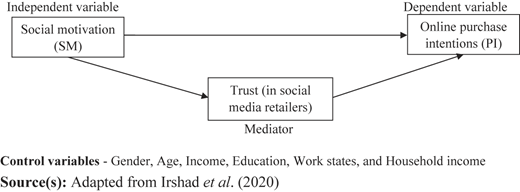
The following conceptual model was developed based on the literature reviews. Online PI is considered as the dependent variable, while SM is an independent variable. Consumer's trust in retailers present on social media (TRSM) is considered as the mediator (Figure 1).
Operationalization
Measurement indicators of all aspects of the questionnaire have been tabulated in the below Table 1.
Questionnaire design and procedure
For the purposes of this study, quantitative data were collected and used. The survey method allowed for the cost-effective collection of a large amount of data from a large population (Saunders et al., 2009). It was also a logical and critical approach that allowed the researcher to have complete control over the measurement and outcome. For the purpose of this study, data were collected from users of the most popular social media network sites (e.g. Facebook, YouTube, LinkedIn, Twitter and Instagram). The data collection focused on Sri Lankan consumers who were frequent users of social media sites. Sri Lanka has a population of 21.9 million people (The World Bank Group, 2021). In January 2020, Sri Lanka had 6.4 million social media users (Kemp, 2020). The study's sample consisted of fashion product consumers residing in the Colombo district. Consumers in the Colombo district are better educated and have higher income levels (Department of Census and Statistics, 2016). The sample selection was done using a convenience sampling strategy. Data were gathered from consumers who worked for a range of organizations, including universities in the Colombo district. A screening question was asked of respondents to obtain confirmation of their social media usage for fashion products (e.g. Do you buy fashion products on social media?), and only those who answered “Yes” were allowed to complete the survey e.g. Irshad et al. (2020). A total of 150 questionnaires were sent out, with 120 being returned with responses. The poll was continued for 88 respondents after the screening question (n = 88) and which is sufficient for better interpretation (Virtanen et al., 1998). The data collection was composed of both primary and secondary sources. The questionnaire created by the researcher was the major source of data gathering. Secondary information was acquired via literature reviews (e.g. books, journals, newspapers, websites, government records, etc.) The questionnaire was constructed to measure the components using pre-tested questionnaire items from Nilashi et al. (2016), Wang et al. (2012), and Chiu et al. (2006). The questionnaire was distributed via Google Forms. Participation was entirely voluntary, and the questions were designed in English. The questionnaire was pilot-tested to confirm content validity of the instruments. This allowed the researchers to fine-tune the questionnaire and ensure that respondents had no difficulty answering the questions (Saunders et al., 2009). In order to achieve verified and applicable data, the research analyses and findings were based on actual numerical facts from the obtained data. Cronbach's Alpha values were used to verify the data's reliability using the IBM SPSS application. The validated data were analyzed using regression analysis and correlation. Multiple regression model regression analysis and significance value were used to test the hypotheses (IBM SPSS). The significance of indirect effects was determined using the Sobel test.
Demographic distribution of respondents
According to the demographic analysis, 56.82% of the respondents were male and 43.18% were female. All the respondents engaged in social media every day and they were all consumers of fashion products on social media. In terms of age groupings, the majority of the participants were between the ages of 25 and 34 (79.5%). About 9.1% of the respondents were aged between 18 and 24 years. About 8% of participants were aged between 35 and 44. In terms of educational attainment, around 16% had a master's degree, 52% had a bachelor's degree and 8% a professional degree. Thus, the target audience was well-educated. In terms of occupational situation, 77% of the respondents said they work full-time. And 7% of those who responded were students. With regard to the respondents' household income levels, participants were distributed as follows; Sri Lankan Rupees (LKR) 100,001 or over: 25%, LKR 80,001–100,000: 9%, LKR 60,001–80,000: 14% and LKR 40,001–60,000: 23%. About 42% of the respondents reported that they spend 2–3 h per day on social media.
Findings
Reliability analysis
Cronbach's Alpha was examined for the purpose of identifying and assuring the internal consistency of the measures of variables used in the study (Table 2).
The Cronbach's Alpha coefficient was calculated using the SPSS program. The reliability of each scale was assessed (with values ranging between 0.839 and 0.860) (George and Mallery, 2003).
Correlation analysis
Pearson correlation between SM and PI was strong and positive in nature, and this is reflected by the high value of 0.724. Pearson correlation between trust (T) and SM was strong and positive in nature, this is reflected by the value of 0.543. Pearson correlation between T and PI was strong and positive in nature, and this is reflected by the value of 0.757. Additionally, all loadings were ample, with statistically significant p < 0.05 (Tables 3 and 4).
Mediation analysis
Hypothesis testing
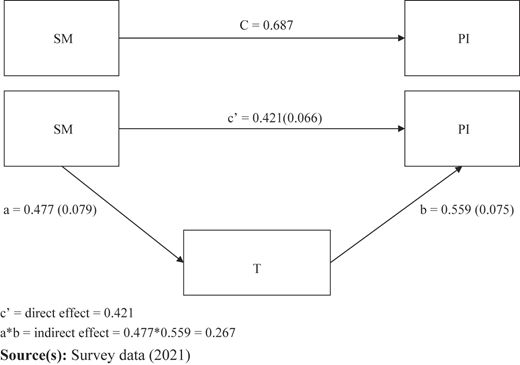
According to the findings, SM has a positive effect on consumers' trust in online fashion retailers (R2 = 0.287 and p < 0.01). Furthermore, SM influences online PI significantly (R2 = 0.518 and p < 0.01). Therefore, H1 and H2 hypotheses were supported. Furthermore, trust toward fashion retailers has a significant positive effect on consumers' online PI. Therefore, H3 hypothesis was supported (R2 = 0.568 and p < 0.01) (Table 6).
The Sobel test method results revealed that trust in fashion retailers mediates the relationship between SM and online PI (indirect path coefficient 0.267 and p-value < 0.01). Finally, H4 hypothesis was supported. However, it was revealed that trust has a partial mediating effect on the relationship between SM and online PI (Table 7) (Following the verification of trust [mediator], the direct effect of SM on online PI remained significant).
Discussion
The purpose of this research was to determine the mediating effect of trust on the relationship between consumer's SM and online PI in the social media marketing environment. According to the findings, SM has a significant positive effect on consumers' trust and online PI (H1 and H2). This is in accordance with a previous study done by Irshad et al. (2020). The results of this study underline that peer influence can be found in a variety of consumption scenarios. Individuals benefit from interaction with their peers, as this assists to create a comfortable environment for them (Gentina et al., 2018). As per the findings, if peers give good reviews about items and services, buyers are more likely to trust retailers on social media. The findings also demonstrated that SM has a substantial beneficial impact on consumers' online purchasing intentions, which is in accordance with earlier research by Irshad et al. (2020) and Liu et al. (2019). The study further proves customers' online PI are significantly influenced by their level of trust (H3). These results are built on existing evidence in previous research by Irshad et al. (2020), Athapaththu and Kulathunga (2018), Li et al. (2007), and Manzoor et al. (2020). Finally, the outcomes of this study show that trust in fashion retailers partially mediates the effects of SM on the consumers' online PI (H4). This is in line with the research result of Irshad et al. (2020). Furthermore, it replicated that trust is an important factor to consider in online purchasing intentions (Irshad et al., 2020; Wang et al., 2015; Manzoor et al., 2020).
Implications for theory and practice
The theoretical contribution of this paper is to the advancement in existing theories of consumer behavior and trust in social media marketing in the Sri Lankan context. This study would shed light on different implications for the existing domain of literature in the fashion industry as well.
Practical implications
As managerial implications of this study, stakeholders in the fashion industry may take the suggestions of this research, such as how to incorporate “trust” in social media marketing to attract and retain customers, into consideration in their future decision making. The importance of social media in describing the global technology revolution is crucial. People may contact one another at any time of the day thanks to technological improvements brought about by social media, which have abolished geographical and time limits (Irshad and Ahmad, 2019). As per this study's findings, fashion retailers should cater to specific consumer motivations in order to increase consumers' trust. Accordingly, online clothing retailers should consider how to enhance their consumers' purchasing intention by increasing consumers' trust in them on social media. They should sensibly hire more skilled resources to build their social media teams, and devise strategies to enable personable interaction to boost the brand's trustworthiness. They must establish a strong relationship with their customers and earn their trust. In order to increase socialization on social media, customers must be given the option to provide feedback on the products or services they purchase from a store. When customers have the option to provide feedback on products and companies, they feel more engaged (Mangold and Faulds, 2009). Irshad et al. (2020) highlighted that fashion retailers can empower their customers to initiate conversations with peers about newly launched fashion designs. Furthermore, they emphasized that fashion retailers can use social media analytics to monitor peer conversations. Fashion retailers would benefit from a thorough investigation of peer interactions and communications on social media (Irshad and Ahmad, 2019). To track information shared with peers, social media experts can use social media analytics tools such as Sprout Social and HubSpot (Barnhart, 2021). To ensure usability, web designers can employ a variety of tools and approaches. They can improve customer experience by implementing convenient search mechanisms and enabling single-click transactions. In order to run a profitable online shop, online shop retailers need to pay considerable attention to the element of trust. Online shop retailers should look into how trust can be built and how it affects online purchasing intention (Athapaththu and Kulathunga, 2018). Customers expect e-retailers to provide high-quality items or services, engage with them and give excellent customer service through the channels they prefer (Yi Wu, 2020). Buyers are more likely to trust retailers on social media if their peers give positive feedback on products and services. Customer satisfaction has a significant influence on a company's performance. Customer satisfaction can be improved by enhancing customer service and product quality. Customers who are happy with their purchases are more likely to recommend them to others (Brown, 2021).
Limitations and future research opportunities
The study has some limitations, which allow for further investigations in the future. Depending on the industry, consumer behavior in social media settings can vary. This research focused solely on the Sri Lankan fashion industry. Consumer behavior relating to other industries may differ. Therefore, this model can be further developed to encompass other industries in future studies. This study only considered trust in the role of a mediator. This research model can be expanded by changing the mediating variable. Moreover, this study is limited to consumer's SM. Future studies can broaden this research model by looking into other consumer motivations in the social media marketing setting, such as remuneration motivation and empowerment motivation in the Sri Lankan context. Future researchers can also conduct qualitative research to learn more about the motivations of consumers.
This study also only focused on social media users in the Colombo district; therefore, broad generalizations relating to the entirety of social media users in Sri Lanka are inappropriate. The results may be generalized upon collection of more data from other districts in Sri Lanka.
Conclusion
This study examined the mediating effect of trust on the relationship between consumers' SM and online PI (relating to the fashion industry in Sri Lanka) in the context of social media marketing. The results revealed that SM has a significant positive effect on consumers' trust and online PI. They also proved that customers' online PIs are significantly influenced by their level of trust. Furthermore, the findings revealed trust in fashion retailers partially mediates the effects of SM on consumers' online PI.
The study's theoretical and practical implications can be applied in a variety of ways to improve existing theories and contribute to practical solutions in the development of consumer behavior (in the context of social media marketing). This research bridges a knowledge gap in relation to consumer behavior in the context of social media marketing in Sri Lanka.