


There is an area of neglect in the extant literature on the role of electronic word of mouth in the relationship between social media marketing and purchase intention. This study aims to investigate how social media influencer marketing impacts consumer purchase intention, focussing on key variables of social media influencer marketing, such as influencers' experience, trustworthiness, attractiveness and content usefulness, in the tourism industry. Additionally, this paper proposes investigating the moderating role of electronic word-of-mouth communication on the relationship between social media influencer (SMI) marketing and purchase intention.
A moderated model was analysed through partial least squares structural equation modelling (PLS-SEM) by using a sample of 385 tourists.
Results revealed that SMI's experience, trustworthiness and content usefulness have a significant and positive effect, while SMI's attractiveness did not show any significant impact on consumers' intention to purchase tourism products.
This paper demonstrates implications for SMI marketing in the tourism sector through better-designed SMI marketing strategies.
This study provides empirical evidence for the moderating role of electronic word of mouth in using social media influencers' trustworthiness in improving purchase intention, specifically in the tourism context.
Introduction
Social media influencer (SMI) marketing continues to grow as a powerful tool, with brands increasingly investing in influencer partnerships to build credibility and reach target audiences more effectively than traditional advertising (Influencer Marketing Hub, 2023). Due to the increasing popularity of SMI marketing (Leung et al., 2022), marketers continue to invest significant budgets in SMI marketing campaigns. However, many of these investments are made without a clear understanding of the return on investment (ROI), leading to widespread frustration and uncertainty within the industry (Influencer Marketing Hub, 2020). Morwitz (2012) explains that purchase intention reflects a consumer's readiness to make a purchase and is a strong indicator of actual buying behaviour. Accordingly, as purchase intention is associated with ROI, marketers struggle to utilise SMI marketing effectively to enhance purchase intention.
However, previous literature on SMI marketing provides areas of contradiction in the extant literature in relation to the aspects of SMI marketing. Venciute et al. (2023) explored the aspects of influencers' experience, trustworthiness, attractiveness and content usefulness on purchase intention by taking influencer-follower congruence as the mediating variable. In the same vein, Liu et al. (2015) studied identifying effective SMIs for electronic word-of-mouth (eWOM) communication. Seen in this light, the effect of SMI marketing on purchase intention moderated by eWOM marketing communication remains unexplored in the existing literature. This study mainly focuses on delivering a model with the moderating effect of eWOM communication on the relationship between SMI marketing and purchase intention. In addition to that, while SMI marketing has become a significant force, the theoretical understanding of how influencers impact consumer decision-making remains underdeveloped (De Veirman et al., 2017). Accordingly, eWOM refers to any positive or negative statement made by potential, actual, or former customers about a product or a company via the internet, encompassing platforms such as social media, blogs, websites and other digital channels (Hennig-Thurau et al., 2004), which needs to be elucidated more in the tourism context. Moreover, there is a lack of understanding regarding how SMI marketing content and SMIs impact customer behaviour (Lou and Yuan, 2019). Therefore, it is important to investigate the area of SMI marketing on purchase intention to contribute to the existing theoretical gap. This study proposes social capital theory to describe the model of SMI marketing and purchase intention with the moderating effect of eWOM communication.
This paper proposes investigating a conceptual framework to describe the direct relationship between SMI marketing and purchase intention and the moderating effect of eWOM on the above relationship. This paper proposed SMI marketing as the combination of the influencer's experience, trustworthiness, attractiveness and content usefulness (Venciute et al., 2023). There is growing evidence that marketers fail to fully leverage SMI marketing to enhance purchase intention, mainly due to the lack of clarity in the mechanisms, as this remains to be empirically under investigated. In the Sri Lankan context, the study of the relationship between SMI marketing and purchase intention is still underdeveloped, and therefore, the proposed study is expected to generate novel findings from a Global South example of Sri Lanka. This is in accordance with the findings of Abidin (2016), who highlighted that SMI marketing in emerging markets is still relatively under-researched, with limited empirical studies addressing its impact on consumer behaviour. Accordingly, these research gaps drive to the following research questions.
What is the relationship between SMI marketing and purchase intention?
What is the impact of eWOM communication on the relationship between SMI marketing and purchase intention?
Based on the above research questions, this paper aims to empirically identify which SMI marketing factor would most significantly influence purchase intention in Sri Lankan context. Thus, it contributes to addressing a contextual gap that currently exists in this domain as evident through the lack of empirical investigations on this phenomenon. It should also be noted that the limited extant literature available on this phenomenon is predominantly based on Global North contexts. Hence, the above research questions are studied through the Sri Lankan tourism empirical context, which enriches the contributions of this study further through contextual contributions. Specifically, it examines whether the relationship between the SMI marketing factors and purchase intention is moderated by eWOM communication. eWOM communication encompasses the re-sharing, commenting and overall engagement with the original post by followers. By incorporating eWOM as a moderating variable, the model seeks to provide a better understanding of how SMI marketing can be effectively conducted through digital platforms and shape the effectiveness of SMI marketing strategies.
In terms of the theoretical underpinning, there are several theories available which describe SMI marketing, where one prominent theoretical underpinning is the social capital theory, as it provides a framework by emphasising the value of social networks and the resources obtained through interactions within these networks and accounts for all social networks' relational, structural and cognitive dimensions (Nahapiet and Ghoshal, 1998). Furthermore, they state that the social capital theory highlights the importance of social networks and the resources individuals obtain through their interactions within these networks. Thus, it is particularly relevant in understanding how SMIs leverage their social capital reflected through trustworthiness, experience, attractiveness and content usefulness to influence consumer behaviour (Bourdieu, 1986; Coleman, 1988). Based on these justifications, this study relied on the theoretical underpinnings provided by the social capital theory to further explore this phenomenon in a tourism context.
The remaining part of this paper includes a comprehensive literature review, followed by the hypothesis development and data analysis. Moreover, the paper will outline the theoretical and managerial implications to help develop strategies and make consumer-driven decisions in SMI marketing. Finally, this study opens opportunities for future research in the same domain.
Literature review
Purchase intention
Purchase intention has been defined in various ways by different authors. Shah et al. (2012) described purchase intention as a decision-making process in which consumers evaluate reasons for choosing a specific brand to purchase. Moreover, purchase decisions refer to the choices consumers make before buying a product or service, beginning with the desire to meet their needs (Fernando and Selvarajan, 2022). These definitions suggest that consumers' needs or problems drive their actual purchase decisions. As a result, consumers begin their purchases by identifying their needs and carefully assessing their specific needs or problems before making a purchase. In response, businesses have started leveraging social media platforms and SMIs to connect with consumers who are deeply engaged online and to build relationships with them (Ye et al., 2021).
Furthermore, purchase intention as defined by Kotler (2004), refers to the actions and decision-making processes individuals undertake when purchasing goods and services for personal use. There are several distinct roles in the process of consumer behaviour. These roles traditionally include influencers, gatekeepers, deciders, buyers, preparers, users, maintainers and disposers, as Schiffman and Kanuk (1997) outlined. Influencers, as defined by Kotler (2004), are individuals or groups who can affect the opinions, attitudes and behaviours of others. They are often seen as knowledgeable or experienced in specific areas, making them valuable sources of information for other consumers. Khamis et al. (2017) describe SMIs as ordinary internet users who accumulate a large following on social media platforms through creating and sharing content, thereby gaining credibility and influence over their followers. Accordingly, the conceptual framework of this paper aims to analyse aspects of SMI marketing, namely influencers' experience, trustworthiness, attractiveness and content usefulness as per the conceptualisation provided in Venciute et al. (2023), which will be outlined in the subsequent sections of this literature review.
Influencer's experience
The influence of an individual's experience in shaping their authority and credibility is fundamental to the success of SMI marketing campaigns. An SMI's experience is not just about their longevity in the field but also about their depth of knowledge and the expertise in the products or services they promote. According to Lou and Yuan (2019), it is the duration and depth of SMIs' engagement in a particular area, which contributes to their perceived knowledgeability and trustworthiness among their audience. As Venciute et al. (2023) describe, experience encapsulates an influencer's competence, which drives their ability to influence their audience effectively. Influencers who are deeply knowledgeable about a specific domain are better equipped to create content that resonates with their audience on a deeper level, thus making their endorsements more persuasive and credible (Carter, 2016; Lou and Yuan, 2019). According to Carter (2016), brands increasingly seek out SMIs who have a passion for their niche and a wide understanding of the subject matter.
Furthermore, research by Alikilic and Ozkan (2018) highlight that SMIs, regardless of their follower count, often specialise in specific areas, whether it's fashion, travel, or technology. The abovementioned literature focuses on SMIs' experience as a key determinant of SMI marketing. Furthermore, it leads to authentic connections with their audience, leading to higher engagement and better marketing outcomes (Casaló et al., 2020; Djafarova and Trofimenko, 2019). It should be noted that literature on influencers' experience from Sri Lankan context is currently limited. Particularly, as influencer is a rising concept in recent literature, the findings of a characteristic such as influencer's experience, specifically from the Global South example of Sri Lanka, would be novel. This would also allow for future comparisons of the findings between studies on this variable conducted in other contexts.
Influencer's trustworthiness
Trustworthiness is a cornerstone of SMI marketing, directly impacting the effectiveness of promotional campaigns. As Ohanian (1990) and McCracken (1989) describe, trustworthiness is demonstrated when influencers make assertions that resonate as truthful from the consumer's perspective. Atkin and Block (1983) further reinforce this by suggesting that sources perceived as trustworthy, such as well-known and respected SMIs, are often more credible than ordinary sources. This credibility is essential in shaping consumer attitudes, as trusted endorsements are more likely to influence consumer behaviour, leading to a higher likelihood of purchase. The power of trustworthy endorsements lies in their ability to cut through this scepticism, making consumers more receptive to the message being conveyed. Connolly (2017) highlights that authenticity is a key element influencing trust in SMIs, as revealed by a multinational survey. This trust is about believing the SMI's words and feeling confident that the influencer is sharing their honest opinions and experiences. Furthermore, literature on influencers' trustworthiness from Sri Lankan context remains an area of neglect in the extant literature.
Influencer attractiveness
Attractiveness, particularly physical attractiveness, plays a pivotal role in SMI marketing, significantly influencing how followers perceive and engage with content. According to Masuda et al. (2022), the constant visibility of an SMI's physical appearance to its followers makes attractiveness a crucial factor in shaping audience perceptions. Yuan et al. (2016) identified five key indicators of influencer attractiveness: the ability to please followers, create a positive image of promoted products, attract attention, possess a pleasant personality and inherently possess the attractiveness that defines them as an influencer. This is particularly important in the initial stages of content consumption, where the attractiveness of the person delivering the message can significantly impact the recipient's evaluation of the content (Baker and Churchill, 1977). SMIs who are seen as attractive can also enhance the perceived value of the products they endorse, leading to a more favourable reception by the audience. Venciute et al. (2023) highlight that influencers perceived as easy-going, charismatic and popular are often seen as more attractive. Hence, the attractiveness of the influence, in turn, builds their popularity among followers, creating a cycle where attractive influencers gain more followers, thereby increasing their influence and effectiveness in marketing campaigns. It should be noted that empirical studies on influencers' attractiveness from the Sri Lankan context are currently limited.
Content usefulness
In the context of SMI marketing, content refers to the various elements that make up an SMI's post, including text, images, videos and any other media used to communicate a message. The usefulness of this content is a critical factor, as it directly impacts the audience's ability to make informed decisions or progress toward their goals (Venciute et al., 2023). SMIs are expected to produce content that resonates with their audience and effectively aligns with the products they promote. Müller and Christandl (2019) highlight that content shared on social media platforms significantly influences customer perceptions and behaviours. Müller and Christandl (2019) further assert that the usefulness of content on social media platforms is instrumental in shaping customers' beliefs and influencing their purchasing decisions. When content is perceived as useful, it can significantly enhance the audience's trust in the influencer and the products they endorse. At the same time, the literature on content usefulness from the Sri Lankan context remains an under-researched area.
eWOM communication
The concept of word-of-mouth (WOM) communication, initially introduced by Arndt (1967), has significantly evolved with the advent of digital technology, leading to the emergence of eWOM communication. eWOM communication denotes any feedback, whether positive or negative, shared by customers about a brand or business through online platforms (Hennig-Thurau et al., 2004). In today's interconnected world, eWOM has become an integral part of consumer decision-making, where individuals rely on online reviews, comments and posts to shape their perceptions and influence their purchasing behaviours. SMIs are pivotal in eWOM communication as they act as intermediaries who convey messages through their social media profiles. However, the authenticity of eWOM communication is sometimes questioned when influencers do not disclose sponsored content. Research by Gosselt and Tempelman (2018) suggests that when influencers fail to disclose that a post is sponsored, audiences are more likely to perceive the content as genuine eWOM communication, thereby increasing its persuasive power. The usefulness of this content is a critical factor, as it directly impacts the audience's ability to make informed decisions or progress toward their goals (Venciute et al., 2023) and subsequently impacts the eWOM communication. According to Müller and Christandl (2019), the content shared on social media is influential in shaping customer attitudes and behaviours, emphasising the importance of content utility for the success of influencer marketing.
eWOM has consistently been recognised as a powerful marketing tool, with studies by Bickart and Schindler (2001), Kumar and Benbasat (2006) and Zhang et al. (2010) affirming its influence on consumer behaviour. In fact, scholars also propose eWOM 2.0 for the new age as it keeps on enhancing market dynamics and consumer behaviour (Liu et al., 2024). Additionally, the literature on eWOM communication from the Sri Lankan context is currently limited. In the next part of the literature review, the social capital theory will be explained, which will be the prominent theoretical base of the proposed study.
Social capital theory
Social Capital Theory is a framework that explores the resources available to individuals and groups through their social networks, relationships and interactions. Originating from the work of sociologists such as Bourdieu (1986) and Coleman (1988), social capital is broadly understood as the collective value derived from social networks and the inclinations that arise from these networks to do things for each other. Social capital is defined as “the sum of the actual and potential resources embedded within, available through and derived from the network of relationships possessed by an individual or social unit (Nahapiet and Ghoshal, 1998, p. 243). In marketing, social capital theory is applied to understand how relationships and networks influence consumer behaviour, brand perception and decision-making processes, particularly in the context of SMI marketing.
The structural dimension of social capital refers to the determinants of access to resources and information within the network (Nahapiet and Ghoshal, 1998). In SMI marketing, the structural dimension is crucial in determining how effectively an influencer can disseminate information across their network. The relational dimension of social capital focuses on the quality of relationships between individuals in a network, particularly the trust, norms and obligations that characterise these relationships. When an influencer has strong relational social capital, their endorsements are more likely to be perceived as authentic and credible, thereby increasing the likelihood of influencing consumer behaviour. Cognitive dimension is concerned with the shared meanings and interpretations that facilitate communication and coordination among members of a network (Nahapiet and Ghoshal, 1998). In SMI marketing, cognitive social capital is evident in aligning the values, beliefs and interests of the influencer with those of their audience. In SMI marketing, Social Capital Theory provides a holistic framework for understanding the dynamics of influence and trust. Social capital theory helps understand the mechanisms of influence and provides practical insights for optimising SMI marketing strategies.
Hypothesis development
Influencers' experience and purchase intention
Influencers can be a reliable source that shapes customers, and the concept of influencer's experience refers to the experience that the influencer possesses (Venciute et al., 2023). Customers are more likely to seek advice from influencers since SMIs often create content that is perceived as an expression of their personal experience. Ohanian (1990) stated that people are likely to rely on the opinion of a competent source, which often leads to a positive attitude towards the promoted product or brand and purchase intention. Till and Busler (2000) highlighted that the experience of an SMI in a specific field can positively impact consumer attitudes and purchase behaviour. Moreover, Venciute et al. (2023) highlighted that an influencer's experience positively influences the purchasing behaviour of their followers. Hughes et al. (2019) conducted a study on the impact of influencer expertise on purchase intention in the UK context. Their findings indicated that bloggers with greater experience were more successful in boosting awareness and driving higher purchase intention through their sponsored posts.
The central idea of social capital theory is that social relationships are a valuable resource that provides a ‘credential’ for a certain individual (Nahapiet and Ghoshal, 1998). This strongly positions an influencer as a credible individual through their social networking. Furthermore, this underscores the importance of influencer experience in influencing consumer decisions. Additionally, Venciute et al. (2023) noted that SMIs with extensive experience positively influence both attitudes and purchases, while Hernández-Méndez and Baute-Díaz (2024) emphasised that influencers with larger followings are often perceived as having greater expertise, particularly in areas like destination promotion. However, there is limited empirical evidence to support this claim in an emerging economy such as Sri Lanka. Based on these insights, the first hypothesis of the study is developed as follows.
There is a significant relationship between influencers' experience and purchase intention
Influencers' trustworthiness and purchase intention
Trustworthiness of influencers is needed to convince customers to purchase products and services, and this concept of influencers' trustworthiness refers to aspects such as sincerity, reliability and honesty (Venciute et al., 2023). The literature underscores that a trustworthy SMI can significantly sway consumers towards making purchases, which highlights the positive and direct relationship between source trustworthiness and purchase intentions. For instance, Venciute et al. (2023) depicted SMI as positively impacting followers' purchase behaviours. Trustworthiness impacts the effectiveness of advertisements (Dou et al., 2012; Weismueller et al., 2020). According to Lee and Koo (2015), trust plays a pivotal role in the influencer-audience relationship, highlighting its significance in consumer decision-making processes. Mishra and Sharma (2015) consistently showed the affirmative impact of source trustworthiness on consumer purchase behaviour.
In connection with the social capital theoretical lens, trustworthiness of influencers is essential in achieving social capital. Moreover, strong social capital facilitates access to other types of resources (Nahapiet and Ghoshal, 1998), which requires the target market to trust the influencers. Further empirical evidence provided by Ao et al. (2023) shows that trustworthiness remains one of the strongest predictors of purchase intention. According to Social Capital Theory (Nahapiet and Ghoshal, 1998), trustworthiness, as a relational dimension, allows consumers to feel confident in SMIs' recommendations, leading to a higher likelihood of purchase. Yet, this relationship remains understudied. Based on these insights, the second hypothesis of the study was developed.
There is a significant relationship between influencers' trustworthiness and purchase intention
Influencers’ attractiveness and purchase intention
The attractiveness of influencers is not limited to only physical appearance, but to other aspects such as personality (Venciute et al., 2023). Attractiveness and its effects have been a topic with contradicting beliefs, where some scholars argue that it does impact outcomes, while some argue against it (Langlois et al., 2000). Being perceived as attractive, influencers wield substantial influence over followers' attitudes and willingness to make purchases (Yuan et al., 2016). In addition, when applying the source attractiveness model, previous research shows that endorsers' attractiveness is positively related to consumers' purchase intentions (Lee and Koo, 2015). More recently, Cheng and Wang (2025) provided empirical evidence for the relationship between the physical attractiveness of SMIs and increased purchase intention. Thus, the above studies imply that influencers' attractiveness has a direct relationship with purchase intention.
From a theoretical standpoint, social capital theory is applied, which states that much of the social capital is incorporated through the networks and recognition (Nahapiet and Ghoshal, 1998). In applying this to an influencer, it is posited that such an individual is attractive to the target audience due to her/his social capital. From an empirical standpoint, further research supports the positive impact of attractiveness on purchase intentions. Masuda et al. (2022) emphasised that SMIs who are perceived as attractive can significantly sway consumer behaviour, particularly in visually driven industries like fashion. Similarly, Sokolova and Kefi (2020) demonstrated that the attractiveness of SMIs enhances social relationships with their followers, further driving purchase decisions. These studies consistently show a strong link between influencer attractiveness and purchase intention, reinforcing the importance of attractiveness in SMI marketing strategies. As the global influencer marketing through social media is rapidly rising (Cheng and Wang, 2025), it is worthwhile to determine whether influencer attractiveness drives purchase intention in another domain, such as tourism, as well as in another empirical context, such as Sri Lanka. Based on these findings, the following hypothesis was created.
There is a significant relationship between influencers' attractiveness and purchase intention
Influencers’ content usefulness and purchase intention
The content usefulness of influencers must be valuable for the target audience, and this concept is evaluated through aspects such as usefulness and desirability (Venciute et al., 2023). Even though it is a relatively new aspect, the usefulness of content may be one of the most important factors for the SMI to stay relevant with its audience (Venciute et al., 2023). The value of influencers' content, in terms of its informed and entertainment value, has been found to positively impact followers' brand awareness, as highlighted by Dehghani et al. (2016). Müller and Christandl (2019) also stress the importance of content usefulness on social media platforms, as it plays a crucial role in shaping customers' beliefs and purchase behaviour. In SMI marketing, the relevance and utility of content significantly affect purchase intent, as highlighted by Venciute et al. (2023). Therefore, the following proposition intends to find evidence to support the above relationship from the Sri Lankan context.
Social capital theory looks at the structure, the relational and the cognitive dimensions of social capital (Nahapiet and Ghoshal, 1998). In applying this to the content usefulness of an influencer, it is important to note that without these three dimensions, the target audience would not find the influencer's content as useful. Moreover, Sokolova and Kefi (2020) found that the perceived value of influencers' content strengthens parasocial relationships, leading to higher purchase intentions. Additionally, Lou and Yuan (2019) emphasise that influencers who provide useful content, especially content that aligns with their followers' interests, enhance consumer trust, which is directly linked to purchase intention. Yet, this relationship remains under researched in the Sri Lankan context. Accordingly, the following hypothesis is proposed to be investigated.
There is a significant relationship between influencers' content usefulness and purchase intention
eWOM, influencer experience (expertise) and purchase intention
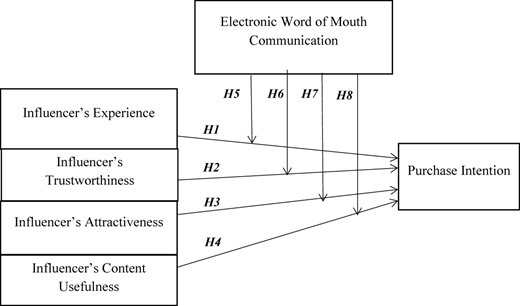
The authors propose eWOM as a moderator of the relationship between SMI and purchase intention in the tourism context, of which H5 to H8 are presented in this section. This argument is built on prior literature. Nofal et al. (2022) proposed eWOM as a moderator for consumer outcomes, specifically purchase intention. According to O'Reilly et al. (2016), an influencer's knowledge and perceived expertise significantly contribute to their credibility in eWOM communication. When followers perceive that an influencer possesses substantial knowledge and experience with impartial intent, they are more inclined to view that influencer as credible. However, some studies have shown that source expertise does not always positively affect purchase intention. For example, Zhu and Tan (2007) found that bloggers with lower expertise can sometimes achieve greater success in influencing purchase decisions in cases of low-involvement products. Moreover, managers of online review sites should recognise that individuals with high expertise are not always the opinion leaders within online communities (Racherla and Friske, 2012). This emphasises that expertise does not automatically equate to influence, which is a key insight for managing eWOM platforms.
Nahapiet and Ghoshal (1998) argued that in social capital theory, intellectual capital is embedded in social relationships as well as in the structure of the social relationships. They also emphasise on the links between experience in facilitating intellectual capital, in the form of tacit knowledge (Nahapiet and Ghoshal, 1998). In eWOM, which is inherently peer-to-peer communication (Civelek and Ertemel, 2018), this is similarly applied. Scholars reveal that source expertise has a positive (Filieri, 2015), negative (Racherla and Friske, 2012) or non-significant relationship (Cheung et al., 2008) with eWOM reviews. This also is in line with the operationalisation of eWOM, which consists of four dimensions by Sohn (2009), which considers the reviews and the credibility of the influencers. In line with this, Sa'ait et al. (2016) highlight that credible eWOM can positively affect consumer purchase decisions as followers are more likely to act on recommendations. According to these insights, the research proposed the following hypothesis.
eWOM communication moderates the relationship between influencers' experience and purchase intention
eWOM, influencer trustworthiness and purchase intention
Trustworthiness is a crucial factor in SMI marketing as it directly influences followers' perceptions of SMI-shared content. McKnight et al. (2002) highlight that consumers are more inclined to share personal opinions about products or services they have used, thereby enhancing perceived Trustworthiness in the source. However, assessing an SMI’s trustworthiness and expertise can be more challenging in online C2C communications than in traditional face-to-face interactions (O'Reilly et al., 2016). While trustworthiness may improve credibility, it may not always be sufficient for followers to fully rely on SMIs' recommendations in their own purchase decisions.
In looking at this discussion from a theoretical lens of social capital (Nahapiet and Ghoshal, 1998), trust plays a key role in social capital. With regard to the influencers and the products and services they endorse, the target audience would need to trust the influencer in order to consider purchasing a product or service promoted by them. Similarly, numerous studies indicate that eWOM significantly impacts consumer purchase intentions (Bickart and Schindler, 2001; Chan and Ngai, 2011; Huang et al., 2011; Kumar and Benbasat, 2006; Park and Lee, 2007; See-To and Ho, 2014; Zhang et al., 2010). When consumers consider eWOM messages as more trustworthy, they are more likely to act upon them, potentially translating into purchase behaviour (Erkan and Evans, 2016). Accordingly, the following hypothesis was developed for this study.
eWOM communication moderates the relationship between influencers' trustworthiness and purchase intention
eWOM, influencer attractiveness and purchase intention
Attractiveness is a powerful driver, as suggested by the Source Attractiveness Theory (McGuire, 1985). Source attractiveness is recognised as an important antecedent of persuasive eWOM messages (Teng et al., 2014). Furthermore, Teng et al. (2014) elaborated that eWOM messages (which could include likes, comments and shares) make the content more persuasive and impactful on consumer attitudes. While source attractiveness is often defined as the positive feelings a message receiver develops toward the physical appearance of the source (Kiecker and Cowles, 2002), people tend to find a source attractive when they resonate with the online reviews posted by others, enhancing the eWOM communication (Teng et al., 2014).
In considering social capital theory, the influence must be attractive to the target audience through structural, cognitive and relational dimensions (Nahapiet and Ghoshal, 1998) in order for the target audience to create positive eWOM on the influencer. For instance, Erkan and Evans (2016) found that eWOM on social media platforms positively influences purchase intentions, particularly when messages are perceived as authentic and relevant. Cheung and Thadani (2012) also highlight that eWOM's influence stems from its interactive nature, which enables consumers to engage directly with reviews, comments and recommendations, leading to higher trust and subsequent purchase intentions. Accordingly, the following hypothesis is proposed for testing.
eWOM communication moderates the relationship between influencers' attractiveness and purchase intention.
eWOM, content usefulness and purchase intention
Many scholars have identified content usefulness as a critical component of eWOM communication. High-quality content significantly impacts consumers' decision-making and experiences in online environments (Filieri, 2015; Ghasemaghaei and Hassanein, 2016). Research on textual eWOM indicates that information quality directly influences purchase intentions (Park and Lee, 2007; Lee and Shin, 2014; Filieri, 2015). In SMI marketing literature, content usefulness is essential for developing opinion leadership (Casaló et al., 2020) and for encouraging the purchase intention of fashion items (Gomes et al., 2022).
In the conceptualisation of social capital as a combination of structural, cognitive and relational dimensions by Nahapiet and Ghoshal (1998), there are many components under each dimension that can be applied to influencer content to be considered as useful by the target audience, which will lead to positive eWOM, such as network ties and shared narratives. Furthermore, research shows the relationship between eWOM and purchase intention. Consumers who rely on eWOM as a reliable source of information, as this helps reduce uncertainties related to product quality (Park and Lee, 2007). For instance, Filieri (2015) demonstrated that high-quality eWOM reviews positively impact purchase decisions. Additionally, Teng et al. (2014) found that persuasive eWOM messages, particularly those perceived as informative content, significantly increase consumers' purchase intentions. Therefore, the following hypothesis is proposed to be investigated in this study.
eWOM communication moderates the relationship between influencers' content usefulness and purchase intention.
The above hypotheses are depicted in the Conceptual Framework, denoted in Figure 1.
Methodology
This study adopts a quantitative, positivist and deductive research design to examine the relationship between SMI marketing and purchase intention, with the moderating effect of eWOM) communication. Specifically, the positivist philosophy supports the use of objective, quantifiable methods to measure variables and test hypotheses with regard to the conceptual model of this study. A deductive approach is employed, starting from existing literature and theories to form hypotheses, which are then tested using survey data. The mono-method quantitative strategy is implemented through a structured questionnaire, where all key variables were operationalised using credible sources as depicted in Table 1.
Structure of the questionnaire
| Research variable | Indicators | Measurement |
|---|---|---|
| Influencer's experience | I think the travel influencers know a lot about the tourism products they are advertising | Likert Scale |
| I think the travel influencers are able to make statements about the tourism products | ||
| I think the travel influencers are experts on the tourism products | ||
| I think the travel influencers have sufficient expertise to make statements about the tourism products. (Adapted from Venciute et al., 2023) | ||
| Influencer's trustworthiness | I think the travel influencers are honest | Likert Scale |
| I think the travel influencers are trustworthy | ||
| I think the travel influencers are sincere | ||
| I think the travel influencers are serious (Adapted from Venciute et al., 2023) | ||
| Influencer's attractiveness | I think the travel influencers are very appealing | Likert Scale |
| I think the travel influencers are very stylish | ||
| I think the travel influencers are attractive | ||
| I think the travel influencers are beautiful (Adapted from Venciute et al., 2023) | ||
| Influencer's content usefulness | The advice provided by travel influencers on tourism products is valuable for my travel planning | Likert Scale |
| Recommendations from travel influencers on tourism products are beneficial in making my travel decisions | ||
| The insights shared by travel influencers help me make the best decisions regarding tourism products (Adapted from Venciute et al., 2023) | ||
| eWOM communication | The reviews shared by travel influencers about tourism products are generally positive | Likert Scale |
| The number of reviews from travel influencers about tourism products influences my purchase decision | ||
| The arguments presented by travel influencers about tourism products are persuasive | ||
| I trust the credibility of the information provided by travel influencers about tourism products (Adapted from Sohn, 2009) | ||
| Purchase intention | After seeing the post by this influencer, I have the intention to buy tourism products | Likert Scale |
| After seeing the post by this influencer, I recommend tourism products to other people in the future | ||
| After seeing the post by this influencer, I want to buy tourism products | ||
| After seeing a recommended product on the influencer's social media, I purchase the tourism products all the time | ||
| I have good experience with purchased tourism products, which was recommended in the influencer's social media | ||
| After seeing a recommended tourism product on the influencer's social media, I have purchased the product in the past (Adapted from Venciute et al., 2023) |
A survey strategy was adopted due to its effectiveness in collecting standardised, comparable data across a large sample. The time horizon is cross-sectional, capturing data from tourists at a single point in time, consistent with similar studies in tourism and influencer marketing (e.g. Venciute et al., 2023; De Veirman et al., 2017). The unit of analysis is the individual tourist influenced by SMIs, and the target population comprises inbound tourists to Sri Lanka between August and October 2024. A sample size of 400 was set, with 385 valid responses retained post data cleaning, as denoted in Table 2.
Demographic profile of the participants
| Frequency | Percentage | ||
|---|---|---|---|
| Gender | Female | 184 | 50.4 |
| Male | 181 | 49.6 | |
| Age | 18–25 | 94 | 25.8 |
| 26–35 | 149 | 40.8 | |
| 36–45 | 103 | 28.2 | |
| 46 and above | 19 | 5.2 | |
| Education level | Diploma/Secondary Education | 152 | 41.7 |
| Graduate | 149 | 40.9 | |
| Post Graduate | 64 | 17.5 | |
Convenience sampling was employed due to accessibility and time considerations, where questionnaires were distributed to the tourists who were visiting Sri Lanka during the above-mentioned time period. Accordingly, in addition to the cost and accessibility advantages, convenience sampling is suited for generalisability when a homogeneous sample is considered (Jager et al., 2017), such as the tourists visiting Sri Lanka, which is the sample considered in this study. Furthermore, as discussed in the measurement model section below, the collected data complied with the threshold values, further proving the suitability of the sample for analysis. Data analysis was conducted using SPSS version 28 and SmartPLS version 4.1.0.8; validity and reliability were assessed through exploratory factor analysis, reliability coefficients and common method bias tests, and hypothesis testing was carried out through structural equation modelling. This comprehensive methodology ensures the robustness and generalisability of the research findings within the tourism marketing context.
Results
Measurement model
Harman's Single Factor Test was applied to assess common method bias. The results depicted in Table 3 showed that the first factor explained 14.227% of the total variance, which is far below the typical threshold of 50%. Overall, these factors together accounted for 50.589% of the variance.
Harman's single factor test
| Component | Extraction sums of squared loadings (total) | % variance | of cumulative % | Rotation sums of squared loadings (total) | % variance | Of cumulative % |
|---|---|---|---|---|---|---|
| 1 | 3.557 | 14.227 | 14.227 | 3.261 | 13.046 | 13.046 |
| 2 | 2.667 | 10.668 | 24.894 | 2.653 | 10.612 | 23.657 |
| 3 | 2.395 | 9.579 | 34.473 | 2.368 | 9.472 | 33.130 |
| 4 | 2.127 | 8.510 | 42.983 | 2.273 | 9.090 | 42.220 |
| 5 | 1.901 | 7.605 | 50.589 | 2.092 | 8.369 | 50.589 |
Note(s): Extraction method: principal component analysis
According to Hair et al. (2017), both Cronbach's alpha values and composite reliability (CR) were used to measure the internal consistency of the model. Each construct measured above complies with the recommended threshold of 0.7 for both Cronbach's alpha values and CR (Hair et al., 2021), indicating good internal consistency. In addition to reliability, the study assessed convergent validity using the Average Variance Extracted (AVE) and factor loadings. All AVE values meet the minimum threshold of 0.5, indicating that more than 50% of the variance in the constructs is explained by their respective indicators. As shown in Table 4, the AVE values ranged from 0.515 to 0.596, satisfying the criterion for convergent validity (Hair et al., 2021). Table 5 presents the discriminant validity of the data, with cross-loading results confirming that each construct is distinct and accurately measured. Further results on Heterotrait-Monotrait Ratio of Correlations (HTMT) along with descriptive statistics are denoted in Tables 6 and 7.
The measurement model: reliability and convergent validity
| Construct | Item | Factor loading | Cronbach's a | CR | AVE |
|---|---|---|---|---|---|
| SMI's A | A1 | 0.813 | 0.753 | 0.838 | 0.581 |
| A2 | 0.503 | ||||
| A3 | 0.792 | ||||
| A4 | 0.885 | 0.777 | 0.797 | 0.538 | |
| SMI's CU | CU1 | 0.682 | |||
| CU2 | 0.804 | ||||
| CU3 | 0.710 | ||||
| SMI's E | E1 | 0.753 | 0.764 | 0.787 | 0.585 |
| E2 | 0.567 | ||||
| E3 | 0.538 | ||||
| E4 | 0.602 | ||||
| SMI's T | T1 | 0.727 | 0.769 | 0.777 | 0.535 |
| T2 | 0.660 | ||||
| T3 | 0.609 | ||||
| T4 | 0.638 | ||||
| eWOM | eWOM1 | 0.845 | 0.780 | 0.835 | 0.596 |
| eWOM2 | 0.723 | ||||
| eWOM3 | 0.765 | ||||
| eWOM4 | 0.749 | ||||
| PI | PI1 | 0.703 | 0.718 | 0.729 | 0.515 |
| PI2 | 0.554 | ||||
| PI3 | 0.597 | ||||
| PI4 | 0.631 | ||||
| PI5 | 0.664 | ||||
| PI6 | 0.701 |
The measurement model: discriminant validity
| PI | SMI's a | SMI's CU | SMI's E | SMI's T | eWOM | |
|---|---|---|---|---|---|---|
| PI | 0.644 | |||||
| SMI's A | 0.120 | 0.762 | ||||
| SMI's CU | 0.387 | 0.087 | 0.734 | |||
| SMI's E | 0.560 | 0.048 | 0.334 | 0.621 | ||
| SMI's T | 0.440 | 0.145 | 0.294 | 0.358 | 0.660 | |
| eWOM | 0.233 | 0.077 | 0.101 | 0.141 | 0.156 | 0.772 |
Note(s): Italic values indicate square root of AVE for each construct
Heterotrait-Monotrait ratio of correlations
| Heterotrait-monotrait ratio (HTMT) | |
|---|---|
| SMI's attractiveness ↔ Purchase intention | 0.179 |
| SMI's content usefulness ↔ Purchase intention | 0.588 |
| SMI's content usefulness ↔ SMI's attractiveness | 0.156 |
| SMI's experience ↔ Purchase intention | 0.843 |
| SMI's experience ↔ SMI's attractiveness | 0.145 |
| SMI's experience ↔ SMI's content usefulness | 0.630 |
| SMI's trustworthiness ↔ Purchase intention | 0.665 |
| SMI's trustworthiness ↔ SMI's attractiveness | 0.232 |
| SMI's trustworthiness ↔ SMI's content usefulness | 0.502 |
| SMI's trustworthiness ↔ SMI's experience | 0.701 |
| eWOM ↔ Purchase intetion | 0.288 |
| eWOM ↔ SMI's attractiveness | 0.102 |
| eWOM ↔ SMI's content usefulness | 0.162 |
| eWOM ↔ SMI's experience | 0.231 |
| eWOM ↔ SMI's trustworthiness | 0.213 |
Structural model
As depicted in Table 8, the path analysis examined the relationship between SMI marketing and purchase intention. The path coefficient between SMI's content usefulness and purchase intention towards tourism products shows (ß = 0.177, p < 0.000), suggesting a strong and significant positive relationship. Similarly, SMI's experience (ß = 0.414, p < 0.000) indicated a highly significant positive influence on purchase intention towards tourism products. The relationship between SMI's trustworthiness and purchase intention towards tourism products also demonstrates a significant positive effect (ß = 0.232, p < 0.000).
The structural model
| Hypotheses | Path | Original sample (O) | Sample mean (M) | Standard deviation (Stdev) | T-statistics (|O/Stdev|) | p-values | Decision |
|---|---|---|---|---|---|---|---|
| H1 | SMI's E → PI | 0.414 | 0.413 | 0.049 | 8.481 | 0.000 | Supported |
| H2 | SMI's T → PI | 0.232 | 0.233 | 0.049 | 4.719 | 0.000 | Supported |
| H3 | SMI's A → PI | 0.051 | 0.053 | 0.036 | 1.386 | 0.166 | Not Supported |
| H4 | SMI's CU → PI | 0.177 | 0.182 | 0.043 | 4.103 | 0.000 | Supported |
Moderator analysis
Regarding the moderator analysis, four hypotheses (H5, H6, H7 and H8) were examined, as denoted in Table 9. The moderation effect occurs when the relationship between two constructs is influenced by a third variable (Hair et al., 2021). The moderating effect of eWOM communication was measured on the relationship between SMI marketing and purchase intention towards tourism products. The path analysis results revealed that eWOM communication does not significantly moderate the relationship between SMI's content usefulness and purchase intention (ß = −0.071, p = 0.114), SMI's attractiveness and purchase intention (ß = 0.001, p = 0.987), or SMI's experience and purchase intention (ß = −0.032, p = 0.507), as all p-values exceed the 0.05 significance threshold. However, a significant negative moderating effect was observed in the relationship between SMI's trustworthiness and purchase intention (ß = −0.148, p = 0.002), suggesting that while trustworthiness generally fosters purchase intention, eWOM communication weakens this effect. This is elaborated further in Figure 2.
Moderator analysis
| Hypotheses | Path | Original sample (O) | Sample mean (M) | Standard deviation (Stdev) | T-statistics (|O/Stdev|) | p-values | Decision |
|---|---|---|---|---|---|---|---|
| H5 | eWOM × SMI's E → PI | −0.032 | −0.035 | 0.049 | 0.664 | 0.507 | Not Supported |
| H6 | eWOM × SMI's T → PI | −0.148 | −0.143 | 0.049 | 3.028 | 0.002 | Supported |
| H7 | eWOM × SMI's A → PI | 0.001 | 0.000 | 0.043 | 0.017 | 0.987 | Not Supported |
| H8 | eWOM × SMI's CU → PI | −0.071 | −0.071 | 0.045 | 1.579 | 0.114 | Not Supported |
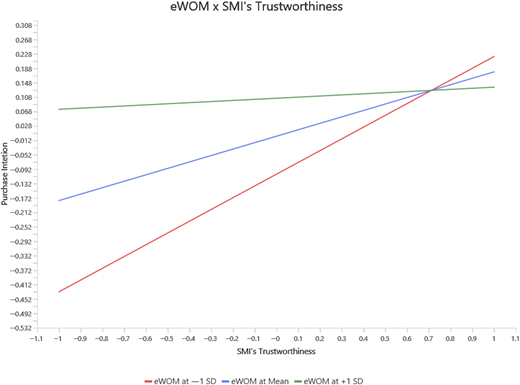
Slope test for the moderating effect of eWOM communication on SMI's trustworthiness and purchase intention. Source(s): Authors’ compilation
Slope test for the moderating effect of eWOM communication on SMI's trustworthiness and purchase intention. Source(s): Authors’ compilation
Discussion and implications
The strong relationship between SMI's content usefulness and purchase intention aligns with Müller and Christandl (2019) and Venciute et al. (2023), who emphasised the importance of useful content on social media in shaping customer beliefs and purchase behaviours, while also the next hypothesis confirmed that SMI's who impose a greater experience are more effective in driving higher purchase intentions through their sponsored posts (Hughes et al., 2019). Conversely, some prior studies have suggested that trustworthiness may not always have a positive impact on followers' purchasing behaviour, such as Venciute et al. (2023). This is evident in the finding of eWOM negatively moderating the relationship between SMI's trustworthiness and purchase intention, suggesting that the electronic mediums utilised in eWOM can play a negative role in establishing trustworthiness of the influencer within the target audience, leading to reduced purchase intention. In contrast, there was no relationship between SMI's attractiveness and purchase intention towards tourism products. This finding diverges from the results of Venciute et al. (2023), who established a positive association between an SMI's attractiveness and purchase intention for tourism products.
Hence, the results are consistent with the antecedents of SMI marketing research. By focussing on SMI experience, Hughes et al. (2019) stated that experienced SMIs are more effective in enhancing awareness and driving purchase intentions. Similarly, trustworthiness also exhibited a significant positive relationship, consistent with the relational dimension of Social Capital Theory, which emphasises the importance of trust in fostering connections and influencing behaviour (Nahapiet and Ghoshal, 1998). Furthermore, content usefulness demonstrated a significant positive impact, which supports the findings of Müller and Christandl (2019), who underscored the importance of providing valuable and relevant content in shaping customer beliefs and purchase intentions. Conversely, attractiveness did not exhibit a significant effect on purchase intention, which is similar to studies such as Venciute et al. (2023), suggesting that the role of attractiveness might be context-dependent. eWOM weakens the impact of SMI trustworthiness on purchase intention. Excessive interactions, like re-sharing and commenting, may create doubts about the SMI's authenticity making tourists perceive them as less genuine. The findings on the moderating effect are aligned with prior empirical research. Previous research showed that social cues can change the viewer's trustworthiness about social media posts. Too many social cues, especially conflicting comments or shares, can make users question the credibility of the content (Erkan and Evans, 2016; Flanagin and Metzger, 2008; Ismagilova et al., 2020). These findings contribute to understanding how eWOM shapes consumer perceptions with SMI marketing in the tourism sector.
Theoretical implications
The theoretical contributions of this study are mainly from an empirical and contextual standpoint. According to Social Capital Theory, marketers leverage the social networks of SMIs and their unique attributes. Trustworthiness is closely tied to the relational dimension, forming the foundation of trust and credibility essential for influence (Nahapiet and Ghoshal, 1998). Trust in an SMI significantly impacts followers' willingness to act on their recommendations (Chaudhuri and Holbrook, 2001). Attractiveness also strengthens the relational dimension by fostering emotional bonds between influencers and their audience. Physical attractiveness often enhances likability, creating stronger connections. eWOM, as a moderator, amplifies the relational dimension by adding an extra layer of trust and authenticity through peer and consumer endorsements (Erkan and Evans, 2016). Experience aligns with the structural dimension, reflecting an SMI's knowledge and longevity within their network (Coleman, 1988). Experienced influencers often have larger, more stable networks, enabling broader reach and sustained influence (Burt, 1992). Content usefulness, on the other hand, contributes to the cognitive dimension by delivering value, addressing audience needs and creating shared understanding and relevance Putnam (2000). Overall, this study provides more empirical evidence for the application of social capital theory from the tourism context.
Practical implications
By addressing SMI's trustworthiness, attractiveness, content usefulness and experience, businesses in the tourism sector can optimise their SMI marketing strategies to drive higher consumer engagement and conversions. However, the findings revealed that an SMI's attractiveness does not significantly influence purchase intention, highlighting the need for marketers to focus more on substantive attributes like trustworthiness, content usefulness and experience of SMIs rather than physical appeal in purchasing tourism products. Previous studies suggested that marketers and researchers often face challenges in evaluating the ROI of SMI marketing campaigns (Brennan, 2019). Thus, this research offered insights into the factors that determine the success of SMI marketing in enhancing purchase intention, which subsequently contributes to improving financial outcomes such as ROI of the investments spent on SMI marketing campaigns. Thus, by prioritising SMI's experience, trustworthiness and content usefulness in engaging with SMIs, tourism marketers can design targeted campaigns that attract more travellers.
Moreover, this study examined the role of eWOM communication as a moderating factor in the relationship between key variables of SMI marketing and purchase intention. The findings revealed that eWOM weakens the relationship between influencer trustworthiness and purchase intention for tourism products. High levels of eWOM interactions, such as frequent resharing of influencer posts and excessive commenting, may create scepticism about the authenticity of an influencer's recommendations (Erkan and Evans, 2016). Even eWOM can amplify the reach of the SMI's post, this finding indicates that they should be carefully managed to prevent adverse effects. Additionally, eWOM does not moderate the relationship between influencer experience, content usefulness, or attractiveness and purchase intention, indicating that its influence is limited to trust-based dynamics.
In the context of tourism, where consumers often rely on recommendations for travel decisions (Han and Chen, 2022; Femenia-Serra and Gretzel, 2020), these findings highlight the need for careful management of eWOM to avoid potential negative effects on influencer credibility. Marketers should implement strategies that encourage organic interactions and authentic storytelling, and the findings of this study indicate that SMI, as well as the positive eWOM generated on SMI, is one way of achieving this. By strategically balancing eWOM interactions and focussing on experienced influencers who provide useful content, tourism businesses can strengthen consumer relationships, enhance purchase intentions and optimise the ROI of their influencer marketing efforts.
Conclusion
The present study addresses the critical challenges of designing effective SMI marketing campaigns to drive purchase intention, specifically in the Global South context of Sri Lanka. Key findings reveal that SMI's experience, trustworthiness and content usefulness significantly influence purchase intention, while attractiveness does not. Interestingly, eWOM weakens the relationship between trustworthiness and purchase intention and does not enhance the effects of other SMI attributes, which highlights the empirical and contextual contributions of this study. Practically, the study underscores the importance of focussing on aspects such as credibility of the SMI who have extensive experience and deliver high-quality content, while carefully managing eWOM engagement to maintain trustworthiness, which will lead to more positive tourism purchases for a context such as Sri Lanka. These insights equip marketers, especially in the tourism sector, with actionable strategies for crafting impactful SMI campaigns. By addressing gaps in understanding SMI marketing dynamics, this research contributes to the field and highlights the need for authenticity and strategic management in influencer collaborations, particularly in tourism. Finally, the limitations of the study such as being limited to tourism data in Sri Lanka, and the restricted generalisability would also be the basis for future related research by using qualitative methods to have deeper contextualisation of the research phenomenon.

