Tourism has emerged as an important driving force for the economic development of nations worldwide. It contributes to society from economic, social and political perspectives, as well as sustainable tourism development helps increase environmental benefits and reduce negative consequences on local communities. Thus, the study aims to identify the motivational factors of religious tourists visiting Lumbini, Nepal and their impact on Behavioural Intention (BI).
To achieve the study's objective, 21 items related to religious motivation and four items related to BI were identified from previous research studies. The data were collected from 390 tourists visiting Lumbini. Furthermore, the study employed exploratory factor analysis (EFA), confirmatory factor analysis (CFA) and structural equation modelling (SEM) to analyse and confirm the conceptual model proposed for the study.
The EFA identified a four-factor model for religious motivation, such as Cultural and Historical attributes, Service Quality, Religious Belief and Socialisation. The CFA analysis confirmed that the proposed model is a good fit. The study also found that service quality is the primary motivational factor influencing BI, followed by Religious Belief and Socialisation. However, Cultural and Historical attributes have an insignificant impact on the BI of religious tourists visiting Lumbini.
To investigate the relationship between religious tourists' motivation and BI, the required data were collected from a single destination Lumbini. Further study can be done including a greater number of religious sites in Nepal, such as Swambhu and Namobuddha, to understand the relations better. Another limitation is that the study has identified only four factors of motivation which influence tourists' BIs. Further study may include more factors of motivation such as personal enrichment, religious learning, relaxation, pleasure-seeking, novelty-seeking, enjoyment, family togetherness, social status, etc. and also further study should investigate the mediating effect of tourists' satisfaction and the moderating role of demographic variables such as age, gender on the relationship.
This study provides actionable insights for enhancing religious tourism in Lumbini. It highlights the need for improved service quality, including better accommodations, accessibility and customer interactions, as key to influencing tourists' BIs. Emphasising religious belief, it suggests creating informative materials, guided tours and collaborations with religious organizations to deepen visitors' experiences. Socialisation opportunities, such as festivals and community events, should be prioritised to foster engagement. Although cultural and historical factors showed limited impact, preserving and promoting these attributes can attract culturally inclined tourists. These strategies collectively support sustainable tourism development and Lumbini's positioning as a global religious hub.
This study contributes to the literature by applying SEM to examine the structural relationship between motivational factors and BIs among tourists visiting Lumbini, addressing a gap in research on religious tourism in Nepal.
1. Introduction
Pilgrimage tourism, also known as religious tourism, spiritual tourism, sacred tourism or faith tourism, is one of the oldest and fastest-growing forms of tourism. Religious tourism is a distinct sector within tourism in which motivation derives from religious belief, cultural identity, experiential learning and social belonging (Shafiee et al., 2013a). It is the practice of travelling to sacred destinations for spiritual growth, worship and religious activities (Swain and Mishra, 2012). Two types of visitors visit these sites: pilgrimage tourists seeking spiritual fulfilment and non-religious tourists interested in non-religious attractions such as artefacts, monuments, architecture, heritage or sightseeing (Piramanayagam et al., 2021).
Religious tourism is a multidimensional activity incorporating cultural, social and spiritual experiences, with a significant impact on society from economic, social and political perspectives (Shafiee et al., 2013a). Travelling to religious places like Mecca, Madina, Jerusalem, etc. demonstrates how religious belief, cultural identity and spiritual learning combinedly create significant motivational factors which influence the decision-making of tourists, intention to revisit and recommending the destination to others. Furthermore, sustainable tourism development can increase environmental benefits and reduce negative consequences on local communities and stakeholders (Shafiee et al., 2013b).
Buddhist pilgrims visit four major Buddhist sites (Lumbini, Bodhgaya, Sarnath and Kushinagar) since, according to Mahaparinibbana Sutta in Digha Nikaya, a Buddhist scripture, Lord Buddha (Gautam Buddha) himself told his disciples to visit Lumbini, where I was born, Bodhgaya, where I attended enlightenment, Sarnath, where I set to motion the wheel of Dharma and Kushinagar, where I shall pass into Mahaparinirvana (Great Passing Away) (Weise, 2013). People from all over the world, regardless of ethnicity, faith or class, are attracted to Buddhist heritages (Pathak and Paudel, 2019) because of the Buddha's teachings on compassion, non-violence, harmonious relations and fraternity, which are more important than ever in the turbulent world of today. Millions of devotees are eager to fulfill their lifetime desire to visit the Buddhist pilgrimage places mentioned by the Buddha. Many dignitaries, such as former UN Secretary-General Ban Ki-moon, Bhutanese queen mother Ashi Wangchuk, Nobel peace laureate Aung San Suu Kyi, and others have visited Lumbini and written, “The dream of my life has come true while being in Lumbini, the holy birthplace of Lord Buddha,” in the Lumbini Development Trust visitors' book (Rai, 2020).
The Greater Lumbini Area (GLA), with around 200 Buddhist heritage sites, is primarily related to Sakyamuni Buddha's life and was inscribed as a UNESCO World Heritage Site in 1997. The “Lumbini Buddhist Circuit” is a tourism route connecting prominent Buddhist sites in the GLA (Rai, 2020). Despite the huge potential to attract more than 500 million Buddhists around the world who strive to visit the sacred site Lumbini – The Birth Place of Lord Gautam Buddha and the UNESCO World Heritage Site, it attracted only 3,45,242 international pilgrims in 2023 (Nepal Tourism Statistics, 2023). UNESCO designation of a destination itself shapes tourist perception of the destination and motivations to visit; however, factors such as lack of promotional campaigns and institutional policies, inadequate infrastructure, low-quality services, a lack of tourist safety provisions, poor connectivity, etc. are the factors responsible for the low tourist flow at Lumbini (Pathak and Paudel, 2019). Therefore, conducting a study to identify the motivational factors of tourists visiting Lumbini and their behavioural intentions (BIs) becomes crucial in providing useful suggestions to tourism stakeholders at Lumbini for tourism development policy planning.
However, it seems that most of the previous research on tourism at Buddhist destinations has concentrated on heritage issues, conflict management and temple management (Nyaupane, 2009; Tepsing and Boonprakarn, 2019), religious food (Son and Xu, 2013), socio-economic impact (Acharya, 2005), tourists' satisfaction with tourism products (Pathak and Paudel, 2019), prospects of religious tourism (Lamichhane, 2023), destination branding and the impact of COVID-19 (Kunwar, 2021), while few have explored the interplay between tourist motivation and BI. Piramanayagam et al. (2021) conducted a study in the Indian context to investigate the relationship between motivational factors and BIs of religious tourists visiting Bodhgaya in India. Similarly, Shanthi and Rajakumari (2025) examined the impact of religious tourist motivation on BI in Tamil Nadu, India. However, both studies have overlooked the “Socialisation”, an important factor in influencing the BI of tourists. Furthermore, Kafley (2023) attempted to examine the relationship between motivation and BI of tourists visiting Lumbini, Nepal. However, the study ignored service quality, the most influential factor of religious motivation (Wang et al., 2016). Further, the study has not tested the model fit of the measurement scale and none of the studies have multiple path relationships between motivational factors and BIs in the Nepalese context.
Thus, this study develops a four-factor motivation and BI model incorporating Socialisation to fill these gaps, focusing on assessing the structural relationship between motivations and the BI of religious tourists visiting Lumbini, the birthplace of Lord Gautam Buddha.
2. Review of literature
2.1 Tourist motivation
Motivation is one of the fundamental concepts of human behaviour. Understanding human motivation involves several fundamental principles. Human motivation originates from a discrepancy between desired and actual conditions (Bayih and Singh, 2020). Motivation, in tourism studies, is recognised as a key psychological factor influencing travel decisions and their behaviour (Kotler et al., 2017). It is a need that becomes intense, creates tension and leads to actions to reduce or avoid it (Kotler et al., 2017). Rybina (2018) identified five levels of tourist motivation: psychological, security, relationship, self-esteem and fulfilment.
Two important theories, the Iso-Ahola escape/search theory and the push and pull motivation theory, have been frequently applied in tourism research to explain tourist behavioural intention. The Iso-Ahola theory suggests tourists travel due to personal and interpersonal escape and search (Rybina, 2018). Likewise, the push and pull model suggests that internal factors (relaxation, adventure, bonding) push people to travel to a destination, while external factors (cost, transport, heritage sites or scenic beauty) pull them towards a particular destination to visit (Rybina, 2018).
Several empirical studies have strengthened the significance of the motivational factors of tourists in influencing both immediate satisfaction and long-term behavioural outcomes. Bayih and Singh (2020) demonstrated that both push and pull motivations influence tourist satisfaction, which in turn affects revisit intention and willingness to recommend the destination in the domestic tourism context in Ethiopia. Further, Chi and Phuong (2022) emphasised on the critical role of travel motivation in shaping the BI of tourists in city tourism. Similarly, Carreira et al. (2022) demonstrated the role of cognitive (knowledge, familiarity) and affective (emotional gratification, social prestige) motivations in enhancing the perceptions of authenticity of tourists at UNESCO World Heritage Sites, which subsequently influences destination image and future intentions.
However, these studies also have some limitations as well. Although they highlight the interaction between tourist motivation and BI, they often overlook the significant role of religious motivations in shaping their behavioural outcome, particularly at a significant religious destination like Lumbini. Additionally, many studies assume that UNESCO status automatically increases destination loyalty without analysing how religious and cultural factors interact in this situation. By applying this understanding to Lumbini, a UNESCO World Heritage Site and the birthplace of lord Buddha, a significant religious site, significant insights into the relationship between religious motivations and BI could be gained, resulting in more sustainable tourism strategies.
2.2 Motivation in religious tourism
Religious tourism has long been categorised as Secular and Spiritual. According to Adler (1989), religious tourists can be classified into two distinct categories, i.e. pilgrims and secular tourists, due to their unique needs (Piramanayagam et al., 2021; Wang et al., 2016). Pilgrims are motivated by religion, while secular tourists prefer to attend conferences, festivals and rituals at sacred sites (Rinschede, 1992). However, Smith (1992) emphasises that there is rarely just one reason for visiting a destination; many visitors have a combination of religious and secular aspirations.
Religious tourists are primarily driven by the desire to learn more about the origins of their religion or faith, develop their religious beliefs, experience new and distinctive cultures, or relax, while simultaneously enjoying local cuisine, heritage museums and religiously themed architectural landmarks at the destination (Wang et al., 2016; Griffin and Raj, 2018). Although the pursuit of religion is said to be one of the main reasons why religious tourists travel to sacred locations, it is also apparent that some religious travellers want to experience other cultures and lifestyles and learning about the history and culture of holy sites (Lankford et al., 2005; Piramanayagam et al., 2021). Additionally, the spiritual atmosphere is another aspect that may motivate someone to visit a holy place (Toader et al., 2009). Consequently, motivation is frequently influenced by both push factors (intrinsic – desire for faith, relaxation, social connection) and pull factors (extrinsic – cultural background, facilities and ease of access), based on the push-pull motivation model (Dann, 1977; Piramanayagam et al., 2021).
Apart from this, researchers have investigated experiential aspects. For example, Andriotis (2009) suggested five dimensions, such as spiritual, cultural, environmental, secular and educational, while Shuo et al. (2009) recognised 28 motivations divided into religious and social experiences. Additional research expanded the focus: Hyde and Harman (2011) identified nationalism and family memories as key to battlefield pilgrimages; Moal-Ulvoas (2016) stressed nostalgia, relaxation and memory creation among elderly tourists and Chun et al. (2017) underscored learning, nature and meditation. Recent discoveries in Jerusalem indicated that faith, personal growth and a sense of purpose are key motivators (Silva et al., 2019).
Nevertheless, non-religious aspects of religious tourism, such as hospitality, service quality and cultural attractions, have not been fully investigated (Piramanayagam et al., 2021). Wang et al. (2016) proposed a three-factor approach that includes mental relaxation, cultural delight and religious belief in an effort to bridge this gap. While its effect on cultural participation is less noticeable, they showed that religious experience has a considerable impact on belief-driven motivation. Further supporting this, Piramanayagam et al. (2021) demonstrated that, in Bodhgaya, service quality outperformed historical or cultural characteristics as the most significant predictor of BI. Similarly, the significance of service quality in Tamil Nadu was confirmed by Shanthi and Rajakumari (2025).
Findings from different contexts support the significance of religion belief while indicating to a number of other factors. Liro (2021) found that while social and recreational factors were also important, religious motivations predominated in religious tourism. According to Kafley (2023), religious belief is the main factor in Lumbini, which is in line with Hassan et al. (2024) in Mecca and Singh et al. (2025) in Vrindavan. However, there are still discrepancies: some research studies emphasise faith, while others concentrate on service quality, while Cultural and Heritage factors have limited impact.
Yavari et al. (2018), using the SERVQUAL model in an Iranian medical clinic, found that service quality directly influences satisfaction and loyalty, supporting (Piramanayagam et al., 2021). Moreover, Tabaeeian et al. (2023) also suggested that the service quality plays a significant role in shaping customer satisfaction and loyalty.
In summary, the literature identifies four main driving forces for religious tourism: religious belief, cultural heritage, service quality and socialisation. However, findings continue to differ depending on the situation. While some studies highlight the vital importance of service quality (Piramanayagam et al., 2021; Yavari et al., 2018), other data highlight faith as the main factor (Liro, 2021; Singh et al., 2025). These differences indicate a significant research gap, especially concerning how cultural and service aspects interact with religious motivations to influence BIs.
Thus, the contradictions in the findings of the studies have created a research gap in the literature, highlighting the need for an empirical study to address this gap. Therefore, the study attempts to analyse the impact of religious tourists' motivational factors, such as Cultural and Heritage attributes, Service Quality, Religious Belief and Socialisation, on BI in Lumbini, the birthplace of the Lord Buddha and a UNESCO World Heritage Site, based on recent research studies by Piramanayagam et al. (2021) and Kafley (2023).
2.3 Behavioural Intention (BI)
Academics have extensively researched BI in the context of tourism. It is defined as an individual's subjective probability that they will undertake the activity (Piramanayagam et al., 2021). Experts often consider BI to be one of the most important indicators of prospective tourists (Albayrak et al., 2016; Wantara, 2016). It has been demonstrated that there are structural relationships between the motivation of tourists and their future behaviour (Hashemi et al., 2017; Bayih and Singh, 2020; Zheng et al., 2024). Previous research on Buddhist religious tourism has primarily focused on perception (Huang and Pearce, 2019), spiritual values (Huang et al., 2019) and religious food (Son and Xu, 2013). However, little or no attention has been paid to the relationship between motivational factors and the BI of religious tourists (Piramanayagam et al., 2021). Furthermore, religious tourism has a multifaceted effect on the economy (Shinde, 2018); thus, religious entrepreneurs must understand the role of motivation and how it affects religious tourists' BIs (Piramanayagam et al., 2021).
3. Research methods
3.1 Study site description
Lumbini is situated in the Rupandehi District of the southwest Nepalese plain. It is well-connected by air through the Gautam Buddha International Airport in Bhairahawa, which offers flights to major cities in Nepal and foreign destinations. Lumbini is accessible by road from the Indian border town in Sonauli and regular bus services and private taxis connect it to Kathmandu and Pokhara, respectively. The nearest train station is in Gorakhpur, India, followed by a convenient road journey for international and domestic travellers.
Lumbini was rediscovered in 1896 by Dr Alois Fuhrer, an eminent archaeological surveyor of British India, who was invited by General Khadga Shumsher Jung Bahadur Rana, the Governor of Palpa, to undertake archaeological investigations. The turning point was the discovery of the Ashoka Pillar, an ancient stone pillar constructed in 249 BCE by the Indian Emperor Ashoka, which bore an inscription recognising the site as the birthplace of Buddha. Later, the recognition of Lumbini as a UNESCO World Heritage Site in 1997 further boosted its prestige, assuring its preservation for future generations and consolidating its position as an international symbol of spiritual and cultural heritage (Weise, 2013).
3.2 Measurement scale
Although there is no consensus on the construct of tourist motivation, the push-pull theory given by Dann (1977) is largely recognised in tourism research. The researchers of this study identified 24 motivational items under four constructs, based on the literature (Piramanayagam et al., 2021; Wang et al., 2016), to determine the underlying push-pull motivating factors of religious tourists at Lumbini. The factors that have been identified are religious Belief, Service Quality, Cultural Heritage of the temple and Socialisation. The study's dependent variable, BI, was measured using five items adopted from Patwardhan et al. (2020) The measuring instrument employed a five-point Likert scale, with 1 denoting strongly disagree and 5 denoting strongly agree.
3.3 Research model and hypothesis
After reviewing the literature, we propose the following hypothesis:
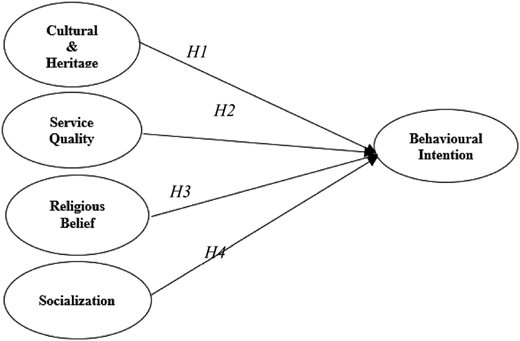
Cultural and Heritage attributes have a positive and significant influence on BI.
Service Quality has a positive and significant influence on BI.
Religious Belief has a positive and significant influence on BI.
Socialisation has a positive and significant influence on BI.
On the basis of an extensive review of the literature and proposed hypotheses, a conceptual model (Figure 1) is formed to investigate the relationship between motivational factors and BI.
3.4 Research design and approach
This study used a cross-sectional descriptive and causal research design for the following reasons. First, the study aims to explain how religious tourists' motivational factors and BIs are related. Second, the study questions and hypotheses were organised based on theoretical and empirical findings. Third, the data were only collected once over a specific time. Fourth, the study examines the relationship between the dimensions.
3.5 Sampling design and sample size determination
Lumbini, the birthplace of Lord Buddha and a UNESCO World Heritage Site, attracts a wide range of international and domestic tourists annually from different religious and cultural backgrounds. Therefore, to understand the relationship between motivation and the BI of a diverse range of tourists, Lumbini was chosen for the study.
The total number of tourists who visited Lumbini in the year 2023 was considered as the population for the study. A total of 681,055 tourists visited Lumbini in 2023 (Nepal Tourism Statistics, 2023).
The formula designed by Krejcie and Morgan (1970) was used to calculate the sample size for the study. The formula is as follows:
Where S = Sample size required
X2 = the value of chi-square for D.O.F. 1 at the desired confidence level (1.968*1.968 = 3.841)
N = Total size of the Population
p = Population proportion (value assumed as 0.50 since this would generate the
maximum sample size).
d = degree of accuracy expressed as a proportion (i.e. 0.05).
The total number of tourists who visited Lumbini in 2023 is 681,055. Therefore, from the above formula, the sample size for the study was determined to be 384.550 questionnaires were distributed to tourists at Lumbini, out of which 390 responses were found appropriate for further study.
The unpredictable and transient nature of tourists, as well as their reluctance to participate in the survey, time constraints, and resource limitations necessitated the researcher to adopt the non-probability sampling. Convenient sampling was employed to collect data from 390 respondents.
3.6 Methods of data analysis
The questionnaires were coded, and data input was done using statistical software. Before starting the data analysis procedure, data preparation was done. The data were reviewed for missing data, outliers, and incorrect entries. Further, exploratory factor analysis (EFA) was used to minimise each component's dimensions. To test reliability and validity, Cronbach's Alpha, convergent and discriminant validity were performed. In addition, a multivariate statistical method called confirmatory factor analysis (CFA) was used to determine the extent to which the measured factors or variables well represent the latent variables. Finally, structural equation modeling (SEM) was applied to test the hypothesised relationships.
4. Results
4.1 Sample characteristics
Out of the 390 respondents, 242 (62%) were male and 148 (38%) were female. The majority of tourists were Hindu, accounting for 254 (65%), followed by Buddhists with 49 (13%), non-religious with 32 (8%), Christian with 26 (7%), Muslim with 8 (2%), and others with 21 (5%).
4.2 Convergent and discriminant validity
According to Field (2009), reliability assesses how consistently instruments reflect the construct they are designed to measure. Cronbach's Alpha values were used to assess the internal reliability of the measurement model. Table 1 shows that all ten components scored over the established level of 0.7 (Field, 2009; Hair et al., 2014). Another reliability measure, composite reliability (CR), also has a superior value greater than the standard value of 0.7 suggested by Hair et al. (2014).
Convergent validity investigates the degree of correlation between two or more instruments representing the same concept (Hair et al., 2014). Since the Average Variance Extracted (AVE) for each construct in Table 1 is higher than the standard 0.5 recommended by Hair et al. (2014), the measurement model has attained convergent validity. Consequently, there are no convergent validity problems with the measurement model, and all of the items sufficiently converged to their corresponding latent constructs.
To assess discriminant validity, the AVE per construct should be greater than the correlations between two separate constructs. Table 1 shows AVE matrices, with the AVE on the diagonal and squared correlations between constructs on the off-diagonal. The findings indicate that there was discriminant validity since the elements on the primary diagonal were larger than the off-diagonal elements.
4.3 Exploratory factor analysis (EFA)
Before assessing the measurement and structural models, an EFA was performed to minimise dimensions and select the best factors. A total of 25 items were developed from the literature to measure the hypothesised model. Initially, the data included six items for Cultural and Heritage, six items for Service Quality, six items for Religious Belief, three items for Socialisation, and four items for BI. The result from Table 2 shows 15 items with factor loading ranging from 0.695–0.947 after deleting those items having factor loading <0.50 and double-loading them.
The investigation utilised the principal component analysis (PCA) approach and the Varimax Orthogonal Rotation technique. The model explained 76.55% of the total variance, above the widely accepted threshold of 60% for social sciences (Hair et al., 2014). The Kaiser-Meyer-Olkin (KMO) value of the model was 0.820, which is excellent according to (Field, 2009). Furthermore, Bartlett's test of Sphericity (X2) = 918.44 at 300 d.f. and p < 0.001 shows that the correlations between variables are adequate to proceed.
4.4 Confirmatory factor analysis (CFA)
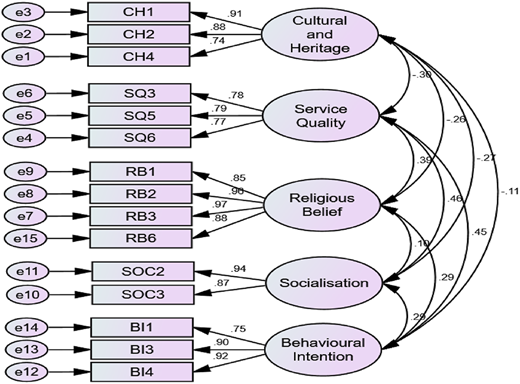
The CFA was conducted to evaluate the relationship between latent and measurable variables (Byrne, 2010). The benefit of CFA is that it can help reduce the gap between theory and observation. Additionally, CFA gives the researcher important information about how well the data fits into a theory-driven model (Piramanayagam et al., 2021). The CFA result revealed that the standardised factor loadings of every component in the measurement model were more than 0.74.
Several criteria were used to evaluate the model fit. First, the chi-square to degrees of freedom (χ2/df) ratio was 2.610, which is within the suggested range of 3 (Hair et al., 2014). Second, the values for the Incremental Fit Index (IFI), Tucker–Lewis index (TLI) and Comparative Fit Index (CFI), were 0.971, 0.962, and 0.971, respectively, which are above the threshold of 0.9, as advised by Bentler and Bonett (1980). Third, the root mean square error of approximation (RMSEA) was 0.064, below the 0.08 threshold level recommended by Browne and Cudeck (1992).
4.5 Structural equation modeling (SEM)
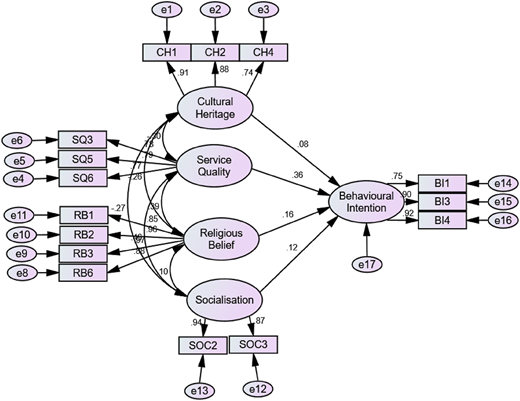
SEM is a multivariate statistical analysis method that is used to examine latent constructs and measurable variables with structural relationships. This technique, which combines factor analysis with multiple regression analysis, is chosen by researchers as it accurately assesses multiple and interrelated dependencies in a single analysis. Endogenous and exogenous variables are the two categories of variables employed in this analysis. Thus, a structural model (Figure 2) was constructed to test the proposed hypothesis. Table 3 shows the following indices for the structural model fit: CMIN/DF = 2.610, RMSEA = 0.064, CFI = 0.971, IFI = 0.971, TLI = 0.962. The findings show a good fit between the observed data and the model. The coefficient of determination (R2) for the structural model is 0.236, indicating that approximately 23.6% of the variance in tourists' BI is explained by the four motivational constructs: Cultural and Historical attributes, Religious Belief, Service Quality and Socialisation.
After validating the structural model, the next step is to investigate the relationships between constructs and test established hypotheses. Figure 3 shows that Cultural and Heritage attractions, Service Quality, Religious Belief and Socialisation are directly related to BI. The results of the path analysis revealed that the Service Quality positively and significantly affected BI (β = 0.361, t = 4.988, p < 0.001). Thus, the hypothesis (H2) was accepted at a 99.9% confidence interval. For hypothesis (H3), the Religious Belief factor of religious tourists positively and significantly affected BI (β = 0.156, t = 2.803, p < 0.01) at a 99% significance level. Similarly, Socialisation factors of tourists' motivation positively and significantly affected BI (β = 0.124, t = 2.075, p < 0.05), and the hypothesis (H4) was accepted at a 95% significance level.
However, Cultural and Heritage factors of religious tourists' motivation positively affected BI but were found to be not significant (β = 0.076, t = 1.381, p > 0.05). Which means the hypothesis (H1) was rejected at a 99% confidence interval.
5. Discussion
Religious tourism is an important part of Nepal's cultural and economic environment, with a considerable impact on both. Nepal draws millions of pilgrims each year because it is home to sacred sites like Lumbini, the birthplace of Lord Buddha, and the Pashupatinath Temple, one of the holiest temples in Hinduism. The arrival of tourists benefits the local economy by increasing income for businesses such as hotels, restaurants and transportation services while also providing new jobs. It also benefits local creative people by increasing the demand for religious artefacts. Religious tourism helps to preserve old customs, festivals and architectural masterpieces for future generations. Additionally, it promotes mutual respect and cross-cultural exchange, strengthening Nepal's standing as a hub of spiritual and cultural harmony (Pathak and Paudel, 2019).
Lumbini, the birthplace of Lord Buddha, has been a popular pilgrimage destination since ancient times. Archaeological remains found in the last century provide evidence of Lumbini as the birthplace of lord Gautam Buddha and a pilgrimage site dating back to the third century BC. Because of these factors, Lumbini was included in the World Heritage List in 1997 (Atzori et al., 2006). Lumbini, the holy site, includes the remains of old monasteries, a sacred Bodhi tree, a bathing pond, the Asoka pillar and the Mayadevi temple, where Buddha was born.
Pilgrims come to this location for religious and spiritual reasons; however, other tourists also visit the holy place for historical attractions, monuments, temple design and landscape. This study attempted to uncover religious and non-religious motivational factors influencing tourists' behaviours at Lumbini. To attain this objective, 21 motivating variables and four variables associated with BI were identified from previous research. Initially, EFA was used to analyse each of the 25 variables. A four-dimensional model for religious tourists' motivation, including cultural and historical attraction, religious belief, service quality and socialisation, has been developed as a result of the EFA. CFA was performed to test the construct factor structures. The CFA results suggested a satisfactory model fit. Thus, SEM was performed to test the proposed hypotheses.
As the relationship proposed in conceptual model (Figure 1), the study found a positive relationship between service quality and BI, aligning with prior research studies suggesting that high-quality services enhance satisfaction and satisfaction in turn enhances positive tourist behaviour such as positive word of mouth, recommendation to family and friends and revisit (Canny, 2013; Piramanayagam et al., 2021). Similarly, the positive relationship between religious belief and BI supports the arguments of previous studies, highlighting it as a prime motivational factor to predict BI for religious tourism (Wang et al., 2016; Kafley, 2023; Piramanayagam et al., 2021). Further, socialisation emerged as the third significant predictor for the BI of religious tourists at Lumbini, supporting the findings of Kafley (2023). However, the study found an insignificant impact of Cultural and Heritage attributes on BI, supporting the findings of Piramanayagam et al. (2021), but contradicting the findings of Kafley (2023).
6. Conclusion
The tourism business is facing growing competition. Therefore, destinations must be made more appealing to attract more tourists. Greater encouragement is necessary to boost the pleasant perception of religious destinations among tourists. Specifically, it has been found that service quality, religious belief and socialisation positively and significantly impact the behaviour of tourists visiting Lumbini. This indicates that the higher the value of service quality, religious belief and socialisation factors of tourists' motivation, the greater the intention of tourists to revisit Lumbini, as well as positive word of mouth and recommendations to friends and family to visit the place. However, the study also found an insignificant impact of Cultural and Heritage attributes on BI. Furthermore, despite the religious motivations, Piramanayagam et al. (2021) emphasised that tourists also expect proper parking facilities, accommodation, accessibility, etc. Consequently, the authorities should consider the study's findings and focus on allocating human resources to ensure good quality service. The authority should also pay attention to the availability of other attractions such as shopping facilities, religious souvenirs and literature on the religious significance of Lumbini. Also, authorities should organise events like Buddha Jayanti and invite religious leaders from different countries to build the image of Lumbini as a religious destination.
However, despite the insignificant impact of Cultural and Heritage attributes of religious tourist motivation on BI, the literature shows culture and heritage as prominent factors of motivation (Piramanayagam et al., 2021). Thus, the authority should enhance the religious atmosphere, local customs and historical attractions to attract tourists. The role of government is also vital in preserving historical relics, creating a religious atmosphere, preserving local customs and improving proper infrastructure.
7. Implication
The findings have significant scientific implications for research on religious tourism and BI. The study extends our understanding of what motivates religious tourists, particularly at religious destinations like Lumbini, by finding four motivational factors: service quality, religious belief, socialisation, and cultural and historical attributes. The combination of intrinsic factors, such as religious beliefs and extrinsic factors, such as service quality, strengthens the theoretical framework for tourism motivation. Furthermore, the study validates the applicability of the push-pull motivation model by providing empirical evidence for its use in religious tourism contexts. Particularly, the finding that service quality is the most influential predictor of tourists' BIs emphasises the importance of infrastructure, accessibility and hospitality in increasing satisfaction and loyalty.
Furthermore, the use of SEM for establishing relationships between motivation and BI provides a strong foundation for forecasting tourist behaviours such as repeat visits and positive recommendations. While the study shows that cultural and historical factors have a lesser effect on BI, it emphasises the relevance of localised insights into Lumbini's socio-cultural environment, recommending further research into those discrepancies. Practically, the findings provide guidance to tourism managers and policymakers at Lumbini on how to improve service quality, promote heritage and encourage socialisation opportunities. Finally, the study provides a framework for future research on additional motivational elements, such as relaxation or enrichment, and promotes comparative analysis across religious locations. Overall, this work fills theoretical gaps while also giving practical insights for sustainable religious tourism management.
8. Limitations and further scope
The required data were collected from a single destination, Lumbini, because of limited resources, to investigate the relationship between religious tourists' motivation and BI. Further study can be done, including more religious sites in Nepal, such as Swambhu and Namobuddha, to understand the relation better. Another limitation is that the study has identified only four factors of motivation that influence tourists' BIs. Further study may include more factors of motivation such as personal enrichment, religious learning, relaxation, pleasure-seeking, novelty-seeking, enjoyment, family togetherness, and social status, etc. and also further study should investigate the mediating effect of tourists' satisfaction, the moderating role of demographic variables such as age, gender on the relationship.
The SEM was applied in this study. Although the method provides robust insights, its reliance on self-reported data limits causal inferences. Future studies could incorporate experimental designs to address this limitation.