


This study investigates the determinants influencing customers’ intentions of using the foodpanda mobile app during COVID-19 pandemic.
This study is based on review of the literature studies and 388 usable data collected from respondents having prior experiences in online food delivery (OFD) services in Dhaka city in Bangladesh. The subsequent data are analyzed through structural equation modeling using Smart PLS 3.3.3.
The findings show that perceived usefulness (PU), ease of use, convenience, attitude and fear of COVID-19 significantly impact intentions to use foodpanda mobile app (ITUFPMA) and attitude. Further, attitude partially mediates between PU, ease of use, convenience and ITUFPMA. Moreover, fear of COVID-19 moderates the strength of association between attitude and ITUFPMA.
The findings of the study may be useful to OFD service operators in formulating business strategies for improving customers’ foodpanda mobile app use intentions and coping with competitive business environment of sharing economy sector.
The study presents a unique case highlighting what are influencing customer intentions toward OFD services during COVID-19 context. The current study provides important insights for industry operators by integrating PU, ease of use, convenience, attitude and fear of COVID-19 in examining ITUFPMA during COVID-19 situation.
Introduction
Rapid growth and advancement of electronic commerce have changed customers’ traditional buying practices, customers’ lifestyles and society. Online food delivery (OFD) services have been introduced due to new trends in the electronic commerce space. As a part of sharing economy, OFD refers to delivering customers’ order-based food from various restaurants via websites or apps. OFD facilitates customers in searching for restaurants, choosing food items and providing delivery information and address. Recently, OFD services are incredibly growing due to increasing Internet service providers and smartphone penetration (Ray et al., 2019). Among these OFD services, foodpanda has achieved popularity among customers serving 3 countries in Europe and 12 countries in Asia. Foodpanda, established in 2013, is a prominent OFD service provider, creating more than 20,000 employment opportunities and having about 50% of customers of this industry in Bangladesh (Ahmed and Ahmed, 2018). Importantly, the affordability of smartphones, telecommunication infrastructure, increasing purchasing power, increasing number of busy people, time and place convenience, cheap Internet and smartphone devices, the growth of population and the rapid growth of fast food demand of the young generation have led to the enormous development of OFD services in Bangladesh (Ahmed and Ahmed, 2018). Customers who are constantly coping with a busy schedule, exercising convenience, enjoying the comfort of staying home, and having the leisure of their own time are inclined to OFD services. The idea of OFD has been sparked due to changing nature of the urban population and the increasing number of the working population in metro cities of Bangladesh.
Interestingly, due to COVID-19 pandemic, customers’ perceptions, lifestyles and economic conditions have changed, which have replaced customers’ physical shopping with online shopping in Bangladesh. These attributes have fueled the growth and popularity of OFD services, especially the foodpanda mobile app in Bangladesh.
Although the foodpanda mobile app has achieved being a popular platform of food delivery services alternative to traditional restaurants, the sustainability and growth of foodpanda mobile app primarily depend on the needs and expectations of its existing customers, and the increasing number of OFD services providers competed with foodpanda mobile app (Ahmed and Ahmed, 2018). Consequently, all stakeholders of the foodpanda mobile app in terms of OFD service providers are interested in understanding the several insights behind the usage intentions of the foodpanda mobile app in Bangladesh. The foodpanda mobile app may attract new prospective customers by understanding the factors to meet their needs. Thus, it can be expected that finding out the determinants influencing foodpanda mobile app use intentions is crucial for industry operators.
Therefore, the current study attempts to explore determinants influencing foodpanda mobile app use intentions for three main reasons: First, the OFD services industry is a fast-growing sector in sharing economy industry with $115.07 billion in estimated revenues in 2020 and an expected $126.91 billion in 2021 (Reportlinker, 2021). Although these immense potentialities, limited prior scientific literature examined factors influencing intentions to use foodpanda mobile app (ITUFPMA) (Yeo et al., 2021; Gupta and Duggal, 2020). Second, most previous studies are conducted outside of Bangladesh. Thus, the study conducted in culturally, socially and economically potential counties like Bangladesh will help better understand determinants influencing intentions. Third, prior studies have extensively studied the acceptance of online services (Hamad et al., 2017; Carter and Bélanger, 2005). However, few studies have investigated determinants influencing intentions in OFD service segment (Annaraud and Berezina, 2020: Gunden et al., 2020).
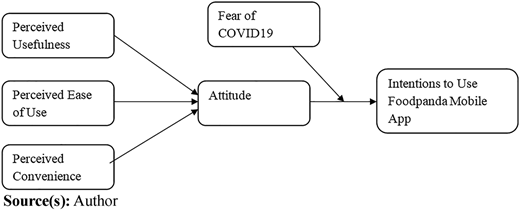
Scholars have used different theoretical frameworks, including the technology acceptance model (TAM), theory of reasoned action (TRA) and electronic service quality to measure acceptance and usage of OFD services (Cheng et al., 2021). To the best knowledge, no previous study examined the casual relationship among perceived usefulness (PU), ease of use, and convenience and food delivery mobile app adoption intentions; mediating effect of attitude between perceived convenience (PC) and food delivery mobile app adoption intentions; and moderating effect of fear of COVID-19 on the strength of the relationship between attitude and food delivery mobile app adoption intentions. Thus, the current study utilizes TAM and extends it, including PC and fear of COVID-19, to examine the determinants of ITUFPMA first (see Figure 1).
Literature review
Online food delivery services
OFD services refer to Internet-based services via which customers order food and get it delivered to their addresses. Prominently, several OFD services are in operation globally in 2020, where Deliveroo, Grubhub and Just Eat operate sequentially in 12 countries, 4,000 cities and 23 countries (Grubhub, 2020; Just Eat, 2020). Also, foodpanda served 12 countries (3 in Europe and 9 in Asia) with estimated revenue of $115.07 billion in 2020 (Ahmed and Ahmed, 2018; Reportlinker, 2021). OFD services facilitate customers in food ordering from different restaurants using Internet-enabled platforms, which plays a crucial role in examining the determinants of intentions toward foodpanda mobile app.
Technology acceptance model (TAM)
There are several theories (e.g. TRA and theory of planned behavior) for measuring customers’ behavioral intentions; however, usually TAM is widely used to examine the customers’ technology use/adoption intentions. Adoption/use intentions are the human cognitive thoughts generated from their perceptions (Hasan et al., 2020; Hasan, 2021). The cognitive TRA is used to understand an individual’s behavioral intentions. In contrast, TAM, the extension of TRA, explains the adoption of behaviors, technologies, devices or systems. Davis conceptualized TAM for the first time, explaining why an individual posits the intention to adopt new techniques or technologies when performing a specific task (Davis, 1989). Many researchers have expanded and adapted TAM to measure the adoption intentions of new systems or innovations in different contexts. For instances, Morosan (2011) uses TAM to investigate biometric system adoption intentions among restaurant customers; Song et al. (2021) apply TAM to measure customer behavioral intentions toward food delivery mobile applications and Roh and Park (2019) test TAM for predicting OFD adoption intentions regarding innovative communication technologies.
Perceived usefulness and intentions to use foodpanda mobile app
Earlier studies have found a connection between PU and intentions differently. PU refers to an individual’s likelihood of using new systems/technologies to improve performance (Hasan and Hasan, 2019). Balakrishnan and Shuib (2021) define PU as the degree to which individuals believe that they can perform a specific job effectively and efficiently using particular systems/technologies. In the previous study, Hong et al. (2021) mention that PU has a significant effect on OFD services adoption intentions. However, an insignificant relationship between PU and intentions is identified by Moslehpour et al. (2018). Interestingly, Yeo et al. (2021) demonstrate that ITUFPMA is positively related to PU. Decisively, it could examine the strength of the relationship between PU and ITUFPMA. Therefore, the study proposes the following hypothesis:
PU significantly influences intentions to use foodpanda mobile app among customers in Dhaka city of Bangladesh.
Perceived ease of use and intentions to use foodpanda mobile app
Prior studies have shown the connection between perceived ease of use (PEOU) and intentions differently. PEOU is defined as the degree of a person’s beliefs about using a particular system that would be free of effort (Ozturk et al., 2016). Previous studies demonstrated that PEOU significantly affects mobile app adoption intentions in a different context such as PEOU is particularly related to customers’ hotel booking intentions via mobile applications (Ozturk et al., 2016), and social media transaction intentions through mobile apps are significantly associated with PEOU (Hansen et al., 2018). However, PEOU is insignificantly related to intentions (Yoon, 2009). Moreover, Kapoor and Vij (2018) claimed that PEOU and other factors determine adoption intentions toward OFD services (Kapoor and Vij, 2018). Based on these studies, this study proposes the following hypothesis:
PEOU significantly influences intentions to use foodpanda mobile app among customers in Dhaka city of Bangladesh.
Perceived convenience and intentions to use foodpanda mobile app
In previous literature, convenience is described as a multidimensional aspect, has not been clearly defined. Yoon and Kim (2007) explain convenience in terms of five dimensions: time – the delivery time of products/services may be convenient for customers; place – the delivery place of products/services is more suitable for customers; acquisition – customers may easily purchase products from firms; use – customers may use products/services more conveniently and execution – someone can provide products to customers. Based on these dimensions, the concept of PC in the marketing area of OFD services can be defined as the ease of getting food delivered within a comfortable time and place. In previous studies, PC strongly influences intentions to use OFD services (Hwang et al., 2019). Conversely, Kim et al. (2009) found an insignificant effect of PC on intentions. In addition, Correa et al. (2019) explain that customers showed positive intentions toward OFD services when they perceived them as convenient to use. Hence, it is pertinent to examine the relationship between PC and ITUFPMA. As a result, the current study proposes the following hypothesis:
PC significantly influences intentions to use foodpanda mobile app among customers in Dhaka city of Bangladesh.
Attitude and intentions to use foodpanda mobile app
Earlier studies have made a connection between attitude and intentions differently. Attitude refers to a summary evaluation of an object’s thought. Attitude can be defined as the determined predisposition to respond toward an object in a particular way (Biswas et al., 2020). Also, Hasan et al. (2020) define attitude as a function of an individual’s salient at a given point in time. Scholars have primarily demonstrated attitude in terms of cognitive and affective aspects, influencing customers’ intentions. Hwang et al. (2021) mention that attitude significantly influences intentions toward drone food delivery services. However, that attitude is insignificantly related to intentions (Kasilingam, 2020). Moreover, Rivera et al. (2015) point out that attitude strongly predicts customers’ online food ordering intentions. Decisively, it is pertinent to explain the effect of attitude on ITUFPMA. Therefore, the current study proposes the following hypothesis:
Attitude influences intentions to use foodpanda mobile app among customers in Dhaka city of Bangladesh.
Perceived usefulness, perceived ease of use, perceived convenience and attitude
To the best knowledge, although no previous study has examined the causal relationship among PU, PEOU, PC and attitude, few studies have found that PU and PEOU significantly influence customers’ intentions in several sectors (Guritno and Siringoringo, 2013; Purnawirawan et al., 2012). Thus, the current study proposes the following hypotheses:
PU significantly affects attitude toward intentions to use foodpanda mobile app among customers in Dhaka city of Bangladesh.
PEOU significantly affects attitude toward intentions to use foodpanda mobile app among customers in Dhaka city of Bangladesh.
PC significantly affects attitude toward intentions to use foodpanda mobile app among customers in Dhaka city of Bangladesh.
The mediating role of attitude
Prior studies have pointed out that attitude mediates between different constructs in different contexts. For instances, the cognitive and affective attitude strongly influence the relationship between PU, ease of use and intentions (López-Bonilla and López-Bonilla, 2017); and attitude mediates the association between PU, PEOU and intentions toward OFD services (Choe et al., 2021). Moreover, Song et al. (2021) verified the mediating effect of attitude in the OFD services. Based on this literature, it could be examined the mediating effect of attitude between PU, PEOU, PC and ITUFPMA. Therefore, this study proposes the following hypotheses:
Attitude partially mediates between PU and intentions to use foodpanda mobile app among customers in Dhaka city of Bangladesh.
Attitude partially mediates between PEOU and intentions to use foodpanda mobile app among customers in Dhaka city of Bangladesh.
Attitude partially mediates between PC and intentions to use foodpanda mobile app among customers in Dhaka city of Bangladesh.
Fear of COVID-19 and intentions to use foodpanda mobile app
Prior studies have shown a connection between fear of COVID-19 and intentions differently. Fear of COVID-19 refers to worries and anxiety among individuals generating negative emotional state due to stress and depression of possible consequences of the COVID-19 pandemic, such as the probability of being infected with the coronavirus (Jian et al., 2020). Fear of COVID-19 has panicked people due to its high mortality and transmission rates (Rahman and Arif, 2021). Thus, people are exposed to panic buying behavior. Recently, Prasetyo et al. (2021) have found that customers’ fear and anxiety of COVID-19 mentally impair and make them imprisoned in indoor activities, which leads to ordering food online. Also, Kim et al. (2021) have identified that indoor staying tendency due to fear of COVID-19 influences online food order intentions. Based on these literature, it can be deduced that fear of COVID-19 is related to ITUFPMA. Thus, the current study proposes the following hypothesis:
Fear of COVID-19 significantly affects ITUFPMA.
The moderating role of fear of COVID-19
Although previous studies have examined the direct effect of fear of COVID-19, few studies have verified the intervening (moderating) impact of fear of COVID-19. Rather (2021) explains that fear of COVID-19 moderates the strength of the relationship between brand engagement and intentions. In addition, Hassan and Soliman (2021) mention that the link between reputation and intentions is moderated by fear of COVID-19. Moreover, a study in Switzerland demonstrates that fear of COVID-19 moderates the association between OFD system intentions and OFD service adoptions (Ali et al., 2021). Therefore, the current study explores the moderating effect of fear of COVID-19 on the strength of the relationship between attitude and ITUFPMA by proposing the following hypothesis:
Fear of COVID-19 moderates the strength of the relationship between attitude and ITUFPMA.
Research gap
A critical review of the literature reveals that previous studies have examined customers’ technology adoption intentions using different theoretical frameworks from different perspectives (Rahman and Arif, 2021; Dahiya and Sachar, 2021). However, to the best knowledge, no prior study has extended TAM, including PC and fear of COVID-19 in OFD services. More specifically, no previous study explores the mediating effect of attitude between PC and food delivery mobile app adoption intentions and the moderating role of fear of COVID-19 on the strength of the relationship between attitude and food delivery mobile app adoption intentions. Moreover, little or no effort has been given for examining the simultaneous effect of PU, ease of use and convenience on food delivery mobile app adoption intentions.
Methodology
Research design and data collection
OFD services is a popular type of sharing economy business model, earning $126.91 billion in 2021 (Reportlinker, 2021) worldwide. Due to the economic contributions and popularity, an OFD service is selected to test the research’s framework. Confirmatory factor analysis (CFA) is conducted to assess the measurement model’s reliability and validity. In subsequent effort, structural equation modeling (SEM) is performed for testing hypotheses. A survey research design was used to collect data using pre-validated structured questionnaires. Data were collected from respondents whose age was between 20 and 59 years using convenience sampling technique, because convenience sampling technique is easy for getting responses. A Google form consisting of the questionnaires was purposively sent to respondents among 1,000 existing foodpanda mobile app users living in Dhaka city and having prior experiences over three categories: app installations, putting the order and getting delivered at least once in a life.
Few procedural remedies were adapted to minimize common method bias. For example, items of variables were intermixed, a cover letter regarding the study concept, and information added above to the questionnaires were sent to the respondents. After that, the study formally surveyed from May to July 2021 to explore customers’ intentions to order food using the foodpanda mobile app. Among 1,000 potential respondents, 439 answered the questionnaires, indicating approximately 43.90% valid response rate supported by Ha and Jang (2010). Out of 439 respondents, 388 responded properly, while 51 answered with extreme values and left incomplete. Thus, 388 responses were used for data analysis, representing population adequately (Krejcie and Morgan, 1970).
Measures
Prior validated measurement items are adopted and modified to fit into this research context for measuring each construct. PU is measured using three items – quick, comfortable and beneficial aspects of the foodpanda mobile app – adapted from Atulkar and Singh (2021) and Okumus and Bilgihan (2014). PEOU consisting of three subdimensions, including easy to use, easy process and more manageable installation, is borrowed from Ray et al. (2019) and Atulkar and Singh (2021). Three measurement items of PC, including usage convenience, time and place, were adopted from Cho et al. (2019). Four items of attitude toward the foodpanda mobile app, including wise, reasonable, sensible and rewarding aspects, are adopted from Pitchay et al. (2021). In addition, four items of fear of COVID-19, including afraid of coronavirus, uncomfortable thinking of coronavirus, afraid of losing life, and anxiety of watching news of coronavirus suggested by Jian et al. (2020), are adopted. Lastly, four items of ITUFPMA, including intention to continue, use in daily life, frequent usage and usage next time, are adapted from Pitchay et al. (2021). All items of each construct are measured employing a five-point Likert scale, where “1” denotes “strongly disagree” and “5” denotes “strongly agree.” In addition, customers’ demographic profiles such as gender, age, income, marital status and education are measured with separate measurement scales.
Data analysis
Two-step approach suggested by Anderson and Gerbing (1988) is used to measure the relationship between independent variables reflected in second-order variables and dependent variables. The current study conducts CFA and SEM tests using Smart PLS 3.3.3.
Results and discussion
The demographic profile presented in Table 1 represents 55.93% males (217) and 44.07% females (174). The majority age (175) is between 20 and 29 years, including average age of 33.90 years. In case of income, majority (n = 163, 42.01%) earns between (United States Dollars) USD 170 and USD 340. In terms of marital status, 53.61% (n = 208) participants are single, while 40.98% (n = 159) participants are married. Moreover, most respondents (35.83%, n = 139) are graduates.
Demographic profile of respondents (n = 388)
| Variable | N | Percentage (%) |
|---|---|---|
| Gender | ||
| Male | 217 | 55.93 |
| Female | 174 | 44.07 |
| Age (years) | ||
| 20 to 29 | 175 | 45.10 |
| 30 to 39 | 106 | 27.32 |
| 40 to 49 | 62 | 15.98 |
| 50 to 59 | 45 | 11.60 |
| Mean age is 33.90 years | ||
| Monthly income [Bangladeshi Taka (BDT)] | ||
| 15,000–29,999 | 163 | 42.01 |
| 30,000–44,999 | 137 | 35.31 |
| 45,000–59,999 | 66 | 17.01 |
| 60,000 or above | 22 | 05.67 |
| Marital status | ||
| Single | 208 | 53.61 |
| Married | 159 | 40.98 |
| Divorced/widowed | 21 | 05.41 |
| Education level | ||
| Below or HSC | 131 | 33.76 |
| Graduate | 139 | 35.83 |
| Postgraduate or above | 118 | 30.41 |
Measurement model
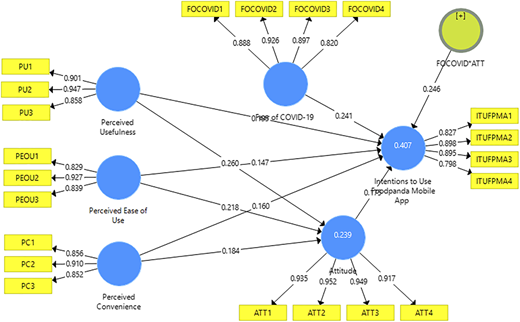
CFA is conducted using Smart PLS 3.3.3 to evaluate the measurement model. The psychometric properties of the measurement model presented in Table 2 and Figure 2, including reliability, convergent validity and discriminant validity, indicate the model’s fitness. The factors’ reliability and convergent validity estimated by composite reliability (CR) greater than 0.70 (Hair, 2009) and average variance extracted (AVE) greater than 0.50 (Hair, 2009) suggest the high internal consistency and validity of measurement items. In addition, all constructs’ Cronbach’s alpha values larger than 0.70 suggest good reliability (Nunnally, 1994). Thus, the measurement model achieves adequate reliability and convergent validity. Fornell and Larcker (1981) propose a method to examine the discriminant validity, where each construct’s square root of AVE and its correlation coefficients are compared with other constructs. The larger value of each construct’s square root of the AVE than the corresponding correlation coefficients presented in Table 3 indicates discriminant validity. The measurement model’s adequate reliability, convergent validity and discriminant validity were statistically supported.
Measurement model results
| Constructs/items | Factor loadings | Cronbach’s alpha (α) | Composite reliability (CR) | Average variance extracted (AVE) |
|---|---|---|---|---|
| Perceived usefulness | ||||
| I can order my food more quickly by using foodpanda mobile app | 0.947 | 0.887 | 0.930 | 0.816 |
| I can order my food more comfortably by using foodpanda mobile app | 0.858 | |||
| The foodpanda mobile app would be beneficial to me | 0.901 | |||
| Perceived ease of use | ||||
| Foodpanda mobile app is easy to use | 0.829 | 0.833 | 0.900 | 0.750 |
| The order placement process via foodpanda mobile app is easy for me | 0.927 | |||
| I believe that foodpanda mobile app is easier to install on mobile phones | 0.839 | |||
| Perceived convenience | ||||
| Using the foodpanda mobile app would be convenient for me | 0.856 | 0.845 | 0.906 | 0.763 |
| The foodpanda mobile app would allow me to order food at any time | 0.91 | |||
| Order food from any place; The foodpanda mobile app would allow me to order food from any place | 0.852 | |||
| Attitude toward foodpanda mobile app | ||||
| Purchasing food using foodpanda mobile app is wise | 0.935 | 0.955 | 0.967 | 0.880 |
| Purchasing food using foodpanda mobile app is good | 0.952 | |||
| Purchasing food using foodpanda mobile app is sensible | 0.949 | |||
| Purchasing food using foodpanda mobile app is rewarding | 0.917 | |||
| Fear of COVID-19 | ||||
| I am afraid of the coronavirus | 0.888 | 0.907 | 0.934 | 0.780 |
| It makes me uncomfortable to think about the coronavirus | 0.926 | |||
| I am afraid of losing my life because of the coronavirus | 0.897 | |||
| When watching news and stories about the coronavirus on social media, I become nervous or anxious | 0.820 | |||
| Intentions to use foodpanda mobile app | ||||
| I intend to continue using foodpanda mobile app in the future | 0.827 | 0.877 | 0.916 | 0.732 |
| I will always try to use foodpanda mobile app in my daily life | 0.898 | |||
| I plan to continue to use foodpanda mobile app frequently | 0.895 | |||
| I have decided to use foodpanda mobile app for purchasing food next time | 0.798 | |||
Results of discriminant validity and collinearity
| PU | PEOU | PC | ATT | FOCOVID | ITUFPMA | |
|---|---|---|---|---|---|---|
| PU | 0.903 | |||||
| PEOU | 0.350 | 0.866 | ||||
| PC | 0.125 | 0.480 | 0.873 | |||
| ATT | 0.359 | 0.397 | 0.321 | 0.938 | ||
| FOCOVID | 0.304 | 0.343 | 0.199 | 0.391 | 0.883 | |
| ITUFPMA | 0.383 | 0.405 | 0.372 | 0.364 | 0.459 | 0.855 |
| VIF | 1.261 | 1.612 | 1.421 | 1.663 | 1.324 | 1.331 |
Note(s): PU = Perceived usefulness, PEOU = Perceived ease of use, PC = Perceived convenience, ATT = Attitude, FOCOVID = Fear of COVID-19, ITUFPMA = Intentions to use foodpanda mobile app, VIF = Variance inflation factor
Structural model
After checking the measurement model’s appropriateness, the structural model is examined using SEM. The structural model examines the path coefficients, path significance and each path’s t-statistics summarized in Table 4 and Figure 3. Moreover, the collinearity was checked, calculating the variance inflation factor (VIF) scores presented in Table 3. Thus, this study demonstrates no method bias or biasing data since the scores of VIFs range between 1.261 and 1.663, smaller than 3.3 supported by Kock (2017).
Path coefficients and hypothesis testing
| Hypothesis | Relationships | Beta | T-statistics | P-values | Decisions |
|---|---|---|---|---|---|
| H1 | Perceived Usefulness → Intentions to Use Foodpanda Mobile App | 0.195 | 4.374 | 0.000 | Supported |
| H2 | Perceived Ease of Use → Intentions to Use Foodpanda Mobile App | 0.147 | 2.475 | 0.013 | Supported |
| H3 | Perceived Convenience → Intentions to Use Foodpanda Mobile App | 0.160 | 3.047 | 0.002 | Supported |
| H4 | Attitude → Intentions to Use Foodpanda Mobile App | 0.175 | 3.272 | 0.001 | Supported |
| H5 | Perceived Usefulness → Attitude | 0.260 | 5.036 | 0.000 | Supported |
| H6 | Perceived Ease of Use → Attitude | 0.218 | 3.753 | 0.000 | Supported |
| H7 | Perceived Convenience → Attitude | 0.184 | 2.984 | 0.000 | Supported |
| H8 | Perceived Usefulness → Attitude → Intentions to Use Foodpanda Mobile App | 0.046 | 2.621 | 0.009 | Supported |
| H9 | Perceived Ease of Use → Attitude → Intentions to Use Foodpanda Mobile App | 0.038 | 2.564 | 0.010 | Supported |
| H10 | Perceived Convenience → Attitude → Intentions to Use Foodpanda Mobile App | 0.032 | 2.206 | 0.028 | Supported |
| H11 | Fear of COVID-19 → Intentions to Use Foodpanda Mobile App | 0.241 | 4.913 | 0.000 | Supported |
| H11a | FOCOVID*ATT → Intentions to Use Foodpanda Mobile App | 0.246 | 3.995 | 0.000 | Supported |
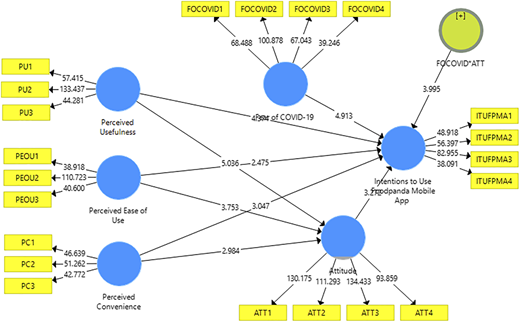
The SEM is conducted for testing the hypotheses. All hypotheses are well supported by the results presented in Table 4. More specifically, PU (H1) (β = 0.195, t = 4.374, p = 0.000), PEOU (H2) (β = 0.147, t = 2.475, p = 0.013), PC (H3) (β = 0.160, t = 3.047, p = 0.002) and attitude (H4) (β = 0.175, t = 3.272, p = 0.001) significantly influence ITUFPMA, supporting H1, H2, H3 and H4. Consistently, PU and ease of use significantly influence customers’ intentions to use OFD services during the COVID-19 pandemic (Hong et al., 2021); and PU and ease of use significantly impact OFD services adoption intentions in the COVID-19 context. Moreover, Table 4 shows that PU is significantly related to attitude (H5) (β = 0.260, t = 5.036, p = 0.000) and PEOU has a significant direct impact on attitude (H6) (β = 0.218, t = 3.753, p = 0.000). Also, a direct significant connection is found between PC and attitude (H7) (β = 0.184, t = 2.984, p = 0.010). These results indicate that customers’ attitude toward foodpanda mobile app is primarily influenced by their perceptions of its usefulness, ease of use and convenience consistently. Moslehpour et al. (2018) explain that PU is positively related to purchase attitude toward E-purchase intention among Taiwanese customers.
Mediation analysis
The classic casual steps approach developed by Baron and Kenny (1986) is followed to test the mediating effect of attitude between exogenous variables (PU, ease of use and convenience) and endogenous variables (ITUFPMA). The current study results presented in Table 4 show that PU, including attitude, significantly affects ITUFPMA (H8) (β = 0.046, t = 2.621, p = 0.009), indicating that attitude partially mediates between PU and intentions. Consistently, attitude toward OFD services partially mediates the post-usage usefulness and behavioral intentions toward OFD services (Yeo et al., 2017). In addition, PEOU included with attitude and ITUFPMA (H9) is significant (β = 0.038, t = 2.564, p = 0.010), indicating the partial mediation. This result implies that ease of using OFD mobile applications, including attitude toward influencing OFD mobile applications adoption intentions aligned with Jaiswal et al. (2021), demonstrating that attitude mediates between PEOU and electric vehicles adoption intentions.
Moreover, the PC significantly influences ITUFPMA (H10) (β = 0.032, t = 2.206, p = 0.028) when attitude is added simultaneously, partial mediation. Interestingly, no prior study has examined the mediating effect of attitude between PC and ITUFPMA. However, attitude mediates between convenience motivation and behavioral intention toward OFD services (Yeo et al., 2017). Thus, findings indicate that customers’ PC–intentions relationship varies due to customers’ attitudes.
Moderation analysis
Partial Least Squares (PLS) approach suggested by Fassott et al. (2016) in the structural model is used to examine the moderating effect of fear of COVID-19 in the proposed model on the strength of the relationship between attitude and ITUFPMA. The result presented in Table 4 shows that fear of COVID-19 significantly influences ITUFPMA (H11) (β = 0.241, t = 4.913, p = 0.000), supporting H11. It implies that fear of COVID-19 determines customers’ ITUFPMA. Moreover, fear of COVID-19 significantly moderates between attitude and ITUFPMA (H11a) (β = 0.246, t = 3.995, p = 0.000), thereby confirming H11a. These findings indicate that customers’ perception of fear during COVID-19 manipulates their attitude–intention relationship toward OFD services. Interestingly, the result is relatively new to technology-based services marketing literature.
Implications
Using TAM, the current study is one of the first researches investigating the effect of PU, PEOU, PC, attitude and fear of COVID-19 on ITUFPMA in Bangladesh, leaving theoretical insights and managerial implications in the field of technology-based services marketing strategies.
Theoretical implications
The present study has analyzed the direct effect of PU, PEOU, PC and attitude on ITUFPMA, revealing a significant impact on intentions supported by previous studies (Caffaro et al., 2020; Bonn et al., 2016; Zhao and Bacao, 2020; Hwang et al., 2021). Also, PU and PEOU significantly influence OFD services adoption intentions during COVID-19 (Ali et al., 2020; Hong et al., 2021). Interestingly, influence of PC on ITUFPMA is a new finding contributing to technology-based services marketing literature. However, several previous studies differ from these findings (Moslehpour et al., 2018; Yoon, 2009; Kim et al., 2009; Kasilingam, 2020). Thus, these findings have confirmed that user-friendliness, user comfortability, user benefits, ease of use, time, place, accessibility and personal predisposed perceptions of the foodpanda mobile app significantly influence ITUFPMA. In addition, attitude toward ITUFPMA is correlated with PU, PEOU and PC, which is consistent with prior studies (Kim, 2016; Yeo et al., 2017). These findings suggest that customers’ perceptions of foodpanda mobile app as usefulness, easiness, and app using convenience influence their attitude. Moreover, findings reveal that attitude partially mediates between PU, PEOU and PC and ITUFPMA, which is aligned with prior study (Song et al., 2021), contributing to technology-based services marketing literature. Furthermore, the present study extends the TAM, understanding the moderating effect of fear of COVID-19 on the strength of association between attitude and ITUFPMA consistent with past study (Mehrolia et al., 2021). This finding implies that customers intend to purchase food using the mobile app when their level of anxiety and consciousness of fear of COVID-19 soar.
Practical implications
The present study also offers several insights for industry operators of OFD services: First, OFD services management may develop customers’ positive intentions, improving app’s usability, ease of usage, benefits and convenience. Second, industry operators should provide customized services by understanding customers’ needs, attitudes and motivations. Third, industry operators should maintain hygiene in food processing and quickness in food delivery. Finally, management should develop a promotional strategy, improving customer awareness and positivity toward OFD services industry.
Limitations and future research
The present study is constrained by several limitations, attending for further analysis. The current study is cross-sectional and data are collected at a particular time, which is methodologically biased. Thus, it suggests longitudinal research offering more generalizable results after the COVID-19 pandemic situation. Moreover, this study has measured the determinants of intentions toward OFD services using only the foodpanda mobile app, which may provide biased results. Thus, future research should use other OFD apps such as Pathao food, Shohoz food, HungryNaki and Cookups.
Conclusion
The current research examines the mobile applications adoption intentions of OFD services, which is still at the nascent stage and attracts the attention of scholars in the related field. This research applies an empirical study to examine factors determining customers’ ITUFPMA during the COVID-19 pandemic, which significantly contributes to technology-based services marketing literature. In addition, the current research extends TAM, including two new variables – PC and fear of COVID-19. Moreover, this study contributes to theoretical and practical implications, providing insightful suggestions for academics and industry operators. Further, the study suggests PC as an essential antecedent of TAM, explaining how technology usage convenience determines customer intentions; and fear of COVID-19, extending TAM is playing a crucial role in understanding customers’ intentions to accept technology-based services in a particular situation.

