Skip to article sections
Purpose

Managerial practices are essential for activating the potential sustainability transition of the food supply chain. Therefore, the purpose of this paper is to contribute to the existing literature on the assessment, reporting, and disclosure of value in the food supply chain through a multiple-case study.

Design/methodology/approach

The present study proposes an assessment tool that can disclose the real impact of managerial practices with an innovative application of the SAFA Food and Agriculture Organization (FAO) framework within the context of the Italian meat production supply chain and, thus, enable producers to orient the transition process.

Findings

The multiple-case study analyzes and discusses three years of data (2019–2021) for three medium and large Italian companies operating in the meat production supply chain. The discussion includes the comparison of results based on the set of 17 themes and 80 proposed sustainability indicators.

Practical implications

This paper has both theoretical and practical contributions to the current discussion. This work extends the literature on the propensity to measure and report sustainability’ performances.

Social implications

This paper fosters the promotion of sustainable managerial practices and expands the literature on managerial tools to disclose sustainability’ performance.

Originality/value

The supply chain due diligence theoretical background has been adopted to investigate the (outside-in) supply chain transparency. In addition, the institutional legitimacy theory has been applied as (inside-out) perspective on how companies address their contribution to the production systems transition.

Two of the areas in which the principles of sustainability are increasingly applied are the management of supply chains (SCs) (Carter and Rogers, 2008; Ashby et al., 2012; Caccialanza, 2022) and the analysis of the sustainability performances of SC managerial practices (Asif et al., 2020; Khalid et al., 2015). Agricultural food production and supporting operations (the agrifood sector) are one of the most emblematic cases of SCs that needs to adapt to climate change challenges, since the sector is exposed more than others to climate change effects (Bonisoli et al., 2018, 2019; Bremmers et al., 2007; Filippi and Chapdaniel, 2021; Tchonkouang et al., 2024). Nevertheless, the need for an effective assessment of sustainability performance in agrifood SCs is still debated, and several solutions have been tested to find an effective approach (de Carvalho et al., 2022; Hens et al., 2018; Kumar et al., 2022). This study fosters the discussion proposing an extensive self-assessment tool for the evaluation of sustainability performance encompassing 17 themes and several managerial practices. To do so, an operationalization of the Sustainability Assessment of Food and Agriculture (SAFA) proposed by the Food and Agriculture Organization (FAO) has been developed, proposed and validated in three medium-to-large food firms. In fact, within the agrifood sector, prior studies highlighted extensive heterogeneity and notable differences within the drivers of sustainable innovation and sustainable targeted performance of food production SCs (Caccialanza and Torelli, 2024; Galli et al., 2023; León-Bravo et al., 2019). Due to the heterogeneity of food product categories, therefore, a focus is required on a singular product category. This study opted for the analysis of the meat production SC as this context represents a balance between innovative trends and more traditional approaches (Ferronato et al., 2021), the promotion of local and guaranteed SC production (Bava et al., 2017; Bragaglio et al., 2018; León-Bravo et al., 2019) and sustainable orientation evolution (Taylor, 2005; Hoek et al., 2021). In addition, there are several reasons behind the focus on the meat SC, considering the extent of the concept of sustainable supply chain management (SSCM) (Seuring and Müller, 2008; Sarkis et al., 2011; Beske and Seuring, 2014; Brandenburg et al., 2014) and the attempted multidimensional approach to the assessment of sustainability performances (Negri et al., 2021; Stindt, 2017). Finally, the meat production SC also involves the ethical dimension of livestock management (Allievi et al., 2015) and animal welfare (Akaichi et al., 2019), as well as the valorization of coproducts and by-products in food SCs (Reisch et al., 2021).

Considering the abovementioned elements, managerial practices activate the potential of food SC sustainability transition (Beske and Seuring, 2014; Fellegara et al., 2023). Consequently, this multiple-case study contributes to the existing literature on the assessment, reporting and disclosure of value in agrifood SCs (Arulnathan et al., 2020; Bennett and Grabs, 2024; McElroy and Thomas, 2015; Porter and Kramer, 2011). Research gaps exist in the comprehension of the impacts of managerial practices, specifically, on the effective assessment and disclosure of the impacts generated on different categories of SC stakeholders (Rialti et al., 2022). The impacts of managerial practices can indeed be studied using two complementary perspectives. On the one hand, internal performance assessment is driven by various endogenous factors, which provide opportunities for continually improving sustainability performance. On the other hand, exogenous factors drive the need for greater transparency in the company’s activities, thus requiring disclosure of the performance of implemented managerial practices. Depending on the perspective adopted, it is possible to identify categories of stakeholders who are most likely to request performance assessments and evaluations of generated impacts, either from inside (e.g. shareholders, members of the sustainability committee) or from outside (e.g. regulators, trade unions, associations and final product distributors). This specific interpretative theoretical framework adopted for each perspective can clarify the peculiarities of the different types of endogenous and exogenous factors. Therefore, a combined adoption of SC due diligence theory and institutional legitimacy theory is applied. The SC due diligence framework has been used as a holistic approach to foster the outside-in SC transparency (Adams and Larrinaga, 2019; Chamas et al., 2021; Caccialanza et al., 2023a, 2023b; Hofmann et al., 2018), in association with the institutional legitimacy theory as an inside-out perspective on how companies address their contribution to a sustainable transition (Cheng, 2010; Crossley et al., 2021; Do et al., 2024; Silva, 2021). The spread of more sustainable managerial practices, therefore, contributes to the legitimation of SC operating companies and to the overall respect of planetary and social boundaries (Persson et al., 2022; Rockström et al., 2009, 2021).

In particular, this three-year study (2019–2021) directly engaged the companies involved in a data collection and reporting process that used a multiple intervention-research approach, thus integrating other studies conducted under similar conditions (e.g. Bebbington et al., 2017; Taïbi et al., 2020). Moreover, this study is part of the debate on how to build a new tool to collect data, manage data and finally report to internal or external stakeholders the impacts of food production in accordance with a multidimensional accounting models perspective (Antonini and Larrinaga, 2017; Azadnia et al., 2015; Bebbington et al., 2007, 2017, 2019; Dillard, 2015; Taïbi et al., 2020).

The following section reviews previous contributions in the literature, and then presents the analyzed context of the meat SC in Italy. This paper is structured in four additional sections dedicated, respectively, to the presentation of the methodology adopted, the presentation and discussion of general results of the three case studies, the illustration of contributions and concluding considerations on the assessment of sustainability performances in meat SCs.

Several previous papers have highlighted both the centrality of the issue of sustainability of the meat SC and the need to be able to conduct performance assessments achieved by individual categories of stakeholders, as well as by the SC as a whole. As discussed extensively by Caccialanza et al. (2023a, 2023b), there are several types of managerial practices that have been addressed over time in the meat SC that can contribute to the mitigation of climate change effects. Specifically, they emphasize that various practices originate both from efforts to enhance SC coordination and efficiency, as well as from the promotion of proactive measures to reduce impacts.

Though improvement per se is already a first and substantial step in the process of transitioning production processes, it also has been stressed that it is important to report and talk about companies’ walk (Schoeneborn et al., 2020), and thus communicate and disclose the real effort and managerial practices adopted. In Italy’s meat SC, distinctive dynamics have already been identified, warranting further transdisciplinary and multilevel investigation (Fellegara et al., 2023). In particular, Galli et al. (2023) analyzed the links and potential limiting and supporting factors between sustainability actions and sustainability reporting, thanks to a comparative approach between companies involved in sustainability actions and those whose reporting practices lack a formal performance assessment or reporting systems (Ghosh and Shah, 2012; Korca et al., 2023). Their analysis pointed out the phenomenon of “greenhushing” in the form of “the deliberate choice to omit or only partially provide information on one’s effective sustainability practices to avoid creating problems for one’s own sector, collaborating companies or clients” (Galli et al., 2023, p. 15). This evidence was also confirmed by empirical examination of the focal firms’ propensity to disclose sustainability reports in the transformation step of this SC (Caccialanza and Marinoni, 2023; Fiandrino et al., 2019). The lack of disclosure regarding value distribution within the SC, along with the assessment of its financial and nonfinancial impacts, hinders a proper understanding of the efforts and challenges faced by specific stakeholder groups (Adams, 2017; Barter, 2015; Grabs et al., 2024; Martinelli et al., 2020). These prior studies highlighted the need to enhance performance awareness and improve the visibility of reporting, driven both by competitive pressures (Gracia et al., 2011; Kumar et al., 2022) and by additional external pressures. In this context, at least two external factors – particularly institutional and regulatory ones – are expected to drive an urgent transition. First, the Corporate Social Responsibility Directive (CSRD) obliges an increasing number of companies to report on their performance, including dimensions that are not strictly economic-financial [Directive European Union (EU) 2022/2464). Second, the European perspective pushes for an impact assessment perspective throughout the whole production SC, as demonstrated by the associated implementation guidance “DRAFT European financial reporting advisory group (EFRAG) IG 2 – Value Chain” by EFRAG or the Corporate Sustainability Due Diligence Directive (CSDDD) approved in July 2024. Additionally, examining production sectors, the agrifood sector is among the most closely monitored and is the subject of greater production and investment constraints being imposed in the planning of the Green Deal, specifically in the Farm to Fork strategy. These aspects further emphasize the need to investigate the performances of business processes to mitigate the impacts generated at the SC level.

As Schaltegger et al. (2023, p. 3) suggest, one approach to examining these dynamics is to adopt a company-level perspective on sustainability transformations and transitions, and to develop management implications that can be effectively implemented at the company level. This opportunity is combined with the need to integrate, according to a holistic approach, different interrelated concepts: sustainability assessment, management accounting, control and reporting (Maas et al., 2016). Consequently, this study aims to increase the awareness of these enterprises that often have already implemented sustainability managerial practices, but do not disclose or communicate their sustainability performance (Galli et al., 2023). As a consequence, this may directly reduce the phenomenon of ‘greenhushing’ already demonstrated as diffused in this sector.

The discussion of the promotion of sustainability accounting and performance in management studies has given rise to a long and varied debate on the study of the interaction between accounting, natural resource boundaries and social dimensions (Adams and Larrinaga, 2019; Bebbington and Larrinaga, 2014). Following this debate, in this study a combined approach of theoretical perspectives is applied, namely, the SC due diligence (Hofmann et al., 2018) in association with the institutional legitimacy theory (Rendtorff, 2020; Silva, 2021). Following legitimacy theory there is a close connection between business legitimacy, corporate social responsibility, stakeholder management and sustainability. With the focus on the SC in CSRD regulation legitimacy is based on the due diligence reporting efforts of the company. Recently, legitimacy theory has been combined with the theory of relational economy, where business ethics and CSR creates business legitimacy through stakeholder relations (Rendtorff et al., 2024; Rendtorff, 2025). Value-creation is based on dynamic interactions between firms and their environments where networking, stakeholder management and relational contracts constitutes the formation of business legitimacy in the firm. The increasing normative pressure for alignment of values and compliance with sustainability is formed on the basis of this integration of the firm in a relational network that determines sustainability and social responsibility.

SC due diligence is increasingly gaining relevance in SSCM studies, due to the increasing normative pressure and the attempt to include the ensuring of profit with the integration of sustainability principles in corporate purposes (Ventura, 2023). Initially, normative pressures and mandatory disclosure requirements targeted the focal companies within SC. Focal companies were expected to drive improvements in the social and environmental performance of suppliers due to their role in governing the SC, their ability to manage upstream and downstream relationships and their responsibility for designing the final product (Seuring and Müller, 2008, p. 1). After also focal food businesses failed to achieve the zero-deforestation goal by 2020, several national (i.e. the UK, Germany, Japan, South Korea, Canada) and international (i.e. European) regulators imposed forms of mandatory SC scrutiny for importers dealing with commodities such as meat, leather, soy, oil palm, coffee, cocoa and rubber (Alexander et al., 2024). In the perspective proposed by previous authors in reference to food SCs (e.g. Velte, 2023; Ollivier de Leth and Ros-Tonen, 2022), we believe that an effective sustainability accounting and reporting system can mitigate exogenous demands for outside-in transparency regarding corporate managerial practices and performance. More specifically, this assessment tool can increase the accountability and propensity for reporting these managerial impacts.

On the other hand, with an inside-out perspective, it is shown that businesses look for a legitimization of their operations and an improvement of sustainability performance (Rotter et al., 2014; Silva, 2021). Accordingly, Cheng (2010) confirms that there are adaptive strategies that members of a SC implement to gain legitimacy in their network and modify their business model. Moreover, businesses engage in sustainable social and environmental practices to strengthen their reputation and image (Crossley et al., 2021; Müeller et al., 2009), while Do et al. (2022) stress the establishment of a “Legitimacy-embedded efficiency” logic, wherein economic growth is attained while simultaneously safeguarding the environment through the optimal utilization of resources.

Therefore, Figure 1 displays the research framework adopted and attempts to combine the several streams of literature that contributed to the definition of the proposed assessment tool, as well as its positioning according to prior research conducted by Maas et al. (2016), Galli et al. (2023) and Caccialanza and Torelli (2024). Consequently, we believe that the combined adoption of the theoretical frameworks may shed light on the perception of the complexity involved in the inside-out (solid down arrows in Figure 1) and outside-in (dotted up arrows in Figure 1) perspectives involved.

Furthermore, we propose, discuss and validate the proposed assessment tool in the field to address the inside-out and outside-in tensions that arise, aiming to prevent “greenhushing” practices and to transparently disclose the true impacts of firms’ managerial practices on SC stakeholders. In line with this purpose, this study includes a review of the main features of existing tools and models in the context of other food product categories (see also Section 3.1).

Several key elements have been included into the theoretical framework, and operationalized in the assessment tool, by integrating the perspectives of institutional legitimacy and SC due diligence. This approach enables the model to be applied to a wide audience within the reference network, fostering discussion on the transition of business models in the context of the meat SC (Fellegara et al., 2023; Hübel and Schaltegger, 2022; Kumar et al., 2022). Accordingly, Cagno et al. (2023) pointed out that an effective assessment framework in manufacturing systems can be promoted thanks to: the integration of different paradigms; the possibility of its application at different levels; and its adaptability to firms’ characteristics with scalable systems. First, in line with the concept of integrating multiple paradigms, McElroy and Thomas (2015, p. 427) underscore that natural resources are part of a broader natural capital – air, land, water, flora, fauna, ecosystems and other biophysical resources – all of which are incorporated into this assessment tool (see Section 3.1). Second, the idea of the applicability of the assessment tool to different levels of the SC is confirmed since we rely on prior studies that analyze the drivers of sustainability reporting in this context at firm (Galli et al., 2023; Hübel and Schaltegger, 2022) and meso level (Caccialanza and Torelli, 2024). Third, the adaptability and scalability of the system is ensured thanks to the qualitative approach (Do et al., 2024; Filippi and Chapdaniel, 2021) and scoring methodology adopted (see Section 3.3 for details).

Within the specific debate on assessment tools for sustainable food SC management (e.g. León Bravo et al., 2021; Yakovleva et al., 2012) proposed several initiatives to improve the food SC performances with reference to social, environmental and ethical issues. In fact, prior research deepened the comprehension of other peculiar categories of products – i.e. fisheries (Ingrao et al., 2016), forestry (Tröster and Hiete, 2018), coffee (Bennett and Grabs, 2024) or soy (Knudsen et al., 2010) – or stages of local economic development (Asif et al., 2020; Ghisellini et al., 2016; Ghosh and Shah, 2012). Several impacts and associated sustainable managerial practices have been identified for the transition to cleaner food production models (McMichael et al., 2007; Smith and Gregory, 2013). However, considering the debate conducted by scholars (e.g. Caccialanza et al., 2023a, 2023b; Demartini et al., 2016; Golini et al., 2017; Hübel and Schaltegger, 2022; Kumar et al., 2022), not enough evidence emerges to apply any existing effective assessment in the specific context of the meat SC described below. According to Demastus and Landrum (2024) none of the currently available sustainability schemes support an effective transition of production models. This study further supports our attempt to validate this context-specific model. More specifically, this gap in literature justifies the study and suggests the promotion of the on-field implementation of a tool especially useful to small and medium-sized enterprises (SMEs), which are not yet directly involved in the sustainability performance disclosure obligation [e.g. see CSRD or Voluntary Sustainability Reporting Standards for nonlisted SMEs (Voluntary sustainability reporting standard for non-listed SMEs VSME) published in December 2024 by EFRAG]. On the other hand, these smaller enterprises might be indirectly involved in the reporting process if they are part of the SC procurement with focal actors who harbor ambitions in the development of sustainable procurement policies or due to the reporting obligation to which larger companies are subjected (Caccialanza, 2022, 2023b). It therefore emerges how this tool can also benefit them in relation to external requests for sustainability (performance) reporting in negotiations and at the stage of their evaluation as suppliers to large firms. Here we refer to the concept mentioned in the theoretical framework of potential competitive advantage due to the product’s sustainability attributes gained by companies adopting the framework. These ambitions might be limited on the other hand by a limited basket of soft and hard skills of SMEs entrepreneurs and managers, as well as by the creation or coordination of substructures or resources internally. The urgency for the adoption of the assessment tool, and the satisfaction of the disclosure requirements, is further reinforced if we assume an expected growth of alternative proteins’ market-share that are positioned as “sustainable” (Allegretti et al., 2018; Verneau et al., 2016) and “cruelty-free” protein sources (Whelan and Kronthal-Sacco, 2019). Evidence of this growth has been already demonstrated in other European countries (Collier et al., 2021), thus representing a further source of risk that might be partially mitigated.

Several studies have previously highlighted the importance of the cultural background and national context in the assessment of food sustainability perception (e.g. Allievi et al., 2015; Leroy and Praet, 2015), and adoption of sustainable meat production SC practices (e.g. Caccialanza et al., 2023a, 2023b; Neo and Emel, 2017). Transdisciplinary research conducted by Almiron and Zoppeddu (2015) and Fellegara et al. (2023) on this SC confirms that the Italian scenario makes no exception, leaving room for research on the better understanding of this context. Additionally, the hypothesis of the monetization of the external costs already has been evaluated by other scholars (e.g. Antheaume, 2004; Unerman et al., 2018), and Nguyen et al. (2012) estimates that 1.9€/kg is the environmental cost for EU pig meat products. In addition, the Italian case represents a unicum in terms of application of European legal requirements, environmental and biodiversity protection and propensity for the export of meat-based products [e.g. EU, COM (2018)181; Leone, 2021]. Accordingly, Amicarelli et al. (2021) estimate that in 2018 the Italian meat industry processed more than 4.9 million tons to produce approximately 2.0 million tons of fresh meat, about 15% of the domestic agrifood sector value. However, Arrigoni et al. (2023) estimate that in 2018 the external cost of meat consumed in Italy potentially generated a cost to society approximately equal to €36.6bn. Therefore, this may represent a great opportunity to increase the transparence of the sustainability performances of current managerial practices and foster the transition of production systems thanks to the sustainability reporting propensity and SC’s multidimensional and multitier perspective (Pérez et al., 2019). As supported by Anestis et al. (2020), the dietary composition in the breeding phase is one of the impactful issues to determine the environmental footprint, so that the traditional heavy Italian pig is the best candidate case for the validation of a specific assessment tool (Bava et al., 2017). An additional indication of a greater propensity to measure the best environmental impact is also suggested by the prevalence of quality certifications achieved at the transformation step of the SC (Caccialanza et al., 2023a, 2023b). Furthermore, a peculiar valorization of complementary products and systems (Bragaglio et al., 2018; Ruviaro et al., 2015) or valorization of by-products (Nguyen et al., 2012; Vergé et al., 2018) may significantly impact the overall sustainability performance evaluation, since no effective data-driven evaluation can be carried on by practitioners without a valid self-assessment tool (Castellini et al., 2012; Kamble et al., 2020). Therefore, this exploratory multiple case study contributes to fill the research gaps that exist in the comprehension of mechanisms of sustainability performance disclosure involving SC stakeholders and SC managerial practices in the Italian context.

To validate the self-assessment tool, a qualitative methodology (Barrat et al., 2011) is adopted to discuss the key SC dimensions and theme in relation to the ability of companies to measure actual performance in the achievement of transition of production systems (Arulnathan et al., 2020; Stindt, 2017; Fellegara et al., 2023). To do so we propose an exploratory multiple-case research design (Crossley et al., 2021; Eisenhardt, 1989; Yin, 2018) to validate a self-assessment model, similar to the approach adopted by previous scholars for the evaluation of multitier SCs (Do et al., 2024; Gold et al., 2010; Perez et al., 2010). In fact, as highlighted by Do et al. (2024, p. 4), a case study approach is suitable for abductive reasoning and to allow a general theory to be reconciled with the “contextual idiosyncrasies” that may emerge from the cases (Gibassier and Schaltegger, 2015; Ketokivi and Choi, 2014). In addition, a multiple-case design is preferable since it leads to more grounded, robust and generalizable results if compared to single cases (Yin, 2018).

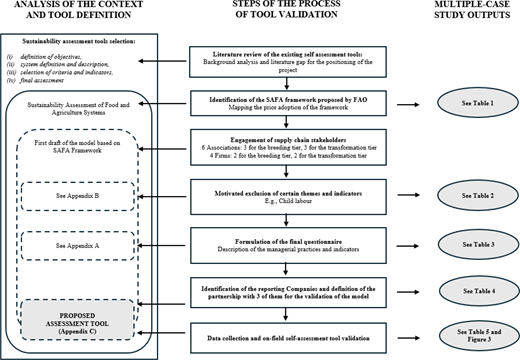
The choice of the FAO’s SAFA existing framework within the existing frameworks (FAO, 2013a, 2013b, 2014, 2015), the adaptations proposed, and the selection of the case studies for the on-field validation of the tool are introduced in the next three sections and anticipated in Figure 2. More specifically, Figure 2 has several functions, since position our tool in the current debate, exploding our contribution with refers to the theoretical framework proposed in Figure 1 and according to the selected Italian food manufacturing context (see left part of both figures and Appendix A, B and C in the supplementary material). The implementation and validation of this self-assessment model has been conducted in different phases (van Cauwenbergh et al., 2007). As proposed by Deytieux et al. (2016) and lately by Havardi-Burger et al. (2021), we follow four main phases: (i) definition of objectives, (ii) system definition and description, (iii) selection of criteria and indicators and (iv) final assessment. Second, Figure 2 visualizes the steps followed for the process of tool definition and validation; thus, allowing higher transparency of the procedures and logical steps followed. Third, the right part of Figure 2 provides an additional callout for each step for the specific outputs of the multiple-case study.

There have been several attempts in the literature over time to formulate models and frameworks with the potential to be applied in different agrifood contexts as discussed priorly in the background section. Proposals have differed in the level of detail and the span of the dimensions involved (de Olde et al., 2017) or the production system adopted (de Olde et al., 2016). Previous attempts to systematize existing assessment systems have further emphasized this need for this specific production SC (Demartini et al., 2016).

Following Taylor (2006), we adapted the structure of the value stream to the present research considering the three main tiers involved in the meat production SC: the farm step, the transformation step and the distribution and consumption step. Each SC tier has been associated with well-defined categories of stakeholders (Lees et al., 2020; Caccialanza et al., 2023a, 2023b) that have been considered as final users of the proposed framework: the breeders and farmers; the slaughterers and processors, and the distributors and consumers. Arulnathan et al. (2020) highlight how the choice of an effective sustainability assessment tool by practitioners is crucial to pursue an effective transition to cleaner production systems, as well as being introduced to sustainability performance metrics (Hassini et al., 2012). They show that it is not possible a priori to define the best framework to apply and how a complementary bottom-up and top-down approach is necessary in this process. To estimate production-related impacts, the tool was designed considering the companies of the farm step and the transformation step of the SC as the main adopters and implementers of the model, as the production phases account for most of the overall impacts according to prior studies (e.g. Arrigoni et al., 2023). The distribution and final consumption stage is thus to be considered as well as the final users of the output of the model and estimators of the different performances that competing SCs produce in light of this integrated evaluation system that allows comparability of the performance among producers (Adams, 2017; Ghosh and Shah, 2012; Grabs and Carodenuto, 2021; Korca et al., 2023). Consequently, this model considers these relevant tiers of the SC as adopters and final users, thus aiming to maximize the stakeholders’ engagement with the model (Adams and Larrinaga, 2007; Bebbington et al., 2017; Correa and Larrinaga, 2015). Indeed, we proceed to define the more suitable existing framework to adapt it to the peculiarities of this SC.

Despite its embedded limitations, Schader et al. (2014) apply the FAO SAFA framework after having analyzed 35 sustainability assessment tools in an attempt to find the most comprehensive in terms of dimensions, themes and indicators involved, as well as a well-established application in literature. Similarly, Bonisoli et al. (2019) apply the SAFA framework to the context of the banana SC in Ecuador. The interest in this framework has been extensively acknowledged in literature regarding its flexibility in different contexts, high credibility, user-friendliness, comprehensiveness and compatibility with other frameworks (Bonisoli et al., 2019). Lately, Havardi-Burger et al. (2021) implemented a theoretical framework based on SAFA to the flowering potted plants SC in Germany for its cost-effectiveness rationality.

Previous operationalizations of the SAFA framework are mapped according to the scheme presented in Table 1, and these applications are compared based on various factors, including the products analyzed, geographical focus, scope of analysis and categories of stakeholders engaged in SC-specific contexts.

Given its extensive prior applications and adaptations, the SAFA (FAO) framework – originally conceived as a broad, farm-oriented tool – raises few specific constraints when applied to a European meat-supply-chain study. In particular, its 327 indicators exceed the practical needs of the context analyzed, its global thresholds do not necessarily align with Italian rules and standards, and part of its scoring relies on self-reported data. We therefore adapted the indicator set for this sector, adjusted thresholds to national standards or documented best practice, triangulated self-assessments with site visits and third-party evidence, and built a three-year (2019–2021) data series to capture performance trends over time. The indicator-selection procedure is detailed in this methodological section, while the residual limitations of our adaptation are discussed in the concluding section.

In accordance with prior studies summarized in Table 1, we proceed with the comparison of the themes proposed in each of the four dimensions of the SAFA model: governance, environment, economy and social. Prior analysis on meat SCs was applied mainly in the contexts of developing countries (Gayatri et al., 2016), so that a reprioritization of material themes occurred to provide an effective context-specific tool (Fernández-Ferrín et al., 2021) and the definition of the objectives (Sala et al., 2015). This reconfiguration became necessary with the prospect of including most small and SMEs in the sector that are currently interested in sustainability issues, but feel they are too small to be able to implement significant investments toward this strategic orientation (Baumgartner and Ebner, 2010; Jansson et al., 2017). More recently, scholars (Petit et al., 2018; Martinelli et al., 2020) confirm that in food systems and meat transformation SMEs the sustainability orientation is differentiated. Moreover, Bonisoli et al. (2018) find that FAO’s SAFA tool is also validated with the purpose of assisting SMEs of the production SCs to improve their processes for a more performance-oriented perspective.

Second, a literature analysis of the compatibility and significance of the subthemes and indicators for this specific production SC is completed, according to the approach adopted by other scholars (e.g. Alexander et al., 2024; Hassini et al., 2012).

An initial version of the questionnaire was drawn up following the comparison with a first draft of significant subthemes and indicators proposed by these studies. This phase included the receipt of feedback thanks to online meetings with six associations (three for the breeding tier, three for the transformation tier) and four firms partnered for the research project (two for the breeding tier, two for the transformation tier). This phase ensures that the issues and metrics were understood and shared by SC stakeholders (Bremmers et al., 2007; Hassini et al., 2012) and that the process of validation of the tool was performed in conformance with the logic of coconstruction of the sustainability accounting tool (Taïbi et al., 2020, p. 1222). The exclusion of some subthemes has never been motivated by the necessity of synthesis of the assessment tool but is due to the inconsistency compared to the context of this specific production SC (e.g. exploitation of child labor). A complete list of excluded indicators in the final version of the assessment tool, along with the rationale for their exclusion, is provided in Appendix B, supplementary material. These indicators from the original SAFA model were omitted from the assessment model for various reasons. First, some indicators relate to compliance with regulations that are either specific to developing countries or low-institutional-quality contexts, making them irrelevant or at least not material issues for a Western European country like Italy. Redundant indicators were omitted, particularly in areas where companies were not directly measuring related metrics, and only the most efficiency-led indicators were retained. Moreover, certain indicators were irrelevant to the animal-based SC being analyzed (i.e. “hazardous pesticides” indicators that refer mainly to cereal-based SC production). Finally, issues like “child labor” or “health coverage and access to medical care” were excluded as they are already adequately addressed by Italian constitutional regulations.

This subsection describes the process for selecting themes, subthemes and indicators, the type of indicators, the scale adopted for scores, and the management of feedback received in the field test phase and during the analysis of the three multiple case studies proposed. Table 2 proposes a comparison between the width of the SAFA model in terms of themes, subthemes and indicators covered, compared to those selected for this assessment model.

At this stage, additional feedback was collected for the drafting of the sections of the document aimed to be used as an operational guideline. This document, that is the final outcome of the whole project, has as final users and target audience the practitioners of this SC (copy of the Italian version of the guidelines is provided in Appendix C, supplementary material). In this phase we add definitions for the dimensions involved, and a list of good and bad practices for each subtheme, as well as practical explications of how to calculate the required performance indicators. As detailed in Appendix A in the supplementary material, which contains the full list of adopted indicators, the document provides a granular overview of the data structure related to the indicators’ collection process, as well as their aggregation into subthemes and themes for each dimension. This type of evaluation criteria is shared and adopted in the literature and in previous studies on the validation of new methodologies of assessment (Singh et al., 2009). For example, within the “G-Governance” area, the disclosure of the “G.1 Company commitment (mission)” theme is addressed. Accordingly, the subtheme “G.1.1 Statement of Intent” measures this commitment through three indicators, including the practice indicator “G 1.1.1 Explicit commitment.” This indicator asks in the questionnaire what activities and practices the company has implemented to ensure that the commitment to sustainability is present in all company documentation and understood by all managers and employees. The activities and practices implemented by Company B (see Section 3.4 for details on this company) in response to this indicator are as follows and have enabled them to achieve a score of 2 out of 2 on that indicator:

  • appointment of a “sustainability delegate” on the board of directors;

  • presentation and approval of the “sustainability plan” by the board of directors as part of the company’s strategic plan;

  • a broad engagement process involving all company departments to define the contents of the Company B’s sustainability plan;

  • participation of the CSR or sustainability manager and the sustainability delegate in the monthly management meetings and in the working group for the development of new products; and

  • regular articles in the company newsletter on the topic of sustainability.

Like the SAFA model, this self-assessment model has three types of indicators: target, practices and performance. When selecting the type of indicators, the identification and importance of the topic in terms of materiality for the organization has been considered through the target indicators. The actual development and implementation of practices in business processes has been enhanced with practice indicators. Finally, the quantitative measurement of impacts has been enhanced by performance indicators. The three different types of indicators did not change during the three years of observation to guarantee the comparability over the time of results obtained and the homogeneity of the metrics (Ghosh and Shah, 2012; Korca et al., 2023).

Direct impact measures are considered by far the best to define the effective impact of a firm’s activities both for internal users and for external stakeholders (Gwiriri et al., 2019; Hassini et al., 2012). On the other hand, Dabkienė (2016) suggests the use of a common data set of comparable data to assess the sustainability impact of farms in Europe. However, previous studies on the propensity for disclosure and accountability in this specific production SC have noted how a systemic approach to sustainability is reduced to a few SMEs (Caccialanza and Marinoni, 2023; Fiandrino et al., 2019), albeit comparability of sustainability metrics and reports is crucial (Ghosh and Shah, 2012; Korca et al., 2023). This is despite the fact that the SMEs constitute the vast majority of producers and have a significant impact both on sustainability performance and prospective competitive advantage (Gracia et al., 2011; Zhu et al., 2018). In accordance with van Cauwenbergh et al. (2007), the introduction of an indicator-based tool can be considered a considerable step in the promotion of this sustainability-oriented strategy. This approach, moreover, responds to the need emphasised by Kaur and Garg (2019) for a holistic analysis of the sustainability performance of agrifood production systems. This need is even more pressing when included in the development phase of performance measurement systems. For this reason, Table 3 proposes an outline of the incremental qualitative scoring methodology adopted in this self-assessment model for each of the types of metrics implemented: target, practices and performance.

To constitute a first time-series of data at the first compilation, we used data on performance of the previous three years (timespan 2019–2021). This approach has been implemented for model performance indicators only. See also Appendix A in the supplementary material for the final version of the full questionnaire and the full list of data and information collected.

As a prior analysis in the Italian meat production SC suggests (Caccialanza et al., 2023a, 2023b), only nine companies publish a sustainability report, including two as part of groups obliged to publish to conform with the European requirements [Directive (EU) 2014/95]. For all the others an external stakeholder may find some sustainability-focused communication on the institutional website and off-print journals (Almiron and Zoppeddu, 2015; Caccialanza et al., 2023a, 2023b), confirming the highly differentiated approach in this SC (Jansson et al., 2017). Within this scenario, as expected by the application of the most recent CSRD Directive (2022/2464), several firms are expected to produce and publish a sustainability report and implement a more detailed nonfinancial performance measurement system. Consequently, by 2024, practitioners will face an expected increase of external-institutional pressures for formal sustainable performance disclosure. Consequently, this tool is expected to help practitioners to face this demand-lead disclosure (Filippi and Chapdaniel, 2021). In view of the high fragmentation of the propensity to publish sustainability reports in this context (Caccialanza and Marinoni, 2023), we differentiate the assessment of performance with respect to differing degrees of orientation toward the disclosure of sustainability performance (Nguyen and Kanbach, 2024) and adopted approaches (Ketokivi and Choi, 2014).

As mentioned above, nine firms were producing a sustainability report at the time the model was disseminated in the Italian meat production SC (Caccialanza and Marinoni, 2023), of which eight were publishing it annually on their website. The ninth firm did not publish its sustainability report precisely because of the “greenhushing” logic mentioned above (Galli et al., 2023). Thanks to the partnership with the relevant trade association for the processing phase the Italian meat and cured meats industry association (ASSICA[1], and given their role in raising awareness of sustainability issues (Caccialanza and Torelli, 2024), we obtain research membership and confidential access to two of these firms (two of nine, response rate around approximately 22%). A third firm was willing, as directly signaled to us by ASSICA, to undertake awareness-raising and was added as an additional case study to saturate the marginal theoretical and applicative contribution of the differentiated propensities for integrating the strategic orientation to sustainability. The engagement process involves three phases. The first one is a formal request to participate in the analysis to nine firms that were already producing sustainability reports, reminding them of our partnership with ASSICA. The request was sent via e-mail to the respective chief executive officers and/or board members, as well as to the CSR managers or delegates. This request allowed for formal tracking of collaboration requests for the project and formally engaged the internal company representatives. Second, for those who accepted a videocall was organized to present the whole project and the self-assessment model as presented in Appendix A, supplementary material. This second phase ensured that all members involved in the data collection and reporting process within the companies were aligned on the prescribed methods of data collection through a written questionnaire. This questionnaire included both the indicators from Appendix A in the supplementary material and the guidelines for their calculation. The companies completed the questionnaire at a later (offline) stage, involving various internal figures in the process, as discussed in similar studies that emphasize the need for internal coordination of activities (e.g. Ashby et al., 2012; Beske and Seuring, 2014; Martins et al., 2017). Third, of the seven remaining firms, four refused to disclose their data due to the “greenhushing” propensity, and three indicated they were not interested in further analysis. These response rates are in line with the findings of other similar analyses on multiple-case studies in similar (Cagno et al., 2023; Perez et al., 2010; Petit et al., 2018) or comparable (Knudsen et al., 2010; Ollivier de Leth and Ros-Tonen, 2022; Ruviaro et al., 2015) food SCs.

Consequently, in the selected case studies of the three engaged firms, Company A has been publishing sustainability reports for two years, Company B was preparing its first sustainability report (the ninth company mentioned above that did not already publish it on the official website), and Company C was planning to produce it soon and therefore decided to participate in the study. This sampling therefore has the merit of representing three different stages of awareness and development of sustainability performance assessment and disclosure issues (Baumgartner and Ebner, 2010). Moreover, the focus on these companies would provide a useful baseline for understanding which practices and best practices are widespread among firms with greater accountability in the meat SC, and for understanding transparency in resource allocation (Adams and Larrinaga, 2019; Chamas et al., 2021; Caccialanza et al., 2023a, 2023b). Participants agreed to be included in the study on the condition that anonymity would be maintained, since it involves the disclosure of sensitive data associated with company performance, as has been the case in other similar studies (Galli et al., 2023; Hübel and Schaltegger, 2022). Once the questionnaires containing the responses to the questions in Appendix A in the supplementary material were collected, the entire research team discussed the answers to assign the correct score to each indicator according to the guidelines previously discussed in Table 3.

Table 4 summarizes the main features of these companies pertaining to the Italian meat SC context. Since all three of the organizations have the role of focal companies for their respective supply and distribution chains, we verified that all three also have similar SCs structure and customers and distribution characteristics (Sala et al., 2015; Seuring and Müller, 2008). This verification improves the internal homogeneity of the case studies selected and minimizes the impact of external influencing factors on the evaluation of the goodness of fit of the framework (Carter and Rogers, 2008). Furthermore, in addition to size characteristics and the number of published editions, it is highlighted that certifications achieved (Bonisoli et al., 2019; Marshall and Standifird, 2005; Tröster and Hiete, 2018) and the obtaining of B-Corp certification (Marchini et al., 2023; Romi et al., 2018) were also mapped because they are highlighted in previous literature as characteristics that potentially have a positive impact on sustainability performance. Table 4 also provides an overview of the top managers involved in the project from an initial and institutional perspective, as well as the support roles that were assisted by the research team during the data collection phase.

Consequently, this multiple-case study allows us to set a benchmark for the further presentation of validated managerial practices in the context of meat SC. This approach also lays the groundwork for future quantitative analyses on larger number of observations, which may enhance the external validity of these findings.

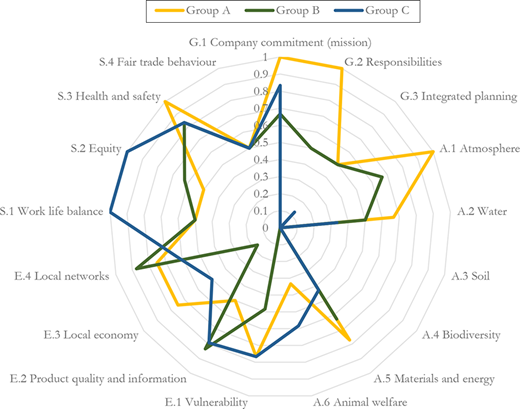
In this section, we discuss the results obtained in the data collection of the three case studies and discuss them through the lenses of the due diligence and the institutional legitimacy theories. With reference to the commentary on indicators, it is also evident that the different case studies analyzed have a highly differentiated ability to provide reporting and potential disclosure. Particularly, Table 5 and Figure 3 display a differentiation that does not refer to the breadth of areas or issues involved in their own reporting and disclosure, but rather the ability to effectively report those dimensions and measure them with indicators. A preliminary analysis of the scores obtained in relation to the level of disclosure across different sustainability dimensions, and reported in Table 5, reveals that companies still tend to prioritize the disclosure of their economic and financial performance. This is followed by a focus on environmental impacts, with a more limited communication regarding governance and social dynamics. Reasoning particularly on the different firm dimensions, it emerges, contrary to previous studies (Fiandrino et al., 2019), that the smallest in size has the best potential sustainability orientation in this regard (Baumgartner and Ebner, 2010). In this multiple-case study it is especially true for medium-sized enterprises compared with the case of the large enterprise. This observation, though limited to the selected case studies and thus lacking external generalizability, further opens up the possibility of applying the model to the many medium-sized enterprises in the context of the meat SC in Italy. A following section has been dedicated to each of the four dimensions involved, while the full list of data and information collected are available in Appendix A, supplementary material for synthesis needs.

The general formalization of the firm’s commitment has been found in all the analyzed firms and it also has been associated with a detailed description of managerial practices that demonstrate this effort. However, the governance also in the SC context must consider the engagement of different categories of stakeholders and with the commitment and endorsement toward sustainability issues at various levels of corporate organization (Demartini et al., 2016; Heikkurinen and Forsman-Hugg, 2011). Within the three firms only Company A has been able to describe and formalize its stakeholder engagement process. Moreover, these themes in this model have been associated with monitoring and evaluating responsibilities as well as with an integrated planning propensity (Adams, 2017). The first one exposes the firm to the external legitimation to operate (Müeller et al., 2009; Spence and Rinaldi, 2014), confirming in this case study a higher transparency of reporting Companies A and B. Additionally, the propensity to evaluate performance periodically is limited to Company A that reported in the previous two years. Particularly noteworthy is how this integrated, goal-oriented approach also occurs in correspondence with cumulative experience from multiple editions of sustainability reports. This consideration ties back to the theoretical model presented in Figure 1, where the integration of sustainability at the core of the strategic formulation process is associated with an improvement in internal performance. It is therefore consistent with expectations that a Company (A) particularly focused on sustainability would be the one most capable of effectively responding to requests for data disclosure and analysis of internal decision-making processes (Asif et al., 2020; Cheng, 2010; Crossley et al., 2021). This helps to understand how well the managerial practices, and the related practice indicators, measure these performance improvements (Bonisoli et al., 2018). Considering the social and environmental dimensions in this holistic thinking, on the cost configuration side, none of them are considering implementing a full costing approach (Antheaume, 2004). This consideration is in line with similar studies on the governance structure of the meat production SC (Fernández-Barcala et al., 2017; Martins et al., 2017). The risk associated with the avoidance of the inclusion of these dimensions at the governance level is the exclusion of mechanisms to protect the unique attributes of the product and organization itself in the long-term (Ghozzi et al., 2016; Van der Merwe et al., 2019). This evidence also supports the literature on the role of corporate governance as an effective enforcement of the overall inside-out transparency, increasing the external stakeholders’ accountability (Bremmers et al., 2007). Moreover, analyzing the propensity for disclosure compared to the governance area, it becomes clear that sustainability disclosure serves as a market legitimization element, although a formal approach to identifying structures and figures in charge is now an accepted awareness (Crossley et al., 2021), particularly if also related to the efficiency of processes (Do et al., 2022). In this sense, and in light of the results obtained, we believe that exogenous pressures such as institutional factors may have a greater impact than endogenous factors in formalizing and systematizing impact assessment for this context (see also Section 5.3 policy contribution).

The environmental dimension has been estimated including all six SAFA themes: atmosphere, water, land, biodiversity, materials and energy and animal welfare (see Appendix A in the supplementary material for full list of subthemes and indicators). In this context differences are observed between the two reporting Companies (A and B) and the company that does not. Accordingly, data on the estimated emissions in the atmosphere were available only for Companies A and B, while for animal welfare only Company C was committed with declared controls upstream in the SC. This also suggests that communication on “green” practices is influenced by the limited perspective that focuses on few material topics for the reporting company (Galli et al., 2023), instead of a multithematic and systematic approach at least on environmental issues (Florindo et al., 2018). On one hand, themes like water, materials and energy use are mapped by all three companies and associated with at least one performance indicator. On the other hand, a confirmation of this limited approach it can be seen in the neglected soils and biodiversity themes that none of the companies are mapping. This consideration is highly relevant for understanding the dynamics within the agri-food sector (e.g. Hübel and Schaltegger, 2022; Kumar et al., 2022). Although the company may potentially impact these areas, it has not voluntarily developed metrics or sustainability management control systems to monitor the broadness and impact of these undisclosed managerial outcomes (e.g. Morioka and Carvalho, 2016a, 2016b). This partial disclosure, limited to abovementioned themes, highlights the constraints and limits of endogenous factors in expanding disclosure beyond current expectations or internal stakeholder, mainly shareholders, requirements. These reflections align with a stream of discussion surrounding “material legitimacy,” as concept that blends strategic legitimacy (what is important to the organization) with institutional legitimacy (the key concerns of its key stakeholders, e.g. Dumay et al., 2015). This approach outlines how companies strive to pursue a higher performance in this transition path to ameliorate the outcomes for the organization itself and their impacted stakeholders (Arvidsson and Dumay, 2022). The challenge, however, lies in determining which issues are deemed “material” and should be disclosed. From this perspective, increasing regulatory pressure for transparency (outside-in) emerges as a viable solution, promoting greater uniformity and consistency in the disclosure of topics. This would enhance the comparability of impacts across the SC, moving closer to the ideal of SC due diligence as theorized in this model. Simultaneously, it clearly indicates two areas where business activities might generate unmeasured impacts, suggesting that only an exogenous regulatory intervention (such as the CSRD) could effectively promote a systematic assessment of these issues, especially in the light of the European Sustainability Reporting Standards (ESRS). Therefore, we believe that greater transparency on these (environmental) issues could be achieved from a transparency perspective through increased regulatory pressure, which is one of the most influential exogenous factors capable of shaping internal reporting processes in food SCs (Alexander et al., 2024; Caputo et al., 2021; Velte, 2023; Ollivier de Leth and Ros-Tonen, 2022). As a final consideration, corporate waste management is addressed both from the perspective of volume reduction (per unit of product) and as an overall quantity of materials sent for recycling. This consideration makes the promotion of a model that advocates an integrated view of the various dimensions and the sensitive and material issues for the sector even more useful (Azadnia et al., 2015; Cagno et al., 2023; Hamad et al., 2023; Maas et al., 2016); this concept also emerged from the context-specific preliminary discussion at the meso (Caccialanza and Torelli, 2024) and micro levels (Galli et al., 2023). In fact, reporting has helped companies to evaluate their management practices more systematically and to identify appropriate performance indicators at least on one theme, as noted in prior studies (Gibassier and Schaltegger, 2015; Harding et al., 2017; Steffen et al., 2015).

The effort on environmentally friendly managerial practices therefore seems justified primarily by the search for internal (economic) efficiency and, secondly, by the opportunity to develop communication and reporting on sustainability issues at both the product and company levels (Thomson, 2020). This leads to the conclusion that those issues not strictly correlated with direct economic impact are under-estimated in the long-term resource allocation and constitute a barrier to the transition to cleaner production systems (Miemczyk et al., 2012). This evidence has been pointed out previously within the context of logistics in short food SCs (Paciarotti and Torregiani, 2021). In this sense both the full costing approach and the sustainability reporting processes may facilitate the assessment of real impacts in this food SC at the level of its different steps (Vachon and Klassen, 2006; Golicic and Smith, 2013).

This dimension is evaluated in terms of the impacts on economic vulnerability, product quality and information and local economy.

Economic vulnerability shows similarities for the overall market stability, as all the companies are influenced by the same structural SC effects. However, variabilities can be found depending on their SC stability and, as direct consequence, on liquidity. These differences enhance the integrated approach to SC and partner stability, with indirect benefits for the other two themes as well. Moreover, they integrate the SC dimension in the mechanism of value and product creation along the SC (Adams, 2017; Negri et al., 2021).

From the point of view of the communication of product quality and information, a large part of the focus is on the definition of more loosely defined targets in the context of actual managerial practices. However, the issue of associating performance indicators with these targets, especially for Companies A and B, remains to be further explored in terms of external stakeholders’ communication. In line, Chekima et al. (2017) have previously discussed the role of product labels as instrumental to disclose and communicate products’ attributes such as differentiation based on quality or premiumness of perceived more sustainable products. Moreover, this disclosure seems to affect consumer loyalty (Fernández-Ferrín et al., 2021). Therefore, we are surprised by the lack of a quantitative approach to this theme, considering its importance. This imbalance, however, on the narrative nature of communicating product quality and promoting sustainability practices at the SC level denotes an informality in the integration of sustainability principles (Baumgartner and Ebner, 2010), even for the Italian context (Caccialanza and Marinoni, 2023; Caccialanza et al., 2023a, 2023b). This logic is also justified by the traditional perception of legitimacy in the market with product quality (Lees et al., 2020; León-Bravo et al., 2019), which in this scenario of transition of production models must necessarily be integrated with a legitimization of demonstrated and disclosed sustainability performance (Crossley et al., 2021; Do et al., 2024; Fellegara et al., 2023).

Local economy is another key element in the evaluation of the valorization of local workforce, local procurement, and the development of networks with universities and research centers. In particular, all the companies have identified targets with reference to the inclusion of a local workforce, and Companies A and C also quantitatively defined their targets and performance indicators. However, surprisingly, none of the companies report on the propensity for local procurement, unlike the literature that positively correlates this dimension with the sustainability orientation (Caccialanza, 2022; Perez et al., 2010).

On the other hand, we confirm the consolidation of relations with research institutes and universities in the promotion and operationalization of models aimed at implementing sustainable product innovations (Boström et al., 2015; Valente et al., 2020). This networking initiative with institutional stakeholders across the SC, including nonsector-specific entities like universities, supports our model’s hypothesis that legitimizing a company’s role within the SC and market is crucial. It positions the company as both a proactive agent in transforming production models and a credible participant in advancing sustainability efforts, as discussed by other scholars in innovative protein sector (Tziva et al., 2021) or meat sector itself (Van der Heijden and Cramer, 2017).

The social dimension in this model includes the discussion of four themes correlated to this dimension, namely: work life balance, equity, health and safety. At first, the work life balance has embraced several practices such as parental leave and initiatives to support maternity but is not yet correlated to performance indicators in terms of increase of salaries in the timespan considered.

Second, a consideration of equity is aimed at disclosing the gender equality policies that in all of the three companies have been formalized in terms of target as well as monitored in terms of specific quantitative performance measures. This, therefore, leads to a reflection on the positive integration of this theme in the sustainable strategic orientation of the case studies analyzed. Moreover, it confirms that sustainability reporting process can play a significant role in advancing gender equality by openly disclosing their organization’s gender-equity practices and by linking them to performance evaluation process (Barrientos, 2023; Miles, 2011) also in this SC.

Workers’ health and safety play a key role both for the hours of training dedicated to worker safety at plants and for the contextual development of process safety-oriented managerial practices and standards (Marshall and Standifird, 2005). Moreover, this theme assumes a reinforced role in the light of the COVID-19 crisis that stressed continuity of both production and processes (Hobbs, 2021). During this period of disruption, which forced the closure of many production activities, the sector had to continue operations under new constraints. These included not only the usual hygiene requirements but also the need for physical distancing on production lines. Simultaneously, the sector faced an emergency in the production process due to a surge in demand from Italian modern grocery distribution, driven by increased domestic consumption of meat and cured meats in lockdown.

The fourth element, fair trade behavior, explicitly is one of the challenges of the meat SC, namely, the downstream SC operators’ support with fair and transparent contracts. This element plays a key enabling role in the reduction of information asymmetries and a greater disclosure to external stakeholders (Theurl et al., 2017). In the light of this consideration, this model proposes a target indicator that has been positively confirmed by all three companies. However, no performance indicators have been implemented in the performance measurement systems, leading to the suspension of the communication transferability of information on the distribution of the value within the SC (Adams, 2017) and the distribution of bargaining power within the categories of stakeholders (Fuchs et al., 2016; Grabs and Ponte, 2019). This consideration becomes even more significant when viewed through the lens of a SC due diligence (outside-in) perspective. In aiming for full transparency in performance measurement processes, this approach seeks to highlight where in the SC the transmission mechanisms of corporate margins may encounter bottlenecks (Asif et al., 2020). These bottlenecks could jeopardize the sustainability of socially and environmentally favorable practices that are essential for transitioning the production model (Bebbington, 2007; Hübel and Schaltegger, 2022). This lack of dissemination of accessible and cost-effective tools makes it even more unlikely that the propensity to “greenhushing” and the analysis of accountability and performance at the SC level will be overcome (Adams and Larrinaga, 2007, 2019). This occurs despite increasing pressure to enhance transparency in production processes and trace the social impacts of production, driven in part by the spread of enabling technologies (Searcy et al., 2022). When applied to practical tools like the one proposed, these technologies can make the collection and preservation of information more accessible while ensuring its integrity is maintained throughout the process (Gaur and Gaiha, 2020).

While the ability to estimate models that establish baselines from a multidimensional and multitier perspective at the SC level is undeniably important (Hofmann et al., 2018; Khalid et al., 2015), this study emphasizes the critical role of abductive and qualitative approaches. By using operational models within traditional production contexts – such as the one analyzed in this paper (Cagno et al., 2023; Hübel and Schaltegger, 2022) – the research contributes to fostering a broader debate on accounting for sustainable development (Bebbington and Larrinaga, 2014; Taïbi et al., 2020). This approach confirms with its results the urgent need for academic intervention research that also aims to provide application and self-assessment tools for the promotion of the transition of production models (Bebbington, 2007). Specifically, we have contributed to the debate within the accounting literature, particularly to respond to this urgent need an accessible and cost-effective tool is provided to diminish the propensity to “greenhushing” and disseminate the sensibility to accountability of impacts and the sustainability performance analysis at the SC level (Adams and Larrinaga, 2007, 2019; Castellini et al., 2012). In doing so, a further development of the application of target-setting logics linked to the material issues at the sectoral level is achieved, in line with prior research on the exogenous and endogenous driving factors that may guide this transition (Caccialanza and Torelli, 2024; Galli et al., 2023). It leverages the theoretical implications of these studies to measure the impacts of these exogenous and endogenous drivers on the accountability of real case studies selected for their differing approaches to sustainability and their propensity for impact disclosure. Consequently, it achieves a higher level of applicability depending on the various contexts, including prior attention to the topic and the medium or large scale of the activities. This higher level of accountability of performances and SC due diligence can also be interpreted across different levels. On one hand, it builds on the drivers of sustainability reporting at the level of individual firms (Galli et al., 2023; Khalid et al., 2015; Schaltegger et al., 2023); on the other, it also engages the mesolevel of the SC (Caccialanza and Torelli, 2024). The SC dimension allows for work not only on the performance of individual actors within the SC using the same self-assessment tool – customized with indicators specific to the farm and transformation phases – but also on fostering the debate around SC due diligence and full transparency in impact disclosure. This aspect has direct implications for internal efficiency-led improvements and the legitimacy of the operations, while the second strengthens the due diligence of SC actors particularly from the perspective of external stakeholders. Furthermore, it operationalizes this self-assessment tool over a multiyear timeframe to promote the idea of performance comparison over time, both against one’s own performance and against a hypothetical industry average, thereby engaging in a process of internal performance improvement. For each of the material themes, context-specific indicators have been identified and associated to specific targets, managerial practices and performance evaluation criteria to foster the debate on sustainability assessment at organizational level (Adams and Larrinaga, 2007, 2019; Lamberton, 2000). Given the theoretical model proposed in Figure 1, future studies may also test or adapt this analysis to other agrifood SC contexts, thus highlighting further differences in the perception of pressure for SC value disclosure and assessment of impacts (Bebbington, 2007; Havardi-Burger et al., 2021; Petit et al., 2018) or notice a different propensity to engage in SC due diligence processes.

This study underscores the need for meat SC stakeholders to analyze the intricate interrelations in terms of impacts, and cooperation at the different tiers of the production process (Hübel and Schaltegger, 2022). These difficulties arise from the fragmentation of operations, resulting in a disjointed condition of both the analysis and propensity to disclosure among actors (Galli et al., 2023; Khalid et al., 2015). Overcoming this “greenhushing” propensity and fostering transformation necessitates extensive cooperation throughout the production chain (Asif et al., 2020; Caccialanza and Torelli, 2024). To do so, we suggest examining the development of a novel sustainability self-assessment instrument grounded in four consolidated dimensions of sustainability (the four areas of the model) through the adaptation of a consolidated existing framework (Gibassier and Schaltegger, 2015). Consequently, on the managerial side this paper reinforces the need for promoting intervention-research initiatives from a SC perspective (Taïbi et al., 2020). Integrating various dimensions related to the strategic sustainability orientation, and using validated self-assessment tools are pivotal for advancing sustainable development in the meat industry (Bebbington and Unerman, 2020; Cagno et al., 2023). Finally, this tool offers valuable support to companies that are or will soon be part of the SCs of large (focal) companies, which, starting in 2024, will be required to report according to the new European standards, the ESRS, due to the implementation of the CSRD. This tool can be particularly beneficial for SMEs in the sector, allowing them to promote conscious and comparable disclosure of their impacts (Baumgartner and Ebner, 2010; Demartini et al., 2016; Golini et al., 2017; Hübel and Schaltegger, 2022; Kumar et al., 2022), even though they are not yet legally bound by these regulations within the European context [see Directive (EU) 2022/2464 or EFRAG IG 2 – Value chain’ (2024) or Sustainability Due Diligence Directive (CSDDD) in 2024].

This study provides policy contribution by presenting an assessment model to better understand the interaction between exogenous and endogenous factors that shape sustainability practices. By highlighting the connection between conflicting regulations, the tendency of actors toward “greenhushing” and the reinforcement of industrial norms, the findings support the development of multilevel initiatives (Cagno et al., 2023; Hofmann et al., 2018) and impactful legislation aimed at promoting the transition of production systems (Fellegara et al., 2023). Policy measures are essential to incentivize sustainable practices, particularly in overcoming the lack of motivation to adopt sustainable production methods and disclose sustainability reporting (Bebbington et al., 2007, 2017, 2019; Dillard, 2015). This aligns with the goals of recent European legislation, such as Directive (EU) 2022/2464, which emphasizes the assessment and disclosure of nonfinancial performance. In this context, the study anticipates key themes of the CSRD by advocating for a broader dissemination of sustainability-related skills and awareness, extending to SMEs. While the CSRD targets larger firms with formalized requirements, SMEs can benefit from a more flexible approach that builds on emerging best practices observed in the selected companies (Adams and Larrinaga, 2019; Chamas et al., 2021; Caccialanza et al., 2023a, 2023b). The study also aligns with the draft implementation guidelines of EFRAG IG 2-Value chain (2023), which emphasize the importance of focusing on various tiers within the SC. This approach seeks to transmit sustainability information across the SC, from production to distribution and ultimately to the end consumer. Recent publications, such as the CSDDD in July 2024 and the VSME guidelines in December 2024, underscore the growing attention on disclosure requirements for SMEs. These developments highlight the increasing role of SMEs in sustainability accountability and SC due diligence processes. Complementing these legislative tools, the validated self-assessment model offers a sector-specific yet customizable instrument. It provides practical applications for a specific product category within a Western European context, further encouraging higher accountability in processes and legitimacy among stakeholders. By addressing sector-specific challenges and aligning with legislative frameworks, this tool helps SMEs navigate sustainability expectations while contributing to a culture of transparency and accountability. Further research could explore the impact of recent legislative developments, such as the CSRD and CSDDD, on the perception of internal efficiency-led and exogenous institutional drivers in shaping sustainability disclosure practices. Additionally, the influence of CSDDD on the perceived pressures for SC due diligence and impact assessments could have long-term effects on the competitiveness of SMEs integrated into the value chains of larger firms subject to these regulations. Understanding these dynamics will be critical for assessing the broader implications of these policies on SME competitiveness and sustainability transitions.

Many industry stakeholders remain unaware of the strategic sustainable positioning of alternatives, such as alternative protein products (Caccialanza et al., 2023a, 2023b). Therefore, intervention-research initiatives that integrate insights from diverse research domains and practical experiences are essential (Taïbi et al., 2019). This integration of knowledge can be beneficial for several categories of stakeholders. In fact, this sustainability integration and assessment of performance empower producers to make informed decisions and embrace more sustainable practices (Asif et al., 2020) and help them in the legitimization process (Cheng, 2010; Crossley et al., 2021). On the consumer side, the historicity and accumulated experience in a sector strongly anchored to the territory and the cultural nature linked to meat consumption make this effort even more urgent (Allievi et al., 2015; Leroy and Praet, 2015). This urgency is further confirmed in the perspective of the emergence of other product categories that wish to position themselves in the market with marked sustainability attributes such as “plant based” (Whelan and Kronthal-Sacco, 2019). More broadly, this self-assessment tool enhances accountability and strengthens SC due diligence processes, fostering stronger connections between producers of traditional products and their local territories while promoting the valorization of local and rare breeds.

Managerial practices and their performance have been proven to play an essential role in the food SC sustainability transition (Fellegara et al., 2023; Hübel and Schaltegger, 2022; Petit et al., 2018; Porter and Kramer, 2011). Consequently, this case study moves the discussion forward within the existing literature on the assessment, reporting and evaluation of the impacts of food production with a multidimensional accounting model perspective (Cagno et al., 2023; Kumar et al., 2022; Rialti et al., 2022). The aim of this study is to contribute to the disclosing of the real impact of managerial practices through the validation of a new self-assessment tool within the context of the Italian meat SCs. This self-assessment tool offers the opportunity to orient producers in the decision-making process to a cleaner production system (Antonini and Larrinaga, 2017; Bebbington et al., 2007). This contribution highlights five main conclusions. The first one identifies the different propensities to measure performance within this production SC, in accordance with prior studies (Caccialanza and Marinoni, 2023; Caccialanza et al., 2023a, 2023b; Fiandrino et al., 2019). Second, it underlines the call for the integration of sustainability principles within the strategic orientation of firms both with an outside-in perspective to the SC transparency and an inside-out perspective on how firms can contribute to the transition to more sustainable production systems (Azadnia et al., 2015; Maas et al., 2016; Schaltegger et al., 2023). The theoretical framework proposed in Figure 1 can be applied across various geographical contexts and explored with different product categories within the agri-food sector or adapted for other production SCs. Third, in this holistic perspective and multidimensional accounting approach, this study concludes that the development of one sustainability dimension (or theme) is not sufficient to fulfill the external stakeholders’ expectations in terms of information asymmetries (Bremmers et al., 2007; Fuchs et al., 2016; Theurl et al., 2017). Fourth, fostering the diffusion of new comparable metrics and indicators in one single tool may lower these information asymmetries and orient the decision-making process to a more systemic approach (Dabkienė, 2016; Ghosh and Shah, 2012; Korca et al., 2023). As a fifth element, this study highlights its anticipatory nature with respect to European guidelines that promote the disclosure of sustainability performance at the micro level (e.g. CSRD or VSME guidelines), as well as transparency and due diligence initiatives at the meso-level within SCs (e.g. CSDDD). Finally, this consideration could be further investigated by an evolution of the present research. A first direction consists of considering whether similar results are identifiable in studies dedicated to the SCs of other food products and, more generally, in the literature on food production. Secondly, the analysis is limited to a single national context, while it seems likely, given the nature of the topic, that further research on the topic may expand its generalizability. Thirdly, the customized tool we propose strengthens internal validity, yet two caveats remain. First, deleting 47 global indicators from the SAFA (FAO) framework improves feasibility but limits comparability with non-EU or crop-based studies. Second, despite triangulation, qualitative evidence still influences governance and social scores more than quantitative metrics, potentially overstating leadership commitment while understating biodiversity pressure when quantitative data are missing. We interpreted the intercompany differences with this asymmetry in mind; nevertheless, future work could test alternative combinations of qualitative and quantitative elements to better balance information needs.

This study was supported by the Doctoral School on the Agro-Food System (Agrisystem) of the Università Cattolica del Sacro Cuore (Italy).

The supplementary material for this article can be found online.

[1.]

For further details see the official ASSICA website: Link to the cited article
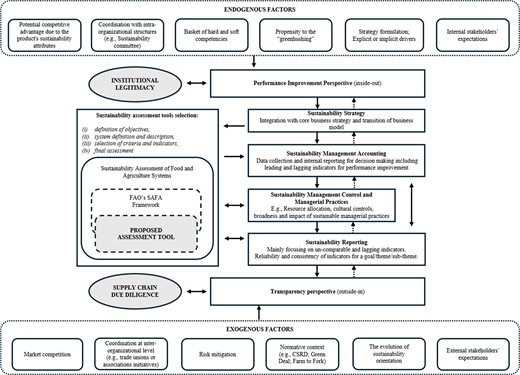
Adams
,
C.A.
(
2017
), “
Conceptualising the contemporary corporate value creation process
”,
Accounting, Auditing and Accountability Journal
, Vol.
30
No.
4
, pp.
906
-
931
, doi: .
Adams
,
C.A.
and
Larrinaga
,
C.
(
2007
), “
Engaging with organisations in pursuit of improved sustainability accounting and performance
”,
Accounting, Auditing and Accountability Journal
, Vol.
20
No.
3
, pp.
333
-
355
.
Adams
,
C.A.
and
Larrinaga
,
C.
(
2019
), “
Progress: engaging with organisations in pursuit of improved sustainability accounting and performance
”,
Accounting, Auditing and Accountability Journal
, Vol.
32
No.
8
, pp.
2367
-
2394
, doi: .
Akaichi
,
F.
,
Glenk
,
K.
and
Revoredo-Giha
,
C.
(
2019
), “
Could animal welfare claims and nutritional information boost the demand for organic meat? Evidence from non-hypothetical experimental auctions
”,
Journal of Cleaner Production
, Vol.
207
, pp.
961
-
970
.
Alexander
,
A.
,
Kumar
,
M.
,
Walker
,
H.
and
Gosling
,
J.
(
2024
), “
Innovation for zero-deforestation sustainable supply chain management services: a performance measurement and management approach
”,
Supply Chain Management: An International Journal
, Vol.
29
No.
3
, pp.
620
-
641
, doi: .
Allegretti
,
G.
,
Talamini
,
E.
,
Schmidt
,
V.
,
Bogorni
,
P.C.
and
Ortega
,
E.
(
2018
), “
Insect as feed: an emergy assessment of insect meal as a sustainable protein source for the Brazilian poultry industry
”,
Journal of Cleaner Production
, Vol.
171
, pp.
403
-
412
.
Allievi
,
F.
,
Vinnari
,
M.
and
Luukkanen
,
J.
(
2015
), “
Meat consumption and production–analysis of efficiency, sufficiency and consistency of global trends
”,
Journal of Cleaner Production
, Vol.
92
, pp.
142
-
151
.
Almiron
,
N.
and
Zoppeddu
,
M.
(
2015
), “
Eating meat and climate change: the media blind spot—A study of spanish and italian press coverage
”,
Environmental Communication
, Vol.
9
No.
3
, pp.
307
-
325
.
Amicarelli
,
V.
,
Rana
,
R.
,
Lombardi
,
M.
and
Bux
,
C.
(
2021
), “
Material flow analysis and sustainability of the italian meat industry
”,
Journal of Cleaner Production
, Vol.
299
, p.
126902
.
Anestis
,
V.
,
Papanastasiou
,
D.K.
,
Bartzanas
,
T.
,
Giannenas
,
I.
,
Skoufos
,
I.
and
Kittas
,
C.
(
2020
), “
Effect of a dietary modification for fattening pigs on the environmental performance of commercial pig production in Greece
”,
Sustainable Production and Consumption
, Vol.
22
, pp.
162
-
176
.
Antheaume
,
N.
(
2004
), “
Valuing external costs–from theory to practice: implications for full cost environmental accounting
”,
European Accounting Review
, Vol.
13
No.
3
, pp.
443
-
464
.
Antonini
,
C.
and
Larrinaga
,
C.
(
2017
), “
Planetary boundaries and sustainability indicators. A survey of corporate reporting boundaries
”,
Sustainable Development
, Vol.
25
No.
2
, pp.
123
-
137
.
Arrigoni
,
A.
,
Marveggio
,
D.
,
Allievi
,
F.
,
Dotelli
,
G.
and
Scaccabarozzi
,
G.
(
2023
), “
Environmental and health-related external costs of meat consumption in Italy: estimations and recommendations through life cycle assessment
”,
Science of the Total Environment
, Vol.
869
.
Arulnathan
,
V.
,
Heidari
,
M.D.
,
Doyon
,
M.
,
Li
,
E.
and
Pelletier
,
N.
(
2020
), “
Farm-level decision support tools: a review of methodological choices and their consistency with principles of sustainability assessment
”,
Journal of Cleaner Production
, Vol.
256
, p.
120410
, doi: .
Arvidsson
,
S.
and
Dumay
,
J.
(
2022
), “
Corporate ESG reporting quantity, quality and performance: where to now for environmental policy and practice?
”,
Business Strategy and the Environment
, Vol.
31
No.
3
, pp.
1091
-
1110
.
Ashby
,
A.
,
Leat
,
M.
and
Hudson-Smith
,
M.
(
2012
), “
Making connections: a review of supply chain management and sustainability literature
”,
Supply Chain Management: An International Journal
, Vol.
17
No.
5
, pp.
497
-
516
, doi: .
Asif
,
M.S.
,
Lau
,
H.
,
Nakandala
,
D.
,
Fan
,
Y.
and
Hurriyet
,
H.
(
2020
), “
Adoption of green supply chain management practices through collaboration approach in developing countries–from literature review to conceptual framework
”,
Journal of Cleaner Production
, Vol.
276
, p.
124191
, doi: .
Azadnia
,
A.H.
,
Saman
,
M.Z.M.
and
Wong
,
K.Y.
(
2015
), “
Sustainable supplier selection and order lot-sizing: an integrated multi-objective decision-making process
”,
International Journal of Production Research
, Vol.
53
No.
2
, pp.
383
-
408
.
Barratt
,
M.
,
Choi
,
T.Y.
and
Li
,
M.
(
2011
), “
Qualitative case studies in operations management: trends, research outcomes, and future research implications
”,
Journal of Operations Management
, Vol.
29
No.
4
, pp.
329
-
342
, doi: .
Barrientos
,
S.
(
2023
), “Gender and corporate social responsibility: beyond compliance in global value chains”,
Research Handbook on International Corporate Social Responsibility
, pp.
408
-
424
.
Edward Elgar Publishing
.
Barter
,
N.
(
2015
), “
Natural capital: dollars and cents/dollars and sense
”,
Sustainability Accounting, Management and Policy Journal
, Vol.
6
No.
3
, pp.
366
-
373
, doi: .
Baumgartner
,
R.J.
and
Ebner
,
D.
(
2010
), “
Corporate sustainability strategies: sustainability profiles and maturity levels
”,
Sustainable Development
, Vol.
18
No.
2
, pp.
76
-
89
.
Bava
,
L.
,
Zucali
,
M.
,
Sandrucci
,
A.
and
Tamburini
,
A.
(
2017
), “
Environmental impact of the typical heavy pig production in Italy
”,
Journal of Cleaner Production
, Vol.
140
, pp.
685
-
691
.
Bebbington
,
J.
(
2007
),
Accounting for Sustainable Development Performance
,
CIMA Publishing, Elsevier
.
Bebbington
,
J.
,
Brown
,
J.
and
Frame
,
B.
(
2007
), “
Accounting technologies and sustainability assessment models
”,
Ecological Economics
, Vol.
61
Nos
2-3
, pp.
224
-
236
.
Bebbington
,
J.
and
Larrinaga
,
C.
(
2014
), “
Accounting and sustainable development: an exploration
”,
Accounting, Organizations and Society
, Vol.
39
No.
6
, pp.
395
-
413
.
Bebbington
,
J.
and
Unerman
,
J.
(
2020
), “
Advancing research into accounting and the UN sustainable development goals
”,
Accounting, Auditing and Accountability Journal
, Vol.
33
No.
7
, pp.
1657
-
1670
.
Bebbington
,
J.
,
Russell
,
S.
and
Thomson
,
I.
(
2017
), “
Accounting and sustainable development: Reflections and propositions
”,
Critical Perspectives on Accounting
, Vol.
48
, pp.
21
-
34
.
Bebbington
,
J.
,
Österblom
,
H.
,
Crona
,
B.
,
Jouffray
,
J.-B.
,
Larrinaga
,
C.
,
Russell
,
S.
and
Scholtens
,
B.
(
2019
), “
Accounting and accountability in the anthropocene
”,
Accounting, Auditing and Accountability Journal
, Vol.
33
No.
1
, pp.
152
-
177
.
Bennett
,
E.A.
and
Grabs
,
J.
(
2024
), “
How can sustainable business models distribute value more equitably in global value chains? Introducing ‘value chain profit sharing’ as an emerging alternative to fair trade, direct trade, or solidarity trade
”,
Business Ethics, the Environment and Responsibility
, Vol.
34
No.
2
, doi: .
Beske
,
P.
and
Seuring
,
S.
(
2014
), “
Putting sustainability into supply chain management
”,
Supply Chain Management: An International Journal
, Vol.
19
No.
3
, pp.
322
-
331
.
Bonisoli
,
L.
,
Galdeano-G′omez
,
E.
,
Piedra-Mu˜noz
,
L.
and
P′erez-Mesa
,
J.C.
(
2019
), “
Benchmarking Agri-food sustainability certifications: evidences from applying SAFA in the ecuadorian banana Agri-system
”,
Journal of Cleaner Production
, Vol.
236
, p.
117579
, doi: .
Bonisoli
,
L.
,
Galdeano-Gomez
,
E.
and
Piedra-Mu∼noz
,
L.
(
2018
), “
Deconstructing criteria and assessment tools to build Agri-sustainability indicators and support farmers’ decision-making process
”,
Journal of Cleaner Production
, Vol.
182
, pp.
1080
-
1094
, doi: .
Boström
,
M.
,
Jönsson
,
A.M.
,
Lockie
,
S.
,
Mol
,
A.P.
and
Oosterveer
,
P.
(
2015
), “
Sustainable and responsible supply chain governance: challenges and opportunities
”,
Journal of Cleaner Production
, Vol.
107
, pp.
1
-
7
.
Bragaglio
,
A.
,
Napolitano
,
F.
,
Pacelli
,
C.
,
Pirlo
,
G.
,
Sabia
,
E.
,
Serrapica
,
F.
and
Braghieri
,
A.
(
2018
), “
Environmental impacts of italian beef production: a comparison between different systems
”,
Journal of Cleaner Production
, Vol.
172
, pp.
4033
-
4043
.
Brandenburg
,
M.
,
Govindan
,
K.
,
Sarkis
,
J.
and
Seuring
,
S.
(
2014
), “
Quantitative models for sustainable supply chain management: developments and directions
”,
European Journal of Operational Research
, Vol.
233
No.
2
, pp.
299
-
312
.
Bremmers
,
H.
,
Omta
,
O.
,
Kemp
,
R.
and
Haverkamp
,
D.J.
(
2007
), “
Do stakeholder groups influence environmental management system development in the dutch Agri-food sector?
”,
Business Strategy and the Environment
, Vol.
16
No.
3
, pp.
214
-
231
.
Butti Al Shamsi
,
K.
,
Compagnoni
,
A.
,
Timpanaro
,
G.
,
Cosentino
,
S.L.
and
Guarnaccia
,
P.
(
2018
), “
A sustainable organic production model for “food sovereignty” in the United Arab Emirates and Sicily-Italy
”,
Sustainability
, Vol.
10
No.
3
, p.
620
.
Caccialanza
,
A.
(
2022
), “Supply chain management and procurement”, in
Brinkmann
R.
(Ed.)
The Palgrave Handbook of Global Sustainability
,
Palgrave Macmillan
,
Cham
, doi: .
Caccialanza
,
A.
and
Marinoni
,
M.A.
(
2023
), “The spread of sustainability reporting in the italian food manufacturing context”, in
Fellegara
,
A.M.
,
Torelli
,
R.
and
Caccialanza
,
A.
(Eds),
Sustainable Transition of Meat Supply Chain: A Transdisciplinary Approach
,
Springer Nature Switzerland AG
: CSR, Sustainability, Ethics and Governance, doi: ,
available at:
Link to the cited article
Caccialanza
,
A.
and
Torelli
,
R.
(
2024
), “
The role of trade associations in promoting corporate sustainability transition and reporting: a case study in the food supply chain
”,
Corporate Social Responsibility and Environmental Management
, Vol.
31
No.
5
, pp.
4469
-
4486
.
Caccialanza
,
A.
,
Cerrato
,
D.
and
Galli
,
D.
(
2023
a), “
Sustainability practices and challenges in the meat supply chain: a systematic literature review
”,
British Food Journal
, Vol.
125
No.
12
, pp.
4470
-
4497
, doi: .
Caccialanza
,
A.
,
Sartori
,
A.
,
Gubelli
,
S.
,
Giannini
,
F.R.
and
Capri
,
E.
(
2023
b), “The sustainability of meat and cured meat supply chain: where are we now?”, in
Fellegara
,
A.M.
,
Torelli
,
R.
and
Caccialanza
,
A.
(Eds),
Sustainable Transition of Meat and Cured Meat Supply Chain
,
Sustainability, Ethics and Governance
,
Springer Nature Switzerland AG: CSR
, pp.
223
-
242
, doi: ,
available at:
Link to the cited article
Cagno
,
E.
,
Negri
,
M.
,
Neri
,
A.
and
Giambone
,
M.
(
2023
), “
One framework to rule them all: an integrated, multi-level and scalable performance measurement framework of sustainability, circular economy and industrial symbiosis
”,
Sustainable Production and Consumption
, Vol.
35
, pp.
55
-
71
.
Cammarata
,
M.
,
Timpanaro
,
G.
and
Scuderi
,
A.
(
2021
), “
Assessing sustainability of organic livestock farming in Sicily: a case study using the Fao Safa framework
”,
Agriculture
, Vol.
11
No.
3
, p.
274
.
Caputo
,
F.
,
Pizzi
,
S.
,
Ligorio
,
L.
and
Leopizzi
,
R.
(
2021
), “
Enhancing environmental information transparency through corporate social responsibility reporting regulation
”,
Business Strategy and the Environment
, Vol.
30
No.
8
, pp.
3470
-
3484
.
Carter
,
C.R.
and
Rogers
,
D.S.
(
2008
), “
A framework of sustainable supply chain management: moving toward new theory
”,
International Journal of Physical Distribution and Logistics Management
, Vol.
38
No.
5
, pp.
360
-
387
.
Castellini
,
C.
,
Boggia
,
A.
,
Cortina
,
C.
,
Dal Bosco
,
A.
,
Paolotti
,
L.
,
Novelli
,
E.
and
Mugnai
,
C.
(
2012
), “
A multicriteria approach for measuring the sustainability of different poultry production systems
”,
Journal of Cleaner Production
, Vol.
37
, pp.
192
-
201
.
Chamas
,
Z.
,
Abou Najm
,
M.
,
Al-Hindi
,
M.
,
Yassine
,
A.
and
Khattar
,
R.
(
2021
), “
Sustainable resource optimization under water-energy-food-carbon nexus
”,
Journal of Cleaner Production
, Vol.
278
, p.
123894
.
Chekima
,
B.
,
Oswald
,
A.I.
,
Wafa
,
S.
and
Chekima
,
K.
(
2017
), “
Narrowing the gap: factors driving organic food consumption
”,
Journal of Cleaner Production
, Vol.
166
, pp.
1438
-
1447
, doi: .
Cheng
,
H.L.
(
2010
), “
Seeking knowledge or gaining legitimacy? Role of social networks on new practice adoption by OEM suppliers
”,
Journal of Business Research
, Vol.
63
No.
8
, pp.
824
-
831
.
Collier
,
E.S.
,
Oberrauter
,
L.M.
,
Normann
,
A.
,
Norman
,
C.
,
Svensson
,
M.
,
Niimi
,
J.
and
Bergman
,
P.
(
2021
), “
Identifying barriers to decreasing meat consumption and increasing acceptance of meat substitutes among swedish consumers
”,
Appetite
, Vol.
167
, p.
105643
.
Correa
,
C.
and
Larrinaga
,
C.
(
2015
), “
Engagement research in social and environmental accounting
”,
Sustainability Accounting, Management and Policy Journal
, Vol.
6
No.
1
, pp.
5
-
28
.
Crossley
,
R.M.
,
Elmagrhi
,
M.H.
and
Ntim
,
C.G.
(
2021
), “
Sustainability and legitimacy theory: the case of sustainable social and environmental practices of small and medium-sized enterprises
”,
Business Strategy and the Environment
, Vol.
30
No.
8
, pp.
3740
-
3762
.
Dabkienė
,
V.
(
2016
), “
The scope of farms sustainability tools based on FADN data. Scientific papers series management
”,
Economic Engineering in Agriculture and Rural Development
, Vol.
16
No.
1
, pp.
121
-
128
.
de Carvalho
,
M.I.
,
Relvas
,
S.
and
Barbosa-Póvoa
,
A.P.
(
2022
), “
A roadmap for sustainability performance assessment in the context of Agri-Food supply chain
”,
Sustainable Production and Consumption
, Vol.
34
, pp.
565
-
585
, doi: .
de Olde
,
E.M.
,
Oudshoorn
,
F.W.
,
Bokkers
,
E.A.
,
Stubsgaard
,
A.
,
Sørensen
,
C.A.
and
De Boer
,
I.J.
(
2016
), “
Assessing the sustainability performance of organic farms in Denmark
”,
Sustainability
, Vol.
8
No.
9
, p.
957
.
de Olde
,
E.M.
,
Bokkers
,
E.A.M.
and
de Boer
,
I.J.M.
(
2017
), “
The choice of the sustainability assessment tool matters: differences in thematic scope and assessment results
”,
Ecological Economics
, Vol.
136
, pp.
77
-
85
, doi: .
Demartini
,
E.
,
Gaviglio
,
A.
and
Bertocchi
,
M.
(
2016
), “
Lessons learned from a process of farm sustainability assessment: Literature review, methodology and governance opportunities
”,
"Rivista di studi sulla sostenibilità”, Franco Angeli, Milano. Permalink
, pp.
129
-
139
,
available at:
Link to the cited article
Demastus
,
J.
and
Landrum
,
N.E.
(
2024
), “
Organizational sustainability schemes align with weak sustainability
”,
Business Strategy and the Environment
, Vol.
33
No.
2
, pp.
707
-
725
, doi: .
Deytieux
,
V.
,
Munier-Jolain
,
N.
and
Caneill
,
J.
(
2016
), “
Assessing the sustainability of cropping systems in single-and multi-site studies. A review of methods
”,
European Journal of Agronomy
, Vol.
72
, pp.
107
-
126
, doi: .
Dillard
,
J.
(
2015
), “
Accountability, social responsibility and sustainability: Accounting for society and the environment
”,
Sustainability Accounting, Management and Policy Journal
, Vol.
6
No.
3
, pp.
439
-
441
, doi: .
Do
,
Q.N.
,
Mishra
,
N.
,
Colicchia
,
C.
,
Creazza
,
A.
and
Ramudhin
,
A.
(
2022
), “
An extended institutional theory perspective on the adoption of circular economy practices: insights from the seafood industry
”,
International Journal of Production Economics
, Vol.
247
, p.
108400
.
Do
,
Q.
,
Mishra
,
N.
,
Correia
,
F.
and
Eldridge
,
S.
(
2024
), “
The role of a boundary object in legitimacy-making strategies for food waste innovation: the perspective of emergent circular supply chains
”,
Supply Chain Management: An International Journal
, Vol.
29
No.
3
, pp.
523
-
539
, doi: .
Dumay
,
J.
,
Frost
,
G.
and
Beck
,
C.
(
2015
), “
Material legitimacy: Blending organisational and stakeholder concerns through non-financial information disclosures
”,
Journal of Accounting and Organizational Change
, Vol.
11
No.
1
, pp.
2
-
23
.
EFRAG IG 2-Value chain
(
2023
), “
Implementation guidelines
”,
available at:
Link to the cited article
Eisenhardt
,
K.M.
(
1989
), “
Building theories from case study research
”,
The Academy of Management Review
, Vol.
14
No.
4
, pp.
532
-
550
.
European Financial Reporting Advisory Group (EFRAG)
(
2024
), “
EFRAG IG 2: value Chain implementation guidance – final version (May 2024)
”,
European Financial Reporting Advisory Group
,
Brussels
,
available at:
Link the cited pdf
FAO
(
2015
),
SAFA - Smallholders App
,
Roma
.
FAO
(
2014
),
Sustainability Assessment of Food and Agriculture Systems
,
Tool, Roma
.
FAO
(
2013a
),
SAFA Guidelines v 3.0
,
Roma
.
FAO
(
2013b
),
Sustainability Assessment of Food and Agricultural System: indicators
,
Roma
.
Fellegara
,
A.M.
,
Torelli
,
R.
and
Caccialanza
,
A.
(Eds) (
2023
),
Sustainable Transition of Meat and Cured Meat Supply Chain: A Transdisciplinary Approach
,
Springer, AG
, p.
282
, doi: .
Fernández-Barcala
,
M.
,
González-Díaz
,
M.
and
Raynaud
,
E.
(
2017
), “
Contrasting the governance of supply chains with and without geographical indications: complementarity between levels
”,
Supply Chain Management: An International Journal
, Vol.
22
No.
4
, pp.
305
-
320
, doi: .
Fernández-Ferrín
,
P.
,
Castro-González
,
S.
and
Bande
,
B.
(
2021
), “
Corporate social responsibility, emotions, and consumer loyalty in the food retail context: Exploring the moderating effect of regional identity
”,
Corporate Social Responsibility and Environmental Management
, Vol.
28
No.
2
, pp.
648
-
666
.
Ferronato
,
G.
,
Corrado
,
S.
,
De Laurentiis
,
V.
and
Sala
,
S.
(
2021
), “
The italian meat production and consumption system assessed combining material flow analysis and life cycle assessment
”,
Journal of Cleaner Production
, Vol.
321
, p.
128705
.
Fiandrino
,
S.
,
Busso
,
D.
and
Vrontis
,
D.
(
2019
), “
Sustainable responsible conduct beyond the boundaries of compliance: lessons from italian listed food and beverage companies
”,
British Food Journal
, Vol.
121
No.
5
, pp.
1035
-
1049
.
Filippi
,
M.
and
Chapdaniel
,
A.
(
2021
), “
Sustainable demand-supply chain: an innovative approach for improving sustainability in agrifood chains
”,
International Food and Agribusiness Management Review
, Vol.
24
No.
2
, pp.
321
-
335
.
Florindo
,
T.J.
,
Florindo
,
G.D.M.
,
Talamini
,
E.
,
da Costa
,
J.S.
,
de Léis
,
C.M.
,
Tang
,
W.Z.
and
Ruviaro
,
C.F.
(
2018
), “
Application of the multiple criteria decision-making (MCDM) approach in the identification of carbon footprint reduction actions in the Brazilian beef production chain
”,
Journal of Cleaner Production
, Vol.
196
, pp.
1379
-
1389
.
Fuchs
,
D.
,
Di Giulio
,
A.
,
Glaab
,
K.
,
Lorek
,
S.
,
Maniates
,
M.
,
Princen
,
T.
and
Røpke
,
I.
(
2016
), “
Power: the missing element in sustainable consumption and absolute reductions research and action
”,
Journal of Cleaner Production
, Vol.
132
, pp.
298
-
307
.
Galli
,
D.
,
Torelli
,
R.
and
Caccialanza
,
A.
(
2023
), “
Sustainability performance and sustainability reporting in SMEs: a love affair or a fight?
”,
Journal of Management and Organization
, Vol.
30
No.
3
, pp.
1
-
26
, doi: .
Gasso
,
V.
,
Oudshoorn
,
F.
,
De Olde
,
E.M.
and
Sørensen
,
C.A.G.
(
2015
), “
Generic sustainability assessment themes and the role of context: the case of Danish maize for German biogas
”,
Ecological Indicators
, Vol.
49
, pp.
143
-
153
.
Gaur
,
V.
and
Gaiha
,
A.
(
2020
), “
Building a transparent supply chain: Blockchain can enhance trust, efficiency, and speed
”,
Harvard Business Review
, Vol.
98
No.
3
, pp.
94
-
103
.
Gaviglio
,
A.
,
Bertocchi
,
M.
and
Demartini
,
E.
(
2017
), “
A tool for the sustainability assessment of farms: selection, adaptation and use of indicators for an Italian case study
”,
Resources
, Vol.
6
No.
4
, p.
60
.
Gayatri
,
S.
,
Gasso-Tortajada
,
V.
and
Vaarst
,
M.
(
2016
), “
Assessing sustainability of smallholder beef cattle farming in Indonesia: a case study using the FAO SAFA framework
”,
Journal of Sustainable Development
, Vol.
9
No.
3
, pp.
236
-
247
, doi: .
Ghisellini
,
P.
,
Cialani
,
C.
and
Ulgiati
,
S.
(
2016
), “
A review on circular economy: the expected transition to a balanced interplay of environmental and economic systems
”,
Journal of Cleaner Production
, Vol.
114
, pp.
11
-
32
.
Ghosh
,
D.
and
Shah
,
J.
(
2012
), “
A comparative analysis of greening policies across supply chain structures
”,
International Journal of Production Economics
, Vol.
135
No.
2
, pp.
568
-
583
.
Ghozzi
,
H.
,
Soregaroli
,
C.
,
Boccaletti
,
S.
and
Sauvée
,
L.
(
2016
), “
Impacts of non-GMO standards on poultry supply chain governance: transaction cost approach vs resource-based view
”,
Supply Chain Management: An International Journal
, Vol.
21
No.
6
, pp.
743
-
758
, doi: .
Gibassier
,
D.
and
Schaltegger
,
S.
(
2015
), “
Carbon management accounting and reporting in practice: a case study on converging emergent approaches
”,
Sustainability Accounting, Management and Policy Journal
, Vol.
6
No.
3
, pp.
340
-
365
, doi: .
Gold
,
S.
,
Seuring
,
S.
and
Beske
,
P.
(
2010
), “
The constructs of sustainable supply chain management–a content analysis based on published case studies
”,
Progress in Industrial Ecology, an International Journal
, Vol.
7
No.
2
, pp.
114
-
137
.
Golicic
,
S.L.
and
Smith
,
C.D.
(
2013
), “
A meta-analysis of environmentally sustainable supply chain management practices and firm performance
”,
Journal of Supply Chain Management
, Vol.
49
No.
2
, pp.
78
-
95
.
Golini
,
R.
,
Moretto
,
A.
,
Caniato
,
F.
,
Caridi
,
M.
and
Kalchschmidt
,
M.
(
2017
), “
Developing sustainability in the italian meat supply chain: an empirical investigation
”,
International Journal of Production Research
, Vol.
55
No.
4
, pp.
1183
-
1209
.
Grabs
,
J.
and
Carodenuto
,
S.L.
(
2021
), “
Traders as sustainability governance actors in global food supply chains: a research agenda
”,
Business Strategy and the Environment
, Vol.
30
No.
2
, pp.
1314
-
1332
, doi: .
Grabs
,
J.
and
Ponte
,
S.
(
2019
), “
The evolution of power in the global coffee value chain and production network
”,
Journal of Economic Geography
, Vol.
19
No.
4
, pp.
803
-
828
, doi: .
Grabs
,
J.
,
Carodenuto
,
S.
,
Jespersen
,
K.
,
Adams
,
M.A.
,
Camacho
,
M.A.
,
Celi
,
G.
,[…] and
Stone
,
E.
(
2024
), “
The role of midstream actors in advancing the sustainability of Agri-food supply chains
”,
Nature Sustainability
, Vol.
7
No.
5
, pp.
527
-
535
, doi: .
Gracia
,
A.
,
de Magistris
,
T.
and
Albisu
,
L.M.
(
2011
), “
Supply chain relationships and SME firms’ competitiveness in the spanish pig-to-cured ham chain
”,
Journal of International Food and Agribusiness Marketing
, Vol.
23
No.
3
, pp.
192
-
210
.
Gwiriri
,
L.C.
,
Bennett
,
J.
,
Mapiye
,
C.
,
Marandure
,
T.
and
Burbi
,
S.
(
2019
), “
Constraints to the sustainability of a ‘systematised’ approach to livestock marketing amongst smallholder cattle producers in South Africa
”,
International Journal of Agricultural Sustainability
, Vol.
17
No.
2
, pp.
189
-
204
.
Hamad
,
S.
,
Lai
,
F.W.
,
Shad
,
M.K.
,
Khatib
,
S.F.A.
and
Ali
,
S.E.A.
(
2023
), “
Assessing the implementation of sustainable development goals: does integrated reporting matter?
”,
Sustainability Accounting, Management and Policy Journal
, Vol.
14
No.
1
, pp.
49
-
74
, doi: .
Harding
,
G.
,
Courtney
,
C.
and
Russo
,
V.
(
2017
), “
When geography matters. A location-adjusted blue water footprint of commercial beef in South Africa
”,
Journal of Cleaner Production
, Vol.
151
, pp.
494
-
508
.
Hassini
,
E.
,
Surti
,
C.
and
Searcy
,
C.
(
2012
), “
A literature review and a case study of sustainable supply chains with a focus on metrics
”,
International Journal of Production Economics
, Vol.
140
No.
1
, pp.
69
-
82
.
Havardi-Burger
,
N.
,
Mempel
,
H.
and
Bitsch
,
V.
(
2021
), “
Framework for sustainability assessment of the value chain of flowering potted plants for the German market
”,
Journal of Cleaner Production
, Vol.
329
, p.
129684
.
Heikkurinen
,
P.
and
Forsman-Hugg
,
S.
(
2011
), “
Strategic corporate responsibility in the food chain
”,
Corporate Social Responsibility and Environmental Management
, Vol.
18
No.
5
, pp.
306
-
316
.
Hens
,
L.
,
Block
,
C.
,
Cabello-Eras
,
J.J.
,
Sagastume-Gutierez
,
A.
,
Garcia-Lorenzo
,
D.
,
Chamorro
,
C.
,
Herrera Mendoza
,
K.
,
Haeseldonckx
,
D.
and
Vandecasteele
,
C.
(
2018
), “
On the evolution of “cleaner production” as a concept and a practice
”,
Journal of Cleaner Production
, Vol.
172
, pp.
3323
-
3333
, doi: .
Hobbs
,
J.E.
(
2021
), “
The covid-19 pandemic and meat supply chains
”,
Meat Science
, Vol.
181
.
Hoek
,
A.C.
,
Malekpour
,
S.
,
Raven
,
R.
,
Court
,
E.
and
Byrne
,
E.
(
2021
), “
Towards environmentally sustainable food systems: decision-making factors in sustainable food production and consumption
”,
Sustainable Production and Consumption
, Vol.
26
, pp.
610
-
626
.
Hofmann
,
H.
,
Schleper
,
M.C.
and
Blome
,
C.
(
2018
), “
Conflict minerals and supply chain due diligence: an exploratory study of multi-tier supply chains
”,
Journal of Business Ethics
, Vol.
147
No.
1
, pp.
115
-
141
.
Hřebíček
,
J.
,
Soukopová
,
J.
,
Štencl
,
M.
and
Trenz
,
O.
(
2013
), “
Corporate key performance indicators for environmental management and reporting in the Czech Republic
”,
Procedia Social and Behavioral Sciences
, Vol.
81
, pp.
543
-
552
.
Hübel
,
C.
and
Schaltegger
,
S.
(
2022
), “
Barriers to a sustainability transformation of meat production practices-An industry actor perspective
”,
Sustainable Production and Consumption
, Vol.
29
, pp.
128
-
140
.
Ingrao
,
C.
,
Bacenetti
,
J.
,
Bezama
,
A.
,
Blok
,
V.
,
Geldermann
,
J.
,
Goglio
,
P.
,[…] and
Huisingh
,
D.
(
2016
), “
Agricultural and Forest biomass for food, materials and energy: bio-economy as the cornerstone to cleaner production and more sustainable consumption patterns for accelerating the transition towards equitable, sustainable, post fossil-carbon societies
”,
Journal of Cleaner Production
, Vol.
117
, pp.
4
-
6
.
Jansson
,
J.
,
Nilsson
,
J.
,
Modig
,
F.
and
Hed Vall
,
G.
(
2017
), “
Commitment to sustainability in small and medium-sized enterprises: the influence of strategic orientations and management values
”,
Business Strategy and the Environment
, Vol.
26
No.
1
, pp.
69
-
83
.
Kamble
,
S.S.
,
Gunasekaran
,
A.
and
Gawankar
,
S.A.
(
2020
), “
Achieving sustainable performance in a data-driven agriculture supply chain: a review for research and applications
”,
International Journal of Production Economics
, Vol.
219
, pp.
179
-
194
, doi: .
Kassem
,
E.
,
Trenz
,
O.
,
Hřebíček
,
J.
and
Faldík
,
O.
(
2017
), “
Sustainability assessment and reporting in agriculture sector
”,
Acta Universitatis Agriculturae et Silviculturae Mendelianae Brunensis
, Vol.
65
No.
4
, pp.
1359
-
1369
.
Kaur
,
H.
and
Garg
,
P.
(
2019
), “
Urban sustainability assessment tools: a review
”,
Journal of Cleaner Production
, Vol.
210
, pp.
146
-
158
.
Ketokivi
,
M.
and
Choi
,
T.
(
2014
), “
Renaissance of case research as a scientific method
”,
Journal of Operations Management
, Vol.
32
No.
5
, pp.
232
-
240
, doi: .
Khalid
,
R.U.
,
Seuring
,
S.
,
Beske
,
P.
,
Land
,
A.
,
Yawar
,
S.A.
and
Wagner
,
R.
(
2015
), “
Putting sustainable supply chain management into base of the pyramid research
”,
Supply Chain Management: An International Journal
, Vol.
20
No.
6
, pp.
681
-
696
.
Knudsen
,
M.T.
,
Yu-Hui
,
Q.
,
Yan
,
L.
and
Halberg
,
N.
(
2010
), “
Environmental assessment of organic soybean (Glycine max.) imported from China to Denmark: a case study
”,
Journal of Cleaner Production
, Vol.
18
No.
14
, pp.
1431
-
1439
.
Korca
,
B.
,
Costa
,
E.
and
Bouten
,
L.
(
2023
), “
Disentangling the concept of comparability in sustainability reporting
”,
Sustainability Accounting, Management and Policy Journal
, Vol.
14
No.
4
, pp.
815
-
851
, doi: .
Kumar
,
P.
,
Abubakar
,
A.A.
,
Verma
,
A.K.
,
Umaraw
,
P.
,
Adewale Ahmed
,
M.
,
Mehta
,
N.
,
Hayat
,
M.N.
,
Kaka
,
U.
and
Sazili
,
A.Q.
(
2022
), “
New insights in improving sustainability in meat production: opportunities and challenges
”,
Critical Reviews in Food Science and Nutrition
, Vol.
63
No.
33
, pp.
1
-
29
, doi: .
Lamberton
,
G.
(
2000
), “
Accounting for sustainable development – a case study of city farm
”,
Critical Perspectives on Accounting
, Vol.
11
No.
5
, pp.
583
-
605
.
Landert
,
J.
,
Schader
,
C.
,
Moschitz
,
H.
and
Stolze
,
M.
(
2017
), “
A holistic sustainability assessment method for urban food system governance
”,
Sustainability
, Vol.
9
No.
4
, p.
490
.
Lees
,
N.
,
Nuthall
,
P.
and
Wilson
,
M.M.
(
2020
), “
Relationship quality and supplier performance in food supply chains
”,
International Food and Agribusiness Management Review
, Vol.
23
No.
3
, pp.
425
-
445
.
León Bravo
,
V.
,
Moretto
,
A.
and
Caniato
,
F.
(
2021
), “
A roadmap for sustainability assessment in the food supply chain
”,
British Food Journal
, Vol.
123
No.
13
, pp.
199
-
220
.
León-Bravo
,
V.
,
Moretto
,
A.
,
Cagliano
,
R.
and
Caniato
,
F.
(
2019
), “
Innovation for sustainable development in the food industry: Retro and forward-looking innovation approaches to improve quality and healthiness
”,
Corporate Social Responsibility and Environmental Management
, Vol.
26
No.
5
, pp.
1049
-
1062
.
Leone
,
L.
(
2021
),
La tutela della biodiversità animale in agricoltura
,
Giuffrè Francis Lefebvre
.
Leroy
,
F.
and
Praet
,
I.
(
2015
), “
Meat traditions. The co-evolution of humans and meat
”,
Appetite
, Vol.
90
, pp.
200
-
211
.
McElroy
,
M.W.
and
Thomas
,
M.P.
(
2015
), “
The MultiCapital scorecard
”,
Sustainability Accounting, Management and Policy Journal
, Vol.
6
No.
3
, pp.
425
-
438
, doi: .
McMichael
,
A.J.
,
Powles
,
J.W.
,
Butler
,
C.D.
and
Uauy
,
R.
(
2007
), “
Food, livestock production, energy, climate change, and health
”,
The Lancet
, Vol.
370
No.
9594
, pp.
1253
-
1263
.
Maas
,
K.
,
Schaltegger
,
S.
and
Crutzen
,
N.
(
2016
), “
Integrating corporate sustainability assessment, management accounting, control, and reporting
”,
Journal of Cleaner Production
, Vol.
136
, pp.
237
-
248
.
Marchini
,
P.L.
,
Tibiletti
,
V.
,
Fellegara
,
A.M.
and
Mazza
,
T.
(
2023
), “
Pursuing a strategy of ‘common benefit’in business: the adoption of the benefit corporation model in Italy
”,
Business Strategy and the Environment
, Vol.
32
No.
4
, pp.
1481
-
1503
.
Marshall
,
R.S.
and
Standifird
,
S.S.
(
2005
), “
Organizational resource bundles and institutional change in the US organic food and agricultural certification sector
”,
Organization and Environment
, Vol.
18
No.
3
, pp.
265
-
286
.
Martinelli
,
G.
,
Vogel
,
E.
,
Decian
,
M.
,
Farinha
,
M.J.U.S.
,
Bernardo
,
L.V.M.
,
Borges
,
J.A.R.
and
Ruviaro
,
C.F.
(
2020
), “
Assessing the eco-efficiency of different poultry production systems: an approach using life cycle assessment and economic value added
”,
Sustainable Production and Consumption
, Vol.
24
, pp.
181
-
193
.
Martins
,
F.M.
,
Trienekens
,
J.
and
Omta
,
O.
(
2017
), “
Governance structures and coordination mechanisms in the Brazilian pork chain–diversity of arrangements to support the supply of piglets
”,
International Food and Agribusiness Management Review
, Vol.
20
No.
4
, pp.
511
-
532
.
Miemczyk
,
J.
,
Johnson
,
T.E.
and
Macquet
,
M.
(
2012
), “
Sustainable purchasing and supply management: a structured literature review of definitions and measures at the dyad, chain and network levels
”,
Supply Chain Management: An International Journal
, Vol.
17
No.
5
, pp.
478
-
496
.
Miles
,
K.
(
2011
), “
Embedding gender in sustainability reports
”,
Sustainability Accounting, Management and Policy Journal
, Vol.
2
No.
1
, pp.
139
-
146
.
Morioka
,
S.N.
and
Carvalho
,
M.M.
(
2016
a), “
Measuring sustainability in practice: exploring the inclusion of sustainability into corporate performance systems in Brazilian case studies
”,
Journal of Cleaner Production
, Vol.
136
, pp.
123
-
133
, doi: .
Morioka
,
S.N.
and
Carvalho
,
M.M.
(
2016
b), “
A systematic literature review towards a conceptual framework for integrating sustainability performance into business
”,
Journal of Cleaner Production
, Vol.
136
, pp.
134
-
146
, doi: .
Müeller
,
M.
,
Gomes dos Santos
,
V.
and
Seuring
,
S.
(
2009
), “
The contribution of environmental and social standards towards ensuring legitimacy in supply chain governance
”,
Journal of Business Ethics
, Vol.
89
No.
4
, pp.
509
-
523
.
Negri
,
M.
,
Cagno
,
E.
,
Colicchia
,
C.
and
Sarkis
,
J.
(
2021
), “
Integrating sustainability and resilience in the supply chain: a systematic literature review and a research agenda
”,
Business Strategy and the Environment
, Vol.
30
No.
7
, pp.
2858
-
2886
.
Neo
,
H.
and
Emel
,
J.
(
2017
),
Geographies of Meat: Politics
,
Economy and Culture
,
Routledge, London
.
Nguyen
,
H.L.
and
Kanbach
,
D.K.
(
2024
), “
Toward a view of integrating corporate sustainability into strategy: a systematic literature review
”,
Corporate Social Responsibility and Environmental Management
, Vol.
31
No.
2
, pp.
962
-
976
.
Nguyen
,
T.L.T.
,
Hermansen
,
J.E.
and
Mogensen
,
L.
(
2012
), “
Environmental costs of meat production: the case of typical EU pork production
”,
Journal of Cleaner Production
, Vol.
28
, pp.
168
-
176
.
Ollivier de Leth
,
D.
and
Ros-Tonen
,
M.A.
(
2022
), “
Creating shared value through an inclusive development lens: a case study of a CSV strategy in ghana’s cocoa sector
”,
Journal of Business Ethics
, Vol.
178
No.
2
, pp.
339
-
354
.
Paciarotti
,
C.
and
Torregiani
,
F.
(
2021
), “
The logistics of the short food supply chain: a literature review
”,
Sustainable Production and Consumption
, Vol.
26
, pp.
428
-
442
.
Perez
,
C.
,
de Castro
,
R.
,
Simons
,
D.
and
Gimenez
,
G.
(
2010
), “
Development of lean supply chains: a case study of the catalan pork sector
”,
Supply Chain Management: An International Journal
, Vol.
15
No.
1
, pp.
55
-
68
, doi: .
Pérez
,
I.A.V.
,
Toral
,
J.N.
,
Vázquez
,
Á.T.P.
,
Hernández
,
F.G.
,
Ferrer
,
G.J.
and
Cano
,
D.G.
(
2019
), “
Potential for organic conversion and energy efficiency of conventional livestock production in a humid tropical region of Mexico
”,
Journal of Cleaner Production
, Vol.
241
, p.
118354
.
Pérez-Lombardini
,
F.
,
Mancera
,
K. F.
,
Suzán
,
G.
,
Campo
,
J.
,
Solorio
,
J.
and
Galindo
,
F.
(
2021
), “
Assessing sustainability in cattle silvopastoral systems in the Mexican tropics using the SAFA framework
”,
Animals
, Vol.
11
No.
1
, p.
109
.
Persson
,
L.
,
Carney Almroth
,
B.M.
,
Collins
,
C.D.
,
Cornell
,
S.
,
De Wit
,
C.A.
,
Diamond
,
M.L.
,… and
Hauschild
,
M.Z.
(
2022
), “
Outside the safe operating space of the planetary boundary for novel entities
”,
Environmental Science and Technology
, Vol.
56
No.
3
, pp.
1510
-
1521
.
Petit
,
G.
,
Sablayrolles
,
C.
and
Yannou-Le Bris
,
G.
(
2018
), “
Combining eco-social and environmental indicators to assess the sustainability performance of a food value chain: a case study
”,
Journal of Cleaner Production
, Vol.
191
, pp.
135
-
143
.
Porter
,
M.E.
and
Kramer
,
M.R.
(
2011
), “
Creating shared value. How to Re-invent capitalism – and unleash a wave of innovation and growth
”,
Harvard Business Review
, Vol.
89
No.
1
, pp.
62
-
77
.
Reisch
,
L.A.
,
Sunstein
,
C.R.
,
Andor
,
M.A.
,
Doebbe
,
F.C.
,
Meier
,
J.
and
Haddaway
,
N.R.
(
2021
), “
Mitigating climate change via food consumption and food waste: a systematic map of behavioral interventions
”,
Journal of Cleaner Production
, Vol.
279
, p.
123717
.
Rendtorff
,
J.D.
(
2025
), “Stakeholder management and relational economics. Towards just and sustainable business practices”,
Advances in Relational Economics: Theoretical, Methodological, Philosophical and Empirical Foundations
,
Springer Nature Switzerland
,
Cham
, pp.
95
-
117
, doi: .
Rendtorff
,
J.D.
(
2020
), “The concept of business legitimacy: learnings from suchman”, in
Rendtorff
,
J.D.
(Ed.)
Handbook of Business Legitimacy
,
Springer
,
Cham
, doi: .
Rendtorff
,
J.D.
,
Belser
,
L.
and
Schwengber
,
J.G.
(Eds) (
2024
),
Advances in Relational Economics. Theoretical, Methodological, Philosophical and Empirical Foundations
,
Springer. Relational Economics and Organization Governance
, doi: .
Rialti
,
R.
,
Marrucci
,
A.
,
Zollo
,
L.
and
Ciappei
,
C.
(
2022
), “
Digital technologies, sustainable open innovation and shared value creation: evidence from an Italian agritech business
”,
British Food Journal
, Vol.
124
No.
6
, pp.
1838
-
1856
, doi: .
Rockström
,
J.
,
Steffen
,
W.
,
Noone
,
K.
,
Persson
,
Å.
,
Chapin
,
F.S.
, III
,
Lambin
,
E.
,
Lenton
,
T.M.
,
Scheffer
,
M.
,
Folke
,
C.
,
Schellnhuber
,
H.
,
Nykvist
,
B.
,
De Wit
,
C.A.
,
Hughes
,
T.
,
van der Leeuw
,
S.
,
Rodhe
,
H.
,
Sörlin
,
S.
,
Snyder
,
P.K.
,
Costanza
,
R.
,
Svedin
,
U.
,
Falkenmark
,
M.
,
Karlberg
,
L.
,
Corell
,
R.W.
,
Fabry
,
V.J.
,
Hansen
,
J.
,
Walker
,
B.
,
Liverman
,
D.
,
Richardson
,
K.
,
Crutzen
,
P.
and
Foley
,
J.
(
2009
), “
Planetary boundaries: exploring the safe operating space for humanity
”,
Ecology and Society
, Vol.
14
No.
2
, p.
32
.
Rockström
,
J.
,
Gupta
,
J.
,
Lenton
,
T.M.
,
Qin
,
D.
,
Lade
,
S.J.
,
Abrams
,
J.F.
, et al. (
2021
), “
Identifying a safe and just corridor for people and the planet
”,
Earth’s Future
, Vol.
9
No.
4
, p.
e2020EF001866
.
Romi
,
A.
,
Cook
,
K.A.
and
Dixon-Fowler
,
H.R.
(
2018
), “
The influence of social responsibility on employee productivity and sales growth: evidence from certified B corps
”,
Sustainability Accounting, Management and Policy Journal
, Vol.
9
No.
4
, pp.
392
-
421
, doi: .
Rotter
,
J.P.
,
Airike
,
P.E.
and
Mark-Herbert
,
C.
(
2014
), “
Exploring political corporate social responsibility in global supply chains
”,
Journal of Business Ethics
, Vol.
125
No.
4
, pp.
581
-
599
.
Ruviaro
,
C.F.
,
de Léis
,
C.M.
,
Lampert
,
V.D.N.
,
Barcellos
,
J.O.J.
and
Dewes
,
H.
(
2015
), “
Carbon footprint in different beef production systems on a Southern Brazilian farm: a case study
”,
Journal of Cleaner Production
, Vol.
96
, pp.
435
-
443
.
Sala
,
S.
,
Ciuffo
,
B.
and
Nijkamp
,
P.
(
2015
), “
A systemic framework for sustainability assessment
”,
Ecological Economics
, Vol.
119
, pp.
314
-
325
, doi: .
Sarkis
,
J.
,
Zhu
,
Q.
and
Lai
,
K.
(
2011
), “
An organizational theoretic review of green supply chain management literature
”,
International Journal of Production Economics
, Vol.
130
No.
1
, pp.
1
-
15
.
Schader
,
C.
,
Grenz
,
J.
,
Meier
,
M.S.
and
Stolze
,
M.
(
2014
), “
Scope and precision of sustainability assessment approaches to food systems
”,
Ecology and Society
, Vol.
19
No.
3
,
42
.
Schaltegger
,
S.
,
Loorbach
,
D.
and
Hörisch
,
J.
(
2023
), “
Managing entrepreneurial and corporate contributions to sustainability transitions
”,
Business Strategy and the Environment
, Vol.
32
No.
2
, pp.
891
-
902
.
Schoeneborn
,
D.
,
Morsing
,
M.
and
Crane
,
A.
(
2020
), “
Formative perspectives on the relation between CSR communication and CSR practices: pathways for walking, talking, and T(w)alking
”,
Business and Society
, Vol.
59
No.
1
, pp.
5
-
33
.
Searcy
,
C.
,
Castka
,
P.
,
Mohr
,
J.
and
Fischer
,
S.
(
2022
), “
Transformational transparency in supply chains: leveraging technology to drive radical change
”,
California Management Review
, Vol.
65
No.
1
, pp.
19
-
43
.
Seuring
,
S.
and
Müller
,
M.
(
2008
), “
From a literature review to a conceptual framework for sustainable supply chain management
”,
Journal of Cleaner Production
, Vol.
16
No.
15
, pp.
1699
-
1710
, doi: .
Silva
,
S.
(
2021
), “
Corporate contributions to the sustainable development goals: an empirical analysis informed by legitimacy theory
”,
Journal of Cleaner Production
, Vol.
292
, p.
125962
.
Singh
,
R.K.
,
Murty
,
H.R.
,
Gupta
,
S.K.
and
Dikshit
,
A.K.
(
2009
), “
An overview of sustainability assessment methodologies
”,
Ecological Indicators
, Vol.
9
No.
2
, pp.
189
-
212
.
Smith
,
P.
and
Gregory
,
P.J.
(
2013
), “
Climate change and sustainable food production
”,
Proceedings of the Nutrition Society
, Vol.
72
No.
1
, pp.
21
-
28
.
Soldi
,
A.
,
Meza
,
M.J.A.
,
Guareschi
,
M.
,
Donati
,
M.
and
Insfrán Ortiz
,
A.
(
2019
), “
Sustainability assessment of agricultural systems in Paraguay: a comparative study using FAO’s SAFA framework
”,
Sustainability
, Vol.
11
No.
13
, p.
3745
.
Spence
,
L.J.
and
Rinaldi
,
L.
(
2014
), “
Governmentality in accounting and accountability: a case study of embedding sustainability in a supply chain
”,
Accounting, Organizations and Society
, Vol.
39
No.
6
, pp.
433
-
452
.
Ssebunya
,
B.R.
,
Schmid
,
E.
,
Van Asten
,
P.
,
Schader
,
C.
,
Altenbuchner
,
C.
and
Stolze
,
M.
(
2016
), “
Stakeholder engagement in prioritizing sustainability assessment themes for smallholder coffee production in Uganda
”,
Renewable Agriculture and Food Systems
, Vol.
31
No.
5
, pp.
428
-
446
.
Steffen
,
W.
,
Richardson
,
K.
,
Rockström
,
J.
,
Cornell
,
S.E.
,
Fetzer
,
I.
,
Bennett
,
E.M.
,
Biggs
,
R.
,
Carpenter
,
S.R.
,
de Vries
,
W.
,
de Wit
,
C.A.
,
Folke
,
C.
,
Gerten
,
D.
,
Heinke
,
J.
,
Mace
,
G.M.
,
Persson
,
L.M.
,
Ramanathan
,
V.
,
Reyers
,
B.
and
Sörlin
,
S.
(
2015
), “
Planetary boundaries : guiding human development on a changing planet
”,
Science
, Vol.
347
No.
6223
, p.
1259855
.
Stindt
,
D.
(
2017
), “
A generic planning approach for sustainable supply chain management-How to integrate concepts and methods to address the issues of sustainability?
”,
Journal of Cleaner Production
, Vol.
153
, pp.
146
-
163
.
Taïbi
,
S.
,
Antheaume
,
N.
and
Gibassier
,
D.
(
2020
), “
Accounting for strong sustainability: an intervention-research based approach
”,
Sustainability Accounting, Management and Policy Journal
, Vol.
11
No.
7
, pp.
1213
-
1243
.
Taylor
,
D.H.
(
2005
), “
Value chain analysis: an approach to supply chain improvement in agri-food chains
”,
International Journal of Physical Distribution and Logistics Management
, Vol.
35
No.
10
, pp.
744
-
761
.
Taylor
,
D.H.
(
2006
), “
Strategic considerations in the development of lean Agri-food supply chains: a case study of the UK pork sector
”,
Supply Chain Management: An International Journal
, Vol.
11
No.
3
, pp.
271
-
280
, doi: .
Tchonkouang
,
R.D.
,
Onyeaka
,
H.
and
Nkoutchou
,
H.
(
2024
), “
Assessing the vulnerability of food supply chains to climate change-induced disruptions
”,
Science of the Total Environment
, Vol.
920
, p.
171047
, doi: .
Theurl
,
M.C.
,
Hörtenhuber
,
S.J.
,
Lindenthal
,
T.
and
Palme
,
W.
(
2017
), “
Unheated soil-grown winter vegetables in Austria: greenhouse gas emissions and socio-economic factors of diffusion potential
”,
Journal of Cleaner Production
, Vol.
151
, pp.
134
-
144
, doi: .
Thomson
,
I.
(
2020
), “Designing environmental impact-valuation assemblages for sustainable decision- making”,
Routledge Handbook of Environmental Accounting
, in
Bebbington
,
J.
(Eds),
Carlos Larrinaga, Brendan O’Dwyer and Ian Thomson. Routledge
.
Tröster
,
R.
and
Hiete
,
M.
(
2018
), “
Success of voluntary sustainability certification schemes–A comprehensive review
”,
Journal of Cleaner Production
, Vol.
196
, pp.
1034
-
1043
.
Tziva
,
M.
,
Negro
,
S.O.
,
Kalfagianni
,
A.
and
Hekkert
,
M.P.
(
2021
), “
Alliances as system builders: on the conditions of network formation and system building in sustainability transitions
”,
Journal of Cleaner Production
, Vol.
318
, p.
128616
.
Unerman
,
J.
,
Bebbington
,
J.
and
O’Dwyer
,
B.
(
2018
), “
Corporate reporting and accounting for externalities
”,
Accounting and Business Research
, Vol.
48
No.
5
, pp.
497
-
522
.
Vachon
,
S.
and
Klassen
,
R.D.
(
2006
), “
Extending green practices across the supply chain. The impact of upstream and downstream integration
”,
International Journal of Operations and Production Management
, Vol.
26
No.
7
, pp.
795
-
821
.
Valente
,
C.
,
Møller
,
H.
,
Johnsen
,
F.M.
,
Saxegård
,
S.
,
Brunsdon
,
E.R.
and
Alvseike
,
O.A.
(
2020
), “
Life cycle sustainability assessment of a novel slaughter concept
”,
Journal of Cleaner Production
, Vol.
272
, p.
122651
.
van Cauwenbergh
,
N.
,
Biala
,
K.
,
Bielders
,
C.
,
Brouckaert
,
V.
,
Franchois
,
L.
,
Garcia Cidad
,
V.
,
Hermy
,
M.
,
Mathijs
,
E.
,
Muys
,
B.
,
Reijnders
,
J.
,
Sauvenier
,
X.
,
Valckx
,
J.
,
Vanclooster
,
M.
,
van der Veken
,
B.
,
Wauters
,
E.
and
Peeters
,
A.
(
2007
), “
SAFE—a hierarchical framework for assessing the sustainability of agricultural systems
”,
Agriculture, Ecosystems and Environment
, Vol.
120
Nos
2-4
, pp.
229
-
242
, doi: .
Van der Heijden
,
A.
and
Cramer
,
J.M.
(
2017
), “
Change agents and sustainable supply chain collaboration: a longitudinal study in the dutch pig farming sector from a sensemaking perspective
”,
Journal of Cleaner Production
, Vol.
166
, pp.
967
-
987
.
Van der Merwe
,
M.
,
Kirsten
,
J.F.
and
Trienekens
,
J.H.
(
2019
), “
Enforcement mechanisms and governance structures to protect a region of origin lamb product
”,
Supply Chain Management: An International Journal
, Vol.
24
No.
5
, pp.
561
-
573
, doi: .
Velte
,
P.
(
2023
), “
Sustainable board governance and sustainable supply chain reporting: European evidence
”,
Journal of Strategy and Management
, Vol.
17
No.
2
.
Ventura
,
L.
(
2023
), “
Corporate Sustainability due diligence and the new boundaries of the firms in the European Union
”,
European Business Law Review
, Vol.
34
No.
2
, pp.
239
-
268
.
Vergé
,
X.
,
VanderZaag
,
A.C.
,
Desjardins
,
R.L.
and
McConkey
,
B.
(
2018
), “
Synergistic effects of complementary production systems help reduce livestock environmental burdens
”,
Journal of Cleaner Production
, Vol.
200
, pp.
858
-
865
.
Verneau
,
F.
,
La Barbera
,
F.
,
Kolle
,
S.
,
Amato
,
M.
,
Del Giudice
,
T.
and
Grunert
,
K.
(
2016
), “
The effect of communication and implicit associations on consuming insects: an experiment in Denmark and Italy
”,
Appetite
, Vol.
106
, pp.
30
-
36
.
Whelan
,
T.
and
Kronthal-Sacco
,
R.
(
2019
), “
Actually, consumers do buy sustainable products
”,
Harvard Business Review
, pp.
1
-
4
.
Yakovleva
,
N.
,
Sarkis
,
J.
and
Sloan
,
T.
(
2012
), “
Sustainable benchmarking of supply chains: the case of the food industry
”,
International Journal of Production Research
, Vol.
50
No.
5
, pp.
1297
-
1317
.
Yin
,
R.K.
(
2018
), “
Case study research: design and methods
”,
6 ed., SAGE Publications
,
available at:
Link to the cited article
Zhu
,
Z.
,
Chu
,
F.
,
Dolgui
,
A.
,
Chu
,
C.
,
Zhou
,
W.
and
Piramuthu
,
S.
(
2018
), “
Recent advances and opportunities in sustainable food supply chain: a model-oriented review
”,
International Journal of Production Research
, Vol.
56
No.
17
, pp.
5700
-
5722
.
Published by Emerald Publishing Limited. This article is published under the Creative Commons Attribution (CC BY 4.0) licence. Anyone may reproduce, distribute, translate and create derivative works of this article (for both commercial and non-commercial purposes), subject to full attribution to the original publication and authors. The full terms of this licence maybe seen at Link to the terms of the CC BY 4.0 licenceLink to the terms of the CC BY 4.0 licence.

Supplementary data

Data & Figures

Figure 1.
A framework diagram displays endogenous and exogenous factors influencing sustainability assessment in agri-food systems, including institutional legitimacy, performance perspectives, and supply chain due diligence.The diagram presents a framework connecting endogenous and exogenous factors in sustainability assessment. Endogenous factors such as competitive advantage, coordination, and stakeholder expectations affect institutional legitimacy and performance improvement perspectives, including sustainability strategy, management accounting, and reporting. The framework integrates the Food and Agriculture Organization’s Sustainability Assessment of Food and Agriculture Systems within a proposed assessment tool. Supply chain due diligence and transparency perspectives align with exogenous factors like market competition, risk mitigation, and normative contexts to ensure legitimacy and accountability across sustainability management practices.

Theoretical model

Source: Adapted from Maas et al. (2016); Galli et al. (2023); Caccialanza and Torelli (2024)

Figure 1.
A framework diagram displays endogenous and exogenous factors influencing sustainability assessment in agri-food systems, including institutional legitimacy, performance perspectives, and supply chain due diligence.The diagram presents a framework connecting endogenous and exogenous factors in sustainability assessment. Endogenous factors such as competitive advantage, coordination, and stakeholder expectations affect institutional legitimacy and performance improvement perspectives, including sustainability strategy, management accounting, and reporting. The framework integrates the Food and Agriculture Organization’s Sustainability Assessment of Food and Agriculture Systems within a proposed assessment tool. Supply chain due diligence and transparency perspectives align with exogenous factors like market competition, risk mitigation, and normative contexts to ensure legitimacy and accountability across sustainability management practices.

Theoretical model

Source: Adapted from Maas et al. (2016); Galli et al. (2023); Caccialanza and Torelli (2024)

Close modal
Figure 2.
A flowchart outlines the validation process for a sustainability assessment tool, from framework identification to stakeholder engagement and data collection.The flowchart illustrates the development and validation process of a sustainability assessment tool for food and agriculture systems. The analysis section defines objectives, system descriptions, and indicator selection. The process section outlines literature review, identification of the Food and Agriculture Organization’s framework, engagement of stakeholders, exclusion of themes such as child labour, and formulation of a final questionnaire. Reporting companies are then identified, and data collection follows for field validation. The final outputs link to multiple-case studies, shown through references to tables and appendices detailing model structure and validation outcomes.

Methodology adopted for the validation of the tool

Source: Authors’ elaboration

Figure 2.
A flowchart outlines the validation process for a sustainability assessment tool, from framework identification to stakeholder engagement and data collection.The flowchart illustrates the development and validation process of a sustainability assessment tool for food and agriculture systems. The analysis section defines objectives, system descriptions, and indicator selection. The process section outlines literature review, identification of the Food and Agriculture Organization’s framework, engagement of stakeholders, exclusion of themes such as child labour, and formulation of a final questionnaire. Reporting companies are then identified, and data collection follows for field validation. The final outputs link to multiple-case studies, shown through references to tables and appendices detailing model structure and validation outcomes.

Methodology adopted for the validation of the tool

Source: Authors’ elaboration

Close modal
Figure 3.
A radar chart comparing three groups across multiple criteria related to sustainability, such as equity and local economy, with distinct lines representing each group.A radar chart illustrates the performance of three groups, labeled A, B, and C, across various sustainability metrics. The axes are divided into categories including Company commitment, Fair trade behaviour, Health and safety, Equity, Work life balance, Local networks, Local economy, Product quality and information, Vulnerability, Atmosphere, Water, Soil, Biodiversity, Materials and energy, and Animal welfare, each marked with a scale from zero to one. Each group is represented by a distinct coloured line, with Group A in yellow, Group B in green, and Group C in blue, showcasing their relative scores across the listed criteria. The chart allows for visual comparison of the groups’ commitments and practices in these areas.

Radar performance of the 17 themes

Source: Authors’ elaboration

Figure 3.
A radar chart comparing three groups across multiple criteria related to sustainability, such as equity and local economy, with distinct lines representing each group.A radar chart illustrates the performance of three groups, labeled A, B, and C, across various sustainability metrics. The axes are divided into categories including Company commitment, Fair trade behaviour, Health and safety, Equity, Work life balance, Local networks, Local economy, Product quality and information, Vulnerability, Atmosphere, Water, Soil, Biodiversity, Materials and energy, and Animal welfare, each marked with a scale from zero to one. Each group is represented by a distinct coloured line, with Group A in yellow, Group B in green, and Group C in blue, showcasing their relative scores across the listed criteria. The chart allows for visual comparison of the groups’ commitments and practices in these areas.

Radar performance of the 17 themes

Source: Authors’ elaboration

Close modal
Table 1.

References applying SAFA framework, focus and span of analysis

GroupReferencesCountriesFocusCategory of the stakeholders involved
Breeders and famers (transformation step of the supply chain)Slaughterers and processors (transformation step of the supply chain)Institution or policy maker
Complete sustainability assessment using SAFAGayatri et al. (2016) IndonesiaBeef meat in small producers supply chainx
Ssebunya et al. (2016) UgandaCoffee supply chainx
Landert et al. (2017) SwitzerlandUrban food systemsx
Butti Al Shamsi et al. (2018) United Arab Emirates and ItalyOrganic productsxx
Cammarata et al. (2021) ItalyAgroecology and organic farming in sicilyx
Pérez-Lombardini et al. (2021) MexicoCompares three types of production systems
Partial sustainability assessment using SAFATheurl et al. (2017) Austria and ItalyWinter vegetablesxx
Bonisoli et al. (2019) Organic and conventional bananasBrazilxx
Sustainability assessment using some of the SAFA indicatorsHřebíček et al. (2013) Czech republicCzech food productsx
Kassem et al. (2017) Czech republicCzech agriculture companiesx
Gaviglio et al. (2017) ItalyEvaluation of farm assessment toolsx
SAFA applied in synergy with other frameworksHřebíček et al. (2013) Czech republicAnalysis of determinants for the application of GRI and SAFA frameworks
Gasso et al. (2015) Germany and DenmarkBiogas sustainability assessmentxx
Dabkienė (2016) European countriesScope of farms sustainability using FADN datax
Soldi et al. (2019) ParaguayAssessment of different classes of agricultural systemsx
Havardi-Burger et al. (2021) GermanyFlowering potted plants supply chainxx
Source(s): Authors’ elaboration
Table 2.

Comparison within SAFA and the present model

SAFA frameworkProposed framework
DimensionThemesSubthemesIndicatorsThemesSubthemesIndicators
Good governance51419359
Environmental integrity614526931
Economic resilience4142641129
Social well-being616194511
Total2158116173080
Source(s): Authors’ elaboration
Table 3.

Proposed model’ scoring methodology

Typology of the VIS model indicator
RatingTargetPracticePerformance
0No specific targetsNo specific practicesNo specific indicator
1One specific targetReference to a managerial practice is describedThere is a nonquantitative proxy or another indicator
2Target is associated with an indicatorAre described more managerial practices and evidence is provided for statements (e.g. certification)There is the indicator for at least one year
Source(s): Authors’ elaboration
Table 4.

Sample features

FeaturesGroup AGroup BGroup C
DimensionMediumLargeMedium
Employee (range 2019–2021)130–1402,200–2,350550–650
Total asset48–53 mln €620–680 mln €120–135 mln €
Turnover47–60 mln €1’000–1’300 mln €110–135 mln €
ProductionMeat and meat-based products; plant-based alternatives; organic meatMeat and meat-based products; cheeseMeat and meat-based products
B-CorpYesNoIn progress – expected by 2023
CertificationsIFS; BRC; Carbon Footprint; ISO 22005; ISO 50001 in progressIFS; BRC; ISO 14001; ISO 45001BRC; ISO 22005:2008; ISO 14001
Sustainability reportYes – with also two prior editionsIn progress – first edition in 2023Implementation planned for 2024 – first edition in 2024
Top management team members and responsible for the data collectionCEO and two supporting secretaries (80 min. of online meeting)Board member and CSR manager (90 min. of online meeting)President and supporting secretary (75 min. of online meeting)
Note(s):

Acronyms – ISF = International Food Standard; BRC = British Retail Consortium

Source(s): Authors’ elaboration
Table 5.

Performance by group

FeaturesGroup AGroup BGroup C
Score (2021 data) – max 1621338285
N. AREAS monitored – max 4 (at least one theme monitored)444
N. THEMES monitored – max 17 (at least one subtheme monitored)141413
N. SUBTHEMES monitored – max 29 (at least one indicator monitored)252222
N. of monitored indicators – max 80615054
Sum of the scores in the governance dimension23126
Sum of the scores in the environmental dimension422518
Sum of the scores in the economic dimension493242
Sum of the scores in the social dimension191319
Source(s): Authors’ elaboration

Supplements

Supplementary data

References

Adams
,
C.A.
(
2017
), “
Conceptualising the contemporary corporate value creation process
”,
Accounting, Auditing and Accountability Journal
, Vol.
30
No.
4
, pp.
906
-
931
, doi: .
Adams
,
C.A.
and
Larrinaga
,
C.
(
2007
), “
Engaging with organisations in pursuit of improved sustainability accounting and performance
”,
Accounting, Auditing and Accountability Journal
, Vol.
20
No.
3
, pp.
333
-
355
.
Adams
,
C.A.
and
Larrinaga
,
C.
(
2019
), “
Progress: engaging with organisations in pursuit of improved sustainability accounting and performance
”,
Accounting, Auditing and Accountability Journal
, Vol.
32
No.
8
, pp.
2367
-
2394
, doi: .
Akaichi
,
F.
,
Glenk
,
K.
and
Revoredo-Giha
,
C.
(
2019
), “
Could animal welfare claims and nutritional information boost the demand for organic meat? Evidence from non-hypothetical experimental auctions
”,
Journal of Cleaner Production
, Vol.
207
, pp.
961
-
970
.
Alexander
,
A.
,
Kumar
,
M.
,
Walker
,
H.
and
Gosling
,
J.
(
2024
), “
Innovation for zero-deforestation sustainable supply chain management services: a performance measurement and management approach
”,
Supply Chain Management: An International Journal
, Vol.
29
No.
3
, pp.
620
-
641
, doi: .
Allegretti
,
G.
,
Talamini
,
E.
,
Schmidt
,
V.
,
Bogorni
,
P.C.
and
Ortega
,
E.
(
2018
), “
Insect as feed: an emergy assessment of insect meal as a sustainable protein source for the Brazilian poultry industry
”,
Journal of Cleaner Production
, Vol.
171
, pp.
403
-
412
.
Allievi
,
F.
,
Vinnari
,
M.
and
Luukkanen
,
J.
(
2015
), “
Meat consumption and production–analysis of efficiency, sufficiency and consistency of global trends
”,
Journal of Cleaner Production
, Vol.
92
, pp.
142
-
151
.
Almiron
,
N.
and
Zoppeddu
,
M.
(
2015
), “
Eating meat and climate change: the media blind spot—A study of spanish and italian press coverage
”,
Environmental Communication
, Vol.
9
No.
3
, pp.
307
-
325
.
Amicarelli
,
V.
,
Rana
,
R.
,
Lombardi
,
M.
and
Bux
,
C.
(
2021
), “
Material flow analysis and sustainability of the italian meat industry
”,
Journal of Cleaner Production
, Vol.
299
, p.
126902
.
Anestis
,
V.
,
Papanastasiou
,
D.K.
,
Bartzanas
,
T.
,
Giannenas
,
I.
,
Skoufos
,
I.
and
Kittas
,
C.
(
2020
), “
Effect of a dietary modification for fattening pigs on the environmental performance of commercial pig production in Greece
”,
Sustainable Production and Consumption
, Vol.
22
, pp.
162
-
176
.
Antheaume
,
N.
(
2004
), “
Valuing external costs–from theory to practice: implications for full cost environmental accounting
”,
European Accounting Review
, Vol.
13
No.
3
, pp.
443
-
464
.
Antonini
,
C.
and
Larrinaga
,
C.
(
2017
), “
Planetary boundaries and sustainability indicators. A survey of corporate reporting boundaries
”,
Sustainable Development
, Vol.
25
No.
2
, pp.
123
-
137
.
Arrigoni
,
A.
,
Marveggio
,
D.
,
Allievi
,
F.
,
Dotelli
,
G.
and
Scaccabarozzi
,
G.
(
2023
), “
Environmental and health-related external costs of meat consumption in Italy: estimations and recommendations through life cycle assessment
”,
Science of the Total Environment
, Vol.
869
.
Arulnathan
,
V.
,
Heidari
,
M.D.
,
Doyon
,
M.
,
Li
,
E.
and
Pelletier
,
N.
(
2020
), “
Farm-level decision support tools: a review of methodological choices and their consistency with principles of sustainability assessment
”,
Journal of Cleaner Production
, Vol.
256
, p.
120410
, doi: .
Arvidsson
,
S.
and
Dumay
,
J.
(
2022
), “
Corporate ESG reporting quantity, quality and performance: where to now for environmental policy and practice?
”,
Business Strategy and the Environment
, Vol.
31
No.
3
, pp.
1091
-
1110
.
Ashby
,
A.
,
Leat
,
M.
and
Hudson-Smith
,
M.
(
2012
), “
Making connections: a review of supply chain management and sustainability literature
”,
Supply Chain Management: An International Journal
, Vol.
17
No.
5
, pp.
497
-
516
, doi: .
Asif
,
M.S.
,
Lau
,
H.
,
Nakandala
,
D.
,
Fan
,
Y.
and
Hurriyet
,
H.
(
2020
), “
Adoption of green supply chain management practices through collaboration approach in developing countries–from literature review to conceptual framework
”,
Journal of Cleaner Production
, Vol.
276
, p.
124191
, doi: .
Azadnia
,
A.H.
,
Saman
,
M.Z.M.
and
Wong
,
K.Y.
(
2015
), “
Sustainable supplier selection and order lot-sizing: an integrated multi-objective decision-making process
”,
International Journal of Production Research
, Vol.
53
No.
2
, pp.
383
-
408
.
Barratt
,
M.
,
Choi
,
T.Y.
and
Li
,
M.
(
2011
), “
Qualitative case studies in operations management: trends, research outcomes, and future research implications
”,
Journal of Operations Management
, Vol.
29
No.
4
, pp.
329
-
342
, doi: .
Barrientos
,
S.
(
2023
), “Gender and corporate social responsibility: beyond compliance in global value chains”,
Research Handbook on International Corporate Social Responsibility
, pp.
408
-
424
.
Edward Elgar Publishing
.
Barter
,
N.
(
2015
), “
Natural capital: dollars and cents/dollars and sense
”,
Sustainability Accounting, Management and Policy Journal
, Vol.
6
No.
3
, pp.
366
-
373
, doi: .
Baumgartner
,
R.J.
and
Ebner
,
D.
(
2010
), “
Corporate sustainability strategies: sustainability profiles and maturity levels
”,
Sustainable Development
, Vol.
18
No.
2
, pp.
76
-
89
.
Bava
,
L.
,
Zucali
,
M.
,
Sandrucci
,
A.
and
Tamburini
,
A.
(
2017
), “
Environmental impact of the typical heavy pig production in Italy
”,
Journal of Cleaner Production
, Vol.
140
, pp.
685
-
691
.
Bebbington
,
J.
(
2007
),
Accounting for Sustainable Development Performance
,
CIMA Publishing, Elsevier
.
Bebbington
,
J.
,
Brown
,
J.
and
Frame
,
B.
(
2007
), “
Accounting technologies and sustainability assessment models
”,
Ecological Economics
, Vol.
61
Nos
2-3
, pp.
224
-
236
.
Bebbington
,
J.
and
Larrinaga
,
C.
(
2014
), “
Accounting and sustainable development: an exploration
”,
Accounting, Organizations and Society
, Vol.
39
No.
6
, pp.
395
-
413
.
Bebbington
,
J.
and
Unerman
,
J.
(
2020
), “
Advancing research into accounting and the UN sustainable development goals
”,
Accounting, Auditing and Accountability Journal
, Vol.
33
No.
7
, pp.
1657
-
1670
.
Bebbington
,
J.
,
Russell
,
S.
and
Thomson
,
I.
(
2017
), “
Accounting and sustainable development: Reflections and propositions
”,
Critical Perspectives on Accounting
, Vol.
48
, pp.
21
-
34
.
Bebbington
,
J.
,
Österblom
,
H.
,
Crona
,
B.
,
Jouffray
,
J.-B.
,
Larrinaga
,
C.
,
Russell
,
S.
and
Scholtens
,
B.
(
2019
), “
Accounting and accountability in the anthropocene
”,
Accounting, Auditing and Accountability Journal
, Vol.
33
No.
1
, pp.
152
-
177
.
Bennett
,
E.A.
and
Grabs
,
J.
(
2024
), “
How can sustainable business models distribute value more equitably in global value chains? Introducing ‘value chain profit sharing’ as an emerging alternative to fair trade, direct trade, or solidarity trade
”,
Business Ethics, the Environment and Responsibility
, Vol.
34
No.
2
, doi: .
Beske
,
P.
and
Seuring
,
S.
(
2014
), “
Putting sustainability into supply chain management
”,
Supply Chain Management: An International Journal
, Vol.
19
No.
3
, pp.
322
-
331
.
Bonisoli
,
L.
,
Galdeano-G′omez
,
E.
,
Piedra-Mu˜noz
,
L.
and
P′erez-Mesa
,
J.C.
(
2019
), “
Benchmarking Agri-food sustainability certifications: evidences from applying SAFA in the ecuadorian banana Agri-system
”,
Journal of Cleaner Production
, Vol.
236
, p.
117579
, doi: .
Bonisoli
,
L.
,
Galdeano-Gomez
,
E.
and
Piedra-Mu∼noz
,
L.
(
2018
), “
Deconstructing criteria and assessment tools to build Agri-sustainability indicators and support farmers’ decision-making process
”,
Journal of Cleaner Production
, Vol.
182
, pp.
1080
-
1094
, doi: .
Boström
,
M.
,
Jönsson
,
A.M.
,
Lockie
,
S.
,
Mol
,
A.P.
and
Oosterveer
,
P.
(
2015
), “
Sustainable and responsible supply chain governance: challenges and opportunities
”,
Journal of Cleaner Production
, Vol.
107
, pp.
1
-
7
.
Bragaglio
,
A.
,
Napolitano
,
F.
,
Pacelli
,
C.
,
Pirlo
,
G.
,
Sabia
,
E.
,
Serrapica
,
F.
and
Braghieri
,
A.
(
2018
), “
Environmental impacts of italian beef production: a comparison between different systems
”,
Journal of Cleaner Production
, Vol.
172
, pp.
4033
-
4043
.
Brandenburg
,
M.
,
Govindan
,
K.
,
Sarkis
,
J.
and
Seuring
,
S.
(
2014
), “
Quantitative models for sustainable supply chain management: developments and directions
”,
European Journal of Operational Research
, Vol.
233
No.
2
, pp.
299
-
312
.
Bremmers
,
H.
,
Omta
,
O.
,
Kemp
,
R.
and
Haverkamp
,
D.J.
(
2007
), “
Do stakeholder groups influence environmental management system development in the dutch Agri-food sector?
”,
Business Strategy and the Environment
, Vol.
16
No.
3
, pp.
214
-
231
.
Butti Al Shamsi
,
K.
,
Compagnoni
,
A.
,
Timpanaro
,
G.
,
Cosentino
,
S.L.
and
Guarnaccia
,
P.
(
2018
), “
A sustainable organic production model for “food sovereignty” in the United Arab Emirates and Sicily-Italy
”,
Sustainability
, Vol.
10
No.
3
, p.
620
.
Caccialanza
,
A.
(
2022
), “Supply chain management and procurement”, in
Brinkmann
R.
(Ed.)
The Palgrave Handbook of Global Sustainability
,
Palgrave Macmillan
,
Cham
, doi: .
Caccialanza
,
A.
and
Marinoni
,
M.A.
(
2023
), “The spread of sustainability reporting in the italian food manufacturing context”, in
Fellegara
,
A.M.
,
Torelli
,
R.
and
Caccialanza
,
A.
(Eds),
Sustainable Transition of Meat Supply Chain: A Transdisciplinary Approach
,
Springer Nature Switzerland AG
: CSR, Sustainability, Ethics and Governance, doi: ,
available at:
Link to the cited article
Caccialanza
,
A.
and
Torelli
,
R.
(
2024
), “
The role of trade associations in promoting corporate sustainability transition and reporting: a case study in the food supply chain
”,
Corporate Social Responsibility and Environmental Management
, Vol.
31
No.
5
, pp.
4469
-
4486
.
Caccialanza
,
A.
,
Cerrato
,
D.
and
Galli
,
D.
(
2023
a), “
Sustainability practices and challenges in the meat supply chain: a systematic literature review
”,
British Food Journal
, Vol.
125
No.
12
, pp.
4470
-
4497
, doi: .
Caccialanza
,
A.
,
Sartori
,
A.
,
Gubelli
,
S.
,
Giannini
,
F.R.
and
Capri
,
E.
(
2023
b), “The sustainability of meat and cured meat supply chain: where are we now?”, in
Fellegara
,
A.M.
,
Torelli
,
R.
and
Caccialanza
,
A.
(Eds),
Sustainable Transition of Meat and Cured Meat Supply Chain
,
Sustainability, Ethics and Governance
,
Springer Nature Switzerland AG: CSR
, pp.
223
-
242
, doi: ,
available at:
Link to the cited article
Cagno
,
E.
,
Negri
,
M.
,
Neri
,
A.
and
Giambone
,
M.
(
2023
), “
One framework to rule them all: an integrated, multi-level and scalable performance measurement framework of sustainability, circular economy and industrial symbiosis
”,
Sustainable Production and Consumption
, Vol.
35
, pp.
55
-
71
.
Cammarata
,
M.
,
Timpanaro
,
G.
and
Scuderi
,
A.
(
2021
), “
Assessing sustainability of organic livestock farming in Sicily: a case study using the Fao Safa framework
”,
Agriculture
, Vol.
11
No.
3
, p.
274
.
Caputo
,
F.
,
Pizzi
,
S.
,
Ligorio
,
L.
and
Leopizzi
,
R.
(
2021
), “
Enhancing environmental information transparency through corporate social responsibility reporting regulation
”,
Business Strategy and the Environment
, Vol.
30
No.
8
, pp.
3470
-
3484
.
Carter
,
C.R.
and
Rogers
,
D.S.
(
2008
), “
A framework of sustainable supply chain management: moving toward new theory
”,
International Journal of Physical Distribution and Logistics Management
, Vol.
38
No.
5
, pp.
360
-
387
.
Castellini
,
C.
,
Boggia
,
A.
,
Cortina
,
C.
,
Dal Bosco
,
A.
,
Paolotti
,
L.
,
Novelli
,
E.
and
Mugnai
,
C.
(
2012
), “
A multicriteria approach for measuring the sustainability of different poultry production systems
”,
Journal of Cleaner Production
, Vol.
37
, pp.
192
-
201
.
Chamas
,
Z.
,
Abou Najm
,
M.
,
Al-Hindi
,
M.
,
Yassine
,
A.
and
Khattar
,
R.
(
2021
), “
Sustainable resource optimization under water-energy-food-carbon nexus
”,
Journal of Cleaner Production
, Vol.
278
, p.
123894
.
Chekima
,
B.
,
Oswald
,
A.I.
,
Wafa
,
S.
and
Chekima
,
K.
(
2017
), “
Narrowing the gap: factors driving organic food consumption
”,
Journal of Cleaner Production
, Vol.
166
, pp.
1438
-
1447
, doi: .
Cheng
,
H.L.
(
2010
), “
Seeking knowledge or gaining legitimacy? Role of social networks on new practice adoption by OEM suppliers
”,
Journal of Business Research
, Vol.
63
No.
8
, pp.
824
-
831
.
Collier
,
E.S.
,
Oberrauter
,
L.M.
,
Normann
,
A.
,
Norman
,
C.
,
Svensson
,
M.
,
Niimi
,
J.
and
Bergman
,
P.
(
2021
), “
Identifying barriers to decreasing meat consumption and increasing acceptance of meat substitutes among swedish consumers
”,
Appetite
, Vol.
167
, p.
105643
.
Correa
,
C.
and
Larrinaga
,
C.
(
2015
), “
Engagement research in social and environmental accounting
”,
Sustainability Accounting, Management and Policy Journal
, Vol.
6
No.
1
, pp.
5
-
28
.
Crossley
,
R.M.
,
Elmagrhi
,
M.H.
and
Ntim
,
C.G.
(
2021
), “
Sustainability and legitimacy theory: the case of sustainable social and environmental practices of small and medium-sized enterprises
”,
Business Strategy and the Environment
, Vol.
30
No.
8
, pp.
3740
-
3762
.
Dabkienė
,
V.
(
2016
), “
The scope of farms sustainability tools based on FADN data. Scientific papers series management
”,
Economic Engineering in Agriculture and Rural Development
, Vol.
16
No.
1
, pp.
121
-
128
.
de Carvalho
,
M.I.
,
Relvas
,
S.
and
Barbosa-Póvoa
,
A.P.
(
2022
), “
A roadmap for sustainability performance assessment in the context of Agri-Food supply chain
”,
Sustainable Production and Consumption
, Vol.
34
, pp.
565
-
585
, doi: .
de Olde
,
E.M.
,
Oudshoorn
,
F.W.
,
Bokkers
,
E.A.
,
Stubsgaard
,
A.
,
Sørensen
,
C.A.
and
De Boer
,
I.J.
(
2016
), “
Assessing the sustainability performance of organic farms in Denmark
”,
Sustainability
, Vol.
8
No.
9
, p.
957
.
de Olde
,
E.M.
,
Bokkers
,
E.A.M.
and
de Boer
,
I.J.M.
(
2017
), “
The choice of the sustainability assessment tool matters: differences in thematic scope and assessment results
”,
Ecological Economics
, Vol.
136
, pp.
77
-
85
, doi: .
Demartini
,
E.
,
Gaviglio
,
A.
and
Bertocchi
,
M.
(
2016
), “
Lessons learned from a process of farm sustainability assessment: Literature review, methodology and governance opportunities
”,
"Rivista di studi sulla sostenibilità”, Franco Angeli, Milano. Permalink
, pp.
129
-
139
,
available at:
Link to the cited article
Demastus
,
J.
and
Landrum
,
N.E.
(
2024
), “
Organizational sustainability schemes align with weak sustainability
”,
Business Strategy and the Environment
, Vol.
33
No.
2
, pp.
707
-
725
, doi: .
Deytieux
,
V.
,
Munier-Jolain
,
N.
and
Caneill
,
J.
(
2016
), “
Assessing the sustainability of cropping systems in single-and multi-site studies. A review of methods
”,
European Journal of Agronomy
, Vol.
72
, pp.
107
-
126
, doi: .
Dillard
,
J.
(
2015
), “
Accountability, social responsibility and sustainability: Accounting for society and the environment
”,
Sustainability Accounting, Management and Policy Journal
, Vol.
6
No.
3
, pp.
439
-
441
, doi: .
Do
,
Q.N.
,
Mishra
,
N.
,
Colicchia
,
C.
,
Creazza
,
A.
and
Ramudhin
,
A.
(
2022
), “
An extended institutional theory perspective on the adoption of circular economy practices: insights from the seafood industry
”,
International Journal of Production Economics
, Vol.
247
, p.
108400
.
Do
,
Q.
,
Mishra
,
N.
,
Correia
,
F.
and
Eldridge
,
S.
(
2024
), “
The role of a boundary object in legitimacy-making strategies for food waste innovation: the perspective of emergent circular supply chains
”,
Supply Chain Management: An International Journal
, Vol.
29
No.
3
, pp.
523
-
539
, doi: .
Dumay
,
J.
,
Frost
,
G.
and
Beck
,
C.
(
2015
), “
Material legitimacy: Blending organisational and stakeholder concerns through non-financial information disclosures
”,
Journal of Accounting and Organizational Change
, Vol.
11
No.
1
, pp.
2
-
23
.
EFRAG IG 2-Value chain
(
2023
), “
Implementation guidelines
”,
available at:
Link to the cited article
Eisenhardt
,
K.M.
(
1989
), “
Building theories from case study research
”,
The Academy of Management Review
, Vol.
14
No.
4
, pp.
532
-
550
.
European Financial Reporting Advisory Group (EFRAG)
(
2024
), “
EFRAG IG 2: value Chain implementation guidance – final version (May 2024)
”,
European Financial Reporting Advisory Group
,
Brussels
,
available at:
Link the cited pdf
FAO
(
2015
),
SAFA - Smallholders App
,
Roma
.
FAO
(
2014
),
Sustainability Assessment of Food and Agriculture Systems
,
Tool, Roma
.
FAO
(
2013a
),
SAFA Guidelines v 3.0
,
Roma
.
FAO
(
2013b
),
Sustainability Assessment of Food and Agricultural System: indicators
,
Roma
.
Fellegara
,
A.M.
,
Torelli
,
R.
and
Caccialanza
,
A.
(Eds) (
2023
),
Sustainable Transition of Meat and Cured Meat Supply Chain: A Transdisciplinary Approach
,
Springer, AG
, p.
282
, doi: .
Fernández-Barcala
,
M.
,
González-Díaz
,
M.
and
Raynaud
,
E.
(
2017
), “
Contrasting the governance of supply chains with and without geographical indications: complementarity between levels
”,
Supply Chain Management: An International Journal
, Vol.
22
No.
4
, pp.
305
-
320
, doi: .
Fernández-Ferrín
,
P.
,
Castro-González
,
S.
and
Bande
,
B.
(
2021
), “
Corporate social responsibility, emotions, and consumer loyalty in the food retail context: Exploring the moderating effect of regional identity
”,
Corporate Social Responsibility and Environmental Management
, Vol.
28
No.
2
, pp.
648
-
666
.
Ferronato
,
G.
,
Corrado
,
S.
,
De Laurentiis
,
V.
and
Sala
,
S.
(
2021
), “
The italian meat production and consumption system assessed combining material flow analysis and life cycle assessment
”,
Journal of Cleaner Production
, Vol.
321
, p.
128705
.
Fiandrino
,
S.
,
Busso
,
D.
and
Vrontis
,
D.
(
2019
), “
Sustainable responsible conduct beyond the boundaries of compliance: lessons from italian listed food and beverage companies
”,
British Food Journal
, Vol.
121
No.
5
, pp.
1035
-
1049
.
Filippi
,
M.
and
Chapdaniel
,
A.
(
2021
), “
Sustainable demand-supply chain: an innovative approach for improving sustainability in agrifood chains
”,
International Food and Agribusiness Management Review
, Vol.
24
No.
2
, pp.
321
-
335
.
Florindo
,
T.J.
,
Florindo
,
G.D.M.
,
Talamini
,
E.
,
da Costa
,
J.S.
,
de Léis
,
C.M.
,
Tang
,
W.Z.
and
Ruviaro
,
C.F.
(
2018
), “
Application of the multiple criteria decision-making (MCDM) approach in the identification of carbon footprint reduction actions in the Brazilian beef production chain
”,
Journal of Cleaner Production
, Vol.
196
, pp.
1379
-
1389
.
Fuchs
,
D.
,
Di Giulio
,
A.
,
Glaab
,
K.
,
Lorek
,
S.
,
Maniates
,
M.
,
Princen
,
T.
and
Røpke
,
I.
(
2016
), “
Power: the missing element in sustainable consumption and absolute reductions research and action
”,
Journal of Cleaner Production
, Vol.
132
, pp.
298
-
307
.
Galli
,
D.
,
Torelli
,
R.
and
Caccialanza
,
A.
(
2023
), “
Sustainability performance and sustainability reporting in SMEs: a love affair or a fight?
”,
Journal of Management and Organization
, Vol.
30
No.
3
, pp.
1
-
26
, doi: .
Gasso
,
V.
,
Oudshoorn
,
F.
,
De Olde
,
E.M.
and
Sørensen
,
C.A.G.
(
2015
), “
Generic sustainability assessment themes and the role of context: the case of Danish maize for German biogas
”,
Ecological Indicators
, Vol.
49
, pp.
143
-
153
.
Gaur
,
V.
and
Gaiha
,
A.
(
2020
), “
Building a transparent supply chain: Blockchain can enhance trust, efficiency, and speed
”,
Harvard Business Review
, Vol.
98
No.
3
, pp.
94
-
103
.
Gaviglio
,
A.
,
Bertocchi
,
M.
and
Demartini
,
E.
(
2017
), “
A tool for the sustainability assessment of farms: selection, adaptation and use of indicators for an Italian case study
”,
Resources
, Vol.
6
No.
4
, p.
60
.
Gayatri
,
S.
,
Gasso-Tortajada
,
V.
and
Vaarst
,
M.
(
2016
), “
Assessing sustainability of smallholder beef cattle farming in Indonesia: a case study using the FAO SAFA framework
”,
Journal of Sustainable Development
, Vol.
9
No.
3
, pp.
236
-
247
, doi: .
Ghisellini
,
P.
,
Cialani
,
C.
and
Ulgiati
,
S.
(
2016
), “
A review on circular economy: the expected transition to a balanced interplay of environmental and economic systems
”,
Journal of Cleaner Production
, Vol.
114
, pp.
11
-
32
.
Ghosh
,
D.
and
Shah
,
J.
(
2012
), “
A comparative analysis of greening policies across supply chain structures
”,
International Journal of Production Economics
, Vol.
135
No.
2
, pp.
568
-
583
.
Ghozzi
,
H.
,
Soregaroli
,
C.
,
Boccaletti
,
S.
and
Sauvée
,
L.
(
2016
), “
Impacts of non-GMO standards on poultry supply chain governance: transaction cost approach vs resource-based view
”,
Supply Chain Management: An International Journal
, Vol.
21
No.
6
, pp.
743
-
758
, doi: .
Gibassier
,
D.
and
Schaltegger
,
S.
(
2015
), “
Carbon management accounting and reporting in practice: a case study on converging emergent approaches
”,
Sustainability Accounting, Management and Policy Journal
, Vol.
6
No.
3
, pp.
340
-
365
, doi: .
Gold
,
S.
,
Seuring
,
S.
and
Beske
,
P.
(
2010
), “
The constructs of sustainable supply chain management–a content analysis based on published case studies
”,
Progress in Industrial Ecology, an International Journal
, Vol.
7
No.
2
, pp.
114
-
137
.
Golicic
,
S.L.
and
Smith
,
C.D.
(
2013
), “
A meta-analysis of environmentally sustainable supply chain management practices and firm performance
”,
Journal of Supply Chain Management
, Vol.
49
No.
2
, pp.
78
-
95
.
Golini
,
R.
,
Moretto
,
A.
,
Caniato
,
F.
,
Caridi
,
M.
and
Kalchschmidt
,
M.
(
2017
), “
Developing sustainability in the italian meat supply chain: an empirical investigation
”,
International Journal of Production Research
, Vol.
55
No.
4
, pp.
1183
-
1209
.
Grabs
,
J.
and
Carodenuto
,
S.L.
(
2021
), “
Traders as sustainability governance actors in global food supply chains: a research agenda
”,
Business Strategy and the Environment
, Vol.
30
No.
2
, pp.
1314
-
1332
, doi: .
Grabs
,
J.
and
Ponte
,
S.
(
2019
), “
The evolution of power in the global coffee value chain and production network
”,
Journal of Economic Geography
, Vol.
19
No.
4
, pp.
803
-
828
, doi: .
Grabs
,
J.
,
Carodenuto
,
S.
,
Jespersen
,
K.
,
Adams
,
M.A.
,
Camacho
,
M.A.
,
Celi
,
G.
,[…] and
Stone
,
E.
(
2024
), “
The role of midstream actors in advancing the sustainability of Agri-food supply chains
”,
Nature Sustainability
, Vol.
7
No.
5
, pp.
527
-
535
, doi: .
Gracia
,
A.
,
de Magistris
,
T.
and
Albisu
,
L.M.
(
2011
), “
Supply chain relationships and SME firms’ competitiveness in the spanish pig-to-cured ham chain
”,
Journal of International Food and Agribusiness Marketing
, Vol.
23
No.
3
, pp.
192
-
210
.
Gwiriri
,
L.C.
,
Bennett
,
J.
,
Mapiye
,
C.
,
Marandure
,
T.
and
Burbi
,
S.
(
2019
), “
Constraints to the sustainability of a ‘systematised’ approach to livestock marketing amongst smallholder cattle producers in South Africa
”,
International Journal of Agricultural Sustainability
, Vol.
17
No.
2
, pp.
189
-
204
.
Hamad
,
S.
,
Lai
,
F.W.
,
Shad
,
M.K.
,
Khatib
,
S.F.A.
and
Ali
,
S.E.A.
(
2023
), “
Assessing the implementation of sustainable development goals: does integrated reporting matter?
”,
Sustainability Accounting, Management and Policy Journal
, Vol.
14
No.
1
, pp.
49
-
74
, doi: .
Harding
,
G.
,
Courtney
,
C.
and
Russo
,
V.
(
2017
), “
When geography matters. A location-adjusted blue water footprint of commercial beef in South Africa
”,
Journal of Cleaner Production
, Vol.
151
, pp.
494
-
508
.
Hassini
,
E.
,
Surti
,
C.
and
Searcy
,
C.
(
2012
), “
A literature review and a case study of sustainable supply chains with a focus on metrics
”,
International Journal of Production Economics
, Vol.
140
No.
1
, pp.
69
-
82
.
Havardi-Burger
,
N.
,
Mempel
,
H.
and
Bitsch
,
V.
(
2021
), “
Framework for sustainability assessment of the value chain of flowering potted plants for the German market
”,
Journal of Cleaner Production
, Vol.
329
, p.
129684
.
Heikkurinen
,
P.
and
Forsman-Hugg
,
S.
(
2011
), “
Strategic corporate responsibility in the food chain
”,
Corporate Social Responsibility and Environmental Management
, Vol.
18
No.
5
, pp.
306
-
316
.
Hens
,
L.
,
Block
,
C.
,
Cabello-Eras
,
J.J.
,
Sagastume-Gutierez
,
A.
,
Garcia-Lorenzo
,
D.
,
Chamorro
,
C.
,
Herrera Mendoza
,
K.
,
Haeseldonckx
,
D.
and
Vandecasteele
,
C.
(
2018
), “
On the evolution of “cleaner production” as a concept and a practice
”,
Journal of Cleaner Production
, Vol.
172
, pp.
3323
-
3333
, doi: .
Hobbs
,
J.E.
(
2021
), “
The covid-19 pandemic and meat supply chains
”,
Meat Science
, Vol.
181
.
Hoek
,
A.C.
,
Malekpour
,
S.
,
Raven
,
R.
,
Court
,
E.
and
Byrne
,
E.
(
2021
), “
Towards environmentally sustainable food systems: decision-making factors in sustainable food production and consumption
”,
Sustainable Production and Consumption
, Vol.
26
, pp.
610
-
626
.
Hofmann
,
H.
,
Schleper
,
M.C.
and
Blome
,
C.
(
2018
), “
Conflict minerals and supply chain due diligence: an exploratory study of multi-tier supply chains
”,
Journal of Business Ethics
, Vol.
147
No.
1
, pp.
115
-
141
.
Hřebíček
,
J.
,
Soukopová
,
J.
,
Štencl
,
M.
and
Trenz
,
O.
(
2013
), “
Corporate key performance indicators for environmental management and reporting in the Czech Republic
”,
Procedia Social and Behavioral Sciences
, Vol.
81
, pp.
543
-
552
.
Hübel
,
C.
and
Schaltegger
,
S.
(
2022
), “
Barriers to a sustainability transformation of meat production practices-An industry actor perspective
”,
Sustainable Production and Consumption
, Vol.
29
, pp.
128
-
140
.
Ingrao
,
C.
,
Bacenetti
,
J.
,
Bezama
,
A.
,
Blok
,
V.
,
Geldermann
,
J.
,
Goglio
,
P.
,[…] and
Huisingh
,
D.
(
2016
), “
Agricultural and Forest biomass for food, materials and energy: bio-economy as the cornerstone to cleaner production and more sustainable consumption patterns for accelerating the transition towards equitable, sustainable, post fossil-carbon societies
”,
Journal of Cleaner Production
, Vol.
117
, pp.
4
-
6
.
Jansson
,
J.
,
Nilsson
,
J.
,
Modig
,
F.
and
Hed Vall
,
G.
(
2017
), “
Commitment to sustainability in small and medium-sized enterprises: the influence of strategic orientations and management values
”,
Business Strategy and the Environment
, Vol.
26
No.
1
, pp.
69
-
83
.
Kamble
,
S.S.
,
Gunasekaran
,
A.
and
Gawankar
,
S.A.
(
2020
), “
Achieving sustainable performance in a data-driven agriculture supply chain: a review for research and applications
”,
International Journal of Production Economics
, Vol.
219
, pp.
179
-
194
, doi: .
Kassem
,
E.
,
Trenz
,
O.
,
Hřebíček
,
J.
and
Faldík
,
O.
(
2017
), “
Sustainability assessment and reporting in agriculture sector
”,
Acta Universitatis Agriculturae et Silviculturae Mendelianae Brunensis
, Vol.
65
No.
4
, pp.
1359
-
1369
.
Kaur
,
H.
and
Garg
,
P.
(
2019
), “
Urban sustainability assessment tools: a review
”,
Journal of Cleaner Production
, Vol.
210
, pp.
146
-
158
.
Ketokivi
,
M.
and
Choi
,
T.
(
2014
), “
Renaissance of case research as a scientific method
”,
Journal of Operations Management
, Vol.
32
No.
5
, pp.
232
-
240
, doi: .
Khalid
,
R.U.
,
Seuring
,
S.
,
Beske
,
P.
,
Land
,
A.
,
Yawar
,
S.A.
and
Wagner
,
R.
(
2015
), “
Putting sustainable supply chain management into base of the pyramid research
”,
Supply Chain Management: An International Journal
, Vol.
20
No.
6
, pp.
681
-
696
.
Knudsen
,
M.T.
,
Yu-Hui
,
Q.
,
Yan
,
L.
and
Halberg
,
N.
(
2010
), “
Environmental assessment of organic soybean (Glycine max.) imported from China to Denmark: a case study
”,
Journal of Cleaner Production
, Vol.
18
No.
14
, pp.
1431
-
1439
.
Korca
,
B.
,
Costa
,
E.
and
Bouten
,
L.
(
2023
), “
Disentangling the concept of comparability in sustainability reporting
”,
Sustainability Accounting, Management and Policy Journal
, Vol.
14
No.
4
, pp.
815
-
851
, doi: .
Kumar
,
P.
,
Abubakar
,
A.A.
,
Verma
,
A.K.
,
Umaraw
,
P.
,
Adewale Ahmed
,
M.
,
Mehta
,
N.
,
Hayat
,
M.N.
,
Kaka
,
U.
and
Sazili
,
A.Q.
(
2022
), “
New insights in improving sustainability in meat production: opportunities and challenges
”,
Critical Reviews in Food Science and Nutrition
, Vol.
63
No.
33
, pp.
1
-
29
, doi: .
Lamberton
,
G.
(
2000
), “
Accounting for sustainable development – a case study of city farm
”,
Critical Perspectives on Accounting
, Vol.
11
No.
5
, pp.
583
-
605
.
Landert
,
J.
,
Schader
,
C.
,
Moschitz
,
H.
and
Stolze
,
M.
(
2017
), “
A holistic sustainability assessment method for urban food system governance
”,
Sustainability
, Vol.
9
No.
4
, p.
490
.
Lees
,
N.
,
Nuthall
,
P.
and
Wilson
,
M.M.
(
2020
), “
Relationship quality and supplier performance in food supply chains
”,
International Food and Agribusiness Management Review
, Vol.
23
No.
3
, pp.
425
-
445
.
León Bravo
,
V.
,
Moretto
,
A.
and
Caniato
,
F.
(
2021
), “
A roadmap for sustainability assessment in the food supply chain
”,
British Food Journal
, Vol.
123
No.
13
, pp.
199
-
220
.
León-Bravo
,
V.
,
Moretto
,
A.
,
Cagliano
,
R.
and
Caniato
,
F.
(
2019
), “
Innovation for sustainable development in the food industry: Retro and forward-looking innovation approaches to improve quality and healthiness
”,
Corporate Social Responsibility and Environmental Management
, Vol.
26
No.
5
, pp.
1049
-
1062
.
Leone
,
L.
(
2021
),
La tutela della biodiversità animale in agricoltura
,
Giuffrè Francis Lefebvre
.
Leroy
,
F.
and
Praet
,
I.
(
2015
), “
Meat traditions. The co-evolution of humans and meat
”,
Appetite
, Vol.
90
, pp.
200
-
211
.
McElroy
,
M.W.
and
Thomas
,
M.P.
(
2015
), “
The MultiCapital scorecard
”,
Sustainability Accounting, Management and Policy Journal
, Vol.
6
No.
3
, pp.
425
-
438
, doi: .
McMichael
,
A.J.
,
Powles
,
J.W.
,
Butler
,
C.D.
and
Uauy
,
R.
(
2007
), “
Food, livestock production, energy, climate change, and health
”,
The Lancet
, Vol.
370
No.
9594
, pp.
1253
-
1263
.
Maas
,
K.
,
Schaltegger
,
S.
and
Crutzen
,
N.
(
2016
), “
Integrating corporate sustainability assessment, management accounting, control, and reporting
”,
Journal of Cleaner Production
, Vol.
136
, pp.
237
-
248
.
Marchini
,
P.L.
,
Tibiletti
,
V.
,
Fellegara
,
A.M.
and
Mazza
,
T.
(
2023
), “
Pursuing a strategy of ‘common benefit’in business: the adoption of the benefit corporation model in Italy
”,
Business Strategy and the Environment
, Vol.
32
No.
4
, pp.
1481
-
1503
.
Marshall
,
R.S.
and
Standifird
,
S.S.
(
2005
), “
Organizational resource bundles and institutional change in the US organic food and agricultural certification sector
”,
Organization and Environment
, Vol.
18
No.
3
, pp.
265
-
286
.
Martinelli
,
G.
,
Vogel
,
E.
,
Decian
,
M.
,
Farinha
,
M.J.U.S.
,
Bernardo
,
L.V.M.
,
Borges
,
J.A.R.
and
Ruviaro
,
C.F.
(
2020
), “
Assessing the eco-efficiency of different poultry production systems: an approach using life cycle assessment and economic value added
”,
Sustainable Production and Consumption
, Vol.
24
, pp.
181
-
193
.
Martins
,
F.M.
,
Trienekens
,
J.
and
Omta
,
O.
(
2017
), “
Governance structures and coordination mechanisms in the Brazilian pork chain–diversity of arrangements to support the supply of piglets
”,
International Food and Agribusiness Management Review
, Vol.
20
No.
4
, pp.
511
-
532
.
Miemczyk
,
J.
,
Johnson
,
T.E.
and
Macquet
,
M.
(
2012
), “
Sustainable purchasing and supply management: a structured literature review of definitions and measures at the dyad, chain and network levels
”,
Supply Chain Management: An International Journal
, Vol.
17
No.
5
, pp.
478
-
496
.
Miles
,
K.
(
2011
), “
Embedding gender in sustainability reports
”,
Sustainability Accounting, Management and Policy Journal
, Vol.
2
No.
1
, pp.
139
-
146
.
Morioka
,
S.N.
and
Carvalho
,
M.M.
(
2016
a), “
Measuring sustainability in practice: exploring the inclusion of sustainability into corporate performance systems in Brazilian case studies
”,
Journal of Cleaner Production
, Vol.
136
, pp.
123
-
133
, doi: .
Morioka
,
S.N.
and
Carvalho
,
M.M.
(
2016
b), “
A systematic literature review towards a conceptual framework for integrating sustainability performance into business
”,
Journal of Cleaner Production
, Vol.
136
, pp.
134
-
146
, doi: .
Müeller
,
M.
,
Gomes dos Santos
,
V.
and
Seuring
,
S.
(
2009
), “
The contribution of environmental and social standards towards ensuring legitimacy in supply chain governance
”,
Journal of Business Ethics
, Vol.
89
No.
4
, pp.
509
-
523
.
Negri
,
M.
,
Cagno
,
E.
,
Colicchia
,
C.
and
Sarkis
,
J.
(
2021
), “
Integrating sustainability and resilience in the supply chain: a systematic literature review and a research agenda
”,
Business Strategy and the Environment
, Vol.
30
No.
7
, pp.
2858
-
2886
.
Neo
,
H.
and
Emel
,
J.
(
2017
),
Geographies of Meat: Politics
,
Economy and Culture
,
Routledge, London
.
Nguyen
,
H.L.
and
Kanbach
,
D.K.
(
2024
), “
Toward a view of integrating corporate sustainability into strategy: a systematic literature review
”,
Corporate Social Responsibility and Environmental Management
, Vol.
31
No.
2
, pp.
962
-
976
.
Nguyen
,
T.L.T.
,
Hermansen
,
J.E.
and
Mogensen
,
L.
(
2012
), “
Environmental costs of meat production: the case of typical EU pork production
”,
Journal of Cleaner Production
, Vol.
28
, pp.
168
-
176
.
Ollivier de Leth
,
D.
and
Ros-Tonen
,
M.A.
(
2022
), “
Creating shared value through an inclusive development lens: a case study of a CSV strategy in ghana’s cocoa sector
”,
Journal of Business Ethics
, Vol.
178
No.
2
, pp.
339
-
354
.
Paciarotti
,
C.
and
Torregiani
,
F.
(
2021
), “
The logistics of the short food supply chain: a literature review
”,
Sustainable Production and Consumption
, Vol.
26
, pp.
428
-
442
.
Perez
,
C.
,
de Castro
,
R.
,
Simons
,
D.
and
Gimenez
,
G.
(
2010
), “
Development of lean supply chains: a case study of the catalan pork sector
”,
Supply Chain Management: An International Journal
, Vol.
15
No.
1
, pp.
55
-
68
, doi: .
Pérez
,
I.A.V.
,
Toral
,
J.N.
,
Vázquez
,
Á.T.P.
,
Hernández
,
F.G.
,
Ferrer
,
G.J.
and
Cano
,
D.G.
(
2019
), “
Potential for organic conversion and energy efficiency of conventional livestock production in a humid tropical region of Mexico
”,
Journal of Cleaner Production
, Vol.
241
, p.
118354
.
Pérez-Lombardini
,
F.
,
Mancera
,
K. F.
,
Suzán
,
G.
,
Campo
,
J.
,
Solorio
,
J.
and
Galindo
,
F.
(
2021
), “
Assessing sustainability in cattle silvopastoral systems in the Mexican tropics using the SAFA framework
”,
Animals
, Vol.
11
No.
1
, p.
109
.
Persson
,
L.
,
Carney Almroth
,
B.M.
,
Collins
,
C.D.
,
Cornell
,
S.
,
De Wit
,
C.A.
,
Diamond
,
M.L.
,… and
Hauschild
,
M.Z.
(
2022
), “
Outside the safe operating space of the planetary boundary for novel entities
”,
Environmental Science and Technology
, Vol.
56
No.
3
, pp.
1510
-
1521
.
Petit
,
G.
,
Sablayrolles
,
C.
and
Yannou-Le Bris
,
G.
(
2018
), “
Combining eco-social and environmental indicators to assess the sustainability performance of a food value chain: a case study
”,
Journal of Cleaner Production
, Vol.
191
, pp.
135
-
143
.
Porter
,
M.E.
and
Kramer
,
M.R.
(
2011
), “
Creating shared value. How to Re-invent capitalism – and unleash a wave of innovation and growth
”,
Harvard Business Review
, Vol.
89
No.
1
, pp.
62
-
77
.
Reisch
,
L.A.
,
Sunstein
,
C.R.
,
Andor
,
M.A.
,
Doebbe
,
F.C.
,
Meier
,
J.
and
Haddaway
,
N.R.
(
2021
), “
Mitigating climate change via food consumption and food waste: a systematic map of behavioral interventions
”,
Journal of Cleaner Production
, Vol.
279
, p.
123717
.
Rendtorff
,
J.D.
(
2025
), “Stakeholder management and relational economics. Towards just and sustainable business practices”,
Advances in Relational Economics: Theoretical, Methodological, Philosophical and Empirical Foundations
,
Springer Nature Switzerland
,
Cham
, pp.
95
-
117
, doi: .
Rendtorff
,
J.D.
(
2020
), “The concept of business legitimacy: learnings from suchman”, in
Rendtorff
,
J.D.
(Ed.)
Handbook of Business Legitimacy
,
Springer
,
Cham
, doi: .
Rendtorff
,
J.D.
,
Belser
,
L.
and
Schwengber
,
J.G.
(Eds) (
2024
),
Advances in Relational Economics. Theoretical, Methodological, Philosophical and Empirical Foundations
,
Springer. Relational Economics and Organization Governance
, doi: .
Rialti
,
R.
,
Marrucci
,
A.
,
Zollo
,
L.
and
Ciappei
,
C.
(
2022
), “
Digital technologies, sustainable open innovation and shared value creation: evidence from an Italian agritech business
”,
British Food Journal
, Vol.
124
No.
6
, pp.
1838
-
1856
, doi: .
Rockström
,
J.
,
Steffen
,
W.
,
Noone
,
K.
,
Persson
,
Å.
,
Chapin
,
F.S.
, III
,
Lambin
,
E.
,
Lenton
,
T.M.
,
Scheffer
,
M.
,
Folke
,
C.
,
Schellnhuber
,
H.
,
Nykvist
,
B.
,
De Wit
,
C.A.
,
Hughes
,
T.
,
van der Leeuw
,
S.
,
Rodhe
,
H.
,
Sörlin
,
S.
,
Snyder
,
P.K.
,
Costanza
,
R.
,
Svedin
,
U.
,
Falkenmark
,
M.
,
Karlberg
,
L.
,
Corell
,
R.W.
,
Fabry
,
V.J.
,
Hansen
,
J.
,
Walker
,
B.
,
Liverman
,
D.
,
Richardson
,
K.
,
Crutzen
,
P.
and
Foley
,
J.
(
2009
), “
Planetary boundaries: exploring the safe operating space for humanity
”,
Ecology and Society
, Vol.
14
No.
2
, p.
32
.
Rockström
,
J.
,
Gupta
,
J.
,
Lenton
,
T.M.
,
Qin
,
D.
,
Lade
,
S.J.
,
Abrams
,
J.F.
, et al. (
2021
), “
Identifying a safe and just corridor for people and the planet
”,
Earth’s Future
, Vol.
9
No.
4
, p.
e2020EF001866
.
Romi
,
A.
,
Cook
,
K.A.
and
Dixon-Fowler
,
H.R.
(
2018
), “
The influence of social responsibility on employee productivity and sales growth: evidence from certified B corps
”,
Sustainability Accounting, Management and Policy Journal
, Vol.
9
No.
4
, pp.
392
-
421
, doi: .
Rotter
,
J.P.
,
Airike
,
P.E.
and
Mark-Herbert
,
C.
(
2014
), “
Exploring political corporate social responsibility in global supply chains
”,
Journal of Business Ethics
, Vol.
125
No.
4
, pp.
581
-
599
.
Ruviaro
,
C.F.
,
de Léis
,
C.M.
,
Lampert
,
V.D.N.
,
Barcellos
,
J.O.J.
and
Dewes
,
H.
(
2015
), “
Carbon footprint in different beef production systems on a Southern Brazilian farm: a case study
”,
Journal of Cleaner Production
, Vol.
96
, pp.
435
-
443
.
Sala
,
S.
,
Ciuffo
,
B.
and
Nijkamp
,
P.
(
2015
), “
A systemic framework for sustainability assessment
”,
Ecological Economics
, Vol.
119
, pp.
314
-
325
, doi: .
Sarkis
,
J.
,
Zhu
,
Q.
and
Lai
,
K.
(
2011
), “
An organizational theoretic review of green supply chain management literature
”,
International Journal of Production Economics
, Vol.
130
No.
1
, pp.
1
-
15
.
Schader
,
C.
,
Grenz
,
J.
,
Meier
,
M.S.
and
Stolze
,
M.
(
2014
), “
Scope and precision of sustainability assessment approaches to food systems
”,
Ecology and Society
, Vol.
19
No.
3
,
42
.
Schaltegger
,
S.
,
Loorbach
,
D.
and
Hörisch
,
J.
(
2023
), “
Managing entrepreneurial and corporate contributions to sustainability transitions
”,
Business Strategy and the Environment
, Vol.
32
No.
2
, pp.
891
-
902
.
Schoeneborn
,
D.
,
Morsing
,
M.
and
Crane
,
A.
(
2020
), “
Formative perspectives on the relation between CSR communication and CSR practices: pathways for walking, talking, and T(w)alking
”,
Business and Society
, Vol.
59
No.
1
, pp.
5
-
33
.
Searcy
,
C.
,
Castka
,
P.
,
Mohr
,
J.
and
Fischer
,
S.
(
2022
), “
Transformational transparency in supply chains: leveraging technology to drive radical change
”,
California Management Review
, Vol.
65
No.
1
, pp.
19
-
43
.
Seuring
,
S.
and
Müller
,
M.
(
2008
), “
From a literature review to a conceptual framework for sustainable supply chain management
”,
Journal of Cleaner Production
, Vol.
16
No.
15
, pp.
1699
-
1710
, doi: .
Silva
,
S.
(
2021
), “
Corporate contributions to the sustainable development goals: an empirical analysis informed by legitimacy theory
”,
Journal of Cleaner Production
, Vol.
292
, p.
125962
.
Singh
,
R.K.
,
Murty
,
H.R.
,
Gupta
,
S.K.
and
Dikshit
,
A.K.
(
2009
), “
An overview of sustainability assessment methodologies
”,
Ecological Indicators
, Vol.
9
No.
2
, pp.
189
-
212
.
Smith
,
P.
and
Gregory
,
P.J.
(
2013
), “
Climate change and sustainable food production
”,
Proceedings of the Nutrition Society
, Vol.
72
No.
1
, pp.
21
-
28
.
Soldi
,
A.
,
Meza
,
M.J.A.
,
Guareschi
,
M.
,
Donati
,
M.
and
Insfrán Ortiz
,
A.
(
2019
), “
Sustainability assessment of agricultural systems in Paraguay: a comparative study using FAO’s SAFA framework
”,
Sustainability
, Vol.
11
No.
13
, p.
3745
.
Spence
,
L.J.
and
Rinaldi
,
L.
(
2014
), “
Governmentality in accounting and accountability: a case study of embedding sustainability in a supply chain
”,
Accounting, Organizations and Society
, Vol.
39
No.
6
, pp.
433
-
452
.
Ssebunya
,
B.R.
,
Schmid
,
E.
,
Van Asten
,
P.
,
Schader
,
C.
,
Altenbuchner
,
C.
and
Stolze
,
M.
(
2016
), “
Stakeholder engagement in prioritizing sustainability assessment themes for smallholder coffee production in Uganda
”,
Renewable Agriculture and Food Systems
, Vol.
31
No.
5
, pp.
428
-
446
.
Steffen
,
W.
,
Richardson
,
K.
,
Rockström
,
J.
,
Cornell
,
S.E.
,
Fetzer
,
I.
,
Bennett
,
E.M.
,
Biggs
,
R.
,
Carpenter
,
S.R.
,
de Vries
,
W.
,
de Wit
,
C.A.
,
Folke
,
C.
,
Gerten
,
D.
,
Heinke
,
J.
,
Mace
,
G.M.
,
Persson
,
L.M.
,
Ramanathan
,
V.
,
Reyers
,
B.
and
Sörlin
,
S.
(
2015
), “
Planetary boundaries : guiding human development on a changing planet
”,
Science
, Vol.
347
No.
6223
, p.
1259855
.
Stindt
,
D.
(
2017
), “
A generic planning approach for sustainable supply chain management-How to integrate concepts and methods to address the issues of sustainability?
”,
Journal of Cleaner Production
, Vol.
153
, pp.
146
-
163
.
Taïbi
,
S.
,
Antheaume
,
N.
and
Gibassier
,
D.
(
2020
), “
Accounting for strong sustainability: an intervention-research based approach
”,
Sustainability Accounting, Management and Policy Journal
, Vol.
11
No.
7
, pp.
1213
-
1243
.
Taylor
,
D.H.
(
2005
), “
Value chain analysis: an approach to supply chain improvement in agri-food chains
”,
International Journal of Physical Distribution and Logistics Management
, Vol.
35
No.
10
, pp.
744
-
761
.
Taylor
,
D.H.
(
2006
), “
Strategic considerations in the development of lean Agri-food supply chains: a case study of the UK pork sector
”,
Supply Chain Management: An International Journal
, Vol.
11
No.
3
, pp.
271
-
280
, doi: .
Tchonkouang
,
R.D.
,
Onyeaka
,
H.
and
Nkoutchou
,
H.
(
2024
), “
Assessing the vulnerability of food supply chains to climate change-induced disruptions
”,
Science of the Total Environment
, Vol.
920
, p.
171047
, doi: .
Theurl
,
M.C.
,
Hörtenhuber
,
S.J.
,
Lindenthal
,
T.
and
Palme
,
W.
(
2017
), “
Unheated soil-grown winter vegetables in Austria: greenhouse gas emissions and socio-economic factors of diffusion potential
”,
Journal of Cleaner Production
, Vol.
151
, pp.
134
-
144
, doi: .
Thomson
,
I.
(
2020
), “Designing environmental impact-valuation assemblages for sustainable decision- making”,
Routledge Handbook of Environmental Accounting
, in
Bebbington
,
J.
(Eds),
Carlos Larrinaga, Brendan O’Dwyer and Ian Thomson. Routledge
.
Tröster
,
R.
and
Hiete
,
M.
(
2018
), “
Success of voluntary sustainability certification schemes–A comprehensive review
”,
Journal of Cleaner Production
, Vol.
196
, pp.
1034
-
1043
.
Tziva
,
M.
,
Negro
,
S.O.
,
Kalfagianni
,
A.
and
Hekkert
,
M.P.
(
2021
), “
Alliances as system builders: on the conditions of network formation and system building in sustainability transitions
”,
Journal of Cleaner Production
, Vol.
318
, p.
128616
.
Unerman
,
J.
,
Bebbington
,
J.
and
O’Dwyer
,
B.
(
2018
), “
Corporate reporting and accounting for externalities
”,
Accounting and Business Research
, Vol.
48
No.
5
, pp.
497
-
522
.
Vachon
,
S.
and
Klassen
,
R.D.
(
2006
), “
Extending green practices across the supply chain. The impact of upstream and downstream integration
”,
International Journal of Operations and Production Management
, Vol.
26
No.
7
, pp.
795
-
821
.
Valente
,
C.
,
Møller
,
H.
,
Johnsen
,
F.M.
,
Saxegård
,
S.
,
Brunsdon
,
E.R.
and
Alvseike
,
O.A.
(
2020
), “
Life cycle sustainability assessment of a novel slaughter concept
”,
Journal of Cleaner Production
, Vol.
272
, p.
122651
.
van Cauwenbergh
,
N.
,
Biala
,
K.
,
Bielders
,
C.
,
Brouckaert
,
V.
,
Franchois
,
L.
,
Garcia Cidad
,
V.
,
Hermy
,
M.
,
Mathijs
,
E.
,
Muys
,
B.
,
Reijnders
,
J.
,
Sauvenier
,
X.
,
Valckx
,
J.
,
Vanclooster
,
M.
,
van der Veken
,
B.
,
Wauters
,
E.
and
Peeters
,
A.
(
2007
), “
SAFE—a hierarchical framework for assessing the sustainability of agricultural systems
”,
Agriculture, Ecosystems and Environment
, Vol.
120
Nos
2-4
, pp.
229
-
242
, doi: .
Van der Heijden
,
A.
and
Cramer
,
J.M.
(
2017
), “
Change agents and sustainable supply chain collaboration: a longitudinal study in the dutch pig farming sector from a sensemaking perspective
”,
Journal of Cleaner Production
, Vol.
166
, pp.
967
-
987
.
Van der Merwe
,
M.
,
Kirsten
,
J.F.
and
Trienekens
,
J.H.
(
2019
), “
Enforcement mechanisms and governance structures to protect a region of origin lamb product
”,
Supply Chain Management: An International Journal
, Vol.
24
No.
5
, pp.
561
-
573
, doi: .
Velte
,
P.
(
2023
), “
Sustainable board governance and sustainable supply chain reporting: European evidence
”,
Journal of Strategy and Management
, Vol.
17
No.
2
.
Ventura
,
L.
(
2023
), “
Corporate Sustainability due diligence and the new boundaries of the firms in the European Union
”,
European Business Law Review
, Vol.
34
No.
2
, pp.
239
-
268
.
Vergé
,
X.
,
VanderZaag
,
A.C.
,
Desjardins
,
R.L.
and
McConkey
,
B.
(
2018
), “
Synergistic effects of complementary production systems help reduce livestock environmental burdens
”,
Journal of Cleaner Production
, Vol.
200
, pp.
858
-
865
.
Verneau
,
F.
,
La Barbera
,
F.
,
Kolle
,
S.
,
Amato
,
M.
,
Del Giudice
,
T.
and
Grunert
,
K.
(
2016
), “
The effect of communication and implicit associations on consuming insects: an experiment in Denmark and Italy
”,
Appetite
, Vol.
106
, pp.
30
-
36
.
Whelan
,
T.
and
Kronthal-Sacco
,
R.
(
2019
), “
Actually, consumers do buy sustainable products
”,
Harvard Business Review
, pp.
1
-
4
.
Yakovleva
,
N.
,
Sarkis
,
J.
and
Sloan
,
T.
(
2012
), “
Sustainable benchmarking of supply chains: the case of the food industry
”,
International Journal of Production Research
, Vol.
50
No.
5
, pp.
1297
-
1317
.
Yin
,
R.K.
(
2018
), “
Case study research: design and methods
”,
6 ed., SAGE Publications
,
available at:
Link to the cited article
Zhu
,
Z.
,
Chu
,
F.
,
Dolgui
,
A.
,
Chu
,
C.
,
Zhou
,
W.
and
Piramuthu
,
S.
(
2018
), “
Recent advances and opportunities in sustainable food supply chain: a model-oriented review
”,
International Journal of Production Research
, Vol.
56
No.
17
, pp.
5700
-
5722
.

Languages

or Create an Account

Close Modal
Close Modal